Cover Story

Canada Euthanized 10,000 People in 2021. Has Death Lost Its Sting?

Here’s what I’ve learned as a Christian doctor receiving requests for physician-assisted dying.

Illustration by Hokyoung Kim

When the hospital staff called me to my patient’s bedside, I could see her distress was severe. She was agitated and breathless, her face etched with discomfort and frustration. “I can’t take this anymore,” she cried.

She had suffered for years with chronic illness and had been admitted to my intensive care unit with acute complications. She was debilitated and exhausted, and her grief and frustration had come to a head. “I just want to die,” she wept.

Her friend was standing next to me at the bedside, and he was clearly upset by her distress. “Just ask for MAID,” he told her, using the popular acronym for medical assistance in dying, often referred to as physician-assisted death. “Then you can end it all now.”

I was startled by his statement. Though physician-assisted death is available in Canada, where I live, I had not expected the conversation to move in that direction. Yet I saw that he was feeling desperate and helpless at the sight of her distress.

After some gentle exploration, we quickly realized that the patient didn’t really want to die; rather, she needed relief from her pain and anxiety and to understand her acute illness and what it meant for her future. She still wanted time with her loved ones. We worked to address her symptoms and concerns, and she soon felt calmer and more comfortable. Watching her rest and converse with family made it hard to believe she was the same person who only hours earlier had cried out to have her life ended.

What is more unbelievable is that the ability to have one’s life ended on short notice is an increasingly acceptable option for Canadian patients—with implications that will reverberate around the globe.

When I was young, I dreamed of being a doctor. The profession of medicine seemed a noble calling, at once intellectually demanding and profoundly humanistic. I devoted myself to the long journey required to become a fully qualified physician.

In the early days, my idealism about medicine’s power to dignify the suffering of fellow human beings prevented me from appreciating its susceptibility to broader cultural and social changes—or appreciating the ways in which medicine has, throughout history, served to undercut rather than protect that dignity.

In 2014, not long after I had finished my training as a specialist in intensive care medicine, serious conversations began in the Canadian medical profession and the wider culture about the possibility of legalizing physician-assisted death.

A high-profile legal case involving two women with degenerative diseases seeking to end their lives garnered a wave of public support for the practice. Death was increasingly regarded as an act of compassion rather than an existential threat. Many of my fellow physicians joined in advocating for this shifting moral consensus. Society wanted the option of physician-assisted death, they argued, so medical professionals had a responsibility to provide it as a matter of compassion and respect for patients.

Illustration by Hokyoung Kim

I distinctly recall the day when it dawned on me that those of us who refused to participate in assisted death would be regarded as physicians of questionable ethics. We might be seen as more concerned for our own personal moral hang-ups than for the welfare of the patient. Where causing death was once a vice, it was soon to be a virtue.

In the name of moral “progress,” the profession was taking on a new role and assuming a new power unto itself: the power not only to save life but also to take it. The ground was shifting beneath our feet. What did this mean for those who refused to shift with it?

Sue Rodriguez was a 42-year-old woman from British Columbia with a dreaded disease: amyotrophic lateral sclerosis (ALS, also known as Lou Gehrig’s disease). Faced with progressive disability, in 1993 she appealed to the Supreme Court of Canada to overturn the Criminal Code’s prohibition on assisted suicide so she could seek one herself. The court denied her appeal and upheld the prohibition, stating that “this state policy is part of our fundamental conception of the sanctity of life.” The court also cited “concerns about abuse and the great difficulty in creating appropriate safeguards.”

Twenty years later, a very similar case was brought before the court. This time, things were different. Years of observing liberal assisted-suicide regimes in Belgium and the Netherlands seemed to show that safeguards could protect the vulnerable from being euthanized against their will.

Canadian social values had shifted as well, according to leading Canadian bioethicists. An influential report prepared by members of the Royal Society of Canada in 2011 claimed that the “attempts at linking appeals to dignity and the sanctity of human life have been widely criticized by philosophers” and that “the value of individual autonomy or self-determination … should be seen as paramount” among the “values over which there is broad [Canadian] societal consensus.”

The report concluded that

there is a moral right, grounded in autonomy, for competent and informed individuals who have decided after careful consideration of the relevant facts, that their continuing life is not worth living, to non-interference with requests for assistance with suicide or voluntary euthanasia.

Legal permissibility soon followed moral permissibility in short order. Gloria Taylor, who also suffered with ALS, brought her case to the Supreme Court of Canada. She sought the possibility of assisted death, saying, “I live in apprehension that my death will be slow, difficult, unpleasant, painful, undignified and inconsistent with the values and principles I have tried to live by.”

Other witnesses in the court’s proceedings testified that “they suffer from the knowledge that they lack the ability to bring a peaceful end to their lives at a time and in a manner of their own choosing.”

In a landmark decision issued in 2015, the Supreme Court held that the criminal prohibition on physician-assisted suicide and euthanasia violated the Canadian Charter of Rights and Freedoms, specifically the right to life, liberty, and security of person.

Grounding the freedom to be killed in the right to life might seem counterintuitive, but the court reasoned that the criminal prohibition on physician-assisted death could force “some individuals to take their own lives prematurely, for fear that they would be incapable of doing so when they reached the point where suffering was intolerable.” Moreover, the court deemed the prohibition on physician-assisted death as an interference with individual decisions about bodily integrity and medical care—rights of liberty and security.

One year later, the Canadian government followed the court’s instruction and legalized medically assisted death. Initially the law stipulated that assisted suicide was restricted to those with “grievous and irremediable suffering” for whom “death was reasonably foreseeable.” However, as the practice has grown in frequency and social acceptance, the restrictions intended to safeguard vulnerable populations have been progressively eliminated.

In 2021, the “reasonably foreseeable death” requirement was removed, and otherwise healthy people with physical disabilities became eligible for assisted suicide. In the course of parliamentary deliberations on that change in law, I testified before the Canadian Senate alongside two women with visible and severe physical disabilities. They shared eloquently about the adverse impact the change in law would have on the disability community in Canada.

I found it gut-wrenching that Canada would declare them eligible to have their lives ended, while someone like me without any recognizable physical disability was barred from medically assisted death. What did this say about our society’s valuation of the disability community?

In the past five years, the number of patients dying with physician assistance in Canada has grown tenfold, from around 1,000 in 2016 to more than 10,000 in 2021—3.3 percent of all deaths in Canada that year, according to official government reporting.

The available data suggest that patients are not being coerced against their will into physician-assisted death, and yet the “culture of death” (a term I initially resisted as needlessly provocative) has taken hold in insidious and surprising ways. Assisted death is no longer seen as a desperate option of last resort but rather as one “therapeutic option” among many, a reasonable and effective means of definitively resolving suffering offered not only to the dying but also to those whose lives are not regarded as worth living.

Some patients with disabilities or mental illness reported that assisted death was proposed to them without their instigation. Patients have sought and obtained euthanasia because they were unable to access affordable housing. There are even reports that patients have received physician-assisted death based on misdiagnosis, discovered at autopsy. Next year, Canada will expand the law to allow patients to obtain euthanasia for mental illness reasons. Some are even pushing to allow it in certain cases for children and youth.

Once death is deemed a form of health care, health care “providers” will be expected to offer it.

The logic of assisted death has proven inexorable: If death is therapy that addresses psychological wounds of suffering and the feeling that life is pointless, then who shouldn’t be considered eligible?

It was clear this moral evolution has placed immense pressure on doctors who refuse to participate in assisted death. The pressure on medical professionals is not so much to perform the act of ending the life as it is to knowingly refer a patient to someone who will. But a referral is no light thing; we are culpable if we knowingly send our patients to a doctor who will treat them in a manner deemed unethical.

The famous Austrian physician Hans Asperger recently fell into disgrace for his involvement in the euthanasia of children during the Nazi occupation of Austria. Though he didn’t directly kill them, he referred children with intellectual disabilities to a Third Reich clinic that did and became complicit in their deaths.

A number of Canadian doctors have partnered with colleagues around the world to advocate for freedom of conscience in the practice of medicine, but the pressures are immense. Several jurisdictions in Canada became the first in the world to require effective referrals with the threat of potential disciplinary action, and California will shortly join them. Once death is deemed a form of health care, health care “providers” will be expected to offer it.

Medical assistance in dying is legal in ten US states and the District of Columbia, where thousands have lawfully been prescribed life-ending medications in the past decade and a half. It is also practiced in seven countries.

Christians should pay special attention to the evolution of ethical and cultural acceptance in Canada, because the US may not be far behind. California, where euthanasia has been legal for six years, significantly eased restrictions on assisted death this past January.

The story of how euthanasia came to Canada runs much deeper than the deliberations of academics or the machinations of courts. It is in part a story of the triumph of aesthetics over ethics.

The case for assisted death was grounded not so much in rational moral deliberation but rather in the appeal of taking control over death. Alasdair MacIntyre observed that emotivism is now the dominant moral paradigm. For emotivists, something is good simply because it feels good. And assisted death, some have argued, just feels right.

It is also the story of how secularism can function in a surprisingly religious manner. There was a time when the fear of death prevented us from using death to escape earthly suffering. Contemplating suicide, Shakespeare’s Hamlet was dissuaded by “the dread of something after death / The undiscovered country, from whose bourn / No traveler returns.” Conscience, he concluded, “doth make cowards of us all.”

If suffering is absurd, it can seem natural, even rational, to choose death.

But if God is dead, conscience no longer calls for caution. We assume we know what death brings. One Canadian provider, sounding more like a priest than a physician, confidently described assisted death as “a peaceful transition into the afterlife,” a claim that can never be tested in clinical trials.

(This hasn’t prevented “innovative” techniques: Last year, a Swiss euthanasia activist announced plans to test a 3D-printed “suicide pod” for a “stylish and elegant” assisted suicide experience). This practice expresses blind faith in a godless but no less religious concept of reality.

Most of all, this is a story of individuals struggling to find meaning in life and purpose in suffering. Quoting Friedrich Nietzsche, Jewish psychiatrist and Auschwitz survivor Viktor Frankl observed: “He who has a why to live can bear almost any how.” As “liberated” individuals, we insist on finding our own personal meaning, yet such invented meaning proves hollow when we are confronted with irremediable suffering.

How can suffering possibly be meaningful? What would make life with suffering worthwhile? If suffering is absurd, it can seem natural, even rational, to choose death. As the French author and playwright Albert Camus put it, “Dying voluntarily implies that you have recognized, even instinctively … the uselessness of suffering.”

How then can we as Christians respond to the matter of physician-assisted death? First, we can call upon reason and the light of nature to affirm absolutely the value of life. Assisted death and suicide is said to be a matter of respect.

But to value a person is to value their existence. A willingness to deliberately end someone’s existence therefore necessarily devalues the person. If people matter, we must not intentionally end them.

Second, our churches can be communities where assisted death is inconceivable because the weak, the aged, the disabled, and the dying are regarded as priceless members of the community. We can be a place where those who suffer enjoy the devoted companionship, love, and support that reminds them of their value and bears them up through pain. This is, after all, what all of us long for.

Third, we can advocate for access to the very best medical and palliative care for those who are suffering or dying. The palliative care movement was started by a Christian physician, Dame Cicely Saunders, and has transformed medical care at the end of life. Yet access to good palliative care in the US, Canada, and the rest of the world is still far too limited.

We can also advocate for the right to freedom of conscience for doctors and nurses who care for the sick and dying, so that they are not forced to participate in assisted death.

Finally, the message of the cross of Christ we bear for the world empowers faith, hope, and love in the face of suffering and death. We have faith in God’s purposes for ultimate good, we have hope in God’s power to redeem, and we have the love of God poured into our hearts.

Suffering cannot rob us of our true meaning—to know and commune with the one who gave himself for us. Indeed, by God’s grace it serves to deepen that communion. To depart and be with Christ is far better, but with patience and faith, we will wait for the master’s call.

Ewan C. Goligher is assistant professor of medicine and physiology at the University of Toronto. If you or someone you know needs help, call the Suicide & Crisis Lifeline at 988 or text a crisis counselor at the Crisis Text Line at 741741. In Canada, call Talk Suicide Canada at 1-833-456-4566.

Books
Excerpt

Don’t Let Missions Fall Prey to ‘Genericide’

By broadening the concept of “missional” activity, are we diluting our focus on the core of the Great Commission?

Illustration by Abigail Erickson / Source Images: Getty Images

You might think that the more a brand name is known, the better, but that’s not always the case. We now commonly use brand names like Kleenex, Jacuzzi, and Frisbee to refer broadly to their most popular products. Such generalization is a serious problem for companies whose products dominate the market. If their product name enters mainstream vocabulary as an item rather than a brand, they can legally lose their trademark rights. It’s called genericide.

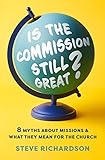
Is the Commission Still Great?: 8 Myths about Missions and What They Mean for the Church

Is the Commission Still Great?: 8 Myths about Missions and What They Mean for the Church

Moody Publishers

208 pages

$12.10

The words missions and missionary are in danger of genericide. When my parents first went to the field, missionaries were ministers of the gospel in a long-term, full-time, cross-cultural capacity, usually overseas. During my lifetime, Christians have started using the terms missions and missionaries in a less specific way. Some Christians now define missions broadly enough to include virtually any activity of the church, including ministering within local congregations, serving the poor, and fighting injustice.

A coworker told me about a missions class in which the teacher presented a list of Christian activities and asked people to raise their hands if they considered each one to be missions. The early examples involved cross-cultural ministry among unreached peoples, and everyone raised their hands. Further down he listed ministries closer to home, and some dropped out.

The last option was, “I take soup to my Christian next-door neighbor.” A few students still raised their hands. The teacher improvised, “What if I’m having devotions in my room by myself?” One man responded, “It depends. You might be reading the Book of Acts.” No one denies that taking soup to a believing neighbor is kind, but does this fit within the scope of discipling the peoples of the earth? Is being involved in missions really as simple as reading the Book of Acts?

Some churches now talk about being on mission or missional or use the term mission rather than missions. Does the vocabulary matter? It depends. If a word is archaic and no longer communicates the intended meaning, then it’s not worth preserving strictly for the sake of tradition.

The relevant question is whether broadening the term missions leads to increased engagement in the task of taking the gospel to every people group on earth. Does calling every Christian a missionary motivate us to pursue the Great Commission more diligently? Or does it dilute our focus? As language evolves, sometimes it’s worth fighting to preserve an ancient concept.

Taken from Is the Commission Still Great?: 8 Myths about Missions and What They Mean for the Church by Steve Richardson (©2022). Published by Moody Publishers. Used with permission.

Books

New & Noteworthy Books

Compiled by Matt Reynolds.

Imperfect Reflections: The Art of Christian Journaling

Kirsten Birkett (Christian Focus)

Before there were blogs, Substacks, or social media pages, people recorded their thoughts by hand, in journals. Lots still do, of course, and Kirsten Birkett, a writer and former lecturer at Oak Hill College in London, is among their number. In Imperfect Reflections, Birkett draws on the Puritan tradition to recommend journaling as a tool of spiritual growth. “I had … always been a little ashamed of my compulsive journaling,” she writes. “Having been awakened to the Puritan practice, however, I started to take [it] more seriously” and think “about the way in which it contributes to my growth in the Lord.”

The Gates of Hell: An Untold Story of Faith and Perseverance in the Early Soviet Union

Matthew Heise (Lexham Press)

The cover of Matthew Heise’s book features a grainy black-and-white photo commemorating the ordination of a Lutheran pastor in the summer after the Bolsheviks came to power in Russia. Heise, director of the Lutheran Heritage Foundation, notes that “within twelve years of this gathering,” both this pastor and his father, also a pastor, “would die in Soviet labor camps,” while “three of the other pastors in the photo … would walk the path to Golgotha that so many believers in Russia would travel.” The Gates of Hell recounts the faithfulness and fortitude of embattled Lutheran communities amid the terrors of Soviet persecution.

Necessary Christianity: What Jesus Shows We Must Be and Do

Claude R. Alexander Jr. (InterVarsity Press)

In the Gospels, Jesus tells us who, and what, he is: the Bread of Life, for instance, or the Light of the World. Statements like these capture the essence of the Good News. As Claude Alexander argues in Necessary Christianity, however, we’re apt to neglect the must statements that Scripture applies to Jesus or that Jesus applies to himself and, by extension, to his disciples. “The life to which the Christian is called is a life of necessity,” writes Alexander, senior pastor of The Park Church in Charlotte, North Carolina (and CT board member), whose chapters cover themes like focus, progress, direction, and diligence. “God calls the Christian to live with a sense of the necessary, the obliged, and the required.”

Books
Review

Christian Orthodoxy Is Your Ticket to a Land of Adventure

Playing in the fields of heresy and ambiguity might offer short-term kicks, but only sound doctrine can supply a lifetime of thrills.

Illustration by Paige Vickers

Over a century ago, G. K. Chesterton wrote his famous book Orthodoxy, a defense of plain, historic Christianity as the only compelling way to make sense of the world and its mysteries.

The Thrill of Orthodoxy: Rediscovering the Adventure of Christian Faith

The Thrill of Orthodoxy: Rediscovering the Adventure of Christian Faith

IVP

240 pages

$14.00

Trevin Wax stands firmly in Chesterton’s tradition with his new book, The Thrill of Orthodoxy: Rediscovering the Adventure of Christian Faith. Wax, a Southern Baptist whose wife hails from Romania, is a far cry from Chesterton’s Anglo-Catholicism. In his own way, however, he is attempting to emulate Chesterton’s defense of the truth and goodness of Christian orthodoxy for our own age.

Earlier this year, Wax came out with his own annotated edition of Chesterton’s classic, meant to introduce it to beginners while bringing fresh insights to longtime admirers. It makes sense, then, for Wax to plot his own path, showing why historical Christianity—what C. S. Lewis called “mere Christianity” and Thomas Oden called “consensual Christianity”—is the farthest thing from a relic of the past.

Digging down, not digging in

The book’s foreword, written by theologian Kevin Vanhoozer, is an elegant reminder that Christian orthodoxy is about realism—what is real and what is true. It is there to help believers stay true to their Lord Jesus Christ. Wax builds on this insight in his first chapter, arguing that defending the orthodox faith matters urgently today because we live in an age of fads, fabrications, and fragmentation.

Orthodoxy is what keeps us rooted in the faith, ensuring that we do not forget our first love. The spiritual malaise of our age needs to be cured, Wax says, with “confidence in the truth and goodness of the Christian faith.” By anchoring ourselves in the historical creeds and confessions of the church—which themselves are summaries of Scripture—we can stay true to the triune God. Such a faith, far from being dry and rigidly dogmatic, represents a kind of drama, to use language popularized by Vanhoozer. As Wax writes, committing to orthodoxy doesn’t mean “digging in,” but instead “digging down to the bedrock of our faith, so we can stand.”

The objection often comes, of course, that orthodoxy is a suffocating box—that it inhibits our ability to think and reflect for ourselves. As Wax argues, however, it is more like having a map to a land of adventure that one is free to explore. (To use a Doctor Who analogy, orthodoxy is like the Doctor’s TARDIS, in that it is much bigger on the inside than it appears on the outside.)

On the surface, maps and blueprints might not sound like the stuff of excitement, but their value comes in showing you how to get around, indicating what paths to take and what hazards to avoid. Playing around in the fields of ambiguity might feel like fun for a while, but eventually you want to reach your destination. You want to find that buried treasure.

Although certainty about the truth can puff up into arrogance, orthodox assurance does not require abandoning humility. As Wax comments, “The adventure of orthodoxy requires us to embark on the journey with humility, seeing religion not as something we construct, but as divine revelation we receive.”

He takes pains to illustrate that heresy, not orthodoxy, is ultimately narrow. Orthodoxy recognizes that truth is multifaceted and multidimensional, whereas heresies trade in either-or equations. Think of Arianism or Docetism, for instance, both of which question whether Jesus can be fully human and fully divine.

Christians are not religious pluralists, of course. We don’t regard Jesus as merely one of many paths up the mountain. But we do believe in the exclusive claims of an inclusive Savior—one who calls himself “the way, the truth, and the life” (John 14:6, CSB) but freely extends the gift of salvation to all who call upon his name.

If one complaint about Christian orthodoxy is that it shackles the intellect, another is that it overemphasizes what you believe relative to how you live. Wax warns against this unhelpful dichotomy between deeds and creeds, explaining that our beliefs and our actions go hand in hand. He points out that the bridge between doctrine and application is the person of Jesus. What one believes about him shapes how one lives for him.

This connection is part of what makes orthodoxy exhilarating rather than stifling. “Religion,” as Wax defines this general category, is about “a reward for achieving spiritual growth and excellence.” In contrast, “The Christian story is not about humanity ascending, but about God descending. The Son of God comes down the mountain to save us, for we cannot save ourselves.” Wax notes that orthodoxy stretches beyond beliefs to include habits, behaviors, pieties, and ethics. We can’t separate it from keeping Jesus’ commands—which we can do only with God’s enablement. As Wax writes, “Grace changes. Grace empowers. Graces makes us new. This is the challenge of orthodoxy.”

Wax provides several examples of how people can find themselves drifting away from God, perhaps without realizing it. Sometimes this results from just going through the motions. On other occasions, believers are anxious about being on the wrong side of the culture. Often enough, the culprit is nothing more than simple apathy. This is understandable, given that so many doctrinal disputes can seem arcane and irrelevant. Even so, we distinguish between orthodoxy and heresy because the dangers of heresy are real! There are positions that need to be affirmed and positions that need to be rejected.

Whatever the reasons for drift, Wax says, we need to develop habits of swimming against the currents of culture (at least some of the time) and embracing a more lasting passion for the gospel. Orthodoxy means being moored to something tested, tried, and true, rather than drifting downstream with whatever currents wash over us.

Furthermore, it means resisting the twin temptations of accommodation and retreat. The first option seeks to make Christian truth palatable to the spirit of the age. The problem, as one popular saying has it, is that if you marry the spirit of one age, you’ll be a widow in the next. The second option, huddling inside a fortress of the holy, is equally objectionable, because it chooses purity over unity and preservation over mission. Christianity might declare itself against certain things, but always for the sake of the world it seeks to reach with the Good News.

By far the most stimulating part of the book is chapter 9, where Wax explains how orthodoxy is unchanging yet flexible. Orthodoxy is not an end in itself, and it’s possible for doctrine, however essential, to become an idol. Addressing our post-Christian age, Wax warns against adopting a righteous-remnant mentality, where we cast ourselves as the faithful few. Even as we hold to “the faith that was once for all delivered to the saints” (Jude 1:3, ESV), we live in the modern world, which calls for a posture of semper reformanda, or “always reforming.”

One theme Wax highlights here—one that more Americans could stand to heed—is the importance of seeing ourselves as connected to the global church. “The beating heart of orthodoxy,” he writes, in a passage worth the price of the book itself, “is not a personal adventure of self-discovery, a patching together of our preferred versions of the Christian faith. It is the connection to saints in various cultures and climates, with different languages, and traditions, all united by a common confession in Jesus Christ, the king.”

A final chapter concerns the future of orthodoxy. The churches that will survive and thrive in the future, Wax argues, are those that actively connect our doctrine with our sense of wonder. Heresy might offer some short-time kicks, but only orthodoxy can promise a lifetime of thrills.

Streams of renewal

Wax’s book is a timely word of encouragement in an age when, all too often, social media and news programs do more to form Christians than the church’s historic teaching or even the Bible. The temptation is to abandon religion as dull and dogmatic or to exploit Christianity as capital for one’s political beliefs. Wax calls us to put aside the godless seductions and idolatries of this age. He writes, “The future of the church belongs to those who want to scale the mountain, who yearn to become more like Christ, who rely on the Spirit for salvation and sanctification, as we were made anew into the image of the one who saved us. The future of the church depends on the thrill of orthodoxy.”

As an Australian theologian viewing American evangelicalism from the outside, I can only think of a few books I would view as must-reads for American churches, but The Thrill of Orthdoxy is definitely one of them. Wax presents a great case for orthodoxy over politics, orthodoxy against heresy, orthodoxy for our spiritual nourishment, orthodoxy for the benefit of the world, and orthodoxy for the glory of God.

In our time, deconstructing faith is a big, sexy trend, and Christian nationalism is making a comeback. As an antidote to those temptations, I hope Wax’s celebration of historic orthodoxy gets a wide hearing. What we need most is not continuing culture wars over vaccines, critical race theory, and the like. It isn’t pastors using their pulpits to audition for Fox News pundit gigs, or exvangelical celebrities complaining on TikTok about Christians who unapologetically treat Christinaity as superior to other faiths. No, what we need most is returning to authentic worship of Jesus Christ. American churches will find streams of spiritual renewal only through recovering the gospel and its embodiment in the orthodox faith of the one holy, catholic, and apostolic church.

Michael F. Bird is academic dean and lecturer in New Testament at Ridley College in Melbourne. He is the author of Religious Freedom in a Secular Age: A Christian Case for Liberty, Equality, and Secular Government.

Books
Review

The World’s Logic Says Diversity Begets Division. Gospel Logic Says Otherwise.

Why the pursuit of unity isn’t as hopeless as it sometimes seems.

Illustration by Rick Szuecs / Source Image: Angelina Bambina / Getty

For what has felt like forever, division has been a common experience for our families, neighborhoods, churches, and nation. This insight is so familiar that we might be tempted to retire it as a cliché.

Uncommon Unity: Wisdom for the Church in an Age of Division

Uncommon Unity: Wisdom for the Church in an Age of Division

Lexham Press

288 pages

$18.32

Except we can’t, because we’ve been through too many painful ruptures to ignore: friends ghosting us without warning, church members leaving for every reason and no reason at all, news of wars far away, and whispers of civil wars near to home.

The deep differences of our cultural moment stir questions in our hearts: Is division the inevitable result of difference and diversity? And if the church is divided, what hope is there for unity in the world?

Theologian Richard Lints tackles such questions in his new volume, Uncommon Unity: Wisdom for the Church in an Age of Division. His book is a cord with three strands. Part 1 (chapters 1–4) narrates the stories of our diverse and divided culture. Part 2 (chapters 5–8) offers resources for pursuing unity with Christian faithfulness. And part 3 (chapters 9–10) helps form a contextualized wisdom for the present and the future.

Lints begins by surveying the different stories we tell about our culture and its history. He describes, for example, how the seeds of both inclusion and exclusion have been planted in the soil of American democracy. I found this helpful for navigating a culture divided between telling the American story as a 1619 exclusion narrative (rooted in the enslavement and subjugation of African Americans) or a 1776 inclusion narrative (rooted in the universalism of the Declaration of Independence). The church’s possession of a gospel that both includes and excludes frees us from picking a team. It allows us to believe and tell the whole truth about our culture.

Lints rightly shows that, in our current moment, the “cultural cover” of Christendom is crumbling. Rather than trying to rebuild this cover or retreating from cultural engagement, we must recover the grace and hospitality of the gospel’s narrative of inclusion.

For those like me, who are still dizzied by evangelicals warmly embracing Christian nationalism over the past half decade, Lints reassures us that we are not crazy. Advocating a new Christian nationalism or Christendom misunderstands both the story of our culture and the story of the Bible.

Instead, the church might find that its diverse, pluralist context provides promise for the pursuit of unity. While illogical to the world, this opportunity makes sense in light of what 20th-century missiologist Lesslie Newbigin calls “the logic of the gospel”—a gospel in which God welcomes estranged others as forgiven friends. Lints stands ably on Newbigin’s shoulders, continuing his pursuit of a mission-shaped church and a church-shaped mission suited to the cultural realities of the post-Christian West.

The church needs resources for this mission, and Lints points toward biblical teaching in two critical places. First, he highlights Scripture’s understanding of humanity, which allows us to wrestle with how race, ethnicity, gender, and sexuality shape our personal identities without defining them to the core. As Lints explains, we can’t treat complex human beings purely as members of identity groups or as atomized individuals. The Bible, instead, treats us as individual persons formed by God in relationship with him and others. Remove individual identity or relational identity, and you corrupt the biblical doctrine of the image of God.

Second, Lints points to biblical teaching on God himself—specifically his Trinitarian nature. This is an idea with clear implications for pursuing unity amid diversity. I do, however, have some reservations with how Lints handles it. He wisely warns against projecting created reality and human relationships onto the utterly unique God who is Father, Son, and Holy Spirit. That said, his discussion on the Trinity’s relationship to created unity and diversity seems to approvingly cite theologians like Stanley Grenz and Miroslav Volf, who advance a relational model of the Trinity. Relational Trinitarianism revises the classic understanding, viewing the three divine persons as individuals who relate to one another in a divine community. This move can risk compromising the doctrine of God’s singular being.

This difference aside, Lints rightly points us away from superficial unity and counsels us to walk in the tension of wisdom. We can’t whip up such wisdom in a microwave. We must inhabit the world of the Word in a slow simmer, so that we can better interpret the world by the gospel’s logic. Such logic must live and move and have its being in union and communion with the one true and living God, made man in the person of Jesus Christ.

Lints admits that “a work both defending and describing the unity of the church may seem a hopeless task.” Yet he reminds us that the gospel offers the church both unshakeable conviction and contextual flexibility. In other words, it gives us a backbone, helping us stand tall on core truths while allowing us to bend on nonessentials. In this gospel, God welcomes strangers and forgives enemies. As the church receives God’s welcome and forgiveness, it offers those to the fragmented world around it.

Here, I want to connect Lints’s discussion to the concept of the church’s pluriformity, a term used by Abraham Kuyper to describe how various traditions and denominations can coexist within the universal church. I think this concept can help us understand how the local church, in its unity and diversity, might witness to a diverse world in a credible way.

Ultimately, Lints’s book affirms that church unity is both a present reality and a future hope. On God’s eschatological timeline, unity fits into the category of “already but not yet.” The church is already one in union with Christ. Yet the church will not fully be one until Christ returns—when, seeing him as he is, we will be fully like him.

In the meantime, we can walk in wisdom, pursuing unity amid difference and division. In fact, our longings for unity may themselves represent essential first steps. As Lints writes, “It is important to remember that we were created for the experience of unity-in-difference, and that our yearnings for it are themselves pointers in the right direction.” Uncommon Unity helps us walk further down the path that God has appointed.

Danny Slavich is pastor of Cross United Church in South Florida. He is an adjunct professor at Trinity International University-Florida.

Books

Tell Me Your Beliefs on Sex Without Telling Me Your Beliefs on Sex

Over time, our embodied lives reliably reveal the stories and myths that shape us.

Illustration by Rick Szuecs / Source Images:Envato Elements

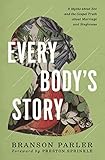
On sexual ethics, Christians and their secular neighbors tend to hold markedly different views. But these differences can obscure how both groups are living according to stories and myths about the meaning and purpose of human bodies—often without knowing it. In Every Body’s Story: 6 Myths about Sex and the Gospel Truth about Marriage and Singleness, Branson Parler examines the myths most influential outside the church (individualism, romance, materialism) and within it (anti-body theology, legalism, and the sexual prosperity gospel).

Every Body's Story: 6 Myths About Sex and the Gospel Truth About Marriage and Singleness

Every Body's Story: 6 Myths About Sex and the Gospel Truth About Marriage and Singleness

Zondervan

256 pages

$12.71

Writer and campus minister Rachel Gilson spoke with Parler—director of theological education at The Foundry, a ministry based in Grand Rapids, Michigan—about the relationship between our bodies and the central truths of the gospel.

Your title raises a question: How does a body tell a story?

Every story entails an embodied way of life. Bodies point, through what they do, to the larger story they’re part of. So if I really want to understand what you’re believing in your bones, then I’ll look at what you’re doing with your body. Work, rest, money, greed, sex—we tend to see these things as disconnected pieces rather than woven together in a single story.

It’s easy to talk about what we believe with our minds. It’s trickier to discern how the way I’m living reveals my deepest beliefs about the good life. With rhythms of work and rest, or Sabbath, for instance, it’s one thing to say I believe God will take care of me. It’s quite another to actually cease doing work.

Many of us are unintentional about the story we’re telling. But if you watch someone over the days, weeks, and months, you’ll see that story more clearly.

You address secular and Christian myths about the body. What inspired you to include myths that influence both sides?

On the one hand, it comes from wanting to help myself, my students, and my church to understand our own culture. We need to be aware of the stories that shape and form us, and these are especially difficult to identify in one’s own culture, because they have a taken-for-granted quality. As Christians, we can be too quick to think, Well, secular culture is living out problematic stories, but the church has it right.

Especially when it comes to questions around sex, bodies, marriage, and singleness, most people like me—who grew up in the church during the purity-culture years—only heard a theology of “No,” and never the “Yes” of self-giving love the gospel offers. So we can acknowledge that the broader culture falls short of the gospel, but we also need to see where our church culture falls short as well.

After researching and writing the book, which myth do you think American evangelicals are mostly likely to believe and to propagate?

I would say the myth of legalism, this idea that we’re justified not by grace but through our own good behavior. Maybe this is shifting, but I’m guessing that many churches still operate on the model of “behave, believe, belong,” in that order. In other words, the first thing we look for in prospective members is whether they have their act together, at least with respect to the things we consider important.

Because of this behave-first model, we don’t always know how to engage with folks who, in an increasingly secular culture, are likely to receive the call to behave as oppressive. We end up drawing unhelpful lines between insiders and outsiders. Legalism ends up being a hinge for the other myths, because if you fall for that one, then it cascades into falling for all the others.

Why would you ever feel the need to write, not once but twice, that “Jesus has a penis”?

[Laughing] Does that seem excessive? We don’t take our own bodies seriously because we don’t take Jesus’ body as seriously as we should. In the book, I talk about how we’re saved through the sexed, gendered body of Jesus. This shows me that God doesn’t stand back from his creation but instead takes on humanity, which means having a body. And I was trying to make that idea sound as scandalous to today’s good Christians as it was when it was first preached in the ancient world.

The New Testament says the Word became flesh in Christ. We can sometimes have this intellectual distance from that reality, which causes us to underestimate God’s involvement with the world. With my students, I’ve pointed out that Jesus passed gas, and they’re always unsure how to respond, because that doesn’t fit with their imagery of Jesus. I’m trying to find ways to remind people that God’s Word is strange, and possibly the strangest thing about the Word is that the Word became flesh.

As Christians today, what is the body question we should be thinking about more often?

I hesitate to mention this one, but I think that when we’re asking what our bodies are for, and what is sex for, we need to think more about reproductive technology and contraception. As with some other questions, people tend to think of these as isolated ethical issues, but they reveal an underlying story.

And I don’t want to make anyone feel guilty about choices they’ve made. In fact, one reason I started thinking about these questions more deeply was because of my journey with fatherhood. But people tend to think of vasectomies or contraception as personal decisions instead of asking what they say about the nature of our bodies or the nature of reality. I don’t want to bind anyone’s conscience. But your conscience does need to be bound by Scripture and Christian community, as opposed to saying, “I have two kids, and any more just seems like a hassle.”

You often point to the importance of singleness alongside marriage. Why?

We have sometimes been very unbiblical in our approach to singleness. We haven’t taken Paul or Jesus seriously enough. Singleness makes sense in our story because the church is the household of God, and God’s family is our first family. Marriage is not ultimate. We are all primarily members of the body of Christ. We are to love each other as siblings, to make vows to each other, to live life together. That is for all disciples, and no one is second class based on marital status. We need to recover belonging to each other more fully. Singleness has loneliness, and marriage has loneliness—but none of us in Christ is truly alone.

What’s your deepest hope for this book?

My hope is for people to see the connection between the good news of the gospel and what we do with our bodies. Our Christian subculture has run through purity culture, the sexual prosperity gospel, and anti-body theology, and we’ve seen where those ideas lead. We’ve hit, I hope, a God-ordained dead end.

But I think secular culture is also realizing that its own stories aren’t holding up either. One recent book, Christine Emba’s Rethinking Sex, looks at this dynamic, saying that we’re freer than we’ve ever been and we’re also miserable. So my hope is that this book helps Christians live and tell the gospel such that other people feel the force of it, even if they end up rejecting it. We want other people to see the “Yes” of the gospel, because that’s what draws us. Only toddlers can live on a diet of “No,” and we are stuck in a lower stage of development if that’s the only way we can talk about these things.

News

More Evangelical Women Have Had Sex With Women Than You Might Think

A study shows an increase in reports of LGBT experience, identity, and affirmation.

Getty / Nick Dolding

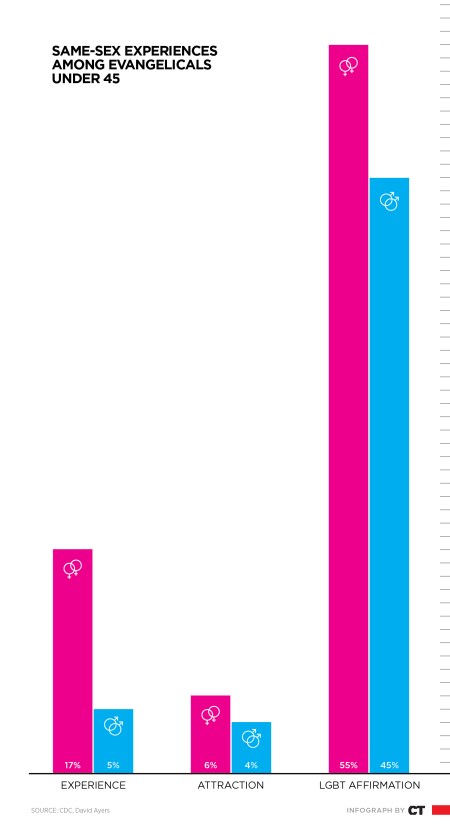
Seventeen percent of evangelical women between the ages of 15 and 44 have had sex with another woman, according to data gathered by the Centers for Disease Control and Prevention (CDC) and analyzed by Grove City College sociology professor David Ayers. Among evangelical men, the percentage who’ve had sex with other men hovers around 5 percent.

Changing attitudes toward same-sex relationships—in the US generally and among older and younger evangelicals specifically—have been well documented. The same-sex experiences and orientation of younger evangelicals, however, have not been widely reported.

The CDC surveyed about 11,300 people about sex, sexual health, and attitudes and preferences. More than 1,800 of those people were evangelical, as defined by their denominational affiliation. Looking at that subset, Ayers, the author of After the Revolution: Sex and the Single Evangelical, was able to determine that roughly 1 percent of evangelical women identify as lesbian and about 5 percent say they are bisexual. Among evangelical girls aged 15 to 17, more than 10 percent identify as bi.

“Why are so many younger evangelical females today open to sex with other women?” Ayers asks in American Reformer. “The simple biblical teaching that all sex outside of marriage between one man and one woman is sinful is hardly secret or subtle. … And yet, among younger people especially, it has been quite a few years since biblical beliefs and practices have been the norm among evangelicals.”

Infograph by Christianity Today
News

Billy Graham Gets State-of-the-Art Archive

A new research facility gathers the full documentary record of the evangelist’s life work to make the case for his continued relevance.

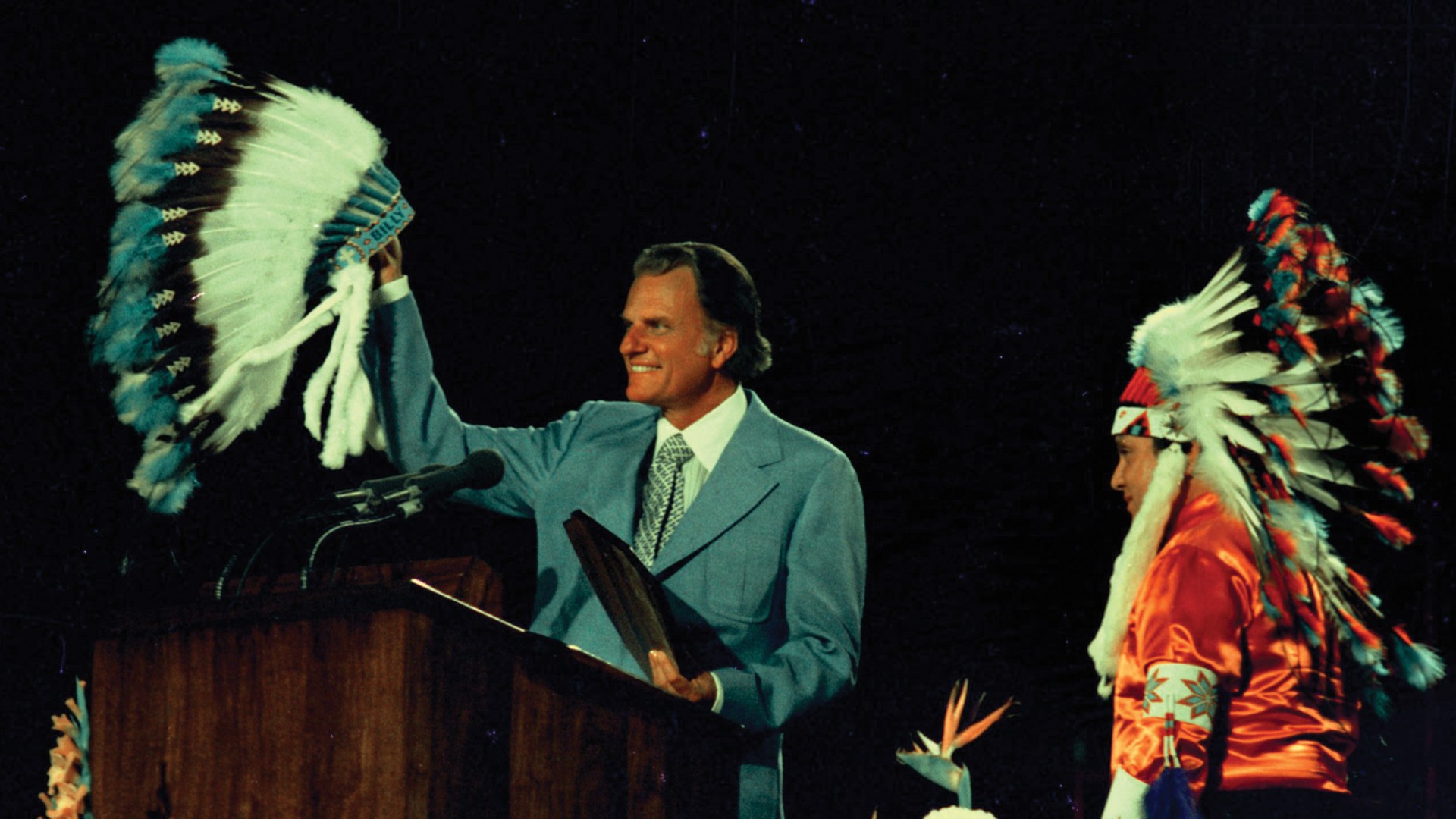
Gifts Billy Graham received, like this Native American headdress, are now collected in Charlotte, North Carolina.

Gifts Billy Graham received, like this Native American headdress, are now collected in Charlotte, North Carolina.

Courtesy of the Billy Graham Archives

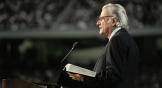
When he watched Billy Graham preach, David Bruce couldn’t help but think of history.

As executive assistant to the famous evangelist, it wasn’t Bruce’s job to think about the distant future—Graham’s legacy, how he would be remembered after he died, how the evidence of his life’s work would be maintained—but he thought about it all the time. Each word and moment seemed so significant that it needed to be preserved.

“When he finished preaching, I would come behind him and gather the pages of his sermon,” Bruce recalled this summer, four years after Graham’s death. “He was not thinking of that. But I could see the call of God on his life and all the history he touched.”

Today, Bruce oversees a state-of-the-art monument to the preservation of that history: a 30,000-square-foot, $12 million archive. It will open on November 7, Graham’s birthday.

A well-lit research room sits quietly on the first floor of the building. It was constructed in consultation with archival design specialist Michele Pacifico and now waits for historians to come and ask for boxes and files. Upstairs, in a carefully climate-controlled room, industrial shelves hold thousands of acid-free archival containers, each with hundreds of papers. Another room houses oversized items, from a pair of gifted lederhosen to Graham’s traveling pulpit.

Graham was given many gifts at his crusades, including this ceremonial headdress from Christian Hope Indian Eskimo Fellowship during a crusade in Arizona.Courtesy of the Billy Graham Archives
Graham was given many gifts at his crusades, including this ceremonial headdress from Christian Hope Indian Eskimo Fellowship during a crusade in Arizona.

The Charlotte, North Carolina, research facility, located across the road from the Billy Graham Library museum, gathers for the first time the full documentary record of Graham’s life and work in one place. The archives that were loaned to the Billy Graham Center at Wheaton College will be combined with the hundreds and hundreds of boxes that remained at Graham’s home office in Montreat, North Carolina, and additional material from his ministry’s former offices in Minneapolis and in storage in Charlotte.

“We’re really trying to make everything as accessible as possible,” said archivist Lindsay Elliott, who previously worked at Jimmy Carter’s presidential museum in Atlanta. “We want to offer the full breadth of his ministry, from the material at Montreat to the productions of World Wide Pictures. We’re describing and classifying everything. We want to look at the entirety of it.”

When plans for the new archives were announced in 2019, a year after Graham died, professional historians expressed deep concern. They worried the Billy Graham Evangelistic Association (BGEA) might not care for the material as well as the professionals at Wheaton and—more upsetting—that the BGEA might sharply limit access.

Private collections sometimes prioritize the preservation of a reputation over open scholarship. This is especially true when the holdings are overseen by family or close associates. They may vet researchers, denying access to those they deem too critical. They may keep sensitive documents out of sight.

Elliott and Bruce, however, say the Billy Graham archives will be open to all scholars, students, and researchers and will be run professionally.

Graham’s legacy is contested in 21st-century scholarship. Some see him as an example of the best of evangelicalism and want to measure others against him. They point out how he was irenic, inclusive, pragmatic, and focused on Jesus. They say he made mistakes and did some reprehensible things but learned from them and was humble enough to actually apologize.

“Graham was not a marble statue,” biographer Grant Wacker writes in the introduction to America’s Pastor, “and he was the first to say so.”

Other historians argue a more careful examination of the record shows Graham participated in the worst parts of evangelicalism and he’s just been given a pass. They’ve called for a more critical look at his involvement in American politics, his positions on race (including antisemitic statements recorded in conversation with Richard Nixon), and his views on women.

There’s a popular struggle over the meaning of Graham, too. As political issues have raised the temperature of internal evangelical debates, people on both sides have appealed to Graham’s memory. Some of his grandchildren, for example, used his legacy to critique support for Donald Trump. But eldest son and BGEA president Franklin Graham said the evangelist voted for Trump in 2016 and believed he was “the man for this hour.”

The archive and research center isn’t designed to settle contests over Graham’s legacy. It will not fix the evangelist’s reputation in time. It’s built, instead, to contest time.

In his own lifetime, Graham was famous and frequently named one of the most respected men in America. When people thought about what it meant to be an evangelical Christian, they thought of him.

While many conservative Christians were suspicious of films, Graham saw their potential power. The Western “Mr. Texas,” the first produced by the evangelist’s film company, came out in 1951.Courtesy of the Billy Graham Archives
While many conservative Christians were suspicious of films, Graham saw their potential power. The Western “Mr. Texas,” the first produced by the evangelist’s film company, came out in 1951.

But famous evangelists fade from memory quickly. Billy Sunday is not a household name anymore, even among evangelicals. He preached to an estimated 100 million people, but his museum, located in Winona Lake, Indiana, has struggled to stay open. The ephemera of Charles Finney’s life and work—including pieces of his revival tent and a phrenological chart of his head—are kept in 12 or 13 boxes at Oberlin College in Ohio.

In Charlotte, though, archivists on Elliott’s team will prepare fresh, new exhibits for the neighboring museum across the road. Since it opened 15 years ago, the Billy Graham Library has welcomed more than 1.7 million visitors, including those who attended Graham’s funeral in 2018. Tripadvisor ranks it the No. 1 thing to do in Charlotte, with more than 80 percent of visitors giving it five out of five stars.

In another room of the archive, audio-visual archivist David Eades will oversee the production of 10 to 25 “Billy Graham TV Classics” to air on TBN and stream on Roku and Amazon Prime. Old crusades with old altar calls will be given another chance to reach people, and Eades and his team will also look for ways to make Graham’s life and message relevant to current events. In September, a new special on Graham’s relationship with Queen Elizabeth II aired across the US and the British Commonwealth.

This isn’t just nostalgia, Bruce insists. It’s not history for history’s sake either.

“Mr. Graham wouldn’t have approved of any of this unless it could be used to further the gospel,” he said. “I hope that people see the work of God in his life, and then all the history he touched, and it can encourage people to reflect on the living, breathing Word of God.”

Daniel Silliman is news editor for Christianity Today.

News

‘Our Father Who Art in Heaven’ Evidence of Russian Torture

And other news briefs from Christians around the world.

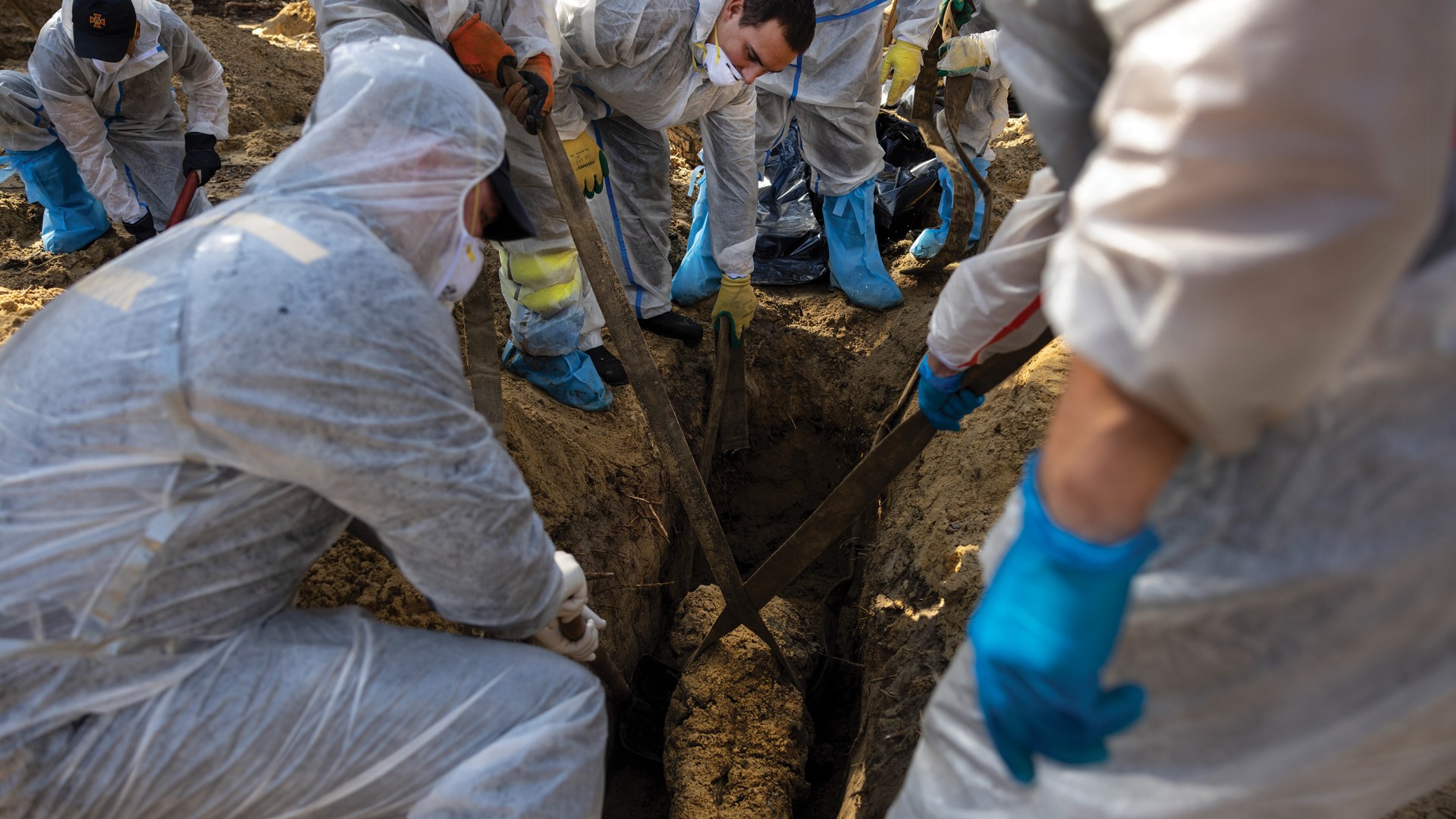
Rescue workers and forensic police exhume bodies from unidentified graves in Izium, Ukraine

Rescue workers and forensic police exhume bodies from unidentified graves in Izium, Ukraine

Getty / Paula Bronstein

Ukrainian authorities say they have uncovered evidence of war crimes in the city of Izyum, which was occupied by Russian forces from April to September. The evidence includes mass graves, bodies buried with their hands tied behind their backs, dead children, and corpses bearing the marks of torture. In one of ten sites the Ukrainians have identified as torture chambers, an unknown prisoner scratched the Lord’s Prayer onto a stone wall in Russian. Vladimir Putin has justified the invasion of Ukraine by saying Russian speakers need to be rescued from ethnic cleansing. But there is no evidence they were being killed or tortured before the invasion. Ukrainian forces strarted retaking territory in the eastern part of the country in September.

United Kingdom: Tammy Faye hits London stage

A new musical dramatizing the life of evangelical television star Tammy Faye Bakker has launched in London. The score was written by pop superstar and gay icon Elton John. Bakker, who died in 2007, was a popular televangelist whose career came crashing down when her husband was caught in a sex scandal and sent to prison for financial fraud. She went on to host her own talk show, craft an alternative approach to the presentation of Christianity on TV, and become a hero in the LGBT community for the compassion she showed during the AIDS epidemic. A movie about her life won an Oscar in 2021.

Tunisia: Constitution raises concerns

Christians are concerned about a new constitution approved in July that gives the president dramatically increased power and declares that the nation “belongs to the Islamic ummah,” or community, and must work toward “the goals of pure Islam.” President Kais Saied had previously promised to remove references to Islam in his revision of the document. The new constitution was drafted behind closed doors and rolls back many of the democratic reforms that were put in place after the Arab Spring revolution in 2011. According to Open Doors, less than 0.2 percent of the Tunisian population is Christian.

Infograph by Christianity Today

Zimbabwe: African Methodists condemn division

A group of Methodist bishops meeting in Zimbabwe released a statement condemning the American traditionalists who seek to split the United Methodist Church. The African bishops side with the American conservatives in the ongoing debate about LGBT affirmation, but that doesn’t mean they’re eager for division. “Unity is our constant point of reference,” said Eben K. Nhiwatiwa, president of the Africa College of Bishops. The Global Methodist Church launched in May after another meeting to discuss division was delayed. The architects of the new denomination have frequently said they expected African Methodists to join them, making Global Methodists the larger denomination. Some traditionalists questioned whether all the African bishops endorsed the unity statement.

Israel: Red heifers brought from Texas

A Texas man has delivered five red heifers to four Israeli rabbis so the young cows can be slaughtered and burned to produce the ash necessary for a ritual purification prescribed in Numbers 19:2–3. Some Jews believe the ritual is a step toward the reconstruction of the temple in Jerusalem. Some Christians believe that “third temple” will set the stage for the Antichrist.

India: Government to verify attacks

The Indian Supreme Court has ordered the Ministry of Home Affairs to investigate the persecution of Christians in eight states. Evangelical and Catholic groups have asked for government protection in Bihar, Haryana, Chhattisgarh, Jharkhand, Odisha, Karnataka, Madhya Pradesh, and Uttar Pradesh. They say there were 200 attacks on Christians in the first five months of 2022, but government officials have said the reports were based on “half-baked and self-serving facts and self-serving articles.” The high court told the ministry to check preliminary police reports, the status of investigations, and information on any arrests or prosecutions.

New Zealand: Pandemic restrictions for churches upheld

The Supreme Court of New Zealand has ruled that COVID-19 pandemic restrictions on churches did not violate religious freedom. The government’s director-general of health deemed religious gatherings “high risk” and limited gatherings to 100 people with proof of vaccination or 25 without. Twenty-four Christian pastors and one Muslim imam sued, claiming discrimination and violation of the New Zealand Bill of Rights Act.

El Salvador: Evangelicals object to VP’s slander

The Evangelical Alliance of El Salvador has asked for an apology after vice president Félix Ulloa claimed without evidence that 80 percent of pastors are gang members. Clergy had been criticizing the administration’s harsh antigang policies. The government declared a state of emergency because of gang violence in March and by July had detained more than 43,000 people, many of them arrested without warrants and held without charges. Some, swept up in what critics call an indiscriminate dragnet, were just poor and young. Some were former gang members who now attend church. Experts say gang suppression is less effective than building trustworthy democratic institutions.

Paraguay: Mennonite runs for president

A former Mennonite pastor who was raised in a Mennonite colony has announced he is running for president. Arnoldo Wiens has been the country’s minister of public works since 2018. He oversaw the construction of the first section of a 300-mile international highway that is supposed to connect Paraguay with Argentina, Brazil, and Chile. Corruption is likely to be a major issue in the race and has troubled Wiens’s political party. His doctoral dissertation in theology was titled “Christian Faith and Challenges of Corruption in Latin America.”

Testimony

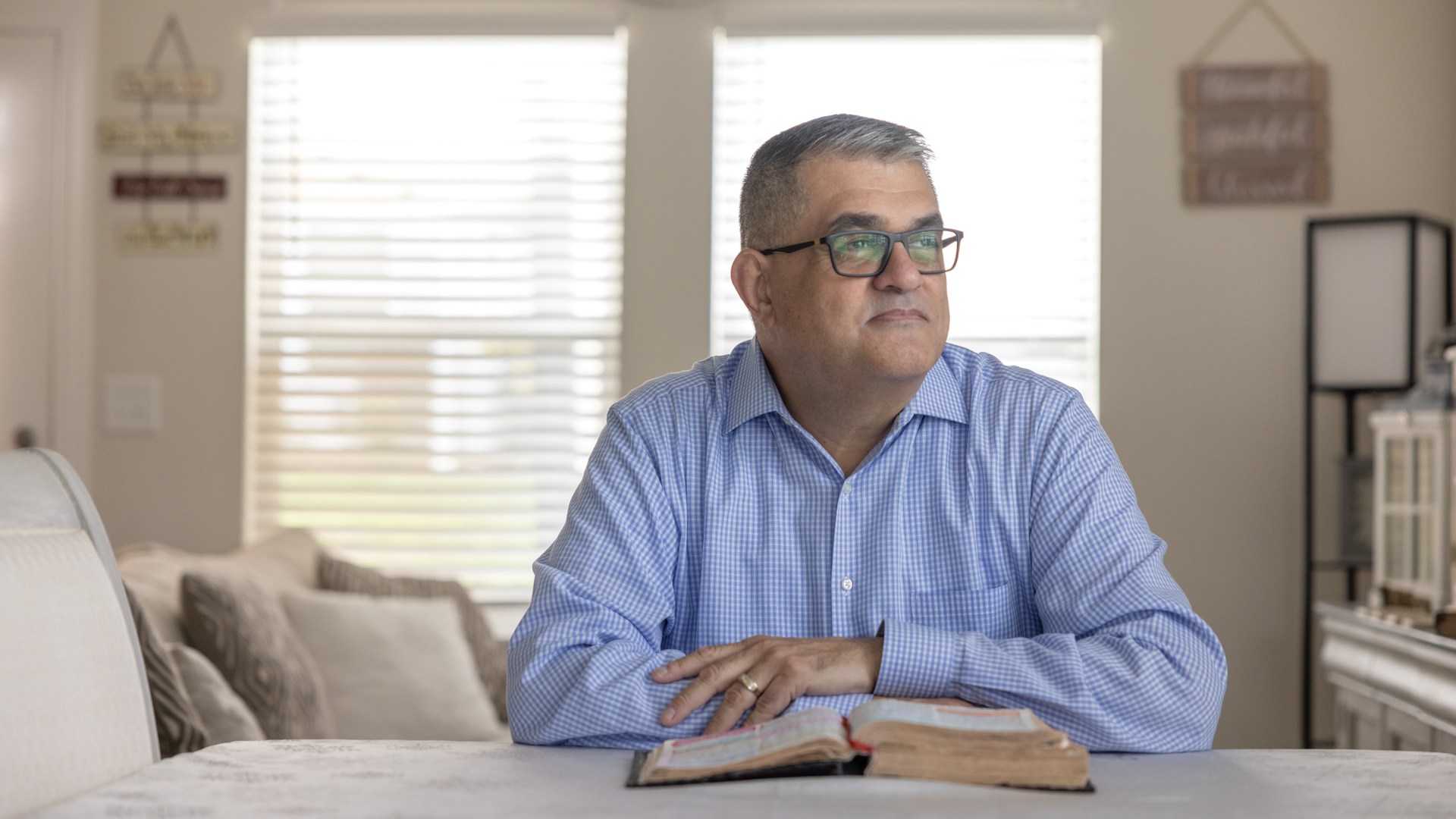
I Untied My Noose and Took Up My Cross

A serious drug arrest had darkened my horizon. But a sweet, soft voice whispered words of hope.

Photography by Hollis Bennett for Christianity Today

It was March 13, 1986, a snowy Thursday night. I was all alone and getting high. But I had also gotten drunk on fantasies of somehow becoming a drug kingpin at age 18.

Earlier that night, I had left my brother’s house in Newburgh, New York, to deliver 4.5 ounces of cocaine to one of his customers. I hadn’t noticed the headlight out on Dad’s pristine red 1978 Plymouth Volare, but the New York state trooper sure did. After pulling me over, he also noticed that I was driving under the influence, not to mention the lump protruding from the left pocket of my leather jacket.

I was young and naive, clueless about what lay ahead. But the stark reality caught up with me later as I sat in a cold cell at the Orange County Jail in Goshen, New York, where I wrapped a bed sheet from an old cot around my neck and began tightening it. Death seemed like the only way out of this mess. I was trapped. Hopeless. Finished.

As the sheet got tighter, the world started fading away. But just before succumbing to the darkness, I heard a voice in my native Spanish: “Eduardo, no lo hagas. Hay esperanza para tu vida.” (“Eduardo, don’t do it. There is hope for your life.”)

That sweet, soft voice saved my life that day—and has changed it every day since.

Drugs, disco, girls

I was born in Uruguay, but my parents moved to Queens soon after. We lived there for a few years before they got divorced. At age five, I went to live with my mom’s parents back in Uruguay, where I experienced feelings of loneliness and hopelessness. From attending a new school to speaking a new language to navigating an unfamiliar culture, everything was changing at a disorienting pace.

Mom rejoined me two years later. She was a very hard worker and constantly showered me with gifts. But what I wanted most from her—affection—was something she didn’t know how to give. I suppose my presence was a tangible reminder of a painful season in her life.

Meanwhile, Dad remarried in New York, and we would sometimes talk on the phone. About ten years later, he paid me a visit while taking a summer vacation in Uruguay. Reconnecting with Dad rekindled my love for the United States, and when I turned 16, I went to live with him in Brooklyn.

Being a young man in the big city was exciting on its own, and that was before meeting my much older brother, Danny, whose existence had been unknown to me. Danny had the life any teenage boy would envy: cars, clothes, money, women. And soon enough, I began tasting small samples of that life myself.

I will never forget stumbling into my brother’s office at the disco he owned and seeing large plastic bags of white powder being weighed and packaged with brown tape. Danny introduced me to marijuana, but that high just wasn’t enough. Before long, I tried my first hit of cocaine. From there, it was drugs, disco, and girls—rinse and repeat. I was hooked on the whole lifestyle—the very lifestyle that led me to jail and to the brink of suicide.

But even at the darkest moment, God’s plan was already unfolding. After hearing the voice that stopped me from killing myself, I said, “God, if that’s really you, please help me.”

I was facing a sentence of 15 years to life in prison, and I didn’t know what to do, but the voice brought a certain peace of mind. When a guard gave me a Bible, I started reading the Gospels, and I was captivated by the stories of Jesus—how he would speak to people in great need and meet those needs in miraculous ways. But the verse that made the deepest impression was 2 Corinthians 5:17, where Paul promises that “if anyone is in Christ, the new creation has come: The old has gone, the new is here!”

Soon, I was invited to a church meeting in the jail’s gymnasium. On a Monday night, a volunteer hugged me and told me that not only did God love me, but he did too. I had forgotten what it felt like to be hugged. That very night, October 6, 1986, I surrendered to the love of Christ, accepting his offer to be my Lord and Savior.

In a sequence of seemingly miraculous events, my sentence was reduced and I became eligible for parole after just three years. Meanwhile, I continued growing closer to Christ. I was a new man in every way. I went from being filled with rebellious thoughts to appreciating the gift of life, no matter the circumstances. With the aid of numerous chaplains and Christian volunteers, I overcame hatred toward my father and brother and learned to forgive them. In the Spirit’s power, I battled to rid myself of foul language and break addictions to pornography and masturbation.

In March 1989, my release date finally arrived. But instead of walking out of prison a free man, immigration officers took me into custody. Three weeks later, I was deported back to Uruguay and banned from returning.

But I was determined, over the next 21 years, to do just that, because I knew I would always be a debtor to America. There were so many people there who shared the love of Jesus with a kid who was completely lost.

As the years passed, I attended Bible college and began preaching. I met my wife, Sandra, and started a family. But the desire to return to America only intensified, even as the US Embassy in Uruguay denied my requests over and over again.

Summing up those two decades of trying, failing, waiting, and failing again in a few sentences doesn’t do it justice. It was grueling, and many times I was upset, frustrated, and worried that all my efforts were made in vain. But God remained faithful even when my spirits flagged. Finally, after writing an extensive letter to Eric Holder, the US attorney general at the time, I received a call from the embassy informing me that a pardon from the State Department had been granted and my tourist visa had been approved.

The larger redemption

I returned to the United States in 2010, connecting with a church near Nashville. In 2012, this church hired me as the pastor of an on-campus Hispanic church. Things were not always easy in these early days as my family adjusted to our new life in America. As the first few years passed, I worked several different jobs, but my heart was always drawn back to those behind prison walls, who are so often forgotten.

I began volunteering and sharing my story with prisoners in county jails and state prisons. Over time, the Tennessee Department of Correction hired me to serve as psychiatric chaplain in a maximum-security prison. Joy filled my heart with each conversation, hug, and promise of hope in Christ that I was blessed to share.

Last January, God finally granted my fervent wish for full US citizenship. But this part of my story is only one piece of the larger redemption he has worked in my life. That sweet voice that cared enough to whisper encouragement into my prison cell still cares deeply for me now. Life has not been easy, but I have tasted and seen that the Lord is good, even to those who make terrible mistakes like mine.

Eduardo F. Rocha is a corporate chaplain for Charter Construction in Tennessee and a military chaplain for the Tennessee State Guard.

Apple PodcastsDown ArrowDown ArrowDown Arrowarrow_left_altLeft ArrowLeft ArrowRight ArrowRight ArrowRight Arrowarrow_up_altUp ArrowUp ArrowAvailable at Amazoncaret-downCloseCloseEmailEmailExpandExpandExternalExternalFacebookfacebook-squareGiftGiftGooglegoogleGoogle KeephamburgerInstagraminstagram-squareLinkLinklinkedin-squareListenListenListenChristianity TodayCT Creative Studio Logologo_orgMegaphoneMenuMenupausePinterestPlayPlayPocketPodcastRSSRSSSaveSaveSaveSearchSearchsearchSpotifyStitcherTelegramTable of ContentsTable of Contentstwitter-squareWhatsAppXYouTubeYouTube