News

Indian National Day of Prayer Raises Tricolor and Red Flags

Hundreds of churches bless the world’s largest democracy as India celebrates 75 years of independence amid its many growing pains.

Christianity Today August 16, 2022
Illustration by Mallory Rentsch / Source Images: Unsplash / Courtesy of India NDOP

After 75 years of independence, Christians in India are proud to be part of the world’s largest democracy. But they also know it could use lots of prayer.

So on Sunday, hundreds of Protestant and Orthodox churches dedicated 30 minutes of their worship services to 40 prayer points, seeking God’s blessing for their nation as well as peace and prosperity in Indian society.

The Evangelical Fellowship of India (EFI) launched the National Day of Prayer (NDOP) six years ago, joined by the National Council of Churches in India (NCCI) two years later. The event is observed on the Sunday closest to India’s Independence Day, thus this year it fell the day before the August 15 holiday.

Denominational leaders told CT this year’s NDOP was different and significant, taking place during the Indian government’s 75-week initiative called Azadi Ka Amrit Mahotsav (Elixir of Freedom) “to celebrate and commemorate 75 years of independence and the glorious history of its people, culture, and achievements” from March 12, 2021, to August 15, 2023.

“God loves the nation of India and is at work in it,” stated EFI and NCCI in their joint call to prayer. “The Church has been called to pray and work for the peace, prosperity, and stability of the nation. The state of our nation and the challenges it faces stirs us to look to the face of the Almighty God and to pray for His unceasing blessings on India.”

Siyyon Prayer Tower in Ludhiana participates in the 2022 India National Day of Prayer.

The two umbrella bodies appealed to Indian Christians to “earnestly intercede for our country, our leaders, and our fellow citizens.”

Churches in India “pray for the nation and its needs every Sunday and in our various weekday prayer meetings,” said EFI general secretary Vijayesh Lal. But in 2017, a special day of united intercession was identified and endorsed as a need.

The suggested prayer points span all sectors of society: from health and wisdom for Prime Minister Narendra Modi, President Droupadi Murmu, and other politicians to judges, military, media, and youth. They also highlight societal issues including gender inequality, caste discrimination, poverty, illiteracy, and religious polarization.

A section focused on Indian churches requests that they “boldly proclaim and stand for the truth,” making Jesus known and imitating his humility and compassion, as well as “engage with God’s Word” and “speak out for the poor, marginalized, and discriminated and continue to serve them.”

A section focused on “the persecuted” requests that every Indian would be able to freely practice and propagate their choice of religion. “Pray for the suffering servants of God to be encouraged, emboldened, and courageous,” reads one point. “Pray that nothing would dampen their spirit to serve their Almighty God with undivided heart.”

Bhatinda Church in Punjab participates in the 2022 India National Day of Prayer.

Tens of hundreds of congregations gathered to pray for their nation in their respective churches across India.

“It was a beautiful ecumenical gathering,” said T. P. Mordecai, joint secretary of Assam Christian Forum, highlighting the first such observance in Guwahati, the largest city in Northeast India. Participants included the Indian affiliate of Cru, Arunachal Christian Fellowship, and various evangelical and Catholic churches that “came together to intercede for the nation,” he said.

Isaac Dutta, EFI’s secretary for Northwest India, said more than 200 churches in his home state of Punjab set aside 30 minutes from their regular Sunday services for dedicated prayer for the nation. He said a “big difference” this year was the presence of India’s saffron, white, and green flag—colloquially know as the Tricolor—in most sanctuaries, given that Modi had called for a Har Ghar Tiranga (Tricolor in every home) Movement from Aug. 13–15 in order to “deepen our connect with the national flag.”

Dutta also said Punjab churches prayed for those doing injustice to become just.

In Chennai on India’s southeast coast, the Evangelical Church of India’s three seminaries and 10 Bible schools all hoisted the Indian flag on their campuses. “We prayed for … all in authority, that God would give them wisdom to rule righteously,” said Bishop David Onesimu, principal of Madras Theological Seminary and College.

In the state of Kerala on India’s southwest coast, Bishop Thomas Abraham of the St. Thomas Evangelical Church of India said his Reformed Orthodox church has observed the NDOP every year. “But this year was a special year, as it was a jubilee year,” he said. They prayed for authorities using 1 Timothy 2:1–2 as a model: “I urge, then, first of all, that petitions, prayers, intercession and thanksgiving be made for all people—for kings and all those in authority, that we may live peaceful and quiet lives in all godliness and holiness.”

In Lucknow in North India, Bishop Rolly Singh said his evangelical church members pray for their nation every day. On NDOP they gathered scores of youth. “Sessions were held explaining various articles of the freedom of religion under the Indian Constitution,” he said, “and then prayers were offered for peace, tranquility, and unity for authorities and the body of Christ in the country.”

When asked why Indian Christians pray for those who persecute them, Abraham said, “We are to do this for the Lord’s sake.” He emphasized that “prayer has power and can change situations.”

“The Lord Jesus laid down his life for everybody,” said Dutta. “It is our duty to pray for those who persecute us and pray that the Lord would enlighten them and lead them in the right way.” He quoted from the Sermon on the Mount: But I tell you, love your enemies and pray for those who persecute you (Matt. 5:44).”

“It is God’s desire that none should perish,” said Ebenezer. “Thus [our persecutors] also need to hear the Good News and rule the people with justice.”
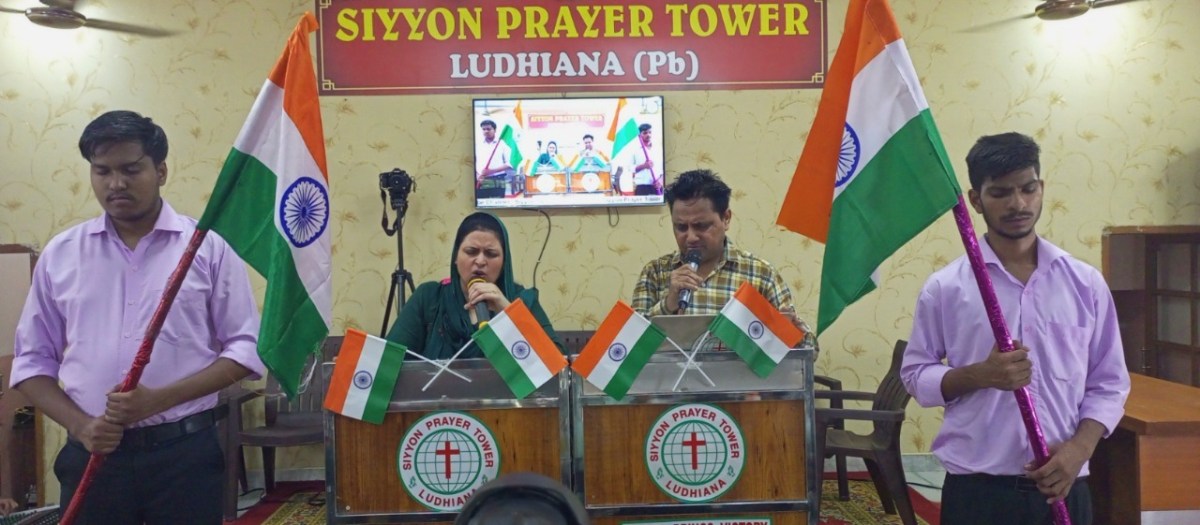
Siyyon Prayer Tower in Ludhiana participates in the 2022 India National Day of Prayer.

EFI and NCCI released statements listing both the achievements of India as a nation and its remaining challenges.

“We should be proud of being the world’s largest democracy,” stated EFI of the 75th anniversary. “We are a nation of 1.3 billion people, a young and aspirational nation with great potential, and obstacles as great to overcome.”

While the Indian government claims the celebration as a “festival of awakening of the nation; festival of fulfilling the dream of good governance; and the festival of global peace and development,” Indian denominational leaders have their apprehensions.

“This year is significant … in terms of how things have been happening now,” said NCCI general secretary Asir Ebenezer. “The nation is moving to a totalitarian state where the ‘Pharaoh’ says [something] and everybody follows. So that is something very dangerous and divisive.”

He worries that while the central government persuades the masses with the tricolor flag today, tomorrow it “might ask us to do something else and if one does not do it, one would be deemed as anti-national.”

Onesimu highlighted the present-day challenges that Indian minorities face, especially Christians and Muslims, and appealed to the government “to focus on the persecution of the minorities and take adequate action against the perpetrators.”

Abraham noted the many “disparities, inequalities, and discrimination challenging our country” and said Indian Christians “must try to address that and pray for peace, unity, and equality to be maintained.”

“The one gnawing issue that soils the otherwise brilliant record of 76 years has been the recurring political use of religion,” stated EFI. “This has been the main cause of pain and suffering in many parts of the country over the last several decades.”

EFI cautioned:

Red Flags must be raised this Independence Day on the basic glue that holds the nation together—of religious coexistence, mutual respect, and equality before the law. Religious polarization and the growth of high-pitched religious nationalism and majoritarianism, fueled by an equally toxic social media and television media, is a major challenge before the nation. The world has known India as the largest liberal democracy with constitutional values of secularism, liberty, plurality, fraternity, and tolerance. Today, that image is under stress and the result could be the weakening of the soft power of India. This should worry all citizens of the country.

Challenges such as poverty, pollution, inequality, and children at risk affect all faith groups and all Indians must work together to address them, said Lal. However, such collaboration is prevented by religious and political polarization, majoritarianism, and religious nationalism.

“These must be checked, and more concentration needs to be focused on what unites us as Indians as opposed to what divides us,” he said. “I am sure that when we as a people work together for the issues that confront us all—regardless of our caste, creed, or religion—we can rise as a nation and overcome.”

Church Life

4 Sri Lankan Christians Seeking Their Nation’s Rebirth

How believers are living out their faith amid unprecedented political upheaval.

Christianity Today August 16, 2022
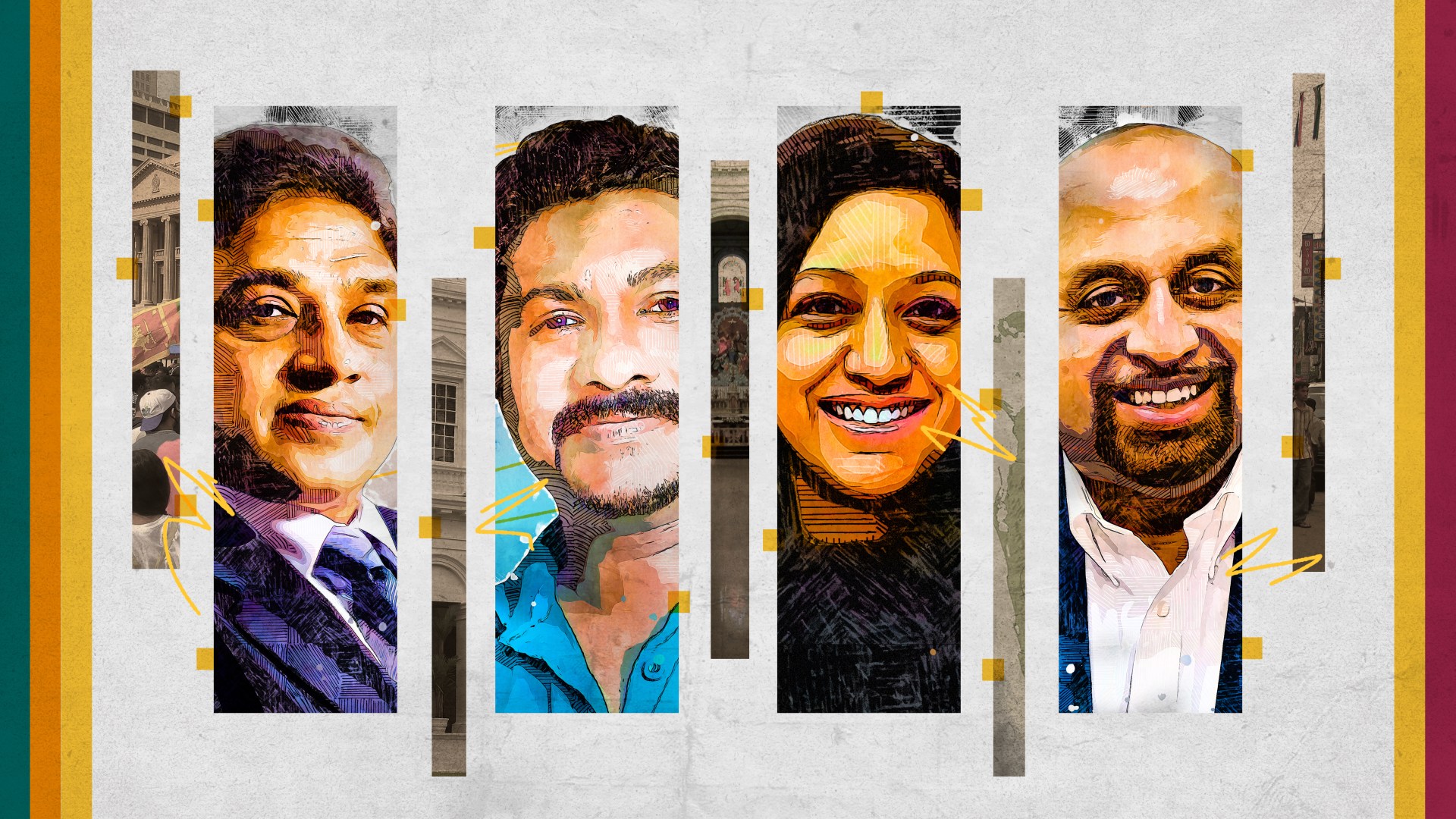
Illustration by Rick Szuecs

In this series

On July 9, after months of taking to the streets, Sri Lanka protesters successfully pressured President Gotabaya Rajapaksa to resign and flee the country. Demonstrations began in early April as prices of fuel, food, and medicine began to soar.

Gotabaya’s tenure, which began in 2019, failed to mitigate much of the damage that his brother Mahinda Rajapaksa had put in place when he served as president from 2005 to 2015. Corruption and disastrous economic policies characterized their respective administrations. COVID-19 dealt the final blow to an already struggling, poorly managed economy, with Sri Lanka even defaulting on external debt for the first time in its history. No one in the island nation of 22 million people has emerged unscathed.

“For the first time in my living memory, the protests have united people from all walks of life and all ethnic and religious communities,” said Christian political blogger and International Fellowship of Evangelical Students (IFES) leader Vinoth Ramachandra.

This includes Christians, who comprise 7.4 percent of the population (evangelicals comprise less than 2 percent). Despite suffering persecution and scores of casualties in 2019 terrorist attacks, many have felt compelled to come alongside their countrypeople in this political moment.

“What better way to love God and love our neighbor as we love ourselves than to work towards the much-needed change in this country, from governance to the grassroots—a cultural change that will lead to a ‘system change,’” said Nadishani Perera, head of the Sri Lanka chapter of Transparency International. “To speak for those who cannot speak, to share our resources with those who have none, as God loves them too. He is watching to see if we who know him would love enough to care for them.”

Though protesters have successfully ended the Rajapaksas’ rule, the gains they aspired to are not guaranteed. Since assuming power, six-term prime minister turned president Ranil Wickremesinghe has declared a state of emergency to govern under laws that allow the suspension of constitutional safeguards of civil liberties and due process.

“Hope begins with the ruin of our expectations,” Ramachandra quoted from Sri Lankan theologian Daniel Thambyrajah Niles in a blog post from April, before writing, “They were words that sustained me during the 30-year civil war this country experienced and, at the close of which, I began writing this Blog. And I continue to cling to them in the continuing darkness that envelopes us and other nations.”

“Christian hope, unlike optimism or mere wishful thinking, is based on the paradoxical triumph of the cross of Christ and Easter promise. The God of the biblical narrative is a God of surprises, working in unexpected places and through unexpected people.”

In this series, CT profiles four Christian leaders who have spent their lives investing in the betterment of Sri Lanka and have been working hard in this moment for the nation’s rebirth within their own spheres of influence.

Joanne Kwok is a writer and creative director based in Singapore.

Godfrey Yogarajah: ‘Our Calling Is to Be the Prophetic Voice’

Christianity Today August 16, 2022
Illustration by Rick Szuecs / Source Images: Envato Elements / Photo Courtesy of Godfrey Yogarajah

In this series

General secretary of the National Christian Evangelical Alliance of Sri Lanka

“As Christians, our calling is to be the prophetic voice in the nation. A crisis gives us more opportunities to play that role. We see the crisis we are facing in Sri Lanka as an opportunity for the church to stand up for the biblical principles of truth, justice, accountability, and the dignity of people.”

As the general secretary of the National Christian Evangelical Alliance of Sri Lanka (NCEASL), Godfrey Yogarajah is at the forefront of a Christian organization that has made “uniting the local church to transform the nation” its vision. The Alliance itself has operated for more than 60 years, working on social-justice-related issues in Sri Lanka and advocating for Christians and other marginalized communities in the country.

During the nearly three decades of civil war, the NCEASL was at the forefront of advocating for civilians who were being abducted or targeted, raising awareness of journalists who were being killed, and speaking out against violations of human rights such as “enforced disappearances.”

In the course of the Alliance’s work, Yogarajah recounted pushbacks, threats, intimidation, raids on their offices, and even staff being taken in for questioning at times by the authorities of successive governments.

Since March, despite the disruptions caused by unbridled inflation and socioeconomic instability, NCEASL has reached out to young people to educate them on politics, democracy, and “good governance.” NCEASL showcased their self-produced short films centering peace and reconciliation at the protest site of Galle Face Green, Colombo, where hundreds of thousands gathered to protest against Rajapaksa and his government.

As the political crisis has worn on, Yogarajah and the Alliance have begun leading community discussions on much-needed constitutional reform.

“We’ve identified individual and corporate righteousness, economic sufficiency, public justice, and social peace as our indicators for transformation,” said Yogarajah, describing how the NCEASL designs its programs and, essentially, picks its battles.

The prophet Amos’s call for his people’s repentance and Esther’s courageous advocacy for her nation are inspirations to Yogarajah. Christians, he says, have that same “prophetic call in the nation.”

While much of his work focuses on engaging civil society, the NCEASL is committed to helping those hurting on the ground. They run community kitchens around the country and have provided relief to low-income families during this time.

“For Christians, I would say that whenever we see injustice and discrimination, God calls us to stand with the oppressed, vulnerable, and marginalised,” said Yogarajah. “Many people are suffering in the current crisis and finding it hard to make ends meet. In the face of such difficulty, it is also our responsibility to respond in love and take care of the vulnerable.”

Nadishani Perera: I Cannot Be Content Ignoring the Needs of Society

Christianity Today August 16, 2022
Illustration by Rick Szuecs / Source Images: Envato Elements / Photo Courtesy of Nadishani Perera

In this series

Executive director of Transparency International Sri Lanka

“If we truly in our hearts love God and want to follow him and pray that he will use us for His great purposes, he will guide us and use us to live the full life for which he created us, using our full potential. There is only one you in this world, and you have been placed in this country by God at a time like this for a purpose, to be his witness, to be a shining light in dark places.”

From a young age, Nadishani Perera asked God to transform her heart and mind to be like him so that “I will hurt when those around me in this nation are hurting, so I cannot be content or have peace by ignoring the needs of the society, that I will be moved to serve by the love I have for others.”

Out of this prayer came a decision to pursue law. When Sri Lanka’s nearly 30-year civil war came to an end in the 2000s, she began to work with victims of police torture and child abuse. It was a major departure from a typical legal route, but Perera describes it as following what she believed was her “calling and passion” in serving the “vulnerable, suppressed, affected, and needy children and people in my country and working towards bringing God’s kingdom values in the nation.”

Perera’s experiences shaped her work with state agencies like the National Child Protection Authority and the Sri Lanka police. By 2020, she had been recruited for the executive director position at Transparency International Sri Lanka (TISL), a global anticorruption movement founded by former employees of the World Bank.

The past two years have been intense: The pandemic debilitated a country exploited by “corrupt power holders” who had manipulated the laws, policies, and systems in the country for their selfish agendas.

TISL’s programs and efforts have taken on new urgency in the present crisis. It is currently engaging politicians, public officials, civil servants, journalists, and private, “diverse citizens” to “bring about the required cultural and systemic changes to resist and combat corruption in the nation.”

Then there are aspects that require Perera’s legal expertise: advocating for and facilitating the drafting of necessary laws and systems to fight corruption and enhance transparency. She and her team regularly issue press releases and conduct press conferences over mainstream media to call out the government when it acts without transparency, is suspected to be involved in corruption scandals, or “takes steps that obstruct accountability measures in governance.”

“This calling to a life lived for others, a life where you make your personal decisions considering what you can do about what is going on in the society and in the country, is one that is very challenging and against the tide of the popular narrative we see in society, where pursuance of one’s happiness is seen as the logical and modern theory of life,“ said Perera. “I honestly do not think Christians have another choice here, as the Word of the Lord is very clear.”

On the ground, there are initiatives to raise civilian awareness and build their knowledge of anticorruption, as well as efforts to “mobilize diverse stakeholders to build coalitions against corruption and to become change makers in their sphere of influence.” TISL also assists victims of corruption to access state services and pursue justice, helping to create tools and mechanisms that can be used within state institutions to mitigate corruption.

“I am humbled and deeply joyful for the opportunity to be a servant of God in this country, at this time,” Perera said. “At this critical juncture of my country, where the people are suffering due to their inability to fulfill their basic needs, where around 70 percent of the population have begun skipping one meal, where my bankrupt country is begging for assistance from the nations across the world.”

To her, this is the time for followers of Christ to love God and love our neighbors.

“If we make this choice and we know that God is on our side, the results are in his hands. While we do what we can do with all our heart and might, then we will have hope and joy that will carry us through the challenges.”

Andrew Devadason: ‘No One Can Be Left Behind’

Christianity Today August 16, 2022
Illustration by Rick Szuecs / Source Images: Envato Elements / Photo Courtesy of Andrew Devadason

In this series

Vicar, St. Paul’s Church, Milagiriya, Colombo

“If you consider a piece of clothing that covers the human body, the entire fabric must be intact. Similarly, unless all segments of society reap the benefit of development, the entire fabric of the nation will not hold good. If a nation is to hold good, all segments of her citizens must hold good. No one can be left behind.”

On Maundy Thursday of this year, a group of Anglican clergy and laity left the building of St Paul’s Church for Galle Face Green park, where those protesting the Rajapaksa government had gathered since the citizen uprising in March.

Clad in their white ceremonial garb, the Christian ministers knelt to wash the feet of a slightly bewildered but obliging crowd, their gestures echoing Jesus’ own act of humility on the night he was betrayed.

Among them was Andrew Devadason, an Anglican vicar at a Colombo congregation. Devadason’s foray into Christian ministry began in 2006 when he started to advocate for the rights of tea plantation workers under the Estate Community Development Mission, a community development program implemented by the diocese of Colombo to empower these marginalized communities.

Devadason described a “tormenting spark for justice” being kindled as he learned of the “modern-day slavery” these descendants of South Indian immigrant workers were caught in. But this mission field was where he also began to develop a threefold strategy in fighting injustice: creating awareness in the society at large, advocating for policy decisions at the state level, and standing in solidarity with the community in need for their legitimate rights.

“The church has the potential to offer a solution,” he said of his advocacy, including his years as a vicar. “The planters and the workers share the same cup at the Eucharist, something unimaginable outside of the church.”

Leading up to the current national crisis, Devadason’s advocacy method had been to “play the catalyst” or “the invisible hand”—that is, doing informal networking with various stakeholders sharing a common goal. This had successfully brought “different political representatives and nongovernmental organizations, civil society movements, and individuals to the same table over a cup of tea to lobby the cause and take it forward.”

This same vision led the clergy and laity to Galle Face Green on Maundy Thursday, hoping to express solidarity with the aggrieved community and to advance their cause peacefully.

But a month later, on May 9, the situation at the frontlines escalated after the leaders received news that supporters of the incumbent party intended to attack protestors. After hearing this information, the clergy headed back out to be with protestors despite the risks involved.

“We had to take the next step—from washing feet to the cross,” said Devadason.

He and his fellow Christian ministers had hoped their religious attire would signal peace and keep the mob at bay, but it was to no avail. The incumbent party supporters beat up Devadason and his fellow clergyman Niroshan de Mel along with the rest of the protestors.

“A national crisis plunges everyone into suffering,” he said. “Our involvement is a practical way of making confession before God of our ignorance of the evil that has been allowed to culminate in our nation.”

And like Moses, who couldn’t resist that spark deep inside that compelled him to stand up for the justice of his people, we too must be compelled to “stand for truth and against the pharaohs of the day.”

“We need lots of prayer and solidarity. The battle is not over yet. There is no zero capacity—for everyone can pray.”

News

Mission Schools Sexual Abuse Suit Dismissed on Technicality

A North Carolina judge says the Nigerian statute of limitations prevents the case from going forward.

Kent Academy was one of two boarding schools in Nigeria where SIM missionary children say they were abused.

Kent Academy was one of two boarding schools in Nigeria where SIM missionary children say they were abused.

Christianity Today August 16, 2022
Screengrab / Google Maps

A North Carolina judge has dismissed a lawsuit alleging a missionary agency was responsible for abuse at a boarding school in Nigeria, ruling the statute of limitations in Nigeria prevents him from hearing the case.

“It was a gut punch—building yourself up for things, hoping, hoping, hoping, then having the rug pulled out from under you at the very last moment,” plaintiff Daniel Robinson, the son of Canadian missionaries, told CT.

The suit against SIM—formerly known as Soudan Interior Mission, Sudan Interior Mission, and Society for International Ministries—claims that seven employees at two schools in Jos and Miango, Nigeria, sexually abused children as young as five. The abuse reportedly went on from 1962 to 1981.

Six of those former missionary kids filed suit in December 2021, arguing the North Carolina–based missionary agency “breached its duty in hiring, retaining and supervising” staff at the schools. The missionary organization counters that, in fact, the schools were not under its supervision.

“We were surprised to have been named in litigation,” SIM said in an official statement sent to CT. “While some SIM USA staff children attended these schools, SIM USA did not manage either school. Both schools were run by local, independent entities in Nigeria, without operational input or oversight by SIM USA.”

One of the schools, however, was named for SIM founder Thomas Kent. Both were staffed by SIM-affiliated missionaries.

The question of oversight didn’t get argued in court, though, because Superior Court Judge Robert C. Ervin ruled last week that a North Carolina law lifting the statute of limitations on sexual abuse cases for a two-year period does not apply to sexual abuse that happened in other places. The state law limits civil liability based on the rules of the jurisdiction where the crime was allegedly committed.

“Good luck if you’re a survivor of child sexual abuse on the mission field overseas,” said Boz Tchividjian, an attorney representing the plaintiffs. “It’s so unfair to them because now the institution that should be being held accountable for placing dangerous people with these children is basically immune from accountability simply because the country that they’re serving in has a statute limitations law that is very limiting or doesn’t even have one at all.”

SIM, founded in 1893, currently has 4,000 ministers working in more than 70 countries. Nathan Krupke, chief operating officer, said in an email that the organization currently has a child safety coordinator and safe recruitment procedures, awareness training, and a code of conduct that includes a commitment to report to law enforcement where possible.

Krupke said SIM, like many organizations, is still working to reckon with the many abuses that occurred in the past.

“We acknowledge the pain of what they experienced, and express our grief for them,” he said. “We seek to understand the harm in each individual situation, and what needs have been created because of the harm.”

Robinson and the other survivors believed that the lawsuit gave them the best chance to push for accountability. He said it was filed despite pushback from a tightly knit missionary community and, in some cases, missionary parents who didn’t want to believe what their children were saying.

He believed for a long time that he was one of only a couple of people who suffered abuse at Hillcrest School until he found a Facebook group called Hillcrest Survivors. It currently has 227 members.

“I would like to make personally sure that none of the things that ever happened to me and my fellow victims can ever happen to anybody ever again,” Robinson said.

The people accused of abuse include James McDowell, a principal of the Hillcrest school who reportedly confessed last year to “molesting two students.” The official Hillcrest School Facebook group posted a letter from the school quoting the confession in April 2021. McDowell did not return an email from CT seeking comment.

Others named in the lawsuit include a dorm supervisor, dining hall employee, and four more employees. Some of them have passed away. CT was unable to reach the others.

The suit tells stories of abusers sexually assaulting children in the dorms, in cars, and in bathrooms. Survivors say they were given alcohol in some cases, and in others they were told the authorities were just “inspecting” their private parts after showers.

The survivors who spoke to CT said they all have dealt with long-lasting and detrimental effects of the abuse, including low self-esteem, depression, anxiety, a mental breakdown, suicidal ideation, long-term disability, post-traumatic stress disorder, and anger at God.

They have been retraumatized, they said, by the way they’ve been treated by Christians.

“Having the church reject me made it 1,000 times worse,” said plaintiff Susan Semons.

They struggle to reconcile what they experienced with what they were taught by their parents, their church communities, and even at the schools.

“It baffles me—their ability to see me as a person and the damage that was being done by their decisions and their policies and their people,” plaintiff Melanie Jansen said. “Nobody wants to take responsibility for the devastation that has happened to us.”

The plaintiffs will meet with their attorneys this week to consider appealing the judge’s decision to the North Carolina Court of Appeals.

“This seems to be the road that I’m on,” said Jansen. “I pray regularly for the strength to endure it. This is what God has put in front of me. So here we are.”

News
Wire Story

Died: Frederick Buechner, Popular Christian ‘Writer’s Writer’ and ‘Minister’s Minister’

Buechner died peacefully in his sleep on Monday at age 96, according to his family.

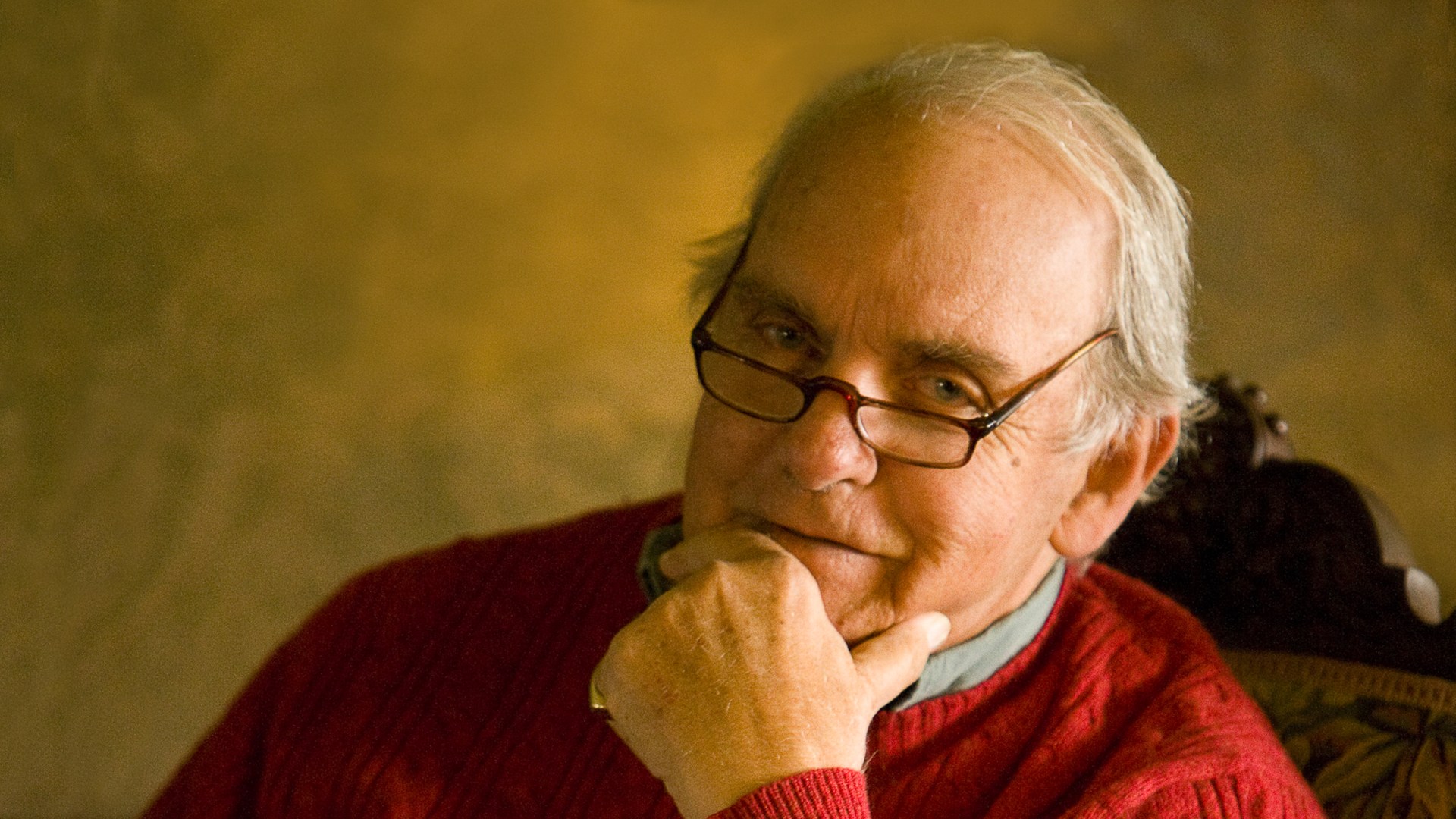
Frederick Buechner in an undated photo.

Frederick Buechner in an undated photo.

Christianity Today August 15, 2022
Alan Fortney / Courtesy of Buechner Family

Frederick Buechner was asked on numerous occasions how he would sum up everything he had preached and written in both his fiction and nonfiction.

The answer, he said, was simply this: “Listen to your life.”

That theme was constant across more than six decades in his career as a “writer’s writer” and “minister’s minister” — an ordained evangelist in the Presbyterian Church (USA) who inspired Christians across conservative and progressive divides with his books and sermons.

Buechner died peacefully in his sleep on Monday (Aug. 15) at age 96, according to his family.

Born Carl Frederick Buechner on July 11, 1926, in New York City, he moved frequently with his family in his early childhood as his father searched for work, settling in Bermuda after his father’s death by suicide when he was 10.

His studies at Princeton University were interrupted by World War II, but he completed his bachelor’s degree in English in 1948. He quickly achieved fame with the 1950 publication of his first novel, “A Long Day’s Dying.”

When his second novel, in his own words, “fared as badly as the first one had fared well,” he moved to New York City to lecture at New York University and focus on his writing.

It was in New York City that he had an experience that changed the course of his life and work: He began attending Madison Avenue Presbyterian Church. Growing up, neither side of his family had a “church connection of any kind,” as he put it, but he went because he happened to live next door and “because I had nothing else to do on a Sunday,” he recounted in a video posted on YouTube by the Frederick Buechner Center.

One Sunday he was struck by a particular turn of phrase by the church’s pastor, the Rev. George Buttrick: “Christ is crowned in the hearts of those who love him and believe in him amidst confession and tears and great laughter.”

He recounted: “I was so taken aback by ‘great laughter’ that I found the tears springing to my eyes.”

He later told Buttrick he wanted to learn more about Christianity, to more than simply join the church. The pastor pointed the young writer to Union Theological Seminary — with some misgivings. Buechner quoted Buttrick in his autobiography “The Sacred Journey” as saying, “It would be a shame to lose a good novelist for a mediocre preacher.”

Buechner graduated with a bachelor’s of divinity — he’d later receive nine honorary degrees — and was ordained as an evangelist in 1958 at the same church where he had been so moved by Buttrick’s words.

That same year, he launched the religion department at Phillips Exeter Academy in New Hampshire, where he taught for nine years before moving with his family to their farmhouse in Vermont. He later was awarded lectureships at Harvard and Yale universities and held teaching positions at Tufts University, Calvin College and Wheaton College.

In 2016, Princeton Theological Seminary President Craig Barnes launched the Buechner Writing Workshop at the seminary, calling Buechner a “minister’s minister.”

Over the course of his life, Buechner wrote nearly 40 books across a number of genres: fiction, autobiography, theology, essays and sermons.

Among his novels, “Lion Country” was a finalist for the 1972 National Book Award and “Godric” a finalist for the 1981 Pulitzer Prize for fiction. His short story “The Tiger,” published in The New Yorker, took third prize in the O. Henry Awards in 1955.

Listening to one’s life became a theme in his work, because, he said in a 1989 appearance on the Chicago Sunday Evening Club, if there was a God and if God were as concerned with the world and involved in it as Christianity says, then surely one of the most powerful ways God speaks to people is in what happens to them.

That’s something bestselling memoirist Anne Lamott, a progressive Christian who wrote the introduction to the 2016 book “Buechner 101,” has said she took away from Buechner’s writing.

It gave Lamott the confidence, after paying attention to her own life, “to share that with my readers and to trust that that is ultimately all we have to share with one another — is our truth in our very own voice,” she said in a YouTube video posted by the Frederick Buechner Center to mark Buechner’s 90th birthday.

While Buechner was ordained in a progressive mainline Protestant denomination, his fans also included Catholics and conservative evangelicals.

Russell Moore, the former head of the Southern Baptist Convention’s Ethics & Religious Liberty Commission who recently was named editor in chief of Christianity Today, credited Buechner’s writing with making him a better evangelical in a 2017 commentary for the magazine.

“J. Gresham Machen and Carl F. H. Henry taught me that I needn’t put my mind in a blind trust in order to follow Jesus. Buechner taught me the same about my imagination,” Moore wrote.

The Rev. James Martin, editor at large of America Media, said in another YouTube video posted by the Frederick Buechner Center that the author was “instrumental in my early days as a Jesuit.”

On Monday, Martin tweeted, “I’m so sorry to hear of the death of Frederick Buechner, who led a long and fruitful life and was one of my favorite spiritual writers. ‘The Sacred Journey’ is one of the most beautiful spiritual memoirs ever written. May he rest in peace with the God he loved for so long.”

Buechner, who split his time between Vermont and Florida, is survived by his wife Judith Buechner, three daughters, a son-in-law and 10 grandchildren.

Books

A Shelf Called Remember: How Frederick Buechner Built Up My Faith

The late writer’s books upended the way I think about almost everything.

Frederick Buechner

Frederick Buechner

Christianity Today August 15, 2022
WikiMedia Commons

After I heard the news of the death of Frederick Buechner this week, I walked over to a bookcase in my study that I visit more than any other.

These shelves are filled with what seems too small to say are my “favorite” authors. These are the ones who kept me Christian, who upended the way I think or feel about everything. The Buechner section of that bookcase seems like a disorganized chaos. There’s no coherent genre. Here’s a novel, there’s a Bible study, here’s a dictionary, there’s not just one but several autobiographies.

And there’s no coherent chronology, either. They are stacked not in the order they were written but in the order that I found them. That’s because, when I look at each one, I am retelling myself a story—of when I discovered each one of them, and what it was like to read each for the first time.

When I stand in front of those shelves, I’m doing what Buechner asked us all to do. I am listening to his life, and to my own.

The first book on the shelf is an old copy of A Room Called Remember, a collection of essays that I discovered as a teenager while rifling through the discard table of a public library. When I started reading, what caught my attention was a serious Christian who seemed to see what I could feel but couldn’t really articulate: that life is a mystery, a mystery that’s a plotline, a plotline that connects us with the story of Jesus.

These stories, he wrote, “meet as well as diverge, our stories and his, and even when they diverge, it is his they diverge from, so that by his absence as well as by is presence in our lives, we know who he is and who we are and who we are not.”

A few inches down on that same shelf, I can find his writings on faith and fiction, The Clown and the Belfry, and remember how I never read another parable of Jesus the same way again after I encountered that book. For years, I had heard those stories just like Pauline Epistles. The preacher would break them down for us—point by subpoint by sub-sub-point, telling us the interpretation and application of each part.

But Buechner had more to say. “If we think the purpose of Jesus’ stories is essentially to make a point as extractable as the moral at the end of a fable,” he wrote, “then the inevitable conclusion is that once you get the point, you can throw the story itself away like the rind of an orange, when you have squeezed out the juice.”

That’s not how stories work, Buechner taught us. They’re meant to involve us—not just with our minds but with our affections and emotions and intuitions too. And all that points us to Jesus himself, who is the Truth—“the whole story of him.”

“So in the long run, the stories all overlap and mingle like searchlights in the dark. The stories Jesus tells are part of the story Jesus is, and the other way round.”

Thanks to another volume on that shelf—a collection of sermons called The Hungering Dark—I never say “Christ” without the word “Jesus.” That’s because Buechner knew the phrase “Christ saves” wouldn’t make us nearly as uncomfortable as would the words “Jesus saves.”

Those words “have a kind of objective theological ring to them,” he wrote, “whereas ‘Jesus saves’ seems cringingly, painfully personal—somebody named Jesus, of all names, saving somebody named whatever your name happens to be.”

First in the pulpit, then in that book, Buechner preached that what we accept or reject is not an abstraction but a person.

A few spaces down on the shelf is The Alphabet of Grace, which even now startles me into paying attention to the miracle of the ordinary:

You get married, a child is born or not born, in the middle of the night there is a knocking at the door, on the way home through the park you see a man feeding pigeons, all the tests come in negative and the doctor gives you back your life again: incident follows incident helter-skelter leading apparently nowhere, but then once in a while there is … the suggestion of plot the suggestion that, however clumsily, your life is trying to tell you something, take you somewhere.

Those words would come to mind when I held my newborn son. They came to mind when I buried my father. They sometimes come to mind when nothing significant seems to be happening at all. And they also emerge in my thoughts alongside words from Now and Then, a book a few spaces down the shelf, reminding me there’s nothing too commonplace for God. He’s present in all of it.

“Listen to your life,” writes Buechner. “See it for the fathomless mystery that it is. In the boredom and pain of it no less than in the excitement and gladness: touch, taste, smell your way to the holy and hidden heart of it because in the last analysis, all moments are key moments, and life itself is grace.”

A few notches down the shelf is Whistling in the Dark, in which Buechner wrote that unexpected tears are a sign that “God is speaking to you through them of the mystery of where you have come from and is summoning you to where, if your soul is to be saved, you should go to next.”

Even before I pulled that book off the shelf after hearing news of his death, I thought of those words as I wiped away unexpected tears. How strange, I thought, to feel grief over the death of a man I never met, a man nearly a hundred years old. But then I wondered whether the tears were about something else.

I pulled off the shelf Godric, his novel about a 12th-century English monk, and found one of Buechner’s most famous passages: “What’s lost is nothing to what’s found, and all the death that ever was, set next to life, would scarcely fill a cup.”

In the Buechner neighborhood of the bookshelf, there is some open space. I guess subconsciously I hoped that there would be, somehow, one more book to come. Those shelves don’t seem like a body of work. They don’t even seem like part of a library. They seem like a story he was telling me—a story I didn’t want to end.

As I put the books back on the shelf (until the next time I need them), I hold back A Room Called Remember and notice words that I’ve read before but, unlike the others, I don’t remember:

At the age of one hundred, the old man knows what at my age I am only just beginning to see—that if it is by grace we are saved, it is by grace too that we are lost, or lost at least in the sense of losing our selves, our lives, our all.

All’s lost. All’s found. All moments are key moments. Buechner didn’t make it to 100, but he told the story at the heart of the plot behind the plots, where all our stories sit—maybe on a shelf called “Remember.”

Russell Moore leads the Public Theology Project at Christianity Today.

Books

Frederick Buechner, the Reverend of Oz

At 70, Frederick Buechner looks back on his ministry in letters. (From 1997)

Frederick Buechner

Frederick Buechner

Christianity Today August 15, 2022
WikiMedia Commons

Frederick Buechner died today (August 15, 2022) at age 96. Christianity Today has covered his books extensively over the years, and published several profiles of the beloved writer. Our sister publication Books and Culture was also enthusiastic; among its many reviews and pieces on Buechner was this 1997 profile by Philip Yancey.

Frederick Buechner has met Christians who remind him of American tourists in Europe: Not knowing the language of their listeners, they speak the language of Zion loudly and forcefully, hoping the natives will somehow comprehend. They seem cocky with faith, voluble with their theology, and content with a God who resembles a cosmic Good Buddy. Their certitude both fascinates and alarms him. “I was astonished to hear students at one Christian college shift casually from small talk about the weather and movies to a discussion of what God was doing in their lives. If anybody said anything like that in my part of the world, the ceiling would fall in, the house would catch fire, and people's eyes would roll up in their heads.”

Buechner himself has gained a reputation as a writer who speaks of his faith in more muted tones. Apart from a few childhood encounters, he hardly gave church a thought until he wandered into one in Manhattan as a young novelist whose star had flared brightly but briefly on the New York literary scene.

For him, faith was a pilgrimage undertaken voluntarily as an adult, a journey fraught with risk. Buechner’s chronicles of that journey have, almost uniquely among modern writings, managed to attract readers from two polarized worlds, the Eastern elite and conservative evangelicals. His work divides evenly between fiction (14 books) and nonfiction (13 books), and Buechner notes that the two genres roughly fit his contrasting audiences: the fiction speaks to the “cultured despisers” of religion while his nonfiction, more overt, finds its primary audience among those already committed to the faith.

This straddling feat has cost him and is, in fact, the central ambiguity of his career. “I am too religious for the secular reader and too secular for the religious reader,” Buechner often laments. Secular reviewers, noting him to be an ordained Presbyterian minister, sometimes prejudge his work. (Buechner has admitted that seeking ordination was probably the stupidest move he could have made for his writing career.)

On the other hand, conservative Christian readers wonder why the Christian message in Buechner’s novels remains so subtle, and why he insists on portraying characters as, well, human, complete with sexual urges and a disturbing penchant for sin. Buechner responds that he writes of people with feet of clay because they are the only kind of people he has met, including himself.

Writers, like farmers and fishermen, tend to dwell on the discouraging aspects of their work. Buechner has not made a breakthrough in sales on the level of, say, Scott Peck or Thomas Moore. He sinks into instant depression when he visits a “Book Superstore” that contains not a single copy of his 27 books. He winces when he reads in the New York Times a reviewer’s comment describing him as someone “whom I wrongly did not read because I thought he was a propagandist.” And he tires of answering the letters from seminary students asking why he felt it necessary to include the scene of incest in Godric, or why he made the hero-evangelist of his Bebb novels a sexual exhibitionist. Furthermore, Buechner objects to the label “Christian novelist” often slapped on him, insisting it only applies in the sense it would apply if a physicist wrote a novel: Of course the author’s outlook would suffuse the novel, and its content may well touch the field of physics, but that would hardly make it a “physics novel” any more than a novel written by a woman necessarily makes it a “women’s novel.”

Yet, in more ways than he is prone to admit, Buechner has indeed succeeded in straddling two worlds. He has maintained close friendships with the great poet (now deceased) James Merrill and with novelist John Irving, who acknowledged his debt to Buechner in the preface to A Prayer for Owen Meany. He gives readings at the New York Public Library. Godric was nominated for a Pulitzer Prize. At the same time, Buechner’s books have become fixtures on the bookshelves of ministers, college professors, and literate Christians spanning a wide spectrum of theology. The sales of his major titles have passed the hallmark 100,000 figure, and they tend to stay in print for the long term.

I first met Buechner in 1979, about the time he decided to send his correspondence and original manuscripts to Wheaton College to repose in the college’s Wade Collection alongside papers from C. S. Lewis, G. K. Chesterton, Charles Williams, J. R. R. Tolkien, and Dorothy Sayers. Buechner knew almost nothing about the school—in our phone conversations he kept calling it “Wheatland College”—but his alma mater, Princeton, had shown little interest while the folks at the Wade Collection had been warm and solicitous. After he had traveled to Wheaton, met evangelicals, and toured the campus, I asked him what he thought of his decision. “Well, it seems a good place for my literary remains to molder,” he said. “A safe place, where at least they will rest in very distinguished company.”

Frederick Buechner and evangelicals have gotten much better acquainted in the last two decades. I have a hunch, in fact, that Buechner has become the most quoted living writer among Christians of influence. Appreciation of his craft continues to grow—who else gets equally laudatory reviews in Christianity Today and the Christian Century? Buechner stumbled on a most appropriate resting place for his papers among the luminaries at Wheaton’s Wade Collection.

If I were called upon to state in a few words the essence of everything I was trying to say both as a novelist and as a preacher, it would be something like this: Listen to your life. See it for the fathomless mystery it is. In the boredom and pain of it no less than in the excitement and gladness: touch, taste, smell your way to the holy and hidden heart of it because in the last analysis all moments are key moments, and life itself is grace.
Now and Then

“Literature deals with the ordinary,” said James Joyce; “the unusual and extraordinary belong to journalism.” By that definition, Buechner’s work fits the category of literature. For him writing is a form of self-discovery, a “conscious remembering,” as he once called it. He writes not about Rwanda or the crisis of postmodernism, rather about a faint memory of his grandmother Naya, or about the old mill down the road, or about two apple tree limbs clacking together in the backyard. His style harks back to the Middle Ages, to writers who sat in cells all day, gazing inward and exploring the soul’s inner depths. Buechner at least walks outdoors, strikes up conversations, has a family to worry over, and takes an occasional trip. From this raw material he forges memoirs-in-process. Unlike traditional memoirs, the reader has no idea where the words are going and sometimes gets the sense that neither does Buechner. He acts more as an observer who peers out on the world-sometimes bemused, sometimes bewildered, always surprised-rather than as a stage manager who manipulates props to fit his first-person point of view.

In his recent volume The Longing for Home, Buechner draws a contrast between “the news of the day” reported on television each night—wars, homelessness, and other big issues—and the news of the day that goes on in our private worlds.

Some of the things that happen in them are so small that we hardly notice them, and some of them shake the very ground beneath our feet, but whether they are great or small, they make up the day-by-day story of who we are and of what we are doing with our lives and what our lives are doing to us. Their news is the news of what we are becoming or failing to become.

Buechner recommends reviewing this more intimate news during the nightly interval when you first turn out the light and lie in the dark waiting for sleep to come. That is when the events of the day—an unanswered letter, a phone conversation, a tone of voice, a chance meeting at the post office, an unexpected lump in the throat—hint at other, subterranean meanings. In these most humdrum events God speaks, and Buechner demonstrates through his writing how to listen.

The same discipline of listening, Buechner claims, also drives his fiction:

“Be still and know that I am God,” is the advice of the Psalmist, and I’ve always taken it to be good literary advice too. Be still the way Tolstoy is still, or Anthony Trollope is still, so your characters can speak for themselves and come alive in their own immortal way. If you’re a writer like me, you try less to impose a shape on the hodgepodge than to see what shape emerges from it, is hidden in it. If minor characters show signs of becoming major characters, you at least give them a shot at it because in the world of fiction it may take many pages before you find out who the major characters really are just as in the real world it may take you many years to find out that the stranger you talked to for half an hour once in a railway station may have done more to point you to where your true homeland lies than your closest friend or your psychiatrist.

Anyone can lie awake and review the events of the day. As a writer, Buechner must shape those memories into prose that keeps awake the reader as well as the rememberer. He succeeds primarily by attending to his words as acutely as he attends to the events themselves. Raised in a nonreligious home, he got baptized “less from any religious motive, I think, than from simply a sense that like getting your inoculations and going to school, it was something you did.” The vaccination worked in a paradoxical way. Baptism during a time when Christianity represented to him all symbol and no substance inoculated him against the cozy imagery of stained glass and statues, against the trappings of church for church’s sake, against the repetition of stale words long since desiccated of meaning.

“I’m sick of religious language,” Buechner once told an interviewer. “I’m sick of sermons right now.” Because he kept agreeing to preach despite the illness, he sought out new carriers for his beliefs. He looked to King Lear and the Wizard of Oz to make his points, as well as to Jacob and to Paul. Most of all, Buechner the prose stylist stuck to a lesson he had learned in writing fiction: nothing alienates an audience faster than a slight note of falsity or unrealism. If he was to write or speak about the Christian life, he must do so with undiluted honesty.

A time came, a difficult time in his personal life, when Buechner made a decision to write about saints. For more than a decade he had been trying to rid himself of Leo Bebb, the flasher-evangelist, an oddball saint and subject of four of his books. He kept on writing sequels, unable to let Bebb go. With no conscious thought of what to write next, he picked up the Penguin Dictionary of Saints, hoping to find some historical saint of the past, perhaps a truly holy man. The book opened to Godric, an eleventh-century English saint and a figure unknown to him. As he read, suddenly it occurred to him that Godric was Bebb in an earlier incarnation: yes, a holy man, a missionary, a body-torturing ascetic who kept two pet snakes, a rough man who became perhaps England’s first great lyric poet; but also a man who took his own sister to bed and who waged a lifelong war against lust, the “ape gibbering in his loins,” as Buechner would later put it.

Giving careful attention to language as usual, Buechner strove in Godric to purge all Latinate words, keeping only the harsher, guttural Anglo-Saxon derivatives. He abandoned his usual cadence in favor of the lyrical style of medieval English. Few readers recognized what was different about the language, but sentence by sentence, paragraph by paragraph, they felt drawn into another world.

Buechner emerged from this book with a new definition of saint: a “life-giver,” one through whose life the power and the glory of God are made manifest, even though the saint himself may be standing up to his ankles in mud. That definition, of course, applies potentially to all of us—which is precisely why Buechner urges us to look to the ordinary, to listen to our lives and seek out God in the most unexpected places, for there is God most likely to be found. When Buechner chose to write about a biblical character (Son of Laughter), he settled on Jacob, the one who physically wrestled with God. Is it any accident that God identified his chosen people as Jacob’s children, the offspring of one who had grappled so fiercely in the night?

If you tell me Christian commitment is a kind of thing that has happened to you once and for all like some kind of spiritual plastic surgery, I say go to, go to, you’re either pulling the wool over your own eyes or trying to pull it over mine. Every morning you should wake up in your bed and ask yourself: “Can I believe it all again today?” No, better still, don't ask it till after you’ve read The New York Times , till after you’ve studied that daily record of the world’s brokenness and corruption, which should always stand side by side with your Bible. Then ask yourself if you can believe in the Gospel of Jesus Christ again for that particular day. If your answer’s always Yes, then you probably don't know what believing means. At least five times out of ten the answer should be No because the No is as important as the Yes, maybe more so. The No is what proves you’re human in case you should ever doubt it. And then if some morning the answer happens to be really Yes, it should be a Yes that’s choked with confession and tears and…great laughter.
— The Return of Ansel Gibbs

A minister, says Buechner, has two stories to tell: Jesus’ story and the minister’s own. In Buechner’s case, the writer’s own story illumines how he tells the other, for a few defining events in his life provide background lighting to virtually everything Buechner has written.

At the age of ten, Fred and his younger brother Jamie watched from their upstairs bedroom window as their mother and grandmother tried to revive a motionless body lying on the driveway. It was their father, dead of carbon monoxide poisoning. A few years later the father’s younger brother, Fred’s uncle, also took his own life. Out of consideration for his mother, who insisted on guarding family secrets, Buechner did not write directly of his father’s suicide for decades, though scenes of suicide haunt his novels. Finally, Buechner decided that he had as much right to tell his father’s story as his mother had not to tell her husband’s story. His book Telling Secrets exercises that right.

Buechner was, in his own words, “a bookish, rain-loving, inward-looking child,” and the deaths of his father and uncle awoke in him a sense of his own mortality that never faded away. For a time he wondered if the family was afflicted with some fatal suicide gene. The tragedy also reinforced Buechner’s intuition that most of us are shaped less by the big forces described each night on the television news than by the intimate forces of family, friends, and shared secrets. He learned, like every good novelist, that human behavior cannot be explained, only rendered.

Another great disruption occurred when he reached the age of 27. With two novels under his belt, one (A Long Day’s Dying) extravagantly praised, Buechner moved to New York to try his hand at writing. He hit a wall, found himself unable to write anything, and contemplated other careers-in advertising, or even working for the CIA. Uncharacteristically, simply because the building sat a block from his apartment, he began attending the Madison Avenue Presbyterian Church, pastored by the celebrated George Buttrick. At the time of Queen Elizabeth’s coronation, Buechner heard a sermon that changed his life. Buttrick was contrasting Elizabeth’s coronation with the coronation of Jesus in the believer’s heart, which, he said, should take place among confession and tears. So far so good.

And then with his head bobbing up and down so that his glasses glittered, he said in his odd, sandy voice, the voice of an old nurse, that the coronation of Jesus took place among confession and tears and then, as God was and is my witness, great laughter, he said. Jesus is crowned among confession and tears and great laughter, and at the phrase great laughter, for reasons that I have never satisfactorily understood, the great wall of China crumbled and Atlantis rose up out of the sea, and on Madison Avenue, at 73rd Street, tears leapt from my eyes as though I had been struck across the face.
The Alphabet of Grace

A week later the young novelist was talking with Buttrick about what seminary he should attend. Buttrick drove him to Union Theological Seminary, and the following fall Buechner enrolled there as a student, to learn from the likes of Reinhold Niebuhr, James Muilenburg, Paul Tillich, and John Knox.

At times Buechner has been tempted to interpret his conversion experience in Freudian terms as a search for a missing father, or in existentialist terms as a self-validating response to anxiety and failure. He resists that temptation. Instead, he sees in it an exemplar of the “crazy, holy grace” that wells up from time to time “through flaws and fissures in the bedrock harshness of things.” As Buechner has noted, many modern writers have plumbed the depths of despair in a world where God seems largely absent, but few have tried to tackle the reality of what salvation, of what God’s presence, might mean.

In his own writing, Buechner has never forgotten that Christ was crowned in the presence of laughter. Beyond the shadows in which we live and move there lies, in a phrase from Tolkien he often quotes, “joy beyond the walls of the world more poignant than grief.” Buechner writes of a magic kingdom, like Oz, of an end to our weary journey, of a home that will heal at last the homesickness that marks our days. “I have been spared the deep, visceral look into the abyss,” Buechner says. “Perhaps God indeed saves his deepest silence for his saints, and if so I do not merit that silence. I have intellectual doubts, of course. But as John Updike put it, if there is no God then the universe is a freak show, and I do not experience it as a freak show. Though I have had neither the maleficent nor the beatific vision, I have heard whispers from the wings of the stage.”

The Episcopal priest and author Robert Farrar Capon sketches two contrasting models of how God interacts with history. The traditional model shows a God “up in heaven” who periodically dispatches a lightning bolt of intervention: the calling of Abraham and of Moses, the Ten Plagues, the prophets, the coming of Jesus. Capon prefers a model that shows God “under” history, constantly sustaining it and occasionally breaking the surface with a visible act that emerges into plain sight, like the tip of an iceberg. Anyone can notice the dramatic upthrusts (Pharaoh certainly had no trouble), but the life of faith involves a search below the surface as well.

Buechner has spoken of his quest for the “continuing dim spectacle of the subterranean presence of grace in the world.” He writes of an anxious moment in an airport (Buechner battles a fear of flying) when suddenly he notices on the counter a tie pin engraved with his initials, “C.F.B.”; and of a good friend who dies suddenly in his sleep and then visits Buechner in a dream, leaving behind a strand of blue wool from his jersey, which Buechner finds on the carpet the next morning; and of sitting parked by the side of the road in a moment of personal crisis when a car barrels down the road with a license plate bearing the simple message “T-R-U-S-T.” Each of these occurrences, Buechner grants, is open to a more “scientific” interpretation. Perhaps nothing happened beyond a cat dragging in a wool thread, or a passenger leaving a tie pin on a counter, or a trust officer of a bank driving down the highway. Buechner, though, prefers to see in such chance occurrences messages upthrusts-of an underlying Providence. For example, when the car drove by, “Of all the entries in the entire lexicon it was the word trust that I needed most to hear. It was a chance thing, but also a moment of epiphany-revelation-telling me, ‘trust your children, trust yourself, trust God, trust life; just trust.’”

In ways like these-ambiguous, elusive, and open to different interpretations-God edges into our lives. Were there no room for doubt, there would be no room for faith, either. For Buechner, such random events present a kind of Pascalian gamble: he can either bet yes on a God who gives life mystery and meaning, or no, concluding that whatever happens happens, with no meaning beyond. The evidence either way is fragmentary and inconclusive, and demands faith.

Faith is different from theology because theology is reasoned, systematic, orderly whereas faith is disorderly, intermittent, and full of surprises. Faith is different from mysticism because mystics in their ecstasy become one with what faith can at most see only from afar. Faith is different from ethics because ethics is primarily concerned not, like faith, with our relationship to God but with our relationship to each other. … Faith is homesickness. Faith is a lump in the throat. Faith is less a position on than a movement toward, less a sure thing than a hunch. Faith is waiting. Faith is journeying through space and through time. If someone were to come up and ask me to talk about my faith, it is exactly that journey that I would eventually have to talk about-the ups and downs of the years, the dreams, the odd moments, the intuitions. I would have to talk about the occasional sense I have that life is not just a series of events causing other events as haphazardly as a break shot in pool causes the billiard balls to careen off in all directions, but that life has a plot the way a novel has a plot, that events are somehow or other leading somewhere, that they make sense.
—From an unpublished speech at Wheaton College

A novel and a life of faith-the two, Buechner concluded, have much in common. Faith and fiction both rely on the concrete and particular far more than the abstract and cerebral, both deal with seeming contradictions, and both involve a sustained process of reordering those particulars and contradictions into some pattern of meaning. Yet Buechner found it very difficult at first to talk of his personal faith. Raised in a nonreligious home, living in a nonreligious part of the country, he felt reticent and embarrassed, as if faith should hide in a closet, one of those family secrets no one mentions in public. The change came about, appropriately, through an odd coincidence.

Buechner was going through a dark time, something approaching a nervous breakdown. He had just moved his family to an isolated farm near the town of Rupert, Vermont, leaving a comfortable position with a private school in order to write full-time. Before long he had written himself into a blank wall. The muses would not show up on schedule. Everything he wrote made him so depressed he could not continue. Then came a letter from Harvard inviting him to deliver the school's Noble Lectures on theology. Perhaps, suggested the chaplain, Buechner could do something on “religion and letters.”

The chaplain no doubt meant the phrase in the sense of letters as literature. But as he stared at the invitation, Buechner saw the word in its most basic, literal essence: the letters of the alphabet, building blocks of all language. The more he thought about it, the more he saw that faith consists of God using the “humdrum events of our lives as an alphabet,” the building blocks of a language that, if listened to properly, can convey God’s self to us. His eye turned inward. Out of those musings came The Alphabet of Grace, an adaptation of the Noble Lectures in which Buechner picks one by one through the fragments of a single day of his life.

At last Buechner had found a “voice” for his nonfiction. He need not be a theologian like his teachers at Union. He need not be a preacher of sermons. He could simply fashion stories and meaning out of the material of his own life, just as he already did in his fiction. The next decade was one of his most fruitful. The Leo Bebb novels emerged, as if Buechner were testing the alphabet of faith in a coarser version. As a counterpoint, he began producing his own quieter, more subtle “letters” of faith (The Alphabet of Grace, Telling the Truth, A Room Called Remember), as well as a series of memoirs (The Sacred Journey, Now and Then, Telling Secrets). Sometimes he would experiment with other forms, such as collected sermons or the “theologized ABC” books (Peculiar Treasures, Wishful Thinking, Whistling in the Dark). Even these more formal structures, though, served as carriers for Buechner’s personal voice, a voice characterized by the hunt for the subterranean, the mining of the ordinary for the hidden message of God.

Once I was being interviewed for a job and somebody said, “If you think of a Christian spectrum with William Sloane Coffin on one hand and Simon Stylites on the other hand, where would you put yourself?” I said, “Much closer to Simon Stylites.” I sit on a mountain writing books.
—From an interview in Radix, July/August 1983

[T]here are really two frontiers: the outer-concerned with issues such as civil rights, the peace movement and poverty, the frontier where justice does battle with injustice, sanity with madness, and so on-and the inner, where doubt is pitted against faith, hope against despair, grief against joy. It’s this inner frontier that I live with and address myself to. And when I feel like justifying myself, I say that ultimately the real battle is going to be won there.
—From an interview in the Christian Century, November 16, 1983

Nearly 30 years have passed since the Buechners moved to the house in rural Vermont and Fred settled into his writing routine. The house had passed down to Fred’s wife, and she domesticated it with outdoor things: flowers, a huge vegetable garden that feeds the deer as well as the family, horses, chickens, a pig “who grew to the size of a large refrigerator,” goats, some cattle. To the household, Fred mainly contributed books, “which, unlike people, can always be depended upon to tell the same stories in the same way and are always there when you need them and can always be set aside when you need them no longer.” He converted part of a barn into a kind of library to hold his many volumes, and for years that barn served as his writer’s refuge where he would retreat to fashion his own books.

Eventually, Buechner added a study onto the back of the house, a bright, airy room looking out onto a pond, a jagged line of stone fences, a stand of birch, a valley, a 3,000-acre preserve of hardwoods. “I call it my ‘magic kingdom,’” he says, and little wonder. Here are displayed Buechner’s most valuable books, many rebound in oiled leather and gold leaf. It takes several shelves just to hold the many first editions, in various languages, of Buechner’s cherished Oz collection. Shelves by the windows hold other objects of delight and whimsy: a kaleidoscope, paired magnets that “suspend” in air, Dorothy’s ruby slippers, a model of Humpty-Dumpty, a gargoyle.

In this room he sits in an upholstered chair by the fireplace, feet propped on an ottoman, and writes on unlined notebook paper with a felt-tip pen. “If you made a video of a writer’s life, it would be hopelessly boring,” he says. “I sit in this chair and make marks on a page. That’s all you can see. I am sinking into my self, of course, into the place where dreams and intuitions come from. It is a holy place. But to an observer, I am not doing much at all.”

Not a single other dwelling is visible from Buechner’s study: leaning on an invisible pulpit, he addresses an invisible audience. Likewise, the results of Buechner’s labors remain mostly invisible to him. He sells thousands of books, but hears from only a small sampling of readers. Some tell him his books saved their faith, or that he was the first Christian writer who seemed honest. I was present at Wheaton College when a troubled young student stood in a large hall and said into a microphone, “Mr. Buechner, I would like to say that your novels mean more to me than the cross of Christ itself.” Buechner was flustered and embarrassed—how could anyone reply to such a remark? What the student probably meant was that Buechner’s novels had presented truth in a more penetrating way than he had ever heard before, especially in church.

Once, upon returning to Vermont after a winter holiday, Buechner found this message on his answering machine: “You don’t know me but I am a fan of yours. I just wanted to tell you I have twice in the last six weeks contemplated suicide, and it was because of your books that I didn’t do it.” Given Buechner’s family history, that message lodged like an arrow: hearing it, he said, “meant more to me than winning the Nobel Prize.”

Because of scattered responses like these, Buechner does not downplay his ministerial role by elevating the “art” of his fiction and dismissing his nonfiction as somehow less valuable. Writing is his ministry: vicarious, indirect, mediated, perhaps, but ministry nonetheless. “I used to hang my head at such responses and say, ‘God, if you only knew who I am.’ Now I’m more likely to say, ‘Yes, I’m a fool, hypocrite, weirdo, but God in his mercy chose me to present himself to you.’ We have this treasure in vessels of clay. … Mine is a disorganized, unstructured kind of ministry, but it is, I hope, a legitimate one.”

Still, apart from these few messages from readers, Buechner remains largely disconnected from the people to whom he ministers. He has not found a satisfying church nearby. “I’ve found that most ministers preach out of their shallows more than out of their depths,” he says. “I rarely go to hear them, and when I do, I feel guilty about my negative reaction. So many churches remind me of dysfunctional families, full of loneliness, buried pain, dominated by an authority figure. Except for a marvelous Episcopal church I attended near Wheaton, I have found no church that truly ministers to me. Al-Anon support groups come closest to what I wish the church would be.”

Most battles of faith, therefore, Buechner fights alone. He has no community of Christian friends nearby. Devotional writers others admire—Kathleen Norris, Henri Nouwen, Thomas Merton—for the most part fail to move him. He finds spiritual nourishment in poets such as John Donne, George Herbert, and Gerard Manley Hopkins, but as a source of artistic inspiration he tends to turn to other novelists: Graham Greene, William Maxwell, Flannery O’Connor. Increasingly, he struggles with melancholy.

“I had my seventieth birthday last year, and it was the only one that really made an impression,” he says. “Forty, fifty, sixty-those birthdays slid right by. This one made me feel shadowy and sad, geriatric. My great friend the poet James Merrill died last year. We knew each other for 55 years. We wrote our first books together one summer in Maine. Yet I don’t want to write out of the shadowy part of myself, but out of the part that is still young and full of joy. I think of the lovely fairy-tale plays Shakespeare wrote in his old age: The Winter’s Tale, The Tempest. I think of the last self-portraits of Rembrandt, suffused with golden light.

“One project, a novel based on Mary Magdalene, depressed me so badly that I abandoned it. And then one day came a miracle of grace. I was reading the apocryphal Book of Tobit, a Hebrew fairy tale about a dog and a journey and a fish, a tale full of magic. Joy welled up. That night, or early the next morning about 4:45 a.m., I got out of bed and began my next project, a retelling of the story of Tobit and his son Tobias. Nothing I have written ever gave me such pleasure, and I finished it in a month and two days. It is called On the Road with the Archangel, to be published this fall.

“Every once in a while a book comes along like that, a gift of grace. Like an artesian well, almost all you have to do is let it flow out under its own power. At least for yourself, the writer, it comes with such life of its own that it almost bowls you over. When that happens, I feel as if the book is gathered in the palm of my hand. It is there, I am holding it. Of course you have to work very hard to get the language and the form right, but the one thing you don't have to do is struggle to bring it to life. The gift comes first, and then the labor.”

Philip Yancey is the author of many books, including most recently The Jesus I Never Knew, winner of the 1996 ECPA Gold Medallion Book of the Year award. After its initial publication, this essay was later adapted as a chapter in Yancey’s book Soul Survivor: How Thirteen Unlikely Mentors Helped My Faith Survive the Church.

Ideas

Treasures in Heaven, Portfolios on Earth

When Christian investors focus solely on avoiding unethical causes, they miss a chance to build up good corporations and ministries.

Christianity Today August 15, 2022
Illustration by Christianity Today / Source Images: NASA / Unsplash

In 1971, the Episcopal Church ignited modern “values investing” when it challenged General Motors’ policies in apartheid South Africa. Holding a meager 0.004 percent of shares, the church introduced a board resolution (alongside Black pastor and GM board member Leon Sullivan) that sparked a movement and changed corporate America’s approach to apartheid.

Those Christian activist investors were building on a long legacy of faith-aligned financial management, stretching from Jewish law to John Wesley’s admonitions against investing in alcohol and tobacco. But over the past 50 years, the church’s approach to values-aligned investing has stagnated even as the mainstream world has fully embraced the concept.

In 2020, there was approximately $106 trillion in managed assets around the world, and at least $35 trillion of that was in “ESG” mandates—those with some explicit focus on environmental, social, or governance concerns. Most major investment and wealth managers now have clear ESG policies and capabilities with defined agendas, sometimes under alternative monikers like “responsible” or “ethical” investing or corporate social responsibility (CSR).

Asset management firms like Blackrock, State Street, and Vanguard—which collectively own almost 20 percent of the S&P 500—regularly push companies to adopt environmental or social policies aligned with their agendas.

The sovereign wealth funds of countries like New Zealand, Norway, China, and Saudi Arabia shape companies and policies all over the world. And huge US pension plans like CalSTRS and the New York State Common Retirement Fund often enforce new policies on asset managers and companies alike related to diversity, environmental impact, and social or cultural change.

Individuals like you and me select ETFs and mutual funds that reflect their cultural, social, or political preferences. The movement has become so dominant and is shaping the world in such dramatic ways that pushback is starting to emerge from politicians, businesses, and even regulators.

In what Tim Smith, a director at investment management firm Boston Trust Walden, called “a watershed year,” 2021 was one of the biggest years for ESG ever. Professional services firm PWC refers to modern capitalism as an “ESG revolution.” In Barron’s, Georg Kell and Andreas Rasche write:

Sustainability and environmental, social, and governance investing used to be the buzzwords of activists. Today, c-suite executives and boards of corporations and financial firms are struggling to come to grips with these terms and the issues around ESG. Firms have an inkling that change in the investment world is afoot, but many have not yet realized that the forces driving ESG will soon force fundamental changes to their business.

Christians may agree with some tenets of ESG. But very little effort has been made to develop a uniquely faith-driven approach to investing.

Estimates indicate, for example, that while Christian individuals or institutions likely fund or control more than $30 trillion in investments (through 401(k)s, individual shareholdings, insurance general accounts, public pensions, foundations, and other sources), only around $260 billion is currently deployed in explicitly faith-aligned strategies, and that is principally through basic “negative screens,” which eliminate offensive products and services from portfolios.

In the rest of their investments, Christians tend to delegate the influence of their shares to mainstream firms that may or may not share their values.

The Christian faith has, at its best, always been more about what it is for than what it is against. And Christians have an opportunity to serve others through their investment dollars while shaping companies and culture in a way that reflects the good news of the gospel.

But how? There are a multitude of potential frameworks—each of which is incomplete in its own way. But I’d propose a very simple framework for Christian individuals and institutions who want to explore the alignment of their investing with their faith.

First, focus on positive screening.

Rather than screening out the 10 percent of the market we find objectionable, what would happen if we screened for the 10 percent of the market we think is functioning especially well?

Funneling capital to the best leaders and the most impactful companies can give them the financial support and partnership to grow and expand their impact. This is quite common in mainstream ESG—for example, investing in funds focused on renewable energy or affordable healthcare.

“There’s a lot of overlap between ESG and faith-based investing” says Julie Tanner, managing director of socially responsible investing at Christian Brothers Investment Services.

But there are also faith-aligned areas of focus that the broader market likely undervalues. Embracing positive screening in each of these areas could transform markets. In his time as chief investment officer of Christian Super, Tim Macready focused on “creation care, human flourishing, and redemptive investing.”

Alternatively, simply investing in Christian or values-aligned leaders who are constructing cultures that promote human flourishing and love of neighbor can help them to build successful enterprises that also witness to the world.

For example, chaplaincy (including multifaith chaplaincy) is a revolutionary tool for organizations that increases productivity, decreases turnover and stress, and positively impacts culture. Yet it is used by only a small percentage of companies. Positively screening for those companies could encourage the practice and generate positive performance for shareholders.

Importantly, positive screening itself can be done in both public and private companies through ETFs, mutual funds, private funds, and other instruments.

Second, pay attention to opportunities for engagement and activism.

Becoming a shareholder—a part owner—of a company provides a real opportunity for engagement.

For example, BlackRock’s team of ESG professionals determine corporate priorities for the year and engage companies through letters and proxy voting that push them to adopt the priorities they want. Some faith-motivated firms deploy a similar approach, engaging the companies they own on topics like affordable care and drug pricing.

But the opportunities for using capital to voice priorities to companies are ample where those pools of capital become large enough to catch the attention of boards and CEOs.

Christians can send shareholder letters to companies or use their shares to vote on important company agendas. Better, they can entrust this to asset or wealth managers who share their values and can aggregate capital to put forward proposals to companies at a much larger scale.

At its most assertive, this engagement can escalate to activism. This involves an investor moving beyond expressing his or her opinions via proxy voting, letters, or shareholder calls and into the concentrated accumulation of shares or votes to take board seats and forcefully influence the direction of a company.

Engine No. 1’s effective takeover of Exxon Mobil is just one example in a long string of minority investors accumulating strong positions or the support of other shareholders to more aggressively and rapidly transform companies.

Firms like Elliott Management deploy this for primarily economic ends (as opposed to Engine No. 1’s social and economic focus); but there’s no reason values-led investors couldn’t take activist positions in firms to reshape them in their own positive ways.

The challenge here may be to engage in activism without acrimony and to assure that our actions are oriented toward the good of the people those companies serve. Thoughtful active investors taking concentrated positions in companies to rally for explicitly faith-aligned ends could more deeply shape individual companies while simultaneously sending a message to the broader marketplace.

Third, use private markets to shape culture.

Investing in private companies or projects can provide potentially even more opportunities to fundamentally and positively influence company culture.

Venture investors come alongside entrepreneurs early in the life of their companies, helping to shape them from birth. Private equity (PE) investors will often buy a majority stake in a company, with the opportunity to install or partner with leadership teams focused on human flourishing and love of neighbor alongside financial success. And real estate investors can reshape developments—from multifamily housing to retail—in ways that reflect the values of faith.

Jimmy Wright and Launch Capital, for example, focus on building multifamily communities for immigrants and refugees, motivated both by “serving the refugee community and being an advocate for them” and by the idea that immigrants make great tenants, which provides more stable returns to shareholders. And tech-savvy companies like Abide have brought faith to the meditation marketplace.

A broader universe of faith-driven private markets could shape thousands of companies or projects and benefit millions of people in a world in which private capital is now outpacing public markets as a source of growth.

Reams of research indicate that good cultures are the greatest competitive advantage in business, and faith-aligned cultures should both help people and lead to commercial success. New and innovative offerings may even make these investments increasingly available to average investors.

Finally, opportunistically pursue concessionary impact.

There are instances where investors may choose to place mission over material success using something we call “concessionary investing.” While all the approaches I’ve described so far can potentially earn market returns (matching those of non-faith-aligned strategies), concessionary investments intentionally place mission over financial return, embracing a higher-risk or lower-return profile in pursuit of positive social impact.

These types of projects may include venture or PE investing to develop regions (in parts of Africa or Southeast Asia, for example) where currency risk or political risk are too great for mainstream investment. It might also include projects that yield low returns but achieve great social change, like constructing health clinics, producing movies, or funding charter school bonds.

These investments may be incredibly worthy and deeply aligned with the tenets of faith but simply not oriented toward generating high returns at a reasonable risk. What’s important here is to make sure investors are aware of the tradeoff and comfortably operating in the environment between charity and conventional capital deployment.

Where do we go from here?

This framework is, of course, only half the story. The above approaches are tools to be utilized, but we must also determine to what end. How can we shape a company or a real estate development to encourage love of neighbor and human flourishing? Where should we withdraw (perhaps through negative screening) and where should we commit but actively engage? What should spiritual integration look like in a pluralistic world where all should feel welcome?

These are important questions, and the answers will likely be tailored to each of the specific approaches mentioned above. In the mainstream world, each investor and asset manager grapples with a version of them, as do the regulatory authorities and governments. While the solutions almost certainly reside at least partially in the consciences of individuals and institutions making these decisions, I believe a series of at least somewhat common principles can be articulated among the majority of Christian investors.

This begins with leaning into positive engagement by promoting faith-aligned approaches that lead to human flourishing in companies—great maternity and paternity leave policies, chaplaincy, employee resource groups, etc.—and by pushing companies to consider the social impact of the goods and services they produce.

It will involve identifying and supporting faith- or values-aligned leaders of these companies. Approaches will be imperfect at first and grow in sophistication over time, as they have in conventional ESG, and the opportunity for cultural transformation focused on loving God and loving others will be almost limitless.

This is not an admonition but an opportunity. Each day we have the chance to engage the world—creatively and constructively—as we steward the capital God has trusted us to deploy.

John Coleman is a Managing Partner at Sovereign’s Capital, a values-based investment firm, the author of several books, most recently the HBR Guide to Crafting Your Purpose, and a host of Faith Driven Investor podcast.

Speaking Out is Christianity Today’s guest opinion column and (unlike an editorial) does not necessarily represent the opinion of the publication.

Apple PodcastsDown ArrowDown ArrowDown Arrowarrow_left_altLeft ArrowLeft ArrowRight ArrowRight ArrowRight Arrowarrow_up_altUp ArrowUp ArrowAvailable at Amazoncaret-downCloseCloseEmailEmailExpandExpandExternalExternalFacebookfacebook-squareGiftGiftGooglegoogleGoogle KeephamburgerInstagraminstagram-squareLinkLinklinkedin-squareListenListenListenChristianity TodayCT Creative Studio Logologo_orgMegaphoneMenuMenupausePinterestPlayPlayPocketPodcastRSSRSSSaveSaveSaveSearchSearchsearchSpotifyStitcherTelegramTable of ContentsTable of Contentstwitter-squareWhatsAppXYouTubeYouTube