News
Wire Story

Report: Christians May Have Helped Run Half of Native American Boarding Schools

Canada’s findings at Kamloops last year have spurred US officials and denominations to investigate their involvement in the residential school system.

The US Indian School in Genoa, Nebraska, is among hundreds of residential schools studied in a recent Interior Department investigation.

The US Indian School in Genoa, Nebraska, is among hundreds of residential schools studied in a recent Interior Department investigation.

Christianity Today May 11, 2022
Stacy Revere / Getty Images

The United States operated 408 boarding schools for indigenous children across 37 states or then-territories between 1819 and 1969 — half of them likely supported by religious institutions.

That’s according to the first volume of an investigative report into the country’s Indian boarding school system that was released Wednesday by the US Department of the Interior.

“Our initial investigation results show that approximately 50 percent of federal Indian boarding schools may have received support or involvement from religious institutions or organizations, including funding, infrastructure and personnel,” Assistant Secretary for Indian Affairs Bryan Newland said at a news conference on the progress of the department’s Federal Indian Boarding School Initiative.

The report revealed nearly 40 more schools than the National Native American Boarding School Healing Coalition previously had identified in the US—and nearly three times more than the number of schools documented in Canada’s residential school system by that country’s Truth and Reconciliation Commission.

It also identified marked or unmarked burial sites at more than 50 schools across the Indian boarding school system. The department expects that number to go up as it continues to investigate.

And it described an “unprecedented delegation of power by the Federal Government to church bodies.”

The Federal Indian Boarding School Initiative was announced last summer by Interior Secretary Deb Haaland to investigate the history and lasting consequences of the schools. That announcement came as indigenous groups across Canada confirmed the remains of more than 1,000 indigenous children buried near former residential schools for indigenous children there.

The Department of the Interior was “uniquely positioned” to undertake such an initiative, the secretary said at the time in a memorandum, because it had been responsible for operating or overseeing the boarding schools.

From 1819 through the 1960s, the US implemented policies establishing and supporting Indian boarding schools across the nation. The report released Wednesday includes the first-ever inventory of those federally operated schools, including profiles and maps of each school.

The boarding schools supported a “twin United States policy” to culturally assimilate Native American, Alaska Native and Native Hawaiian children and to seize indigenous land, according to Newland, a citizen of the Bay Mills Indian Community (Ojibwe).

“The report explains that the federal government pursued this policy of forced assimilation by targeting Indian children. Federal Indian boarding schools were the primary means to carry out this policy, and the report shows that all three branches of the federal government impacted the system,” he said.

Generations of children were “induced or compelled by the federal government” to attend the schools, which separated them from their families, languages, religions and cultures, he said.

The schools attempted to assimilate children in a number of ways, including giving indigenous children English names, cutting their hair, even organizing them into units to perform military drills, according to the report. They discouraged or prevented children from speaking indigenous languages or from engaging in their own spiritual and cultural practices.

Many children endured physical and emotional abuse. Some died.

“The consequences of federal Indian boarding school policies—including the intergenerational trauma caused by forced family separation and cultural eradication, which were inflicted upon generations of children as young as 4 years old—are heartbreaking and undeniable,” said Haaland, a member of the Pueblo of Laguna and the first Native American to serve as a Cabinet secretary.

The Federal Indian Boarding School Initiative’s work included collecting records and information related to the department’s involvement in the Indian boarding school program and consulting with tribal nations, Alaska Native corporations and Native Hawaiian organizations.

It also partnered with the National Boarding School Healing Coalition.

Deborah Parker, a citizen of the Tulalip Tribes and chief executive officer of the National Native American Boarding School Healing Coalition, said their collaborative work had identified nearly 500 boarding schools total, including another 89 that received no federal funding.

“This is a historic moment as it reaffirms the stories we all grew up with, the truth of our people, and that often immense torture our elders and ancestors went through as children at the hands of the federal government and religious institutions,” Parker said.

The Roman Catholic Church and a number of Protestant denominations—including Methodists, Episcopalians, and Presbyterians—already have begun investigating their own roles in those boarding schools.

The Federal Indian Boarding School Initiative report explained that the government divvied up reservations among “major religious denominations.”

Those religious institutions and organizations were able to nominate new agents and direct educational and other activities on the reservations. They also were given tracts of reservation land to use for educational and missionary work and, at times, paid per capita for each indigenous child who entered the schools they operated.

Several Catholic groups and Protestant denominations also have called for the United States to establish a Truth and Healing Commission similar to Canada’s Truth and Reconciliation Commission, which issued its final report on its own residential school system for indigenous children in 2015. The Protestant supporters include the Christian Reformed Church of North America’s Office of Race Relations, the United Methodist Church’s General Board of Church and Society, the Episcopal Church, and the Evangelical Lutheran Church in America.

They’re joined by lawmakers, who reintroduced the Truth and Healing Commission on Indian Boarding School Policies in the United States Act last year.

The act would create a commission to investigate, document and acknowledge the past injustices of US boarding school policy. A US commission also would develop recommendations for Congress to help heal the historical and intergenerational trauma passed down in Native families and communities and provide a forum for boarding school survivors to share their experiences.

At Wednesday’s news conference, Parker reiterated the call for a Truth and Healing Commission.

“We must be able to locate church and government records beyond the Department of Interior’s reach,” she said.

Other speakers outlined next steps for the Federal Indian Boarding School Initiative.

Newland said the next volume of the initiative’s report will approximate the total number of children that attended boarding schools, the amount of federal support for this system and the total number of marked and unmarked burial sites at schools. It also will attempt to identify the names, ages and tribal affiliations of children interred at those burial sites.

And Haaland announced the launch of “The Road to Healing,” a yearlong tour of the country to give American Indian, Alaska Native, and Native Hawaiian survivors of the federal Indian boarding school system the opportunity to share their stories. It also will help connect communities with trauma-informed support and facilitate the collection of oral histories.

“This is not new to us,” Haaland said.

“It’s not new to many of us as indigenous people. We have lived with the intergenerational trauma of federal Indian boarding school policies for many years. But what is new is the determination in the Biden-Harris administration to make a lasting difference in the impact of this trauma for future generations.”


Ideas

Being a Political Journalist Made Me a Better Christian

While many Christians are hostile towards news media, my faith grew deeper because of it.

Christianity Today May 11, 2022
Illustration by Mallory Rentsch / Source Images: WikiMedia Commons / James / Unsplash / robynmac / Getty

One question I’m often asked is “Is it hard to be a Christian and a journalist?”

Whenever I speak to young people about my job, this inquiry pops up almost every time. I always think it odd. I was raised deep inside the cocoon of a nondenominational evangelical church myself, so I know the question reflects presumptions about the world outside. But I still can’t quite nail down why it bothers me so much.

Many conservative Christians are told that the media is evil—almost as bad as Democrats, or maybe worse. That’s the way I grew up. Just like Hollywood and universities, I was taught that the media were secular, godless liberals; that they hated us and our values.

Sometimes it came from a speaker at church. More often it came from the media and messaging centers that dominated evangelical culture. This was conservative talk radio for sure. But I also heard this from conservative political organizations like the Family Research Council, Focus on the Family, the Christian Coalition, and others. I heard it in places like the Teen Mania conferences where I went to get “fired up” for Christ and sign up for overseas mission trips.

So, when kids ask me if it’s hard to be a Christian and a journalist, I know they have a certain picture in their heads. They visualize me going to work surrounded by debauched atheists who did lots of drugs and had lots of drunken sex and read atheist propaganda.

When recently elected US Rep. Madison Cawthorn (R-NC) told stories about orgies and cocaine, which were later refuted, he seemed to be working off the same assumptions that drove the questions I got from students just a little younger than he.

Conservative Christians are far more hostile toward the media now than they were when I was growing up. Some of my own family members have told me I should be ashamed of myself for doing my job. In fact, most people don’t like the media—and that’s bad for society. The media shares some of the blame for that, as I’ve written recently for Yahoo! News.

But after working in journalism for 20 years, my Christian faith is deeper and stronger because of this job. As I’ve worked on a book about growing up evangelical and then becoming a mainstream journalist, one thing has become increasingly clear to me: Being a journalist has actually made me a better Christian.

Journalism has empowered many of the most noble, the most Christian elements of my character. I have been discipled for two decades in how to discern what is true and false, and—probably more importantly—how to discern when there are no easy answers or solutions. I have been trained in pursuing truth without regard to whom it offends.

I have also been given a sense of humility about what we can know for sure and how often we need to acknowledge that our point of view is limited and incomplete. This is sometimes called “epistemological modesty,” and it is a quality that we badly need more of in our discourse.

Many “crisis merchants” love to pretend that the answers to our challenges as a nation are simple. It allows these self-proclaimed leaders to build mini empires for themselves through social media likes and followers, viewers on prime-time TV or listeners on talk radio. They whip people into a frenzy of anger and fear and reap a harvest of dollars.

In addition, I have experienced the incredible benefit of expertise. One of the journalist’s chief jobs is to identify experts and separate them out from those who claim to have insight—to talk to them and then translate their expertise for the reader. The effect is transformative. A set of facts might look one way, or one-dimensional, until one talks to an expert.

From a very young age, I latched on to the idea that Christianity is a faith that believes in truth. I’ve always loved the way that Jesus stood for truth. “I am the way, the truth and the life,” Christ said (John 14:6). At another point, he promised that his Spirit would “guide you into all the truth” (16:13).

When he was about to be executed, Jesus told Pontius Pilate, “The reason I was born and came into the world is to testify to the truth” (18:37). Elsewhere, Christ said that “the truth will set you free” (8:32).

But there are many constraints that make it harder for most people to pursue truth today—and yet being a journalist has freed and equipped me to do just that.

Most people form a point of view about the world based on which groups they spend time with and which groups they are a part of. The groups they belong to shape their identity: their family, their church or affinity group, their political party, their profession. Even bigger than that, their group defines the story they believe they are living in.

A person’s worldview and “story” then filters what information they take in and what they reject.

Whatever group you are in, it will punish you for believing or saying the “wrong” things and reward you for supporting what they support. This problem exists in all groups, mainstream journalism included. Most journalists in the mainstream media live in places that skew left politically, and so they either grow up with that perspective or come to be influenced by it in big and small ways.

However, journalism is one of the few circles in which speaking up against one’s own group, against groupthink in one’s own culture, is generally encouraged and rewarded. It is far more valued than in most other tribes.

There are other groups like this, people who belong to professional societies that hold what former CIA director Michael Hayden called “Enlightenment values: gathering, evaluating, and analyzing information, and then disseminating conclusions for use, study, or refutation.”

In his book The Constitution of Knowledge, Jonathan Rauch notes that the worlds of scholarship, science, research, statistical analysis, regulation, and law all elevate these values in addition to journalism.

I have had a varied career. For eight years, I worked for a conservative newspaper, The Washington Times. Then I spent a year and a half helping Tucker Carlson start the Daily Caller. Then I worked at a liberal website, The Huffington Post. And for the past seven-plus years, I’ve worked at Yahoo! News.

My stint at The Washington Times set the tone for my career. There were ways in which that newspaper had institutional biases set by the owners and the top editors. But those of us reporting the news were fiercely committed to following facts wherever they led.

I’ve always lived by that code in my two decades in journalism, and here’s the key: The industry, on the whole, has rewarded that pursuit.

I have been free to listen, to consider, to agree or disagree, and to follow whichever direction the evidence pointed to on each issue. In this respect, I feel I am paid to move in a Christian direction—one that remains apart from arguments motivated by ideology or group membership.

That is because, as Martin Luther King Jr. put it, Christians should always have a prophetic presence in the world, rather than be beholden to any power or principality or political party.

“The church must be reminded that it is not to be the master or the servant of the state, but rather the conscience of the state,” King said. “It must be the guide and the critic of the state—never its tool. As long as the church is a tool of the state it will be unable to provide even a modicum of bread for men at midnight.”

But Christians cannot be the conscience of the state if we are not first the conscience of whichever political party we belong to. We have the difficult task of belonging to political parties and working for the good of the country through those institutions, while also standing apart from those parties to criticize them at times for their weaknesses, errors, and corruptions.

The more one stands outside political powers, parties, and groups, the more one is free to pursue the truth where it leads. And the more one pursues the truth, the more one will see the many areas for constructive critique at every point along the ideological aisle.

This is what it means to stand with one foot planted in the kingdom of man and the other planted in the kingdom of God: to be a “border-stalker,” as artist Makoto Fujimura calls it.

Christians should cross many borders. They should belong to parties and stand outside of them. They should even cross between parties at times, never pledging unswerving allegiance to either. They should be deeply invested in working toward the good of this country and this world, while remembering that their citizenship is in heaven and their hope is in Christ, come what may.

By crossing back and forth across different borders to increase understanding and tear down lies, especially those stemming from reductionist caricatures and misleading confusion, Christians can carry out the call to be agents of truth, nuance, and healing—to engage in culture care rather than culture war.

Jon Ward is chief national correspondent for Yahoo! News, author of Camelot’s End, and host of The Long Game podcast. His second book, Testimony—a story of growing up evangelical and then becoming a mainstream journalist—will be released in April 2023 by Brazos Press.

Speaking Out is Christianity Today’s guest opinion column and (unlike an editorial) does not necessarily represent the opinion of the publication.

Ideas

Christians Should Lead the Way in Diversity and Equity

Our faith encourages us to give unto others the same sense of belonging we have received.

Christianity Today May 11, 2022
Edits by Christianity Today / Source Image: Juan Moyano / Getty

For those of us who believe we are saved by faith and who care for others as an extension of our faith, we know that the former must precede the latter—and yet it’s easy to let tasks and to-dos be our guiding stars.

As a three on the Enneagram, I intimately understand what it looks like to let the pursuit of progress and accomplishment overshadow why we’re on the journey to begin with. The challenge is that when we allow our what and how to supersede our why, we can quickly become burdened by completing our “checklist.”

In doing so, we neglect the deeper heart change that’s needed to address the brokenness and suffering in our neighborhoods, communities, and society.

This is the problem facing those who work in areas of diversity, equity, and inclusion (DEI) today. For instance, a Forbes leadership article presented four reasons DEI programs fail—all of which are task-centered. But as Christians, we know there is far more to this issue.

Diversity, equity, and inclusion should matter to us because they are the outworking of a critical truth embedded deeply within the Christian faith. The truth is that despite our differences, we were all made equally in God’s image and ultimately belong to God and to each other. This is the “why” behind everything we do—the fuel that keeps our outreach ministries in motion.

However, the focus shouldn’t just be on DEI, but on diversity, equity, and belonging (DEB) efforts, wherein the word “inclusion” is replaced by a more holistic sense of belonging—which I believe is the crucial lynchpin around which diversity and equity revolve.

I believe Christians are in the best position to advance DEB initiatives and movements that will stand the test of time and serve as a testament to the world. But we cannot do this until we have fully grasped the two central realities of why we must see and elevate the voices and lives of those who are unlike us.

First, we belong to God.

For several years, my community has taken a hard look in the mirror to understand how we are ensuring those called to serve under our banner a sense that they belong. Our goal is to introduce people from all walks of life and help them grow in their faith—so that they will feel and know that they can thrive in their individual callings.

To that end, we have sought to lay the foundation for what we hope will be sustaining work in elevating and including those from diverse backgrounds and experiences. I have been deeply convicted to do this because I believe DEB is a gospel matter.

The reasoning is simple: We do this work because Christ died, so that each of us—regardless of our differences—could once again belong in God’s Kingdom. Scripture doesn’t say that Christ died for some according to a certain hierarchy (e.g., whites more than nonwhites, rich more than poor, males more than females, etc.).

In his kindness, God offers us all true belonging—a familial sense of community and a knowledge that we belong to him and never have to be alone. At the heart of our desire to make sure people are seen and heard is not the urge to join the cultural moment but to reflect the true nature of a God who loves everyone, and who therefore loves diversity.

God wants us to trust in him, to draw near to him, and to be part of his family. We are his children. When he put his imprint on us, he said that we belonged to him.

How many of us need to hear that message today? How many of our Black and brown, female, disabled, poor, and neglected neighbors need to know that they belong to Someone who, rather than judging and mocking them for who they are, how they look, or what society thinks about them, instead seeks to embrace them in Christ?

God knows something we don’t know (shocker): The differences that we look down upon in others are a reminder of how outrageously intentional, creative, beautiful, openhanded, and openhearted our God is. Sameness is not a virtue in God’s economy. On the contrary, sameness actually limits our ability to see and appreciate the full beauty of the diverse mosaic that is God’s creation.

In The Next Evangelicalism, Soong-Chan Rah writes, “While our Western individualism will focus our attention on the personal reflection of the imago Dei in the individual, we need to see the image of God expressed as a corporate reflection.” It is only in our diversity that we manifest the full beauty of the image of God.

Bottom line? God’s welcoming arms have no limits. As Christians, we ourselves have experienced God’s belonging, and it ought to be our desire that all people experience it—from God and from people.

Second, we belong to each other.

Catchwords exist for a reason. When the pandemic hit in 2020, how many of us heard the word “pivot” until we thought we would scream? And yet that word was what that moment called for. Today, a rising term I have heard a lot lately is “proximity”—the importance of nearness in space, time, or relationship.

I believe we will simply never get DEI right until we cultivate a sense of proximity between ourselves and those around us—by closing the gaps of understanding between our experiences and people from different backgrounds (i.e., ethnically, racially, economically, generationally, etc.).

At the risk of sounding controversial, I sometimes wonder if believers turn certain terms or ideas into boogeymen just because we are looking for an easy way out of hard discussions and tensions. How many of us have seen a conversation shut down as soon as terms like “CRT” or “woke” come up?

The truth is that some aspects of Western American theology have failed to equip us to hold together tension and discomfort. This can leave us woefully unable to lean into the hard realities that the pursuit of belonging requires us to see and sit in. It’s much more difficult for us to press into our points of conflict and to explore our differences together.

In his book Think Again, psychologist Adam Grant explains that we often listen to views “that make us feel good, instead of ideas that make us think hard” and “favor the comfort of conviction over the discomfort of doubt.” Ouch.

The reality of the Kingdom of God is that we all belong to each other and therefore we cannot ignore hard conversations that seek to honor the imago Dei in all of us. Too often, we look only at ourselves and others as individuals. But God’s work in us is also corporate and communal—he has placed us in the context of a family in the body of Christ.

This is why DEB matters—because all of us working and living together matters to God. He has created us to live in community with each other and reflect his image in this world.

I would invite us to reflect on not only the what and how of diversity, equity, inclusion, and belonging, but also to examine why are we elevating these values. As Christians, we must begin our pursuit of DEB initiatives by standing firmly on the foundation that God has already laid out for us.

We are a people who belong to him and to each other—and God desires that to be true for all people, everywhere. The Good News is that God invites us to participate in helping those around us experience this truth and discover that they belong in his kingdom, too.

Arthur L. Satterwhite III is the vice president of diversity, belonging, and strategy at Young Life.

Speaking Out is Christianity Today’s guest opinion column and (unlike an editorial) does not necessarily represent the opinion of the publication.

How American Exclusion Created the Chinese Church

The first Chinese converts in the US were drawn to a gospel of equality.

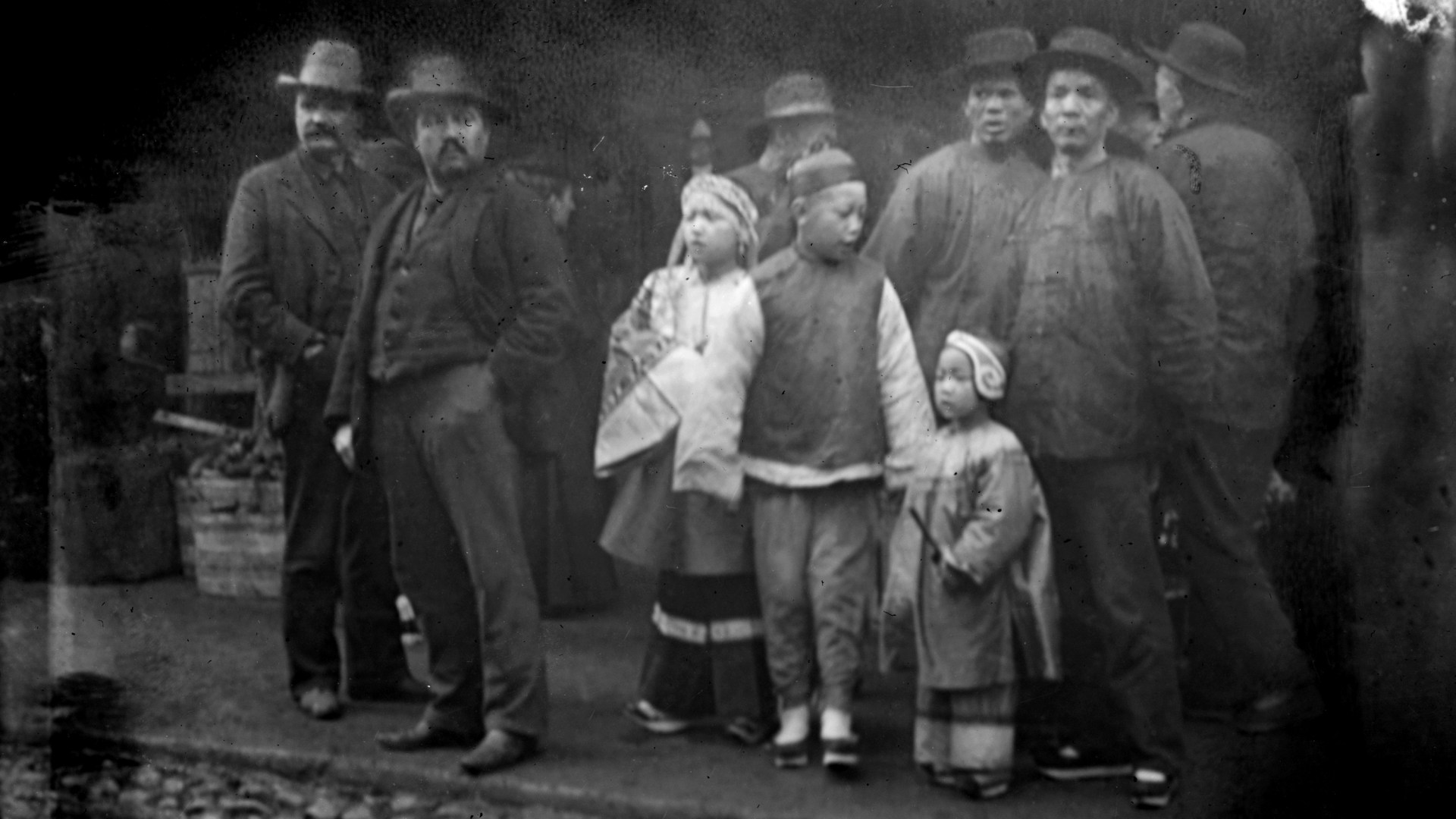
A corner crowd in Chinatown, San Francisco, between 1896 and 1906.

A corner crowd in Chinatown, San Francisco, between 1896 and 1906.

Christianity Today May 11, 2022
Library of Congress / WikiMedia Commons

Chinese Protestant Christianity was born in the crucible of Chinese interaction with European and American missionaries in the 19th century. This was an era marked by the expansion of British and American commercial and military power. After the Opium Wars (1839–1842 and 1856–1860), Great Britain successfully pried open China to the West and to Protestant missionaries. Before the United States acquired Hawaii and the Philippines, it was engaged in territorial expansion in North America. This territorial expansion was accompanied by rapid economic development that created a tremendous demand for labor. The abolition of slavery in the British territories (1807) and the United States (1863) only intensified the need for cheap labor globally.

These historical developments explain, in part, the growth of the Chinese diaspora and Chinese immigration to the United States and Canada. A small but significant presence in the Spanish, Portuguese, and Dutch colonies in the 16th through 18th centuries in Asia, the Chinese diaspora grew rapidly during British expansion. Chinese labor was crucial for the growth of the North American West. Much of California‘s agricultural industry as well as US and Canadian railroads were built by Chinese contract workers from Guangzhou.

What about the Christians? Most were delighted that the British and American powers had pried China open for the spread of the evangelical faith and cultural uplift. Abolitionists, who fought to eradicate slavery and trafficking, saw new opportunities to share the gospel of liberty and equality globally.

In the 1850s, when Chinese immigrants started to come to the United States in significant numbers, the Western Protestant missionary presence in China was limited to Hong Kong and five treaty ports. American mission societies saw an opportunity to build a transpacific Chinese Christian network that could reap the benefits of American Christianity. But even before the first Chinese church in North America (today’s Presbyterian Church in Chinatown, San Francisco) was started in 1853 by four Chinese Christian merchants, obstacles arose that would decisively shape the character of Chinese American Christianity.

First, Chinese immigrants almost immediately faced hostility. Like European immigrants, the first Chinese immigrants were adventure seekers who saw an opportunity to become rich through mining or commerce shortly after the news of gold strikes in California in 1849 spread to China. But in 1852, the state of California passed discriminatory taxes and later attempted to force Chinese out of the mines and stop Chinese immigration.

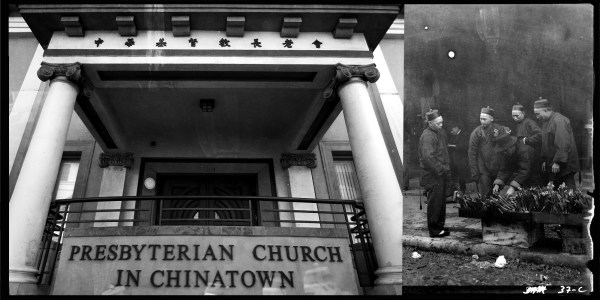
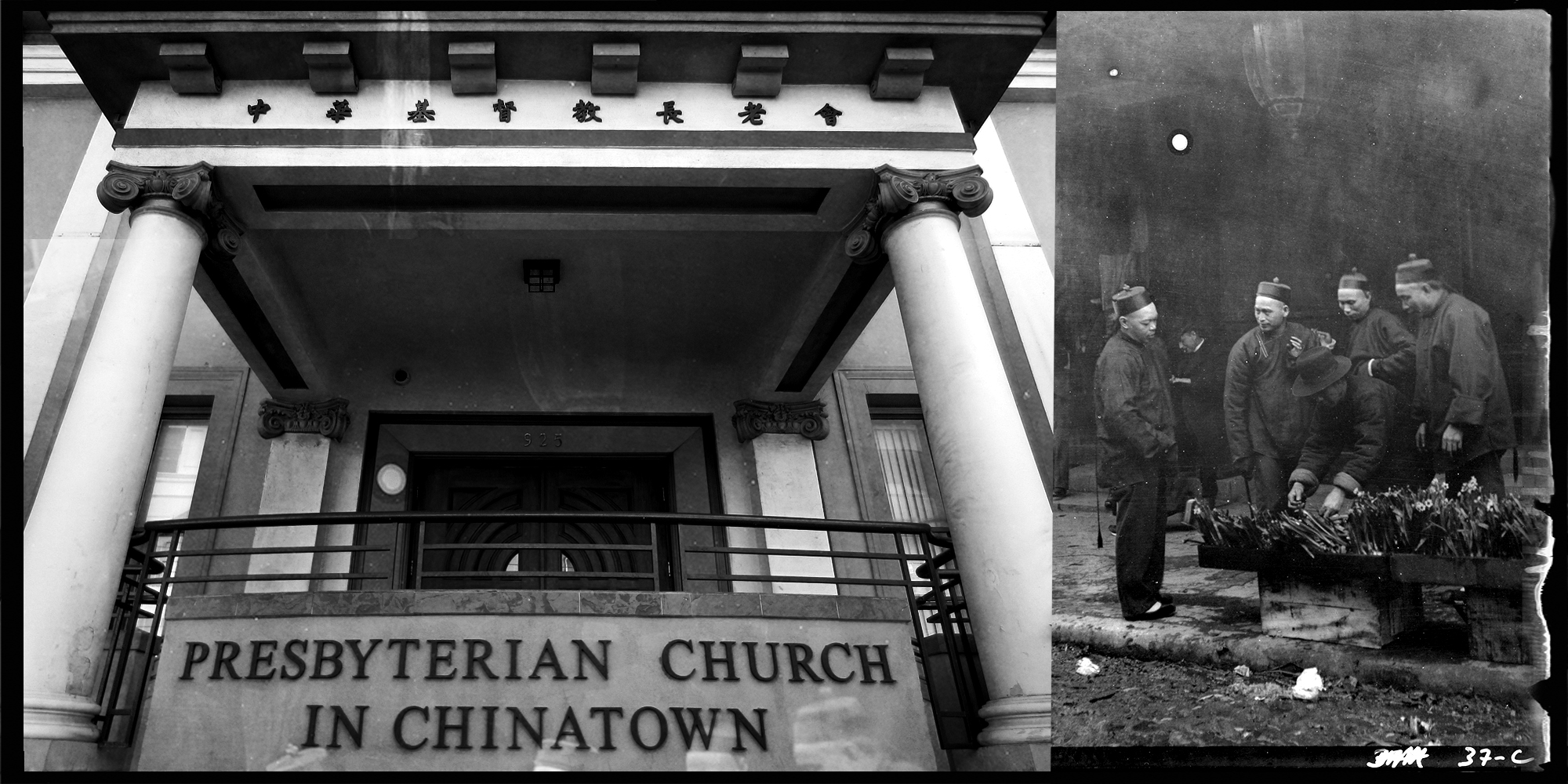
Left: Presbyterian Church in Chinatown, San Francisco, started in 1853 by four Chinese Christian merchants. Right: A lily vendor in Chinatown between 1896 and 1906.WikiMedia Commons
Left: Presbyterian Church in Chinatown, San Francisco, started in 1853 by four Chinese Christian merchants. Right: A lily vendor in Chinatown between 1896 and 1906.

Protests from the Chinese associations (including a self-described naturalized citizen and Christian merchant, Norman Asing) could not stem the growing animosity. Even the advocacy of missionaries and mission agencies could do little to prevent the US (and later, the Canadian) government from passing discriminatory immigration and naturalization laws in the late 19th and early 20th centuries.

Second, the transient, geographically scattered, and male-dominant Chinese immigrants made it nearly impossible to form stable faith communities. This was especially true during the 1850s and 1860s when most Chinese worked in mines scattered across the American West. As the mines dried up, many settled in adjacent small towns. Some started shoe – and cigar-making companies; others entered domestic service.

The construction of the Central Pacific Railroad in the 1860s brought a new wave of contract laborers. Many later worked on railroad construction in Canada, the American South, and the Northeast. A number of white congregations reached out to their new Chinese neighbors through language schools; however, they could not retain them because of cultural-linguistic barriers and Chinese work transience. An attempt to plant a Chinese Baptist church in Sacramento in 1854 was quickly abandoned. Even the Presbyterian mission in San Francisco, the only free standing Chinese Christian church in North America at the time, became inactive by 1860.

In the 1870s, however, a series of events gave birth to North American Chinese Christianity. As the Chinese population nearly doubled to 63,000 by 1870 and approached 105,000 by 1880, animus toward the Chinese intensified. They were blamed for the 1870s economic downturn in the West. Lacking the legal protection that comes with citizenship, Chinese were driven out of mining towns and many were killed. As they fled into Chinatown enclaves, they created segregated urban slums. Fueled by the backlash against Reconstruction in the South, the anti-Chinese movement quickly grew into a national movement leading to the passage of the Chinese exclusion acts of 1882, 1892, and 1902.

During this time, American missionary agencies renewed their efforts to build up and support the Chinese Christian community. Beginning in 1868, Methodist, Congregationalist, Baptist, and Episcopalian missionaries and Chinese pastors were assigned to San Francisco’s Chinatown. Before long, women missionaries accompanied them and established English language schools, community centers, and women’s rescue homes.

A number of white missionaries gained notoriety for their fearless advocacy of the rights of the Chinese. William Speer (1822–1904) not only helped plant the Chinese Presbyterian mission in San Francisco, but he also left important testimony in the California state records defending the Chinese in the face of racial prejudice. His successors, Augustus W. Loomis (1816–1891), Ira M. Condit (1833–1915), and Donaldina Cameron (1869–1968) have all left important legacies as supporters of the Chinese in North America. Otis Gibson (1825–1889), an unflinching ally who started the Chinese Methodist work, set the tone for Protestant advocacy for racial justice. Congregationalist William C. Pond (1830–1925) was supported by the abolitionist American Missionary Association. He and the Chinese Congregationalist pastors were among the most passionate preachers of the gospel of human equality. Together, these missionaries and Chinese Christian leaders provided stability for the community and channeled denominational attention and support.

The first Chinese converts were clearly drawn to the egalitarianism of an abolitionist-inspired evangelicalism. In a speech at an anniversary celebration of the Methodist Chinese Mission in San Francisco in 1875, Ma See connected the Christian view of a Creator God and Chinese rights: “If this world was created by the one universal God; if it belongs to God; if men are all created equal; if all men come from one family; if these things be so, and they are so, then the Chinese, of course have the same right to come to this land and to occupy the land, that the people of any other nation have.”

They also distinguished between what they perceived to be authentic and false Christianity. In the North American Review (1887), Yan Phou Lee noted that when “the Chinese were persecuted some years ago—when they were ruthlessly smoked out and murdered—I was intelligent enough to know that Christians had no hand in those outrages; for the only ones who exposed their lives to protect them were Christians.”

While white missionaries have been rightly accused of racial paternalism, they were among the few who protested anti-Asian violence and fought exclusionary and discriminatory legislation, albeit unsuccessfully. They modeled a postmillennial zeal that made public witness an indelible mark of Christian faithfulness. Despite their unequal collaboration with missionaries, Chinese Christians embraced a spirituality that wedded personal connectedness to God with social and political engagement. Together they built a Christian transnational network that envisioned racial uplift and national salvation.

Timothy Tseng is the Pacific area director for InterVarsity Christian Fellowship’s Graduate and Faculty Ministries (GFM) and coexecutive director of New College Berkeley. He has served as a seminary professor, nonprofit founder, and pastor. His PhD dissertation was titled “Ministry at Arms’ Length: Asian Americans in the Racial Ideology of American Mainline Protestantism, 1882–1952.”

Originally published in 2020 winter issue of ChinaSource Quarterly.

Books
Review

Do Single Christians Need a Better Theology of Singleness, or Better Relationship Training?

As two recent books demonstrate, the answer is both—together. (And not only for singles.)

Christianity Today May 11, 2022
Illustration by Rick Szuecs / Source images: FabrikaPhoto / DragonImages / Envato Elements

Marriage is on the decline, at least in the United States, but whether you see that as a crisis or an opportunity depends on how you frame ideal life and community. As two recent books show, it’s possible for Christians to reach very different conclusions about the current state of relationships. That’s a good thing.

Singleness and Marriage After Christendom: Being and Doing Family

Those who lament declining marriage tend to focus on what it means for families and children—and rightly so. Less-committed relationships produce well-documented challenges for the children born and raised in such pairings.

But declining marriage doesn’t just mean weaker family structures. It also means more entirely uncommitted people: more singles. As theologian Lina Toth argues in Singleness and Marriage after Christendom, “today’s surge in the number of single people is actually an opportunity for the church to reconsider both singleness and marriage as distinctly Christian ways of living.”

Authors John Van Epp and J. P. De Gance take a very different view in their book Endgame: The Church’s Strategic Move to Save Faith and Family in America. “If [churches] want to turn the tide of a declining Christianity,” the authors write, then they “must build intentional communities anchored in championing healthy relationships that lead to and revitalize God-affirming marriages.”

Singleness then and now

Toth anticipates such views. Her largely historical work puts the prevailing Christian view of singleness and marriage in a much-needed and often fascinating context. Whereas Van Epp and De Gance focus mainly on changes in the 20th and 21st centuries, Toth goes back to the start of the church.

What she finds is both predictable and surprising. Not surprising: laments about the family’s decline, which are nothing new. But surprisingly, those the Romans “accused of destroying family and … society were none other than the Christians” (emphasis mine).

If you’re thinking that’s because Romans saw “family” differently than we do today, that’s true, Toth says. But so, too, did the Christians they found so threatening. She cites the early believers’ “insistence that, for the followers of Jesus, their primary community was to be the new creation called the church,” which posed a radical threat to perceived norms.

This view of the church held significant appeal for women, many of whom had few options for adult life outside marriage and little agency within marriage. As Toth recounts, singleness in Christian community enjoyed several centuries of esteem, especially for the widows and never-married women, for whom it offered many benefits.

With the advent of increased legal standing and birth control, modern women of all faiths and none now expect freedoms that once existed mainly for single Christians. (For a fascinating take on this that, importantly, breaks the near-monopoly of white, European/American commentary on singleness, see Amia Srinivasan’s collection of essays, The Right to Sex.)

Toth does not reckon with the church’s reduced role in empowered singleness, perhaps because she’s trying to challenge Christians’ frequent binary (and nonbiblical) approach to partnership, which deems marriage good and singleness mostly bad.

It would be just as faulty to deem singleness better or worse depending on a person’s faith (or lack thereof). Christian singleness can be agonizing. Secular singles sometimes have a better handle on what their season of life allows. But secular singleness can also bring deeply painful relationships, especially those that produce children. And Christian singles are often caught in the middle of different cultural standards.

To this practical challenge, Van Epp and De Gance have devoted much of their lives—work that deeply informs Endgame. Van Epp, a Protestant, has developed and taught the relationship curricula that figure prominently in the book. De Gance, a Catholic, helped found the initiative now called Communio, a nonprofit that helps churches strengthen marriages in their communities.

In the first third of Endgame, the authors describe the problem their book addresses, drawing on original research that found a surprising connection between parental marriage and adult church involvement. The second third turns to healthy relationships, arguing that “most Christian churches fail to offer relationship skill training as a counterpart to their emphasis on virtue development.” The final third lays out a plan for churches to develop relationship ministries as a way to engage their communities and strengthen their congregations.

My first impression of Endgame left me skeptical, despite a positive previous encounter with Van Epp’s writing on relationships. (His then-titled How to Avoid Marrying a Jerk gave me significant help in moving on from a painful romantic disappointment; it remains one of the wisest dating guides I’ve seen.) The cover of Endgame depicts a church sinking beneath the sands of an hourglass. The title and subtitle strike an ominous note. With a sinking heart, I braced for yet another piece of Christian handwringing over marriage that ignored the church’s quite substantial sex gap.

Thankfully the book proved more than that. While some of their ideas for celebrating marriage will likely deepen the pain of singles (based on my conversations with 300-plus Christians in nearly 40 countries), Van Epp and De Gance repeatedly acknowledge those of us without partners. And they do not ignore older singles, like widows and divorcees.

Endgame also notes the sex gap and encourages churches to think about outreach likely to draw more men into their community. (I’m not convinced that evangelism will change the sex gap much, but at least they acknowledge it exists! Many Christians could learn from them.)

Perhaps Endgame’s most significant contribution, however, comes in a finding that even Toth could stand to reckon with. De Gance describes how, in his role at Communio, he commissioned sociologist Mark Regnerus to conduct a survey on American religious affiliation. Initially, the findings echoed what many other surveys have shown: a seeming correlation between religious attendance and age. But when De Gance asked Regnerus to filter responses by family of origin, “We had a pretty big ‘Aha!’ moment,” he writes.

Their discovery? “Differences between age groups in church attendance vanish if you control for just one variable: parental marriage.” When adults’ parents have stayed married, people attend church at a fairly similar rate, regardless of age. In addition to all their other well-documented challenges, children of divorced or unmarried parents also seem to struggle with or be less interested in church commitment.

Better together

Because both these books come from smaller presses, it’s likely that many readers haven’t heard of them. But if I had my druthers, most readers of these books would encounter them like I did: together.

As much as they try to acknowledge singles, Van Epp and De Gance seem to hope that a combination of effective men’s outreach and relationship ministries could reduce a lot of singleness in the church. Toth serves as a strong counterbalance to this. But in trying to avoid common problems around discussing sexual activity, she errs on the side of addressing its role in singleness too little.

Toth gives many compelling examples of how vibrant Christianity community has helped singles since the time of Jesus meet nearly all their needs. In doing so, she positions singleness as a viable life season that can be just as meaningful as marriage and sometimes richer. But for Christians who try to follow the traditional biblical ethic, sex remains the one area for which singles have no alternate provision.

For most Christian singles, this leads to some combination of sex outside marriage, struggles with pornography and masturbation, and lots of guilt and shame around our bodies and sexuality. It doesn’t help that churches’ attitudes toward marriage tend to sanction married sex and sexuality as inherently obedient and therefore mostly sinless, as opposed to the primarily sinful sexuality of singleness.

Van Epp and De Gance don’t address the challenge of single sexuality directly, but their book consistently frames relational training as something all Christians could benefit from. This significantly destigmatizes it and, in its own way, helps bring a measure of the equality Toth aims to advance. Their emphasis on relational skills also provides ample support for single Christians whose struggles with sexuality affect their relationships. (And how, as an inherently relational act, can sexual intimacy not affect relationships?)

Integrated conversations

One of the greatest challenges of Christian singleness for most of us is its uncertainty. During my four years at Redeemer Presbyterian Church in New York City, Katherine Leary, as she was then named, served as a powerful example of an older Christian single woman.

Though I never learned much of her story, I knew that she’d had a vibrant career, discovered Jesus, and found a meaningful full-time role helping Christians of all life stages think about how their work could help further God’s kingdom. Hers wasn’t exactly a life I aspired to (I really wanted marriage), but I admired the kind of work to which she’d committed her midlife singleness. It gave me a picture of the purpose my own life could find, even if God continued to withhold marriage from me.

Then one day, I noticed her name had changed. She had married—a story I’d someday love to hear. Another friend has told me of a now-dead woman who spent all her life doing missions work alone … and then married unexpectedly in her 80s.

No single person knows what the future holds, any more than any married person does. (Most singles are likely more aware of our uncertain future, however.)

We will all be single at least once, if not twice. For that reason, all Christians need the vibrant picture of the church as our ultimate family to which Toth’s book calls us. But we also all live with the broken and imperfect relationships that De Gance and Van Epp want to help us improve.

Churches and pastors that want to read these books would gain much from a group discussion engaging both texts. And importantly, these two books provide ways for single and married Christians to talk with each other about what kind of community we’re all called to. Becoming the integrated body Jesus intended starts with more integrated conversations.

Anna Broadway is the author of Sexless in the City: A Memoir of Reluctant Chastity. She lives in Alaska, where she is working on a book about the global experience of singleness, due out from NavPress in fall 2023.

News

Why Tennessee Is Just Now Looking at Lifting a Ban on Clergy in the Legislature

A Presbyterian was burnt in effigy, a Methodist was shot in the leg, and that’s just the start of the story of this constitutional prohibition.

Tennessee state senators bow their heads in prayer.

Tennessee state senators bow their heads in prayer.

Christianity Today May 10, 2022
Mark Humphrey / AP Images

Tennessee voters will decide this fall whether to lift a ban on clergy serving in the state legislature. The ban hasn’t been enforced since 1978, when the United States Supreme Court ruled it unconstitutional, but it’s still written in the state constitution, as it has been since Tennessee was founded.

The state senate and assembly have put an amendment on the November ballot so voters can change that. Tennesseans will be asked if they would like to strike section 1 of article IX, which says that “no minister of the Gospel, or priest of any denomination whatever, shall be eligible to a seat in either House of the Legislature.”

The change was proposed by Republican state senator Mark Pody, a conservative evangelical from outside of Nashville. Pody believes “Our fore fathers founded this nation on Christian biblical values.” It’s one of the five core issues he lists on his website. “I adhere to such principles,” he writes.

But when he was asked why Tennessee’s forefathers barred Christian ministers from becoming lawmakers when they founded the state in 1796, Pody didn’t have an answer.

“That’s a great question,” he told the Chattanooga Free Times Press. “I don't know the back story or why they put it in originally.”

He’s not alone. The history of the constitutional clause keeping clergy out of the legislature is obscure, even among scholars who study the separation of church and state. Section 1 of article IX isn’t a part of anyone’s standard historical narrative.

The strange story of why Tennessee is only now considering changing the constitution to allow ministers into the state legislature involves Anglican oaths, Presbyterian effigies, fighting Methodist, and Baptists breaking tradition.

A tool for religious disestablishment

The legal language originally comes from England. Because England had an established church, its ministers were vested with the authority of the state and so couldn’t be involved in electoral politics, just as today it would be seen as a problem if an active-duty soldier ran for Congress.

But when the newly independent American states started to disestablish religion—working out the legal ways to separate church and state—this establishment rule seemed useful. Instead of abandoning the old law, Georgia, South Carolina, North Carolina, Virginia, Maryland, Delaware, and New York all incorporated it into their new constitutions.

Not all advocates of the separation of church and state approved. James Madison, who drafted the US Bill of Rights, thought disqualifying ministers from representative government was a travesty.

“Does not the exclusion of ministers of the gospel, as such, violate a fundamental principle of liberty by punishing a religious profession with the privation of a civil right?” he wrote to his friend Thomas Jefferson.

Jefferson wasn’t swayed. Though he believed that “all men shall be free to profess … their opinions in matters of religion, and that the same shall in no wise diminish, enlarge, or affect their civil capacities,” he included the line disqualifying ministers from the state legislature in his draft of the Virginia state constitution.

Jefferson’s position carried the day.

One reason was widespread animosity toward Anglican clergy. Most opposed the American revolution. Anglican priests took an oath to the king in their ordinations, and in every service prayed that God would save him. This put them at odds with the new nation, freshly free from that same king. A lot of them fled. In Virginia, more than two-thirds of the Anglican churches closed. In North Carolina and Georgia, the once-dominant church dwindled to one priest and one parish each. And the new states, drafting their new constitutions, were not eager to give them a way to gain back any power.

After the revolution, half a dozen additional states, including Kentucky, Mississippi, and Tennessee, adopted the same legal language about ministers.

Stuck between fighting Presbyterians

The founders of Tennessee may have also been influenced by what happened in the state of Franklin (or, as it was sometimes called, “Frankland”). A group of white settlers attempted to separate from North Carolina and establish a new state in what is now East Tennessee in the mid-1780s. A proposed constitution was drafted by a Presbyterian minister—and then successfully shot down by another.

The first, William Graham, proposed that only orthodox and moral men should make laws. He drafted a constitution that required representatives agree that there are three persons in the Godhead, co-equal and co-essential, along with other theological statements. But Graham wasn’t picturing where his fiercest opposition would come from: another Presbyterian.

Hezekiah Balch, on the other hand, was used to fighting his fellow Presbyterians. He was an advocate for evangelical revivals and continually clashed with the Old School Calvinist leaders who disapproved of the excess and emotions. In the process, Balch developed a strong personal aversion to religious authorities. He went out of his way to oppose Graham’s constitution, arguing it didn’t sufficiently protect religious liberty in the new state.

The disagreement started with dueling speeches. That led to a volley of aggressive pamphlets and expanded to include theological issues such as election and revivalism.

And it got personal. Graham said Balch was trying to make room for evil in local politics.

“It is objected that [the constitution] excludes some men of great ability and experience who might do good,” Graham wrote in one pamphlet. “The devil has great ability and long experience.”

He was subsequently burned in effigy.

The escalating dispute was brought before a church judiciary—where it threatened to split the regional synod.

A decade after the dispute divided the unborn state of Franklin, the state of Tennessee was founded with a constitution that was mostly borrowed from North Carolina. The founders decided to keep that line barring clergy from the state legislature.

They thought of Methodists

Over the next 100 years, almost all the other states got rid of the prohibition on clergy in the legislature. But not Tennessee. In Tennessee, when state leaders thought about pastors becoming politicians, they didn’t think of their own pastors or people they liked. They thought of Methodists.

Methodists like William Gannaway Brownlow. A circuit-riding Wesleyan who was once shot in the leg in a theological dispute, Brownlow earned the nickname “the fighting parson.” After years preaching he switched from pulpit to press and became a sarcastic newspaper editor and fierce opponent of secession and the Confederacy. Then he became governor during Reconstruction. (The constitution might have prohibited him from taking a seat in the state assembly or senate, but it never said anything about governor.)

Brownlow was a force as governor. He was racist by the standards of his own time, but he hated Tennessee’s Confederate traitors more than anything, so he became a radical Republican and dedicated his political career to punishing Confederates and securing civil rights for Black people.

It didn’t make him popular. And it didn’t persuade many state leaders to make it easier for ministers to go into politics.

After Brownlow and the end of Reconstruction, Tennessee saw a flood of politically active Methodists as the church grew rapidly. One preacher at the time claimed there were nearly 3,000 preachers who “would not hesitate” to be called political partisans. They picked up the banner of prohibition, and one Methodist minister from north of Nashville ran for governor on the Prohibition Party ticket.

For those opposed to prohibition—and its related reform effort, women’s suffrage—it was obvious why Tennessee’s forefathers had prohibited ministers from becoming lawmakers.

“Methodist preachers divert themselves,” one prominent state judge complained at the end of the 19th century, “from the care of souls to the task of amending constitutions.”

Judge Jere Black hurried to clarify he didn’t have any problem with the people in the pews or preachers who didn’t advocate for women’s right to vote. But, he said, politically active Methodists were undermining democracy and eroding the separation of church and state.

“Christ and his apostles kept them perfectly separate,” he wrote. “They expressed no preference for one form of government over another. They provoked no political revolutions, and they proposed no legal reforms.”

Other states at this time revised their constitutional provisions against ministers in the legislature. Tennessee kept section 1 of article IX in place.

Used to stop Black Baptists

It was Baptists who finally broke the constitutional ban on ministers in the legislature. Two Black Baptists in particular: Roy Love and Paul McDaniel.

Love was pastor of Mt. Nebo Baptist Church in Memphis, and he got involved in the civil rights movement, fighting poll taxes and registering Black people to vote. In 1954, he decided he could do more as a state senator and announced he was going to run for office.

The initial reaction was surprise. “It was the first time in the memory of local political observes that a Memphis Negro has presented himself as a candidate for political office,” a Memphis paper reported.

Journalists asked him if he didn’t think he would lose, but Love was undeterred.

“It won’t be the first time we’ve lost,” he said.

Then someone in power remembered the constitutional prohibition, and Love was told he was disqualified. Even if he took a leave of absence from the church, the state said, he couldn’t serve in the legislature.

Paul McDaniel, pastor of Second Missionary Baptist Church in Chattanooga, tried again 23 years later. He ran to be a delegate to the 1977 constitutional convention, where Tennessee would consider amendments to end segregated schools and a ban on interracial marriage. Delegates had to meet the same standards as legislators to qualify, however, and his opponent sued to keep McDaniel off the ballot.

The case went to the Supreme Court. The Southern Baptist Convention’s public policy arm and the American Civil Liberties Union both wrote to the court to support McDaniel, defending the rights of ministers to get involved in politics.

On the other side, an assistant attorney general for the state of Tennessee argued the constitutional ban wasn’t an arbitrary discrimination against ministers but had an important purpose: the separation of church and state.

Victory for political ministers

The court disagreed. Chief Justice Warren Burger wrote that Tennessee was making the ability to exercise a civil right—the right to run for office—conditional on the surrender of a religious right, the right to be a minister. Seven justices signed on to the opinion and one abstained, giving McDaniel a unanimous 8–0 victory.

The first minister was elected to the Tennessee legislature the next year. Ralph Duncan was a white Pentecostal from Western Tennessee. He ran as a Republican, won, and served four years before he decided to leave politics and start a new church.

He was followed by more ministers in the legislature, some of whom served with distinction and some who were little noted outside their districts, until the sight of clergy at the capitol became, for the most part, unremarkable. But section 1 of article IX of the Tennessee constitution stayed on the books, a vestigial reminder of the complicated and confusing history of religious liberty and the ongoing fights over the relationship of churches and states.

State legislatures may not know the whole backstory, and voters most likely have never heard of the Baptists, Methodists, Presbyterians, and Anglicans who ran up against that constitutional rule. But they’ll decide in November whether they finally want to get rid of it.

News

The Supreme Court Leak Was an Unplanned Complication for Pregnancy Centers

Caught in a national firestorm, Christian groups focus on local needs of women preparing for babies.

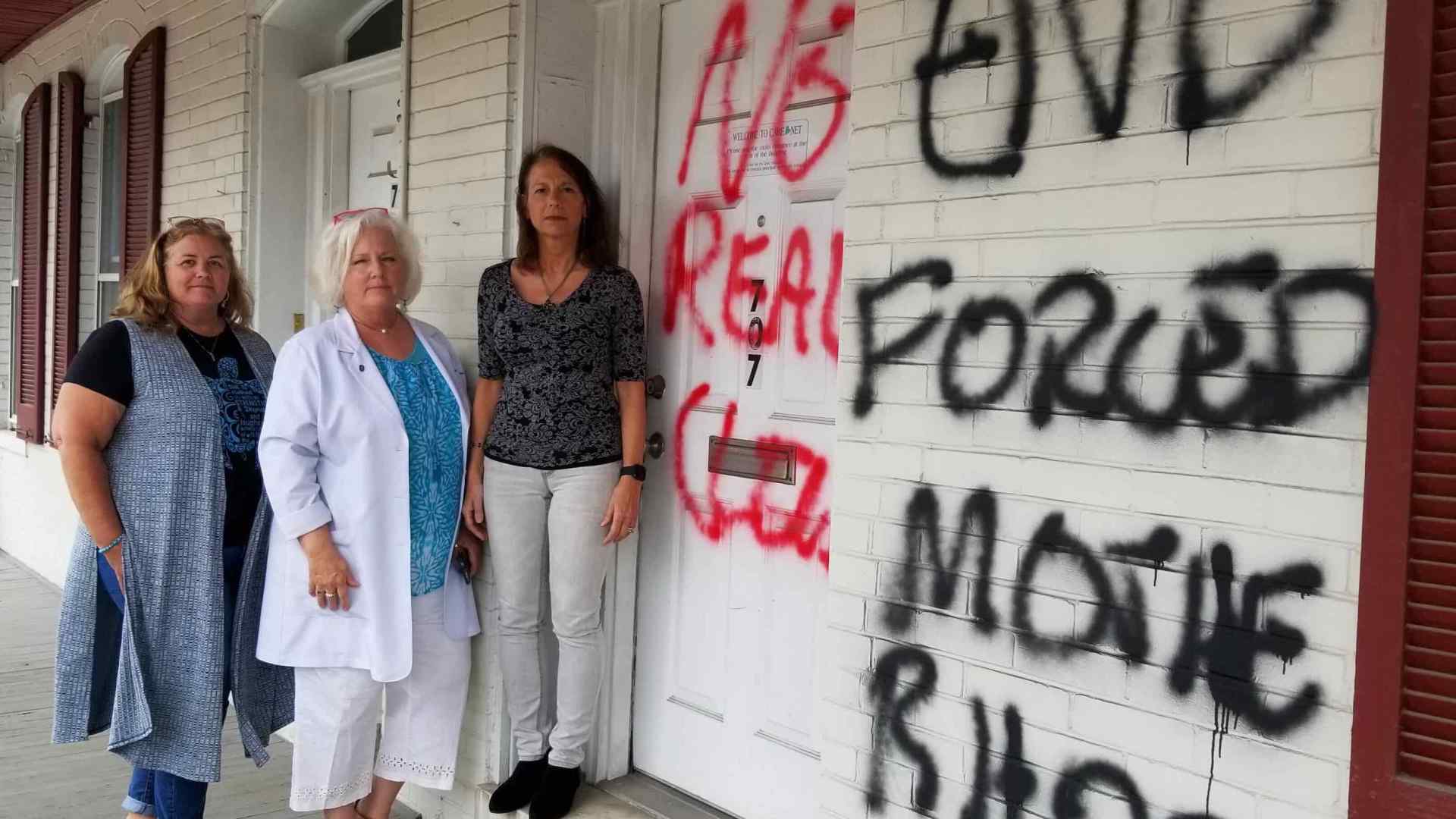
Care Net staff arrived at work in Frederick, Maryland, to find graffiti.

Care Net staff arrived at work in Frederick, Maryland, to find graffiti.

Christianity Today May 9, 2022
Courtesy of Care Net

Penni Hill never expected First Step Pregnancy Resource Center in Bangor, Maine, to become a target of pro-life protestors. The pregnancy center is, after all, a pro-life alternative to an abortion clinic, helping women choose to carry their pregnancies to term.

But days after the leak of a draft of a Supreme Court ruling overturning Roe v. Wade, some phone calls came in, with people shouting that abortion is murder. As the temperature of the national debate spiked, some angry people were getting confused about who was on whose side. Then the director of the pregnancy center found the center’s sign and sign holder on the front door ripped off.

“We’ve never had anything here like that,” said Hill, whose center has a good enough relationship with the local health department that it refers clients to the center for parenting classes. “The town has been in an uproar.”

In Maine, even if the Roe reversal comes to pass, abortions would still be legal until viability, or 24 weeks. Hill spoke to the local media in Bangor, serving as a counterpoint for stories about protesters defending the right to abortion.

Meanwhile, she and other pregnancy center leaders in both red and blue states said that the women they are serving haven’t brought up the news at all.

“I don’t know if our clients know what’s going on,” Hill said. “If they’re dealing with an unplanned pregnancy, they might not be paying attention to the news.”

For women thinking about having an unplanned baby, there are more pressing concerns, like the national shortage of infant formula. Melanie Miller, executive director of Ashland Pregnancy Care Center in Ashland, Ohio, said on May 5 that their center did an outreach with a formula giveaway and one mom came in sobbing because she hadn’t been able to find formula anywhere.

Pregnancy resource centers—faith-based pro-life organizations that offer services ranging from basic counseling to full medical care for women with unplanned pregnancies or other needs like STI testing–find themselves in the middle of a chaotic situation. The news that the Supreme Court might overturn the 1973 decision that legalized abortion across the country left them tense, not triumphant.

They were anticipating a possible ruling in June. They weren’t prepared for the political upheaval without an actual decision.

Some pregnancy centers have experienced vandalism since the leak. Two days after the leak, someone busted the windows of the Southeast Portland Pregnancy Resource Center in Oregon and spray-painted an obscenity about pregnancy centers. The center, which has medical staff who do ultrasounds and testing for sexually transmitted infections (STIs), is part of an umbrella organization, First Image, that also does grief care for miscarriages, stillbirths, or women who are post-abortive or grieving an adoption.

“I believe that when the world heats up, it should be a call for us to lean into redemptive work,” said executive director Luke Cirillo in a blog post about the vandalism.

In Wisconsin, police reported that someone had set on fire the office of a political group opposing abortion, writing in graffiti, “If abortions aren’t safe then you aren’t either.”

Staff arrived at work on May 4 at another pregnancy center, Care Net in Frederick, Maryland, to see graffiti covering the building. The red and black graffiti read, “Fake clinic … end forced motherhood … abortion is a human right.”

If Roe is overturned, Maryland will continue to allow abortion up to viability, and for a woman’s life or health after viability. A donor to the center who owns a construction company had the graffiti painted over by late afternoon. Inside, the center was hosting a healing class for post-abortive women.

“It’s disturbing and unnerving,” said executive director Linda King. “We are a real clinic, we have all the licensures required by the state, our doctor is a licensed ob-gyn in the state of Maryland.”

It’s not always clear what precisely motivated an attack though. The night before the vandalism, a heated local board of education meeting discussed STI testing awareness for middle schoolers, King said, and a school video pointing teenagers to Planned Parenthood for testing. One former board member of the pregnancy center stood up at the meeting to say that Care Net also offered free STI testing. King wasn’t sure whether the graffiti was related to that local discussion or the Supreme Court leak, or both.

Care Net is installing more security cameras around the building.

A new generation of pregnancy centers has tried to be less political and focus on serving a variety of needs pregnant women have, during the pregnancy and after. Most centers advertise what specific services they offer and make clear that they do not perform abortions.

“I believe we should be out front and honest from the get-go. Nobody likes a used-car salesman,” said Savannah Marten, executive director of The Pregnancy Center of Greater Toledo in Ohio.

New York City, meanwhile, has on its department of health website a section titled “Avoid Fake Clinics,” referring to pregnancy centers, and links to a “fake clinic map,” which includes the most inoffensive of faith-based counseling and support centers.

Anne O’Connor, the vice president of legal affairs for NIFLA, an umbrella organization for pregnancy centers, said they are calling on centers to increase their security.

Pregnancy centers avoid celebrating—and social media

A number of pregnancy centers CT contacted said they were under a media blackout, either from their parent organizations or self-imposed. They didn’t want to be commenting on an uncertain situation, or make themselves targets in the debate.

The Pregnancy Center of Greater Toledo in Ohio had a statement prepared for a possible Supreme Court overturn of Roe. But they decided not to release anything because of the uncertainty around the leak. Marten, the executive director, said the news and social media chatter, especially about the pro-life side not caring about women, has been “exhausting.”

“I try to shield my team from it here,” she said, telling them not to get online and try to defend themselves. “I saw a post on Instagram: ‘I’ve never met a pro-life person who is addressing access to health care, accessible childcare, college education.’ Hundreds of people are commenting, ‘Yeah I’ve never met one of those.’ I’m thinking I’m going to lose my mind. We’re here!”

“We’re getting women into housing same day, we’re getting them out of domestic violence same day, we’re getting them furniture the same day,” Marten continued. “For my team to go home every day and turn on the news and social media and get gaslit, saying, ‘If you really cared …’ It’s an emotional toll.”

Centers find it difficult to connect some of the national discussion with what they see in their local communities. Marten said her center has a “pretty good” relationship with the abortion facility in town, where the abortion facility understands the work the pregnancy center does, but she said that took five years of work. Still, given the national debate, her center did a safety briefing for staff after the leak.

Clientele up, but not because of the case

While pregnancy centers in blue states anticipate a higher number of clients seeking abortions across state lines, pregnancy centers in red states are also trying to adjust how they serve clients. Texas pregnancy centers saw an immediate influx of women in need after Texas passed a law banning abortions after six weeks.

“Overnight it changed the way pregnancy centers did their ministries,” said Miller, the Ashland executive director. “A woman doesn’t have the time. She needs to make a decision right away.”

Individual situations, of course, don’t always map onto national debates. Miller said five weeks after spring break is always a busy time for her center, but she hasn’t heard any client bring up the issue of Roe being overturned. The Pregnancy Center of Greater Toledo has seen a significant increase in abortion-minded women this year, but Marten hasn’t heard too many people talking about the Supreme Court.

“What brings them through our doors doesn’t have a rhyme or reason,” she said.

Lisa Hogan, the executive director of Sav-A-Life pregnancy center in Birmingham, Alabama, said pregnancy centers serve people by being constant and not changing their approach with the ups and downs of the fight over abortion, politics, and the news.

“We’re not changing anything we’re doing. We’ve been doing it for 42 years,” said Hogan. “We may get busier. … We’re gonna meet them right where they are, love them right where they are.”

News

Despite Pandemic Holdups, Christians Keep Shifting Foster Care Approach

Advocates address COVID-19 fallout and focus on family unity.

Christianity Today May 9, 2022
Lindsey Howeler / Lightstock

For tens of thousands of vulnerable children whose lives and families were already unstable before COVID-19 hit, the pandemic brought further disruption, unpredictability, and loss.

Prior to 2020, the child welfare system in America had begun to adjust its approach. The focus among Christian ministries, advocates, and government programs had increasingly turned to prevention and early intervention for at-risk families to get the support they need.

There’s been a “huge shift” recently, according to Cheri Williams, senior vice president of domestic programs at Bethany Christian Services, as systems work to find ways to “keep kids safe and protected with their [biological] families.”

The Families First legislation, passed in 2018, addressed strains in the foster care system by promoting ways to keep children being removed unnecessarily from their parents. The law offered more help for kinship guardians—relatives who could care for children in need—while aiming to reduce the need for fostering and limit group home options to the most difficult situations.

The coronavirus derailed some of those plans, as everything from funding to placements to preventative programs slowed to a halt amid government lockdowns and insufficient, makeshift virtual solutions. Agencies and advocates are now attempting to move forward with pre-pandemic plans, but the consequences of the past couple of years still linger.

Foster care entrances were down by 14 percent from 2019 to 2020, according to data released late last year, but not for lack of need. Rather, there were fewer opportunities to see and report abuse or neglect.

The Administration for Children and Families found that parental terminations were down by 11 percent in 2020, and 8,000 fewer children were adopted in 2020 than in 2011, likely due to lack of oversight and COVID-19-induced, bureaucratic stall.

According to the Children’s Bureau, a federal agency, more than half the decrease in entries occurred in March, April, and May, just as stay-at-home orders across the country were enacted. Calls to child abuse hotlines were down in most states, and runaways and child deaths increased by 13 percent and 6 percent, respectively.

Megan Perry is a Christian foster parent and volunteer guardian ad litem (GAL) in Noblesville, Indiana. She fostered and worked with children throughout the pandemic. In her role as a GAL, also known as a court-appointed special advocate or CASA, she would check in with kids over video calls, often with parents just out of frame.

“It’s hard when you aren’t actually there to say is the neglect and abuse still going on or is it a parenting style,” she told Christianity Today. “You can only see very small things on video, and you can’t be in the home or go to the school, and it’s all just so impersonal.”

Because of the lack of access, Perry couldn’t be sure she was learning everything necessary.

For kids in foster care, if the trauma of home separation wasn’t bad enough, they had to go stretches of COVID-19 lockdowns with no in-person contact with their parents at all.

“The kids on my caseloads wanted to see their parents so unbelievably bad,” she said. “And they would just get 15 minutes of Zoom with them.”

Some of those same children, those who might have been reunited with their families in another year, were separated longer because of delays in foster care exit requirements.

Delayed court procedures, parenting classes, and drug treatment programs required for families to get their children back caused a system freeze, leaving children to linger in care without their parents. The other issue was COVID-19 itself. More than 200,000 kids in the US lost a parent or caregiver to the virus, creating more need on an overburdened system.

And though experts believe the best place for children who can’t be with their parents is often with kin caregivers, those family members are disproportionately older, putting them at higher risk for the virus. This meant fewer foster families and caregivers were available to open their homes, and less oversight and opportunity for children to get back to their biological families.

Weeks into the pandemic, Bethany president Chris Palusky predicted this result. “The coronavirus has already claimed millions of victims,” he wrote for CT in April 2020. “Whenever the COVID-19 crisis ends, we will need homes for a different kind of victim: the additional children entering foster care over the coming weeks and months.”

In many states, the foster care system was already struggling before COVID-19. Last year, a shocking study reported that 978 children went missing from Missouri’s foster care system in 2019. The state is not an outlier. Gen Justice, an organization that exists to protect and represent vulnerable children, found that 20,000 children “disappear” from foster care every year nationwide.

Jedd Medefind, president of Christian Alliance for Orphans, said the stories of missing children are a heartbreaking glimpse into the foster care system and a call to the church to step into a “vital role.”

May marks National Foster Care Month. The church “can’t outsource” the responsibility they have to help “provide caring homes and supportive communities” for those within the child welfare system, he said.

CAFO works with churches across the country to “grow effective adoption, foster care and global orphancare rooted in the local church.”

About 40 percent of Protestant churchgoers say their congregation had been involved with adoption or foster care, according to a 2018 Lifeway Research survey, and a quarter knew someone at their church who had fostered children.

Some fear many of the missing—usually runaways—may be getting trapped into the sex trafficking industry. Studies out of the University of Connecticut found that half of sex trafficking victims had been part of the child welfare system or juvenile justice system at some point. The National Center for Missing and Exploited Children estimated that, of children reported missing in 2021, 19 percent were likely victims of sex trafficking.

Gen Justice worked to help pass a bill in Arizona that would require the immediate reporting of missing foster children through a photo ID system integrated with search and rescue. “Our missing kids will now also be reported to law enforcement within two hours, rather than weeks later or not at all,” wrote Gen Justice Founder Darcy Olson.

Despite these challenges, child welfare advocates are on a mission to protect more children through preventative and early intervention services that keep families together. Through Families First funding, foster agencies, ministries, and other organizations work with families before the need for foster care arises.

The legislation provides funding for parents to cover mental health services, substance abuse treatment, or parenting skills classes. It also allots funds for families providing kinship care and for vulnerable youth who are aging out of the foster care system without support up to the age of 23.

“We’re shifting to say, ‘Hey, how can we, as the body of Christ and the church, come alongside those who are struggling?’” said Williams. “How can we learn to be good neighbors, as believers can and should, versus judging families that are struggling?”

Williams believes Bethany’s mission as a Christian organization is to listen to the voices of foster families and children and to find innovative solutions in partnership with given federal resources.

Even with pandemic restrictions lifted, job loss, addiction, depression, anxiety and other negative responses could make the task of biological-family unity harder.

“As Christians, we have a clear imperative that God designed the family as his best for his children,” said Medefind, who supports new changes in the Families First legislation to support families but hopes to see continued improvement on the side of child protective services as well. “Taking from one [source of funding] and moving it to the other is going to leave many children highly vulnerable.”

Because Families First directs funds to family unification and prevention, some of the funding for child protective services, money that goes toward foster care programs, has been diverted. Various components of the Families First legislation have been rolled out over time. The next piece of the bill is set to be in place by the end of 2025, when the US Government Accountability Office will submit an evaluative study to Congress.

Other helpful tools, like the Supporting Foster Youth and Families Through the Pandemic Act, were also passed. This act banned states from allowing a child to age out of foster care before October 1, 2021, giving young adults an option to return to foster care and receive funding if necessary.

With 23,000 youth aging out each year, many of whom become homeless, this bill was important. Money, however, is just one facet of helping these young adults succeed.

CAFO’s “Aging Out” Initiative was developed to equip churches to walk with children aging out of the system through a series of steps, including life skills training, transitional housing, spiritual mentoring, career development and church and community support.

Other programs, like San Antonio’s Thru Project, are locally based and began out of faith-based ministries or churches. The Thru Project helps those aging out secure housing, get life skills training, and obtain free cellphones and career training. “Life is never simple for young people transitioning into adulthood without the support and care of family,” said Medefind. “COVID and our response to it dramatically amplified that strain and isolation. The one thing that every aging-out youth most needs—strong relationships—was put all the more out of reach.”

How CT Encourages an AI Technologist to Stand Firm in Tough Times

Joanna Ng finds inspiration through the actions and writing of Timothy Dalrymple and Russell Moore.

How CT Encourages an AI Technologist to Stand Firm in Tough Times
Photo Courtesy of Joanna Ng

Joanna Ng has 47 patents granted to her name. She’s had a successful career at IBM and now runs her own artificial intelligence initiative. In 2020, she was highlighted in a CT piece profiling 12 Christian women in science and that same year wrote about how her faith has shaped her views on AI.

Ng entered the tech industry with a strong belief that God had called her to a field largely dominated by atheists. Growing up in a church culture that regarded work as “secular,” and an unspoken expectation that those who loved the Lord would leave their “worldly” careers to go into full-time ministry, she felt Christians misunderstood and invalidated her call to the tech industry. She went through seasons of doubt, but Ng says the Lord confirmed his plan for her again and again through unusual circumstances.

In the midst of her isolation, Ng prayed for a female mentor who loved Jesus and was passionate about technology. Over the years, she felt the nudge to become the answer to her own prayer for others, as more Christians felt called to the tech field. That led Ng to found the ministry Kingdom on Earth.

“I started this because I felt more Christians want to live a life worthy of Christ, believing that God divinely set them apart in the field of tech, or in other industries,” Ng said. “My desire is to gather such a community for spiritual equipping and iron-sharpening-iron. We need to go deeper to process how our identity in Christ shapes the work of our hands, how to purify our ambition to seek his glory, what it means to seek first his kingdom and his righteousness in the context of the tech industry.”

While the 1 percent of Christians called to full-time ministry have a team of Christians who provide them with resources, support, and prayers as they minister, the 99 percent of Christians in the secular workforce are on their own (a point first made by Lausanne Movement CEO Michael Oh), isolated, as they shine the light of Christ where they are.

Ng has appreciated Oh’s articulation of this phenomenon. She felt further convicted by Revelation 1:6, where John writes that Jesus “has made us to be a kingdom and priests to serve his God and Father.”

“One hundred percent of Christians are called by Jesus to be a priest for his kingdom,” Ng said.

As priests at secular workplaces, Ng said, “there is our carrying of the presence of God. King Nebuchadnezzar came to know Daniel’s God through Daniel’s work that evidently carried God’s presence and anointing. Without Daniel sharing his faith in words, just by being Daniel’s boss, King Nebuchadnezzar was transformed from not knowing God to writing a prayer of praise himself in Daniel chapter 4.”

Ng added that Christians in the workplace also face spiritual struggles. “As we try to minister by being salt and light, we face so many challenges, such as poisonous corporate culture. While we confront spiritual darkness through issues not known to the 1 percent, we are doing it in a disconnected mode from the body of Christ, without backup and support.”

“The 1 percent are to equip the 99 percent for works of service [Eph. 4:11–12]. If the 1 percent have to know the Bible well, the 99 percent need a double mastery of that,” she continued.

Part of Ng’s passion for this support comes from raw and vulnerable conversations with colleagues she’s had over the years that often took her by surprise.

“On the spot, I felt like I had to masterfully wield the double-edged sword of Scripture, exercising spiritual wisdom and discernment, praying that the Holy Spirit would give me words to say that might touch my coworkers’ hearts. In tough and toxic situations, I would pray for the boldness to speak truth that might be inconvenient in aggressive and hostile circumstances.”

In these situations, CT has been a resource for Ng. In particular, she’s looked to the work of CT president and ceo Timothy Dalrymple as an example of leading with conviction, mentioning his editorial “Why Evangelicals Disagree on the President.”

“When Tim spoke out the day before the November 2020 US election, I couldn’t even imagine the hostile responses that he would get from evangelicals,” she said. “I couldn’t imagine the weight that Tim carried as he counted the cost, the threats, the risk on funding, the finding faults and personal attacks for revenge.”

Ng also admires CT public theologian Russell Moore, who has faced significant pushback from many in his denomination for his previous work at the Ethics and Religious Liberty Commission. She was especially moved by Moore’s story of embracing both truth and love, “My Dad Taught Me How to Love the Exvangelical.”

“It is because of such faithfulness and courage to guard the truth and righteousness in tough times regardless of the cost that I am committed to support Christianity Today,” Ng said after recently becoming a CT Sustaining Partner. “Such boldness to speak truth in love, to serve an audience of one, is rare and precious. As the days of the Lord’s return draws near, we have been warned by Jesus that even tougher times are still to come. Protecting the voice of faith that would guard the truth no matter how hard, is what I believe CT is about, for such a time as this.”

In her days with IBM, Ng was in situations that required her to speak up against subtle discriminations on behalf of victims who could not speak for themselves because of power imbalances. To her surprise, non-Christian colleagues expressed their relief.

“They wanted to believe Christians would speak up for justice and fairness. Somehow, it was important to them that the Christian they knew did not disappoint them in these matters,” she said. “As evangelicals, we are far from perfect and prone to sins, but if Jesus accepts us just as we are, then we cannot afford to discredit our witness for the Lord among the unbelievers.”

Seeing CT consistently act with this level of courageousness “encourages boldness in my faith, to persevere, to press on, though the path may be narrow and difficult,” she said.

“You don’t know the ripple effect,” she added. “There may be a Christian somewhere who may feel like they want to give up because no one else did the right thing, and need a cheer from the cloud of witnesses, who have counted the cost, carried the weight, and chose to stand firm despite the threats.

“It is paramount that in such a time as this, with widespread deceits and confusions, that CT be the prominent Christian voice of faith, truth, and righteousness, a trusted voice to guard the truth, as CT models integrity through its journalism.”

Morgan Lee is global media manager at CT.

Theology

The Market Value of a Proverbs 31 Mother

Scripture attests that the contributions of motherhood to our society extend far beyond the home.

Christianity Today May 6, 2022
Illustration by Mallory Rentsch / Source Images: Yevgen Romanenko / Mukhina1 / Getty

As Mother’s Day rolls around again, so do the memes and articles trying to calculate the value of the work that mothers do.

In 2021, for example, Salary.com estimated the median annual salary of a stay-at-home mom to be $184,820, tracking “real-time market prices of all the jobs that moms perform.” Among these jobs, analysts identified roles like chief financial officer, logistics analyst, facilities manager, nutrition director, server, and event planner. Of course, the irony is that should a mother wish to import these same skills onto her professional résumé, they would be meaningless in the public sector. Even attempting to quantify her domestic work this way would very likely lead to her being deemed an “unserious person.” Like an NFT or cryptocurrency, motherhood has value only for those who already value it. Part of the reason that the work of motherhood doesn’t easily transfer to the marketplace is because we tend to view it as a private vocation, the extension of our personal lives. In our culture, motherhood is (as debates around abortion imply) a matter of personal choice. It is inherently private and personal.

Consider something as innocuous as where we place the apostrophe in Mother’s Day greetings. This Sunday, we are not celebrating all mothers or the idea of motherhood (“Mothers’ Day”); we’re each celebrating our own individual mother (“Mother’s Day”). This privatization of motherhood shapes the way that we relate to mothers when they do enter the public sphere. And ironically enough, viewing motherhood as primarily a private vocation may actually lead to our devaluing it.

It hasn’t always been this way, however.

In her book, The Secret History of Home Economics, author Danielle Dreilinger contends that the field of home economics once merged cutting-edge scientific research with domestic arts—elevating homemaking and providing pathways for mothers to pass into the marketplace with their unique skill set. Women trained as home economists were recruited to set nutritional guidelines, educate their communities in new technology, design clothing, write recipes, and act as dietitians. “Home economics was far more than baking lumpy blueberry muffins, sewing throw pillows, or lugging a bag of flour around in a baby sling to learn the perils of parenting,” Dreilinger writes. “In its purest form, home economics was about changing the world through the household.”

But since the 1960s, motherhood has slowly crept back to the private sphere—and with it, our understanding of the role mothering serves in communal enterprises. This is true even in the church. Throughout the New Testament, the Epistles liken the church to a family, the household of God in which every member plays a role. In 1 Timothy 5:1–2, the apostle Paul tells his protégé Timothy to treat an older man “as if he were your father” and to “treat younger men as brothers, older women as mothers, and younger women as sisters, with absolute purity.” But our ability to honor “older women as mothers” in the church hinges a great deal on whether we understand how to honor mothers within broader society. Because while many folks feel strong sentimental ties to their own mothers, what of those who don’t?

And what of those women who are not biological mothers but who act within the rhythms of motherhood, nurturing life and goodness wherever they are? What would it look like to value the impulses behind motherhood? If nothing else, learning to value motherhood would help us remember that none of us exist without another person. As elementary as this sounds, our “begotteness” is a reality easily lost to modern humans who prefer modes of self-creation. But the Scripture calls us to the kind of humility Paul recognizes in 1 Corinthians 11:11–12. Discussing male-female dynamics in worship, he writes, “Nevertheless, in the Lord woman is not independent of man, nor is man independent of woman. For as woman came from man, so also man is born of woman. But everything comes from God.” Without this essential understanding, we lose the basis on which God commands us to honor our fathers and mothers. Honoring our parents is a humble acknowledgement that we did not make ourselves. Generations have come before us and made our lives possible. But beyond valuing motherhood as the source of life, we must also value the unique wisdom that flows from motherhood, including those insights that could not be learned any other way.

The book of Proverbs opens with a call for young men to seek wisdom, in part by listening to their mothers:

Listen, my son, to your father’s instruction
and do not forsake your mother’s teaching.
They are a garland to grace your head
and a chain to adorn your neck. (1:8–9)

The book of Proverbs ends in chapter 31 with the words of King Lemuel—who recounts the wisdom that “his mother taught him.” Mature women have many things to teach—not only to their biological children but also to the church and society at large. Because beyond telling Timothy to respect older women as mothers, Paul also reminds him of where his faith originated, that it lived first “in your grandmother Lois and in your mother Eunice” (2 Tim. 1:5). Proverbs is correct: The degree to which we dismiss the teaching of mothers is the degree to which we are a foolish people. Learning to value motherhood means learning to value the role that mothering impulses play in forming, building, and defending our communities. At its most basic level, biological motherhood testifies to how women form a community within their own bodies—two individuals living together as one. But a woman’s instinct to protect and care for her community goes beyond bringing children into the world. Judges 4–5 tells the story of Deborah, a prophetess who judged Israel before the time of the kings. Deborah held court under a palm tree, and “the Israelites went up to her to have their disputes decided” (4:5). Eventually she summons the military leader Barak and tells him that he must confront the enemies of Israel to restore peace and the futures of the nation. When they sing later of the victory God gives them over their enemies, Deborah frames her role as that of a mother:

In the days of Shamgar son of Anath,
in the days of Jael, the highways were abandoned;
travelers took to winding paths.
Villagers in Israel would not fight;
they held back until I, Deborah arose;
until I arose, a mother in Israel. (5:6–7)

So too, we must understand the role that God is calling mature, godly women to play in the restoration of the church and broader community. Right now, as the evangelical church is struggling to find its way, God is raising up “mothers in Israel” to help rebuild and restore our communities. We must learn to recognize the unique and irreplaceable work God is doing through such women. These women are more than worthy of our praise this Sunday. To such women, we rise up as their children and call them “blessed.” May we join in declaring the words of King Lemuel to all those who fulfill the biblical role of motherhood in our midst:

“Many women do noble things,
but you surpass them all.”
Charm is deceptive, and beauty is fleeting;
but a woman who fears the Lord is to be praised.
Honor her for all that her hands have done,
and let her works bring her praise at the city gate.

Hannah Anderson is the author of Made for More, All That’s Good, and Humble Roots: How Humility Grounds and Nourishes Your Soul.

Apple PodcastsDown ArrowDown ArrowDown Arrowarrow_left_altLeft ArrowLeft ArrowRight ArrowRight ArrowRight Arrowarrow_up_altUp ArrowUp ArrowAvailable at Amazoncaret-downCloseCloseEmailEmailExpandExpandExternalExternalFacebookfacebook-squareGiftGiftGooglegoogleGoogle KeephamburgerInstagraminstagram-squareLinkLinklinkedin-squareListenListenListenChristianity TodayCT Creative Studio Logologo_orgMegaphoneMenuMenupausePinterestPlayPlayPocketPodcastRSSRSSSaveSaveSaveSearchSearchsearchSpotifyStitcherTelegramTable of ContentsTable of Contentstwitter-squareWhatsAppXYouTubeYouTube