News

From the Archives: Elisabeth Elliot’s Devotionals

A selection of the late author’s CT publications.

Christianity Today August 9, 2022
Courtesy of Buswell Library Archives & Special Collections, Wheaton College, IL

This fall, a recently discovered collection of daily devotionals by Elisabeth Elliot will be published posthumously and released to the public.

In the process of searching for a separate project, writes Michelle Van Loon, radio producers at Back to the Bible “made an extraordinary discovery: A long-buried computer file contained an unpublished devotional by Elliot called Heart of God: 31 Days to Discover God’s Love for You.”

“We ran across it strictly by accident,” said Kathy Reeg, president of the Elisabeth Elliot Foundation. “But nothing is accidental. Everything is providential.” Read the rest of the story here and then revisit past pieces by the late missionary, speaker, and writer:

For more information about the language used in reference to the Waorani tribe, read here.

News

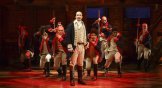
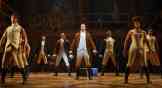
Alexander Hamilton Raps His Way to Jesus at Texas Church

Unlicensed production prompts cease-and-desist letter from Broadway musical.

Christianity Today August 9, 2022
Screengrab / The Door

When offered a chance to save his soul at a Texas church this past weekend, Alexander Hamilton did not throw away his shot.

During a slightly adapted production of the hit musical Hamilton at The Door Church, a large, diverse congregation, the main character bowed his head, closed his eyes and gave his life to Jesus.

“What is a legacy?” the actor playing Hamilton said, according to a recording of the show obtained by Religion News Service. “It’s knowing you repented and accepted the gospel of Jesus Christ that sets men free.”

There was just one problem. The church did not have the rights to perform Hamilton or post videos from a performance online.

Hamilton does not grant amateur or professional licenses for any stage productions and did not grant one to The Door Church,” a spokesperson for the musical told RNS in an email.

After learning about the unauthorized performance on social media, the producers of Hamilton sent a cease-and-desist letter to the church, instructing them to remove all videos and other images of the August 5 performance. The producers did tell the church it could go ahead with a performance on the following day, provided the performance was not recorded, no images of the event were posted online and no additional productions would be staged.

According to a statement from the producers, they planned to discuss “this matter with the parties behind this unauthorized production within the coming days once all facts are properly vetted.”

Written by actor and composer Lin-Manuel Miranda, Hamilton reimagines the early days of the United States with a diverse cast and a hip-hop inspired score. The musical debuted in 2015 and became a pop culture juggernaut.

A staffer told RNS the church has no comment about the production. During a worship service, pastor Roman Gutierrez acknowledged that the church was contacted by a lawyer from Hamilton and had removed the videos.

“We had over 30 people get saved between both nights, and that is really why we do these plays,” he said. “For people to get saved.”

The church website contains links to previous church productions of Toy Story, Despicable Me, and Beauty and the Beast, using images from films of those stories.

Videos of the church’s Hamilton included a series of references to Jesus not found in the original play. In a scene between Hamilton and his wife, Eliza, she tells him that everything will be all right if he gives his life to Jesus.

“God is not who I need right now,” Hamilton replies.

Following the production—which included costumes and an extensive set that seemed to replicate that of the Broadway show—a pastor gave an altar call. He told people that no matter their struggles, whether it was finances, addictions or homosexuality, God could help them.

The comparison of LGBT people to people with addictions angered Hamilton fans. So did the use of a beloved show without permission.

Doing so was the equivalent of stealing, said secular commentator and writer Hemant Mehta, who posted about the church on social media. Church leaders should have known better, he said.

“Are you telling me that no one involved in putting on this show asked the question, can we do this?” he said.

Jake Johnson, associate professor of musicology at Oklahoma City University, said that while there are serious ethical and legal issues involved, he was impressed by the sophistication of the church production. But he was not surprised by it. Churches have long adapted works of pop culture to spread their messages, he said. And they are not above changing the text or even adding songs from other sources to get their point across.

The most extreme example, he said, is the Re-Sound of Music, a reworking of The Sound of Music to promote the polygamist beliefs of the Fundamentalist Church of Jesus Christ of Latter-Day Saints. That music, which still exists online, turns a song called “You Two,” originally sung by a father to his children in the movie version of Chitty Chitty Bang Bang into a polygamist anthem.

A Canadian church is also known for creating Christian-themed plays based on popular movies and musicals, including one called The Passion of the Iron Man, in which the Marvel hero is crucified while the villainous Loki sings R.E.M.’s “The End of the World as We Know It.”

Musicals are also uniquely suited to be used by religious groups, said Johnson, author of Lying in the Middle: Musical Theater and Belief at the Heart of America, which looks at church adaptations of musicals.

“Musicals are almost always a kind of Christian narrative, in the sense that they’re about reconciliation and redemption,” he said. “Even if it’s not overtly about religion at all, the story can easily slide into this pocket of Christian idealism where everything works out in the end and the good guys win and the bad guys will be vanquished.”

Johnson also said that musicals appeal to a wide range of American society, including theater-going audiences in liberal cities like New York as well as a red state like Texas. The church adaptation is a kind of homage to the power of musicals to bring people together, he said.

Author and historian Peter Manseau also sees some parallels between Hamilton and more overtly religious musicals.

Hamilton is in some ways a show in the mold of Jesus Christ Superstar and Godspell, which also began as radical new tellings of a familiar story,” he told RNS. “Given the popularity of Hamilton, it’s almost inevitable churches would try to repurpose it, even in ways counter to the show’s intentions.”

Musicals can also be a way for churches and other faith groups to bring people together. For a number of years, Bethany Lutheran Church in Crystal Lake, Illinois, has put on musicals like Joseph and the Amazing Technicolor Dreamcoat and Mary Poppins.

The church pays for the rights to perform those shows, said Ruth Ann Poppen, director of worship and music, and sees them as a way to help people in the church and the community build their musical skills and self-confidence—and to celebrate the talents in the community. Half the cast from a recent version of Mary Poppins came from outside the church.

“It is a way for us to reach out to be more visible and have people come into our sanctuary outside of really regular worship services,” she said.

Howard Sherman, an arts administrator, writer and advocate, said churches and other groups can stage musicals if they get the rights to them. The church in Texas did not do that, which he found concerning. Copyrights help artists make a living and give them the right to control their own work.

“That is a lesson that anyone in a leadership capacity, an educational capacity, or an ethical capacity should be teaching people, especially young people,” said Sherman, who posted about the Texas play on Twitter.

Mehta suggested, in the spirit of musicals, a redemptive resolution to this situation, allowing the Texas church to make amends.

“I would love to see them make a sizable donation to a fine arts program—that might be a way to make up for what they have done and allow everyone to benefit.”

Kathryn Post contributed to this story.

Books

Elisabeth Elliot’s Lost Manuscript

While searching through old files, radio producers at Back to the Bible discovered an unpublished work written by the late missionary pioneer.

Christianity Today August 9, 2022

When people pass on, their loved ones or legacy holders sometimes sift through old papers and discover a stash of love letters or a forgotten stock certificate. Once in a while, that good fortune is a gift to the public.

Heart of God: 31 Days to Discover God's Love for You (A 31-Day Devotional) – The Perfect Mother’s Day Gift for Christian Moms

Last year, Kathy Reeg, the president of the Elisabeth Elliot Foundation, reached out to Back to the Bible, the producers of Elliot’s long-running radio show, Gateway to Joy, in search of some information about Elliot’s past work.

In the process of looking for that other project, the team made an extraordinary discovery: A long-buried computer file contained an unpublished devotional by Elliot called Heart of God: 31 Days to Discover God’s Love for You. The book is scheduled for release this September by DaySpring.

“We ran across it strictly by accident,” said Reeg. “But nothing is accidental. Everything is providential.”

She knew there were a few unpublished materials in the archives, but the discovery of Heart of God was a complete surprise. A staffer at Back to the Bible told her how sorry they were they hadn’t found it earlier.

“No,” Reeg replied. “This is all God’s timing.”

The story of the manuscript’s discovery is also the story of a relationship between Reeg and Elliot.

“I got to know Elisabeth through her writing and later her daily Gateway to Joy broadcast, just as so many others have,” said Reeg. “I’d heard her speak in person at a seminar and had even exchanged letters with her after her book The Shaping of a Christian Family released.”

After Elliot was diagnosed with dementia in 2001, Reeg began corresponding with Elliot’s husband, Lars Gren, first as she was looking for some recordings of Elliot’s messages, and then as Reeg and her husband hosted Elisabeth and Lars at their home. The couples became dear friends.

Gren was diagnosed with dementia in 2016, and Reeg now manages Gren’s care at an assisted living facility located near her home.

In June of 2020, her desire to honor her longtime mentor’s life and work led her to create the Elisabeth Elliot Foundation. The foundation exists to steward the work of Elisabeth Elliot; her first husband, missionary Jim Elliot; and their only child, author Valerie Elliot Shepherd.

In addition to providing a home for the family’s writing, the foundation is also involved with other Elliot-related projects, including a planned retrospective of Elliot’s life at The Museum of the Bible in Washington, DC, in spring 2023.

Although Reeg hoped the foundation would play a role in introducing Elliot’s work to a new generation, she never imagined bringing a new book to that younger audience and also offering a fresh resource to the scores of others who cherished Elliot’s ministry.

“Elisabeth was a true spiritual mentor to me throughout my adult years, just as she was for countless others,” said Reeg. “And though we live in different times now, her example of grace, mercy, and love, without compromising belief, still speaks today.”

Based on the dates of the files in which Heart of God was found, Reeg and the Back to the Bible team suspect Elliot wrote the bulk of the manuscript in the late 1990s. Elliot appears to have revisited the manuscript in 2004, around the time Mel Gibson’s movie The Passion of the Christ was in theaters. She references the film briefly in her introduction to the devotional.

The rest of the volume focuses on the character of God—his sovereignty, generosity, and justice—through short daily devotionals, prayers, and relevant quotes from other writers and thinkers. This devotional, like her others, exposes the same impulse she had as a young missionary: to share the gospel with those who don’t yet know it.

In one of the devotional entries, Elliot writes,

Our loving heavenly Father is a compassionate God who seeks the very best for us. Because of this, however, our Creator is also a jealous God who intends that we worship Him and only Him.

God’s jealousy, however, should not be interpreted as a sign that God is uncaring or sinister. God’s jealousy is a righteous jealousy for His people. God wants what is best for us, and what is best is this: nothing other than God.

While Elliot’s unflinching approach to faith has inspired many over the years, it has also stirred controversy.

After the deaths of her first husband, Jim Elliot, on the mission field in Ecuador, and her second husband, theology professor Addison Leitch, Christianity Today interviewed her in 1978, shortly after she married Lars Gren.

She recognized even then that her unflinching views about missions, gender roles, and personal holiness were a lightning rod for some.

“Whenever I’m attacked, I am emotionally affected,” she said at the time. “I’m not at all thick-skinned. However, I try not to allow people’s opinions to dictate my behavior or color my doctrine. Instead, I try to get my beliefs directly from the Bible. And if I feel that what I believe is biblical, I can’t pay a lot of attention to people’s feelings.”

Reeg wishes Elliot’s critics were able to see beyond the legalism her detractors accuse her of and instead see the generosity of spirit she expressed in person, on the air, and in her voluminous correspondence.

“She took Scripture seriously, while reflecting the time in which she lived,” said Reeg. “She shared the message God put on her heart for that time and season. We need to read her through that perspective. She communicated with the many who reached out to her in tender ways. She said hard things, but she lived a life of great compassion, service, and humility.”

Reeg believes that faithfulness can be seen afresh is this posthumous publication.

As Elliot’s years of public ministry were drawing to a close, she wrote in Heart of God:

When we welcome Jesus into our hearts, an old life ends and a new life begins. God transforms our lives and gives us a completely new view of the world. Let us, then, live out that transformed life. Each morning offers a fresh opportunity to invite Christ to rule over our hearts and our days. Each new day presents yet another opportunity to take up our cross and follow in His footsteps.

If the late author were still alive to see the publication of her last manuscript, she would likely take the excitement in stride and insist that the devotional isn’t the treasure—only Jesus is.

Michelle Van Loon is the author of seven books, including Translating Your Past: Finding Meaning in Family Ancestry, Genetic Clues, and Generational Trauma (Herald Press, 2022).

News

Died: Stuart Briscoe, Renowned British Preacher and Wisconsin Pastor

As a child, he found the courage to be a nonconformist. As an adult, to trust the Holy Spirit.

Christianity Today August 8, 2022

Stuart Briscoe preached his first sermon at 17.

He didn’t know much about the topic assigned him by an elder. But he researched the church of Ephesus until he had a pile of notes and three points, as seemed proper for a sermon. Then he stood before the Brethren in a British Gospel Hall and preached.

And preached. And preached.

He kept going until he used up more than his allotted time just to reach the end of the first point and still kept going, until finally he looked up from his notes and made a confession.

“I’m terribly sorry,” he said. “I don’t know how to stop.”

Briscoe recalled in his memoir that a man from the back shouted out, “Just shut up and sit down.”

That might have been the end of his preaching career. But he was invited to preach again the next week. Then he was put on a Methodist preaching circuit, riding his bike to small village churches where a few faithful evangelicals would gather to worship and encourage the fumbling young preacher with exclamations of “Amen” and “That’s right, lad.”

In the process Briscoe became a better preacher, discovered he had a gift, and was encouraged to develop it. He ultimately preached in more than 100 countries around the world and to a growing and multiplying church in America.

When Briscoe died on August 3 at the age of 91, he was known as a great preacher who spoke with clarity, loved the people he preached to, and a had deep trust in the work of the Holy Spirit.

“My primary concern in preaching is to glorify God through his Son,” he once wrote for CT. “I’ve worked hard to preach effectively. But I’ve also learned to trust as well. Farmers plow their lands, plant their seed, and then go home to bed, awaiting God’s germinating laws to work. Surgeons only cut; God heals. I must give my full energy to doing my part in the pulpit, but the ultimate success of my preaching rests in God.”

Briscoe was born on November 11, 1930, as the Armistice Day parade of World War I veterans marched past his house. He was born at home in Millom, England, a village north of Manchester, in the Lake District. It was a town, Briscoe noted, that John Wesley once described as a “habitation of thieves and robbers.” His parents, however, were grocers and devout Brethren.

A reminder of courage

Stanley and Mary Briscoe named their eldest son after the missionary Eva Stuart Watt, who wrote a book about being orphaned by her missionary parents and how she remained committed to the cause of proclaiming the gospel.

“‘Stuart’ to them spoke of missions and jungles and people without God,” Briscoe wrote. “In their minds my name was a reminder that courage was needed, that commitment was necessary, that sacrifice was normative, that service was lifestyle, and that life was earnest.”

As a child, Briscoe found he needed courage to be a nonconformist. Every Sunday he and his parents marched past the Anglican Church, which approved by the state and respected by the culture, carrying their Bibles to a small building called the Tin Chapel, which was seen by everyone as odd.

World War II began just before Briscoe turned 9, however, and the year he was 10 the town filled up with soldiers from across the British Empire. Many of them found their way to the Tin Chapel. Briscoe learned that his small faith community was actually part of a global evangelical movement. Those brave, funny, and enthusiastic young men from Australia, India, South Africa, and Canada shared his parents’ love and trust for the God of the Bible.

Briscoe was especially influenced by one artillery captain who regularly asked him, “What’s your best thought today, Stuart my boy?”

During an air raid, Stuart wrote in his memoir, the captain taught him how to calculate the distance of falling bombs by timing the difference between the flash of light and the thump of an explosion. As search lights probed the darkness and anti-aircraft filled the sky with tracer bullets that looked “like strings of burning sausages,” the captain also taught Briscoe how to find courage in a crisis. He pointed at the Scripture verse Briscoe’s mother had framed on the wall: “Thou wilt keep him in perfect peace, who is stayed on thee” (Isa. 26:3, KJV).

Briscoe graduated from school at 16 and found his way into banking. He earned a reputation for trustworthiness and was promoted and promoted again, but he felt pulled increasingly toward ministry. He was invited to preach to the Brethren, then on the Methodist circuit, and then started to work with Torchbearers International, associated with Keswick theology, teaching and training people to allow Christ to live in them.

A live of service to God

He was encouraged to pursue Christian service by a young Cambridge University graduate he met in the 1950s. Jill Ryder had been very active with InterVarsity Christian Fellowship during her time at university and told Briscoe that she was only interested in having a romantic relationship if the man was committed to living a life service to God. Briscoe was interested in that. He told Jill that was his goal in life too, and they were married in 1958.

Early in their marriage, Stuart got to see what Jill meant by a full life of Christian service when the popular coffee shop across the street from their home in Manchester unexpectedly closed. Jill went over and invited all the young people home with her. They trooped up to her apartment and she asked them about their lives and told them about Jesus, while also caring for her first child. When Stuart got home, he later recalled, there were so many young people in the apartment that the door wouldn’t open. “Sorry mate,” said a young man sitting against the door. “It’s full.”

Shortly after that, Briscoe turned down a promotion at the bank. The top managers called him in for a meeting and asked what his ambitions were.

“I want to preach the gospel,” Briscoe said, “to as many people as possible.”

He resigned and went to work for Major Ian Thomas, head of the Capernwray Bible School and Torchbearers. Briscoe spoke at the Keswick Convention alongside the evangelical giant John Stott and was then asked if he would be willing to travel regularly, preaching on a global circuit.

Briscoe made his first trip to the US in 1964, preaching in Chattanooga, Dallas, Chicago, and New York. His second trip, in 1971, changed the course of his ministry.

A call to love the church

A friend told him that he thought Briscoe’s preaching was too individualistic. He didn’t care enough about the church. Briscoe protested that he did care about the church—the church was, after all, the bride of Christ. But the friend pointed out Briscoe only loved an abstract idea of the church, a mystical, and invisible bride, where the New Testament from Acts to Revelation is full of very real churches with specific locations and contexts. Briscoe, always on the road, didn’t love a church like that.

Feeling convicted, the 40-year-old preacher was surprised when he went to speak at a nondenominational church in Milwaukee and the elders of the Wisconsin congregation asked him out of the blue to be their minister. Briscoe said he’d pray about it.

Jill, tired of her husband always being on the road, said, “You pray while I pack.”

Transitioning from a preaching circuit to pastoral ministry was not easy, but under Briscoe’s leadership, Elmbrook Church started to grow. Briscoe didn’t have a model that he was trying to follow. He just knew he was committed to preaching the Word, loving the people, and praying the Spirit would move.

The church filled with lapsed Catholics inspired by the Second Vatican Council to delve deeper into Scripture, Briscoe wrote in his memoir. And there was an influx of young “Jesus people” who had found faith while wandering through the hippie movement and then got invited to something called “The Friday Night Thing” by a married couple in the congregation.

Melding the historic General American Reformed Baptists congregation that had founded Elmbrook with the hippie Christians, former Catholics, and some Lutherans wasn’t always easy, but within a few years Elmbrook was the largest evangelical church in Wisconsin.

“Sometimes, I think, too much emphasis is laid on the effectiveness of pastoral leadership in a church at the expense of lay leadership and congregational involvement,” Briscoe wrote. “A church where the Spirit of God is actively and freely at work will discover that life springs where water flows.”

Briscoe learned again, as a pastor, that there’s a time to “Just shut up and sit down.” The health of the church should be measured less by the quality of his latest sermon, Briscoe argued, than the way the congregation was formed to follow Christ.

He was thrilled when he came back from a trip in the early 1980s to find part of the church full of furniture. He asked a woman he didn’t know what was happening and she said, “It’s for our refugee ministry.” That was the first Briscoe heard of the church’s refugee ministry, which went on to host Hmong and Lao families fleeing the violence in Cambodia.

Confidence in the future

Briscoe also continued to hone his preaching skills, eventually becoming a sought-after expert on how to preach difficult and controversial sermons, how to deal with mistakes, and how to evaluate the success of preaching. He became a regular contributor to Preaching Today.

With the help of a TV news reporter who attended Elmbrook, Briscoe also started a TV and radio ministry broadcasting his sermons in the Midwest and eventually across the US. Today, his sermons can still be heard on the radio from Alaska to Alabama, as well as online with a mobile app.

Briscoe stepped down from pastoral ministry in 2000. He said at the time he’d continue to serve however he could for as long as he could, but he also believed he could trust the work of the Spirit, and he knew a rising generation of evangelicals was carrying the gospel like a torch held high.

“I have seen the future in the set of the jaw, the intensity in the eyes, the devotion to Jesus, and the love for people in the next generation of believers on every continent,” he wrote.

For himself, he told the Milwaukee Journal Sentinel, he hoped people would say he served God in his generation “and now has fallen asleep and is ready to meet his Lord.”

Briscoe is survived by his wife, Jill, and children, Dave, Judy, and Pete. Arrangements for a celebration of his life will be announced soon.

Theology

Baby Blues: How to Face the Church’s Growing Fertility Crisis

If current rates continue, most religious communities in America will shrink by more than half within three generations. But nondenominational Christianity might buck the trend.

Christianity Today August 8, 2022
Illustration by Rick Szuecs / Source Images: Maxime Bouffard / Unsplash / Vadymvdrobot / Envato / NYPL / Picryl / FLickr / CCO

Birth rates in the United States are near record lows, but not for everyone.

Under the surface of the fertility decline is a little-noticed fact: Births have declined much more among nonreligious Americans than among the devout.

Data from the National Survey of Family Growth (NSFG) from 1982 to 2019, along with data from four waves of the Demographic Intelligence Family Survey (DIFS) from 2020 to 2022, point to a widening gap in fertility rates between more religious and less religious Americans.

In recent years, the fertility gap by religion has widened to unprecedented levels. But while this difference may comfort some of the faithful who hope higher fertility rates will ultimately yield stable membership in churches and synagogues, these hopes may be in vain. Rates of conversion into unfaith are too high, and fertility rates too low, to yield stable religious populations.

Past religious fertility

Since 1982, the NSFG has asked respondents about their religious attendance and their recent fertility history. In recent years, it has operated as a continuous annual survey.

As a result, data from over 70,000 women surveyed from 1982 to as recently as 2019 can be used to estimate fertility rates for three broad groups of women: those without any religious affiliation, those with religious affiliation but less than weekly attendance, and those with at least weekly attendance.

Total fertility rates are estimated by using a given group’s current birth rates by age to guess how many children a woman would end up having over the course of her life. In practice, however, birth rates shift as women get older, and of course religious identity can change over time, as well, so fertility measures of this kind are unlikely to perfectly predict outcomes.

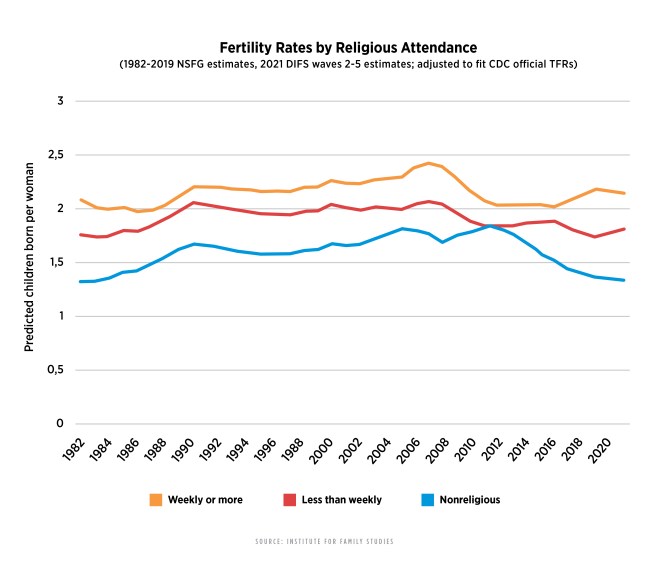
Figure 1 shows estimates from the NSFG for the three religious attendance groups.

It’s evident that birth rates among Americans who attend weekly have never dropped much below 2 children per woman, and as recently as 2008 were around 2.4 children each. Fertility among religious people did decline after the 2008 recession, but by 2017–2019, it was rising again.

In other words, there was no long slump in births to the most devout parents.

Religious women who attended church less than weekly had lower fertility in all time periods but especially during the 2000s. What’s most striking is that, since 2016, fertility rates for weekly- and less-than-weekly-attending women have moved in opposite directions, with fertility falling among the more nominally religious.

Finally, fertility among nonreligious women rose considerably from 1982 to 2005, then again from 2008 to 2012, showing a very different pattern than the one we see for religious women.

From 2010 to 2013, nonreligious women had about the same birth rates as women who attended religious services less than weekly, before their fertility slumped through 2019.

Here’s the most notable takeaway: Virtually 100 percent of the decline in fertility in the United States from 2012 to 2019 can be explained through a combination of two factors: growing numbers of religious women leaving the faith, along with declining birth rates among the nonreligious.

Before going further, it’s worth reflecting on the large cultural difference this represents. In 2019, most religious Americans had similar fertility rates as women in India, Libya, Sri Lanka, Tunisia, Iran, Myanmar, Saudi Arabia, Peru, or Mexico. That same year, the least religious Americans had birth patterns similar to Hong Kong, Japan, Portugal, Greece, Italy, Singapore, or Moldova.

COVID-19 has not reduced these differences. From fall 2020 to spring 2022, across four waves of the DIFS (which included about 9,000 participants), women who never attended church reported a fertility rate of around 1.3 children per mother, versus 2.1 for women who attended weekly. Those rates are very similar to the ones found in the NSFG for 2019.

Declining religion in America

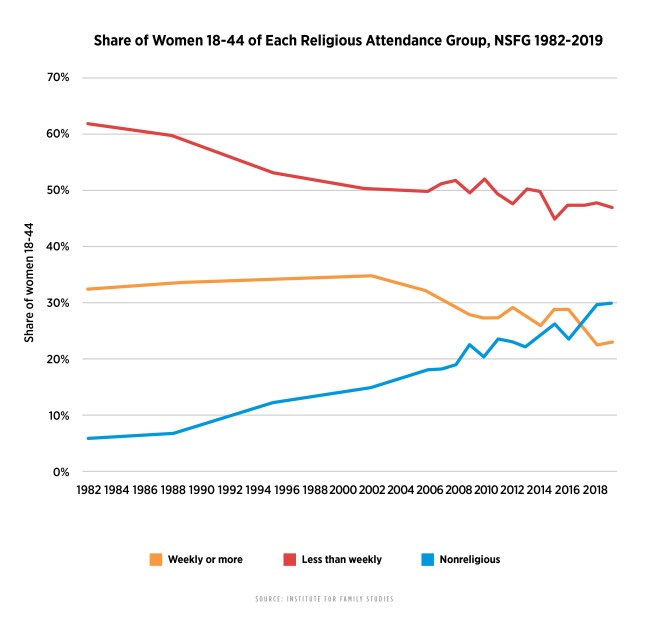
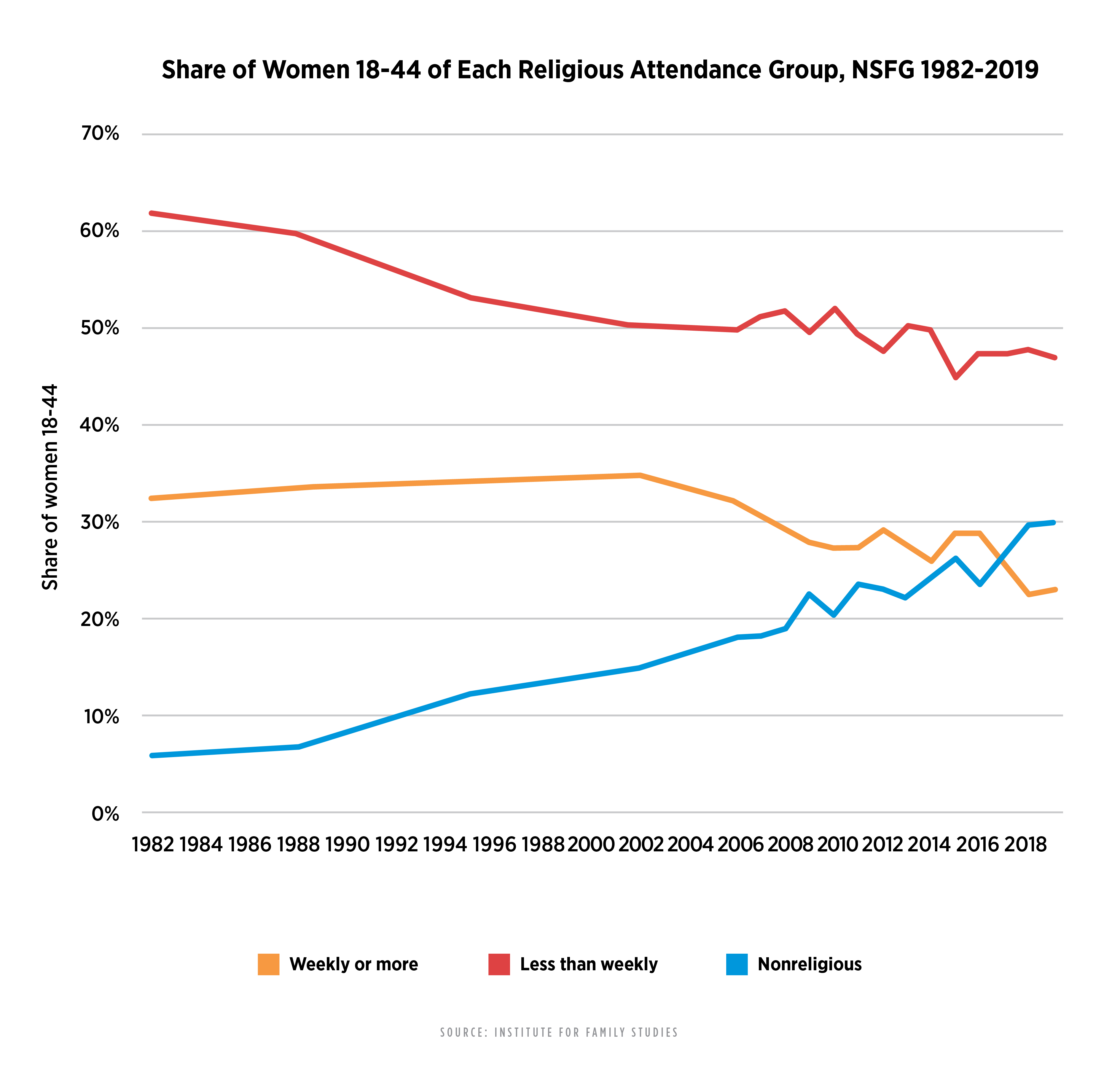
But fertility rates aren’t the only thing driving birth trends. The number of women to whom those rates apply may vary as well. Figure 2 below shows the share of women ages 18–44 who were in each religious grouping, according to the NSFG.

Since 2002, the share of reproductive-age women who attended church weekly or more has fallen from about 35 percent to 24 percent. In the DIFS data, the share was even lower: only about 18 percent of women.

In other words, while the fertility rate among religious women has been stable, society has still become less religious on the whole, meaning the overall number of births to religious mothers has trended downwards.

Here’s the second striking takeaway, then: Despite a widening fertility gap, the ongoing trend of young Americans becoming more secular more than offsets the fertility advantage enjoyed by people of faith. Religious birth rates simply are not high enough to offset losses from the move to irreligion.

Data from the 2014 Pew Religious Life Survey suggest that net conversions in and out of American religions lead to about a 16 percent loss in religious people over the course of a generation. To offset that, religious American women would need to have 2.44 children each on average.

Among weekly attending women, the true figure is just 2.1. If we add in women who are irregular attenders to count all people of faith together, then religious women in 2019 had a fertility rate around 1.8 or 1.9 children each.

With birth rates at just 1.8 or 1.9 children per woman, versus a conversion-adjusted “replacement rate” of 2.44, religious communities in America will tend to decline by about 25 percent in each generation.

If these trends continue, then within three generations, religious communities in America will have shrunk by more than half—a devastating loss.

Key differences across religious groups

However, it’s not right to lump all religious groups together when it comes to fertility. Using data on conversions and births from the Pew Religious Life Survey (PRLS) in 2014, it’s possible to describe some crucial differences.

Using data from the PRLS, I separated individuals from different major world religions, and within Christianity, I broke out six distinct subgroups: Roman Catholics and Eastern Orthodox (grouped together, since there are few Orthodox respondents); Pentecostals; Protestant denominations in which at least 75 percent of respondents said they believed “the Bible is the Word of God”; groups that fall under the 75 percent marker; and nondenominational groupings over or under 75 percent on the same question.

Prior research has suggested that beliefs about the Bible are a good indicator of fertility behaviors in general.

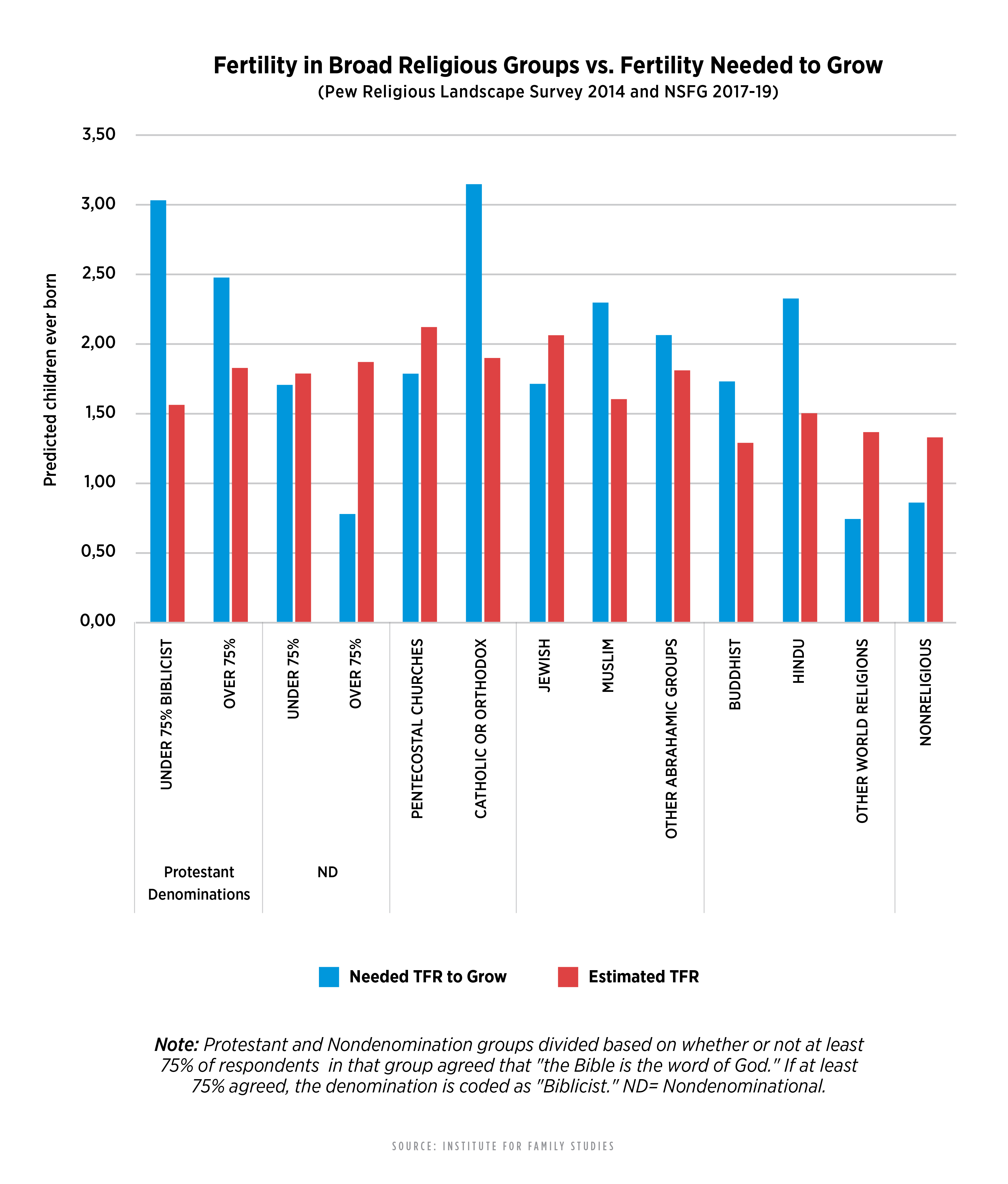
Figure 3 below shows two indicators. First, it details the total fertility rate (TFR)—or number of children born per woman—that a religious group would need to achieve to experience growth, given the conversion rates, and assuming there’s zero immigration into the country.

The second indicator is an estimate of the actual TFR for that demographic, using between-group differences observed in the PRLS in 2014, then applied to actual fertility trends in 2019.

When the needed TFR is higher than the estimated TFR, it means that a religious group is likely to shrink over the next generation—unless it receives new members through immigration.

As the figure above shows, liberal Protestant denominations appear to be facing a dire situation. Given high rates of conversion out of these traditions, they need to achieve fertility rates of 3 children per woman to grow over the next generation. They only have about 1.5 or 1.6.

Conservative Protestants who believe the Bible is the Word of God have higher fertility rates (around 1.8 children per woman) and less-negative conversion rates, meaning they only need to have around 2.4 children per woman.

As a result, liberal denominations can expect a 48 percent decline in a generation, versus just a 26 percent decline for conservative denominations. (Again, that’s assuming no members are gained through immigration.)

On the other hand, there has been robust growth among nondenominational churches. Liberal nondenominational movements have roughly the fertility rate they need for stability (1.8 or 1.9), but conservative nondenominational movements have seen extraordinary growth: They only need to have about 0.8 children per woman to grow, but in fact they have around 1.9.

This means they will more than double in size over the next generation, even without immigrants. Likewise, Pentecostal churches will grow, with actual fertility (2.1) appreciably above needed fertility (1.8).

On the other hand, Catholic and Orthodox churches will see appreciable decline, with an average of 1.9 children born per woman—nowhere near high enough to offset high rates of conversion out of these faiths—yielding a needed fertility rate of 3.1.

Roman Catholic churches can expect a 40 percent decline in the next generation, unless immigration offsets that trend. (Numbers for other faith groups are included in the full brief.)

Although nonreligious fertility rates are very low, high rates of conversion into the “no religious affiliation” category will result in over 50 percent growth in the nonreligious population over the next generation.

In sum, faith groups in America in general face the prospect of stark decline. However, different segments will have different experiences.

For institutionalized Protestantism, Catholicism, and many of the other major world religions, the decline will be swift and deep, with high rates of religious exit and modest-sized families.

Some conservative denominations—for example, the Presbyterian Church in America—will be able to stave off serious decline for the immediate future. But fertility drops will still be the average experience. It’s only within nondenominational Christianity, Pentecostalism, Orthodox Judaism, heterodox offshoots of Christianity, small religious movements, and secularism that we’ll see significant fertility growth.

Takeaways for the church

For reasons I’ve described in length elsewhere, religiosity in America is declining. Changes in education, parenting styles, marital trends, and the geography of American neighborhoods have all conspired to suppress faith across the last several generations.

Meanwhile, the “fertility gap” between religious and nonreligious Americans has been growing for two decades and is now the widest it’s ever been. This fertility advantage, however, is nowhere near large enough to offset losses from the rejection of faith.

To compensate, religious Americans would need to have about 2.4 children each, and in some religious subgroups, even more. Most faith communities in America are having fewer children than they need for long-run stability, and as a result, the next few generations are likely to see a considerable decline in American religion.

However, this decline is not inevitable: Achieving growth again would not require American churches to do impossible things. Having one more child on average, successfully integrating a modest share of immigrants into the US, or achieving higher conversion rates could all stave off decline.

Lyman Stone is a research fellow at the Institute for Family Studies (IFS), chief information officer of the population research firm Demographic Intelligence, and an adjunct fellow at the American Enterprise Institute.

Published in collaboration with IFS. The full research brief is available here.
News

The Hardship Is Plentiful But the Workers Aren’t Few: Evangelicals Unite on Ukraine

20 European groups join as focus shifts to the internally displaced and their long-term trauma.

A Bible camp for displaced Ukrainian children

A Bible camp for displaced Ukrainian children

Christianity Today August 5, 2022
Mission Eurasia

Her mother died of cancer. Her father was killed in the war. When her home in Donetsk was destroyed by a Russian missile, retreating Ukrainian troops brought the eight-year-old orphan and her grandparents and uncle to volunteers serving with the Chernivtsi Bible Seminary (CBS), 680 miles to the west.

Their only possessions were the clothes on their backs.

Resettled in temporary housing, last month the uncle was called back to the front lines. The girl has been sent to a Christian camp, and the seminary—serving as a ministry hub for the internally displaced—is doing what it can to assist.

“We did not think that serving a refugee is such a complicated process,” said Vasiliy Malyk, CBS president. “But no matter how difficult it may be, we can help them at least with some dignity.”

It is a team effort, and once tallied the numbers both stagger and pale in comparison to the need.

The Alliance for Ukraine Without Orphans (AUWO) has mobilized 3,000 volunteers to provide temporary housing for 6,000 people, mostly women and children. It has evacuated 38,000—more than two-thirds of which have been orphans. Nearly 59,000 people have received some sort of humanitarian aid.

“When the war started, everyone was focused on responding,” said Ruslan Maliuta, a former AUWO president and current network liaison for One Hope. “But then we realized the war is going to last, the crisis is huge, and the response will require us all to work together.”

To do so, in April the World Evangelical Alliance (WEA) launched The Response—Ukraine Special Taskforce (TRUST), with Maliuta as its leader. AUWO united with Ukraine’s Baptists, Pentecostals, and seven other national church and parachurch organizations to coordinate refugee relief efforts, alongside ten regional partners from Poland, Moldova, Slovakia, Hungary, and Romania.

“Having churches reach across denominational lines to work together has been one of the most encouraging things,” said Chris Guess, a Romanian pastor. “We have volunteers from across the globe, [as] God’s people have jumped in with us.” For example, volunteers from Argentina shipped 20,000 tons of rice.

Comparing notes from March onward, the evangelical network has mobilized 64,000 volunteers. Temporary housing has been offered to 271,000. Over 346,000 people have been evacuated, while nearly 600,000 have received humanitarian aid. Over $1.1 million has been distributed to partners.

“TRUST is coming alongside the admirable work of professional aid agencies with no intention of competing or creating a new relief organization,” said Thomas Schirrmacher, WEA secretary general. “TRUST offers a bridge that connects.”

Yet the United Nations underscores the grim reality: 6.2 million need shelter, 10.2 million need food, and 12.1 million need health assistance.

“People are on the edge of exhaustion,” said Rafal Piekarski, serving with Proem Ministries in Poland. “Our Polish resources are over. We don’t want to compete with each other, but be good stewards of what you can bring from your countries, your churches.”

In May, Piekarski was one of 72 leaders from 22 European nations to form the Christian Ukrainian Collaboration (CUC) to address the overwhelming need. Maliuta was also there, as both initiatives brought together individuals who had never previously interacted.

Initial cooperation between the networks was minimal, as the CUC addressed the continental response while TRUST worked through channels in Ukraine and neighboring countries. But Maliuta later joined the CUC core leadership, to strengthen coordination.

As the war enters its sixth month, the longterm needs are changing. But for many, the paralysis continues.

“Physical sensations of falling apart. Insomnia or, inversely, persistent sleepiness. Continuous nightmares. One’s mind is unable to shake off horrible images,” Maryna Ashykhmina, vice rector at Tavriski Christian Institute (TCI) and a psychologist with PTSD experience, told ScholarLeaders’ Insights Journal. “Every one of us is kneeling prayerfully.”

“The infrastructure of my life had been ruined, and it is next to impossible to make long-term or even middle-term plans,” Tanya Gerasymchuk, public relations assistant at Odessa Theological Seminary, told the theological education journal. “The feeling I and many other Ukrainian women possess now is uncertainty about the future.”

Food, medicine, and shelter provisions are still vital, said Maliuta. But cooperation makes possible the forward vision necessary to rebuild.

Trauma is a key area. Ukraine’s health ministry estimates that one-third of the population will require mental health care. TRUST partner Save Ukraine has provided 12 psychologists alongside its medical and legal volunteers to assist 32,000 beneficiaries.

By Day 3 of the war, the affiliated European Freedom Network (EFN) had already distributed 100,000 brochures at border crossings to warn Ukrainians about human trafficking. But as criminal efforts now shift to the newly resettled, EFN has also responded with trauma care, to strengthen the vulnerable. Its “top tips” have been shared with the UN and ordinary local churches.

But the larger need is now with the internally displaced in Ukraine, said Oleksandr Zibarov, national director for Cru. Of the 6 million refugees in Europe, 3.8 million have found temporary protection assistance from various national governments. Cru is still helping these, but most of its 4-week “yellow box” aid packages—each parcel advancing the gospel message—are distributed in Kyiv and central Ukraine.

Many of the previously evacuated are returning. Zibarov summarized their rationale: “‘Should I suffer here with strangers, or go back and contribute to my hometown?’”

The UN counts 4.2 million refugee border crossings to Ukraine, which it cautions is not the same as a permanent relocation. But the displaced are coming with children, who need something to do.

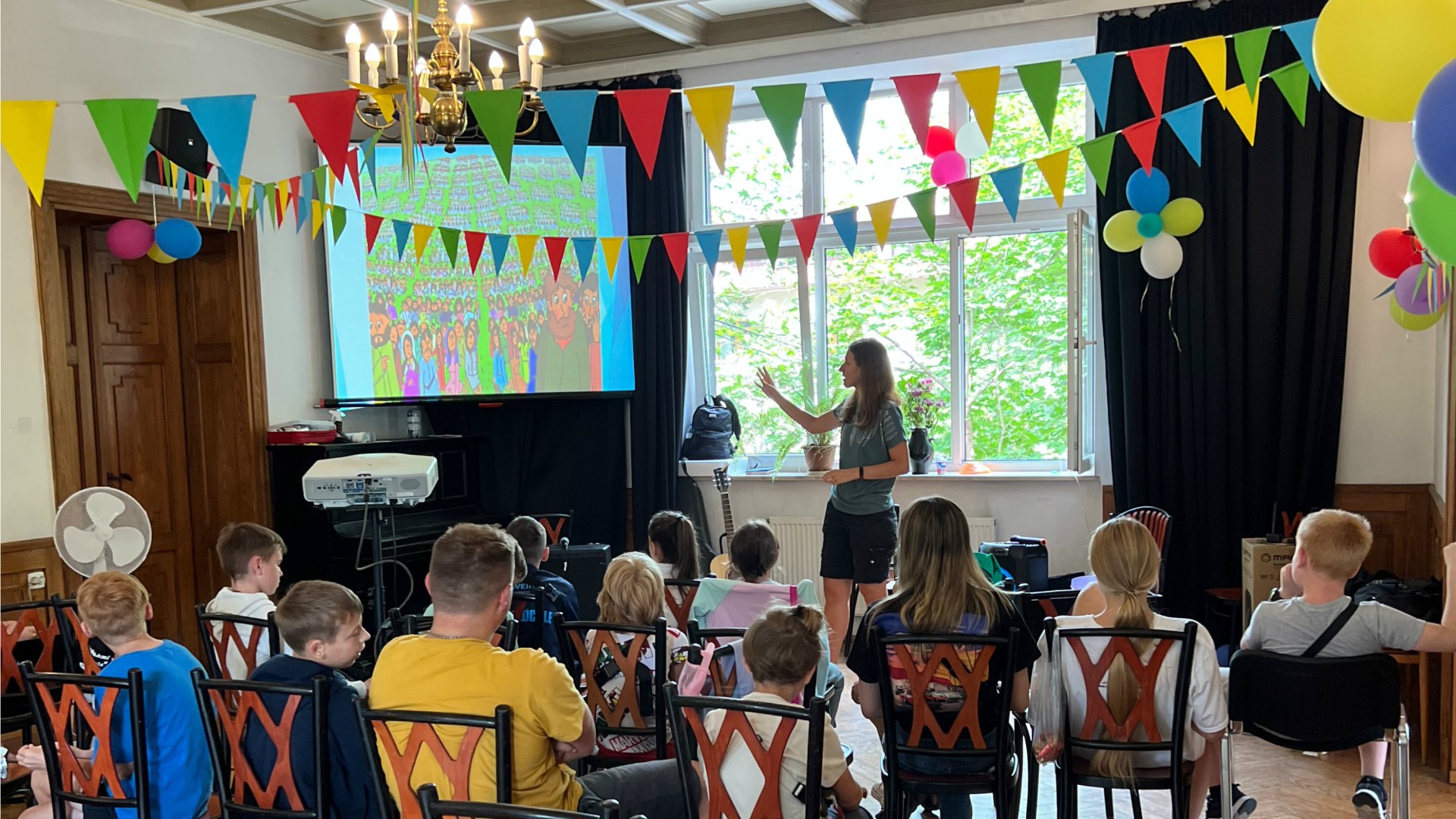
Therefore, another medium-term development has been the post-COVID reopening of summer camps. Mission Eurasia is providing trauma care to over 20,000 youth through its Camp of Hope network.

An additional 1,000 will be at Camp Karabin.

“They get the opportunity to be kids again, and not hear the sounds of sirens or shelling,” said Vadym Kulynchenko of Our Legacy Ukraine, a TRUST partner. “The children hear about hope in the gospel, taken care of in a place that is safe.”

Camps additionally assist the parents, who are freed to begin the work of rebuilding their lives. Our Legacy and many others have raised funds to repair the roofs of damaged homes, before the rain and windy cold set in.

According to Sergey Rakhuba, president of Mission Eurasia, this is becoming an essential medium-term need, due to Russian shelling. Residential power stations providing heat and hot water have been deliberately destroyed, he said. And so have warehouses of humanitarian supplies, seeking to spread fear and suffering.

“If the war continues into the winter and these issues are not addressed,” Rakhuba said, “it will be a disaster for millions of people in Ukraine.”

And for the shepherds assisting them. A June resolution recognized the role of clergy in Ukraine’s long-term recovery.

“Churches are key to the response, but churches rely on leadership,” Maliuta said. “Many pastors went through horrible things; we must support them, so they can continue to serve.”

Specific programs have yet to materialize.

But pastors carry on. One in southern Ukraine burst into tears upon the delivery of potatoes. There had been no food in his area for many days, he told volunteers.

“War makes the presence of goodness and the showing of mercy incredibly important,” Valentin Siniy, president of TCI, told Insights Journal. “Under these circumstances, leadership becomes important—not political, but in small groups.”

Ukraine is currently mounting an offensive to retake the occupied Black Sea port of Kherson, home to TCI, and other southern territories seized by the Russians. Long-range weapons supplied by the US have enabled the Ukrainian army to target ammunition stocks behind enemy lines. Analysts say such maneuvers are slowing the Russian advance in the eastern Donbas region, and the coming weeks may prove decisive.

In the meanwhile, Ukrainian evangelicals are uniting in service—and asking for help to help themselves.

“Our churches in these countries are seeing an incredible outpouring of manpower and passion from their congregations,” said Schirrmacher. “They need prayers and financial support from around the globe.”

And TRUST—whether for orphans, housing, or pastors—is the WEA’s recommended evangelical vehicle for coordination.

“People are not waiting for the war to be over, they are restoring their neighborhoods,” said Maliuta. “It is time to respond not just to urgent needs, but to build a foundation for long-term recovery.”

Follow CT’s Russia-Ukraine war coverage on Telegram: @ctmagazine (also available in Chinese and Russian).

Select articles are offered in Russian and Ukrainian.

News

Nondenominational Churches Are Adding Millions of Members. Where Are They Coming From?

It’s not mainline traditions anymore.

Christianity Today August 5, 2022
Kristina Paparo / Unsplash

Over the last decade Baptists, Methodists, Lutherans, Presbyterians, and every other Protestant family has declined except for those who say they are nondenominational.

The 2020 US Religion Census, due out later this year, tallied 4,000 more nondenominational churches than in 2010, and nondenominational church attendance rose by 6.5 million during that time.

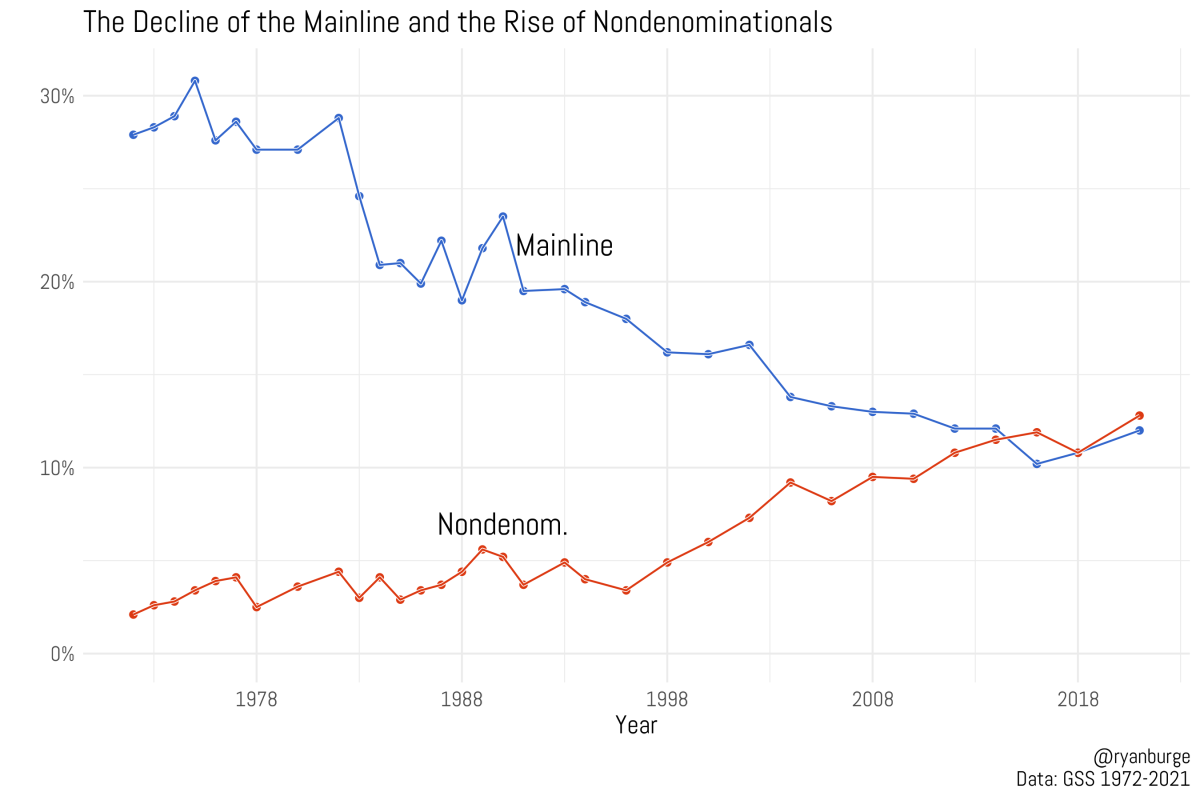
At the same time, mainline Protestant Christianity is collapsing following five decades of declines. In the mid-1970s, nearly a third of Americans were affiliated with denominations like the United Methodist Church, the United Church of Christ, and the Episcopal Church. But now, just one in ten Americans are part of the mainline tradition.

In 2021, nondenominational Protestants in the United States outnumbered mainline Protestants. But what is causing this tremendous shift in the church landscape?

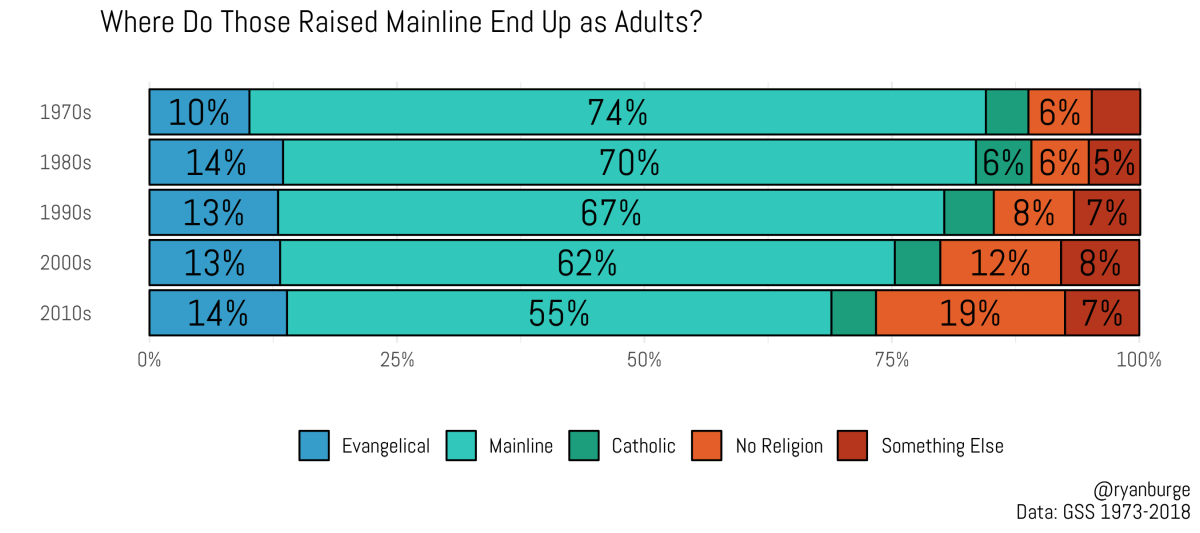
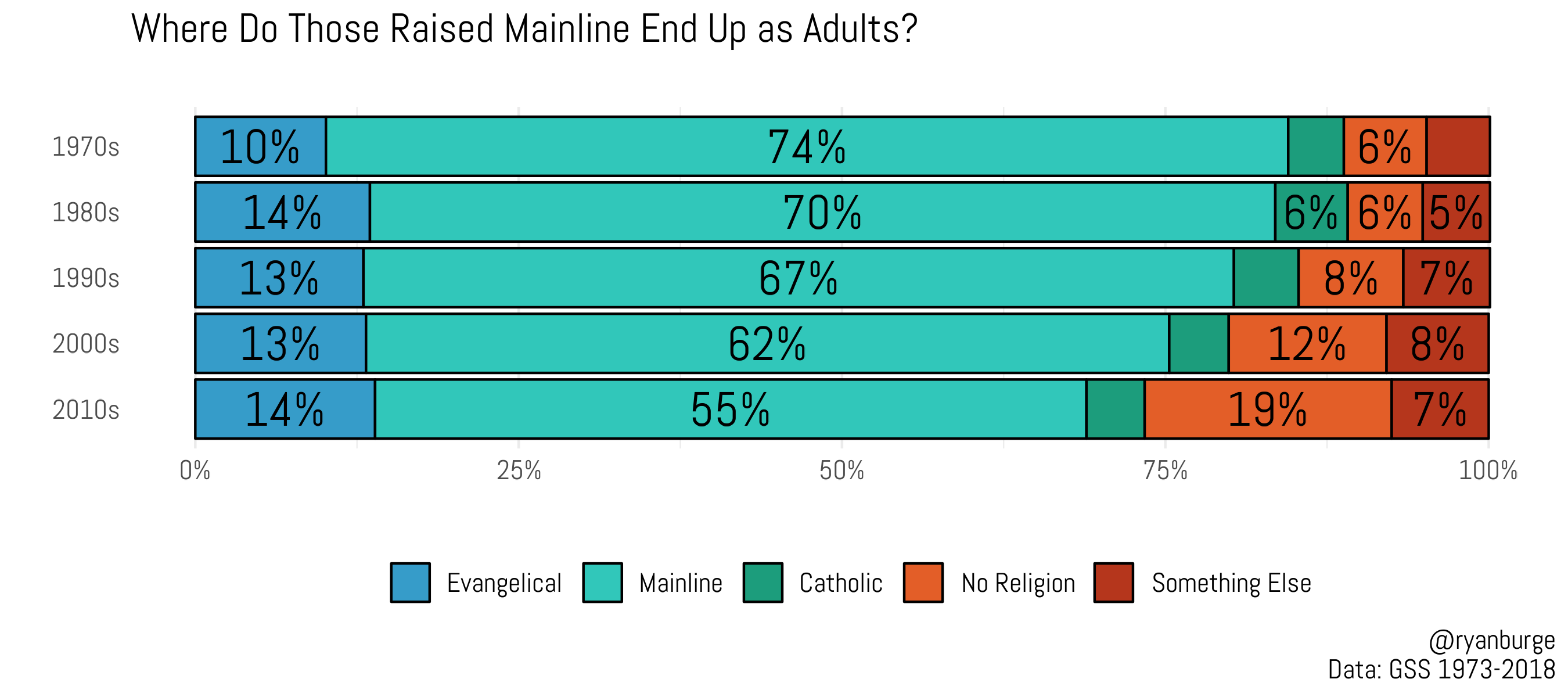
In the General Social Survey, Americans are asked about the religion they were raised in and then their current tradition. Mainline traditions have struggled for decades to retain believers born into their churches. In the 1970s, about three-quarters of those raised mainline would still belong to mainline churches as adults. In the 2010s, the share who stayed mainline had declined to just over half (55%).

Of the 45 percent of the mainline who leave, some end up in evangelical congregations; however, the evangelical share did not increase between the 1980s and the 2010s. Instead, the bigger story is that the portion of those who leave the mainline and become a religious “none”—claiming no faith or no tradition in particular—has tripled since the 1970s, from 6 percent to nearly 20 percent in the most recent data. Thus, there’s not a lot of evidence that the rise of nondenominationals is being directly fueled by the decline of the mainline.

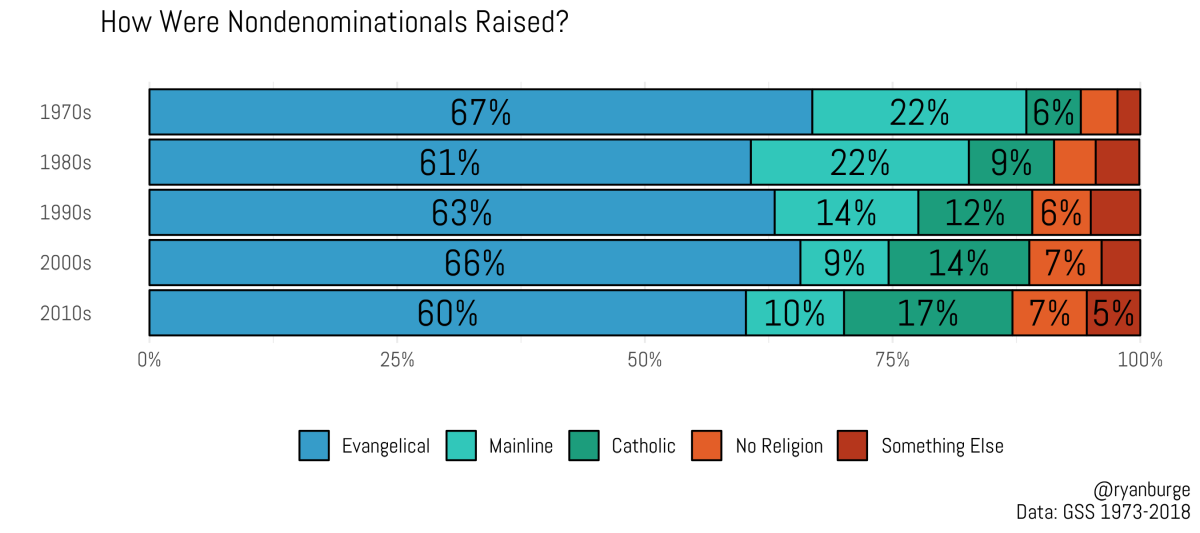
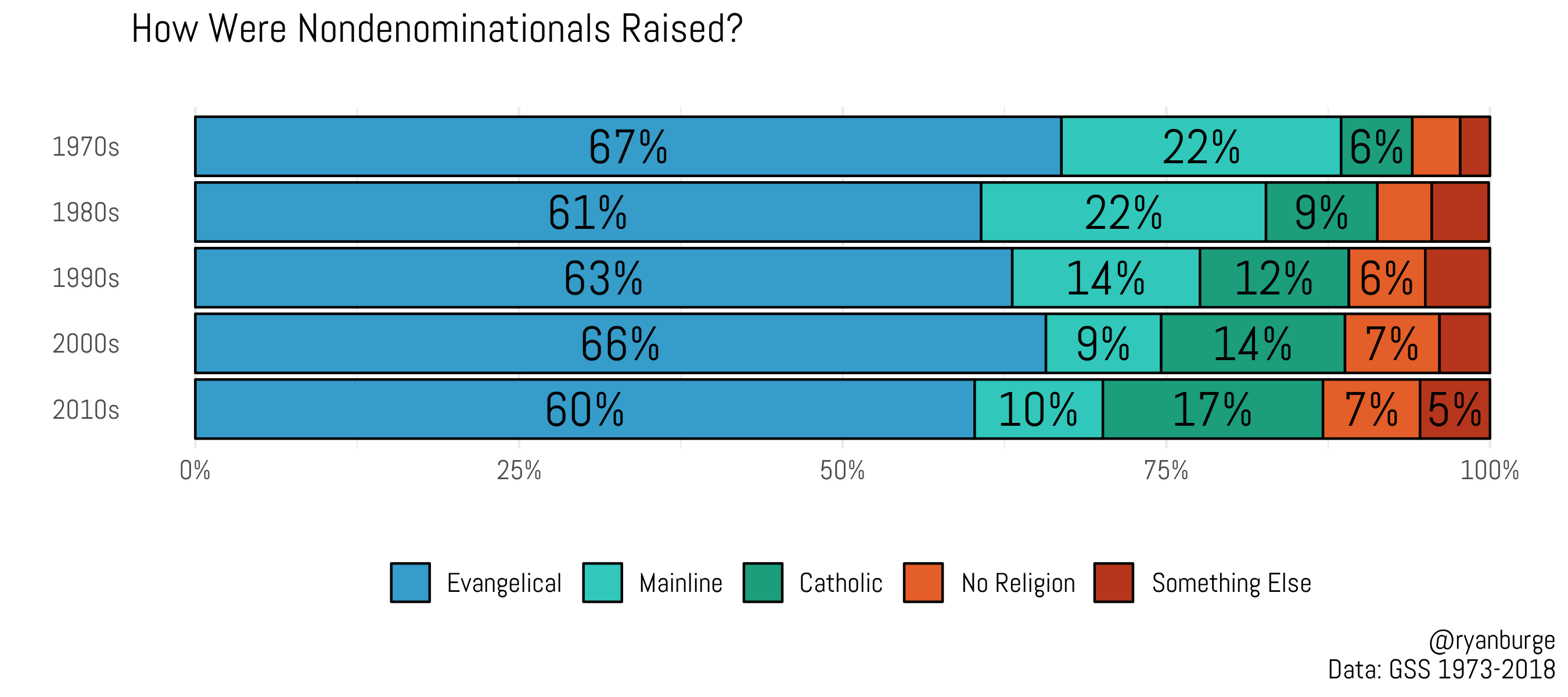
People in nondenominational churches are actually becoming less likely to have mainline backgrounds as the number of mainline believers declines. About 22 percent came from the mainline in the 1970s, compared to 10 percent over the last decade.

Yet the portion of people who were raised in the Catholic faith and identify as nondenominational as adults is growing. In the 1970s, just 6 percent of nondenominationals were converted Catholics. Today, that number has nearly tripled to 17 percent. Thus, there’s a much larger Catholic-to-nondenominational pipeline than one that stretches from the mainline to nondenominational churches.

But religious growth is not only fueled by people switching from one religion to another; it’s also driven by parents raising their children in a faith tradition. Given that most people do not leave the religion they grew up with, an important indicator of future growth is having lots of young people in a religious tradition. That’s certainly part of the reason that nondenominationals continue to rise while other traditions are struggling with their membership numbers.

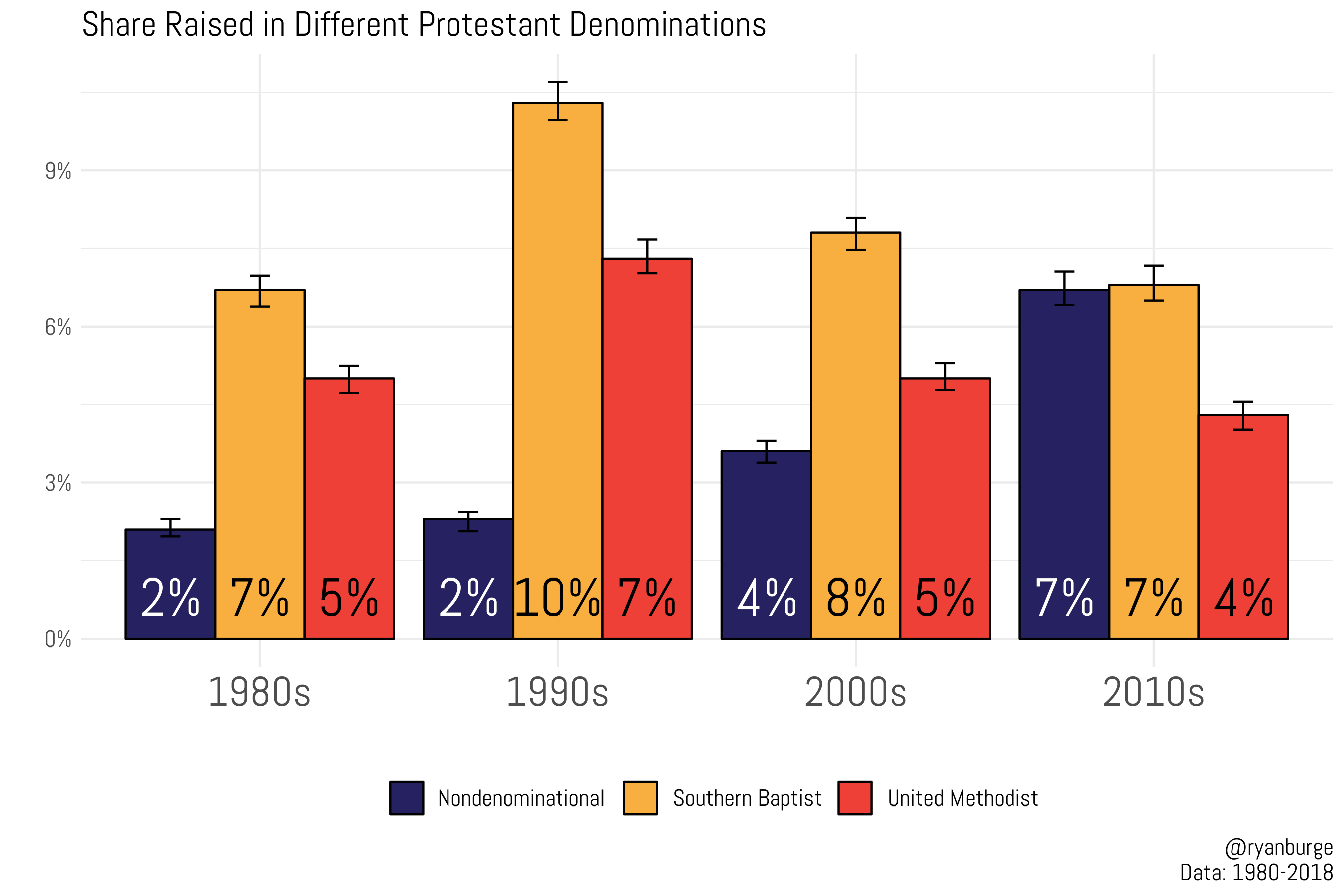
In the 1980s, just 2 percent of people were raised in a nondenominational church, compared to 7 percent who were raised Southern Baptist and 5 percent who were raised in the United Methodist Church. However, those percentages have shifted significantly over the last 40 years. Now, a young person is just as likely to be raised in a nondenominational church as a Southern Baptist one—but just 4 percent of people are being raised United Methodist.

What is driving the growth of nondenominational churches? While in the past it resulted from a significant portion of individuals leaving a mainline tradition, now it looks like nondenominational congregations are increasing by taking in people who were raised Catholic—which is about a quarter of the general population.

At the same time, more and more young people are being raised in nondenominational churches, which means that retaining their own will become just as important to nondenominationals as bringing in new adult members in the future.

Church Life

Moral Failings in the Pulpit Lead to Moral Injury in the Pews

Church and pastoral abuse can trigger a unique form of PTSD.

Christianity Today August 5, 2022
Illustration by Mallory Rentsch / Source Images: Alex Green / Pexels / digitalhallway / Getty

I first encountered the concept of moral injury during my MDiv program at the University of Chicago in an anthropology class called Humans After Violence.

The MDiv program required each of us to intern at a site of our choosing for the middle year of the program, and I’d opted to work with the clergy at my church. Earlier that year, our church had discovered reports of our priest’s abuse of power, and he was removed from leadership.

Initially, my school supervisors worried it might be a bad idea for me to work at a church where so many of us still felt betrayed and uncertain. But I wanted to conduct my internship at a church that was asking questions about how to do community and how to steward power well—rather than at a church that could gloss over these conversations simply because they were functioning better.

Halfway through the internship, I signed up for the class hoping it would help me understand what our community was experiencing. The professor told us she aimed to explore “where violence leaves us—or rather, how violence doesn’t leave us.”

Through examining various case studies, I learned that trauma is not necessarily about the way someone is hurt but about how they carry their hurt. I also discovered that the concept of PTSD was developed by mental health professionals who worked with Vietnam veterans.

What captured me the most, though, was the concept of moral injury—a term developed by these military therapists after they noticed that some classic PTSD symptoms in vets were sparked not by a reminiscence of physical threat to life but by a profound violation of their moral sensibilities. Moral injury could occur, for instance, after obeying a trusted superior’s order to carry out an act the vet believed to be reprehensible.

And while classic PTSD and moral injury share many of the same symptoms—such as anger, anxiety, sleeplessness, nightmares, dissociation, and self-destructive coping methods—emotions like regret, sorrow, grief, guilt, and shame are typically more central to moral injury than PTSD.

Theorists debate the nuances of how to precisely classify moral injury, but what most of the literature seems to agree on is the fact that we all have “fundamental assumptions about how things should work and how one should behave in the world.” And when we witness or carry out harmful actions incompatible with these deeply held assumptions, we can suffer moral injury as a result.

Such actions could be our own or those of someone else, a group, an organization, or a combination of the above. This means we can understand a potentially morally injurious event as a betrayal of ‘what’s right’, either by a person in legitimate authority or by one’s self in a high stakes situation.

Ultimately, moral injury can replace a person’s capacity to trust themselves, others, and transcendent beings with “the settled expectancy of harm, exploitation, and humiliation.”

It struck me that what our church and I had experienced fit the bill for a potentially morally injurious event. In fact, the abuse of power in religious settings might even be the ultimate example of moral injury. Our leader’s misconduct was a betrayal of what is right—and it took place in the church, an institution that aspires to guide its members’ moral formation.

Many of us had considered our leader to represent a legitimate authority on who God is, what God is doing, and what God would have us do—the most important spiritual facts of life. And for many, the stakes of church life could not be higher for our relationships with God, our community with other believers, and our very souls. In fact, many theorists agree that traumas attached to one’s sense of the sacred are intensified.

It was a relief to think in these terms about the disruption to our church and to me. I had wondered for months, What’s wrong with me? With us? Didn’t I know Christians do bad things? Didn’t we know leaders can be misleading? But understanding moral injury reminded me of the simple fact that human beings aren’t built for betrayal—that God did not create us to betray and be betrayed.

Instead of judging our grief at experiencing spiritual abuse as a sign of foolish naïveté or a source of shame, we recognize that betrayal hurts and disrupts us so profoundly because we were made for goodness and a mutual, unbroken trust as God’s creatures—for this is our hope and our glory.

Broken trust is one aspect of the “enslavement to decay” that all creation suffers (Rom. 8:21, NRSVUE). For “we know that the whole creation has been groaning together as it suffers,” Paul writes, “and not only the creation, but we ourselves, who have the first fruits of the Spirit, groan inwardly while we wait for adoption, the redemption of our bodies. … Likewise the Spirit helps us in our weakness, for we do not know how to pray as we ought, but that very Spirit intercedes with groanings too deep for words” (8:22–23, 26, NRSVUE; emphasis mine).

As those who possess the first fruits of the Spirit, we groan alongside the Spirit’s own groaning and the groaning of a suffering creation.

Could the PTSD symptoms of moral injury be a kind of groaning too deep for words—a way for our bodies to communicate a depth of brokenness that we feel but cannot articulate? What if the way our bodies carry grief is aligned with God’s heart for creation rather than a source of shame?

Such a perspective does not resign us to the havoc such grief might wreak on us. Instead, it allows us to wait expectantly as we participate in the redemption of our bodies. Not only that, but seeing things this way might help us be gentler and wiser in dealing with one another’s grief as well.

Understanding moral injury can help us look out for it in ourselves, our churches, our relationships, and our ministry efforts. Recognizing and treating our own wounds without shame is crucial if we are to meet others’ wounds without blame.

With the abuse of power as rampant in our churches as it has been, we can expect many people both in and out of our communities to be suspicious of our offers to come alongside them—having been manipulated by those means before.

I think of one CT headline from 2019, “1 in 10 Young Protestants Have Left a Church Over Abuse,” and countless others since that reckon with the rise of deconstruction and the sizeable exodus from evangelicalism.

Many Christians today are skeptical of anyone’s sense of hearing God’s voice (including their own), after being abused by false prophets. Some are furious at church leaders for being betrayed by those who wear the same cloth. Others feel disgusted with themselves, bearing guilt for having perpetrated or been a bystander to abuses of power. Still more are outraged at God for their suffering wrongs done in his name as unprotected victims.

But we can expect to find God with and among these abused and disabused men and women.

At Lent during my church internship year, I was asked to do some artwork for the Holy Week devotional material at another local church. They asked me to portray any moment of the week leading up to Jesus’ death. Without thinking, I chose the moment Judas meets Jesus and greets him with a kiss—identifying him to be handed over for torture and execution.

Later I realized I’d depicted exactly the image I needed that Holy Week: a savior who, just like us, was betrayed by a friend and handed over by religious leaders. A savior whose life, death, and resurrection were precisely for the sake of that same friend and those very leaders.

I think of Judas’s horror after what he had done as a moral injury he clearly suffered, which led to the end he chose for himself—not seeing the end to violence offered and promised us in Christ.

In the meantime, may we take seriously the responsibility to love our neighbors with the power we wield. May our yes be yes, our no be no, and our kisses be real signs of blessing and not markers of coming harm. And may the worship of our just God signal deference to the justice he stands for.

Otherwise, our faith without works is not only dead but also brings death. And while we await God’s redemption, we’ve still got work to do.

A native Texan, Wheaton College alum, and recent UChicago MDiv grad, Laura Howard is now based in Wheaton, Illinois, and seeks to promote Christian education in Scripture, theology, and culture. Her MDiv thesis consisted of a theological response to abuse of power in evangelicalism.

News

Assemblies of God Ordains Record Number of Women

There is work to do and some of those God has called to do it are female, Pentecostal leaders say.

Christianity Today August 5, 2022
Kristina Paparo / Unsplash

The Assemblies of God (AG) has ordained, on average, more than 5 women per week every week for the last 14 years, bringing the total number of ordained women in the Pentecostal denomination up to 10,383. Currently, a record 27.6 percent of Assemblies ministers are women, according to a denominational report.

“The image of God is best reflected when the church of Jesus Christ is healthy,” said Crystal Martin, national director of the denomination’s Network of Women Ministers, “and women are empowered to fulfill their call at every level of church leadership.”

Women have been preaching and teaching in the AG since it was founded in 1914. The church embraced women’s leadership based on its understanding of New Testament models of ministry and Scripture’s testimony to the equal outpouring of the gifts of the Spirit. But 30 years ago, only about 300 women were leading AG churches.

The trend toward more women in ministry started in the late 1990s. Many received support from the Network for Women Ministers, which was founded in 1999 as the Task Force for Women in Ministry. In 2010, the AG reiterated its support for women in ministry with a position paper laying out the biblical argument from a Pentecostal perspective.

Some young women still find it hard to believe that they could be called to lead a church, though.

“I sat down with one young woman, and she shared her whole life vision,” Martin told CT. “And I said, ‘It sounds like God’s calling you to be a youth pastor.’ And when I said that she felt uncomfortable—she had just never seen a female pastor.”

According to Pentecostal scholar Joy Qualls, support for women in ministry waned in the late 20th century as Pentecostals interacted with other traditions that looked down on what they saw as disruptions of the natural, God-given order. When cultural conflicts over gender roles erupted in American society, some Pentecostal leaders worried their tradition was lined up on the wrong side.

“As the movement institutionalized women’s influence, leadership, and roles became increasingly constrained,” wrote Qualls, a professor and dean at Biola University. “The constraints placed on women in Pentecostalism had more to do with the influence of Evangelical culture, lack of education in our history and theology, and general discourse, than it did [with] Scripture or theological positions.”

Today, 7 in 10 self-identified evangelicals say they support women preaching. Even in complementarian traditions, such as the Southern Baptist Convention, about 65 percent say women should be allowed to serve as clergy.

Still, in America today, only about 13.5 percent of congregations are led by women, and that drops to a little less than 2.5 percent when you just look at white evangelical churches.

Women lead about 6 percent of Assemblies churches, a number that has doubled since the 1990s. Qualls and others point to top leadership in the denomination driving that change.

In 2018, the denomination elected the first woman to the national leadership team. Donna Barrett, who became a credentialed minister in 1986, was made general secretary. Her election opened the door for more change.

“If you see a snapshot of the six executive leaders a few years ago, they were white men who are married and a little bit older,” Barrett told CT. “And now when you look at the six of us at the executive leadership team, you have an African American, a Hispanic, a female who’s single. We’re a little bit more diverse, and that gives a picture to other ministers and parishioners of the denomination that there’s a place for everyone.”

According to Barrett, the Assemblies’ affirmation of women in ministry is deeply rooted in the denomination’s commitment to evangelism. They believe the harvest is plentiful and are eager to see the gospel preached everywhere.

“If we pray to God to send more workers and then we disqualify more than 50 percent of them, saying, ‘Sorry, they’re the wrong gender,’ we have handicapped the church,” Barrett said. “It’s important that if God calls a person, we don't step in and humanly interrupt that.”

The denomination is looking to diversify and empower its leadership team and members across the board, said Maricela Hernández, who was elected as the West Spanish language area executive presbyter last year. She's served as a lead and assistant minister in Peñitas, Texas, for more than 25 years, and is passionate about ensuring all people who feel called to serve God also have the opportunity to.

“I just thank God that he has allowed me to represent Hispanic people, the Hispanic ministers,” she told CT. “God is bringing the mission field to our place and our homes, and we have to be ready to embrace, to make room, to appreciate, and welcome all of our brothers and sisters—regardless of their race, language or skin color."

The focus on diversity was championed by the late George O. Wood, who served for 24 years as general secretary and general superintendent. When he began as general superintendent in 2007, the executive presbytery was made up of 14 white men. When he left, that executive team had expanded to 21 seats. Seven of those seats were held by racial minorities, and two by women. “He had a unique ability to open doors for young people, women, and ethnic minorities by providing them a meaningful seat at the table,” Doug Clay, Wood’s successor as general superintendent, told AG News. “That has been a major force behind our growth in each of those areas.”

Leaders in the Network of Women Ministers still see more work to be done, though. Only five of the 206 AG district officials are women. And there are still young women in the denomination who have never seen a woman lead a church and don’t realize they could be called by the Spirit to ministry.

“The work of our next decade is to mobilize women and to normalize women on decision-making tables at every platform,” Martin said.

She hopes women will recognize the abundance of God’s gifts and that the church will see an abundance of ministers preaching with the power of the Spirit.

“Why would we look through a scarcity lens of, ‘We only have half the population who can handle a platform’?” Martin said. “It’s not where we sit theologically, and I pray in the next decade, it's not where we sit practically.”

Christianity Today Names Russell Moore Editor in Chief

Longtime publishing executive Joy Allmond also comes on board to advance the vision of the ministry.

Christianity Today August 4, 2022
Eric Brown

What makes a person great in the world is not the possession of extraordinary talent but a fierce and persistent application of talent, guided by courage and character, toward a worthy objective. What makes a person great in the kingdom of God is, according to Jesus, a spirit of humble servanthood (Matt. 20:26).

Which is why I am so deeply pleased to announce that Russell Moore will step into the role of editor in chief of Christianity Today on September 1.

That Moore is a person in possession of extraordinary talents is incontestable. He was named dean of the School of Theology at Southern Baptist Theological Seminary when he was a mere 32 years old. Through his books, his articles and podcasts, his public speaking, and his leadership of the Ethics and Religious Liberty Commission, Moore has served as possibly the most prominent evangelical Christian public voice in the country for the past decade. Anyone who has read his writings or heard his oratory will attest to his prodigious natural gifts.

But talent alone is not the reason for our excitement. Moore has demonstrated, time and again, the courage to express his convictions and the integrity to live by them. Sometimes this has meant contending for essential biblical and theological truths in the public square. Sometimes it has meant declaring truths to the church that challenge and convict us.
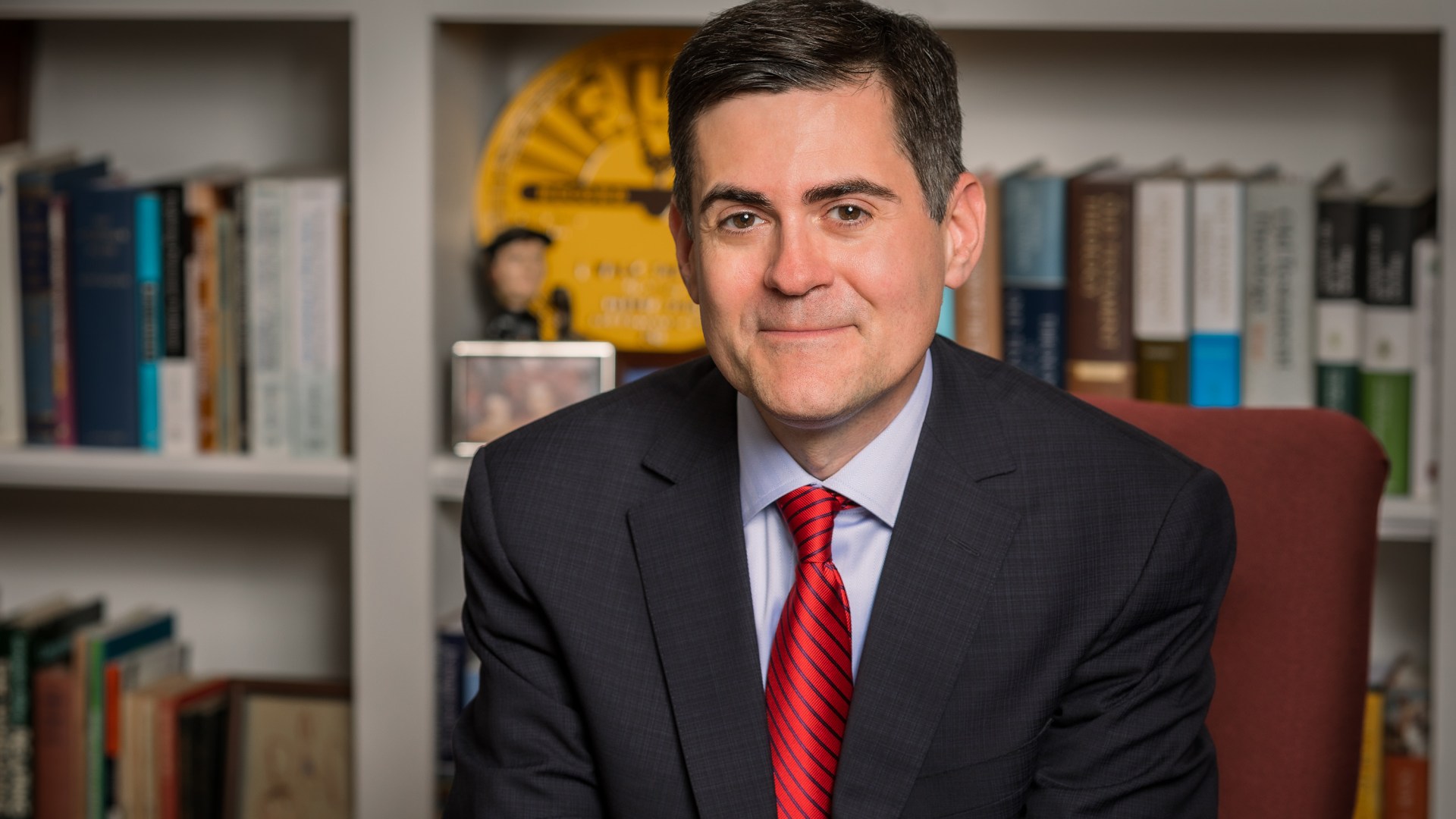
He has worked tirelessly to help men and women of evangelical conviction address the sin within our own ranks, whether that is related to idolatry and prejudice or abuse and neglect. Moore has taken on some of the most important and urgent objectives of our time, even when it has meant suffering the slings and arrows of critics both inside and outside the camp.

What excites me the most, however, is the way he has never lost sight of our core Christian calling to serve the least and seek the lost. Whether it is counseling pastors in crisis, welcoming the survivors of abuse into his home, or sharing the gospel with college students, Moore is not an ivory tower academician or a lobber of Twitter bombs, but someone who is deeply engaged in the life of the church and in sharing the love of God with others. An ordained Baptist minister who has held multiple pastoral roles (and holds one still today), Moore has served the church and the kingdom tirelessly throughout his career.

We aspire at Christianity Today to advance the stories and ideas of the kingdom of God. The basic question that animates our work is What does it look like to be a faithful follower of Jesus Christ in our time? We hope to be for a new generation what we were for Moore himself when he came across Christianity Today at the age of 15: a capacious and compelling vision of Christian life that opens a path through a fallen world and into the kingdom of God.

That’s why appointing Moore to this position is so important. As president and CEO, I have held the editor in chief position in stewardship for a brief time, but it needs someone to inhabit it fully, and Moore exhibits that way of following Jesus that is deeply rooted, beautifully orthodox, thoughtful and compassionate, and committed to serving the kingdom even at great cost to ourselves.

Significantly, we are also bringing longtime communications and publishing veteran Joy Allmond onto our team to serve as editorial chief of staff. One of the primary charges for Moore will be to continue advancing the Public Theology Project. Allmond will work alongside him to see that project flourish. With an extensive background at the Billy Graham Evangelistic Association, Decision magazine, and Lifeway, Allmond will bring considerable editorial, executive, and interpersonal gifts to the smooth functioning of our publishing enterprise as well as forthcoming events and programs.

Ours is an era of great peril and great promise for the church. We are determined at Christianity Today to do everything we can to serve the church in a turbulent and divisive time, and to love the world God made. We were honored to bring Russell Moore onto the team a little over a year ago. Now we look forward to what he, Allmond, and our extraordinary editorial team can accomplish in the years ahead.

addApple PodcastsDown ArrowDown ArrowDown Arrowarrow_left_altLeft ArrowLeft ArrowRight ArrowRight ArrowRight Arrowarrow_up_altUp ArrowUp ArrowAvailable at Amazoncaret-downCloseCloseellipseEmailEmailExpandExpandExternalExternalFacebookfacebook-squarefolderGiftGiftGooglegoogleGoogle KeephamburgerInstagraminstagram-squareLinkLinklinkedin-squareListenListenListenChristianity TodayCT Creative Studio Logologo_orgMegaphoneMenuMenupausePinterestPlayPlayPocketPodcastprintremoveRSSRSSSaveSavesaveSearchSearchsearchSpotifyStitcherTelegramTable of ContentsTable of Contentstwitter-squareWhatsAppXYouTubeYouTube