Books
Review

A Nonconservative’s Plea to Those Leaving Conservative Churches

Roger Olson sympathizes with liberal leavers, but he draws the line at liberal theology.

Christianity Today August 19, 2022
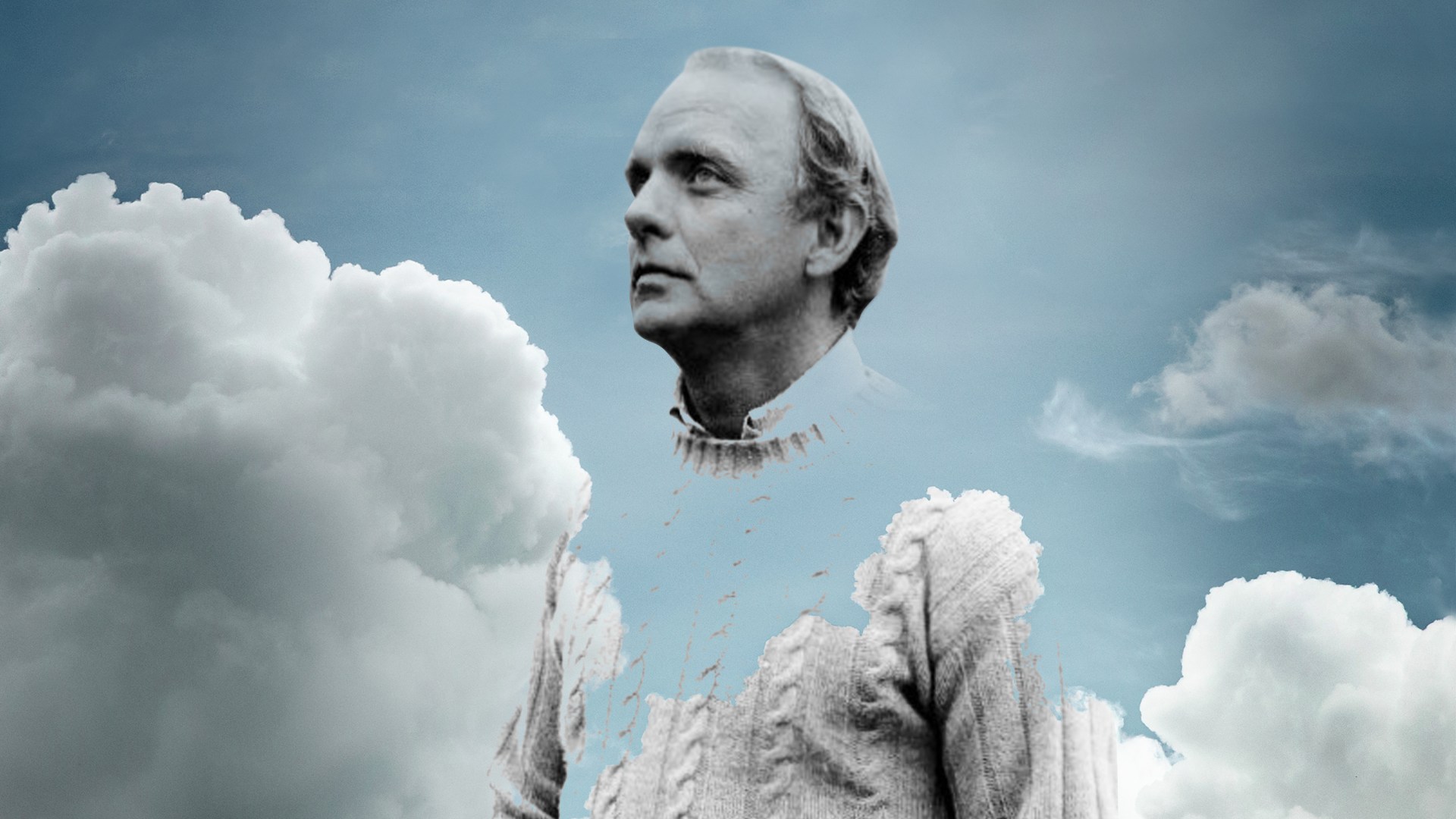
Illustration by Mallory Rentsch / Source Images: Pexels / WikiMedia Commons

In the preface of Roger Olson’s new book, Against Liberal Theology, we meet a particular type of exvangelical all too familiar in this age of disillusionment and deconstruction. As Olson describes this tribe, “They grew up in fundamentalist churches, found them stifling, anti-intellectual, legalistic, whatever, and rushed past the middle ground to the opposite end of the Christian spectrum, to liberal Christianity.”
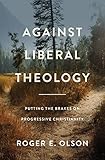
Against Liberal Theology: Putting the Brakes on Progressive Christianity

Against Liberal Theology: Putting the Brakes on Progressive Christianity

HarperCollins Children's Books

192 pages

These people haunt him. Olson fully sympathizes with their desire to escape the militant dogmatism of churches on the far-right fringe. But he is baffled by the flying leap they have taken from one extreme position to its opposite. It is a leap that carries them over the broad fields of Christianity itself, skimming lightly past every actual position of any churches along the entire scale of theological possibilities.

Why not touch down somewhere before the antipode? Olson is vexed by this quantum leap. But he is more vexed by the actual landing point: the position known as liberal theology, against which he has written this short book.

Cutting the cord

The book’s title is admirably clear about its main goal. Olson’s thesis is “that liberal Christianity has cut the cord of continuity with the Christian past, orthodoxy, so thoroughly that it ought to be considered a different religion.” But the book also has a secondary goal, indicated in the subtitle: “Putting the Brakes on Progressive Christianity.”

About this thing called progressive Christianity—“whatever that means, exactly,” as Olson mutters in one aside—the book has very little to say. He is not sure that the phrase has any specific meaning, and he suggests that it is “simply a label used by many different individuals who do not want to be thought of as conservative and who are attracted to social-justice issues, often to the neglect of evangelism, sound doctrine, and traditional Christian norms of belief and life.”

Progressive Christianity cannot be pinned down; it’s not “a tradition or a movement or even a real identity,” in Olson’s words. It indicates nothing more than a trajectory away from fundamentalism. Exiting fundamentalism is fine with Olson; he encourages it. But he recognizes that self-styled progressive Christians are often actually on the road to liberal theology without having counted the cost. Olson’s concern is to help them “put the brakes on” their trajectory before they reach a terminal point in actual liberal theology. He hopes to do so by carefully explaining what liberal theology actually is.

Against Liberal Theology has two great merits. The first is that Olson carefully specifies the liberal theology that he is against. He identifies it as a tradition derived from an earlier brand of German theology that took its classical form in the 19th century. More specifically, it began with Friedrich Schleiermacher (1768–1834) and reached its definitive shape in the work and influence of Albrecht Ritschl (1822–89).

Being so specific about the system’s pedigree has a focusing effect. Olson never gives in to the temptation to use liberal as a mere term of abuse or to mean something as loose as “any theological deviation to the author’s left.” For Olson, it is a tag that should be applied only to Schleiermacher’s theological descendants.

It’s a handy simplification of a complex tradition, and it mostly works. I say “mostly” because at key points Olson also broadens his story to include Georg Wilhelm Friedrich Hegel (1770–1831), who certainly belongs in the story of liberal theology but equally certainly does not spring from the tribe of Schleiermacher. The Schleiermacher-to-Ritschl genealogical narrative also fails to accommodate a number of Anglo-American thinkers with diverse intellectual backgrounds. Process theology, for example, is rightly reckoned a variety of liberal theology in that it denies God’s unchangeable nature, but its roots are American and British, not German. To extend his analysis, Olson also appeals to a standard definition of liberal theology as any project that gives “maximal acknowledgment of the claims of modernity in Christian thinking about doctrines.”

The phrase is quoted from liberal theologian Claude Welch (1922–2009), and it is characteristic of Olson’s fairness that he calls on actual liberal theologians to secure his definitions. Throughout the book, Olson likewise appeals to liberal historians, chiefly to Gary Dorrien’s excellent three-volume The Making of American Liberal Theology. When he asserts that liberal theology holds a particular position, Olson demonstrates it from primary sources, so that Against Liberal Theology is a little anthology of key statements taken directly from self-identified liberal theologians. This practice should be more common, especially in popular-level polemical works like this. It helps keep reader and writer honest.

The book’s second great merit is its point-by-point, chapter-by-chapter theological analysis of liberal theology. Olson compares liberal and orthodox understandings of the Bible, God, Christ, salvation, and eschatology, as well as the theological method itself. In all cases, he establishes a definite contrast. To use debate terminology, we could say he achieves good clash: The two systems are not talking past each other about different topics but disagreeing on central categories.

Overall, Olson sees liberal theology as a system that emphasizes God’s immanence within creation to such an extent that it fails to take seriously divine transcendence. This judgment should be no surprise to readers who remember that Olson made the same assessment in the widely used 1992 textbook that he coauthored with Stanley Grenz, 20th-Century Theology: God and the World in a Transitional Age. Olson has held the same view of liberal theology across these 30 years.

What is new here is the focused survey of the doctrinal consequences of denying transcendence. For liberal theology, the Bible is a repository of human insights into spiritual matters rather than a supernatural communication from the Holy Spirit himself. In the doctrine of God, theism gives way to panentheism, and God has no life or identity but the one he necessarily shares with creation. As Olson puts it, liberal theology finds it “necessary to empty God of his transcendence, almighty power, self-sufficiency, personhood (in some cases), and wrath.” Christ becomes not so much the unique source of salvation but a kind of symbol representing what salvation can be when it takes shape in human life.

Olson traces the liberal doctrine of salvation as an attempt to bypass the doctrine of sin and replace it with a concept of the kingdom of God becoming actualized in human social achievement. That optimism about saving the world by building the kingdom gives way to a shocking deflation of the traditional doctrine of the future. Liberal eschatology is almost entirely vacuous. Older liberal theologies tended to promote a vague sense of an afterlife, but more recent versions tend to embrace a thorough naturalism terminating in humanity reintegrating into the dust without remainder.

Seek elsewhere

Just over a century ago, in his little classic Christianity and Liberalism, J. Gresham Machen made the same point: that authentic Christian theology and liberal theology are two different religious systems. Olson gladly aligns himself with the judgment of the older book: “I have come to the same conclusion Machen did, and I think any orthodox Christian, however progressive they might be, must agree that liberal Christianity is not authentically Christian.”

There are, however, some significant theological and temperamental differences between Olson and Machen. Olson repeatedly argues that liberal theology has “cut the cord of continuity” with its Christian past but then goes on to talk about the liberal system as a variety of Christian theology. In other words, he makes the definitional move (liberal theology is not Christian theology) but doesn’t adjust his own terminology. Readers may have to parse some of the resulting sentences rather closely to reconcile them with each other.

Olson is also eager to assure his readers, “I will not argue that liberal Christians are not Christians; I will argue that their theology is not authentically Christian.” Apparently, Olson is confident he can make this clean distinction between doctrine and piety by acknowledging that Christian faith is largely a matter of the heart, whereas theology, right or wrong, is a matter of the head. Still, readers holding in their hands Olson’s own sweeping, six-point argument that liberal theology is not Christian are bound to wonder where the definitional limits lie. It would be an error to insist that perfect theology is what saves us. But being programmatically in error regarding God, Christ, sin, salvation, and Scripture raises some questions about the nature of faith, and Olson’s book would seem less woolly if he had addressed these questions more than just in passing.

Against Liberal Theology may be a confusing read for people who expect clear distinctions to be drawn and maintained. It will certainly be a frustrating book for readers more conservative than Olson. But Olson’s target audience is Christians moving away from a stifling fundamentalism, feeling their way toward a more progressive faith, with liberal theology just over the horizon. Olson has seen that territory and has written this book to explain to such seekers why they should seek elsewhere.

Fred Sanders is professor of theology at Biola University’s Torrey Honors College. His books include The Deep Things of God: How the Trinity Changes Everything and Fountain of Salvation: Trinity and Soteriology.

Books

Meet the Christian Rap Duo from ‘Reservation Dogs’

Hip hop artists Lil Mike and Funny Bone got their start performing at churches. Now they’re acting on FX’s critically acclaimed television series.

Funny Bone and Lil Mike

Funny Bone and Lil Mike

Christianity Today August 18, 2022
Courtesy of LiL Mike and Funny Bone

When Lil Mike and Funny Bone (who perform as the hip-hop duo Mike Bone) auditioned for the television show Reservation Dogs, they never expected the series to gain much attention outside the Native American community.

Co-created by Sterlin Harjo and Taika Waititi, the show follows the lives of four Native American teens in Oklahoma and finds humor in some of the dark realities of reservation life. Now in its second season on FX, the critically acclaimed series received a Peabody and has been nominated for numerous other awards.

Fans of the show may not know that Lil Mike and Funny Bone—who appear as Mose and Mekko, respectively—have been Christian hip-hop artists for nearly 25 years. Using a style that draws together rap, dance, and comedy, they got their start performing at churches and house parties and eventually appeared on America’s Got Talent in 2013.

CT spoke recently with the duo about using music to fight Satan, throwing pajama parties for Jesus, and working on Reservation Dogs.

Some of our readers will be familiar with you through the show Reservation Dogs, but they may not know about your musical work and careers up to this point. How long have you been making music as Mike Bone, and how did you get started?

Lil Mike: So I started making music in 1992, and it was a form of therapy. I had anger issues. I would black out and try to hurt people. So, they told me, write out your problems instead of acting out. In 1997, we joined together. Funny Bone came and got in and did some comedy.

Funny Bone: Yeah, I would jump on stage and do something funny while he was switching out songs. And then I slowly started to write my own rhymes. I got some skits on different tracks where I’m like slapping Satan, making fun of Satan. It’s pretty hilarious. Like, “I just threw Satan off a cliff.”

Where were you performing when you were just starting out? What were the venues like?

Funny Bone: Churches, talent shows, nightclubs—any nightclubs we could that we could get, we were jumping in. House parties—we did a lot of house parties. Block parties.

We opened our own nightclubs, and they were strictly, like, teen nightclubs. No alcohol, no smoking. We wanted to do our own parties so we could play what we want. We were playing faith-based music.

Lil Mike: So we opened up a teen nightclub, and opening night, we did a pajama party. People was like, a little afraid to dance, you know, to Christian music. I started playing songs they had never heard before. But then after a while, people got loose. And I was like, “It’s okay to praise God and dance.”

We even made a mixed drink called Jesus Juice, and it was basically apple juice and orange juice and lemonade. No alcohol—we don’t do that. One church that hosted our nightclub was like, “We’ll stop in the middle of the nightclub and then have a service.” And we’re like, save service for Sunday!

When you started hosting these kinds of shows and dance parties, did you run into churches that were uncomfortable hosting you?

Funny Bone: Yeah, definitely. We got kicked out of a lot of churches.

Lil Mike: Yeah, I don’t know if you’ve listened to any of Funny Bone’s older stuff, but we tried to push the button. There was this song he did called “This One’s for Satan.” And we were rapping in church—

Funny Bone: And I dedicated it to the Devil.

Lil Mike: Some people would love it, and some people would hate it. But basically, he’s just dissing the Devil through the whole track.

Funny Bone: “Kicked Satan in the balls, had his nuts clappin’”?

Lil Mike: Yeah, that one. We would try to push the button. Some people have different ways of, you know, fighting against the Enemy. And for us, it was music.

Talk about how you came to faith.

Lil Mike: We grew up in the church. It was an Indian Southern Baptist church. It was very strict. The songs sounded kinda sad, and we were just, like, not really paying attention. I mean we were believers, but we weren’t really …

Funny Bone: Religious?

Lil Mike: Yeah, religious or whatever. And so, we was getting in trouble and stuff like that. And once we started to get our head on straight, we was like, “You know what? This church is cool, but we gotta go explore.” So, we would do something called church hopping, and we would visit different churches.

Funny Bone: Some of those churches were just robotic. You could tell, none of these people are feeling the Spirit. Like, singing about joy but they’re just sad singing, so sad and not moving.

Lil Mike: I mean, we got kicked out of so many churches ’cause, like, “You can’t treat Jesus like it’s a nightclub.” Or after going there for so long, they’d be like, “Now you’re members, and Jesus is trying to change you” or whatever. And we’re like, “Nah, dude, each disciple was different, homie. You ain’t gonna change the way I look just because I came to Christ. We all bang different.”

Then there was this one church we went to. We pull up to the parking lot, and all we hear is music, and I go, “Man, that’s rude. Somebody just gonna be sittin’ in the parking lot playing music.” And as soon as we opened the door, we realized the sound was coming from inside the church, and we walked around the corner, and it was a dance floor, party lights. And this was a Sunday morning. And there was dancing and break dancing and stuff like that. And we were like, “Oh, we home.”

Funny Bone: Yeah, it was pretty dope. Stayed there for a cool minute. Big shout out to Bringing the Fire in Oklahoma City.

As artists, you foreground your faith and your Native American identity. How did you come to fully embrace both of those parts of yourselves in your work?

Funny Bone: We’ve been in the faith for a long time, and we’ve felt the Creator Spirit personally. And it is powerful. That’s kind of what helps ground me, just knowing personally, feeling that touch from God. Whenever it’s looking bleak, whenever we going through struggles, not gonna worry about it, ’cause I know Creator has it. I know God’s got this. We have a song called “Ain’t Worried ’Bout It.”

A lot of people definitely need encouragement like that, especially in the indigenous community. They have the highest rates of suicide, depression. I got really close at one point. I’m not ashamed to say it. The Enemy was just attacking me. And the only thing that really kept me going was knowing that God has to have something better for me.

Are there particular parts of Scripture or biblical figures you resonate with?

Lil Mike: I really enjoy the Book of James. Sometimes I just open the Word and go to James and let it just fall out. And the words in red, man. Everything that Jesus said. Take that to heart.

Part of the reason why Reservation Dogs has been so celebrated and influential is that it elevates the Native American experience and centers performers from that community. What has it been like to be a part of that project?

Lil Mike: So, when we got on the show, we auditioned, and there were cuss words in the script. And we were like, “Yeah, we don’t cuss,” and they honored that for us. They let us rewrite a lot of the stuff too.

Funny Bone: They respected it and let us do our own little jokes and throw our own little swag in there. They’ve added writers of all types of backgrounds. It’s an honor to be part of something so monumental for the indigenous community.

Lil Mike: I never thought that it would get momentum outside of Indian country. So for everybody else to enjoy it …

Funny Bone: Yeah. It’s showing them who we really are as indigenous people, even through all the struggles and systematic oppression. We learn to kind of turn things and just laugh at it. That’s what’s kept us going.

Even before the TV show, a lot of your music was a form of activism or advocacy. How does that show up in your work these days?

Funny Bone: The song “Fist in the Air” is one of our first singles. It’s pretty recent, and it’s dedicated to raising awareness for missing and murdered indigenous people.

Lil Mike: And we have a song called “That’s Enough” about police brutality and racism. Talking about those subjects can be touchy with some folks, but we do feel obligated to use our platform to raise awareness. Any way we can help.

In the hip-hop and indigenous spaces you occupy, is Christian sometimes an uncomfortable label for the two of you?

Funny Bone: Very. I don’t wanna say that we get ashamed to call ourselves Christian, but amongst the indigenous community, there’s a bit of that. The colonizers stole a lot, including religion. So we try to tell the natives—just because that’s what colonizers are doing doesn’t mean that’s what Jesus stands for. They are manipulating the Word of God to get over on people.

Not everyone has good intentions. Some people are just wicked. If your Christianity allows you to hate somebody, then you’re doing it wrong. God is love.

Lil Mike: We’re just trying to stay grounded with our connection to Creator.

Funny Bone: God is love. Anything else is not of God.

Culture

Chinese Christian Pop Star G.E.M.’s New Song Is Courageous

Deng Ziqi’s “Gloria” music video embeds gospel messages and shares a journey from wasteland to gospel hope.

Christianity Today August 18, 2022
WikiMedia Commons

In July 2022, the singer G.E.M., Chinese name 邓紫棋 (Deng Ziqi), released her 14-track album Revelation. On August 9, the music video of the album’s first song, “Gloria,” was released online. G.E.M. also recorded and released a short video sharing her spiritual journey in the creation of the song.

Deng, nicknamed “China’s Taylor Swift,” is one of China’s most popular and successful female singers. She is a Christian who has openly talked about her faith on social media. She said in the recorded message that “Gloria” was actually her real English name, given to her by her father when she was a child. She liked this name very much since childhood “because it feels like being full of glory” and she named the song after her real name to “present the real me to everyone without framing.”

The background of most scenes in the “Gloria” music video is a gray, desolate wasteland. The computer-generated imagery creates a vibe of the metaverse. The singer stands in the wasteland, with tears “falling into the wilderness.” She walks into the “Afterland” only to find it is not paradise but a place full of pain and numbness.

However, the light of hope gently shines through, and the singer hears a whisper from heaven that was “indistinct and healing.” She slowly turns around and walks through ruins to a seaside where the dawn is emerging. The background begins to change color. As the singer is moved to tears and kneels to pray, the sea parts. As the lyrics of “I’m waiting for you, waiting for you to come back” play, she walks toward a glowing door.

Deng said that she hopes the visual effects of the music video will create an “immersive experience for the audience as they walk with me through those moments of pain, despair, and redemption.” She said that the inspiration for the entire Revelation album came from a supernatural experience she encountered. One day, overwhelmed by sadness, she was crying and praying in the bathroom. When she began humming a melody unconsciously in the shower, she began to feel it bringing her peace, transcending her circumstances.

The inspiration for an album emerged: She wanted to use her new song to speak of her struggles, heartbreaks, and prayers, and to remember how God answered prayers to redeem and bless her.

Walking through the wasteland

G.E.M., now 31, grew up in Hong Kong. An alumna of Christian education, she learned to sing in her school choir. In 2008, at the age of 16, she debuted in Hong Kong with her first solo EP “G.E.M.” and began touring around the world.

In 2014, Deng entered the entertainment industry in mainland China and competed on the singing competition show, I Am a Singer 2, a contest that sent her popularity soaring across the country. She is known as the “Iron Lung Girl Singer” due to her wide vocal range. She is the first Chinese-speaking singer whose music videos have exceeded 200 million views on YouTube, and the only Asian musician on Forbes’ 2016 list of “30 Under 30.”

But there were tears and pain behind the glamor of success. In addition to the critics and rumors that characterize the entertainment industry, G.E.M. also faced heat for her supposed political stance, even though she did not like to talk about politics publicly. Some who support the Hong Kong pro-democracy movement accused her of supporting the then–chief executive Leung Chun-ying, who they saw as the Chinese government’s pawn. On the other side, Chinese censorship officials placed her on a list of “strictly controlled” persons because she prayed for Hong Kong “in bitter tears” during the Occupy Central movement in 2014.

G.E.M. has spoken publicly about often feeling physically and mentally wasted and has broken down at concerts multiple times. But she also admitted on social media that it was her faith in God that kept her through the hardships of her career and allowed her to grow in trials.

“I gradually learned that the result is not the most important thing because whether it’s a failure or a success, I would gain experiences either way,” she said. “I think everyone is a walking witness to other people.”

“Gloria” is not Deng’s first song that contains elements of the Christian faith. She wrote and sung “Heartbeat” and “Walk on Water” with gospel implications before. In the lyrics of “Gloria,” Deng repeatedly talks about love using Biblical language such as “Do not be afraid; there is no fear in love” and “love never fails.”

Most Chinese Christians appreciate the song’s message

The release of the “Gloria” music video (MV) brought out many discussions among Chinese and overseas Chinese Christians. In a recent livestream on the evangelism YouTube channel “All Things Tea House,” Cui Yu, a member of the Christian worship band and song writing team The Burning Bush, said he admired G.E.M.’s high production values in the music video and the quality song composition. Cui was deeply moved by the image of the Red Sea parting: “We read about the Red Sea story in the bible often, but the visual effect in the MV has such a strong artistic impact.”

While he doesn’t consider himself a fan of her music, Chicago-based pastor Jiang Shaolong admired Deng’s courage to use music to testify her Christian faith. “There are commercial and political risks in today’s China for a Christian artist to testify her faith publicly.” Jiang said in the same livestream. “Although Deng has participated in a wide variety of popular TV shows that can reach hundreds of millions of audiences, it is impossible for her to be given any opportunity to openly witness her Christian faith on those shows. She knew that expressing her Christian faith in the song may cause her to lose fans or be critically attacked, but she was determined to speak out using her music.”

Deng’s use of biblical vocabulary to express her Christian faith in her song could be a good “pre-evangelism work,” said Jane Hao, also a member of “The Burning Bush” team. Hao also defended G.E.M. from Christians who criticized the song for not mentioning “God” or “Lord Jesus” directly: “Churches should not rely on a Christian pop star to do the whole work of evangelism. Some non-believers may become curious about Deng’s faith through her musical works, but it is the responsibility of the Christians around them to share the complete gospel with them.”

Kris Wang, elder of the Lansing Chinese Church in Michigan and campus ministry leader who has been following and writing commentaries on pop culture, shared with CT, “It is very rare to see in the Chinese pop music industry that a singer would disclose her faith in songs and to generate ideas from the Bible for the entire album. There are examples in the United States that songwriters integrate their faith into pop music, like Kanye West, Justin Bieber, and DMX have done. But in atheism-dominated China, doing so is innovative and creative.”

“Deng Ziqi is a singer, not a theologian. It is commendable that she presents spiritual encounters in the form of art and from a first-person perspective,” Christian author Naxier said in a WeChat article. “We can’t judge her work as cheap-grace gospel simply because there is no mentioning of sin and repentance in the song. We should allow a work of art to take on one aspect of the Christian faith at a time.”

According to Naxier’s interpretation, the MV is telling its audience a story of redemption: Gloria was a scarred person, lured into false hope, losing her identity and dignity as a human. After hearing the voice of God and turning to him, she is finally complete in her humanity. This song is a call to people who also live in the wasteland to abandon the disillusion of finding a paradise in that world, to return to the love of God, and to enter the real paradise of God’s grace.

When Deng entered the entertainment world, she gave herself a lively stage name, “G.E.M.,” which means “Get Everybody Moving.” Many among her Chinese Christian fans are praying now that the love of God she witnesses through songwriting will get everybody moved—that her songs would move and comfort the hearts of many who are still struggling in the wasteland.

Sean Cheng is Asia editor of Christianity Today.

Translation by Yi-Ting Tsai

News

Egypt Church Fire Kills 41, Sparks Blame of Building Law’s Legacy

Reforms have legalized 2,400 Christian structures, yet Abu Seifein represents problems from when construction and repair permits were impossible to obtain.

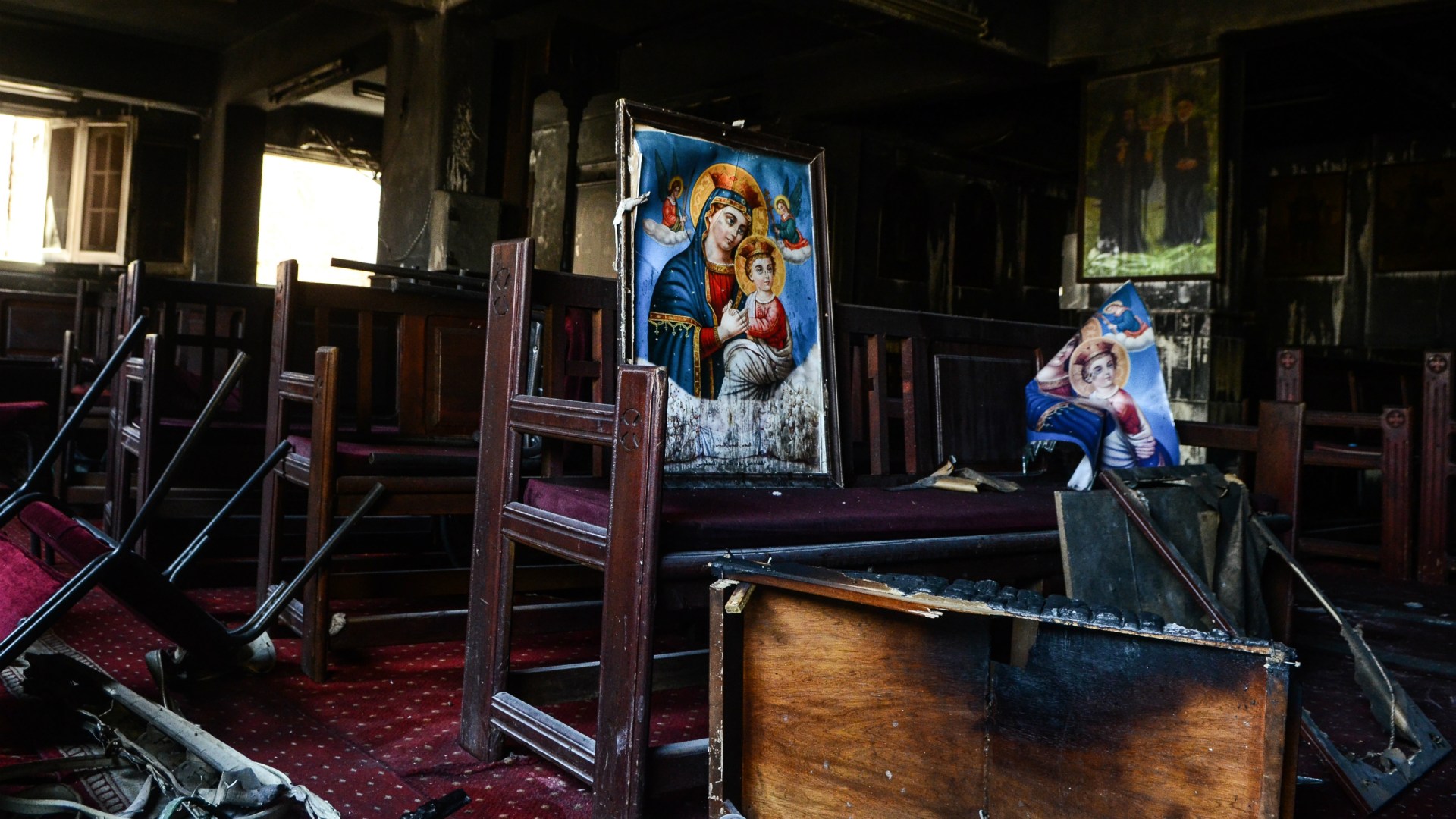
Burnt icons and wooden benches inside Abu Seifein Coptic Orthodox Church in Imbaba after a massive fire broke out during a Sunday service on August 14, 2022.

Burnt icons and wooden benches inside Abu Seifein Coptic Orthodox Church in Imbaba after a massive fire broke out during a Sunday service on August 14, 2022.

Christianity Today August 18, 2022
Tarek Wajeh / picture alliance / Getty Image

As Egypt reels from the tragic church fire that killed 41 worshipers on Sunday, many search for where to put the blame.

“God forgive the fire department,” said Ishak Henin, a deacon at Abu Seifein Coptic Orthodox Church in Imbaba, a dense urban neighborhood of Cairo. “If they had come earlier, they could have saved more people.”

Egyptian authorities stated they arrived almost immediately after the 9 a.m. fire was first reported. Eyewitness testimony varied; some stated 15 minutes, others over two hours.

Abu Seifein means “the father of two swords” and is the Arabic moniker for second-century martyr Saint Mercurius, whose icon reflects his military origins.

But the word church may give the wrong impression to overseas audiences, as the sanctuary was located between ground floor shops and towering residences. Illegally repurposed in 2007 from one of many tightly packed apartment complexes, the now-charred chapel traced back to an era when Egyptian Christians were unable to obtain permits to build new houses of worship.

The law was changed in 2016, and a Coptic legal expert stated Abu Seifein was officially licensed in 2019. Since the latest batch in April, the slow-moving process has now legalized 2,401 churches and affiliated service centers.

Yet many remain in their original condition, below safety codes, and according to the law full legality can only come once all regulations are satisfied.

Abu Seifein's four-story building housed two daycare facilities, and 18 children died in the blaze. Around 100 people were present at worship that morning; authorities stated most deaths—which included the local priest—were caused by smoke inhalation and the resulting stampede.

One family lost a set of five-year-old triplets, their mother, and grandmother.

The head of Egypt’s evangelical community was “deeply pained,” and offered condolences to Pope Tawadros, patriarch of the Coptic Orthodox Church.

“We pray that God will give comfort and patience to the people,” stated Andrea Zaki, “and bless the injured with speedy recovery.”

The fire was caused by a short circuit to the air conditioning unit, sparked by an overload when the private generator did not shut off upon the return of government electricity. The death toll could have been worse, as most Egyptian Christians worship on Friday—the Muslim day of communal prayer and the start of the official weekend.

Or it could have been less. On Monday and Tuesday, two other churches—one in Cairo, one in the Upper Egyptian region of Minya—suffered similar electrical damage, with no casualties. Officials then pledged to review safety precautions in every church in Egypt.

Early fears suspected arson.

In May 2011, the nearby Virgin Mary Church was burned by extremist Muslims in the first sectarian attack on a church following the outbreak of Egypt’s Arab Spring that January.

This past weekend’s fire, though accidental, fell on the ninth anniversary of the 2013 dispersal of crowds protesting the deposing of then-president Mohamed Morsi, elected as the candidate of the Muslim Brotherhood. Around 1,000 people died in the security operation, and that same day churches were attacked across the country in response.

Once sabotage was ruled out at Abu Seifein, others blamed shoddy urban construction.

“It is not [only] terrorism that kills in Egypt,” wrote Zeinobia, a popular Egyptian blogger. “Negligence kills more, and on a daily basis with no discrimination whatsoever.”

Egyptian authorities were quick in response. President Abdel Fattah al-Sisi ordered the church repaired, and by Monday evening the building façade already appeared newly built. The government announced that families of the deceased were to be given about $5,200 each, with up to $1,000 for the injured.

Al-Azhar, Egypt’s top Islamic institution, pledged an additional $2,600, and the Red Crescent sent specialized teams for psychological support. Back in April, the grand imam had restated the right to build churches, emphasizing he would defend any that were attacked.

But violence sometimes continues, often connected to church building issues. In June, Christian properties in a village near Luxor were attacked following the licensing of its church under the 2016 law.

Church leaders linked the fire to the old conditions.

“At best, today’s tragic #EgyptChurchFire is a direct result of a painful time when Christian communities could not build purpose-designed churches,” tweeted Archbishop Angaelos of London, England, “and would have to covertly use other buildings, not fit for purpose and lacking the necessary health and safety features and escapes.”

Pope Tawadros praised the response of Sisi, noting that restrictions reflected the policy of previous governments. But his implicit criticism of the status quo included a call for authorities to move Abu Seifein to a larger space or to facilitate its expansion to accommodate the large number of area Christians.

But as laborers worked throughout the night under the watch of soldiers, Christians buried their dead and tried to take stock of their ruined facility. Wooden pews were stacked on the street, upon which sat religious icons covered in soot.

“We don’t have a lot of places to build as churches,” said Henin, the church deacon. “If we don’t learn from this experience, it could happen again.”

News
Wire Story

Ukrainian Seminary President: 400 Baptist Churches Gone

As refugees flee, the war-torn country is left in a pastoral leadership crisis.

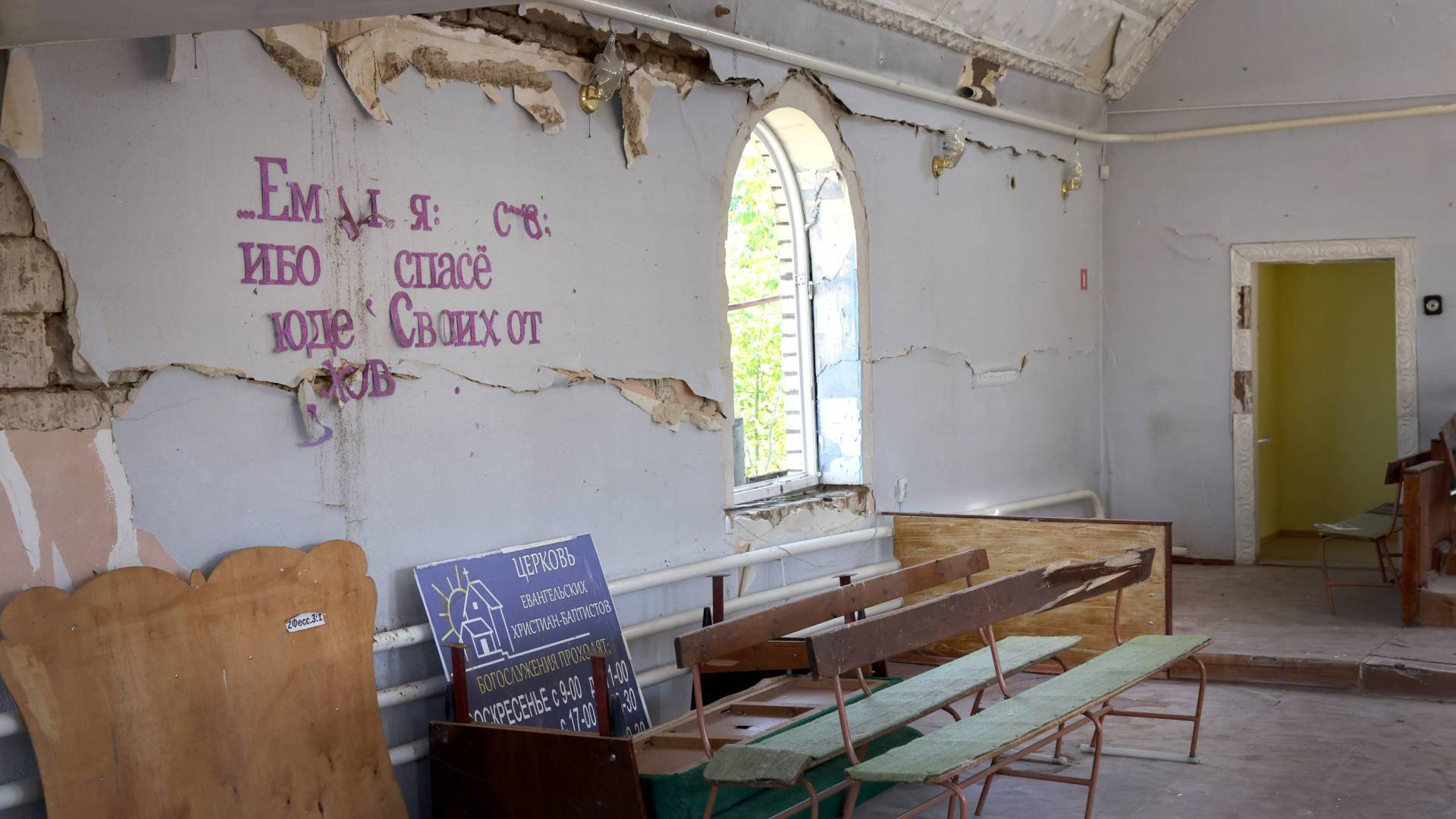
Sukovska Baptist church in Druzhkivka, Ukraine, was heavily damaged by missile strike in June.

Sukovska Baptist church in Druzhkivka, Ukraine, was heavily damaged by missile strike in June.

Christianity Today August 18, 2022
Scott Olson / Getty Images

About 400 Ukrainian Baptist congregations have been lost in Russia’s war on Ukraine, said Ukrainian Baptist Theological Seminary (UBTS) president Yaroslav Pyzh, who is working to restore pastoral leadership to impacted cities.

While volunteers at six humanitarian relief We Care Centers across Ukraine are helping internally displaced people winterize their homes, replacing roofs, windows, and doors, Pyzh said the real challenge for UBTS is to rebuild pastoral leadership in places pastors have been displaced.

“Since the war started, six months already, we lost about 400 Baptist churches. And so the real build is the rebuilding of leadership capacity, because if you rebuild buildings and you have no pastors to lead churches, I don’t think it’s going to do any good,” Pyzh, a graduate of Southwestern Baptist Theological Seminary in Fort Worth, Texas, told Baptist Press last week. “So the real challenge is not so much rebuilding walls and windows and doors.”

“The real challenge is similar to Nehemiah’s challenge,” he said, referencing the biblical story of Nehemiah. “It’s not only rebuilding the walls of Jerusalem. It’s rebuilding the nation of Israel, of worshiping God. … That’s the same thing here in Ukraine.”

Many pastors were displaced from war-torn areas, Pyzh said, leaving no one to bring godly hope in the midst of fear and hopelessness. About 2,300 Baptist congregations existed across Ukraine before the war began in February, according to the All-Ukrainian Union of Churches of Evangelical Christian Baptists.

“Our main challenge in the future, when the war will be over, is to bridge the gap in leadership that we lost,” Pyzh said. “And sadly, the longer the war goes, the more the gap’s going to be. The church is not buildings. It’s people leaving that place and relocating to the United States, and with people relocating to Germany, or people relocating to other places. And with those people, pastors left too.”

While the United Nations High Commissioner for Refugees estimates a third of Ukrainians have been displaced from their homes, many pastors have remained and churches have responded greatly to wartime needs, Pyzh said.

“The biggest thing the community has in these moments of being destroyed and bombed is fear; it’s hopelessness,” Pyzh said. “And the only one who can relieve and bring hope to the hopeless are pastors, churches, Christians.”

Pyzh estimates that as many as 150 UBTS graduates and students are working at the We Care Centers that he said will need to bring spiritual light and salt to the war-ravaged communities while also helping structurally rebuild communities and provide needed supplies. UBTS is training volunteers to serve as counselors to internally displaced residents and those who have remained.

Southern Baptist donations are helping fund the support of We Care Centers, but Pyzh said donations have greatly diminished as the war has continued. Care Centers grew from local church ministry outreaches established in concert with local governments, and are housed in buildings governments are providing at no cost.

“We’ve stepped in and tried to help them be more effective in what they do and actually sharing some of the resources that we’ve received from Southern Baptists. So we’re using these resources that we’ve received from Southern Baptists,” Pyzh said. “Instead of the seminary directly dealing with humanitarian relief (as in the initial months of the war), we work with these care centers and help them.

“The basic idea of care centers is to provide a platform for churches to cooperate with each other to serve the community. That’s the basic idea. It’s not only responding to the needs of the war, but actually creating something that can stay within the community for a long time.”

UBTS, providing education at no cost to students during the war, plans to work with about a dozen care centers by the end of the year, Pyzh said. With Ukraine’s inflation rate of nearly 30 percent, UBTS has halted tuition fees and is concentrating on raising funds to support its educational efforts.

Pyzh, who is the founding pastor of Journey Church in Lviv, encourages Southern Baptists to continue praying for a miracle of peace and victory, to pray specifically for the rebuilding of church leadership, to continue giving to humanitarian relief efforts in Ukraine and to consider establishing scholarships to support UBTS students during the war.

“Send Relief helps us with donations that we are using at We Care Centers,” Pyzh said. “But overall, donations are dropping down big time, not like we had two or three months ago. People are just tired of the war, but I see a tremendous decrease in donations.”

In one of his latest UBTS videos, Pyzh expressed continued hope. “The same God that was faithful in the past will be faithful in the future. So in the midst of all the struggle that we’re going through right now, we’re looking forward with great hope, knowing that God is with us through you,” he said on the video. “Thank you for your help.”

Theology

Does Jesus Wear Undies?

My kids ask the darndest theological questions—putting my seminary degree to the test.

Christianity Today August 17, 2022
Illustration by Mallory Rentsch / Source Images: WikiMedia Commons / Getty

I was six months pregnant when I walked across Fuller Seminary’s commencement stage in 2012. Underneath the cap and gown, my mind and body felt full: the former with all the theology I’d read to complete my master’s degree, and the latter with anticipation for my forthcoming life as a mother.

After graduation and before my first daughter was born, I had a dream of propping her up on my lap to look at an ABC board book that began with Augustine and ended with Zizioulas. This was, I think, my psyche’s way of creating some continuity from one chapter of life to the next. But as all new parents can attest, babies don’t work like that.

Arriving a little past her due date at just past 3 a.m., my firstborn was a healthy, pink tornado that ripped through my orderly and cerebral life. Then three years later, my second daughter, Olivia, was born.

For an exhausting decade, my husband and I have juggled two kids and two full-time jobs with little time between sending emails and changing diapers (and then Pull-Ups and big-girl britches) to read theological texts.

I’ve got what many call the “mommy brain”—I’m a whiz at detangling bedhead hair, getting slime out of the carpet, and making Razzle Dazzle Berry Smoothies, but I’d be hard pressed to describe the variety of atonement theories I learned about in Systematic Theology II.

Yet even if I had remained in tiptop intellectual shape, explaining the Christian faith to my daughters would likely be just as mind-bending as it is now.

Why? Because children make for a unique audience, quite unlike what you’d find in most seminary classrooms—they are simultaneously “religious” and “secular.”

They are religious in the sense that cognitive and developmental psychologist Justin Barrett’s work has demonstrated, which is chiefly that the structures of children’s minds make them prone to belief. Belief, in this sense, is the perception that reality is full of meaning and order and that a superagent (God) is in charge of it.

For instance, the other day my six-year-old Olivia was scratching a mosquito bite when she lamented, “Mom, why did God make mosquitoes?”

I’ve taught her enough to know that creation is God’s idea—he’s in charge of it and gives it order—so the idea that the instigator of this itchy torture might be the product of a random, cosmic accident in the universe is the last thing in her mind.

But that also means she’s left to wonder why God would allow such merciless vampires to exist in the world—to reflect on what good they do or what meaningful purpose they embody in his creation.

Incidentally, I told her I’d have to get back to her with the answer to that question.

But kids are also secular in the sense that they know nothing of religious dogma or the rules of faith until we teach them to adopt those beliefs—which means no question is beyond the pale. This makes them refreshingly innocent and persistent tire kickers, unafraid of appearing heretical or irreverent.

Fielding my girls’ questions about faith has been a delightful and harrowing part of parenting. I try my best to take them seriously, factoring in their developmental stages and working within the limits of concepts and vocabulary they possess. But frankly, no rubric totally prepares you for the random connections they can sometimes make.

The other day, I was driving the kids home from school when Olivia asked me, nonchalantly, whether Jesus wears undies. For a few seconds, the only sound was the tick of my blinker. “Yeah, probably linen ones,” I finally managed. (After all, he still has a human body.)

My daughter took in this information with a nod and continued staring out the window.

In the past, she’s asked me how Jesus could “live in the clouds but not be made of them.” And while some might dismiss such inquiries as ignorant or ridiculous, they become a bit more interesting when placed in a theological light.

Her questions might in fact be seen as an imaginative poke at Christ’s dual natures—a simplistic way of trying to reconcile his humanity and divinity. Such a doctrinal conundrum took hundreds of years to sort out before meriting an official orthodox formulation at the early church Council of Chalcedon.

Now, some might say that discussing Jesus’ underwear amounts to dangerous, extrabiblical speculation, a pop culture syncretism that could harm our kids. And while I share concerns about erring toward heterodoxy, I disagree that such conversations are dangerous.

The creeds, the rules of faith, and Scripture itself are meant to be our guardrails. They keep us from skidding off the path of God’s self-disclosure, and we are wise to stay within their constraints. But as any seasoned artist will tell you, constraint fosters creativity, and creativity is a vital aspect of theologizing—especially with little children.

I believe that if we are to reach the next generation with the good news, we can’t present it to them through adult formulations of doctrine and formal “Christianese.” We must meet them where they are and present the faith through Spirit-inspired improvisation.

In Surprised by Scripture, and more comprehensively in Scripture and the Authority of God, N. T. Wright reflects on the different ways conservatives have approached biblical interpretation. He grieves that “evangelical” studies of Scripture have “so often meant a closing down of scripture reading rather than its opening up.”

Against those who want to declare that we’ve already arrived at all the Bible has for us, Wright argues that no generation completes the task of studying and understanding God’s Word. “Each generation must do its own fresh historically grounded reading, because each generation needs to grow up, not simply to look up the right answers and remain in an infantile condition,” he writes.

Theologizing with kids, or with any honest seeker for that matter, is like a live theater play performed with sensitivity and regard for each context, each audience. And in some cases, it might mean discussing the Messiah’s knickers.

Now that my kids are a bit older, I’m left with the feeling that I never really graduated. I might have a diploma on my wall, but I’m still very much a student. And that’s partially because, as it turns out, “momming” is a kind of seminary in itself.

And one of the best things about that is seeing how children integrate and relate faith into every aspect of their lives. Watching them wrestle with theological questions reminds me that the mystery of faith is a gift from God, not merely the product of reason alone.

Certainly, this earnest, whole-life approach to discipleship is something Jesus must have seen when he told his disciples to “let the little children come to me, and do not hinder them, for the kingdom of heaven belongs to such as these.”

Katherine Lee is a poet and a mom who is currently writing a memoir that traces the ways that motherhood was defined by the women in her family. Her master’s in theology has informed these pursuits in surprising ways.

Church Life

Amal Kumarage: ‘Prayer and Persistence Should Prevail’

Christianity Today August 17, 2022
Illustration by Rick Szuecs / Source Images: Envato Elements / Photo Courtesy of Amal Kumarage

In this series

Transport and logistics professor at University of Moratuwa, Moratuwa, Sri Lanka, and former president of Colombo Theological Seminary

“Disruptions are not always unproductive as long as they turn us towards the order that God intended. Though such disruptions are painful, God can, in his infinite mercy, grant a nation healing not just economically but spiritually, as well as politically.”

Long before protestors hit the streets in March to call for the resignation of then president Gotabaya Rajapaksa, Amal Kumarage, a transport and logistics professor at the University of Moratuwa, was already publicly voicing his opinions on citizen responsibility.

A familiar byline on the public-interest website Colombo Telegraph, which is run by exiled Sri Lankan journalists, back in 2018 Kumarage called for the need to see past impassioned political allegiances in the clear face of a nation that struggles with “debt, corruption and worse still keeps getting divided along language, racial, religious and now possibly along values and ethics—a symptom of failure of keeping a country together.”

Citizens could not then shirk responsibility after voting in a less-than-capable government, but rather, the “dismantling of the checks and balances of governance rests with us”—the very people ”who have elected them.”

His conclusion: “We should be able to identify and reject the lies, the conspiracy, the greed, the grab and the hold to power to generate values in public opinion around us. On that alone can we rest Sri Lanka’s future.”

On a personal front, Kumarage has taken this said citizen responsibility seriously over the span of his prolific career, serving his countrypeople through his expertise in transport planning, policy implementation, and research.

With his knowledge and experience in one of the most important economic indicators of a country, he has published papers from as early as 2014 (The Real Cost of Highway Development—Who Has Got the Numbers Right?in The Sunday Times) to expose the corrupt practices catalyzing poor investment decisions on highways and roads and enormous financial drain. These issues came to a head this year when fuel prices skyrocketed with inflation and petroleum eventually ran out.

“This is where Christians need to be natural in our calling,” said Kumarage when asked how he was standing up for justice and righteousness toward effective change in Sri Lanka. “In recent years the church has played a much more biblical role in healing the many wounds of the nation.”

On-the-ground humanitarian work is biblical, he says. But the church must also be at work where structural injustice is happening and where, he believes, “prayer and persistence should prevail.”

“As the country looks forward to a ‘system change,’ as the protestors called it, the new expectation—especially of the youth—gives all of us a new opportunity to redeem many areas of corruption, injustice, waste, and neglect all around us, be it in our professions, public services, businesses, or churches.”

Ideas

Why Theologians Aren’t as Excited About Chinese Christianity’s Growth as Sociologists

Success for the church looks different depending on your discipline.

Christianity Today August 17, 2022
Edits by Christianity Today / Source Images: Getty / Unsplash

On March 1, the Chinese government enacted wide-ranging restrictions on religious communication, teaching, and evangelistic efforts conducted online. Now, only religious groups with government approval can carry out such activities.

Various media outlets around the world shared this news, which is unsurprising. When we think or talk about Christianity in China, its social impact and implications for issues such as human rights and China’s international relations—rather than its pastoral and theological developments and challenges—have received disproportionately large attention in the Western press in the recent decades.

There are many methods and approaches we can apply in observing and interpreting Christianity in China. But this leads to a larger question: How do we read Christianity in general? Religion is a complex social phenomenon, and different disciplines can draw varying—even opposite—conclusions about it. More issues arise when scholars in one discipline begin to cross the boundaries of other fields of study and claim universal applicability for their conclusions.

Church and state relations in the West

A good example of this is how differently theologians and sociologists approach and evaluate the establishment of classical Christendom in the West.

Traditionally, theologians have viewed the church’s transition from a persecuted minority to the state religion as a great triumph. However, in recent decades, they are increasingly considering it a tragedy and betrayal of the vision of the early church.

On the other hand, certain sociologists’ growing interest in early Christianity has led to assessments of the church’s transition from minority to establishment status. They present Christianity’s historical transfiguration as a classic case of how a religion can develop and gain in size and power to the point that the social and cultural mainstream must take it into account and even include it.

A prominent example of this is American sociologist Rodney Stark’s book The Rise of Christianity: How the Obscure, Marginal Jesus Movement Became the Dominant Religious Force in the Western World in a Few Centuries. Here, Stark attributed Christianity’s growth in the Greco-Roman world to the early church’s strong conversion networks and believers’ high fertility rates.

Theologians are doubtful of, and even discredit, the notion of a “Christian society or nation.” Their focus has shifted from the number and size of the Christian population to their discipleship, and from quantity to quality of the Christian community. In contrast, sociologists continue to discuss the notion of a “Christian society or nation,” and numbers and influence are still the focus of study and the primary ground for evaluation.

We do not have to decide who is right or wrong. My opinion is that both approaches are right as long as they stay in their respective fields.

From a theological point of view, the center of Jesus’ teaching and the early church’s vision is a radical form of discipleship in tension with, or even in confrontation with, the world. But this teaching and vision is fundamentally lost in the Christendom paradigm that turns the church into a master in the world and mutes its prophetic voice. Then what we have is a spiritually weak and socially collaborative church.

As Christendom collapses in the West, the church again finds itself marginalized, even exiled, in society and culture. An increasing number of church leaders are calling the church to recover the lost vision of the early church and return to a mode of witnessing as a faithful minority in a not-so-friendly world.

When sociological interpretations go awry

From a sociological point of view, the transfiguration of the church from a marginal to mainstream group has produced immense cultural and social impact. Problems occur when sociologists begin to go beyond empirical and scientific studies of Christianity and draw theological conclusions using a sociological approach.

Some sociologists tend to present their studies of early Christianity in such a way that advocates for the establishment of Christendom or Christian dominance in society, especially in countries like China. Encouraging the church to grow numerically and enhance its social and cultural influence is purportedly the only way to secure Christianity’s future in the world. As an article in The Telegraph declared in 2014: China is on track to become “the world’s most Christian nation” by 2030.

However, this approach to church growth does not match our global, social reality well. As the once-Christianized West is quickly entering the “post-Christian age,” it is highly doubtful that Christianity will be a dominant, sustainable, cultural, and social force in the 21st century—even in the majority world where churches have been on the rise.

Further, just because something is true sociologically does not necessarily mean it is also true biblically or theologically. A culturally powerful and numerically large Christian majority in a society may not be good news for the church’s spiritual health and witness.

Church history and empirical evidence attest to this. “Christians engaged the culture without excessive compromise and remained separate from the culture without excessive isolation,” wrote theologian Gerald L. Sittser, in an essay exploring how the early church flourished as a minority movement. “Christians figured out how to be both faithful and winsome. They followed what was then known as the ‘Third Way,’ a phrase that first appeared in a second-century letter to a Roman official named Diognetus.”

Finally, biblically and theologically speaking, a Christianized society is an untenable concept and an undesirable reality. However, sociologically and historically, Christianized societies and nations did exist, and they remain a sociological possibility and even an inevitability in certain contexts.

Again, a sociological and historical reality does not mean it is theologically desirable and commendable. History has told us that a society dominated by a Christian majority is bound to be a nominal Christian society that only pays lip service to gospel values or distorts them for its own advantage.

Theological pitfalls to avoid

Of course, problems arise when theologians go beyond their own fields, too.

Some theologians may denounce Christendom so harshly that they completely ignore the historical inevitability of Christendom in the West and the constructive social and cultural consequences that Christendom may bring to a society. But a biblical point of view can and should endorse the latter.

Having said this, I do not believe that these theologians’ “offense” is too serious. After all, when they denounce Christendom and all the harm it brought to the church, they are largely speaking to their own circle, the church. But when some sociologists speak highly of Christian dominance in society, it seems they are predicting where the church is going and suggesting what the church should do in the future. Theologically, this could be very troubling and misleading.

The key is for Christians to draw a proper line between sociological reality and theological merit and truthfulness. If we fail to distinguish these, the consequences could be immediate and serious.

This is especially evident in contemporary interpretations of Christianity in China.

In my view, an overwhelmingly sociological reading that is not adequately balanced by theological considerations has serious implications. It contributes to the tendency of the Western press—secular as well as Christian—to overemphasize Chinese Christianity’s numerical growth and cultural, social, and even political impact. This is at the expense of the church’s theological and pastoral trends.

As a result, issues like religious freedom and church-state relations dominate the discourse about the church in China. These issues mistakenly define the Chinese church’s essential agenda. Even more ominously, a “Christianized society” becomes the goal for the church in China to strive toward.

To correct this unfortunate situation, one thing we can do as the interpreters of Christianity in China is to become fully mindful of the strengths and limitations of each discipline and perspective. A sense of humility is also needed in our reading of such a complex phenomenon like Christianity in contemporary China.

Kevin Xiyi Yao is professor of world Christianity and Asian studies at Gordon-Conwell Theological Seminary.

A previous version of this piece was published on ChinaSource.

Books

Doubt Be Not Proud

Frederick Buechner diffused the power of disbelief and brought hope to wandering hearts.

Christianity Today August 17, 2022
Illustration by Christianity Today / Source Images: Unsplash

In The Alphabet of Grace, the late writer Frederick Buechner gave an account of his conversion. He was agnostic at the time but had been attending a church because he liked the preacher, George Buttrick.

Queen Elizabeth had recently been crowned, and Buttrick made a connection to those events by saying that unlike the queen, Jesus has been crowned again and again in the hearts of those who trust him. Here’s how Buechner describes it:

He said in his odd, sandy voice, the voice of an old nurse, that the coronation of Jesus took place among confession and tears and then, as God was and is my witness, great laughter, he said. … At the phrase great laughter, for reasons that I have never satisfactorily understood, the great wall of China crumbled and Atlantis rose up out of the sea, and on Madison Avenue, at 73rd Street, tears leapt from my eyes as though I had been struck across the face.

I study apologetics, especially the dynamics of faith and doubt, so Buechner’s testimony is doubly significant to me. I can hardly read that passage without tears of my own. I confess that the gospel often feels too good to be true, even as I long for it to be true with every fiber of my being.

But if I find myself with faith, it’s at least in part because I know the feeling of being claimed by “tears and great laughter” while hearing the gospel or receiving Communion. I know of no writer other than Buechner who captures what I might call the incredulity of joy—a doubt-tinged hope that insists on “whistling in the dark,” as he put it.

I was raised in a religious context that emphasized certainty, moments of decision, and the clarity of Scripture over experience. Those emphases are not so much incorrect as incomplete. There’s nothing wrong with wanting to stand on a firm foundation or trying to explore the world from a stable base.

But life is full of sharp edges to puncture our illusions of control. At least that’s what I found as I went away to college in a big city, began to wrestle with doubt, and started working in ministry. In any case, I quickly learned that the world was much bigger than I had ever imagined and that I needed a more capacious story than the one I had been given.

That’s when Buechner entered my life—during my early years of college. I never met him in person, and yet he was one of my most reliable guides as I made the transition from the fundamentalism of my youth to a more grounded and vital faith in my 20s and 30s.

My wife—who deserves the credit for inspiring me to read Buechner—first encountered his fiction in The Book of Bebb and The Christmas Tide. She then purchased all his published works and eventually wrote her graduate thesis on him.

After we learned of Buechner’s death, I asked her what it was about him that so captured her imagination.

“Growing up in fundamentalism, it was like there was this unexplored cavern of meaning,” she said. “We were taught that nothing in the world really mattered because it was all going to pass away. But here was Buechner showing me the importance of the everyday, of the way that God shows up in the midst of the mundane.”

Indeed, as she and I embarked on life together, Buechner taught us to celebrate the moments of ordinary goodness that fill married life. “There is no event so commonplace but that God is present within it, always hiddenly,” he wrote in Now and Then, “always leaving you room to recognize him or not to recognize him, but all the more fascinatingly because of that, all the more compellingly and hauntingly.”

It was this dynamic of hiddenness and recognition that felt so compelling to me, especially because it matched my experience of longing for God but struggling to feel his presence. Buechner taught me that faith is not certainty—at least not the kind of certainty that keeps you in control. Belief requires vulnerability, honesty, facing the darkness without and within.

That journey isn’t easily taken. In a world where both wonderful and terrible things happen, doubt makes a lot of sense. “There is doubt hard on the heels of every belief,” writes Buechner in Secrets in the Dark, “fear hard on the heels of every hope, and many holy things lie in ruins because the world has ruined them and we have ruined them.”

Even as he taught us to be comfortable with the darkness, he never allowed us to lose our memory of the light. He refused the hubris of despair.

In Telling the Truth, Buechner gives his account of “the gospel as fairy tale”—a story that stirs up our deepest hopes but also has “one crucial difference from all other fairy tales.” It’s true, and it “not only happened once upon a time but has kept on happening ever since and is happening still.”

By describing the gospel as a fairy tale, Buechner acknowledges our instinctive incredulity. But he also confronts us with a question: What if it happened? And happens still?

In Luke’s account of the Resurrection, we’re told twice about the disciples’ disbelief. The first time, we hear about their cynical doubt: “They did not believe the women, because their words seemed to them like nonsense” (Luke 24:11). But then an encounter with Jesus leads them to a new sort of incredulity: “They still did not believe it because of joy and amazement” (v. 41).

As I followed Buechner’s writing as a young adult, I found him preparing the way for that second form of incredulity. He was not interested in getting me to question my belief. Whatever he was trying to do, it didn’t feel like deconstruction.

If he challenged my unexamined certainties, he did so gently, by painting more beautiful pictures of the life of faith. He wrote so honestly about how it feels to be human: the loneliness, the confusion, the clumsy struggle to receive the love we are given or to give love in a way that can be received.

That was Buechner’s special ministry—saying the quiet part out loud. Giving language to the inarticulate murmurings of the heart. Speaking what we all felt rather than what we were supposed to say. Teaching us to tell the truth.

But what Buechner did better than almost anyone was holding the door ajar for grace to come bursting in, when it is least expected and least deserved.

Justin Ariel Bailey is associate professor of theology at Dordt University and author of the forthcoming book Interpreting Your World (Baker Academic, 2022). He is also an ordained minister in the Christian Reformed Church and has served as a pastor in Filipino-American, Korean-American, and Caucasian-American settings.

Theology

A Seminary Room of Her Own

Historically, evangelicals have been ahead of the curve in women’s education and also way behind it. My pursuit of an MDiv is now part of that mixed legacy.

Christianity Today August 17, 2022
Edits by Christianity Today / Source Image: Unsplash

This week I’m packing up my 18-year-old daughter as she heads off to college. In a twist of providence, I’m also returning to the classroom after 21 years away. While she’s navigating the firsts of freshman year, I’ll be navigating the firsts of a master of divinity. These last few months of applying to schools, securing funding, and planning out our schedules have been a sweet time for us. In God’s wisdom, he’s decided that we’ll share these milestones. But this time has also made me wrestle with how the evangelical church both facilitates and impedes women’s academic development. My education story doesn’t begin with me and my daughter. It starts with my maternal grandmother, who left home at 16 to attend college—not because she was drawn by academics or a career but because she felt called to a life of Christian service. She came of age during the post–World War II years, when a great youth revival was sweeping the nation. As my grandmother’s best friends settled into lives of factory work and marriage, she moved 800 miles away to study for church work. There she eventually met my grandfather, who was funding his own ministerial training through the GI Bill. Ironically, my grandmother never considered herself much of a student and even decades later carried a sense of “imposter syndrome,” despite her college degree. But her brave steps established a norm for her daughters, who all pursued higher education—at least higher Christian education.

The same evangelical culture that called my grandmother, mother, and aunts to higher education also reminded them of the importance of home and family, and the balancing act between both became increasingly difficult as the gender wars ramped up in the wake of second-wave feminism. So while my mother—one of the brainiest women I know—began graduate work after college, she soon set it aside to have a family and support my dad as he finished his own education. Still, she always found a way to keep learning. When she was teaching in a Christian day school, she took distance education courses to improve her Latin. As a young girl, I watched her study with her textbooks and papers spread across the dining room table. But as I remember it, even those efforts had to be justified by her work in ministry.

While men’s education seemed almost self-validating, women had to explain how their pursuit of higher education would be used to “serve God.” Baylor history professor Andrea Turpin, whose work focuses on gender and religious higher education, talks about an “evangelical pragmatism” that might explain this phenomenon.

Even schools and denominations that traditionally restricted women’s roles in society “were willing to bend cultural norms about appropriate activities for women in order to get more hands on deck for God,” she writes. This unique combination of gender traditionalism and higher learning makes evangelical women something of an anomaly. Historically, they’ve been both ahead of and behind the curve of female advancement.

When my grandmother went off to college in the late 1940s, she was among only 5 percent of American women. And when my mother received her degree in 1975, that number had risen only 6 points to 11 percent. Both were in the clear minority of US women. But they were also part of a deeply traditional subculture that erected barriers to their ability to use their degrees outside the home or church. These mixed signals are still in play today, I would argue. For evangelical women, pursuing higher education is or has to be deeply tied to their commitment to God. This dynamic might help explain another curious trend: While higher education tends to correlate to lower degrees of religious commitment, data suggests that evangelicals with college degrees are among the most committed churchgoers. In my family’s anecdotal experience, education and religious commitment go hand in hand—especially for women. But this also presents a unique set of questions for evangelical women who are pursuing ministry degrees like I am:

How much of the decision to pursue seminary is driven by the fact that “ministry” is one of the few ways we can justify higher education? And perhaps even more disconcertingly, what happens when women exit academia for a professional space that may not have available jobs for them? What happens when we study for ministry in a context that doesn’t always support women in ministry?

I once asked a college professor how she advises her students. After earning a doctorate in the male-dominated field of theology and after spending years in a Bible college setting, what does she say to evangelical women who believe they are called to seminary? How can they justify investing time, resources, and expense in a space that may not have positions for them when they finish? She responded with wisdom that I believe serves men and women alike. “You don’t go to seminary because a job or a career is waiting for you on the other side,” she said. “You go to seminary to study and learn. You go to seminary because God calls you there. And he will provide for whatever he calls you to.”

As I embark on my own seminary journey—middle-aged and uncertain of what lies ahead—I hold this insight close to my heart. Returning to school at this point in my life is a significant sacrifice and in many ways a risk. But it’s because I’ve had to wait 21 years that I value it all the more. In her dissertation, “An Exploration of the Factors that Influence Women to Pursue a Master of Divinity at Evangelical Seminaries,” Sharon Hodde Miller notes that choosing to attend seminary is a significant decision for evangelical women precisely because of the barriers they face. “None of the women,” she writes of those she interviewed, “woke up one morning and spontaneously decided to attend seminary. The decision was not made rashly or in haste. None of the participants entered seminary out of sheer gumption. On the contrary, most of the women attended seminary in spite of their fears. The participants weighed the cost—some with great anguish—and after much prayer and seeking counsel, decided to take the leap.” As I return to school this fall, I know there are no guarantees. In many ways, I’m emerging from a complicated space that both advances and restricts women in higher education. I can see all the ways the system is broken and all the ways I’d like to be part of fixing it. But I can also see how God uses broken things to bring about goodness. I see how he used my grandmother’s call to Christian ministry to set her on a path she would never have taken otherwise. I see how that call—although it never resulted in a career—changed the course of her life and the lives of her daughters, granddaughters, and, this fall, her great-granddaughter. I see how the obedience of her 16-year-old self meant more than she could have ever known. And I can’t help but wonder how my obedience at 43 might do the same.

Hannah Anderson is the author of Made for More, All That’s Good, and Humble Roots: How Humility Grounds and Nourishes Your Soul.

addApple PodcastsDown ArrowDown ArrowDown Arrowarrow_left_altLeft ArrowLeft ArrowRight ArrowRight ArrowRight Arrowarrow_up_altUp ArrowUp ArrowAvailable at Amazoncaret-downCloseCloseellipseEmailEmailExpandExpandExternalExternalFacebookfacebook-squarefolderGiftGiftGooglegoogleGoogle KeephamburgerInstagraminstagram-squareLinkLinklinkedin-squareListenListenListenChristianity TodayCT Creative Studio Logologo_orgMegaphoneMenuMenupausePinterestPlayPlayPocketPodcastprintremoveRSSRSSSaveSavesaveSearchSearchsearchSpotifyStitcherTelegramTable of ContentsTable of Contentstwitter-squareWhatsAppXYouTubeYouTube