Gordon Liddy’s Rush of Reason

While preparing for a recent lecture series, I spent some time studying the doctrine of repentance. My desk was piled high with Greek lexicons, thick concordances, thin-paged theological tomes. Repentance: in the Greek, metanoia. Literally, a change of mind. The heart of the gospel.

I uncovered some rich material. But what I lacked was a good illustration of that change of mind. I decided to take a break, and picked up a cassette tape a friend had given me.

The tape was an address by an old White House colleague; as I listened, I found in it a most compelling articulation of metanoia. It was an example all the more powerful because it was so startling, for the speaker was G. Gordon Liddy.

Over the years, few Watergate characters have inspired more fascination than Liddy, ex-FBI agent, Nixon White House aide—as irrepressible and colorful a character as any Hollywood director could order up from Central Casting.

Even as a youth Liddy was, to say the least, unconventional. A sickly child, he was easily frightened, and so he resolved to conquer his fears by facing them down. Because he feared heights and electricity, for example, he would climb to the tops of electrical towers. Or, because he had a fear of rodents, he roasted and ate part of a rat. He exercised his will to the point where it was stronger than anything he confronted.

Liddy went on to become a pilot, an FBI agent, an attorney, a White House aide—in just a few short years. A student of Nietzsche, the German philosopher who venerated the will to power as the highest of human goals, Liddy saw the world as a challenge to be conquered. Even as the Nixon White House shattered around him, Liddy would not be broken. He was eventually sentenced to 21 years in prison for his role in Watergate.

I visited Liddy in prison. He was as tough and unrepentant as ever. As he tells it in his autobiography (titled, of course, Will), “Chuck asked me if I had ‘seen the light.’ ‘… No,’ I replied. ‘I’m not even looking for the switch.’ ”

Liddy served four years and was released. He appeared before a throng of waiting reporters and gave a long, extended statement—in German. The befuddled journalists scratched their heads. It turned out Liddy was quoting Nietzsche.

Liddy had kept his family and marriage in good shape. He started several successful businesses. He became a popular lecturer, even a folk hero. He also accomplished the ultimate macho act of appearing on “Miami Vice.”

One evening Liddy appeared on the David Letterman show. “What happens after we die?” asked Letterman.

“We are food for the worms,” responded Liddy.

“That’s all?” asked Letterman.

“That’s all,” said Liddy.

Gordon Liddy had conquered every challenge set before him. But his impromptu comment to Letterman created a deep sense of inner unease. He didn’t know why.

Then Liddy and his wife moved to a different state, in the process renewing a friendship with former FBI colleagues he had known for 30 years. Liddy had always been drawn to them—they were sharp, compassionate, well-read. And when they asked him to study the Bible with them, he agreed. But only after spelling out his terms: “I’m an agnostic,” he said. “I’m here because I’m interested in the Bible. Period. Please do not try to convert me. I don’t want to be bothered.”

Liddy, you see, felt no compelling need for God in his life. His interest in the Bible was purely historical. But then he thought about his friends and their 30-year example of Christian love and excellence. “If they are persuaded of the correctness of this,” thought Liddy, “then maybe I should take another look.”

He started by thinking about God. “By definition, God is infinite, and by definition we are finite,” he reasoned. “It is contrary to the rules of logic for a finite being to be able to apprehend the infinite. So … there has to be some communication. That infinite being is going to have to tell me. I am never going to be able to apprehend that myself.”

The next step in the process, for Liddy, was to wonder if there was any communication.

Then, he says, “a light went on in my head. That’s what this Bible is all about!” The Bible was not merely a historical record; it was God’s means of communicating with finite man.

But, he thought, it would be impossible for a finite being to be worthy of the infinite. So there must not be only communication, but something more. So, says Liddy, “you have God sending down his Son to do two things: to win for you all of that which we cannot win for ourselves; and to continue the communication.”

Many people, says Liddy, experience a “rush of emotion” in conversion. Yet for him there came a “rush of reason.” He realized Christ was who he claimed to be. And Gordon Liddy became a Christian.

Since then, the man who wrote Will has said, “Now the hardest thing I have to do every single day is try to decide what is God’s will, rather than what is my will. What does Jesus want, not what does Gordon want. And so the prayer that I say most frequently is, ‘God, first of all, please tell me what you want—continue the communication. And second, give me the strength to do what I know you want, what your will is, rather than my own.’ I have an almost 57-year history of doing what I want, what my will wants, and I have to break out of that habit into trying to do the will of God.”

Thick theological treatises may explain doctrine. But none can capture the essence of metanoia better than Gordon Liddy’s simple words—to subordinate one’s will to the will of God. And this from a man who spent his entire life affirming the indomitability of his own will.

I now pray for Gordon Liddy as a brother—and pray that the fruits of repentance will spill out of his life, as the grace of God has already changed his heart and will.

Great Teachers Rock the Boat

What makes a great teacher? Certainly competence can be achieved when a faithful teacher uses time-honored practices of pedagogy. But when a visionary transcends the rules and elevates teaching from technique to art, great teaching occurs. Such teachers yank students off the educational assembly line and launch them on the Quest.

Great teachers take chances and dare their students to succeed. Great teachers are often impatient; sometimes they are abrasive. Great teachers rock the boat, and because they do, they are not always welcome.

Boards and administrators are notorious for preferring straight rows of desks to lively debates, clearly plotted lesson plans to dynamic, interactive experiences. And if Jesus was history’s greatest teacher, the Pharisees were history’s quintessential school board.

Such tensions provide the basis for Stand and Deliver, the best recent teacher movie. As thousands of teachers and millions of students march off this month on another campaign, Stand and Deliver ought to be required viewing for everyone involved—students, parents, teachers, and administrators.

Turning On “Dim Bulbs”

Based on the true story of Jaime Escalante (played by Edward James Olmos of “Miami Vice”), a computer engineer who left a secure, well-paying job in industry, Stand and Deliver transports us to an East Los Angeles high school. There drugs, joblessness, and early pregnancy contribute to the despair of kids who believe school is but a way station on the road to a minimum-wage job, welfare, or prison. On the first day of school, the principal announces there are no computers for Escalante’s computer class, so he is “assigned to teach remedial math instead.

Clipped And Filed:

Going Nowhere Slowly

New Age music is spreading like kudzu, and for good reason. It eliminates the most complex, time-consuming, mentally draining part of the musical experience: paying attention.

New Age albums are nothing if not unobtrusive. They ripple along, arpeggio after arpeggio, scale after scale; they go nowhere slowly, basking in their own resonance. Try to listen, and your mind invariably wanders; the stuff is strictly nonstick, audio Teflon.”

John Pareles in the Chicago Tribune (Dec. 3, 1987), © New York Times News Service.

The reigning wisdom at Garfield High dictates that Hispanic kids are dim bulbs who might just master the times tables if they repeat them year after year.

But Escalante will have no part of it. In a moment of visionary clarity he announces, “No more remedial math; we’re going to do algebra.”

Thanks to his innovative, eccentric teaching, the students master algebra, and he ups the ante. “Now we’re going to do calculus,” he states—with the finality of Hitler mandating the invasion of Russia. Calculus has never been taught at Garfield, but Escalante tells his students they will take the Advanced Placement Exam at the end of the year. So begins a grueling campaign of after-school and Saturday assaults on the mysteries of higher math.

This is not To Sir With Love. Jaime Escalante is not Mr. Chips. He coaxes, threatens—even humiliates—his students. “You gonna mow people’s lawns? You gonna flip their tacos?” he jabs as a kid talks about dropping out. “Why do you want to fix cars for a living when you can design them?” But when a timid girl is pulled out of school to work in the family restaurant, Escalante visits the father and pleads for the girl’s future.

No Second String

Stand and Deliver could be accused of an amoral shallowness. After all, there is more to education than a high score on the Advanced Placement Exam. A cynic might say Escalante has merely created barrio yuppies.

But such criticism misses the more profound issues raised by this remarkable story. Most students will rise to the expectations held before them. Kids constantly confronted with the basics—times tables, verb conjugations, statistics such as the chief products of Peru—will rise only enough to meet those expectations. This is why socioeconomic class is the biggest predictor of academic success. Rich kids conform to high expectations; poor kids conform to low ones. Kids from Beverly Hills are not more intelligent or moral than those from East Los Angeles, but they get into less trouble, and fewer end up in jail.

Escalante understood that kids must see the Quest as an unending journey if they are to avoid the dead end of the underclass. Remedial classes simply reinforces the notion that these students are second-string players in the game of life. Escalante takes students off the bench and puts them in the game. Success in school can lead to self-sufficiency and a life full of possibilities.

Great teaching is more than calculus, physics, and English. It is about life. Thus, the secret of great teaching—and the challenge for Christian parents and educators—hinges on raising student expectations and launching them on the Quest. Checking out Stand and Deliver—available soon on videotape—might be a good place to start.

By Stefan Ulstein, chairman of the English department, Bellevue (Wash.) Christian School.

Remembering The Man Who Forgot Nothing

“A man must dig very deep to bury his father,” says a Maori proverb, recognizing that our parents are deeply imbedded in our psyches as both cheerleaders and critics.

But Chicago poet Li-Young Lee digs deep in order to exhume and understand his father. Along the way, Lee hopes to understand God as well.

“When I was a child,” says Lee, “I prayed to God; but as a teen, I discovered I had been praying to my father.”

Honorable Ancestors

Sorting out who God is, and who his father was, is a major task for Lee. He wants to understand his forebears so he can know that of which he is a part (following his Chinese heritage, which places a high value on ancestors):

“… Last night / I found the red book the world lost, /the one which contains the address of the rain, /all the names of the beloved dead, and how/and where they can be reached.”

Lee’s ancestors were notable. His great-grandfather was Yuan-Shih Kai, the first president of the People’s Republic of China. His father was personal physician to Mao, then vice-president of an Indonesian medical college, philosopher and linguist, a political prisoner in a leper colony, and (following an apparently miraculous escape) a Presbyterian minister in a small Pennsylvania village.

In Rose, his first volume of poetry (BOA Editions, 1986), Lee struggles to know this “… serious man who devised complex systems of / numbers and rhymes / to aid him in remembering, a man who forgot / nothing …” The reverent son continues: “… my father / would be ashamed of me. / Not because I am forgetful, / but because there is no order/ to my memory, a heap / of details, uncatalogued, illogical.”

“My father was always the last to bed and the first to rise,” says Lee. “He was studying constantly. He wanted to be consumed by God, but he fought the impulse because he was afraid of emotionalism. He was a very emotional man, but he believed his task was to bring his mind to bear upon the issues.”

Can the poet understand the scholar? A major breakthrough came when Lee inherited his father’s library. The books by Schleiermacher and Kierkegaard—brought Lee pleasure. But he found particular joy in his father’s Bible. “When I opened his Bible and read the marginalia,” says Lee, “there was a part of him that opened up to me.

“Can you know a person by reading his Bible?”

Knowing The Outlaw Christ

Reading that Bible has not only helped Lee know his father, it has also shaped his poetry. The rhythms of Ecclesiastes and the Song of Songs have especially influenced him. And images from his own life, like the glossy, knee-length black hair of his mother and sister, for instance, intertwine in his mind with biblical images, like the hair of Absalom that was both his beauty and his doom.

Lee insists on approaching the Bible without the aid of commentary and criticism. Read that way, he says, “the Bible is incomprehensible—like life.” But he does not read primarily for comprehension: “Interpretation is not as important to me as intuiting my way through, letting the beauty and the mystery unfold.”

As a person of color, Lee has been suspicious of the white man’s religion. But reading Scripture has exposed Lee to Christ the outsider. When this outlaw Christ replaces the imperial Christ of the official church, Jesus can live in the poetic imagination with all the other beloved outcasts of literature.

A Dark Sweetness

Lee’s poetry is a vision of sadness, but it is not an oppressive weight. The darkness is tender and sweet: “… Memory is sweet. / Even when it’s painful, memory is sweet.”

Although frustrated in his search to know his ancestors and preoccupied with his own mortality (“It is moving toward me all my life”), Lee has a strong sense of the ongoing chain of life in which we are not only products of the past but givers to the future. Death pervades all; the ripe fruit falls and decays, but we compost the world for those who follow and spring from our seed. Lee’s vision of mortality is not tempered by transcendence, but it is a sweet darkness.

Li-Young Lee is not done exploring mortality, reading the Bible, or seeking his father and his father’s God. He plans to study Hebrew. He will write more poetry, thanks to a grant from the National Endowment for the Arts and occasional teaching appointments. Two publishers are negotiating for his next volume.

But all these things do not make him a poet. “I don’t consider myself a poet,” he says. “Donne is a poet; I hope to be a poet someday.”

If it is that hope that keeps him writing, let no one tell him what he has already achieved.

By David Neff.

“We Have to Disobey”

NEPAL

The cost of being a Christian in Nepal can be high. Preaching the gospel and baptizing new believers are against the law in this land-locked country that borders India to the north. The church also faces financial hardships, with high inflation and a Nepalese yearly per capita income of $200.

Nevertheless, the number of believers has grown, from about 25,000 in 1982 to 75,000 today, according to missiologists’ estimates. Nepalese pastor Nicanor Tamang started a church there in 1978 with a handful of members. It had grown to 600 by the time he left the country earlier this year.

Tamang was jailed on two occasions for his Christian activities, confined to a windowless cell—8 by 20 feet—with up to 13 other prisoners. He was released on the condition that he leave the country permanently.

Tamang, along with his wife and their three children, now live in India. CHRISTIANITY TODAY interviewed him while he was touring the U.S. on behalf of International Needs, a Scranton, Pennsylvania-based mission organization dedicated to supporting Christian missionaries in their native countries.

How did you become a Christian?

I was born into a Buddhist family. I found Christ at age 16 as a result of the witness of an associate where I was employed. At the time I was living in Sikkim, where being a Christian was not illegal. [Sikkim later became part of India.] I returned to Nepal in 1972 at the age of 21 to help expand the work of Youth for Christ.

Why does the government of Nepal oppose Christianity?

Nepal is the only Hindu kingdom in the world. It is the duty of the state to preserve and propagate the Hindu religion. Anyone who leaves Hinduism is viewed as a traitor.

The government also fears that the growth of Christianity might cause social problems, rioting with other religious communities. These fears are unfounded. There are millions of Christians in India, and rarely are there reports of conflict with other religious groups.

How did the legal limitations affectthe ministry you were engaged in?

Let me first say that for me and my family, to leave the country and people we love was a very heart-rending experience. The children were shattered when they heard they had to move. Christians in Nepal are loyal to the government, and advocate obedience to the laws of the country.

But if a law is against what Christ commands us, we have to disobey. Like John and Peter in the Book of Acts, we cannot but speak the things we have heard and seen. And so we did many things in direct violation of the law, such as preaching to Hindus, teaching them about Christ. But we never sought Hindus specifically. We asked young Christians to bring all their friends to our youth rallies, whether Hindu or not.

How did you avoid legal problems for as long as you did?

The police do not go around hunting for Christians, but they do respond to reports of Christian activity. We did not draw much attention until we formed a church and began to meet on a regular basis in the same place. We were very careful about who we selected for baptism, because of the possibility they could be spies. As the church grew, the risk was greater.

Proselytizing is illegal. Defined by the law, this means changing somebody’s religion. As Christians, we don’t change anyone’s religion. Conversion is between man and God. So if a man tells the police he became a Christian because he wanted to, he should not be prosecuted. The authorities communicated to me that it did not matter if people came on their own. They said if the church would not be there, nobody could come.

Are you optimistic that the government will change its anti-Christian policies?

We are praying and hoping for two things: either that the government will give us freedom to believe or that in persecution we will become stronger and many others will become Christians. Fear is a very present reality for the church in my country. Today there are more than 140 Christians undergoing trials in different courts.

Even so, cultural traditions are a greater barrier to the growth of the church than the law. There is a deep-seated cultural belief against conversion, even conversion to Hinduism. I believe thousands would like to become Christians, but to do so is to risk being alienated from their families.

In Nepal, as in other parts of the world, the church has flourished in persecution. Is persecution good for the church?

Nobody who is being persecuted wants persecution. It is painful. It does help the church grow, but we don’t need it for church growth. There is mixed feeling in Nepal about what would happen if freedom of religion is given. Some say people who are not true Christians will dilute the church. I feel that many, many more would respond sincerely to the gospel.

Have you formed any impressions about Christianity in America?

It seems there is a spiritual slothfulness here. The meaning of the word “Christian” has become diluted. It has to be rediscovered and reclothed with greater emphasis on a commitment that runs deeper than a few surface moral changes and religious exercises. Some people behave as if it’s the Lord’s privilege that they are Christians. They have forgotten that to be a Christian is to give everything, even life itself, for the privilege.

More Christians Saying No to Church

TRENDS

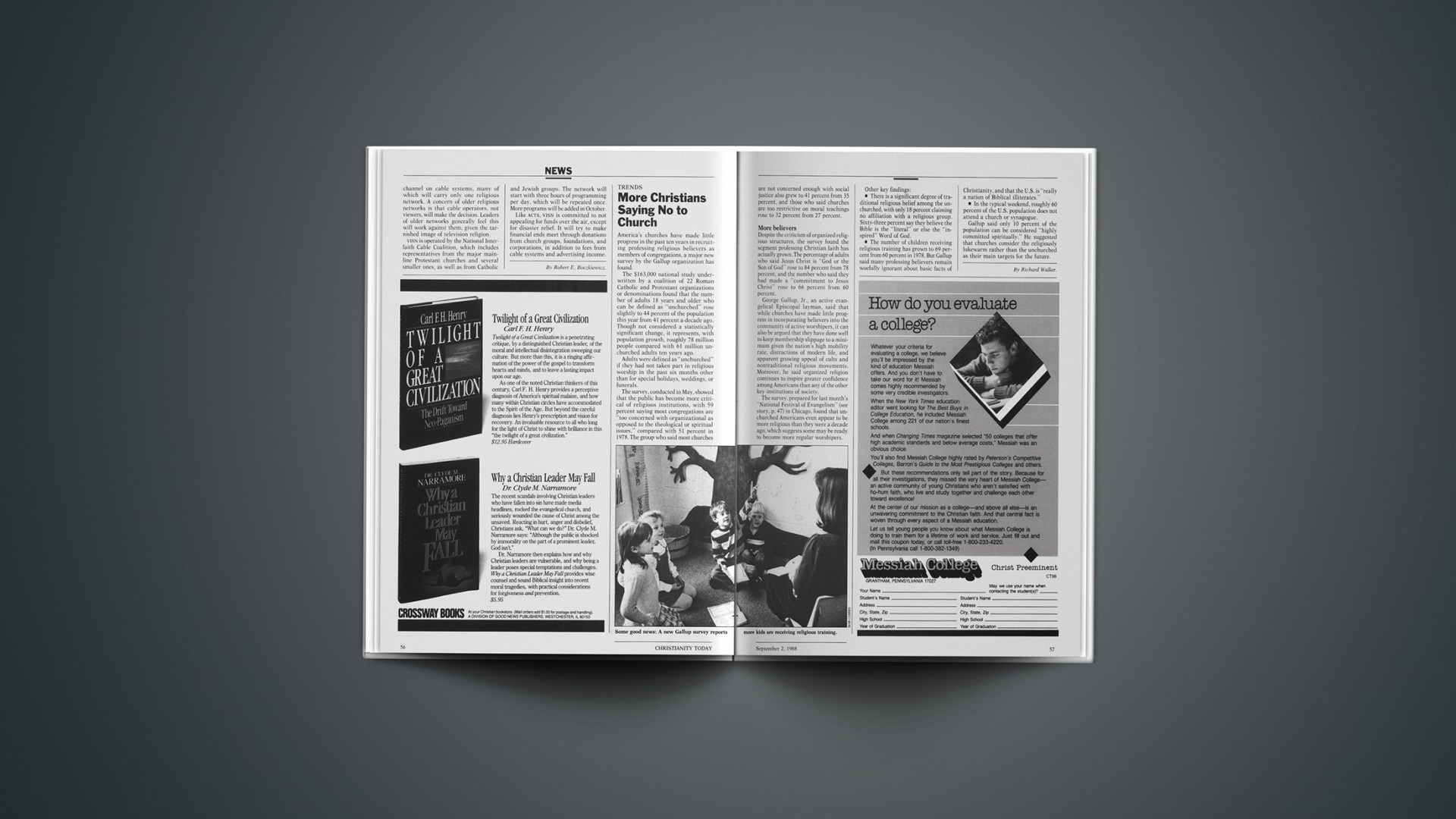
America’s churches have made little progress in the past ten years in recruiting professing religious believers as members of congregations, a major new survey by the Gallup organization has found.

The $163,000 national study underwritten by a coalition of 22 Roman Catholic and Protestant organizations or denominations found that the number of adults 18 years and older who can be defined as “unchurched” rose slightly to 44 percent of the population this year from 41 percent a decade ago. Though not considered a statistically significant change, it represents, with population growth, roughly 78 million people compared with 61 million unchurched adults ten years ago.

Adults were defined as “unchurched” if they had not taken part in religious worship in the past six months other than for special holidays, weddings, or funerals.

The survey, conducted in May, showed that the public has become more critical of religious institutions, with 59 percent saying most congregations are “too concerned with organizational as opposed to the theological or spiritual issues,” compared with 51 percent in 1978. The group who said most churches are not concerned enough with social justice also grew to 41 percent from 35 percent, and those who said churches are too restrictive on moral teachings rose to 32 percent from 27 percent.

More Believers

Despite the criticism of organized religious structures, the survey found the segment professing Christian faith has actually grown. The percentage of adults who said Jesus Christ is “God or the Son of God” rose to 84 percent from 78 percent, and the number who said they had made a “commitment to Jesus Christ” rose to 66 percent from 60 percent.

George Gallup, Jr., an active evangelical Episcopal layman, said that while churches have made little progress in incorporating believers into the community of active worshipers, it can also be argued that they have done well to keep membership slippage to a minimum given the nation’s high mobility rate, distractions of modern life, and apparent growing appeal of cults and nontraditional religious movements. Moreover, he said organized religion continues to inspire greater confidence among Americans than any of the other key institutions of society.

The survey, prepared for last month’s “National Festival of Evangelism” (see story, p. 47) in Chicago, found that unchurched Americans even appear to be more religious than they were a decade ago, which suggests some may be ready to become more regular worshipers.

Other key findings:

• There is a significant degree of traditional religious belief among the unchurched, with only 18 percent claiming no affiliation with a religious group. Sixty-three percent say they believe the Bible is the “literal” or else the “inspired” Word of God.

• The number of children receiving religious training has grown to 69 percent from 60 percent in 1978. But Gallup said many professing believers remain woefully ignorant about basic facts of Christianity, and that the U.S. is “really a nation of Biblical illiterates.”

• In the typical weekend, roughly 60 percent of the U.S. population does not attend a church or synagogue.

Gallup said only 10 percent of the population can be considered “highly committed spiritually.” He suggested that churches consider the religiously lukewarm rather than the unchurched as their main targets for the future.

By Richard Walker.

New TV Network May Crowd the Market

BROADCASTING

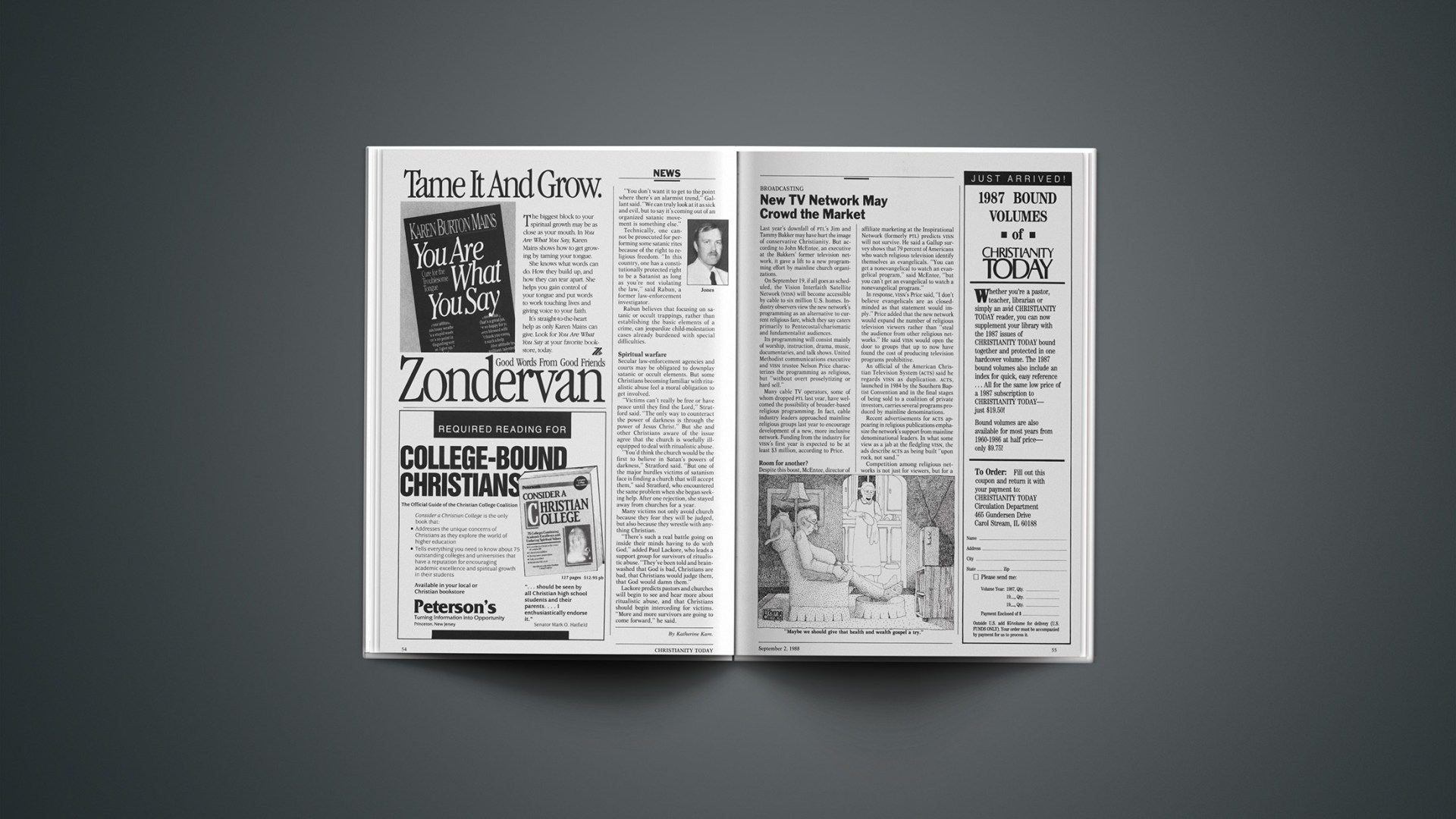
Last year’s downfall of PTL’S Jim and Tammy Bakker may have hurt the image of conservative Christianity. But according to John McEntee, an executive at the Bakkers’ former television network, it gave a lift to a new programming effort by mainline church organizations.

On September 19, if all goes as scheduled, the Vision Interfaith Satellite Network (VISN) will become accessible by cable to six million U.S. homes. Industry observers view the new network’s programming as an alternative to current religious fare, which they say caters primarily to Pentecostal/charismatic and fundamentalist audiences.

Its programming will consist mainly of worship, instruction, drama, music, documentaries, and talk shows. United Methodist communications executive and VISN trustee Nelson Price characterizes the programming as religious, but “without overt proselytizing or hard sell.”

Many cable TV operators, some of whom dropped PTL last year, have welcomed the possibility of broader-based religious programming. In fact, cable industry leaders approached mainline religious groups last year to encourage development of a new, more inclusive network. Funding from the industry for VISN’S first year is expected to be at least $3 million, according to Price.

Room For Another?

Despite this boost, McEntee, director of affiliate marketing at the Inspirational Network (formerly PTL) predicts VISN will not survive. He said a Gallup survey shows that 79 percent of Americans who watch religious television identify themselves as evangelicals. “You can get a nonevangelical to watch an evangelical program,” said McEntee, “but you can’t get an evangelical to watch a nonevangelical program.”

In response, VISN’S Price said, “I don’t believe evangelicals are as closed-minded as that statement would imply.” Price added that the new network would expand the number of religious television viewers rather than “steal the audience from other religious networks.” He said VISN would open the door to groups that up to now have found the cost of producing television programs prohibitive.

An official of the American Christian Television System (ACTS) said he regards VISN as duplication. ACTS, launched in 1984 by the Southern Baptist Convention and in the final stages of being sold to a coalition of private investors, carries several programs produced by mainline denominations.

Recent advertisements for ACTS appearing in religious publications emphasize the network’s support from mainline denominational leaders. In what some view as a jab at the fledgling VISN, the ads describe ACTS as being built “upon rock, not sand.”

Competition among religious networks is not just for viewers, but for a channel on cable systems, many of which will carry only one religious network. A concern of older religious networks is that cable operators, not viewers, will make the decision. Leaders of older networks generally feel this will work against them, given the tarnished image of television religion.

VISN is operated by the National Interfaith Cable Coalition, which includes representatives from the major mainline Protestant churches and several smaller ones, as well as from Catholic and Jewish groups. The network will start with three hours of programming per day, which will be repeated once. More programs will be added in October.

Like ACTS, VISN is committed to not appealing for funds over the air, except for disaster relief. It will try to make financial ends meet through donations from church groups, foundations, and corporations, in addition to fees from cable systems and advertising income.

By Robert E. Boczkiewicz.

Ritual Killings Have Satanic Overtones

OCCULT

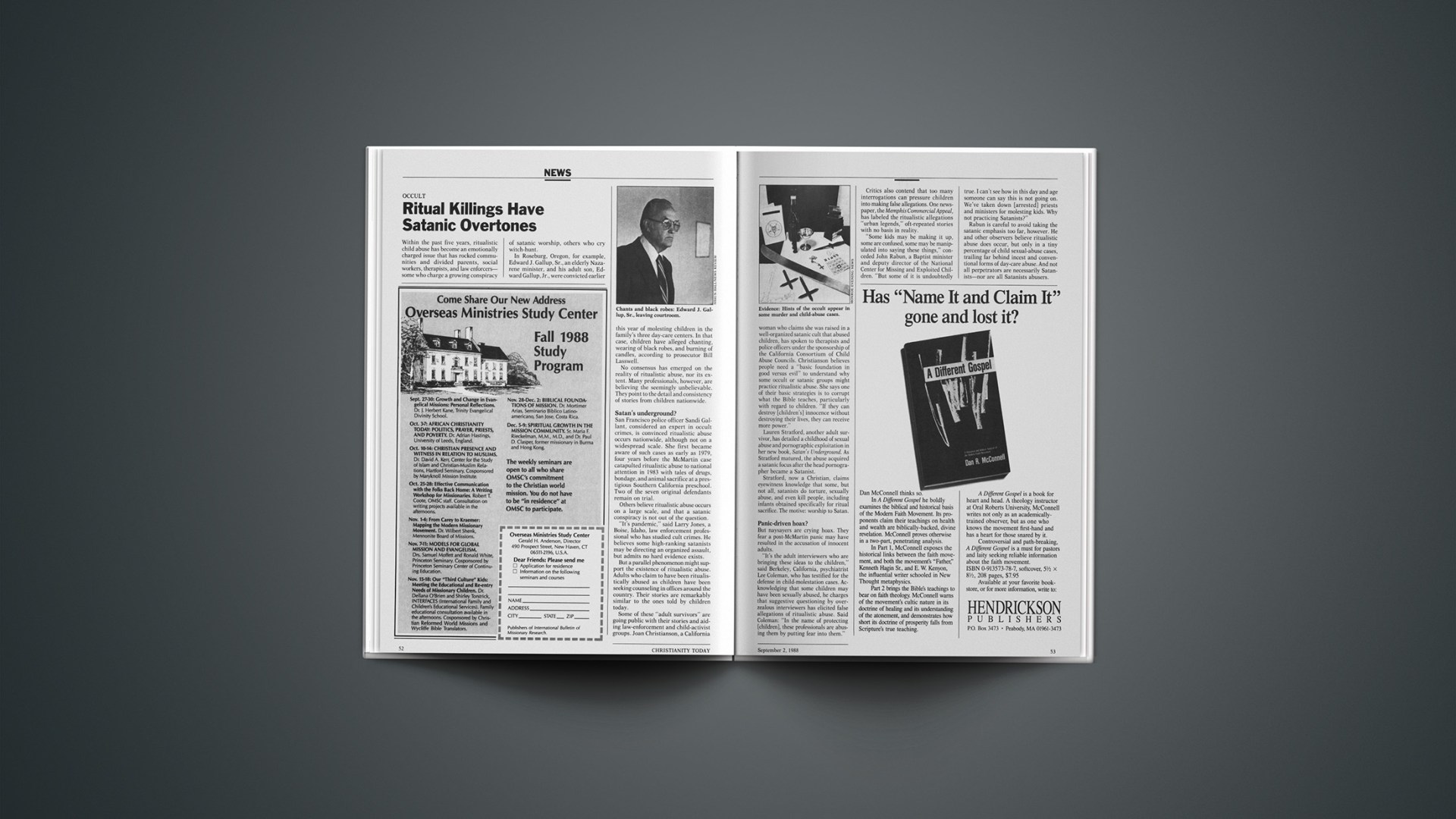
Within the past five years, ritualistic child abuse has become an emotionally charged issue that has rocked communities and divided parents, social workers, therapists, and law enforcers—some who charge a growing conspiracy of satanic worship, others who cry witch-hunt.

In Roseburg, Oregon, for example, Edward J. Gallup, Sr., an elderly Nazarene minister, and his adult son, Edward Gallup, Jr., were convicted earlier this year of molesting children in the family’s three day-care centers. In that case, children have alleged chanting, wearing of black robes, and burning of candles, according to prosecutor Bill Lasswell.

No consensus has emerged on the reality of ritualistic abuse, nor its extent. Many professionals, however, are believing the seemingly unbelievable. They point to the detail and consistency of stories from children nationwide.

Satan’S Underground?

San Francisco police officer Sandi Gallant, considered an expert in occult crimes, is convinced ritualistic abuse occurs nationwide, although not on a widespread scale. She first became aware of such cases as early as 1979, four years before the McMartin case catapulted ritualistic abuse to national attention in 1983 with tales of drugs, bondage, and animal sacrifice at a prestigious Southern California preschool. Two of the seven original defendants remain on trial.

Others believe ritualistic abuse occurs on a large scale, and that a satanic conspiracy is not out of the question.

“It’s pandemic,” said Larry Jones, a Boise, Idaho, law enforcement professional who has studied cult crimes. He believes some high-ranking satanists may be directing an organized assault, but admits no hard evidence exists.

But a parallel phenomenon might support the existence of ritualistic abuse. Adults who claim to have been ritualistically abused as children have been seeking counseling in offices around the country. Their stories are remarkably similar to the ones told by children today.

Some of these “adult survivors” are going public with their stories and aiding law-enforcement and child-activist groups. Joan Christianson, a California woman who claims she was raised in a well-organized Satanic cult that abused children, has spoken to therapists and police officers under the sponsorship of the California Consortium of Child Abuse Councils. Christianson believes people need a “basic foundation in good versus evil” to understand why some occult or satanic groups might practice ritualistic abuse. She says one of their basic strategies is to corrupt what the Bible teaches, particularly with regard to children. “If they can destroy [children’s] innocence without destroying their lives, they can receive more power.”

Lauren Stratford, another adult survivor, has detailed a childhood of sexual abuse and pornographic exploitation in her new book, Satan’s Underground. As Stratford matured, the abuse acquired a satanic focus after the head pornographer became a Satanist.

Stratford, now a Christian, claims eyewitness knowledge that some, but not all, satanists do torture, sexually abuse, and even kill people, including infants obtained specifically for ritual sacrifice. The motive: worship to Satan.

Panic-Driven Hoax?

But naysayers are crying hoax. They fear a post-McMartin panic may have resulted in the accusation of innocent adults.

“It’s the adult interviewers who are bringing these ideas to the children,” said Berkeley, California, psychiatrist Lee Coleman, who has testified for the defense in child-molestation cases. Acknowledging that some children may have been sexually abused, he charges that suggestive questioning by overzealous interviewers has elicited false allegations of ritualistic abuse. Said Coleman: “In the name of protecting [children], these professionals are abusing them by putting fear into them.”

Critics also contend that too many interrogations can pressure children into making false allegations. One newspaper, the Memphis Commercial Appeal, has labeled the ritualistic allegations “urban legends,” oft-repeated stories with no basis in reality.

“Some kids may be making it up, some are confused, some may be manipulated into saying these things,” conceded John Rabun, a Baptist minister and deputy director of the National Center for Missing and Exploited Children. “But some of it is undoubtedly true. I can’t see how in this day and age someone can say this is not going on. We’ve taken down [arrested] priests and ministers for molesting kids. Why not practicing Satanists?”

Rabun is careful to avoid taking the satanic emphasis too far, however. He and other observers believe ritualistic abuse does occur, but only in a tiny percentage of child sexual-abuse cases, trailing far behind incest and conventional forms of day-care abuse. And not all perpetrators are necessarily Satanists—nor are all Satanists abusers.

“You don’t want it to get to the point where there’s an alarmist trend,” Gallant said. “We can truly look at it as sick and evil, but to say it’s coming out of an organized satanic movement is something else.”

Technically, one cannot be prosecuted for performing some satanic rites because of the right to religious freedom. “In this country, one has a constitutionally protected right to be a Satanist as long as you’re not violating the law,” said Rabun, a former law-enforcement investigator.

Rabun believes that focusing on satanic or occult trappings, rather than establishing the basic elements of a crime, can jeopardize child-molestation cases already burdened with special difficulties.

Spiritual Warfare

Secular law-enforcement agencies and courts may be obligated to downplay satanic or occult elements. But some Christians becoming familiar with ritualistic abuse feel a moral obligation to get involved.

“Victims can’t really be free or have peace until they find the Lord,” Stratford said. “The only way to counteract the power of darkness is through the power of Jesus Christ.” But she and other Christians aware of the issue agree that the church is woefully ill-equipped to deal with ritualistic abuse.

“You’d think the church would be the first to believe in Satan’s powers of darkness,” Stratford said. “But one of the major hurdles victims of satanism face is finding a church that will accept them,” said Stratford, who encountered the same problem when she began seeking help. After one rejection, she stayed away from churches for a year.

Many victims not only avoid church because they fear they will be judged, but also because they wrestle with anything Christian.

“There’s such a real battle going on inside their minds having to do with God,” added Paul Lackore, who leads a support group for survivors of ritualistic abuse. “They’ve been told and brainwashed that God is bad, Christians are bad, that Christians would judge them, that God would damn them.”

Lackore predicts pastors and churches will begin to see and hear more about ritualistic abuse, and that Christians should begin interceding for victims. “More and more survivors are going to come forward,” he said.

Episcopalians Tiptoe along Moral Tightrope

DENOMINATION REPORT

The sixty-ninth General Convention of the Episcopal Church that met July 2–11 in Detroit was at best an Anglican stand-off. Neither side really got what it wanted.

Yet the convention produced no splits, mainly because some 200 bishops and 950 clerical and lay deputies took no sharply defined positions that could have alienated its liberal, evangelical/charismatic, or anglo-Catholic wings. But an ever-growing polarization was evident, and it appears that an Episcopal battle for the Bible is shaping up for years to come. During debates in the House of Deputies and the House of Bishops, the two governing branches of the Episcopal legislature, biblical conservatives were referred to as legalistic, moralistic, or homophobic, while conservatives hinted that their more liberal counterparts were redefining sin.

Sexuality Revisited

As the top policy-making body for the 2.5 million-member Episcopal Church, bishops and deputies passed about 470 resolutions during the ten-day convention. Issues of sexuality dominated, most notably an affirmation of “chastity and fidelity in personal relationships,” and pleas for holiness from Christian leaders and dialogue between homosexuals and heterosexuals. This vote was a watered-down replacement for another resolution passed last year by the Church of England that said sex should be kept within marriage and that fornication, adultery, and “homosexual genital acts” were sins. That resolution failed twice in the House of Bishops and once in the House of Deputies. Homosexuality was the stumbling block, as too many delegates made it clear they did not consider homosexual acts a sin.

Homosexuality cropped up again in a resolution to alter canon law so as not to forbid anyone access to the ordination process. Selection for the Episcopal priesthood can take as long as four years, and Episcopalians had already voted in 1979 to forbid ordination to practicing homosexuals.

While some wondered if such a canonical change would be redundant or unnecessary, others wanted a statement that no one would be denied access on the basis of “race, color, ethnic origin, sex, sexual orientation, physical disabilities or age, except as specified by church canon.” Episcopal canon law says nothing about sexual orientation.

Bishops passed the resolution, which was “better than we thought we could do,” said Newark Bishop John Spong, the church’s most prominent liberal, whose recent book, Living in Sin: A Bishop Rethinks Human Sexuality, proposes church blessings of gay unions.

The deputies were not so accommodating, however; they sent a shortened version back to the bishops. Everyone expected an easy concurrence from the bishops until headlines in both Detroit newspapers warned incorrectly that Episcopalians were on the brink of ordaining homosexuals. The bishops tossed the resolution back to the House of Deputies where it failed by one lay vote. The action essentially reaffirmed the church’s 1979 stance forbidding ordination of practicing homosexuals or heterosexuals engaged in extramarital sex.

“I think the bishops wish the whole subject would go away,” said John Throop, the Ohio priest who directs the conservative caucus Episcopalians United, which helped marshal forces against liberal influence on church doctrine. “They don’t want to be cornered into defining sinful behavior,” he said.

“Male Visitors”

Another thorny question on the Episcopal agenda was how to accommodate the election of a female bishop with church traditionalists who are opposed to female clergy.

The delegates came up with an appropriately Anglican compromise for traditionalist congregations in dioceses headed by a female bishop. These congregations would have a male “Episcopal visitor” bishop perform functions such as confirmations and ordinations instead of their own female diocesan bishop. The diocesan bishop, however, would maintain authority over that congregation in all other instances.

The resolution barely passed the House of Deputies. “I feel the vote was probably providential,” said Houston clergywoman Helen Havens, who ran unsuccessfully for bishop of Michigan in May. “That says something to world Christendom that we can handle such an explosive issue.”

North American Scene

UPDATE

More Good News For Linscott

New evidence in the case of Steven Linscott, who was convicted of murder in 1982, may expedite the end of the former Bible student’s legal nightmare. Linscott was convicted largely because of similarities between his account of a murder he says he dreamed about and the details of the actual killing of a 24-year-old nursing student (CT, Feb. 4, 1983, p. 42).

The new evidence consists of a preliminary report by two experts in forensic dentistry at Northwestern University in Evanston, Illinois. The two examined photos of bite marks on the body of the victim. After comparing them with Linscott’s dental impressions, they concluded the marks could not have been caused by Linscott’s teeth.

The report resulted from the initiative of a medical examiner who reopened his files on the case after reading the book Innocence (Zondervan Books, 1986) written by Linscott supporter Gordon Haresign. The examiner, Edmund R. Donoghue, had noted subtle abrasions on the body in his 1980 autopsy report but said at the time he did not know what caused them. Linscott’s conviction was overturned by the Illinois Appellate Court last year and is now on appeal to the state supreme court.

Harper Buys Zondervan

Plagued with tepid financial results and a weak stock price, the Zondervan Corporation has been a likely takeover target for larger companies. In July, Rupert Murdoch’s Harper & Row Publishers signed a merger agreement with Zondervan that paves the way for Harper & Row to make the evangelical publishing company its subsidiary.

According to Harper & Row executive Robert Biewen, his company has no plans to sell any Zondervan assets or change its operations, though he did not rule out such changes in the future. Brent Clark, corporate attorney for Zondervan agrees, saying that Harper & Row “respects Zondervan’s position in the religious publishing marketplace.” Clark says the merger will enable both companies to serve their markets better.

STEWARDSHIP

Earning More, Giving Less

American church members may be getting more selfish as their incomes rise, according to a recent survey of 31 denominations. Funded by a grant from the Lilly Endowment, Inc., empty tomb, inc., a nonprofit research and service organization in Champaign, Illinois (CT, Mar. 4, 1988), contrasted changes in per-member giving patterns with changes in U.S. per-capita disposable income.

The report points out that although income after taxes and inflation increased 31 percent from 1968 to 1985, per-member giving as a percentage of disposable income was 8.5 percent less during that same period.

“People are objectively richer, but the wealth is not expanding the ministry of the church,” said Sylvia Ronsvalle, who founded empty tomb with her husband, John, in 1970. Their study further reports that most of the money donated by members to their churches stays within the local congregation. “We may be seeing an accommodation to lifestyle expectations among evangelicals that will rob them of their commitment to the church,” said Ronsvalle.

According to the survey, 24 of the 31 denominations showed a decrease in giving as a percentage of disposable income. The Evangelical Mennonite Brethren Conference led the denominations surveyed with members giving an average of nearly 10 percent of their disposable incomes, an increase of 3.38 percent since 1968.

GATHERING

Unlikely Conference Hosts

The Hutterian Brethren pretty much keep to themselves in their “Bruderhofs,” or Christian communities. So it was a bit of a surprise when they hosted five conferences this summer. It was even more surprising that a total of 980 people from 15 countries showed up at these conferences to discuss “The New Testament Church in the 21st Century.”

Agendas at the five events were sketchy at best. Evening speakers were occasionally assigned at the last minute, and each guest put in a half-day’s work on such projects as making pies, hoeing corn, mulching blueberry bushes, or setting tables. Invited participants included Malcolm Muggeridge (at the Darvell Bruderhof in England), Tom Sine, David Hilfiker, and John Perkins.

The idea for the series of conferences came from two Hutterians who attended an evangelical conference in Washington, D.C., but who felt the opulent setting seemed inappropriate for the message.

EVANGELISM

Few Attend Congress 88

Organizers of the Congress 88 National Festival of Evangelism had planned on 15,000 people attending their event in Chicago last month. Instead, 3,000 showed up at what had been billed as a major ecumenical conference on evangelism.

Conference director Paul Benjamin cited an abundance of conferences as one reason for the low turnout. But he also said the inclusion of speakers from a broad theological spectrum “may have been asking people to stretch a bit more than they felt comfortable stretching.” Among the event’s major speakers were Prison Fellowship’s Charles Colson, Gen. Eva Burrows of the Salvation Army, and Joseph Cardinal Bernardin of the Roman Catholic Church.

Benjamin said he was encouraged that a high percentage of those who did turn out were leaders of various denominations. He said income fell short of the budget by an undetermined amount and that efforts are being made to meet the deficit.

Prolife Tilt

The convention also passed a resolution stating that abortion should be used only in “extreme situations” while not defining what those situations are. It also opposed abortion “as a means of birth control, family planning, sex selection or any reason of mere convenience.” Prolife Episcopalians were especially happy that language stating the church’s “unequivocal opposition” to legislative efforts to stop abortion was removed from the final resolution.

In other actions, the convention:

• Rejected a liberal sex-ed curriculum called “Sexuality: A Divine Gift”;

• Voted to boycott U.S. Shell Oil;

• Approved a $4 million program to benefit the poor.

The future direction of the Episcopal Church is up in the air, with many new bishops coming in to fill the shoes of their predecessors. Whether the newcomers will tilt to the Right or Left is yet undetermined. Most evidence leans toward a new, more polarized generation of Episcopalians taking over.

Word is out that Detroit was only a warm-up for the real showdown at the next general convention in 1991 in Phoenix. And both sides say they are already marshaling forces for the battle.

By Julia Duin in Detroit.

World Scene

VIETNAM

Rebuilding A Suffering Church

The Communist government of Vietnam still keeps the church there in a tight grip, but a measure of freedom has returned, says Reg Reimer, president of World Relief Canada and a former missionary to the Southeast Asian nation.

Reimer has made several trips to Vietnam since the Communists took over in 1975, but says that during his visit this summer he saw signs that “a measure of glasnost has also rubbed off on the Vietnamese.”

Reimer spoke with eight evangelical pastors during his visit, including two colleagues recently released from prison. He was able to confirm that 13 pastors had been released from prisons and re-education camps since an earlier visit two years ago. However, seven remain in prison, including two pastors who have been in Reimer and friends jail since 1983.

With an estimated per capita gross national product of $55, Vietnam is one of the poorest countries in the world. World Relief Canada has contributed to several postwar relief projects there.

PUBLIC HEALTH

Aids Surfaces In Ecuador

Ten cases of AIDS have been confirmed in Quito, Ecuador, with all but one traced to exposure in the United States. Roy Ringenberg, a physician serving with Christian radio station HCJB, said that eight of the ten have died.

Ringenberg is in charge of medical education of interns and residents at HCJB’s Hospital Vozandes-Quito. He says the symptoms associated with Ecuador’s AIDS patients resemble the “slim disease” symptoms of African patients. “The Ministry of Health is doing all sorts of education—reaching kids in the schools, making videos, publishing pamphlets, and informing doctors,” he said.

OLYMPICS

Seoul Aims For Souls

Many of the 30,000 athletes and coaches invading South Korea this month for the XXIV Olympic Games may become couriers of the gospel, according to John Cho, chairman of the Olympic Outreach Committee (OOC). Cho has assembled volunteers from 150 parachurch organizations and 25 denominations to minister to the Olympians.

“To us, it is the Soul Olympics,” said Cho, who is also president of Seoul Theological Seminary. “Many athletes will be here from nations closed to the gospel. We hope they can return to their countries as Christians, taking the gospel with them.”

Cho admits it is a bit unusual for a theologian and seminary president to become active in sports ministry. “But my passion has always been world evangelization, and when I saw how Christian athletes are revered, I realized this was an effective way to communicate Christ.”

The OOC will use a variety of methods to reach athletes, including chapel services in the Olympic Village, Bible and literature distribution, Christian movies, and a hospitality house. Using these methods at the 1986 Asian Games in Seoul, Cho says several Chinese athletes accepted Christ and took Bibles home with them after the competition.

ENTERTAINMENT

Films Violent Worldwide

A recent study of films from around the world shows that over the past 40 years, films have become progressively more violent and psychologically harmful to normal viewers of all ages. The study, covering 1,500 films from 61 countries, was completed by the International Coalition Against Violent Entertainment.

Of the one thousand 1987 films in the study, 52 percent were rated as either predominantly or extremely violent. And of the 20 countries with 12 or more films in the 1987 sample, Hong Kong, the United States, and Mexico produced the highest percentage of violent films. Film producers who tended toward lesser degrees of violence included Japan, West Germany, and the Soviet Union.

TRENDS

Kids March Off To War

Even war has its rules, but many fighting nations are breaking the minimum age requirement (15 years) for soldiers, set by the Protocols on International Humanitarian Law. A recent report prepared by the London-based Friends World Committee for Consultation contends that the world’s armies include about 200,000 youths, some as young as 12.

The report said parents in poorer nations sometimes urge children to enlist in armies to gain food, jobs, or payments to parents if the children die in battle Based on news reports and private research, the report gave specific examples of below-age soldiers:

• Street roundups in Afghanistan to recruit youths under 15.

• The lowering of Iran’s conscription age to 13, with parental consent for enlistment of even younger children.

• The use of boys as young as 12 by the contra rebels in Nicaragua, and the recruitment of 3,000 youths by the Nicaraguan government.

No international organization addresses the problem, the report said, and veterans’ or soldiers’ groups do not defend the interests of child soldiers. It also said the youngsters are often subjected to brutality and trained in terrorism.

Christian Feminists Regroup to Debate Future

WOMEN

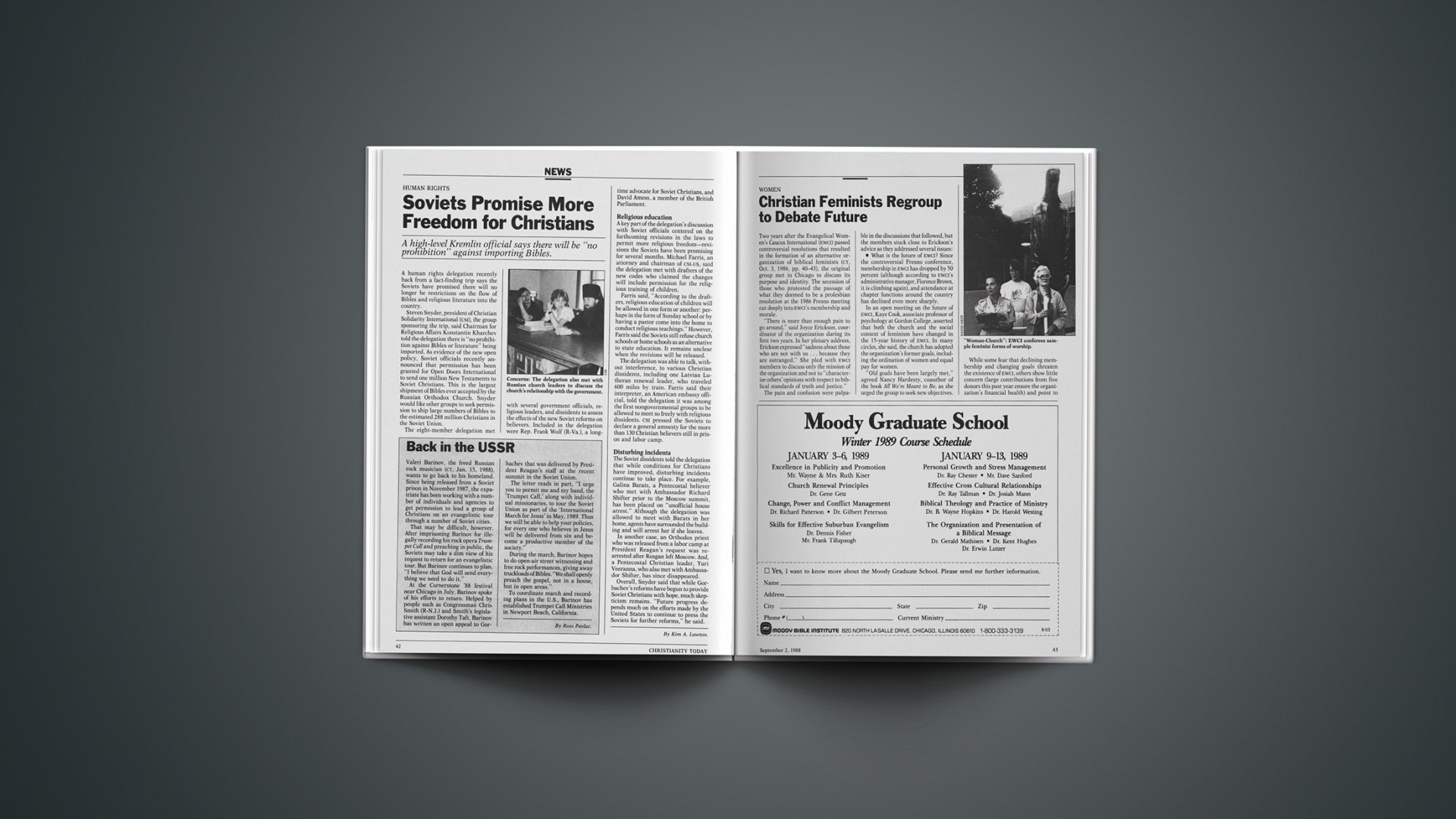
Two years after the Evangelical Women’s Caucus International (EWCI) passed controversial resolutions that resulted in the formation of an alternative organization of biblical feminists (CT, Oct. 3, 1986, pp. 40–43), the original group met in Chicago to discuss its purpose and identity. The secession of those who protested the passage of what they deemed to be a prolesbian resolution at the 1986 Fresno meeting cut deeply into EWCI’s membership and morale.

“There is more than enough pain to go around,” said Joyce Erickson, coordinator of the organization during its first two years. In her plenary address, Erickson expressed “sadness about those who are not with us … because they are estranged.” She pled with EWCI members to discuss only the mission of the organization and not to “characterize others’ opinions with respect to biblical standards of truth and justice.”

The pain and confusion were palpable in the discussions that followed, but the members stuck close to Erickson’s advice as they addressed several issues:

• What is the future of EWCI? Since the controversial Fresno conference, membership in EWCI has dropped by 50 percent (although according to EWCI’S administrative manager, Florence Brown, it is climbing again), and attendance at chapter functions around the country has declined even more sharply.

In an open meeting on the future of EWCI, Kaye Cook, associate professor of psychology at Gordon College, asserted that both the church and the social context of feminism have changed in the 15-year history of EWCI. In many circles, she said, the church has adopted the organization’s former goals, including the ordination of women and equal pay for women.

“Old goals have been largely met,” agreed Nancy Hardesty, coauthor of the book All We’re Meant to Be, as she urged the group to seek new objectives.

While some fear that declining membership and changing goals threaten the existence of EWCI, others show little concern (large contributions from five donors this past year ensure the organization’s financial health) and point to responsiveness to current issues as the key to the organization’s relevance.

• What is the mission of EWCI? At the organization’s 1984 Wellesley conference, disagreement arose over whether EWCI should restrict itself to encouraging sexual equality in evangelical and fundamentalist churches or should take stands on issues with political overtones, such as civil rights for lesbians and reproductive freedom for women.

Now that an alternative organization for biblical feminists, Christians for Biblical Equality (CBE), has been active in evangelical and fundamentalist churches, some EWCI members suggested it is time to focus more on “minority and justice issues, as well as bringing Woman-Church [feminist-oriented worship] to Protestants.” Others argued that EWCI needs to continue its ministry to those who believe conservative Christianity and feminism are incompatible.

• How will EWCI relate to lesbianism? The 1986 resolution on civil rights for lesbians contained language that recognized “the presence of the Lesbian minority” in EWCI, thus sparking continued discussion of sexuality at the 1988 conference. A plenary forum on “Issues of Sexuality” was addressed by a bisexual female who has a monogamous, lesbian relationship in which she has experienced “eight years of faithfulness” and which she believes “has been blessed by God.” Also addressing the forum was Roberta Kenney, one of the founders of Exodus International, a coalition of ministries committed to helping Christian homosexuals toward healing.

Emotionally charged discussion followed in which lesbianism appeared to be affirmed. “People who did not support” the idea that there is no biblical ground on which to critique lesbianism “felt intimidated,” says Kaye Cook, the newly appointed co-coordinator of EWCI. Nevertheless, says Cook, the heterosexual women in the group are concerned.

Following the biennial conference, the executive committee met and made recommendations yet to be approved by the membership: That informal ways of addressing issues be introduced to the organization in order to avoid the potential divisiveness of formal resolutions; and that the organization’s name be changed from the Evangelical Women’s Caucus International to Ecumenical Women’s Coalition.

“There’s a strong sentiment that many people in the organization don’t participate in evangelical churches anymore,” says Kaye Cook, “and that ecumenical more accurately reflects our composition. EWCI formerly focused on service in the evangelical tradition, but is now moving out to address other issues. Nevertheless, we want to retain our biblical feminism.”

By David Neff.

Soviets Promise More Freedom for Christians

HUMAN RIGHTS

A high-level Kremlin official says there will be “no prohibition” against importing Bibles.

A human rights delegation recently back from a fact-finding trip says the Soviets have promised there will no longer be restrictions on the flow of Bibles and religious literature into the country.

Steven Snyder, president of Christian Solidarity International (CSI), the group sponsoring the trip, said Chairman for Religious Affairs Konstantin Kharchev told the delegation there is “no prohibition against Bibles or literature” being imported. As evidence of the new open policy, Soviet officials recently announced that permission has been granted for Open Doors International to send one million New Testaments to Soviet Christians. This is the largest shipment of Bibles ever accepted by the Russian Orthodox Church. Snyder would like other groups to seek permission to ship large numbers of Bibles to the estimated 288 million Christians in the Soviet Union.

The eight-member delegation met with several government officials, religious leaders, and dissidents to assess the effects of the new Soviet reforms on believers. Included in the delegation were Rep. Frank Wolf (R-Va.), a long-time advocate for Soviet Christians, and David Amess, a member of the British Parliament.

Back In The Ussr

Valeri Barinov, the freed Russian rock musician (CT, Jan. 15, 1988), wants to go back to his homeland. Since being released from a Soviet prison in November 1987, the expatriate has been working with a number of individuals and agencies to get permission to lead a group of Christians on an evangelistic tour through a number of Soviet cities.

That may be difficult, however. After imprisoning Barinov for illegally recording his rock opera Trumpet Call and preaching in public, the Soviets may take a dim view of his request to return for an evangelistic tour. But Barinov continues to plan. “I believe that God will send everything we need to do it.”

At the Cornerstone ‘88 festival near Chicago in July, Barinov spoke of his efforts to return. Helped by people such as Congressman Chris Smith (R-N.J.) and Smith’s legislative assistant Dorothy Taft, Barinov has written an open appeal to Gorbachev that was delivered by President Reagan’s staff at the recent summit in the Soviet Union.

The letter reads in part, “I urge you to permit me and my band, the ‘Trumpet Call,’ along with individual missionaries, to tour the Soviet Union as part of the ‘International March for Jesus’ in May, 1989. Thus we will be able to help your policies, for every one who believes in Jesus will be delivered from sin and become a productive member of the society.”

During the march, Barinov hopes to do open-air street witnessing and free rock performances, giving away truckloads of Bibles. “We shall openly preach the gospel, not in a house, but in open areas.”

To coordinate march and recording plans in the U.S., Barinov has established Trumpet Call Ministries in Newport Beach, California.

By Ross Pavlac.

Religious Education

A key part of the delegation’s discussion with Soviet officials centered on the forthcoming revisions in the laws to permit more religious freedom—revisions the Soviets have been promising for several months. Michael Farris, an attorney and chairman of CSI-US, said the delegation met with drafters of the new codes who claimed the changes will include permission for the religious training of children.

Farris said, “According to the drafters, religious education of children will be allowed in one form or another: perhaps in the form of Sunday school or by having a pastor come into the home to conduct religious teachings.” However, Farris said the Soviets still refuse church schools or home schools as an alternative to state education. It remains unclear when the revisions will be released.

The delegation was able to talk, without interference, to various Christian dissidents, including one Latvian Lutheran renewal leader, who traveled 600 miles by train. Farris said their interpreter, an American embassy official, told the delegation it was among the first nongovernmental groups to be allowed to meet so freely with religious dissidents. CSI pressed the Soviets to declare a general amnesty for the more than 130 Christian believers still in prison and labor camp.

Disturbing Incidents

The Soviet dissidents told the delegation that while conditions for Christians have improved, disturbing incidents continue to take place. For example, Galina Barats, a Pentecostal believer who met with Ambassador Richard Shifter prior to the Moscow summit, has been placed on “unofficial house arrest.” Although the delegation was allowed to meet with Barats in her home, agents have surrounded the building and will arrest her if she leaves.

In another case, an Orthodox priest who was released from a labor camp at President Reagan’s request was rearrested after Reagan left Moscow. And, a Pentecostal Christian leader, Yuri Veeranna, who also met with Ambassador Shifter, has since disappeared.

Overall, Snyder said that while Gorbachev’s reforms have begun to provide Soviet Christians with hope, much skepticism remains. “Future progress depends much on the efforts made by the United States to continue to press the Soviets for further reforms,” he said.

By Kim A. Lawton.

Coaching Kids on Morality: Reagans at YFC Festival

YOUTH

News of First Lady Nancy Reagan’s dabbling with astrology dominated the headlines this spring after the publication of former White House Chief of Staff Donald Regan’s new book. Yet both the First Lady and President Reagan testified to a more traditional source of inspiration in separate appearances at this summer’s Youth for Christ’s [YFC] DC ‘88 Student Congress on Evangelism.

The Reagans have seldom spoken together at the same function, leading some observers to suggest their appearance was intended to deflect criticism from the Religious Right about the astrology issue. And some youth workers at the convention questioned YFC’s judgment in giving the Reagans such a pulpit. Nevertheless, few critics could be found among the 8,000 students who attended.

From The Heart

Mrs. Reagan, an intensely private person, chose the Washington gathering to speak for the first time publicly about her father’s spiritual experience near the time of his death. The First Lady told the young delegates how her father, as a boy, had unfairly lost a Sunday school contest to a minister’s child. “Feeling wronged and disillusioned, [he] allowed no place for faith in his life for the next 80 years,” she said.

However, at the end of his life, Mrs. Reagan said her father was “terribly frightened,” reluctant even to go to sleep “for fear he wouldn’t awake.”

“My husband wrote him two long letters explaining the encompassing comfort he’d receive if he’d just put himself in the Lord’s hands,” she said.

Mrs. Reagan said that two days before he died, her father asked to see the hospital chaplain. Moved to tears, the First Lady said, “I don’t know what the chaplain did or what he said, but whatever it was, it was the right thing, and it gave my father comfort.… When he died … he was at peace, finally.

“The reason I tell you this story is because you … are so fortunate that you’ve found a strong faith at an early age.”

Youth for Christ gave the First Lady an award for her battle against drug abuse. She enlisted the help of the group in her fight. “You are the role models for others,” she said.

Fatherly Advice

President Reagan made his appearance the following day and was greeted enthusiastically. Speaking about the importance of “moral and religious values,” Reagan said that while “in recent years America did seem to lose some of her religious and moral bearings,” he believes that is now changing for the better.

Proclaiming that his administration has “worked hard to reflect this return to basic values,” the President listed several executive efforts, including opposition to abortion, legislation against pornography, the as-yet unsuccessful push for school prayer, and the passage of the Equal Access Act of 1984, which allows voluntary religious groups to meet at schools on the same basis as other groups. This was especially well received because Youth for Christ’s Campus Life clubs meet at local high schools.

In a personal note, the President advised the young people to avoid premarital sex. “It’s so important for you not to pay any attention to all those who say that promiscuity is somehow stylish or rewarding,” Reagan said. “You can start being true to that special person [you will marry] right now.”

Organizers said the 8,000 delegates attending the conference came from all 50 states and nine foreign countries. Spokesman Jim Patterson said DC ‘88 was designed to encourage young people to mature in their own faith and share their beliefs with friends.

Apple PodcastsDown ArrowDown ArrowDown Arrowarrow_left_altLeft ArrowLeft ArrowRight ArrowRight ArrowRight Arrowarrow_up_altUp ArrowUp ArrowAvailable at Amazoncaret-downCloseCloseEmailEmailExpandExpandExternalExternalFacebookfacebook-squareGiftGiftGooglegoogleGoogle KeephamburgerInstagraminstagram-squareLinkLinklinkedin-squareListenListenListenChristianity TodayCT Creative Studio Logologo_orgMegaphoneMenuMenupausePinterestPlayPlayPocketPodcastRSSRSSSaveSaveSaveSearchSearchsearchSpotifyStitcherTelegramTable of ContentsTable of Contentstwitter-squareWhatsAppXYouTubeYouTube