Life Fit for Eternity

“The sun knoweth his going down”—PSALM 104:19

“Time, that takes a survey of all the world,” wrote Shakespeare, “must have a stop.” No one has ever doubted that the pendulum of each individual life must some day fail to hit its full arc, and fall motionless. But today there is an astonishingly widespread feeling that in a larger sense the corporate life of all men, human history, is reaching some kind of culmination or cataclysm. The dizzying acceleration of events, coupled with the incalculable growth of power and no balancing growth of wisdom, has created a feeling that man’s influence on his destiny is cracking or already shattered. The belief is growing that the Bible’s view of human history as linear, with a beginning, middle, and end, may have some truth in it.

The voices of the complacent (“since the fathers fell asleep, all things continue as they were from the beginning …”) have little conviction, and the faces of the prophets of automatic human progress wear strained smiles. True, the old mottoes are still sometimes heard, chiefly those predicting the elimination or reduction of the human problem through technology, or computers, or drugs, and to doubt this is still to open oneself to the charge of pessimism. But beneath the surface one finds in most people a profound disquiet. Perhaps the following statement is too strong, but one rather sympathizes with its mood: “We confront several problems,” it was recently asserted, “which are absolutely predictable, absolutely unavoidable, and absolutely disastrous.” (Mentioned were the population explosion, pollution of the planet, proliferation of atomic weapons, and depletion of natural resources. Not mentioned: sin.)

When, in Housman’s phrase, to think is to lay one’s hand upon his heart, it is natural to try to block off the troublesome message of reason, and to live viscerally, unthinkingly, emotionally, passionately. “O for a life of sensations rather than of thoughts!” cried Keats, though he had no conception of the aid in this direction man would find in the electric guitar and the weird realm of psychedelia.

So to live, however, requires that one put his entire trust in this flesh and this world, both demonstrably slaves of time—and it is sometimes hard to hear the music over the ticking of the clock. It is, indeed, difficult to comply merrily with the injunction to “love that well which thou must leave ere long.” Worse yet, it requires that one retreat into himself, the smallest prison possible, and the loneliest. And worst of all, it requires that death be embraced as the only ultimate reality, for such a life must, if the inescapable fact is faced, be defined as death. Only that which is not born is not subject to death. The first moment of biological life is a movement toward biological death, with only a quantitative element, time, intervening, an element that, no matter how prolonged, is incapable of altering one whit the qualitative fact of death.

It may be objected that this is needlessly melancholy talk, probably the product of poor metabolism, lack of vitamins, or some other condition easily alleviated by diet and exercise. But the facts remain, and they have haunted man from the beginning of his existence on this earth. The most enduring monuments of his literature, those in which he most deeply expressed himself, are composed in a minor key. Indeed, it has often been pointed out that the greatest literary works of the greatest writers from the ancients to the moderns have expressed a tragic (a term not synonymous with despairing) view of man. This is also the Bible’s view, for at the heart of tragedy is the theme of the fall of a great one owing to a basic moral flaw. Investing the mood with hope and grandeur is the possibility of victory, of redemption, even if the glimpse, in secular works, be so faint as that in the cry the dying Lear utters, with Cordelia in his arms, thinking he sees life: “Look on her! look! her lips! Look there, look there!” A corrective to Kent’s “All’s cheerless, dark, and deadly.”

The foregoing lines have had a single purpose: to provide a frame of reference in which to assert the total and unique relevance of the Bible to man in his every dimension, and to plead in these dangerous and perhaps climactic days that all hear and obey the word of God graciously commanding, “Look unto me, and be ye saved, all the ends of the earth: for I am God, and there is none else” (Isa. 45:22).

It is a cause of continuing astonishment to the Christian that the words and works of God are so seemingly invisible and inaudible to the world. And yet he knows the reason for that, too: sin, the common lot of all men, hardens the heart and makes rigid the mind in stubborn refusal even to look to God, much less to turn in obedience to him, willing to receive his mercy and love. How hard it was for the prodigal son, even in his hunger, enslavement, and misery, finally to say, “I will arise and go to my father, and will say unto him, Father, I have sinned against heaven and before thee.…” Yet how untiring and persistent is the invitation to return—“I have spread out my hands all the day unto a rebellious people, which walketh in a way that was not good, after their own thoughts” (Isa. 65:2). “As I live, saith the Lord God, I have no pleasure in the death of the wicked; but that the wicked turn from his way and live: turn ye, turn ye from your evil ways; for why will ye die?” (Ezek. 33:11).

The most poignant and futile question a person asks himself is usually an echo of that query, “Why?”—“Why did I do this?” or “Why did I not do that?” In retrospect one sees that the moment came when one could have taken the action, made the decision, that would have altered a timeless future. And one sees, in retrospect, with what folly that moment was dismissed in the hope that another, more propitious, moment would come. But none did, and “What might have been is an abstraction/Remaining a perpetual possibility/Only in a world of speculation,” as Eliot expresses it in “Burnt Norton.” There is no record that those at Athens who told the Apostle Paul, “We will hear thee again of this matter,” ever did.

There is only one “accepted time” mentioned in the Bible: Now (2 Cor. 6:2). “Choose ye this day …” exhorted Joshua; and Jesus’ command was, “Follow me,” not “Join me next week.” Time, God’s great and mysterious gift to man, is not to be wasted, much less killed. It is to be redeemed (Eph. 5:16).

Why Hast Thou Forsaken Me?

—PSALM 22:1

Perhaps the Socrates he had never read,

The Socrates that Socrates poorly understood,

Had the answer. From opposites, opposites

Are generated. Cold to heat, heat to cold,

Life to death, and death to life.

Perhaps the grave’s Obscenity is the womb, the only one

For the glorified body. It may be

Darkness alone, darkness, black and mute,

Void of God and a human smile, filled

With hateful laughter, dirty jokes, rattling dice,

Can empty the living room of all color

So that the chromatic slide of salvation

Fully possesses the bright screen of vision.

Or perhaps, being Man, it was simply

He must first go wherever man had been,

To whatever caves of loneliness, whatever

Caverns of no light, deep damp darkness,

Dripping walls of the spirit, man has known.

I have called to God and heard no answer,

I have seen the thick curtain drop, and sunlight die;

My voice has echoed back, a foolish voice,

The prayer restored intact to its silly source.

I have walked in darkness, he hung in it.

In all of my mines of night, he was there first;

In whatever dead tunnel I am lost, he finds me.

My God, my God, why hast thou forsaken me?

From his perfect darkness a voice says, I have not.

CHAD WALSH

From The Psalm of Christ, by Chad Walsh. The Westminster Press Copyright © 1963 by W. L. Jenkins. Used by permission.

Hear again from the Isaiah 45:22 text how gracious the Lord is, how direct, how all sufficient, how simple: “Look unto me, and be ye saved.…” So direct and simple, indeed, as to offend the pseudo-sophisticate, who does not see that the command goes to the depth of man’s need. Every twist of human philosophy, every complexity of history, every confusion of man’s effort to understand himself, producing a tangled mass of theory spinning as large as the world itself, is encompassed, cut through, laid out, and given an utterly authoritative interpretation, based upon an inerrant statement of the cause of man’s need. “Ah, sinful nation, a people laden with iniquity, a seed of evildoers, children that are corrupters. They have forsaken the LORD, they have provoked the Holy One of Israel unto anger, they are gone away backward. Your country is desolate, your cities are burned with fire …” (Isa. 1:4, 7). “The pastors are become brutish, and have not sought the LORD: therefore they shall not prosper, and all their flocks shall be scattered” (Jer. 10:21). “It is an evil thing and bitter, that thou hast forsaken the LORD thy God, and that my fear is not in thee, saith the Lord GOD of hosts” (Jer. 2:19). “They are all gone aside, they are all together become filthy; there is none that doeth good, no, not one” (Ps. 14:3).

In short, and quite frighteningly, man is “the enemy of God” (Rom. 5:10), he is “alienated from the life of God” (Eph. 4:18), he is “guilty before God” (Rom. 3:19), he is “under the wrath of God” (John 3:36), and he will be punished by God (2 Thess. 1:8, 9). A fearful and insupportable condition.

But in the midst of the helplessness and the hopelessness of man’s predicament, God’s sovereign invitation remains open, precisely as long as time shall last: “Look unto me, and be ye saved.…”

Now the command to “look” may not be construed (the Bible makes plain) as merely to glance in the direction of. True, the first evidence of man’s compliance is that he gives God his attention, that he pays heed to the Lord. But one cannot look when his back is turned, and to turn about at God’s invitation involves much more—repentance, belief, obedience. Each of these conditions goes counter to the first act of sin, wherein Adam set the course of his natural offspring. Hence, each is “unnatural,” and God must provide the power to enter into them.

One thinks of the occasion described in Numbers 21, when the Israelites wandered in a desert wasteland (as fallen man does, spiritually) and were bitten to death by serpents, typifying sin. First God provided a mediator, Moses (foretype in this role of Christ), who “prayed for the people.” Then God provided what seemed a strange salvation. At his command, Moses made a bronze serpent, symbolizing sin judged, and held it high on a pole, as Christ was made sin for us (though he knew no sin) and was lifted up on the cross; and it came to pass that “if a serpent had bitten any man, when he beheld [simply, obediently looked] the serpent of brass, he lived” (Num. 21:9).

When a greater than Moses was come, the object of our looking—our repentant, believing, obedient looking—was manifested and authenticated to all men. “This is my beloved Son, in whom I am well pleased; hear ye him” (Matt. 17:5). Our hope is in him, or nowhere, for “all flesh is as grass, and all the goodliness thereof is as the flower of the field … but the word of our God shall stand forever” (Isa. 40:6, 8). In the presence of such a One, no one has uttered the true Gospel more clearly than Mary: “Whatsoever he saith unto you, do it” (John 2:5). Jesus said, “Come unto me …” (Matt. 11:28), and “My sheep hear my voice, and I know them, and they follow me: and I give unto them eternal life; and they shall never perish, neither shall any man pluck them out of my hand” (John 10:27, 28). One who knows God and does not believe him makes him a liar, “because he believeth not the record that God gave of his Son” (1 John 5:10). “If ye will not believe, surely ye shall not be established” (Isa. 7:9). “How long will this people provoke me,” the Lord asked Moses, “and how long will it be ere they believe me, for all the signs which I have shewed among them?” (Num. 14:11). “O my people, what have I done unto thee? And wherein have I wearied thee? Testify against me” (Mic. 6:3).

The Lord will not weary the people with his graciousness forever. “He hath appointed a day, in which he will judge the world in righteousness,” “… when the Lord Jesus shall be revealed from heaven with his mighty angels, in flaming fire taking vengeance on them that know not God, and that obey not the gospel of our Lord Jesus Christ”; “behold, the day of the Lord cometh, cruel both with wrath and fierce anger …” (Acts 17:31; 2 Thess. 1:7, 8; Isa. 13:9). Time must have a stop—but it has not yet; and, as W. H. Auden says in his introduction to the journals of Baudelaire, “Though the spirit needs time, an instant of it is enough.”

Man does so love to modify, adjust, alter the things of God as he thinks they should be! He is offended by the absolute, and tries with much learning and sophistication to convince himself that God means neither his promise of absolute salvation nor his warning of absolute condemnation. The arrogance, the bland superiority, the sheer brassy conceit of man, surrounded on every hand by the mounting mess he has made of the world, must make the angels weep.

How solemn, how applicable are the warnings: “If ye will not hear, and if ye will not lay it to heart, to give glory unto my name, saith the LORD of hosts, I will even send a curse upon you, … because ye do not lay it to heart” (Mal. 2:2). “Their foot shall slide in due time: for the day of their calamity is at hand, and the things that shall come upon them make haste” (Deut. 32:35). In nature, in history, in sign and wonder, in the words of the Book, in the inner voice of conscience, and supremely in the revelation of God himself in the Son, man has been taught. He is without excuse. But still not without hope, for, most amazingly, he is loved. “I have loved thee with an everlasting love …”; “I have loved you, saith the LORD …”; “I will heal their backsliding, I will love them freely: for mine anger is turned away …” (Jer. 31:3; Mal. 1:2; Hos. 14:4). “Thou, Lord, art good, and ready to forgive; and plenteous in mercy unto all them that call upon thee” (Ps. 86:5).

Confirming his divine words with double affirmation, Jesus said: “Verily, verily, I say unto you, he that heareth my word, and believeth on him that sent me, hath everlasting life, and shall not come into condemnation; but is passed from death unto life” (John 5:24). It is not given to man to edit these words, or modify them—only to believe them, or to declare them a lie. He cannot even ignore them, for having once heard them he is judged by his knowledge of them.

The clock ticks, the minutes run. The first moment after time is eternity. “The night of time far surpasseth the day, and who knows when was the equinox.”

How God Melted C. S. Lewis*

Amiable agnostics who talk cheerfully of “man’s search for God”might as well speak of “the mouse’s search for the cat”

The odd thing was that before God closed in on me, I was in fact offered what now appears a moment of wholly free choice. In a sense. I was going up Headington Hill on the top of a bus. Without words and (I think) almost without images, a fact about myself was somehow presented to me. I became aware that I was holding something at bay, or shutting something out. Or, if you like, that I was wearing some stiff clothing, like corsets, or even a suit of armor, as if I were a lobster. I felt myself being, there and then, given a free choice. I could open the door or keep it shut; I could unbuckle the armor or keep it on. Neither choice was presented as a duty; no threat or promise was attached to either, though I knew that to open the door or to take off the corset meant the incalculable. The choice appeared to be momentous but it was also strangely unemotional. I was moved by no desires or fears. In a sense I was not moved by anything. I chose to open, to unbuckle, to loosen the rein. I say, “I chose,” yet it did not really seem possible to do the opposite. On the other hand, I was aware of no motives. You could argue that I was not a free agent, but I am more inclined to think that this came nearer to being a perfectly free act than most that I have ever done. Necessity may not be the opposite of freedom, and perhaps a man is most free when, instead of producing motives, he could only say, “I am what I do.” Then came the repercussion on the imagination level. I felt as if I were a man of snow at long last beginning to melt. The melting was starting in my back—drip-drip and presently trickle-trickle. I rather disliked the feeling.

The fox had been dislodged from Hegelian Wood and was now running in the open, “with all the wo in the world,” bedraggled and weary, hounds barely a field behind. And nearly everyone was now (one way or another) in the pack: Plato, Dante, MacDonald, Herbert, Barfield, Tolkien, Dyson, Joy itself. Everyone and everything had joined the other side. Even my own pupil Griffiths—now Dom Bede Griffiths—though not yet himself a believer, did his share. Once, when he and Barfield were lunching in my room, I happened to refer to philosophy as “a subject.” “It wasn’t a subject to Plato,” said Barfield, “it was a way.” The quiet but fervent agreement of Griffiths, and the quick glance of understanding between these two, revealed to me my own frivolity. Enough had been thought, and said, and felt, and imagined. It was about time that something should be done.

For of course there had long been an ethic (theoretically) attached to my Idealism. I thought the business of us finite and half-unreal souls was to multiply the consciousness of Spirit by seeing the world from different positions while yet remaining qualitatively the same as Spirit; to be tied to a particular time and place and set of circumstances, yet there to will and think as Spirit itself does. This was hard; for the very act whereby Spirit projected souls and a world gave those souls different and competitive interests, so that there was a temptation to selfishness. But I thought each of us had it in his power to discount the emotional perspective produced by his own particular self-hood, just as we discount the optical perspective produced by our position in space. To prefer my own happiness to my neighbor’s was like thinking that the nearest telegraph post was really the largest. The way to recover, and act upon, this universal and objective vision was daily and hourly to remember our true nature, to reascend or return into that Spirit which, in so far as we really were at all, we still were. Yes; but I now felt I had better try to do it. I faced at last (in MacDonald’s words) “some thing to be neither more nor less nor other than done.” An attempt at complete virtue must be made.

Really, a young Atheist cannot guard his faith too carefully. Dangers lie in wait for him on every side. You must not do, you must not even try to do, the will of the Father unless you are prepared to “know of the doctrine.” All my acts, desires, and thoughts were to be brought into harmony with universal Spirit. For the first time I examined myself with a seriously practical purpose. And there I found what appalled me: a zoo of lusts, a bedlam of ambitions, a nursery of fears, a harem of fondled hatreds. My name was legion.

Of course, I could do nothing—I could not last out one hour—without continual conscious recourse to what I called Spirit. But the fine, philosophical distinction between this and what ordinary people call “prayer to God” breaks down as soon as you start doing it in earnest. Idealism can be talked, and even felt; it cannot be lived. It became patently absurd to go on thinking of “Spirit” as either ignorant of, or passive to, my approaches. Even if my own philosophy were true, how could the initiative lie on my side? My own analogy, as I now first perceived, suggested the opposite; if Shakespeare and Hamlet could ever meet, it must be Shakespeare’s doing. Hamlet could initiate nothing. Perhaps, even now, my Absolute Spirit still differed in some way from the God of religion. The real issue was not, or not yet, there. The real terror was that if you seriously believed in even such a “God” or “Spirit” as I admitted, a wholly new situation developed. As the dry bones shook and came together in that dreadful valley of Ezekiel’s, so now a philosophical theorem, cerebrally entertained, began to stir and heave and throw off its graveclothes, and stood upright and became a living presence. I was to be allowed to play at philosophy no longer. It might, as I say, still be true that my “Spirit” differed in some way from “the God of popular religion.” My Adversary waived the point. It sank into utter unimportance. He would not argue about it. He only said, “I am the Lord”; “I am that I am”; “I am.”

People who are naturally religious find difficulty in understanding the horror of such a revelation. Amiable agnostics will talk cheerfully about “man’s search for God.” To me, as I then was, they might as well have talked about the mouse’s search for the cat. The best image of my predicament is the meeting of Mime and Wotan in the first act of Siegfried: hier brauch’ ich nicht Spärer noch Späher, Einsam will ich … (I’ve no use for spies and snoopers. I would be private.…)

Remember, I had always wanted, above all things, not to be “interfered with.” I had wanted (mad wish) “to call my soul my own.” I had been far more anxious to avoid suffering than to achieve delight. I had always aimed at limited liabilities. The supernatural itself had been to me, first, an illicit dream, and then, as by a drunkard’s reaction, nauseous. Even my recent attempt to live my philosophy had secretly (I now knew) been hedged round by all sorts of reservations. I had pretty well known that my ideal of virtue would never be allowed to lead me into anything intolerably painful; I would be “reasonable.” But now what had been an ideal became a command; and what might not be expected of one? Doubtless, by definition, God was Reason itself. But would He also be “reasonable” in the other, more comfortable, sense? Not the slightest assurance on that score was offered me. Total surrender, the absolute leap in the dark, were demanded. The reality with which no treaty can be made was upon me. The demand was not even “All or nothing.” I think that stage had been passed, on the bus top when I unbuckled my armor and the snowman started to melt. Now, the demand was simply “All.”

You must picture me alone in that room in Magdalen, night after night, feeling, whenever my mind lifted even for a second from my work, the steady, unrelenting approach of Him whom I so earnestly desired not to meet. That which I greatly feared had at last come upon me. In the Trinity Term of 1929 I gave in, and admitted that God was God, and knelt and prayed: that night, the most dejected and reluctant convert in all England. I did not then see what is now the most shining and obvious thing; the Divine humility which will accept a convert even on such terms. The Prodigal Son at least walked home on his own feet. But who can duly adore that Love which will open the high gates to a prodigal who is brought in kicking, struggling, resentful, and darting his eyes in every direction for a chance of escape? The words compelle intrare, compel them to come in, have been so abused by wicked men that we shudder at them; but properly understood, they plumb the depth of the Divine mercy. The hardness of God is kinder than the softness of men, and His compulsion is our liberation.

Milton D. Hunnex is professor and head of the department of philosophy at Willamette University, Salem, Oregon. He received the B.A. and M.A. degrees from the University of Redlands and the Ph.D. in the Inter-collegiate Program in Graduate Studies, Claremont, California. He is author of “Philosophies and Philosophers.”
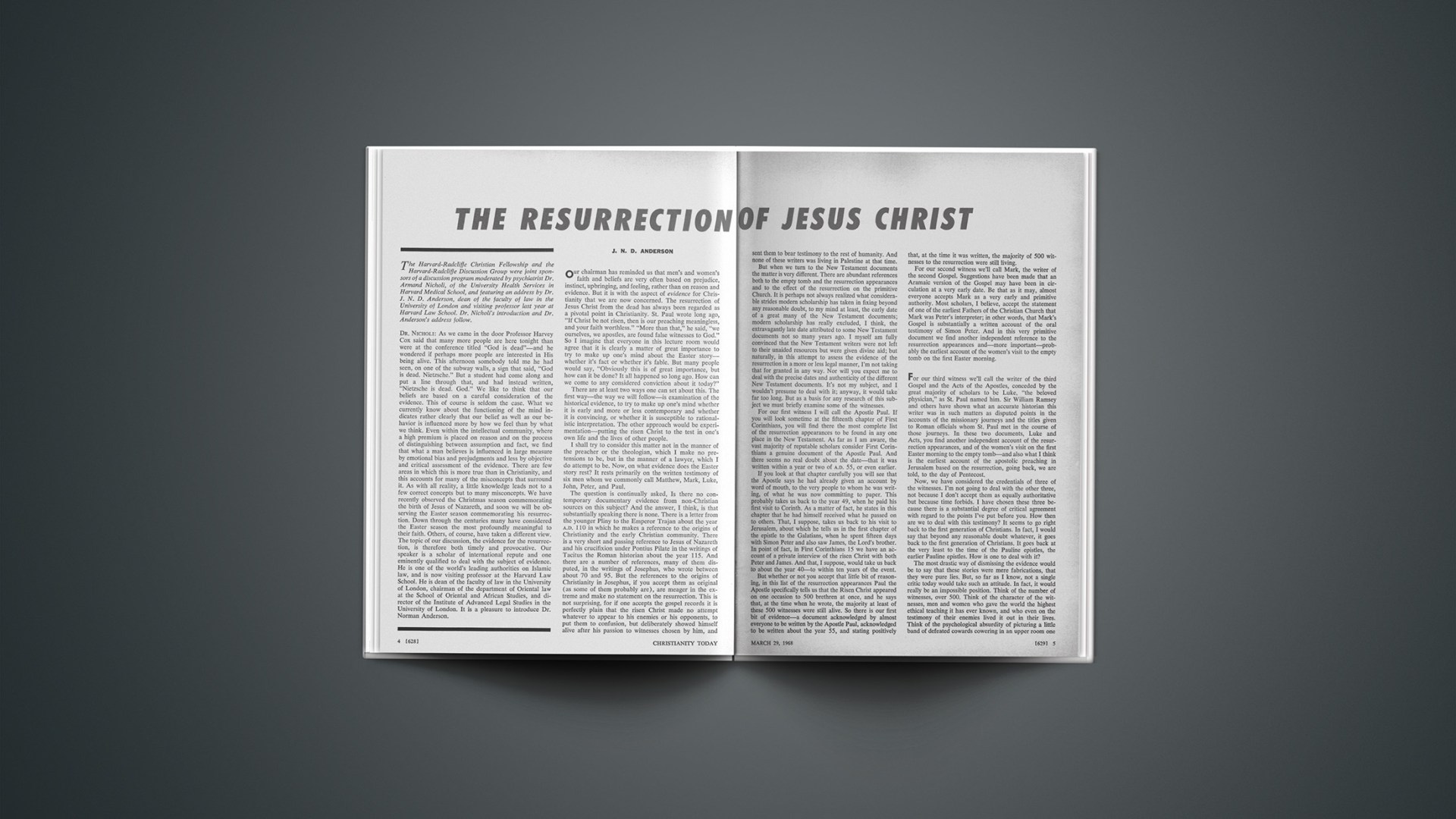
The Resurrection of Jesus Christ

The Harvard-Radcliffe Christian Fellowship and the Harvard-Radcliffe Discussion Group were joint sponsors of a discussion program moderated by psychiatrist Dr. Armand Nicholi, of the University Health Services in Harvard Medical School, and featuring an address by Dr. J. N. D. Anderson, dean of the faculty of law in the University of London and visiting professor last year at Harvard Law School. Dr. Nicholi’s introduction and Dr. Anderson’s address follow.

DR. NICHOLI: As we came in the door Professor Harvey Cox said that many more people are here tonight than were at the conference titled “God is dead”—and he wondered if perhaps more people are interested in His being alive. This afternoon somebody told me he had seen, on one of the subway walls, a sign that said, “God is dead. Nietzsche.” But a student had come along and put a line through that, and had instead written, “Nietzsche is dead. God.” We like to think that our beliefs are based on a careful consideration of the evidence. This of course is seldom the case. What we currently know about the functioning of the mind indicates rather clearly that our belief as well as our behavior is influenced more by how we feel than by what we think. Even within the intellectual community, where a high premium is placed on reason and on the process of distinguishing between assumption and fact, we find that what a man believes is influenced in large measure by emotional bias and prejudgments and less by objective and critical assessment of the evidence. There are few areas in which this is more true than in Christianity, and this accounts for many of the misconcepts that surround it. As with all reality, a little knowledge leads not to a few correct concepts but to many misconcepts. We have recently observed the Christmas season commemorating the birth of Jesus of Nazareth, and soon we will be observing the Easter season commemorating his resurrection. Down through the centuries many have considered the Easter season the most profoundly meaningful to their faith. Others, of course, have taken a different view. The topic of our discussion, the evidence for the resurrection, is therefore both timely and provocative. Our speaker is a scholar of international repute and one eminently qualified to deal with the subject of evidence. He is one of the world’s leading authorities on Islamic law, and is now visiting professor at the Harvard Law School. He is dean of the faculty of law in the University of London, chairman of the department of Oriental law at the School of Oriental and African Studies, and director of the Institute of Advanced Legal Studies in the University of London. It is a pleasure to introduce Dr. Norman Anderson.

Our chairman has reminded us that men’s and women’s faith and beliefs are very often based on prejudice, instinct, upbringing, and feeling, rather than on reason and evidence. But it is with the aspect of evidence for Christianity that we are now concerned. The resurrection of Jesus Christ from the dead has always been regarded as a pivotal point in Christianity. St. Paul wrote long ago, “If Christ be not risen, then is our preaching meaningless, and your faith worthless.” “More than that,” he said, “we ourselves, we apostles, are found false witnesses to God.” So I imagine that everyone in this lecture room would agree that it is clearly a matter of great importance to try to make up one’s mind about the Easter story—whether it’s fact or whether it’s fable. But many people would say, “Obviously this is of great importance, but how can it be done? It all happened so long ago. How can we come to any considered conviction about it today?”

There are at least two ways one can set about this. The first way—the way we will follow—is examination of the historical evidence, to try to make up one’s mind whether it is early and more or less contemporary and whether it is convincing, or whether it is susceptible to rationalistic interpretation. The other approach would be experimentation—putting the risen Christ to the test in one’s own life and the lives of other people.

I shall try to consider this matter not in the manner of the preacher or the theologian, which I make no pretensions to be, but in the manner of a lawyer, which I do attempt to be. Now, on what evidence does the Easter story rest? It rests primarily on the written testimony of six men whom we commonly call Matthew, Mark, Luke, John, Peter, and Paul.

The question is continually asked, Is there no contemporary documentary evidence from non-Christian sources on this subject? And the answer, I think, is that substantially speaking there is none. There is a letter from the younger Pliny to the Emperor Trajan about the year A.D. 110 in which he makes a reference to the origins of Christianity and the early Christian community. There is a very short and passing reference to Jesus of Nazareth and his crucifixion under Pontius Pilate in the writings of Tacitus the Roman historian about the year 115. And there are a number of references, many of them disputed, in the writings of Josephus, who wrote between about 70 and 95. But the references to the origins of Christianity in Josephus, if you accept them as original (as some of them probably are), are meager in the extreme and make no statement on the resurrection. This is not surprising, for if one accepts the gospel records it is perfectly plain that the risen Christ made no attempt whatever to appear to his enemies or his opponents, to put them to confusion, but deliberately showed himself alive after his passion to witnesses chosen by him, and sent them to bear testimony to the rest of humanity. And none of these writers was living in Palestine at that time.

But when we turn to the New Testament documents the matter is very different. There are abundant references both to the empty tomb and the resurrection appearances and to the effect of the resurrection on the primitive Church. It is perhaps not always realized what considerable strides modern scholarship has taken in fixing beyond any reasonable doubt, to my mind at least, the early date of a great many of the New Testament documents; modern scholarship has really excluded, I think, the extravagantly late date attributed to some New Testament documents not so many years ago. I myself am fully convinced that the New Testament writers were not left to their unaided resources but were given divine aid; but naturally, in this attempt to assess the evidence of the resurrection in a more or less legal manner, I’m not taking that for granted in any way. Nor will you expect me to deal with the precise dates and authenticity of the different New Testament documents. It’s not my subject, and I wouldn’t presume to deal with it; anyway, it would take far too long. But as a basis for any research of this subject we must briefly examine some of the witnesses.

For our first witness I will call the Apostle Paul. If you will look sometime at the fifteenth chapter of First Corinthians, you will find there the most complete list of the resurrection appearances to be found in any one place in the New Testament. As far as I am aware, the vast majority of reputable scholars consider First Corinthians a genuine document of the Apostle Paul. And there seems no real doubt about the date—that it was written within a year or two of A.D. 55, or even earlier.

If you look at that chapter carefully you will see that the Apostle says he had already given an account by word of mouth, to the very people to whom he was writing, of what he was now committing to paper. This probably takes us back to the year 49, when he paid his first visit to Corinth. As a matter of fact, he states in this chapter that he had himself received what he passed on to others. That, I suppose, takes us back to his visit to Jerusalem, about which he tells us in the first chapter of the epistle to the Galatians, when he spent fifteen days with Simon Peter and also saw James, the Lord’s brother. In point of fact, in First Corinthians 15 we have an account of a private interview of the risen Christ with both Peter and James. And that, I suppose, would take us back to about the year 40—to within ten years of the event.

But whether or not you accept that little bit of reasoning, in this list of the resurrection appearances Paul the Apostle specifically tells us that the Risen Christ appeared on one occasion to 500 brethren at once, and he says that, at the time when he wrote, the majority at least of these 500 witnesses were still alive. So there is our first bit of evidence—a document acknowledged by almost everyone to be written by the Apostle Paul, acknowledged to be written about the year 55, and stating positively that, at the time it was written, the majority of 500 witnesses to the resurrection were still living.

For our second witness we’ll call Mark, the writer of the second Gospel. Suggestions have been made that an Aramaic version of the Gospel may have been in circulation at a very early date. Be that as it may, almost everyone accepts Mark as a very early and primitive authority. Most scholars, I believe, accept the statement of one of the earliest Fathers of the Christian Church that Mark was Peter’s interpreter; in other words, that Mark’s Gospel is substantially a written account of the oral testimony of Simon Peter. And in this very primitive document we find another independent reference to the resurrection appearances and—more important—probably the earliest account of the women’s visit to the empty tomb on the first Easter morning.

For our third witness we’ll call the writer of the third Gospel and the Acts of the Apostles, conceded by the great majority of scholars to be Luke, “the beloved physician,” as St. Paul named him. Sir William Ramsey and others have shown what an accurate historian this writer was in such matters as disputed points in the accounts of the missionary journeys and the titles given to Roman officials whom St. Paul met in the course of those journeys. In these two documents, Luke and Acts, you find another independent account of the resurrection appearances, and of the women’s visit on the first Easter morning to the empty tomb—and also what I think is the earliest account of the apostolic preaching in Jerusalem based on the resurrection, going back, we are told, to the day of Pentecost.

Now, we have considered the credentials of three of the witnesses. I’m not going to deal with the other three, not because I don’t accept them as equally authoritative but because time forbids. I have chosen these three because there is a substantial degree of critical agreement with regard to the points I’ve put before you. How then are we to deal with this testimony? It seems to go right back to the first generation of Christians. In fact, I would say that beyond any reasonable doubt whatever, it goes back to the first generation of Christians. It goes back at the very least to the time of the Pauline epistles, the earlier Pauline epistles. How is one to deal with it?

The most drastic way of dismissing the evidence would be to say that these stories were mere fabrications, that they were pure lies. But, so far as I know, not a single critic today would take such an attitude. In fact, it would really be an impossible position. Think of the number of witnesses, over 500. Think of the character of the witnesses, men and women who gave the world the highest ethical teaching it has ever known, and who even on the testimony of their enemies lived it out in their lives. Think of the psychological absurdity of picturing a little band of defeated cowards cowering in an upper room one day and a few days later transformed into a company that no persecution could silence—and then attempting to attribute this dramatic change to nothing more convincing than a miserable fabrication they were trying to foist upon the world. That simply wouldn’t make sense.

Others might say, No, we wouldn’t call these stories lies, but let’s call them legends; that’s a kinder word. And of course, if it had been possible to date the Gospels two or three hundred years after the event (I hardly need remind you that the attempt to do that has been made by a wealth of scholars and that it has quite definitely failed), then it might have been possible for legends of this sort to develop. But it seems to me almost meaningless to talk about legends when you’re dealing with the eyewitnesses themselves.

Besides, if you examine these stories you find they don’t really look like legends. To a legend-monger it would have been a great temptation to invent some story as to how the resurrection took place, or some incident in which the risen Christ appeared to put his opponents to confusion; but we find no such attempt. What legend-monger would have made the first resurrection appearance to Mary Magdalene, a woman of no great standing in the Christian Church? Wouldn’t any legend-monger have made the first appearance to Simon Peter the leading apostle, or John the beloved disciple, or—still more likely, perhaps—to Mary the mother of our Lord? Why to Mary Magdalene?

And who can read about the appearance to Mary Magdalene, or the incident where the risen Christ joined two disciples on an afternoon walk to Emmaus, or the time when Peter and John raced each other to the tomb—who can read these stories and really think they’re legend? They are far too dignified and restrained; they are far too true to life and psychology. The difference between them and the sort of stories you find in the apocryphal gospels of but two or three centuries later is a difference almost between heaven and earth. No, as far as I know, no one today suggests that these stories are either lies or legends, just like that.

All the attempts to explain the Easter story and the resurrection appearances that I’ve seen are marked by a rather interesting phenomena. The critics first of all isolate the stories of the empty tomb and attempt to explain them on a variety of ingenious hypotheses, and then they turn to the resurrection appearances and dismiss them as some form of psychological or pathological experience—no doubt vivid and convincing on a subjective level to the apostles, who certainly believed in the resurrection, but, according to the critics, with no objective foundation.

Well, let us consider the question of the empty tomb. The earliest attempt to explain away the empty tomb can be found in St. Matthew’s Gospel. There we are told that the Jewish leaders gave money to the guards to say that the apostles had come by night and stolen away the body and had no doubt disposed of it somewhere. But so far as I know, no one today suggests that the apostles did that. I am aware, of course, of a recent book entitled The Passover Plot, which comes back to that particular solution in a rather different way. I’d prefer to deal with that comprehensively a little later. But that the apostles as we know them came and stole the body really would be an impossible view in view of both ethics and psychology. To imagine that they just foisted a miserable deception on the world simply wouldn’t fit in with their life and teaching and all we know of them. And it couldn’t begin to explain this dramatic change of the little band of defeated cowards into witnesses whom no persecution could silence.

No, better than that would be the suggestion that the body was removed by orders of the high priest or by orders of the Roman governor, or conceivably by Joseph of Arimathea, the owner of the sepulcher. Quite apart from anything else that may be said about those three suggestions, which we’ll take together to save time, the crucial point as I see it is this: Within seven short weeks—if the records are to be believed at all, and I cannot see any possible reason for Christian writers to have invented that difficult gap of seven weeks—within seven short weeks Jerusalem was seething with the preaching of the resurrection. The apostles were preaching it up and down the city. The chief priests were very much upset about it. They said that the apostles were trying to bring this man’s blood upon them. They were being accused of having crucified the Lord of glory. And they were prepared to go to almost any lengths to nip this dangerous heresy in the bud. Well, then, if the body had been moved by their orders, then, when the apostles started preaching the resurrection up and down the city, why didn’t they issue an official denial? Why didn’t they say, “That’s nonsense. The body was moved at our orders.” If that wouldn’t have convinced people, why didn’t they call as witnesses those who took the body away? If that wouldn’t have sufficed, why didn’t they point people to its final resting place? And if that wouldn’t have sufficed, why didn’t they produce the body? Surely they could have exploded Christianity once and for all. Why didn’t they do it?

To me there’s only one answer: They couldn’t, because they didn’t know where the body was. The same argument would apply to the Roman governor. He too was upset about this strange teaching. If he had had the body moved, it seems incredible that he wouldn’t have informed the chief priests when they were so upset. And that would bring us back to the question, Why didn’t they explode the whole story?

Well, what about Joseph of Arimathea? I think my answer would be that the critics really can’t have it both ways. They have a choice. On the one hand, they can accept what the New Testament says about Joseph, that he was a secret disciple, in which case it is unlikely that he would remove the body without consulting the apostles first—and incredible that he wouldn’t have told them afterwards, when the preaching of the resurrection was echoing up and down the lanes and alleys of the city. That would bring us back to the idea that the apostles were foisting a miserable deception on the world.

The other view critics can choose to take about Joseph of Arimathea—apart from the suggestion in The Passover Plot—is that he was a pious Jew who put the body in his sepulcher so that it wouldn’t hang on the cross on the sabbath day. In that case it’s unlikely that he would have moved the body without consulting the chief priests first, and it is fantastic to suggest that he wouldn’t have told them afterward, when they were so upset about this heresy. In that case, why didn’t they call Joseph as a witness? Why didn’t they issue an official denial?

Another suggestion about the empty tomb was espoused by one of the theological teachers at Cambridge, England, in the days of my own youth and innocence in that university. It runs somewhat like this: The women were Galileans and strangers in Jerusalem; they didn’t know their way about the city very well. They saw their Master buried in the half-light of the evening, when their eyes were blinded with tears, and they went to the tomb in the half-light of the morning. According to this theory they missed their way and went to the wrong sepulcher. A young man happened to be hanging about and, guessing what they wanted, said to them, “You seek Jesus of Nazareth. He is not here [pointing to the tomb they were looking at]. Behold the place where they laid him [pointing to another tomb].” But the women got frightened and ran away. Subsequently they decided that the young man was an angel proclaiming the resurrection of their Master.

That’s very ingenious, but I don’t think it stands up to investigation. To begin with, it’s based on accepting the beginning and the end of what the young man is recorded to have said and leaving out the most important part, the middle; and for that I can see no scholarly justification whatever. For we are told that what the young man said is, “You seek Jesus of Nazareth. He is not here. He is risen. Behold the place where they laid him”—which changes the whole meaning, of course.

However, even if you think that it’s justifiable to deal with his statement the other way, it’s not really as easy as it might seem—as those who put forward this theory themselves admit. For if the women went straight back to the apostles and told them, why didn’t the apostles do one of two things: either go and check up on the facts for themselves or start preaching the resurrection at once? Unless you ignore the whole tenor of the New Testament documents, they didn’t start preaching for another seven weeks. As I’ve already said, I cannot see any possible motive for Christian writers to have invented that seven-week gap. So we’re asked to believe that the women didn’t tell the apostles this story for quite a long time. Why not? Because the apostles had supposedly run away to Galilee. Why? Well, because Jerusalem was not a very healthful place for Christians just then. But we’re not told why the apostles were so particularly ungallant that they ran away and left their wives and sisters and mothers behind. We’re asked to believe that the men went down to Galilee and left the women in Jerusalem, and that the women stayed in Jerusalem for some weeks for no apparent reason. It was only when the apostles came back from Galilee already convinced by some mystical experience that their Master was still alive—only then, supposedly, that the women told them about the visit to the tomb. Then the apostles put two and two together, made seven or eight out of it, and proclaimed the resurrection.

Frankly, I don’t find that convincing. On that basis, I suppose the body of our Lord would still have lain where it had always lain, in Joseph’s tomb. The chief priests must have known where that was, or if not they could have found out very easily. So they could have exploded the whole story by saying, “This is nonsense. If you don’t believe us, come and see.”

There is another explanation of the empty tomb, first put forward by a man named Venturini a couple of centuries or so ago. It has been resuscitated in recent years in a slightly different form by a heterodox group of Muslims called the Ahmadiya, who used to have their main headquarters at a place called Qadian and who have their English headquarters in a part of London called Putney. On two occasions they’ve invited me to go and address them. Their explanation runs like this: Christ was indeed nailed to the cross. He suffered terribly from shock, loss of blood, and pain, and he swooned away; but he didn’t actually die. Medical knowledge was not very great at that time, and the apostles thought he was dead. We are told, are we not, that Pilate was surprised that he was dead already. The explanation assertedly is that he was taken down from the cross in a state of swoon by those who wrongly believed him to be dead, and laid in the sepulcher. And the cool restfulness of the sepulcher so far revived him that he was eventually able to issue forth from the grave. His ignorant disciples couldn’t believe that this was a mere resuscitation. They insisted it was a resurrection from the dead.

Well, again, it’s very ingenious. But it won’t stand up to investigation. To begin with, steps were taken—it seems—to make quite sure that Jesus was dead; that surely is the meaning of the spear-thrust in his side. But suppose for argument’s sake that he was not quite dead. Do you really believe that lying for hour after hour with no medical attention in a rock-hewn tomb in Palestine at Easter, when it’s quite cold at night, would so far have revived him, instead of proving the inevitable end to his flickering life, that he would have been able to loose himself from yards of graveclothes weighted with pounds of spices, roll away a stone that three women felt incapable of tackling, and walk miles on wounded feet? The skeptic Strauss, you know, quite exploded that theory, to my mind, when he wrote that it would have been impossible for a being who had crept sick and faint out of a sepulcher, needing bandaging, sustenance, and attention, to convince his disciples that he was the risen Lord of Life, an impression which lay at the foundation of their future ministry. Such a resuscitation could by no means have changed their reverence into worship.

So much for the empty tomb, except for two quick points. The first is this: Have you noticed that the references to the empty tomb all come in the Gospels, which were written to give the Christian community the facts they wanted to know? In the public preaching to those who were not believers, as recorded in the Acts of the Apostles, there is an enormous emphasis on the fact of the resurrection but not a single reference to the empty tomb. Now, why? To me there is only one answer: There was no point in arguing about the empty tomb. Everyone, friend and opponent, knew that it was empty. The only questions worth arguing about were why it was empty and what its emptiness proved.

The second point is this: I’ve been talking all this time about the empty tomb, but it seems that it wasn’t really empty. You remember the account in John’s Gospel of how Mary Magdalene ran and called Peter and John and how the two men set out to the tomb. John, the younger, ran on quicker than Peter and came first to the tomb. He stooped down, “peeped” inside (which I believe is the literal meaning of the Greek), and saw the linen clothes and the napkin that had been about the head. And then Simon Peter came along and, characteristically, blundered straight in, followed by John; and they took note of the linen clothes and the napkin, which was not lying with the linen clothes but was apart, wrapped into one place. The Greek there seems to suggest that the linen clothes were lying, not strewn about the tomb, but where the body had been, and that there was a gap where the neck of Christ had lain—and that the napkin which had been about his head was not with the linen clothes but apart and wrapped in its own place, which I suppose means still done up, as though the body had simply withdrawn itself. We are told that when John saw that, he needed no further testimony from man or angel; he saw and believed, and his testimony has come down to us.

So much then for the empty tomb, which seems to me to be an exceedingly important bit of evidence, in fact, a basic piece of evidence. But equally important, I don’t think you can dismiss the resurrection appearances as just some form of hallucination or psychological or pathological experience. Now, I’m no doctor. Our chairman this evening is a psychiatrist, and I’d much rather leave this part of the presentation to him. But let me just say that I understand from medical friends that hallucinary experiences commonly conform to certain rules that simply don’t apply in this case.

To begin with, only certain types of persons have experiences like this—the type we call high-strung people. But I do not see how you can categorize witnesses to the resurrection as any one or two psychological types. Again, I’m told that experiences of this sort are highly individualistic, because they are naturally linked to the subconscious mind and to the past lives of the persons who experience them. So two different people will not have identical hallucinations. But in this case 500 are recorded as having had the same experience on one occasion, eleven on another, ten on another, and seven on another. And there were other groups, too. It doesn’t look purely subjective; it looks as if these experiences had some objective foundation.

Again, I am told that experiences of this sort commonly concern some expected event. A mother whose son runs away to sea always believes that he will come home, and she lights a lamp each evening to welcome him home. One day she imagines she sees him walk in at the door. But here the evidence is overwhelming that the disciples were not expecting any such thing. They ought to have been, but they weren’t.

Again, I am told that experiences of this sort commonly occur in suitable circumstances with suitable surroundings. But analyze the resurrection appearances: one at the tomb in the early morning; one during an afternoon walk into the country; one or two private interviews in the full light of day; one in an upper room in the evening; one at the lakeside in the early morning; and so on.

Finally, I am told that experiences of this sort commonly recur over a very considerable period, either getting more and more frequent until there is some crisis, or less and less frequent until they die away. But in this case 500 people claim to have had at least one such experience. A number claim to have had several such experiences within a period of forty days. And at the end of those forty days these experiences seem to have come to a sudden end. Not one of these men or women claims to have had such an experience again. I am aware that the Apostle Paul some years later claims to have seen a vision of the risen Christ in heaven on the road to Damascus. I have no doubt that he did have it, but I suggest that there was a fundamental difference between this vision and the experiences of the forty days during which the risen Christ came in and went out among the disciples.

Nor do I think you can explain these alleged appearances by the phenomena of modern spiritism. Here I’m certainly no expert, but you certainly can’t find one medium who was present on each occasion, nor can you find the usual little band of earnest seekers after the supernatural. And the One who appeared seems to have been very different from alleged spirit emanations. He could be clearly seen in broad daylight, recognized with some difficulty (it seems), and he could invite a finger to explore the print of the nails.

Nor do I think that these stories are adequately explained by the theory of the mere spiritual survival of Christ. It seems to me that the evidence goes much further than that. The evidence is that his spirit came back to his mutilated human body, which was somehow transformed—transformed into something that I can only call a spiritual body. If you ask me what a spiritual body is like, I must say frankly that I don’t know. But we live in a world of three dimensions, and there are lots of other things we don’t know. The evidence seems to point to the fact that this body could withdraw itself from the grave-clothes, could apparently pass through closed doors, could appear and disappear, and yet could be recognized with some difficulty, could be clearly seen and distinctly heard, and could invite, as I said, a finger to explore the print of the nails.

Now just a word, if I may, about that recent book called The Passover Plot. It’s an ingenious book, but I must say that I find it wholly unconvincing. It is an attempt to explain the whole story of the crucifixion and resurrection, written by a Jew who has great respect for Jesus of Nazareth but who excludes even the possibility of his deity without any examination of this in the book at all. He believes that Christ himself believed he was the Messiah foretold in the Old Testament Scriptures and that he very largely interpreted his messiahship in terms of the passages about the suffering servant in the latter part of Isaiah. And the author of The Passover Plot believes that Christ deliberately set to work to fulfill those prophecies by suffering an apparent death, and something that might be regarded as a resurrection. Jesus is said to have very carefully kept the secret of what he intended to do from the twelve apostles, who knew nothing about it whatever, and to have confided his plan only to Joseph of Arimathea and to one or two others in Jerusalem—that he plotted it all; that he virtually provoked the betrayal; that it was arranged that one of the people in the plot should put a sponge to a reed, and put it to his lips, containing a substance which would cause him to swoon away; that Joseph would then go and ask for the body, alleging that it was dead when it was not dead; that the body should be nursed and looked after and that Christ should be revived; but that this plan was frustrated by the spear-thrust in his side. The author imagines that the persons in the plot managed to resuscitate Jesus of Nazareth for a period of about half an hour, that he was able to give messages to his disciples, but that he then died and they disposed of his body somewhere. Then they tried to pass on his messages to the apostles, who knew nothing about this, and the apostles made a whole series of mistakes which led them to belief in a resurrection.

Never in my life have I read a book which took some bits of evidence and rejected others on such a subjective basis. Many incidents in the Gospels are accepted just because they fit this theory; others are rejected because they don’t. Occasionally an attempt is made to give an objective basis, but time and again it’s purely subjective. I find the elements in the plot wholly unconvincing—the utter secrecy from the twelve, and the supposed provocation of the betrayal, for example; and I cannot see what would have been the result had the alleged plot succeeded. What would have happened if Christ had apparently come back to life? Would he then have told the disciples? What would he have gained? I cannot believe that this story in any way explains the resurrection appearances, which allegedly refer to an entirely different person. Surely the apostles would not have made so gigantic a mistake as that. And I cannot see how the conspirators would have kept it secret after it had all failed, and would never have shared it with the other apostles.

There’s a phenomenon in the world today called the Christian Church. It can be traced back in history to the region of Palestine in the first century. To what does it owe its origin? The New Testament—its documents of association, as a lawyer would call them—makes the unequivocal statement that the Church owed its origin to the resurrection of its founder from the dead. Is there really any other theory that fits the facts?

Much the same can be said about the phenomenon of the Christian Sunday, which can be traced back in much the same way. We need to remember that almost all the first Christians were convinced Jews who were fanatically attached to the Jewish sabbath. What would have prompted them to change that to the first day of the week? It would have required something pretty significant. In fact, it took the resurrection to make them do it. Much the same argument could be used about the festival of Easter.

What about the success of the early Church? Our Lord himself had had a big following in Galilee but a very small following in Jerusalem. We are told, however, that the apostles made thousands of converts in Jerusalem, many of them from among the circle of the priests. They did it by preaching the resurrection. And they did it within a short walk of Joseph’s tomb. Anyone who listened to them could have walked to the tomb and back between luncheon and what the English call afternoon tea. Do you really believe they would have made all those converts if the tomb hadn’t been empty?

What about the apostles? What was it that changed Peter from one who three times denied his Master before servants to someone who defied the chief priests? We are told that the risen Christ appeared to Peter, and he was never the same man again. What changed James, the unbelieving brother of our Lord during the days of his ministry, so that he became the president or bishop of the Jerusalem church a few years later? We are told that the risen Christ appeared to James, and he then wrote about his human relative as the Lord of glory. Or what about Paul the persecutor, who was in the inner councils of the chief priests? Do you believe he would have become Paul the apostle without checking up on whether the tomb was empty? Why, he must have known the tomb was empty, but he didn’t know until the vision on the road to Damascus why it was empty.

What about the very strong evidence that Christ himself foretold his resurrection, though the disciples simply couldn’t understand it? Not so very long ago there was in England a young man barrister, or what you would call a trial lawyer, by the name of Frank Morrison. He was an unbeliever. For years he promised himself that one day he would write a book to disprove the resurrection finally and forever. At last he got the leisure. He was an honest man and he did the necessary study. Eventually, he wrote a book that you can buy as a paperback, Who Moved the Stone? Starting from the most critical possible approach to the New Testament documents he concludes inter alia that you can explain the trial and the conviction of Jesus only on the basis that he himself had foretold his death and resurrection.

What about that awkward seven weeks’ gap to which I have already referred? How can you really explain it in any other way except by that fact that the apostles were completely absorbed for the first forty days by their intermittent interviews with their risen Lord, and that they then waited for another ten days at his command until the Holy Spirit came?

What about Christian experience all down the ages? And the multitude of men and women—rich and poor, reprobate and respectable, learned and ignorant—who have found in the risen Christ their joy and peace and certainty?

And what about the One who rose? Even if someone were to take the attitude, “I can’t help it; however strong the evidence may be, I will never believe that Tom Smith could be dead for a large number of hours and then come alive again,” would that apply to the One of whom we are speaking? Why, he was unique—unique in his teaching, unique in his miracles, unique in his claims, unique in his personality, unique in his sinlessness. Quite apart from the resurrection there is most excellent evidence, to me at least, that he wasn’t just a man but God incarnate. Is it incredible that such a One should rise again? To me the incredible thing is that such a One as he should die for us men and for our salvation.

I have been dealing with the historical evidence for the resurrection. No doubt you could hire a lawyer to do it very much better than I’ve done it. But I can only say that I wholeheartedly believe in what I’ve been saying. And I suppose that, for the individual, the final evidence of the resurrection—I don’t mean the most important evidence but the concluding evidence—is the evidence of personal experience. I’m not referring to some weird mystical experience of the risen Christ apprehended by the senses. I am saying only that all through the ages, and still today, men and women have come to faith in Christ and through him in God through the evidence for the resurrection, and that their faith has been authenticated in daily life. This experience has been true down the ages; it’s true today. I’ve traveled a good deal and have lived in a number of different countries, and I’ve seen it happen time and again. I can only say that I for one am thoroughly convinced.

Milton D. Hunnex is professor and head of the department of philosophy at Willamette University, Salem, Oregon. He received the B.A. and M.A. degrees from the University of Redlands and the Ph.D. in the Inter-collegiate Program in Graduate Studies, Claremont, California. He is author of “Philosophies and Philosophers.”
Confessions of an Editor

God stabbed my conscience that night and pinned me to the ground with a fiery bolt of lightning. He was calling me, but I had never dreamed he would or could call so insistently, nor so inconveniently. All through that sodden Long Island night he pursued me, joining thunder and flaming arrow to unnerve his retreating quarry.

When the fire fell I knew instinctively that the Great Archer had nailed me, as it were, to my own footsteps.

The Bible is not without a theology of thunder and lightning, one that differs notably from the familiar Donner und Blitzen of a gift-laden Saint Nicholas. It speaks, in truth, of God’s judgment. And that night, as I trembled in the storm, I knew unmistakably that the Eternal One was coding an urgent message to my soul.

This harrowing moment, this unexpected meeting with God, was no ordinary, soon-to-be-forgotten rendezvous. To be sure, it had a past as well as a future. But now the fire kindled in my heart refused to die; its light exposed memories that conscience could not deny. Across the years I had sparred often with the Invisible One. All the while I was still a pagan—a neo-Christian pagan, as it were—born into a presumably Christian home where mother was a Roman Catholic and father a Lutheran. At the age of twelve I was confirmed in the Christian faith—in fact, on two successive Sundays, though still very much a stranger to Jesus Christ, I was baptized and confirmed by the local Episcopal priest. I shed the Church in my mid-teens. In the course of my evacuation I had managed to pilfer a Bible from the pew racks, however, and as I opened it now and then upon retiring, one segment of that Book held a special fascination for me: its narratives of the resurrection of Jesus Christ from the dead.

I did not know then—as I should have known, and as anyone having even the slightest contact with the Church ought not to be able to forget—that the Apostle Paul associates Christ’s crucifixion for sinners and the bodily resurrection as central tenets of the Evangel, or God’s great good news. I was a newspaperman preoccupied with man’s minutiae when God tracked me down; the Word was pursuing a lost purveyor of words. In this encounter, my own semantic skill meant little. When, shortly after the Almighty One had used lightning to pierce my soul, a university graduate prodded me to pray, I found myself at a loss for words. There I was, a Long Island editor and suburban correspondent quite accustomed to interviewing the high and mighty of this world, yet wholly inept at formulating phrases for the King of Glory. Not even the dimly familiar words from the Order of the Holy Communion (some of which I now treasure deeply, e.g., “… Christ’s blood was shed for thee … be thankful”) seemed to fit the sheer spontaneity of that occasion.

So my friend and I settled for the Lord’s Prayer. Jesus had said, “When thou prayest, enter into thy closet.…” My altar rail was the front seat of my automobile; we parked it beside the waters of Great South Bay, locked the doors, and knelt to pray. Phrase by phrase I repeated the words of my friend. My heart owned its abysmal depth of need. “How blest are those who know that they are poor; the kingdom of Heaven is theirs”—so the New English Bible translates Jesus’ opening words in the Sermon on the Mount. My aching spirit cried out to God for the forgiveness of sins and for new life in Christ. Somewhere in the echoes of eternity I heard the pounding of hammers that marked the Saviour’s crucifixion in my stead.

Like a sure wind from the eternal world comes God’s assurance of forgiveness to the redeemed. For me the fearsome lightning now became a fountain of light; the roll of thunder, a surge of confidence. Incomparable peace, the reality of sins forgiven, a sense of destiny and direction, and above all the awareness of a new Presence and Power at the core of life—this is rebirth. I was now on speaking terms with God, a friend of the King, a servant of the Saviour.

The very next day I would have gone to the ends of the earth to do the Divine Redeemer’s bidding. I would, in truth, have gone to China; instead, in his time, and after a time of training, I went to campuses, and then to CHRISTIANITY TODAY.

And now where? After a span of service—whether here or there—to the eternal presence of God. That is the believer’s momentous prospect. For Jesus Christ turns life right-side-up and heaven outside-in.

In our century everything seems to be changing; nothing abides. Only those who know the Living God escape this threat of universal obsolescence. God abides. The Divine Commandments abide. Christ’s Gospel abides. And whoever abides in him now will forever abide with him. The cosmic process offers no enduring place to hide but God’s own abiding place.

The Prospect of Peace and Purity …

The World Congress on Evangelism was held in Berlin in 1966. From more than 100 nations came onetime strangers to the Living God who had found new life in Christ, to voice to the world the realities of personal salvation. To men and women of all nations and races they echoed the personal prospect of peace and purity, of happiness and hope.

The Berlin meetings brought to light a tremendous imbalance in the Christian community’s witness to the world: although the majority of the world’s inhabitants are not Christian, most of the literature of the Church—in an age of mass-media access—is directed to those who are already committed to Christ. This issue of CHRISTIANITY TODAY concentrates on this neglected frontier. Entitled “Rebirth,” it is addressed to the uncommitted, to whom it presents an invitation to personal acceptance of Jesus Christ as Saviour and Lord.

Why Did They Riot?

Episcopal Bishop Anson Phelps Stokes, Jr., urges church people to make “required reading” of the report of the President’s National Advisory Commission on Civil Disorders. “This Lent,” says Bishop Stokes, “our spiritual reading need not be out of the Bible, for a spiritual and moral crisis has been presented to us all by an arm of government.”

If anyone still doubts that a crisis exists, he ought to take the bishop’s advice immediately, Lent or no Lent. The riot report is a disturbing, almost despairing, document. It finds that despite all the marches and all the violence and all the legislation of the last fifteen years, the plight of America’s 22 million Negroes grows progressively worse. And the rioting of last summer, indeed the whole “explosive mixture which has been accumulating in our cities since the end of World War II,” is traced to a basic single source. Says the commission: “White racism is essentially responsible.”

This is a severe moral judgment—one that ought not to be lightly offered or hurriedly credited. It is a somewhat surprising finding, too, since the report as a whole reflects a secular sociological tone. The makeup and methodology of the commission allowed for little in the way of a theological dimension. The role of the churches in urban crisis gets no study in the 250,000-word report.

But what of the charge? Is it really “white racism” that is behind our ghetto problem?

Careful analysis suggests another answer. The underlying evil is not so much prejudice as avarice. The inordinate desire for “more, more, more” is at the heart of the matter. Blame must be shared by Negro and white.

The white man relegates the Negro to the ghetto, not because of his skin color, but because by and large he appears to be a threat to what the white man thinks are his own best interests. The Negro represents a lower standard of living, and the white man sees the granting of equal rights to the Negro as a lowering of the white standard. This is so in housing, in employment, and in education—the three major frontiers of the Negro struggle.

The insatiable quest for material goods is in itself a social problem. A study might well show, for example, that a major reason for unemployment and underemployment among Negro males in the big cities is the large number of white working mothers who pour in from the suburbs every morning. These women rarely work out of necessity. Many find jobs because they want to raise the yearly family income from $10,000 to $15,000, some because they lack the fortitude to cope with their own children. Then they hire Negro women from the ghettos to care for the children and the house at $2,500 a year.

Greed is common to all races. Many Negroes rioted, not because they hated the white man per se, but because rioting gave them the opportunity to get things they might not otherwise get. The commission contends that the rioter made targets out of white power symbols. Had that been true, the objects of destruction would have been schools, police stations, courthouses, banks and loan companies, and employment agencies. But these escaped almost unscathed. The commission itself noted that rioters aimed primarily at stores selling liquor, clothing, and furniture. An estimated 80 per cent of the loss in the Newark riot was in inventory.

Let it be plainly said that if greed were ever justified, the American Negro would be among the first to qualify. The squalor of the slums—seen, for example, in the estimate of 14,000 cases of ratbite each year, most of them in the inner cities—is a condition for which the smug suburbanite, both Christian and non-Christian, must share the blame. God will surely judge every contribution to this degradation—whether by acts of commission or of omission.Where does all this bring us? Should we try to buy our way out by vast new commitments to public spending, as the commission recommends? Such spending will help to treat the symptoms and may be a necessary stopgap. But history shows that it is not a permanent solution: public housing and urban-renewal programs have actually contributed to, rather than alleviated, racial segregation.

The commission did well to complete and publish its report four months before its deadline so as to give time for remedial action before another long, hot summer begins. The rest is up to the citizenry.

The urban crisis offers evangelicals an unprecedented opportunity for legitimate and responsible social action. What is needed is a grass-roots movement in which both whites and Negroes reach across the bounds of avarice and prejudice. Let the evangelical Negroes make constructive proposals for what their white Christian brethren should do, and let biblically oriented congregations respond with an unprecedented wave of compassion. Lent might well be observed with the riot report in one hand and an open Bible in the other.

The Theology of Hope

In the history of theology, we find now this and now that dimension of the Gospel suddenly forcing itself into the center of attention. When this happens, it seems to strike no one as being strange; it is always as though this particular aspect is terribly important at this particular time. In our own time, the “theology of hope” is one of the centers of everyone’s concern.

Jürgen Moltmann’s book, The Theology of Hope (see February 16 issue, page 32), is a symptom of the Church’s new concern for eschatology. We could, of course, say that the Church has been busy with the eschatological side of the Bible for a long time. The days are passed, indeed, when theologians assumed that the eschatological problems were all solved or the eschatological structure wholly finished. At any rate, that eschatology looms large on the theological horizon is not a new discovery.

Many works have been devoted to the subject during the past thirty years. Still, Moltmann’s book already published in several translations, has earned unusual response, partly because of its stress on hope as an antidote to many forms of modern theology in which any expectation of a new and future act of God on earth, any reality of fulfillment, has been shoved aside. The “not yet” is not put in opposition to the “already come.” But Moltmann insists that the “realization” of the New Covenant, particularly in the resurrection of Christ, may never be a reason for ignoring the “yet to come.”

The manner in which Moltmann puts his thesis has provoked a great deal of discussion. This was apparent in the publication last year of Diskussion über die “Theologie der Hoffnung.” In this symposium, several writers offered their answer to Moltmann’s book and Moltmann himself responded extensively to his critics. The book sets several acute questions on the agenda, facing one another in tension. We cannot go into an analysis of the book here but can zero in on one point that is unusually important.

The prevailing charge made against Moltmann is that he is one-sided in his stress on the futuristic aspect of eschatology, and that this weakens, if it does not negate, the significance of what has already been realized in Christ. Moltmann denies this; the realized aspect is not whittled down by the fact that there is also a yet-to-be-realized aspect. Precisely in and because of what has been realized in Christ, the attention of the believer is directed toward the future.

Christ’s resurrection is the anticipation of the coming kingdom; but anticipation is not the same as arrival. Surely, Moltmann argues, faith is directed first of all to what has already been given. But on the basis of that, hope rises as the primary Christian disposition. Hope has its fundament in faith.

The Church’s hope is not set on a kind of utopia; rather, it goes its way through this life in productive obedience. This does not mean that we—by our works—can build the Kingdom, in the fashion of a new social gospel. The obedience demanded of us is obedience to the God who promises the Kingdom in his time and his manner. Obedience flows from his promises. But His promises do not offer a vague future expectation; they offer a demand for obedience that is involved with action in today’s world. For the Spirit has in fact already been given for this, in the midst of creaturely need and misery, in the midst of a creation that is groaning for its redemption.

This world is not without perspective, and expectation for it does not leave us merely with dreams of the future. The perspective on the world given by God’s promise for the future summons us to service in the world here and now. The Spirit of the risen Christ grasps this world. And he does this, not as an intervention from above, from outside us, on his own, but through us, through our expectations, and through our readiness, and through our obedience.

One has to read Moltmann’s book in order to understand what all this means in the concrete, in the midst of our complex life in this complex century. Some of his critics have asked for more specific guidelines on obedience. Moltmann is the first to agree that many questions and much reflection must still be asked and given. But what he wants is to press the necessity of such reflection and to warn against defeatism in our world. He wants to summon the Church away from a spirit of hopelessness that sacrifices this real world to the “powers of evil and corruption” and uses eschatology only as an escape from this world, an eschatology that is void of perspective for today.

The discussion of Moltmann’s book is far from over. It would be interesting to consider how much it has in common with Pannenberg’s point of view; both men are captivated by the significance of history for the understanding of redemption. Moltmann himself says that he finds more in Pannenberg’s recent publication to agree with than to differ with.

But in any event, we are confronted anew with the questions of the “already” and the “not yet.” The “already” does not give us title to an “ecclesiology of glory”; rather, it reminds us of the cross and the resurrection, of the Gospel for the world in its need, and of our calling to go into this world with the promise of a new earth in which righteousness dwells (2 Pet. 3:13). This promise is not an “escape” from the world; it is a word of promise, of expectation, and of responsibility.

We ought to take note of all this and to be abreast of the discussion. For this is not abstract theology. It has to do with a theology that liberates us from the romanticism and individualism our flesh is tempted to adopt. It tells us that anyone who dreams of the future without accepting the challenges of today is not in tune with the biblical expectations and hope. The New Testament pictures the Church that has received the Spirit and is sent by the Spirit into the world. This does not rule out the reality of comfort, any more than it rules out the “for me” aspect of personal salvation. But it does rule out the notion that the Gospel is directed merely to us personally; it does rule out narrow and provincial individualism. It rules out any perspective that has no room for the wide and deep work of the Spirit in the whole gamut of our perspective of the Kingdom of God.

As a result of Moltmann’s book, we are brought up short and reminded to think and to preach about the future in a biblical perspective. If this happens, all the theological talks have borne good fruit. This is much more than an academic theological matter. It involves the Church, its hopes, and its expectations—and all this, not in tension, but in dynamic unity with its faith and its love.

Haiti’s Ills Prod Evangelical Activist

Rarely have a nation and its leader suffered such castigation as Haiti and François Duvalier in the current film The Comedians, which is anything but comic. Graham Greene’s story teems with political corruption, paganism, and sadism drawn from real life—and death. To bring things up to date, the United Nations Commission on Human Rights is scheduling hearings this month on mistreatment of Haiti’s numerous political prisoners.

The real-life Duvalier has more than public relations to worry about. After years of divisiveness and frustration, 40,000 anti-Duvalier exiles in the United States have forged a common front, the Haitian Coalition. Its affable, 36-year-old leader, Raymond Joseph, is hardly what doctrinaire liberal or conservative Protestants would expect. He’s an anti-Communist lecturer, Bible translator, and graduate of Moody Bible Institute and Wheaton College—in short, an evangelical who has chosen the vocation of social revolution.

Why revolution? Besides being a mess politically, says Joseph, Haiti is the Western Hemisphere’s most illiterate, most impoverished nation.

As is true in all Latin lands, Haiti’s religion is largely Roman Catholic, but Joseph’s father was a leading Baptist pastor who worked with the West Indies Mission. Joseph says that Catholicism traditionally has been identified with the urban mulatto elite and Protestantism has made a successful appeal to black rural peasants. He still recalls a Catholic forced-conversion drive in the 1940s, with government help. Since Vatican II the church has gotten interested in such things as literacy campaigns.

Although Duvalier is Catholic, priests form one bloc he can’t control. He was excommunicated by the Vatican when he threw out the archbishop, but the feud was patched up in 1966. Voo-doo has proven more useful to the regime. Many accounts tell how it capitalizes on paganism to spread belief in its omnipotent power. People fear that even dogs and cats will eavesdrop and turn them in if their talk is disloyal.

Joseph’s father kept him out of high school to avoid contact with Catholic priests. At the time this made Joseph so angry that he would hardly speak to his father; now he has a hunch father knew best. Joseph studied at home and taught himself English. He bucked missionary opposition and talked his way into conditional admittance to Moody, despite his lack of high-school education. His goal was to learn Greek and Hebrew so he could translate the Bible into Creole, the language of Haiti’s masses.

Joseph leapt over his educational handicap and also turned out to be a student leader at Moody, and later at Wheaton. A tip-off to his personality is the humor and lack of bitterness he shows as he recounts how Wheaton asked him to withdraw during his last semester, when he married a white girl he had met at Moody. He went back to Haiti to finish a New Testament translation for the American Bible Society, and the college later mailed him final exams and granted a degree.

At that point Joseph thought education was the solution for Haiti (he still thinks it is, in the long run). Hoping to start a college with “a Christian foundation,” he went to the University of Chicago and had nearly finished course work for a Ph.D. in social anthropology by November, 1964.

That was the turning point. He learned that Duvalier had paraded the young children of the capital city, Port-au-Prince, to where they could witness the firing-squad death of two young revolutionaries. “I was revolted. I thought, Duvalier just seems to enjoy slaughtering people.” Two months later he was out of the ivory tower and setting up the Coalition, which now has offices in New York’s Park Sheraton Hotel and pays him $750 a month.

Joseph’s strategy was to shun the guns-first approach of previous exile movements, such as the comic-opera invasion attempt—complete with CBS camera crew—that U. S. Customs agents broke up a year ago. That group was led by Jean Baptiste Georges, a former priest who was supposed to be president until new elections were held.

Haiti’s regime “uses rape, murder, and terror not so much to produce power as to generate despair,” the Saturday Evening Post comments. To build a base for overthrowing Duvalier, the Coalition uses news and humor to inform the people, building contacts and confidence within Haiti. The media are a weekly paper and a daily short-wave “Six O’clock Mass” broadcast in Creole.

More than his fundamentalist background makes Joseph seem an unlikely revolutionary. He says he has no political ambitions. He doesn’t know how to shoot a gun (100 exiled army officers in the New York area handle that side of things). He has little use for most revolutionaries, with their platitudes and unrealistic utopian schemes.

Joseph sometimes lectures for Fred Schwartz’s Christian Anti-Communism Crusade, and he says Duvalier has made Haiti ripe for a Castro-induced “liberation.” But he also fears a takeover by U. S. Marines, as happened from 1915 to 1934. The Coalition ideology, he says, is “left of center,” with “a mixed economy, a government hand in many things, and great social reforms for the masses.”

There was also hope for reforms when “Papa Doc” became president, since he was credited with significant aid work as a rural physician. But he soon outdid the terrorism of his predecessors. In the 1963 turmoil (during which 150 Protestant missionaries were evacuated), Duvalier uttered the poetic promise, “There will be a Himalaya of corpses.”

Things now seem to be coming to a head. The economy is sagging. United States aid, which totaled $43 million up to 1963, has become a trickle of food and medicine, since Duvalier refuses supervision of the money. American journals abound with news of unrest: Last year Duvalier denounced his wife, son, and daughter, charged his son-in-law with treason, and fired half his cabinet. He held firing squads for members of his secret police, and for nineteen Army officers. Street protests broke out in the north. Foreign embassies were crowded with refugees, and at one period 1,000 exiles a week sneaked into the Bahamas, creating a touchy situation still under negotiation.

Estimates of Coalition success vary. The New Republic said last year that claims of an underground in Haiti are “nonsense.” But U. S. Marine Colonel Robert D. Heinl, Jr.—who had a run-in with Duvalier when he tried to reform the Haitian army—says the Coalition “has deliberately limited its objectives, has behaved with self-discipline,” and “gives promise at least of a base of leadership” for an interim regime.

In Haiti a poster has shown Jesus with his arm around Duvalier, saying, “I have chosen him.” And the President for Life himself has said, “I shall keep the power. Only God can deprive me of it.” Joseph says Duvalier will fall this year.

TWO VIEWS OF DUVALIER

When Raymond Joseph (story above) takes to the airwaves to belittle Haiti’s Duvalier regime, one of his targets is a fellow Protestant, Arthur Bonhomme, who happens to be the ambassador to the United States. The satirical scripts often recount the latest atrocities, then twit Bonhomme with questions like, “Pastor Arthur, does the Bible teach you this?”

For Bonhomme is a lay preacher in a conservative Methodist group. He suffered persecution after he converted from Catholicism while in prison for joining a 1937 plot to assassinate Haiti’s president. He occasionally speaks to Full Gospel Business Men’s meetings about miraculous healings he has experienced.

Joseph remembers Bonhomme when he ran a gospel bookstore in Port-au-Prince. Bonhomme also heads an independent Bible society that sells a Creole translation in competition to the version Joseph completed for the American Bible Society.

Bonhomme says he and Joseph are “very good friends,” and they had a two-hour chat in a Washington hotel lobby last summer. Joseph wondered how Bonhomme, as a Christian, could work with Duvalier. Bonhomme says he replied that Duvalier has broken the Roman Catholics’ privileged position and has given Protestants state land, school aid, and freedom to preach the Gospel.

Just as Jehovah said the emperor Cyrus was his servant, “Duvalier is a tool of God. If he was so wrong, he would be an enemy of the Word of God,” Bonhomme reasons. On the basis of the Bible, he argues, “Does God want democracy? No. He wants his Word to be preached. If men are changed, then we will have democracy.”

Joseph has reacted against missionaries’ view that “the people of God are called from” politics and other worldly pursuits. He was a counselor at Billy Graham’s Chicago crusade and likes the evangelist because he “tries to relate the Christian message in the world of today.” “I don’t disagree with the message,” he says, but he thinks Haiti needs “more than the Bible.… What we need is to get rid of a dictator, I don’t see how more Gospel will help us with Duvalier.” Prayer is seen by Haiti’s evangelicals as one solution, he says, but they use it as an escape “so they don’t have to tackle the problems.”

Bonhomme and Joseph find each believes he is in the will of God. Bonhomme has told Joseph, “If God approves, you will succeed.”

PROTESTANT PANORAMA

The Southern Baptist Convention, which just reported 11,142,726 members, apparently will remain the country’s biggest Protestant group despite next month’s addition of Evangelical United Brethren to the Methodist total. SBC mission churches also baptized 46,275 new members in 1967.

The Living Church and American Church News criticized absence of theological expertise on the new board that is to implement the major report on Episcopal seminaries.

The Ford Foundation gave the United Church of Christ $160,000 for its efforts against bias in radio-TV programming.

The foundation of the late Time Editor Henry R. Luce gave $500,000 to Princeton Seminary for the ecumenics chair in honor of Luce’s father, a Presbyterian missionary to China.

The American Lutheran Church Council recommends further study and delay until 1970 for a decision on whether to join the National Council of Churches.

May approval is sought for a plan for full unification of the two American Baptist seminaries in California, involving possible sale of the Berkeley seminary’s campus and full merger into the Graduate Theological Union. A statement said the schools affirm “the authority of the Bible” and both evangelical and ecumenical commitments.

The Djakarta Regional Council of Churches has invited evangelist John Haggai of Atlanta, Georgia, to conduct a crusade in May. Indonesians outside the council had previously invited Haggai.

A judge in Cameroun ruled against fifteen Presbyterian pastors who withdrew in protest against World Council of Churches ties and sought to retain mission property.

Government troops in the Portuguese colony of Angola have destroyed a Plymouth Brethren outstation, Christian Times reports. Some national Christians have been killed by terrorists, and missionaries have left the station.

MISCELLANY

The end to draft deferments of graduate students, except those in medical fields, will not affect the customary 4-D exemptions for seminary students and clergymen.

The Women’s Christian Temperance Union joined a protest against renewing the National Press Club’s liquor license, on the technicality that its vice-president is an alien.

Colombia finally issued visas to advisers for the 1968 Evangelism-in-Depth campaign, but warned that only the Catholic Church is permitted to “catechize” in “missions territories.”

World Vision plans its sixty-sixth pastors’ conference since 1953 for next month in Nairobi, Kenya. Some 2,000 persons attended two recent conferences in India led by the Rev. Paul S. Rees.

Soviet authorities closed an “underground” plant that produced 12,000 belts imprinted with Bible quotations.

The 1967 survey of the International Short-Wave Club shows Ecuador missionary station HCJB ranks twelfth in popularity, ahead of Radio Free Europe, Radio Moscow, and Vatican Radio.

PERSONALIA

Latin Americans who attended a recent audience with Pope Paul said he broke into tears after talking off the cuff about indiscipline and lack of obedience among “sons of the Church.” The pontiff admitted bitterness in his heart, “especially at night,” as he read reports of unrest from various Vatican offices.

Monica Baldwin, former nun who wrote I Leap Over the Wall, said God told her twenty-three years later it was a mistake to leave the convent. John Peifer, former philosophy chairman at a Catholic seminary in Milwaukee who turned Episcopal last July, has again become Catholic.

Pope Paul named Bishop John J. Carberry, of Columbus, Ohio, head of the U. S. bishops’ ecumenical commission, to the pivotal archbishopric of St. Louis.

Ruben Esteban, a Seventh-day Adventist in the Spanish army, was given six years in prison for refusing Saturday duty.

Orthodox Archbishop Makarios Won another five-year term as president of Cyprus, with 95 per cent of the vote.

Lutheran Church in America President Franklin Clark Fry will receive this year’s Upper Room citation.

Mrs. Charlotte Browne-Mayers of the Standard Oil Company education staff, first woman nominated to direct a division of the World Council of Churches staff, will handle aid and refugee work.

Gordon E. Michalson, president of MacMurray College, Illinois, will now head the Methodist-related School of Theology at Claremont, California.

New York University Vice-president George H. Williams was named new president of Methodist-related American University, in Washington, D. C., which marked its seventy-fifth anniversary February 24.

Dr. Stanley D. Walters, religion-philosophy chairman at Greenville College, Illinois, won a one-year $ 11,400 research grant—the first from the new Institute for Advanced Christian Studies—to begin a linguistic and historical commentary on First and Second Samuel.

NCC Board Passes Sweeping Political Policies

The National Council of Churches’ policymaking General Board, meeting in San Diego February 20–22, shifted into high gear to drive conciliar churches into deeper participation in political, social, and economic affairs. Occupying the NCC presidential driver’s seat, former HEW secretary Arthur S. Flemming called for “a crash program” of involvement in the racial crisis. “The Church should become more and more involved in political action,” he said. “We’re going to push hard on this one.”

The meetings were highlighted by passage of an unprecedented, sweeping executive order to implement immediate church action in the racial conflict and a host of liberal resolutions on international and economic matters. All this gave further evidence of the NCC’s intention to view the mission of the Church as political in character.

The board gave “highest priority” to an action program devoted to “the crucial struggle for justice in the nation.” It called for churches to work with the council in: development of a communications network to respond to the outbreak of racial conflict, replacement of regular adult Christian education curriculum materials with NCC materials on racial issues for the April–June quarter, increased support of poverty/rights action groups by Church Women United, and financial backing and involvement by churches in the National Urban Coalition.

Local churches were called upon to provide “funds for local black groups to strategize for the summer,” to support “inclusion of black-power and black-nationalist organizations in local task groups seeking action and solution to problems,” and “to develop strategies to counter white racism, backlash, and repressiveness” (including observation of police behavior and reporting of any improper or brutal activity). They were further urged to work for needed civil-rights legislation, to support “churchmen who take risks to remedy crisis situations and who are consequently misunderstood, criticized and ostracized,” and to form action task groups to move on basic issues in cooperation with the ghetto community rather than through “white paternalism” programs.

The board’s special order gave President Flemming and General Secretary R. H. Edwin Espy virtually a blank check for dispersing funds and deploying manpower to implement the policies. It marked the NCC’s first attempt to prescribe curriculum materials to replace those used by the various communions. It placed the NCC squarely behind many who threaten to resort to violence to bring about social change. And it called for greater participation by churches than any previous NCC action program.

In the international realm, the NCC board called for drastic alterations in U. S. foreign policy. It overwhelmingly passed a resolution asking immediate cessation of U. S. bombing of North Viet Nam to facilitate peace negotiations with all major elements of the Vietnamese population, including the National Liberation Front. It also adopted, 100 to 14, a 5,000-word report on “Imperatives of Peace and Responsibilities of Power,” presented by Methodist mission executive Tracey K. Jones, Jr. The report appealed for: (1) avoidance of provocative military action against Red China, along with reduction of U. S. military forces in the Asian area; (2) admission of Red China to the U. N. and development of travel, trade, and cultural exchanges with Peking; (3) recognition of the government of Cuba; (4) acceptance of the existence of the (East) German Democratic Republic; (5) removal of restrictions on imports from all Communist countries and encouragement of American trade and investment in Eastern Europe and the U. S. S. R.; (6) removal of travel restrictions on Soviet visitors and of limitations on cultural exchanges “so that Soviet visitors will not be limited by Soviet willingness to accept United States visitors”; and (7) cooperation with the U. S. S. R. in scientific projects, especially the space program.

On economic matters, representatives of the thirty-four denomination NCC:

• Affirmed support for the principle of guaranteed annual income “as a matter of right.” No particular implementation was recommended.

• Commended church groups that use “their economic power for goals of justice” through selective purchasing, as in Project Equality, which promotes businesses on such criteria as employment practices.

• Urged churches to expand their international program to combat world hunger. The board called for legislation to increase American grant and loan funds for agricultural and economic development (to at least 1 per cent of the gross national product annually). It said the United States should make food aid “available to needy people through governmental, inter-governmental, and voluntary agencies without discrimination because of ideological or cold war considerations.”

• Backed an investment program for ghetto community development. A spokesman reported that a “pump-priming” $180,331 had already been made available from NCC unrestricted general capital funds, and that “tentative commitments totaling several million dollars” had been received.

• Called for the United States to increase its attack on world poverty by encouraging indigenous economic power in less developed countries without imposing “our ideology upon different cultures.” Measures cited as essential included congressional authorization of long-term assistance (up to five years), progressive removal of “buy American” purchase restrictions, and programs for family planning and literacy. The board said development assistance—aid or trade—should, “to the maximum degree possible, be provided through international channels and institutions.”

• Opposed restrictions on American travel abroad instituted by the government to reduce the outflow of U. S. dollars.

• Voted support of Cesar Chavez, union organizer of Delano, California, grape-pickers, “in his non-violent struggle for social justice.”

In other actions, the board received and submitted to Flemming for study and recommendation a report on last October’s explosive Detroit Conference on Church and Society. It also passed a resolution protesting the conviction of thirty South-West Africans on charges of terrorist activities, and called upon the Republic of South Africa “to undo this monstrous travesty on justice.”

Espy asserted the NCC’s desire to “expose the facts” on suppression of religious freedom in the U. S. S. R. and other Communist countries. The board later approved a petition from the Russian Orthodox Greek Catholic Church protesting harassment of dissident Baptists and Jews in the Soviet Union.

Floor debates throughout the conference were marked by the virtual absence of conservative viewpoints in opposition to the raft of liberal pronouncements. A rare exception was provided by United Presbyterian Stated Clerk William P. Thompson in his well-reasoned opposition to church support of civil disobedience by conscientious objectors to the draft. He was responding to a vigorous appeal by guest speaker Richard Neuhaus, a Missouri Synod Lutheran pastor who is a leader of Clergy and Laymen Concerned About Vietnam.

The San Diego sessions signaled a full-speed-ahead socio-politico-economic drive by the General Board that may lead many churchmen to re-evaluate their support of the National Council of Churches.

PRESSURING SOCIETY

Militant American churchmen now meet secretly in efforts to involve the religious establishment at more radical levels of social action. Their first big conclave was held last month in the Washington, D. C. suburb of Chevy Chase. About two hundred persons were on hand, from all over the Eastern half of the nation. They apparently came on a by-invitation-only basis. Reporters were barred.

“There is nothing subversive about it,” said the Rev. Richard F. McFarland of Dumbarton Avenue Methodist Church in Washington. “These are establishment people.” McFarland, understood to be local arrangements chairman, politely refused to divulge any details.

The three-day meeting was chaired by the Rev. Howard Moody, who carries on an avant-garde type of ministry in New York’s Greenwich Village. A number of social-action staff members of denominations and councils of churches were also said to have been present.

Speakers included the Rev. Albert Cleage, black-power advocate from Detroit, and the Rev. Willis Elliott of New York, an outspoken foe of orthodoxy who is employed by the United Church of Christ.

Several representatives of the National Council of Churches were on hand, too. But the temper of the group is obviously to the left even of the socially preoccupied National Council.

William R. MacKaye of the Washington Post reported that “the effort to develop an interchurch coalition for social action independent of the National Council appeared to supply additional confirmation to hints in recent months of growing council reluctance to give any open support to the kind of militant intervention in the political and economic scene now sought by some churchmen.”

The “intervention” contemplated so far has been mostly in the area of economic boycotts. The National Council has been reliably warned that to engage in such activities would invite prosecution under federal anti-trust laws that forbid combinations in restraint of trade.

MacKaye said the new church group calls itself the “Communications Network of the Inter-Area Committee for Action and Renewal.”

OPENING SHOTS ON 1968

“With the New Hampshire primary almost upon us and the nominating convention only months away, with Reagan in decline and with most commentators agreed that Nixon will swamp Romney, the central issue for the delegates becomes clear: Does the GOP want to lose with Nixon or win with Rockefeller or some other serious peace candidate? Or, to put it another way, is the GOP still plagued by the same death urge that drove the party to destruction with Barry Goldwater in 1964?”

Sounds like a Washington political columnist—except for the erroneous labeling of Rocky as a “peace candidate.” But it came from Commonweal, the lay Catholic weekly.

The early weeks of 1968 gave a foretaste of the coming political rhetoric in the religious press. The Methodist student magazine motive sees Bobby Kennedy as the only hope for “new leadership” in American politics and says it is “imperative” for him to run this year.

Christianity and Crisis, voice of the Niebuhr-Union Seminary group, says this will be the “most significant” presidential election since FDR trampled Hoover, and two members of the Editorial Board offer their advice.

Robert McAfee Brown puts “top priority” on getting rid of Johnson and Humphrey and takes “very seriously” the Democrats’ peace candidate, Senator Eugene McCarthy. But if it’s Johnson vs. Reagan or Nixon, Brown doesn’t know what to do. Stephen C. Rose offers a “devout prayer” that either Bobby or Rocky will be the next president. But he thinks even Nixon would be better than Johnson.

More enthusiasm for Nixon has been engendered by Harry Flemming, son of President Arthur Flemming of the National Council of Churches who last month became Nixon’s Virginia co-chairman.

The Methodist Christian Advocate, a magazine for ministers, devoted a recent issue to church political action, including doorbell-ringing for good candidates. Editor James Wall deplores the TV reruns of the movie A Man Called Peter because the late Peter Marshall’s individualized approach to political ethics is out of date in this “crucial political year of 1968.”

And Church of God Bishop Homer Tomlinson’s Theocratic Party, whose Pentecostal presidential nominee has returned to evangelism, plans to nominate Lyndon Baines Johnson for president because he “has led America halfway into the Kingdom of God, by his help for the poor, the sick and afflicted, the children and the aged in the greatest manifestation of Christian love this world has ever known.”

United Presbyterian Stated Clerk William P. Thompson, something of a lone wolf, said the Church “must not” support particular candidates for office, either directly or by implication. “Neither the pulpit nor classes and forums of the church school should be used as a sounding board for partisan interests. Neither a particular congregation or judicatory should give the impression that it speaks for the whole church. Certainly no church official dare do so.” But he said the Church should help members evaluate such moral issues in the coming election as Viet Nam, poverty, and the urban crisis.

CANADA: IMMORAL TV?

Canada’s three largest church bodies asked in February that educational TV be provided for home reception under the government’s new Broadcast Act, which passed the Senate late last month. A similar appeal from the Parent-Teacher Federation said such programs “will do much to offer an alternative to the banalities, the insults to intelligence, the stress on crime, brutality, vulgarity and sex which permeate much of commercial TV.”

The Anglican, United, and Roman Catholic Churches made their joint presentation as part of the first overhaul in broadcast legislation since 1958. The bill would create a powerful Canadian Radio-Television Commission, with authority to set conditions for licensing and imposing penalties.

In the debate on the bill, Senator Gunnar Thorvaldson of Manitoba violently attacked the government-controlled Canadian Broadcasting Corporation, saying it is in the hands of a few persons who, by filling living rooms “with the stench of demoralizing filth,” aim to mold Canadians in their own “hippy drug-addicted image.”

In the Commons debate, Presbyterian Ralph Cowan, a maverick government member, did his best to scuttle the act as part of his continuing fight with the CBC. He won support from the Social Credit Party’s Robert Thompson, who charged the CBC with deliberately encouraging young people to use drugs. Thompson—a graduate of Bob Jones University and onetime missionary in Ethiopia from a pietistic evangelical Free Lutheran background—claimed a Sunday night program, “The Way It Is,” was in effect “a clever and subtle job of selling drugs as part of the new morality.” He called for an investigation to see whether the program was financed by the Mafia.

Thompson’s proposed amendment to outlaw any CBC broadcast that “could be considered as encouraging to criminal activity” was defeated.

Although other members of Commons showed little interest in Thompson’s complaints and proposals, one churchman, the Rev. W. Gordon Brown, dean of Central Baptist Seminary in Toronto, agreed that the CBC needed more moral control. He cited a western Canada Baptist pastor’s public meeting protesting a “very salacious” drama, “Waiting for Caroline.”

“There isn’t any subject about which you can’t do a broadcast—sex, violence, drugs,” said the Rev. Richard Berryman, supervisor of mass media in the Division of Communications for the Anglican Church of Canada. “You can show anything on TV. It’s how you handle it.”

Speaking in defense of the CBC, Bonnie Brennan, executive director of the National Catholic Communications Centre, said the trouble is not with broadcasting but with audiences. The CBC, Miss Brennan said, is in the unfortunate position of having to cater to the lowest denominator of mentality. It could, presumably, attempt to raise the cultural level. “But how do you do this when most of the country watches hockey or football?”

AUBREY WICE

SEATTLE SHOWDOWN

A Seattle Superior Court trial involving a congregation that withdrew from the United Presbyterian Church over its new confession has been extended to May 21. The idea is to seek an out-of-court settlement.

The hearing—originally slated to end February 20—is one of the most important of several disputes involving United Presbyterian churches that want to withdraw and retain their buildings.

The Laurelhurst Church congregation and its pastor, the Rev. James L. Rohrbaugh, voted 183 to 11 last October to withdraw. The church has about 650 members. In the civil suit, the presbytery seeks to gain possession of the property and church records in trust for the denomination, those members who did not attend the October meeting, and the eleven who voted against withdrawal.

Presbytery attorney Robert A. Yothers told the court that under the denominational constitution an entire congregation cannot withdraw as a body. He said the presbytery had attempted to work out an orderly withdrawal for dissenters but was “completely rebuffed.”

Representing the congregation, Alfred Schweppe argued that the legal title is with the individual church, and spoke of a deep-seated conviction to stay with the Presbyterian doctrines as known over the past 300 years.

Following this line in his testimony, Rohrbaugh said, “After I read the new confession of faith once, I knew I couldn’t go along with it.” He called the doctrinal changes a “catastrophe” and read from a letter he mailed to his members last June, referring to the confession’s position on the Bible, to political action, and to the denomination’s involvement in the National and World Councils of Churches.

The presbytery held a judicial hearing on schism charges the day the civil court recessed. Rohrbaugh, who was not present, was represented for the first time by defense counsel: former Seattle Mayor William Devin and Professor Talmage Wilson of Seattle Pacific College.

CARL JOHNSON

EPISCOPAL BISHOP ON TRIAL

The Episcopal Church announced last month it is going to try one of its bishops, the Right Reverend Joseph S. Minnis of Colorado. Specific charges were not immediately made public.

“The presentment cites alleged breach of his ordination vows,” said the Episcopal Church announcement. Other sources cited “personal conduct in violation of the canons.”

Unlike accusations against Bishop James Pike, the charges leveled at Bishop Minnis reportedly do not touch upon theological matters. Pike, a bestselling author of books that take issue with key Christian doctrines, came close to being the object of a heresy trial before he resigned as head of the Episcopal Diocese of California. That the Minnis case should come to trial is a surprise, since top Episcopal churchmen exerted special effort to avoid a big showdown in the obviously more crucial Pike case.

Minnis, 61, has been Bishop of Colorado since 1955. He lives with his wife in Denver. The couple has two sons in the Episcopal ministry, both of whom serve in the Colorado diocese.

No date has been set for the trial, but according to canon law the court must be convened between April 20 and August 20.

ABILENE: SHIFTING TO NEUTRAL

Country-style preaching by Nashville’s “Fiery” Ira North and songleading by crooner Pat Boone drew a record 13,500 members of the Churches of Christ to the fiftieth anniversary of the Abilene Christian College Lectureship—this despite high winds, muddy snow, and below-freezing temperatures.

Breaking from the recent tradition of exploring church trends and new ideas, the 1968 lectureship focused on less than best-known speakers, for the most part, and concentrated on preaching. Many saw it as a kind of recession from recent years (see March 17, 1967, issue, page 44), resulting from quite a bit of vocal opposition from conservatives, and as a typical lectureship pattern this year at all Churches of Christ colleges.

“Actually, it was intended to emphasize ordinary preaching rather than what you might call high intellectual comment,” explained lectureship director J. D. Thomas, an ACC Bible professor. “We like to scale the lectureship every year to the greatest appeal. This lectureship was probably as popular as any we have ever had.”

Lectureships are the nearest thing to a convention in the 2,350,000-member Churches of Christ but are designed for teaching and fellowship only. Since the 18,500 congregations are autonomous, no proposals or resolutions are ever passed. But the lectureships are considered a barometer of the state of the movement.

MARQUITA MOSS

FINE POINTS ON MERGER

Voting procedures, seminaries, and elders were major considerations of the Joint Committee of Twenty-four, meeting last month to finish drafting the plan of union of the Presbyterian Church in the U. S. (Southern) and the Reformed Church in America.

On constitutional amendments or merger with other church bodies, presbyteries of the Presbyterian Reformed Church in America (proposed name of the new church) will have one vote “unit” for each 1,000 members rather than the former one vote for each presbytery regardless of size.

Also affecting voting is the provision for the General Assembly of the new denomination to realign synod and presbytery boundaries once during the church’s first three years.

Another major change in the plan of union concerns the “approved theological seminary.” In earlier drafts an “approved seminary” was one controlled by its supporting synods and by the Assembly. The revision leaves seminary control to “their respective boards” and provides for a permanent committee on seminaries to recommend “a strategy and program of theological education.” (RCA seminaries now are governed by the denomination’s top court; PCUS seminaries are independent.)

Other revisions state elders must be “sound in faith, men of wisdom and discretion,” although they are no longer required to be “blameless in life.” Their election “from the membership” of the local congregation opens the door for women to serve as elders (which they now may not do in the RCA). The office of deacon has been eliminated from the final draft; congregations may reordain deacons to the eldership.

The final version of the plan of union will be submitted to the PCUS General Assembly and the RCA General Synod at their June 6–12 meetings in Montreat, North Carolina, and Ann Arbor, Michigan, respectively.

LAITY CAUTIONS ON UNION

The Anglican-Methodist union proposals in England suffered a setback at February’s meeting of the House of Laity. Anglo-Catholics and evangelicals combined (in a rare unanimity that both somewhat self-consciously acknowledged) to urge that more time and thought be given before the final decision. Under the present timetable, the deadline is the summer of 1970.

It all began with an innocent-looking motion by G. E. Duffield of Oxford, giving general approval to the official timetable, “provided that more time can be made available, should it be widely felt that this timetable does not provide adequate time for discussion.…” In a lucid and convincing speech, Duffield pleaded for rejection of “ecclesiastical joinery,” quoted an eminent Methodist who admitted there is considerable opposition to the union proposals, then added: “It is no good just uniting churches at the top.”

Both evangelical and high-church publications have criticized the Service of Reconciliation, and the Methodist Conference has passed a resolution stating that at “Stage II” Methodists must retain intercommunion with non-episcopal churches.

Professor J. N. D. Anderson was less than happy with the ambiguity in the Service. The attitude of “reverent agnosticism” is not always reverent, he observed, and here it is “objectionable.” He would “infinitely prefer some such scheme as that of South India.” Jack Wallace of London said many in both churches had “vested interests in the denominational machinery” and the danger exists of forgetting that the object of unity is “that the world might believe.” Since we already enjoy the unity of the Spirit, he suggested, the Service might well be pointless.

After Duffield’s motion carried by a large majority, he succeeded with a second one also, saying the laity would “welcome the earliest possible opportunity to debate the final Anglican/Methodist union report.” An informal discussion was then announced for June 24.

J. D. DOUGLAS

METHODISTS MAY EASE ALCOHOL CURBS

The Methodist social-concerns board is asking next month’s General Conference to scratch the requirement that clergy abstain from alcohol and tobacco and that lay officials also be teetotalers. Alcohol problems director Thomas Price said the move does not mean approval of smoking or drinking, but a feeling that “complete dedication of oneself to the ministry is sufficient restraint.” The official Methodist ministers’ magazine contends that the new study Alcohol Problems: A Report to the Nation “conclusively demonstrates” that Methodist abstinence is “out of date.”

Missionary Describes Siege at Dalat

The Rev. Dale S. Herendeen was one of thirty-four North American missionaries who survived a major Communist attack on the Vietnamese resort city of Dalat. Herendeen attended several colleges in the Los Angeles area, graduated from Fuller Theological Seminary, and has served with the Christian and Missionary Alliance in Viet Nam for more than ten years. This is his account of the siege:

We were missionaries gradually being caught in a closing trap. Whether or not the trap was meant for us is irrelevant. We got out just two hours before it shut.

Tuesday, January 30, was New Year’s Day in Viet Nam, the day on which the Viet Cong began their attack. You have to understand the Oriental to know how clever and vicious this was. For Tet is a day when the Vietnamese ordinarily go home to their families, a great and wonderful time when they think of anything but war.

On that day I wrote “Truce?” in my diary. We heard on the radio that the VC had begun to attack the cities in force. Outside our city of Dalat, normally a quiet place, they were infiltrating and ambushing. Nevertheless, my wife Pat and I drove about twenty-five miles down the highway that day to keep a preaching engagement. We got back without incident.

On Wednesday Dalat went on yellow (stand-by) alert. About four in the afternoon the VC sent a message downtown that they would hit the marketplace. That night a curfew was called at eight. Our mission property was spread over a pine-dotted hill covering the equivalent of about two city blocks. I went from house to house telling our missionary staff to stay in their houses.

At 3 A.M. Thursday we were awakened by a great deal of firing. A C47 flare plane, of the type dubbed “Puff the Magic Dragon,” circled overhead. There was steady firing the rest of the night.

About 9 A.M. we had a conference call on the military telephone. We were told that the VC were now in the city, that they had taken over the main theater downtown, and that they were holding hostages. Rumors streamed in all day long, but we were still cool, calm, collected.

The same day we heard from the province chief via telephone. He offered us sanctuary but suggested that since we were non-combatants we might be better off to stay where we were. Our American military also thought we ought to stay put but advised us to keep together. So I collected our staff members from the seven houses in which they lived, and we occupied adjoining dormitories. It was a relatively quiet night.

On Friday morning our cook and our cleaning woman came to work as usual. But during the day the VC again began to attack and to infiltrate on a larger scale, especially on the other side of the city, where the airport is located. That was about four or five miles away from us. The VC apparently were holed up in a cemetery there, and jets began to come in two at a time, strafing the cemetery.

Viet Nam Toll

Big Communist attacks on the cities of South Viet Nam have taken a toll not only in American lives, including at least six missionaries, but in extensive church property damage. Wycliffe Bible Translators reported that their language center in Kontum was taken over by Viet Cong and “completely demolished” by U. S. artillery and bombing. The French Protestant Church at Dalat was destroyed by air strikes when Communist troops holed up in it. The base chapel at Tan Son Nhut airport in Saigon was leveled by a direct hit from a Communist mortar. Communists also wrecked several missionary residences at Ban Me Thuot. In places where missionaries have had to flee there has been considerable looting by the Communist North Vietnamese and Viet Cong as well as by “friendly” South Vietnamese troops.

Just above our dormitories on top of a hill stood a three-story house with a commanding view of the whole area. Late that afternoon my wife and I and others went up and stood on the balcony watching the strikes across the city. We went back down for dinner, and about 5:30 the phone rang and we heard that Robert Ziemer, missionary veteran at Ban Me Thuot, had been killed (see March 1 issue for an account of the Ban Me Thuot massacre). I had to break the news to Mrs. Rick Drummond, a daughter of Mr. Ziemer.

About 6:30 P.M. we heard that the VC were beginning to move up the valley below us toward our side of the city. We set up watchmen outside our property. Our people, all of them defenseless and unarmed, were getting a little scared.

We had our time of prayer. Then we checked out our “bunker,” actually a choir room off the stage of an auditorium. The room had three good sides and a door opening out into the auditorium. The only trouble was that the auditorium opened out toward the valley where the VC were. Despite this exposure, we decided that our ten-by-fifteen room was the best place to go if things got bad.

To add to the drama, about 10 P.M. a Vietnamese woman who was with us gave birth to a baby girl. Fortunately we had a nurse to look after her. A men’s bathroom was turned into a delivery room, and mother and child apparently came through the experience reasonably well.

At 1 A.M. I was awakened by the noise of heavy automatic-weapons fire. It was coming from a street down the hill and from across a little ridge. That was just about the length of a couple of football fields from us. It was frightening. The firing subsided but in about three or four minutes started up again.

I woke up my wife and said, “Honey we’d better get out of here.” We crawled across the floor in the darkness and got Cheri, our baby daughter. Then we moved into the ironing room of the dormitory, feeling that might be safer. Pat was still in her nightclothes, as was Cheri, but I got dressed. Then there was a tremendous explosion right below us that shook the building and rattled the glass.

I stepped out into the hall and met another missionary, the Rev. Robert Henry of Hamilton, Ontario. I said, “Bob, we’d better get our people out of here and down to our auditorium room.” So we said, “Let’s go, everybody. Keep away from the windows.”

It was a tight squeeze to get everyone into the room. There were nine children and fourteen women, four of whom were pregnant. Just as we got in we heard more blasts. We finally got settled about 2 A.M.

Gunfire continued through the night. Flare ships flew overhead. Some thought they heard a bugle blow and voices. The auditorium acted like an echo chamber. We tried to keep everyone quiet, knowing the VC were moving up and down the road near us and probably across our property. It was not easy. My own daughter would wake up from time to time and start calling, “Daddy, Daddy,” and we all would sort of hold our breath.

That’s the way we sat out the night. Once the American military called to see how we were. Later I called them and learned that the VC had occupied a house just around the corner from us.

At one point a pregnant woman who had had several miscarriages began to get cramps. We quietly bowed our heads, and while some of the men laid hands upon her we all prayed. The cramps stopped immediately, and the expectant mother was comfortable the rest of the night.

Scripture In The Stronghold

Evangelicals are jubilant over the distribution of 10,500 Gideon New Testaments to students at the University of San Carlos at Cebu City, oldest Roman Catholic college in the Philippines. The ultimate goal is 100,000 Testaments, and another shipment has arrived. The new load weighs seven and one-half tons, said to be the biggest ever.

Cebu City is the site of the nation’s first Christian baptism and of its first church, founded during Magellan’s 1521 visit. The diocese, a conservative stronghold, has until recently been closed to ecumenical overtures by Protestant groups, which have had more cordial relations with Catholicism elsewhere. Even in recent years, evangelicals have witnessed frequent stonings of buildings and other harassment by rabid Catholics.

“But all this is beginning to change rapidly,” says Charles Barrows, father of Billy Graham songleader Cliff Barrows and head of the distribution. Now that San Carlos has opened up, “the other schools in the area are lining up for their copies as well,” he said.

Missionaries in the area say an important factor in the success is Barrows’ status as a layman who retired to the Philippines as official agricultural adviser to Philippine President Marcos. Civic leaders held a welcome banquet when Barrows visited two years ago.

He gave his Christian testimony, and afterwards university President Rudolf Rahmann said, “That’s exactly what we need.” Their friendship has resulted in showing at the university of Graham films, attended by 7,000 students.

A leading university professor revealed, “For over thirty years I have prayed that we could get the Scriptures into the hands of our students.”

EUSTAQUIO RAMIENTOS, JR.

We welcomed the dawn. At 7:30 A.M. I decided to get everyone to move into the dining room, and at nine I felt we should evacuate the building. We asked the local American military commander to get us out. He promised to get back to us, so we just waited. About ten I got a call that the VC had taken one of the billets just about a block away and were using it as a stronghold. After several hours we were told to prepare for evacuation to a local military compound. We were to use our own vehicles but would have a military escort. As we were loading, two Huey gunships (American helicopters) made strafing and rocket runs on a ridge next to our compound. Twice I had to flatten out on the ground because I was looking right down the plane’s gun barrels.

At 1:15 P.M. our escort pulled up in jeeps and trucks. We got out quickly and made our way to the military compound. There we were given rooms, and cots were brought in. Then the gunfire started up again. The VC were said to be all over the mission property and setting up roadblocks. Our base, however, proved to be secure enough.

Again it was wonderful to see the dawn. I spoke to the commander again about evacuation, and he said a chopper was coming. About 9:30 A.M. one of those large Chinook helicopters landed on a pad right outside the compound. The aircraft commander agreed to fly all thirty-four of us to Cam Ranh Bay, and that’s how we got out.

It’s hard to describe how it felt. By then we had heard of the slaying of all six of the missionaries at Ban Me Thuot. Some days later we were flown to Saigon, and for a while things didn’t seem to be much better there than at Dalat. One morning the mortars fell only about three blocks away from us.

Missionary women and children were being flown out of Viet Nam, temporarily at least. But our mission officials have been optimistic, and we feel deeply our obligation to the national church and to the Lord’s work. In some ways the work will be hindered, but we hope to continue on, and as the situation improves probably many of the women and children will return.

Book Briefs: March 15, 1968

Prisoner For Christ

Christ in the Communist Prisons, by Richard Wurmbrand and Charles Foley (Coward-McCann, 1968, 225 pp., $5), and The Wurmbrand Letters, by Richard Wurmbrand (Cross Publications, 1967, 169 pp., $2.50), are reviewed by David Foster, director, Eurovangelism, Bournemouth, England.

Richard Wurmbrand is likely to become one of the most controversial religious figures ever to emerge from behind the Iron Curtain. A Lutheran pastor, he was first arrested by Rumania’s Communist regime as he was walking home from his church on Sunday, February 29, 1948. This was the prelude to more than fourteen years of “relentless interrogation, attempted brainwashing and physical torture.”

Christ in the Communist Prisons is a well-written autobiographical account of this experience. The author impresses one not only with his ability to withstand unbelievable pressures with quick-witted arguments and answers for his persecutors but also with his ability to remember in detail conversations that took place under acute mental and physical stress as much as twenty years ago.

“What’s Jesus doing tonight?” jeers a bullying interrogator.

“He’s praying for you,” Wurmbrand replies.

Later, as the climax of a long period of sleeplessness and torture, he was threatened: “If you don’t answer properly, we’ll have you stretched on the rack” (a machine last used three hundred years ago for forcing confessions).

His reply: “In St. Paul’s Epistle to the Ephesians it is written that we must strive to reach the measure of Christ’s stature. If you stretch me on the rack, you’ll be helping me to fulfill my purpose.”

It is interesting to see the number of purged Party members, including high officials, who show up as prisoners throughout the story. Sometimes even the torturers become the tortured as the winds of change blow through the regime. Wurmbrand’s first cellmate was Rumania’s minister of justice, a victim of the “justice” he created. Seeing the irony of this, he reminds himself of the Swiss senator who wanted to be navy minister.

“But we have no navy,” said the prime minister.

“What does that matter?” the senator asked. “If Rumania can have a minister of justice, why shouldn’t Switzerland have a minister of the navy?”

Some questions raised have answers that are hard to take. For instance, can a Secret Police torturer continue his hideous task once he becomes a born-again believer in Jesus Christ? Wurmbrand does not give the obvious answer:

I met other secret believers among the Secret Police, some of whom still go about their duties. Never say that a man cannot torture and pray at the same time. Jesus tells us of a tax-gatherer (whose work in Roman times went hand in hand with extortion and brutality) who prayed for mercy as a sinner and went home ‘justified.’ The Gospel does not say, however, that he immediately abandoned his unpleasant job. God looks into the heart and sees in a good prayer the promise of a new life in the future.

One thing that bothered Wurmbrand was that he had no Bible. But this encouraged him to recall previously memorized Scriptures, such as the words of Jesus: “Blessed are you when men come to hate you, when they exclude you from their company and reproach you and cast out your name as evil on account of the Son of Man. Rejoice in that day and leap for joy.” He had rejoiced in his adverse circumstances but realized this was only partial obedience to Christ’s command. He writes:

When the guard next peered through the spy hole, he saw me springing about my cell. His orders must have been to distract anyone who showed signs of breakdown, for he padded off and returned with some food from the staff room: a hunk of bread, some cheese and sugar. As I took them, I remembered the conclusion to the verse in St. Luke: “Rejoice in that day and leap for joy—for behold your reward is great.” It was a very large piece of bread; more than a week’s ration.

It is understandable that one who has suffered so much at the hands of Communism has dedicated himself to its overthrow. Wurmbrand’s philosophy is summed up in this statement:

Wishful thinking about Communism is our greatest danger. Men trained in the school of Lenin and Stalin see goodwill as weakness to be exploited, and for their own good, we must work for their defeat. Love is not a universal panacea. Communist rulers are criminals on an international scale, and only when the criminal is defeated does he repent; only then can he be brought to Christ. I was convinced that the fate of the West was either to destroy Communism or be destroyed by it.

His final release was brought about by Christians in the West who paid a ransom said to be “approximately $10,000” in the book and $7,000 on the cover flap. Before he left the country a Secret Police officer told him:

Your passport is ready. You can go when and where you like, and preach as much as you wish. But don’t speak against us. Keep to the Gospel. Otherwise you’ll be silenced for good. We can hire a gangster who’ll do it for $1,000—or we can bring you back, as we’ve done with other traitors. We can destroy your reputation by staging a scandal over a girl, or money.

Richard Wurmbrand has let that warning go unheeded. Probably more than any other Christian leader from Eastern Europe, he has loudly denounced the regime before U. S. congressmen, British Members of Parliament, and church leaders, and has even planned to speak out in West Berlin’s island of freedom more than one hundred miles behind the Iron Curtain. His actions have raised questions in the West and open protest from Christians in Eastern Europe, who claim he is “putting a noose around our necks.”

The Wurmbrand Letters is an anticlimax. It appears to be a publisher’s attempt to get more mileage out of the same story. The good pastor devoted thirty-three pages to explaining “Why I Write This Book.” Then comes a section of “Drawings from Prison Life”—a set of dry-brush efforts by an American clergyman, captioned with stomach-turning quotations from Wurmbrand. The letters are long communications to various church leaders (mainly in Europe) whose view of the incompatibility of church and Communist state does not entirely match the author’s. Finally, there are sections endorsing the fact that Communists are masters of deceit.

One learns in this book that dedication to a militant anti-Communism ministry can result in distorted views of the mainstream of Christian life and worship. Speaking of church services in America, Wurmbrand describes his “constant impulse when the pastor gives the benediction at the end to shout to him ‘But pastor, you have not yet had the religious service.’ Every religious service at which the martyrs are not even mentioned, in which prayer is not offered that God will strengthen their faith, is a divine service which is not valid before God.” This sweeping claim invalidates a vast number of divine services.

Perhaps the most questionable claim is made in the author’s answer to those who tell him to confine himself to positive gospel preaching:

A pastor should never preach or write something else than the Gospel. The Greek word translated in English “Gospel” means in the original “Good News.” In this book I have also preached the Gospel because I have given you good news. America is not lost yet. There exists a power behind the Iron Curtain which can save America.… Oh, that the spirit of the martyred church behind the Iron Curtain should pass to American Christianity!

Such “good news” may be a gospel, but is it really the Gospel?

Sermonic Feedback

Partners in Preaching, by Reuel L. Howe (Seabury, 1967, 127 pp., $3.50), is reviewed by Haddon W. Robinson, professor of homiletics, Dallas Theological Seminary, Dallas, Texas.

Some wag has undressed preaching as “the noble art of talking in someone else’s sleep.” Even a casual observer can sense that many church members regard the sermon as little more than a poor substitute for golf on a rainy Sunday morning.

Reuel Howe shares this prevalent skepticism about much modern preaching. Drawing upon interviews conducted by the Institute for Advanced Pastoral Studies, he offers taped comments by disgruntled laymen and discouraged pastors as evidence that communication in the Church is both a disabling frustration and a primary need. From his observations and interviews, he concludes that the weakness of preaching comes from “its wordiness and monological character.”

Howe advances a solution for what he sees as the cold war between pulpit and pew: dialogue. Stripped of its theological overtones, what he is asking is that we recognize that there is a man at both ends of the sermon, and that the hearer is as important as the preacher. What makes this book more than a keen insight into the obvious is that the author suggests practical ways by which a congregation can become active in its pastor’s preaching. These include instruction of laymen on how to listen to a sermon, study groups, and continual provision for feedback on preaching. To tie theory to life, a helpful appendix contains an analysis of a taped discussion of an actual sermon by a group of church members.

One question Howe leaves virtually untouched is that of the starting point. He assumes that all preachers have a message from God and that communication is their major problem. For many men, however, the problem is not simply that they do not interact with their people; it is that they have not interacted with God. When a preacher has nothing much to say, dialogue can become a sharing of pious ignorance. For that reason, too, a dialogue can become a fog in the pew.

A Book Like A Camel

How to Search the Scriptures, by Lloyd M. Perry and Robert D. Culver (Baker, 1967, 276 pp., $4.95), is reviewed by Harold W. Fife, minister at large, Far Eastern Gospel Crusade, Detroit, Michigan.

This book has the laudable intention of teaching people how to study the Scriptures and contains some excellent material. But it leaves one perplexed about whether it was written for ministers or for laymen. One finally concludes that it is a collection of lectures to students by three professors. This would explain its camel-like effect—very useful but uneven.

The introduction deals simply with the compilation of the Bible and includes many helpful scriptural quotations about its use, value, and reliability. It then quotes a number of statements about the Bible by great leaders—a list confined, unfortunately, almost wholly to persons in the eighteenth and nineteenth centuries. The next section touches on the history of our English Bible and gives a useful comparison of the popular translations in current use.

The second chapter is an excellent study of the Christian doctrine of Scripture, written on a wholly different level and requiring of the reader greater study ability. It handles with skill and balance such matters as inspiration, revelation, and illumination, and convincingly comes to the conclusion that “God also … by the undefined, but real, work of inspiration gave men a Bible in which human instruments and divine authorship perfectly met.… This record, as originally written and interpreted according to the Author’s intentions, is without error.”

Chapter three uses the unoriginal device of recording the private Bible-study methods of seventeen people—all middle-class Americans. If this section had brought us insights from Christians in, say, Africa and Latin America, it might well have been rewarding. As it is, we are merely conducted along a well-trodden and unexceptional path, meeting a few familiar faces along the way.

A considerable part of the book consists of practical, detailed descriptions of methods of Bible study; this will surely be of help to groups that feel a need for variety in their study. All in all, this is a useful book for those who want to study the Bible but do not know how. Its basic weakness is, as I suggested before, that it seems too simple for the minister and, in parts, too technical for the average layman.

Reading For Perspective

CHRISTIANITY TODAY’S REVIEW EDITORS CALL ATTENTION TO THESE NEW TITLES:

The Social Conscience of the Evangelical, by Sherwood E. Wirt (Harper & Row, $4.95). Contending that true evangelical faith leads to sensitive social concern, Wirt offers sound biblical perspectives on vital social issues of our day.

Christ in the Communist Prisons, by Richard Wurmbrand (Coward-McCann, $5). A heroic Rumanian minister, fourteen years a prisoner of the Communists, vividly describes the opposition to Christianity behind the Iron Curtain.

Who Shall Ascend, by Elisabeth Elliot (Harper & Row, $5.95). At the request of the Latin America Mission, a gifted missionary-novelist has written an intimate, probing biography of R. Kenneth Strachan, Costa Rica mission leader who developed “Evangelism-in-Depth.”

Quo Vadis Bonhoeffer?

In Pursuit of Dietrich Bonhoeffer, by William Kuhns (Pflaum Press, 1967, 314 pp., $6.95), is reviewed by Richard K. Morton, professor of sociology and religion, Jacksonville University, Jacksonville, Florida.

Evangelicals may well join Catholics in this careful appraisal of the ideas and aims of Dietrich Bonhoeffer, as seen through the new objectivity and catholicity of William Kuhns. While Kuhns, as a Catholic, shows high regard for the sacramental nature of the Church, the monastic traditions, total commitment to the Church’s teachings, and high sensitivity to community, he emphasizes two major points: the incarnation and the lordship of Jesus. Barthian centrality of Jesus is joined, in Bonhoeffer’s views, with a vital and concrete concept of the Church as community and of revelation as being in our world, incarnate. Bonhoeffer clearly stresses, not religion incorporated, but religion incarnate. He sees no wall between church and state; in his view the church should work with and through the state.

Neither Kuhns nor Bonhoeffer himself answers two basic questions: What are the things of God and what are the things of Caesar—how does one tell them apart? And, since Christ has universal sway, what is the function and fate of revelations through other religions? One might add a third also: Since revelation must be incarnate and the Church must involve itself intensely with the world, how can it avoid creating the excessive organizational and doctrinal trappings apparent today?

Bonhoeffer seems inconsistent in urging the fullest worldly involvement in some situations and detachment in others. He does not outline how this incarnate revelation is to be fulfilled in saved human lives. And he does not really satisfy in answering the question, How to reclaim for Christ a world “come of age,” that is, one in which daily recourse to God is considered unnecessary?

Yet whatever the weaknesses of Bonhoeffer’s theological structure or of Kuhn’s partial description of it, this book will stimulate the reader with fresh views of religion, the Church, community, and what it means to be a Christian. Although many may be unwilling to acknowledge “religionless Christianity” as a new form, one that calls for holy worldliness, Christian atheism, and response and social commitment, most will recognize the importance of Bonhoeffer’s teaching that “to be conformed with the Incarnate is to have the right to be the man one really is.” And many also will agree that “the Church … stands in the midst of the world as the community of men who have been restored to wholeness, and who keenly recognize their responsibility to other men.”

Seeds For Thought

The Church: Design for Survival, by E. Glenn Hinson (Broadman, 1967, 128 pp., $1.95), is reviewed by Walter Russell Bowie, professor emeritus of homiletics, Virginia Theological Seminary, Alexandria, Virginia.

This honest and helpful book grew out of a study of a church in Louisville, Kentucky. But the author reaches out beyond this local reference to deal with difficulties all Christian congregations are now confronting, and gives a constructive outline of the sort of “experimentation and adaptation” the Christian Church must dare in these changing times.

Dr. Hinson begins with what the New Testament makes us realize that the Church ideally is: the body of Christ, the people of God, and the servant of God. Because the Church is the body of Christ and the people of God, there can never be a “religionless Christianity,” if that means getting along without worship and without feeding of our spirits by the living God. But because the Church is also the servant of God, it must find its life not in some pious isolation but in direct involvement in all the needs and risks of our secular world.

The best chapters in the book are “Proclamation and Priesthood” (especially the discussion of the “priesthood” of laymen as the crucial witnesses to a relevant Gospel) and “Pouring Out Life in Service.” Christians must find “the holy in the common,” and Christian churches must sharpen and deepen their response to the problems of these disturbed and challenging times. But Design for Survival does not merely state these things in generalities; it gives specific suggestions for effective things Christian congregations might do.

In his preface Hinson writes: “I pray that the book will offer seeds for thought to many Christian pastors and laymen in all communions.” It does.

Old And New Treatments Of Paul

The Divine Apostle, by Maurice F. Wiles (Cambridge, 1967, 161 pp., $6.50), The Letters of Paul to the Philippians and to the Thessalonians, by Kenneth Grayston (Cambridge, 1967, 116 pp, $1.65), and The Letters of Paul to the Ephesians, to the Colossians, and to Philemon, by G. H. P. Thompson (Cambridge, 1967, 198 pp., $1.65), are reviewed by Richard N. Longenecker, associate professor of New Testament history and theology, Trinity Evangelical Divinity School, Deerfield, Illinois.

Taking Clement of Alexandria’s ascription of the Apostle as his title, Maurice F. Wiles has presented us with a significant little book on ante-Nicene interpretation of Paul. Wiles, formerly dean of Clare College and lecturer in patristics at the University of Cambridge, is now professor of theology at the University of London. His work is mainly a descriptive, rather than evaluative, study of the Greek and Latin commentaries of the period on the Pauline letters (exclusive of the pastoral epistles and Hebrews).

With skill of treatment and respect for the exegesis of the Fathers—though, as a Protestant, he does not bow to their authority—Wiles has allowed them to speak for themselves on topics crucial in Pauline thought. He has refrained from trying to modernize them. Underlying the presentation are three theses: (1) that the variations and progressions in the Fathers’ interpretation do not seriously distort the general substance of Paul’s teaching, though new elements of precision and new emphases are introduced (Wiles at one point says “entirely alien” elements and emphases, but his evidence and the general tone of his argument fail to support so strong an assertion); (2) that in large measure the variations evidence genealogical relationships; and (3) that such differences are to be credited to “the exigencies of contemporary debate” wherein the commentators were “thinking primarily in terms of their own situation.”

On the vexing question, “How far did the ante-Nicene Fathers give a true interpretation of Paul?,” Wiles refuses to commit himself. He notes that the very asking of the question presupposes a true, or truer, understanding of Paul today (which he refuses to assert) and tends to ignore the cultural conditioning involved in every interpretation, modern as well as ancient. On a question of greater significance to evangelicals, “How normative is Paul’s message for today?,” he makes no comment.

Wiles is somewhat overconfident that he can be merely descriptive without also being evaluative, for a prioris cannot be kept out of any discussion—his inevitably show through. Nevertheless, judged on its own declared purpose, The Divine Apostle is a gold mine of information and a reliable guide to the patristic understanding of Paul. Especially for the beginning student, it may profitably be used in connection with R. A. Stewart’s Rabbinic Theology and D. E. H. Whiteley’s The Theology of St. Paul. Although there are differences in the quality of treatment, all three are similarly arranged and through their convergence offer the possibility of running the gamut of Pauline theology in its major aspects.

In 1967, Cambridge University Press also published two more volumes in its “Cambridge Bible Commentary” series: Philippians and Thessalonians, by Kenneth Grayston, and Ephesians, Colossians, and Philemon, by G. H. P. Thompson. According to the preface, this series is designed to make available to the general reader “the results of modern scholarship” and, in conformity to British standards of commentary writing, seeks only to explicate the text.

The volume by Grayston is disappointing throughout. He treats introductory matters by listing many possible options, often without evaluation. And where he does express judgments, evangelicals will often find them disquieting and critically unfounded. Thus, for example, he sees Philippians as a compilation of three letters and says that the hymn of 2:6–11 stems in form from a Near Eastern myth about a divine-human redeemer figure and must therefore be understood as symbolic poetry rather than substantive theology. In treating the text, he dwells upon the ambiguous and highlights the uncertain. One reads more of what “some scholars think” and the reaction of “many readers” to the Pauline obscurities than of what the Apostle says. And Grayston repeatedly denies that these epistles are relevant to our modern day, since conditions are very different now than they were then and our lives are not so anxiety-ridden. Although it is evident that in studying a commentary one must read both text and comments, here the reader is well advised to conclude with the text and allow the Apostle to clarify the mass of undigested observations and questions posed by Grayston.

Thompson’s commentary, though in the same format, is of a different kind. Although the critical issues here are more crucial and complex, they are treated more adequately, more forthrightly, and more constructively. The author makes telling criticism of the ease with which pseudonymity is often claimed for these letters, and urges caution in the use of hapax legomena, statistical analysis, and matters of style to determine authorship. He also gives prominence to an amanuensis theory in the writing of Paul’s letters. In explicating the text, he offers conclusions on controversial matters and brings much knowledge to the task of explaining the Pauline message. The discussion of each epistle concludes with an organized and pertinent discussion of the “challenge” or “value” of that letter for today. All in all—without, of course, assenting to every point made—I highly recommend Thompson’s book to that audience for which it is intended: pastors, students, and the general Christian public.

Vital Sidelight On Christology

The Son of Man in Myth and History, by Frederick Houk Borsch (Westminster, 1967, 431 pp., $8.50), is reviewed by Wayne E. Ward, professor of theology, Southern Baptist Theological Seminary, Louisville, Kentucky.

Books on the “Son of Man” theme have poured from the presses in recent years; they now number in the dozens and have appeared in all the major European languages. These works explore all the canonical writings, together with the additional materials now available from the Dead Sea caves and the Gnostic library Nag-Hamadi.

The reason for this great interest is obvious: According to the Synoptic Gospels, the one title Jesus constantly used to refer to himself and his mission in the world is “Son of Man.” Although many radical critics have attributed this identification almost entirely to the early Church, they are embarrassed by the awkward fact that the term almost disappears in later canonical writings and exerts little influence on early creedal formulation. This indicates that the “Son of Man” sayings were actually in the most primitive Synoptic sources and that the theological developments in the later Church moved away from them.

To this important matter, Professor Borsch has made a tremendous contribution. In a work of such great scope that no one is likely to repeat it, he has traced the heroic-tragic “Son of Man” figure through Greek mythology, the writings of Jewish and Jewish-Christian sects, Iranian literature, the Nag-Hamadi Gnostic library, the whole of the inter-biblical apocryphal and pseudepigraphical works, and the entire Old and New Testaments. The research and documentation are impressive, to say the least. No recent work compares with this one in breadth, and, because some of the sources did not appear until recent years, it is likely to be a standard sourcebook for a long time.

Borsch’s basic conclusion is that the Synoptic “Son of Man” sayings fit quite naturally into the broad background of hope for the coming “Ideal Man,” and that even the tension between the suffering Son of Man and the triumphant figure who comes upon the clouds in apocalyptic glory is understandable against this background of the heroic and tragic “Primal Man.” Borsch may also have discovered why the term fell into disuse in the later Church. The mythological background of the “Ideal Man,” especially the Semitic one, envisioned the elevation of an earthly man to a semi-divine status. This was exactly the reverse of the incarnational concept—the Divine Son becoming a man.

This unexpected sidelight on Christology may prove to be the most significant part of Borsch’s monumental study. Nowhere in the vast wilderness of ancient mythology, religious writings, or philosophy is there anything quite like the central Christian belief: God became a Man in Jesus Christ. Man never thought of this; it was the precious gift of God himself in his revelation to man. The “Son of Man” came down from above in his first appearance in humility, suffering, and death. He will come from his heavenly throne in his second advent in triumph and judgment. The Gospel of Jesus Christ is not the story of a man becoming a “god”; it is the thrilling good news that God has come to men in Jesus Christ to make men what he wants them to be.

Book Briefs

Sign from Outer Space, by Lon Woodrum (Carlon, 1967, 111 pp., $1). A writer-evangelist discusses the Olivet Discourse verse by verse. In language for laymen, he claims Jerusalem belongs to the Jews by God’s will and declares the eschatological necessity for a third temple.

A Time to Dance, by Margaret Fisk Taylor (United Church Press, 1967, 180 pp., $2.95). Subtitled “Symbolic Movement in Worship” and drawing on First Corinthians 6:19, 20, this book traces the history of dance in worship and encourages establishment of church choral movement groups.

Rivers among the Rocks, by E. Margaret Clarkson (Moody, 1967, 95 pp., $1.95). Poetic meditations by the author of the well-liked hymn “So Send I You.”

How Can We Still Speak Responsibly of God?, by Fritz Buri (Fortress, 1968, 84 pp., $2.50). A University of Basel professor calls for a theology of responsibility that emerges from the prayer experience of a “being in Christ.” An abandonment of the biblical basis for theology in favor of the existential.

Center of the Storm: Memoirs of John T. Scopes, by John T. Scopes and James Presley (Holt, Rinehart and Winston, 1967, 278 pp., $5.95). The defendant in the 1925 “Monkey Trial” relives his moment of glory and concludes: “Partially because of the trial I think the day will come when we will not be bothered by Fundamentalists.” That’ll be the day!

Hebrews: A Commentary, by Lyle O. Bristol (Judson, 1967, 192 pp., $4.95). A good reference work that correlates Hebrews with Old Testament citations and other ancient writings.

Letters from Mesopotamia, by A. Leo Oppenheim (University of Chicago, 1967, 217 pp., $5.95). A fascinating look into the daily life of Mesopotamia from 2300 to 500 B.C. by means of official and private letters on clay. Ranges from overdue bills, demands for police protection, and farming problems to affairs of state and of international relations. Includes a very helpful survey of the structure and development of Mesopotamian civilization.

The Living Story of Jesus (Gospel Light, 1967, 140 pp., $4.95). Children will love this highly readable life of Christ based on the modern-language paraphrasing of Kenneth Taylor’s Living Gospels. Excellent art work, too.

Cross Words, by W. A. Poovey (Augsburg, 1968, 112 pp., $1.95); and And I Look for the Resurrection, by Kay M. Baxter (Abingdon, 1968, 64 pp., $2.25). New brief volumes on Christ’s seven last words.

The Pilgrim’s Progress, by John Bunyan (Baker, 1967, 408 pp., $4.95). A new facsimile of the beautiful J. D. Watson edition of 1861.

The Mountain that Moved, by Edward England (Eerdmans, 1967, 126 pp., $3.50). An English religion editor touchingly tells the story of the tragedy at Aberfan, Wales, in October, 1966, when a mountain of slag descended on children at school.

Divorce and Remarriage, by Guy Duty (Bethany Fellowship, 1967, 154 pp., $3.50). An examination of scriptural teaching and scholarly Christian opinion on divorce. Mr. Duty contends that divorce based on adultery frees both parties to remarry.

Report From Viet Nam

This commentary was prepared by Dr. Harold John Ockenga, minister of Park Street Church, Boston, after a February trip to South Viet Nam. He talked with the military and chaplains in areas where he preached, had an hour-long interview with United States Ambassador Ellsworth Bunker, and met with evangelical church leaders.

Our departure from Viet Nam [February 19] points up the kind of war we are fighting. The curfew in central Saigon kept the streets empty of traffic from 7 P.M. till 7:30 A.M. Two newsmen had been shot by trigger-happy Vietnamese guards for violating it. Pan Am’s flight 819 to Singapore was to depart at 8 A.M. We left the Caravelle Hotel at 7:30, expecting a flight delay because of the curfew.

At Tan Son Nhut airport the checkpoint was crowded and surveillance was more strict, but we went through. In the airport lobby, confusion reigned. Benches were overturned and wrecked, glass was scattered about, pools of blood lay on the floor, a great gaping hole opened above the Pan Am counter, and signs were askew. At 6:05 A.M. a mortar shell had landed on the roof of the lobby and penetrated the room in which scores of GI’s were waiting to leave Viet Nam on an early flight. Two were killed, forty-nine wounded. Charlie had scored again.

The airport was closed. No one knew when the next shell would fall. We waited with forlorn hope. Then at noon Air Vietnam brought in a plane, Qantas landed a big jet, and Pan Am announced that 819 would come in and go out. All customs red tape was cut, and by 2:10 we were airborne, headed for Singapore.

Death is common in Viet Nam. Every night mortars, hidden by the Viet Cong, open fire on the airport and on military installations. Two men can carry a mortar gun and shells, hide them in a home or cave, and then use them at will. Areas from which these shells come are then raked by our howitzers or by planes. The visitor in Viet Nam learns to sleep to the rumble and thunder of exploding shells.

Only a small portion of Saigon was destroyed. From a helicopter I viewed the areas of heaviest fighting and was surprised that they were so limited. Electricity, water, food, and traffic moved much as usual. There was no danger that the city would fall or be destroyed. The VC merely used harassing tactics.

The Tet offensive almost succeeded. Several floors of the embassy were penetrated, and the VC reached the runways of Tan Son Nhut airport. They intended to capture the radio station and declare that the people had risen up to overthrow the regime (the tape that was to be used has been captured). But a heroic defense was made by South Vietnamese troops, by airport clerks who took to guns, by the American MP’s in the city, and by the general military. Only the citizens who were forced at gunpoint by threat rose in support of the VC.

The attack was turned back with an enormous loss to the VC: the weapons count, along with the count of bodies, supports the figure of 27,000 to 30,000 dead. Moreover, the whole Communist apparatus in the cities came out in the open and was destroyed.

Now for the first time the indigenous church is hopeful. Two years ago church leaders asked to be moved to another country. Today, encouraged, they wish to stay.

The VC did many atrocious things. In Mi Tho they entered an orphanage and gunned down the children and superintendent. In Ban Me Thuot they killed six missionaries of the Christian and Missionary Alliance. Vietnamese were compelled to feed the VC and then were shot. Wives and children of Vietnamese officers and leaders were sought out and killed where possible.

The great concern expressed here is that the U.S. government will work out a compromise with the VC, bringing them into a coalition government. Then everything for which this people has fought and suffered will be lost. The more our press and our leaders at home talk of negotiation, the weaker the Vietnamese people’s desire to resist will become. Men like John K. Galbraith who prophesy the collapse of the government and the defeat of the American military do a great disservice to a heroic people and a great cause. The Kennedy brothers weaken our cause by their calls for negotiation.

What is the solution to the vexing problem? Three alternatives seem to offer themselves. First, withdraw. Take the defeat. Swallow our pride. Admit we made a mistake. This would be tragic for Viet Nam and for all Southeast Asia. Communism would take over. Even now the Communists are holding large areas of Laos and are infiltrating Thailand.

Second, negotiate. That is, bring the VC into the government of South Viet Nam. As in China, so here this would ultimately mean a Communist takeover.

Third, go for victory. If we have any right to be here at all, we should fight to win, not merely to hold an area. I am convinced that the present strategy will never win this war. The heart of resistance must be struck, not the periphery. This means blockading Haiphong harbor, from where the war supplies come. It means crossing the DMZ. It means destroying the enemy strongholds in Laos and Cambodia. And it means chancing a bigger war and an encounter with Russia and China. With the facts fully before the great powers, there would be a possibility of negotiation and neutralization.

Why should 200,000,000 Americans continue to live as usual while 15,000 Americans die and 100,000 are wounded in Viet Nam? These men have as much right to live as you and I. If we must hazard their lives, we must hazard our security, too.

Let us ask the ultimate questions and give courageous answers. Then let us act upon our conclusions. The carnage can be stopped only by victory or by withdrawal.

addApple PodcastsDown ArrowDown ArrowDown Arrowarrow_left_altLeft ArrowLeft ArrowRight ArrowRight ArrowRight Arrowarrow_up_altUp ArrowUp ArrowAvailable at Amazoncaret-downCloseCloseellipseEmailEmailExpandExpandExternalExternalFacebookfacebook-squarefolderGiftGiftGooglegoogleGoogle KeephamburgerInstagraminstagram-squareLinkLinklinkedin-squareListenListenListenChristianity TodayCT Creative Studio Logologo_orgMegaphoneMenuMenupausePinterestPlayPlayPocketPodcastprintremoveRSSRSSSaveSavesaveSearchSearchsearchSpotifyStitcherTelegramTable of ContentsTable of Contentstwitter-squareWhatsAppXYouTubeYouTube