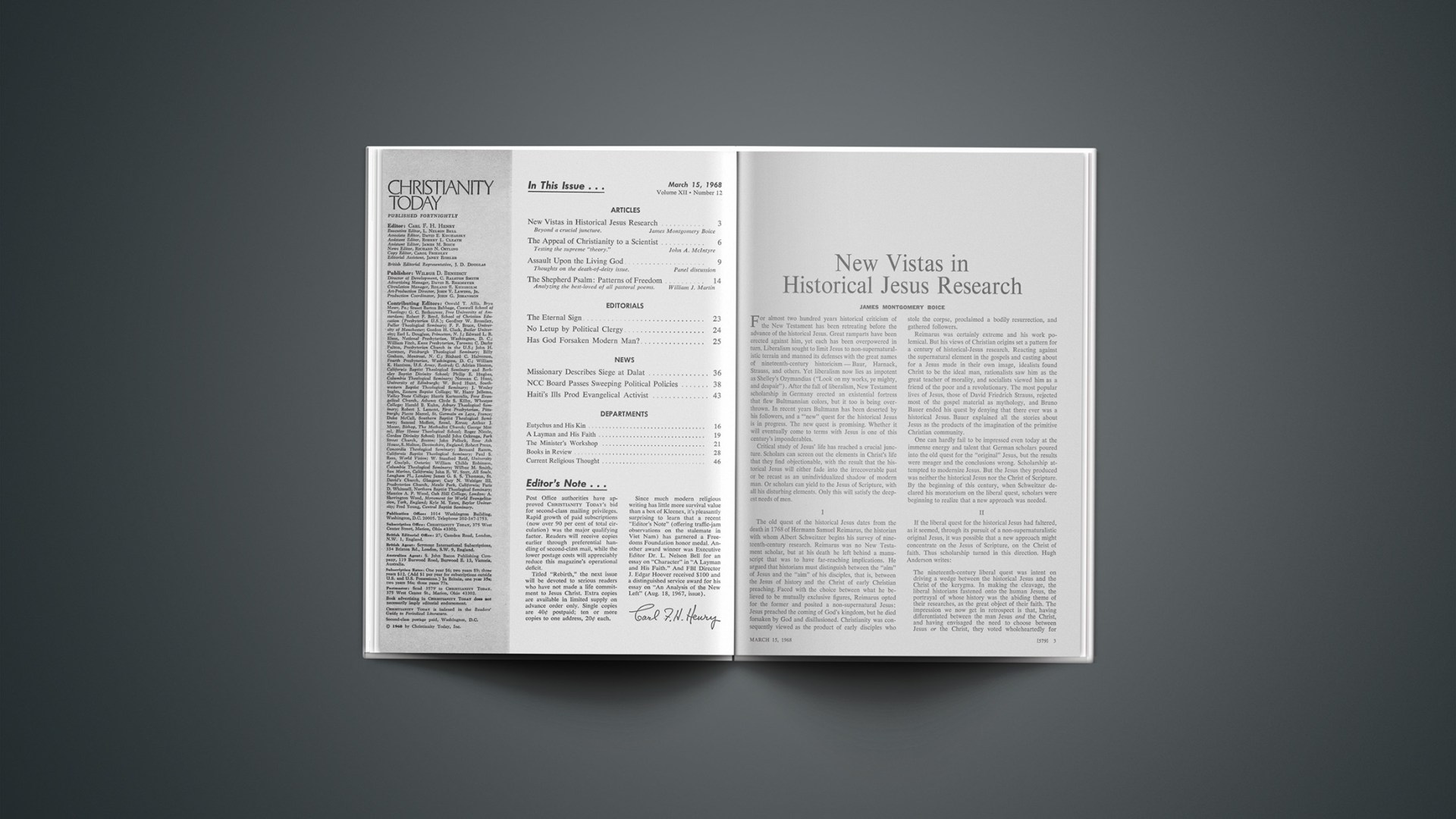
Ideas

The Eternal Sign

Take two planks of common wood, nail one across the other, and what do you have? A gruesome object, a perpendicular couch of horror, a death-beam for impaling an outlaw.

Crosses have caught on their fierce arms some of the worst men in history. Killers, renegades, robbers, have stained the ugly beams with their blood. Hard-hearted Romans turned away their eyes when they saw those death-sticks growing like a forest on the Appian Way. And the Scripture of Israel cried, “Cursed is everyone who is hanged on a tree!”

Imagine a man holding up a hangman’s noose and saying, “This is the sign of my faith!” Think of wearing a scaffold on a golden chain. Incredible! Yet an execution-beam is the sign borne by Christians. This death-piece became a symbol of life, “towering o’er the wrecks of time.” It glitters on a million altars in a million churches. A cynical world traveler once pointed toward the cross and cried half angrily, “The sun never sets on that thing!”

On this side of Calvary the cross is a glorious object. On that wretched hill it underwent a metamorphosis, changing from an emblem of death to an emblem of life. Out of ah execution has come a consciousness of pardon for millions. Out of agony have arisen uncountable songs of joy.

Actually, the cross had nothing to do with this strange thing that happened. At times, perhaps, the Church has spoken as though the cross itself effected something tremendous. The cross is a stick of wood. It is an instrument of destruction. Anybody could die on it, and many did in those tormented times when Caesar ruled the world. The sight of some groaning wretch spiked to the tree was common.

Crosses cannot save men; they kill men. Had there not been a certain Man in the world, the cross would still be only a grim relic of a barbaric age. No one would try to interpret its meaning, for it would have no meaning. It would have the status of a gas chamber.

But the Man who immortalized the cross was unlike any other man ever crucified. He changed everything he touched—including that brutal beam. He stooped a long way to allow that ugly shape to take him on its dreadful arms, for he had had a glory with the Father Almighty before the world began. He was the Word out of eternal mystery, come to walk the earth on scuffed sandals. His was a power that had “sprinkled all the midnight with a powdered drift of suns.” His command could hush a tornado, his look drive a hard-knuckled fisherman to his knees.

He came from beyond circling suns and star-swarms to an innkeeper’s cattle-cave. He invaded the human situation at its most agonizing level. Uneasy angels must have kept watch while he drank his deadly cup.

His cross marks an awesome moment in eternity. It changed the calendar and the clock of time. The cross never could be the same again once his death-cry had risen from it. This was the great Happening—for the first and the last time on earth. The cross was converted. That gallows-tree would haunt history. For the Man who took up that cross staggered with it toward a throne.

Kings and kingdoms come and go; but his cross remains, like a sword thrust at the heart of mankind. It is not strange that an ancient oracle envisioned him and called him Wonderful.

“This doctrine of the cross is sheer folly to those on their way to ruin, but to us who are on the way to salvation it is the power of God.… Jews call for miracles, Greeks look for wisdom; but we proclaim Christ—yes, Christ nailed to the cross; and though this is a stumbling block to Jews and folly to Greeks, yet to those who have heard his call, Jews and Greeks alike, he is the power of God and the wisdom of God” (1 Cor. 1:18, 22–24, NEB).

“The divine nature was his from the first; yet he did not think to snatch at equality with God, but made himself nothing, assuming the nature of a slave. Bearing the human likeness, revealed in human shape, he humbled himself, and in obedience accepted even death—death on a cross. Therefore God raised him to the heights and bestowed on him the name above all names, that at the name of Jesus every knee should bow—in heaven, on earth, and in the depths—and every tongue confess, ‘Jesus Christ is Lord,’ to the glory of God the Father” (Phil. 2:6–11, NEB).

Laymen who are hoping that the political clergy will soften direct pressures upon government decision-makers and planners apparently are due for disappointment. Indications are, to the contrary, that the neo-Protestant social-action curia is expanding its behind-the-scenes strategy for even wider and deeper involvement. Several recent developments signify a continuing disregard by ecumenical leaders for the growing lay dissent.

One noteworthy sign of the times is a report by the Washington Post (February 19, 1968) of a secret conclave of ecumenical “insiders” to project more aggressive and extensive social involvement. Another significant sign is the prophecy voiced by Dr. David S. Stewart, of Emory University’s Candler School of Theology, to the National Council of Churches’ Division of Christian Education, to the effect that as secular involvement becomes a priority of modern Christianity, debate over doctrinal matters will subside. Echoing the mood of leaders who readily transmute theology into sociology, Dr. Stewart said: “I expect us to come to functional definition of our profession as the most fruitful basis for ongoing conversation.”

Funds For The Left?

A prediction that the differences of opinion in the role of the church in socio-economic and political affairs will become more and more a factor in financial campaigns was made by Manning M. Pattillo, Jr., President of the Foundation Library Center. Pattillo expressed his opinion while addressing the annual meeting last November of the American Association of Fund-Raising Counsel.

Pattillo pointed out that the churches are playing down traditional theological and doctrinal teaching and are adopting a new social orthodoxy. He viewed this trend as most apparent in the thinking of national church officials and in the seminaries which prepare men for the ministry.

The trend is encouraged by the mass media, observed Pattillo. Local clergy are moving in the same direction, though more slowly. However, stated Pattillo, a substantial fraction of active laity do not approve the new orthodoxy, and this is the attitude of many who have worked hardest for the church and have given most generously to it in the past.

“The cleavage between clergy and laity is serious in many places,” asserted Pattillo. “There is a tendency toward polarization and divisiveness—I am afraid that churchmen are not always skillful in reconciling conflicting ideas and groups—and there is increasing evidence of a dropping off of church membership and support in some denominations. This is accompanied by a decline in the number of candidates for the ministry and for other types of religious service. It appears likely that the trend will continue and perhaps accelerate.”

Turning to the financial side of the situation, Pattillo stated: “My prophecy is that the differences in opinion about the role of the church will become more and more a factor in financial campaigns. It will, I believe, be increasingly difficult to make a strong and distinctive fund-raising case for the church as it abandons its unique ‘spiritual’ character (the area in which it has had a monopoly) and becomes one among many social reform agencies. In its new role it will be in competition for loyalty and money with a wide range of governmental, political, and social service organizations.

“It remains to be seen whether churchmen who are social or theological liberals are equally liberal in their giving. The history of the churches that have been liberal for some time suggests a negative answer to this question.”

The Presbyterian Layman (Feb., 1968, issue).

The social-action planning session was described by the Washington Post as an effort to go beyond the kind of involvement currently carried out by the NCC. About two hundred clergymen and laymen from major metropolitan areas east of the Mississippi and Missouri River were on hand for the three-day, closed-door conference. The churchmen called their movement the “Communications Network of the Inter-Area Committee for Action and Renewal.” An object of the sessions, held at the National 4-H Center in Chevy Chase, Maryland, was reportedly to create a national organization of churchmen committed to militant social action.

Theological commitment to revolutionary social change was further seen in the conference on “Christians and Social Revolution” at Washington’s St. Paul College. Princeton Seminary Professor Richard Shaull opposed Jesuit Father Rock Caporale’s contention that revolutions are “an irrational mode of human action” that in some respects represent “an escape from freedom.” Shaull held that modern society needs “a new politics of revolution” to replace our dominant economic order and bureaucracy with another power base. He claimed that this power base could be provided by “radical biblical communities” in middle-class America that could infiltrate and subvert present institutions and be the catalyst for the future society.

Actions taken by the NCC General Board in San Diego last month show the determination of social-activist denominational officials to use the institutional church not only to become politically involved, but to advance perilous political policies. Recommendations included renewed efforts to seat Red China in the U. N., recognition of Castro’s Cuba, “acceptance of the existence” of the government of East Germany, and various policies that call for the United States to forsake unilateral decisionmaking in favor of international agreements. The ecumenists’ strategy is doubly damaging. By placing primary emphasis on secular goals, it diverts the Church from a more important spiritual mission. By advocating policies in line with Communist preferences, it weakens the position of America as the stronghold and guardian of freedom. The board purportedly represents the views found in leading American churches. But its heavy domination by liberal and even radical viewpoints indicates that the NCC does not practice the democratic policies to which it gives lip service, and that it is far afield from the spiritual priorities for which the Church exists.

The ecumenical establishment has already become largely an unrepresentative bureaucracy heedless of widespread dissent in the ranks of both laymen and ministers. Dr. Manning M. Pattillo, Jr., recently told the American Association of Fund-Raising Counsel (see accompanying quotation, “Funds for the Left?”) that the substitution of socio-political orthodoxy for theological orthodoxy will discourage financial support by those who view the Church of Christ, not as one among many social reform agencies, but as a body endowed with a uniquely spiritual mission.

The core leadership of the political clergy is supplied by influential, self-asserting churchmen among the two hundred denominational and council secretaries of social action and overseas missions, their executive staff colleagues, professors of ethics, and other church leaders mainly interested in social issues. They are now striving to overcome the image of a self-asserting social-action curia by shifting implementation to socially minded churchmen in all denominations and cities. For years this unrepresentative bureaucracy has promoted its politico-economic declarations as virtually the voice of Protestantism. Not only are these pronouncements often formulated in disregard of truly representative processes, but they repeatedly reflect the personal bias of salaried leaders of the ecumenical establishment who unhesitatingly assert their own opinions as expressions of the conscience of the Church.

The Cross of Jesus Christ was a stumbling block to the Jews. To the Greeks it was foolishness. But to modern man it has become a symbol of despair. The God-forsakenness of Jesus at Calvary seems to signify the God-forsakenness of the twentieth-century world. Atheism and nihilism find symbolic expression of their world view in a secular reading of Good Friday. For such minds, the Cross is a sign of the nothingness that finally engulfs all men and things.

This outlook of the contemporary unbelieving world embodies a strange reversal. For this was the last thing that the Cross meant to the early disciples. The Cross meant death, even a horrible death. But Jesus’ death was never viewed from a quivering precipice this side of nothingness. It was viewed as a staggering, almost un-fathomable event in a great series of God’s acts of self-revelation and redemption and as the determinative act that effected man’s salvation. For the early Christians, the Cross was the defeat without which there would never have been a victory. It was the death without which there would never have been resurrection life.

For the early Christians, and indeed for Christians in all ages, the Cross is the symbol of atonement. It is a symbol of judgment upon all the sins of humanity—the failures, hatred, wickedness, lost hopes, and even the despair. But precisely because it is that, because it is judgment, it is also the symbol of a future free from judgment. If Jesus did not bear God’s wrath, then there is no future for anyone, least of all for the men of our world. But if he did bear God’s judgment, as the Bible says he did and as all Christians believe he did then there is a glorious future for all who align their lives with his. Jürgen Moltmann speaks of this dimension:

If the modern a-theistic world thus comes to stand in the shadow of Good Friday, and Good Friday is conceived by it as the abyss of nothingness that engulfs all being, then there arises on the other hand the possibility of conceiving this foundering world in theological terms as an element in the process of the now all-embracing and universal revelation of God in the cross and resurrection of reality [The Theology of Hope, p. 169].

He adds that for the Christian, “the cross is the mark of an eschatological openness which is not yet closed by the resurrection of Christ and the spirit of the Church, but remains open beyond both of these until the future of God and the annihilation of death.”

Seen in proper perspective, the Cross is exactly the opposite of what modern minds imagine it to be. In the first place, it is the evidence that man is not forsaken. It is evidence that the one by whom man feels abandoned and before whom he stands condemned actually loves him and strives to draw him to himself. John’s Gospel states that “God so loved the world that he gave his only Son” (John 3:16). And Paul says that “God shows his love for us in that while we were yet sinners Christ died for us” (Rom. 5:8). D. M. Baillie is certainly close to the truth of these statements when he comments: “The most remarkable fact in the whole history of religious thought is this: that when the early Christians looked back and pondered on the dreadful thing that had happened, it made them think on the redeeming love of God” (God Was in Christ).

Second, far from standing for the alienation of man from God, the Cross actually stands for reconciliation. It is the bridge that connects eternity to time, that vaults the gulf between the holy and that which is unholy and lost beyond self-reformation. Colossians relates that the fullness of God was pleased to dwell in Christ, that through him God might “reconcile to himself all things, whether on earth or in heaven, making peace by the blood of his cross” (1:20).

The Cross of Christ is also the reversal of all human values. For there weakness becomes strength, foolishness becomes wisdom, loss becomes gain, suffering becomes a gate to glory. “The Cross represents the inversion of all human values. The human is put to death; and out of death comes life” (John Courtney Murray, Social Order). Thus, for Christians the Cross becomes the signpost that marks a new pathway for life, a path of self-sacrifice for others. All the Christian virtues follow from the Cross.

Finally, the Cross is a symbol of power, not the dynamic power of the resurrection—life out of death and victory—but the winsome power of a life poured out for others. It is the power to which Jesus alluded when he said, “I, when I am lifted up from earth, will draw all men to myself” (John 12:32). And so he has, down through the ages. No other standard in history has been so able to rally men to it as the Cross of the crucified Christ.

All this needs to be said again in an age stained with blood, weary of virtue, and bound by individual and collective guilt. If the floodtide of despair now at disaster level is to be successfully checked, then the Cross must be restored to Christianity. For many, it is still a scandal and foolishness. For others it is a symbol of despair. But for those who are being saved, it is the wisdom and power of God. It is the sublime token of God’s gracious, reconciling presence in the midst of a fallen and distressed humanity.

LOSS OF AN OLD TESTAMENT GIANT

“I have not shirked the difficult questions.…” That quotation is inscribed on the portrait of Dr. Robert Dick Wilson that hangs in the faculty room of Westminster Theological Seminary. It was also inscribed in the life of Dr. Edward J. Young, a successor to Dr. Wilson in the Old Testament chair at Westminster, and like Wilson a doughty defender of the inspired Scriptures. When sudden death ended Professor Young’s career, he left an evangelical legacy of a lifetime of biblical scholarship.

Thy Word is Truth, title of one of Young’s many books, asserts his basic conviction. He believed the Bible, simply and devoutly. Yet he correlated his faith and his scholarly labors. Personally modest and retiring, he was driven by conviction to contend for the faith; the power of his preaching somewhat astonished those who enjoyed his quiet conversation. For him, unbelieving biblical scholarship was a contradiction in terms.

Professor Young’s own scholarship gained an international reputation. He mastered nearly thirty languages as tools of research; in his travels abroad he preached in German, read lectures in Spanish, and chatted with bus-drivers in Arabic. He insisted that his graduate students “get the languages.” In addition to Hebrew, Arabic, and Aramaic, he taught Babylonian, Syriac, Ethiopic, and ancient Egyptian. Frequently he complained about scholars who erected critical castles on secondary sources.

He was ready to stand against the current. His three-volume commentary on Isaiah argues with patient cogency for the integrity of that book (the first volume has appeared in the “New International Commentary on the Old Testament,” an Eerdmans series of which he was editor).

He has left a varied legacy: Introduction to the Old Testament, a landmark in conservative scholarship; devotional writings (Isaiah 53; Psalm 139); language study aids (Arabic for Beginners, Old Testament Hebrew for Beginners). Beyond his books are the men he has trained, now scattered around the world, teaching the Old Testament in Tokyo or preaching it in Arabic in Africa.

His witness points a way for scholars who are willing to pay the price of toiling in the precious things of the Word of God. There is a radical scholarship of faith that humbly bows before the Lord and listens to his Word, and E. J. Young was a living demonstration.

The Minister’s Workshop: Counseling the Dying

A gowned, draped figure lay on an anesthetic cart awaiting transportation to the operating room. Some gauche zealot had placed on his chest a tract: “Are You Prepared to Die?” The minister who goes to a home or a hospital to see a dying person must be far wiser and more sensitive than that. He goes as an ambassador of the Risen Christ to give comfort, to pray, to empathize, to make known the promises of God.

Conduct. This is no time for the ecclesiastical smile, for Dale Carnegie ebullience or Charles Atlas salubriousness; nor is it the time for a countenance of gloom or for the insincere playing of games. Between the minister and the dying patient there must be authenticity. Masks and roles must be swept away.

A dying person is enervated, fatigued, often in pain and nauseated, without appetite for food or entertainment. He is psychologically and physically incapable of listening to talk about the case histories of others, the pastor’s latest golf score, community tragedies, or the world situation. This is the time to make every moment count, for drugs, disease, and impending death reduce the patient’s span and energy supply.

Communication. The minister should sit or stand near the bed in the place where the patient can most easily see and hear him. Although the patient’s vision may be blurred, the reassurance of seeing the emissary of God, even fuzzily, is very valuable in these last hours of his life.

The senses of touch and sound are important also. In recent years medical publications have stressed to physicians the value of touching the geriatric patient. From the pastor, too, the patient may appreciate the tactile expression of concern, particularly during prayer. This may well prove a means of spiritual communication. Christ used the laying on of hands in healing (Mark 5:23; 7:32) and in benediction (Mark 10:16; Luke 24:50). This practice, made part of life of the Church, was used in both healing and blessing (Acts 9:17). From it sprang the apostolic rite of transmission of the Holy Spirit. What wholesome expressions of loving concern, tenderness, and oneness in faith can be embodied in this simple act.

The clergyman should speak clearly and loudly enough to be easily heard. He can do this without sounding pontifical or disturbing nearby patients. And he should never conclude that his words, his prayers, or his Scripture readings fail to reach through the seemingly impenetrable mist of unconsciousness. That a patient is unable to respond does not necessarily mean that he is not conscious of what is being said and done. And, of course, any dismal comments on the patient’s condition must be reserved for the hospital corridor. The dying patient may fully comprehend any unguarded comment, such as that of a crass and careless intern, “He’s had it! Don’t forget to ask for an autopsy.”

When a relative, a minister, or a physician places a finger in the hand of the semi-comatose person and asks him to squeeze it, there will usually be a response, indicating the patient’s ability to hear and comprehend. Even when his clinical profile indicates that he is definitely unconscious, there is still the possibility of perception. Often hearing is the last of the senses to go. On the assumption that the patient can hear his voice and the promises of God, the pastor must continue his ministry. Who can know how many dying souls have at that point silently cried: “God be merciful to me, a sinner!”

Content. The clergyman should, at first, let the conversation flow where it naturally goes. The patient may only wish to listen to the promises of God. Or he may long to repent, to express his worries or fears. He may ask searching questions about the meaning of it all. Or he may wish to confess. The prudent minister is a superb listener. At some point, however, he may feel he should pose thoughtful questions that will encourage the patient to express any concerns he is feeling.

After this the pastor may read passages of Scripture, not the morbid “ashes to ashes, dust to dust” variety but loving messages from the One who is all love and forgiveness. “The LORD is my light and salvation; whom shall I fear? The LORD is the stronghold of my life; of whom shall I be afraid?” (Ps. 27:1) As a final gesture before leaving, he may grasp the patient’s hand or lay his hand upon his head as he prays. This prayer should be simply phrased and rich in the message of hope, of repentance, of reconciliation, and of redemption.

Charismata. Ministering to the fatally ill is probably the most challenging of all pastoral functions. Any man who enters a room of death without prayerful preparation is in dereliction of his spiritual calling. As Christians we are undergirded by the assurance that God “comforts us in all our affliction, so that we may be able to comfort those who are in any affliction …” (2 Cor. 1:4). We are promised the gift of speaking the word of wisdom (1 Cor. 12:8), to enable us to receive and explain the deep things of God. Much is mysterious in God’s dealings with men, and the unenlightened Christian is often in need of a particular word that will throw light on the human dilemma. How profoundly the pastor needs compassion, concern, sensitivity, empathy, and, yes, special charismatic gifts to help him lovingly transmit to a dying man God’s promise that he can share Christ’s risen life.

Christ. The ambassador of God enters the sick room to proclaim and uphold Christ. His effectiveness rests on spiritual and technical depths. Has he lived Christ, exalted Christ, proclaimed Christ, served Christ, radiated Christ? All the diabolical forces of disease, degeneration, and death cannot overcome the dynamic of such a life, for it communicates the power of the One who said, “I am the resurrection and the life; he who believes in me, though he die, yet shall he live.”

—A. D. DENNISON, JR., M.D., Indianapolis, Indiana.

Lay Concern

In almost every major denomination today laymen are showing more and more concern over the lessening of emphasis on the spiritual nature and message of the Church.

Church leaders have always solicited the interest and support of laymen. Some are now finding that many laymen have become restive about some programs they are being asked to support. Many feel their leaders are promoting activities outside the province of the Church, placing primary emphasis on secondary things, and seeking to reform society without the redemption of individuals.

Recently members of a Southern Presbyterian lay organization known as Concerned Presbyterians (address: 234 Biscayne Boulevard, Miami, Florida) met with members of another group within the denomination that represents a more liberal approach to the mission of the Church, particularly in the area of social action. The meeting was called by the moderator of the church.

Some ministers present expressed deep apprehension because Concerned Presbyterians is made up entirely of laymen. In reply the president of that group said frankly that this was necessary because ministers who joined might be subject to “ecclesiastical reprisals.” But a number of ministers are quietly helping the organization.

For about two years there has existed in the United Presbyterian Church a group called the Presbyterian Lay Committee, whose board is composed of some of America’s most distinguished Christian laymen and churchmen. In January this group (offices at 200 Fifth Avenue, New York City) began publishing a monthly magazine called The Presbyterian Layman, “edited for the entire membership of the United Presbyterian Church.” It is a “voice of the laity, expected to stimulate greater discussion in Church matters, foster constructive ideas for strengthening the United Presbyterian Church, encourage more dedicated involvement of laymen and women in the activities of their own churches, and also to encourage laymen to take public positions as Christian citizens on secular matters.”

This group, when questioned about its position (“Is it conservative or liberal? Is it fundamental, traditional or modern? Reactionary or progressive? Right or left? Capitalistic or socialistic? Existentialistic or antidisestablishment-arianistic?”), replied that it “rejects all labels” and “intends to conduct its affairs guided by the Scriptures, as clearly defined in the Westminster Confession of Faith.”

Groups of laymen in other denominations have formed, or are now forming, organizations that they hope will help to return their churches to their original calling. Because of the mushrooming of these movements and because of their potential effect on the Church as a whole, they call for careful evaluation.

Here are some of the reasons for concern cited by many laymen:

• The preaching they too often hear, stressing some form of social action or activity without a corresponding emphasis on the redemptive work of Christ at the personal level;

• The institutional church’s participation in pronouncements on almost any subject, its taking of positions on controversial matters without either the mandate or the competence to do so;

• A growing tendency to enlist the political and economic power of the federal government on behalf of schemes dear to church leaders that, almost without exception, point straight to the concepts of a socialistic state—despite the ever-increasing evidence of the failure of socialism wherever practiced;

• A shift in emphasis from the individual to society as a whole, though the primary aim of the Gospel is to reach individual persons, and through them the social structure.

• A shift in emphasis from distinctively Christian programs to basically humanistic ones (“there seems more concern that the surroundings of the Prodigal, and his personal comfort, shall be improved rather than that he shall be called back to his Father in penitence and restitution”);

• A new and false interpretation of “evangelism” in terms of social engineering and revolution rather than proclamation of the redeeming love and grace of God in the person and work of his Son;

• A preoccupation with this world and its ills without a corresponding concern for the souls of sinners who desperately need the Saviour;

• A failure of many church leaders to take the Bible seriously, with the result that they are tossed to and fro on the seas of human speculation without the anchor of a clear “Thus saith the Lord”;

• The implicit redefining of the good and proper word “ecumenical” to mean “organizational.” Little of the true spirit of ecumenicity is offered to evangelicals and distinctly evangelical organizations such as Campus Crusade and Inter-Varsity.

These lay movements are not schismatic. By and large members recognize that an effective witness can be borne only within the denominations; splitting only adds to the problems. These laymen are true loyalists—loyal to their churches and to the standards that are part of their heritage.

This is not nostalgia for the past. Those who are concerned know well that neither the Church nor the world can be turned back. They are nostalgic for a renewed realization that the Gospel of Jesus Christ is relevant for the needs of every age and that, by the power of the Holy Spirit, it can bring about a marvelous change in men and nations today, just as it did in the first Christian century. (One detractor said about some of these laymen in the South, “They would like to go back a hundred years and wave the Confederate flag.” One wonders what flag their Northern counterparts would presumably like to wave. The Union Jack?)

These movements are not a call for maintaining the status quo; some of these laymen seem far more aware of the world and its basic needs than the social activists.

Nor are they an attempt to drive a wedge between the pulpit and the pew. While there are undoubtedly laymen who resist all change and who also have their social consciousness blurred by bigotry, prejudice, and pride, the laymen who are furthering these movements are concerned with personal obedience to their Lord and loyalty to their church. Their goal is to see that the Church continues as a spiritual power and does not degenerate into an organization with social action as its primary concern. If this concern is divisive, it is others who must assume the blame.

The world is in a desperate plight. One social activist recently said, “The world is going to hell while we nit-pick.” But these laymen are not “nitpicking.” Tens of thousands of persons believe that the plight of men and nations is not beyond the redeeming and transforming power of the Lord Jesus Christ. They do not want him crowded out by a program of social engineering. They believe the task is a personal one, winning individual men to Christ. Then and only then can “society be redeemed.”

Eutychus and His Kin: March 15, 1968

Dear Pot-holders and Pill-pushers:

For most of his sixty-five gleeful years, Malcolm Muggeridge, Britain’s master of wit and satire, has relentlessly wielded a razor-sharp rhetorical rapier against the false and the pompous. His perennial duels with the Establishment so endeared him to students at the University of Edinburgh that they elected the former editor of Punch as rector, to present their views to the administration. But recently Muggeridge, true to his deepening convictions, drew blood from the student body in announcing his resignation as their spokesman. In a rectorial sermon in St. Giles Cathedral, he lit into them for expressing their rebellion against “our run-down, impoverished way of life” by “a demand for pot and pills, for the most tenth-rate sort of escapism and self-indulgence.” Said Mug to his youthful audience: “We await the great works of art, the high-spirited venturing into new fields of perception and understanding, and what do we get?—the resort of any old slobbering debauchee anywhere in the world at any time—dope and bed.”

Students reacted by pooh-poohing the drug charge, claiming “the pill” was a passport not to promiscuity but to responsibility, and saying representation by a rector was anachronistic, anyway. But it was apparent to a nation of spectators that the man described by critic Stanley Kauffman as “an iconoclast with astigmatism, a hater of sham with a touch of sadism,” had shattered a new idol.

The disdain of MM toward pot and the pill should make all evangelicals consider their involvement with these modern-day visas to ennui. I must confess I have a real pot problem. But it’s not the pot you get a belt out of; it’s the pot you try to get a belt around. My wife’s concern is not whether to take the pill but how to put up with a pill (me—a real hophead).

It might be a good idea if we stayed away from all forms of pot and the pill. Let’s begin by abolishing those pot-luck suppers. The way they affect my pot, they may drive me to pot. And maybe we better follow the Catholic method of birth control. When a priest was describing it to a jazz musician, he said, “There are only two alternatives: periodic abstinence and complete abstinence.” The musician replied, “Oh, I get it—rhythm and blues!”

Down with pot and the pill! Up with Muggeridge!

EUTYCHUS III

APPLES OF GOLD

If “a word fitly spoken is like apples of gold in pictures of silver,” then Calvin D. Linton’s article on “Higher Education: The Solution—Or Part of the Problem?” (Feb. 16) is twenty-carat stuff.

H. DALTON MYERS

Calvary Memorial Church

Wayzata, Minn.

Linton’s definition of the five “myths” of modern education has helped me to see more clearly what is my responsibility in preaching and in the teaching of young people. The Christian young people of our community have frequent disagreements with the philosophy of their “humanistic, man-oriented” teachers in the public school, some of whom openly ridicule Christianity. With the information provided in Linton’s article I hope to be able better to show my young people the difference between the biblical and natural views of man, and too, I pray, how to defend themselves against such destructive noneducation.

PETER B. GROSSMANN

Eureka Reformed Church

Eureka, S. D.

Dr. Linton’s essay was a clear and articulate statement of what may prove to be the most pressing problem of our generation, getting as it did to the root and “gut” issues rather than dealing exclusively with their manifestations. It was refreshing to hear nonsense properly labeled and the epithet responsibly defended. As one who works with collegians, academically and spiritually, I appreciate this cogent and concise statement.

ERIC G. LEMMON

Adult Education

First Baptist Church

Montebello, Calif.

I just finished reading.… “Higher Education: The Solution—Or Part of the Problem?” … and I cannot refrain from writing a brief word of appreciation.…

For a time after its founding, about a dozen years ago, CHRISTIANITY TODAY did not, in my judgment, seem to attract the necessary educated talent and intellectual caliber to hold its own in a highly competitive field. In recent years, however, it has come of age, and it clearly merits serious attention on the part of policy-makers and other leaders in contemporary American society. The editorials themselves seem to reflect decreasingly an obvious effort to grind the old “fundamentalistic” axe and increasingly a resolve to come to grips with basic issues of our time. Between this journal and the Christian Century one can now hope to achieve some reasonable balance as he tries to keep abreast of developments in the religious world of our time. Anyway, both editor and writers in this particular issue merit hearty thanks and congratulations for putting out an excellent product.

PHILIP J. ALLEN

Chairman, Dept. of Sociology

Mary Washington College

Fredericksburg, Va.

It is most encouraging to read … the essay by Calvin D. Linton.… I am privileged to serve on the Governing Body of Wolverhampton Grammar Technical High School and, in addition, frequently meet educationalists, head teachers, and staff in connection with work of the Gideons International within the British Isles.… Mr. Linton’s essay would be most useful if produced in booklet form.

SAMUEL A. MORRIS

Chairman

Ascalon Holdings Limited

Warley, Worcester, England

The article was not only most inspiring but straightforward and factual. I was highly pleased.

JOHN H. STOLL

Chairman, Bible Dept.

Grace College

Winona Lake, Ind.

I would like to commend you highly on the February 16 issue.… It is the finest thing on higher education I have read yet. It certainly comes at a very important time.

DELBERT W. DANIELS

Central Christian Church

Wenatchee, Wash.

CONCERNS OF THE HEART

It was satisfying that you found “Some Ethical Concerns” worthy to be included as a comment on the editorial, “Are Heart Transplants Moral?” (Feb. 16). The editorial itself is one of the finest I have seen to date.

WALTER O. SPITZER, M.D.

General Director

Christian Medical Society

Oak Park, Ill

Dr. Spitzer states, “The moral, ethical, and theological implications related to the choice of the one who will live and the consequent de facto sentencing of 99 who could have lived but will die, stagger the mind.” To me as a law student the term “de facto sentencing” seems unfortunate, for sentencing is an act against a person or persons which is positive, and also a condemnation. In the case illustrated I cannot see any aspect of sentencing. Where there are 100 patients requiring a heart transplant to live for every available donor, I see this situation not as a de facto sentencing of the 99, but as the saving of one, and the choice of that one is the choice which has the implications which are great. If none of the 100 received the transplant, none would live. Where there is one donor, then one life is saved. Ninety-nine are not sentenced “who could have lived,” for they, in this illustration, could not have lived in any case.

CHARLES TROUTMAN III

Washington, D.C.

Unfortunately, death is not usually sudden and definite. It is preceded by a gray period of impending death, especially in the donor for transplantation, who is usually a patient with severe brain damage following an accident or a stroke. The urgency and enthusiam for finding a donor must not interfere with the usual heroic measures to give these patients every chance of survival. In addition, the judgment to continue the various mechanical devices for supporting life against statistical odds should not be clouded by the need for a donor.

These two points focus on the real problem concerned in transplantation: Who should be the overseer for proper conduct and decisions during the “gray” period preceding death? This question is not restricted to transplantation but pertains to use of prisoners for drug research, to use of humans for cancer research, and to manipulation of the genetic coding. The fundamental question is whether or not one individual should have authority over the life and death of another. Since this is not a scientific question, I would insist that these moral judgments be based on and overseen by a group of Christian laymen. The medical profession should be a part of this group but not the controlling interest.

Will concerned laymen recognize the increasing importance of these moral decisions concerning life and death and then accept their responsibility, or will they give authority of one individual over another to science or a governmental agency?

LOREN J. HUMPHREY

Department of Surgery

University of Kentucky

Lexington, Ky.

JELLYFISH AND COURAGE

I am writing to express my disapproval of your comments on Eartha Kitt (“Eartha Kitt’s White House Spectacle,” Editorial, Feb. 16). Your jellyfish attitude toward the incident is a disgrace. You would have been able to work very well with the third Reich. What we need in this dying nation of ours are people willing to have the integrity and courage to stand up for what they believe is right.

ERIC J. GOTHBERG

Asst. Pastor

Emanuel Lutheran Church

Manchester, Conn.

Why must you clutter your fine magazine with occasional unnecessary and uncalled for disparaging remarks about the John Birch Society? The most recent case in point is your excellent editorial concerning Eartha Kitt’s intemperate public outburst at a White House luncheon, which you compared to “a John Bircher who called a former president a Communist.” This is an oversimplification at best and a deliberate falsehood at worst.

MICHAEL L. ISBELL

First Christian Church

Hampton, S. C.

BEWARE ICE-AGE PETRIFICATION!

More and more I have come to appreciate the quality of your magazine. It is refreshing to see an “evangelical” publication deal with so many pertinent issues as yours does in such a forthright manner.

Don’t let Carl Henry or his approach get away from you. I fear that an ice-age prejudiced narrow-minded approach will petrify your power.

JACK H. ARNOLD

Bethany Methodist Church

Purcellville, Va.

I respect the sound perspective and balanced judgment in your editorials. I also find the various contributions by leading scholars excellent reading. Yours is the only church periodical I find worth reading consistently.

SILAS A. MECKEL

San Antonio, Tex.

A DOVE AND THE HORSES

Since your editorial, “All the King’s Horses” (Feb. 16) expresses the wish that “the doves would stipulate precisely where … they would draw a line against Communist aggression,” this “dove” would like to suggest his answer. The line against anybody’s aggression should be drawn precisely where the aggression takes place. We saw this achieved in the Korean war, where the aggression of North Korea was combated in such a way as to restore the status quo ante bellum.…

Likewise, in Southeast Asia, aggression should be stopped where it occurs. But the truth here is: there was no such aggression committed by Communists. Viet Nam was not divided into two sovereign countries.… The United States fabricated the present division of Viet Nam, propounding the fiction of two separate countries. Whatever armed encounters result from this situation can hardly be justifiably labeled as simple “Communist aggression.” One must take into account the fact that America has unjustly and immorally prodded the Communists into the actions we undertake to counteract. The “Pueblo” incident, also, must be viewed within this context.

PAUL D. STEEVES

Lawrence, Kan.

A TASTE OF GRIEVANCES

Although not a Negro, I am a non-Caucasion (Chinese) who has had a taste of the grievances they experience to a degree we cannot ever comprehend. But it is as a Christian that I am especially appreciative of the fine editorial, “Confronting the Racial Crisis” (Feb. 16). It is, in a sense, an indictment of us who in our spiritual concerns fail to see our earthly responsibilities … or choose to do so.

BRUCE Y. DONG

Seattle, Wash.

I am writing to present a concept of Christian involvement in the urban problems of our times.…

In the majority of the evangelical churches I have had contact with, the method of reaching people with the Gospel is exactly the opposite of the way it is done in the mission fields. In the “home” churches, the pastors encourage their congregations to “go into the highways and hedges and bring them in,” and then these pastors evangelize from the pulpit every Sunday.

In the “mission churches,” as I understand it, the missionary goes where the people are, preaches the Gospel, does personal evangelism, and then forms a church. The church services are devoted first to worship and then to instructing “the saints for the work of the ministry” so that they go out where the people are, repeat the process, and form new churches. Also, mission works are concerned with the whole man, i.e., “Love the Lord thy God with all thy heart, soul, strength, and mind.” Therefore they include schools to teach the mind and often have dispensaries and “soup kitchens” to meet physical needs.

Now the question is this: Why do we not go and do likewise and send a qualified Negro missionary into, say, northeast Washington, D. C., and begin a “mission field” church there?

If I read my Bible correctly, this approach is scriptural, and if I read my history correctly, it is relevant. It may be the only way of avoiding another “long hot summer,” and possibly would begin a revival.

In addition, there is another plus financially. It seems to be fairly well established that the mission schools, dispensaries, and other services are performed with more effect and less cost than any government program, no matter how efficiently operated. This is no doubt due primarily to a difference in dedication and motivation of the individuals involved.

KENNETH MEYER

Annandale, Va.

CONCERT’S SOLEMN NOTE

“Skeptics in Concept?” (News, Feb. 16) should sound a solemn note of warning to our Christian educators who still believe the verities of the Protestant Christian faith.

The unabashed liberalism of the current curriculum of the United Church of Christ will be merged with the “Confession of 1967” mentality in the United Presbyterian Church. Throw in the Episcopal view of heresy as “anachronistic” and God only knows what monstrosity will be concocted.… What a tragedy to see church officials shattering the foundation of belief and assuming the role of disciples of humanism and political science.

No doubt all three churches will have a significant contribution to make to COCU—“The Corporation of Cocksure Uncertainty.”

RICHARD H. MACKAY

Watertown, Mass.

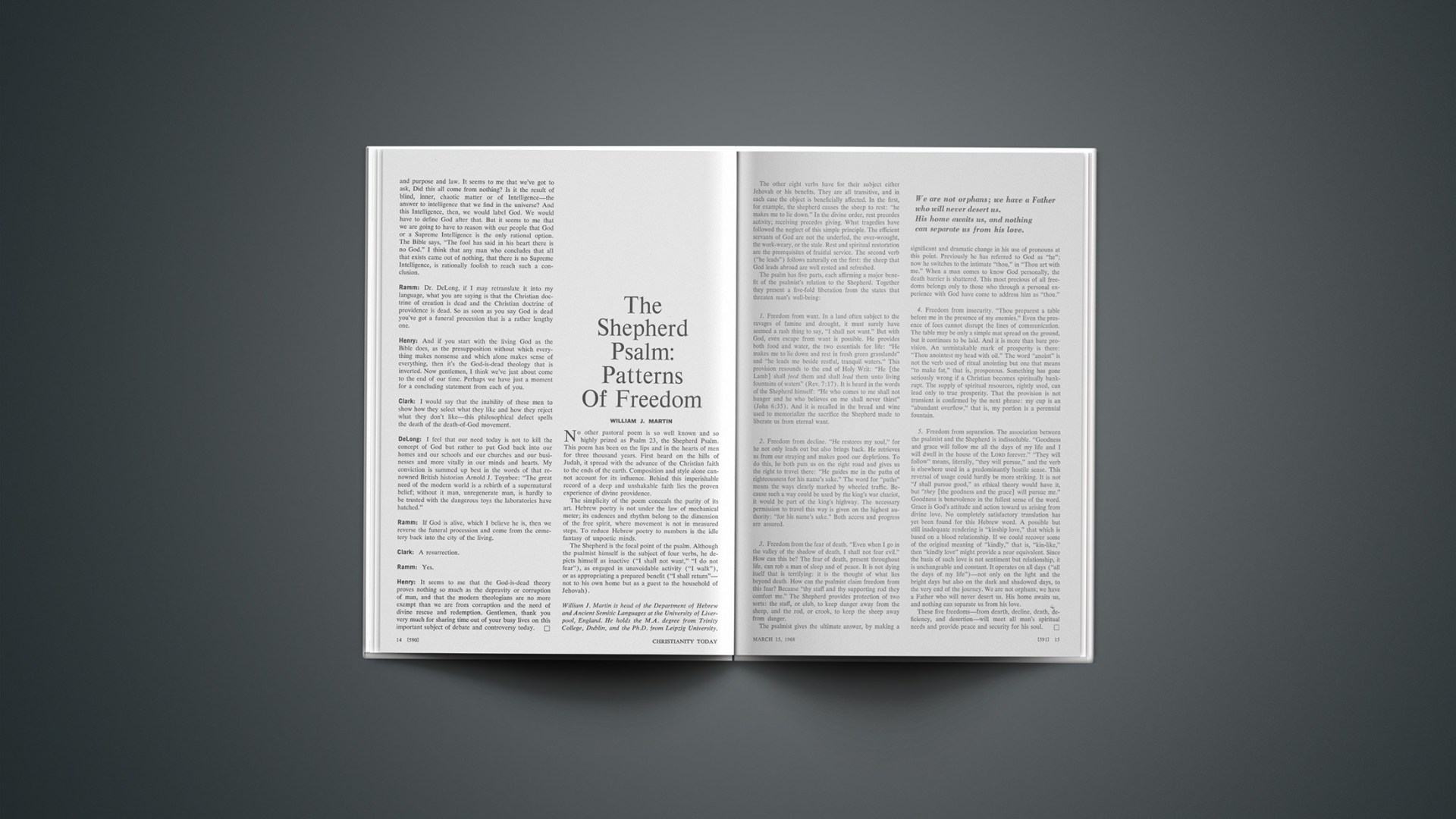
The Shepherd Psalm: Patterns of Freedom

No other pastoral poem is so well known and so highly prized as Psalm 23, the Shepherd Psalm. This poem has been on the lips and in the hearts of men for three thousand years. First heard on the hills of Judah, it spread with the advance of the Christian faith to the ends of the earth. Composition and style alone cannot account for its influence. Behind this imperishable record of a deep and unshakable faith lies the proven experience of divine providence.

The simplicity of the poem conceals the purity of its art. Hebrew poetry is not under the law of mechanical meter; its cadences and rhythm belong to the dimension of the free spirit, where movement is not in measured steps. To reduce Hebrew poetry to numbers is the idle fantasy of unpoetic minds.

The Shepherd is the focal point of the psalm. Although the psalmist himself is the subject of four verbs, he depicts himself as inactive (“I shall not want,” “I do not fear”), as engaged in unavoidable activity (“I walk”), or as appropriating a prepared benefit (“I shall return”—not to his own home but as a guest to the household of Jehovah).

The other eight verbs have for their subject either Jehovah or his benefits. They are all transitive, and in each case the object is beneficially affected. In the first, for example, the shepherd causes the sheep to rest: “he makes me to lie down.” In the divine order, rest precedes activity; receiving precedes giving. What tragedies have followed the neglect of this simple principle. The efficient servants of God are not the underfed, the over-wrought, the work-weary, or the stale. Rest and spiritual restoration are the prerequisites of fruitful service. The second verb (“he leads”) follows naturally on the first: the sheep that God leads abroad are well rested and refreshed.

The psalm has five parts, each affirming a major benefit of the psalmist’s relation to the Shepherd. Together they present a five-fold liberation from the states that threaten man’s well-being:

1. Freedom from want. In a land often subject to the ravages of famine and drought, it must surely have seemed a rash thing to say, “I shall not want.” But with God, even escape from want is possible. He provides both food and water, the two essentials for life: “He makes me to lie down and rest in fresh green grasslands” and “he leads me beside restful, tranquil waters.” This provision resounds to the end of Holy Writ: “He [the Lamb] shall feed them and shall lead them unto living fountains of waters” (Rev. 7:17). It is heard in the words of the Shepherd himself: “He who comes to me shall not hunger and he who believes on me shall never thirst” (John 6:35). And it is recalled in the bread and wine used to memorialize the sacrifice the Shepherd made to liberate us from eternal want.

2. Freedom from decline. “He restores my soul,” for he not only leads out but also brings back. He retrieves us from our straying and makes good our depletions. To do this, he both puts us on the right road and gives us the right to travel there: “He guides me in the paths of righteousness for his name’s sake.” The word for “paths” means the ways clearly marked by wheeled traffic. Because such a way could be used by the king’s war chariot, it would be part of the king’s highway. The necessary permission to travel this way is given on the highest authority: “for his name’s sake.” Both access and progress are assured.

3. Freedom from the fear of death. “Even when I go in the valley of the shadow of death, I shall not fear evil.” How can this be? The fear of death, present throughout life, can rob a man of sleep and of peace. It is not dying itself that is terrifying: it is the thought of what lies beyond death. How can the psalmist claim freedom from this fear? Because “thy staff and thy supporting rod they comfort me.” The Shepherd provides protection of two sorts: the staff, or club, to keep danger away from the sheep, and the rod, or crook, to keep the sheep away from danger.

The psalmist gives the ultimate answer, by making a significant and dramatic change in his use of pronouns at this point. Previously he has referred to God as “he”; now he switches to the intimate “thou,” in “Thou art with me.” When a man comes to know God personally, the death barrier is shattered. This most precious of all freedoms belongs only to those who through a personal experience with God have come to address him as “thou.”

4. Freedom from insecurity. “Thou preparest a table before me in the presence of my enemies.” Even the presence of foes cannot disrupt the lines of communication. The table may be only a simple mat spread on the ground, but it continues to be laid. And it is more than bare provision. An unmistakable mark of prosperity is there: “Thou anointest my head with oil.” The word “anoint” is not the verb used of ritual anointing but one that means “to make fat,” that is, prosperous. Something has gone seriously wrong if a Christian becomes spiritually bankrupt. The supply of spiritual resources, rightly used, can lead only to true prosperity. That the provision is not transient is confirmed by the next phrase: my cup is an “abundant overflow,” that is, my portion is a perennial fountain.

5. Freedom from separation. The association between the psalmist and the Shepherd is indissoluble. “Goodness and grace will follow me all the days of my life and I will dwell in the house of the LORD forever.” “They will follow” means, literally, “they will pursue,” and the verb is elsewhere used in a predominantly hostile sense. This reversal of usage could hardly be more striking. It is not “I shall pursue good,” as ethical theory would have it, but “they [the goodness and the grace] will pursue me.” Goodness is benevolence in the fullest sense of the word. Grace is God’s attitude and action toward us arising from divine love. No completely satisfactory translation has yet been found for this Hebrew word. A possible but still inadequate rendering is “kinship love,” that which is based on a blood relationship. If we could recover some of the original meaning of “kindly,” that is, “kin-like,” then “kindly love” might provide a near equivalent. Since the basis of such love is not sentiment but relationship, it is unchangeable and constant. It operates on all days (“all the days of my life”)—not only on the light and the bright days but also on the dark and shadowed days, to the very end of the journey. We are not orphans; we have a Father who will never desert us. His home awaits us, and nothing can separate us from his love.

These five freedoms—from dearth, decline, death, deficiency, and desertion—will meet all man’s spiritual needs and provide peace and security for his soul.

Milton D. Hunnex is professor and head of the department of philosophy at Willamette University, Salem, Oregon. He received the B.A. and M.A. degrees from the University of Redlands and the Ph.D. in the Inter-collegiate Program in Graduate Studies, Claremont, California. He is author of “Philosophies and Philosophers.”

Assault upon the Living God

Three well-known American religious spokesmen here discuss implications and overtones of current God-is-dead speculation. They are Dr. Gordon H. Clark, head of the philosophy department at Butler University in Indianapolis, Indiana; Dr. Russell V. DeLong, Nazarene educator and evangelist, who served as president of colleges in California and Idaho for nineteen years; and Dr. Bernard Ramm, professor of Christian theology at California Baptist Theological Seminary in Covina, California. Moderator of the discussion is Editor Carl F. H. Henry of CHRISTIANITY TODAY. The panel is one of thirteen produced by Educational Communication Association in the series “God and Man in the Twentieth Century,” offered for public-service television use.

Henry: Gentlemen, I think you will recall a statement by Dietrich Bonhoeffer written shortly after the Nazis had imprisoned him. In his Letters and Papers from Prison, Bonhoeffer writes that man has now learned to cope with all questions of importance without recourse to God as a working hypothesis. Of course, Bonhoeffer is referring especially to science and to art and to ethics; but he adds that for the last one hundred years this has been increasingly true of religious questions also. It is becoming evident, he says, that everything gets along without God and just as well as before. Now, will anyone dispute this assertion, that much of modern life has experienced what some of the death-of-God theologians call “the eclipse of God”?

Clark: This phrase, “the death of God,” is a little silly if you think of the supreme God ceasing to exist. But it is to the credit of these men, and particularly Professor Gabriel Vahanian of Syracuse University, that they describe very accurately the secularism of our culture. Professor Vahanian unmasks the hypocrisy of modern religion and shows the essentially secular nature of what goes on in most of our churches. His criticism of American religion is devastating and salutary. I appreciate his writing.

DeLong: It seems to me, Dr. Clark, that there really are two kinds of atheists. First there is the theoretical, philosophical atheist, who says there is no God and acts like it, which is really the Communist approach. The second type I would label practical atheists. They would say, yes, there is a God, but they ignore his existence. If you asked the average professional man “Are you an atheist?” he would be insulted.

Henry: The Gallup polls indicate something of this, don’t they?

DeLong: Yes. Millions of people would be insulted if you labeled them atheists. And yet, practically, if God were dead it wouldn’t change their pattern of living. They never pray; they never go to church. Their God is sort of a dead concept buried in the intellectual cemeteries.

Ramm: Well, I think that there is something very critical in the God-is-dead emphasis, and that is, a program in theology. But this program only works if the validity of the New Testament—its theology, its interpretation of Jesus Christ, and its life of Christ—is destroyed. As long as there is any possibility that the New Testament is the authentic document of the life of Christ, that who he was and what he said and did comes through its pages—I say, as long as there is this possibility, then this movement can’t even get off the ground. So the prior question then is not “Is God dead?” but “Is the New Testament reliable?”

Henry: So that as a Christian theologian you are suggesting that this God-is-dead theory rests on the premise of the invalidity, the fallaciousness, of the Apostles’ Creed, the invalidity of the biblical revelation, the collapse of the whole Christian view of God and the world.

Ramm: Well, let’s say—you have to have quite a funeral procession! You have to have “the Old Testament is dead”; “the New Testament is dead”; “the Apostles’ Creed is dead”; “the great issues of the Reformation are dead.” And only as you have successfully taken this trip to the cemetery can you say “God is dead.”

Henry: Is an attack of that kind on the Christian view of God something essentially new and modern?

Clark: Oh, no, no, no! There is nothing new or earth-shaking in this. There have always been attacks not only on the Bible but on religion in general. The phrase “God is dead” was of course used by Nietzsche. Ludwig Feuerbach, about 1840 or so, provided some of the arguments and even some of the words that these people use. With some existentialist trappings, this God-is-dead movement can be viewed as a last gasp of reaction against the Hegelian absolutism of the early nineteenth century. There’s nothing new, nothing earth-shaking.

DeLong: Well, if it isn’t new, why is so much publicity given to it?

Clark: Yes, that’s a question, isn’t it? Why is it so popular? Well, I don’t know. Why is it?

Ramm: I think one difference between this movement and Nietzsche and other men of the nineteenth century is that these men of today are attempting to give a theological justification for it, a theological interpretation of it, so that “God is dead” is not just the raucous protest of an unbeliever but a methodological conclusion of people who are following a certain track in theology. And this, partially, is why it has received such a tremendous hearing—it’s a theological program, not a program of protest.

Henry: Do you mean that there is a development or a trend in modern theology which has made concessions farther back along the way, and that these, when consistently applied, lead to this more radical and extreme denial of religious propositions and beliefs?

Ramm: Yes. I think that in the time of the German enlightenment and French materialism and English deism there was a repudiation of the historic grounds of Christianity. Now sometimes it might take two hundred years for the real disease to develop. So I think the God-is-dead movement is the only kind of theology—if you can call it theology—that’s consistent with a denial that took place a couple hundred years ago whereby we are now neo-pagans; we are no longer Christians bound to the authority of Holy Scripture.

Henry: At least those who are caught up in this rebellion are in this predicament.

Ramm: Yes, that’s right.

Henry: What accounts, however, for the fact that the death-of-God theology has taken hold in our time in this way?

DeLong: It seems to me that this modern movement is being championed by so-called Christian theologians, whereas some of the God-is-dead movement in the past has come from men like Nietzsche, Spinoza, and some others who were not professedly Christians. This makes it more astonishing today, the fact that Christian theologians would come out and say God is dead.

Henry: And then, the press has helped to popularize the position, in a day of mass media. It seems also that the alumni of some Christian institutions have carried the revolt to the attention of their constituency by way of critique of what is going on in their institutions.

Clark: Dr. Ramm spoke about methodology in theology. I think this is one of their poorest points. They accept some modern scientific ideas, some existentialism, some remnants of the Judeo-Christian tradition, plus this or that or something else. They also reject some of these.

Henry: Perhaps you can spell this out just a bit.

Clark: The point is this. They accept some parts of existentialism, some parts of the Judeo-Christian tradition, but they reject other parts. Now the question I want to ask is, On what basis do they select some things and reject others? What criterion, Dr. Henry, do they use in putting together this amalgam of their positive program? What’s the basis of their choice—or in technical language, what is their fundamental epistemological principle? If you read their books you have great difficulty in discovering any answer at all to this question. They seem to accept and reject at random, and this to my mind is a serious philosophical defect.

Henry: There is a certain amount of intellectual irresponsibility here, you feel?

Clark: Well, you can put it that way.

Ramm: Dr. Clark, pressing just as hard from another direction are the great number of people who are deeply afflicted by physical disability, physical sickness, maybe even emotional disturbance. It would be catastrophic to come and tell these people that God is dead, because they have a tremendous spiritual vitality. It keeps them going day after day with these afflictions. So I think that anybody who buys a theology has to buy the practical consequences that go with it. And the consequences of this God-is-dead theology are very drastic when you talk to a cripple, a wheelchair case, a cancer patient.

Clark: You’re talking like a pastor. Of course I’m a professor and I don’t meet those cases.

Henry: I suppose you’re saying that, in contrast with the theology of the Bible, the God-is-dead philosophy is spiritually and morally powerless.

Ramm: Yes, you’ve got to live with the cases. I grant, Dr. Clark, that they’re not academic cases or instances; but I know of such people, and I know that they are kept alive by a very powerful faith in the living God. I for one would not have the moral courage to go and tell these people that this is all just a mistake, a dream, a soliloquy that they’re having among themselves.

Henry: Well, if you were convinced that God is dead, would you feel an obligation to tell them?

Ramm: There are some times when it is more humane to shut up than to try and tell somebody he is mistaken.

Henry: Well, do you think that God is dead?

Ramm: The question I have in my mind is: Whoever got the idea that God is alive? Go back to Exodus where the name of God is given as Yahweh, which comes from the verb “to be” or “to be alive.” And God said to Moses, “I am the living one.” So the whole motif of the Bible is that here out of nowhere comes the God who is the living God. The real question to me is not, “Is God dead?,” but, “How come we happen to have had the idea for centuries that God is alive?”

DeLong: Let me ask you this, Dr. Ramm. I’m not a theologian, but it seems to me that this God-is-dead declaration is the logical, maybe the next, step of those who during the past fifty years have denied the supernatural and those who have championed humanism; that divine revelation has been relegated to the theological dump heap, and now the Deity who makes this revelation possible is cast aside as an unnecessary and nonexistent being.

Ramm: Yes. Historically, Christian theology should be the critic of culture. In the God-is-dead movement we have a sudden reversal in which culture becomes the critic of Christianity. And if this is true, then God is dead and the Bible is dead and all of Christian theology is dead. So it’s back again to Dr. Clark’s question of methodology. If you’ve got your methodology backwards, you’re going to come out to some mighty sick conclusions.

Henry: Isn’t there a whole tidal wave of organized atheism in the world today?

DeLong: Yes, it seems to me that this movement makes a good atmosphere and a good soil for the spread of atheistic Communism. The God-is-dead movement is dangerous, very dangerous. If it becomes widespread it will cut the vital nerve of ethical living. If there is no God, there are no higher values. If there is no God, there is no Christ who is the Son of God. If there is no God, there is no Calvary, no salvation, no immortality. Human beings are merely hunks of protoplasm floating over the briny sea of life. We then live a life with no meaning. We’re sort of bodies without souls living in a universe without a God. It seems to me that it’s impossible to have a vital, dynamic ethics that isn’t rooted and grounded in a meaningful metaphysics.

Henry: Of course, some of these God-is-dead theolologians do postulate an ethics of sorts. But you’re saying that if they were really consistent with their major premise they would scuttle it.

DeLong: Yes. If God is dead, what is the purpose of living?

Ramm: If God is dead, the Great Commission is also dead. And if the Great Commission is dead the Church is dead, because the function of the Church is to execute the Great Commission. So once again I see a fascination with an idea without a real calculation of everything it pledges me to. When you start to articulate what you are forced to deny, in saying that God is dead, it becomes rather frightening. Yet this list ought to be made up.

Henry: These God-is-dead theorists retain a certain passion to leave a mark upon the world that is derived from Christian presuppositions. But the Great Commission, and the relation of a small body of men or believers to the world, really ought to be erased if you scuttle the presuppositions on which the whole rests.

Clark: Now it is obvious that when people today talk about God they have various concepts. For accurate thinking we ought to know just what we mean by God, the living God. Personally I like the definition of the Westminster Shorter Catechism, that “God is a Spirit, infinite, eternal, unchangeable in his being, wisdom, holiness, justice, goodness and truth.” There you have something definite; you know what you’re talking about.

Henry: I have a feeling that these God-is-dead theorists, or philosophers in general, really obscure the living God whenever they say that one cannot have rational knowledge of God, or when they speak of an abstract God without any reference to his revelation, his self-revelation in Christ and the revelation of truths about himself and about his purposes for man and the world—in other words, whenever they cease to speak of the Bible as God’s revealed word. Do you see a connection between this tendency in modern theology and a loss of awareness of the revelation of the living God?

Ramm: Right at this point, you see, we have a certain treatment of the Bible. This theology is not based on looking at texts in the Scripture and saying, here is the meaning of these texts. Rather, it is, shall I say, philosophical theology in the sense that it’s dealing with ideas, not with the concrete materials of the biblical revelation. And I as a Christian standing in the tradition of nineteen centuries want to say that this is wrong, seriously wrong.

Henry: You know, last night I picked up my Bible—one that happens to be falling apart, actually—and I thought, Well, look at this, the way it’s been marked for devotional study, for preaching. I read the death-of-God theologians once, maybe twice, perhaps three times to get a nuance here and there. I don’t think anybody reads that literature with the sense of permanent possession and treasure that this Book holds for those who have searched it through the ages.

DeLong: The leaders of the God-is-dead movement, as I understand it, call themselves Christian atheists. To me that seems to be a misnomer, for I don’t see how a man can be a Christian atheist any more than he can be an honest thief or a truthful liar.

Clark: Or a Mohammedan Buddhist or a Jewish Hindu. The combination is untenable. The word “God” just doesn’t have any meaning in a sentence that says God is dead, and a Christian can’t possibly be an atheist. I don’t see how they get these combinations.

Henry: Dr. Ramm, let me ask you this question. Do you think that these men have made any contribution besides what Dr. Clark has said, that is, that insofar as they speak of the secularism of modern society, they do give an apt characterization of it? They are not the only ones who have made this characterization, and it doesn’t depend for its effectiveness or its accuracy on their thesis that God is dead. In denominational circles today so often we hear references to the “insights” of these God-is-dead theologians and the “great contribution” they are making to the religious dialogue of our time, how they have stirred up new interest in the Christian faith, and so on. What do you think of all this?

Ramm: I have a sort of glassy look at this because it just shows me one particular thing: If you do not accept the truth of God as embodied in Holy Scripture, then you can go anywhere. This shows one of the simply odd and crazy places where you can go, where you can put together, as Dr. Clark and Dr. DeLong have said, such contradictory notions as God and death. So it has deepened me in my own convictions about how I’m to think about Christian theology and about Christian truth.

Henry: There is one point where these two notions do come together dramatically in the Christian faith, and that is in the crucifixion and resurrection of Christ, the great center of Christian faith. But these death-of-God theologians destroy that center.

Clark: Well, the crucifixion, the atonement, doesn’t mean of course that God ceased to exist. Jesus was crucified and died and was buried and rose again, but that doesn’t mean that God ceased to exist for three days.

Henry: You’re exactly right.

Ramm: There is another interesting angle to this. The earliest origin of this concept was to scare people into Christianity. A German philosopher, poet, littérateur, Johann Richter, used this notion that God is dead to show how terrible it is to be an atheist. Here we have the odd turn that something that started out to drive people to Christianity is now used for the annihilation of Christianity.

Henry: Which means that evangelists perhaps ought to be especially careful what theological devices they use to get their message across.

DeLong: I’d like to raise this practical question—we’ve been dealing with theory a great deal. Of course, we all deny this God-is-dead movement; we believe in the living God. But how are we going to put God back into the thinking of modern youth especially, and of nonchurch people? We can’t very well do it through divine revelation or through prayer. It seems to me we’ve got to begin at the foundation and through a dialectic process point out that intelligence is the most satisfactory and rational solution of all that exists, with our spaceshots, moonshots, and all the evidence of order and purpose and law. It seems to me that we’ve got to ask, Did this all come from nothing? Is it the result of blind, inner, chaotic matter or of Intelligence—the answer to intelligence that we find in the universe? And this Intelligence, then, we would label God. We would have to define God after that. But it seems to me that we are going to have to reason with our people that God or a Supreme Intelligence is the only rational option. The Bible says, “The fool has said in his heart there is no God.” I think that any man who concludes that all that exists came out of nothing, that there is no Supreme Intelligence, is rationally foolish to reach such a conclusion.

Ramm: Dr. DeLong, if I may retranslate it into my language, what you are saying is that the Christian doctrine of creation is dead and the Christian doctrine of providence is dead. So as soon as you say God is dead you’ve got a funeral procession that is a rather lengthy one.

Henry: And if you start with the living God as the Bible does, as the presupposition without which everything makes nonsense and which alone makes sense of everything, then it’s the God-is-dead theology that is inverted. Now gentlemen, I think we’ve just about come to the end of our time. Perhaps we have just a moment for a concluding statement from each of you.

Clark: I would say that the inability of these men to show how they select what they like and how they reject what they don’t like—this philosophical defect spells the death of the death-of-God movement.

DeLong: I feel that our need today is not to kill the concept of God but rather to put God back into our homes and our schools and our churches and our businesses and more vitally in our minds and hearts. My conviction is summed up best in the words of that renowned British historian Arnold J. Toynbee: “The great need of the modern world is a rebirth of a supernatural belief; without it man, unregenerate man, is hardly to be trusted with the dangerous toys the laboratories have hatched.”

Ramm: If God is alive, which I believe he is, then we reverse the funeral procession and come from the cemetery back into the city of the living.

Clark: A resurrection.

Ramm: Yes.

Henry: It seems to me that the God-is-dead theory proves nothing so much as the depravity or corruption of man, and that the modern theologians are no more exempt than we are from corruption and the need of divine rescue and redemption. Gentlemen, thank you very much for sharing time out of your busy lives on this important subject of debate and controversy today.

The Appeal of Christianity to a Scientist

We are sometimes told that the modern mind cannot accept the 2,000-year-old Gospel of Jesus Christ. I first heard the Gospel as a practicing physicist, and I find this opinion about the “modern mind” hard to understand. For when I first examined the gospel message I found that it appealed to me in the same way that physics had first appealed to me. In fact, I concluded that my training as a physicist had given me a viewpoint and a manner of thinking that made acceptance of the Gospel particularly easy.

The way I began to study the Bible was through a Bible class in a home. Here, for the first time in my experience, the Bible was examined seriously. I’d been brought up in a church where the Bible was up on the pulpit, but somehow the preacher and the congregation never really got into what it said. The people in the class took it seriously, and I found that they looked at the Bible in the same way that I looked at nature in a laboratory. It was considered to be reliable and important. If something didn’t seem quite right, they didn’t throw the whole thing away. They studied it carefully, compared different parts, crosschecked things, just as the scientist does in the laboratory. The difficulties were taken as a basis on which to learn more. Everyone seemed to believe that problems could lead to new understandings.

Now, this is a very scientific point of view. Professor P. A. M. Dirac, winner of a Nobel Prize for his work in quantum mechanics, makes this clear in commenting on the quantum theory:

I should now like to dwell a bit on the difficulties in physics in the present day. The reader who is not an expert in the subject might get the idea that because of all these difficulties physical theory is in pretty poor shape and that the quantum theory is not much good. I should like to correct this impression by saying that the quantum theory is an extremely good theory. It gives wonderful agreement with observation over a wide range of phenomena. There is no doubt that it is a good theory, and the only reason physicists talk so much about the difficulties is that it is precisely the difficulties that are interesting. The successes of the theory are all taken for granted. One does not get anywhere simply by going over the successes again and again, whereas, by talking over the difficulties people can hope to make some progress.

Scientists have learned to live with difficulties; we expect them. Thus the difficult things in Scripture were not the problem for me that they are for many people.

As a result of this inductive Bible study, I also saw the Bible message as a whole for the first time. Now it is hard for me to see how anybody can miss it, though I did for many years. The message is simply that back in the beginning (and we don’t know the details at all), man turned away from God. He was made to be in fellowship with God, but he rejected this fellowship. We have the story of the Garden of Eden. We see over the centuries how rejection of God got man into trouble over and over again. But God, who created man in his own image and loves him, determined to do something to restore this fellowship. He did this by coming himself. We say by “sending his Son,” but after all God and the Son are the same. He came himself, though in a sense that we don’t really understand. He didn’t pick somebody else to bear this burden but came himself and took on himself the punishment deserved by man. Because of this we can once more have good relations with God; we can have a new birth. We can be new people, no longer out of fellowship with God, no longer estranged from him.

Then we go on, and at the end of the Bible we have the Tree of Life again; we have God and Satan, the same cast we saw at the beginning, and the drama is completed. Those who are in fellowship with God are united with him forever. It’s a tremendous—let me use the word—“theory.” It encompasses history; it encompasses our own lives, our own thoughts. It explains the tragic history of man—terribly clever, yet somehow never able to prevent things from falling into ruin. Most convincing of all, we see a change in the lives of those who have become new creatures in Christ.

It was the attractiveness of this very comprehensive and beautiful theory, plus the fact that everywhere that I could test it in my own experience it rang true, that led me to become a Christian. There are difficulties. But this theory certainly explained a lot of things. A scientist doesn’t throw away a good theory because of a few difficulties.

I think that at this point it is perfectly understandable for people to demur. They can say, “well, you’re not very objective. You accepted this theory just because it seemed like a nice theory. Isn’t that wishful thinking? Are you going to believe in things simply because they are appealing?”

Let me appeal to scientific advances that are based on precisely this principle, that we want the world to be very nice and pleasant and that it’s right to construct theories that are this way. The first example is Einstein’s theory of general relativity, a theory of gravitation. Physics really began with Newton’s theory of gravitation, by which he could explain the orbits of the earth and planets. His theory was so good that we can use it to predict eclipses to a hundredth of a second. In fact, Newton’s theory was essentially perfect. As far as anybody knew, it explained everything.

Then why did Einstein produce another theory? Because he didn’t like the looks of Newton’s theory; it wasn’t quite symmetrical. One had to put in several assumptions, and these could be removed. Hence Einstein developed a new theory called “general relativity.” Of course, it had to predict everything Newton’s theory did, because Newton’s theory was right. But it also predicted three more things, things that were deviations from Newton’s theory. They were so small nobody had ever found them. But physicists scurried to their telescopes to see whether they could find them and apparently have found all three. Einstein was right; his theory was better. And the basis of the theory was just that it was a beautiful theory. It was what scientists call “elegant.”

My second example concerns the quantum theory. Professor Dirac wrote:

I think there is a moral to this story, namely that it is more important to have beauty in one’s equations than to have them fit experiment. It seems that if one is working from the point of view of getting beauty in one’s equations and if one has really a sound insight, one is on a sure line of progress. If there is not complete agreement between one’s work and experiment one should not allow oneself to be too discouraged because the discrepancy may well be due to minor features that are not properly taken into account, and they will get cleared up with further developments of the theory.

Professor Dirac says that if you have to choose between exact agreement with experimental data and the beauty of a theory, you choose the beauty of the theory. This is the way a scientist looks at nature. And this is how I responded to the Gospel. Here is a theory that is really beautiful; it explains so many things.

Yet what about the evidence? I really believed for the first time when I sat down and read through the Gospel of John one night. I was compelled to believe that this man Jesus was what he said he was. But then I got very concerned about being objective and began to look into the evidence for the reliability of the Bible. I was very pleased, actually, just as Einstein was when they tested his theory, to find out that the Bible is indeed reliable. For example, there are literally hundreds of archaeological discoveries that make contact with Old Testament history, and we’re told that not one discovery has conclusively disagreed with the Bible. This is remarkable, almost unbelievable. A lot of things are still unexplained, of course; we don’t know, for example, just how the world was created by God. But a tremendous amount is verified.

We also find that the New Testament stories of Christ were written within the lifetime of the people who knew him, all within the first century. It would be like historians writing about the First World War between 1940 and 1980. Historically, then, the evidence is very good that what we have in the Bible now is accurate. It is as accurate as a historical record can be. In thinking back about my decision to believe, however, I realize that I really believed before I knew these things. And I think that Einstein also believed in his theory before the tests were made.

Another aspect of the Christian message that appeals to the scientist is that both the physical world and the Christian Gospel have certain peculiar characteristics. We find when we study the atom that we get down to a little particle called the “electron.” I said “little particle,” but it turns out that this “little particle” isn’t always a particle. Sometimes it is like a wave. A particle is something that is right here, exactly, and a wave is something that is everywhere. Two things could not be more different from each other; yet both these descriptions fit electrons. The electron is sometimes a particle and sometimes a wave. It depends on how one looks at it. When it zips through a geiger counter and the geiger counter goes blip, there goes a particle through the counter. But sometimes the electron diffracts around things and spreads all over, then it looks like a wave.

There is nothing mysterious about all this; it’s just part of nature. But it is very complicated, and when we try to speak of something as small as the electron in terms of particles and waves that we see all around us, we find out that these limited concepts of ours just aren’t adequate. Actually the electron is different from either a particle or a wave; but we must use human language and haven’t lived inside an atom, and so are limited in our description of what happens.

PREPARING THE CROSS

Long ago when the earth was bare

He fed the soil.

And with His breath

Blew Life into a tree.

Then He hid the crooked wood

Beneath a cloak of leaves

And the thorns

Beneath the rose.

And He made

The carpenter,

The soldier

and the priest.

And gave to them

A nail,

A spear

And a lamb.

And then He waited …

DANIEL J. CALLAGHAN

The physicist isn’t terribly surprised, then, when he runs into paradoxes in the Bible. For example, predestination and free will could not be more different from each other. In predestination everything is determined, while with free will man can choose to do what he wishes. What really brings the problem to a head is that Paul writes about both. In fact, he writes about predestination in the ninth chapter of Romans and free will in the tenth. There they are, and unless Paul is a fool we have to recognize the force of both positions. To me, this is one of the best signs that Scripture is a revelation. A man writing from his own knowledge just would not clearly contradict himself; Paul obviously was writing down things he didn’t completely understand. Certainly, no theologians since then have really understood these things.

This comparison between science and theology can be made even more precise. When we look at things from God’s point of view, we find the sovereignty of God and predestination. What he says is going to be done is done. When we get around on the other side and look from man’s point of view, we see that we have free will. It’s very much like the matter of the electron: what the object looks like depends on the experiment one does. Thus, there is something in the Christian Gospel that is very similar to what we find in nature, and as a scientist I find this reassuring. The Gospel may be very complicated and not readily understandable, but it shows signs of having the same Maker that nature has.

There is one point, however, at which I think the scientist is at a disadvantage in responding to the Christian message. One has to believe the Gospel. He can’t just say, “Yes, that looks very nice. I’ll write a book about it. I’ll discuss some reasons why a scientist is attracted to the Christian Gospel.” That is the natural response of a scientist: to set up his experiment on Christianity, get back, keep hands off, and see what happens. But he does not become a Christian by doing that. He has to take a step forward and say, “Yes, I believe it; I’m going to commit my life to it.”

The Gospel does promise that if we believe, then we will begin to accumulate evidence. Let me quote Peter here. When everybody was turning away from Jesus, he said to his disciples, “Are you all going to leave me now?” Peter answered, “We have believed and have come to know that you are the Holy One of God.” The disciples believed first, and then they were convinced. It’s a bit like learning how to swim. One may be pretty sure he can do it, but in order to know he has to jump in. In responding to the Gospel one has to say, “All right, it’s very convincing; I’m going to commit my life to this.” Then, when he opens the Bible, he begins to understand things he didn’t understand before. He can begin to pray in a different way. Events fall into place, and his assurance grows.

It was about ten years ago that I made this decision for myself, and I have never had reason to regret it. Since then I’ve learned more and more about the Gospel and therefore about myself, other people, and the purpose of life. The promises of God have been kept in my own experience; I’ve seen prayers answered, have had warm fellowship with other Christians, have experienced “the peace that passeth understanding.” What more could a scientist want than to have the most beautiful theory he can imagine validated so completely in the laboratory of life?

Milton D. Hunnex is professor and head of the department of philosophy at Willamette University, Salem, Oregon. He received the B.A. and M.A. degrees from the University of Redlands and the Ph.D. in the Inter-collegiate Program in Graduate Studies, Claremont, California. He is author of “Philosophies and Philosophers.”

New Vistas in Historical Jesus Research

For almost two hundred years historical criticism of the New Testament has been retreating before the advance of the historical Jesus. Great ramparts have been erected against him, yet each has been overpowered in turn. Liberalism sought to limit Jesus to non-supernaturalistic terrain and manned its defenses with the great names of nineteenth-century historicism—Baur, Harnack, Strauss, and others. Yet liberalism now lies as impotent as Shelley’s Ozymandias (“Look on my works, ye mighty, and despair”). After the fall of liberalism, New Testament scholarship in Germany erected an existential fortress that flew Bultmannian colors, but it too is being overthrown. In recent years Bultmann has been deserted by his followers, and a ‘ “new” quest for the historical Jesus is in progress. The new quest is promising. Whether it will eventually come to terms with Jesus is one of this century’s imponderables.

Critical study of Jesus’ life has reached a crucial juncture. Scholars can screen out the elements in Christ’s life that they find objectionable, with the result that the historical Jesus will either fade into the irrecoverable past or be recast as an unindividualized shadow of modern man. Or scholars can yield to the Jesus of Scripture, with all his disturbing elements. Only this will satisfy the deepest needs of men.

I

The old quest of the historical Jesus dates from the death in 1768 of Hermann Samuel Reimams, the historian with whom Albert Schweitzer begins his survey of nineteenth-century research. Reimarus was no New Testament scholar, but at his death he left behind a manuscript that was to have far-reaching implications. He argued that historians must distinguish between the “aim” of Jesus and the “aim” of his disciples, that is, between the Jesus of history and the Christ of early Christian preaching. Faced with the choice between what he believed to be mutually exclusive figures, Reimarus opted for the former and posited a non-supernatural Jesus: Jesus preached the coming of God’s kingdom, but he died forsaken by God and disillusioned. Christianity was consequently viewed as the product of early disciples who stole the corpse, proclaimed a bodily resurrection, and gathered followers.

Reimarus was certainly extreme and his work polemical. But his views of Christian origins set a pattern for a century of historical-Jesus research. Reacting against the supernatural element in the gospels and casting about for a Jesus made in their own image, idealists found Christ to be the ideal man, rationalists saw him as the great teacher of morality, and socialists viewed him as a friend of the poor and a revolutionary. The most popular lives of Jesus, those of David Friedrich Strauss, rejected most of the gospel material as mythology, and Bruno Bauer ended his quest by denying that there ever was a historical Jesus. Bauer explained all the stories about Jesus as the products of the imagination of the primitive Christian community.

One can hardly fail to be impressed even today at the immense energy and talent that German scholars poured into the old quest for the “original” Jesus, but the results were meager and the conclusions wrong. Scholarship attempted to modernize Jesus. But the Jesus they produced was neither the historical Jesus nor the Christ of Scripture. By the beginning of this century, when Schweitzer declared his moratorium on the liberal quest, scholars were beginning to realize that a new approach was needed.

II

If the liberal quest for the historical Jesus had faltered, as it seemed, through its pursuit of a non-supernaturalistic original Jesus, it was possible that a new approach might concentrate on the Jesus of Scripture, on the Christ of faith. Thus scholarship turned in this direction. Hugh Anderson writes:

The nineteenth-century liberal quest was intent on driving a wedge between the historical Jesus and the Christ of the kerygma. In making the cleavage, the liberal historians fastened onto the human Jesus, the portrayal of whose history was the abiding theme of their researches, as the great object of their faith. The impression we now get in retrospect is that, having differentiated between the man Jesus and the Christ, and having envisaged the need to choose between Jesus or the Christ, they voted wholeheartedly for Jesus. In our own century the vote has swung. There has been something of a landslide away from the historical Jesus to the Christ of the Church’s kerygma, the Christ of the Church’s faith … [Jesus and Christian Origins, p. 18].

The shift that Anderson mentions may be traced to a book by Martin Kähler, The So-Called Jesus of History and the Historical, Biblical Christ. Kähler rejected the attempt to get behind “Christ” to ‘ “Jesus,” arguing that the proper concern of Christians is with the Christ of the early Christian preaching. Only this Christ, he said, is of permanent significance for faith. At the same time, Kähler did not neglect the question of history, for he felt that the biblical descriptions of Christ give every indication of being the most complete reality.

Since the Second World War elements of Kähler’s thesis have been revived in an extreme form by Rudolf Bultmann. Much of Bultmann’s energy has been expended on stripping away what he feels to be the “mythology” of the New Testament writers—heaven, hell, miracles, and so on. But Bultmann’s views are misunderstood if one imagines that the historically real Jesus lies beneath the allegedly mythological layer. According to Bultmann, what lies beneath the mythology is the Church’s deepest understanding of life created by its experience with the risen Lord. Consequently, nothing may be known of Jesus in terms of pure history except the mere fact that he existed. In Bultmann’s words, “We can now know almost nothing concerning the life and personality of Jesus” (Jesus and the Word, p. 8)

Operating under the assumption that a period of oral transmission intervened between the years of Christ’s earthly ministry and the transcribing of the traditions about him in the Gospels, Bultmann envisions a creative church that devised the unique theology and sublime ethics of the New Testament. In Bultmann’s reconstruction there is no literal preexistence of Christ, no virgin birth, no sinlessness and deity, no literal atonement, no ascension, and no second coming. By these motifs, he says, the early Church was actually speaking of the possibility for all men of dying to the past and opening themselves to the future. Salvation consists in experiencing a profound inner release and freedom.

According to the Bultmannian school: (1) the earliest Christian sources exhibit no interest in the actual history or personality of Jesus, (2) the biblical documents are fragmentary and legendary, (3) there are no other sources against which to check the data provided by the biblical writers, and (4) preoccupation with the historical Jesus is actually destructive of Christianity, for it leads, not to a faith in Jesus as God, but to a Jesus-cult, the effects of which can be clearly seen in Pietism.

Fortunately, Bultmann’s system has not proved satisfying either intellectually or spiritually, and theological leadership has now passed into other hands. In the first place, even Bultmann’s disciples have expressed dissatisfaction with his statements on the historicity of Jesus. If, as Bultmann says, virtually all we need to know of the historicity of the Christian faith is the mere “thatness” of Jesus Christ, his existence, then why even that? Why was the incarnation necessary? And if it was not really necessary or if it is impossible to show why it was necessary, what is to keep the Christian faith from degenerating into the realm of abstract ideas? And what in that case is to distinguish its view of the incarnation from Docetism or from a Gnostic redeemer-myth? Käsemann raised these questions in his famous address to the reunion of old Marburg students in 1953, arguing that “we cannot do away with the identity between the exalted and the earthly Lord without falling into docetism and depriving ourselves of the possibility of drawing a line between the Easter faith of the community and myth” (Essays on New Testament Themes, p. 34). A few years later Joachim Jeremias voiced a similar warning:

We are in danger of surrendering the affirmation “the Word became flesh” and of abandoning the salvation-history, God’s activity in the Man Jesus of Nazareth and in His message; we are in danger of approaching Docetism, where Christ becomes an idea [The Expository Times, 69, p. 335].

Even Bultmann’s supporters must find it a bit incongruous that in his Theology of the New Testament the former Marburg professor can give only thirty pages to the teachings of Jesus while devoting more than one hundred pages to an imaginary account of the theology of the so-called hellenistic communities, of which we know absolutely nothing.

It is also clear to many New Testament scholars that Bultmann has minimized both the early Church’s concern for the facts of Jesus’ life and its dependence upon him as teacher. While it is true, as Bultmann argues, that the biblical documents are concerned primarily with Jesus’ identity as the Messiah and with the revelation he brings of the Father, it is no less significant that their understanding of him is embodied, not in theological tracts or cosmic mythologies (as in Gnosticism), but in Gospels. Their structure is historical. Moreover, every verse of the Gospels seems to cry out that the origin of the Christian faith lies, not in the sudden enlightenment of the early Christians or in an evolving religious experience, but in the facts concerning Jesus Christ—his life, death, and particularly his resurrection. Even the kerygma proclaims the historical event, for it was Jesus of Nazareth who died for our sins according to the Scriptures, was buried, and rose again on the third day.

The nature of Christianity and its written sources constantly drive the student to the figure of the historical Christ. To settle for a kerygma divorced from history is to reject the Incarnation, and neither the Church’s documents nor the risen Lord of the Church will long permit it.

Throughout the modernist period, from Reimarus to Schweitzer, the major studies of Christ’s life combined a concern for historical fidelity with a commitment to liberal theology. In the Bultmannian period there has been acute historical skepticism coupled in many cases with doctrinal conservatism, or at least confessionalism. Both have proved inadequate. The old liberalism tried to find Jesus behind the New Testament while the Bultmannian school tries to find him above and beyond it in individual involvement and response. It is no wonder that the new school has tended to produce an existential Christ just as the earlier generation produced a purely human one.

III

Growing dissatisfaction with the need to choose between purely historical interests and the Christ of the early Christian preaching has inspired the so-called new quest for the historical Jesus, a quest that carries scholarship of the Gospels into a third and more promising phase.

Since 1954, when Käsemann’s address to the old Marburg students first appeared in print, many of the post-Bultmannians—Käsemann, Fuchs, Bornkamm, Conzelmann, Robinson—have reacted both to the extremely negative results of the old quest and to the historical defeatism that characterized the Bultmannian years. At the same time they have sought renewal of the search for the Jesus of history along new lines. These men reject the psychologizing about Jesus that was prominent in the liberal quest. But they also reject Bultmann’s premise that the facts about him cannot and need not be known. Instead of a historical Jesus stripped of all mystery and all doctrinal significance, the post-Bultmannians seek a Jesus whose words and deeds are to be understood only in theological and existential categories. Thus they are again opening the possibility that some aspects of the Christ of the kerygma and the Jesus of history may be one.

The work of these scholars involves more than a change of attitude and approach. It also involves a new appreciation of Jesus and his message. For instance, Käsemann argues that scholarship can be certain that Jesus possessed a unique sense of authority, an authority that rivaled that of Moses. According to Käsemann, Jesus believed himself divinely and uniquely inspired. He writes:

While Jesus may have made his appearance in the first place in the character of a rabbi or a prophet, nevertheless his claim far surpasses that of any rabbi or prophet.… Certainly he was a Jew and made the assumptions of Jewish piety, but at the same time he shatters this framework with his claim. The only category which does justice to his claim (quite independently of whether he used it himself and required it of others) is that in which his disciples themselves placed him—namely, that of the Messiah [Essays on New Testament Themes, p. 38].

Ernst Fuchs and Günther Bomkamm not only follow a similar line but also add assurances about what Jesus did. They stress his gracious attitude toward social outcasts and his self-consciousness of an ability to forgive sins. James M. Robinson notes “an unmistakable movement toward a consensus as to the basic direction of Jesus’ message” (“The Formal Structure of Jesus’ Message,” Current Issues in New Testament Interpretation, ed. by Klassen and Snyder, p. 97).

The prominence given such views today represents a promising reaction against the extreme skepticism of the Bultmannian era. But even this newer portrait of Jesus is not satisfying. One great discovery has emerged from the post-Bultmannian studies—namely, that we cannot have the historical Jesus without the risen Christ (the error of liberalism), nor the risen Christ without the historical Jesus (the error of the early Bultmannian school). But the new quest has still not come to terms with either prong.

Robinson argues that the selfhood of Jesus is “available to us … via historical research and via the kerygma” (A New Quest of the Historical Jesus, p. 125). But the historiography of the post-Bultmannians still reveals a one-sided commitment to existentialism, which influences the selection of data. And reliance on the narrowest criteria for historical authenticity inevitably rules out valuable dimensions of Christ’s life and personality. Exegetes wish to admit only those aspects of Christ’s life that have no parallel in first-century documents. But Jesus was both the Son of God and a man of his times, a rabbi who spoke in terms his followers would understand. Hence, much of his teaching and many of his acts must have been very similar to the teaching and actions of many of his contemporaries.

There is no doubt, moreover, that most post-Bultmannians are still highly reluctant to admit the supernatural. Thus, Käsemann seems to follow in the footsteps of nineteenth-century liberalism when he contrasts the Gospels of Matthew, Mark, and John with that of Luke, arguing that Luke erred in attempting to contain Christ’s life within the category of historicity. He argues that Luke’s approach wrongly makes “Jesus into a miracle-worker and the bringer of a new morality, the Cross into a misunderstanding on the part of the Jews, and the Resurrection into the marvellous reanimation of a dead man” (Essays on New Testament Themes, p. 30).

IV

For over two hundred years the quest of the historical Jesus has had its ups and downs; for most of those years the Christ of scholarship has emerged in a fashionconscious mini-version, carefully tailored to the philosophy and interests of those who write his story. Scholarship has pursued its way with vigor. Yet it is a tribute to the inescapable historicity of Jesus and to the reliability of the Gospels as history, not to scholarship, that a truer picture of Jesus has emerged in recent studies.

The new historians of Christ’s life are on the way, but they have not gone far enough. It is true that the Gospels are theology as much as they are history. This is the one great contribution of the Bultmannian school. But the New Testament claims to present, not merely a spiritual appraisal of Jesus’ life and death, but the proper appraisal. “Jesus died for our sins.” “Jesus rose for our justification.” The Bible never presents these statements as optional interpretations to be measured against one another, weighed, and possibly rejected. They are true, and the events of Jesus’ life cannot be understood without them. Oscar Cullmann constantly calls attention to this, noting that the New Testament takes its place alongside the Old Testament in presenting both the divine acts in history and the divinely given interpretation of those acts.

It cannot be forgotten, moreover, even in the most critical appraisal of the New Testament, that the biblical writers lay claim to divine inspiration. And this is to say that they are conscious of being guided by Christ’s Spirit. In the farewell discourses in John, Jesus observes that “the Holy Spirit, whom the Father will send in my name, he will teach you all things, and bring to your remembrance all that I have said to you” (John 14:26). And he adds, “When the Spirit of truth comes, he will guide you into all the truth … for he will take what is mine and declare it to you” (John 16:13, 14). If this is true, then one cannot legitimately claim to recognize the voice of the risen Christ as he is present to us through the preaching and at the same time reject the testimony of the New Testament about him. According to Scripture, the definitive testimony of the risen Christ is precisely the material that we have transmitted through the historical memory of specially commissioned and divinely inspired apostles.

Ultimately scholarship must decide, not between the Jesus of history and the Christ of faith (a stage already passed in the discussions), but between its own reconstruction of Christ’s history after a sifting of the biblical material and Jesus’ own interpretation of his history as it is transmitted to us by the Spirit in the New Testament documents.

Milton D. Hunnex is professor and head of the department of philosophy at Willamette University, Salem, Oregon. He received the B.A. and M.A. degrees from the University of Redlands and the Ph.D. in the Inter-collegiate Program in Graduate Studies, Claremont, California. He is author of “Philosophies and Philosophers.”

Editor’s Note …

Post Office authorities have approved CHRISTIANITY TODAY’S bid for second-class mailing privileges. Rapid growth of paid subscriptions (now over 90 per cent of total circulation) was the major qualifying factor. Readers will receive copies earlier through preferential handling of second-class mail, while the lower postage costs will appreciably reduce this magazine’s operational deficit.

Titled “Rebirth,” the next issue will be devoted to serious readers who have not made a life commitment to Jesus Christ. Extra copies are available in limited supply on advance order only. Single copies are 40¢ postpaid; ten or more copies to one address, 20ȼ each.

Since much modern religious writing has little more survival value than a box of Kleenex, it’s pleasantly surprising to learn that a recent “Editor’s Note” (offering traffic-jam observations on the stalemate in Viet Nam) has garnered a Freedoms Foundation honor medal. Another award winner was Executive Editor Dr. L. Nelson Bell for an essay on “Character” in “A Layman and His Faith.” And FBI Director J. Edgar Hoover received $100 and a distinguished service award for his essay on “An Analysis of the New Left” (Aug. 18, 1967, issue).

Ministry in the Megacity

The inner city and its ministries continue to be a prime conversation starter in today’s theological circles. It is still far from certain whether the megacity is to be a place of constructive “anonymity, freedom, and opportunity” in the future; perhaps it will prove to be the place “where the action is” in a radically demonic and negative manner. There is still some reasonable doubt whether Christianity must, if it is to survive, broadly affirm the emerging norms in our secular and urban world.

The recent trend toward world-acceptance clearly seems to be a reaction against the earlier (and gloomy) stress upon the “alienated man in the asphalt jungle.” It may also be a reaction against certain strains in dialectical theology, with its motif of the ultimate weakness of mere human endeavor and its distrust of any long-range solution to social problems through programs of Christian action. In any case, the newer emphasis is upon identification, participation, and acceptance.

Certain questions emerge from the newer discussions of the city in such works as Gibson Winter’s New Creation as Metropolis and Harvey Cox’s The Secular City. These writers, especially Cox, view the freedom, anonymity, and multiplied opportunities that urban life affords as high on the scale of tomorrow’s values. Now, it may be that the one who has the money, the background, and the sophistication to enjoy these will find them exhilarating; but to the one who is excluded from participating in them, they may prove terrifying. Anonymity, for example, may be of some value to a certain type of person, but if anonymity is imposed by poverty or loneliness, it may lead to the gravest sort of anxiety.

Underlying part of the current eulogizing of the megacity’s virtues is the assumption that there is a unified and identifiable urban community. But though certain characteristics may be common in urban living, the megacity is more accurately seen as a varied and complex collection of subcommunities linked together by a common water system. It is only those who are a part of a well-structured subcommunity who do not find the total city to be a threat. Those who lack a stable place in some subcommunity (and the number of these is increasing rapidly) seem to fall outside the pale of the urban blessed. To many of these, the city is a cage with invisible bars, a menacing and chaotic place.

The fragmentation of the urban community has deprived even the ghetto of its earlier meaning and role. To the immigrant of two generations ago, the ghetto was a defense against the confusions of the city as a whole, a retreat in which he could find a common set of symbols and a common mode of discourse. Today’s ghetto seems to possess most of the liabilities of the traditional ghetto but few or none of its assets, though these assets are still desperately needed. Those who are in a position to judge tell us that in many ghetto-situations the so-called storefront mission is the most effective agency for projecting the creative values of the ghetto, and especially for bridging the gulf between the environment its dwellers left behind and the mainstream of life in the culture they adopted.

In light of all this, one is inclined to ask: Are not many of the projections for the future of the city so problematical that one should view with reserve even the drawing of sociological inferences from urbanization? This does not mean that the Christian should not welcome any valid insights into urbanization that the social sciences may yield; he should prayerfully seek the implications of these for the projection of the Evangel into the emerging world of tomorrow. What seems open to legitimate question is the acceptance of the megacity as the interpretative norm for theology.

Submerged just below the surface of much of the discussion of the urban community as a controlling model for Christian thinking and action is the view that the new urban pattern confronts the Church with a cultural situation so radically different from that of the past that traditional patterns of ministry are now obsolete and historic understandings of the Christian Evangel in need of radical revision.

This is another way of saying that the urban man of today is a qualitatively different sort of being, that he faces social needs and conflicts radically different from those of his predecessors. Biblical faith is thus thought to need a profound reflective alteration, and biblical projection of the Good News is said to demand abandonment of older ministerial structures and techniques in favor of procedures dictated by the emerging situation, and especially by the “discoveries” of the social scientists. It may be that those who propose this radical reappraisal and restructuring of Christian theology and evangelical practice have performed an unwarranted extrapolation, in which there is a false appraisal of the parallelism involved.

In practical application, this assumption has led some to insist that the local church or “geographical parish” is an anachronism (resting, it is said, upon the dwindling prestige of bourgeois values) that will inevitably be supplanted by new structures. The parish ministry is alleged to be passé as a model for the propagation of Christianity. It will persist for a time as a phase of cultural lag, we are told, but is doomed to ultimate disappearance.

More significant still, the avant-garde urban religious planners say that preaching is a relic of a bygone age, partly at least because of its appeal to reason, which, like Piggy’s spectacles in Golding’s Lord of the Flies, is assumed to be badly fractured, and at best a pseudo-Promethean crutch to man. Perhaps the Apostle Paul foresaw some such development when he spoke of “the foolishness of preaching” and said that “the foolishness of God is wiser than men.”

All shades of the theological spectrum are represented in the inner-city ministries. But much of the theoretical work, as well as too much of the planning, is being done by those deflecting the tendencies just described. The evangelical may well be perplexed, perhaps frustrated, by what seems to him a sort of tyranny of the inner-city ministries.

The problem demands some sort of reasoned answer. May we propose the following: Let us as evangelicals welcome varied forms of urban ministries as pilot projects, with the distinct understanding that they are just that, and that their pronouncements are tentative. Let them teach whatever may be of value in the matter of approach, and whatever may be found to cast light upon the realities of man’s predicament. But let us make it plain that we do not take kindly to premature assertions of the obsolescence of the preaching and witnessing Church, or of the ministry by which lost and alienated persons are reconciled to God through Jesus Christ.

addApple PodcastsDown ArrowDown ArrowDown Arrowarrow_left_altLeft ArrowLeft ArrowRight ArrowRight ArrowRight Arrowarrow_up_altUp ArrowUp ArrowAvailable at Amazoncaret-downCloseCloseellipseEmailEmailExpandExpandExternalExternalFacebookfacebook-squarefolderGiftGiftGooglegoogleGoogle KeephamburgerInstagraminstagram-squareLinkLinklinkedin-squareListenListenListenChristianity TodayCT Creative Studio Logologo_orgMegaphoneMenuMenupausePinterestPlayPlayPocketPodcastprintremoveRSSRSSSaveSavesaveSearchSearchsearchSpotifyStitcherTelegramTable of ContentsTable of Contentstwitter-squareWhatsAppXYouTubeYouTube