More Ferment among Southern Baptists

Two seminary officials tender their resignations, and the Washington office is put on notice.

Messengers (delegates) to last summer’s annual meeting of the Southern Baptist Convention (SBC) overwhelmingly approved a denominational peace plan. However, ongoing tensions between moderates and conservatives in the 14.6 million-member denomination are becoming increasingly evident.

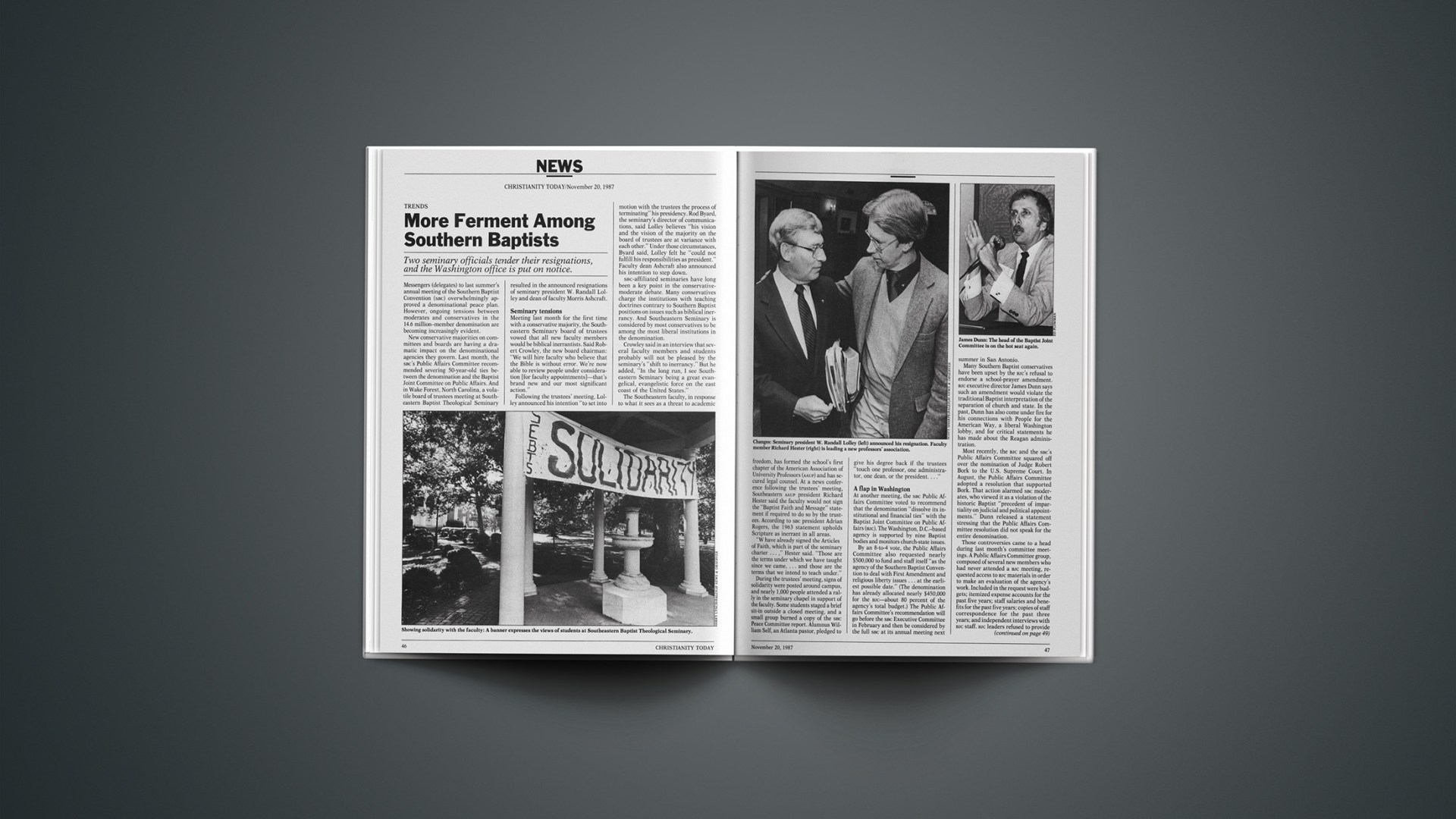
New conservative majorities on committees and boards are having a dramatic impact on the denominational agencies they govern. Last month, the SBC’S Public Affairs Committee recommended severing 50-year-old ties between the denomination and the Baptist Joint Committee on Public Affairs. And in Wake Forest, North Carolina, a volatile board of trustees meeting at Southeastern Baptist Theological Seminary resulted in the announced resignations of seminary president W. Randall Lolley and dean of faculty Morris Ashcraft.

Seminary Tensions

Meeting last month for the first time with a conservative majority, the Southeastern Seminary board of trustees vowed that all new faculty members would be biblical inerrantists. Said Robert Crowley, the new board chairman: “We will hire faculty who believe that the Bible is without error. We’re now able to review people under consideration [for faculty appointments]—that’s brand new and our most significant action.”

Following the trustees’ meeting, Lolley announced his intention “to set into motion with the trustees the process of terminating” his presidency. Rod Byard, the seminary’s director of communications, said Lolley believes “his vision and the vision of the majority on the board of trustees are at variance with each other.” Under those circumstances, Byard said, Lolley felt he “could not fulfill his responsibilities as president.” Faculty dean Ashcraft also announced his intention to step down.

SBC-affiliated seminaries have long been a key point in the conservative-moderate debate. Many conservatives charge the institutions with teaching doctrines contrary to Southern Baptist positions on issues such as biblical inerrancy. And Southeastern Seminary is considered by most conservatives to be among the most liberal institutions in the denomination.

Crowley said in an interview that several faculty members and students probably will not be pleased by the seminary’s “shift to inerrancy.” But he added, “In the long run, I see Southeastern Seminary being a great evangelical, evangelistic force on the east coast of the United States.”

The Southeastern faculty, in response to what it sees as a threat to academic freedom, has formed the school’s first chapter of the American Association of University Professors (AAUP) and has secured legal counsel. At a news conference following the trustees’ meeting, Southeastern AAUP president Richard Hester said the faculty would not sign the “Baptist Faith and Message” statement if required to do so by the trustees. According to SBC president Adrian Rogers, the 1963 statement upholds Scripture as inerrant in all areas.

“W have already signed the Articles of Faith, which is part of the seminary charter …,” Hester said. “Those are the terms under which we have taught since we came, … and those are the terms that we intend to teach under.”

During the trustees’ meeting, signs of solidarity were posted around campus, and nearly 1,000 people attended a rally in the seminary chapel in support of the faculty. Some students staged a brief sit-in outside a closed meeting, and a small group burned a copy of the SBC Peace Committee report. Alumnus William Self, an Atlanta pastor, pledged to give his degree back if the trustees “touch one professor, one administrator, one dean, or the president.…”

A Flap In Washington

At another meeting, the SBC Public Affairs Committee voted to recommend that the denomination “dissolve its institutional and financial ties” with the Baptist Joint Committee on Public Affairs (BJC). The Washington, D.C. based agency is supported by nine Baptist bodies and monitors church-state issues.

By an 8-to-4 vote, the Public Affairs Committee also requested nearly $500,000 to fund and staff itself “as the agency of the Southern Baptist Convention to deal with First Amendment and religious liberty issues … at the earliest possible date.” (The denomination has already allocated nearly $450,000 for the BJC—about 80 percent of the agency’s total budget.) The Public Affairs Committee’s recommendation will go before the SBC Executive Committee in February and then be considered by the full SBC at its annual meeting next summer in San Antonio.

Many Southern Baptist conservatives have been upset by the BJC’S refusal to endorse a school-prayer amendment. BJC executive director James Dunn says such an amendment would violate the traditional Baptist interpretation of the separation of church and state. In the past, Dunn has also come under fire for his connections with People for the American Way, a liberal Washington lobby, and for critical statements he has made about the Reagan administration.

Most recently, the BJC and the SBC’S Public Affairs Committee squared off over the nomination of Judge Robert Bork to the U.S. Supreme Court. In August, the Public Affairs Committee adopted a resolution that supported Bork. That action alarmed SBC moderates, who viewed it as a violation of the historic Baptist “precedent of impartiality on judicial and political appointments.” Dunn released a statement stressing that the Public Affairs Committee resolution did not speak for the entire denomination.

Those controversies came to a head during last month’s committee meetings. A Public Affairs Committee group, composed of several new members who had never attended a BJC meeting, requested access to BJC materials in order to make an evaluation of the agency’s work. Included in the request were budgets; itemized expense accounts for the past five years; staff salaries and benefits for the past five years; copies of staff correspondence for the past three years; and independent interviews with BJC staff. BJC leaders refused to provide several of the requested items, leading to the Public Affairs Committee vote to cut Southern Baptist ties to the agency.

In response, Dunn said the Public Affairs Committee’s “course of action clearly departs [from] the Baptist way” and would “definitely destroy the ‘jointness’ of the Baptist Joint Committee.” He said he did not think approval of the recommendation would destroy the BJC because “there are literally several million Southern Baptists who believe very strongly in the Baptist way as the Joint Committee has enunciated it on religious liberty and church-state separation.” Dunn noted the full SBC has approved continued relations with and support for the BJC on three separate occasions in the past four years.

Moderate leader James Slatton, pastor of River Road Baptist Church in Richmond, Virginia, said the recent tensions are the result of “hard-ball politics” being waged by a “mean fundamentalist machine.… Our task is to awaken our constituency to the fact that they’ve given power into the hands of people who are going to wreck this great denomination.”

Conservative leader Paige Patterson, head of the Criswell Center for Biblical Studies in Dallas, disagreed that the tensions are products of church politics. Rather, he said, they are the natural results of new conservative majorities making “changes that had to come.

“For the last 25 to 35 years, the leadership of the convention has been out of step with the supporting constituency,” he said. “… We had reached the end of the line on paying the salaries of people to teach the opposite of what we believe. It’s like shipping scrap metal to the enemy to get it shot back at you.”

Further Developments

Ongoing friction between moderates and conservatives has led to other developments in the SBC.

  • Lee Roberts, a leader among conservative Southern Baptists, sent a 16-page letter to thousands of Georgia Baptists accusing Mercer University of hosting “debauchery” and university officials of having “spiritual convictions contrary to the Baptist doctrine.” Fueling the controversy was the appearance of some Mercer students in a recent issue of Playboy magazine. The Georgia Baptist Convention supplies a small percentage of the university’s budget.
  • Earlier this fall, in a 15-to-15 vote, conservatives lost a bid to remove N. Larry Baker as the executive director of the SBC Christian Life Commission. The commission works on social issues for the denomination, and some conservatives have expressed questions about the extent of Baker’s prolife convictions.
  • Shelby Baptist Association in Memphis, Tennessee, voted last month to withdraw fellowship from Prescott Memorial Baptist Church because the congregation called a woman as senior pastor. Nancy Hastings Sehested assumed pastoral duties at the Memphis church on November 1.

SBC president Adrian Rogers, pastor of Bellevue Baptist Church in Memphis, voted in favor of the action against Sehested’s church. In 1984 the SBC adopted a resolution against women serving as pastors. However, because of the denomination’s polity, such resolutions are not binding on individual congregations.

By Kim A. Lawton.
Classic & Contemporary Excerpts from November 20, 1987

Nomads on the Jericho Road

God does not want Christians to be nomads, hermits, or recluses.… In the light of this truth it might be good if we gave up singing one of the old spirituals:

On the Jericho Road,

There’s room for just two,

No more and no less,

Just Jesus and you.

Think about it. If that song is right, we had better get off the Jericho Road. That is not the highway to glory because, as the New Testament repeatedly discloses, the glory highway is broad enough to allow all of God’s people to march along together. Side by side.

Vernon C. Grounds in Radical Commitment

The humility of thankfulness

The modern American seldom pauses to give thanks for the simple blessings of life. One reason is that we are used to having so much. We simply assume that we will have all the good things of life. Another reason is that it hurts our pride to be grateful. We do not want to admit that God is the Provider of all good things. We are simply His stewards. Being thankful requires humility and faith in God. When we have these, we can be grateful.

Richard B. Douglass in Quotable Quotations

Some through the fire

Faith for my deliverance is not faith in God. Faith means, whether I am visibly delivered or not, I will stick to my belief that God is love. There are some things only learned in a fiery furnace.

Oswald Chambers in Run Today’s Race

Escapism—or truth?

We are very shy nowadays of even mentioning Heaven. We are afraid of the jeer about “pie in the sky,” and of being told that we are trying to “escape from the duty of making a happy world here and now into dreams of a happy world elsewhere.” But either there is “pie in the sky” or there is not. If there is not, then Christianity is false, for this doctrine is woven into its whole fabric. If there is, then this truth, like any other, must be faced, whether it is useful at political meetings or no.

C. S. Lewis in The Problem of Pain

Teamwork

Our progress in holiness depends on God and ourselves—on God’s grace and our will to be holy. We must have a real living determination to reach holiness.

Mother Teresa in A Gift for God

Thanklessness

Our biggest problem in the church today is this vast majority of Sunday morning Christians who claim to have known the Master’s cure and who return not [at other times] to thank Him by presence, prayer, testimony and support of His church. In fact, the whole Christian life is one big “Thank You,” the living expression of our gratitude to God for His goodness. But we take Him for granted and what we take for granted we never take seriously.

Vance Havner in The Vance Havner Quote Book

No loose strings

We must face the fact that many today are notoriously careless in their living. This attitude finds its way into the church. We have liberty, we have money, we live in comparative luxury. As a result, discipline practically has disappeared.

What would a violin solo sound like if the strings on the musician’s instrument were all hanging loose, not stretched tight, not “disciplined”?

A. W. Tozer in Men Who Met God

Only one talent needed

Whatever our unique gifts are and whatever skill we have in using them, they are not God’s key concern with us. Maturing in our walk as Christians is not helped or hindered by our “special” talents (or lack thereof), save one—obedience. This is one gift everyone has a crack at.

Michael K. Blanchard in

A Common Thread (July 1987)

Thanksgiving casts out pride

To thank with all your heart is an art—an art which the Holy Spirit teaches. And you need not worry that the man who can really say Deo gratias (to God be thanks) with all his heart will be proud, stubborn, rough, and tough, or will work against God with His gifts.

Martin Luther in What Luther Says

Will Success Spoil the South Korean Church?

Churches in South Korea are not just big. They’re huge.

In and around the capital city of Seoul, for example, traffic patterns are disrupted and entire districts closed when the faithful make their way to one of that city’s 10,000 churches, usually beginning around six o’clock on a Sunday morning. There are half a million at Yoido Full Gospel Church; 40,000 at Young Nak Presbyterian; 15,000 at Sung Rak Baptist—the sheer numbers boggle the mind, and experiencing them firsthand only heightens the wonder and mystery. Not surprisingly, enterprising American Christians have come to regard the tiny peninsula as a veritable Mecca, where pilgrims can gather the secrets of revival and church growth.

And yet, as intriguing a story as Korea’s church-growth phenomenon is, it is but the opening chapter of a story that today includes an economic boom, a government in transition, and a maturing church agonizing over its proper role in a secular state. Said one Christian university president: “When Christians form 25 percent of a society, then they should bear responsibility for that country’s history. In Korea, it’s time.”

So it was that in May, the Christianity Today Institute spent the better part of three weeks in South Korea, asking church leaders and the nation’s politicians questions relating to four general areas: The reasons behind Korea’s astounding church growth (and their potential application in the Western church); the current spiritual health of Korea’s churches; the related question of church unity; and the role of the church in society—specifically, how the church is coping in the current political situation.

Making up the team investigating these and other related questions were Ro Bong-Rin, executive secretary of the Asia Theological Association in Taiwan, and William W. Menzies, professor of theology at Evangel College in Springfield, Missouri. Completing the team were institute editor Lyn Cryderman, and Harold B. Smith, managing editor of CHRISTIANITY TODAY magazine. Also lending invaluable assistance stateside was Samuel H. Moffett, professor emeritus of missions and ecumenics at Princeton Theological Seminary, and one of the foremost Western experts on the church in Korea.

The approach to Seoul’s Kimpo Airport reveals a sight most Koreans over 30 are still hard-pressed to believe: a world-class city on the fast track toward Western opulence. Just a short generation ago the capital city, like nearly all of Korea, was little more than a collection of skeletal buildings, makeshift shanties, and destitute people looking for their next meal. Twice overrun by Communist forces from the North and twice retaken by U.S. troops during the Korean War, Seoul, only a half-hour from the 38th Parallel separating the two Koreas, was caught in a perpetual crossfire. When the armistice was signed on July 27, 1953, the task of rebuilding seemed like making bricks with no straw: Backbreaking. Impossible.

But then, Koreans pride themselves in doing the impossible.

“It’s really quite unbelievable,” Ro told us, as he pointed to the street that was “home” during the later war years. “The tallest building then was a movie theatre.” Today, it’s a 62-story, sloping, golden skyscraper-pyramid—the tallest building in all of Asia—built by Choi Soon-Young, a Christian businessman.

“And there was plenty of begging,” Ro continued. Today, many streets—some with eight lanes and featuring an occasional Westin, Hilton, or Sheraton, others with cobblestones and only a subcompact wide—breathe a burgeoning capitalism that would make Adam Smith proud. Street vendors barter everything from Reebok shoes and Gucci bags to Cabbage Patch Dolls and three-piece suits—made to order in a day.

In 1962, South Korea had a per capita gross national product of $87 a year; now that figure is over $2,500 and climbing rapidly. The republic is a major exporter of steel, textiles, ships, consumer electronics, and most recently, automobiles. (The Hyundai is one of the fastest-selling imports in the U.S.) And South Korean exports to the United States have increased 170-fold over the last 20 years.

Perhaps a fitting metaphor of the miracle that is Seoul—and increasingly the rest of Korea—is the Han River, which separates the downtown from Yoido (the city’s “Manhattan Island”). Used throughout much of this century for everything from drinking water to waste disposal, the Han became, for all practical purposes, a dead river—its summer stench fast becoming the city’s aromatic trademark. But in the 1970s, it was announced that the Han would be cleaned. Again, the Korean people undertook the impossible.

“It’s beautiful, isn’t it?” our driver proudly asked, as his taxi wound its way circuitously through traffic on one of the many steel bridges spanning the Han. And, indeed, the river is just that. People swim and boat. And there is no smell. It is another miracle in a land that seems intent upon performing the miraculous—like hosting the 1988 Olympics.

Or like building churches with over 500,000 members.

Christianity In Context

The greening of a 5,000-year-old nation over 30 short years has meant astounding adjustments for the people of Korea—politically, socially, culturally. And the disparity between old and new comes to light immediately upon our arrival in Seoul.

A large group of Koreans—a few women in the traditional hanbok dress, the rest in skirts, dresses, the men in shirts and ties—eagerly await the arrival of Oral Roberts’s faith-healer son, Richard, while outside, the day-long traditional celebration of the Buddha’s birthday draws to a festive close. Bright paper lanterns line the darkened streets commemorating the holy day. But they are no more prominent than the red neon crosses standing sentinel over church after church after church.

Buddhism and Christianity are the two major religions in South Korea: the former is intricately woven through some 2,000 years of Korean history, its statuary and temples dotting the rolling countryside and an occasional mountain peak. All of which in the new Korea is quite symbolic: the religion of the hills now finds itself increasingly set apart from the mind and manner of the people.

Not surprisingly, this concerns the Buddhist devout, who are now trying to use heritage as leverage in proselytizing their world view. A nation on fast-forward can ill afford to forget its past; and so celebrations like the Buddha’s birthday rekindle Korean pride and nationalism, and give the faltering faith a positive—and countrywide—visibility, if only for a day.

But in addition, Buddhist monks are increasingly coming down from the hills and moving to cities, towns, and villages, actively seeking converts. In places like Iri, a small town located in the center of the republic, this evangelistic brand of Buddhism has established “churches” complete with hymnbooks and Sunday school.

Keeping watch: South Korean border patrol.

In Iri, where ancient symbols and insignias were seen everywhere in honor of Buddha’s birthday, this newfound evangelistic fervor has resulted in heightened religious tensions between the two groups—capped off recently by the burning of a church. According to an official at the Christian Broadcasting Network there, witnessing to the Buddhist community has been kept to a minimum in an effort to maintain some semblance of peace. Ironically, however, the Christian population is so large that Buddhists have wound up hiring some for odd jobs at their area school—which is also symbolic. For the hiring, like the borrowed methodology, reveals just how strong an impact Christianity has had on Korea.

Approximately 25 percent of South Koreans claim to be Christian (as opposed to just under 30 percent who claim to be Buddhist). Conservative estimates place the number of adult Protestant church members at between 7 and 8 million, with an additional 2 million Roman Catholics.

Two Gallup surveys done earlier in this decade indicate that these figures are on the upswing. The first survey, in 1982, questioned Koreans of all ages and found 29 percent professing Buddhism and 20 percent Christianity (Protestants 16 percent, Catholics 4 percent). The second, in 1983, surveyed Korean young people between the ages of 18 and 24 and discovered that 30.4 percent “believed in Christianity” (Protestant 24.3 percent, Roman Catholic 6.1 percent). These surveys, corroborated by other studies, strongly suggest a significant decline of about 1 million Buddhists and an accelerating rise in the number of Christians, particularly among Korean young people, in the three years under study.

Samuel Moffett of Princeton Theological Seminary, whose family perspective on Korean faith spans nearly 100 years, expresses the gospel explosion this way: “When my father reached Seoul in 1890, there were between 10,000 and 17,000 Roman Catholics. Records for 1889 show only 74 communicant Protestants. Forty years later, when I was a boy in Korea in 1930, the number was 415,000 Christians, or 2 percent of the population. When I returned in 1955 there were 1,117,000, or about 5 percent. Today there are over 10 million Christians in Korea, or about 23 percent. Very roughly that would mean one Korean in a thousand was Christian in 1890, 1 in 50 in the 1930s, 1 in 20 in 1955, and 1 in 4 today.”

But statistics tell only part of the story. Throughout Seoul and the southern cities of Chonju and Taegu visited by CHRISTIANITY TODAY, stories of individual churches—begun with a handful of people yet today boasting memberships in the thousands—became almost matter-of-fact; and perhaps to the Koreans who told the stories, they were. After all, “we serve a great God, to whom nothing is impossible. Should such growth surprise us?”

It does.

With a membership of over 40,000, Young Nak Presbyterian is the largest Presbyterian church in the world. It was started in late 1945 as a fellowship of 27 believers, led by Han Kyung-Chik. Han was born into a Confucian family, accepted Christ through the ministry of American missionaries, and, in service to God, was persecuted first by the Japanese (who occupied Korea from 1910 to 1945) and then the Communist North Koreans from whom he had fled with over 5 million others during the Korean War. He is today, in effect, the spiritual head of the Korean Presbyterian church; a spiritual giant in whose presence one can hear—and feel—firsthand the faithfulness of God during Korea’s rugged twentieth century. Indeed, Han’s 84 years document the specifics of Korea’s church growth.

The missionary presence. Han was born in a small village 30 miles north of Pyongyang, the capital of North Korea. Like much of the North before the Communist takeover, it eventually became a Christian stronghold, thanks to a missionary presence that, says Han, modeled the faith “in every way.”

Presbyterian missionaries first came to Korea in 1884. They, along with the early Methodist missionaries, brought with them conservative values generating a high appreciation for historic orthodox elements in Protestant theology (an appreciation that persists in the majority of Korean churches today). And unlike the Roman Catholic missionaries of a century earlier who insisted upon maintaining foreign control of church leadership, Presbyterian missionaries were intent upon “Koreanizing” the church and developing indigenous leadership.

Under an ingenious methodology called the Nevius Plan (see sidebar on p. 34), the Northern Presbyterian Mission (U.S.A.) stressed a quick transition from mission leadership to self-government in the national churches, along with self-support and self-propagation. As a result, Koreans saw the new faith as one that respected them as a people—something they were desperate for in the wake of foreign takeovers, first from China and, in the early twentieth century, from Japan. They were consequently open to the message of Christ and saw its proponents as “liberators” of the Korean people from their foreign taskmasters. This connection, which grew ever more tangible during the Japanese occupation and the Communist takeover as Christians stood up against persecution, remains indelibly imprinted on the Korean conscience—making, among other things, the Buddhists’ exhortations about national culture and the supreme worth of the old religious ways sound hollow.

Persecution. Unique in Asia, Christianity came to a nation that embraced it as a redemptive message, not an alien and imperialistic intrusion. (In Korean history, colonialism has been Asiatic, not Western.) The symbolism was not lost on Korea’s twentieth-century oppressors.

In attempting to impose its own culture over the 30-plus years it ruled Korea as a protectorate, Japan sought to eradicate Christian influence both directly through persecution and indirectly through accommodation. The most notable example of the latter was the so-called Shinto shrine controversy, which persisted through the Second World War. The Japanese asked that the Christian church (all religions, for that matter) incorporate the bowing down to a shrine as part of its regular worship. It was a political matter, the Japanese claimed, not a spiritual one. But not surprisingly, the matter became a test of faith, with the aftershocks still felt today. While the majority of conservative churches refused to go along with the Japanese order, a number of those churches “that did not bend a knee to Baal” eventually pulled out of the Presbyterian church (then only a single, united denomination) to form the Presbyterian Koryo denomination. Separatistic in lifestyle, it is today the third-largest Presbyterian group in Korea.

Han vividly remembers the Shinto controversy, as well as Japan’s use of more forceful tactics. He himself was forbidden to preach for three years, “so I worked quietly with orphans and others in need”—a ministry Young Nak continues to this day. Then, following emancipation in 1945, he again took to the pulpit with the 27 believers that would later become Young Nak Presbyterian Church. But that initial manifestation was short-lived. The Communists who entered the North were less interested in accommodation than eradication, and widespread persecution of the church began.

It would probably be safe to say that nearly every one of the 40,000 who attend Young Nak has been affected by the Communist takeover. Those over 40 years of age are especially likely to have had a brother, sister, mother, or father either killed or, in essence, held hostage north of the 38th Parallel. Communications across the parallel are nearly impossible. Many have not heard from family members since 1953.

Thus, not unlike the Japanese persecution, the specter of totalitarianism has made the words security, hope, freedom, and peace a part of the Korean mindset. It is a passion. And in the course of attaining and maintaining those realities, the Koreans have looked positively toward the “liberating” gospel of Jesus Christ.

Inner Strengths

When asked about the factors involved in Korea’s church growth, Han (like most of those interviewed) repeatedly talks about the sum being greater than its parts: “We begin and end with the Holy Spirit.” In between this divine dimension are the “supporting players”: the outside influences of Western missions and political persecutions discussed above, and the inner strengths of Korea’s “peculiar people.”

It is the latter factor, of course—the distinctives that individual Koreans bring to the practice of their faith—that Americans can perhaps learn most from. Yet they are distinctives that say as much about who the Korean is culturally as they say about who he or she is spiritually. Quite clearly, the Korean culture readied the Korean people for the record spiritual harvest currently being taken in.

Given to prayer. Even if one allows for a culture where Buddhist and shamanistic influences have perpetuated a respect for prayer, Korean Christianity seems to have built upon that respect, making the believer’s prayer life an intense priority (see sidebar on page 37). Predawn prayer meetings have been a special feature of Korean church life since shortly after the first Protestant missionaries arrived. And more recently, influenced by the example of Paul Yonggi Cho and his “world’s largest” Yoido Full Gospel Church, numerous “prayer mountain” retreats operate daily; and virtually all churches maintain a weekly all-night prayer meeting (usually on Friday).

Respect for leadership. Respect for scholarship, which can be traced to the ethics of Confucianism, is reflected in the high regard given to the trained Christian leader. Pastors are expected to lead spiritually by being present at the daily predawn prayer meetings and the all-night meetings, and by visiting the people on a regular schedule.

In short, the demands on leadership are enormous. And they do take their toll. Family time is usually a few stolen hours on a Sunday afternoon; and further study is practically out of the question. “The pastor who speaks 12 or 13 times a week doesn’t have time to develop strong sermons,” Jun Ho-Jin told us. The president of Pearson Theological College outside of Seoul said there is little time for meditation or preparation. “Generally,” said Jin, “the pastor serves the church with his feet, not his head.”

Lay commitment. Nevertheless, the amazing dedication of the people to “run the race” flat-out matches that demanded from their leaders. Indeed, without great commitment from the people, it is hard to see how the church would grow as it has. They have been trained to tithe, even to the point of great personal sacrifice. And they give of their time liberally, not only attending public church services, but gathering in groups of 10 or 12 for weekly cell meetings.

An essential element in the organization of most of Korea’s churches (Protestant and, increasingly, Catholic), these neighborhood gatherings are an evangelistic cornerstone, and their success is undeniable. Following the “doubling principle” of basic mathematics, these cells are encouraged by pastors like Paul Cho to double every few years. Thus, according to Cho, 500,000 members in 50,000 cell groups will eventually expand to 1 million members in 100,000 cell groups—goals for 1990 that Cho has established for his Yoido church.

Confrontational. One Korean churchman in Chonju facetiously described his countrymen as “the Irish of the Orient.” And Koreans are indeed confrontational, frank—unlike the more diplomatic Japanese. As a result, they are unafraid to talk to strangers and relatives about the Lord Jesus Christ. In the course of idle conversation, the question posed after commenting on the weather may well be, “Are you a Christian?”

Moreover, with rapidly growing resources in personnel and funds, Koreans are committed to taking this evangelistic zeal overseas. Recognizing their responsibility to the unreached world, Korean churches have sent over 600 missionaries to locations throughout Asia as well as points West—most notably the United States.

A darker side of this trait is the role it plays in the Korean church’s penchant for splitting apart. The aggressiveness of Koreans has led to multiple fractures, most based on personality conflicts rather than theological or doctrinal questions (unlike the Koryo split over the Shinto controversy). Presbyterians, by far the largest Protestant community, are also the most divided group, with 32 different denominations—5 large ones and 27 splinter groups. There are four divisions in Methodism, seven among Pentecostals, and four among Baptists.

And yet in much the same way that oppressive regimes historically have both hindered and fostered church growth, schisms have ironically done the same. “In Korea when churches split,” says Samuel Moffett, “in an amazingly short time each side of the schism seems to be as large or larger than the sum total of the united body before division.”

Belief in the supernatural. The animistic background of Korea furnishes the historical and cultural context for belief in demons, spirits, and spiritual powers. In the Korean church, a series of great revivals beginning in the early years of this century had a profound effect on the churches. Prayer for the sick, concert prayer by the people in public services, and an openness to the operation of the gifts of the Spirit mark virtually all the churches, regardless of denomination (see sidebar on p. 37).

Indeed, Korean Christians thrive on the supernatural power of the gospel and, perhaps more specifically, on the dramatic manifestations of that power. At Sung Rak Baptist Church, the largest Baptist church in Korea, “regular” encounters with the supernatural take on the form of physical healings, exorcisms, even resurrections. Church pastor and founder Kim Ki-Dong almost matter-of-factly describes such events as a logical (biblical?) outcome of what has become his own life verse, 1 John 3:8: “The reason the Son of God appeared was to destroy the devil’s work.”

Not surprisingly, then, Kim sees the work of signs and wonders against the forces of darkness as available to all who profess the name of Christ. “You too can cast out demons,” he confidantly exhorts his listeners. And to date, the over 15,000 who attend his church believe it.

Still, critics charge that obsession with the miraculous—culturally based or not—will make the gospel message sound escapist, rather than the answer to real problems in a real world. The “obsessed” church, say critics, may neither be in or of the world—but out of this world.

The culturally conditioned receptivity of the Korean people to the liberating message of Jesus Christ, and the high cost of discipleship during decades of political repression and persecution, have translated to record numbers attending Sunday services and coming to faith. But, say the faithful, these God-ordained, Holy Spirit-manipulated elements have also ignited an economic transformation nationwide, the extent of which the world has yet to fully see. This blessing, which has attached to it a “prosperity-gospel” concept coming from Korea’s shamanistic thinking (which sees rewards as the primary motivation for serving the deities), looms ever larger in Korean Christian thought and theology. The reason for this is obvious. Korea is on an economic fast track. Its churches are burgeoning. God, therefore, must be blessing.

Few Koreans would deny outright this divine connection. Choi Soon-Young would certainly not deny it. As one of Korea’s—Asia’s—wealthiest businessmen, he has built buildings, bought a professional soccer franchise (the “Hallelujah” team), rescued a Christian university from financial ruin, and started (with one other family of four) and built a church that now claims over 4,000 members.

Nor would Kim Chang-In deny it. As pastor of Seoul’s Chung Hyeon Presbyterian Church (the largest church in the Hapdong denomination), the eighth grade-educated Kim shepherds a flock of 12,000 whose gathering place consists of a multistoried school for missionary training, elaborate offices for the hundreds of workers on its staff, and a new, Gothic-style cathedral that, when completed, will cost over $20 million—all on a piece of land considered worthless ten years ago.

Nor would the average layperson deny the financial impact of the divine hand—especially those living in Korea’s urban centers. The church buildings in Seoul, Chonju, and Taegu are themselves a reflection of a boom prosperity. While not all boast the facilities of a Chung Hyeon, a Young Nak, or a Yoido Full Gospel, urban congregations are uniformly convinced that inevitable growth will lead to inevitable building: perhaps an elementary school or a training center for missionaries, a home for unwed mothers or an elaborate church office center. Unlike the United States, where congregations as a rule anguish (and, at times, split) over building programs, Koreans approach building as an expression of God’s greatness—and his blessing on a church that has kept the faith. But like the United States, in Korea, bigger is better.

Nevertheless, Choi, Kim, and others would admit to the social and theological dangers inherent in the handling of this economic blessing. The lessons of the Western church have not gone unnoticed—and its shortfalls are to be avoided.

A better understanding of stewardship is pivotal, according to Choi, who, from his mahogany-paneled office high above Seoul, told of his own church’s financial commitment to both missions and social services to the poor. Part of that commitment, said Choi, goes to churches in Korea’s countryside, where the nation’s economic prosperity has yet to make much of an impact. Pastoral salaries in these modestly attended churches (a hundred congregants or less) are low, making the lure of the urban dollar almost irresistible. Consequently, getting well-trained pastors to take these outpost positions and survive spiritually, emotionally, and financially is a challenge with which the more affluent urban churches are increasingly wrestling. (At least one denomination, the Korean Evangelical Church, has developed a formal plan not only to send pastors to rural churches, but to provide enough financial assistance to make such assignments desirable.)

With up to 75 percent of the youthful population having no direct awareness of either the Japanese occupation or the Korean War, the persecution mindset that gave Korea its martyrs and a church on fire is fast giving way to a blatant materialism not unlike that which threatens the church in the West. Stewardship is important, and the Korean sense of commitment remains strong even among youth; and yet, having today what was only a dream yesterday (be that a home, a car, or simply the next meal) is increasingly challenging that commitment.

“The church is following the trend of social development rather than transforming it,” a concerned Kim Myung-Hyuk told us. The general secretary of the Korean Evangelical Fellowship recounted the story of one police chief who sarcastically addressed a minister as “president,” for, said Kim, “he was assisted by a number of secretaries, and equipped with a spacious, luxurious office complete with bed and bath.

“As a result,” lamented Kim, “the [evangelical] church is losing reliability as well as respectability in the society.”

The church may also stand to lose its integrity. Partly because of the influence of American Presbyterianism, which brought with it a high appreciation for scholarship and intellectual discipline, and partly because of the traditional respect for the scholar, the Korean churches have outdone themselves in providing educational opportunities for their young. In turn, Christian universities, seminaries, and Bible institutes have contributed to the entire nation. However, the very thirst for learning (and, unfortunately, the status symbols of academia) seems to have opened the door in many institutions to processes that indicate spiritual and theological erosion. The older missionaries bemoan the weakening of the values the institutions were founded upon.

The materialistic ethic has also created obvious tensions between the mainline evangelical bodies (Presbyterian, Methodist, Holiness, Baptist) and the Pentecostal/charismatic components of the church who rely heavily upon the material blessings of a walk with Christ. Paul Cho, because of his enormous numeric success, is the object of special interest on this point. Along with a clear gospel message (he emphasizes the need for a personal commitment to Jesus Christ for the forgiveness of sins), he weekly features what appears to be a heavy dose of “blessing” theology: “Cast your financial crises on Jesus, and they will be resolved.” While this theological debate between Cho and evangelical leaders seems to be clouded with personal elements that include a degree of jealousy (Cho, after all, does have half a million members), it appears that there is a need for encouraging more serious Pentecostal theology (see sidebar on page 41).

“[Korean] theology is very this-worldly,” said Son Bong-Ho, professor of philosophy at Korea’s prestigious Seoul National University. “We look for the blessing of this world. Very few can resist the temptation to teach health and wealth.”

Reflecting on how far Korea has come since the dark days of the war, Son concluded: “At this time Korea is probably more optimistic than any country in the world. Thus our focus—the society’s, the church’s—is below.”

In one sense, the current government under Gen. Chun Doo-Hwan also bemoans the church’s penchant for things below. Certainly the number-one temporal issue on the minds and hearts of all the churches this year has been the political future of the Korean republic. Across Korea, Christians are nearly unanimous in their dissatisfaction with the current regime. At the same time, however, they are perplexed by how best to display that dissatisfaction—beyond simply casting an anti-Chun vote in next month’s presidential election.

The young, particularly the university students and even students in conservative seminaries, demonstrate their protest vocally and vividly. Older Christians, on the other hand, tend to be more restrained, remembering that the entire history of democracy in Korea is but 40 years old—and their national history is 5,000 years old. Yet what impresses and surprises the onlooker is the obvious fact that both old and young are concerned that they not destabilize the government to the point where North Korea takes advantage of the political turmoil. Thus, the almost orchestrated student demonstrations are quite restrained—almost polite, when compared with American campus violence of the 1960s.

“There is no doubt that evangelical church leaders and students are as acutely concerned for the nation as the liberal churchmen,” Lee Jong-Yun told CT. From his office on a prominent Chonju hill, the president of Jeonju University said, however, that the evangelical approach to addressing these concerns was through understanding, communication, and prayer, “rather than violence and demonstrations against the government.”

According to Edward Dong of the political section of the U.S. Embassy in Seoul, the basis for antigovernment sentiment among Korean Christians and non-Christians alike has been the perception of Chun’s administration being “both illegitimate and immoral.”

On the first count, the so-called Seoul Spring—that is, Korea’s readiness for full-fledged democracy—turned cold quickly when Chun inflicted press censorship and suppressed his critics (such as jailing opposition leader Kim Dae-Jung) shortly after his ascent to power by a coup in 1980. Exacerbating the illegitimacy question was the killing, also in 1980, of at least 200 (some claim 2,000) protesting students in Kwangju by government troops. While that incident is still shrouded in mystery (the question of why it ever happened has never been answered), the blame is squarely placed on Chun’s shoulders.

Thus, while offering religious freedom, the government has taken certain actions to limit both the number of NCC-related disruptions and the influx of Koreans increasingly making the evangelical churches a political voice to be reckoned with. All Christian radio stations, for example, are forbidden to report or comment on news; and the smell of the eye-searing pepper gas in front of Seoul’s magnificent Myondong Cathedral is a daily reminder that outside church grounds, the outspoken Catholic hierarcy is neither to be seen nor heard.

Two other actions raising evangelical outcries (and prompting evangelicals to take a more critical view of the government) were a proposed change in the Christian day of rest and a nationwide promotion of Dangun worship. The former concerned a 1985 order to the three branches of the armed forces to change the Sunday holiday to Thursday or Friday for the sake of “national security.” The latter objection concerned the mythical ancestor of the Korean people, Dangun, whose worship was promoted by Chun to encourage nationalism—and, according to many church leaders, throw confusion into the church.

Neither move has gone beyond the initial recommendation stage, but both, along with the more recent accusations of human rights violations and the on-again, off-again promises to initiate constitutional reforms, have proven to be the catalysts for the church confronting its own relationship to the political process. Yet unlike the more combative stance of the Religious Right in America, the evangelical church in Korea is not so much interested in taking over the reins of power as they are making Christ relevant to a nation facing its most critical hour.

How Should We Then Influence?

Moon Tong-Hwan is a revered Presbyterian, a respected scholar, and one of the more outspoken activists opposing the Chun regime. His social conscience has meant imprisonment. His theology means never giving up.

Moon is one of the refiners of Minjung “people” theology—a liberation theology of the poor. Emphasizing freedom from political, social, and economic bondage, it is not unlike the liberation theology of Gustavo Gutiérrez. The theological starting point for both systems is the belief in the structural nature of evil, as evidenced in oppression and exploitation. Moreover, both systems believe the mission of the church is to liberate the oppressed.

In Moon is the emotional yet rationally intense passion that Minjung’s followers apply to an agenda that calls for the ouster of Chun, free elections, and full democracy—now. Use of violence to meet that agenda is condemned. Passive resistance, condoned. “It’s the dictator who uses violence,” says Moon, “not us.”

Either methodology is anathema to the majority of Korea’s Protestants, who question any talk of “resistance,” decry Minjung’s overemphasis on the social over against the spiritual, and wince at the theology’s socialist overtones. Korea’s strong inoculation against Marxism makes talk of the poor rising up in revolt less than popular rhetoric.

“The students and pastors influenced by Minjung theology interpret society from the perspective of rich-poor and oppressor-oppressed relationships,” said Jeonju University’s Lee. “However, Jesus’ chief concern was the kingdom of God and his righteousness on earth as it is in heaven.

“The church’s priority is evangelism, and the churches should encourage Christians to pray for the establishment of a responsible society and provide advice and counseling to government officials, particularly in moral and spiritual issues.”

Lee’s position is clearly the starting point from which the majority of Korea’s evangelical Christians are attempting to build their church-state understanding. Speaking truth and changing hearts is their twofold emphasis, an emphasis the Korean Evangelical Fellowship articulated in a landmark paper entitled “Human Rights in Korea.” In it, KEF general secretary Kim Myung-Hyuk set apart the evangelical methodology from that of Minjung by stating:

• “Our first priority and prayer [is] to initiate a widespread Bible-based evangelical movement and a holy lifestyle in the Korean Church where the secularized world view and lifestyle are epidemic.”

• “The church’s involvement in politics and becoming a political body is wrong because it is an arrogation of the church’s proper role.”

• “Even though the church should not be directly involved in politics, we Christians should help actualize the Christian ideal of life in our given situation by actively engaging ourselves in political, social, and economic activities. We are to renew our vision of Christianity as having both a historical and culture-transforming dimension as well as a supernatural and eschatological dimension.”

• “We agree that it is advocating an extreme theocracy to insist upon only the implementation of Christian beliefs in a modern pluralistic society and political system. Nevertheless, it is wrong to politicize Christianity by reducing it to civil religion or nationalism in order to use it as a driving force in politics or social movements.”

• “Change by violence or revolution should never be repeated again. A just and equal society can only be established by peaceful means and moral persuasion.”

“If you believe in Christ and live for him—imitate him—society will change.”

To Lee Won-Sul, as to a growing number of concerned Christians, this statement of faith is by no means an excuse to withdraw from political entanglements. It is, instead, the effectual means by which political structures can—and will—change. But even with 25 percent of the nation Christian, that change has come slowly—and not fast enough for the growing student population that wants democracy now.

On the campus of Han Nam University in Taejon, where Lee serves as president, and on university, college, and seminary campuses across Korea, student restlessness has meant months of political rhetoric, antigovernment singing (a traditional form for voicing displeasure), and, of course, daily demonstrations.

Unlike the student marches characterizing the Vietnam War years, Korea’s antigovernment demonstrations appear more formal, less spontaneous. An afternoon at Yonsei University in Seoul offers a case in point.

About 500 armed troops have been assigned residence at the main campus gate. No one looks particularly concerned or perturbed—only bored, with most content to walk in circles until their services are needed. Inside the gates, all appears normal: book-laden students going to classes, boyfriends and girlfriends holding hands.

Then, around 3 P.M., it happens. Almost on cue, troops and students take their places. The “stage” where the action will take place includes the gate and the adjoining city street, which is closed to traffic. Government troops, now in riot gear and looking like 50 or more Darth Vader clones, raise high a protective netting, a wall separating and protecting them from student abuse.

As for the students, they are less regimented, of course, but approach their opposition as one, armed with rocks, bottles, and more than a few Molotov cocktails.

Within ten minutes, the actors are in place and the political drama begins. Missiles fly. The netting is hit. The troops stand their ground. There is a perceptible reserve on both sides. The students seem content not to rush the fencing; the troops seem content to wait.

After another ten minutes, however, a second line of Darth Vaders emerges, carrying rifles loaded with foreboding canisters: pepper gas. After six or seven fusillades, the crowd disperses. The road is cleaned of debris. And everything returns to “normal”—save for the fact that the students now walk away from the gate holding handkerchiefs over their noses to avoid breathing in the irritating fumes.

“Demonstrations are the growing pains of our nation,” philosophized Lee Jong-Yun in Chonju, who sees marching for reforms as but another step toward Korea becoming a full democracy, complete with the freedoms of press and expression. But the demonstrations are also the spiritual growing pains of a population still clearly interested in religion, yet wondering how faith—any faith—plays into the political scheme of things.

At Korea’s “Harvard,” Seoul National University, for example, Christian students are caught between the biblical mandate to be “peacemakers” and the political initiative to actively take a stand against a government perceived to be immoral: What, in effect, does Christlikeness mean in the face of a less than ideal government?

“The passive majority of students sympathizes with the active minority,” observed Seoul National’s Son Bong-Ho. But, says Son, most evangelical students do not have the courage to stand against them. “Radical students,” he continued, “are both antigovernment and anticapitalist. The majority of students, however, are the former, not the latter.”

Students from an InterVarsity chapter at Seoul National agree.

“We want democracy,” said one senior, “we don’t want to lose what freedoms we already have. Nor is violence a means to that freedom.”

Korean students appear, then, at least on the surface, to be less radical than media accounts would imply. There is a clear sense that while the current government must be reformed, there is little false idealism promoting communism as a “solid alternative.” Results of a survey to determine the political attitudes of students on Yonsei’s campus showed that students have a generally negative attitude toward the social situation in the Communist North. Moreover, while sentiment toward the United States is mildly negative, that toward the USSR is clearly negative, as that country is perceived to be the primary reason for the North-South split.

“We have more freedom than in North Korea,” an observer of the student rioting said in Taegu. “The students must remember that.”

From all indications, they do. And that is good news for the socio-political health of the nation, of course, but only if the government does not test student patience to its limits: Some are concerned that Chun—or his successor—will cry “communism” one time too many.

It is also good news for the church. For while the younger generation’s head knowledge of the Communist takeover can never surpass the heart knowledge of those who suffered firsthand, it should, nevertheless, serve to remind the Christian young of what faithfulness to the Cross cost the saints only a short time ago. It is a testimony of triumph that continues to bridge the growing generation gap.

This is not to imply that the next generation is solidly in the church. Granted, the passion to find some meaning to life is still very much on the minds of today’s students. And at Yonsei, the majority of students surveyed in a poll on religion expressed the opinion that religion is necessary because of the fear of Korea’s unknown future. But the church’s inability (or apathy) to clearly bring its message to bear on those visceral political questions filling youthful minds may alienate the next generation and, in turn, jeopardize the future effectiveness of the church.

“When religious leaders speak out,” said one Catholic student, “we will listen.”

Reaching out to these students—as Korea’s stability and the church’s hope—remains the inbred desire of Horace Underwood, an assistant to the president at Yonsei University. The third Underwood to call Korea home in service to Jesus Christ (his grandfather was the first ordained Presbyterian missionary to Korea, and founder of Yonsei), the gray-haired iconoclast speaks with the precision of a Christian educator and a passion sparked by his enormous missionary heart.

Education was a part of the missionary master plan for moving Korea into the twentieth century and giving it—and its Christian church—solid leadership. As early as 1908, missionaries could write that “We are in the midst of an educational revolution. So strong has been the leadership of the church that … the course of study used in Christian schools has been the pattern for unbelievers’ schools as well.”

Moreover, it was an education open to everyone—men and women. Christianity, in effect, shattered class barriers and liberated women from the restraints of a male-dominated culture. Thus, says Samuel Moffett, “It is no accident that the world’s largest women’s college [Ehwa University] is in Korea, and that it is a Christian institution.”

However, since coming to Yonsei, Underwood has seen the complexion of that Christian commitment to, and influence on, education subtly change. At his university (as at other church-affiliated schools), reduction of compulsory chapels, erosion of a commitment to Christian faculty, and an increasingly permissive spirit on campus have softened, to some extent, the school’s spiritual commitment. “Perhaps it’s inevitable,” Underwood surmises, thinking of the fate of Harvard, Yale, and the other pillars of higher education set into motion by men of faith. But on deeper reflection, he sees a weakening commitment to missions on the part of certain Western denominations as, in turn, contributing to the potential weakening of both church-related schools and the church generally.

Increasingly, the Presbyterian Church in America (along with the United Methodist Church) seems intent on ending its 100-year “mission relationship” with the Korean church as quickly as possible. The primary reason given for this radical decision—which includes cutting back the number of missionaries as well as the amount of financial support given—is simply that the need no longer exists: The church, after all, has exploded. However, there are two other factors recognized by seasoned missionaries as operating in this decisive cutback: first, the tendency among the liberal groups in the States toward universalism theologically, in which other cultural religions are accepted or incorporated into Christian doctrine, thereby blurring the uniqueness of the Christian message; and second, the rapid erosion of financial support in the United States among these groups for foreign missions. Underwood and others (like Howard Moffett in Taegu and David Seel in Chonju) fear that the exodus from mission-started schools and medical centers, for example, may prove premature, jeopardizing the original purposes—even the ongoing existence—of these institutions.

“The national churches here have not materially supported institutions such as schools and hospitals,” explained Underwood. “They tend to look at the university, for example, as a hotbed of power and prestige, rather than a ‘ministry’ needing their support.”

As to the shortfall of missionaries working side by side with nationals, Underwood agrees with the missionary vision set forth in the Nevius Plan—that is, replace a missionary with a Korean. But, said Underwood, Koreans themselves are looking for “support staff” from the West, something the mainline groups are not willing to supply.

“The ironic thing,” explained Underwood, “is that half the presbyteries here have asked for missionaries, but their requests have been denied. Clearly, the church back in the States is intent on carrying out its own program rather than meeting the needs here.”

By sharp contrast, the Southern Baptists—relative newcomers to the peninsula—already have 135 missionaries on the field and plan to increase that number indefinitely at the fastest-possible absorption rate. They are working on the assumption of a “partnership” principle, in which the missionary can continue to play a supportive role to the emerging church. And Overseas Missions Society (OMS) has already achieved such a partnership with the Korean Evangelical Church, the third-largest denomination in Korea and a group birthed by OMS.

According to Underwood, such a partnership is absolutely essential, whether the context is a local church or a major university. “All churches have blind spots,” philosophizes Underwood. “They can help us, we can help them.” It is an arrangement, seemingly, that would work to improve both churches: giving them trained leaders; insuring a future based on sound scholarship and spiritual commitment. It is little wonder, then, that Horace Underwood and his contemporaries are so reticent to see it slip away.

When the Presbyterian Church in Korea celebrated its one-hundredth anniversary in 1984, one million Koreans gathered along an enormous cement strip known as Yoido Plaza to worship and give thanks to God, and to witness the passage of this “miracle” out of adolescence.

Entering adulthood—strong and idealistic—the Korean church today eagerly awaits its destiny. Already it has established fast-growing congregations here in the United States; and it has taken upon itself the task to evangelize Asia—even daring (in the case of Paul Cho) to claim a goal of reaching 10 million Japanese for Christ by the year 2000.

But the church, as strong and vibrant as it is, is only a young adult, and as such it faces head-on the distractions that threaten to take it away from its first love. Over 60 church leaders articulated those distractions to us (many of the more problematic are recounted here), and together they admitted that youthful idealism has meant the church is only now beginning to take those challenges seriously.

Regrettably, the pullout of the mainline church missionaries—those whose legacy is the dynamic Korean church of today—means that new support persons will be needed to model spiritual fidelity for the young-adult church in the wake of the surrounding secularism, materialism, and growing political influence. Fortunately, those workers are coming—but they are perhaps not arriving as fast as the Koreans themselves would want: along with the numeric success has come the false assumption that all is well.

Still, the Korean church is an astounding, heaven-sent mystery. The crush of the crowds on Sunday morning, the one-on-one evangelism, those red neon crosses—all denote a movement of God’s Holy Spirit that we in the West would do well to heed. Says Samuel Moffett: “Even the most secular of historians must admit at times to the mystery in history, and the church historian, mindful that the more decisive areas of Christian growth are beyond the reach of statistics, finds himself [when discussing Korea] quoting Scripture: ‘I [Paul] planted, Apollos watered, but God gave the growth’ ” (1 Cor. 3:6).

Going First Class on the Titanic

Campus ministers report on hedonism—Christian and otherwise.

How is the Christian student doing in the modern “secular” university? In The Closing of the American Mind, Allan Bloom’s recent analysis of higher education, students are said to be faced by the unusual pairing of nihilism and hedonism. Bloom and other commentators tell us most students simply do not care about the “big questions”: What is life for? What should I do with my life? Can I make a difference?

The church, then, faces a real challenge, since the big questions are the ones Christianity considers important, and the ones about which it can offer guidance.

What can the church do to help students not only survive the university, but engage it—with a maturing and thoughtful passion for God, their culture, and their world?

Recently 2,000 students met in Pittsburgh to “examine together the meaning of the coming of the kingdom of God in our daily lives, in our studies, and in our world.” Such was the purpose of Jubilee ’87, a conference sponsored annually by the Coalition for Christian Outreach.

CHRISTIANITY TODAY gathered five professionals in campus ministry, all at Jubilee ’87, and discussed with them what today’s secular university students are like and how they can be reached.

The panelists included Elward Ellis, the national director of black campus ministry for InterVarsity Christian Fellowship; David Gill, president of New College, Berkeley, California; Jerry Herbert, associate director of the Christian College Coalition’s American Studies Program in Washington, D.C.; Dick Keyes, director of the L’Abri Fellowship in Southborough, Massachusetts; and Gene Thomas, now a businessman in Boulder, Colorado, but formerly a staff member with InterVarsity Christian Fellowship.

The Freshmen: A Twenty-Year Study, 1966–85, observed that in 1967, 83 percent of entering freshmen believed it was “essential or very important to develop a meaningful philosophy of life,” whereas in 1985 only 43 percent affirmed that proposition. In your experience, do students today care less about meaning in life?

Dick Keyes : The book When Dreams and Heroes Died, by Arthur Levine, examines the college student of the 1980s. Levine says students have a sense of impotence and fatalism on the large issues. When they are asked about the future of America or the future of the world, they say, “It’s going down the tubes and there’s nothing we can do about it.” With that attitude, students think they might as well enjoy themselves. Levine calls this hedonism “going first class on the Titanic.

If you’re going on the Titanic first class, you don’t want a world view, an understanding of life as a whole. It would only get in the way of enjoying yourself and not thinking about tomorrow. That is very, very different from the sixties and early seventies.

David Gill : In some respects I’m more hopeful than ever, because there’s never been a time in which there have been so many books on developing a Christian view of work and a Christian way of thinking about one’s field of study. There are also a lot of conferences addressing these issues.

On the other hand, while the Christian campus groups seem to be growing, there’s growing interest in a sort of Christian hedonism: God exists to make me happy.

What obstacles stand in the way of students evaluating what is true and important?

Jerry Herbert : One of the most difficult things for our students is leaving a Christian environment where the big questions are asked, and going back on campus where few people care. The students say conversations back at school are all about, “What are we going to do on Saturday night?”

Keyes : People won’t think about larger issues unless they have to. For example, we have some friends living in China. They’ve ordered many of our L’Abri tapes. They play them for other Americans in China who land in Beijing, have utter culture shock, and start asking major world-view questions for the first time in their lives. They are absolutely open and hungry to know everything they can about where they stand, about what is true, and what really matters.

Another example is our experience with our L’Abri center in America. We are in Boston, the nation’s capital of higher education, yet we have almost no college undergraduates visiting. But we do have a lot of people out of college, some who are working out vocational crises, and some who are in graduate school. They are now asking the larger questions they weren’t forced to ask during their college experience.

Many of the Christian students we see are plagued with what I often call a “metaphysical affluence.” Our pluralistic culture offers so many answers, they can’t see the questions. Until something really pulls the carpet from under them, they don’t really engage the questions personally.

Elward Ellis : One of the reasons for that is that our educational process has not focused on critical thinking. I see a lot of students who are inarticulate when it comes to stating the questions they feel inside of them. They oftentimes back away from heavy issues. They don’t have the tools to go at it.

If developing a Christian view of life is often not part of the Christian student’s agenda, what is?

Keyes : Evangelism and Christian growth—meaning privatized Christian growth—prayer life, Bible reading, and discipleship. World-view thinking is thought to distract from evangelism and privatized Christian growth.

Gill : I’m afraid that’s true. Many students think the Christian mind is a luxury. But I don’t buy that at all. You are always using your mind. There’s a complex, rich brew of mind and spirit, and of emotional and intellectual life. It’s that entire complex that needs to be nurtured under the lordship of Christ.

Shouldn’t the idea of the Christian faith penetrating the whole of reality—particularly in the university world—be an effective tool for evangelism? Do we really have to make a choice between evangelism and cultivating a Christian mind?

Keyes : It’s not an either/or option at all. J. Gresham Machen had this tremendous image. He talked about modern culture being like a vast river of ideas, practices, and institutions. The church is sitting on the bank, scratching its head, wondering, “How do we get into this? What do we do with it?” He said that unless we get engaged in the ideas, the Christian church is going to have to be content with doing all its work in the eddies and backwaters of modern culture.

I find in the Northeast that the colleges with the highest reputations are the places where the Christians tend to be the most anti-intellectual with regard to their faith. Not anti-intellectual in general: they’re excellent in their fields. But with regard to their faith, they are entirely privatized. And you can see what a battle it is to take these ideas into the public arena.

How can we show students that Christ’s lordship has something to do with their everyday lives? How do we make the connection between thinking Christianly and living Christianly?

Gill : Let me give a personal illustration. I never ride in an airplane or sit in a restaurant by myself for very long before I’m asked to talk about my faith. What happens is that I’ll be friendly to whomever I’m sitting by, and then they will ask me what I do. I explain that I work at a school where we work with people to relate their personal Christian convictions to their public life.

And these people invariably say to me, “Can you tell me more? What is this?” I spend the next three hours, going back and forth with them. They find this fascinating; it is so different from what they have come to think of the Christian life.

Gene Thomas : Students have asked me how they could bring up the subject of God in discussions with other students. I’ve said, “Every novel and every movie is about good and evil. How can you discuss a movie or a novel without getting to God somehow?” They were fascinated by the fact that no matter what point we started at, we got to the gospel. That has to happen if God permeates every area of our life and our thinking.

Keyes : Another thing we can say to students is “How do you get a grip on vocation without first having a grip on what counts in life?” You’re bound to go off half-cocked on vocation if you don’t already have a sense of the lordship of Christ over all of life. You’re bound to think in a sacred-secular kind of a split, and think you’re a second-class Christian because you want to be a lawyer or a banker instead of a pastor.

How can those of us who know students use Scripture to help them make the connection between the everyday college concerns and the more transcendent, theological issues that put their lives into perspective?

Gill : My main principle in this regard is from Jacques Ellul. When we’re studying the Bible, it’s infinitely more important to know what God’s questions are for us than to ask what our questions are for God. It’s more important to read the Bible, pray, and ask God to question us than it is to take a list of ten issues in search of answers from the Bible. The important thing is to teach students to read the Bible, continually asking not just “What did this mean to the original authors and editors,” but “What is God trying to say to me and to us today? What is he calling into question?”

Keyes : I focus on the imitation of Christ, dealing with Christian heroic virtues: “Do it as Jesus did it, as Jesus did it to you.” We have the example of Jesus, the teaching of Jesus, and the work of the Holy Spirit aiming at the development of Christian character.

Herbert : Even though our work deals primarily with analysis of public policy issues, we work hard to engage students in their personal walk with Christ. We look at four norms or images: idolatry, justice, stewardship, and peacemaking. We take them into the Scriptures every Wednesday in a Bible study. The most exciting thing is that people begin responding to questions being asked of them. And they begin seeing Christ. It changes from being a head trip—“How am I going to use this to analyze a public policy issue?”—and begins to grapple with their hearts.

Thomas : My understanding is that the early church used the parables and the Sermon on the Mount with all new Christians, so we alternate every summer—one summer the parables, one summer the Sermon on the Mount. My conviction is that the parables and the sermon cover major issues in life, and we’re meant to know them so that they haunt our lives. They are meant to bother us. And the more we try to live by what Jesus teaches in the Sermon on the Mount and the parables, the more alive they become.

Ellis : What we have tried to do is to come to the Scriptures from the obvious experiences that we know people have: the male-female relationship in the black community, the black-on-black crime issue, and so on.

Much of our work is in looking at models: Esther, Nehemiah, and Daniel. We compare their situations with our own opportunities and predicaments today, and find out what they teach us.

Once we get students thinking about the big questions, how can we teach them to live out Christianity’s response to them?

Ellis : One of the things that would help is the revival of mentoring roles. In academia, the process is oriented to a kind of mass production. The university provides a large body of content that students need in order to be certified. The time to teach it is very short, and the numbers to teach it to are very large. The opportunity to see a great mind work, for most students, is just not there.

Thomas : Mentoring needs to be connected to some kind of action. I think it’s particularly crucial because students want to be taught but they also want to try it out, to do something with it.

Ellis : Students do respond to having a mentor, someone who puts time into them. They need social times as well as thought times with their mentors. Students need content, but content will never be received unless a person can see that “caring for me.”

You must see some students with a passion for God and his concerns who care deeply about their culture and their world. What makes them different?

Herbert : There is something that has made a significant impact on some of our students, that has made them different even from others that are in the program. I’m not sure I can articulate it well, but it has to do with the kingdom, and a vision that they can be a part of that kingdom—and indeed are a part of that. Somehow it gives immediacy to life, and not just the idea that something’s going to happen after death or in heaven. “Without a vision the people perish”—that’s the reality at work.

Thomas : A girl recently said to me, “If I go and become a bookkeeper, I don’t know if that’s going to be satisfying or not.”

I said to her, “Would it be worth it if God sent you there and in the course of your lifetime just one person was brought into the kingdom by your being there?

She thought a bit, and said, “I think it might be worth it.” People who are willing to have a vision of the value of human life can be sent to some truly difficult place, invest their lives in something, and really know that it is worthwhile.

What they’re asking is, “Is it really worth the sacrifice, worth being a servant, with the cost of it all?” We live in a world in which life is very cheap. We have to join with Jesus in reevaluating what a human life is worth. That makes an incredible difference to students in terms of their willingness to invest themselves in a problem. Otherwise, if the significance has to be in terms of numbers, then I don’t think people are going to do it. We have to help kids reevaluate their world, and develop a completely different perspective about what we believe about the value of one human life.

Keyes : People who are going “first class on the Titanic” need to see their lives as part of the master story of the kingdom of God, a sort of master cable of which they are strands. Then we can build people who have a clear sense of their ability to affect the world under God.

The Private Lives of Public Leaders

Believers once stood watch with each other. Now they have learned to wink at questionable ethical choices.

“I began to feel I was an exception, that what I would censure in others, I could justify for myself,” a pastor reflects. “Looking back, I realize that as I was burning out, my values were going first. And there were no relationships where I was open or accountable.”

Individualism. Narcissism. Loneliness. Value-free choices.

“My counselee told me, ‘If you really cared for me, you’d hold me,’ ” a pastor reports. “So since caring is the essence of pastoral care, we held each other. Then we decided that much more caring was needed by us both.”

Individualism. Narcissism. Loneliness. Value-free choices.

“I became convinced that I deserved more pay. Other professionals around me were making double my salary,” a parachurch minister confides. “I found a way to enable my board to correct my problem and to increase their fringe benefits at the same time.”

Individualism. Narcissism. Value-free choices.

These are all key elements in the decline of the practice of mutual accountability in Western churches, among clergy and laity alike. Where once believers stood watch with each other against the loss of center, of values, of faithfulness, there is an increasing willingness to wink at questionable ethical choices, considering them “none of our business.”

The practice of ministry, however, always involves making, fulfilling, and keeping covenants. A group is as healthy as its “social contract” is clear; a congregation as faithful as its covenant is mutually understood; a pastor as effective as the pastor’s and people’s commitment to trust and integrity is honored, guarded, and fulfilled. The integrity of boundaries and the trust of those maintaining them are central tasks in the ministries of interpretation, teaching, preaching, counseling, administration, and evangelism. Any decrease of accountability in any of these ministry tasks diminishes the integrity of each of the others. Accountability, mutuality, and interdependence in body life are what we are about in “being church” with one another.

Forces Of Destruction

From the multiple factors in our culture that strongly encourage the diminishing of accountability in the ministry, seven stand out and call for comment. They are interlocking elements in the system that shapes the setting for pastoral work. These elements function with different strengths and varied styles from person to person or from parish to parish. But they are present in almost all ministries.

  • Individualism. This remarkable belief sees the self as an island of autonomous experience distinct from every other human being. This is imagining what is unimaginable to most of the world’s population for most of the world’s history. The individualist assumes that he or she lives in a private, inviolate, protected territory (the boundaries of the self) where one is “free to choose,” to undertake projects of personal expression, free to live a private life with a personal history separate from all others. Choices can simply be defended as “my own business.” However, both individual autonomy and communal solidarity are necessary to a fully human existence.
  • Narcissism. With the increase of an individualism that grounds identity in self-esteem, there is the inevitable rise of narcissism. The classic characteristics of narcissism are now afflicting both pastors and their counselees: an inability to make appropriate attachments to others, an inflated concern for one’s own interests, and self-centered moral processes. The loss of authentic social interest in the welfare of others and the inability to experience genuine mutuality are more common tendencies in us all than we care to own.
  • Isolation. Shrinking personal networks have come to characterize Western life. According to Mansell Pattison (Pastor and Parish, Fortress), the healthy person needs from 20 to 30 significant others—5 or so each drawn from family, church, work, play, neighborhood, and relatives. These are partially interlocking, yet richly varied networks of friends with commitment to intense, positive, reciprocal, instrumental relationships with history and continuity. Many pastors are hard pressed to name more than five to ten such friends who are truly mutual and reciprocal. The constant temptation to be a helper in nonreciprocal and non-accountable relationships leaves a care giver impoverished relationally, with less community than is necessary for healthy functioning.
  • Value-free society. Contemporary society, in its commitment to pluralism and tolerance, avoids expressing moral judgments about people’s choice of religious beliefs or sexual habits. This value-free context infects the unconscious of its citizens. The capacity to rationalize questionable choices (excusing oneself) or tolerate immoral behavior (ignoring one’s neighbor) is central to socialization for life in a pluralistic society. Pastors and their people catch this ability to explain their choices as “inevitable, necessary, and excusable” from the media, literature, and the arts. The sense of being imbedded in moral realities that must be honored before God and others is not as assimilated in the depths of the psyche as it would be in settings where central commitments of faith are core beliefs that integrate life.
  • Decentered faith. Christians used to say, “I believe, therefore I know.” Their faith was the essential beginning point of thought and action. But that approach to faith has become instead, “I know empirically, therefore I can believe.” This rationally based, scientifically grounded Western approach to knowledge has less room for central commitments that spring from faith. Thus religious belief takes on different roles: as an additive (contributing an enriching dimension to life), as integrative (helping one make sense of difficult experiences), or even as the fulfilling completion of life (“Ah, sweet mystery of life …”). But when faith is no longer the source from which all else springs, it becomes weak and decentered.
  • Superficial reconciliation. Together all these factors remove the possibility of deep reconciliation for those who are estranged by sin, prejudice, power politics, or old-fashioned feuding. Forgiveness becomes equated with live-and-let-live tolerance, acceptance, and “love”—rather than absorbing the hurt and building bridges of understanding. Repentance becomes a desirable consequence of forgiveness—rather than an essential ingredient in this difficult process. One individualist, with narcissistic tendencies, isolated from many genuine relationships, will set values aside, adjust faith commitments, and “forgive” another individualist’s shortcomings without working through injury and pain to authentic reconciliation.
  • Confused authority. An egalitarian society has led us to discard vertical models of authority. But it has not created alternative models for appropriately distributing authority in community. Horizontal models of authority that work out patterns of mutual accountability are available. But they have their price: They require us to limit our individualism, to adjust our narcissistic self-realization, to commit ourselves intentionally to building personal peer networks with integrity, and to make increased commitments to values, core faith positions, authentic repentance, and renewal of relationships.

The motivation for such change is already present in any theology grounded in New Testament faith. We are called to community; we are instructed to claim solidarity; we are invited to experience mutuality; we are empowered to believe deeply; we are to follow Jesus, who expressed all of the above.

The Mark Of Maturity

Accountability, puzzling as the concept is in the modern situation, is the mark of maturity in discipleship. It is not optional, nor a mere by-product. It is essential, central, and definitive of life in the community of the Spirit.

Who will model the nature of mutual accountability in the church if pastors avoid peer accountability and shun open responsibility with congregational and denominational colleagues? (The pastor can break the taboo against peer accountability by contracting monthly peer group sessions with a semi-annual review of her or his work.)

Who will confront the patterns of individualism, self-absorption, and isolation if not ministering persons who choose to create rich networks of accountable relationships to teach by lifestyle what personhood-in-community means? (The pastor can intentionally enrich his or her network by making commitments of time to groups built around family life, the neighborhood, or common recreational interests. These can reduce the obsessive investment of time into work, and model a more person-centered lifestyle in our task-oriented culture.)

Who will interrupt the abuses of sex, money, and power among church leaders except those who commit themselves to open conversation on their sexual and financial temptations (as well as those that come by virtue of their position in the church) with colleagues who dare both to question and support, to care and confront? (Every pastor should have a consultant relationship for monthly reflection on her counseling relationships; for annual review of his time, talent, and money budgeting; and for spiritual direction and growth.)

Who will invite the members of the body to join in watching with one another, rather than merely winking?

David Augsburger is professor of pastoral care at the Associated Mennonite Biblical Seminaries, Elkhart, Indiana. His most recent book is Pastoral Counseling Across Cultures (Westminster, 1986).

Cover Story

The Road to Restoration

How should the church treat its fallen leaders?

In recent months, nation and church have been stung by leaders who betrayed their trust and fell into grievous sins. The problem is not new. In the last century, Grover Cleveland was charged with immoral conduct while running for the presidency. He admitted the charge and took responsibility for a son born to a woman with whom he had had an illicit relationship. He repented of his sin, and made restitution by providing for the woman and the child. He also had no further relations with the woman. The American people forgave him, believed he had proved himself capable, acknowledged him now to be a man of moral integrity, and elected him President.

Recently, Gary Hart was accused of carrying on an affair with a model. He lashed out at his accusers, but was finally forced to admit adultery—though he would not say with whom. Frustrated, Hart noted that he was not running for sainthood but for the presidency. He was obviously not repentant, and many questioned both his honesty and his judgment. Instantly, his campaign self-destructed.

Scandals In The Church

Things are not all that different inside the church. When PTL host Jim Bakker betrayed the trust of his supporters by immoral conduct and extravagant living, he claimed that he had repented and that he should be restored immediately to his former role. God had forgiven him, he declared. How could Christian people do less? Some of his former followers indeed have forgiven him, but few observers are convinced that he should be restored to leadership.

The case of Gordon MacDonald presents a different scenario. MacDonald, then president of InterVarsity Christian Fellowship, also fell into an illicit relationship. He confessed his sin to his wife and made things right with her. When knowledge of the affair became public, he saw it was necessary to resign his post. MacDonald gives every sign of genuine repentance and has pulled back from all public ministry, though he expresses the hope that God will someday restore him to Christian leadership. Meanwhile, he is content to replenish his spiritual resources and to wait for clear direction from God and a call from the people of God before seeking another public ministry.

The church has always dealt more lightly with converted sinners than with backslidden saints. This is natural enough because the backslider has clearly sinned against the light and his fall seems like failure after a second chance.

We do not often hear about fallen ministers who have been restored to successful leadership. Perhaps this is because ministers do not get into serious scrapes as often as others. And when they are convinced that repentance is genuine, other Christian leaders do not want to gossip, for they know it would destroy any possibility for their fallen brother to renew his ministry.

I know of fallen leaders who long to return to the kind of spiritual ministry they previously enjoyed, but no evangelical congregation will accept them. Their gifts of leadership are permanently lost to the church.

Forgive And Forget?

Few problems trouble the Christian church more than what to do with its fallen leaders. Every church knows that a Christian should be willing to forgive a sinner and receive him or her back into the loving fellowship of the body of Christ. But responsible Christians know also that not every Christian is capable of exercising wise and effective leadership. Choosing leaders calls for hard-headed, spirit-guided discernment. Unfortunately, some Christians find it easy to forgive and forget, but extremely difficult not to restore leadership to anyone who has suffered grievously and seems to be truly repentant.

The problem has many facets: When should a faithful and conscientious deacon “blow the whistle” on a pastor who has fallen into sin? How can we be sure repentance is genuine? When we are convinced a fallen leader is truly repentant, are we not inconsistent if we do not restore him to leadership? When God forgives, does he not also “forget”? And what can we do to prevent such tragedies from happening?

The Bible does not give us a set of pat answers to these questions. But it does give us clear principles we need to understand in order to carry on church business in a way pleasing to God.

Here are biblical presuppositions that underlie any right answers to this question: How should the church treat those who have fallen?

1. The God we worship is both infinitely holy and infinitely loving. Therefore, he demands that humans made in his image be not only holy but also loving, gracious, and forgiving. This is perhaps the heart of the problem: Christians tend to lean toward one pole or the other. But the God of the Bible encompasses both, and so must we.

2. Christians are sinners—redeemed, but still sinners—tempted, capable of sin, and actually sinning. As a part of the church, I must remember that I, too, am a sinner, capable of sin, and actually sinning at the very deepest level, feeling rebellious against the will of the holy God. Daily, but especially when I judge a fallen leader, I must remind myself: “There, but for the grace of God, go I!”

3. God is disposed to restore the fallen. His goal is to restore every believer to perfect Christlikeness. The laws of the state will carry out God’s vindictive judgment upon the wicked. But as a member of the body of believers, I am to forgive the repentant and join with others in seeking his reconciliation and restoration to an obedient life and fruitful ministry in the kingdom of God.

Paradoxically, God sometimes permits us to fall into sin for our own growth and sanctification and ministry. Executive placement officer Robert W. Dingman reminds us: “Before Bathsheba caught his attention, King David would have delighted the search committee, but later he was clearly ‘damaged goods.’ I submit that he was a much better candidate after Bathsheba, as was Peter after the agonizing over his denials of Christ. People who have experienced the penalties of error have often received an inoculation that gives a future immunity. Should these truths be ignored by those who choose our leaders?” Praise God that he can use our failings to further his will.

4. Yet genuine forgiveness does not necessarily imply restoration to leadership. It only implies we should seek to restore one who has fallen to usefulness and ministry in Christ’s kingdom.

But we are not always able to achieve the goal we seek—certainly not immediately! Some object. They point out that when God forgives, Scripture says that he forgets our sins and does not hold them against us. True. But God also knows our hearts. Neither at too fast nor too slow a pace will God nudge us back into leadership. In one respect, those who have fallen are like new converts or babes in Christ. They are not to be received immediately into roles of responsible leadership, teaching, and governance in the church.

Moral lapses are specially important considerations because the church is in the business of moral instruction and leadership. Scripture, therefore, makes a higher requirement in doctrine and life for those who are entrusted with leadership, and thus serve as models in the church (1 Tim. 3:1–13; 5:17–22).

5. The church of Jesus Christ is an interdependent body. Ultimately, we are all dependent upon God. But in the church each believer is dependent on and responsible to all other believers. And God holds the church responsible for selecting good and capable leaders with the qualifications necessary for high office. Moral qualifications are no small part of the biblical requirements. Not to vote for a person to hold office in the church does not mean that we do not love that person. It only means that we are not convinced that it is God’s best for him and for the church.

What To Do?

The Bible does not teach any specific set of requirements for every situation in which we try to restore a fallen leader to renewed ministry. Each decision represents a personal judgment for which we need the special illumination and guidance of the Holy Spirit. Often our decision becomes a delicate balance between a judgment as to the genuineness of the person’s repentance and a quite different judgment as to what the fallen leader has learned from this experience that will enable him or her to do a better job and to be preserved from falling into a similar error.

The body of Christ and each member in it needs a God-given love and a spirit of discernment to make decisions that will be best both for the individual and the church. The procedure for restoration must not be forced into a rigid pattern. Nevertheless, in the light of biblical teaching, the following guidelines are specially appropriate:

Remorse: A deep genuine sense of regret for sin and not just for the unpleasant consequences that have accompanied the sin. Often it is very difficult to tell the difference, but the distinction is immensely important. With true remorse the guilty person will have learned from his fall and be the stronger for it. This was true of David, Peter, and Paul.

True confession: Acknowledgment of sin and guilt to all who have been specially hurt by the sin or who might suffer harm if they did not know. This does not require open confession to all. Here is a general rule: Open and publicly known sins require open confession; private sins, private confession.

However, in the case of private sins, we must ask if some people would not be hurt more by confession than if the sin is kept secret. At a revival meeting, a young fellow became convinced that he ought to confess his sin of lust against a young woman in the congregation. Certainly, the girl would have been better off not to have heard his confession.

Accountability: A recognition by the wrongdoer that sin is never a completely isolated act and that we are always accountable to fellow believers. For evangelists, missionaries, and leaders, this means they are always accountable to a board of responsible Christian peers not only in spiritual matters, but also in financial practices.

Sometimes leaders in parachurch organizations choose a board composed of friends or relatives. In all likelihood, they are not chosen because they are specially knowledgeable about current business practices. These hand-picked boards do not effectively guard the resources of the kingdom.

Fruits that befit repentance: Evidence that clearly shows the person is moving in a right direction. The nature and circumstances of the wrong, as well as the kind of role to which a wrongdoer is to be restored, will dictate what kind of evidence and how long it must be displayed before the person can be safely entrusted with new responsibility. Demands laid on a President of the United States, for example, would necessarily be far more stringent than those required of a county commissioner. Similarly, we would be far more strict in restoring a senior pastor than a speaker for a Saturday-night youth rally.

Restitution: Setting right what has been done wrong. Where possible, restitution must be made, and the wrongdoer must recognize the importance of taking responsibility for his wrong. He must show his willingness—even eagerness—to right his wrong. When restitution is impossible or unwise, the wrongdoer must still show his willingness to bear the full responsibility.

Retreat: Withdrawing for a time from public responsibility and visibility. This is wise in the case of egregious wrongdoing, both to give the leader a time for healing and to protect others. The apostle Peter waited for two months after his fall before he began to exercise leadership in the church. And following his conversion, the apostle Paul spent three years in Arabia before he took up his mission to the Gentiles.

Leadership in the church, like forgiveness, cannot be bestowed on oneself. If anyone insists too readily that he or she “ought” to be forgiven or “ought” to be restored immediately to leadership, that is a clear sign that godly sorrow for sin is lacking. It may be that important lessons remain unlearned and the person is not yet ready for a return to leadership.

A genuine call: God is free to lay his servant “on the shelf” permanently or to call him back. But the call must be accompanied by a clear message to those who are to accept leadership. Neither the repentant sinner nor the church can dictate to God, for he heals in his own time. Just as there is great diversity in the speed with which our physical bodies heal, there is much variation in the time needed for spiritual and emotional healing. We must wait patiently upon God for his guidance.

These guidelines, drawn generally from Holy Scripture, are not a rigid and invariable formula. Our task as a church is to recognize the loving plan of God for every believer, to forgive, and to seek to restore. The matchless grace of God being what it is, we know he will restore his fallen children. But how and when and to what, we do not know. We only wait expectantly upon him.

We are always to listen to the all-loving, all-wise Spirit of God. Calvin thought he was not ready to lead Geneva, but he was wrong. Jim Bakker thinks he is ready to move back into control of his former TV empire. Most of us think he too is wrong.

The sensitive Christian will seek to move toward reconciliation and restoration. But in doing so, he will take care not to devastate the moral and spiritual well-being of the one he seeks to restore. And he will be zealous for the health and safety of the church. The church will be stronger when we take more seriously what the Bible has to say about how we should treat those who have fallen.

Ideas

Embarassed Physicians

Modern medicine does not know what to do when a cure is impossible

Modern medicine now influences the way people live and die more than Christian theology. That statement needs nuances to be defensible, but its basic cogency was clear at a recent forum on organ transplantation. There gathered some of the most advanced physicians and researchers in the world. A few dozen rows of scientific papers on exhibit—with elaborate statistical correlations and photos of dazzling, stainless steel technology—were a vivid reminder of just how powerful the medicine of the moment is. No longer does a worn-out heart or liver mean immediate death. There are more and more cures for our various ills, and they are more and more effective.

As one surgeon commented when he addressed the convention, the doctor’s role has shifted in the last 50 to 60 years. Improved sanitation, an assortment of polio and other vaccines, aseptic (infection-free) surgery, respirators, and X-ray machines are among the revolutionary developments, perfected if not originated in this century, that have practically altered the definition of medicine. As the surgeon commented, physicians at the turn of the century spent most of their time presiding over and observing illnesses they could not cure. Today, he implied, they spend less time “presiding” and more time curing.

With impressive technology and intricate knowledge, doctors are embarrassed when they cannot effect a cure. As a result, notes ethicist William May, they now avoid and deny death. Death is resisted whenever possible, and frank discussion of it is avoided when it becomes inevitable. For twentieth-century doctors, to admit death is to admit failure. They are “beaten” despite their formidable skill and machinery.

Of course, the effects of these changes in medical practice are not confined to hospitals and clinics. The increased ability to cure illness and to resist death has altered the way all of us look at suffering and death, and at the value of “presiding over” or caring for those who are suffering and those who are dying. Our trust in medicine is so strong that it has taken on quasi-religious overtones. As May puts it, ancient gnostics believed death was overcome or transcended by knowledge, and we moderns believe the same thing. Medical technology—a result and exercise of knowledge—is our weapon against death.

The Thrall Of Death

All this is not an attack on the medical profession, and certainly not on the lessened suffering made possible by it. It is rather a reminder to us in the church: We witness to a unique way of living and dying, a way that can be traveled with the doctors and nurses as they work their wonderful cures, but that can be taken further when all cures are exhausted.

The Christian can only encourage the physician in the struggle against death. Helmut Thielicke has observed that the New Testament exhibits near “contempt” for it. But the Christian need not avoid or deny death when, as finally happens for each one of us, it becomes irresistible. Here the church has too easily capitulated to the wider culture’s habits about death. We have made health into a fetish, have gone along with the morticians’ pretentious restoration of the corpse, have isolated dying kin in hospitals, and have shunned sermons about mortality. We are as ill-equipped as anyone to confront the inevitable.

Ironically, avoiding death only puts us more in its thrall. Unencountered by common faith and courage, death festers and grows to more terrifying dimensions in the dark closets of our private imaginations.

Not that the church should swagger and bluster before death. (Jesus, it is significant to remember, did not.) The church’s responsibility is simply to witness that there is only one Lord, and death is not it. By avoiding and denying death, our culture makes it taboo, and what is made taboo gains the status of the sacred. If Christians avoid and deny death, we also accord it the status of the sacred. We imply there are two Lords: the Lord of life and the Lord of death. But as May eloquently notes, “The Christian faith does not speak of two parallel Lords. The Lord of the church is not ruler of a surface kingdom. His dominion is nothing if it does not go at least six feet under.”

Witnessing to the Lord of life and death does not devalue the potency of modern medicine. It does disclaim any religious trust unconsciously placed in modern medicine. And that is only a favor to medicine, for it places it back within reasonable parameters of expectation. Medicine no longer carries the burden of pretending to be a god capable of ultimately defeating death. Physicians are no longer “priests” who must live with false guilt about (or the uneasy denial of) death’s inevitability.

Caring And Curing

But nearly as significant as the church’s witness to the true overcoming of death is its badly needed reminder that caring and curing are not the same thing. A culture so misguided about death cannot help being misguided about suffering. Our culture’s response to suffering is nearly identical to its response to death. Suffering is eliminated whenever possible, and otherwise avoided. Sufferers, especially those who suffer acutely and may even be dying, are signs of our common mortality. If we want to avoid our dying, we want equally to avoid those who suffer and bear evidence of encroaching death. As William Wharton remarks in his novel Dad, “You’re old when most people would rather have you dead”—out of sight and out of mind.

Again the church has too easily capitulated to the surrounding culture. Like a young physician recently writing in Discover magazine, we in the church are apt to find it nearly “unthinkable” that there is suffering in face of which there is “nothing we can do.”

But what the doctors and we too quickly forget is that even after a cure is impossible, caring is not. Job’s much-maligned comforters at least recognized this much. They saw Job’s “suffering was great” and sat with him, silently, for seven days. To sit with, touch, listen to, talk to the sufferer—all these are ways of caring, of letting a hurting human being know he or she is not abandoned.

In the gospel scheme of things, Jesus does not promise always to relieve (or cure) our suffering. What he promises is always to be with us in it. Truly Christian prayers at a sickbed are not pious supplements to the “real” work of doctors, or desperate “remedies” tried after all others have failed. They are instead palpable acts of caring for a sufferer, means of God’s presence whether medicine succeeds or fails.

Suffering is not a good, and caring is not romantic. (It would be preposterous to glamorize soiled bedsheets or an 80-year-old babbling and gurgling like an infant.) But in a broken world, suffering too often remains unavoidable, and the Christian story of the crucified Son of God insists sufferers have not lost dignity and value: God is with them. Caring is a quiet and steady, but very powerful, witness to Christians’ stubborn love for one another, and to a God whose dominion indeed exceeds the depth of the grave.

The Insane Dragons Meet the Unknown Vice Lords

The van with the Youth for Christ USA emblem on the door rolls to a stop at a traffic light on the northwest side of Chicago. This is familiar terrain for Joey “Baby Bandito” Vega of the Insane Dragons, who is riding in the front passenger seat and giving directions to the volunteer driver.

For over an hour, as dusk settles into night, the van winds through streets that tourists and suburbanites see only if they are lost. The van stops several times for Joey to run up to a door or into a building, and return with a new companion.

At the same time, three other vehicles crisscrossed the city’s west, south, and southwest sides picking up a total of 21 passengers. The common destination was an unusual meeting of youth gang leaders from around the city, a monthly summit that YFC staffer Gordon McLean calls his “Little UN” (since each gang designates itself a “nation”).

“One more stop,” says Joey.

“Who is it?” asks Gilberto “Bam Bam” Flores of the Latin Lovers.

Joey gives a name. “You know him? He’s LK [Latin King]. You probably shot at him sometime.”

“Maybe,” replies Bam Bam. “If he live on this street, I know we be havin’ it out.”

McLean had explained earlier: “We plan our pickup routes very carefully, because we don’t want some of the guys to know where some of the others live.”

The van does a lot of backtracking before everyone is aboard and heading for McLean’s apartment. The eight-story building lies just a few blocks beyond the official Chicago city boundary. More important, it falls outside any territories claimed by a gang.

The police department says you can find more than 125 different youth gangs in Chicago. McLean and his colleagues with YFC’S Youth Guidance Division know right where to look. Primarily an institutional ministry working with young people in juvenile homes and prisons, YFC’S Chicago Youth Guidance program is currently working with kids from 23 of the city’s gangs. “If you’re going to follow up with these kids when they go back on the streets, you’re going to have to know who their friends are. So that’s how we’ve come to work with the gangs,” explained McLean.

Every gang in the city of Chicago, large or small (and they range in size from 10 to over 4,000), is allied with one of two factions—“the People” or “the Folks.” Violent conflict between the factions results in 60 to 80 known deaths a year. And there are countless lesser acts of violence.

At McLean’s apartment, there are greetings all around the crowded living room. Not everyone shakes hands. But there is no real feeling of tension. The air is relaxed and comfortable. The laughter and loud conversation (much of it gossip from the streets) drowns out the sound of the ball game on the TV in the corner. This is obviously neutral turf.

The first order of business at every meeting is food. So as soon as everyone has arrived, the apartment empties again and the crowd piles back into cars for the drive to a nearby Western Sizzler steak house.

The long line of gang guys filing into the busy restaurant draws many curious stares from other diners. But the management is expecting the group. A blessing is given and the procession to the giant salad bar begins.

One of the first times the group came to this restaurant the manager came to the table to greet them. “Is this a basketball team?” he asked.

The guys grinned. “No.”

A football team?

No.

Before he could guess again, one of the guys spoke up and said, “I don’t think you really want to know.”

An hour later the group is seated, on couches and on the floor of the apartment living room. Introductions are made for the benefit of visitors and newcomers. Everyone gives his name and street name along with his gang affiliation. There are more than 20 in all.

“Julios Cerrano, ‘Capone’—Latin Kings.”

“James ‘sweet Pea’ Davis—Unknown Vice Lords.”

“ ‘Little Fly,’ Hector Lara—Two Six.” “Johnny LeSain—Egyptian King Cobras—‘Nutty.’ ”

“ ‘Little Benito’ Moreno—Satan’s Disciples.”

When introductions are completed, McLean calls on a special guest, a young man he recently led to Christ in the Cook County Jail. Steve B. had been accused of murder and held for six months without bail before a judge finally heard the testimony of Steve’s boss. He said Steve was working for him at the time of the murder. All charges against Steve were dropped and he was finally released.

Everyone in the room listens respectfully as Steve recounts his story. He talks about what God has done in his life and what he now plans for the future.

When Steve finishes, Gordon McLean steps to the front and takes charge of the meeting. While the two other Youth Guidance staffers appear at home on the city streets, McLean looks as if he’s been miscast. A veteran of more than 30 years of youth ministry, he is white, in his fifties, and almost always wears a coat and tie. He looks more like a pillar of the establishment than a street worker. He gives a brief, straightforward talk about the difficulties of Christian discipleship.

Then it’s prayer time. And the prayer requests are a little different from those you hear in the average Wednesday night church prayer meeting: “Pray for my boy Spooky. He’s locked up.”

“Pray that when I get back in school I’ll stay there.”

“Pray for the tension in my area between the Villa Lobos and the Latin Kings.”

When all the requests are made, Gordon asks his young colleague Gerald Long to pray, and everyone in the room reverently bows his head. Gerald’s “Amen” signals the end of the official meeting.

Will it make any difference? This kind of youth ministry demands a lot of patience.

“One day on the street I asked one of my young friends how he was doing spiritually,” McLean recalls. “He said, ‘I’m doing better. I’m trying to cut down on shooting people.’ ”

There are successes. Some kids have broken free from the influence of the streets to live productive lives in Christian ministry. And the Villa Lobos and the Two Six have been bitter, violent rivals for years. But “since they’ve both been represented at our meetings there hasn’t been a shooting incident between them in over a year and a half,” reported McLean.

He considers Proverbs 16:7 his personal theme verse for the Little UN meetings: “When a man’s ways are pleasing to the Lord, he makes even his enemies live at peace with him” (NIV).

It’s happening even now in the lobby of the apartment building, where everyone gathers for the ritual group photos taken after every meeting.

“First let’s have all the ‘People’ in here.” The camera shutter snaps.

“Now the ‘Folks.’ ”

“You mean the ‘Flakes’!” There is laughter, and the camera snaps again.

“Okay. Now everyone together!”

By Gregg Lewis, senior editor of PARTNERSHIP and editor-at-large of CAMPUS LIFE.

Culture Shock on the Prairie

This year my husband and I are both on leave from Calvin College in Michigan while he pastors a small church in a small city on the edge of the Canadian prairies. Canadian-born, I looked forward to returning “home” (if only temporarily). I am also looking forward to my two sons (ages 9 and 11) learning that Christians can express regional and national loyalty in different ways and still be united in confessing Christ as Lord of all. I want them to figure out both what is nonnegotiable about being Christian, no matter where one lives, and what is open to personal and regional variation as part of the freedom and creativity God gives to individuals and communities.

The culture shock was at first a little hard on them. Although they attend a Christian school, as they did in Michigan, they are suddenly learning French in middle elementary school, which they would not have done until tenth grade back home. They are in a place where the provincial symbol (the buffalo) is also served up as meat. And they are in a place where the landscape is flatter but skies are grander than back home.

Getting to know and appreciate another region’s values and loyalties also set me pondering the value and limits of patriotism. Can we bring a biblical analysis to bear on this complex emotion, which at one extreme can weld together millions of diverse individuals, and at the other be used to excuse such things as wars of aggression, genocide, and prideful ignorance about the rest of the world? I think we can.

The good news about patriotism is that God has made us irreducibly social creatures. It is no accident that God says in Genesis 1, “Let us make humankind in our own image, after our own likeness.” Already, at the very beginning of the Bible, we have a strong hint about the Trinitarian nature of God: The Godhead is a social unit of three mutually supportive persons; consequently, we can never fully “image” God as isolated individuals.

Therefore, we were made for community, and for communal interdependence and loyalty. But we are finite, and we cannot practice equal interdependence with everyone on Earth, so it is creationally normal (and intuitively understandable) that we tend to organize primarily in smaller units—local churches, provinces, and nations-states.

Moreover, in the same chapter God tells both male and female to “open up” the creation, to “be fruitful and multiply, and fill the earth and subdue it” (Gen. 1:28–29). Again, this is something they must do together, by implication with the help of their offspring: It would be far too big a task for any one person, even if the Fall had never occurred.

There is nothing in this account that suggests opening up the creation should result in everyone doing everything the same way. Our God takes pleasure not just in individual, but also regional, racial, and national variety. And patriotism can be a legitimate expression of all this.

The bad news, of course, is that the Fall did occur. So group loyalty becomes group exclusivity (even in the church); patriotism degenerates into jingoism, civil religion, and prejudice. Even Christians forget that their primary loyalty to Christ is one that must transcend regional and national differences to include people of every nation, tongue, and tribe.

In the end, only the transformation and renewal of our minds by Christ’s spirit can guarantee that we retain the good of patriotism while exorcising the bad. Also, deliberately cultivating an appreciation of regional and national diversity will help us along this path.

Gradually this is happening in my sons: From complaining about French, they have become pleasantly smug about returning home more bilingual than their peers in Michigan. From deploring the absence of Mexican food, they have come to praise buffalo meat. And from being homesick for a bigger church and Christian school, they have come to appreciate small as beautiful.

God willing, this year away will give them—will give me—a more solidly biblical appreciation of the virtues and limits of patriotism.

MARY STEWART VAN LEEUWEN

Letters

A Christian Sex Ethic

It was with great interest and appreciation that we read Tim Stafford’s CT Institute article, “Great Sex: Reclaiming a Christian Sexual Ethic” (Oct. 2). It evidences a good grasp of biblical teaching and mature logic in application. It is refreshing after reading and hearing the teaching of many Bible teachers who seem bent on finding ways to accommodate those who have only self-interest at heart. I am going to file this article for future reference.

ARLIE D. RAUCH

Columbus, Neb.

Stafford’s article for the most part met an acute need in the body of Christ. Unfortunately, the section on masturbation failed to take into account such biblical passages as Leviticus 15:16 and 22:4. Such passages do not explicitly declare masturbation as sin, but they do point to God’s displeasure at such action.

CRAIG DRESSLER

Portland, Oreg.

A fine article by Stafford—but the bibliography by Cook and Grenz proved to be typically Protestant: Only one reference addresses celibacy. Do we have to leave this area of Christian experience primarily to Catholic spirituality? Isn’t it high time evangelical Protestants began celebrating celibacy?

DOUGLAS FOSTER

Missoula, Mont.

Politicizing the judiciary

Charles Colson’s column “Why Roast Bork?” [Oct. 2] misses half the problem. Colson complains that senators’ opposition, for ideological reasons, to President Reagan’s nomination of Robert Bork to the Supreme Court threatens the Constitution’s balance of powers. But Reagan obviously chose Bork on ideological grounds, and nominations made on a transparently ideological basis invite opposition in kind. Colson is right to deplore the politicization of the judiciary; but to be consistent, he should advise Reagan to appoint a fair-minded jurist and not an outspoken ideologue. Those who are campaigning for Bork’s appointment are just as guilty of politicizing the judiciary as Bork’s detractors.

JOEL A. CARPENTER

Wheaton, Ill.

For Colson to suggest that constitutional liberties hinge on the all-too-simplistic view of government’s three branches and their separate powers leaves out completely the public-policy development process and the intragovernmental relationships necessary to function in our complex world.

CAMERON E. CRABTREE, NEWS EDITOR

The California Southern Baptist

Fresno, Calif.

Colson makes historical and logical errors when he argues that the Founding Fathers intended for the Senate to accept the President’s choice, except in cases of “unjustified favoritism.” Quoting the Federalist Papers is like quoting the Democratic National Platform or the Republican National Platform. It represents one side of the argument, but in this case does not represent the consensus of the “constitutional framers,” as Colson argues.

DAVID E. SUMNER

Knoxville, Tenn.

I don’t understand how the separation and balance of powers is the “… most direct Christian contribution to constitutional order” when it’s merely good political sense on the part of our constitutional framers, who were certainly not all Christians. Government is permitted by God because men are sinful, but it doesn’t necessarily follow that each government or political order is ordained by God. God doesn’t necessarily like all that he permits.

TOM EMERY CROPPER

Keizer, Oreg.

A Vietnamese Bible

The news item titled “Translation Project: Scriptures in Vietnamese” [Oct. 2] mentions that “a team in the United States is working to produce the first Vietnamese Bible to be translated from Greek and Hebrew.” To set the record straight, Living Bibles International (LBI) has been working on a Vietnamese Bible since 1973 and expects to print a first edition before the end of 1988. That Bible uses Greek and Hebrew texts as primary sources.

LBI’S translators use as their main sources the original Greek and Hebrew texts and other available translations in the given language (such as the 1916 Vietnamese version mentioned). Living translations are thought-for-thought translations written in everyday language and are specifically designed to communicate to people of average education.

JOHN A. KOSKI

Communications Coordinator

Living Bibles International

Naperville, Ill.

The misinformation in this news item is remarkable. Apparently nobody checked with the Christian and Missionary Alliance or consulted their records. They entered Vietnam in 1911; the work stymied during World War I, but was pursued vigorously from 1918 until 1975. Bible translation became an urgent task. The William C. Cadmans in Hanoi and John Olsen in Saigon began translation work in 1918. In mid-1923 Vietnamese Christians received with considerable exuberance the first edition of the New Testament, and in mid-1925 the whole Bible.

A translation aimed at sixth-grade reading level may be worthwhile, but a reprinting of the 1925 Bible would immediately serve a useful purpose.

JOHN S. SAWIN

Missionary to Vietnam, 1947–62

Fort Myers, Fla.

Confirmania

The recent Senate confirmation hearings of Judge Robert Bork had an unusual effect on our church. With the selection of church officers coming up next month, the nominating committee began taking its cues from the Senate Judiciary Committee. Each potential nominee was called in to answer some tough questions before nomination.

Prospective elders were asked about the original intent of Robert’s Rules of Order, and asked, “Do you consider yourself an ecclesiastical activist?”

Ushers were also grilled. “Have you ever owned, or do you now possess, a plaid sport coat?” Anyone with a beard came under more intense scrutiny.

And a potential chairman of the shepherding committee was disqualified when the nominating committee’s investigators uncovered his checkered past. As a junior higher he had written a letter home from camp confessing that he “hated the counselors.”

Most of our congregation is pleased that the nominating process is being so carefully handled.

But the nominating committee is having some problems of its own. The current members of the committee were found never to have held a prior post in the church—other than this one, where they ask other people to do the work.

EUTYCHUS

Mourning a lost influence?

I came away from reading Harold Smith’s editorial “No Time for End Times” [Oct. 2] with the impression that what he is bewailing is not really the fading of biblical Christianity, but rather mourning for the inevitable loss of influence of premillennial dispensationalism. The complete cultural impotence of dispensational premillennialism—in the face of an ever-growing disintegration of Western society—is prima facie evidence that the dispensationalists do not have biblical answers for how the people of God are to use the written Word of God.

REV. MARSHALL PIERSON

Church of the Master

Monroeville, Ohio

Our joy is glorifying God

James Hoover has missed the whole point when his review of Desiring God: Meditations of a Christian Hedonist, by John Piper [Books, Oct. 2] implies a “moral calculus that can ask, Will this make me happy?” The calculation advocated by Piper is “Will this glorify God?” That is the question. Our joy is in this.

Piper also addresses the question of disobedient “believers.” Those who seek the consolation of God without the concommitant obligation to honor God with obedience are not embracing Christian Hedonism, but mere hedonism, which is quite another thing altogether.

PAUL GODDARD, PASTOR

Hillside Baptist Church

North Fork, Calif.

One picture is worth …

I can’t thank CT enough for highlighting the works of excellent artists—and sincere Christians—like Ed Knippers [Arts, Mar. 6], Sheila Keefe [Oct. 2], and others. A work of art, in any form, can be so eloquent and so radically creative in pinpointing the message that countless volumes of print or spoken homilies repeat, time and again, in words.

KAREN L. MULDER, PRESIDENT

Christians in the Arts Networking, Inc.

Cambridge, Mass.

Keeping our religion private

As an admirer and former student of Will Willimon’s, I was somewhat taken aback by his article “The Chains of Religious Freedom” [Sept. 18]. He argues that in return for religious freedom, we in America have agreed to “keep our religion to ourselves” and so have “voluntarily qualified our loyalty to God in the name of the state.” I agree that the Christian church should not allow itself to be privatized by American culture. However, I doubt that this has actually happened to any great extent.

With the exception of about 50 years of fundamentalism and the withdrawing of sects like the Amish, most American Protestantism has engaged in an ongoing, even raucous, critique of the American political, economic, and cultural orders. At this moment, two Baptist ministers, at either end of the political spectrum, are running for President. This hardly seems like “privatized” religion.

REV. CARL W. LINDQUIST, PRESIDENT

National Foundation for the Study

of Religion and Economics

Greensboro, N.C.

I was overwhelmed by the article’s eloquence. I found myself underlining almost every sentence and circling every paragraph. If only this could be required reading for every Christian—even required memorization!

BILL BARRON

Concord, Calif.

New Age mysticism

The article “Under Fire” [Sept. 18] may be a valiant attempt to warn Christians against “New Age mysticism.” However, it merely skims the surface of a deadly and dangerous phenomenon of our day, namely the revival and spread of Eastern mysticism in many different forms into our Western world and culture. What is needed is a thorough, in-depth, understandable, explanation of the mental breakdowns that can result from the practice of non-Christian, pagan meditation (Eastern mysticism), along with a description of both the logical and the psychological reasons for this. As a former college and seminary professor, I know it can be explained in depth and answered in a convincing and scholarly manner.

REV. DR. R. ALLAN KILLEN

North Vancouver, B.C.

Richard Foster and David A. Seamands are well known for their glorification of the “imagination” of mankind. Has anyone noticed that throughout the Holy Bible there are 108 references to “imagery, images, imagination, imaginations, imagine, imagined and imagineth,” 107 of which are in the connotation of evil, the sole exception being 1 Chronicles 29:18. Foster and Seamands recommend the “sanctification” of this perverted faculty of humankind, as well as the process of “visualization” in their use by Christians. Why is it that if either process is important to the believer, it is not mentioned in the Bible?

MURL MING

Little Rock, Ark.

Apple PodcastsDown ArrowDown ArrowDown Arrowarrow_left_altLeft ArrowLeft ArrowRight ArrowRight ArrowRight Arrowarrow_up_altUp ArrowUp ArrowAvailable at Amazoncaret-downCloseCloseEmailEmailExpandExpandExternalExternalFacebookfacebook-squareGiftGiftGooglegoogleGoogle KeephamburgerInstagraminstagram-squareLinkLinklinkedin-squareListenListenListenChristianity TodayCT Creative Studio Logologo_orgMegaphoneMenuMenupausePinterestPlayPlayPocketPodcastRSSRSSSaveSaveSaveSearchSearchsearchSpotifyStitcherTelegramTable of ContentsTable of Contentstwitter-squareWhatsAppXYouTubeYouTube