Impromptu Outline

This past June, in the wake of the adulteries of PTL’S Jim Bakker and InterVarsity’s Gordon MacDonald, the senior editors frankly discussed what role the church played in this downward spiral and when, how, and if fallen leaders should be restored to responsibility.

Former senior editor Gil Beers remarked that the church “doesn’t know whether it should watch over the spiritual and moral condition of its leaders, or simply wink at their periodic indiscretions—and hope they go away.”

The rest of the editors agreed, and felt the church needs to come to grips with its responsibilities not only to sustain spiritually and nurture—but to restore biblically as well. On this last point, “elder statesman” Kenneth Kantzer was particularly eloquent.

He was so eloquent, in fact, that following the meeting he was asked to expand upon his “impromptu outline” for the benefit of our CT readers. His incisive thinking on this critical—and often confusing—issue begins of page 19. And on page 23, Mennonite seminary professor David Augsburger expands on Dr. Beers’s concern about the watching/winking church.

The Church in Korea. Pepper gas, kimchi, megachurches, and many, many interviews went into the formation of the special 16-page supplement beginning on page 29, “Will Success Spoil the South Korean Church?” It represents the second time in as many years that the Christianity Today Institute has looked in depth into the life of the Christian church in a foreign land.

Next stop: Egypt.

HAROLD B. SMITH, Managing Editor

Ideas

So Where’s the Crisis?

Current wisdom claims that a leadership crisis holds evangelical Christianity in a death grip. The argument goes something like this: The leaders who founded the principal evangelical institutions are retiring, and too few young stars are on the horizon to take their place.

The argument sounds airtight for several reasons: the potential of what, if true, would be a terminal trend for the growth of evangelical Christianity; the disappointing lack of character demonstrated recently by a few prominent leaders; and the experience or testimony of anyone who has had to sit through the endless meetings of a leadership search committee.

Yet recent events belie claims of a crippling leadership dearth. When earnestly seeking institutions need a leader, God keeps calling young, capable men and women to take the reins. Moody Bible Institute recently named Joseph Stowell, a man of vision and powerful communication skills, as its seventh president. North Park College called David Horner to administer its future in urban Chicago. And Philadelphia’s Eastern College named Roberta Hestenes as its president, the first woman to lead an evangelical institute of higher education. All three come to their jobs with fiery Christian commitment and impeccable leadership credentials, and have already, in the first few months of their terms, supplied constituents with good reasons to expect a bright future.

These three recent appointments reflect a process that continues despite occasional cries to the contrary. Whether it be the local church, a denominational office, or any number of ministry-related organizations, God raises up capable men and women to lead.

So where is the crisis? Perhaps it is not so much a shortage of leaders but more a problem of our inability to easily identify them. We have fully and profitably learned to use the business techniques of determining specific skills, matching those skills with needs, and writing doable job descriptions. We have found those techniques to be needed and useful. But they leave out an important step: how to factor in the unprogrammable direction of the Holy Spirit. The voice of God to Samuel, instructing him to travel to Jesse’s family and anoint young David king, is a voice foreign to modern ears. Only with great effort do we keep the element of divine call in our deliberations. Perhaps the crisis is our own increasingly difficult battle to harmonize the secular interviewing process with the ram’s horn full of God’s anointing oil.

Choosing leaders will never be an easy task. And the “crisis” of naming new leaders for each generation should always be one that tears at the guts of our institutional representatives. After all, a small piece of eternity is at stake each time we choose.

But seeing the unique and special gifts of Joe Stowell, David Horner, and Roberta Hestenes harnessed to the wagons of these crucial Christian institutions gives us a warm, hopeful feeling of comfort in the faithfulness of God’s providence and care.

By Terry Muck.

Are All Sins Created Equal?

Whenever a Christian leader is discovered to have carried on a clandestine affair, a self-assured voice emerges among the gasps and sniggers. “Let us remember,” it says, “that all sin is equally heinous before God. Sexual sin is no different. We are all sinners, and in God’s eyes we are as guilty as our fallen brother or sister.”

There is a logic to that statement. It seems to suggest that if we will accept a leader with a mean streak, or learn to live with a visionary who subordinates accounting procedures to his pet projects, then we can rally round the banner of a sexually fallen leader.

But at least three realities set sexual immorality apart from other sin—and move us to treat it far more seriously when we discover it in the life of a leader.

First, like no other sin, dalliance destroys trust. Before the adultery comes the marriage. A man and woman stand before their community and the official representative of the church and the state. Short of baptismal promises, the marriage vows are the most comprehensive vows a Christian can make. When the dike is breached by adultery, spouse and children can drown in the tide of pain. And the ripples and eddies of hurt reach far beyond the immediate family.

The leader who philanders has broken a trust placed in him by a wide community—trust in his vision, reliability, wisdom, and veracity. And the essence of leadership is that trust. So a leader who violates trust in a fundamental and public manner is ipso facto no longer a leader.

But not only does adultery break a leader, it brands a leader. Acts of lust inflame the imagination. More than any other sin, sexual immorality scripts mental movies in which we can star.

When a leader treats a subordinate unfairly, it may stir up a storm. But soon the sea is once more calm. Yet when a leader is caught in illicit love, visions of “Dynasty” dance in our heads. A leader’s sins of the flesh become the sins of the imagination for the wider, lustful public. And the sins of the imagination breed yet more sins of the flesh.

Finally, sexual sin destroys a leader’s image. An essential part of leadership is the way leaders’ images match their organizations’ goals. Thus Presidents—a rail-splitter, a peanut farmer, a Hollywood cowboy—image American ideals.

While no Christian leaders are perfect—or should pretend they are perfect—they must reckon with reality: Christian leaders must look like islands of virtue in a sea of vice. Indeed, image and reality must match, however roughly, if they are to survive for years as leaders.

In short, whether or not all sins are created equal, different sins have differing social consequences. For the social good, we are wise to spotlight the special dangers of sexual sin. (At the same time, of course, we should not become obsessed with sexual sins and so further, if inadvertently, inflame our imaginations.)

We are not alone in classing sexual sins apart from sundry other trespasses. In 1 Corinthians 6:18 Paul writes, “Flee from sexual immorality. All other sins a man commits are outside his body, but he who sins sexually sins against his own body.”

Although it is clear that Paul considers sexual sins in a category by themselves, his precise meaning is far from transparent. Perhaps Gordon Fee’s New International Commentary: 1 Corinthians is of help here. After considering several options, Fee paraphrases Paul’s meaning: “In fornicating … a man removes his body (which is a temple of the Spirit, purchased by God and destined for resurrection) from union with Christ and makes it a member of [a prostitute’s] body, thereby putting it under her ‘mastery’.… Every other sin is apart from (i.e., not ‘in’) the body in this singular sense.… Thus the unique nature of sexual sin is not so much that one sins against one’s own self, but against one’s own body as viewed in terms of its place in redemptive history.

If Fee is right, each sin is as gross as the next for the non-Christian. But for those who have been marked as Christ’s own, sexual immorality is an especially grievous sin: Since our bodies belong to Christ, they cannot, from an eternal perspective, also belong to an accomplice in adultery.

By David Neff.

Nevius: Starting on the Right Foot

In 1934 my father, Samuel Austin Moffett, in whose territory the first quickening of Protestant church growth had broken out 40 years earlier, looked back over 50 years of Protestant missions in Korea and summed it all up in one memorable sentence. “For 50 years,” my father said, “we have held up before these people the Word of God, and the Holy Spirit has done the rest.”

Theologically speaking, Father’s statement was right. But other peripheral factors were divinely used of God to bring about Korea’s church explosion, beginning with a creative approach to missions.

In 1890 the Northern Presbyterian Mission (U.S.A.) adopted what was called “the Nevius method,” named for a Princeton seminary graduate (and later missionary to China) who refined the famous “three-self principles” of mission strategy. It stressed a quick transition from mission leadership to self-government in the national churches, as well as self-support and self-propagation.

To these original emphases on ecclesiastical independence, lay evangelism, and self-reliant financial responsibility, the missionaries to Korea added a strong foundational program of Bible study through systematic winter and summer Bible classes—and not just for the leaders, but for all believers. This, in turn, led to a widespread literacy campaign in the churches to ensure that all Christians could read the Bible.

Out of these Bible classes came the primary agents of the advance of the faith in Korea: not the foreign missionaries (though they did the early planting), and not even the national church leaders (though they were faithful evangelists and pastors)—but the laymen and lay-women of the Korean church.

The Nevius Plan, however, is not without its critics. Indeed, some of its severest critics have been Korean Christians themselves. The method has been accused, for example, of overemphasizing lay leadership and popular Bible study classes, thereby undercutting the development of mature critical judgment and broader theological perspectives in the professional leadership of the churches.

Whatever defects the method may have had, however, the one denomination that officially adopted the plan is the one that claims as adherents two-thirds of all the Protestants in Korea.

By Samuel Hugh Moffett, professor emeritus of missions and ecumenics at Princeton Theological Seminary in Princeton, New Jersey.

A Lot of Tired Prayer Warriors

You hear it once, you hear it a thousand times: The Koreans are people of prayer. And indeed they are. As one elder confessed between services at the Hallelujah Bible Church in Seoul, “CT will have to excuse me if I make little sense. I’ve been in prayer all weekend.”

Predawn prayer sessions, all-night prayer meetings, and numerous prayer mountains call literally tens of thousands of people like this tired elder to seek God’s face in a way and intensity little seen in the West. And it is this intensity, say the faithful, that has brought blessing to the church.

To quantify the specifics of Korea’s penchant for prayer and fasting, the Korea Evangelical Fellowship surveyed 300 pastors about the prayer habits of their congregations. About 100 ministers responded.

Daybreak prayer

One hundred percent of the ministers responding said they engage in daybreak prayer, with about 80 percent spending up to an hour in personal prayer following the corporate session. In most cases, the pastor (or in certain instances the assistant pastor) leads the prayer meeting, which usually begins between 4:30 and 5:00 A.M. About 10 percent of the congregation regularly attend, which means attendance of 250 to 300 is not unusual.

All-night prayer

Fifty percent of the ministers said they engage in overnight prayer once a week, usually on Friday. Times for this all-church session, on the average, range from 10:00 P.M. to 4:00 A.M. with upwards of 20 percent of a congregation attending. During the course of the evening, it is not uncommon for some from the congregation to leave and go up to a prayer mountain, where they then continue their often vocal supplications before God.

Among the multiple benefits of all-night prayer, said the ministers, are its spiritual impact on the person praying and the close spiritual fellowship developed in the early morning hours. There were negatives cited as well, however: the tendency to produce spiritual arrogance, and, not surprisingly, simple physical exhaustion.

Fasting

Many ministers acknowledged they fasted, with a few reporting fasts of up to 40 days. The major reasons given for prayer and fasting were: (1) to cultivate a deeper faith; (2) to solve family problems; (3) to receive (for oneself or someone else) physical healing; and (4) to solve a problem.

By Harold B. Smith and Kim Myung-Hyuk, general secretary of the Korea Evangelical Fellowship.

As to the perceived immorality of the Chun administration, Dong said the Korean view of government is one of maintaining justice and morality. Chun has failed to keep this twofold purpose, said Dong; instead, he has gained great personal wealth as Korea’s leader and given family members key government positions.

“The morality question is especially critical to the church,” Dong said. And indeed, it was the moral question that motivated the Catholic church in Korea to issue the Myondong Declaration (named after the Catholic cathedral in Seoul) earlier this year. It states that if the church is unable to resist Chun politically, we can resist morally.”

Needless to say, the government is watching this political morality play with intense interest. While the Roman Catholic Church and the politically liberal Protestant churches represented by the Korean National Council of Churches (made up of seven denominations) persist at being a daily nuisance to the Chun administration (demonstrations, head shavings, hunger strikes), it is the growing evangelical church that has the government particularly edgy. They know rightly that evangelical political influence would undeniably have an effect on what kind of reforms—indeed, what kind of government—Korea would have during this last year of Chun’s administration and the initial days of a new government.

To The North: Signs Of Hope

It is a standard part of every church service: prayer for reunification, and for the Christian community in the North—or what’s left of it.

Since the Communist takeover of the North following the Second World War, the government of Kim Il-Sung has methodically removed all evidences of religious faith and heritage. What was once a hotbed of Christian activity (with some cities, like the capital, Pyongyang, claiming a population of upwards of 75 percent Christian) is now a secularized state—with Kim and his family the objects of idolization and admiration once preserved for deity alone.

Thus far, attempts to contact individual Christians or take the gospel surreptitiously into the North have proven fruitless. Yet the passion to reawaken the church there remains strong. The prayers continue unabated; and some people, like Chung Hyeon’s Kim Chang-In, are actively training missionaries in both Bible and basic survival techniques for that day when they will cross the 38th Parallel.

And that day may come soon, with the North opening its borders for the first time to host selected events for the 1988 Seoul Olympics. According to many who have prayed for just such an opening, this opportunity is but another indication that God may indeed be laying a groundwork for the return of his gospel to the North. Other situations fueling South Korean optimism include: (1) A North Korean law requiring every home to have a radio. Done for propaganda purposes, the law nevertheless has opened every home to Christian radio broadcasts coming from the South; and (2) The burgeoning Christian community in China. The Chinese are free to cross into North Korea (which borders Manchuria to the north); with some have come words of encouragement from the South, as well as Bibles and other Christian literature.

“My father wanted me to return to Pyongyang,” Ro Bong-Rin told us, as he stood on a hill in the Demilitarized Zone. As he looked across the barbed wire into the North, he said, “He wanted me to establish a church. He wrote that wish in my Bible.

“He made me promise I would.”

Whether or not Ro will ever have the chance to keep that promise remains to be seen. But for the first time since the end of the Korean War, there are signs that his father’s hope—indeed, the church’s hope—will prove one day to be more than a pipe dream.

In the meantime, the church in the South continues to pray, confidently, expecting God to answer sooner than later.

By Harold B. Smith.

Presbyterian, Pentecostal–or Both?

Pentecostalism is alive and thriving in Korea—so much so, in fact, that the typical Korean Presbyterian could almost pass for Pentecostal. Indeed, Western visitors find it strange to hear the murmurs (even shouts) of collective, audible prayer in “staid” Presbyterian congregations throughout Korea.

The pastors of some of these churches have had difficulty relating to this charismatic activity. The products of Korea’s vast and sophisticated university and seminary opportunities, these men tend to be influenced more by intellectual analysis than by the more supernatural aspects of the charismatic movement. Still, the “Holy Spirit infatuation” of their largely working-class congregants has forced pastors and theologians alike to investigate anew the doctrine of the Holy Spirit and his role in the life of the believer.

Beyond this local church dichotomy, however, are the larger tensions between Pentecostals and the evangelical community in general. These tensions are due, in part, to the tremendous numeric success of “full gospel” churches like that of Paul Yonggi Cho. Charges of “sheep stealing” have become almost commonplace as non-Pentecostal churches lose members to Cho and others.

But apart from these petty jealousies lies the more serious question of the theological integrity—or lack thereof—of the message proclaimed from some Pentecostal pulpits. One prominent Pentecostal leader, for example, advocates a “fivefold gospel,” adding to the more traditional themes of salvation, healing, baptism in the Spirit, and the imminent return of Christ a fifth article of faith: “blessing.” This has apparent pragmatic appeal to the burgeoning business class in Korea, as well as to the working people who aspire to material prosperity. Critics, however, complain that this has syncretistic overtones—Christian teaching laced with Confucian values.

These concerns over the alleged aberrations in Korean Pentecostalism, while demanding our attention, should nevertheless be put into perspective. The Pentecostal component of Korean Christianity is young, having a history largely compressed into the post-World War II generation. And most of the early Pentecostal pioneers have been theologically untrained. Perhaps some of the innovative practices initiated by men such as Paul Cho have come into being precisely because these pioneers were largely self-taught. Untrained leadership often promotes currently popular notions out of well-meaning, albeit pragmatic, considerations. This, in turn, has led to a degree of theological pragmatism.

Restraint is needed on both sides—a willingness among non-Pentecostal evangelicals to give time for the maturing of Pentecostal theology in Korea; and a teachable spirit on the part of Korean Pentecostals. The Pentecostal movement is at a point in its maturation where it should accept responsibility for the implications of the message it promulgates.

By William W. Menzies, professor of theology at Evangel College in Springfield, Missouri.

Playing for God

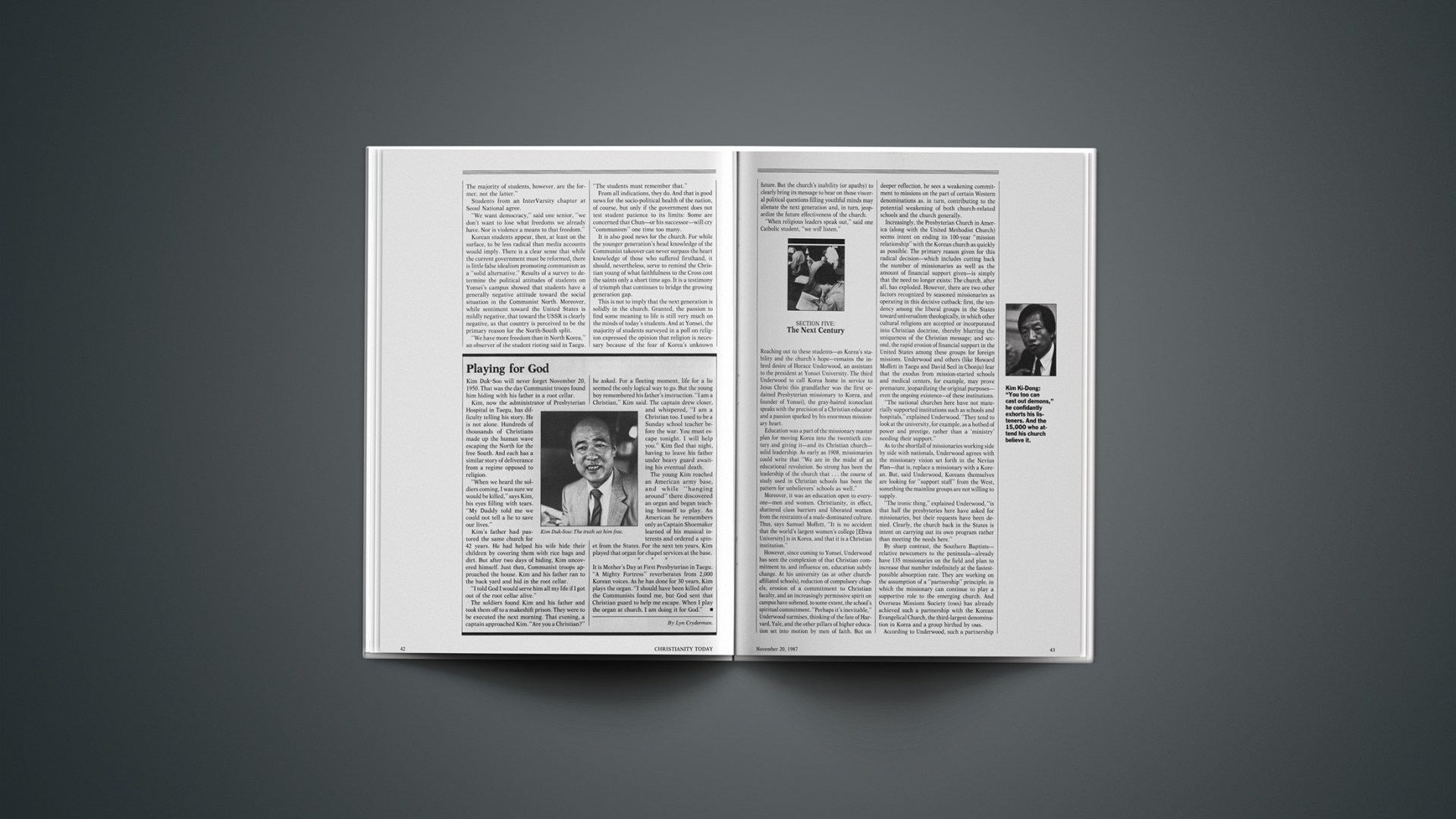
Kim Duk-Soo will never forget November 20, 1950. That was the day Communist troops found him hiding with his father in a root cellar.

Kim, now the administrator of Presbyterian Hospital in Taegu, has difficulty telling his story. He is not alone. Hundreds of thousands of Christians made up the human wave escaping the North for the free South. And each has a similar story of deliverance from a regime opposed to religion.

“When we heard the soldiers coming, I was sure we would be killed,” says Kim, his eyes filling with tears. “My Daddy told me we could not tell a lie to save our lives.”

Kim’s father had pastored the same church for 42 years. He had helped his wife hide their children by covering them with rice bags and dirt. But after two days of hiding, Kim uncovered himself. Just then, Communist troops approached the house. Kim and his father ran to the back yard and hid in the root cellar.

“I told God I would serve him all my life if I got out of the root cellar alive.”

The soldiers found Kim and his father and took them off to a makeshift prison. They were to be executed the next morning. That evening, a captain approached Kim. “Are you a Christian?” he asked. For a fleeting moment, life for a lie seemed the only logical way to go. But the young boy remembered his father’s instruction. “I am a Christian,” Kim said. The captain drew closer, and whispered, “I am a Christian too. I used to be a Sunday school teacher before the war. You must escape tonight. I will help you.” Kim fled that night, having to leave his father under heavy guard awaiting his eventual death.

The young Kim reached an American army base, and while “hanging around” there discovered an organ and began teaching himself to play. An American he remembers only as Captain Shoemaker learned of his musical interests and ordered a spinet from the States. For the next ten years, Kim played that organ for chapel services at the base.

It is Mother’s Day at First Presbyterian in Taegu. “A Mighty Fortress” reverberates from 2,000 Korean voices. As he has done for 30 years, Kim plays the organ. “I should have been killed after the Communists found me, but God sent that Christian guard to help me escape. When I play the organ at church, I am doing it for God.”

By Lyn Cryderman.

North American Scene from November 20, 1987

LEGISLATION

No Wombs For Rent?

Congress is considering legislation that would ban contractual agreements that involve payments to a surrogate mother. The bill, sponsored by U.S. Rep. Thomas Luken (D-Ohio), would also impose criminal penalties on people who arrange such contracts or advertise for prospective surrogate mothers.

“Surrogacy is a nice word,” Luken said, “a fancy word that is used for sugar-coating a practice in which the baby peddlers are involved in the business of selling babies.” A House Commerce subcommittee held hearings on Luken’s bill last month.

Harriet Blankfeld, operator of a suburban Washington firm that oversees surrogate arrangements, told members of Congress that the payment received by surrogate mothers is for their childbearing service, not for the baby itself. “We’ve had 49 births and no surrogate mothers who challenged the contract,” she said.

However, four surrogate mothers testified in favor of the ban on surrogacy contracts. “The economics of surrogacy in this country are simple,” said Mary Beth Whitehead, the surrogate mother who lost custody of her daughter in the highly publicized Baby M case. “The sperm donors are well-off, and the women they hire to bear their children generally are not.”

MAKING CHANGES

Proposed Methodist Hymnal

The United Methodist Hymnal Revision Committee has ended its controversial three-year task, producing what it calls a “populist” hymnal. The new hymnbook will be submitted for approval to the denomination’s general conference next April.

The United Methodist Hymnal is designed to replace the church’s Book of Hymns, produced 21 years ago. Many of the new book’s hymns contain changes to rid them of perceived sexism or racism. “Any time a new translation comes out that is this far-reaching in its potential, there’s going to be close scrutiny,” said hymnal editor Carlton Young. “… This hymnal is for more people than the other [hymn] book is.”

Whenever possible, the committee replaced the words “man” and “mankind” with terms such as “us” or “friends.” The committee also reduced the use of “his” or “him” when referring to God. And it injected alternative images for the deity—such as “Creator” and “Comforter”—to limit the number of masculine images such as “King” and “Father.”

None of the hymns in the new book refer to God as “she,” although a few refer to God’s motherlike qualities. But the committee left unchanged such favorites as “Rise Up, O Men of God” and “Dear Lord and Father of Mankind.”

SATELLITE PHOTO

Locating Noah’s Ark?

After analyzing a satellite photo of Mount Ararat, a Canadian clergyman says he has located the remains of Noah’s ark.

Edward Crawford, an archaeological illustrator and Presbyterian pastor in Edmonton, Alberta, said he discovered an unusual rectangular object that fits the biblical description of Noah’s ark. The object, which shows up on infrared film, sits about 2,000 feet below the peak of Mount Ararat.

During a visit to the Ahora Gorge region of Mount Ararat, Crawford said he examined cave drawings dating to about 4,000 B.C. He says he found a symbol for “star” or “God,” another indicating an event, and a third that could indicate a rainbow. The object Crawford believes to be the ark rests at the top of the gorge. He is planning a trip next summer to make an on-site excavation.

HOUSTON

Successful Youth Crusade

Sponsors of a recent four-night evangelistic crusade for youth in Houston say they were surprised at the results. More than 24,000 teenagers showed up for the meetings, with more than 1,600 responding to the invitations to get right with God.

Popular youth speaker and author Dawson McAllister preached at the meetings. “… I’ve never seen something quite like this before,” said McAllister, who has worked with youth for 16 years. “I saw rich kids and poor kids, rough kids, punk kids—all kinds of kids—coming down the aisle with the same determination to find God.”

More than 200 churches and Christian organizations from a variety of denominations sponsored the event. On the first night, about 500 teenagers responded to McAllister’s altar call. “We had about five students for every counselor,” said Mark Wright, crusade coordinator of counseling and assistant rector at Ascension Episcopal Church. “… We made a call from the stage for anyone who had been trained to lead people to Christ to come down and help out.”

To assure ongoing spiritual guidance, the names and addresses of teenagers who filled out cards at the crusade were sent to more than 200 churches throughout the Houston area.

PEOPLE AND EVENTS

Briefly Noted

Appointed : Country singer Willie Nelson, to the board of United Theological Seminary, a United Methodist institution in Dayton, Ohio. Seminary president Leonard Sweet, defending his choice of Nelson, said, “He may not have conventional piety, but I don’t know anyone who does have a conventional piety.” Nelson’s background includes a stint as a Sunday school teacher at a Methodist church in Texas.

Ended : A boycott of Mazda Motors of America, called by a coalition known as Christian Leaders for Responsible TV (CLEAR-TV). The coalition ended the boycott after Mazda agreed to reduce the amount of programming containing sex, violence, and profanity it helps sponsor on television. In July, CLEAR-TV ended a boycott of the Noxell Corporation after reaching a similar agreement.

World Scene from November 20, 1987

ANGLICAN COMMUNION

Not A Breakaway Bishop

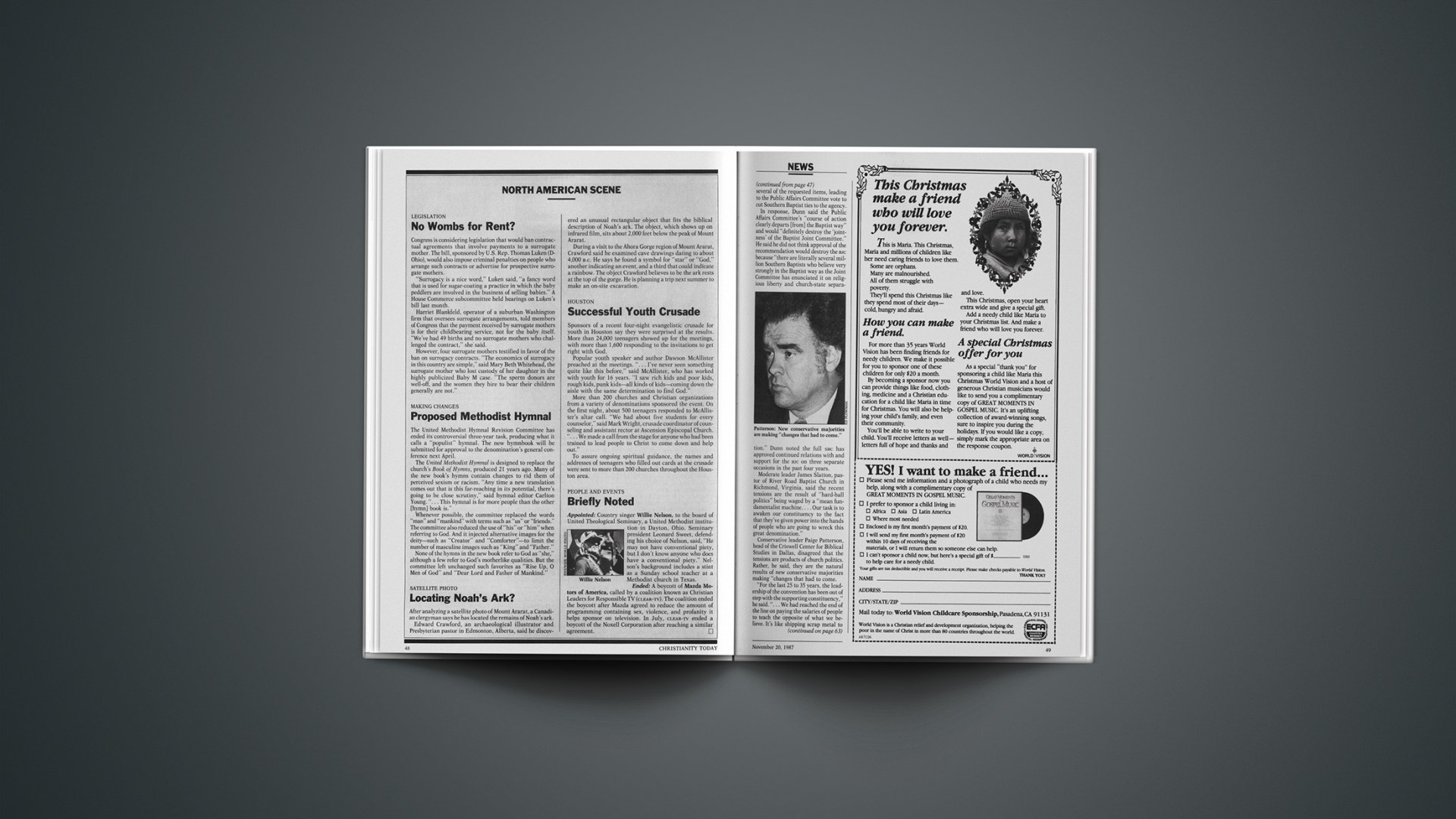
Although Church of England Bishop Graham Leonard has lent his support to a traditionalist movement in the worldwide Anglican communion, he says he is “not prepared to lead a breakaway church.”

Leonard, the bishop of London, is considered the unofficial leader of Anglicans in several countries who oppose women’s ordination, the acceptance of homosexuality, and the revision of the church’s liturgy. During a recent appearance at Westminster College in Fulton, Missouri, Leonard predicted new alignments across denominational lines among church traditionalists. “In time,” he said, “[the movement] could acquire the dimensions of a second Reformation.” He also praised a move to establish a central register of traditionalist Episcopalians in the United States. The registration effort is being coordinated by the Church Information Center and the United Episcopal Church of North America, which maintains a toll-free telephone number to sign up traditionalist allies. Episcopalians in the United States are part of the worldwide Anglican communion.

“… I am prepared to support others who support the orthodox Christian tradition,” Leonard said. “I would only define my role as being one of those bishops, of whom there are a number, who would be perfectly happy to be known as wanting to maintain the orthodox faith as we know it within the Anglican community.”

ECUADOR

An Indian Martyr

Antonio Zuma, a 28-year-old Quichua Indian who pastored a group of 80 Christians in Totoras, Ecuador, was killed in a mob attack during a Sunday morning worship service.

Zuma and others were attacked with boards and stones during a service at a church member’s house. The mob also destroyed the congregation’s unfinished church building and some of the believers’ houses, and stole many of their animals and other possessions.

According to Missionary News Service, the mob was incited by Catholic priests and owners of local bars whose business has been hurt by the growth of the church. Quichua Indians who have become conservative Protestants make up nearly 38 percent of Totoras’s population. Quichua Christians in several of Ecuador’s mountain provinces have been persecuted in recent years, including two believers who were killed in 1985.

SOUTH KOREA

Fueling Missions Efforts

Since Korea sent out its first cross-cultural worker in 1912, the country’s foreign missions force has grown to 511 missionaries serving in 47 nations.

According to Luis Bush, president of Christian Nationals Evangelism Commission, the number of Korean missions agencies has grown to 89, up from 47 just five years ago. Bush said the Korean church plans to send out 10,000 missionaries by the year 2000 and to have at least one missionary working in every country of the world.

SOUTH AFRICA

Nonwhite Church Merger

Two nonwhite Reformed denominations in South Africa have agreed to begin a merger process, but they will not try to include the country’s major white Dutch Reformed body. In the past, the white Nederduitse Gereformeerde Kerk (NGK) rejected all merger proposals from its nonwhite daughter churches.

The black Nederduitse Gereformeerde Kerk in Africa (NGKA) and the Nederduitse Gereformeerde Sendingkerk (NGSK), made up of mixed-race South Africans, hope to merge within five years. They plan to form a Dutch Reformed church that will be open to all races.

VIETNAM

Four Pastors Sentenced

Four clergymen in the Evangelical Church of Vietnam have been convicted and sentenced on charges of preaching against the revolution, organizing boat trips for refugees, and receiving U.S. currency from abroad.

Two senior pastors, Ho Hieu Ha and Nguyen Cuu Cuong, were sentenced to eight years imprisonment. Their assistants were sentenced to five years and four years respectively.

The senior pastors have been in jail since their arrest in 1983. The church formerly pastored by Ha was closed by the government. The cross was removed from the front of the building, which was turned into a center for the Communist Youth League.

Eighteen pastors of the Evangelical Church of Vietnam are known to be in prison, according to Reg Reimer, president of World Relief Canada and a former missionary to Vietnam.

WORLDWIDE

Growing Student Movement

Christian student groups from 13 countries joined the International Fellowship of Evangelical Students (IFES) earlier this year during the fellowship’s quadrennial meeting in Bogota, Colombia.

The new members brought the total number of national affiliates to 80, most of which represent Third World countries. One of the new IFES affiliates is a Christian student movement from Cuba, the first member organization from a Communist country.

At its quadrennial meeting, IFES made plans to expand evangelization efforts and to begin student ministries in countries not represented at the Bogota meeting. Some 100 countries still do not have an evangelical student witness.

IFES was founded in 1947 with 10 member organizations. Today it works with students in 130 countries. InterVarsity Christian Fellowship-USA is a charter member.

Ideas

The Laws Against Homosexuality

Homosexuality is growing rapidly in the United States even as the laws prohibiting it are being whittled away. An increasingly permissive atmosphere is bringing acceptance and even status to homosexual practices. A federal government panel has now urged repeal of laws against homosexual activity among consenting adults.

Scripture pronounces its own judgment on homosexuality and states clearly that those who practice it shall not inherit the kingdom of God. This sin, however, is only one of a number that Scripture specifically states will exclude one from God’s kingdom. In the matter of homosexuality, many Christians hate the offender as well as his sin. This the Bible does not endorse. Christ died to save the homosexual just as he died to save the liar, the cheat, and the adulterer.

Undoubtedly the earliest stringent laws against homosexual conduct sprang from the Hebrew-Christian tradition. Wherever Christianity was strong, laws against the homosexual abounded. In our day Christianity is rapidly becoming a minority faith, and with its decline has come a loosening of laws against sexual immorality. Even within the Church there is increasing moral laxity and adherence to situation ethics.

Although impressive arguments are now adduced to justify and legitimatize homosexuality, the Bible sounds a different note. Romans 1:18–32 shows that homosexuality is contrary to nature, and that it is part of the degeneration of man that guarantees ultimate disaster in this life and in the life to come. Homosexuality was one of the leading sins that brought about God’s final judgment on Sodom and Gomorrah.

We are quick to point out that the Gospel is for the homosexual too. But grace does not legitimatize what is sinful. The Church had better make it plain that Christianity and homosexuality are incompatible even as it proclaims deliverance for the homosexual from his sinful habit through faith in Jesus Christ.

Apple PodcastsDown ArrowDown ArrowDown Arrowarrow_left_altLeft ArrowLeft ArrowRight ArrowRight ArrowRight Arrowarrow_up_altUp ArrowUp ArrowAvailable at Amazoncaret-downCloseCloseEmailEmailExpandExpandExternalExternalFacebookfacebook-squareGiftGiftGooglegoogleGoogle KeephamburgerInstagraminstagram-squareLinkLinklinkedin-squareListenListenListenChristianity TodayCT Creative Studio Logologo_orgMegaphoneMenuMenupausePinterestPlayPlayPocketPodcastRSSRSSSaveSaveSaveSearchSearchsearchSpotifyStitcherTelegramTable of ContentsTable of Contentstwitter-squareWhatsAppXYouTubeYouTube