Let’s Not Just Praise the Lord

What is the proper place of those popular praise and worship songs?

Are we entering a “post-hymnal” age? As strange as it may seem, the answer for now appears to be a qualified yes.

It was Martin Luther who capitalized on the development of print and gave the German people the Bible and the hymnal in their own language. And it was this that allowed Reformation believers to hear God through his Word and speak to him through the hymnbook. Today, however, the hymnbook is being increasingly discarded as part of the church’s accommodation to the video revolution.

Many church leaders say traditional hymns are too hard to understand, too theological in language. Some have discarded their hymnals in favor of simple worship choruses sung from memory or with the help of an overhead projector. But these uncomplicated songs may in fact mirror the video age in which they were born: as short and encapsulated as news stories, and as repetitive as fast-food commercials.

Let us take a closer look at these “tiny hymns”—miniature both in length and in content—that threaten to replace our historic hymns. Their very title—“praise and worship” music—suggests they are principally texts of adoration and praise. This is surely commendable—despite their obvious limitations—and we should be grateful the movement has revived the ancient practice of singing Scripture verbatim. But labeling this new form suggests “praise and worship” texts are new, and that is surely not true—our hymnals are full of worthy “praise and worship” words.

These new pieces are short, often no longer than two lines. Their main characteristic is simplicity; usually only one idea is stated, and it may be repeated many times. Those having more than one “stanza” change only a word or two with each repetition. Nor is the music really contemporary in style. With a few exceptions (mostly borrowed from Jewish folk dances), the tunes and harmonies are ultrasimple in the gospel-song tradition.

Perhaps the best illustration of this is the popular chorus “Alleluia.” It repeats that word of praise eight times, using only four different melody notes and three chords. The second stanza repeats the words “He’s my Savior” eight times, with similar changes in the third, fourth, and fifth stanzas.

Before it appeared in print, the chorus was learned in a much stronger oral tradition. In it the words “He’s my Savior” of the second stanza were alternated with the word “Alleluia,” and so on. This version gave each stanza both unity and variety—an agreed norm for both a work of art and a folk hymn with its own artless charm. But then, it would not then be so simple—and today, simplicity is in!

Nothing New Under The Sun

But choruses are not new. They are the logical successors of the refrains of gospel songs and the “spirituals” (of both black and white heritage) that emerged from the camp-meeting revivals of the early 1800s. Furthermore, those well-known forms were patterned after the alternation of stanza and refrain that has always characterized secular folksong. A refrain would contain or suggest the central message of a song; then it was interspersed with stanzas elaborating on that theme.

In nineteenth-century revivalism, the refrains or “choruses” of gospel songs were often sung without using the stanzas. Simple songs—like “Draw Me Nearer,” “At the Cross,” “We’re Marching to Zion”—became even simpler: only the central thought was expressed. And they could be sung spontaneously, from memory.

So, who needs a hymnal?

The next logical step was to omit the stanzas completely, and simply write the refrain, or “chorus.” This was common in the 1940s in the Youth for Christ (YFC) movement. Choruses were standard fare in the Saturday night mix of worship, evangelism, and entertainment. But those choruses were quite different from today’s. They usually expressed the same concepts as their gospel song antecedents—narratives of Christian experience or devotional expressions directed to Jesus alone. Typical of these choruses are “Gone, gone, gone, gone! Yes, my sins are gone”; “I have the joy, joy, joy, joy, down in my heart”; “For God so loved the world”; and “Every day with Jesus is sweeter than the day before.”

These earlier forms were all products of renewal movements in the church—first in the highly emotional brush-arbor camp meetings of the early nineteenth century; later in the urban-centered “Second Awakening” under Charles G. Finney and the evangelistic efforts of D. L. Moody, R. A. Torrey, and Billy Sunday; and finally in the parachurch movements associated with Youth for Christ and radio evangelism. It should not be surprising that the new choruses first appeared as part of today’s charismatic renewal movement.

It may be argued that these new expressions are stronger than the YFC choruses, since they express adoration and praise rather than personal testimony. “King of kings and Lord of Lords, glory hallelujah,” “We have come into his house and gathered in his name to worship him,” “Don’t you know it’s time to praise the Lord,” “I love you, Lord, and I lift my voice,” and “Sing hallelujah to the Lord” are good examples. Many of these texts abound in Scripture quotations, especially the Psalms. Some, like “Worthy is the Lamb that was slain,” “Bless the Lord, O my soul,” “Thou art worthy, O Lord,” “I will sing of the mercies of the Lord,” and “Seek ye first the kingdom of God,” are taken completely from the Scripture.

Praising Praise, Worshiping Worship

Take just one of these refrains and compare it with the worship hymns it may be replacing. For instance, “Let’s just praise the Lord” seems to express a casual approach to the holy service of worship. The problem may be with the word just—as in “Let’s just sit down and have a cup of coffee.”

The following exercise might be more revealing if the words were spoken audibly, which the reader may or may not choose to do:

Let’s just praise the Lord!

Praise to the Lord the Almighty, the King of Creation!

O my soul, praise him, for he is your health and salvation!

Let’s just praise the Lord!

A mighty fortress is our God, a bulwark never failing,

Our helper he, amid the flood of mortal ills prevailing.

Let’s just praise the Lord!

Holy, holy, holy, merciful and mighty,

God in three persons, blessed Trinity!

Let’s just praise the Lord!

Immortal, invisible, God only wise,

In light inaccessible hid from our eyes.

Let’s just praise the Lord!

O worship the king, all glorious above,

O gratefully sing his power and his love.

Let’s just praise the Lord!

Great is thy faithfulness, O God my Father,

There is no shadow of turning with Thee.

The constant repetition of phrases such as “Let’s just praise,” or “Come, let us worship the King,” or “Don’t you know it’s time to praise the Lord” sounds more like an “invitation to praise” than praise itself. An Assemblies of God leader from India recently said his American friends seem to be “praising praise” and “worshiping worship.” But the larger hymns not only call us to adoration; they describe the excellence of God and recount his promises and mighty deeds—stating the motivation for worship.

The New Testament Standard

Some Christians prefer to be called “restorationist” because they believe they are returning to the worship and ministry experiences of the apostolic period. But how closely do they follow the early church’s standards for worship music?

The apostle Paul mentions three distinct types of song: “psalms and hymns and spiritual songs” (Eph. 5:19; Col. 3:16). We believe these were different types of music—in origin, in text, and possibly even in the way they were performed.

Psalms no doubt included all the psalms and canticles common to Jewish worship—the historic, classical worship expressions known to all Jewish Christians who had grown up hearing them in the temple and the synagogue: songs of praise and thanksgiving to Yahweh, didactic psalms, witness psalms, psalms of petition and lament.

Hymns were probably new songs that expressed the Christology of the new sect. A number of these hymns appear in Paul’s letters, written in the patterns of classical Greek poetry. Like many of the hymns of Martin Luther and Charles Wesley, they were written to express, and thus teach, Christian doctrine. One is in the form of a simple creed, or statement of faith:

Great indeed, we confess, is the mystery of our religion:

He was manifested in the flesh,

vindicated in the Spirit,

seen by angels,

preached among the nations,

believed on in the world,

taken up in glory.

(1 Tim. 3:16)

In another example, the poetic (and possibly antiphonal) form is obvious:

The saying is sure:

If we have died with him, we shall also live with him;

if we endure, we shall also reign with him;

if we deny him, he also will deny us;

if we are faithless, he remains faithful

for he cannot deny himself.

(2 Tim. 2:11–13)

The patristic fathers and modern musicologists both agree that spiritual songs described ecstatic singing that was either wordless or had unintelligible words—singing in tongues. It is the one type of New Testament song that belongs exclusively to modern-day Pentecostals and charismatics. But it is still fair to ask: How does the new music measure up to the total spectrum of New Testament musical practice?

The new chorus literature is—according to its title—exclusively “praise and worship.” But many would contend that if this is the church’s only song, praise becomes both simple and simplistic. On the one hand, we ought to rejoice that the movement has reinstated the practice of singing the words of Scripture. But Scripture choruses are but snippets of Holy Writ; their use may be compared to singing “proof texts.” On the other hand, Roman Catholics, by comparison, today sing or say major portions of a psalm in every celebration of the mass. Over three years, in just Sunday observances, over 150 different psalm passages will be used. Furthermore, modern choruses pointedly omit all the expressions of the didactic, the penitential, and the petitionary psalms, and contain nothing comparable to the psalms of lament. Nor does the new music make an effort to teach the doctrines of our faith.

Moreover, except for the Scripture fragments used, this type of contemporary worship tends to ignore the traditional forms that express the continuity of our faith and the perpetuity of God’s covenants with his people. The early Christians knew they were still the children of Abraham, Isaac, and Jacob—but also of David and Solomon and the prophets who left their songs to be sung in worship. The sixteenth-century followers of Luther understood that they had the same heritage, and they added the patristic and medieval hymns of Ambrose of Milan, Fortunatus, Gregory the Great, Francis of Assisi, Rhabanus Maurus, and of the two Bernards—one of Clairvaux and one of Cluny.

Until recently, evangelicals acknowledged in their music their identity with the same family tree, and we added the hymns of Luther, Gerhardt, Calvin, Wesley, Newton, Bonar, and many others. When we stood to sing their songs, we were joining our own spirits and voices with theirs and the thousands of believers who followed in their train, exulting in the glory and redeeming love of God. And our faith was strengthened. Today, some of our family of faith seem to be willing, even eager, to discard this heritage for a simpler fare that may disappear as suddenly as it has flowered.

It is probably true—especially in our less-literate day—that many worshipers have difficulty finding their way through the phrases of a standard hymn. But should we reduce our liturgical statements to those that every person, of any age, will understand immediately? The answer, of course, is no. Like the ancient creeds of the church, like many passages in Scripture—like even the Lord’s Prayer—we repeat them because the historic and continuing church has found in them its understanding of our faith. Their meaning comes to us slowly, but surely. And in the meantime, their truth has been preserved for us and for our children. It is still true, as C. H. Sisson said, and Brian Morris quoted in Ritual Murder: “There is no such thing as passing on profound truths in superficial speech.”

Using The New Music Well

An increasing number of church musicians admit they have reluctantly added this music style to their worship resources. They felt compelled to do so by the large number of folk who heard “praise and worship” music in another “successful and rapidly growing” church, and came home with glowing reports of its significance. Competition, after all, is a factor in church life today: If you don’t give people church music they want, they may go down the street where they can get it.

In a recent article, “What to Do with Church Hoppers,” William Self, pastor of Wieuca Road Baptist Church in Atlanta, said: “I’ve been hammering my folks with the need to be steadfast, unmoveable, always abounding in the work of the Lord—not a popular theme in these days of rootlessness. Somehow, we have to make disciples instead of inspiration junkies.”

Disciples, of course, are people accustomed to discipline. And how many of our folk understand that the central requirement of worship is not “getting a blessing,” but giving God an acceptable sacrifice of praise? A true sacrifice is always a costly thing, not a demand for instant gratification of our pleasure needs.

Even so, it may be wise to use the best examples of the new music. It is surely an appealing form in our day and probably an example of the folkish styles that tend to appear in times of spiritual renewal. The “tiny hymns” are quite ideal for an informal service in the home or on the beach, for Sunday evening worship or the prayer meeting. In regular worship, these choruses can be used much like the historic antiphons, preceding and following a more serious, more didactic hymn.

For instance, “Let’s Just Praise the Lord” could provide an introduction and coda to the chorale to which we compared it—“Praise to the Lord, the Almighty.” The chorus “He Is Lord” would help prepare the congregation for the biblically based, theologically rich hymn by F. Bland Tucker, “All praise to thee, for thou, O King divine, didst yield the glory that of right was thine, that in our darkened hearts thy grace might shine. Alleluia!” Others would serve well as preparation for, or a response to, the pastoral prayer.

Some churches are using this music as “preparation for worship.” In our evangelical tradition, the organ prelude is, unfortunately, not used as an aid to quiet meditation, serving merely as background—even as competition—to the noisy “fellowship” that seems to be the first priority for many. So in some churches, these “tiny hymns” are sung for about ten minutes before the service begins. As a result, conversation ceases and there is opportunity for a gradual quieting of the spirit and focusing of the mind in preparation for the meeting with God. When the service begins, using the standard hymns of the church in good liturgical design helps to make their meaning clear.

Must Our Worship Be Nonliterate?

We cannot expect this generation to respond to hymns that are rich in content unless they are taught carefully and used convincingly. The shallow-but-pleasurable emotional response to worship choruses is derived from the repetition of a few simple phrases. Those who expect worship to be more reasoned and rational must patiently and lovingly introduce their people to the deeper emotional resources of words that will truly challenge and stimulate the imagination. Texts of great hymns have done this since the sixteenth century, and they still have the power to do so—even in this post-Gutenberg era. Perhaps we can use our new nonverbal languages to clarify the meaning of words, and vice versa.

It may also be argued that the younger generation is “turned off” by certain classic hymns that contain obscure and/or archaic language. Hymnal editors are encouraged to revise the texts of older hymns to match the new Scripture versions and modern prayer language, so that God is addressed as “you” instead of “thou.” Many churches would also insist on the elimination of sexist language pertaining to people; for example, “Good Christian Men, Rejoice” is easily changed to “Good Christians All, Rejoice.”

Church musicians and ministers should also get to know the rich new hymns being produced today. It is ironic that many churches overemphasize ephemeral, simplistic materials and ignore the “explosion” of exciting new hymns being produced in Great Britain and North America by Timothy Dudley-Smith, Bryan Jeffrey Leech, Margaret Clarkson, Fred Pratt Green, Bryan Wren, Christopher Idle, and others.

Turn Off The TV!

A recent public-service announcement aired on NBC Television offers some sound advice. In it, Steve Allen, the gifted musician and comedian, appears and says: “Don’t let television dominate your life. Walk over and turn the … thing off. Get a good book and read it!” Perhaps, for us, that book might be a hymnal, a stimulus to aid our personal worship.

This practice was common in earlier times, when worshipers carried the hymnbook, as well as the Bible, to church. At home it was used for singing in family worship and for reading in personal devotions.

A good hymnal contains many paraphrases of Scripture and is a compact handbook of Christian theology in poetic form. It also includes noble examples of all the forms of prayer with which we respond to God’s self-revealing—adoration, confession, thanksgiving, petition, supplication, surrender, and dedication. It can supply thoughts and words to express our devotion when we have difficulty finding our own. Used regularly, it enlarges and enriches our personal vocabulary of worship, and—when we meet in church on Sunday—helps us sing the hymns with joy and understanding.

Donald P. Hustad is senior professor of church music at Southern Baptist Seminary, Louisville, Kentucky, and author of Jubilate! Church Music in the Evangelical Tradition.


An Eye on the Cradle

There are plenty of reasons to worry in our bleak world. How could Jesus expect us not to?

From a sermon delivered at Saint Peter’s Episcopal Church, Hillsdale, Michigan, upon the baptism of Jacob Stewart Roche.

It was some 40 years ago, but I remember it well: a baby’s cry at three in the morning. I reached out my hand, rocked the cradle, and groggily assured our firstborn that his daddy was near and that all was well: “Sleep, baby, sleep. Don’t worry about a thing!”

I recalled this nightly exercise the other day when I read the Sermon on the Mount and noted again how, almost repetitiously, Jesus exhorted his disciples: “Do not worry” (Matt. 6:25, 31, 34), and “Why do you worry?” (6:28).

At the beginning of the twentieth century, many theologians and philosophers also were saying, “There’s nothing to worry about.” They said it, however, on foolhardy assumptions, like that of the essential goodness of man, the inevitability of progress, and utopia-just-around-the-corner. Swiss theologian Karl Barth preached that optimistic view until he was suddenly shocked awake.

The steady loss of young men from his congregation and the ever-increasing black armbands worn by women whose husbands and sons and sweethearts would never return from the battlefields of World War I shattered his confidence in the future. Barth then read and reread Paul’s epistle to the Romans. There he found plenty to worry about: the sinfulness of man, the perversity of history, the dread judgment of a holy God, man’s need of supernatural salvation.

Some years ago, while lecturing abroad, I lodged with a professor friend in Seoul, Korea. One Sunday morning as he left very early to preach at an army compound, he said, “Don’t worry about a thing!” Soon I heard strange noises in that unfamiliar home, and on investigating found that water pipes in the basement were leaking—in fact, leaking furiously.

Mrs. Henry and I set to work at once emptying pans and then pails of water as we tried to cope with a situation that worsened steadily, for in that maze of pipes I could not find the master control. “Don’t worry about a thing” is scant comfort when one is caught in a swirl of circumstances that seemingly have no purpose and are indifferent to personal expectations.

It is that way, too, when modern scientism postulates a universe without purpose, regards man as an accidental by-product of an evolutionary explosion, and engulfs human personality in a network of impersonal processes. Someone has called this an effort to capture the real world in a laboratory test tube. It leads to the contemporary creed, “I believe in Big Bang yesterday, in Big Brother or Big Bucks today, and in Big Blank in the life to come.” Adept at controlling cosmic power, scientism is a stranger to moral and spiritual power. Once hailed as the biggest advance in Western civilization, the Atomic Age now cannot cope with nuclear waste and even trembles as the clock of destiny ticks, perhaps relentlessly, toward nuclear midnight.

“Sleep, baby, sleep! Don’t worry about a thing!” No, Jacob Stewart Roche, there is much to worry about; there is good reason to cry in the night. The prophets of liberty are vanishing, the freedom is fragile and not self-sustaining. Predatory powers are restless for world revolution. Totalitarian nations have gulags. And free world nations mortgage their future by spiritual neglect.

Sooner than you know, Jacob Stewart, you may need to decide whether some ideals are worth living for, even worth dying for. You will need to decide whether to betray or to augment the great moral and spiritual heritage of the West. Someday you must decide between deities true and deities false, and choice of the wrong God will lead to a dead end for human worth and destiny. We refuse to yield you to a world of chance, change, relativism, and skepticism; we who cherish you, claim you instead for the living Lord, for God the Creator and Redeemer and Judge.

When Jesus said, “Do not worry,” he knew only too well the horrendous reality of evil and the dread depth of the human predicament. He knew the whole range of earthly anxieties: “The pagans run after these things” (Matt. 6:32), he said, the things they made their priorities—food, raiment, survival.

But when Jesus said, “Do not worry,” he was reassuring disciples and believers, not pagans. Put first the kingdom of God and his righteousness, he said, and everything else will fall into place. “Do not worry.”

His point was not that natural evils and moral evils do not exist, or that believers will be spared hardship and pain and suffering. In Jesus’ day, anesthesia and antibiotics were unknown; pain was unmitigated pain, and suffering was unmitigated suffering. Saul of Tarsus wrote, moreover, that the apostles were perceived as “men condemned to die … a spectacle to the whole universe … fools for Christ … the scum of the earth” (1 Cor. 4:9–13). He suffered political injustice, and at the height of his career was confined to the Mamertine prison. When you are in Rome, see for yourself what sort of hellhole it was.

What Jesus taught his disciples was to put God first and to subsume all else under him: Caesar, survival, money, status, power, everything. Caesar has his place, but there is one Lord, the Lord Jesus Christ; survival has its place, but he who clings to physical life above all other values betrays eternal perspectives; mammon has its place, but love of money is a root of evil; other things have their place as well, but life’s true fullness does not consist of an infinity of sex, of status, or of things.

Accordingly, the early Christians anchored their lives to three great certainties:

  • They knew that—for the believer—the worst that can happen is already past. God had already judged their sin and Christ had borne it; they had made their own the redemption that is in Christ Jesus. They knew Jesus as “the way to the Father.”
  • They knew that—for the believer—however dark it may be, the present always has a brighter side. And we know that “in all things God works for the good of those who love him, who have been called according to his purpose” (Rom. 8:28). For Paul, the “all things” of Romans 8:28 included even “the things that happened” to him in Rome (Phil. 1:12), including his imprisonment and eventual execution by Roman soldiers. As the psalmist put it: “He alone is my rock and my salvation; he is my fortress … trust in him at all times” (Ps. 62:6–8). God is the God of all seasons and the God of “all things.”
  • They knew that—for the believer—the best that will happen lies in the future. Even sudden death is sudden glory, for to be “with Christ” is “better,” yes, “far better,” than what this earthly life offers (Phil. 1:23).

When Jesus impressed these truths on his disciples he was poised on the very brink of eternity. It was while on the way to the cross, to his own crucifixion, that he told his disciples to believe in God and also in him, the Redeemer Son. On the way to the cross it was Jesus who had peace, whereas the disciples, although not facing crucifixion, had troubled hearts. To those troubled disciples and to us as well Jesus bequeathed his own unique peace: “Peace I leave with you; my peace I give you. I do not give to you as the world gives you” (John 14:27).

I tell you that a peace that can look beyond the terrors of crucifixion to resurrection morning—a peace that can see in the very death of the cross itself God’s victory over all that would put an end to Christ’s cause, and the conquest of death itself—is a peace adequate for any exigency that you or I will ever be called upon to face. On that cross, divine mercy triumphed; by the Suffering Servant our debt was paid.

Abba, Father—literally, in Aramaic, Daddy—has his eye on the cradle of his children. When we cry in the night, a nail-pierced hand beckons us not to worry. “My peace I give you,” said Jesus. “Do not let your hearts be troubled and do not be afraid.”

“Why do you worry?”

Carl F. H. Henry was editor of Christianity Today for 12 years and is the author of more than 40 books, including the six-volume God, Revelation, and Authority (Word).

Gentle into that Good Night

Recently my father composed and posted a letter to his seven scattered children, a formal letter containing the sort of news that makes common relationships suddenly formal, that strikes life itself with a grave formality and contemplation.

I read the letter. I learned his news. I did not deny the news, but allowed myself to experience it. I suffered the news to consume me with its implications. And in the end—precisely because of that news—I realized what a genuine, holy, consoling gift my father had been bequeathing me all the days of my life, though I had not known the gift nor its perdurable power until that letter, this news, and this, the forty-third year of my maturity.

My father had been setting me free.

He is nearly 70. Threescore years and ten. He is “Walter,” as was his father before him—as am I, the oldest of his children. And I sign myself a “junior” always, in every public place, to honor our common name. “There are two of us,” I say with my signature. “When you see me, you see evidence of him; and I shall, however long he lives, however long I live thereafter, be his junior.”

When he was much younger he used to brush his hair into a peculiar swirl at the peak of his forehead—a brown cone fixed front like a miner’s lamp. For me that swirl was as needful and as comforting as a nightlight, because it was ever the first sign of my father’s presence. There were summer afternoons when he would take me shopping, when I would lose myself among the comic books, lose all sense of time, and then look up to find my father gone. My heart would begin to buzz like a bee in a bottle and my limbs go limp with panic. I would stare down the aisles of the alien store, struggling not to cry. I would scan the top of the crowd, the heads of the shoppers—their hair.

There were Sunday evenings when my mother and I would drive to the airport to meet my father after a week away, when we would pass down long halls loud with belligerent sound, bright with a bloodless, fluorescent light, brutal with herds of stampeding strangers, and I would diminish in such an unfamiliar place. I would grow smaller and smaller and ever more fearful—until my mother squeezed my hand the harder and whispered, “There. There he is. There’s Dad.” And then I would stand tiptoe and scan the top of the crowd, the heads, searching for that peculiar swirl of hair.

When suddenly I recognized it (five miles away), the whole world changed in an instant, became kindly and familiar, and I would let go my mother’s hand and run.

The sight of my father’s curl set me free in an airport. Or I would race up the aisles of strange department stores, as bold as any citizen, because I had seen the sign of my father. That cone of hair consoled me, that looping curl alone. Where it was, he was. Where he was, I was home.

But in the years of my childhood my father was often gone indeed. He traveled for days and weeks at a time—and then I knew the intensity of my longing for him by an odd trick of the air of our house, a trick I fell for every time. His study lied to me, and I believed the lie. Whether he was working at his desk, or whether he was absent altogether, Dad kept the door to his study closed; that, perhaps, abetted my deception.

I would be involved in some common thing, playing in the living room, descending the staircase that ended at his study door, eating lunch as blithe as a child, and busy. It would be morning and sunlit. The house would be murmuring sounds of active contentment, I unconscious at my business—when all at once, as clear as a radio, I heard my name called: “Wally!” This was my father’s voice. It came directly from his study. It named me just once—“Wally!”—as though he needed me. And I would rise without another thought but that my dad had called. I ran.

I thumped the study door and entered the room, and found it empty. Always, the room was terribly neat and terribly still and vacant. But someone had called me in my father’s voice. No, no one had called me. I would stand in front of his desk, adjusting to the silence, and like a pragmatic adult would school myself in the truth that, no, my father was gone. My father was traveling. Something else—the study, the air, or my own desire—deceived me. Nobody had called my name. Merely: I missed him.

We lived in an enormous house, in those days, as dark in its depths as a cave.

But on another day my mother would say, “Dad’s coming home today,” and that day would snap into a perfect pattern, and I had a job to do.

“When is he coming?”

“I don’t know, Wally. This afternoon.”

In fact, the time didn’t matter. On such a day, the whole day through, I would enact my infant loyalty, my absolute faith in my father, my love, and my reason for being.

Straight from breakfast I shot outside to the street in front of our house and took up a position on the curb, from which I could keep the length of the street in surveillance. I sat, and I stayed there. I stayed there while the sun went from my back to the front of me. I stayed there full of happiness and hope, stayed there like a junior gargoyle fixed to the concrete. And this is what I did: I grinned and waved at every car that passed—but watched for one in particular.

I gathered bouquets of waves in return: all the world must have known who drove not far behind. I classified the various kinds of waves that humans could produce. I showed an astonished patience, but that came of the faith that Dad was on his way in a green Chevy station wagon; and until that car turned onto Reeves Drive, I was content to be nowhere but there, where I would be the first to see him.

When it did, finally, nose underneath the gracious trees, the reflections of leaves slipping up its windshield, neither patience nor chains could keep me seated, but I leaped and ran into the street and peered through the coming window and recognized among the leaves that signal swirl of hair and then the smiling face below, and I was glad. Dad was home.

Silly memories. A boy clasping his hands like prayer and bowing and laughing in the middle of the street. A boy like exhaust smoke trailing a Chevy up the driveway. A boy demanding that his father immediately be seated in a chair at a desk, that the boy might only gaze on him in that place, and on his hair.

Foolish memories.

Dad and I are older now, the both of us. My sisters and brothers, his children, are so far scattered round the world that he had to send his formal letter to the Sudan in Africa and to Tombstone, Arizona; to Denver in Colorado and Clearwater, Florida, and here, to Evansville, Indiana, the house on the corner of Chandler and Bedford.

He is threescore years and ten. Not so old, though, that he no longer works. On Sundays my father still preaches in rural congregations that lack their own pastors. Do they know the treasure they are getting? He brings to these little parishes the garnered wisdom of a long career; for he has been, in his time, a college president, an editor of Christian educational books, a professor of theology, the founder of a liberal arts college in Hong Kong, a pastor. Do they know the gift he offers them? Well, I think so. Because all his wisdom, all his experience is nothing without the thing that sustained his career from the beginning, the thing he gave his son even in the early days. About this thing my father has never been coy or secretive.

He brings to the little parishes his core self, his holy, sweet stability—his faith. They cannot mistake it. Perhaps he uses a different language now than he did in the past. Long experience will surely enrich the words. And perhaps, since the people he preaches to are farmers and ranchers, while I was just a kid when I listened, I wouldn’t recognize the images of his present homiletics. But I would certainly recognize the flash in his eye and the intensity of his tone—just as the farmers see the flash and the ranchers hear the tone. Because this thing remains the same today as first I saw it in his fatherhood and in my childhood: that he trusts absolutely in the Cross of Jesus Christ, the forgiveness and the promise of that Cross. This caused his career in the first place. This he gave to me. And this he brings to 30 people in a rural pew with as much commitment, dash, and preparation as though they were 3,000 in an auditorium: Liberty!

He brings them his faith.

What he no longer brings is the swirl of hair by which his son once spied him in a crowd. He has developed a very high forehead, now; and the few hairs left above it he combs straight back. They are white. And the sides of his head, they are snow white.

In his formal letter to the seven scattered children, my father wrote that he had passed a kidney stone; that the physician was moved, in this event, to examine other parts of his person; that his prostate gland was found to be enlarged; and that a biopsy of the gland revealed a malignancy. Dad has cancer of the prostate.

What, then, shall I do? Shall I in any manner deny my father’s age? Shall I assume the sunny disposition that asserts with grim grins only good things, nothing bad? All Will Be Well. You’ll be fine, Dad. This is an easy cancer to treat. I can name a happy host of men who lived years and years behind this piddling sort of tumor. You will not die. You will never die. My father shall never not come home again. Shall I prison myself in even the kindly lie?

What shall I do? Shall I shrink from the specter that promises to turn me into a little child again? Shall I shrink from death? From the certainty of my father’s death—and the possibility, now, that it could be sooner than later?

Even at this distance, death makes me the boy who heard his name called from an empty study: “Wally!” I need you. I will run into his room, but he won’t be there and his desk will be too terribly neat. Death makes me a curb sitter, a watcher on the street forever, waving at every car that passes, except the one that isn’t coming. What shall I do? Shall I reject these feelings and deny the incipient stabs of missing him? Shall I turn away from the truth of my father’s present condition, and the truth of my father’s future, soon or late? Well, if I do that, I turn away from my father as well, since this is who he is now. I divorce me from him. I prison out love in my own deceptions, and I become for him a fraud, no healer and no help at all.

Then what shall I do?

Why, now, when death has taken a face and found a foothold in his body—now especially—I will invoke the gift my father has given me all along. I will act in liberty, free from the need to lie, free from fear. I will myself benefit from my father’s abiding, unhidden faith in the promises of Christ: that is his chiefest gift to me, most practical right now, empowering me to benefit him.

For 43 years, consciously or not—it doesn’t matter—my father has been preparing me for this crisis; and it is right to plead with every Christian parent: Please, never make a secret of your faith! For the sake of your children, against the day when you will surely die, in order to transfigure then their grief into something more healing than destroying, assure them with cheerful conviction, even in the good, green days of their childhood, that you live and you shall die in the arms of Jesus, in whose love is life and everlasting life. Let them know that you know. Your knowledge shall be their precious gift. Their freedom.

Walter Wangerin, Senior, clings like an infant, simple and unashamed, to Jesus Christ. Walter Wangerin, Junior, has always known that. For the son, then, there are no final terrors in his father’s death, and he may gaze at the approach with clear eyes, undeceived and undenying. This is the gift, revealed in my reaction to a formal letter. The son need not shrink backward, but may companion his father even in this trip—to the door if not through the door.

All my father’s wisdom falls away, all his successes and his accolades. His long career becomes a dust, none of it a consolation now. And the swirl of hair is gone; it cannot comfort me. He is reduced, whenever his end shall come, whether sooner or later, to the flash in his eye, the intensity of his tone, and the joy with which he looks to meeting Jesus face to face. This excites him still: that God will touch the tears from his cheeks. This faith endures. This is the sign of my father now, infinitely kinder than a looping curl of hair.

I believe his believing. If his dying doesn’t destroy him, it doesn’t destroy me either. If it is for him a beginning, it can be for me a passage and a patience. I can sit on the curb a long, long time. I can sit till the kingdom itself turns onto Reeves Drive in the shape of a Chevy. Hope keeps me there. Hope has a marvelous staying power.

I don’t mean, in any of this, to sound unrealistic: I will mourn my father when he dies. I will miss him grievously, and the empty air will wound me, calling “Wally!” when no one is there. I will cry. I know how to cry. But I will not grieve as those who have no hope, which is the killing grief, which is despair.

And this is the evidence of our common, hopeful, liberating faith: that I am writing to you now, my father, my senior, this letter fully as formal as the letter you sent to us, fully as honest and unafraid as yours. On behalf of the seven scattered round the world, I send you our thanksgiving. Whenever it must be, dear Father, go in peace. You leave behind a tremendous inheritance, and sons and daughters still unscarred. Go, Dad. We will surely follow after you.

Walter Wangerin, Jr., is the author of the award-winning novel The Book of the Dun Cow (Harper & Row). His latest books include As for Me and My House (Thomas Nelson) and a collection of poetry, The Miniature Cathedral (Harper & Row).

The Graying of the Church

What kind of ministry awaits the growing ranks of retirees?

I recently attended a conference at which Christian “senior leaders” discussed what would be their legacy to a younger generation. White-haired gentlemen greeted each other with backslaps; they had known one another for a long time, or at least had read each other’s books.

Many of these men still led sizable institutions. Yet they did not act like a small club trying to hold on to dwindling power. They spoke keenly of the demands of our times, and seemed anxious that a younger generation be empowered to tackle them. “Whether we like to admit it or not,” several said, “our day is coming to a close.”

Such magnanimity often characterizes the elderly. In my own church, seniors are among the fiercest in insisting that we have an outstanding youth program. As they put it, “The young are the future of the church.”

While admiring this generosity, I believe it has become dangerous—an old virtue out of place in these new times. For it assumes that the world belongs to the young, and that the elderly may (and should) retire into the background.

Yet America increasingly belongs to the old. Those white-haired leaders, ready to retire into the pleasures of travel and golf, are far from finished. In 1933, when the new Social Security Administration set the age of retirement at 65, most 65-year-olds were within a handful of years of death. Now, 65 is quite young. The average American, retiring at 63, has between 15 and 20 years of good health ahead. If seniors opt out of the challenges of the coming century, if they retire into senior hedonism and toss away a quarter of their adult life, we will lose our wisest, most experienced leaders before their time.

And if the church neglects the elderly, overlooking their needs and their potential because we are so used to focusing on young families, we will miss a key opportunity. In a rapidly increasing sense, the old are our future.

Nearing The Peak

Today about 11 percent of Americans are over 65. That proportion will gradually rise over the next 15 years, and take a big jump when the baby boomers start turning 65, in 2010. Meanwhile, Americans have not been reproducing at a rate that would replace themselves. Ultimately, the proportion of seniors should peak between 18 percent and 22 percent—about double what it is today.

Many churches are already there. James Ellor, professor of human services at Chicago’s National College of Education, has found that in any given American community, church attendance will include about 10 percent more elderly than the community at large; thus, if a certain town has the national average of 11 percent over 65, its churches will be about 21 percent elderly.

The mainline denominations particularly confront aging membership. About one-quarter of Presbyterians, Episcopalians, and Methodists are over 65, and about half are over 50. These denominations are consequently doing the most to organize ministry with the elderly. A Methodist seminary, Saint Paul’s in Kansas City, has the nation’s first endowed chair of gerontology at a seminary. The professor, David Oliver, says that some of his students will have ministry experiences in rural churches where 100 percent of the congregation is over 65. There are some churches in the Sun Belt, ministering to retirement communities, that are also overwhelmingly made up of the elderly.

Crises And Miracles

The aging of America will pose national crises of two kinds. The most obvious is financial. The twin miracles of social security and Medicare, combined with huge tax breaks for pension plans, have made older citizens better off than the population at large. A significant minority remain tragically poor, without even the theoretical possibility of working their way out of poverty. But 20 years ago the elderly were poor as a group. Now they are, by some measures, the wealthiest sector of America. The difference is almost entirely due to government spending. Let no one say that you cannot solve poverty by throwing money at it. We did.

This huge cash transfer was almost painless because it coincided with the coming of age of the baby boom. A rapidly expanding labor force made it possible to spread the increasing cost over a growing pool of workers. Now, however, the field has begun to reverse itself. When the baby boomers hit 65, something will have to give. It is projected that payroll taxes for social security would reach 25 to 30 percent just to maintain the current level of benefits. This could provoke a major crisis—perhaps even a conflict between the generations.

But another, subtler crisis could come: a crisis of national self-image. Americans have seen themselves as idealists—the “city on a hill” image—and as pragmatists—the “can-do” image. It would be difficult, given our current way of thinking, to associate either image with a nation dominated by retirees.

We have seen how the baby boomers skewed the thinking of the nation toward each generation they were passing through: toward family life when they were children in the fifties, toward idealistic protest when college students in the late sixties, toward economics and entrepreneurialism when young workers in the eighties. Toward what will this lean when they are retired? Golf? It is hard to imagine, today, that an old America will find it easy to think proudly of itself, or to feel purposeful. We will need a better interpretation of what it means to be old.

The church should lead in this reinterpretation. But right now it is part of the problem. Carol Pierskalla, who heads senior programs at American Baptist headquarters, complains, “I hear pastors say, ‘What can I do with this church? I look out and see that all the heads are gray.’ It’s that kind of ageism that will do us in.”

Fortunately for us, that kind of ageism is not found in Scripture, not in one single verse. We have a source of guidance to help us change our thinking.

The Church’s Response

How should the church respond to the aging of America? No doubt Christian bodies will have some voice in shaping national policies, in building better housing, in making government bureaucracies responsive. But the church’s major role must surely be the one it has always done best: interpreting and embodying the true meaning of life through Jesus Christ.

Aging in modern America has two distinct characteristics. First, for the majority, it is leisure: premature and long years of leisure by the standards of all earlier eras. (Seniors may be very busy, but they usually have considerable choice in how they spend their time.) Then, for at least a large minority, aging is distinctively loss, usually gradual and cumulative over as much as a decade. And unlike Horatio Alger, unlike Scarlett O’Hara in Gone with the Wind, unlike refugees from war-torn Germany, these losers will never make a new start.

As aging is both leisure and loss, so the church’s response must be in two kinds. First, older Christians must make something purposeful of this long stretch of life called retirement. Second, older Christians must find meaning and spiritual growth through the losses that often accompany their last years on Earth. These responses are essential if we are to reclaim the biblical idea of old age as a blessing (Exod. 20:12; Job 12:12).

While many church programs begin by concentrating on ministry to the dependent elderly—the homebound or those in convalescent hospitals—there is increasing recognition that most of those over 65 are hale and hearty.

Church ministries specially designed for the “young old” typically involve Sunday school classes, a midweek luncheon or Bible study, educational trips, and retreats. These programs may appear to be like entertainment-oriented youth programs; but they fill an especially important role in the life of seniors. Aging people often find their circle of human contact limited by the fact that they no longer work, that they are less able or motivated to get out, and that their circle of friends has begun to die off. Social contact is a vital need.

But few people involved in seniors ministry are content to provide only social programs. Says David Oliver of Saint Paul’s Seminary, “When I first came here everybody was talking about ministry to the aging. Now it’s shifted to ministry with. I’m thinking maybe we need ministry from. They probably can teach us more about our faith than anybody. Who else has been in relationship with God longer?” Adds Pat Parker, who ministers to older adults at Pennsylvania’s Drexel Hill Baptist Church, “It’s the retired in our churches who have the time to give to the community. I get really upset with pastors who say, ‘Oh, my congregation is all gray-headed.’ That’s where your money is, that’s where your energy is. Young people have energy, but we don’t have it to give to the church.”

The most common way of using retired people in the church is to involve them with ministry to those still older than they—to visiting the homebound, for instance. Presbyterians have launched the “Gift of a Lifetime,” a kind of VISTA program in which retired people volunteer two years to go to another church and develop ministry to the elderly. “Part of the issue is a call to older people, ‘What does the Lord require of you?’ ” says Thomas Robb of the Presbyterian Church (U.S.A.) Office on Aging. Adds psychologist Coleen Zabriskie, “I don’t see any permission in Scripture for us to retire from serving the Lord.”

Others emphasize that the elderly should not merely minister to one another; they see intergenerational programs as crucial for breaking down the age-biased thinking of old and young alike. Harold Hinrichs, director for Family Life and Aging of the American Lutheran Church (now the Evangelical Lutheran Church in America), suggests that “One of the main gifts of the elderly, spiritually, is reminiscence. They don’t need to reminisce just with older people but with younger.”

His main emphasis has been to bring the generations together in worshiping communities—small sharing groups that follow a carefully structured weekly program for celebrating the Eucharist together. Other churches organize “Adopt-a-grandparent” programs, or send youth groups to interview older church members.

Not only do the elderly have great potential to serve, they have greater availability for spiritual development. Ed Powers, a gerontologist at Iowa State University, says, “Now you can say, ‘We’re going to get together two nights a week,’ and nobody says, ‘We need babysitters.’ We don’t have people saying, ‘I can’t do that because I work until 7:00.’ The opportunity exists for servanthood and spiritual development on a scale that we have not envisioned.”

Yet it is often the old who disqualify themselves. “There are two barriers I’ve seen from the start,” says David Jobe, pastor for senior adult ministries at First Evangelical Free Church in Fullerton, California. “One is, ‘I won’t get involved because I’ve done my part.’ The other is, ‘I can’t. I couldn’t do that, I’m too old for that.’ ”

“Often older people pull back in retirement and rest,” notes Janine Tartaglia, of Pasadena’s First Nazarene Church. “That’s okay. There’s a place for rest. We need to retreat. But we need to remember that we shouldn’t go into retreat forever.” She recommends that churches help people plan in advance what they want to accomplish during retirement.

Many pastors to the elderly also encourage retirees to plan for their own death or disablement. Not only is there great practical value in thinking through funerals, wills, and the degree of medical intervention they wish in the event of a serious disease. The planning process may also deepen spiritual growth, as the older Christian confronts the losses that will occur.

All But Forgotten

If the “young old” should be challenged with their potential for service, the “old old” (those over 85) challenge the younger church to serve them. When people become homebound, or even unable to talk intelligibly, do they remain members of Christ’s body? In many churches they are all but forgotten.

Serving the homebound means opening avenues for them to continue a life of service, through prayer, through the telephone, through the mail, through routine tasks that can be done at home. One of the worst parts of being homebound is a sense of uselessness and isolation. James Ellor says, “When people are no longer able to participate in worship there is a period of withdrawal, of real unhappiness.” He notes that many find a “functional equivalent” in the electronic church, and suggests church leaders should recognize and even offer counsel about this through a list of preferred TV programs.

Pat Parker emphasizes the church’s responsibility to stay in touch. “I hear them saying, ‘I gave my life to the church. Was it worth it? Now when I expect some return, where is it?’ ” Janet Yancey, who runs an inner-city seniors program at Chicago’s LaSalle Street Church, notes, “There’s no bang for the bucks when you’re working with older people. Some would say the best you can expect is that they’re going to die. Young people have great potential. They’re going to be missionaries. They’ll earn money and pour it into our program. Old people are going to get crabbier and sicker. But God’s command to me is not to put my money where there is a big bang. His command is to visit the homeless and the widow.”

Programs involving the “old old” tend to meet very practical needs. Many churches sponsor convalescent home visitation and worship services, and give home Communion. Some churches attempt to keep in touch with members through volunteer visiting or telephoning teams, who can touch base on at least a weekly basis. Often tapes of Sunday services are hand-carried to elderly members, and at least one church has used taped “calls to worship” from homebound members to begin Sunday worship. James Ellor cites a church that organizes one-on-one Bible studies in the homes of the homebound.

Other churches work to provide “Meals on Wheels,” transportation, or escort services. Says Yancey, who uses 25 church volunteers in a Homebound Elderly Program, “They need someone to take them to the bank. They’re not steady on their feet, they’re nervous, they’re not used to being out there. They don’t want someone to do it for them. They want help—for balancing their checkbook, grocery shopping, going to the doctor, paying bills. We must build programs to meet their needs. They may not need another Bible class.”

Carol Pierskalla of the American Baptists says, “If you were to sink your money into one thing, I think it should be having a member of staff who knows what services are available.” Her comment reflects the confusing and overlapping bureaucracy of social welfare agencies that offer benefits to the elderly—everything from adult day-care centers to home-nursing care. Most agencies are understaffed and it takes considerable persistence to find out just what is available. Pastors can function as part-time social workers, guiding families through the maze of options, but most find it difficult to stay abreast of rapid changes.

Usually the children of the elderly are involved in decisions, sometimes from a distance. They need spiritual counsel and support; guilt is an abiding theme. Pierskalla relates, “People say to me, ‘What if I go to church and people ask me, “Where’s your mother-in-law?” and I say, “I put her in a nursing home”?’ One woman said to me, ‘The deacons came to visit my mother-in-law, but they never came to visit me, and I was desperate.’ ”

Old Age As Blessing

Our challenge is to understand old age as something good. That means treasuring and caring for those whose ability to contribute or attend church is diminished. That means considering a congregation that has grown predominantly old as full of opportunity and hope. That means seeing seniors as people with great potential for ministering to others. That means building a spirituality that incorporates loss—what Eugene Bianchi in Aging as a Spiritual Journey calls “growth through diminishment.” For seniors, problems don’t go away; they usually grow larger while the individual grows weaker. We need to articulate a spiritual life where loss is not a total loss, but part of God’s pattern of loving kindness.

It may also mean, especially in rural or urban areas, reconfiguring our image of evangelism and church growth. James Ellor describes a church on the west side of Chicago that has a nursery filled with practically antique toys. “Everything is in its place, which is a bad thing to say about a nursery. It means nobody is using it.” The congregation, he says, has come to see that nursery as a symbol of what is hopelessly wrong with it: there are no young people to fill it with children. “If you ask the elderly how to make a church grow, they’ll say bring in the young.” But there are very few young people left in the neighborhood.

Ellor is not so sure the old members are right. “Maybe they need to have a sale and get rid of those antique toys. Maybe they should use the proceeds to put in a senior center. What is wrong with reaching out to widows?” In the decades ahead, more and more churches will need to ask that kind of question.

Ideas

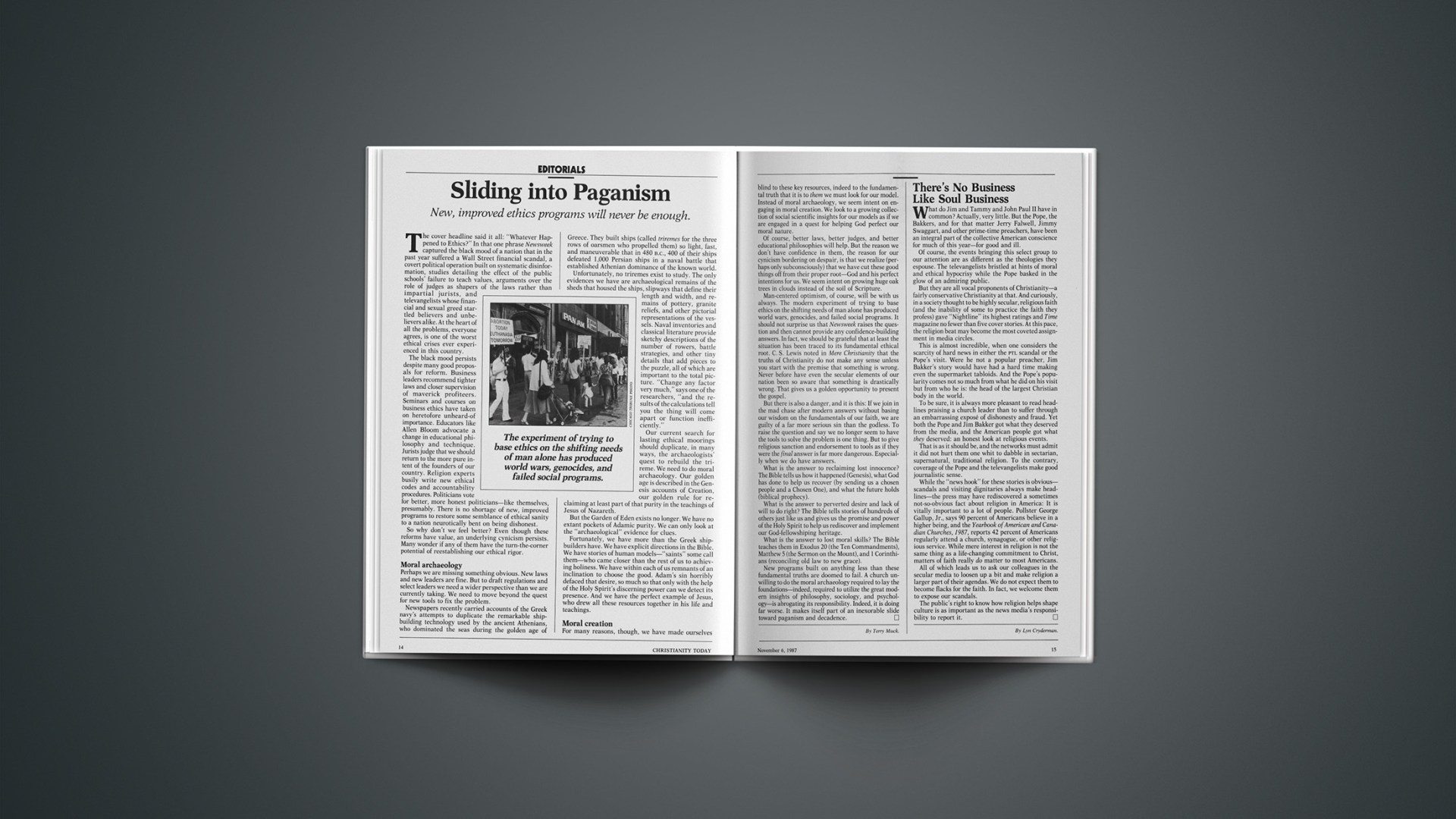
Sliding into Paganism

New, improved ethics programs will never be enough.

The cover headline said it all: “Whatever Happened to Ethics?” In that one phrase Newsweek captured the black mood of a nation that in the past year suffered a Wall Street financial scandal, a covert political operation built on systematic disinformation, studies detailing the effect of the public schools’ failure to teach values, arguments over the role of judges as shapers of the laws rather than impartial jurists, and televangelists whose financial and sexual greed startled believers and unbelievers alike. At the heart of all the problems, everyone agrees, is one of the worst ethical crises ever experienced in this country.

The black mood persists despite many good proposals for reform. Business leaders recommend tighter laws and closer supervision of maverick profiteers. Seminars and courses on business ethics have taken on heretofore unheard-of importance. Educators like Allen Bloom advocate a change in educational philosophy and technique. Jurists judge that we should return to the more pure intent of the founders of our country. Religion experts busily write new ethical codes and accountability procedures. Politicians vote for better, more honest politicians—like themselves, presumably. There is no shortage of new, improved programs to restore some semblance of ethical sanity to a nation neurotically bent on being dishonest.

So why don’t we feel better? Even though these reforms have value, an underlying cynicism persists. Many wonder if any of them have the turn-the-corner potential of reestablishing our ethical rigor.

Moral Archaeology

Perhaps we are missing something obvious. New laws and new leaders are fine. But to draft regulations and select leaders we need a wider perspective than we are currently taking. We need to move beyond the quest for new tools to fix the problem.

Newspapers recently carried accounts of the Greek navy’s attempts to duplicate the remarkable shipbuilding technology used by the ancient Athenians, who dominated the seas during the golden age of Greece. They built ships (called triremes for the three rows of oarsmen who propelled them) so light, fast, and maneuverable that in 480 B.C., 400 of their ships defeated 1,000 Persian ships in a naval battle that established Athenian dominance of the known world.

Unfortunately, no triremes exist to study. The only evidences we have are archaeological remains of the sheds that housed the ships, slipways that define their length and width, and remains of pottery, granite reliefs, and other pictorial representations of the vessels. Naval inventories and classical literature provide sketchy descriptions of the number of rowers, battle strategies, and other tiny details that add pieces to the puzzle, all of which are important to the total picture. “Change any factor very much,” says one of the researchers, “and the results of the calculations tell you the thing will come apart or function inefficiently.”

Our current search for lasting ethical moorings should duplicate, in many ways, the archaeologists’ quest to rebuild the trireme. We need to do moral archaeology. Our golden age is described in the Genesis accounts of Creation, our golden rule for reclaiming at least part of that purity in the teachings of Jesus of Nazareth.

But the Garden of Eden exists no longer. We have no extant pockets of Adamic purity. We can only look at the “archaeological” evidence for clues.

Fortunately, we have more than the Greek shipbuilders have. We have explicit directions in the Bible. We have stories of human models—“saints” some call them—who came closer than the rest of us to achieving holiness. We have within each of us remnants of an inclination to choose the good. Adam’s sin horribly defaced that desire, so much so that only with the help of the Holy Spirit’s discerning power can we detect its presence. And we have the perfect example of Jesus, who drew all these resources together in his life and teachings.

Moral Creation

For many reasons, though, we have made ourselves blind to these key resources, indeed to the fundamental truth that it is to them we must look for our model. Instead of moral archaeology, we seem intent on engaging in moral creation. We look to a growing collection of social scientific insights for our models as if we are engaged in a quest for helping God perfect our moral nature.

Of course, better laws, better judges, and better educational philosophies will help. But the reason we don’t have confidence in them, the reason for our cynicism bordering on despair, is that we realize (perhaps only subconsciously) that we have cut these good things off from their proper root—God and his perfect intentions for us. We seem intent on growing huge oak trees in clouds instead of the soil of Scripture.

Man-centered optimism, of course, will be with us always. The modern experiment of trying to base ethics on the shifting needs of man alone has produced world wars, genocides, and failed social programs. It should not surprise us that Newsweek raises the question and then cannot provide any confidence-building answers. In fact, we should be grateful that at least the situation has been traced to its fundamental ethical root. C. S. Lewis noted in Mere Christianity that the truths of Christianity do not make any sense unless you start with the premise that something is wrong. Never before have even the secular elements of our nation been so aware that something is drastically wrong. That gives us a golden opportunity to present the gospel.

But there is also a danger, and it is this: If we join in the mad chase after modern answers without basing our wisdom on the fundamentals of our faith, we are guilty of a far more serious sin than the godless. To raise the question and say we no longer seem to have the tools to solve the problem is one thing. But to give religious sanction and endorsement to tools as if they were the final answer is far more dangerous. Especially when we do have answers.

What is the answer to reclaiming lost innocence? The Bible tells us how it happened (Genesis), what God has done to help us recover (by sending us a chosen people and a Chosen One), and what the future holds (biblical prophecy).

What is the answer to perverted desire and lack of will to do right? The Bible tells stories of hundreds of others just like us and gives us the promise and power of the Holy Spirit to help us rediscover and implement our God-fellowshiping heritage.

What is the answer to lost moral skills? The Bible teaches them in Exodus 20 (the Ten Commandments), Matthew 5 (the Sermon on the Mount), and 1 Corinthians (reconciling old law to new grace).

New programs built on anything less than these fundamental truths are doomed to fail. A church unwilling to do the moral archaeology required to lay the foundations—indeed, required to utilize the great modern insights of philosophy, sociology, and psychology—is abrogating its responsibility. Indeed, it is doing far worse. It makes itself part of an inexorable slide toward paganism and decadence.

By Terry Muck.

Evangelical Politicians Defeat Themselves

Unless evangelical Christians learn from their 1986 political mistakes, 1988 could be their electoral Armageddon. And instead of blaming the press or other outside forces for the string of political election defeats, Christians need to examine their own propensity toward self-inflicted wounds. Christians lose at the polls for the same reason other candidates lose: They do not campaign intelligently.

Part of the problem, ironically, comes from our success. In 1976, Democrat Jimmy Carter would never have been elected President had he not garnered 56 percent of the evangelical vote. But once we discovered our power, we began to think an evangelical on the ballot would automatically bring out the born-again voting bloc. It just doesn’t work that way, as we learned in the ill-fated 1986 elections.

Questionable Tactics

It does not help much when Christian candidates seldom reach beyond the pew during their campaigns, framing issues in language that the broader constituency cannot understand. For example, in 1986 incumbent Congressman Mark Siljander of Michigan sent a tape to evangelical pastors in his district urging them to “break the back of Satan” and to repel the attacks against him. Predictably, Siljander’s opponent strongly objected to being compared with Satan, which, of course, was not Siljander’s intent. Nonetheless, the die was cast. Siljander himself conceded “… the tape did it.”

In that same election year, North Carolina incumbent Congressman Bill Cobey mailed a campaign letter exhorting fellow Christians to send him back to Congress “so our voice will not be silenced and then replaced by someone who is not willing to take a strong stand for the principles outlined in the word of God.”

Cobey’s phrases—politically risky against any foe—hurt his campaign even more since most voters did not understand his Christian terminology. In addition, his opponent was an active Southern Baptist with a divinity degree. Cobey’s opponent demanded an apology and got one. However, the damage proved irreparable.

It is little wonder, then, that Christians get filleted by the media and rejected by the electorate. Such mistakes not only discredit the gospel, but chase away potential voters.

On the other hand, Christians who ride more on political savvy than religious affiliation stand a better chance of being taken seriously. Oregon candidate Joe Lutz enlisted as many as 10,000 volunteers to help him nearly topple a respected 18-year senatorial incumbent. How? In addition to motivating evangelicals, Lutz made an effort to reach beyond his natural support among Christians and prolife activists.

Christians need to realize the political process is not a tool to evangelize the world.

As a result, ABC’S veteran political commentator Hal Bruno observed, “Here’s one conservative who happens to be a Christian rather than vice-versa.”

Beyond Ideology

My point is that we must look for substance along with ideology and then speak to those issues that concern more than Christians. Biblical heroes like Daniel, Joseph, Nehemiah, Esther, and Deborah were raised to positions of power, influence, and authority not simply because they were God’s people, but because they had something to offer the entire society. “When the righteous triumph, the people rejoice” (Prov. 29:2).

But to elect sound candidates, Christians need to understand the political process better. It is not a tool to evangelize the world, but a vehicle for bringing sound leaders into positions of responsibility in government.

Certainly Christians need to register and vote. In 1986, only 35.2 percent of the eligible electorate voted in the nation’s Senate races—the lowest turnout since World War II. Such a small turnout favors candidates with a small constituency, often allowing narrow ideological groups to overly influence candidates, as they did with Walter Mondale and Geraldine Ferraro. Even now, churches can mobilize their members to make sure they are registered for next fall’s elections.

Beyond that, Christians must be willing to form coalitions with others who support moral (not necessarily Christian) candidates. And it seems unwise to push a Christian into a race when a capable candidate—one who is sensitive to moral and religious issues—is already entered.

It is to be hoped that 1988 will not be the final chapter in an evangelical electoral resurrection. The movement has far from crested. It remains to be seen, however, if evangelical Christians can continue to be an effective force in America’s electoral process. If they are to be, they must do more than appeal to their own constituency.

By Bruce Hallman, communications consultant to Oregon Republican senatorial candidate Joe Lutz in 1986, and currently a political consultant in Washington, D.C.

SPEAKING OUT offers responsible Christians a forum. It does not necessarily reflect the views of CHRISTIANITY TODAY.

For Once We Knew When to Quit

It was late Saturday night in Washington, D.C. As I walked away from the huge Convention Hall in the center of the capital and headed back to my hotel, I had a good feeling. We had just concluded the final session of the Second Congress on the Bible sponsored by the International Council on Biblical Inerrancy (ICBI)—and had officially voted the organization out of existence.

It all began ten years ago in Chicago with a meeting of some 250 men and women who were seriously committed to a consistent evangelicalism that included a doctrine of biblical inerrancy. That meeting produced the now widely accepted “Chicago Statement on Biblical Inerrancy.”

Two further scholarly sessions followed, one on biblical hermeneutics and the other on the practical application of an inerrant Bible to social, political, and moral issues of the day. Then came an interminable number of planning sessions, a spate of books and articles sponsored by the inerrancy council, a congress in 1982, and now this final meeting. Of the long-term gain for evangelicals flowing from ICBI, it is not for me to speak. Time alone will tell that tale. I do, however, see two significant gains stemming from its work.

First, we have sharpened our definition of inerrancy. More people now know what that potentially explosive term means: that the Bible is wholly true. Even Time magazine has caught on that inerrancy is not a synonym for obscurantism, and that it does not mean every statement in the Bible must be taken literally.

Second, we have had our collective consciousness raised as to the importance of this doctrine for the health of the church. The Bible, as Martin Luther taught us long ago, is the crib in which the Christ child comes to us. If we take the baby out of the crib and lay it in the street, it dies. Even if the crib is shaky, it jeopardizes the safety of the baby. So inerrancy is one safeguard for a wholesome and consistent Christian faith.

What made me feel especially good as I walked back to my hotel that Saturday night, however, was a sense of “mission accomplished.” Here was one organization, brought into being for a specific purpose, that accomplished its goal and dissolved. This is almost a first in the history of Christian organizations.

One of the hardest things in the world for an organization to do willingly is close up shop—especially if money is coming in regularly in support of that organization. All sorts of arguments can be made for keeping the thing going—even if the organization’s reason for being no longer exists. The “Old Boy Syndrome” takes over. Those who have guided an organization from its beginnings or through its deepest valleys just cannot resist the warm, fuzzy, comfortable feelings their associates bring them. To stop the organization is viewed as casting a vote against motherhood and apple pie.

To their everlasting credit, the leaders of ICBI knew when to quit. After authorizing the officers to pay off all debts (and they had adequate resources to do this), they simply voted the organization out of existence and dispensed its assets to other like-minded Christian projects.

I know 25 other Christian organizations that ought to do the same thing right now—or yesterday. Perhaps ICBI’S action will inspire some of them to do it. It might start a new trend of immense worth to evangelicalism. It would certainly save kingdom resources for other worthwhile ministries, and increase the efficiency of the whole Christian cause.

Who knows? Maybe in the long run, that could prove to be the greatest single contribution of ICBI to the evangelical world.

KENNETH S. KANTZER

Letters

Let’s Get On with It!

On the one hand, I commend you for treating subjects such as the one in “Under Fire” [Sept. 18]. On the other hand, it incenses me that so much time and energy are expended arguing, debating, and otherwise dissecting Christian doctrine. Give me a break! Let’s get on with the Father’s business of soul saving and leave men like Richard Foster and David Seamands alone to do their thing—which certainly sounds to me like it is Christ’s and the Father’s thing.

DIANE MELANG

West Allis, Wis.

David Hunt and T. A. McMahon’s Seduction of Christianity does an excellent job of documenting the infiltration of occult philosophy into Christian institutions, but there is one flaw. The authors provide ample support for their point that visualization has become a common practice in contemporary Christianity. But in spite of their repeated and vigorous contention that visualization is an ancient occult practice, they do not quote a single authority or cite even one reference to support that claim.

MARVIN MOORE

Pacific Press Publishing Association

Boise, Idaho

A new deli delight

Now that you have revealed to the world why we at Fuller are so severely troubled with chronic theological indigestion through printing our Catalyst snack shop menu in your September 18 issue [“The Divine Deli”], let me offer some hope to those who may be suffering. The committee is considering a new addition: The John Wimber: Miracle Whip on Wonder Bread.

C. PETER WAGNER

Fuller Theological Seminary

Pasadena, Calif.

Christians in a secular state

William Willimon’s essay on religious freedom [“The Chains of Freedom,” Sept. 18] is a clear articulation of the dilemma Christians now face. “Now,” because it is only as we have experienced the breakdown of a Judeo-Christian consensus that we are forced to wonder what is the Christian role in the creation of a purely secular state.

This is not only a political dilemma, but an intellectual one as well. The Christian’s claim to truth for the whole nation is not a priori. We believers must come to terms with the uncomfortable fact that faith no longer has the accent of reality, sociologically or intellectually. Kierkegaard was right: We do not enter faith by rational, impersonal, universal knowledge, but by inwardness and personal commitment. The fact of the matter is, however, the “human right” of freedom of choice takes precedence over the Christian’s right to make disciples.

THOMAS J. BOWER

Marshalltown, Iowa

The only reason Christians are safe in the United States is that we are moderately Christian!

TOM BLACK

Birmingham, Ala.

Channels only

I was appalled that the New Age movement is using the word channel to make mediumship respectable [“Theology from the Twilight Zone,” Sept. 18]. The word has an honorable past in Christian spirituality; ask anyone who’s prayed to be a channel of God’s grace. And to use entity to mean spirit spoils a useful comprehensive term.

MIRIAM WEISS

New York, N.Y.

It is important to recognize that it is the object of our faith, not our personal spiritual experiences, that makes Christianity unique among the world’s religions. While basically agreeing on the essentials of faith, it is possible to be quite diverse in our expressions and experiences of that “one, true faith.” In secondary matters, one Christian tradition’s orthodoxy is another’s heresy! If we are to show a loving respect for each other’s religious consciences—certainly a necessity if our witness to a loving, redemptive God is to be credible—we must learn the art of fruitful dialogue, rather than alienating polemic, in theological and spiritual disputes.

CAROL A. DWORKOWSKI

Annapolis, Md.

Doing theology

I have a theological problem with Tim Stafford’s review of John Wimber’s Power Healing [Books, Sept. 18]. Stafford asks, “Since when have movements been decided by theology?” I would suggest he take a good hard look at Acts 15 and the Book of Galatians. The apostles James and Paul saw fit to apply theology to the question of circumcision for believers.

ARTHUR FOX

Cedar Grove, Wis.

Holy Phobias

Our church has made “mental health in the body of Christ” a real priority lately. Of course, we don’t pretend to have the professional resources to deal with serious mental illness or severe emotional trauma, but there are many phobias, disorders, or compulsive behaviors that we can address because they are specific to church life. For example:

  • Cuppickupia: The compulsive urge to run around picking up all the little cups after a Communion service. Especially prevalent among preacher’s kids.
  • Kleptocuppia: An advanced form of cuppickupia, in which the kleptocuppiac hides one Communion cup on his person while collecting the empty cups. This causes other cuppickupiacs great emotional trauma.
  • Oopseedaisia: The dread of dropping anything in church. Oopseedaisiacs often slow down offerings or Communion services by either refusing to touch the passing plate or holding on so tightly that they can’t let it go.
  • Whoomeegulpia: The fear of being called on to pray after a long string of prayer requests have been mentioned. The Whoomeegulpiac often blanks out and reverts to “Now I Lay Me Down to Sleep.”
  • Titheomania: The irresistible urge to make increasingly large Sunday offerings. Somehow, this seems to be one of the rarer church compulsions.

EUTYCHUS

Public or private schooling?

The informative article by Paul F. Parsons, “The Fourth R” [Sept. 4], was an oversimplification of the conditions in both the public secular and private Christian school systems. As a retired public school educator who has supported the private Christian school movement, I am aware that Christian school advocates tend to generalize negative conditions in the public schools. During my career I worked alongside both Christian and non-Christian administrators and teachers. These dedicated educators strive against difficult circumstances to establish order and teach traditional values. Many of the problems in the public sector stem from the power structure that assigns responsibility without sufficient authority to correct conditions.

The private Christian school system, however, has its problems. They range from hiring qualified personnel to establishing positive relationships among pastors, administrators, teachers, students, and parents. Private does not always mean good; neither does public always mean bad. Each situation must be judged on its own merit.

L. A. ROBINSON, PH.D.

Laguna Beach, Calif.

I commend Professor Parsons for his thorough research and for visiting Christian schools in 60 cities. I believe he caught the spirit of this remarkable movement and reported it well.

PAUL A. KIENEL

Association of Christian Schools Intl.

LaHabra, Calif.

I am in a particularly good position to confirm your positive comments on the solid Christian traits visible in the staff and faculty of the Stony Brook School in Long Island. Just a few days ago my son had to return from Stony Brook (and preseason football practice) to attend his mother’s funeral. What I’m finding to be typical of the Stony Brook mentality was the matter-of-fact decision by his head coach to miss football practice and accompany my son on the flight and attend the funeral with him—and the coach was planning to pay for his own ticket.

The Stony Brook School is indeed a special place with staff and faculty who show evidence of the “fruit of the Spirit” and not mere doctrinal allegiance.

HAL BEAVER

Atlanta, Ga.

I am concerned that “Christianizing” education may do more damage than good, as much of our second-rate Christian counterculture has. The education is mediocre, particularly in the lazy ACE system. There a student is cut off from the rest and told to work at his own pace, then given shoddy tests. He graduates at an early age, and those not in the know think he is a prodigy. Imagine his horror in his first year in college, with its strict strata and common plateaus, as he struggles alongside those raised on definite expectations and evaluations. Without a standard, how can anyone’s work be properly evaluated?

PETER T. CHATTAWAY

Vancouver, B.C., Canada

Inclusive hymnody

Regarding the Arts section in the September 4 issue, I was disturbed by the insensitivity of the hymn “Ambivalence.” Even with “tongue firmly in cheek” it made light of a very serious issue in the church: exclusive language. Any language that excludes a Christian brother or sister is less than what Jesus modeled for us. Fortunately, God’s grace covers our ignorance and insensitivity.

REV. EMMA RICHARDS

Lombard Mennonite Church

Lombard, Ill.

Full name, please

That was an interesting piece on our friend Jane and her hymns [“A Trendy Voice,” Arts, Sept. 18]. But you did leave out a couple of things: two letters in her middle name. It’s Jane Parker Huber.

VIC JAMESON

Presbyterian Survey

Atlanta, Ga.

Oops!—Eds.

Society needs condom ads

John Piper [“Just Say No to Condom Ads,” Speaking Out, Sept. 4] raises some important concerns, but in an idealistic way. We have to understand that we’re dealing with both a society determined to have sex outside the bounds of marriage and a killer disease. The condom ads are not addressed to the Christian community, but to society at large. A part of our responsibility, as Jeremiah so clearly understood, is to seek the welfare of the land in which we live, even though our hearts yearn for something better. As much as any of us would like to deal in absolutes with our culture, we have to engage in creative compromise.

DR. THOMAS P. EGGEBEEN

First Presbyterian Church

Sapulpa, Okla.

Needed: Healthy patriotism

I was somewhat disturbed by the general tenor of the editorial “Return of the Big Stick” [Sept. 4]. Much of the evidence Terry Muck cited as “raising renewed fears of creeping militarism” is better interpreted as a renewal of healthy patriotism. One has the impression that the military is actively attempting to establish itself as some sort of idol, usurping the place of God.

CHAPLAIN ROBERT C. STROUD

United States Air Force

Reese Air Force Base, Tex.

Is it possible that another reason people are looking to the military institution of man for protection rather than to God is that they see churches and Christian leaders demonstrating their lack of trust in God and their trust in man’s institutions in such matters as lawsuits and legal disputes? You cannot pick up a newspaper without encountering Christians suing their churches, churches suing their parishioners, and Christian leaders taking their disputes against one another to law “before unbelievers.”

WILLIAM D. BONTRAGER

Christian Conciliation Service

of Minnesota

Minneapolis, Minn.

Forward into the Past

A television commercial says it all: “I’m going to fight aging every step of the way.”

Unfortunately, among the “casualties” of that fight is our increasing over-65 population—a population on the rise (currently 11 percent of all Americans, with projections as high as 22 percent by 2010), yet one often ignored in our society’s struggle against age spots. Gray hair and wrinkles are, after all, a symbol of Everyman’s mortality.

But they are also a symbol of our future. Or they should be, according to CT senior writer Tim Stafford. “If the church neglects the elderly,” Tim writes in his third CT cover story for 1987, “overlooking their needs and their potential because we are so used to focusing on young families, we will miss a key opportunity.”

Meeting such a challenge won’t be easy, as Tim learned in researching a book on aging scheduled for release next year. As originally planned, the book was to have focused almost exclusively on caring options for the elderly, with special attention given to adult children struggling with questions of what to do with aging parents. But halfway through the project, Tim became convinced that a more foundational question concerned what aging means in the context of faith. Why do we age? And how would God have us deal with this reality, to the betterment of his kingdom?

In the end, says Tim, “We need to articulate a spiritual life where loss is not a total loss, but part of God’s pattern of lovingkindness.” With this as his base, Tim presents a picture of how the church can serve the aged—and the aged the church—in his article beginning on page 17.

HAROLD B. SMITH, Managing Editor

North American Scene from October 16, 1987

TENNESSEE

A Woman As Senior Pastor

On November 1, Nancy Hastings Sehested will become senior minister of the 235-member Prescott Memorial Baptist Church in Memphis. When she assumes that post, she will become the only woman to pastor a church affiliated with the Tennessee Baptist Convention.

Prescott Memorial is dually aligned with the American Baptist Churches in the U.S.A. and the Southern Baptist Convention (SBC). Women’s ordination has been a controversial issue in the SBC, which in 1984 passed a resolution opposing women pastors.

Sehested, currently associate pastor of a Southern Baptist congregation in Georgia, will become one of only four women to serve as senior pastor in the SBC, and one of only 11 to serve as either pastor or copastor of an SBC-affiliated congregation. However, there are an estimated 450 ordained women in the denomination.

A native of Texas, Sehested is the daughter and granddaughter of Southern Baptist clergymen. Her husband, Kenneth, is an ordained Southern Baptist minister and executive director of the Baptist Peace Fellowship of North America.

“Women are finding it more and more difficult to find positions in SBC agencies, in churches, on campuses,” she told the Memphis Commercial Appeal. “These aren’t easy times for women.”

PUBLIC SCHOOLS

Failing Grades—Again

The National Endowment for the Humanities, in a study requested by Congress, says the nation’s public schools are failing to adequately teach history and literature. The agency said the situation is caused by an overemphasis on the process of learning at the expense of content.

“Instead of preserving the past, they [educators] more often disregard it, sometimes in the name of’ progress …,’ ” said Lynne Cheney, National Endowment for the Humanities chairman. The agency cited a National Assessment of Educational Progress report that found that more than two-thirds of 8,000 American 17-year-olds tested this year were unable to place the Civil War within the correct half-century. In addition, a majority of the 17-year-olds were unable to identify a number of writers whose works are considered classics.

The National Endowment for the Humanities said reading textbooks used in many public school classrooms contain few selections from classic children’s literature. In addition, the agency said history textbooks “are poor in content, and what content they do contain is not presented in a way to make anyone care to remember it.”

ABORTION

A Significant Lie

The woman who challenged a Texas abortion law, leading to the U.S. Supreme Court decision legalizing abortion on demand, has admitted she lied when she claimed her pregnancy was the result of a gang-rape.

Norma McCorvey, called “Jane Roe” in the 1973 Roe v. Wade case, said in a television interview that she lied about being raped because Texas law at that time allowed abortions only to save the life of the mother. McCorvey hoped the rape story would somehow enable her to circumvent the restrictive abortion law.

However, she was unable to obtain an abortion, and eventually placed her child for adoption. McCorvey’s lead attorney, Sarah Weddington, said rape was never an issue when the case reached the Supreme Court.

Kate Michelman, executive director of the National Abortion Rights Action League, said McCorvey’s lie “should not cloud the discussion about the right of a woman to terminate her pregnancy.… It was her life circumstances that created the conditions that mitigated [sic] against her being straightforward about the fact that she was pregnant and wanted to terminate that pregnancy.”

But members of the prolife movement say McCorvey’s admission is a significant development. Dan Donehey, of the National Right to Life Committee, said this adds “another piece of strong evidence” for the Supreme Court to take into account if it reconsiders Roe v. Wade. “Now that the original case has been shown to be a situation that did not involve any of the hard cases [like rape],” Donehey said, “we would hope the members [of the high court], especially those who voted in support of Roe in 1973, would have their eyes opened.”

PEOPLE AND EVENTS

Briefly Noted

Declining : To the lowest level since record keeping began, the percentage of Americans who smoke cigarettes. In 1986, less than 27 percent of the adult population smoked, down nearly 4 percentage points from the 1985 level. A study conducted by the Centers for Disease Control found that an estimated 24.6 percent of U.S. adults are former smokers. In 1964, the year the U.S. surgeon general issued the landmark health warning about smoking, 40 percent of the adult population smoked.

Increasing : The percentage of the U.S. population that is made up of Hispanics. The U.S. Census Bureau estimates that the number of Hispanics in the United States has grown by 30 percent since 1980, five times as fast as the rest of the population. The bureau set the Hispanic population at 18.8 million as of March 1987.

Set : By the nation’s state and federal correctional institutions, a record high prison population. The number of inmates grew 4.7 percent during the first half of this year, as 570,519 convicts jammed correctional facilities. Prison officials were forced to add about 1,000 new beds each week to keep up with the influx. Criminologists attributed the increase to more stringent sentencing by judges.

Sought : By one in five adult Americans, medical or other professional help to combat a drinking problem involving the individual or a member of his or her family. According to a Gallup poll, the percentage of Americans who have sought such help is up sharply from 1984, when 9 percent sought assistance. The current survey found that 41 percent of adult Americans say they have suffered physical, psychological, or social harm because of someone else’s drinking. Seventeen percent said they have suffered because of their own drinking.

Apple PodcastsDown ArrowDown ArrowDown Arrowarrow_left_altLeft ArrowLeft ArrowRight ArrowRight ArrowRight Arrowarrow_up_altUp ArrowUp ArrowAvailable at Amazoncaret-downCloseCloseEmailEmailExpandExpandExternalExternalFacebookfacebook-squareGiftGiftGooglegoogleGoogle KeephamburgerInstagraminstagram-squareLinkLinklinkedin-squareListenListenListenChristianity TodayCT Creative Studio Logologo_orgMegaphoneMenuMenupausePinterestPlayPlayPocketPodcastRSSRSSSaveSaveSaveSearchSearchsearchSpotifyStitcherTelegramTable of ContentsTable of Contentstwitter-squareWhatsAppXYouTubeYouTube