Does Cultural Captivity Threaten American Churches?

A Christianity that flirts with the reigning culture is on the way to secular enslavement

ROBERT H. LAUER1Robert H. Lauer is pastor of Salem Baptist Church, Florissant, Missouri. He holds the B.S. in electrical engineering from Washington University, St. Louis, and the B.D. from Southern Baptist Theological Seminary.

Long ago, William Law warned that the world is now a greater enemy to the Christian than it was in apostolic times:

It is a greater enemy, because it has greater power over Christians by its favours, riches, honours, rewards, and protection than it had by the fire and fury of its persecutors.

It is a more dangerous enemy, by having lost its appearance of enmity. Its outward profession of Christianity makes it no longer considered as an enemy, and therefore the generality of people are easily persuaded to resign themselves up to be governed and directed by it [A Serious Call to a Devout and Holy Life, London, 1906, p. 228].

Law here describes what is perhaps the most subtle temptation of the Christian church—to be captive to its culture. The Church succumbs to this temptation when it reflects its culture rather than exposing it to the light of God’s will, when it is a mirror of its age rather than an imitator of its Lord. So often has this cultural captivity been evident that Herbert Butterfield says the Church on the whole has been the “cement of society, the buttress of whatever was the existing order, and the defender of the status quo … (Christianity and History, New York, 1950, p. 176).

Since none of us can wholly detach ourselves from our culture, any criticism of contemporary religion cannot escape a certain ethnocentric tinge. It is far easier to discern the failings of our forebears than to perceive our own cultural shackles. But the very recognition of past failure compels us to examine the present, lest we too become merely a footnote of our times rather than a molding force for the future.

In his autobiography, From Pagan to Christian, Lin Yu-T’ang speaks of our age as one of destruction. He takes note of Picasso’s dissection of the material world, then continues: “Stravinsky laughed at harmony, Gertrude Stein destroyed grammar, E. E. Cummings destroyed punctuation, Lenin destroyed democracy, Joyce destroyed idiom, and Dali destroyed sanity. Everyone was tearing up something” (From Pagan to Christian, Cleveland, 1959, p. 200).

Unquestionably there is a strong iconoclastic hue to contemporary culture. And quite often it seems to overflow into capricious destructiveness. When we turn to theology’, therefore, we should not be overly surprised to find someone crying that God is dead. We can expect that in some way the destructive tendencies of our age will find expression in theology.

Another obvious aspect of our culture is its love-affair with science. In an age when the word of the scientist carries the authority that once characterized the word of the priest or king, we should not be surprised at the attempt to demythologize the Scriptures, to make them more scientifically palatable.

Some claim that these are attempts to interpret the Gospel to modern man. True, such interpretation is a never-ending task of the theologian. But insofar as these movements depart from the biblical revelation, they are not interpretations but cultural distortions. The Church has the hard task of communicating the Gospel without becoming merged with the culture of the age.

In personal and social ethics there is the same temptation to reflect cultural patterns rather than to imitate our Lord. We saw this in the Bible-quoting defenders of slavery and see it now in their progeny, the Bible-quoting defenders of segregation. We saw it in the German pastors who bowed before Hitler. We read it in the Kinsey reports, which indicated that social strata are more significant in sexual attitudes than religious affiliation.

Recently I heard a man high in my own denomination ask, “Are we trying to convert people to our culture or to our Lord?” He went on to say that the problem of any First Baptist Church in the South is the same—a cultural one. If a Negro enters, an aggressive church member may bodily escort him out. But if a frayed malodorous white man enters, in two or three weeks he will be frozen out. It was perhaps an awareness of this situation that led another to declare that we need to develop ways to win some people to Christ whom we will never win to our church. One’s thoughts are wrenched to James 2:1–9.

In the above cases, Christians were busily at work in the dreary business of defending the status quo. At the other extreme are those who wear the label of Christian and defend the new morality. They, too, are subject to their culture, though in its radical rather than its conservative expression. Max Lerner has said that the “reigning moral deity in America is ‘fun.’ ” As the song puts it, we must enjoy ourselves—it’s later than we think. Couple this with the moral relativity that has leavened our age, and the new morality becomes a logical, cultural development. Those who defend it are not merely making a realistic adjustment; they are capitulating to a cultural pattern.

The primary goal of American man is money. So claimed the late C. Wright Mills in his book The Power Elite. And one is tempted to believe it. A sign on a large Protestant church in St. Louis said, “The Church is America’s first business, because if the Church fails, America’s business fails.” One can only conclude that if we want our prosperity to continue, we had better let the Church have its share.

Is the Church of today using materialistic goals as a kind of lure to secure the loyalty of its members? I have read more than one tract and heard more than one sermon that implied that an increase in income awaited the tither. And I once responded to an ad that spoke of a new way of prayer. In the printed material I received there were such testimonials as, “Money is coming in from everywhere.”

What is the goal of the American Church? Many people choose a church for its social level rather than its doctrinal and spiritual level. Perhaps this is why Americans erect magnificent edifices in which they may worship, while channeling only meager funds into world missions. And perhaps this is why officials of a Presbyterian church in a metropolitan area, while interviewing a prospective pastor, told him, “We don’t care to have any new members. We just want you to come and minister to the ones we already have.”

What is the goal of the American minister? To be conformed to the image of his Lord? Or to slip into a comfortable position in his culture? In an article entitled “Slick-Paper Christianity” (The Nation, Vol. CLXXXV, No. 18, pp. 56–59) Dan Wakefield tells of a literature class at Columbia University in which Mark Van Doren discussed the modern minister and Christ. Jesus, said Van Doren, was far different from the ministers today “who try to be ‘one of the crowd’ and take a drink at a cocktail party to prove it, or tell an off color joke.” Van Doren paused, then added, “Maybe that’s why we hate them so much.” A survey of the minister’s image in modern literature confirms this attitude of contempt. Modern culture, like its ancient counterpart, will make every effort to quell the prophetic voice, and then despise the fallen prophet.

If the Christian Church is to rise above its culture, if it is to be a lamp and salt rather than mirror and cement to its society, it must be constantly vigilant. Reinhold Niebuhr has rightly said, “Only the most rigorous searching of hearts can prevent prophets from mixing the prejudices of communities and the desires of kings with the counsels of God, and offering the compound as the word of the Lord” (Beyond Tragedy, New York, 1937, p. 83). To this we could add one amendment: Above all, the Church must unceasingly search the Scriptures, subjecting its theology, its ethics, and its values to the light of God’s Word.

Fishers Of Men

There could be a hundred million new Christians in the world today … one hundred million new converts to Jesus Christ … if just one in every nine professing Christians were really interested in winning a friend to Christ, influencing a friend for Christ.

One hundred million persons might be born into the Christian family through the power of God today … translated by the heart-changing dynamic of the Gospel from darkness to light, out of death unto life … if one-ninth of us who claim to be Christians were really faithful followers of the One who said, “Follow me and I will make you fishers of men.”

Of course you don’t regiment the Spirit of God—and it is he who gives birth to the children of God. You don’t dictate to God—setting quotas or schedules for the harvest of souls.

Nevertheless, the statistics dramatize the thrilling possibilities of one day—any day—if we Christians were really serious about the mission to which our Lord has called us.

Who can measure what the Spirit of God might do today if we who make professions of faith in Jesus Christ were obedient to the mandate which he left his Church? What an absolutely exciting prospect if today each of us decided it was his duty—his vocation, his holy calling—to be a witness, by the Spirit, among his colleagues, friends, and associates.

Certainly the failure is not God’s! It is “not his will that any should perish.”

He who loved the world so much that “he gave his only begotten Son” is certainly not indifferent to the lostness—the waywardness—the disorientation of men.

He who loved the world so much that he laid down his life on the Cross—submitting to the ignominious treatment and shame of ruthless and profane men, letting his own blood pour out as a sacrifice for the sin of the very men guilty of the atrocity—surely he is not without care and concern for men everywhere. Surely he would speak to the hearts of men, woo them to himself, if he had a faithful servant through whom to speak and love.

Jesus Christ has his people everywhere! But many are indifferent. They are cold and heartless and preoccupied with their own achievements and acquisitions.

You aren’t responsible for the 900 million who call themselves Christian—but you are responsible for you! DR. RICHARD C. HALVERSON, in Perspective, a weekly devotional letter to businessmen.
Clergymen and Psychiatrists: Rivals or Allies?

Continue the dialogue, urges this Canadian psychiatrist, confident that no final science of man will contradict the Creator’s revelation

Are Christianity and psychiatry enemies? Are Christianity and psychiatry at odds with each other? Have Christianity and psychiatry reached a truce? Are Christianity and psychiatry allies? Such questions have not been answered to everyone’s satisfaction. Hence the dialogue goes on.

One of the major problems in relations between psychiatry and Christianity lies in their differing views of man and of God.

Christianity holds that man was created by God in the image of God but by his own choice became separated from God. Since then he has not been able to reflect a perfect image of God. In the Christian view, man’s basic problem is his separation from God.

The Christian believes that his view of man is a part of “revealed” truth, information that is known only because God chose to reveal it. Man could not have arrived at it through his own reason.

Psychiatry’S Approach To Man

Psychiatry, on the other hand, approaches man through observation, postulation, and theories. It tries to understand man largely by a process of inductive reasoning. Conflict arises when psychiatric theories of man clearly run contrary—or are wrongly thought to run contrary—to the Christian view of man.

Conflict arises also when psychiatrists—such as Freud, in his book The Future of an Illusion—dismiss the concept of God as a mere creation of man; that is, when they see God as created in the image of man.

The psychiatry of today owes much to Freud’s ideas, which continue to have a strong influence on much current thinking. Yet the Christian should realize that there are virtually as many “denominations” within psychiatry as within Christianity.

In his New Introductory Lectures on Psychoanalysis (London, 1933), Freud states that his “is a scientific world view.” Psychoanalysis has enabled science to study the mind, he says. Intuition and inspiration are seen to be wish-fulfilling illusions. Science claims the whole field of human activity as its own, declares Freud, and will not permit philosophy or religion to usurp any part (pp. 218, 219).

Such a strong stand, frequently reiterated, caused many Christians to reject Freud’s contributions entirely.

However, this statement by Freud is not based on any truth derived from his scientific psychology or observations about man; rather, it is based on his own philosophical presuppositions about the nature of the universe and on the assumption that “all knowledge can be gained by the scientific method.” Yet Freud seems to make this statement as a scientist, assuming the authority of science to add weight to his position, presumably unaware that he has left his scientific precepts behind and has entered the realm of philosophy. His conclusion is not scientific but rather philosophical. Hence the debate shifts to a philosophical framework in which naturalism confronts Christian theism.

This is apparent again in his claim that psychoanalytic scrutiny shows that God is really the over-rated father of childhood and ethical precepts merely the extension of parental commands and prohibitions. The truth of religion may be altogether disregarded, Freud says. It is a parallel to the neurosis through which the individual passes on his way from childhood to maturity. Religion is illusion and derives its strength from the fact that it falls in with our instinctual desires (op. cit., pp. 222–24).

Leaving Science Behind

However, psychological explanations for believing or not believing that a certain entity exists in no way prove or disprove its existence. If I have psychological reasons for wanting to believe that God exists, may not Freud have had psychological reasons for not wanting to believe God exists? The question of God’s existence cannot be approached through conclusions drawn from the study of human personality.

The vehemence of Freud’s denial of religion seems to outrun the cogency of his supporting evidence and logic. In the words of Shakespeare, he “doth protest too much, methinks.” Indeed, Freud himself pointed out (in New Introductory Lectures on Psychoanalysis) that imperfect logic demonstrates the existence of a particularly strong motive for making a denial, a motive that can only be affective and serve to bind an emotion. As possible reasons for his strong anti-religious bias, Freud’s biographers have noted his childhood encounters with anti-Semitism and his negative attitude toward his father. (In old age Freud admitted himself that an underestimation of his father had supplanted his childhood overestimation.)

Christianity was alarmed by Freudian psychology because with it, in a package deal, went a philosophy that ruled out God and therefore any Christian view of man; but this was based on Freud’s presuppositions, not his objective findings about personality.

Two-Sided Error

There were errors on both sides. Psychiatrists erred in assuming that the study of man alone could lead to an inclusive metaphysical system that could pass judgment on the existence of God. Christians erred by throwing out the good with the bad. Gradually, however, Christians began to separate Freud’s philosophical presuppositions from his objective observations.

The contemporary neo-Freudian Eric Fromm also closely intertwines philosophical assumptions with his scientific observations and presents a non-Christian view of man.

Fromm has spoken of the need for man “to face the truth, to acknowledge his fundamental aloneness and solitude in a universe indifferent to his fate, to recognize that there is no power transcending him which can solve his problems for him.” Such statements suggest that the Christian must approach psychiatric theories with caution. But approach them he must.

Christianity and psychiatry can be allies while frankly recognizing differences of presupposition and function. Each has a role; neither can totally supplant the other. Each has its own primary area of concern. Paul Tillich notes the three basic sources of existential anxiety: the threat of death, meaninglessness, and guilt. These belong to existence and affect all men. But surely existential anxiety is a priestly concern, while pathological anxiety is the concern of the psychiatrist. As Orville Walters has written, “The goal of both professions is to help the patient achieve full self-affirmation. They may collaborate fruitfully, but neither should try to replace the other” (“Metaphysics, Religion, and Psychotherapy,” Journal of Counselling Psychology V, 4, p. 247).

Shakespeare observed this years ago. In Act V of Macbeth, the question arose as to who should treat Lady Macbeth’s distress. A physician was brought in. But listen to his opinion:

This disease is beyond my practice.

Foul whisperings are abroad!

Unnatural deeds do breed unnatural troubles;

Infected minds to their deaf pillows will discharge their secrets.

More needs she the Divine than the physician.

God, God forgive us all.

Here the theoretical issues are brought to the bedside of the patient.

It is significant that, while theoretically Freud objected to religion, on the level of empirical observation his statements are more positive toward religion. In 1928 he wrote, “The true believer is in a high degree protected against the danger of certain neurotic afflictions” (The Future of an Illusion, New York: Live-right Publications, 1949, p. 77). Also, in a letter to a Protestant clergyman he wrote, “You are in the fortunate position of leading them on to God, fortunate at least in the one respect that religious piety stifles neuroses” (Ernest Jones, Sigmund Freud: His Life and Work, II, London: Hogarth Press, 1955, p. 489).

A second problem in the dialogue has been the lack of clear understanding between clergy and psychiatrists of each other’s aims, methods, and views.

Most psychiatric workers in North America have little idea of what is meant by such Christian terms as “conversion,” “salvation,” “justification,” “sanctification,” and “stewardship.” They often regard the clergy as guilt-producers, failing to see that the Church cannot be absolutely permissive. The Church has been commissioned to the ministry of reconciliation. To be reconciled to God, a man must first recognize his guilt and his estrangement from God. The Church must point out guilt, but only to lead the guilty to the one source of forgiveness.

Still A Rotten Egg

Clergymen, on the other hand, have often had defective views of personality development and function and of mental hygiene. Many Christians also wrongly feel that to explain something is to explain it away—that psychiatry explains away sin and personal responsibility. The fact is, however, that human personality and conduct are approached from two different viewpoints—that of Christianity and that of psychiatry—at two different levels, by two groups using different language. To explain why a small boy steals helps us understand him, but it does not make his stealing proper. A rotten egg is still a rotten egg, whether diagnosed by the farmer or explained by the biochemist. The psychiatrist seeks to understand a patient and his motives in a non-judgmental way, quite apart from the moral issues involved.

A third area of difficulty is largely semantic. The psychiatrist speaks of decreasing a patient’s “guilt,” meaning his guilt feeling. Perhaps this is a guilt feeling about something he should not feel guilty over at all. Or perhaps he has a feeling of guilt but no awareness of its origin.

Now guilt, to the clergyman, is an objective ethical state in the relationship between man and God. If the clergyman fails to see the semantic problem, he may feel that the psychiatrist is trying to convince the patient that he is not guilty, when the clergyman himself knows that the only real solution is admission, repentance, and forgiveness through Christ. In interdisciplinary dialogue we must remember, from Through the Looking Glass, what Humpty-Dumpty said to Alice: “When I use a word, it means just what I choose it to mean—neither more nor less.”

Frequency And Morality

A fourth area of difficulty is the assumption social scientists sometimes make that because some act or behavior is frequent, it is normal, and—going a step further—that “therefore it must not be considered sinful. Dr. Kinsey’s “purely scientific facts” of sexual behavior were mostly facts; but the report also pushed the hidden premise that frequency could be equated with naturalness, that naturalness could be equated with normality, and that normality made the behavior licit. This leads to the view that all moral standard are relative, a view that disturbs most Christians despite the current popularity of “situational ethics.”

Frequency seems to have little to do with morality. Murder is relatively infrequent, adultery relatively common; yet the Christian views both as sinful. Risking one’s life to rescue a stranger is rare and unnatural. Making love to one’s wife is common and natural. Yet the Christian views neither of these as sinful.

As a Christian and a psychiatrist, I cannot solve all the paradoxes of Christianity. Nor can I always be sure which of several rival theories in psychiatry is the correct one. Many current psychiatric theories are mutually contradictory. It is not to be expected that such a young science can be perfectly integrated or harmonized with Christianity. However, I know of no solid facts about human personality or psychiatric disease that run contrary to or undermine my Christian beliefs. And on faith I can only believe that the final science of man will not contradict the revelations about man given us by the Creator of man.

I encourage Christian young people to accept the spiritual and intellectual challenge of working in the social sciences. Christianity can use the insights of the social scientist, and I firmly believe the social sciences need the insights of Christianity. For a young person desiring a future in which there will be both challenge and the opportunity to express Christian love and concern for others, this area will do just fine.

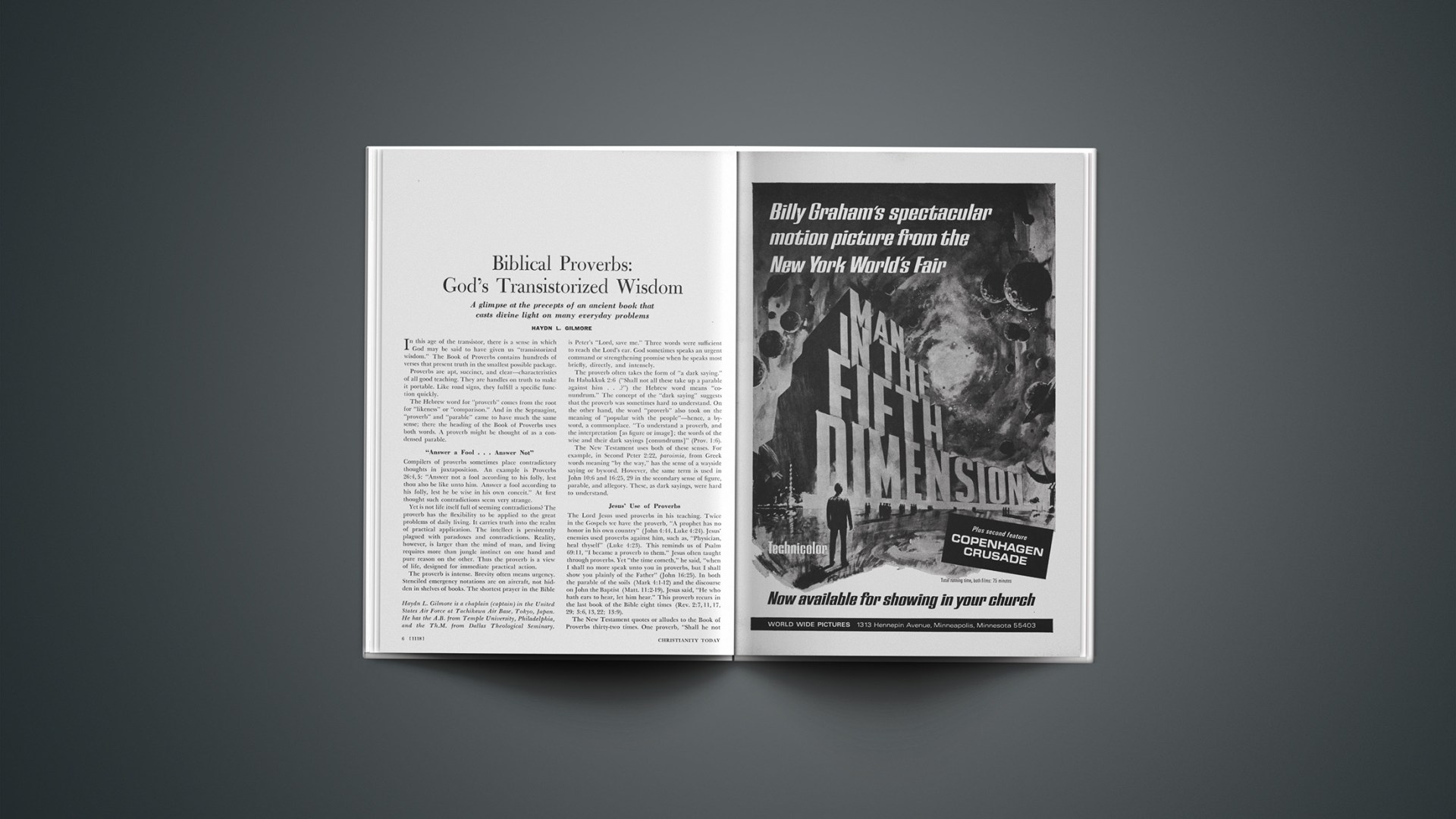
Biblical Proverbs: God’s Transistorized Wisdom

A glimpse at the precepts of an ancient book that casts divine light on many everyday problems

In this age of the transistor, there is a sense in which God may be said to have given us “transistorized wisdom.” The Book of Proverbs contains hundreds of verses that present truth in the smallest possible package.

Proverbs are apt, succinct, and clear—characteristics of all good teaching. They are handles on truth to make it portable. Like road signs, they fulfill a specific function quickly.

The Hebrew word for “proverb” comes from the root for “likeness” or “comparison.” And in the Septuagint, “proverb” and “parable” came to have much the same sense; there the heading of the Book of Proverbs uses both words. A proverb might be thought of as a condensed parable.

“Answer A Fool … Answer Not”

Compilers of proverbs sometimes place contradictory thoughts in juxtaposition. An example is Proverbs 26:4, 5: “Answer not a fool according to his folly, lest thou also be like unto him. Answer a fool according to his folly, lest he be wise in his own conceit.” At first thought such contradictions seem very strange.

Yet is not life itself full of seeming contradictions? The proverb has the flexibility to be applied to the great problems of daily living. It carries truth into the realm of practical application. The intellect is persistently plagued with paradoxes and contradictions. Reality, however, is larger than the mind of man, and living requires more than jungle instinct on one hand and pure reason on the other. Thus the proverb is a view of life, designed for immediate practical action.

The proverb is intense. Brevity often means urgency. Stenciled emergency notations are on aircraft, not hidden in shelves of books. The shortest prayer in the Bible is Peter’s “Lord, save me.” Three words were sufficient to reach the Lord’s ear. God sometimes speaks an urgent command or strengthening promise when he speaks most briefly, directly, and intensely.

The proverb often takes the form of “a dark saying.” In Habakkuk 2:6 (“Shall not all these take up a parable against him …?”) the Hebrew word means “conundrum.” The concept of the “dark saying” suggests that the proverb was sometimes hard to understand. On the other hand, the word “proverb” also took on the meaning of “popular with the people”—hence, a byword, a commonplace. “To understand a proverb, and the interpretation [as figure or image]; the words of the wise and their dark sayings [conundrums]” (Prov. 1:6).

The New Testament uses both of these senses. For example, in Second Peter 2:22, paroimia, from Greek words meaning “by the way,” has the sense of a wayside saying or byword. However, the same term is used in John 10:6 and 16:25, 29 in the secondary sense of figure, parable, and allegory. These, as dark sayings, were hard to understand.

Jesus’ Use Of Proverbs

The Lord Jesus used proverbs in his teaching. Twice in the Gospels we have the proverb, “A prophet has no honor in his own country” (John 4:44, Luke 4:24). Jesus’ enemies used proverbs against him, such as, “Physician, heal thyself” (Luke 4:23). This reminds us of Psalm 69:11, “I became a proverb to them.” Jesus often taught through proverbs. Yet “the time cometh,” he said, “when I shall no more speak unto you in proverbs, but I shall show you plainly of the Father” (John 16:25). In both the parable of the soils (Mark 4:1–12) and the discourse on John the Baptist (Matt. 11:2–19), Jesus said, “He who hath ears to hear, let him hear.” This proverb recurs in the last book of the Bible eight times (Rev. 2:7, 11, 17, 29; 3:6, 13, 22; 13:9).

The New Testament quotes or alludes to the Book of Proverbs thirty-two times. One proverb, “Shall he not render to every man according to his works?” (Prov. 24:12), is alluded to six times.

Ephesians 6:17 is a striking example of the sufficiency of a transistor-sized word. The sword of the Spirit is said to be, not the Word, considered in its totality (for the customary logos is not used), but rather the phrase, or saying (rhema), of God. The Christian warrior is to take the appropriate expression to use as the Lord’s sword in spiritual warfare.

Proverbs is a highly practical book. The problems of youth, middle age, and old age are mentioned. Mild vexation and international strife are both dealt with in principle.

There are thirty-one chapters in the Book of Proverbs, one for each day of any month. For years, in addition to my other Scripture reading, I read one chapter of Proverbs daily. This was one of the most practical steps I ever took in my Christian life.

In fact, Proverbs is a good place for anyone to start reading the Bible. It is well fitted to create a “market” for the Gospel. In it the human heart can see its own lack of practical righteousness and thus discover its own need. By showing us how far short we fall of God’s standards, Proverbs shows us that we need a Saviour. And indeed, the Saviour is foreshadowed in Proverbs 8:22–31, 23:11, and 30:4.

When the words of God in Proverbs have been discerned, the Word of God in the Gospels can be more personally appreciated. Practical thinking as well as emotional turmoil introduces people to Christ. Christ is concerned with every aspect of life, and Proverbs may well be studied for the way God meets the diverse psychological needs of men.

Plain Advice For Youth

The Book of Proverbs is, in a special sense, dedicated and directed to youth, as the prologue (1:1–6) shows. There are few pieces of writing that young people need more than this book. The children of God should be wiser than the children of this world. As they go to school or to ball games or on dates, Proverbs is a spiritual transistor that can be carried in the heart if not in the pocket. In the barracks, in town, in school and home, the Book of Proverbs speaks to plain, everyday situations. It is an inspired part of the literature of realism, helping us face life as it is—difficult and demanding. None of us will ever outgrow his need for this type of plain-spoken wisdom.

The housewife, the professional man or businessman, the workman or the shopkeeper—each may turn to this most practical portion of the Word of God. The ear may be opened to the Spirit of God as he calls us to Jesus Christ above the noise of the day. In Proverbs we may all learn of the wisdom of him who at the appointed time made his Son, “Christ crucified … the power of God and the wisdom of God.”

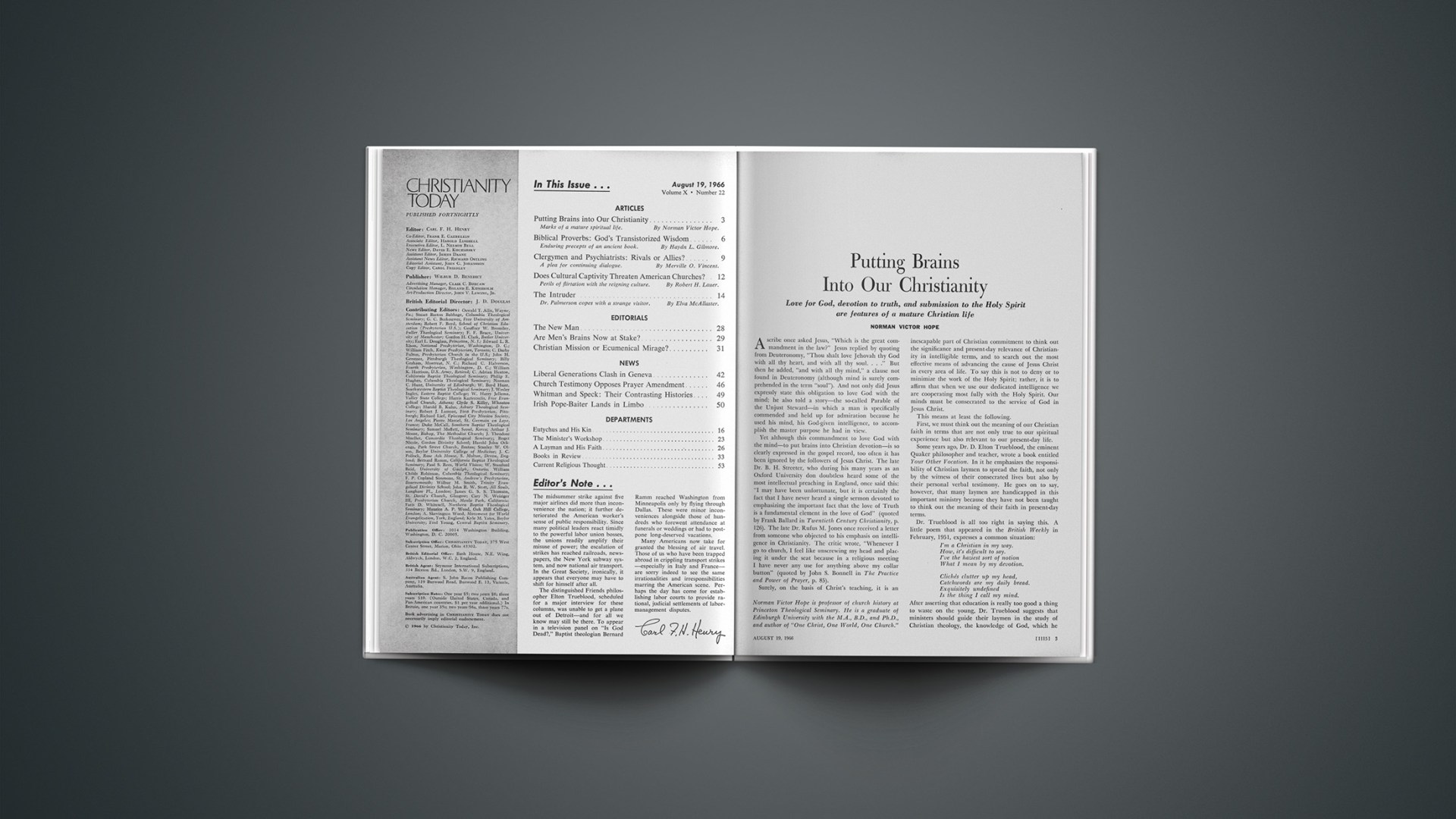
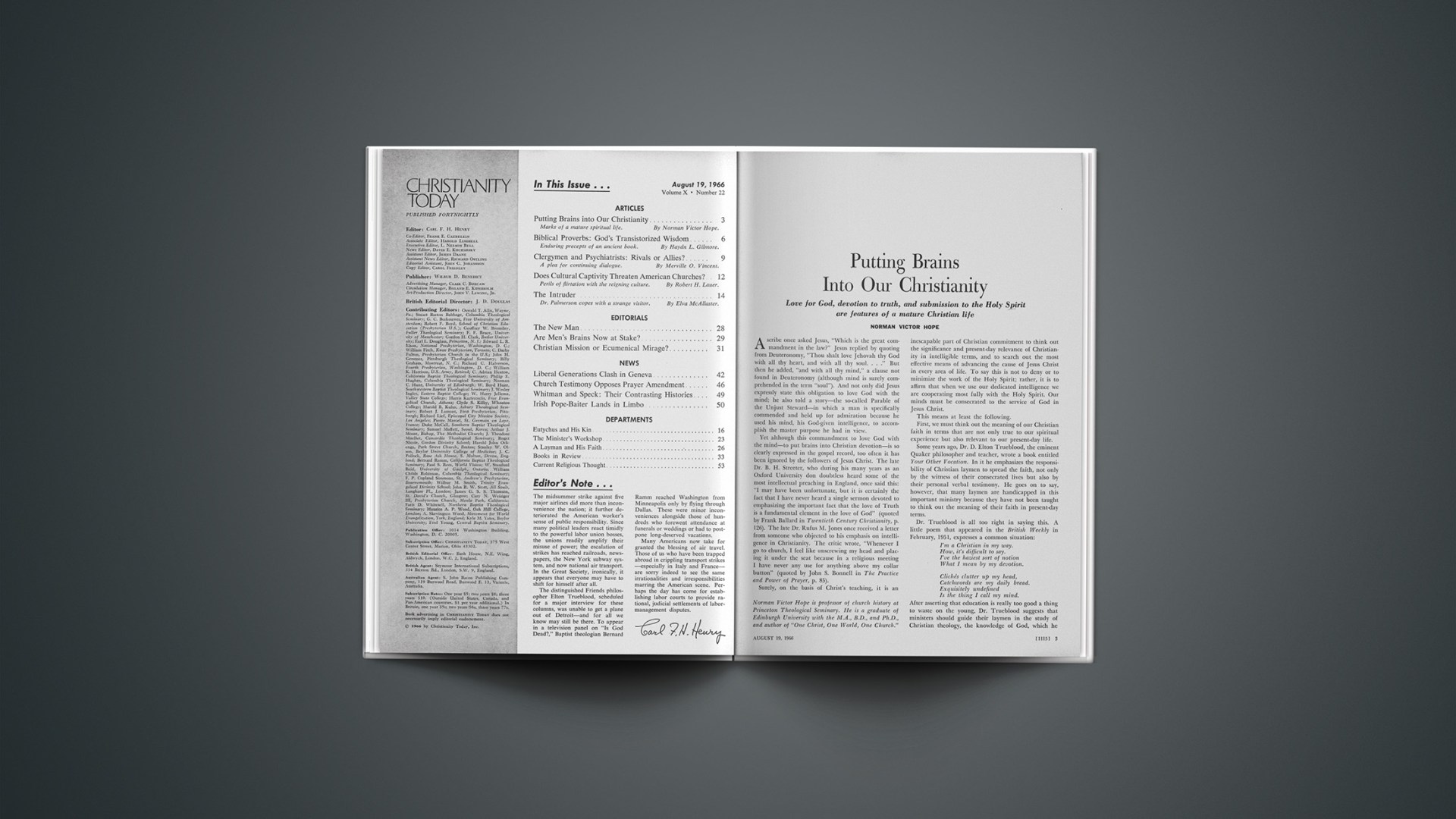
Putting Brains into Our Christianity

Love for God, devotion to truth, and submission to the Holy Spirit are features of a mature Christian life

NORMAN VICTOR HOPE1Norman Victor Hope is professor of church history at Princeton Theological Seminary. He is a graduate of Edinburgh University with the M.A., B.D., and Ph.D., and author of “One Christ, One World, One Church.”

A scribe once asked Jesus, “Which is the great commandment in the law?” Jesus replied by quoting from Deuteronomy, “Thou shalt love Jehovah thy God with all thy heart, and with all thy soul.… But then he added, “and with all thy mind,” a clause not found in Deuteronomy (although mind is surely comprehended in the term “soul”). And not only did Jesus expressly state this obligation to love God with the mind; he also told a story—the so-called Parable of the Unjust Steward—in which a man is specifically commended and held up for admiration because he used his mind, his God-given intelligence, to accomplish the master purpose he had in view.

Yet although this commandment to love God with the mind—to put brains into Christian devotion—is so clearly expressed in the gospel record, too often it has been ignored by the followers of Jesus Christ. The late Dr. B. H. Streeter, who during his many years as an Oxford University don doubtless heard some of the most intellectual preaching in England, once said this: “I may have been unfortunate, but it is certainly the fact that I have never heard a single sermon devoted to emphasizing the important fact that the love of Truth is a fundamental element in the love of God” (quoted by Frank Ballard in Twentieth Century Christianity, p. 126). The late Dr. Rufus M. Jones once received a letter from someone who objected to his emphasis on intelligence in Christianity. The critic wrote, “Whenever I go to church, I feel like unscrewing my head and placing it under the seat because in a religious meeting I have never any use for anything above my collar button” (quoted by John S. Bonnell in The Practice and Power of Prayer, p. 85).

Surely, on the basis of Christ’s teaching, it is an inescapable part of Christian commitment to think out the significance and present-day relevance of Christianity in intelligible terms, and to search out the most effective means of advancing the cause of Jesus Christ in every area of life. To say this is not to deny or to minimize the work of the Holy Spirit; rather, it is to affirm that when we use our dedicated intelligence we are cooperating most fully with the Holy Spirit. Our minds must be consecrated to the service of God in Jesus Christ.

This means at least the following.

First, we must think out the meaning of our Christian faith in terms that are not only true to our spiritual experience but also relevant to our present-day life.

Some years ago, Dr. D. Elton Trueblood, the eminent Quaker philosopher and teacher, wrote a book entitled Your Other Vocation. In it he emphasizes the responsibility of Christian laymen to spread the faith, not only by the witness of their consecrated lives but also by their personal verbal testimony. He goes on to say, however, that many laymen are handicapped in this important ministry because they have not been taught to think out the meaning of their faith in present-day terms.

Dr. Trueblood is all too right in saying this. A little poem that appeared in the British Weekly in February, 1951, expresses a common situation:

I’m a Christian in my way.

How, it’s difficult to say.

I’ve the haziest sort of notion

What I mean by my devotion.

Clichés clutter up my head,

Catchwords are my daily bread.

Exquisitely undefined

Is the thing I call my mind.

After asserting that education is really too good a thing to waste on the young, Dr. Trueblood suggests that ministers should guide their laymen in the study of Christian theology, the knowledge of God, which he says is the most mature discipline in which men and women can engage.

Asking Hard Questions

He goes on to specify some of the difficult questions which this kind of study should confront: On what grounds does the Christian justify belief in the uniqueness of Christianity, when there are certain elements of truth in the teaching of other world religions? How does the Christian believe in the efficacy of intercessory prayer and yet at the same time believe that there is an objective order of natural law that makes possible the scientific prediction of events? How does he justify belief in both the goodness and the power of God, when so many innocent people suffer with such obvious injustice and without profit to themselves or others? How can he believe in the evidential value of the widely reported direct experience of God, when it appears that such experience is purely subjective or can be explained in psychological terms? This effort to work out a reasoned faith, marked both by scientific integrity and by evangelical vigor, is one aspect of our Christian obligation to love the Lord our God with all our mind.

Secondly, it is our duty to think out how to apply our Christian faith most effectively to every situation that confronts us. Each Christian faces a daily combination of circumstances peculiar to him; he must determine the way in which his faith can best operate in those circumstances.

A story told by Andrew D. White, United States ambassador to Russia during the later years of the nineteenth century, illustrates this point. He tells of walking down the Nevsky Prospect in St. Petersburg, then the capital of Russia, with Leo Tolstoy. In their walk they encountered a number of beggars asking for alms, and to each Tolstoy gave a kopeck. Dr. White protested that this indiscriminate charity encouraged the creation of a dependent and debauched population, which was one of the gravest social problems of the day. Tolstoy’s reply was that it was not his business to consider the consequences of his action, and that the Gospel of Jesus Christ said simply, “Give to him that asketh thee.” It was his duty, he said, to obey the Gospel without considering the consequences.

But Tolstoy was quite wrong. It most emphatically is the Christian’s business to think out the consequences of his actions. Before acting he must be as sure as he can be that what he does will make the greatest possible contribution to the Christianization of men. Sometimes his duty will be to give all he can, poor though he may be. But at other times his duty will be to refuse to give money—even though he may be wealthy—and try to aid needy people in some other way, such as helping them get a job.

Preacher In The Red

THANKS TO ALL

It was the young minister’s first funeral service. Although the man who had died had not had a very commendable reputation, a fairly large crowd came to pay their last respects. All were curious to hear the new minister’s message. The text was well chosen and fitting words were spoken, but at the graveside it seemed that something had been forgotten. The undertaker stepped to the minister when the benediction had been pronounced and whispered something in his ear. The minister took the cue and with strong voice said, “I have been asked to announce that the family would like to have me thank all those who have helped to make this funeral possible.”—The Rev. JOHN NIEUWSMA, pastor, Ebenezer Reformed Church, Morrison, Illinois.

War: Can Christians Take Part?

The Christian encounters another aspect of this principle when he tries to determine the attitude he should have toward war. The question of war, which is the most pressing public question in our world, is peculiarly difficult for Christians, since they agree that war is contrary to the mind of Jesus Christ, their Lord and Redeemer. Some have contended that the question is answered by the saying of Jesus Christ in the Sermon on the Mount: “Resist not evil.” This is Christ’s own word on the matter, these persons say, and it should prevent any Christian from participating in war in any way.

But on a deeper and sounder interpretation of the mind of Jesus Christ, this utterance alone—though it is very important and must be considered carefully—cannot be allowed by itself to determine the final Christian attitude toward war. The Christian will, of course, do all in his power, both individually and in cooperation with other Christians, to prevent war; he will indeed be willing to make all kinds of sacrifices for this end. But if war should break out, he will then have to consider most carefully the consequences of any proposed attitude toward it; and if he should decide, after careful and prayerful reflection, that the results of abstaining would be less Christian than the results of participating, then, with however heavy a heart, he will be bound to participate. Thus he will choose what for him is the lesser of two evils.

These are only two examples of the general proposition that it is our business as Christians to think out how our faith may best be expressed in each situation that confronts us.

Thirdly, it is our duty to think out the most effective means by which to spread the Christian faith in the present-day world. One of the basic and inescapable tasks of the Christian Church is so to present Jesus Christ to men and women that they surrender to him as Saviour and serve him as Lord in the fellowship of the Church. This task is known as evangelism. And one of the most encouraging features of present-day church life is that churches—not only the store-front groups but also the standard brands—are becoming interested in evangelism as they have not been in many years. They are realizing what is surely the truth, that the Church that does not evangelize will fossilize.

Now, in order to evangelize most effectively, two things are needed; first, a deep heart-devotion to the Lord Jesus Christ, and secondly, the ability and willingness to think out the most convincing ways of presenting his Gospel to the unevangelized.

History serves to confirm this truth. The Apostle Paul, for example, conducted his great evangelistic campaigns by going to the great cities of the Roman Empire, those strategic centers from which religious influences radiated to the hinterlands. And in the cities he started to preach in the Jewish synagogues, where for some years there had been growing up a large fringe of Gentiles who were deeply interested in the Jewish religion because of its doctrine of one sovereign God and its high ethical standards. There, in those synagogues, Paul could count on a favorable reception; and from such Gentile “God-fearers,” as they were called, came many of the earliest Christian converts.

Again, in the sixteenth century, Luther spread his great Reformation revival, first by translating the Bible into the vernacular language of his German people, and then by writing short, pithy tracts in German to expound his point of view. These tracts of Luther circulated not only throughout Germany but over a large part of Europe and unquestionably did much to win converts for Protestant New Testament Christianity.

Then in the nineteenth century, D. L. Moody, who according to one comment “reduced the population of hell by one million,” not only preached the Gospel in a vivid, pointed style, so as to bring his hearers to the point of decision, but also persuaded Ira D. Sankey to play and sing gospel hymns in order to present Christian truth in song. In addition, Moody set up organized inquiry rooms where those who wished to decide for Jesus Christ could be led into an understanding acceptance of him and could be shown how to grow in grace and in the knowledge of their Lord and Saviour.

Using Mass Media

This age in which we live is very different in many ways from that in which Paul lived and from Luther’s sixteenth century and Moody’s nineteenth. The Gospel we proclaim is of course the same: our Lord Jesus Christ is the same yesterday, today, and forever. But we are obligated to think out the most effective ways to present Christ to the men and women of today. We shall have to employ those tremendous media of mass propaganda—the press, the movies, the radio, and television—that modern science has placed in our hands, as Billy Graham and others are doing. If these media are not used for good, they will most assuredly be used for evil.

Finally, it is our duty to think out how Christianity can be applied most effectively to the problems of group relations.

One fact frequently pointed out by thoughtful readers of Scripture is that the New Testament has virtually nothing to say, at least explicitly, about the problems that arise out of the existence of social groups. Dr. T. E. Jessop, that thoughtful English Methodist layman and professor of philosophy, has written a book entitled Social Ethics, Christian and Natural, in which he draws attention to this general fact and specifies several such problems. Among the questions he raises are these: (a) How should a group—a labor union, say, or a government, a nation, or the United Nations—behave? What principles should govern the actions of such bodies? (b) How should an individual behave while acting as a member of a group—as a citizen, for example, or as a member of a labor union that is taking a strike vote? (c) How should an individual behave when he acts as the representative of a group—as, for example, a member of Congress, or a wage-negotiator?

Freedom Brings Responsibility

The Bible in general, and the New Testament in particular, has little or nothing to say about specific rules of conduct for such situations as these. Doubtless the main reason for this absence lies in the twofold fact that most such groups did not exist in New Testament times and that, in any case, the government under which all New Testament Christians had to live was a totalitarian dictatorship that demanded obedience, not responsibility.

But today this situation has changed greatly, at least in all those countries that are not behind the Iron or Bamboo Curtain. The Christian of today, whether he likes it or not, has to live in a world of social groups. It is therefore his Christian obligation to think out the methods by which his Christianity may most effectively be brought to bear upon group situations; and in order to do this, he will have to rack his brains as well as say his prayers.

In John Bunyan’s allegory, The Pilgrim’s Progress, Mr. Greatheart’s party on the road to the Celestial City finds an old man, obviously a pilgrim, asleep under a tree. They awake him and ask him who he is. Somewhat resentful at being disturbed, he replies that his name is “Honest” and that he comes from the town of “Stupidity.”

Then says Mr. Greatheart to him, “Your town is worse than the city of Destruction itself.” This is Bunyan’s vivid and picturesque way of stating the New Testament truth that the Christian is obligated to love the Lord his God, not only with all his heart and soul and strength, but also with all his mind.

Editor’s Note from August 19, 1966

The midsummer strike against five major airlines did more than inconvenience the nation; it further deteriorated the American worker’s sense of public responsibility. Since many political leaders react timidly to the powerful labor union bosses, the unions readily amplify their misuse of power; the escalation of strikes has reached railroads, newspapers, the New York subway system, and now national air transport. In the Great Society, ironically, it appears that everyone may have to shift for himself after all.

The distinguished Friends philosopher Elton Trueblood, scheduled for a major interview for these columns, was unable to get a plane out of Detroit—and for all we know may still be there. To appear in a television panel on “Is God Dead?,” Baptist theologian Bernard Ramm reached Washington from Minneapolis only by flying through Dallas. These were minor inconveniences alongside those of hundreds who forewent attendance at funerals or weddings or had to postpone long-deserved vacations.

Many Americans now take for granted the blessing of air travel. Those of us who have been trapped abroad in crippling transport strikes—especially in Italy and France—are sorry indeed to see the same irrationalities and irresponsibilities marring the American scene. Perhaps the day has come for establishing labor courts to provide rational, judicial settlements of labor-management disputes.

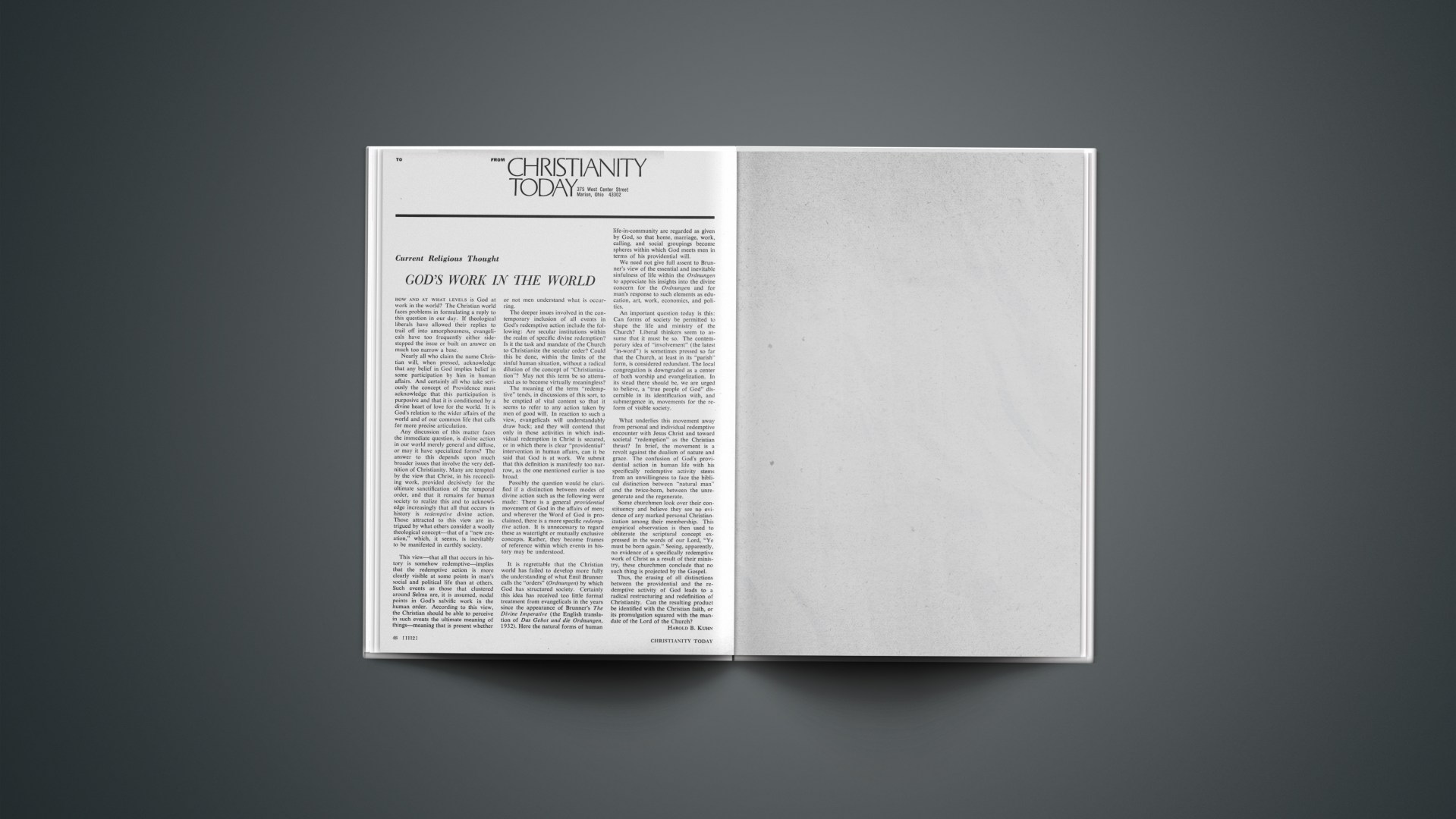
God’s Work in the World

How and at what levels is God at work in the world? The Christian world faces problems in formulating a reply to this question in our day. If theological liberals have allowed their replies to trail off into amorphousness, evangelicals have too frequently either sidestepped the issue or built an answer on much too narrow a base.

Nearly all who claim the name Christian will, when pressed, acknowledge that any belief in God implies belief in some participation by him in human affairs. And certainly all who take seriously the concept of Providence must acknowledge that this participation is purposive and that it is conditioned by a divine heart of love for the world. It is God’s relation to the wider affairs of the world and of our common life that calls for more precise articulation.

Any discussion of this matter faces the immediate question, is divine action in our world merely general and diffuse, or may it have specialized forms? The answer to this depends upon much broader issues that involve the very definition of Christianity. Many are tempted by the view that Christ, in his reconciling work, provided decisively for the ultimate sanctification of the temporal order, and that it remains for human society to realize this and to acknowledge increasingly that all that occurs in history is redemptive divine action. Those attracted to this view are intrigued by what others consider a woolly theological concept—that of a “new creation,” which, it seems, is inevitably to be manifested in earthly society.

This view—that all that occurs in history is somehow redemptive—implies that the redemptive action is more clearly visible at some points in man’s social and political life than at others. Such events as those that clustered around Selma are, it is assumed, nodal points in God’s salvific work in the human order. According to this view, the Christian should be able to perceive in such events the ultimate meaning of things—meaning that is present whether or not men understand what is occurring.

The deeper issues involved in the contemporary inclusion of all events in God’s redemptive action include the following: Are secular institutions within the realm of specific divine redemption? Is it the task and mandate of the Church to Christianize the secular order? Could this be done, within the limits of the sinful human situation, without a radical dilution of the concept of “Christianization”? May not this term be so attenuated as to become virtually meaningless?

The meaning of the term “redemptive” tends, in discussions of this sort, to be emptied of vital content so that it seems to refer to any action taken by men of good will. In reaction to such a view, evangelicals will understandably draw back; and they will contend that only in those activities in which individual redemption in Christ is secured, or in which there is clear “providential” intervention in human affairs, can it be said that God is at work. We submit that this definition is manifestly too narrow, as the one mentioned earlier is too broad.

Possibly the question would be clarified if a distinction between modes of divine action such as the following were made: There is a general providential movement of God in the affairs of men; and wherever the Word of God is proclaimed, there is a more specific redemptive action. It is unnecessary to regard these as watertight or mutually exclusive concepts. Rather, they become frames of reference within which events in history may be understood.

It is regrettable that the Christian world has failed to develop more fully the understanding of what Emil Brunner calls the “orders” (Ordnungen) by which God has structured society. Certainly this idea has received too little formal treatment from evangelicals in the years since the appearance of Brunner’s The Divine Imperative (the English translation of Das Gebot und die Ordnungen, 1932). Here the natural forms of human life-in-community are regarded as given by God, so that home, marriage, work, calling, and social groupings become spheres within which God meets men in terms of his providential will.

We need not give full assent to Brunner’s view of the essential and inevitable sinfulness of life within the Ordnungen to appreciate his insights into the divine concern for the Ordnungen and for man’s response to such elements as education, art, work, economics, and politics.

An important question today is this: Can forms of society be permitted to shape the life and ministry of the Church? Liberal thinkers seem to assume that it must be so. The contemporary idea of “involvement” (the latest “in-word”) is sometimes pressed so far that the Church, at least in its “parish” form, is considered redundant. The local congregation is downgraded as a center of both worship and evangelization. In its stead there should be, we are urged to believe, a “true people of God” discernible in its identification with, and submergence in, movements for the reform of visible society.

What underlies this movement away from personal and individual redemptive encounter with Jesus Christ and toward societal “redemption” as the Christian thrust? In brief, the movement is a revolt against the dualism of nature and grace. The confusion of God’s providential action in human life with his specifically redemptive activity stems from an unwillingness to face the biblical distinction between “natural man” and the twice-born, between the unregenerate and the regenerate.

Some churchmen look over their constituency and believe they see no evidence of any marked personal Christianization among their membership. This empirical observation is then used to obliterate the scriptural concept expressed in the words of our Lord, “Ye must be born again.” Seeing, apparently, no evidence of a specifically redemptive work of Christ as a result of their ministry, these churchmen conclude that no such thing is projected by the Gospel.

Thus, the erasing of all distinctions between the providential and the redemptive activity of God leads to a radical restructuring and redefinition of Christianity. Can the resulting product be identified with the Christian faith, or its promulgation squared with the mandate of the Lord of the Church?

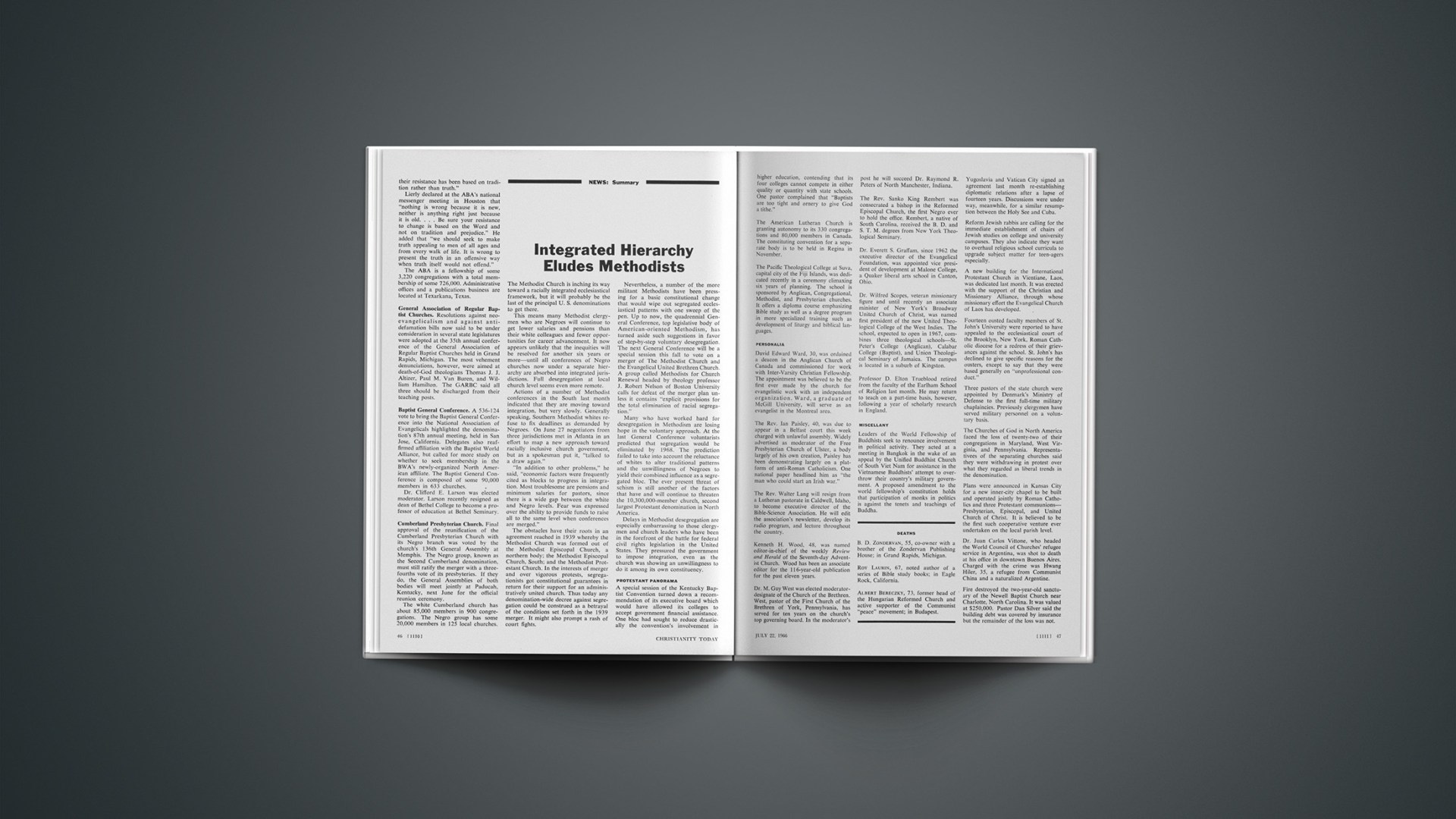
Integrated Hierarchy Eludes Methodists

The Methodist Church is inching its way toward a racially integrated ecclesiastical framework, but it will probably be the last of the principal U. S. denominations to get there.

This means many Methodist clergymen who are Negroes will continue to get lower salaries and pensions than their white colleagues and fewer opportunities for career advancement. It now appears unlikely that the inequities will be resolved for another six years or more—until all conferences of Negro churches now under a separate hierarchy are absorbed into integrated jurisdictions. Full desegregation at local church level seems even more remote.

Actions of a number of Methodist conferences in the South last month indicated that they are moving toward integration, but very slowly. Generally speaking, Southern Methodist whites refuse to fix deadlines as demanded by Negroes. On June 27 negotiators from three jurisdictions met in Atlanta in an effort to map a new approach toward racially inclusive church government, but as a spokesman put it, “talked to a draw again.”

“In addition to other problems,” he said, “economic factors were frequently cited as blocks to progress in integration. Most troublesome are pensions and minimum salaries for pastors, since there is a wide gap between the white and Negro levels. Fear was expressed over the ability to provide funds to raise all to the same level when conferences are merged.”

The obstacles have their roots in an agreement reached in 1939 whereby the Methodist Church was formed out of the Methodist Episcopal Church, a northern body; the Methodist Episcopal Church, South; and the Methodist Protestant Church. In the interests of merger and over vigorous protests, segregationists got constitutional guarantees in return for their support for an administratively united church. Thus today any denomination-wide decree against segregation could be construed as a betrayal of the conditions set forth in the 1939 merger. It might also prompt a rash of court fights.

Nevertheless, a number of the more militant Methodists have been pressing for a basic constitutional change that would wipe out segregated ecclesiastical patterns with one sweep of the pen. Up to now, the quadrennial General Conference, top legislative body of American-oriented Methodism, has turned aside such suggestions in favor of step-by-step voluntary desegregation. The next General Conference will be a special session this fall to vote on a merger of The Methodist Church and the Evangelical United Brethren Church. A group called Methodists for Church Renewal headed by theology professor J. Robert Nelson of Boston University calls for defeat of the merger plan unless it contains “explicit provisions for the total elimination of racial segregation.”

Many who have worked hard for desegregation in Methodism are losing hope in the voluntary approach. At the last General Conference voluntarists predicted that segregation would be eliminated by 1968. The prediction failed to take into account the reluctance of whites to alter traditional patterns and the unwillingness of Negroes to yield their combined influence as a segregated bloc. The ever present threat of schism is still another of the factors that have and will continue to threaten the 10,300,000-member church, second largest Protestant denomination in North America.

Delays in Methodist desegregation are especially embarrassing to those clergymen and church leaders who have been in the forefront of the battle for federal civil rights legislation in the United States. They pressured the government to impose integration, even as the church was showing an unwillingness to do it among its own constituency.

Protestant Panorama

A special session of the Kentucky Baptist Convention turned down a recommendation of its executive board which would have allowed its colleges to accept government financial assistance. One bloc had sought to reduce drastically the convention’s involvement in higher education, contending that its four colleges cannot compete in either quality or quantity with state schools. One pastor complained that “Baptists are too tight and ornery to give God a tithe.”

The American Lutheran Church is granting autonomy to its 330 congregations and 80,000 members in Canada. The constituting convention for a separate body is to be held in Regina in November.

The Pacific Theological College at Suva, capital city of the Fiji Islands, was dedicated recently in a ceremony climaxing six years of planning. The school is sponsored by Anglican, Congregational, Methodist, and Presbyterian churches. It offers a diploma course emphasizing Bible study as well as a degree program in more specialized training such as development of liturgy and biblical languages.

Personalia

David Edward Ward, 30, was ordained a deacon in the Anglican Church of Canada and commissioned for work with Inter-Varsity Christian Fellowship. The appointment was believed to be the first ever made by the church for evangelistic work with an independent organization. Ward, a graduate of McGill University, will serve as an evangelist in the Montreal area.

The Rev. Ian Paisley, 40, was due to appear in a Belfast court this week charged with unlawful assembly. Widely advertised as moderator of the Free Presbyterian Church of Ulster, a body largely of his own creation, Paisley has been demonstrating largely on a platform of anti-Roman Catholicism. One national paper headlined him as “the man who could start an Irish war.”

The Rev. Walter Lang will resign from a Lutheran pastorate in Caldwell, Idaho, to become executive director of the Bible-Science Association. He will edit the association’s newsletter, develop its radio program, and lecture throughout the country.

Kenneth H. Wood, 48, was named editor-in-chief of the weekly Review and Herald of the Seventh-day Adventist Church. Wood has been an associate editor for the 116-year-old publication for the past eleven years.

Dr. M. Guy West was elected moderator-designate of the Church of the Brethren. West, pastor of the First Church of the Brethren of York, Pennsylvania, has served for ten years on the church’s top governing board. In the moderator’s post he will succeed Dr. Raymond R. Peters of North Manchester, Indiana.

The Rev. Sanko King Rembert was consecrated a bishop in the Reformed Episcopal Church, the first Negro ever to hold the office. Rembert, a native of South Carolina, received the B. D. and S. T. M. degrees from New York Theological Seminary.

Dr. Everett S. Graffam, since 1962 the executive director of the Evangelical Foundation, was appointed vice president of development at Malone College, a Quaker liberal arts school in Canton, Ohio.

Dr. Wilfred Scopes, veteran missionary figure and until recently an associate minister of New York’s Broadway United Church of Christ, was named first president of the new United Theological College of the West Indies. The school, expected to open in 1967, combines three theological schools—St. Peter’s College (Anglican), Calabar College (Baptist), and Union Theological Seminary of Jamaica. The campus is located in a suburb of Kingston.

Professor D. Elton Trueblood retired from the faculty of the Earlham School of Religion last month. He may return to teach on a part-time basis, however, following a year of scholarly research in England.

Miscellany

Leaders of the World Fellowship of Buddhists seek to renounce involvement in political activity. They acted at a meeting in Bangkok in the wake of an appeal by the Unified Buddhist Church of South Viet Nam for assistance in the Vietnamese Buddhists’ attempt to overthrow their country’s military government. A proposed amendment to the world fellowship’s constitution holds that participation of monks in politics is against the tenets and teachings of Buddha.

Yugoslavia and Vatican City signed an agreement last month re-establishing diplomatic relations after a lapse of fourteen years. Discussions were under way, meanwhile, for a similar resumption between the Holy See and Cuba.

Reform Jewish rabbis are calling for the immediate establishment of chairs of Jewish studies on college and university campuses. They also indicate they want to overhaul religious school curricula to upgrade subject matter for teen-agers especially.

A new building for the International Protestant Church in Vientiane, Laos, was dedicated last month. It was erected with the support of the Christian and Missionary Alliance, through whose missionary effort the Evangelical Church of Laos has developed.

Fourteen ousted faculty members of St. John’s University were reported to have appealed to the ecclesiastical court of the Brooklyn, New York, Roman Catholic diocese for a redress of their grievances against the school. St. John’s has declined to give specific reasons for the ousters, except to say that they were based generally on “unprofessional conduct.”

Three pastors of the state church were appointed by Denmark’s Ministry of Defense to the first full-time military chaplaincies. Previously clergymen have served military personnel on a voluntary basis.

The Churches of God in North America faced the loss of twenty-two of their congregations in Maryland, West Virginia, and Pennsylvania. Representativees of the separating churches said they were withdrawing in protest over what they regarded as liberal trends in the denomination.

Plans were announced in Kansas City for a new inner-city chapel to be built and operated jointly by Roman Catholics and three Protestant communions—Presbyterian, Episcopal, and United Church of Christ. It is believed to be the first such cooperative venture ever undertaken on the local parish level.

Dr. Juan Carlos Vittone, who headed the World Council of Churches’ refugee service in Argentina, was shot to death at his office in downtown Buenos Aires. Charged with the crime was Hwang Hiler, 35, a refugee from Communist China and a naturalized Argentine.

Deaths

B. D. ZONDERVAN 55, co-owner with a brother of the Zondervan publishing House; in Grand Rapids, Michigan.

ROY LAURIN, 67, noted author of a series of Bible study books; in Eagle Rock, California.

ALBERT BERECZKY, 73, former head of the Hungarian Reformed Church and active supporter of the Communist “peace” movement; in Budapest.

Fire destroyed the two-year-old sanctuary of the Newell Baptist Church near Charlotte, North Carolina. It was valued at $250,000. Pastor Dan Silver said the building debt was covered by insurance but the remainder of the loss was not.

Church of the Brethren Shuns COCU

Church of the Brethren. The largest of the Brethren denominations in North America said no to the Consultation on Church Union last month. By a decisive vote of 881 to 220, delegates to the annual conference of the Church of the Brethren adopted a study committee’s recommendation against full COCU participation. The denomination now maintains an observer-consultant relationship, and that will continue.

COCU leaders reportedly had held out a big hope that the 200,000-member Brethren body would be the next to join. There are already eight denominations participating in the COCU talks, representing a prospective new superdenomination of some 24,000,000 members.

The Brethren committee expressed doubts about such a “vast” church organization. Their report called on the constituency “to be even more creatively and responsibly involved” in the ecumenical movement but indicated anxiety over the effect of a merger on pacifist Brethren convictions.

Such a merger, the report added, might also endanger the denomination’s conversations with other churches. Exploratory talks on unity have been held during the past year between the Church of the Brethren and four other denominations: the American Baptist Convention; the Churches of God in North America, with headquarters in Harrisburg, Pennsylvania; the Brethren Church, with headquarters in Ashland, Ohio; and the Evangelical Covenant Church.

The committee noted that COCU, in its negotiations looking toward a united Protestant church, regards only baptism and communion as sacraments. This, it said, “diminishes the recognition of the presence of God in other acts of the church such as feet-washing, anointing, marriage, and ordination.”

In addition, the committee said, “the forms and office of the ministry in the merging united Church, based upon the acceptance of the historic episcopacy, seem to perpetuate the sharp cleavage between clergy and laity, and give insufficient recognition of the growing creativity of the ministry of all believers.”

Lutheran Church in America. The question most Protestants are asking of the Lutheran Church in America never got an answer during the 3,260,000-member denomination’s third biennial convention in Kansas City.

Why has the LCA, largest and most ecumenically minded of the Lutheran denominations, steered clear of the Consultation on Church Union? Both the LCA and the 2,600,000-member American Lutheran Church have rejected even observer status. Much to their surprise, the more conservative Lutheran Church—Missouri Synod listened in officially at the May meeting of COCU.

Franklin Clark Fry, the articulate LCA president who was re-elected, says Lutherans have “no doctrinal basis” for unity talks with COCU. Lutherans, he declared, feel that common doctrine is the only basis for unity, whereas leaders of Reformed bodies see unity gained through organic union, followed by the working out of doctrinal problems as the union matures.

“We would be willing to sit down right now and discuss doctrinal statements,” Fry said. “We emphasized there was no antipathy toward the discussions, and our rejection was received in good faith.”

What happens now? Even though Fry is a strong ecumenist (he heads the Central Committee of the World Council of Churches), he is obviously not advocating a rushing into Lutheran-Reformed talks. The LCA and the ALC are still working out the problems of the mergers that brought them into existence four years ago, and they don’t want to jeopardize hopes of a merger with Missouri’s 2,780,000 members.1The LCA, however, has implicity declined for the time being overtures from the other two churches for pulpit and altar fellowship. Such a union would represent 90 per cent of the nine million U. S. Lutherans.

As expected, last month’s LCA convention voted unanimously to become part of the Lutheran Council in the U. S. A., seen by some as another big step toward more Lutheran unity. This cooperative agency will replace the present National Lutheran Council, which has served the LCA and the ALC and their predecessors since 1918. Conventions of the ALC, Missouri, and the smaller (20,000 members) Synod of Evangelical Lutheran Churches have already approved participation in LCUSA. A parallel body is to be formed in Canada.

The new agency will engage in theological studies, public relations, military personnel and educational services, and welfare and mission activities. The Rev. Dr. C. Thomas Spitz, a Missouri Synod pastor long active in broadcasting, is to be selected general secretary, a position in which he has been working unofficially for several months. An organizational meeting is scheduled for November, and the new offices will open in New York in January.

In a statement on church-state relations, the convention chose a middle ground. Said one of the framers, Philadelphia seminary dean William H. Lazareth, “A political position which advocates separation between church and state presupposes separation between Creator and Redeemer. Since God is One, this would mean schizophrenia in the Godhead.”

“The state is God’s agent for his non-redemptive work,” Lazareth said. “This is not an endorsement of the principle of state aid to private education” or other institutions, he added, nor does it mean the Church feels it is “morally mandatory” for the state to offer financial aid.

The statement said, “The position rejects both the absolute separation of church and state and the domination of either one by the other, while seeking a mutually beneficial relationship in which each institution contributes to the common good by remaining true to its own nature and task.”

In the first step of a “master plan” toward realignment of seminaries, the convention voted to merge a small seminary at Fremont, Nebraska, with the Lutheran School of Theology in Chicago. In other action, delegates overrode a Fry recommendation and voted a study of the role of women in the ministry. (Fry felt the study is “unwise” at this time, explaining that Missouri now limits its ordination to men and that in view of current talks, he hopes to narrow, rather than widen, the gap between Lutheran bodies.)

The delegates also: passed a sixteen-point “manifesto,” designed as a checklist for local congregations, which reaffirms the theological position of the church and invites congregations to work with churches and secular groups “in activities that promote justice, relieve misery and reconcile the estranged”; spoke strongly for abolition of the death penalty, noting that capital punishment falls disproportionately upon those least able to defend themselves; heard Fry report that the church was forced to dip into reserves for more than $300,000 to complete its work last year because of lack of revenue; and expressed cautious approval of U. S. involvement in Viet Nam, commending men serving in the war but recognizing the right of those who feel they cannot participate in the war to hold this position.

The convention turned down an amendment offered by a Milwaukee industrialist to a statement dealing with programs to counteract deprivation. The amendment of Carl T. Swenson, a lay delegate, sought to shift the emphasis to non-governmental programs as a means of eliminating injustice and want. Swenson said that talent should be enlisted from industry to help carry out programs planned in a Christian framework.

A variable-income pension approved by delegates will give program participants the option of sharing directly in the value of common stocks. The pension plan provides payments for life, but they will increase or decrease according to fluctuations in dividend income and market value of stocks in which members’ contributions are invested.

Evangelical Free Church of America. Joining the swelling ranks of U. S. Protestants who need money for their schools and yet desire to keep church and state separate were delegates to the eighty-second annual conference of the Evangelical Free Church of America. A dean of the denomination’s college called for “judicious use” of federal aid, but a committee report turned thumbs down on the idea. The whole question was tabled pending further study.

Immediate effect of the action was a loss of $183,000 in a grant said to have been offered the church’s Trinity College by the federal government for a new science building.

National Association of Congregational Christian Churches. A banquet address by Mormon George Romney, governor of Michigan, was heard by some 1,000 persons during the annual meeting of the National Association of Congregational Christian Churches. Romney told them that churches should help provide the moral character needed for responsible citizenship in all areas of life. The association is the largest of the Congregational church groups opposing the merger that created the United Church of Christ.

Evangelical Covenant Church of America. Two official Sunday School curricula have been adopted by the Evangelical Covenant Church of America. One is the Covenant Life curriculum, a cooperative venture with the Presbyterian Church in the U. S. (Southern) and four other denominations. The other is that of Gospel Light Publications.

At the church’s 81st annual General Conference, held in Chicago, delegates adopted a resolution supporting President Johnson’s “willingness to negotiate unconditionally to achieve peace in Viet Nam.” They did not pass specific judgment, however, on the American military action there.

A committee on interchurch relations was instructed to continue explorations regarding merger with other denominations. Such talks have taken place during the year past with the Moravian Church in America, the Evangelical Free Church, the Church of the Lutheran Brethren, the Church of the Brethren, and others.

The Rev. Milton B. Engebretson, 45, was elected president of the 66,000-member church to succeed the retiring Dr. Clarence A. Nelson next year.

Toward A Consecrated Rebellion

Among the largest of American religious conventions is one where no laws are enacted, no resolutions passed, and no politics allowed. It is the annual North American Christian Convention, unofficial focal point of the conservative element of the Disciples of Christ. The only activities are naming of officers (president for 1966–67: L. Palmer Young, a minister from South Louisville, Kentucky), formal speeches, discussions, and fellowship.

This year’s convention in Louisville, which drew a staggering total of 25,000 registrants, included an incisive address by Donald H. Sharp, minister of Woodland Heights Christian Church in Crawfordsville, Indiana. Here are excerpts:

“Jesus rebelled against religious legalism, social injustice, and personal hypocrisy.

“Since Jesus there have been a parade of rebels. Among them there have been charlatans and fools. There have been egocentrics looking for some scrap of notoriety. There have been kooks rebelling for kicks. And yet every great leap forward seems to have come through the inspiration of some deeply consecrated rebel who, as Frank Meade has said, ‘objected not so much to men or institutions as to the abuses of men within those institutions.’ …

“We must remember that the separation of the rebel fools and the rebel greats is clearly defined in what man becomes indignant about. To wildly rebel against the establishment for the sake of rebelling is to play the part of the fool. Rebellion must have purpose beyond itself. To rebel against hypocrisy, social injustice, and religious bigotry is rebellion with a purpose and is to become at least in one sense God-like.

“Our brotherhood does not send delegates to conventions to pass resolutions and to impose decrees upon the brethren, and this is as it should be. However, our brotherhood does have positive responsibilities in convention, one of which is surely to instill into every hearer the will to be a God-like rebel.

“I’m tired of Christendom winking at hypocrisy, condoning social injustice, and upholding religious bigotry in the name of conservatism. I believe in conserving the faith once and for all delivered unto the saints, but I rebel against man-made traditions that draw little circles to shut men out. I believe in the separation of church and state but I rebel against this profane silence that we have fostered because we are afraid of being identified with the liberals.…

“Faith in Christ answers man’s need to rebel and be a rebel. We can rebel against the hypocrisy of our own lives.… We can rebel against social injustice beginning first with ourselves, for when we have removed the logs of injustice from our own eyes we shall be much better prepared to see how to correct the injustice fostered by others. We can rebel against religious Pharisaism by placing our pet opinions under the light of God’s Word and then quit imposing our opinions upon others as God’s law. Much of our brotherhood’s division is not on what the Bible has said but rather on what the Bible has not said.”

American Baptist Association. “Baptists have been slow to change,” said President Vernon E. Lierly of the American Baptist Association, “but many times their resistance has been based on tradition rather than truth.”

Lierly declared at the ABA’s national messenger meeting in Houston that “nothing is wrong because it is new, neither is anything right just because it is old.… Be sure your resistance to change is based on the Word and not on tradition and prejudice.” He added that “we should seek to make truth appealing to men of all ages and from every walk of life. It is wrong to present the truth in an offensive way when truth itself would not offend.”

The ABA is a fellowship of some 3,220 congregations with a total membership of some 726,000. Administrative offices and a publications business are located at Texarkana, Texas.

General Association of Regular Baptist Churches. Resolutions against neo-evangelicalism and against antidefamation bills now said to be under consideration in several state legislatures were adopted at the 35th annual conference of the General Association of Regular Baptist Churches held in Grand Rapids, Michigan. The most vehement denunciations, however, were aimed at death-of-God theologians Thomas J. J. Altizer, Paul M. Van Buren, and William Hamilton. The GARBC said all three should be discharged from their teaching posts.

Baptist General Conference. A 536–124 vote to bring the Baptist General Conference into the National Association of Evangelicals highlighted the denomination’s 87th annual meeting, held in San Jose, California. Delegates also reaffirmed affiliation with the Baptist World Alliance, but called for more study on whether to seek membership in the BWA’s newly-organized North American affiliate. The Baptist General Conference is composed of some 90,000 members in 633 churches.

Dr. Clifford E. Larson was elected moderator. Larson recently resigned as dean of Bethel College to become a professor of education at Bethel Seminary.

Cumberland Presbyterian Church. Final approval of the reunification of the Cumberland Presbyterian Church with its Negro branch was voted by the church’s 136th General Assembly at Memphis. The Negro group, known as the Second Cumberland denomination, must still ratify the merger with a three-fourths vote of its presbyteries. If they do, the General Assemblies of both bodies will meet jointly at Paducah, Kentucky, next June for the official reunion ceremony.

The white Cumberland church has about 85,000 members in 900 congregations. The Negro group has some 20,000 members in 125 local churches.

Ten Days at Wenham: A Seminar on Scripture

In a seminar unprecedented in recent evangelical history, fifty-one biblical scholars met at Gordon College and Divinity School (Wenham, Mass.) for ten days’ intensive discussion of the authority and inspiration of the Bible. Participants, most of them seminary professors and administrators, came from six European countries as well as from Australia, Korea, Canada, and the United States. They were members of various communions, including Anglican, Reformed, Lutheran, Baptist, Methodist, Congregational, Free Church, and independent bodies.

The lively discussions were conducted with remarkable freedom and candor in an atmosphere of Christian fellowship and submission to the authority of Scripture. Daily sessions, moderated by members of the convening committee (Harold J. Ockenga, chairman; Frank E. Gaebelein; and Russell T. Hitt), were supplemented by many hours of informal conversation.

Major papers and responses covered such subjects as archaeology, biblical authority in the light of exegesis and hermeneutics, Roman Catholic attitudes toward Scripture, liberal stereotypes of the evangelical view of the Bible, the contemporary relevance of Warfield’s approach to inspiration, and the theological definition of authority, inspiration, and inerrancy.

Among those presenting papers were Dr. Donald J. Wiseman, professor of Assyriology at the University of London; Dr. Herman Ridderbos, professor of New Testament at the Theological Seminary of the Reformed Churches, Kampen, The Netherlands; Dr. James I. Packer, warden of Latimer House, Oxford; Dr. Oswald C. J. Hoffmann, preacher on “The Lutheran Hour”; and Dr. Kenneth S. Kantzer, dean of Trinity Evangelical Divinity School.

Much of the wide-ranging discussion was on inerrancy. Some held this to be an essential biblical doctrine, while others preferred to speak of Scripture as infallible. There was general agreement that any definition of inerrancy must be framed in the light of all the biblical data, and there was also a consensus on the complete truthfulness of the Bible and its authoritativeness as the only infallible rule of faith and practice. No participants affirmed the errancy of the Bible.

At the conclusion of the seminar, this statement was adopted—not as a formal confession but as a report of mutual attitudes, common ground, and matters requiring further study:

Text Of Communique

A privately sponsored Seminar on the Authority of the Bible was held at Gordon College, Wenham, Massachusetts, June 20–29. The participants sought to clarify their understanding of scriptural authority in order that they might more faithfully acknowledge it as the authority of Christ himself.

The historic Protestant confession of the supreme authority of Scripture provided the background for discussion and the structure of hearty agreement. Among the agreed positions affirmed were the following:

That the Holy Scriptures, comprising the sixty-six canonical books given by the Holy Spirit, are verbally inspired and are the revealed Word of the Triune God;

That the Scriptures are completely truthful and are authoritative as the only infallible rule of faith and practice;

That because the Word of God was written by men in particular historical contexts, the disciplines of accurate scholarship have a full and proper use in its study;

That the Bible as a whole sets forth the history of redemption and directs us to Jesus Christ, the Word incarnate;

That God has committed the Scriptures to his people to search, obey, and proclaim, and that through the working of his Holy Spirit he effectively uses the Scriptures for the salvation of men, the instruction and government of his Church, and the consummation of his purpose.

In an endeavor to put such theological truth into the language of today, a committee drew up the following statement, which does not necessarily reflect the viewpoint of each member of the seminar:

Attitudes toward the importance of the Bible are changing throughout the Christian world. The renewal of biblical studies among Roman Catholics and the increasing concern for the biblical message through the whole Church, together with current confusions regarding that message, are facts which call for new endeavor on the part of evangelicals. In this situation we must acknowledge that neither our methods of expression nor our practices have sufficiently witnessed to our faith in God’s Holy Word; hence we offer the following testimony to its power and authority;

The Bible is wholly trustworthy, for its words speak God’s truth and give men final answers to the deepest problems of their lives. Scripture throughout the centuries has brought men to the saving Christ who died and rose again, and we affirm that it will do this today when it is read and proclaimed in the power of the Holy Spirit. We stand under it and commend it to a frustrated age that needs above all to hear the clear and powerful voice of God in judgment and in grace.

Holy Scripture sets forth abiding standards of conduct for men and nations. Christians have often failed to concern themselves sufficiently with the suffering and injustice of our sick society and to hold forth to dying men the Word of Life. We, therefore, give ourselves anew to declaring the biblical Word, which alone offers hope in this world and the next.

In the fruitful and candid discussions of the seminar, certain questions were found to require further study and consultation. They included the interpretation of historical, chronological, and literary difficulties in the Scriptures; the extent to which reconciliation of such difficulties should be sought; the bearing of modern science on biblical narratives; the concept of inerrancy, whether and in what sense it is a biblical doctrine, and its relation to biblical authority.

For those privileged to participate in it, the seminar brought rewards beyond those anticipated. Personal friendship and mutual understanding flourished in an arduous docket of meetings. The urgency of evangelical engagement in current theological debate became increasingly apparent. Above all, the clarity, excellence, and authority of the Bible itself commanded a response of praise in an enterprise where labor cannot be far from prayer.

Potions Under Study

Not only does LSD induce religious awareness, say the psychedelic prophets; it can also promote world peace, assuage the distress of the dying, help alcoholics, and boost learning processes. In short, this is what the world has been waiting for, according to some who participated in a landmark conference on LSD in San Francisco last month. The prospects of induced religious experience kept recurring, but a few of the more dubious participants had the nerve to challenge the cure-all claims and pointed instead to the rising incidence of LSD use among teen-agers, the hundreds of LSD-induced “acute panic” hospital admissions, and prolonged psychotic reactions—even suicides.

This was not enough to dampen the enthusiasm of Dr. Timothy Leary, flamboyant evangelist of the LSD cult, who said, “The present LSD boom is no less than a religious renaissance that is only just beginning.” The only real danger to a person, he asserted, is that he will “refrain from LSD and thus abide in his house of spiritual plague.” Further, “LSD’s first place of impact is in religious experience as it alters our attitudes toward ourselves and society.”

LSD is a chemical that is colorless, odorless, and tasteless when dissolved in water. It is the best known of a number of substances that, taken internally, produce hallucinations—or, as Leary and his disciples would have it, expand the person’s levels of consciousness (see June 24 issue, page 46, and July 8 issue, page 44). The six-day San Francisco conference, sponsored by the adult education branch of the University of California, was the first such scholarly colloquium on psychedelics (the technical term for so-called consciousness expanding compounds).

Because the word “religious” is “too loaded,” Dr. Paul Lee had misgivings about Leary’s view and preferred to label the LSD “session” or “trip” as “the most profound existential or mythical experience one can have.” Lee, who claims to have new insight into St. Augustine’s Confessions as a result of LSD intake, will teach philosophy beginning this fall at the University of California, Santa Cruz. He has been Protestant chaplain at Brandeis University and assistant professor of humanities at the Massachusetts Institute of Technology. Lee suggested that a psychedelic experience can be seen in “the myth of Genesis,” in which Adam and Eve partook of “the tree of all possibilities—a symbol of mental creativity.”

“I do believe in psychedelic religion, where LSD is the sacrament,” said Dr. Frank Barron, a University of California research psychologist, “but I do not agree with it.” He pointed out two dangers: LSD can convert latent psychoses into overt forms; and it can cause a basic change in values, such as loss of distinction between right and wrong.

Essential sensations of a “trip” were outlined by a prominent psychiatrist and UCLA professor of medicine, Dr. Sidney Cohen, author of The Beyond Within: The LSD Story. These include loss of ego boundaries and fusion with the universe (“you may see your body melting into the carpet”), a philosophical basis of some major religions. Said Cohen: “Many who have taken LSD say they have discovered the great white light of God; they say that this is the ‘real reality,’ and they yearn to return to this state.” Thus the experience—not the drug itself—becomes addictive, a point repeatedly referred to during discussions of legal and moral implications.

Along more scholarly lines, Dr. Abram Hoffer, a Canadian psychiatrist and university professor, reported his use of LSD in treating 800 alcoholics. He said that more than one-third were cured as against the average 10 per cent cure rate of all other treatments combined.

For most of those cured, the “healing” came within a context of religious experience, said Hoffer. For example, there was the priest named John who, under LSD’s influence, “saw” God and heard him say, “John, no more drinking!” From that day, months ago, the priest has remained sober. While admitting the unusual nature of this instance, Hoffer said that “properly used LSD therapy can, with great speed and economy, convert a large number of alcoholics into sober members of society.”

A “Center for Dying and Being Born,” where terminal patients would be LSD-enabled to face death “in a conscious and open way,” was called for by Dr. Richard Alpert, a research psychologist and former Leary colleague. His idea received weight from a paper by Eric C. Kast, a Chicago psychiatrist. Kast wrote that LSD administered by him to experimental groups of dying patients created “acceptance and surrender to the inevitable loss of control” and even gave some “a new will to live and a zest for experience.” Added Alpert, “A patient could choose to die in my ‘Center’ under whatever religious metaphor he wished, because psychedelic clergymen abound today.”

Ecumenism At The Altar

News reports last month disclosed two unusual and presumably unprecedented marriage ceremonies.

A Jesuit priest was married to a former nun by a fellow Jesuit colleague at the University of Detroit.

A Southern Baptist pastor and a Catholic priest participated together in a wedding ceremony at St. Michael Catholic Church in Memphis.

Father Lawrence Cross, 47, former head of the sociology department of the Jesuit-run University of Detroit, made front-page news with his marriage to Joan Renaud, 37, a nurse who had left the Sisters of Mercy three years ago. Father Thomas Blackburn, chaplain of the university, celebrated the marriage.

Father Cross, on leave since January to teach at Rome’s Pontifical Gregorian University, returned to the country in May and married Miss Renaud May 31. He entered the Jesuit order in 1937 and was ordained in 1951. In 1957 he joined the university faculty, after studying as a Fulbright scholar in Belgium. Father Cross has been active in civil rights work and served on the Archbishop’s Committee on Human Relations and in the Detroit chapter of the NAACP.

Under canon law, a priest who marries is automatically suspended of his “faculties” and cannot celebrate Mass, hear confession, or distribute the Holy Communion. He remains, however, a priest for life.

In Memphis, Joyce Jackson, a Baptist, and James M. Larkin, a Catholic, were married at St. Michael Church by Father James Miller, assistant pastor, and by Miss Jackson’s brother, William, pastor of the Bethel Baptist Church of Hebbardsville, Kentucky.

Father Miller led in the exchange of vows and Jackson delivered a sermon and gave the benediction. The sermon described love as presented in First Corinthians 13 as the basis for marriage.

The bride had visited Father Miller two days after the Vatican degree liberalizing restrictions on Catholic-Protestant marriage ceremonies and asked how her brother could participate in the wedding.

Jackson, a graduate of Southern Baptist Theological Seminary and Union University, said Father Miller had been very generous in allowing him time during the ceremony.

A Baptist Press release quoted Jackson as saying, “There were almost no restrictions given me, except that he had to exchange the vows and this is something that I would want to do at any wedding performed in my church.”

The bride said she will remain Baptist and her husband Catholic.

In a draft of a new hymnal for Presbyterian churches in the British Isles a hymn for burial services was inadvertently printed in the section for weddings. The misplaced hymn began, “Go happy soul, thy days are ended.”

Off LSD himself since February, Alpert theorized that the drug was possibly a key to show persons how to create and order their environment. He went on to link LSD-induced religious experience to most “rock and roll” groups: it makes possible mutual spontaneity in improvisation and rhythm which then becomes a high level of spiritual communication. He revealed plans already drawn up for a “discotheque church” that would include “rock and roll spiritual endeavor.”

The Leary-Alpert school came in for some hard knocks from Huston Smith, author of The Religions of Man. Smith questioned the “staying-power” of LSD-religion—“where faith is confirmed, awe felt, and obedience increased,” for true religious experience triggers from the core of man’s being a “triple movement of mind, emotions, and will.”

Smith chided the movement for “failure to integrate psychedelic experience with daily life” (referring to Leary’s radical doctrine of “quit society, quit work, quit school”) and also for its failure to face up to the problems of sexual irresponsibility, lethargy, and anarchy that grow out of its antinomian nature.

EDWARD E. PLOWMAN

Tribute In A Window

The FBI director was honored June 26 by the congregation of the Capitol Hill Methodist Church, Washington, D. C., who named a window in their new $1 million building the J. Edgar Hoover Window. Hoover, a Presbyterian, was born and grew to adulthood in a home on the site of the new Methodist church.

The colored-glass window, designed to symbolize statesmanship through Christian virtues, is twenty-two feet wide and thirty-three feet high. It is constructed in seven longitudinal sections framed on all sides in limestone.

“The window is designed to symbolize the Christian virtues of Hoover and other Christian statesmen,” said the Rev. Edward B. Lewis, pastor. He explained that the symbols in the window include: an anchor, symbol of hope; balance scales, law and justice; a compass, temperance; the cross, faith; a lamp, education and learning; a lily, purity; and the oak leaf, courage and fortitude.

Social Activist

The Rev. Lester Kinsolving, founder and president of the newly organized Association of Episcopal Clergy, is also being given the full-time job of lobbying for repeal of California laws prohibiting abortion. The appointment was made by the Rt. Rev. James A. Pike, the resigning Bishop of the Episcopal Diocese of California.

A campaign to repeal abortion laws was begun after nine San Francisco Bay area doctors were charged with performing illegal abortions on women exposed to German measles.

The outspoken Kinsolving, who leaves his work as vicar of the Church of the Holy Spirit in Salinas, California, says that “certain aspects of the Church … are definitely in a bad way.” He organized the clergy association to aid in the defense of clergy in trouble; to correct injustices in relations between clergy and church superiors; to study the Episcopal Church’s pension fund; and to serve as a placement bureau for clergy.

The organization met some initial criticism from the presiding bishop of the Episcopal Church, the Rt. Rev. John E. Hines, who called it a “trade union.” Kinsolving contends that the organization is comparable to the Association of University Professors or a teachers’ association and is not a trade union.

Federal Fever

The gradually growing religious lobby in Washington will soon have an Orthodox wing. Establishment of a secretariat in the nation’s capital at a cost of $100,000 per year was approved this month by delegates to the eighteenth biennial Clergy-Laity Congress of the Greek Orthodox Archdiocese of North and South America. The action came upon recommendation of Archbishop Iakovos, primate of the archdiocese, who indicated that he planned to spend considerable time in the new office. His rationale: “Because of the extent of our responsibilities and role as a major faith, we need a center in Washington to be in better direct contact with the nation and national politics.”

‘Up With People’ Ban

The Columbia Broadcasting System is refusing to let its television stations show the Moral Re-Armament film, “Up With People.” The film was to have been carried under the sponsorship of the Schick Safety Razor Company. Edward Baltz, vice president of the firm, said that a protest against the CBS ban would be lodged with the Federal Communications Commission.

According to Baltz, the reason given by the network for banning the show was a CBS policy that no sponsored program could be of ideological or editorial nature and that some segments of the film were contrary to this rule.

Prayers Under Protest

A federal judge ruled in Chicago last month that a traditional verse of thanksgiving without the word “God” does not constitute a prayer when recited by De Kalb, Ill., kindergarten children.

Judge Edwin A. Robson dismissed a request for an injunction against De Kalb’s Elwood School which asked children to recite:

“We thank you for the flowers so sweet.

We thank you for the food we eat.

We thank you for the birds that sing.

We thank you for everything.”

The ruling came in response to the request of Mr. and Mrs. Lyle Despain of De Kalb who charged that the constitutionally guaranteed freedoms of their five-year-old daughter were being violated when she was asked to recite the verse.

Mrs. Esther Wayne, 63, kindergarten teacher, said that she had already eliminated “God” from the last line of the verse at the request of the Despains. She contended that the verse was not a prayer but “a method of learning graces and manners.”

Mrs. Despain testified that some children concluded the recitation of the verse with an “amen” or by crossing themselves.

The judge said there was no indication that the children “took a devotional attitude” in reciting the verse. The verse simply “expresses gratitude,” he said.

The Chicago decision contrasted with a 1965 decision by the Federal Court of Appeals in New York which ruled that a similar prayer without the deletion of “God” was unconstitutional in a Whitestone kindergarten. In the Whitestone case, parents of kindergarten children took action against the school for disallowing prayer after principal Elihu Oshinsky stopped school prayers in keeping with a Board of Education ruling.

The U. S. Supreme Court refused to hear the case after parents appealed the ruling of the Federal Court of Appeals.

CAROLYN LEWIS

Moscow Charges Bible Smuggling

Moscow Radio reported this month that three British tourists and a Dutch citizen were expelled from the Soviet Union for attempting to smuggle religious literature in the country.

The report said that Anthony Richard Hippisley and his wife, Anne Marie, tried to smuggle through a border checkpoint 400 Bibles and other books which they had received from the British and Foreign Bible Society for “illegal” circulation in the Soviet Union. The books, the station added, were concealed in eight secret compartments in a specially adapted Volkswagen.

A second smuggling attempt at the Lyausheny checkpoint in Soviet Moldavia, Moscow Radio said, involved two Baptist ministers—identified as John Murray, a Briton, and Johannes Fisser, a Dutchman. It said they tried to bring in similar literature concealed in an automobile.

In each case, the “smugglers” were said to have been ordered out of the country and their books and cars confiscated.

London Crusade Produces Historic Climax

In June, Americans were all over London, that much publicized “swinging city”: tourists, tennis fans at Wimbledon, Cassius Clay, Hugh Hefner unveiling yet another Playboy Club, and as the head of the British Safety Council observed, “two American savers of souls,” Ralph Nader, author of Unsafe at Any Speed, and Billy Graham.

Evangelist Graham far outdrew the competition, speaking to more than 900,000 persons, his largest audience ever for a month of meetings. The crusade was also his longest since Philadelphia in 1961. The meetings at Earls Court, Britain’s biggest hall, put the career total of persons responding to Graham’s altar calls past one million.

The Greater London Crusade was a bench mark for at least one other reason—Graham used television as never before. Three services were recorded in color for telecast later this year in America. Big-screen theater-type TV accommodated overflow crowds in the main arena and simultaneous services in ten cities across Britain. Graham is now talking about a “national crusade” in America, using closed-circuit TV.

Supporters and skeptics alike will now maintain close scrutiny of the 40,000 persons who registered decisions for Christ. About a tenth of these responded to the appeal at the closing service July 2 in Wembley Stadium, England’s largest outdoor arena. Under a near-cloudless evening sky, they filed silently onto the tarpaulin-covered turf track where dogs had raced twenty-four hours earlier. In all, some 86,000 got into Wembley.

Surveying the dramatic throng, the purple-cloaked Lord Bishop of Coventry, Dr. Cuthbert Bardsley, inserted some commentary before his benediction. He said Graham “brought new life to our nation when we greatly needed it.” While critics say Graham doesn’t “preach a social message,” the bishop predicted thousands of reformed individuals would go forth from the crusade to help reform society.

Some considered the crusade as a holding action, merely reinforcing the faithful. Although a large part of the audience was churchgoers, figures on the “inquirers” tell a different story. Counselors’ cards show a third have no church connection at all, while another third have church membership but no regular participation.

Another significant fact: Two-thirds of the inquirers are under 25. This is in marked contrast to the three-month Harringay crusade in 1954, where those going forward were predominantly middle-aged. A magazine ad on Graham’s behalf seemed to capture the mood: “Make religion a real live switched-on thing.”

London will also be remembered for the stark silence as the inquirers responded. After thorough discussion, Graham’s team decided to eliminate the usual choir song of penitence, chiefly to counter criticism that an emotional spell was cast. Once the change was made, new critics popped up, claiming the shuffling of thousands of feet was just as hypnotic.

The spell of silence was interrupted three nights, twice by individual protesters and, on the final Tuesday, by a dozen youths chanting, “Save souls in Viet Nam.” As they were hustled out of the hall strewing leaflets, the sober converts filed past. The next night, antiwar demonstrators reportedly planned to interrupt Graham’s sermon every five minutes. But that day the United States bombed near the centers of Hanoi and Haiphong, and protests centered on the American embassy instead.

Another night, a gang of war critics planned to go forward and tie up as many counselors as possible in political arguments, but few went through with the plan. Before another service, a telephone crank threatened to bomb the counseling room.

Graham’s refusal to preach on international politics also caused criticism from clergymen. There was a string of other complaints: Graham shouldn’t “seek publicity,” should mention the sacraments, should be more intellectual, should take a parish in an underprivileged area. A common reservation was voiced by the Archbishop of York, a distinguished Graham supporter: “We may not like all the methods he uses.…”

But Congregationalist analyst Cecil Northcott says theology, not methods, was the basic issue. The week after the crusade closed, Northcott contended in the Church Times (Anglican) that the £1 million (nearly three million dollars) spent on Graham activities in 1954 and 1966 would have been better used to found and endow a “National Institute of Mission” for “ecumenical study” of evangelism, free of Graham’s “biblicism and servitude to the printed word.”

Amid all the Protestant complaints, Roman Catholic writer-editor Michael de la Bedoyere praised Graham for getting down to the essentials of the faith, asked prayers for his success, and said, “We may yet see him as ‘Saint Billy’!”

The Graham team took a turnabout look at the churches in a special meeting for clergymen. Lane Adams said that “the average church expects more maturity from crusade inquirers than veteran members” but should remember they are “spiritual infants.” Graham appealed for more basic, uncomplicated gospel preaching.

The evangelist’s approach to British churches came through in his nightly talks to inquirers. He said they must become active in a church even though many say “that’s the hardest thing you’ve asked me to do.” But he told them also to join one of the 6,000 Bible study groups now functioning in the London area. He urged the new Christians to take part in social service, such as visiting the sick or lonely or “making friends with someone of another race.”

A lot has happened to Great Britain and to Billy Graham since their encounter a dozen years ago. Something of an American curiosity in 1954, Billy Graham in 1966 is a world figure. He carried his biblical beliefs to luncheon with Queen Elizabeth, a charity ball to which he was invited by Princess Margaret, a breakfast meeting for 150 members of Parliament (many of whom had been debating on the floor of Commons until 7:30 A.M.), and 2,000 leaders of society and culture at a Foyles Literary Luncheon.

Graham’s sermons contained the same concise, dramatic Gospel he preaches everywhere, but these upper-crust gatherings produced some new material.

In introducing Graham at the literary luncheon, publishing magnate Lord Thomson said “the cynics are quieter than twelve years ago” because there is more crime, child cruelty, laziness, and selfishness. After being toasted with champagne, the teetotaling evangelist said that in Britain and America “there is a developing vacuum like that in prewar Germany. If it is not filled with something hopeful that will answer the ultimate problems of life, there will be trouble in the next generation.”

Graham said the life taught by Christ “never had all the taboos built up in the Victorian period.” And at the parliamentary breakfast, he called for a “new Puritanism” of “disciplined, New Testament living.” In the style of Earls Court, he said a new revival “could begin in the heart of someone here today.”

As for the crusade, Graham told a church audience to judge its results in five or ten years. (Dozens of ministers converted at Harringay were in evidence at Earls Court.)

The evangelist will return to London for two days in September to shore up new converts, on his way to a preaching mission in Poland. He has no major events scheduled over the summer.

The evangelist told an unofficial meeting at the Anglican Church Assembly July 5 that he found widespread religious interest in Britain but also “a revolt against the institution of the Church,” particularly among laboring classes. He said professionals alone cannot evangelize Britain. The laity must be mobilized, and this will require “a drastic revolution.” He said it is time for the Church to take the offensive, with “unambiguous proclamation.”

Graham labeled the “so-called radical movement” as “reactionary” because it is merely “defensive in the face of secularism, humanism, and rationalism.” He said the Church has also been defensive in morals by hesitating to denounce sin.

Billy And The British Press

One of Billy Graham’s most extraordinary achievements in Britain was making salvation into page-one news. There were hundreds of articles in stately journals and lowbrow dailies, notices of crusade trips in provincial papers, and seemingly endless letters to the editor. The treatment of Graham was rougher than anything he gets from secular journalists in the States.

The Communist Morning Star, in a huge headline, dismissed the crusade as “Sky-pie—in the new king-size, flip-top packet.” A Reading columnist said bluntly, “Go Home, Billy Graham.” In a similar vein, a Glasgow writer said that with “150 million scarlet sinners in the U. S. A.… Graham’s search for souls in London surely takes on some comic opera qualities.”

Anti-Americanism also cropped up in a letter to the Ipswich Evening Star: “It’s no use sobbing your socks off at Earls Court about your minor peccadilloes if you then go off and murder men, women, and children in Vietnam because President Johnson tells you to.”

The Mirror’s Cassandra, who is syndicated in the United States, said soberly, “Billy Graham hasn’t changed, but I think that we in Britain have—for the worse.” He considers Graham “a good, simple man who comes from a country where revivalism has a bad record.”

The Times, the “Establishment” daily, was rare in perceiving theological undertones to anti-Graham feeling within the Church. It said “few could deny the harsh truth” in much that he said.

Some reporters went into print with stories that the crusade might not be able to pay its bills. As it turned out, contributions proved to be more than enough.

Despite the barbs by columnists, Graham thanked the press from the pulpit for its objective coverage in the basic news stories and said he “felt sorry” for some reporters because “they don’t have a clue to what it’s all about.”

addApple PodcastsDown ArrowDown ArrowDown Arrowarrow_left_altLeft ArrowLeft ArrowRight ArrowRight ArrowRight Arrowarrow_up_altUp ArrowUp ArrowAvailable at Amazoncaret-downCloseCloseellipseEmailEmailExpandExpandExternalExternalFacebookfacebook-squarefolderGiftGiftGooglegoogleGoogle KeephamburgerInstagraminstagram-squareLinkLinklinkedin-squareListenListenListenChristianity TodayCT Creative Studio Logologo_orgMegaphoneMenuMenupausePinterestPlayPlayPocketPodcastprintremoveRSSRSSSaveSavesaveSearchSearchsearchSpotifyStitcherTelegramTable of ContentsTable of Contentstwitter-squareWhatsAppXYouTubeYouTube