The Questions Lawmakers Ask about Religion

PUBLIC POLICY

When a member of Congress has a complicated question involving religion, more often than not the person who provides the answer is Charles H. Whittier.

Twenty years ago, when Whittier became the specialist in religion and public policy at the Library of Congress’s Congressional Research Service, lawmakers were concerned about a narrower range of religious issues. He says their questions were limited primarily to church-and-state issues, such as prayer in public schools and federal aid to parochial schools. Today, the researcher says, questions range from Islamic fundamentalism to liberation theology, and from conservative Christian politics to liberal religious activism.

Says Whittier: “… The interest in and concern about religious values and activism by religious groups, both conservative and liberal, are at an all-time high.”

Whittier provides answers to lawmakers’ questions in telephone calls and brief reports, as well as in longer research studies.

Sometimes he projects trends, such as when he prepared a report on the future of the Religious Right in light of the PTL scandals. As to the possible impact of those scandals on the conservative Christian political movement, he wrote: “Continuing investigations may further damage the public image of the new Religious Right, but there is no reason to believe that the vitality of [political] evangelicalism or fundamentalism will be significantly diminished. The strength of the movement lies not in its personalities, vivid as their impact may be, but in underlying values, sustained by a vast and expansive network of social institutions.”

Asked what topics are of interest to legislators at the moment, Whittier said the bicentennial of the U.S. Constitution has prompted many to inquire into America’s spiritual roots and the religious beliefs of the Founding Fathers. He also cited a growing interest in the religious cultures of foreign countries, due partly to the religious roots of conflicts in the Middle East, India, Sri Lanka, and elsewhere.

By Religious News Service.
Enlisting Blacks in the Battle against Abortion

Kay James is president of Black Americans for Life, an organization that seeks to educate and mobilize the black community to oppose abortion. Formed in 1986, the group claims more than 3,000 members in 40 states. In an interview with CHRISTIANITY TODAY, James discussed the goals of Black Americans for Life.

Why Was Black Americans For Life Formed?

Some blacks who are prolife were sitting around a table lamenting that the news media do not recognize the strong prolife constituency in the black community. The National Right to Life Committee, which I serve as director of public affairs, had already started an effort to enlist blacks in the prolife movement. Black Americans for Life took this idea and gave it a new structure, and we’ve become the black caucus of the prolife movement.

Are There Other Reasons Why A Prolife Organization For Blacks Is Needed?

Proabortionists use black people as pawns in advancing their agenda. The school-based clinic movement, for example, stresses the need for clinics in minority communities. We often hear that it’s poor, black women who need counseling on abortion. We felt a black voice was needed to say, “Thanks, but no thanks. We’re not interested.”

What Are The Organization’s Purposes?

Our focus is two-fold. First, to educate the black community about the prolife issues our country is facing, including infanticide and euthanasia. Second, we are mobilizing the prolife sentiment that exists in the black community, but for a variety of reasons has never been pulled together.

Black Americans for Life produces printed materials that address abortion as it relates to the black community. State and local chapters show films at black colleges, and we speak before black church and community groups. We feel that Black Americans for Life can reach the black community in ways the traditional prolife movement cannot.

Why Is That?

Proabortionists tell blacks abortion is necessary to improve the quality of life for black children. We point out that if black Americans had stopped having children for that reason, we never would have survived slavery.

In addition, the whole issue of freedom of choice has special significance for blacks. There was a time when people argued over whether owning a slave should be a choice, based on personal preference. Black Americans understand in a special way that there are certain choices our government ought not grant.

Is Membership Limited To Blacks?

We have white members, but leadership at both the local and national levels is black. We recognize the need to build bridges between the races. We weren’t sure a separate group for blacks was the right way to go. But reconciliation can and should take place among individual blacks and whites. We felt we needed a specifically black organization in order to make our point with the news media and with politicians that the prolife movement is strong in the black community.

Do You Feel A Need To Defend Involvement In A Movement Commonly Associated With White Conservatives?

Abortion is not a conservative or Republican issue. It’s not a white or a black issue, a Catholic or a Protestant issue. So we’ve never felt we had to apologize for our prolife stand. I have been criticized for hopping on the white Republican bandwagon. But usually the criticism comes not from blacks, but from liberal whites who think abortion should not be on my agenda.

How Do You Respond To This Criticism?

I point out that the abortion rate among black women in this country is almost twice as high as among whites. So statistics indicate we should be more interested in this issue than anyone else. Abortion is a problem, not part of the solution to the problems of the black community. It should be at the top of the black agenda.

‘Take It or Leave It’ Religion

For most Canadians, religious commitment is “a former acquaintance rather than a current companion,” according to sociologist Reginald Bibby.

The University of Lethbridge sociology professor describes church members and others who treat religion as a consumer commodity, selectively choosing beliefs and considering faith something to be taken up or put down at will. Bibby details his findings in The Fragmented Gods: The Poverty and Potential of Religion in Canada (Irwin).

The vast majority of Canada’s citizens claim allegiance to a Christian denomination. Some 47 percent are Catholics; 43 percent are Protestants; 7 percent profess no religious affiliation; and 3 percent identify with non-Christian religions. Bibby estimates that conservative Protestants account for 6 percent of the national population.

To determine their level of religious commitment, Bibby and his colleagues polled more than 3,000 adults in three national surveys, conducted in 1975, 1980, and 1985. The results indicate that 8 out of 10 Canadians are not Christian in the traditional sense. While 90 percent said they believe in God and 70 percent believe in Jesus, more respondents said they pray occasionally than were sure they believe in God.

The sociologist disagrees that the decline of traditional Christian belief is the churches’ fault, as some critics have suggested. Instead, he writes, “for some time now, a highly specialized, consumer-oriented society has been remoulding the gods. Canadians are drawing very selectively on religion.”

While mainline churches did not create this pattern of consumerism, Bibby feels they have given in to it and “have taken a pluralistic view of religious belief and practice, leaving much up to the individual.”

Not suprisingly, Bibby’s surveys found that adherence to only certain isolated religious beliefs has little influence over a person’s outlook. “The world’s great religions, including Christianity, have never claimed that one’s outlook in life is transformed by the holding of an isolated belief, engaging in an occasional prayer, or having a rite performed by a religious professional.”

Outreach Efforts

“Conservatives are no more successful than the mainline Protestant denominations in reaching people not active in other religious groups,” he writes. The sociologist bases that finding on two separate studies of 3,000 randomly selected members of conservative Protestant churches in the Calgary area. He studied the first group from 1966 through 1970. Then, from 1976 to 1980, he studied another randomly selected group of equal size from the same congregations.

Bibby found that among the churches represented, recruitment was 70 percent by membership transfer from other churches, 20 percent by birth, and 10 percent by marriage and friendship. The average church recruited only 1.9 outsiders per year.

“Church growth is largely internal,” Bibby writes, “related to a birth rate higher than the national average and greater success in holding on to children and geographically mobile members.” Generally, faced with membership problems, the churches in his studies preferred to relocate to rapidly growing suburbs where congregations could attract new arrivals looking to transfer their church membership.

In general, the sociologist says, Canadian church leaders have responded favorably to his study. “… From the standpoint of sheer description, they felt it was ‘ringing home,’ describing reality as they understand it, from their own experience.”

Brian Stiller, executive director of the Evangelical Fellowship of Canada, said Bibby’s findings are useful to both liberal and conservative Protestants. “Liberal Protestants will be shocked to realize how little their theology matters to their people,” Stiller said. “Conservative Protestants will be suprised to learn that their seeming growth in numbers amounts to an overall percentage of the population not above 8 percent.”

While expressing confidence in the reliability of Bibby’s research, Stiller said it would be a mistake to project future trends based on such studies. “… Sociological analysis deals with the past and the present, not necessarily the future,” he said. “… If religion has anything to do with God, it has to do with the unexpected. Renewal tends to come out of spiritual lethargy.”

By Denyse O’Leary, in Toronto

Hunger and Armed Conflict Threaten Mozambique

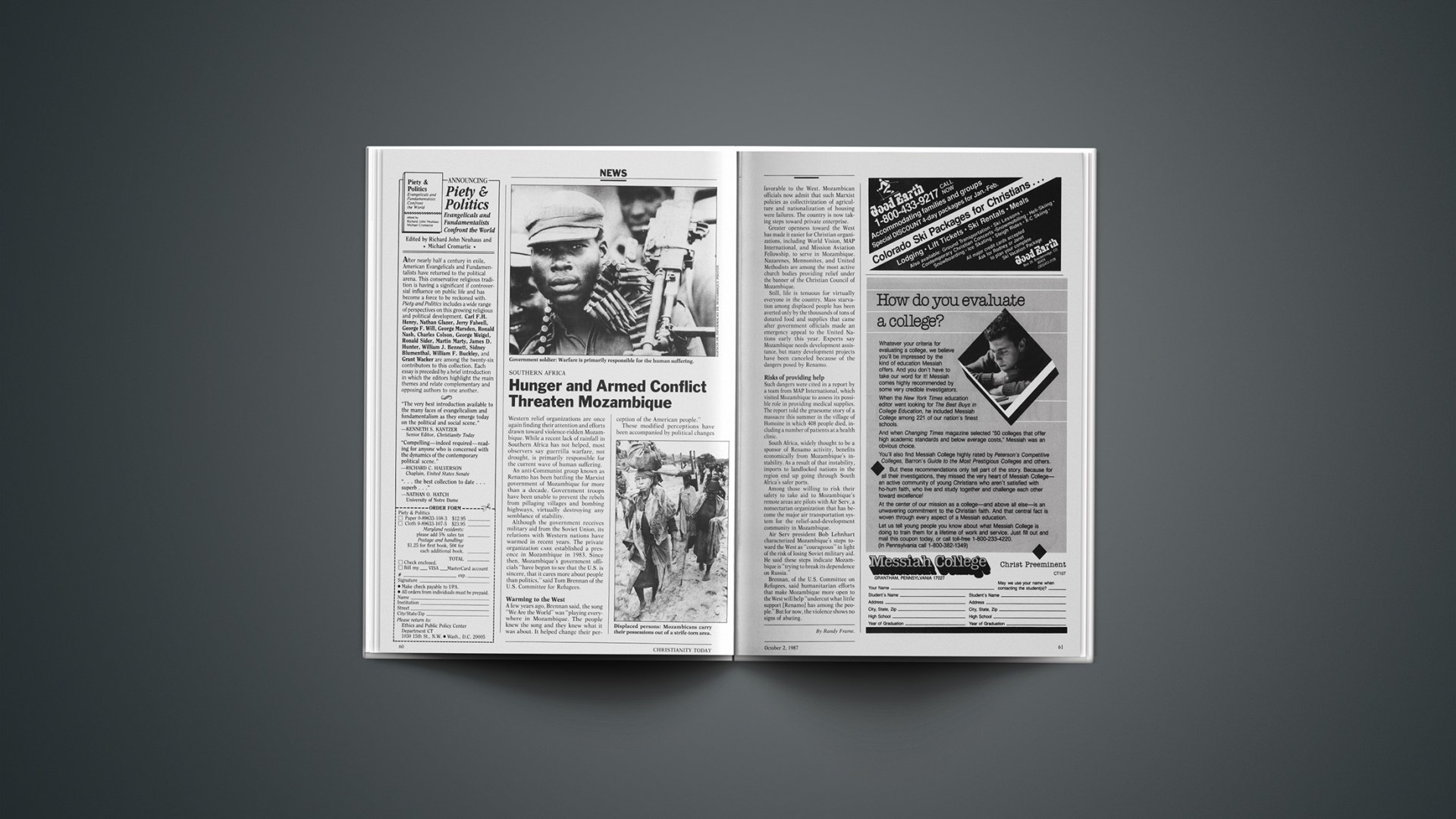
Western relief organizations are once again finding their attention and efforts drawn toward violence-ridden Mozambique. While a recent lack of rainfall in Southern Africa has not helped, most observers say guerrilla warfare, not drought, is primarily responsible for the current wave of human suffering.

An anti-Communist group known as Renamo has been battling the Marxist government of Mozambique for more than a decade. Government troops have been unable to prevent the rebels from pillaging villages and bombing highways, virtually destroying any semblance of stability.

Although the government receives military aid from the Soviet Union, its relations with Western nations have warmed in recent years. The private organization CARE established a presence in Mozambique in 1983. Since then, Mozambique’s government officials “have begun to see that the U.S. is sincere, that it cares more about people than politics,” said Tom Brennan of the U.S. Committee for Refugees.

Warming To The West

A few years ago, Brennan said, the song “We Are the World” was “playing everywhere in Mozambique. The people knew the song and they knew what it was about. It helped change their perception of the American people.”

These modified perceptions have been accompanied by political changes favorable to the West. Mozambican officials now admit that such Marxist policies as collectivization of agriculture and nationalization of housing were failures. The country is now taking steps toward private enterprise.

Greater openness toward the West has made it easier for Christian organizations, including World Vision, MAP International, and Mission Aviation Fellowship, to serve in Mozambique. Nazarenes, Mennonites, and United Methodists are among the most active church bodies providing relief under the banner of the Christian Council of Mozambique.

Still, life is tenuous for virtually everyone in the country. Mass starvation among displaced people has been averted only by the thousands of tons of donated food and supplies that came after government officials made an emergency appeal to the United Nations early this year. Experts say Mozambique needs development assistance, but many development projects have been canceled because of the dangers posed by Renamo.

Risks Of Providing Help

Such dangers were cited in a report by a team from MAP International, which visited Mozambique to assess its possible role in providing medical supplies. The report told the gruesome story of a massacre this summer in the village of Homoine in which 408 people died, including a number of patients at a health clinic.

South Africa, widely thought to be a sponsor of Renamo activity, benefits economically from Mozambique’s instability. As a result of that instability, imports to landlocked nations in the region end up going through South Africa’s safer ports.

Among those willing to risk their safety to take aid to Mozambique’s remote areas are pilots with Air Serv, a nonsectarian organization that has become the major air transportation system for the relief-and-development community in Mozambique.

Air Serv president Bob Lehnhart characterized Mozambique’s steps toward the West as “courageous” in light of the risk of losing Soviet military aid. He said these steps indicate Mozambique is “trying to break its dependence on Russia.”

Brennan, of the U.S. Committee on Refugees, said humanitarian efforts that make Mozambique more open to the West will help “undercut what little support [Renamo] has among the people.” But for now, the violence shows no signs of abating.

By Randy Frame.

Hard Times Rock the Christian Music Industry

Christian music—with annual sales of 300 million dollars for records, tapes, and compact disks, and millions more in concert tickets and merchandise—is recoiling from a major slump. After a few boom years of 10 to 20 percent annual growth, record companies are waking up to 1987 sales that are 20 to 30 percent below projections, according to MusicLine Update, an industry newsletter.

Sales of records and tapes are down, causing cutbacks at record companies and jitters among Christian bookstore owners. Retail sales have been hurt in part by higher retail prices for records. According to the Christian Booksellers Association’s (CBA) 1987 Operating Statement Survey, music sales now account for only 18.5 percent of total sales in the average Christian bookstore. In 1985, the figure stood at 23 percent.

Pop/Rock Tailspin

Sales of contemporary Christian recordings have been hardest hit. According to Todd Hafer, assistant editor of CBA’SBookstore Journal, recordings in the pop/rock field held 16 of the top 20 spots on the magazine’s “Best-Selling Christian Recordings” chart in September 1985. By July 1986, contemporary recordings held 12 positions. And on last month’s music chart, they held only 6 of the 20 positions.

In addition, concert attendance is spotty. Some observers say the problems can be attributed to a lack of new recordings by Christian “superstars.” Singers Amy Grant and Sandi Patti have not released new albums in more than a year. And since both popular singers are expecting babies, they have cut back on live appearances.

“We’re kind of low on talent right now,” says Jon Robberson of Celebration Concerts, a major Christian concert promoter in California. “I have such a lack of confidence in the current situation that I’m not doing as many concerts as I have in the past.”

Last year Robberson promoted 35 shows, compared to only 6 this year. “Part of the problem is that Amy and Sandi are not out [on regular concert tours],” he says. “… But I get the feeling that the guy in the [audience] is getting burned out. There’s a large gap between a highly charged, well-produced Amy Grant show and everything else, and the fans are beginning to feel that what they see and feel at concerts isn’t that special anymore.”

Record company executives acknowledge the slump. But they say it is temporary, hoping new releases this fall will bring customers back into Christian bookstores and concert halls.

A Spiritual Crisis

Other observers say problems in the Christian music industry are due to a lack of spiritual commitment and meaningful lyrics. John Styll, editor of Contemporary Christian Music magazine, attacked wishy-washy Christian music in an editorial titled “Wanted: Explicit Lyrics.”

“Too often form has been allowed to take precedence over content,” he wrote. “Some ‘Christian’ songs today are so veiled in terms of spiritual content that their meaning is lost to all but the most imaginative.

“… I don’t like somebody saying they have a ministry if they really don’t,” Styll wrote. “I think some of the consumers have picked up on this dichotomy between the artists’ words and actions.”

Billy Ray Hearn, president of Sparrow Records, agrees somewhat with Styll’s assessment. “We’ve been guilty of not really giving people the meat they want,” he says. “We are now reexamining ourselves and trying to correct this. But we have a problem of credibility among youth pastors and Christian leaders who have brought their kids to our concerts.

“When Christians go to a concert they don’t want boogie for boogie’s sake,” Hearn said. “They want to see a definite ministry with a clear opportunity to make a life-changing decision.”

Failing To Cross Over

Many singers have softened their Christian message in an effort to “cross over” into the secular marketplace. But many now say this practice has damaged their credibility with Christian audiences while blunting their impact on secular consumers.

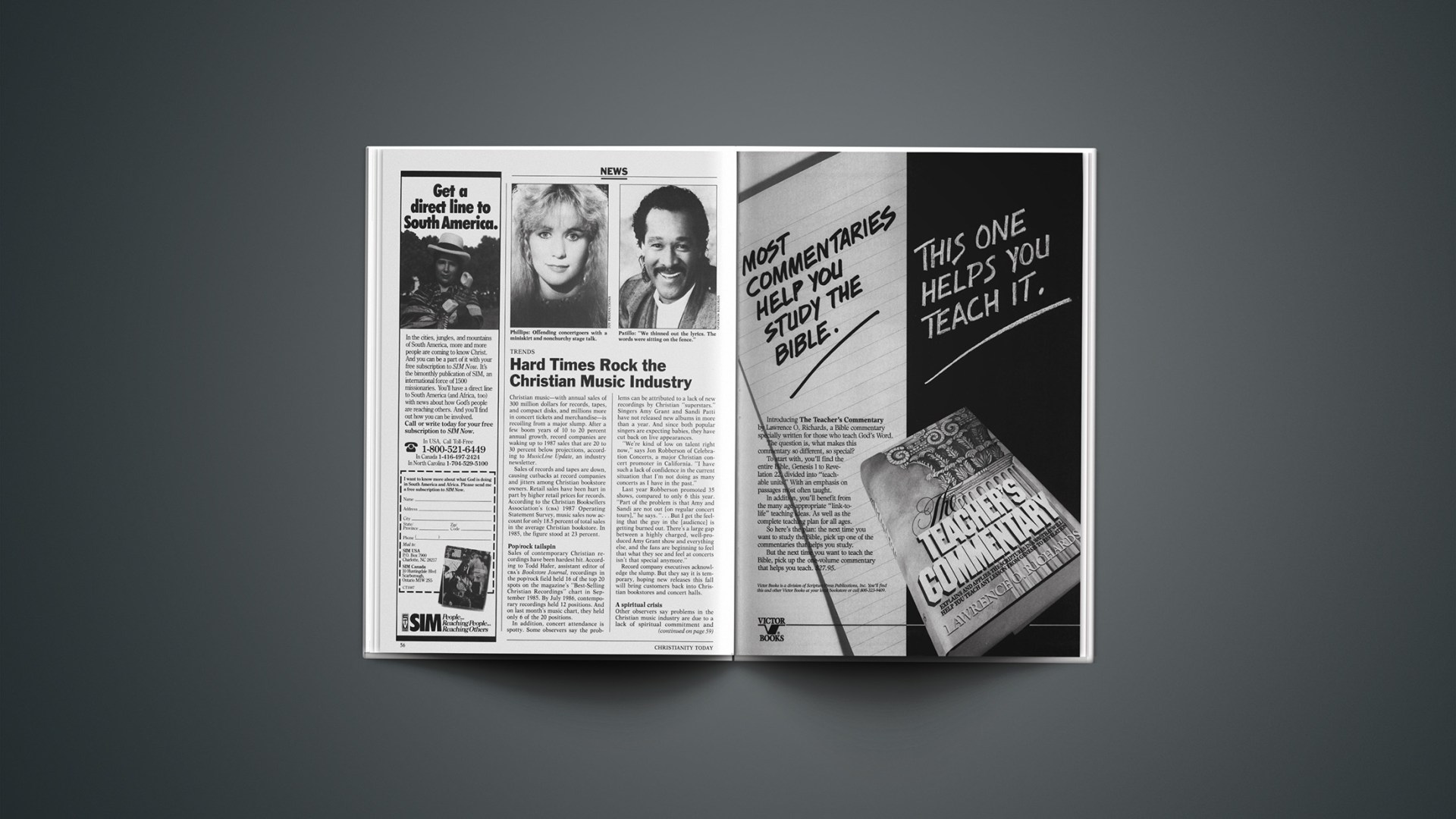
Many fans of contemporary Christian music were shocked when singer Leslie Phillips announced she was leaving the gospel music world to sign a recording contract with a secular record label. At a California concert in May, Phillips’s new material, black miniskirt, and nonchurchy stage talk were more than many fans could handle. An estimated 1,500 people walked out during the performance.

“I’ve never seen an audience react that way in my eight years of promoting,” says Robberson, who promoted the concert and formerly managed Phillips. “Fans were disappointed and surprised, and I was in shock myself.”

Other Christian artists, like Leon Patillo, have flirted with crossing over but are now returning to a more explicit Christian message. “We thinned out the lyrics,” says Patillo, who in 1985 aborted a controversial tour in which he was backed by an all-female band of non-Christian musicians. “The words were sitting on the fence. We didn’t commit to the gospel side or the secular side. As a result, people didn’t get any real meat from my music. And when you’re hurting, that’s what you need.”

Skeptics wonder whether a new lyrical explicitness among some gospel artists is motivated by God or mammon, noting that economics has forced many in the industry to do some soul searching. But Sparrow’s Hearn insists the return to biblical basics is more than a marketing decision.

“Sales are merely an indicator of whether we’re meeting people’s needs,” he says. “The drop in sales may have shocked some of us into realizing we were not on the right track. But our desire to meet people’s spiritual needs is deeper than that.”

By Steve Rabey.

Feeding the Hungry with Surplus Food

While the farm crisis no longer makes daily headlines, problems continue to plague many of the nation’s family farms. And an Oklahoma evangelist is calling on churches to get involved in programs that would help farmers and also benefit hungry people.

Larry Jones, president of Feed the Children, has been a long-time advocate of using the country’s billions of bushels of farm surplus to feed the hungry. “It’s hard to believe that one out of every four children—including one out of every two nonwhite children—are malnourished in a country where there are not enough [grain] elevators to store our surplus food,” he has said. Jones estimates it costs American taxpayers $9.6 million a day to store surplus harvests.

In an effort to dramatize how churches can become involved, Jones has launched a series of special events in several major cities. The kick-off event, Feed the Children Washington, D.C., included a three-day evangelistic crusade at the Washington Monument and distribution of more than 1 million pounds of food. Some of the food was donated by farmers and corporations, and Feed the Children purchased the rest from farm surplus. More than 600 Washington-area churches distributed the food to the needy through food banks and soup kitchens.

While much of the media attention focused on the food giveaway, Jones said he believes the evangelistic rally was equally important. When people are physically hungry, he said, they often are also spiritually thirsty. “Words are cheap at times, but when we follow our words with a million pounds of food for these people, we feel they’re going to see that someone really does care.”

The Washington, D.C., effort included a visit to centers of political power. Jones presented U.S. House of Representatives Speaker Jim Wright (D-Tex.) and the Reagan administration with 300,000 petitions calling on the federal government to implement programs to encourage the private sector, including churches, to use farm surpluses to feed the hungry.

Billy Graham Postpones China Trip

Evangelist Billy Graham postponed his long-awaited trip to China last month after sustaining injuries in a fall in Tokyo.

According to Graham spokesman Larry Ross, the evangelist fractured a rib, reinjured several others, and bruised the left side of his chest when he tripped over a briefcase in a hotel room. Graham was treated by doctors in Tokyo until he was well enough to travel to the Mayo Clinic in Rochester, Minnesota, to see his personal physician.

Ross said Graham was in extreme pain after the fall, which initially left him partially immobile and confined to his bed. Graham postponed the China trip on the advice of his doctors, but he hopes to reschedule it for next spring.

“This is one of the greatest disappointments of my life,” the evangelist said. “Many unique opportunities awaited us in China. I was especially looking forward to accompanying my wife to see her birthplace, where she spent the first 17 years of her life.”

For his first-ever trip to China, Graham had scheduled meetings with religious and political leaders, visits to churches and house churches, and addresses at three universities. He was invited by the Chinese People’s Association for Friendship With Foreign Countries and the China Christian Council. Graham was also to have visited Hong Kong, where he was scheduled to address religious leaders, sponsored by the Hong Kong Chinese Christian Churches’ Union.

Graham had stopped in Tokyo en route to China from Helsinki, Finland, where he conducted his seventh crusade in five months. Ross said the Helsinki crusade was the largest religious event in Finland’s history, with 300 of the country’s 900 churches participating.

How Can Government Encourage Adoption?

A task force appointed by President Reagan is expected to report next month on ways the government can promote and encourage adoption. In announcing the task force, the White House pointed out that thousands of childless families are waiting for children, thousands of children with special needs are not adopted, and women experiencing crisis pregnancies often do not place their babies for adoption.

“We must expand and broaden our efforts to make sure that America’s family-less children are adopted,” Reagan said. “We must do all we can to remove obstacles that prevent qualified adoptive parents from accepting these children into their homes.”

According to a White House statement, the Reagan administration “is especially committed to infant adoption as an alternative for pregnant women” who are considering raising their children alone or obtaining abortions. The task force is charged with identifying barriers to adoption, assessing laws and regulations affecting the process, and recommending ways to improve it. “There are as many problems as there are kinds of adoptions,” said Mary Gall, task force chairperson and counselor to the director of the federal Office of Personnel Management. Gall, who is single, adopted two children from Guatemala.

The 13-member task force is made up of government staff officials from a variety of federal agencies and departments, including two White House policy officials. The task force report is due November 22.

Identifying Needs

A major obstacle confronting the task force is the lack of statistical data on adoption. Federal efforts to collect such data ended in 1975, and the best source of information today is the Adoption Factbook, published in 1985 by the National Committee For Adoption (NCFA.) Adoption is regulated by state laws that vary considerably on such matters as the time it takes to finalize an adoption, how an independent adoption may be pursued, and an adopted child’s access to birth records.

Gall said the task force is contacting leading adoption groups and agencies to ask for recommendations and data. In 1982 there were 50,720 adoptions of unrelated children by couples or single people. More than 5,000 of these were children from abroad, primarily from Korea, Latin America, India, and the Philippines.

Along with data collection, the task force will examine issues such as health insurance coverage for adoption, the need for better maternity care and housing for pregnant women, and tax benefits for the adoption of children with special needs, such as children with disabilities. The task force will also examine state laws and adoption processes that appear to be working well, Gall said. She cited California as a state with “an excellent approach” in terms of job counseling of pregnant women, helping them obtain high school equivalency degrees, and other forms of assistance.

NCFA president William L. Pierce said he welcomes the task force appointment. “This task force not only needs to look at broad issues and identify legislation that needs to be enacted,” he said. “They also need to spend time rallying our society behind adoption.”

Social Trends

NCFA’s 1985 report identifies trends that have made adoption increasingly difficult. These include the legalization of abortion, the impact of the sexual revolution, and the practice of allowing pregnant teenagers to continue attending public schools. NCFA points out, “While this is an advancement of access to education for young pregnant women, it results in less privacy for young women who carry their babies to term.… Coming back to school from the hospital without a baby is ‘unthinkable’ to many teens.”

Other factors include court decisions upholding the rights of fathers. NCFA’s report says, “It is ironic that while a woman can unilaterally choose a confidential abortion, she does not have the unilateral right to place the child for adoption.” Reduced social stigmas for raising out-of-wedlock babies and the closing of many maternity residences for young pregnant women work against adoption as well.

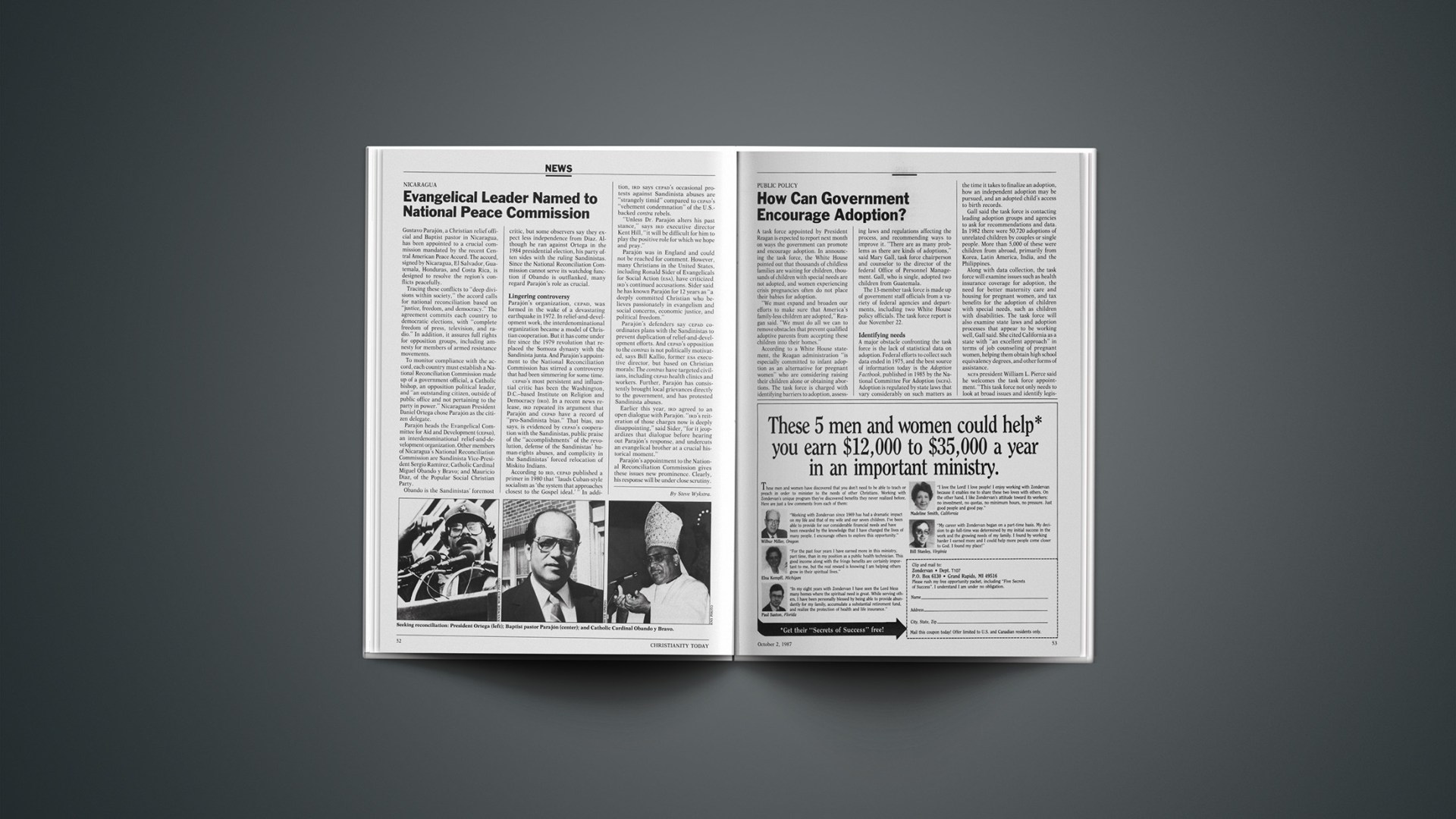
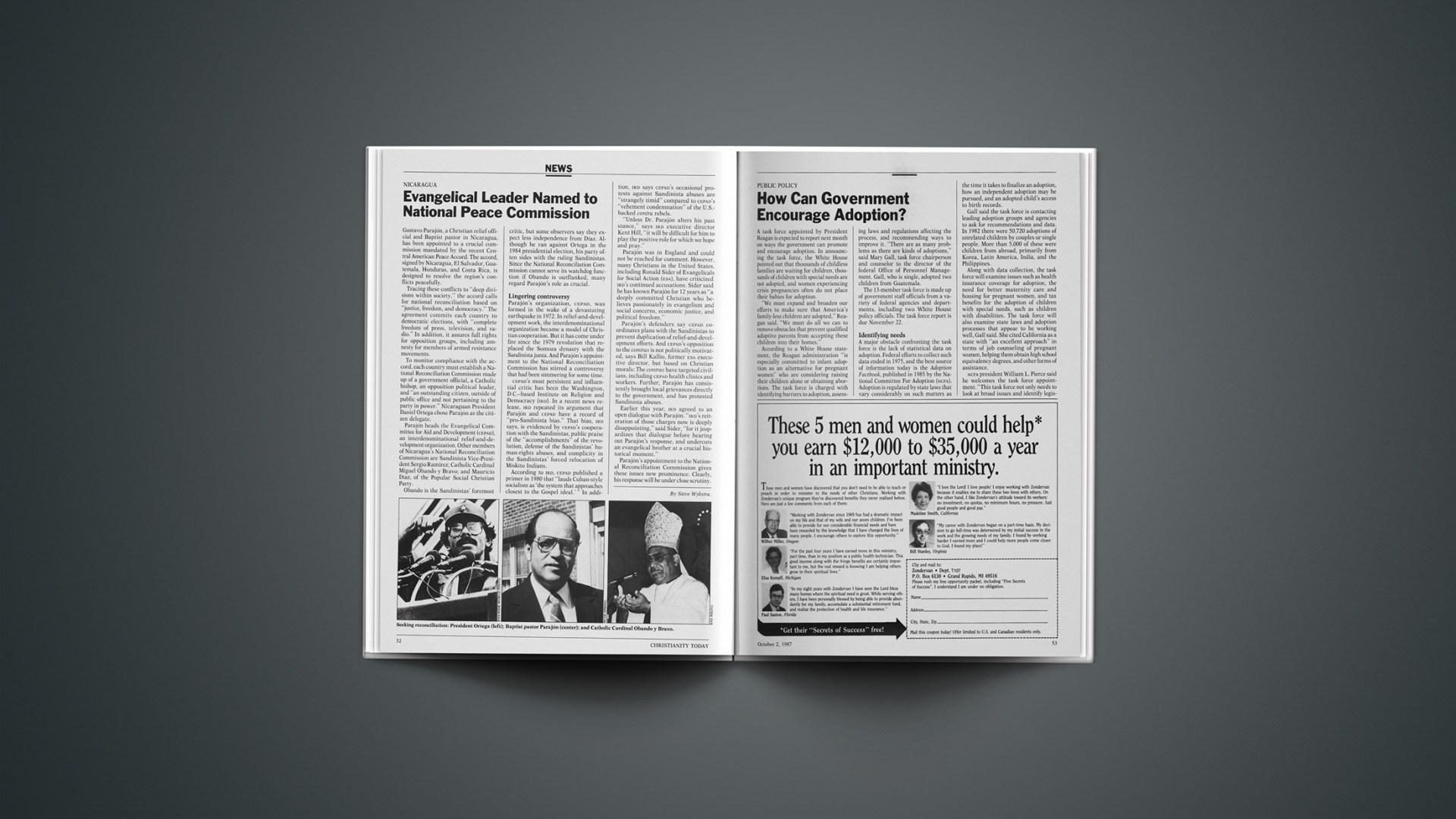
Evangelical Leader Named to National Peace Commission

Gustavo Parajón, a Christian relief official and Baptist pastor in Nicaragua, has been appointed to a crucial commission mandated by the recent Central American Peace Accord, The accord, signed by Nicaragua, El Salvador, Guatemala, Honduras, and Costa Rica, is designed to resolve the region’s conflicts peacefully.

Tracing these conflicts to “deep divisions within society,” the accord calls for national reconciliation based on “justice, freedom, and democracy.” The agreement commits each country to democratic elections, with “complete freedom of press, television, and radio.” In addition, it assures full rights for opposition groups, including amnesty for members of armed resistance movements.

To monitor compliance with the accord, each country must establish a National Reconciliation Commission made up of a government official, a Catholic bishop, an opposition political leader, and “an outstanding citizen, outside of public office and not pertaining to the party in power.” Nicaraguan President Daniel Ortega chose Parajón as the citizen delegate.

Parajón heads the Evangelical Committee for Aid and Development (CEPAD,) an interdenominational relief-and-development organization. Other members of Nicaragua’s National Reconciliation Commission are Sandinista Vice-President Sergio Ramírez; Catholic Cardinal Miguel Obando y Bravo; and Mauricio Díaz, of the Popular Social Christian Party.

Obando is the Sandinistas’ foremost critic, but some observers say they expect less independence from Díaz. Although he ran against Ortega in the 1984 presidential election, his party often sides with the ruling Sandinistas. Since the National Reconciliation Commission cannot serve its watchdog function if Obando is outflanked, many regard Parajón’s role as crucial.

Lingering Controversy

Parajón’s organization, CEPAD, was formed in the wake of a devastating earthquake in 1972. In relief-and-development work, the interdenominational organization became a model of Christian cooperation. But it has come under fire since the 1979 revolution that replaced the Somoza dynasty with the Sandinista junta. And Parajón’s appointment to the National Reconciliation Commission has stirred a controversy that had been simmering for some time.

CEPAD’s most persistent and influential critic has been the Washington, D.C. based Institute on Religion and Democracy (IRD.) In a recent news release, IRD repeated its argument that Parajón and CEPAD have a record of “pro-Sandinista bias.” That bias, IRD says, is evidenced by CEPAD’s cooperation with the Sandinistas, public praise of the “accomplishments” of the revolution, defense of the Sandinistas’ human-rights abuses, and complicity in the Sandinistas’ forced relocation of Miskito Indians.

According to IRD, CEPAD published a primer in 1980 that “lauds Cuban-style socialism as ‘the system that approaches closest to the Gospel ideal.’ ” In addition, IRD says CEPAD’s occasional protests against Sandinista abuses are “strangely timid” compared to CEPAD’S “vehement condemnation” of the U.S. backed contra rebels.

“Unless Dr. Parajón alters his past stance,” says IRD executive director Kent Hill, “it will be difficult for him to play the positive role for which we hope and pray.”

Parajón was in England and could not be reached for comment. However, many Christians in the United States, including Ronald Sider of Evangelicals for Social Action (ESA,) have criticized IRD’s continued accusations. Sider said he has known Parajón for 12 years as “a deeply committed Christian who believes passionately in evangelism and social concerns, economic justice, and political freedom.”

Parajón’s defenders say CEPAD coordinates plans with the Sandinistas to prevent duplication of relief-and-development efforts. And CEPAD’S opposition to the contras is not politically motivated, says Bill Kallio, former ESA executive director, but based on Christian morals: The contras have targeted civilians, including CEPAD health clinics and workers. Further, Parajón has consistently brought local grievances directly to the government, and has protested Sandinista abuses.

Earlier this year, IRD agreed to an open dialogue with Parajón. “IRD’S reiteration of those charges now is deeply disappointing,” said Sider, “for it jeopardizes that dialogue before hearing out Parajón’s response, and undercuts an evangelical brother at a crucial historical moment.”

Parajón’s appointment to the National Reconciliation Commission gives these issues new prominence. Clearly, his response will be under close scrutiny.

By Steve Wykstra.

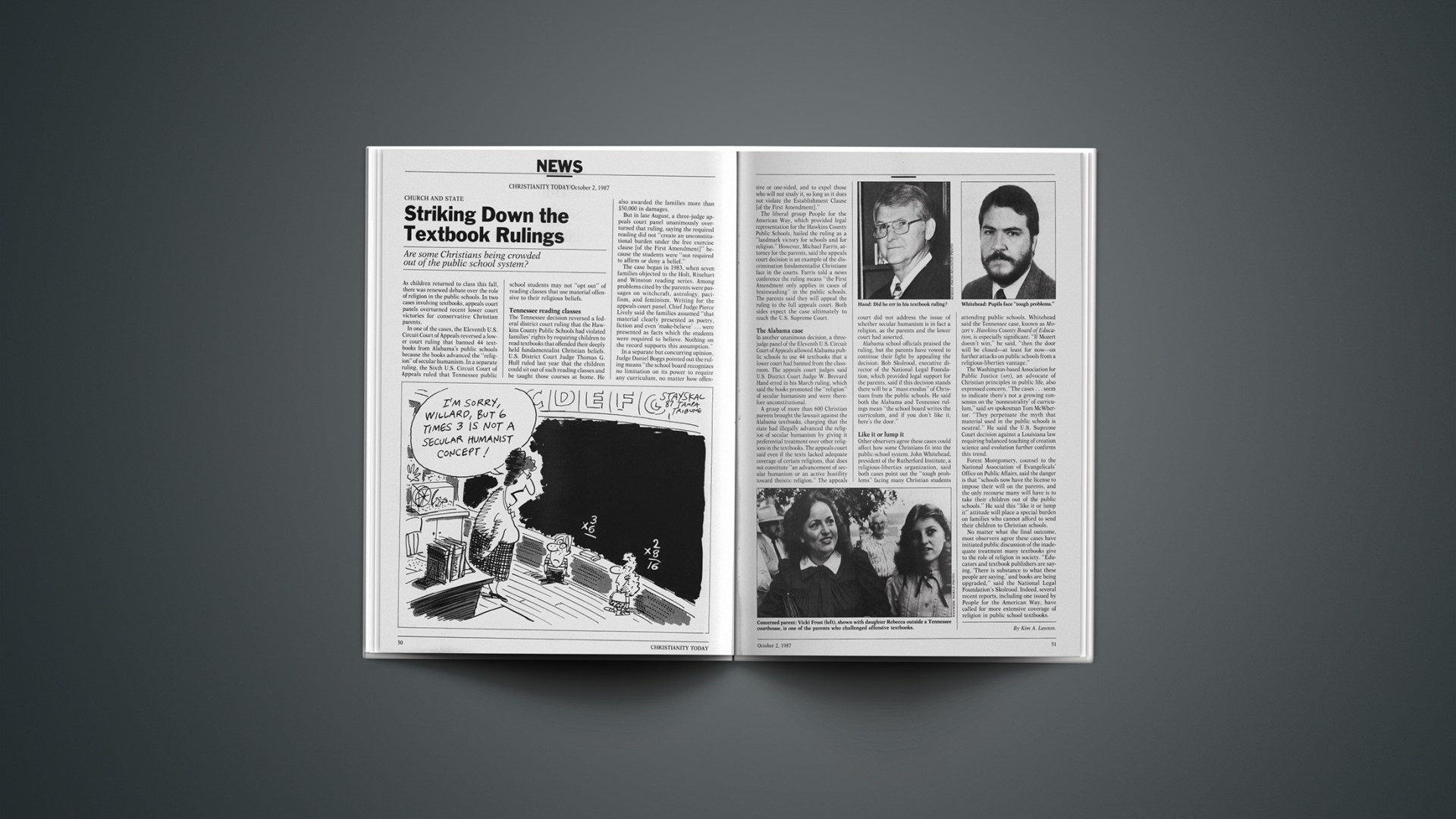
Striking down the Textbook Rulings

As children returned to class this fall, there was renewed debate over the role of religion in the public schools. In two cases involving textbooks, appeals court panels overturned recent lower court victories for conservative Christian parents.

In one of the cases, the Eleventh U.S. Circuit Court of Appeals reversed a lower court ruling that banned 44 textbooks from Alabama’s public schools because the books advanced the “religion” of secular humanism. In a separate ruling, the Sixth U.S. Circuit Court of Appeals ruled that Tennessee public school students may not “opt out” of reading classes that use material offensive to their religious beliefs.

Tennessee Reading Classes

The Tennessee decision reversed a federal district court ruling that the Hawkins County Public Schools had violated families’ rights by requiring children to read textbooks that offended their deeply held fundamentalist Christian beliefs. U.S. District Court Judge Thomas G. Hull ruled last year that the children could sit out of such reading classes and be taught those courses at home. He also awarded the families more than $50,000 in damages.

But in late August, a three-judge appeals court panel unanimously overturned that ruling, saying the required reading did not “create an unconstitutional burden under the free exercise clause [of the First Amendment]” because the students were “not required to affirm or deny a belief.”

The case began in 1983, when seven families objected to the Holt, Rinehart and Winston reading series. Among problems cited by the parents were passages on witchcraft, astrology, pacifism, and feminism. Writing for the appeals court panel, Chief Judge Pierce Lively said the families assumed “that material clearly presented as poetry, fiction and even ‘make-believe’ … were presented as facts which the students were required to believe. Nothing on the record supports this assumption.” In a separate but concurring opinion, Judge Daniel Boggs pointed out the ruling means “the school board recognizes no limitation on its power to require any curriculum, no matter how offensive or one-sided, and to expel those who will not study it, so long as it does not violate the Establishment Clause [of the First Amendment].”

The liberal group People for the American Way, which provided legal representation for the Hawkins County Public Schools, hailed the ruling as a “landmark victory for schools and for religion.” However, Michael Farris, attorney for the parents, said the appeals court decision is an example of the discrimination fundamentalist Christians face in the courts. Farris told a news conference the ruling means “the First Amendment only applies in cases of brainwashing” in the public schools. The parents said they will appeal the ruling to the full appeals court. Both sides expect the case ultimately to reach the U.S. Supreme Court.

The Alabama Case

In another unanimous decision, a three-judge panel of the Eleventh U.S. Circuit Court of Appeals allowed Alabama public schools to use 44 textbooks that a lower court had banned from the classroom. The appeals court judges said U.S. District Court Judge W. Brevard Hand erred in his March ruling, which said the books promoted the “religion” of secular humanism and were therefore unconstitutional.

A group of more than 600 Christian parents brought the lawsuit against the Alabama textbooks, charging that the state had illegally advanced the religion of secular humanism by giving it preferential treatment over other religions in the textbooks. The appeals court said even if the texts lacked adequate coverage of certain religions, that does not constitute “an advancement of secular humanism or an active hostility toward theistic religion.” The appeals court did not address the issue of whether secular humanism is in fact a religion, as the parents and the lower court had asserted.

Alabama school officials praised the ruling, but the parents have vowed to continue their fight by appealing the decision. Bob Skolrood, executive director of the National Legal Foundation, which provided legal support for the parents, said if this decision stands there will be a “mass exodus” of Christians from the public schools. He said both the Alabama and Tennessee rulings mean “the school board writes the curriculum, and if you don’t like it, here’s the door.”

Like It Or Lump It

Other observers agree these cases could affect how some Christians fit into the public-school system. John Whitehead, president of the Rutherford Institute, a religious-liberties organization, said both cases point out the “tough problems” facing many Christian students attending public schools. Whitehead said the Tennessee case, known as Mozert v. Hawkins County Board of Education, is especially significant. “If Mozert doesn’t win,” he said, “then the door will be closed—at least for now—on further attacks on public schools from a religious-liberties vantage.”

The Washington-based Association for Public Justice (APJ,) an advocate of Christian principles in public life, also expressed concern. “The cases … seem to indicate there’s not a growing consensus on the ‘nonneutrality’ of curriculum,” said APJ spokesman Tom McWhertor. “They perpetuate the myth that material used in the public schools is neutral.” He said the U.S. Supreme Court decision against a Louisiana law requiring balanced teaching of creation science and evolution further confirms this trend.

Forest Montgomery, counsel to the National Association of Evangelicals’ Office on Public Affairs, said the danger is that “schools now have the license to impose their will on the parents, and the only recourse many will have is to take their children out of the public schools.” He said this “like it or lump it” attitude will place a special burden on families who cannot afford to send their children to Christian schools.

No matter what the final outcome, most observers agree these cases have initiated public discussion of the inadequate treatment many textbooks give to the role of religion in society. “Educators and textbook publishers are saying, ‘There is substance to what these people are saying,’ and books are being upgraded,” said the National Legal Foundation’s Skolrood. Indeed, several recent reports, including one issued by People for the American Way, have called for more extensive coverage of religion in public school textbooks.

By Kim A. Lawton.

Apple PodcastsDown ArrowDown ArrowDown Arrowarrow_left_altLeft ArrowLeft ArrowRight ArrowRight ArrowRight Arrowarrow_up_altUp ArrowUp ArrowAvailable at Amazoncaret-downCloseCloseEmailEmailExpandExpandExternalExternalFacebookfacebook-squareGiftGiftGooglegoogleGoogle KeephamburgerInstagraminstagram-squareLinkLinklinkedin-squareListenListenListenChristianity TodayCT Creative Studio Logologo_orgMegaphoneMenuMenupausePinterestPlayPlayPocketPodcastRSSRSSSaveSaveSaveSearchSearchsearchSpotifyStitcherTelegramTable of ContentsTable of Contentstwitter-squareWhatsAppXYouTubeYouTube