Call to World Evangelism

This is no time to slacken the evangelistic outreach of the Church

Imagination boggles at what the Apostle Paul would make of the modern Church if he were to appear among us. He would find much to amaze him and not a little to dismay. High on his list would surely be our attitude toward evangelism.

Evangelism is not a game that those who like that sort of thing may play. It is not an extra for the unusually devout. It is an obligation resting on every member of the body of Christ. It is a duty that arises out of the nature of the Christian Gospel and does not rest solely on the last command of Christ (important though that was). Once God sent his only Son to the world, and this Son died on a cross to put away the sins of men. Since none less than God is involved, the action cannot be regarded as of merely local significance. And since the salvation that Christ brought about is not meant for any restricted group, Jews or anyone else, since there is no salvation in any other, the news of that salvation must be taken throughout the world. How else is the world to know what God has done? The Christian Gospel carries a built-in demand that it be taken to all mankind.

This was better understood by a previous generation. We today are apt to look back pityingly on the men who adopted slogans like, “The evangelization of the world in this generation,” or “Evangelize to a finish to bring back the King.” But they had a consuming passion for souls that puts our tepid generation to shame. We no longer sing with deep emotion.

Far, far away, in heathen darkness dwelling

Millions of souls for ever may be lost.

But we might well ask whether we measure up to the men who did.

Their convictions gave them drive. They carried on a missionary endeavor seldom if ever paralleled in the history of mankind. The last century, called by Kenneth Scott Latourette “The Great Century,” witnessed a flowering of missionary and evangelistic zeal that any generation could be proud to claim.

True, the situation has altered radically. Missionaries can no longer go into certain countries. Ancient religions that earlier appeared moribund have been revived. Islam still presents a solid wall of opposition (though with one or two perhaps significant cracks). The overthrow of colonialism and the emergence of nationalism have often generated a heat against all foreigners, missionaries included. Much of the educational and medical service that used to be the special preserve of the Church now rests securely in government hands. In the more restricted sphere that is still allowed missionaries, they must often walk delicately. They are learning, sometimes painfully, to work under the direction of nationals who are not always wise.

But when full allowance has been made for all this, it is still true that today is no time to slacken the evangelistic outreach of the Church. Although some doors of opportunity have closed, more are open than the Church is using effectively. And control by nationals, though it sometimes brings frustration and difficulty, more often gives the preaching of redemption an indigenous and effective turn.

Modern developments in communication present today’s missionary with opportunities previously undreamed of. Radio waves know no frontiers and can carry the Gospel to places the missionary could never penetrate. Many a missionary can now through one broadcast reach more people than Jesus spoke to during his whole life.

This is the era of the printed page. Millions are streaming out of the darkness of illiteracy and demanding something to read. Where the Church responds adequately, what it produces is read avidly. And, like the radio wave, the printed page will penetrate where its author cannot. Moreover, it has an advantage over the spoken word in that it remains with the reader and can be read again and again.

An area that has so far been little explored is the usefulness to the missionary effort of scientific aids like the computer. Yet it is already obvious that they will be very valuable. Computers can store up the accumulated experiences of missionaries in widely separated areas and periods and relate them to one another. In time, computers may well be used to indicate lines of activity that are likely to prove fruitful.

New avenues of approach are open. Christians in the Peace Corps have the opportunity for indirect witness, while others who serve in their professional capacities in non-Christian countries are usually free to engage in direct evangelism. In areas where the Church is suspect, such approaches are often acceptable.

It cannot be denied that, while the difficulties are formidable, the opportunities before this generation are great. It is accordingly important that we realize our responsibility. Today’s heathen were not reached by previous generations of missionaries and will not be reached by any following ones. Only Christians now alive can evangelize this generation. It is we who must make the effort and do so now.

Some deepening of concern for evangelism is evident. The Wheaton Congress on the Church’s Worldwide Mission was a notable event whose repercussions will be felt for a long time. The World Congress on Evangelism to be held in Berlin later this year is further evidence of this concern. Leaders in evangelism from all over the world will gather to consider what can best be done to present the Gospel now. In the providence of God, this may well provide the charge needed to galvanize God’s people into the activity that the present situation demands. The very holding of such a congress will focus attention on the importance of this aspect of the Church’s responsibility. But only the efforts of Spirit-filled men will discharge it.

The Radiant Joy Of Faith

G. A. Studdert-Kennedy, a British chaplain in World War I, wrote a poem beginning, “Our Padre were a solemn bloke/We called ’im Dismal Jim.” But it is not only “Dismal Jim” who understands Christianity as a gloomy affair. To many church members, Sunday worship is a grim sort of thing. They don uncomfortable “Sunday clothes” and get themselves into a decently uncomfortable frame of mind. They take themselves off to a severe building, dim and gloomy inside, with decently uncomfortable pews.

Caricature? Yes. But caricature is the exaggeration of something real. For most of us there is something gloomy about things ecclesiastical.

The origin of this idea is a bit of a mystery. Certainly the New Testament is not the source. It is interesting to observe that little children were found near Jesus. When he wanted to illustrate a point in a sermon, he “took a little child.” He did not have to send for one; one was there. It is hard to think of children clustering round Mohammed or Buddha. But they came to Jesus. Now, children do not hide their real feelings, and they do not like gloomy, solemn people. The personality of Jesus as revealed in the Gospels was attractive. He enjoyed life. He was a popular dinner guest. Ordinary people gladly listened when he spoke.

And what he began his followers carried on. The word “joy” and its derivatives occur with startling frequency throughout the New Testament. The Greek word for “grace” is akin to joy and might even be defined as “that which causes joy.” One of the words for forgiveness comes from the same root. Forgiveness is a happy thing.

A Christian as the New Testament describes him is a man with a zest for living. So exhilarated were the disciples when the Spirit of God came upon them that some thought they were drunk. Their joy did not arise from having an easy and comfortable life. When Paul and Silas were beaten, thrown into jail, and their feet put in the stocks, they sang at midnight. “Under the circumstances …” we sometimes say in considering a situation. But the first Christians were not “under” the circumstances; they had learned to be on top of them. They lived lives of compelling joy, savoring day by day the sheer thrill of being Christ’s.

Men today have forgotten that the Christian life is a zestful life. One of the devil’s best propaganda jobs is convincing people that life, to be really enjoyable, must have a tinge of naughtiness. Goodness is insipid; a “do-gooder” is a kill-joy. Many are convinced that those of the last generation made life a misery for themselves and their neighbors by being too much caught up with religious regulations, mostly of a “don’t do that” variety. So they have thrown off restraints and persuaded themselves that license leads to happiness.

But the truth is, as C. S. Lewis said, that the devil never invented a single pleasure. Any “pleasure” in sin is a perversion of the true pleasure that comes from walking in the ways of God. Healthy eating and drinking, for example, result in simple and wholesome pleasure. The gluttony to which Satan tempts men does not bring new pleasures. It dilutes old ones and introduces new miseries of its own.

Many today identify the serious with the dull. Yet the really serious things of life are not dull. The scientist given over singlemindedly to his research is engaged in a very serious quest. But he is not bored. He is rather supremely satisfied, and cannot imagine himself in a whirl of activities pursuing only personal pleasures. That for him would lead straight to frustration and boredom.

And that is where many of us are going. We are made for God and delude ourselves if we think otherwise.

Christians live according to their Maker’s specifications. This is what gives them their drive and their joy of living. They do not waste energy in aimless performance of tasks they were not designed to do. In the service of God their instincts and abilities and energies find proper outlet. They have life and they have it more abundantly—and joyously.

Water Is No Luxury

Luxuries are often confused with necessities in our culture, and so we lose sight of what is really indispensable to life. Men can live without wall-to-wall carpeting, split-level houses, television sets, and automobiles. But no man can live without water.

An article in the Saturday Evening Post is captioned, “Our Dying Waters.” The title, while shocking, tells the truth. Few industrialized nations have been more generously endowed with water resources than the United States; yet no such nation of modern times has defiled these resources more extensively.

Because our editorial offices are in Washington, we are well aware of the pollution of the Potomac as it flows by the District of Columbia. And what has happened to this beautiful river is happening to hundreds of others in America, including the mighty Mississippi, which some now call “the colon of mid-America.” The contamination of our waters is more than an aesthetic matter. A dirty river does not simply defile the landscape; it also menaces life and health.

Why are rivers being turned into sewers and subsurface waters being ruined by pollutants? As with most human problems, the answer goes back to sin—in this case selfishness and irresponsibility. Disposing of wastes by dumping them into the waterways of the nation may be cheap, but it is also deadly.

God commanded Adam to subdue and cultivate the earth, not to despoil and ruin it. It becomes a matter of Christian as well as national concern when our physical environment is progressively spoiled through a callous disregard of the responsibility to preserve and pass on undefiled our God-given natural resources. Surely the time is long overdue for Americans, and especially Christians, who ought to exercise their stewardship of God’s creation, to wake up and do something about the pollution of our waters.

The World Congress And The Churches

The World Congress on Evangelism this fall will bring 1,200 delegates and observers to the Kongresshalle in Berlin, that frontier between two diverse worlds. If this congress is to be more than just another meeting, it must make its influence felt in the churches around the world. The congress itself, while of great importance, will chiefly be a summons to action. Out of it must come the clear sound of the trumpet calling and enlisting men and leading to the renewal of evangelism among the people of God.

Those who cannot go to Berlin can still do much to support the congress and to appropriate its benefits for themselves and their churches. The first thing is to pray not only for the congress but also for renewed spiritual life in all the churches.

Secondly, churches might well hold an “Operation Andrew” campaign during the period when the congress is in session, October 26 to November 4. Let every Christian determine to witness to at least one person a day. Let him hand out tracts or Bible portions. Let him tell others what Christ has done for him and means to him. Let these autumn days be a time of rejoicing in the Lord.

Thirdly, let ministers preach on personal witnessing and tell their members what they ought to do and how to do it. Then let them lead their flocks by doing it themselves.

Fourthly, ministers can acquaint their congregations with the prize-winning hymn on evangelism (printed in this issue of the magazine along with the hymns that received honorable mention).

The Berlin congress comes at a good time. Vacations will be over, and people will be preparing for the winter routine. They should have something to reach out for, an objective to attain, a height to climb. The fellowship of Christians transcends the barriers of space and time, and if all will work together this planet can be shaken for Christ in 1966. This is one way all Christians can demonstrate their unity, that the world may believe.

Practical Evangelism

The recent death of Professor F. Kiss of Hungary removed one of Eastern Europe’s most distinguished Christians. For fifty-two years he had lectured as an expert in anatomy. Converted at the age of thirty, he traveled widely, both as a representative of the Free Churches of Hungary and in connection with his profession. He was to have delivered an address at the forthcoming World Congress on Evangelism in Berlin, and we herewith share some of his prepared comments.

“The first Christian evangelistic effort took place in Jerusalem on the day of Pentecost. The evangelist was the Apostle Peter, and his audience inhabitants of Jerusalem and other Jews who had made a pilgrimage there from all parts of the empire. Those same people who had so recently cried out, “Crucify him!,” now heard a message about the crucified Jesus and learned that they bore the main guilt for the crucifixion.

“There are ten important points. Peter referred to Jesus’ mission, to the guilt of those who rejected him, to the resurrection, to the gilt of the Holy Spirit, and to God’s exaltation of Jesus. Finally he called for repentance and baptism. The results were true conversions, the linking of new believers in a spiritual fellowship, and a sharing of material resources. The risen Jesus put his seal on this by adding new believers daily.

“I can suggest nothing better than that where possible we return to this first evangelistic effort as our pattern. I am well aware that many today consider the message of Peter, and present-day evangelism with it, to be drunkenness and folly. Among them the most dangerous are those liberal professors of theology and critics of the Bible who through their speaking and writing deny the divine authority of holy Scripture and of Jesus, God’s Son become man. Forty years ago Sadhu Sundar Singh referred to such men as those who ‘hang themselves with the rope of unbelief on the tree of knowledge.’ That is still tragically possible today.”

W. E. Hocking’S Death

The death of W. E. Hocking at 92 ends the long career of an influential philosopher of religion whose writings widened the sway of post-Hegelian idealism in American Protestantism. Hocking taught at California, Yale, and Harvard universities, all centers of philosophical idealism in the forepart of this century.

His work on The Meaning of God in Human Experience deplored the decline of reason in religious experience. But it broadly anticipated two facets of later existential thought: that the “I” and “Thou” are inseparable in experience, and that God is disclosed not only in the universal but also in the particular. While Hocking avoided existentialist irrationalism, his rationalistic and syncretistic approach obscured the full claim of special revelation and redemption.

Hocking’s visit to the Far East resulted in Re-thinking Missions, a Laymen’s Report later indicted for its weak sense of “apostolic consciousness” and its absence of a demand for universal conversion.
Ideas

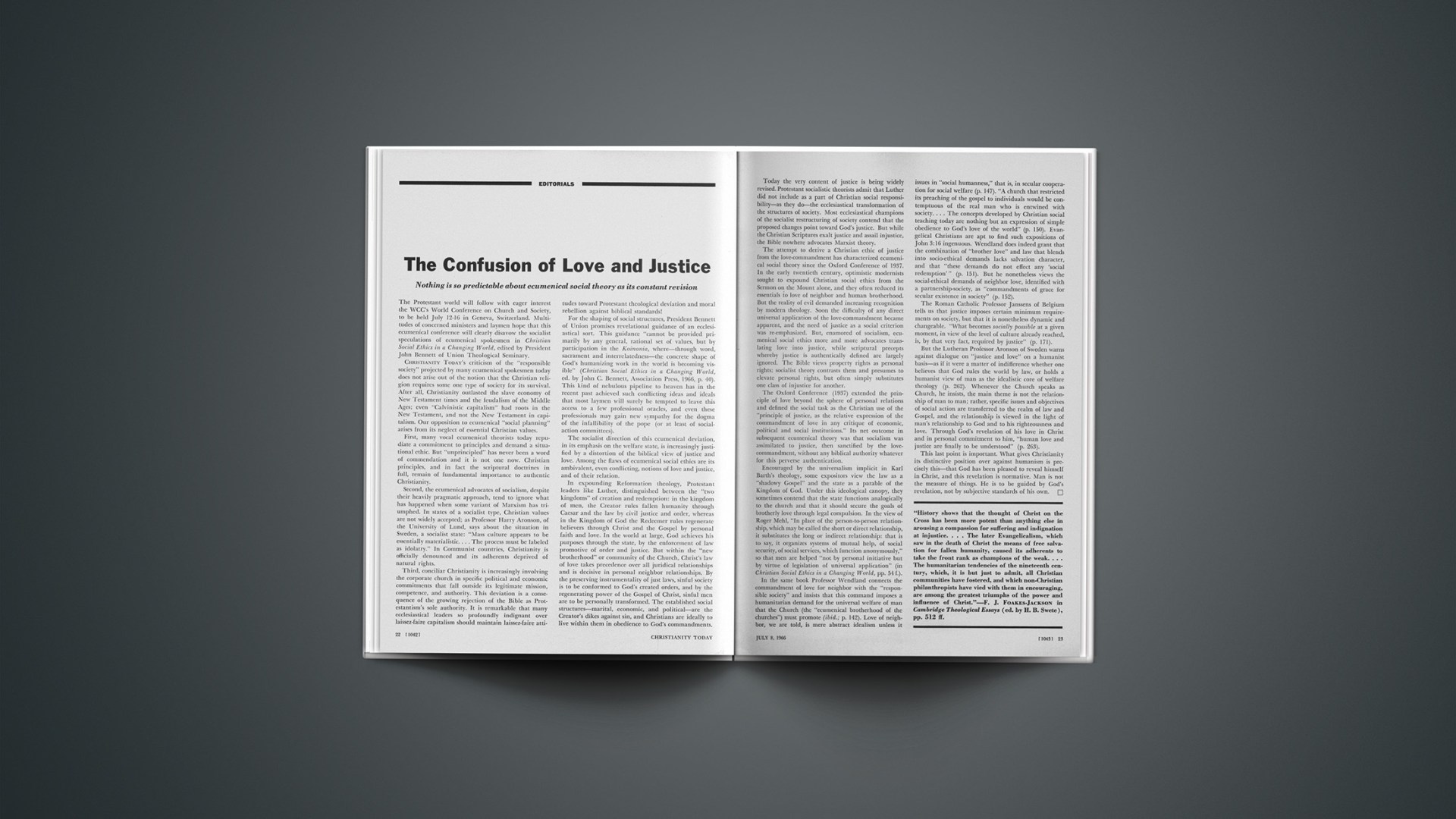
The Confusion of Love and Justice

Nothing is so predictable about ecumenical social theory as its constant revision

The Protestant world will follow with eager interest the WCC’s World Conference on Church and Society, to be held July 12–16 in Geneva, Switzerland. Multitudes of concerned ministers and laymen hope that this ecumenical conference will clearly disavow the socialist speculations of ecumenical spokesmen in Christian Social Ethics in a Changing World, edited by President John Bennett of Union Theological Seminary.

CHRISTIANITY TODAY’S criticism of the “responsible society” projected by many ecumenical spokesmen today does not arise out of the notion that the Christian religion requires some one type of society for its survival. After all, Christianity outlasted the slave economy of New Testament times and the feudalism of the Middle Ages; even “Calvinistic capitalism” had roots in the New Testament, and not the New Testament in capitalism. Our opposition to ecumenical “social planning” arises from its neglect of essential Christian values.

First, many vocal ecumenical theorists today repudiate a commitment to principles and demand a situational ethic. But “unprincipled” has never been a word of commendation and it is not one now. Christian principles, and in fact the scriptural doctrines in full, remain of fundamental importance to authentic Christianity.

Second, the ecumenical advocates of socialism, despite their heavily pragmatic approach, tend to ignore what has happened when some variant of Marxism has triumphed. In states of a socialist type, Christian values are not widely accepted; as Professor Harry Aronson, of the University of Lund, says about the situation in Sweden, a socialist state: “Mass culture appears to be essentially materialistic.… The process must be labeled as idolatry.” In Communist countries, Christianity is officially denounced and its adherents deprived of natural rights.

Third, conciliar Christianity is increasingly involving the corporate church in specific political and economic commitments that fall outside its legitimate mission, competence, and authority. This deviation is a consequence of the glowing rejection of the Bible as Protestantism’s sole authority. It is remarkable that many ecclesiastical leaders so profoundly indignant over laissez-faire capitalism should maintain laissez-faire attitudes toward Protestant theological deviation and moral rebellion against biblical standards!

For the shaping of social structures, President Bennett of Union promises revelational guidance of an ecclesiastical sort. This guidance “cannot be provided primarily by any general, rational set of values, but by participation in the Koinonia, where—through word, sacrament and interrelatedness—the concrete shape of God’s humanizing work in the world is becoming visible” (Christian Social Ethics in a Changing World, ed. by John C. Bennett, Association Press, 1966, p. 40). This kind of nebulous pipeline to heaven has in the recent past achieved such conflicting ideas and ideals that most laymen will surely be tempted to leave this access to a few professional oracles, and even these professionals may gain new sympathy for the dogma of the infallibility of the pope (or at least of social-action committees).

The socialist direction of this ecumenical deviation, in its emphasis on the welfare state, is increasingly justified by a distortion of the biblical view of justice and love. Among the flaws of ecumenical social ethics are its ambivalent, even conflicting, notions of love and justice, and of their relation.

In expounding Reformation theology, Protestant leaders like Luther, distinguished between the “two kingdoms” of creation and redemption: in the kingdom of men, the Creator rules fallen humanity through Caesar and the law by civil justice and order, whereas in the Kingdom of God the Redeemer rules regenerate believers through Christ and the Gospel by personal faith and love. In the world at large, God achieves his purposes through the state, by the enforcement of law promotive of order and justice. But within the “new brotherhood” or community of the Church, Christ’s law of love takes precedence over all juridical relationships and is decisive in personal neighbor relationships. By the preserving instrumentality of just laws, sinful society is to be conformed to God’s created orders, and by the regenerating power of the Gospel of Christ, sinful men are to be personally transformed. The established social structures—marital, economic, and political—are the Creator’s dikes against sin, and Christians are ideally to live within them in obedience to God’s commandments.

Today the very content of justice is being widely revised. Protestant socialistic theorists admit that Luther did not include as a part of Christian social responsibility—as they do—the ecclesiastical transformation of the structures of society. Most ecclesiastical champions of the socialist restructuring of society contend that the proposed changes point toward God’s justice. But while the Christian Scriptures exalt justice and assail injustice, the Bible nowhere advocates Marxist theory.

The attempt to derive a Christian ethic of justice from the love-commandment has characterized ecumenical social theory since the Oxford Conference of 1937. In the early twentieth century, optimistic modernists sought to expound Christian social ethics from the Sermon on the Mount alone, and they often reduced its essentials to love of neighbor and human brotherhood. But the reality of evil demanded increasing recognition by modern theology. Soon the difficulty of any direct universal application of the love-commandment became apparent, and the need of justice as a social criterion was re-emphasized. But, enamored of socialism, ecumenical social ethics more and more advocates translating love into justice, while scriptural precepts whereby justice is authentically defined are largely ignored. The Bible views property rights as personal rights; socialist theory contrasts them and presumes to elevate personal rights, but often simply substitutes one class of injustice for another.

The Oxford Conference (1937) extended the principle of love beyond the sphere of personal relations and defined the social task as the Christian use of the “principle of justice, as the relative expression of the commandment of love in any critique of economic, political and social institutions.” Its net outcome in subsequent ecumenical theory was that socialism was assimilated to justice, then sanctified by the love-commandment, without any biblical authority whatever for this perverse authentication.

Encouraged by the universalism implicit in Karl Barth’s theology, some expositors view the law as a “shadowy Gospel” and the state as a parable of the Kingdom of God. Under this ideological canopy, they sometimes contend that the state functions analogically to the church and that it should secure the goals of brotherly love through legal compulsion. In the view of Roger Mehl, “In place of the person-to-person relationship, which may be called the short or direct relationship, it substitutes the long or indirect relationship: that is to say, it organizes systems of mutual help, of social security, of social services, which function anonymously,” so that men are helped “not by personal initiative but by virtue of legislation of universal application” (in Christian Social Ethics in a Changing World, pp. 54 f.).

In the same book Professor Wendland connects the commandment of love for neighbor with the “responsible society” and insists that this command imposes a humanitarian demand for the universal welfare of man that the Church (the “ecumenical brotherhood of the churches”) must promote (ibid.; p. 142). Love of neighbor, we are told, is mere abstract idealism unless it issues in “social humanness,” that is, in secular cooperation for social welfare (p. 147). “A church that restricted its preaching of the gospel to individuals would be contemptuous of the real man who is entwined with society.… The concepts developed by Christian social teaching today are nothing but an expression of simple obedience to God’s love of the world” (p. 150). Evangelical Christians are apt to find such expositions of John 3:16 ingenuous. Wendland does indeed grant that the combination of “brother love” and law that blends into socio-ethical demands lacks salvation character, and that “these demands do not effect any ‘social redemption’ ” (p. 151). But he nonetheless views the social-ethical demands of neighbor love, identified with a partnership-society, as “commandments of grace for secular existence in society” (p. 152).

The Roman Catholic Professor Janssens of Belgium tells us that justice imposes certain minimum requirements on society, but that it is nonetheless dynamic and changeable. “What becomes socially possible at a given moment, in view of the level of culture already reached, is, by that very fact, required by justice” (p. 171).

But the Lutheran Professor Aronson of Sweden warns against dialogue on “justice and love” on a humanist basis—as if it were a matter of indifference whether one believes that God rules the world by law, or holds a humanist view of man as the idealistic core of welfare theology (p. 262). Whenever the Church speaks as Church, he insists, the main theme is not the relationship of man to man; rather, specific issues and objectives of social action are transferred to the realm of law and Gospel, and the relationship is viewed in the light of man’s relationship to God and to his righteousness and love. Through God’s revelation of his love in Christ and in personal commitment to him, “human love and justice are finally to be understood” (p. 263).

This last point is important. What gives Christianity its distinctive position over against humanism is precisely this—that God has been pleased to reveal himself in Christ, and this revelation is normative. Man is not the measure of things. He is to be guided by God’s revelation, not by subjective standards of his own.

“History shows that the thought of Christ on the Cross has been more potent than anything else in arousing a compassion for suffering and indignation at injustice.… The later Evangelicalism, which saw in the death of Christ the means of free salvation for fallen humanity, caused its adherents to take the front rank as champions of the weak.… The humanitarian tendencies of the nineteenth century, which, it is but just to admit, all Christian communities have fostered, and which non-Christian philanthropists have vied with them in encouraging, are among the greatest triumphs of the power and influence of Christ.”—F. J. FOAKES-JACKSON in Cambridge Theological Essays (ed. by H. B. Swete), pp. 512 ff.

God in Perspective

UNREGENERATE MAN HAS ALWAYS BEEN at odds with God. From the day that he heeded the cynical rejoinder, “Yea, hath God said?,” he has not ceased to question the Almighty.

Except for its tragic implications, such an attitude would appear ludicrous. Can the finite question the infinite? Can the creature of time comprehend the Eternal One? Can limited man judge the sovereign God? Can the created call to account the Creator?

An objective contemplation of the universe leads one to sense something of its Creator. The immensity and order of the creation stagger one’s imagination; they indicate the existence of Someone great, wise, and powerful, before whom man should bow in worship.

But often man does not make this response. He whose mind has never grasped the reality of God—his power and love, his justice and mercy, his infinite capabilities and marvelous condescension—complains about and rebels against this God who made him.

Many years ago I was examining with a fluoroscope a Chinese man who had received a chest wound in which it was thought there might be a piece of metal. The patient had loudly asserted his poverty, and the examination was being given without charge.

The fluoroscope did not reveal any foreign material in the chest or lungs. As I checked down toward the man’s waist, however, I saw, in his canvas belt, about fifty silver dollars.

The divine X ray never fails in its diagnosis and will even reveal the sins a man says he does not have. So men are exposed and judged by it. We read in the letter to the Hebrews that “the word of God is living and active, sharper than any two-edged sword, piercing to the division of soul and spirit, of joints and marrow, and discerning the thoughts and intentions of the heart.” Then we are confronted with this sobering statement: “Before him no creature is hidden, but all are open and laid bare to the eyes of him with whom we have to do” [Heb. 4:12, 13, RSV).

Mechanical contrivances and scientific techniques can tell us much about be physical condition of a person, but only God knows the “thoughts and intentions of the heart.” This should be a frightening idea to all who have rejected his redeeming grace.

David, by the Holy Spirit, speaks of the deep truths of God. In the 139th Psalm he tells us: “Even the darkness is not dark to thee, the night is bright as the day; for darkness is as light with thee” (v. 12). The psalm ends with the prayer, “Search me, O God, and know my heart! Try me and know my thoughts! And see if there be any wicked way in me, and lead me in the way everlasting!”

How strange that man should call God in question. The Apostle Paul, paraphrasing the words of Isaiah, says: “Who are you, a man, to answer back to God? Will what is molded say to its molder, ‘Why have you made me thus?’ ” (Rom. 9:20).

Man’s questioning of God stems from his pride and unbelief. He forgets that God has declared himself in terms that preclude reasonable arguments. The eternal nature of God is stated in many ways, none more clear than, “Lord, thou hast been our dwelling place in all generations. Before the mountains were brought forth, or ever thou hadst formed the earth and the world, from everlasting to everlasting thou art God!” (Ps. 90:1, 2).

How can man, whose life is but a breath, argue with the One who exists from everlasting to everlasting?

The consistency of God should also preclude foolish questions. He is always the same. The Apostle James speaks of “the Father of lights with whom there is no variation or shadow due to change [or inconsistency]” (Jas. 1:17).

God revealed himself to Amos as the “plumb-line God” whose righteousness, holiness, justice, love, and mercy are constant and consistent. How foolish it is to question such a God.

Man is saved by faith, and that faith is effective because of God’s faithfulness. Baalam, inspired by the Lord, said “God is not man, that he should lie, or a son of man, that he should repent. Has he said, and will he not do it? Or has he spoken, and will he not fulfill it?” (Num. 23:19). The Apostle Paul exclaims, “Let God be true though every man be false, as it is written, ‘That thou mayest be justified in thy words, and prevail when thou art judged’ ” (Rom. 3:4).

We are rightfully overwhelmed by the multitude of known facts today. It is said that 90 per cent of scientific knowledge must now be stored away for the future, because at present we have no way to use it.

But what about the One who created all things and the laws that govern them? Man has not discovered anything that God did not create, and he never will. God is the ultimate source of reference, the Creator of all truth and knowledge. Man can only discover what God has made. How can he hope to argue effectively with the Creator?

The infinity of God and the finitude of man are a fact from which man cannot escape. The difference between the Creator and the created is pointed up in Psalm 115:16: “The heavens are the Lord’s heavens, but the earth he has given to the sons of men.”

The majesty and power of God, as well as his love, call us to worship him. Overwhelmed by a revelation of God, the Apostle Paul exclaims: “O the depth of the riches and wisdom and knowledge of God! How unsearchable are his judgments and how inscrutable his ways! ‘For who has known the mind of the Lord, or who has been his counselor? Or who has given a gift to him that he might be repaid?’ For from him and through him and to him are all things. To him be glory forever” (Rom. 11:33–36).

Job, catching a vision of God, asked, “Can you find out the deep things of God? Can you find out the limit of the Almighty?” (Job 11:7).

Man must acknowledge that he is very limited and that God is omnipotent, omniscient, omnipresent, and sovereign. For man either to question or to resist will not change the fact, which he must accept in humility and faith.

The steps to knowing and enjoying God are wonderfully simple. First one must believe that he exists; this is an act of faith based on the irrefutable facts of creation and life with which we are surrounded. The Apostle Paul tells us: “Ever since the creation of the world his invisible nature, namely, his eternal power and deity, has been clearly perceived in the things that have been made” (Rom. 1:20). Out of this step of faith the Holy Spirit gives understanding, and things once an enigma fall into place in the overall realization of God himself.

The second step is obedience. God reveals himself not to satisfy our curiosity but to elicit our obedience. The “heroes of faith” listed in the eleventh chapter of Hebrews proved their faith by their obedience to the God in whom they believed.

Faith like theirs is available to all who will humble themselves and turn to God. When this is done, faith and obedience assume their rightful place in the new relationship with the Eternal God.

Eutychus and His Kin: July 8, 1966

Pomp And Circumstance

Nothing strikes terror to my heart more than the sober strains of “Pomp and Circumstance”; for when I hear that, I know that very shortly I shall have to make a commencement address to a high school or college audience. I can’t remember ever having marched in to the beat of “Pomp and Circumstance,” since the speakers usually enter from the wings; but it must be the perfect number for marching—everybody is doing it.

If you haven’t done so recently, attend three or four high school graduations (I have just spoken at five) and ponder the American Way of Life. Better than that, ponder the American “Religion.”

The whole graduation affair, wherever it is held, has the characteristics of a true religion. In the first place, it catches the whole community. On this one occasion the speaker has an audience that extends almost from the cradle almost to the grave, and many of the listeners haven’t heard a speech since last commencement time. Everybody is conditioned to feel comforting and comforted. Here, at least, in the high school gymnasium, a man just knows that his basic belief that education solves everything is going to have its hour of reassurance. The basic belief that differences among religions do not make a whole lot of difference is supported by the other belief that our educational system, at least, believes in “values”; and everybody believes also that values can hang out in the air unrelated to other basic commitments.

The sobriety of the occasion is almost unnerving. The students march in with a broken step (one of the worst inventions I can think of) and refuse to smile from the time they come in until they walk out again. They seem to be almost paralyzed by the importance of the occasion and their part in it. Then it is enlightening to observe what constitute the “honors” of the class, and to listen carefully to what is said.

The superintendent of schools will be bound to say something that includes “each and every one.” And I’ll never forget that school superintendent who closed the evening by turning to the seniors and saying, “And now, God bless you and good luck.” Something for everybody!

EUTYCHUS II

Point And Counterpoint

I have just had occasion to read with some interest and edification your issue (June 10) on the inner city.…

I have been moved to write, however, on a matter of personal sensitivity.… I refer to the stereotype comment in the threshold essay which uses the sentence, “For every East Harlem Protestant Parish experiment conducted on the supposition that men must be socially and economically uplifted before they can recognize the relevance of and their need for the Gospel.…” I would be most interested in knowing how, in anything that the East Harlem Protestant Parish staff has done or written, one could come to the conclusion that they make this kind of unfortunate and unbiblical distinction about the task of Christian witness and service in the inner city, or any place else. It is my firm conviction that the function of the Church in the inner city is focused on its calling to witness and service in the name of Jesus Christ. I do not believe it is biblically sound or pragmatically possible to make some separation of men as material and spiritual, and then attempt to deal with them in these two segments.…

I have some feeling that in your essay you are precisely concerned to enter into parochialism and defensiveness, if not to say unveiling a limited amount of animosity.

G. W. WEBBER

Metropolitan Urban Service

Training Facility

New York, N. Y.

• The observations were based on a statement from My People Is the Enemy, by William Stringfellow, who wrote after his personal experience in the East Harlem Parish: “Before the Gospel could be preached and received by the people of the slums, the way for the Word had to be prepared by improving the education of the people, renovating their housing, finding jobs for them, clearing the streets of garbage.…” Upon accepting a post with Metropolitan Urban Service Training Facility, Mr. Webber is reported as saying that the project is moving “from saving people to serving the world.”—ED.

The Confession Of ’67

Re the revised “Confession of 1967”: Your news report (June 10 issue) indicates a bias, failing to report the conservative feeling held by a minority of commissioners. Although the voice vote was overwhelmingly in favor of the proposal, many commissioners were disheartened by the change of procedure which prevented them from speaking against the revised confession as a whole.

The revised confession as presented by the “Committee of Fifteen” preserved the integrity of the original proposed confession and therefore is unacceptable to many evangelicals. The 178th General Assembly has rejected the infallibility of the Bible and has gone on record as believing that there is no system of doctrine taught in the Scriptures.… It rejected the truth that the Bible is the final authority in matters of faith and practice.

I believe that if the average member in the United Presbyterian Church is aware of the content of the revised confession, he will oppose it.

Great Valley Presbyterian

Malvern, Pa.

As a commissioner to the General Assembly in Boston, I was interested in your comments on the changes in our confession.

My views evidently are in a minority position, even among the conservatives, but I think they are worthy of consideration. We are not just adding a new confession, we are changing our whole position; and this should be opposed in presbyteries as a matter of principle.

United Presbyterian Church

Paterson, N. J.

I should like to express my deepest appreciation for the very accurate … report dealing with my statement on the floor of the UPUSA’s General Assembly at Boston concerning “The Confession of 1967.” Often my words have been quoted out of context so that they do not convey my thoughts. Your reporting did not do that.

However, I feel compelled to elaborate upon my statement because such a few words leave the door open for possible misunderstanding of my theological position. My particular position is not important. However, since I represent the campus ministry and this segment of our church is often thought of as the “Young Turks of a most liberal bend” by the rest of the church, let me make my point clear. The paradox of the situation is that my particular position regarding the words “are received and obeyed as the word of God written” as contained in the confession is conservative, I hold that it opens up our basis of faith for the widest possible range of liberal interpretations. I object to the wording for this reason. In short, my “liberal” position is far more conservative than the so-called conservative position. On the other hand, it can be construed to mean biblical literalism, which is a dead issue on campus. Such vague and general statements should no longer be tolerated in our day and age.…

C. WILLIAM HASSLER

UCCF University Pastor

University of Montana

Missoula, Mont.

Missouri Lutherans And The Ncc

In the April 25, 1966, issue of U. S. News and World Report, Billy Graham quotes CHRISTIANITY TODAY as saying … “Another great denomination that’s not in the NCC is the Missouri Synod (Lutheran).” …

We are members of the Lutheran Church—Missouri Synod and know that this church body is affiliated with the NCC in home missions, foreign missions, social welfare, and the like.

In the Lutheran Witness (our publication) dated November 14, 1961, we read, “Voting membership no longer possible says Synod’s Board.” It was due to pressure that the Synod’s Board decided to “continue relationships with the NCC on informal levels.”

Missouri Synod has rejected all efforts by its membership to sever all connections with the NCC at the 1961 conference and again in the 1965 convention in Detroit.…

MR. AND MRS. PERCY WRIGHT

Santa Rosa, Calif.

Playing Fair

I was delighted [with] your editorial “Honesty and the Offering Plate” (May 27 issue). It is indeed very timely. I have had similar experiences, with the offering minus the expense, and then not a dime left for the guest speaker.

We are only a young and small church, but we give the speaker $25.00 with no special offering. At least then he does not go away empty-handed nor with a dishonest offering.

PETER F. WALL

Faith Community Church

Palmdale, Calif.

The ethics of the representative who “put twenty-five dollars in small bills in the offering plate as an experiment” may be compared to those of the congregation which kept back part of the price.

Your editorial must have been written without too much thought.

TERRY TINGLEY

Director

Baptist Youth Fellowship

Saint John, New Brunswick

Chilean Pentecostals

Your editorial (“Evangelicals in a Corner?,” May 27 issue) contains a question addressed to the World Council of Churches, referring to “the recent exodus” of “the Pentecostals of Chile from the conciliar movement.”

Pastor Enrique Chavez Campos, leader of the Pentecostal Church of Chile, who is the president of the Council of Evangelical Churches of Chile, told me in my home on the night of May 16, 1966, and has made the same statement repeatedly and publicly in the United States, that he has no intention of his church leaving the World Council of Churches. Neither has there been any indication that the Pentecostal Mission Church of Chile, under the leadership of the Rev. Victor Pavez Ortiz, is considering any change in its membership in the World Council of Churches.

EUGENE L. SMITH

Executive Secretary

World Council of Churches

New York, N. Y.

• Our information is that of some 1,200,000 Pentecostals in Chile, two groups—one numbering 10,000 and another numbering 60,000—are now identified with the World Council.… Our comment was based on reports that the latter group had decided to withdraw from the WCC. Further inquiry indicates that the matter of its withdrawal or non-withdrawal is scheduled for discussion in August. We are glad to publish Dr. Smith’s comment on our erroneous phrase, “recent exodus.”—ED.

Dialogue: Doves And Hawks

The moral cynicism of your editorial on what the clergy should say to Viet Nam-bound youth shocked me.… Your advice … sounded like that given to Austrian clergy in World War II. They were urged to say nothing that would raise doubts in parishioners’ minds about the rightness of Hitler’s war, no matter what their personal convictions were. They too were urged to tell their parishioners “what they want to hear,” namely, that government orders for them to kill in battle repealed the Scripture command, “Thou shalt not kill.” …

Your motto would seem to be “Render unto Caesar what is Caesar’s and unto God whatever Caesar allows you to render.”

MARCIUS E. TABER

Delton, Mich.

It bothers me to hear people quoting from the “Ten Commandments” when the commandment does not apply to the Viet Nam war.…

Command after command is found in Deuteronomy justifying conditions for war. See 13:15: “Thou shalt surely smite the inhabitants of that city with the edge of the sword, destroying it utterly …”; and 13:9: “But thou shall surely kill him.…” We must remember that these commands were official and not personal grudge.…

I see no reason to believe that the sixth commandment can apply to our condition in this war. It is evident from Matthew 5:18 that the moral law is still in effect and will be as long as man will be on this earth. The ceremonial and the judicial will change as Jesus taught.

Norfolk, Neb.

The editorial brought up the question of the commandment, “Thou shalt not kill.” I feel our servicemen could be taught they may also be in combat to help a defenseless neighbor, and to help save his life and the lives of his family. This neighbor may not even know he needs defending. This neighbor may also be 10,000 miles away.

VERNON STENBERG

LCDR, CHC,

USNR

Office of the Chaplain

Weapons Training Battalion

Camp Pendleton, Calif.

Never have I seen in my life such outright and seemingly willful ignorance in the quotation of the injunction “Thou shalt not kill.” If we take the commandment in its generalized sense as it appears in the English translations, then we would have no right to kill anyone or anything. We would not be able to kill animals for food.…

The Christian is subject to the edicts of his government if he is a citizen of that government. He is obligated to take up arms if his government calls upon him to do so, unless of course he be a conscientious objector and feels that the government’s edict is contrary to the will of God. The responsibility for the killing that the soldier or the policeman might do falls to the government who has issued him the authority and the gun. This is killing but not murder.

Yes, I think that we should take literally and seriously the Old Testament commandment “Thou shalt not murder.”

ERNEST T. HARPER

Captain

United States Army

Asbury Park, N. J.

The Winds Are Blowing

The excellence of your May 27 issue has caused me to overcome my distaste for letter-writing. Dr. Berkouwer (“What Conservative Evangelicals Can Learn from the Ecumenical Movement”) spoke, I think, to the deepest instincts of the Christian soul, and no pious evasion can suffice to cloud the true issue. The Holy Spirit will no longer tolerate our rationalizations for our lovelessness and pride. May the winds of the Spirit continue to blow over the Church, and may we turn our face toward that wind.

J. R. MITCHELL

Superintendent

Pennsylvania-New Jersey District

The Pilgrim Holiness Church

Allentown, Pa.

Good’S Not God’S

You noted, of course, the unfortunate error in my book review on page 40 (May 27 issue), right column. The mistake was not mine. Correct “God’s” with “Good’s” (E. M. Good, Stanford).…

CLARK H. PINNOCK

New Testament Department

New Orleans Baptist Theol. Seminary

New Orleans, La.

Just A Cover-Up

More and more I am convinced that all the publicity about ecumenism and about social action is just a cover-up for our failure to take Christ at his word and to preach the full Gospel [particularly healing] of his ministry. It takes guts to lay the chips on the line, to suffer the looks of scorn and the loneliness of silence, but I guess that is what Christ warned us of. The churches that do preach this Gospel are vital and growing while we mainliners are slipping each year. There is restlessness and discontent among most of our churches today. Perhaps that restlessness grows out of an unconscious realization that we are hearing only part of the story—that Christ to be relevant must be relevant to all our needs and not just a beautiful hope for the future.

ROBERT F. GALBREATH, JR.

New Wilmington, Pa.

Sex Appeal Or Heart Appeal?

In this day of the “new morality,” or, as so appropriately suggested by Billy Graham in World Aflame, the old immorality or paganism revived, we use all kinds of gimmicks supposedly to reach people for Christ. I wonder if our leaders are making a proper analysis of the types of appeals that are being made.…

My reason for this grave concern results from my first-hand knowledge of a recent revival effort in which a youth rally was planned.… I insisted that my teen-age daughter attend for the spiritual benefit I felt would result from such an effort. To my amazement the program began with a “rock ’n’ roll” number in which the rhythms of this sexy fad were displayed by those who presented it. The first three or four numbers consisted of this type of music. Later an effort was made to lead the same group in singing “Amazing Grace” and other spiritual hymns. As would be expected the transition could not be made. This particular meeting was a dead one. I was broken-hearted and somewhat angry.

I analyzed prayerfully the defenses of those responsible.… I settled with this answer: “Rock ’n’ roll” and music of this sort is purely sex appeal and that is its sole appeal.… This is not what we need to reach our youth. There is already a vast over-emphasis on this in almost every walk of life. If we reach our young people it must be with a heart appeal.… The appeal of Jesus Christ through the Holy Spirit with song, testimony, preaching, teaching, and good Christian humor presented by an enthusiastic and dedicated Christian offers the strongest appeal that one can use.… I do not believe that anyone has ever been won to Jesus Christ through sex stimulation (as holy and sacred as this can be in its proper place—marriage).

J. S. BROWN

Pepperton Baptist Church

Jackson, Ga.

Needed: A Prophetic Breakthrough

Institutional church” is now a term of reproach in some circles, for there are those who feel that the organized church has reneged on its responsibilities, muffed its opportunities, and failed to be a light in a dark age. Certainly some criticism is justified. Sociological studies have shown that church membership today is often a mark of status in which what a man believes and how he lives hardly matter. Most denominations are hard pressed to meet the leadership needs of member churches because young men are dodging God’s draft call to the organized church ministry, preferring to be “where the action is” in related church vocations.

Critics of the institution try to give new direction. But the scene resembles a yardful of children attempting to play follow-the-leader. A few claim to be the leader and run wildly off in various directions. The rest stand puzzled, wondering whom to follow.

The American Baptist Convention may be a case in point (although other denominations with which the writer is less familiar are undoubtedly in similar situations). Unofficially, and in some cases officially, denominational leaders speak a babel to the host of conservative men and women who comprise the larger part of this denomination. Unofficially there are opinion-molders like Colgate-Rochester’s William Hamilton, who is proclaiming that God is dead, and Harvard’s Harvey Cox, who would have us embrace the secular city. Officially, the secretary of evangelism of the American Baptist Home Mission Society, Dr. Jitsuo Morikawa, wants to redeem social structures rather than persons. Dr. Robert G. Middleton, General Council member, was inclined to favor consideration of a new denomination through the Consultation on Church Union, until the American Baptists refused to join the consultation. There is even a convention committee promoting merger of ABC seminaries, not only across theological lines but also across denominational lines, and this in the interests of ecumenics and finances. None of these persons can be said to be representative of the American Baptist Convention as a whole. But together they represent the variety of opinions and the lack of consensus now facing the ABC.

Besides the avant-garde, there are among American Baptists some traditionalists, who would retreat into the past to revive their founding fathers’ distinctives. The distinctives they claim as their heritage include the authority of Scripture for faith and life, separation of church and state, a democratic church polity and the autonomy of the local church, baptism by immersion of believers only, and the priesthood of all believers. Yet one would not have to look far to see that these distinctives are shared by other denominations. And a mere re-emphasis of form is no guarantee of continued faithfulness.

The institutional church could silence its critics and restore its ministry by once again having a membership filled with the Spirit of God, as did the early church and also today’s mainline denominations in their early years. The spiritual fathers of Presbyterians, Methodists, and Baptists would have a hard time identifying their progeny. The vigor of our forefathers is attested by the tremendous growth of Protestantism in the nineteenth century. Today the Church is fortunate to keep up with the population growth. Once it was vocal, proclaiming boldly the faith once delivered. Now it is confused and controversial. Once to be a follower of the Way was to be a visible representative of God’s invisible Kingdom. Today one would be hard put to identify the churchman from the non-churchman on the basis of how he lives. It is not too harsh a judgment to say that the average church member today is neither vigorous, nor vocal, nor visual in his Christian life.

A return to a Spirit-filled life would mean a return to a sense of the awfulness of sin. People today are as shock-proof as the watches they wear. It may be that a world that has witnessed the horrors of the Nazi regime has seen a standard of evil so monstrous that sins of passion and violence seem insignificant before it. Such manifestations of sin as racial bigotry, student drug addiction, and cheating in the classroom and on tax forms seem to many hardly important enough to warrant a great fuss. Theology has not helped when it has declared that God is a God of love and nothing more. He is indeed pure love; yet he is also righteous, and his wrath and judgment on sin are inevitable.

One of the marks of our Spirit-filled fathers was the emphasis on a separated life. The mark of today’s church people is too often a secluded life. The observation that eleven to twelve on Sunday morning is America’s most segregated hour is all too true. At that time, white, middle-class America successfully severs all ties with other socio-economic groups and ministers to itself in isolation. The Church is no longer the fellowship of means to the end of evangelizing the world; it has become the end in itself. Holy living must be rediscovered in all of life’s relationships.

In former times, lay people moved by the Spirit were stirred up against the religious establishment. The Gospel is designed to be simple enough for its message of God’s intercession on behalf of a lost world to be understood by all, and the Bible’s directives for living demand only obedience. But how complicated Christianity seems today! If all church members were seminary graduates, the rationale behind some denominational programs in missions and in evangelism would be clearer. Religious experimenters build programs on novelties. Although it would be unfair to suggest that the experimenters are purposely misleading the rank and file, it is fair to say that a benevolent religious despotism is being exercised. Until lay leadership emerges in policy departments and until the ivory tower listens to the busy sidewalks, the programs and personnel sent out from headquarters will be only half-heartedly received by unhappy pastors and an unenthusiastic laity.

There was once an urgency about the proclamation of God’s redeeming love in Christ. In the early Church, Christ conquered Caesar, and in the Reformation spiritual fires burned so strongly that the sparks leaped an ocean and spread revival to a growing country. Does our day require any less urgency? Some of the criticism leveled at mass evangelism may be justified, but the critics offer nothing to take its place. A redeemed social structure will never come into being without redeemed men. Mass evangelism is filling a vacuum left by evangelless churches and people. However one may disagree with Jehovah’s Witnesses or Mormons, he must admire the dedication and sense of mission that takes them from door to door in the face of ridicule and abuse. A multi-million-voice Protestantism proclaiming the Good News would do more to change the structures of society than the power politics of super-churches.

If a return to the Spirit-filled basis of the early Church and the Reformation would renew the church membership, a return to the prophetic stance of the Bible would renew its ministers.

The minister has become a priestly organization man who is concerned to maintain the status quo. Services are held, programs run, diverse elements incorporated into the whole, and influence courted, and no one rocks the boat. The great moan of today’s minister is that he is little more than fund-raiser, back-slapper, arbitrator, instigator, and promoter—that is, the conserver and consolidator of the institutional church. In his way he is not unlike the priestly element of the time of Christ. This trend is rooted in the bureaucratic structure of the religious organization and is reflected in the ecumenical approach.

He who would be prophetic chops away at the dead wood of the Church. He breaks old molds. He cracks ossified custom, so that new springs can break forth to replenish arid lands. His message is authoritative because it is based on the Word of God. Pronouncements on right-to-work laws, our involvement in Viet Nam, recognition of Red China, and civil disobedience are pronouncements of a priestly establishment. As such they may be right or wrong, depending on the viewpoint of the beholder, but they can hardly be called prophetic.

The difference between the minister who would be priest and he who would be prophet is evident in preaching. The priest is concerned with ritual, the prophet with preaching. For some time Protestantism has suffered from an abdication of this prime source of breakthrough. It is significant that in a time when the free-church tradition is moving to more liturgical forms of worship, the liturgical Roman church is stressing more the preaching of the Word. But the Protestant minister will not lead men into a spiritual breakthrough until he himself can cry that the Spirit of the Lord is upon him and woe is him if he preach not the Gospel.

The prophet is essentially a layman; the priest is part of a hierarchy. The minister today faces the burden of being a layman with professional training. On the one hand, a priestly influence is at work that removes him from the arena of life. He is set apart, often in his own mind, from other mortals, as if he had a special “in” with God. He is the shepherd. His word is listened to, and often his word is law. On the other hand, congregations tend to give more power and responsibility to the minister than is good for either of them. Pastors of churches across our land are forced into a mold partly of their own choosing and partly of their people’s choosing. Add to this a hothouse existence in which nearly all their work takes place in a Christian context and the result is a priestly clergy. Ministers must make a conscious effort to shed their robes and mingle with men on the street.

The prophetic witness and the movement of the Spirit are related; the former can cause the latter to come into full force. Methodists look back to John and Charles Wesley, Baptists to Roger Williams. History appears to record that after the initial impact and growth, institutionalization sets in with its consolidation of gains and codification of doctrine. Christians become accepted as the norm, and the Church becomes respectable.

Can the trend be reversed in American Protestantism? The answer is uncertain. Yet of this we can be sure: God’s message of love in Christ for a lost world is not dependent upon Baptists, Methodists, Presbyterians, or any other group. He has raised up prophetic voices in the past and will raise them up again. Spirit-filled people will move into situations where there is a spiritual vacuum, and they will bring with them the scandal that is Christ crucified and risen. But what sorrow will fill our hearts if we ourselves are found unworthy to be bearers of such a precious gift!

What Is Church Music All About?

Consider matters of musical style, theology, and the individual situation when choosing music for worship services

In a recent article Donald Hustad called for a philosophy of church music that is more than “a matter of aesthetics.” Such a philosophy is not easy to achieve. Prejudice must be divorced from taste, and both prejudice and taste must face art. Although art by its very nature is not authoritative, there are still certain time-honored aesthetic judgments that transcend taste. Generation after generation has found them true and has been ennobled through them.

Almost every age since Augustine has tried to establish a valid philosophy of church music. But most of such endeavor has been forgotten, and the need remains for what we may call a working philosophy of church music that will provide some principles for the more effective worship of God.

There are three main elements of such a philosophy: (1) pertinence to the situation in which music speaks; (2) a structure of theology based on the Bible; (3) the basic principles of musical style.

In the first place, church music should be pertinent to the situation in which it speaks. Congregations gather in churches for the worship of Almighty God, for prayer and the preaching and teaching of the Word, and for the celebration of the sacraments. The music used in church ought to be thoughtfully chosen, carefully rehearsed, and viewed as an offering to God. Music should fit its place in the service. The varying moods of worship, not only within the service itself but also from service to service, week in and week out, should be carefully considered. The object must be, not just to sway the congregation emotionally, but to be true to the particular biblical and gospel theme that forms the basis for the service.

At the outset, then, music demands a liturgy. To some evangelicals liturgy means set prayers, cold formality, and uninspired religion. Liturgy may indeed be all of these things. But before hastily condemning it, let us remember that any time Christians gather together to read Scripture, pray, and preach, they have performed a liturgy. Some liturgies are thoughtful and have age-old traditions; some simply grow because the same people say the same things in the same way Sunday after Sunday. Some liturgies are little more than patterns of procedure; yet all such patterns are surely liturgies, and all tend to become mere mouthings of words until they are vitalized by the Spirit.

Liturgy is much more than an order of service. Candles, vestments, acolytes, and multiple choirs singing responses are sometimes confused with liturgy. Liturgy is essentially theological, and every valid worship service should proclaim a theology. This fact may be a stumbling block to the church musician and his listeners. Matters of taste intrude, and music the choir director or the congregations like is sung regardless of what it says. So Calvinists find themselves listening to requiems with prayers for the dead, or to Latin texts calling for the intercession of saints. If the music is beautiful, the text is less binding than when spoken. The most fearful kind of familiarity may be taken with the Most High God, and, if it is done in a pretty manner, no one shudders. If the music is impressive and ennobling, it seems to serve as worship regardless of what the text says.

It follows that both clergyman and musician should have a clear understanding of the theological intent of every service of worship and that each item of the service should aim at that intent. Many times congregations find themselves moved by familiarity with a great truth and the means chosen to communicate it in a particular service. But sometimes new and unfamiliar means may have to be learned if the witness is to be vital and powerful.

Every church musician who has planned a service with a minister who understands the theological meaning of worship knows what it means for him and his work and the people to be blessed. He sees music adding its voice to a service that can be a powerful avenue for God to communicate to man and man to God. As a spiritual language of praise and adoration, of supplication and invitation, music can become an active agent in proclaiming the Word. Music can fill the moments when late-comers are being seated or when the offering is being received. Although music at such times will be meditative or contemplative, it will not necessarily be soft and sweet.

Not only is liturgy helpful in making music pertinent; sometimes music without it is impertinent. The danger of making an anthem a performance is almost insurmountable without careful planning. Certain styles, often the best in musical art, may become sounding brass and tinkling cymbal without careful consideration of their place in the service. Many services with beautiful but inappropriate music would be better off without any music.

Hymns as well as anthems, responses, and preludes should all be fitting to the service. The music of the congregation as well as that of the choir and organist must be evaluated. And the denomination also should continually evaluate its music. It is encouraging that some major denominations are publishing new hymnals as often as each generation. Hymns included in the denominational books should be selected for their place in the witness of the church, and churches that rely upon their denominational hymnals use hymns best. Theological integrity prevents aberrations based upon individual prejudice or subjective experience.

The second element to be considered in formulating a philosophy of church music is its theological structure. The authority for theology is not the works of theologians but the Bible. Orders of service should be based upon biblical patterns such as Isaiah 6:1–8 or the passage beginning at Luke 24:13. Scriptural language should be used in many portions of a service. The influence of such language lessens the possibility of man-centered worship. Music skillfully composed so as to enhance and expound a biblical passage brings depth to worship.

At first only scriptural texts were used in the music of worship. But very early, hymns such as the Te Deum found their way in. Later, the ceremony of the medieval church introduced non-scriptural sequences. The Reformation redressed the balance and brought a return to music based on scriptural texts. In recent days many varied texts have again appeared—some of them rich in biblical allusion, others with only a tenuous connection with Scripture, and still others with no connection at all.

Denominations have tried to control the use of hymns by publishing collections for their services. These are generally compendiums of Christian hymnody including Greek, Latin, German, French, and English hymns, and some from more recently evangelized areas of the world. In selecting tunes, denominational leaders need keen musical judgment to be able to sift true piety from mere sentiment. Long ago Augustine warned against becoming so engrossed in a tune that one ceases to hear the text.

Much of the best church music is based on biblical texts. Through the years the Church has been given many great musical settings of Scripture. The canticles used in the offices of morning and evening prayer have been set to music by many great composers. Some of these settings, such as Bach’s Magnificat, are too elaborate for ordinary worship, but others, such as Gustav Holst’s Short Te Deum, are suitable. One of the greatest composers upon biblical texts was Heinrich Schütz (1585–1672), whose music is useful in small parishes. Schütz wrote for the small choirs available in churches whose members were involved in the Thirty Years’ War. Many of his biblical scenes (available today from various publishers) are masterly sermons in sound.

Age is no respecter of art. Thus some great scriptural music is old and some contemporary. Some typical examples are as follows:

1. “Call to Remembrance” (Ps. 25:5, 6), by Richard Farrant (1530–1580).

2. “Who Shall Separate Us?” (Rom. 8:35–39), by Heinrich Schütz (1585–1672).

3. “The Ways of Zion Do Mourn” (Lam. 1:4, 5, 11, 12, 15, 16), by Michael Wise (1648–1687).

4. “Rejoice in the Lord Alway” (Phil. 4:4–7), by Henry Purcell (1658–1695).

5. “The Lord Will Not Suffer Thy Foot To Be Moved” (Ps. 121:3, 4), by J. S. Bach (1685–1750).

6. “O Taste and See How Gracious the Lord Is” (Ps. 34:8–10), by John Goss (1800–1880).

7. “Psalm 150” (“O Praise Ye the Lord”), by César Franck (1822–1890).

8. “Seek Him That Maketh the Seven Stars” (Amos 5:7, 8), by James H. Rogers (1857–1940).

9. “O How Amiable” (Ps. 84:1–4; Ps. 90:17), by Ralph Vaughn-Williams (1872–1958).

10. “As Many as Are Led by the Spirit” (Rom. 8:14, 17a; 1 Cor. 15:58; and Rom. 11:33, 36), by David McK. Williams (1887).

11. “Psalm 122” (“I Was Glad When They Said”), by Leo Sowerby (1895).

12. “Psalm 103” (“Bless the Lord, O My Soul”), by Isadore Freed (1900–1960).

13. “Psalm 126” (“When the Lord Turned Again”), by Ernst Krenek (1900).

14. “The Beatitudes” (Matt. 5:3–16), by Richard Gore (1909).

15. “Two Motets” (“O Lord God,” Ps. 94:1, 2; and “Why Art Thou Cast Down?,” Ps. 42:11), by Daniel Pinkham (1923).

One’s whole being is edified in praising God through the imaginative art of music as represented in these anthems. The main theme of “Call to Remembrance” seems almost to knock on the door for God’s attention. The childlike simplicity with which height and depth are represented in “Who Shall Separate Us?” and the bubbling joy of “When the Lord Turned Again” graphically illustrate the biblical words. The indignation against the proud and the marvelous musical description of pride in Daniel Pinkham’s first motet are vivid. In the face of such artistry, it is discouraging to hear people complain that the sound is not pleasing to their ears.

Not every church choir can sing all this music. Some of it is difficult. Yet several of these anthems are within reach of any four-part choir willing to make the effort to learn them. Moreover, very many other pieces of music equally beautiful and equally scriptural are available. With such riches to choose from, church musicians can always use the Bible as the basis of the anthems they present. “Back to the Bible” is a slogan quite capable of realization in the music of worship.

Finally, consider some of the elements of musical style particularly suitable to church music. Any real aesthetics for church music must be in the music itself. Good church music is good music. Time teaches this, for some music lives and some dies. The surviving music we call good, and the dead, for the most part, we call bad. Various terms have been used to describe the quality that gives life to music. In an essay entitled “Church Music and Theology,” Eric Routley speaks of “newness” as a constant factor in all good music. Every time one hears it, he hears it as if for the first time. This imaginative and original element in music is essential; and when coupled with a biblical text, such music makes a new song unto the Lord whenever it is sung.

Yet this does not mean that only time-honored music should be sung in church. We have an obligation to use the music of today for the praise of God. As we come to know music of various styles and various ages, we learn to make judgments about music, judgments based upon a knowledge of styles and not only upon taste. In fact, even present-day music after one or two hearings may be criticized on the basis of whether it has a continuing “newness.”

Music has certain principles of composition that have served for a thousand years. Styles and forms have changed, but these principles remain unchanged. They belong to all styles; lasting musical art seems always to employ them. Among them are the contrapuntal devices that some good church music employs.

The use of church modes is sometimes considered a criterion for good church music. The beauties of plain song, the polyphonic art of the fifteenth century and much sixteenth-century music, the Reformation hymns of Lutheran and Calvinist, the folk carols over several hundred years, the folk hymns in Europe and in Asia, as well as the rich heritage from Negro and white in the mountain areas of our own country, are all modal. The rich writing of many complex musical structures is also essentially modal. Most of the nineteenth- and twentieth-century music that glows with intemperate emotion and sophisticated affectation is in the major mode (which is not in the church mode tradition). Interestingly enough, the great bulk of what Robert Stevenson has called “bargain basement” music is also major. Since the major mode is used in so much bad music, it should probably be used with care.

The question of rhythm is more knotty. Some writers (Archibald Davison, for example) feel that such devices of rhythm as dotted notes and complex rhythmic patterns should be avoided in sacred music. Churches deeply rooted in ecclesiastical tradition, such as the Roman church and to some extent the Anglican church, have developed a musical art that emphasizes the unworldly. The best music in these traditions is essentially impersonal, and one important element in this lack of personality is a lack of conscious rhythm. On the other hand, Lutheran and Reformed churches emphasize the exposition of Scripture, and the thrust of their services is to make the Bible real. Hence their anthems are more personal and dramatic. In the hands of Heinrich Schütz and Johann Sebastian Bach, imaginative rhythmic device or rhythmic association is a strong factor in proclaiming the Gospel. Schütz’s setting of the parable of the Pharisee and the publican is a fine example of dramatic writing using rhythmic devices. Bach’s St. Matthew Passion is full of rhythmic passages, and the lovely dance to which Christe eleison is set in the Mass in B minor is weighted with profound theological truth.

Excess is sin in music as in any other area. So some “Catholic” music becomes ascetic and irrelevant, and some “Protestant” music becomes so centered in Christian experience that it is all personal in its approach. In Schütz and Bach, even though the music with its strong rhythmic pulse is highly dramatic, the rhythmic patterns are determined by the accents of the text, and the rhythmic devices are inherent in the words themselves. With such a treasure as the Bible, why should we stray into poor music?

Sound itself is another criterion for good church music. It should be clear, precise, free, and full. William Scheide in an article in Theology Today (“What Should A Congregation Sing?,” July, 1963) suggests that the sound of the baroque organ is duplicated in the voices of the people. Whether voices imitate the organ or the baroque organ imitates voices is beside the point. A certain clear, free sound is necessary for the execution of the music of worship we have described. The sound must be clear and precise enough to distinguish the various voices in a polyphonic pattern. Many churches are quite resonant, and this kind of sound makes good use of such buildings. If the composer has done his job well, the music will sound best in such a setting.

The height of emotionalism and sensationalism in the nineteenth century is characterized by mere bigness of sound. Alfred Einstein in Music in the Romantic Era suggests that the one element that ties all the diverse music of romanticism together is its big sound. The romantic voice using all the tricks of the musical stage for music with religious texts confuses church music.

In suggesting a theological approach, a use of biblical texts, and certain musical criteria as the basis of an aesthetic for church music, mere matters of taste have been avoided. Many styles can be approved under these criteria, and music from many centuries of the Christian era can be used in the worship of God. But the Spirit must move in the congregation to produce true worship. In the Letter to the Ephesians, Paul exhorted the people to sing with melody in their hearts unto the Lord. This is the kind of vitality our Christian music needs. Our judgment needs to be discriminating to keep our music pure.

Singing the Gospel

They are not a vanishing breed, after all. A publisher need only announce he is looking for a new hymn, and writers rush to the challenge. CHRISTIANITY TODAY’S contest for a new hymn on evangelism attracted nearly 1,000 entries from 300 persons in nineteen countries, including Lebanon, Bermuda, Zambia, South Africa, Thailand, the Philippines, and Ceylon. Among the contestants were sixty-seven ministers, fifty-five housewives, many missionaries, a mining engineer, a psychologist, a seminary president, a railroad clerk. A retired Anglican rector sent in more than 300 hymns, painstakingly copied in a beautiful script, “to be considered for the new hymnal” he understood we were compiling! Many of the “also rans” were worthy of publication, and it is hoped that they will be submitted to hymnal editors to help meet the need of a new hymnody for our day.

Because of the high quality of the entries, the contest judges decided to give “honorable mention” to five hymns, which, quite incidentally, indicate the variety of backgrounds among contributors. The Rev. Ernest Emurian, the minister of Cherrydale Methodist Church in Arlington, Virginia, calls himself “an amateur hymnologist” but has already published several books about hymns. His poem “God’s Witnesses in Every Age” recalls the choral “A Mighty Fortress.”

The fine poetic gift of another minister is shown in “Gracious Lord, Thy Love Has Found Us,” by the Rev. E. Elmore Turner of the Christian Church (Disciples of Christ), West Point, Georgia.

Dr. William J. Danker is professor of missions at Concordia Theological Seminary (Lutheran Church-Missouri Synod). His hymn “The Sending, Lord” will be a favorite of many, because of its graceful phrases wedded to Vaughan Williams’s tune “Sine Nomine.”

A. Morgan Derham, a Baptist journalist in England, begins his poem “O God, Thou Maker of Mankind” with an ascription of praise to the Trinity. The remaining stanzas develop the motto of the World Congress on Evangelism, “One Race, One Gospel, One Task.”

Miss E. Margaret Clarkson, a teacher in Toronto and a Presbyterian, also developed the congress theme. “One Is the Race of Mankind” will doubtless have a special appeal in this day when brevity is highly valued.

The winning hymn comes from the distaff side of the parsonage. Anne Ortlund, whose husband is pastor of Lake Avenue Congregational Church in Pasadena, California, is a graduate of Redlands University and holds the A.A.G.O. of the American Guild of Organists. She is organist at the “Old Fashioned Revival Hour” broadcasts.

The judges of the contest decided that Mrs. Ortlund’s hymn “Macedonia” best expresses the urgency of the challenge for which the World Congress on Evangelism has been called. They felt that she met with distinction the difficult task of the hymnologist, to be simple and direct and at the same time convey images and ideas that will remain fresh through repeated singing.

The rules of the contest suggested that the hymns submitted should be contemporary in expression and should conform to a common hymn meter. Several writers complained that a poem cannot be truly modern and yet submit to the rigidity of regular rhyme and rhythm. Perhaps this is one of the problems holding back the development of a contemporary hymnody.

Although Mrs. Ortlund’s hymn is not new in poetic structure or in theological content, it clearly expresses the problem of the world and of the Church today. The opening words of the various stanzas describe needy man, both pagan and sophisticate, the threat and the opportunity provided by a growing literacy, and the immanence of judgment of the nations, of the Church, and of the sinner. The second half of each verse directs attention to the Great Commission. Finally, because the best hymnodic expression leads to personal application, there is the plea, “Begin within my heart.”

The winning hymn will be translated into French, German, and Spanish for the World Congress on Evangelism, to be held in Berlin October 26 to November 4 of this year. CHRISTIANITY TODAY will make this hymn and the five receiving honorable mention available for reprinting, without charge.

Perhaps these hymns and also others written for the contest will be added to the Church’s song literature. Churches ought to make more use of the many fine hymns all too often neglected as certain favorites—not all of them worthy—are constantly repeated. Yet there is also a need for more new evangelical hymns.

One Is The Race Of Mankind

Tune: Lobe den Herren (Praise Ye the Lord, the Almighty)

One is the race of mankind under sin’s condemnation;

One is the Gospel that frees us from death’s domination;

One is our task,

Sin, death and hell to unmask,

Showing God’s way of salvation.

One is the hope of eternal rejoicing before us,

One is the song we shall share in God’s heavenly chorus;

Till that glad day

Let us His mandate obey—

Tell the whole world of salvation.

—E. Margaret Clarkson, Toronto, Canada

The Sending, Lord, Springs From Thy Yearning Heart

The sending, Lord, springs from Thy yearning heart.

Tune: Sine Nomine (For All the Saints)

God, Thou the Sender, Thou the Sent One art,

And of Thy mission makest us a part.

Alleluia! Alleluia!

Thy body paid for men of every race;

To them we witness, Christ, Thy boundless grace,

With them, one Body, kneel before Thy face.

Alleluia! Alleluia!

Where men their brothers heartlessly oppress,

Where people suffer, hopeless in distress,

There we Thy name in deed and word confess.

Alleluia! Alleluia!

One man in need in body, mind and soul;

One word in Jesus’ name to make him whole;

One Lord, one Mission leads us to the goal.

Alleluia! Alleluia!

One Mission takes me over land and sea

And to the Christian brother next to me.

Help me to listen, Lord, and speak for Thee.

Alleluia! Alleluia!

From urban deeps, to orbits high in space,

Through cross to glory moves one pilgrim race,

Praising the Father-Son-and-Spirit’s grace;

Alleluia! Alleluia!

—William J. Danker, St. Louis, Missouri

O God, Thou Maker Of Mankind

Tune: St. Catherine (Faith of Our Fathers)

O God, Thou Maker of mankind,

Our life and peace in Thee we find;

O Christ, the Saviour of our race,

We preach the Gospel of Thy grace;

O Holy Spirit, Life and Power,

We seek Thy strength to face this hour.

One humankind in all its need

Calls us its deep distress to heed;

One in the grip of guilt and shame,

Shadowed by fears men dare not name;

One race whose life the Son did share,

Willing our pain and sin to bear.

One is the Gospel we proclaim—

Lord, let it set our hearts aflame!

Teach us to love the sacred page

That speaks one truth in every age.

Make us bold heralds of Thy cross,

Willing to count all else but loss.

One is the task, constraining prayer

Till hardened hearts are made to care;

One call to show by word and deed

How God in Christ has met man’s need.

One living sacrifice we make—

Ourselves, our all, for Jesus’ sake.

—A. Morgan Derham, Chorleywood, Herts, England

God’S Witnesses In Every Age

Tune: Ein’ Feste Burg (A Mighty Fortress)

God’s witnesses in every age

Proclaim the truth eternal;

Revealed within the sacred page

And in Christ’s life supernal.

In Him let all men see

The truth that makes them free;

And herald far and near

That all who need may hear,

And find in Him salvation.

Built on the rock of Christ our Lord

The Church doth stand, though shaken;

He is the true and living Word,

Ne’er shall we be forsaken.

So let His Truth abound

The radiant orbs around;

In Him we are secure,

His Kingdom shall endure

Forever and forever.

Those whom the Lord hath called and sent,

Our God will never leave them;

They walk the way the Master went,

Though sinful men may grieve them.

To all who from above

Receive His gift of love,

The sons of God are they

To hearken and obey;

And God with them abideth.

—Ernest Emurian, Arlington, Virginia

Gracious Lord, Thy Love Has Found Us

Tune: Cwm Rhondda (Guide Me, O Thou Great Jehovah)

Gracious Lord, Thy Love has found us;

To Thy Kingdom we belong.

How God’s treasured mercy ’round us

Stirs our souls to thankful song!

Strong Redeemer, we adore Thee,

Son of Man, and Son of God!

Son of Man, and Son of God!

Millions still Thy love are needing;

Mankind walks in dark despair.

Now anew Thy heart is pleading

That the Word of grace we share.

Risen Lord, we hear Thy summons:

“Go, disciple all the earth;

Go, disciple all the earth.”

Send us forth, Thy love declaring;

Nerve our witness day by day;

Grant, as fruit, whole nations sharing

Joy in Thy great Kingdom’s sway.

Living Christ, may all confess Thee

Lord of everlasting Life!

Lord of everlasting Life!

—M. Elmore Turner, West Point, Georgia

The World Council and Socialism

Geneva conclave of ecumenical churchmen will reflect WCC attitudes on political involvement

THE EDITOR

Ought the Christian Church as a corporate institution to champion a specific political program? Is economic revolution a proper ecclesiastical goal? Should Christians welcome socialism as an aspect of the Kingdom of God? Is Karl Marx a latter-day Christian prophet?

When the World Conference on Church and Society meets in Geneva, Switzerland, July 12–16, under the auspices of the World Council of Churches, millions of churchgoers will gain a clearer impression of the political attitudes of the ecumenical movement, which is already the center of mounting controversy over organizational Protestantism’s “meddling” in secular affairs.

Since the prestige of the institutional church has already been widely undermined in our generation by theological and moral confusion, many evangelical spokesmen insist that world ecumenical endorsement of direct political engagement as an authentic ecclesiastical mission, and beyond that the official encouragement of a socialist society, may provoke a disruptive break in ecumenical cooperation. Some view the prospect of a politically active world church as the final stage of the unevangelical secularization and the spiritual irrelevance of corporate Christianity.

Moreover, the possibility that differences over official ecumenical commitments in social ethics may increasingly pull apart the world Christian community is conceded by the Rev. Paul Albrecht of Geneva, secretary of the section on social questions at the Evanston (1954) and New Delhi (1961) assemblies and now executive secretary of the Department on Church and Society of the WCC Division of Studies.

“God is a ‘politician’,” contends Professor Paul L. Lehmann, formerly of Princeton Theological Seminary and now of Union Theological Seminary, New York (Ethics in a Christian Context, New York, Harper & Row, 1963, p. 85). An advocate of “contextual ethics,” Lehmann distrusts absolute moral principles and thinks Christianity should support relative and pragmatic positions in politico-economic affairs. With an eye on the socialist revolution, Dr. Denys Munby, a British lay theologian and Oxford economist, writes: “God is in the process of transforming our economic order.” The Church, he insists, should “participate in that activity” (God and the Rich Society, London: Oxford University Press, 1961, p. 179).

A background book for the upcoming WCC Geneva conference edited by President John C. Bennett of Union Seminary, New York, shows a marked ecumenical bias toward socialist theory. The volume, entitled Christian Social Ethics in a Changing World (Association Press and SCM Press, 1966) and promoted as “insights from world Christian leaders on the Church’s role in national and international politics,” almost invariably views capitalism critically; moreover, it repeatedly approves socialism and advocates for it spirited ecumenical support. Copyright to the volume is held by the World Council of Churches. (See editorial pp. 22 f.)

Revolt Against Revealed Truths And Principles

One dominant emphasis of this initial Geneva background volume is its rejection of fixed moral principles, irrespective of divine revelation and the Bible.

This development marks a further declension from the older liberal conception of Christian social ethics evident in the Oxford Conference (1937), where, as in the earlier Stockholm Conference (1925), numerous church leaders still insisted on an ethic based on New Testament principles (albeit particularly the Sermon on the Mount) despite Emil Brunner’s rejection of divinely revealed principles and truths. In Britain, Archbishop William Temple’s Christianity and the Social Order (1942) stressed principles of social order above the expanding ecumenical tendency to submerge these. But the Oxford report finally placed itself over against the inherited Christian view by sharing largely in the revolt against an ethics based on revealed social principles; moreover, by applying the principle of “love” beyond purely personal relations, it broke with Reformation ethics. The principle of “justice” was now regarded as the relative expression of the love-commandment in criticism of economic, political, and social institutions. The revolt against fixed revelational principles in ecumenical social theory has increasingly led on toward an unprincipled, situational ethic.

Defenders of an existential and contextual approach to social ethics point out that, in practice, most ecumenical social thinking is already situational. Social radicals deplore as “legalistic” and “moralistic” whatever remnants of biblical norms, standards, or general principles survive in ecumenical social thought and plead instead for ethical commitments based wholly on an existential or contextual approach. For this reason, ecumenical positions in the social arena threaten to become highly pragmatic and subject to frequent revision.

Dr. Russell Chandran, principal of the United Theological College in Bangalore, India, considers contextual ethics one of the “best guides for Christian thinking in the future.… Christian ethics and particularly Christian social ethics does not consist in absolute moral precepts” (Christian Social Ethics in a Changing World, pp. 222 f.). (Chandran has been Henry W. Luce Visiting Professor on World Christianity at Union Theological Seminary.)

Although Dr. Harry Aronson of the University of Lund, Sweden, views the Ten Commandments as “words of eternal truth,” he stresses that “they were given in a historical situation. Our historical situation is a different one. Our life, given to us by God, has its own law; man has to listen to God as he speaks and guides in each place and in each historical situation (ibid., p. 260).

Adeolu Adegbola of Nigeria, Methodist theologian and chairman of the WCC’s youth department, espouses “trinitarian pragmatism” in ethics. In new social situations, he contends, man’s ethical responses cannot be laid down “once and for all” but rather “need to be rediscovered anew under the impulse of the ever-acting Spirit of God.… We have at our disposal the inspiration of the Holy Spirit” (p. 187).

John C. Bennett, long a champion of radical social theories, pithily summarizes the widespread ecumenical mood: “It is our contention that a contextual theology and ethic offer creative possibilities …” (p. 43).

The few favorable references to moral principles in the Geneva background volume are illuminating. Professor H. D. Wendland, of the University of Westphalia, points to socio-ethical possibilities of economic and political partnership as attesting “the need of our times for new principles of social order” (p. 139, n. 5, ital. sup.). Paul Albrecht of Geneva thinks that “probably the greatest challenge to Christian thought in the coming decade” lies in a discovery of “theological and social categories that will help to express the meaning of the Christian faith for the problems of an emerging world society” (p. 162). The continuing “search for ‘Christian principles’ for social action,” he adds, “is qualified by emphasis on the ambiguity of all programs for social justice. The search for ‘principles’ has arisen in the discussion of the new and creative forms of justice that might be possible in any particular social situation” (p. 163). The inherited moral principles transmitted by the Christian religion are implied by Bruce Reed of England, an Anglican, to be of “vague and uncertain” relevance to complex modern problems (quoting Morris Ginsberg, p. 116); “social ethics for Christ arose out of concrete situations,” says Reed (p. 105). The Christian, we are told by J. M. Lochman, is not to be “different on principle” (p. 239). An American Lutheran, William H. Lazareth, casts Luther in opposition to “all unevangelical ethics or principles” (p. 122); Christians, we are informed, do not have “principles to apply” (p. 128). The biblical ethic is tapered into “an ethic of concrete decisions in concrete situations” (Wolfgang Schweitzer, quoted on p. 251). The “responsible society” that the Church should seek rests on “a universal and ‘humane’ demand,” and not upon an unconditional divine command such as love for neighbor; but the Christian ethic “formulates the principles and postulates of a Christian humanism that seeks to determine … what can be done for the good of man” (H. D. Wendland, pp. 141, 147).

Is Socialism A Providential Gift Of God?

President Bennett notes that Marxism alone considers revolution “essential to the creation of a more stable and just society” (p. 26). What Bennett especially protests is the fact that “after it comes to power, alters the structures of society and institutionalizes a new order … the very ideology that provided the dynamic for revolution gets in the way of a creative response to the problem of order and change” (pp. 26 f., ital. sup.). Bennett pictures God as a revolutionary deity, the Christian religion as revolutionary, and political and social revolution as the cutting edge of God’s humanizing action in history (here Bennett quotes Paul Lehmann); he therefore ascribes the social revolution to divine Providence (pp. 27 f.). The Christian may even detect “a relative coincidence in the direction of the revolutionary struggle with God’s humanizing action in the world” (p. 36). Wholly optimistic over the new patterns of society latent in the revolutionary struggle, Bennett urges that we understand this future through “an order of truth … not necessarily logical, but … determined by the providential ordering of God” (pp. 37 f.). Central to God’s humanizing activity in the world, Bennett says, are forgiveness, justice, and reconciliation (of perspectives!) (p. 41). Bennett’s this-worldly view of Christ’s Kingdom is clear from his emphasis that “revolutionary structures can contribute to this goal only as they provide all classes and groups in society with an opportunity for increasing participation in the shaping of the life of the community, the economic order and the nation” (pp. 41 f.). Students of the Scriptures must surely be disillusioned to discover how meagerly Jesus and the early Christians promoted the priorities by which Bennett defines God’s special historical providence.

A leader of French ecumenical thought, Dr. Roger Mehl, candidly locates in Karl Marx the inspiration for the WCC’s aim of altering the structures of society. Marx, he writes, “brought out the factthat the social system itself needed to be changed.” In other words, “socialism discovered that the chief problems of social ethics are problems of structures.… The consequence of this discovery was the setting up of a science of social structures—sociology. Individual decisions and good will have no power over social structures.… It is puerile to suppose … that this change of atmosphere is enough to resolve social problems.…” (pp. 44 f., ital. sup.). While Marxism and Christianity alike claim to open a “way into the future of man,” the unique and irreplaceable element in the New Testament is its emphasis on a future already present (p. 53). Modern society “organizes systems of mutual help, of social security, of social services, which function anonymously … not by personal initiative but by virtue of legislation of universal application.… The state can also correct the too-anonymous, too-impersonal element in the system.… The social order can become a figure, a parable, an analogy of the order of love that is the law of the Kingdom” (pp. 54 f., ital. sup.). “We must be grateful to the World Council of Churches, especially since the Evanston Assembly (1954), for having launched the idea … of the responsible society.… The idea … appears to us to be the analogized transcription in the secular world of the brotherhood of the gospel” (p. 56, ital. sup.).

Some ecumenical planners even project a pattern covering all man’s social existence. Professor Wendland, rector of the University of Westphalia, identifies the socio-ethical task of ecumenism as “the formation and handing down of socio-ethical conventions that everyone in society can understand and observe, the demands of a general social ethos, binding and expressing the responsibility of all in every aspect of life.” This sweeping proposal he prefaces with the declaration that “the ecumenical social ethic cannot limit itself to an appeal to the individual to realize his responsibility for his fellow-man” (p. 139). He projects a social partnership built on “legal-ethical control of social differences” (p. 140). Wendland grants that social “partnership” is not the brotherly love insisted on by Christ, but he insists that “brotherly love … should make use of partnership as a form of practicing human solidarity that will pave the way toward reducing social difference.…” (pp. 140 f.).

Louis Janssens, professor of moral philosophy at the Catholic University of Louvain, Belgium, asserts that the maxim “From each according to his ability,” constantly found in Marxist writings, merely paraphrases Paul’s instruction (2 Thess. 3:10) (p. 173); and “To each according to his needs,” so dear to the Marxists, is said to be taken from Acts 4:35 (p. 177). In an international society, Janssens contends, the authorities in control should tax highly developed nations in proportion to their income in order to promote world partnership (p. 174). Dr. Chandran of India hails the movement of the Indian National Congress toward “a socialistic pattern of society” as progress toward social justice (p. 221). “Society needs to be constantly reminded that revolutionary social and economic changes are called for which aim at nothing short of the liberation of every single person from the consequences of an unjust order” (p. 225). He approves endorsement of welfare state goals and of a socialist society by the National Christian Council of India and the Christian Institute for the Study of Religion and Society (p. 224). Chandran complains because the social revolution in India “is not radical enough”: the methods are too slow, and socialist objectives should be more swiftly implemented (p. 226).

Dr. Gonzalo Castillo Cárdenas of Colombia, executive secretary of the Commission on Presbyterian Cooperation in Latin America, writes: “Communism, socialism and other groups of the political left have gone ahead of all other groups in preaching a new system of values, which has as its motivation and goal a social justice that would satisfy the immediate necessities of the people for … social security.” “The priority of the moment,” he thinks, “is an ecclesiastical strategy adequate to this explosive situation” (p. 203). Cárdenas holds that the Church “must understand its mission in terms of the humanization of secular society” and “must speak loudly and clearly and even become actively involved in the struggle against the present political, social and economic organization” (pp. 212 f.).

The “responsible society” projected by the World Council of Churches is, Mehl makes clear, a socialist compromise of capitalism and Communism: “It excludes equally the type of individualistic society that is based on free competition and profit seeking and the type of authoritarian society that is entirely enclosed in the meshes of plans laid down at the top” (p. 56). Indeed, it aims to add ethical fulfillment to Marxism: “Does the purpose of human society consist in insuring that everyone can satisfy his primary needs (food, clothing, housing) and his secondary needs (health, security, culture, leisure)? Beyond these objectives should we not aim at a more brotherly society … not only a society whose needs are satisfied?… It is the duty of Christians to offer both to the capitalist world and to the communist world a social purpose with an ethical content. Originally, Marxism did this …” (pp. 57 f.).

The need for “comprehensive social and economic planning” can be met, Wendland suggests, if partnership and democracy break through differences of social position and issue in a “social democracy” (p. 147). “The ecumenical social ethic” must oppose both conservative determinism and Marxism as condoning unjustifiable evils, whereas “the guiding concept of the responsible society … presupposes the changeability of social structures and the necessity for continually revising them” (pp. 148f.). Curiously, Wentland warns that all historical programs are provisional and cautions the Church against “falling into a new Christian social ideology,” yet espouses “social democracy” as if it were the will of God.

From within the socialist world, Czechoslovakian theologian J. M. Lochman tells of almost unprecedented changes that have overtaken the churches. “Their main emphasis has naturally been in the economic and social fields; their aim is reconstruction toward the socialist society.… This reconstruction is based on the sharply defined presuppositions of an ideology that claims to be the sole authority in all essential social spheres. It is the ideology of Marxism-Leninism, consciously materialistic, which has never had a positive relationship to religion” (p. 231). The Church is ultimately regarded as a relic of a past epoch, which for pragmatic political reasons is to be tolerated but which (at least in its original, religious form) is intrinsically foreign to the future of a socialist society (p. 232). In Czechoslovakia, neither the Marxist state nor the church, Lochman writes, encourages the ideological blending of Marxism with the Gospel, or the assimilation of the church and socialism into a “socialist Christianity” (p. 234). But he esteems Communism for its “constructive and humanistic possibilities” above “destructive and nihilistic fascism” (p. 236). And he emphasizes that a socialist society can be creatively molded because it is dynamic, not static. “Skeptical doubts about the possibility of a Christian existence and mission in a socialist society are not justified; and, from the theological point of view, they must be dismissed” (p. 236). In a Marxist-socialist society, new ways of secular witness must be found. It is a judgment on the Church, he writes, that socialism recognized more clearly than most Christians that Christian philanthropy requires not simply personal charity but a “purposeful, organized and planned system of welfare for the whole sphere of men’s social life, a reconstruction of society, not only the dealing with crying individual needs” (pp. 246 f.). Lochman professes to derive the socialistic revolution from the Bible and to find in the Gospel a basis “for our saying ‘yes’ to socialist reconstruction, to its principle and to many of its results, such as the generous provision of our health services” (p. 247). Since in a Marxist-socialist environment everybody lives consciously in “the new society” and nobody seeks to maintain political “anticonceptions,” concludes Lochman, new possibilities of witness are created by the fact that “Christians cannot be dismissed simply as reactionary partisans of the past system” (pp. 239 f.).

(New Program of the Communist Party, U. S. A. [A Draft], pp. 116 f.)

In this respect we are guided by these principles:

1. We oppose all attempts to create division and antagonism among the people along religious lines. Accordingly, our Party is made up of believers and non-believers. What unites its ranks is a common social-political outlook.

2. Marxists disagree philosophically with the supernatural, mystical elements of religion; nevertheless we recognize many positive, humanist values in ethical and moral precepts of the several religions. We salute the increasing attempts of social-minded religious individuals and groups to apply the positive precepts of their faiths to the struggle for a better life on earth. A salutary development of our time has been the growing involvement of clergymen of all faiths, frequently on the front lines, in the battles for civil rights, peace, civil liberties and economic welfare. To all such efforts we extend the welcome hand of friendship and solidarity.

3. We subscribe to the fundamental tenets of democracy that are deeply imbedded in American tradition (even though they are too often violated): the right to freedom of conscience (which includes, of course, the right to atheistic convictions as well as religious beliefs), and the separation of church and state.

4. Full freedom of conscience and worship will be guaranteed in a socialist United States. (Quoted from the Marxist Quarterly, No. 17, Spring, 1966, p. 30).

A Warning From Sweden Against Idolatry

It is highly significant that from Sweden, where “the social democratic dream of the welfare state is approaching realization” (p. 258), the Lutheran philosopher of religion Harry Aronson offers the most telling comments on “Christian socialism” to be found in the Geneva background volume. “It would be unrealistic and somewhat naïve to assume,” he writes, “that the Christian understanding of man … as created and fallen and current ideas of the welfare state should be identical. There are certainly common ideas that should be emphasized and that can serve as a starting point for continued conversation. But in all ideologies their dynamics, their goals, arise out of very real conditions. These presuppositions and goals, bound up as they are with human needs, give them consistency and a relative ‘truth’.… It may be argued that the church has the same goals as social forces of humanist origin, but it must not be forgotten that it has a very special contribution to make” (p. 263). And Swedish culture today, as Aronson sees it, shows obvious signs of “laissez-faire in the spiritual and moral field.… The Church of Sweden has to face the challenge of a welfare ideology and cultural pluralism, which easily becomes ethical and religious relativism.… The Bible as a book of eternal truth is no longer a reality for most people” (p. 264). “Mass culture appears to be essentially materialistic, a reflection of an economic system and of physiological materialism.… Theologically, the process must be labeled as idolatry” (p. 265).

Ncc Leader Calls Fear Of Socialism Ridiculous

Professor Roger L. Shinn of Union Theological Seminary, a leader in social-action movements sponsored by the National Council of Churches, writes that “the Christian Church, in its centuries of history, has lived through many revolutionary eras. It has learned, or should have learned, not to ally itself too closely with any specific social environment” (p. 266). Yet Dr. Shinn considers a “major reshaping of society” along the economic lines of the Scandinavian countries a divine imperative (p. 277). “The United States enjoys its high production partly because of and partly in spite of a devotion to free enterprise. It is out of tune with the majority of mankind in its ritual deference to a traditional economic ideology.… In some respects the fear of socialism in this country is ridiculous” (p. 281). As a matter of fact, notes Shinn, socialism has already made strategic gains on the American scene, and the process should be accelerated. “The United States has led the world in socialized education. It has considerable socialized housing, socialized parks, socialized water systems, socialized dams and power plants.” As Shinn sees it, the Church “must carry out four tasks” in the social arena, including a major reconstruction of society along socialist lines.

Socialism And The Kingdom Of God

To what extent do ecumenical spokesmen find the good providence of God and the presence of Christ in the socialist revolution?

While much ecumenical social theory unabashedly endorses socialism, ecumenical theorists are divided over the precise connection of socialism with God’s Kingdom.

Wendland notes that all orderings of human society, as provisional and historically conditioned, lack the “ultimate character” of the eschatological telos (goal) of God’s Kingdom. “The responsible society” (apparently an ecumenical synonym for socialism) “is not the Kingdom of God on earth nor even a transitory stage or bridge on the way to it in the shape of a ‘Christian society’ ”; rather, it is secular and historical, and “must and can exist among non-Christians.… One need not become a Christian in order to work for its realization” (p. 141). “It is the expression of a ‘world-wide’ humanism” (p. 142). Hence Wendland avoids utopian claims for the ecumenical “responsible” (or socialist) society—which is relative and historically conditioned, and “makes no illusory claims to absolute justice or to creating a totally ‘new’ man” (p. 143). The law as socio-ethical demand does not effect “social redemption”; “the responsible society” cannot “take the place of the Kingdom of God or of the Church”; and “the Christian expectation of the Kingdom of God indicates that the secular character of social-ethical programs must be clearly recognized” (p. 151). The Gospel is neither a “socio-revolutionary” program nor a “legal catalogue” for social reform. Yet when Wendland adds that the Church’s refusal to assail the social structures “would mean the eschatological abolition of all provisional forms of the Kingdom of God, such as church or social institutions” (p. 150), he seems to concede what he had refused—a principal connection between socialism and the Kingdom.

The Church And Revolution

The Geneva document includes some acknowledgment that the Christian must not be committed to revolution per se. Wendland clearly states that the Christian thrust for social justice cannot be assimilated to “ ‘absolute’ revolution, which regards radical negations as a sufficient basis for a new ordering of society” (pp. 144 f.), nor identified with the “illusion of a society without government, which could be organized solely through communal sentiment, or, according to the claim of Christian enthusiasts, solely through love” (p. 146). And Cárdenas asserts that Christians “must demonstrate their presence in the revolutionary process by a concern for the integrity of men. They must refuse to allow them to be manipulated and used as mere instruments …” (p. 213).

One might expect Christian religious leaders familiar with the recent collectivistic view that man is merely an instrument of state policy to offer a few relevant observations on this perverse theory, or, in lieu of this, to expound social justice in terms of the commandments of God. But their appeal for social change is set mainly in the context of approval of socialism and criticism of capitalism. The overwhelming impression is given that free-enterprise economics, even “Calvinistic capitalism,” has little if anything to commend it, and that Christian social conscience, if authentic, must approve socialism and even promote it. That “justice” is to be understood in terms of transcendent norms, or of the revealed will of God, and not simply in terms of socio-economic adjustment along Marxist lines, is here and there briefly stated in passing. But the truths and principles of the Bible are handled gingerly in relation to divine revelation by most participants in this ecumenical dialogue; both anti-intellectual theories of revelation and higher critical theories of Scripture have left their mark.

Professor N. H. Söe of Denmark asks, “Was not Karl Marx an instrument in arousing a lazy church to see more clearly its social responsibility?” (p. 300), and adds that “the Christian church could learn much from Karl Marx and his modern disciples” (p. 305).

Surely Christianity takes a critical-transcendent view of society and culture. Surely it is interested in the abolition of social abuses and injustices. But by what right does Marx define the critical norms of an ideal society? And how is socialistic social planning as a “divine” imperative to be squared with the precise teaching of Jesus and his apostles and with their example? If the Church is to identify “Christian economics” with a socialist economy, what happens to its claim that all of life is under the judgment of God? How are “the principles and postulates” formulated by ecumenical social theory to be reconciled with the principles and postulates of the biblical revelation of God and his purposes for man?

Surely, in facing a revolutionary world situation in which the alternatives of anti-religious Marxism and ecumenical socialism seem equally objectionable, evangelical Christians must avoid an addiction to a mere negative “theology of anti-Communism” or to a secular endorsement of materialistic capitalism. They are called to rediscover the searching judgment that the biblical revelation passes on all social and personal life. Can they move their hearers in this age to grasp their genuine interest in the elevation of the working world, and in righteousness in the social, economic, and political order? Can they expound the implications of justice in the sacred tradition of the Bible, in powerful relevance to crucial modern concerns without the offensive meddling in non-ecclesiastical matters that characterizes much of institutional Christianity today?

Editor’s Note from July 08, 1966

Our subscribers will be pleased to learn that Dr. C. Ralston Smith, who has ministered for eighteen years in the First Presbyterian Church of Oklahoma City, will join our staff September 1 as field representative. He recently completed a $2 million building program to accommodate the church’s 2,750 members and is immediate past president of the Oklahoma City Council of Churches.

Dr. Smith has been a member of CHRISTIANITY TODAY’S board of directors since its founding. He has also been a trustee of Princeton Theological Seminary and a member of the Commission on Ecumenical Mission and Relations of the United Presbyterian Church in the U. S. A.

In his newly created post, Dr. Smith will do considerable traveling and public speaking in behalf of our magazine. A native of Philadelphia, he is a graduate of Asbury College and Princeton Theological Seminary. He also attended the University of Pennsylvania and Temple University.

Dr. Smith’s wife has been active in the women’s work of the Oklahoma congregation. The Smiths have four children. One daughter is married to a Presbyterian minister in Detroit; the other is a high school student. Their older son is completing his sophomore year in college after serving in the Navy, and the younger son has just finished his plebe year at the United States Naval Academy in Annapolis.

Because of work-week priorities in Washington, our staff writers have had to decline scores of invitations to address ministerial and church groups. Dr. Smith’s association will keep us in fuller touch with our growing company of friends throughout the nation as he presents to them the outlook and needs of our magazine.

Chasubles in Public

JOHN DUNCAN SOMEWHERE TELLS of an election campaign meeting in the Scottish border country at which an unbriefed but resourceful speaker hit on a winning formula. “Will you have your daughters sold into simony?” he demanded of his startled rustic audience. “Will you have a chasuble set up in your market place?” In no time at all he had them crying, “No! No!”

Similar tactics are not unknown on the contemporary ecumenical scene in Scotland. Smoke screens originating in secondary or irrelevant issues have bedeviled Anglican-Presbyterian conversations in the past and continue to do so, making it incredibly difficult to follow and make sense of what is happening. Contributing to this situation is a Scottish newspaper of large circulation and dogmatic views, dedicated to the exposure of plottings designed at enslaving Scots again in the yoke of episcopacy loathed long since and lost awhile.

The paper does this partly by giving the impression that the purpose and sole topic of inter-church conversations is negotiation of the terms on which the Kirk would accept bishops. Whenever there is a further development in Presbyterian-Anglican relations, the publication in question (founded by Lord Beaverbrook, himself a son of the manse) sounds that come-to-the-battle note that stirs Auld Scotia’s pride. Even that section of the populace loosely identifiable as “Presbyterian atheists” rushes suitably outraged to the conflict at the sound of this uncertain trumpet. Viet Nam and Rhodesia are edged off the front page as religion becomes again big news in a land that can never quite forget John Knox. Mention bishops in Presbyterian Scotland (even “bishops-in-presbytery,” as recommended by the 1957 report) and you will get virtually the same response that was elicited nearly four centuries ago: “Busk [dress] him, busk him as bonnilie as ye can … we see the horns of his mitre.”

That this relentless opposition has shaken even English imperturbability was seen in the Convocation of Canterbury last month. Dr. Oliver Tomkins, Bishop of Bristol, usually the most irenic of men, was rash enough to make a public attack on his newspaper adversary. In exasperation he referred to the “tyrannous pretensions of this strident spokesman of the Fourth Estate” that vitiated all discussion by “shrill vituperation and gross distortion” and by playing on the “least pleasing aspects of Scottish sentiment.”

The conversing committees in one way have only themselves to blame. If Anglicans and Presbyterians had given more thought to public relations at their January meeting in Edinburgh, there would have been no scope for sensational press disclosures of “secret plots.” The fact that a confidential document was leaked to the offending paper (which naturally made the most of the shining hour), and that unwarranted assumptions were drawn from it, gave ammunition to the anti-bishop faction and did far more harm than would have been caused had the ecumenical officials been more forthright.

The Bishop of Bristol’s was not the only convocation commentary on the Scottish ecclesiastical scene. With excellent motive and dubious wisdom, Canon Hugh Montefiore of Cambridge broached the explosive subject of the Rev. John Tirrell, the American Episcopalian who jumped the ecumenical gun by becoming assistant at Presbyterian St. Giles’ (see “Edinburgh: A Jurisdictional Dispute,” CHRISTIANITY TODAY, December 3, 1965, p. 46). Montefiore, with mysterious references here and there to his “Edinburgh friends,” took the convocation step by step through the complexities of this whole sorry business, which has enhanced the reputation of none of the parties involved and has profited nothing but opportunistic journalism. Thereafter, in proceeding to recommend any action at all on a domestic Scottish issue, the Convocation of Canterbury was a two-time loser. Though wisely rejecting a proposal to send a message to the Church of Scotland General Assembly, it encouraged the Archbishop of Canterbury to write personally to the moderator (quite the wrong way to deal with Presbyterianism), expressing the hope that the Tirrell affair would not influence the assembly’s deliberations later that month. This letter, relayed with the purest of intentions, was doomed to condemnation in some Scottish circles as an impertinent intrusion. The Tirrell case is no cause célèbre but a squalid dispute in which pride and clashing personalities are more conspicuous than elements of high principle.

I have been concerned to spell out these various details and problems in Scotland partly to show how easy it is in matters ecumenical for spiritual concerns to be squeezed out when controversy looms large. Cautious ecumenicals are accused of shiftiness and evasion (overmuch definition of terms is unhappily deemed ecumenically dangerous), Scottish national pride has been made a more vital factor than Christian humility, and the ghost of Jenny Geddes is conjured up, with stool ready poised to hurl at Episcopal heads. So loaded is the atmosphere in Scotland at present that it confirms the view of moderate Presbyterians that conversations have been pushed on too quickly after the Bishops’ Report of 1957, and that it would be better if the whole matter were put into cold storage for a generation.

It must be added, however, that there is little in this latest report on Anglican-Presbyterian conversations that will offend. It recommends the development of bilateral conversations within the two countries—that is, between the Presbyterian establishment and the Episcopal minority in Scotland, and between the Episcopal majority and the Presbyterian group in England. The report goes on to deal briefly with such questions as the meaning of unity as distinct from uniformity in church order; the meaning of “validity” as applied to ministerial orders; the doctrine of Holy Communion: the meaning of the Apostolic Succession as related to the foregoing matters; the Church as Royal Priesthood; and the place of the laity in the Church. The report calls each church “to sacrifice in order that a Church united and enriched in God’s truth may emerge.”

Whether in all this the Scottish Daily Express will see something akin to establishing chasubles in public, I don’t know. It seems to me the real crisis will come when Anglicans and Presbyterians are caught practising intercommunion in secret.

addApple PodcastsDown ArrowDown ArrowDown Arrowarrow_left_altLeft ArrowLeft ArrowRight ArrowRight ArrowRight Arrowarrow_up_altUp ArrowUp ArrowAvailable at Amazoncaret-downCloseCloseellipseEmailEmailExpandExpandExternalExternalFacebookfacebook-squarefolderGiftGiftGooglegoogleGoogle KeephamburgerInstagraminstagram-squareLinkLinklinkedin-squareListenListenListenChristianity TodayCT Creative Studio Logologo_orgMegaphoneMenuMenupausePinterestPlayPlayPocketPodcastprintremoveRSSRSSSaveSavesaveSearchSearchsearchSpotifyStitcherTelegramTable of ContentsTable of Contentstwitter-squareWhatsAppXYouTubeYouTube