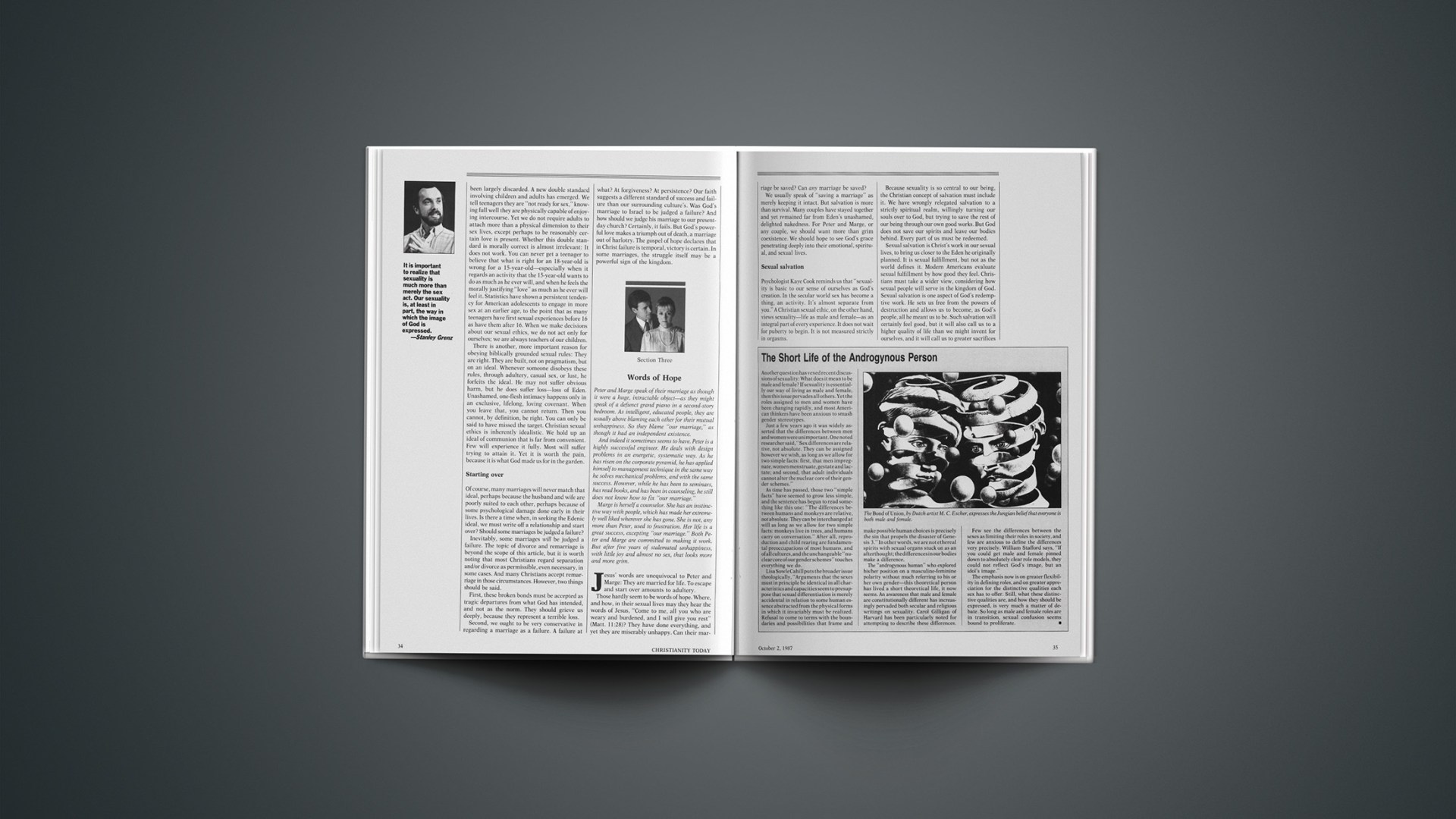
The Short Life of the Androgynous Person

Another question has vexed recent discussions of sexuality: What does it mean to be male and female? If sexuality is essentially our way of living as male and female, then this issue pervades all others. Yet the roles assigned to men and women have been changing rapidly, and most American thinkers have been anxious to smash gender stereotypes.

Just a few years ago it was widely asserted that the differences between men and women were unimportant. One noted researcher said,” Sex differences are relative, not absolute. They can be assigned however we wish, as long as we allow for two simple facts: first, that men impregnate, women menstruate, gestate and lactate; and second, that adult individuals cannot alter the nuclear core of their gender schemes.”

As time has passed, those two “simple facts” have seemed to grow less simple, and the sentence has begun to read something like this one: “The differences between humans and monkeys are relative, not absolute. They can be interchanged at will as long as we allow for two simple facts: monkeys live in trees, and humans carry on conversation.” After all, reproduction and child rearing are fundamental preoccupations of most humans, and of all cultures, and the unchangeable “nuclear core of our gender schemes” touches everything we do.

Lisa Sowle Cahill puts the broader issue theologically, “Arguments that the sexes must in principle be identical in all characteristics and capacities seem to presuppose that sexual differentiation is merely accidental in relation to some human essence abstracted from the physical forms in which it invariably must be realized. Refusal to come to terms with the boundaries and possibilities that frame and make possible human choices is precisely the sin that propels the disaster of Genesis 3.” In other words, we are not ethereal spirits with sexual organs stuck on as an afterthought; the differences in our bodies make a difference.

The “androgynous human” who explored his/her position on a masculine-feminine polarity without much referring to his or her own gender—this theoretical person has lived a short theoretical life, it now seems. An awareness that male and female are constitutionally different has increasingly pervaded both secular and religious writings on sexuality. Carol Gilligan of Harvard has been particularly noted for attempting to describe these differences.

Few see the differences between the sexes as limiting their roles in society, and few are anxious to define the differences very precisely. William Stafford says, “If you could get male and female pinned down to absolutely clear role models, they could not reflect God’s image, but an idol’s image.”

The emphasis now is on greater flexibility in defining roles, and on greater appreciation for the distinctive qualities each sex has to offer. Still, what these distinctive qualities are, and how they should be expressed, is very much a matter of debate. So long as male and female roles are in transition, sexual confusion seems bound to proliferate.

In fact, the root of sexual salvation lies in Christ’s calling us to something greater than pleasure. Set up as a god, sexual pleasure calls the couple to an endless menu of sexual variations, yet often leaves them restless and bored despite their “good sex life.” The sexual gourmet will experience many remarkable sensations, but will end up unsatisfied. The person who hears God’s call can never end dissatisfied. Sexuality was meant to be the beginning of something, not the end. In Eden the first man and woman were made to delight in their complementarity, but their concerns did not end with that delight. God commanded them to multiply and fill the Earth, and to rule the Earth. Surely these commands have a spiritual dimension in Christ’s kingdom.

This places “marital problems” against the larger struggle to preach and live the kingdom of God in an unloving and unjust world. Couples who share each other’s spiritual calling almost inevitably come to appreciate each other as more than mere sex partners—and that appreciation is likely to help them become better sex partners. Thus, Christians who find themselves estranged begin to find sexual salvation as they turn their eyes more completely toward Christ. In plain, prosaic ways, loving marriages are encouraged in a kingdom of love, while they are hindered by a kingdom of self-fulfillment.

And yet, the kingdom of love encourages good marriages, and good marriages are critical to Christ’s kingdom, so much so that Paul compares the marriage bond to Christ’s love for his church. Ethicist Stan Grenz puts it this way: “There are various levels in which the divine nature is expressed by humanity. But perhaps one of the highest ways is the family unit, the coming together of two persons to form a unit. That expresses at a higher level the unity which will come.” Sexual salvation for married people means creating an environment of fidelity and love (even suffering and sacrificial love) where Christ’s love and eternal faithfulness are mirrored.

Does this mean only married couples experience sexual salvation? Are marriages alone a sign of the kingdom? Not at all. Paul’s example and teaching, and Jesus’ life leave no doubt that singleness may also be a sign. “From now on those who have wives should live as if they had none; those who mourn, as if they did not; those who are happy, as if they were not; those who buy something, as if it were not theirs to keep; those who use the things of the world, as if not engrossed in them. For this world in its present form is passing away” (1 Cor. 7:29–31). In this context, Paul explains that he favors celibacy over marriage. He is not merely speaking of simplifying lifestyle to give more time to ministry. He is speaking of a life that has gone beyond contingent realities, and lives “in undivided devotion to the Lord.”

As Paul saw them, both marriage and celibacy are of only relative value as they allow us to fulfill our responsibilities to the kingdom, and to the Christian community that anticipates it. The unmarried are not condemned to eternal solitude. Nor have the married entered eternal bliss. Instead, God designed our present lives to prepare us for a a more complete life as male and female. Our chief and ultimate orientation is not toward marriage but toward God and his church.

While marriage signals Christ’s covenant of love, a saved singleness makes another, different sign of God’s kingdom: a sign that says, ultimately, God is our satisfaction. Marriage trains us in the service of love. Singleness frees us to see God as the only source of our freedom. Both are modes for sexual salvation that shows itself ultimately in freedom. The redeemed can be unconstrained and unguarded, because they want what is good and do not want what is bad, because they are integrated rather than divided against themselves. “It is for freedom that Christ has set us free” (Gal. 5:1).
North American Scene from October 2, 1987

SURROGATE MOTHERS

Pushing For A Ban

A new coalition including surrogate mothers, feminists, and critics of biotechnology will push for a federal law banning contracts that require surrogate mothers to give up their babies. The National Coalition Against Surrogacy also will provide free legal advice to surrogate mothers.

The organization will receive initial funding from the Foundation on Economic Trends, headed by Jeremy Rifkin. He called surrogacy arrangements a “modified form of slavery” that violates contract law and the principles of the U.S. Constitution.

At a Washington news conference, Rifkin was joined by three surrogate mothers, including Mary Beth Whitehead, who lost custody of her daughter in the Baby M trial. “Don’t let this happen anymore; it’s not right,” Whitehead said. “I feel in my heart the only crime we [surrogate mothers] committed was loving our babies. That’s it. We haven’t done anything wrong.”

Feminist author Gena Corea described the rise of a “surrogacy industry,” stressing concerns that surrogacy could be coupled with new reproductive techniques to allow couples to “order” babies with preselected characteristics.

ABORTION

A First-Time Decline

Federal health officials reported a decrease in the number of abortions for the first time since record keeping began in 1969.

A report released by the Federal Centers for Disease Control (CDC) says 1,268,987 abortions were performed in 1983, the latest year for which statistics are available. That figure was down 2.7 percent from the number of abortions reported in 1982. However, the health agency noted that the number of reported abortions was probably lower than the number actually performed.

The CDC report said the abortion rate declined in 1983 to 23 for every 1,000 women 15 to 44 years old, from a 1980 peak of 25 per 1,000 women. The percentage of abortions obtained by teenagers also declined—from 29 percent of the total in 1980 to 27 percent in 1983.

EDUCATION

Failing The Teacher Test

A new U.S. Department of Education report indicates that 17 to 28 percent of prospective public school teachers fail basic competency tests, despite “extremely low” requirements to pass the tests.

“Given that the tests are not difficult and that the passing scores appear to be relatively low, one would expect virtually everyone to pass teacher certification examinations,” the report states. “Yet this is not the case.”

All but two states, Alaska and Iowa, require applicants to achieve minimum test scores, either when they apply for admission to a college of education, or before they are awarded a license to teach.

“The common practice of establishing extremely low passing scores further diminishes the ability of many teacher-testing programs to support meaningful standards,” said Lawrence Rudner, a former federal analyst who directed the study.

In 22 of the states that require minimum test scores before certifying teachers, 17 percent of the applicants failed the test. In the 27 states with admissions testing programs for prospective education majors, an average of 28 percent failed.

UNITED METHODISTS

Lesbian On Suspension

A church court in New Hampshire suspended United Methodist minister Rose Mary Denman after determining that she violated a rule that bans practicing homosexuals from the clergy.

Denman was suspended from pastoral duties until next June, when clergy in the church’s New Hampshire Annual Conference will vote on her ministerial status. The sentence was the most lenient possible. Denman could have been defrocked and even expelled from the United Methodist Church.

A divorced mother, Denman requested the church trial after obtaining a leave of absence from two parishes in New Hampshire and notifying her bishop that she was a lesbian. She said she wanted to stand trial in order to challenge the 1984 church rule barring practicing homosexuals from the pastorate.

However, Bishop Neil Irons, who presided at the trial, said the issue at stake was whether Denman had violated church law, which says clergy must practice “fidelity in marriage and celibacy in singleness.” He said the trial was not a forum for debating the merits of the ban on homosexual clergy.

Denman lives in Portland, Maine, with Winnie Weir, the ex-wife of a pastor. Denman has said she will attempt to transfer her ministerial credentials to the Unitarian Universalist Association, which accepts homosexual clergy.

PEOPLE AND EVENTS

Briefly Noted

Dropped : From the list of institutions approved for the education of United Methodist clergy, the Oral Roberts University School of Theology. The school was one of 11 non-Methodist seminaries dropped by the United Methodist University Senate, which declined to give reasons for its action. Criteria used in evaluating theological schools include freedom of academic inquiry, compatibility with the denomination’s social principles, racial and sexual inclusiveness of faculty and student body, and academic quality.

Sought : By the Wisconsin Evangelical Lutheran Synod, a new name. The church’s biennial convention asked a committee to recommend a name that will reflect the spread of the denomination’s membership far beyond the boundaries of one state. The 114,000-member church has congregations in all 50 states and three Canadian provinces, as well as overseas mission work on all continents except Australia.

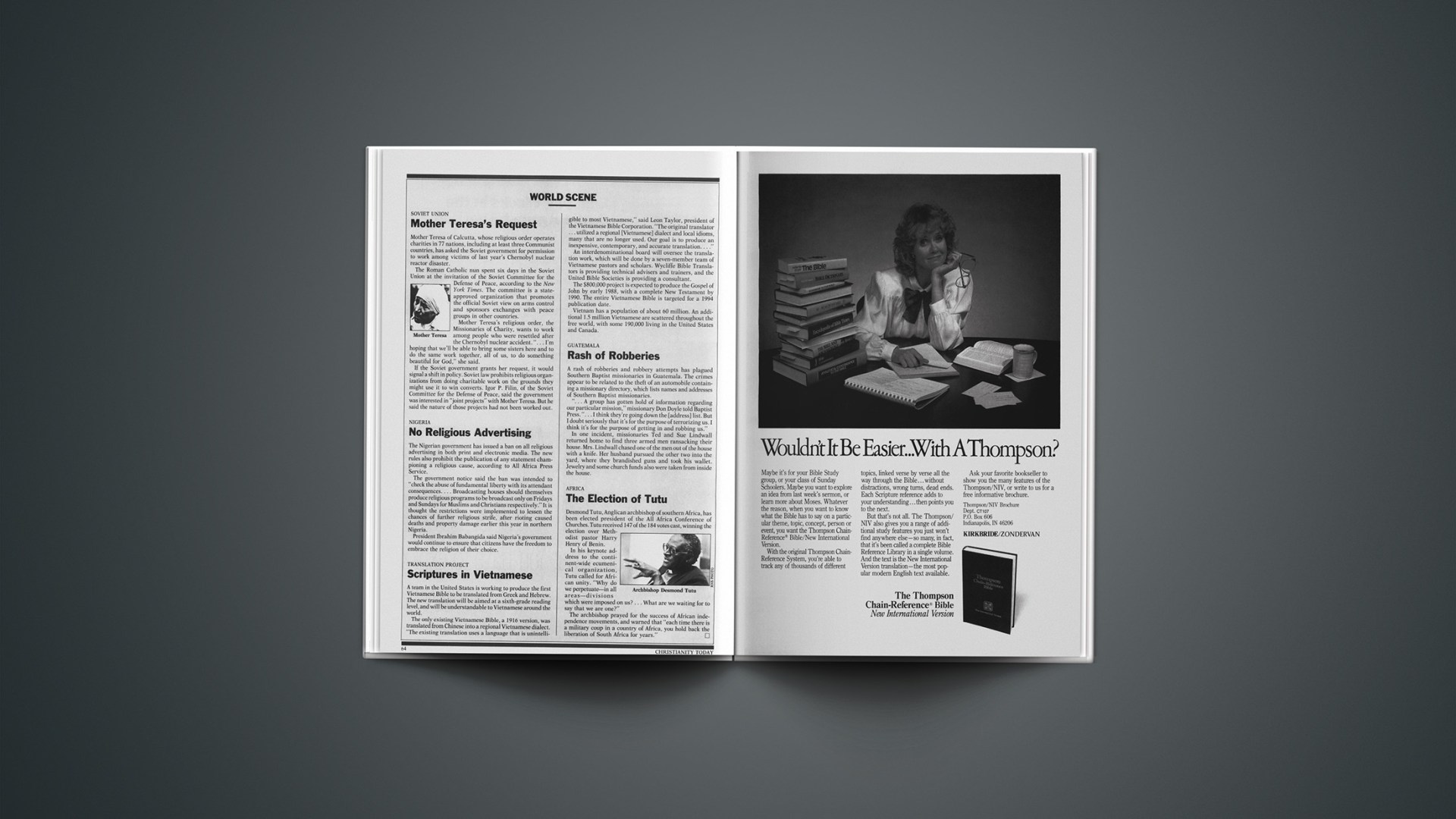
World Scene from October 2, 1987

SOVIET UNION

Mother Teresa’s Request

Mother Teresa of Calcutta, whose religious order operates charities in 77 nations, including at least three Communist countries, has asked the Soviet government for permission to work among victims of last year’s Chernobyl nuclear reactor disaster.

The Roman Catholic nun spent six days in the Soviet Union at the invitation of the Soviet Committee for the Defense of Peace, according to the New York Times. The committee is a state-approved organization that promotes the official Soviet view on arms control and sponsors exchanges with peace groups in other countries.

Mother Teresa’s religious order, the Missionaries of Charity, wants to work among people who were resettled after the Chernobyl nuclear accident.” … I’m hoping that we’ll be able to bring some sisters here and to do the same work together, all of us, to do something beautiful for God,” she said.

If the Soviet government grants her request, it would signal a shift in policy. Soviet law prohibits religious organizations from doing charitable work on the grounds they might use it to win converts. Igor P. Filin, of the Soviet Committee for the Defense of Peace, said the government was interested in “joint projects” with Mother Teresa. But he said the nature of those projects had not been worked out.

NIGERIA

No Religious Advertising

The Nigerian government has issued a ban on all religious advertising in both print and electronic media. The new rules also prohibit the publication of any statement championing a religious cause, according to All Africa Press Service.

The government notice said the ban was intended to “check the abuse of fundamental liberty with its attendant consequences.… Broadcasting houses should themselves produce religious programs to be broadcast only on Fridays and Sundays for Muslims and Christians respectively.” It is thought the restrictions were implemented to lessen the chances of further religious strife, after rioting caused deaths and property damage earlier this year in northern Nigeria.

President Ibrahim Babangida said Nigeria’s government would continue to ensure that citizens have the freedom to embrace the religion of their choice.

TRANSLATION PROJECT

Scriptures in Vietnamese

A team in the United States is working to produce the first Vietnamese Bible to be translated from Greek and Hebrew. The new translation will be aimed at a sixth-grade reading level, and will be understandable to Vietnamese around the world.

The only existing Vietnamese Bible, a 1916 version, was translated from Chinese into a regional Vietnamese dialect. “The existing translation uses a language that is unintelligible to most Vietnamese,” said Leon Taylor, president of the Vietnamese Bible Corporation. “The original translator … utilized a regional [Vietnamese] dialect and local idioms, many that are no longer used. Our goal is to produce an inexpensive, contemporary, and accurate translation.…”

An interdenominational board will oversee the translation work, which will be done by a seven-member team of Vietnamese pastors and scholars. Wycliffe Bible Translators is providing technical advisers and trainers, and the United Bible Societies is providing a consultant.

The $800,000 project is expected to produce the Gospel of John by early 1988, with a complete New Testament by 1990. The entire Vietnamese Bible is targeted for a 1994 publication date.

Vietnam has a population of about 60 million. An additional 1.5 million Vietnamese are scattered throughout the free world, with some 190,000 living in the United States and Canada.

GUATEMALA

Rash Of Robberies

A rash of robberies and robbery attempts has plagued Southern Baptist missionaries in Guatemala. The crimes appear to be related to the theft of an automobile containing a missionary directory, which lists names and addresses of Southern Baptist missionaries.

“… A group has gotten hold of information regarding our particular mission,” missionary Don Doyle told Baptist Press. “… I think they’re going down the [address] list. But I doubt seriously that it’s for the purpose of terrorizing us. I think it’s for the purpose of getting in and robbing us.”

In one incident, missionaries Ted and Sue Lindwall returned home to find three armed men ransacking their house. Mrs. Lindwall chased one of the men out of the house with a knife. Her husband pursued the other two into the yard, where they brandished guns and took his wallet. Jewelry and some church funds also were taken from inside the house.

AFRICA

The Election Of Tutu

Desmond Tutu, Anglican archbishop of southern Africa, has been elected president of the All Africa Conference of Churches. Tutu received 147 of the 184 votes cast, winning the election over Methodist pastor Harry Henry of Benin.

In his keynote address to the continent-wide ecumenical organization, Tutu called for African unity. “Why do we perpetuate—in all areas—divisions which were imposed on us?… What are we waiting for to say that we are one?”

The archbishop prayed for the success of African independence movements, and warned that “each time there is a military coup in a country of Africa, you hold back the liberation of South Africa for years.”

Tombs and Inner Temples

Tombs appear everywhere in Sheila Keefe’s paintings. There are recumbant figures, bodies reclining in final repose. And there is darkness—several shades of black and purple and brown and deep blue—on the incised and painted wooden panels that are stacked and hung about her cluttered studio at Arlington, Virginia’s Torpedo Factory Art Center.

The shadowy tombs reflect Keefe’s fascination with the continuing influence of her ancestors—and ours. It is a fascination sparked largely by the birth of her first grandson, Joseph Bartholomew, in December 1984. Keefe celebrated the birth in a four-by-six-foot painting, The Godfather, which was the subject of a recent issue of Potter’s House Press, a Washington, D.C. based Christian arts journal.

The painting presents a cavelike darkness in which a white-robed Joseph stands by a reclining ancestor. The ancestor’s hand rests on Joseph’s shoulder, and golden rays from the reclining body envelop the child. To the left, another corpse rests above a crude catacomb inscription. From this ancient Christian corpse, a stream of fish swim beneath Joseph’s feet.

“Timeless” is how James Stambaugh of the Wheaton (Ill.) Billy Graham Center Museum characterizes Keefe’s work. “It could have come from the catacombs in Rome when the church was just beginning, or from some time in the future. When dealing Christian message,” Stambaugh says, “it is important for the artist to create a sense of timelessness.”

Keefe learned the sepulchral colors of her somber palette while traveling in Nepal. “Her use of dark colors lends a mystical and ancient quality to her work,” says Stambaugh, who has purchased two of Keefe’s panels for the Billy Graham Center Museum.

To invite viewer involvement, Keefe puts doors with hinges on some of her paintings. One large wooden panel on her studio wall has ten small paintings and ten sets of matte black doors. The invitation is too effective. You want to touch the painting, to open and close the doors. Thus, to keep browsers from incessantly playing with the merchandise, Keefe has hung that panel high and out of reach.

Keefe’s doors lead to paintings she calls “Inner Temples” or “Contemporary Icons”—meditation art for viewer participation. “I consider the viewer as important as the artist,” she says of the inviting and frustrating nature of her work.

A show of Keefe’s contemporary icons will be mounted at the Selzer Gallery in Manhattan’s Soho district, December 10–23.

By David Neff.

History

From the Archives: A Dialogue on the Lord’s Prayer

Tyndale wrote this treatise to, he writes, “fill up the leaf of the paternoster” [as he would have known the Lord’s Prayer]. The treatise is, he says, “very necessary and profitable, wherein—if you mark it—you shall perceive what prayer is and all that belongs to prayer.” The harsh and irritated tone of God’s language in the piece is at times somewhat jarring; but the importance of this to the dialogue is explained in Tyndale’s preface:

“The sinner prays the petitions of the paternoster, and God answers by the law, as though He would put him from his desire. The sinner acknowledges that he is worthy to be put back, but nevertheless, faith cleaves fast to God’s promises and compels Him, for His truth’s sake, to hear the petition. Mark this well and take it for a sure conclusion: when God commands us in the law to do anything, He commands not therefore that we are able to do it, but to bring us unto the knowledge of ourselves, that we might see what we are and what a miserable state we are in, and to know our lack, that thereby we should turn to God to acknowledge our wretchedness unto Him, and to desire Him that of His mercy He would make us what He bids us be, and to give us strength and power to do that which the law requires of us ….The office of the law is only to utter sin, and to declare what miserable damnation and captivity we are in. Is it not a miserable, yes, a fearsome and horrible damnation …, when our very hearts are so fast bound and locked unto the power of the devil that we cannot once as much as consent unto the will of almighty God, our Father, Creator, and Maker?”

Tyndale writes that we should elaborate upon the Lord’s Prayer like this:

The Sinner: Our Father who is in heaven, what a great space is between Thee and us. How therefore shall we, Thy children here on earth, banished and exiled from Thee in this vale of misery and wretchedness, come home to Thee into our natural country?

God: The child honors his father, and the servant his master. If I am your father, where is My honor? If I am your lord, where is My fear? (Malachi 1). For My name through you and by your means is blasphemed, railed upon and evil spoken of (Isaiah 52).

The Sinner: Alas, o Father, that is true. We acknowledge our sin and trespass. Yet be Thou a merciful father, and deal not with us according to our deservings, neither judge us by the rigorousness of Thy will, but give us grace that we may so live that Thy holy name may be hallowed and sanctified in us. And keep our hearts, that we neither do nor speak, no, that we not once think or purpose anything but that which is to Thy honor and praise, and above all things make Thy name and honor to be sought of us and not our own name and vain glory. And of Thy mighty power bring to pass in us that we may love and fear Thee as a son his father.

God: How can My honor and name be hallowed among you, when your hearts and thoughts are always inclined to evil, and yes in bondage and captivity under sin, moreover seeing that no man can sing My laud and praise in a strange country (Psalm 136).

The Sinner: O Father, that is true. We feel our members, yes, and also our very hearts, prone and ready to sin. And that the world, the flesh, and the devil rule in us, and expel the due honor of Thy holy name. Wherefore we beseech Thee, most merciful Father, for the love that Thou hast unto Thy son Christ, help us out of this miserable bondage, and let Thy kingdom come, to drive out the sin, to loose the bonds of Satan, to tame the flesh, to make us righteous and perfect, and to cleave unto Thee, that Thou only may reign in us, and that we may be Thy kingdom and possession, and Thee obey with all our power and strength, both within and without.

God: Whom I help, them I destroy. And whom I make living, safe, rich and good, them I kill, condemn and cast away, make them beggars and bring them to nought. But so be cured of me, [and] you will not suffer (Psalm 77). How then shall I heal you, yes, and what can I do more? (Isaiah 5).

The Sinner: That is to us great sorrow and grief, that we can neither understand nor suffer Thy wholesome hand. Wherefore help, dear Father, open our eyes and work patience in us, that we may understand Thy wholesome hand and also patiently suffer Thy godly will to be fulfilled in us. Furthermore, though Thy most wholesome cure be never so painful unto us, yet go forward therewith, punish, beat, cut, burn, destroy, bring to nought, damn, cast down unto hell, and do whatsoever Thou will, that Thy will only may be fulfilled and not ours. Forbid, dear Father, and in no wise suffer us to follow our own good thoughts and imaginations, neither to prosecute our own will, meaning and purpose. For Thy will and ours are clean contrary one to the other, thine only good (though it otherwise appear unto our blind reason), and ours evil (though our blindness see it not).

God: I am well served and dealt withal, that men love me with their lips and their hearts are far from me, and when I take them in hand to make them better and to amend them, then run they backward, and in the midst of their curing, while their health is aworking, they withdraw themselves from me, as you read (Psalms 77). Conversisunt in die bell;. They are turned back in the day of battle, that is to say, they which began well and committed themselves unto me, that I should take them in hand and cure them, are gone back from me in time of temptations and fulfilling of the flesh, and are returned to sin and unto dishonoring me again ….

The Sinner: O Father, have mercy on us, and deny us not that bread of love. It grieves us sore, even at the very root of our heart, that we cannot satisfy Thy words and follow it. We desire thee, therefore, to have patience with us, Thy poor and wretched children, and to forgive us our trespass and guilt, and judge us not after Thy law, for no man is righteous in Thy presence. Look on Thy promises. We forgive our trespassers, and that with all our hearts, and unto such hast Thou promised forgiveness—not that we through such forgiveness are worthy of Thy forgiveness, but that Thou are true, and of Thy grace and mercy have promised forgiveness unto all them that forgive their neighbors. In this Thy promise, therefore, is all our hope and trust.

God: I forgive you often and loose you often, and you never abide steadfast. Children of little faith are you. You cannot watch and endure with me a little while, but at once fall again into temptation (Matthew 26) …. I am righteous and right in my judgment, and therefore sin cannot go unpunished ….

The Sinner: For as much, then, as adversity, tribulation, affliction and evil which fight against sin give us temptation, deliver us out of them, finish Thy cure and make us thoroughly whole, that we, loosed from sin and evil, may be unto Thee a kingdom, to laud, to praise and to sanctify Thee. Amen. And seeing that Thou hast taught us thus to pray, and hast promised also to hear us, we hope and are sure that Thou wilt graciously and mercifully grant us our petitions, for Thy truth’s sake, and to the honoring of Thy truth. Amen.

Finally, some man will say haply, “What and if I cannot believe that my prayer is heard?” I answer, “Then do as the father of the possessed did in the 9th [chapter] of Mark, when Christ said unto him, ‘If you could believe, all things are possible unto him that believes.’ The father answered, ‘I believe, Lord help my unbelief,’ that is to say, heal my unbelief and give perfect belief and strengthen the weakness of my faith and increase it.”

Copyright © 1987 by the author or Christianity Today/Christian History magazine. Click here for reprint information on Christian History.

History

William Tyndale: A Gallery of Characters in Tyndale’s Story

Sir Thomas More

One of William Tyndale’s bitterest opponents, and one of the best-known men in 16th-century England—for his power, his intellect and his religious convictions. His was the central character in the prize-winning play and movie, A Man for All Seasons. A devout and intelligent Roman Catholic layman, he was appointed to the post of Lord Chancellor, then was commissioned by the king and the church to refute William Tyndale’s arguments and to discredit his character. He wrote nine books against Tyndale, filling more than 1,000 pages with arguments and invective against the reformer, and always defending the ultimate authority of the pope and the Roman Catholic Church (see “The Pen-and-Ink Wars,”).

Ironically, though More had many people executed because they denied the pope’s authority, his immovable commitment to that authority eventually led to his own death. When King Henry insisted on getting a divorce contrary to papal proclamations, then went on to declare that the pope no longer had authority in England, More told the king that he disagreed and would have to resign his post. Henry could not tolerate the public humiliation of having his closest advisor visibly questioning his wisdom, so he had More executed on trumped-up charges.

Cuthbert Tunstall

The bishop of London to whom Tyndale went in 1524, seeking patronage for his work of translating the New Testament into English. As far as the church hierarchy went, Tunstall was a shrewd choice on Tyndale’s part. Tunstall was a learned man, a language scholar of some ability himself, and he had declared his affection for some of Erasmus’s reform oriented ideas.

But Tyndale’s request came at a time when things done in the name of reform were creating havoc in Europe: violent riots; overthrows of local authorities; attacks on clergymen …. So Tunstall was leery of anything that smacked of “Lutheranism,” and it was Luther’s common-language German version of the New Testament that figured prominently in the sources of the havoc. No matter how intelligent or concerned for scholarship he was, he was at that time unready to support any New Testament translation work, and so sent the young translator looking elsewhere for patronage. Later, he can be seen burning Tyndale’s testaments and other pro-reform literature. Apparently politics had won out.

Anne Boleyn

This French-trained English beauty was indirectly a friend to William Tyndale, though unfortunately for both her and Tyndale, she was not enough of a friend to her husband the king. This lady-in-waiting probably first came to Henry’s attention about 1527, after his repeated attempts to conceive and raise up a healthy son with Catherine had aged her and frustrated him. So while he pursued getting a divorce from Catherine, he was also pursuing the affections of Anne. She teased him, but would not give herself to him until he had the divorce and married her. This done, she became queen. During her brief reign as queen (1533–36), she managed to lay hands on an ornate copy of Tyndale’s 1534 edition of the English New Testament, as well as a copy of his “heretical” The Obedience of a Christian Man that she showed to Henry.

The king loved it, and for a time wanted Tyndale to be his court propagandist. But in the meantime, Anne was unable, like Catherine before her, to produce a healthy male heir. Plus, her prima donna attitude alienated many in the court, and some of them told the king of her sexual philandering with other men. Already disappointed in her, the incensed Henry had her quickly executed and the marriage declared void. Anyway, he had already set his eye upon Jane Seymour, and with Anne out of the way she soon became Henry’s third wife.

Thomas Wolsey

This power-hungry son of an English butcher became chaplain to the Archbishop of Canterbury at age 30, and chaplain to Henry VII at 34. Under Henry VIII’s sovereignty, at age 44 he rose to Cardinal, and at 54 became the pope’s personal representative in England. The corruption in his heart apparently went deep; he accumulated property and fineries that were exceeded in luxury only by King Henry’s, and was well-known for having at least one “wife” and two or more illegitimate children. He became the king’s right-hand man in several arenas, but especially in negotiating with the pope to get the king’s way. Opposing and persecuting refomers was just another way to keep both king and pope happy and united against a common enemy. Unfortunately for Wolsey, he was unable to secure papal permission for Henry’s divorce from Catherine quickly enough, and so was sentenced by the king to die “for treason.” Just past 61 years of age, he died of fright and heart failure en route to his execution.

Bishop Stokesley

The bishop of London after Cuthbert Tunstall, he became infamous as one of the cruelest opponents of Protestantism to ever hold church office in England. He was responsible for the martyrdoms of even more Protestants than Sir Thomas More, and was very likely the one who financed Henry Phillips, the man who searched Tyndale out and betrayed him.

The Poyntzes

The English couple who took Tyndale in, when he was fleeing various agents of the king and the church, and gave him quarters at the English merchants’ lodgings in Antwerp. Thomas Poyntz was related to Lady Anne Walsh. During Tyndale’s stay with them, the Poyntzes encouraged him, gave him a place to study, guarded his secrecy, and warned him of their fears about Henry Phillips. After Phillips betrayed Tyndale, Thomas worked diligently trying to secure Tyndale’s release, and himself was imprisoned for his persistence and his pro-reformation sympathies.

H. Monmouth

Humphrey Monmouth was the London businessman who took young Tyndale in and briefly gave him lodging, before the translator abandoned hope of translating the New Testament in England and headed for Europe. Apparently a good-hearted Catholic who only briefly flirted with Protestantism, he later suffered appreciably for that flirtation; he was brought to trial by the church for harboring the “heretic.”

Miles Coverdale

A translator/scholar who Tyndale befriended at Oxford, he later helped Tyndale with his always continuing revision work on the New Testament translation. After Tyndale’s death, it was an entire English Bible with Coverdale’s name on it that Henry VIII officially approved to be spread “among all the people.”

John Frith

One of Tyndale’s closest friends, and like Tyndale, one of England’s ablest scholars, also educated at both Oxford and Cambridge. Three or four years younger than Tyndale, Frith probably sat at Tyndale’s feet in the reform-oriented Bible studies that Tyndale led at Oxford, then later Frith was, like Tyndale, pursued around England and Europe for his reformation and translation efforts. A priest who married, Frith was captured and martyred some three years before Tyndale. One of Tyndale’s Scripture-filled letters to the imprisoned Frith includes the encouragement that Frith’s wife was “well content with the will of God, and would not for her sake have the glory of God hindered.”

John and Anne Walsh

Sir John and Lady Anne Walsh were the masters of Little Sodbury, the estate where Tyndale worked briefly after leaving Cambridge, probably as a tutor to their two young sons. They were known in the region for their hospitality to both nobility and clergy; it was at their table that Tyndale challenged a visiting cleric, “If God grant me life, ere many years pass I will see that the boy behind his plow knows more of the Scriptures than thou dost!” Exposed to reformation thinking by Tyndale, the Walshes gave him money to support himself in Europe, and later made efforts to get him released from Vilvoorde prison.

Thomas Cromwell

He succeeded Sir Thomas More as chancellor to the king, and tried to be a friend to Tyndale when the reformer was sitting in prison. He is best-known for carrying out King Henry’s order to suppress the monasteries in England, then for being executed by the king soon after the last monastery had surrendered. A man of Protestant sympathies, he attempted to get Tyndale set free from Vilvoorde prison by contacting the governor of the prison. He was obviously not successful, but he was successful in convincing the king to approve distribution of the English Bible translated by Tyndale and Coverdale.

Copyright © 1987 by the author or Christianity Today/Christian History magazine. Click here for reprint information on Christian History.

History

William Tyndale: Recommended Resources

The Independent Works of William Tyndale (Washington, D.C.: Catholic University of America Press, scheduled for release between 1992 and 1998). Yale University Press is publishing newly annotated editions of the works of Sir thomas More, including his polemic writings against Tyndale, and CUAP’s series will feature Tyndale’s rebuttals, as well as several of his expositions of Scripture.

Lewis Lupton, Tyndale, Translator and Tyndale, Martyr, from which several of the illustrations in this issue were taken. Published by The Olive Tree Press, Chiswick, England, these books are part of a multi-volume history that Lupton, a retired artist, is writing about the English Bible. No mechanical printing appears in these remarkable books, as Lupton has completely hand-lettered and -illustrated them himself.

Other Good Tyndale-Related Works:

Brian H. Edwards, God’s Outlaw (Phillipsburg, NJ: Evangelical Press, 1976; reprint, 1986).

Henry Walter, ed., The Works of William Tyndale, Parker Society Series (Cambridge: The University Press, 1848–50; reprint London: Johnson Reprint Corp., 1968).

George Duffield, ed., The Works of William Tyndale, The Courtenay Library of Reformation Classics (Berkshire: The Sutton Courtenay Press, 1964).

J.F. Mozley, William Tyndale (Westport, CO: Greenwood Press, 1971 reprint).

Donald Dean Smeeton, Lollard Themes in the reformation Theology of William Tyndale (Published by the Sixteenth-Century Study Council, 1987).

Copyright © 1987 by the author or Christianity Today/Christian History magazine. Click here for reprint information on Christian History.

History

The Church That Tyndale Fought

Corruption in the church has existed as long as there have been people in it (consider, for example, both Peter’s denials and Judas’s greed), but widespread corruption and resistance to the truth were especially acute during Tyndale’s day.

For decades after the election of Rodrigo Borgia as Pope Alexander VI in 1492, the papacy was, in the words of Roman Catholic historian Father Bede Jarrett, “little else than a small Italian princedom ruled by some of the least reputable of the Renaissance princes.”

The great Roman Catholic historian, Dr. Ludwig Pastor, says of Alexander that “his life of unrestrained sensuality was in direct contradiction with the precepts of Him whose representative . . . he was.”

As with the head, so with the feet; most of the English priests leading masses, according to an archbishop of the time, were barely able to pronounce the Latin liturgies properly, much less comprehend them; leading clergymen throughout England were known for their illegitimate “wives” and children; and the business of indulgences was bringing huge sums into the Church’s coffers.

Copyright © 1987 by the author or Christianity Today/Christian History magazine. Click here for reprint information on Christian History.

History

From the Archives: From The Obedience of a Christian Man

According to Tyndale experts, the translator’s basic purpose in this treatise was to set forth, based on Scripture alone, his understanding of the real duties of a Christian—and to show how the abuses and imbalances of the institutional church of the time were leading people away from these “true duties.” In the book’s several chapters, Tyndale treats, in order, the expectations God outlines in Scripture for children, wives, servants, and the king’s subjects. He then proceeds to God-ordained duties for husbands, masters, landlords, judges and king’s officers, showing how, in his interpretation, each ought to rule. Then he suggests ways in which the papacy’s abuses had usurped the authority allotted to these other powers, hence dealing with the sacraments, the Antichrist, baptism, wedlock, monastic orders, penance, confession, contrition, absolution, anointing, miracles, the adoration of saints, and prayer. He then analyzes and critiques the four approaches to Scripture interpretation that were prevalent at the time, and concludes with “a compendious rehearsal of that which goeth before.” This extract is from that “rehearsal.”

I have described unto you the obedience of children, servants, wives, and subjects. These four orders are of God’s making, and the rules thereof are God’s Word. He that keeps them shall be blessed—yea, is blessed already—and he that breaketh them shall be cursed.

If any person, from impatience or a stubborn and rebellious mind, withdraw himself from any of these, and get him to any other order, let him not think thereby to avoid the vengeance of God in obeying rules and tradition of man’s imagination.

If thou shavest shine head in the worship of thy Father, and breakest His commandments, shouldest thou so escape? Or, if thou paintest thy Master’s image on a wall and slickest up a candle before it, shouldest thou therewith make satisfaction for the breaking of His commandment? Or, if thou wearest a blue coat in the worship of the king and breakest his laws, shouldest thou so go quit?

Let a man’s wife make herself a sister of the chatterhouse, and answer her husband, when he bids her hold her peace. My brethren keep silence for me, and see whether she shall so escape. And be thou sure that God is more jealous over His commandments than man is over his, or than any man is over his wife.

Because we are blind, God has appointed in the Scripture how we should serve Him and please Him. As pertaining unto His own person, He is abundantly pleased when we believe His promises and the holy testament which He has made unto us in Christ, and [hence] for the mercy which He there showed us, [we] love His commandments.

All bodily service must be done to man in God’s stead. We must give obedience, honor, toll, tribute, custom and rent unto whom they belong. Then if thou have ought more to bestow, give unto the poor which are left here in Christ’s stead, that we show mercy to them ….

Therefore, I say, is a Christian called to suffer even the bitter death for his hope’s sake, and because he will do no evil. I showed also that kings and rulers, be they ever so evil, are yet a great gift of the goodness of God, and defend us from a thousand things that we see not.

I proved also that all men, without exception, are under the temporal sword, whatsoever names they give themselves. Because the priest is chosen out of the laymen to teach this obedience, is that a lawful cause for him to disobey? Because he preaches that the layman should not steal. is it therefore lawful for him to steal unpunished? …

Moreover, Christ became poor, to make other men rich, and bound, to make others free. He left also with His disciples the law of love. Now love seeketh not her own profit, but her neighbor’s …. The spirituality [the clergy], therefore, are condemned by all the laws of God, who through falsehood and disguised hypocrisy have sought so great profit, so great riches, so great authority and so great liberties; and have so beggared the laymen, and so brought then into subjection and bondage, and so despised them, that they have set up franchises in all towns and villages, for whosoever robs, murders or slays them, and even for traitors unto the king’s person also.

Copyright © 1987 by the author or Christianity Today/Christian History magazine. Click here for reprint information on Christian History.

History

The Bible Translator Who Shook Henry VIII

What does it take to shake a king? Ask William Tyndale. Henry VIII was a very powerful king, but Tyndale shook him at least briefly—with a power even greater.

In this series

Henry VIII, obviously the eighth king of England to bear the name of Henry, was a robust 33-year-old in 1524.

He had already excelled in many areas, had acquired a number of accolades, and could easily have felt that the world was at his feet. In fact, much of his surrounding world seemed to act as if it were lying at his feet.

With his impressive size, his impressive clothes, his impressive pomp and ceremony, his Renaissance education and his unflagging self-confidence, he appeared larger than life to most of his subjects, and was seen as a major force to be reckoned with in the European balance of power. He was at least what our age would call “an achiever,” probably even “an over-achiever.” He could play multiple musical instruments, dance, hunt game, lead an army, win at a joust, control his nobles and spend money like it grew on trees. Whatever constituted the stage, Henry VIII dominated it.

Even theology was not beyond the exertions of this highly confident King. When Martin Luther questioned the reigning theology of the period, with its minimal piety and its idolatry of popes, priests, saints and symbols, Henry considered himself quite capable of rebutting the troublesome Saxon monk, and soon produced his Defense of the Seven Sacraments. This appeared in 1520, about one year after Luther’s writings began to achieve really-wide circulation, and was almost entirely Henry’s work. For a while at least, it was the predominant theological apologetic in England for the traditional Catholic faith.

Although today, post-Reformation, we might question the Defenses’s effectiveness in combatting “the Lutheran heresy,” the pope at the time was apparently impressed with it. At least he was quite effusive in his praise of it (but of course nurturing good relations with kings was always a good political move for the pope). The pope named Henry “Defender of the Faith,” another plaudit to add to his various other titles of accomplishment.

So at age 33, in his prime, Henry VIII had established himself as a powerful, “go-getter” king, and his kingdom was enjoying a period of relative economic and political stability that had been unknown in recent English history. With his gifts, personality and training, he was leading England out of the Middle Ages and into more-modern, less-tumultous times.

One might think his personal life would have reflected this less-tumultous ideal, and in many ways it promised to. He had an adoring wife, Catherine of Aragon, who was a daughter of the most powerful dynasty Spain had ever seen. Their marriage had secured an important diplomatic ally, establishing close family ties between Henry and Emperor Charles V, and had produced one child for the couple, a daughter they named Mary. However, this facade of domestic and political bliss was actually quite shallow, as a closer look at Henry will demonstrate.

In many ways, as history records him, Henry was more a picture of the “red-necked” blue-collar worker who curses at his wife, talks with his mouth full, and stands on the street corner boasting of his sexual exploits. Numerous records exist to show us that he was ostentatious, authoritarian, unpredictable, a bully, a braggart, and certainly not deserving of much trust. He forsook alliances and broke political promises without notice. At various moments he used his royal favors to tease court factions, foreign governments and even religious leaders, then disdained or even attacked these same people the next moment, depending on his royal whim. Unfortunately, it was this darker side that eventually came to dominate Henry’s life, not only destroying his first marriage and wife, but also the several that came after her.

However, in 1524, at age 33, Henry was still relatively restrained, probably imagining neither the extremes he would go to nor the trouble he would receive from an obscure English priest who slipped out of his kingdom and headed for the Continent that year. Perhaps later the king wished he would have learned more about this priest before the man left his kingdom, because it was only after leaving England that Tyndale began to cause Henry problems.

But Henry did not know, in 1524, about Tyndale’s frustration with the religious ignorance of the priests and abbots who visited Little Sodbury Manor.

Nor did he know about Tyndale’s disappointment when the bishop of London, Cuthbert Tunstall, denied the translator permission and help to do what he believed he had to do, no matter what the law said.

Tyndale’s request seems harmless enough today: he merely wanted to translate the Bible from its original languages into English. But at that time, a church law established in 1408 was still in effect, and that law said that all translation of the Bible into the vernacular language was absolutely forbidden, except by specific ecclesiastical permission.

So Henry did not know, in 1524, that Tyndale was determined that his countrymen would have the Bible in their own language. But Henry would soon clearly come to know that, as he heard about William Tyndale and his vernacular Bible many times in the next 12 years.

In the fall of 1525, in Germany, Tyndale saw something that no Englishmen had ever seen before. At Peter Quentel’s shop in Cologne, Tyndale witnessed pages of the New Testament translated from Greek coming off a printing press, the most-modern technology of the day. Not only was the text in English, but the books would be available at a price affordable to the common man.

However, informers and anti-reformers interrupted Quentel’s production of the New Testament before it could be completed, so Tyndale and his companion, William Roye, fled Cologne and found another printer—this one in reform-minded Worms—who would reset the text. By early 1526 this printer had produced several thousand copies of the first printed English New Testament.

Within the first three months of 1526, complete New Testaments and copies of the Cologne fragments were arriving in England by the hundreds. Most of the religious establishment was outraged, and the government issued proclamations prohibiting the importation—but the dissemination of the books could not be stopped. Probably the first time Henry VIII heard William Tyndale’s name was during the hubbub surrounding the clergy’s attempts to stop the smuggling in and black-market selling of the forbidden translations.

By the end of 1526, Tyndale had produced a theological introduction to the book of Romans, in which he set forth his understanding of salvation by faith alone. Two years later, from Antwerp, he published The Parable of the Wicked Mammon and The Obedience of a Christian Man. These two works also declared Tyndale’s views on justification, as well as several other areas in which he disputed the Roman Church’s teaching.

It had become obvious that Tyndale was the genius behind the translation, that he was a writer of considerable merit, and that he was an articulate theologian committed to the reformation cause. The English crown and the church saw that this man had either to be stopped, or co-opted to join their forces. Meanwhile, despite the official hostility toward Tyndale, his smuggled-in works were finding thousands of avid readers in a nation just awakening to the power of the printed page.

By this time, Henry’s passion for a male heir to secure the throne had become his personal obsession, and hence, of course, a matter of public concern. After several tries Catherine still had not provided the desired boy-child, and Henry was convinced there must be a larger, metaphysical reason. Of course it was not his fault. And he could always have yet another affair, but the legitimacy of his son had to be beyond challenge. Something was desperately wrong about his marriage to Catherine, he concluded—perhaps it was cursed because, after all, Catherine was the widow of his deceased brother, and marrying your brother’s wife was clearly prohibited in Leviticus 18:16, wasn’t it? He must, he decided, be freed from Catherine if he was ever going to bear a son in wedlock. He needed his first marriage annulled.

But getting an annulment required the Church to make a special exception to its law, not normally an easy thing to accomplish. However, for people in high places, with power to wield, such exceptions were frequently made. Henry wanted such an exception, and he would have one.

But the pope procrastinated. Henry grew impatient. Furthermore, Henry could not forget that he had a responsibility for the spiritual welfare of his realm. If the pope would not free him from his “Spanish cow,” he would free himself from papal obedience. He would lead the church in England himself.

In fact, he wanted to be free to marry the new attraction at his court, a young French-trained lady named Anne Boleyn. She was naturally enchanting (later Henry would declare she was bewitching!), and she especially worked to enchant the king. But despite her enticements, she refused to be his mistress. He must marry her first.

Henry, not one to be concerned with the details, leaned heavily in this matter on his friend and long-time advisor, Cardinal Thomas Wolsey. Wolsey was a competent and efficient administrator, who somehow served simultaneously both as Henry’s Lord Chancellor and the pope’s special representative to England! Wolsey was vain and insensitive, but Henry found him useful. However, Wolsey’s limitations soon showed up; he was unable to secure the king’s desires quickly enough. Wolsey, like others before and after him, felt the king’s wrath. Henry would have his way, no matter who it hurt.

Once England’s separation from Rome became a reality, then separation from Catherine was easy. Although there were some in England who rejoiced to see this king distance himself from the pope, there were many others who were horrified by these events. The king and his advisors concluded that such conservatives needed to be persuaded.

Thus a program of propaganda was launched to show the benefits of the change. And who would be better to have on the side of the king than the author of The Obedience of a Christian Man? In this work, Tyndale tried to answer the critics who said that the new view of faith would lead to fragmentation of society and rebellion against the established rulers. Tyndale’s response to this charge was to set forth the doctrine that all subjects were to be obedient to those over them. According to one record, a copy of Obedience was brought to the king’s attention, and he read several passages that had been marked for his consideration. His response was allegedly one of great delight, with him proclaiming, “This book is for me and all kings to read!”

Tyndale could be a powerful addition to the king’s propaganda machine, thought Henry. Someone must find Tyndale and offer him safe conduct to return to England.

These efforts were chiefly carried out by Thomas Cromwell and his agent in Antwerp, Stephen Vaughan. But Vaughan’s meetings with Tyndale proved unfruitful. The court had underestimated Tyndale’s character. Love England and freedom as he might, he was not about to surrender his work as a translator, theologian and preacher in order to become merely another nationalistic propagandist.

In the meantime, Tyndale had continued translating, writing and publishing, such significant works as an English translation from the Hebrew of the first five books of the Old Testament, his Answer to Sir Thomas More and The Practice of Prelates. From these last two it was obvious that Tyndale could not be bought off or controlled for the king’s selfish purposes.

In The Practice of Prelates, Tyndale argued from Scripture that divorce was against God’s will, and specifically dared to assert that the king should stay with his first wife! He also developed a theme introduced in his earlier writings: that the Roman Church and the recent popes, thoroughly corrupted as they were, had successfully manipulated several naive kings, Henry implicitly included, in order to increase their own power.

Needless to say, this whole treatise was rather unflattering to Henry, and as was his custom when frustrated, he turned about and began to revile Tyndale. This suited the leading ecclesiastics in England quite well, because they were already reviling Tyndale and the pernicious influence his writings were having on the common people. His works were widely read and heeded—as is evident from royal proclamations dealing with Tyndale as well as from the testimony records of his final trial—and Henry jumped firmly in with those who wanted this influence stopped, no matter what the cost.

If Tyndale’s books could not be effectively blocked, and if Tyndale himself could not be co-opted, then he could at least be destroyed, went the king’s thinking. So he changed his tactics. He sent Sir Thomas Elyot to Brussels in 1531, with the overt mission of collecting opinions on the king’s divorce. But Elyot’s secret orders were to find and kidnap William Tyndale.

Elyot could not seem to find Tyndale, and after spending more time and money—mostly on “locater” bribes—than Henry had allocated, the king called him back to London. So Henry’s will was thwarted and Tyndale remained free. Unfazed, he continued his work of writing Bible commentaries and preparing a revision of his New Testament translation. But other searches for Tyndale went on.

Finally, in 1535, Tyndale’s place of residence in Antwerp was discovered by English informers, and he was betrayed. By May of that year, he was in the prison in Vilvoorde. And while there is no evidence to indicate that Henry was the culpable authority, it is definitely evident that he did nothing to secure the translator’s release.

Yet even while Tyndale was shivering in his cold stone prison cell, a complete Bible in English, dedicated to King Henry VIII, was circulating freely in their shared homeland. This Bible was published by Miles Coverdale, a collaborator of Tyndale’s, but it consisted in the main of Tyndale’s work. By 1537 at least two other Bible versions had been published, both bearing these words on the title page: “Set forth with the king’s most gracious license.” These too largely consisted of Tyndale’s work.

Others were to follow. What Henry and others had fought so hard to prevent—the Bible in English—eventually was ordered by his royal command. Though Henry would never have admitted it, it was an impressive tribute to the martyred Tyndale.

Certainly Tyndale was not the greatest influence in Henry’s life during this period. But he was a prominent one. And especially noteworthy because Henry was not a man easily shaken. Yet Tyndale, the humble priest, with his translation of Scriptures and his forthright exposition of those Scriptures, was the translator who—at least briefly—shook the mighty Henry.

Dr. Donald Dean Smeeton is associate dean of the college division at the International Correspondence Institute, a Christian correspondence university based in Brussels, Belgium. He is author of a historically ground-breaking work, Lollard Themes in the Reformation Theology of William Tyndale, published by the Sixteenth Century Studies Conference, and is serving as a consulting theological editor for the Catholic University of America’s forthcoming Tyndale series

Copyright © 1987 by the author or Christianity Today/Christian History magazine.Click here for reprint information on Christian History.

Apple PodcastsDown ArrowDown ArrowDown Arrowarrow_left_altLeft ArrowLeft ArrowRight ArrowRight ArrowRight Arrowarrow_up_altUp ArrowUp ArrowAvailable at Amazoncaret-downCloseCloseEmailEmailExpandExpandExternalExternalFacebookfacebook-squareGiftGiftGooglegoogleGoogle KeephamburgerInstagraminstagram-squareLinkLinklinkedin-squareListenListenListenChristianity TodayCT Creative Studio Logologo_orgMegaphoneMenuMenupausePinterestPlayPlayPocketPodcastRSSRSSSaveSaveSaveSearchSearchsearchSpotifyStitcherTelegramTable of ContentsTable of Contentstwitter-squareWhatsAppXYouTubeYouTube