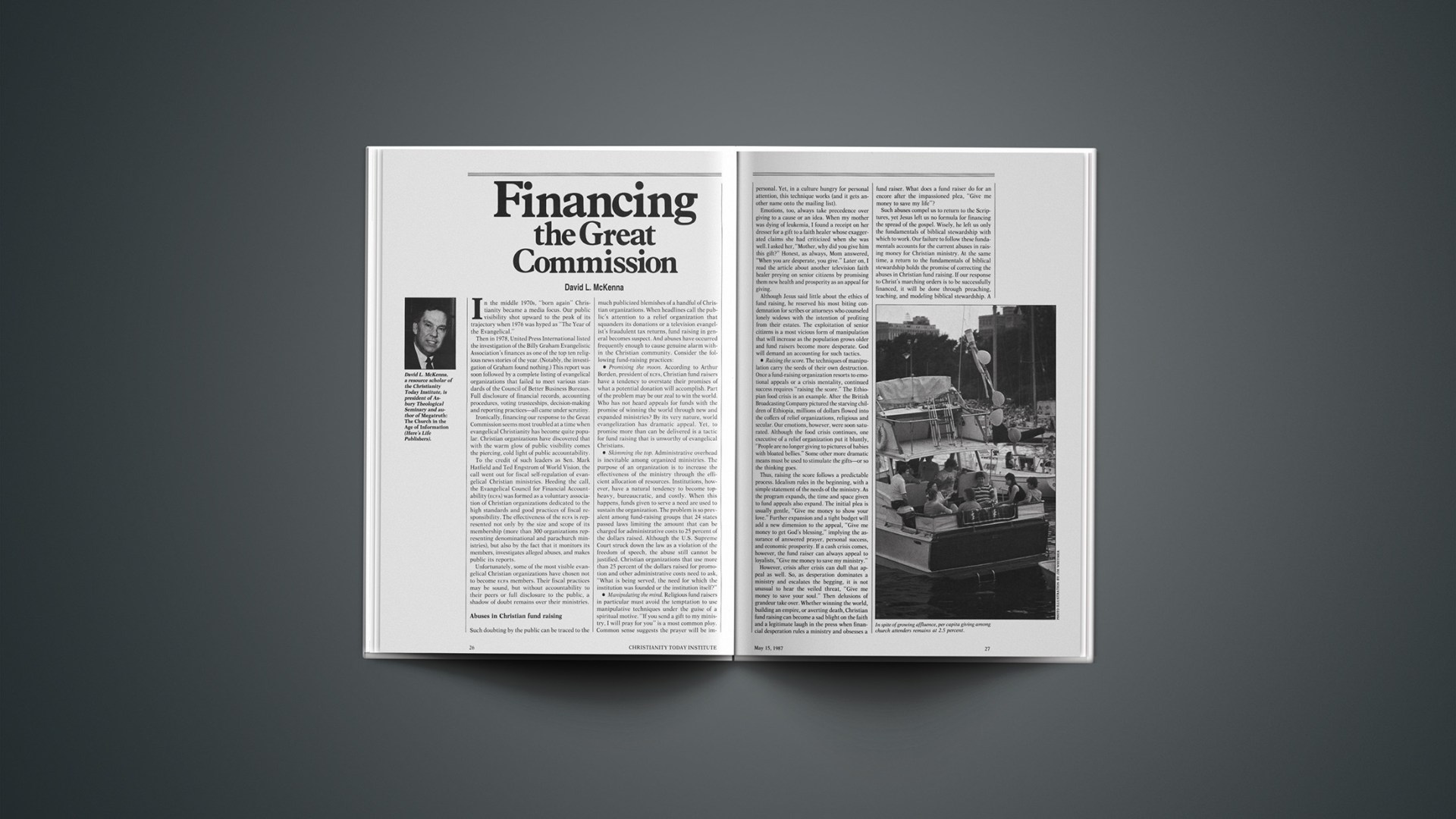
Financing the Great Commission

In the middle 1970s, “born again” Christianity became a media focus. Our public visibility shot upward to the peak of its trajectory when 1976 was hyped as “The Year of the Evangelical.”

Then in 1978, United Press International listed the investigation of the Billy Graham Evangelistic Association’s finances as one of the top ten religious news stories of the year. (Notably, the investigation of Graham found nothing.) This report was soon followed by a complete listing of evangelical organizations that failed to meet various standards of the Council of Better Business Bureaus. Full disclosure of financial records, accounting procedures, voting trusteeships, decision-making and reporting practices—all came under scrutiny.

Ironically, financing our response to the Great Commission seems most troubled at a time when evangelical Christianity has become quite popular. Christian organizations have discovered that with the warm glow of public visibility comes the piercing, cold light of public accountability.

To the credit of such leaders as Sen. Mark Hatfield and Ted Engstrom of World Vision, the call went out for fiscal self-regulation of evangelical Christian ministries. Heeding the call, the Evangelical Council for Financial Accountability (ECFA) was formed as a voluntary association of Christian organizations dedicated to the high standards and good practices of fiscal responsibility. The effectiveness of the ECFA is represented not only by the size and scope of its membership (more than 300 organizations representing denominational and parachurch ministries), but also by the fact that it monitors its members, investigates alleged abuses, and makes public its reports.

Unfortunately, some of the most visible evangelical Christian organizations have chosen not to become ECFA members. Their fiscal practices may be sound, but without accountability to their peers or full disclosure to the public, a shadow of doubt remains over their ministries.

Abuses In Christian Fund Raising

Such doubting by the public can be traced to the much publicized blemishes of a handful of Christian organizations. When headlines call the public’s attention to a relief organization that squanders its donations or a television evangelist’s fraudulent tax returns, fund raising in general becomes suspect. And abuses have occurred frequently enough to cause genuine alarm within the Christian community. Consider the following fund-raising practices:

  • Promising the moon. According to Arthur Borden, president of ECFA, Christian fund raisers have a tendency to overstate their promises of what a potential donation will accomplish. Part of the problem may be our zeal to win the world. Who has not heard appeals for funds with the promise of winning the world through new and expanded ministries? By its very nature, world evangelization has dramatic appeal. Yet, to promise more than can be delivered is a tactic for fund raising that is unworthy of evangelical Christians.
  • Skimming the top. Administrative overhead is inevitable among organized ministries. The purpose of an organization is to increase the effectiveness of the ministry through the efficient allocation of resources. Institutions, however, have a natural tendency to become top-heavy, bureaucratic, and costly. When this happens, funds given to serve a need are used to sustain the organization. The problem is so prevalent among fund-raising groups that 24 states passed laws limiting the amount that can be charged for administrative costs to 25 percent of the dollars raised. Although the U.S. Supreme Court struck down the law as a violation of the freedom of speech, the abuse still cannot be justified. Christian organizations that use more than 25 percent of the dollars raised for promotion and other administrative costs need to ask, “What is being served, the need for which the institution was founded or the institution itself?”
  • Manipulating the mind. Religious fund raisers in particular must avoid the temptation to use manipulative techniques under the guise of a spiritual motive. “If you send a gift to my ministry, I will pray for you” is a most common ploy. Common sense suggests the prayer will be impersonal. Yet, in a culture hungry for personal attention, this technique works (and it gets another name onto the mailing list).

Emotions, too, always take precedence over giving to a cause or an idea. When my mother was dying of leukemia, I found a receipt on her dresser for a gift to a faith healer whose exaggerated claims she had criticized when she was well. I asked her, “Mother, why did you give him this gift?” Honest, as always, Mom answered, “When you are desperate, you give.” Later on, I read the article about another television faith healer preying on senior citizens by promising them new health and prosperity as an appeal for giving.

Although Jesus said little about the ethics of fund raising, he reserved his most biting condemnation for scribes or attorneys who counseled lonely widows with the intention of profiting from their estates. The exploitation of senior citizens is a most vicious form of manipulation that will increase as the population grows older and fund raisers become more desperate. God will demand an accounting for such tactics.

  • Raising the score. The techniques of manipulation carry the seeds of their own destruction. Once a fund-raising organization resorts to emotional appeals or a crisis mentality, continued success requires “raising the score.” The Ethiopian food crisis is an example. After the British Broadcasting Company pictured the starving children of Ethiopia, millions of dollars flowed into the coffers of relief organizations, religious and secular. Our emotions, however, were soon saturated. Although the food crisis continues, one executive of a relief organization put it bluntly, “People are no longer giving to pictures of babies with bloated bellies.” Some other more dramatic means must be used to stimulate the gifts—or so the thinking goes.

Thus, raising the score follows a predictable process. Idealism rules in the beginning, with a simple statement of the needs of the ministry. As the program expands, the time and space given to fund appeals also expand. The initial plea is usually gentle, “Give me money to show your love.” Further expansion and a tight budget will add a new dimension to the appeal, “Give me money to get God’s blessing,” implying the assurance of answered prayer, personal success, and economic prosperity. If a cash crisis comes, however, the fund raiser can always appeal to loyalists, “Give me money to save my ministry.”

However, crisis after crisis can dull that appeal as well. So, as desperation dominates a ministry and escalates the begging, it is not unusual to hear the veiled threat, “Give me money to save your soul.” Then delusions of grandeur take over. Whether winning the world, building an empire, or averting death, Christian fund raising can become a sad blight on the faith and a legitimate laugh in the press when financial desperation rules a ministry and obsesses a fund raiser. What does a fund raiser do for an encore after the impassioned plea, “Give me money to save my life”?

Such abuses compel us to return to the Scriptures, yet Jesus left us no formula for financing the spread of the gospel. Wisely, he left us only the fundamentals of biblical stewardship with which to work. Our failure to follow these fundamentals accounts for the current abuses in raising money for Christian ministry. At the same time, a return to the fundamentals of biblical stewardship holds the promise of correcting the abuses in Christian fund raising. If our response to Christ’s marching orders is to be successfully financed, it will be done through preaching, teaching, and modeling biblical stewardship. A good place to start is in our current attitudes toward wealth.

The Disease Of Affluence

When we in the affluent Western church think about world evangelization, we immediately think about dollars. Little do we realize how pervasively our attitudes have been influenced by money. We have become victims of a disease called “affluenza,” with its companion, self-interest.

Affluenza is a strange malady that affects the children of well-to-do parents. Though having everything money can buy, the children show all of the symptoms of abject poverty—depression, anxiety, loss of meaning, and despair for the future. Affluenza accounts for an escape into alcohol, drugs, shoplifting, and suicide among children of the wealthy. It is most often found where parents are absent from the home and try to buy their children’s love.

Affluent Christians and affluent churches show some of the same symptoms. Guilty because of the lack of personal engagement in missions and evangelism, we allow money to become the substitute for love. Although our guilt is relieved, we still show the symptoms of spiritual affluenza—meaninglessness, anxiety, and the loss of joy. In the Book of Revelation, the angel of the Lord found these same symptoms of sickness in the church at Smyrna and wrote, “I know your affliction and your poverty—yet you are rich!” (Rev. 2:9).

Persecution was predicted for the purifying of the church at Smyrna, and perhaps there is no other cure for our own affluenza. As Walbert Buhlmann notes in his book The Coming Third Church, the present church of the West has the resources for world evangelization, but lacks the spiritual vitality and the sacrificial will to give itself away. After his release from a Romanian prison, Pastor Richard Wurmbrand said he suffered more under American affluence than under the heel of the Communists. He suffered the loss of the “beauty of his persecuted and purified Church, serving Christ in poverty and nakedness.” While none of us seeks persecution for our purification, we must confess the poverty of spirit that comes with the attitudes of affluence.

The Symptoms Of Self-Interest

Self-interest always lurks in the company of affluenza. Almost a decade ago, warnings about radical self-interest were being sounded by such secular prophets as Christopher Lasch in his book The Cult of Narcissism and Daniel Yankelovich in New Rules: Living in a World Turned Upside Down. Today, other scholars are tracing their predictions into the reality of radical self-interest dominating American culture and changing our character. The book Habits of the Heart reads like prophecy as the authors see the biblical vision of a “moral community” and the republican dream of the “common good” being undercut by utilitarian and expressive individualism. Without the “habits of the heart” that are created and sustained by the impulses of spiritual renewal, a sense of responsibility for the moral community gives way to “doing whatever we want for our own profit” and “being whatever we want for our own pleasure.”

Not surprisingly, self-interest has invaded the normally other-directed world of fund raising. The federal government originally created the charitable deduction in recognition of the value of voluntary giving for the common good. While tax reform has maintained deductions for “charitable gifts,” the item has been shifted from a “pre-tax” category as a benefit to the society into the listing as a “tax expenditure,” which is a cost to the society and a potential “loophole” to be plugged.

Corporations and foundations, the major givers to charity in the United States, have also taken on the attitudes of self-interest. While we presume that corporation and foundation giving is a charitable response for the common good, the fact is that most of these gifts follow the “identifiable self-interest” of the donor. A recent editorial in the Wall Street Journal noted this disturbing trend. An airline is commended for withdrawing from making general gifts for the common good in favor of a free flight of mercy for a person who needs an organ transplant. The editorial notes that the gift serves the interest of the airline in the free publicity about the flight of mercy. Other corporations are urged to follow this example of identifiable self-interest as the motive and the policy for their contributions.

However, churches and religious organizations that are both the recipients and dispensers of charitable gifts are not free from the influence of self-interest. In the distribution of those dollars, direct aid to the needs of the hungry at home and abroad ranks high. But, at home especially, there is evidence of increasing gifts in support of “advocacy” positions, ranging all the way from peace issues in the liberal sector to voter registration among conservatives. Advocacy is its own form of self-interest.

With the intrusion of self-interest into every level of charitable giving as well as across Christian and secular lines, the contemporary climate is not conducive to financing the Great Commission. Sacrificial giving for world evangelization runs counter to the attitudes of affluence and the ends of self-interest. Furthermore, if an excuse is needed, the well-publicized abuses of evangelical Christian organizations in fund raising can stop the flow of dollars.

Biblical Principles Of Stewardship

Is there an antidote for the disease of affluence and the symptoms of self-interest in Christian fund raising? Radical answers include eliminating the tax deduction for charitable contributions, expecting the federal deficit to put us back on bread lines, or waiting for the backlash that will return evangelical Christianity to its position as a beleaguered (if not persecuted) minority. Pessimists who predict these actions may be right, but we cannot grant them their day until we have tried to restore the full understanding and consistent practice of biblical stewardship among evangelical Christians. This is our hope, not only for curing the disease of affluence and correcting the abuses of fund raising, but also for financing the Great Commission.

In the parable of the talents, Jesus gives us the fundamentals for a biblical understanding of stewardship. Because the parable is so well known, it need not be repeated. But also because it is so well known, its familiarity may cause us to miss the hard-hitting principles of biblical stewardship that Jesus taught.

  • We are owners of nothing. According to the parable, the servant-steward is a person who owns nothing. All belongs to the master. In theory we accept this fact, but in practice we act the opposite. Our budgeting begins with our needs and adds our wants. God gets what is left over. If we really believed that we own nothing, the process would be reversed.
  • We are entrusted with everything. Scholars agree that the parable of the talents addresses all of the resources that God has given us to manage—time, talents, and treasures. Yet, it is significant that money is used as the symbol for our stewardship of life. Jesus reinforced this principle when he said, “Where your treasure is, there will your heart be also.” Paul added further reinforcement when he wrote, “The love of money is the root of every evil thing.” Therefore, it is not out of order to suggest that the totality of a person’s spiritual commitment is reflected in how he spends his money. Once that is established, it is easy to see how biblical stewardship goes beyond monetary values. God has entrusted to us his creation, his Word, and his grace. Paul the apostle saw the highest level of stewardship in the astounding truth that God has entrusted us with the “mystery of the knowledge of God,” or the gospel itself. Thus, stewardship of money and the gospel parallel one another.
  • We owe all. The “love-slave” relationship between the servant and the master in the parable is implied. Total obedience is the servant’s commitment, but out of love, not fear. Both the motive and the goal of Christian stewardship is giving out of gratitude for the grace and the trust God has given to us. Any other motive for asking or giving is a distortion of biblical stewardship.
  • We invest all. Stewardship in the Old Testament tends to be “trusteeship” with an emphasis upon the preservation of assets. In the parable of the talents, Jesus advances the Old Testament meaning by adding the element of risk and introducing the idea of investment. The test of our stewardship is more than a question of conserving the resources that God has entrusted to us. We are expected to lead in the multiplication of those resources through risk ventures such as investing in Third World leadership training. The line between faith and foolishness, however, is very thin. Only the check-and-balance of the Holy Spirit can keep our vision clear and our objective in sight as we are responsible for “asking in faith” and “counting the cost” at the same time.
  • We serve all. Stewardship is an earthy word with spiritual meaning. It derives from the image of the “sty ward” or the keeper of the pigpen. Extended and dignified in the parable of the talents, stewardship means “household” and is the same word from which we get economics. We are responsible for the “household of God,” which begins with our domestic family, extends to the body of Christ, connects with the needs of our neighbors, serves all those who suffer, and embraces the whole human family. Jesus has little to say about the means of fund raising but he has much to say about the use of our resources. In his encounter with the rich young man, his parable of the rich man and Lazarus and his vivid picture of the final judgment leave no doubt that we are responsible to share our resources with those who suffer from poverty, hunger, oppression, and nakedness.
  • We are accountable for all. God is an absentee landlord in the parable. He puts full trust in his servants. And while his return may be a surprise, his standards are no secret. In his commendation, “Well done, good and faithful servant,” the Lord lets us know how our stewardship will be judged. Are we faithful to his mission? Do we have integrity in our practices? Are we effective in our performance? Of course, these criteria can be put in spiritual terms, but we cannot ignore their practicality for judging our motives, means, and effectiveness in evangelical Christian fund raising today. To fall short on any one of these standards is to fail the accountability test for Christian stewardship.
  • We are rewarded by God. The Master rewards as well as commends his servant who is faithful, good, and effective. And the reward is both professional and personal. Professionally, the servant is entrusted with greater responsibilities. Most of us do not think of money as the test that God uses to determine how much he can trust us. Yet, this is one of the lessons of the parable. If we want to understand our spiritual poverty in the midst of our economic affluence, the parable of the talents gives us the answer. Also, we may begin to understand why the Spirit of God seems to be bypassing our rich Western culture in favor of the impoverished nations of the Southern hemisphere. If we have failed to exercise biblical stewardship with our money, can God trust us with the blessing of his Spirit? Or, to follow the apostle Paul’s thinking, if God cannot trust us with the investment of his dollars, can he trust us with the stewardship of the gospel?

Joy is the personal reward for the good, faithful, and effective servant-steward of God. Time and time again, I have told candidates for fund-raising positions, “Don’t expect to be thanked.” Most people are not only suspicious of fund raisers, they neither understand nor appreciate the emotionally exhausting nature of this ministry. The fund raiser must be satisfied with the joy of the Lord rather than the acclaim of people.

Stephen, the deacon, is our model. Chosen for the task of soliciting adequate resources for the early church and distributing them fairly, he did his job so well that the Lord entrusted him with the defense of the gospel before the Sanhedrin. He died under a hail of stones, but with a shining face. Joy is the ultimate testimony of Christian stewardship.

Investing In The Great Commission

As fund raising has become a major growth industry in American life, codes of ethics have been developed to protect the public against fakes and fraud in the field. The Council for Advancement and Support of Education, for instance, dedicated the January 1987 issue of its magazine to a question for fund raisers, “Do you lie, cheat, or steal?” In posing five test cases, the magazine illustrates the answer, “Even if you don’t, you face tough ethical choices.”

Christian fund raising is subject to the same tough, ethical questions. Certainly as a starting point, we will support and practice the ethical codes for fund raising adopted by secular associations and advanced with specific implications for Christian organizations by the Evangelical Council for Financial Accountability. Over and above these standards of good practice, however, we are also responsible for the standards and spirit of biblical stewardship. Therefore, as a guide for evangelical Christians who want to invest in the Great Commission, the biblical theology of stewardship leads us to support a ministry that asks: Are we investing in a ministry that:

… focuses upon the Great Commission as its primary mission?

… identifies people rather than money as the priority resource for fulfilling its mission?

… presents itself through leaders who show the spirit of servanthood?

… models biblical stewardship as the Christian’s way of looking at the whole of life?

… teaches giving as gratitude for the grace of God?

… demonstrates its commitment to the spiritual growth of the donor?

… builds up the whole household of God in a complementary rather than a competing ministry?

… states its needs rather than begs for money?

… spends its dollars for the purpose to which the dollars are given?

… multiplies the gifts through creative, spirit-guided strategies?

… meets the ethical standards of professional and Christian fund-raising codes?

… rejects the gimmicks and tactics of manipulation?

… avoids a crisis-to-crisis mentality?

… accepts full, accurate, and timely accountability to its donors, the church, the community, and appropriate agencies?

… maintains the witness of a “good report” with the general public?

… serves and saves persons who are suffering?

… reports spiritual results that have eternal value?

All generations of Christians are given a special grace by which they can serve their present age. In the latter part of the twentieth century, evangelical Christians in North America have been given the grace of financial resources. If we rediscover the biblical theology of stewardship as given to us by Jesus Christ as a means for fulfilling the Great Commission, we can still be honored with the joy of being given increased responsibility for the gospel. It means a change in our policy and practices of fund raising. Biblical stewardship is a whole-life investment in ministries that are spiritual in motive, moral in means, and eternal in ends. Stewardship has been defined as what you do after you say, “I believe.” So whether we represent evangelical Christianity as individuals or institutions, the critical test of our commitment to the Great Commission is the challenge, “How have your spending habits changed since you became a Christian?”
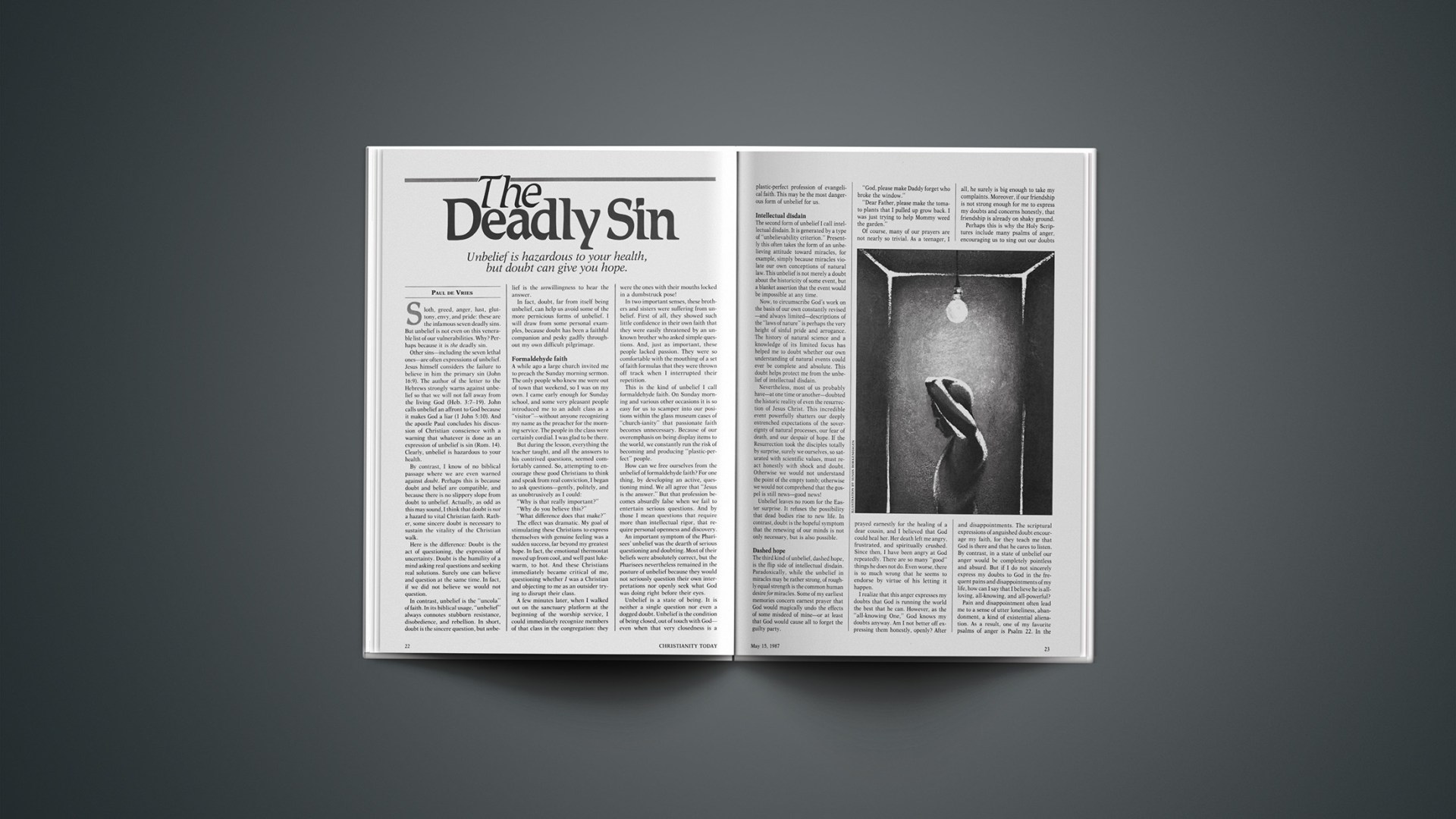
The Deadly Sin

Unbelief is hazardous to your health, but doubt can give you hope.

Sloth, greed, anger, lust, gluttony, envy, and pride: these are the infamous seven deadly sins. But unbelief is not even on this venerable list of our vulnerabilities. Why? Perhaps because it is the deadly sin.

Other sins—including the seven lethal ones—are often expressions of unbelief. Jesus himself considers the failure to believe in him the primary sin (John 16:9). The author of the letter to the Hebrews strongly warns against unbelief so that we will not fall away from the living God (Heb. 3:7–19). John calls unbelief an affront to God because it makes God a liar (1 John 5:10). And the apostle Paul concludes his discussion of Christian conscience with a warning that whatever is done as an expression of unbelief is sin (Rom. 14). Clearly, unbelief is hazardous to your health.

By contrast, I know of no biblical passage where we are even warned against doubt. Perhaps this is because doubt and belief are compatible, and because there is no slippery slope from doubt to unbelief. Actually, as odd as this may sound, I think that doubt is not a hazard to vital Christian faith. Rather, some sincere doubt is necessary to sustain the vitality of the Christian walk.

Here is the difference: Doubt is the act of questioning, the expression of uncertainty. Doubt is the humility of a mind asking real questions and seeking real solutions. Surely one can believe and question at the same time. In fact, if we did not believe we would not question.

In contrast, unbelief is the “uncola” of faith. In its biblical usage, “unbelief” always connotes stubborn resistance, disobedience, and rebellion. In short, doubt is the sincere question, but unbelief is the unwillingness to hear the answer.

In fact, doubt, far from itself being unbelief, can help us avoid some of the more pernicious forms of unbelief. I will draw from some personal examples, because doubt has been a faithful companion and pesky gadfly throughout my own difficult pilgrimage.

Formaldehyde Faith

A while ago a large church invited me to preach the Sunday morning sermon. The only people who knew me were out of town that weekend, so I was on my own. I came early enough for Sunday school, and some very pleasant people introduced me to an adult class as a “visitor”—without anyone recognizing my name as the preacher for the morning service. The people in the class were certainly cordial. I was glad to be there.

But during the lesson, everything the teacher taught, and all the answers to his contrived questions, seemed comfortably canned. So, attempting to encourage these good Christians to think and speak from real conviction, I began to ask questions—gently, politely, and as unobtrusively as I could:

“Why is that really important?”

“Why do you believe this?”

“What difference does that make?”

The effect was dramatic. My goal of stimulating these Christians to express themselves with genuine feeling was a sudden success, far beyond my greatest hope. In fact, the emotional thermostat moved up from cool, and well past lukewarm, to hot. And these Christians immediately became critical of me, questioning whether I was a Christian and objecting to me as an outsider trying to disrupt their class.

A few minutes later, when I walked out on the sanctuary platform at the beginning of the worship service, I could immediately recognize members of that class in the congregation: they were the ones with their mouths locked in a dumbstruck pose!

In two important senses, these brothers and sisters were suffering from unbelief. First of all, they showed such little confidence in their own faith that they were easily threatened by an unknown brother who asked simple questions. And, just as important, these people lacked passion. They were so comfortable with the mouthing of a set of faith formulas that they were thrown off track when I interrupted their repetition.

This is the kind of unbelief I call formaldehyde faith. On Sunday morning and various other occasions it is so easy for us to scamper into our positions within the glass museum cases of “church-ianity” that passionate faith becomes unnecessary. Because of our overemphasis on being display items to the world, we constantly run the risk of becoming and producing “plastic-perfect” people.

How can we free ourselves from the unbelief of formaldehyde faith? For one thing, by developing an active, questioning mind. We all agree that “Jesus is the answer.” But that profession becomes absurdly false when we fail to entertain serious questions. And by those I mean questions that require more than intellectual rigor, that require personal openness and discovery.

An important symptom of the Pharisees’ unbelief was the dearth of serious questioning and doubting. Most of their beliefs were absolutely correct, but the Pharisees nevertheless remained in the posture of unbelief because they would not seriously question their own interpretations nor openly seek what God was doing right before their eyes.

Unbelief is a state of being. It is neither a single question nor even a dogged doubt. Unbelief is the condition of being closed, out of touch with God—even when that very closedness is a plastic-perfect profession of evangelical faith. This may be the most dangerous form of unbelief for us.

Intellectual Disdain

The second form of unbelief I call intellectual disdain. It is generated by a type of “unbelievability criterion.” Presently this often takes the form of an unbelieving attitude toward miracles, for example, simply because miracles violate our own conceptions of natural law. This unbelief is not merely a doubt about the historicity of some event, but a blanket assertion that the event would be impossible at any time.

Now, to circumscribe God’s work on the basis of our own constantly revised—and always limited—descriptions of the “laws of nature” is perhaps the very height of sinful pride and arrogance. The history of natural science and a knowledge of its limited focus has helped me to doubt whether our own understanding of natural events could ever be complete and absolute. This doubt helps protect me from the unbelief of intellectual disdain.

Nevertheless, most of us probably have—at one time or another—doubted the historic reality of even the resurrection of Jesus Christ. This incredible event powerfully shatters our deeply entrenched expectations of the sovereignty of natural processes, our fear of death, and our despair of hope. If the Resurrection took the disciples totally by surprise, surely we ourselves, so saturated with scientific values, must react honestly with shock and doubt. Otherwise we would not understand the point of the empty tomb; otherwise we would not comprehend that the gospel is still news—good news!

Unbelief leaves no room for the Easter surprise. It refuses the possibility that dead bodies rise to new life. In contrast, doubt is the hopeful symptom that the renewing of our minds is not only necessary, but is also possible.

Dashed Hope

The third kind of unbelief, dashed hope, is the flip side of intellectual disdain. Paradoxically, while the unbelief in miracles may be rather strong, of roughly equal strength is the common human desire for miracles. Some of my earliest memories concern earnest prayer that God would magically undo the effects of some misdeed of mine—or at least that God would cause all to forget the guilty party.

“God, please make Daddy forget who broke the window.”

“Dear Father, please make the tomato plants that I pulled up grow back. I was just trying to help Mommy weed the garden.”

Of course, many of our prayers are not nearly so trivial. As a teenager, I prayed earnestly for the healing of a dear cousin, and I believed that God could heal her. Her death left me angry, frustrated, and spiritually crushed. Since then, I have been angry at God repeatedly. There are so many “good” things he does not do. Even worse, there is so much wrong that he seems to endorse by virtue of his letting it happen.

I realize that this anger expresses my doubts that God is running the world the best that he can. However, as the “all-knowing One,” God knows my doubts anyway. Am I not better off expressing them honestly, openly? After all, he surely is big enough to take my complaints. Moreover, if our friendship is not strong enough for me to express my doubts and concerns honestly, that friendship is already on shaky ground.

Perhaps this is why the Holy Scriptures include many psalms of anger, encouraging us to sing out our doubts and disappointments. The scriptural expressions of anguished doubt encourage my faith, for they teach me that God is there and that he cares to listen. By contrast, in a state of unbelief our anger would be completely pointless and absurd. But if I do not sincerely express my doubts to God in the frequent pains and disappointments of my life, how can I say that I believe he is all-loving, all-knowing, and all-powerful?

Pain and disappointment often lead me to a sense of utter loneliness, abandonment, a kind of existential alienation. As a result, one of my favorite psalms of anger is Psalm 22. In the loneliness of suffering I sometimes feel like crying out the first line of that psalm: “My God, my God, why have you deserted me?” I find it helpful to express those words openly, as a reminder that even in that lonely experience God participates with me.

Sometimes I even turn to look for Jesus and let him remind me, “I am with you in your loneliness, because I have drunk deeply of the same anguished doubt.” This does not take the pain away. But it does give my pain significance and provides me with an unexplainable peace. Unbelief would leave me lost.

Comfortable Numbness

Perhaps the most difficult challenge of unbelief hit me when I was 19 years old. I was involved in a large evangelical church—so involved, in fact, that I became, even at such a young age, the chairman of the Outreach Committee for a church of over 2,000 members. I was a certified believer of the evangelical faith, and I sought to live by its moral standards.

Nevertheless, something began to bug me. It struck me that we could continue to do our church work, preach, try to obey the Scriptures, and even “win people to Christ,” whether or not Christ was in our enterprise at all. The only saving factor would be if we were, on a personal dimension, aware of the presence of the living Christ.

My problem was that I did not experience the living Christ. In evangelistic work, I professed that I had this personal awareness of his presence. But I lied. It wasn’t there. Perhaps he was there in my work, but I did not know him. I did not even know what to look for in order to recognize him. So I began watching others. And I also began to doubt seriously whether anyone I knew had the personal relationship to Christ that we professed.

I decided to go right to the top. I made an appointment with our senior pastor and explained my problem. However, before he had a chance to give me any comforting or cajoling commentary, I wanted to know if he had what I lacked. I looked him in the eye and asked him if he had the personal experience of Christ that he preached.

He swallowed and quietly admitted, “No.” He was in the same condition I was in. I went to another pastor whom I greatly respected, and with the same results. Could it be that we ourselves were so involved in our own lukewarm activities and religious professions that we did not hear our own Savior gently knocking on the outside of our Laodicean church doors (Rev. 3:20)?

What gave me hope in that situation was doubt. I doubted that this formal profession of faith was all God had for me, for us. And what gave me doubt was hope. I doubted that my knowledge was the extent of Christian faith because I sincerely hoped that there was more. Still believing the Bible, I asked questions. I knocked, hoping the doors would open; I sought, hoping that I would find. Strangely, I would not have asked, knocked, or even sought, if I had not doubted.

I am finding and receiving, and the doors are being opened. Throughout my rough-and-tumble pilgrimage of the last several years, I have discovered ways of being open to the presence of Christ—especially through the practiced disciplines of meditation and service. Such spiritual disciplines have helped me to see Christ, just as anyone needs scientific training to make scientific observations. All mature perceptual experiences require training of some kind. It even took extended training for us as children to begin to recognize the basic colors and the letters of the alphabet.

Now let me say this bluntly: The comfortable numbness with which my former pastor and, I think, many other Christians publicly profess what they do not have and promote what they do not know is an insidious and deceitful form of unbelief. It is deadly, but also amazingly attractive. You see, as long as we claim to have the truth and live by right general standards, our lives can be comfortably consistent and coherent—and all perfectly within our own control. We can avoid the suffering of Christ as well as the daily surprises of his instruction. We can also miss the incomparable power of his presence and the authentic light of his truth.

Comfortable numbness is an insidious form of unbelief. The walls of theological security with which we seek to insulate ourselves from doubt can become the very fortress of unbelief that makes us comfortably numb to the living Christ. Biblical, evangelical faith requires us to doubt the completeness of our best religious understandings long enough to await still eagerly the frequent Easter morning surprises from the One who has called himself the “I Will Be What I Will Be” (Exod. 3:14).

Constructive Doubt

We can summarize how doubt can be constructive in three ways:

First, we “see through a glass darkly” (1 Cor. 13:12). We can see—we can, to an extent, even see Christ himself. But what we see is always clouded by our finitude and our fallibility, our stupidity and our sin. Consequently, we must doubt. “We see through a glass darkly,” but we have no excuse for failing to strain to see what we can through the glass. We must seek in order that we may find. We must believe in order that we may know. Unbelief has no place for us.

Second, whatever we know in this life we “know only in part” (1 Cor. 13:12). Humility of mind must characterize our most enthusiastic professions of faith. The power of God’s Word does not depend on our personal assertions. Let us act and speak both in the humility of self and in the authority of God’s presence.

Third, let us be so honestly enticed by our doubts that we are increasingly hungry for the Truth, the whole Truth, and nothing but him, so hungry that we will earnestly pray for the time when we will know him as well as he knows us (1 Cor. 13:12). And this hunger excludes unbelief.

Paul de Vries is associate professor of philosophy and coordinator of general education at Wheaton College (Ill.). His articles have been published in The Christian Scholar’s Review and The Journal of Business Ethics.

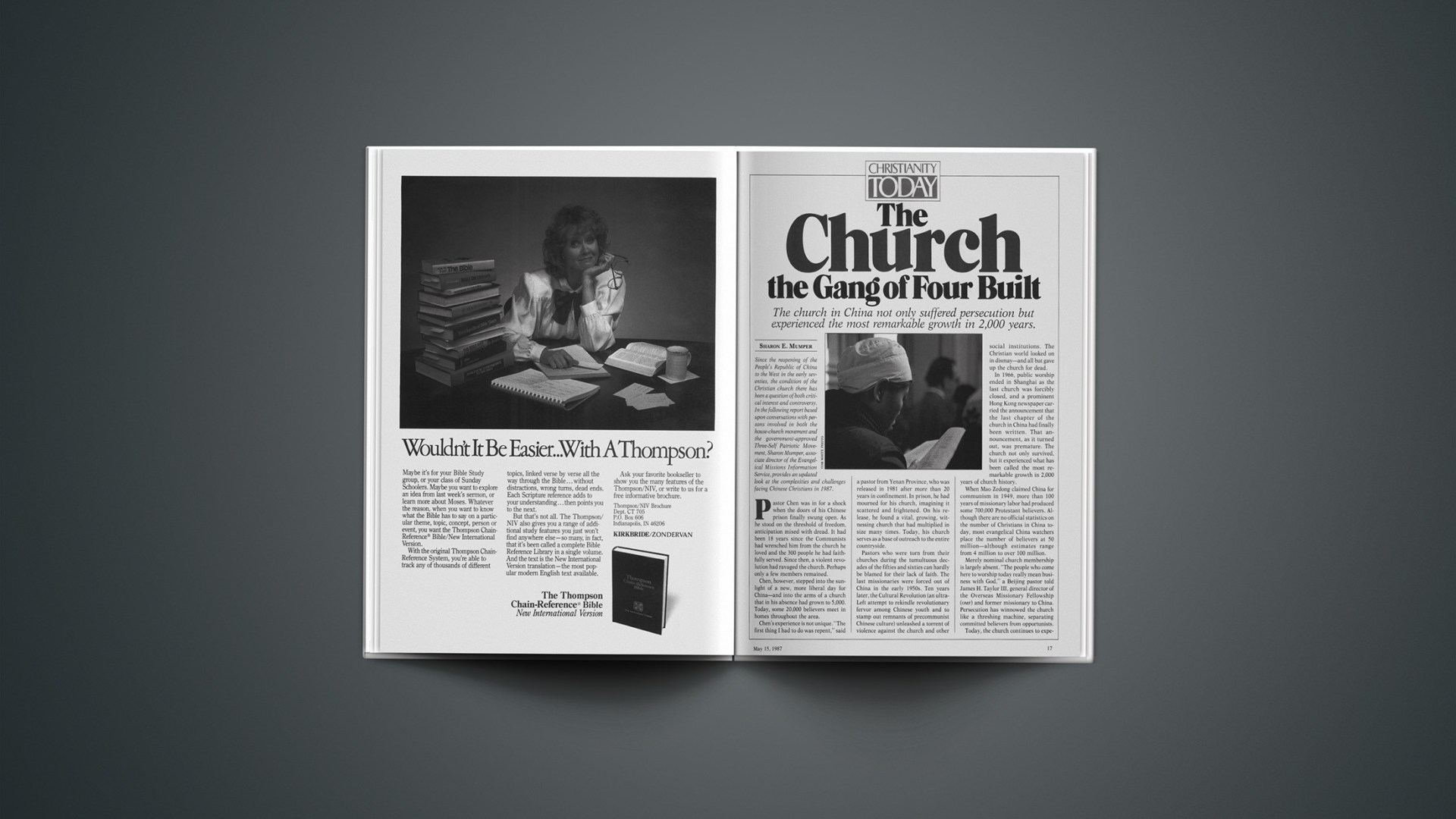
The Church the Gang of Four Built

The church in China not only suffered persecution but experienced the most remarkable growth in 2,000 years.

Since the reopening of the People’s Republic of China to the West in the early seventies, the condition of the Christian church there has been a question of both critical interest and controversy. In the following report based upon conversations with persons involved in both the house-church movement and the government-approved Three-Self Patriotic Movement, Sharon Mumper, associate director of the Evangelical Missions Information Service, provides an updated look at the complexities and challenges facing Chinese Christians in 1987.

Pastor Chen was in for a shock when the doors of his Chinese prison finally swung open. As he stood on the threshold of freedom, anticipation mixed with dread. It had been 18 years since the Communists had wrenched him from the church he loved and the 300 people he had faithfully served. Since then, a violent revolution had ravaged the church. Perhaps only a few members remained.

Chen, however, stepped into the sunlight of a new, more liberal day for China—and into the arms of a church that in his absence had grown to 5,000. Today, some 20,000 believers meet in homes throughout the area.

Chen’s experience is not unique. “The first thing I had to do was repent,” said a pastor from Yenan Province, who was released in 1981 after more than 20 years in confinement. In prison, he had mourned for his church, imagining it scattered and frightened. On his release, he found a vital, growing, witnessing church that had multiplied in size many times. Today, his church serves as a base of outreach to the entire countryside.

Pastors who were torn from their churches during the tumultuous decades of the fifties and sixties can hardly be blamed for their lack of faith. The last missionaries were forced out of China in the early 1950s. Ten years later, the Cultural Revolution (an ultra-Left attempt to rekindle revolutionary fervor among Chinese youth and to stamp out remnants of precommunist Chinese culture) unleashed a torrent of violence against the church and other social institutions. The Christian world looked on in dismay—and all but gave up the church for dead.

In 1966, public worship ended in Shanghai as the last church was forcibly closed, and a prominent Hong Kong newspaper carried the announcement that the last chapter of the church in China had finally been written. That announcement, as it turned out, was premature. The church not only survived, but it experienced what has been called the most remarkable growth in 2,000 years of church history.

When Mao Zedong claimed China for communism in 1949, more than 100 years of missionary labor had produced some 700,000 Protestant believers. Although there are no official statistics on the number of Christians in China today, most evangelical China watchers place the number of believers at 50 million—although estimates range from 4 million to over 100 million.

Merely nominal church membership is largely absent. “The people who come here to worship today really mean business with God,” a Beijing pastor told James H. Taylor III, general director of the Overseas Missionary Fellowship (OMF) and former missionary to China. Persecution has winnowed the church like a threshing machine, separating committed believers from opportunists.

Today, the church continues to experience rapid growth. But it also faces limited freedoms and internal dissension.

Miraculous Manifestations

One of the main factors nourishing church growth in the midst of difficulty and persecution has been manifestations of the power of God. “When there was no hope from a human point of view, Christians in China’s house churches saw God revealing his power and overruling in the history of their day,” wrote former China missionary David H. Adeney (now professor of Christian mission, New College, Berkeley, Calif.) in China: The Church’s Long March.

And Jonathan Chao, director of the Chinese Church Research Center in Hong Kong, says, “They experienced remarkable healings and deliverance in response to their prayers. In the house-churches they grow by leaps and bounds because of the signs and the miracles.”

Chao says many Chinese Christians experience Pentecostal and charismatic manifestations. “They don’t call themselves that,” he says. “They don’t even know the terms.” He says that while in some places he has heard leaders exercise the spiritual gift of tongues, in other places it is apparently uncommon. “There is no division among them because of that,” he says.

The evidence of supernatural healing and other miracles has been a key component in the spontaneous growth of the church in many areas:

  • In Asian Report (Nov./Dec. 1986), Marjorie Baker tells the story of Hannah, a Chinese lay worker who spent 23 years in a forced labor camp. After her release, Hannah renewed her acquaintance with an elderly woman who was now blind. Eye specialists at three hospitals had turned the woman away without hope for recovery. After three days of fasting and prayer, Hannah went to the woman’s home and prayed for her healing. Her sight was miraculously restored, and as a result her family and some 30 others in the village were baptized.
  • According to Chao, in 1976 a Christian man in charge of security at a coal mine felt the Spirit prompting him to pull the alarm—even though there had been no signs that disaster was about to strike. When the men assembled on the surface, they thought a mistake had been made—until moments later when the earth rumbled and a large section of the mine collapsed. Some 400 miners turned to Christ after the Lord intervened miraculously to spare their lives.
  • Chao also tells of a young woman on her way home from an evening prayer meeting who was accosted by three would-be rapists. She dropped to her knees to pray, and the attackers froze. When she opened her eyes, she found they were unable to move. Hurrying back to the prayer meeting, she returned with several elders to where the three still stood paralyzed. The young men were ready to repent and be saved when the elders prayed for their release. “As a result, a great awakening took place in that area,” Chao says.

The Impact Of Prayer

Chao believes the demonstration of God’s power that is evident in China today is largely the result of a prayer movement that began about 1970.

“It was illegal to believe or to hold meetings,” he says. “So the survivors turned to prayer. Even today the church in China is a praying church.”

Writing in Chinese Around the World (Sept. 1986), OMF’S Taylor says, “We must not underestimate the impact of prayer worldwide in the dynamic growth of the mainland Chinese church.” Taylor credits the remarkable growth of the church to the faithful perseverance of lay people. At a time when missionaries had been expelled and many pastors imprisoned, ordinary Christians took responsibility for the church.

Even today, trained leaders are in short supply, and lay people carry heavy responsibility. One layman who was released from prison in 1982 was unable to find another Christian in the vicinity of his home. He began to witness, and within three years saw 7,000 people turn to Christ.

The lay movement is still dominant in the church, says Chao. The movement is built on the church’s experience during the Cultural Revolution “when everyone suffered.” “Suffering transformed the Chinese church from a timid church to a vibrant, growing one,” he says.

This fact is acknowledged even by government representatives, according to David Wang, executive vice-president of Asian Outreach International, Ltd. He says one official told him, “The Gang of Four [the four Chinese leaders who led the country into the Cultural Revolution] destroyed the Communist party, but they built the Christian church.”

While Christians often were purified and strengthened through the suffering they experienced, non-Christians were devastated by their experiences.

“The suffering endured by Christians in China has enabled them to draw closer to non-Christians, especially to intellectuals, who were also suffering,” says Adeney. “Certainly the suffering … prepared the hearts of many to seek true meaning to life.”

The desperate epoch of the Cultural Revolution, now denounced by the government as a near-fatal mistake, also opened the eyes of many young people to the futility of placing faith in ideology.

“Young people are disillusioned with their leaders and with the ideology of their nation,” says Taylor. “But they are seeing that Christians are dependable citizens.”

Today, order has returned to Chinese society, and the living standards of most Chinese have improved. “In spite of this fact, people are finding that in any society there is a spiritual hunger or yearning that cannot be satisfied by a political system,” says Bishop K. H. Ting, president of the China Christian Council (ccc), a body of officially recognized Christian groups, and chairman of the national committee of the Three-Self Patriotic Movement (TSPM), the government-church liaison organization.

Many people find in the message of the Christian faith the thing that can give them peace and rest,” he says.

Crossfire Among Christians

Unfortunately, while many individuals find peace, it eludes the church in China as a whole. Both inside and outside China, controversy is fed by conflicting claims and allegiances.

On one side are the so-called open churches and house churches associated with the CCC and the TSPM. On the other are independent house churches that refuse to link with those it regards as little more than agents of the Communist government.

The independent house-church movement began in the early 1950s, as institutional churches increasingly were brought under the control of the newly formed TSPM.

“During the early 1950s, the Chinese Communist Party eventually clamped down on all existing independent religious bodies and brought them under TSPM control,” Adeney writes. “Church members had to attend political training classes in the churches, and were ordered to criticize not only themselves, but others too, at special self-criticism meetings.”

Pastors who refused to cooperate eventually were arrested and jailed. The number of churches was dramatically reduced as TSPM officials sought to eliminate denominational worship, uniting congregations of various denominations into one body. Church attendance waned, and by 1958 only 4 of Beijing’s 64 churches remained open. Shanghai s 200 churches were reduced to 23. Other major centers had only 3 or 4 churches.

With the closing of churches during the Cultural Revolution, there was no longer any need for a liaison organization between government and church, and the TSPM disappeared from view. But by the time the Revolution closed the doors of all remaining institutional churches, a secret house-church movement already was under way.

When the TSPM resurfaced at the end of the Cultural Revolution, and began once again to open church buildings in China’s major cities, the stage was set for controversy. Some pastors welcomed the opportunity to preach openly in a legall

y approved setting, even though they might face restrictions. Others rejected government registration as suspect and compromising.

What’s The Difference?

One key difference of opinion between proponents of official and independent house-churches is rooted in world view, according to Ralph Covell, academic dean and professor of world missions at Denver Theological Seminary. Many who are part of the ccc believe God is using the Communist government to accomplish his purposes. They believe the church is obliged to support and work with the government wherever it can.

On the other side are those who see the atheistic government in prophetic terms as a tool of Satan. “They believe they must keep their distance … having nothing to do with it,” says Covell.

Chao, of the Chinese Church Research Center, views the primary difference between the groups as disagreement on the issue of who is the lord of the church. “Is it Christ or the state?” he asked. Chao adds that another point of departure is whether one can preach the gospel according to the Great Commission.

Officially, public evangelism in China may be carried out only by recognized leaders within the confines of registered buildings or meeting points approved by the TSPM. Subjects such as the Creation or the second coming of Christ are not considered appropriate sermon topics, and must be handled, if at all, with considerable care. (Proclaiming God’s role at the beginning or end of human history is contrary to basic Marxist teaching.)

TSPM officials frown on the practice of praying for healing and exorcism, and discourage the exercise of charismatic gifts. Nevertheless, some open churches report the occurrence of healings and other supernatural signs among their members.

The major open churches in the cities are controlled by the ccc and the TSPM, Chao charges. Yet, in rural areas, he says, “churches that join the TSPM conduct themselves just like those that don’t.”

At the grassroots level, believers in all of the churches are intensely evangelical, according to Asian Outreach’s Wang. Many pastors of churches associated with the TSPM preach sound, Bible-based evangelical messages, he says.

Most preachers in large churches affiliated with the TSPM were trained many years ago by mainline denominations, and today preach the kinds of messages common in those denominations in the 1950s and 1960s, according to Chao. There are few who dare to preach liberal sermons. “No one would listen to them,” Chao says.

In some cases, the differences between the groups that will and will not associate with the TSPM are no longer clear-cut. “It has become increasingly difficult to make general statements about the relationship between the two,” Covell says. “In some places, the groups are as polarized as ever. But in other places, there is a good deal of intermingling.… It depends on the local situation.”

How Many Are There?

Today, some 4,000 church buildings are open for worship, and tens of thousands of Christians meet in home meetings described by Bishop Ting as “very much a part of the CCC.” Outside the auspices of the CCC and the TSPM are Christians described by Bishop Ting as “scattered small groups.”

These “scattered small groups” are described by most evangelical China watchers as making up the majority of the Chinese church. “There are 200,000 to 300,000 independent house churches that refuse to join the TSPM,” says Chao. “This is about 95 percent of the Christian population of China.”

Chao’s organization and other evangelical research groups based in Hong Kong are a thorn in the flesh of TSPM officials. A work report prepared at a conference last year by the standing committees of the TSPM and the ccc censured Chao’s organization and two others for “anti-China activities.”

TSPM authorities object to the aid supplied to the house churches by Chao’s organization and others outside the country. Hong Kong, the British colony adjacent to China’s Guangdong Province, serves as a base of operation for a plethora of church and parachurch groups that supply Bibles, reference books, teaching tapes, broadcast programming, and financial support for itinerant evangelists.

Such activity is viewed by top TSPM leaders as foreign interference and a violation of the movement’s principles of self-support, self-government, and self-propagation. Evangelical groups outside of China, however, say most Chinese Christians do not have access to resources produced within China, and are eager to get whatever resources may be available from any source.

After nearly 40 years of careful regulation of foreign contacts with the Chinese church, Bishop Ting says Christianity has lived down its reputation as a foreign religion. He believes this has contributed to the growth of the Chinese church.

And On The Left…

Some evangelicals, however, believe that today China’s officially recognized church lags behind its own government in openness to the resources available from the outside world.

“China observers say that Bishop Ting in his public pronouncements seems to be more to the left of government policy than secular officials in his reluctance for Chinese to be exposed to foreign influence,” says David Aikman, former China bureau chief for Time magazine.

Aikman says that while the TSPM discourages Christians from listening to Christian broadcasting from outside the country, secular leaders do not seem to care if people listen to foreign broadcasts. He says the attitudes of secular officials toward Christians vary, but that at the politboro level, the approach to Christianity in recent years has been “extraordinarily undogmatic and pragmatic.”

“Chinese Communists are not eager to convert all Chinese religious people to atheism,” Bishop Ting says. “What concerns them most is to unite the people.” Nevertheless, he says, over-zealous local officials who do not understand China’s policy toward religious freedom constitute a major problem for the church.

Many evangelical China watchers agree with his assessment. Some add that officials associated with the TSPM are sometimes part of the problem, and that at times they have helped security personnel apprehend uncooperative Christians.

Many, if not most, of the pastors and Christian workers who were imprisoned before and during the Cultural Revolution have now been released. However, other Christians arrested within the last few years are still being held.

“An unceasing problem is the persecution of itinerant evangelists,” says Chao. “Thirty-nine evangelists from five counties were in prison six months ago. Now there are 17, and they have been in prison for two to four years.”

Another serious problem faced by the church is the scarcity of trained leaders. The rapid growth of the church has outstripped its ability to disciple its converts. “What do you do when 400 miners join the church in one day?” asked Chao. “You have instant churches. Now how do you pastor them?”

“During the 1950s and 1960s, there was a period when we couldn’t train leaders,” says Bishop Ting. “Our main job now is to try to produce the future leaders of the church.” In the last six years, 300 pastors have been ordained. Some 500 students now attend ten two-and four-year seminaries. In addition, 40,000 lay leaders receive quarterly correspondence material developed by the CCC.

Some independent house-church organizations have developed ministry training institutes and seminars, many of which, because they are not official functions of a recognized church, are held secretly. One well-organized group that fields 400 full-time evangelists now maintains seven short-term training programs called Seminaries of the Field.

Sharon E. Mumper is associate director of Evangelical Missions Information Service in Wheaton, Illinois. She has been writing about the church in China for several years and has visited that country three times.

Q: Is China’S Bishop Ting Courting American Evangelicals?

A: Yes, he is, say evangelical China watchers like author David Adeney, who believes Bishop Ting’s Three-Self Patriotic Movement needs the support of evangelical churches outside China. “They want to be able to demonstrate there is no doctrinal reason why their organization should not be accepted as the unifying force in Chinese Christianity,” he says. But he warns that full acceptance of the government-authorized group would make it easier for the government to pressure unauthorized house churches.

Evangelicals sympathetic to the independent house-church movement say the government-recognized groups seek to influence Western Christians by inviting them to attend carefully orchestrated China tours and Christian conferences. Bishop Ting and other approved leaders write magazine articles and go on speaking tours of Western countries. A good communicator, Bishop Ting speaks the language of evangelicals. The question is whether he is in China what he appears to be to outside observers.

“Bishop Ting’s public theology has become increasingly evangelical and conservative,” says Time correspondent David Aikman. Bishop Ting’s early theological writings identified the Communist revolution with biblical redemption. But Aikman says the bishop’s theology has changed as Communist party leaders have come to see that evangelicals play a major role in forming American opinion about events in China.

Q: Do The Government-Authorized China Christian Council And Three-Self Patriotic Movement Really Represent All The Christians In China?

A: Neither the ccc nor the TSPM is a church. They do, however, represent the churches with which they are associated, totaling approximately four million baptized believers.

There are churches in large cities that are controlled and directed by ccc and TSPM. But in the countryside, some churches that have joined the organization pay their dues, but do their own thing. Not surprisingly, those who sympathize with the house-church movement say that most of China’s Christians may be found in churches outside the purview of the TSPM and the CCC.

Q: Are Official Reports Of The Number Of Christians In China Grossly Underestimated?

A: Bishop Ting reckons that his estimate of close to four million baptized Protestants may be conservative. House-church observers say it is absurd. Figures most frequently floated by evangelicals sympathetic to the house-church movement hover between 30 and 50 million. Bishop Ting brands such estimates as “not true.”

In statistics released at the beginning of the year, world church statistician David Barrett said surveys indicate China has a total of 81,600 worship centers with 21,500,000 baptized adult believers and a total Christian community of 52,152, 000.

China watcher David Wang believes Bishop Ting cannot reveal the true size of the church in China, because “the government would have less confidence in the TSPM, because they are not controlling that many.”

Leadership training is an important ingredient in the fight against the heresies that have sprung up in the absence of Bibles and other Christian resources. Many, if not most, Bibles were destroyed during the Cultural Revolution. But some 2.1 million Bibles have been printed in China in the last six years, according to a TSPM report. More than a million others have been carried into China by visitors, according to Chao. And nearly a million were deposited on China’s shores in a daring and controversial sea mission by Open Doors with Brother Andrew.

If there are at least 50 million Christians in China, as many evangelical estimates claim, then most Christians do not have a Bible. Many would not even have access to one.

Pastors who came blinking out of the dark night of prison into the brightness of a new China in the late 1970s and early 1980s were thrilled to see what God had done. Nevertheless, their most challenging years may lie ahead.

Ideas

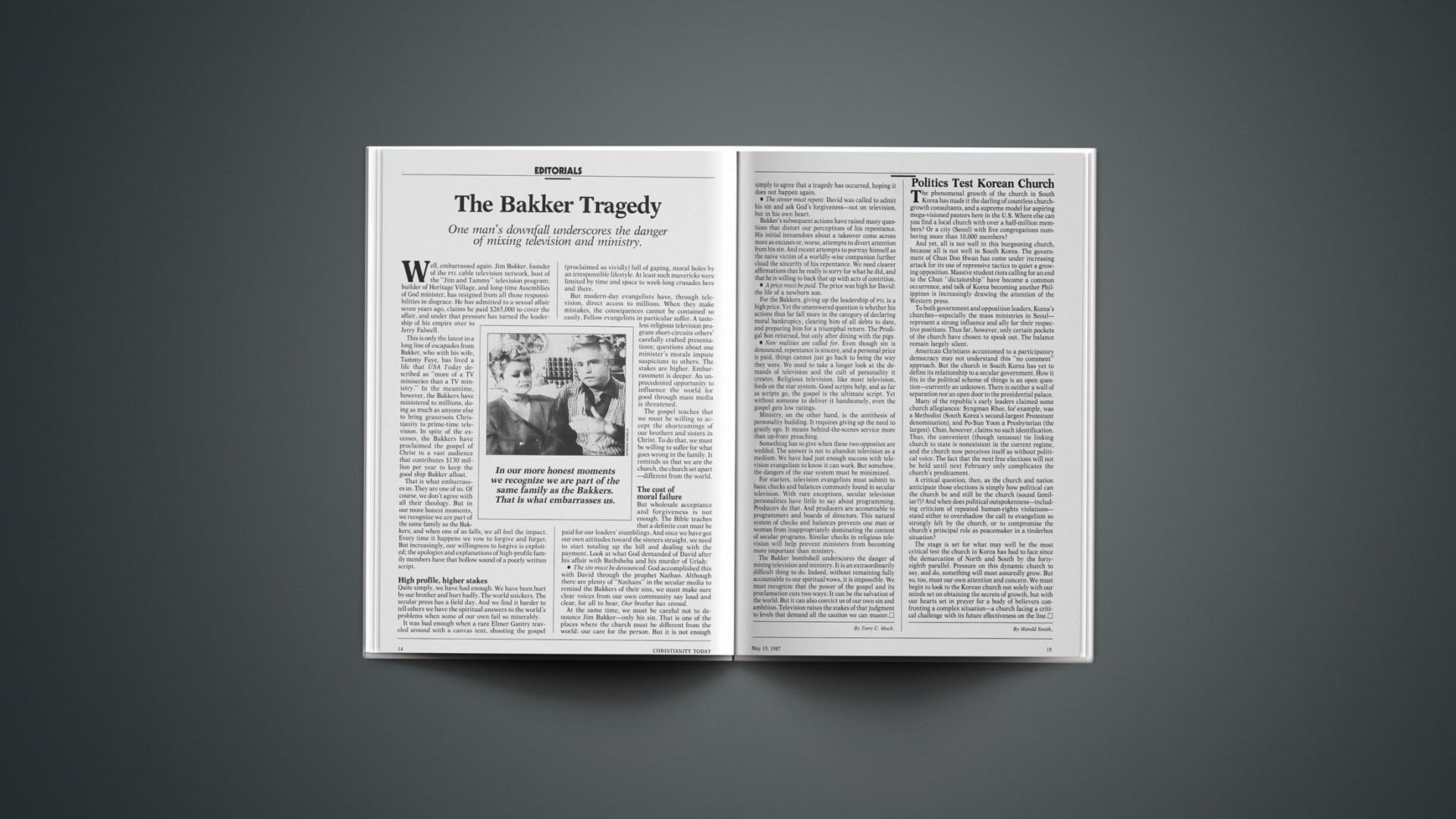
The Bakker Tragedy

One man’s downfall underscores the danger of mixing television and ministry.

Well, embarrassed again. Jim Bakker, founder of the PTL cable television network, host of the “Jim and Tammy” television program, builder of Heritage Village, and long-time Assemblies of God minister, has resigned from all those responsibilities in disgrace. He has admitted to a sexual affair seven years ago, claims he paid $265,000 to cover the affair, and under that pressure has turned the leadership of his empire over to Jerry Falwell.

This is only the latest in a long line of escapades from Bakker, who with his wife, Tammy Faye, has lived a life that USA Today described as “more of a TV miniseries than a TV ministry.” In the meantime, however, the Bakkers have ministered to millions, doing as much as anyone else to bring grassroots Christianity to prime-time television. In spite of the excesses, the Bakkers have proclaimed the gospel of Christ to a vast audience that contributes $130 million per year to keep the good ship Bakker afloat.

That is what embarrasses us. They are one of us. Of course, we don’t agree with all their theology. But in our more honest moments, we recognize we are part of the same family as the Bakkers; and when one of us falls, we all feel the impact. Every time it happens we vow to forgive and forget. But increasingly, our willingness to forgive is exploited; the apologies and explanations of high-profile family members have that hollow sound of a poorly written script.

High Profile, Higher Stakes

Quite simply, we have had enough. We have been hurt by our brother and hurt badly. The world snickers. The secular press has a field day. And we find it harder to tell others we have the spiritual answers to the world’s problems when some of our own fail so miserably.

It was bad enough when a rare Elmer Gantry traveled around with a canvas tent, shooting the gospel (proclaimed so vividly) full of gaping, moral holes by an irresponsible lifestyle. At least such mavericks were limited by time and space to week-long crusades here and there.

But modern-day evangelists have, through television, direct access to millions. When they make mistakes, the consequences cannot be contained so easily. Fellow evangelists in particular suffer. A tasteless religious television program short-circuits others’ carefully crafted presentations; questions about one minister’s morals impute suspicions to others. The stakes are higher. Embarrassment is deeper. An unprecedented opportunity to influence the world for good through mass media is threatened.

The gospel teaches that we must be willing to accept the shortcomings of our brothers and sisters in Christ. To do that, we must be willing to suffer for what goes wrong in the family. It reminds us that we are the church, the church set apart—different from the world.

The Cost Of Moral Failure

But wholesale acceptance and forgiveness is not enough. The Bible teaches that a definite cost must be paid for our leaders’ stumblings. And once we have got our own attitudes toward the sinners straight, we need to start totaling up the bill and dealing with the payment. Look at what God demanded of David after his affair with Bathsheba and his murder of Uriah:

The sin must be denounced. God accomplished this with David through the prophet Nathan. Although there are plenty of “Nathans” in the secular media to remind the Bakkers of their sins, we must make sure clear voices from our own community say loud and clear, for all to hear, Our brother has sinned.

At the same time, we must be careful not to denounce Jim Bakker—only his sin. That is one of the places where the church must be different from the world: our care for the person. But it is not enough simply to agree that a tragedy has occurred, hoping it does not happen again.

The sinner must repent. David was called to admit his sin and ask God’s forgiveness—not on television, but in his own heart.

Bakker’s subsequent actions have raised many questions that distort our perceptions of his repentance. His initial innuendoes about a takeover come across more as excuses or, worse, attempts to divert attention from his sin. And recent attempts to portray himself as the naive victim of a worldly-wise companion further cloud the sincerity of his repentance. We need clearer affirmations that he really is sorry for what he did, and that he is willing to back that up with acts of contrition.

A price must be paid. The price was high for David: the life of a newborn son.

For the Bakkers, giving up the leadership of PTL is a high price. Yet the unanswered question is whether his actions thus far fall more in the category of declaring moral bankruptcy, clearing him of all debts to date, and preparing him for a triumphal return. The Prodigal Son returned, but only after dining with the pigs.

New realities are called for. Even though sin is denounced, repentance is sincere, and a personal price is paid, things cannot just go back to being the way they were. We need to take a longer look at the demands of television and the cult of personality it creates. Religious television, like most television, feeds on the star system. Good scripts help, and as far as scripts go, the gospel is the ultimate script. Yet without someone to deliver it handsomely, even the gospel gets low ratings.

Ministry, on the other hand, is the antithesis of personality building. It requires giving up the need to gratify ego. It means behind-the-scenes service more than up-front preaching.

Something has to give when these two opposites are wedded. The answer is not to abandon television as a medium. We have had just enough success with television evangelism to know it can work. But somehow, the dangers of the star system must be minimized.

For starters, television evangelists must submit to basic checks and balances commonly found in secular television. With rare exceptions, secular television personalities have little to say about programming. Producers do that. And producers are accountable to programmers and boards of directors. This natural system of checks and balances prevents one man or woman from inappropriately dominating the content of secular programs. Similar checks in religious television will help prevent ministers from becoming more important than ministry.

The Bakker bombshell underscores the danger of mixing television and ministry. It is an extraordinarily difficult thing to do. Indeed, without remaining fully accountable to our spiritual vows, it is impossible. We must recognize that the power of the gospel and its proclamation cuts two ways: It can be the salvation of the world. But it can also convict us of our own sin and ambition. Television raises the stakes of that judgment to levels that demand all the caution we can muster.

By Terry C. Muck.

Ideas

Liberation Theology Is Remarkably Protestant

Something exciting is happening, thanks to liberation theology: hundreds of thousands of Catholic base communities—small groups who gather to read and study the Bible—have sprung up throughout Latin America.

In Brazil, for example, the number of base communities has climbed from 70,000 to 200,000 in just five years. From the favelas of Rio to villages in the Amazon, Catholic laypeople meet for hours to study the Bible, worship, sing, and discuss how the gospel applies to their daily lives. These groups, in turn, are playing an increasingly important and controversial role in the shaping of Latin America’s destiny.

Familiar Protests

True, some liberation theologians espouse dangerous and wrong theology, deemphasize personal salvation, or have used the gospel solely for political ends. But their critics have overlooked the similarities between aspects of this movement and the Protestant Reformation of the sixteenth century. Consider the Protestant-ness of three main emphases in the movement’s writings:

First, liberation theologians emphasize the priesthood of all believers. Like Luther, they speak scathingly against the Catholic church’s lofty view of the hierarchy because they believe it goes against scriptural teaching.

The case of Brazilian priest Leonardo Boff, a leading spokesman for liberation theology, illustrates the danger of such thinking. In May 1985, the Vatican summoned him to Rome and offered an ultimatum: He was either to reinterpret his writings or be subjected to a silencing order. He chose the latter.

What was Boff’s heresy? The Vatican mentioned his use of Marxist analysis, but it is clear Rome had other, more serious concerns. In one of his 40 books, Church: Charisma and Power, Boff compared Catholic hierarchy to the organization of the Soviet Communist party, and denounced the infallibility of the pope. Then, after making a powerful, biblical case for the priesthood of all believers, he wrote: “There exists a fundamental equality in the Church. All are people of God. All participate of Christ, directly, without mediators” (emphasis added).

As Luther found out, these are revolutionary, if not heretical, statements for a Catholic to be making. Compare Boff’s statement with the one that Luther made in his treatise, To the Christian Nobility of the German Nation: “All Christians belong to the priesthood and there’s no difference among them except in terms of ministry.” No wonder Boff defends the Reformer: “It was a mistake for the Catholic church to expel Luther.… it expelled the possibility of reform from within.” Liberation theology is releasing Catholic laity into ministry, one of the very things Luther fought for.

The Role Of Scripture

Liberation theologians are also encouraging the Catholic laity to study the Bible. The right of each Christian to interpret the Scriptures, another Reformation battle cry, dominates liberation theologians’ thinking and the base communities’ practice. Listen to Boff again: “The base communities are born from the Word of God.… There the Gospel is read, shared and believed in.…”

Bible study among Catholics in the base communities has become so popular that leaders of the United Bible Societies report that in several Latin American countries they are selling more Bibles through the Catholic churches than through the Protestant churches. And many base community meetings now seem so “Protestant” that evangelicals find it easier than before to relate to these Catholics.

Finally, liberation theologians stress God’s sovereignty over all areas of life. The Reformers vehemently protested against Rome’s separation of the sacred and the secular. Faith, they said, had to have a day-to-day effect on the Christian life. The Radical Reformers took this concept of discipleship even further and called believers to share in the sufferings of Christ.

Jon Sobrino, a Jesuit priest in El Salvador, voices this common theme among liberation theologians when he says emulating Jesus means “saving the world through persecution and martyrdom.”

Furthermore, though we might oppose their political agenda (and even consider it ungodly), liberation theologians’ insistence that faith influences society coincides with Reformed thought.

With liberation theologians at a crossroads as they try to consolidate the exponentially growing base-community movement, evangelicals need to observe and listen more carefully so they can help fan the flames of orthodoxy and quench unbiblical beliefs. By continuing to caricature liberation theology as politically leftist, we risk opposing a movement that is clamoring for many of the things the Reformers fought for.

SPEAKING OUT offers responsible Christians a forum. It does not necessarily reflect the views of CHRISTIANITY TODAY.

By C. Rene Padilla, general secretary of the Latin American Theological Fraternity, and Andres Tapia, assistant editor of U magazine (formerly HIS).

An Accidental Author

This little pig went to market, this little pig stayed home … and this little pig went to India, where he was greeted with a request from a student magazine for an article that would encourage India’s budding Christian writers.

Why, I wonder, did they pick on me? I suppose they must see me as a senior writer who has made the grade, and so can serve as a role model for the young. Are they wrong? Not entirely. My books have gone into ten languages and sold over a million-and-a-half copies. And they have helped all sorts of readers, old and young, male and female, academic and unlettered, Calvinist and Arminian, Christian and pagan. (I know this from the flow of testimonies that the mailman has brought me over the years.) It amazes me that God should use my material so constantly in this way, but in his mercy he does, so that my writing has become the central item in my ministry. I ought, therefore, not to refuse to strut my stuff as a model for tomorrow’s wordsmiths, however much my (British? elitist? modest? spiritual? lazy? hypocritical?) instincts urge me to do just that.

But am I a good role model as a Christian writer? I doubt it. Certainly, I have been putting things in print for 30 years, and my bibliography has 200 entries. Certainly, I try to give the world a book a year, and shall continue trying as long as my brains hold out. And certainly, I feel myself under constraint in this: Woe is me if I do not write the gospel! But even allowing for the way my mind highlights all that seems odd, I cannot but think myself a very odd writer indeed.

To start with, I can’t do fiction, or poetry, or travelogues, or honest autobiography. (I could do dishonest autobiography, but who wants that?) I can write only about ideas and issues of mind and heart before the Lord. My range is absurdly narrow.

Moreover, I am untutored; I never read a book or took a course on writing in my life. One of Iris Murdoch’s novels is called An Accidental Man; well, I am an accidental writer. I got into it by being obliging, writing what I was asked to write for no better reason than that I was asked to write it. One day I was asked to write up a talk I had given, and like Topsy, the script “just growed” into a full-length book that sold 20,000 copies in its first year. Behold! I had become an established author. By now, I suppose, I should count myself a professional, having published so much. But to myself I remain an amateur who scribbles till he likes his flow and wording, then mails the result to the publisher (usually late), and moves on to the next thing so hastily that within 24 hours he forgets what he has written. What sort of a role model is a man like that?

Wait a minute, though; that is not a complete statement. (Give youself a kick in the pants, Packer.) I have to remember that God made me a communicator. No one ever had to teach me how to make myself clear, nor tell me that good communication is half rational analysis and half pictorial and dramatic imagination, as in Isaiah and Ecclesiastes and Jesus and Paul and Luther and C. S. Lewis. No one ever had to admonish me to start by deciding who my ideal reader was, and to write for him throughout. Thus I began with certain natural advantages, which some would-be authors clearly lack.

What I find that I know about writing boils down to this: There are four rules. First, have something clear to say. Second, keep it simple. Third, make it flow. Fourth, be willing to redraft as often as is necessary to meet these requirements.

Writing is both an art and a craft, and you learn it by doing it. To see things you want to say, and to have ideas about how to say them, is how it starts: then you have to find the sound of your own voice talking on paper, and you can only do that by reading your initial drafts and making improvements. It is as simple—and as difficult—as that. “The teacher searched to find just the right words,” says Ecclesiastes (12:10), and in this he was the model for all writers anywhere in any age.

Okay, CT, that’s enough for you. I must get on with my article for India.

J. I. PACKER

Letters

Remarkably Fresh

Philip Yancey’s “Sin” [Mar. 6] did it again. With remarkable freshness he plows through theological conventionalities regarding the purpose of divine law, finds the coherent thread of both OT and NT, and shares his own self-authenticating experience that affirms his biblical conclusion: God’s laws are primarily descriptive, not prescriptive.

HERBERT E. DOUGLASS

Weimar Institute

Weimar, Calif.

May I respectfully correct a misconception of a Hebrew verbal construction in Yancy’s otherwise fine treatment? The Hebrew in the Ten Commandments is doing far more than merely “giving a description of what a holy people will look like.” A more accurate statement would have been: “The Hebrew in the Ten Commandments is giving strong divine commands as to what a holy people must and must not do.”

DR. KENNETH L. BAKER

Capital Bible Seminary

Lanham, Md.

Yancey has egregiously offended all George MacDonald lovers by prematurely dating his death! Had he died in 1858, many great works would never have been written. MacDonald died at Ashtead, Surrey, in 1905.

JAY PIERSON

Kensington, Md.

Medical ethics: A complex issue

I was delighted with the two articles on medical ethics in your March 6 issue [“Life-defying Acts,” by Ed Larson and Beth Spring, and “The Inevitability of Death,” by Rob Roy MacGregor]. I share the concern expressed by the authors that the evangelical voice has been notably absent from discussions about decisions to limit treatment. The two articles presented a reasoned and balanced view of a complex issue.

ROBERT D. ORR, M.D.

Brattleboro, Vt.

I was surprised that the eventual determining factor in the sustain-life controversy was never seriously discussed: stewardship of resources. How many lives of children of the world could be saved with the money spent to sustain life for one day in a highly technical, critical care center?

REV. JAMES T. CHRISTY

Church of the Nazarene

Greeley, Colo.

Putting families first

I commend you for the courage to include in your March 6 issue the “Speaking Out” article “Home-grown Kids Need a Full-time Mom,” when the majority is opposed to its views. A full-time “mom” is the most honorable of occupations for women. Money, prestige, and selfish gain are poor substitutes for the satisfaction of putting our families first.

P. FREDRICK FOGLE

Tallahassee, Fla.

Attitudes such as those portrayed in the article keep the church from being all that it could be. Working full-time for a Christian organization and trying to support a family on the salary I receive would be impossible. My wife gets more money from a public school (twice the pay for three-quarters the time) that I receive after seven years of employment in the same location. Perhaps those of us who are skilled, yet underpaid and male, should break the mold of tradition and stay home to be full-time dads!

BILL LEWIS

Seattle, Wash.

Unfortunately, the groundwork for a “career” mother is emphasized even in our best and largest seminaries, where the spouse is encouraged to place her child in the readily available child-care center and acquire a “job” to support her husband through seminary (will women seminarians please excuse my bias?). How, then, can a Christian community respond to the needs of a two-parent, one-income family when its very leaders have been taught otherwise by example and by implication?

LARRY A. RILEY

Ft. Worth, Tex.

Blaming Eve

I read with interest your review of George Gilder’s Men and Marriage [Mar. 6]. The review seems to imply that civilizing the sexual barbarians is women’s work. This viewpoint puts us right back to the garden and Adam’s original sin, doesn’t it? “She offered me the fruit and I ate it!” Isn’t it time that men took responsibility for their own liberation from sexual barbarism and acted accordingly, instead of putting the blame on Eve?

V. GIVENS

Cedar Park, Tex.

Iron sharpeners

Thank you for your March 20 CT Institute discussion of universalism. From Nicole to Kantzer it was a fitting example of “As iron sharpens iron.…”

JOHN KUTSKO

Whitesboro, N.Y.

Regarding universalism et al. [Mar. 20]: What a testimony to the authenticity of the original sin—hubris! Who are we to “understand” what God is doing in his dealings with man? A pox on theologians! May they spend eternity with each other!

ELIZABETH CROZIER

Indiana University

Indianapolis, Ind.

“Fire, Then Nothing” by Clark Pinnock is the most refreshing thing I have read in evangelical writing for some time. The answer given by David Wells is the typical theodicy of those who believe God did not say exactly what he meant to say.

REV. HARRY J. BOWERS

Antioch Christian Church

Asheville, N.C.

I was somewhat disappointed in Pinnock’s interpretation of the “fire” of “God’s judgment [which] consumes the lost.” David Wells and Roger Nicole came through positively, biblically, hermeneutically correct (from my perspective), and theologically sound!

R. M. BAERG

Saskatoon, Sask., Canada

I would note that a fairly basic point seems to have been overlooked in the flurry of Scripture citations supporting the views examined: in the final analysis, it is God’s decision. When the Lord Christ sits in judgment at the right hand of the Father, He will be deciding—not one of our pet systems of thought.

REV. FR. CHRISTOPHER W. FITZPATRICK

Airport Chaplaincy

Seattle, Wash.

Tithe Reform

Unlike the Undersecretary for Paperwork Design and Proliferation at the IRS, the church has always kept its requirements simple: a straight 10 percent off the top. In the past you no doubt simply divided your income in tenths and wrote checks to your favorite church and mission boards.

But perhaps church officials should consider engaging in some “Tithe Reform.” After all, in our culture the importance of any financial transaction is directly proportional to the number of sheets of paper it takes to process it.

The new T-4, Estimated Tithe Declaration Forms, could work like this: On line 1 write down the amount of your regular paycheck. On line 2, enter the number of times you go to church each year. (If you are Baptist or Catholic, you have the greatest opportunities here.) Multiply the number on line 2 by 3.056. Enter the result on line 3. On line 4 enter your age when you first professed Christ. On line 5, enter your pastor’s salary. (This can be found on the mimeographed budget distributed at your church’s annual meeting—which is always held on the day of the Super Bowl.) Compare line 5 with line 1. Feel guilty. Subtract line 5 from line 1. Take a deep breath and ignore the result. Multiply the amount on line 1 by.10 and enter it on line 6. Throw in a few extra bucks to make you feel better about the minister’s salary. And write that check.

EUTYCHUS

God’s communications

Special thanks for Terry Muck’s editorial, “God and Oral” [Mar. 20]. No matter how badly we may garble the message, we must always affirm God as the loving Father who teaches and communicates with his children. The fact that God speaks to us does not, by itself, guarantee that we grasp the full dimensions of the teaching or even that we will always correctly understand the message. And this reality is true not only for Oral Roberts, but for every one of us.

RICHARD J. FOSTER

Friends University

Wichita, Kan.

CT is spreading the confusion. Does Terry Muck believe God is adding to the recognized books of the canon of Scripture? I believe it confuses hearers in the Christian community to have our religious leaders loosely using phrases like “God said” and “God told me.” Most often our use of such phrases is meant to refer to our personal guidance by God, not the authoritative word of inspired Scripture.

REV. DAVID SCHUTJER

Portland, Oreg.

I was scandalized by Terry Muck’s endorsement that God gives extra-biblical revelation to Oral Roberts or anyone else. Should we all buy loose-leaf Bibles to store these revelations? Or would Bibles with spare white pages in the back be sufficient?

WARREN CULWELL

Dallas, Tex.

Sin and compassion

Thanks for Ben Patterson’s editorial on the Christian response to AIDS [Mar. 20]. Sin is sin—and condemned and dealt with by God. But the Christian’s response to a sinner (all of us) is best demonstrated by Jesus. I don’t recall his presence at too many floggings or executions during his walk on earth. In fact, he said, “He that is without sin among you, let him first cast a stone.” The Christian response to suffering is compassion. Period.

MRS. BARB WHEELER

Tripoli, Iowa

The issue is not whether AIDS is God’s judgment; it is rather, how we should respond if it is (Luke 13).

RICHARD NATHAN

Columbus, Ohio

If we think of AIDS as God’s punishment for homosexuality, then botulism must be his punishment for poor hygiene, the common cold his punishment for rudely sneezing in one another’s face, etc.

ROBERTA BALDWIN

Mulberry Grove, Ill.

Whose voice?

Your “news analysis” on Christian Voice [Nov. 7, 1986] by Beth Spring was totally inaccurate in regard to comments made about my magazine, the Candidates Biblical Scoreboard. These injurious inaccuracies might not have occurred had your writer taken time to telephone me for an interview.

The Candidates Biblical Scoreboard is not Christian Voice’s publication as cited in the article, but a sole proprietorship owned by me and my wife. I founded the publication in 1980 and have published it in election years. Its production, including editorial content, is developed solely by me and a staff of nearly 100 people. The publication, promotion, marketing, and distribution were the sole responsibility of my news publishing organization, Biblical News Service (BNS).

Spring was right in indicating that millions of Biblical Scoreboards were distributed—but not by Christian Voice as stated. BNS distributed the Scoreboard while CV distributed Scorecards.

Spring attacks the Biblical Scoreboard as not being “nonpartisan and nonsectarian.” Editorial partisan preference was not shown to Republicans or Democrats; this was very obvious in our California edition.

Scoreboard has always been nonsectarian, and never directly or indirectly influenced or controlled by any denomination or religious group. Articles are written in a news magazine format, and we have gained wide respectability for the quality of our research and writing. We often sell reprint rights to other publications, and have been quoted as an authoritative news source by the New York Times, U.S. News and World Report, and others.

The worst implication clearly left by your article is that Scoreboard is either a Unification Church-Sun Myung Moon publication, or supported or tainted by a Moon connection. Scoreboard has never had a Moon connection, nor has any Moon organization or individual had any direct or indirect influence on it.

I can confirm that among my 30,000 bulk customers, Moon organizations such as CAUSA have purchased quantities of Scoreboard: we have a policy of selling to anyone who pays their bills.

In summary, your “News Analysis” on Christian Voice was not objective; rather, it was misleading. It was highly opinionated and should have been classified as an opinion piece. For it to be news analysis, an editor should have deleted the writer’s editorializing and established some objective balance to the feature. Calling the article “news analysis” caused CT readers to believe that what they read was totally factual. This led many to draw untrue conclusions about Biblical Scoreboard, causing injury to the reputation of my publication.

I hope this letter will set the record straight regarding the Candidates Biblical Scoreboard.

DAVID W. BALSIGER

Founder-Publisher, Biblical Scoreboard

Costa Mesa, Calif.

We are pleased to make the above details of the ownership of the Candidates Biblical Scoreboard clear to readers.—Eds.

Hello, Information?

No matter how you feel about America’s decentralized phone confusion, the fact remains that, thanks to Ma Bell, Nanjing, China, is as close as Nantucket, Maine—give or take a few touch tones. And for author Sharon Mumper, this meant the difference between a cover story based solely upon second-and third-hand reports, and one offering CT readers an insider’s look at a complex situation.

Most surprisingly perhaps, Mumper, the associate director of Evangelical Missions Information Service and three-time visitor to the People’s Republic, was able to dial Bishop Ting, the controversial head of China’s state-approved church organization, direct.

“It’s hard to get a phone number inside a Communist country,” she telephonically told CT editors after completing her story. “But fortunately, we had a contact in Hong Kong who had the bishop’s Nanjing number.”

Twelve digits later, Sharon had her interview: “The bishop’s superb English made the best of a bad connection.”

Sharon reached out and touched the Orient eight times, getting quotes and counsel from assorted men and women familiar with both Ting’s Three-Self Patriotic Movement and China’s multitudinous house churches: all in addition to getting a phone bill for $295.93.

HAROLD SMITH, Managing Editor

Textbook Cases

In Tennessee, Judge Thomas Hull ruled that children could not be required to read school textbooks offensive to their parents’ religious beliefs. In Alabama, Judge Brevard Hand ruled that more than 40 school texts advocated the “religion” of secular humanism, thus were unsuitable for public education. Both decisions, stemming from suits brought by fundamentalist Christian parents, have ironic, frightening, and hopeful implications.

Ironically, Judges Hull and Hand used the same judicial reasoning that the Supreme Court has used to systematically eliminate school prayer and Christian values from the public school curriculum. In effect, the Court has said that since prayer, religious history, and Judeo-Christian values imply endorsement when taught, none are permissible in a religiously pluralistic culture. What the judges in these two particular cases have finally recognized is that prayerlessness, “valueless” education, and textbooks that ignore religious history all imply endorsement of an identifiable religion—secular humanism—and are equally offensive to the majority’s religious sensibilities. That makes the teaching of secular humanism unconstitutional, at least according to the way the recent Supreme Court has interpreted the Constitution. It is a satisfying, tit-for-tat victory for conservative Christians.

The frightening aspect is this: similar suits are pending in Arizona, Georgia, and Wisconsin. If successful, good ideas are likely to disappear along with the bad. Public education, instead of being a stimulating marketplace of ideas, is in danger of becoming either sterile bastions of triteness or totalitarian drugstores dispensing the (liberal or conservative) party line. Neither option seems consistent with the constitutional vision that recognized and endorsed the spiritual nature of man. The 1987 spectacle of religious and philosophical groups using the courts as bully pulpits would have been as foreign to Jefferson, Madison, and Hamilton as if the courts ruled that man did not have a spiritual nature at all.

The two decisions do have their hopeful side, however. Surely the dead-end direction of the current course of events will become increasingly clear to both liberals and conservatives as various courts wrestle with the landslide of cases likely to follow.

We will hopefully recognize that the courts are not the place for bartering our religious heritage. Judges are inadequate to the role of spiritual arbiter. Juries are unreliable witnesses to faith. Laws are shallow representations of eternal truths.

We will hopefully recognize that religious freedom cannot be maintained by partisan power politics. Just as faith cannot be produced by coercion, religious truth is not decided by vote.

We will hope that school textbooks will once again show that the spiritual nature of man is as essential as the biological, and that we all are faced with answering questions of meaning rising far above petty politics.

If Christian values are presented fairly alongside the other value systems of the day, the gospel will advance. Neither pluralism nor evangelism will suffer.

By Terry C. Muck.

North American Scene from April 17, 1987

LUTHERANS

Merger Clears Another Hurdle

The congregations of the American Lutheran Church (ALC) have authorized the denomination to unite with two other Lutheran bodies to form the Evangelical Lutheran Church in America.

ALC congregations backed the merger by an 81 percent majority. During a six-month referendum ending last month, 3,752 congregations voted in favor of the merger; 863 opposed the plan; 45 abstained.

ALC presiding bishop David W. Preus predicted that no more than 50 of his church’s congregations will stay out of the merger. “Now, with the vote behind us,” he said, “I ask all congregations to close ranks and move forward in the mission that God has entrusted to the church.”

The Committee for the Formation of the Association of American Lutheran Churches had urged ALC congregations to vote against the merger. Committee leaders Duane Lindberg and James Minor said churches opposing the union are invited to join the movement, which might form an alternative denomination.

Later this month another partner in the merger, the Lutheran Church in America (LCA), will take a final vote on union. Then, at a constituting convention beginning April 30, the LCA, ALC, and the Association of Evangelical Lutheran Churches will form the 5.3 million-member Evangelical Lutheran Church in America. The new church, to be headquartered in Chicago, will begin operating January 1.

NORTH AMERICA

Steady Seminary Enrollment

Seminary enrollment in the United States and Canada held steady last year, with a fall enrollment of 56,335, according to the Association of Theological Schools (ATS).

In its annual statistical breakdown, the Vandalia, Ohio-based association identified several trends. Full-time equivalent enrollment dropped by 1.7 percent, and enrollment of Hispanic students was down 10.8 percent. On the increase were enrollments of black students (7.6%); Pacific-Asian American students (16.6%); first-year students (1.0%); and women (2.2%).

Women now make up 26.4 percent of students in ATS-member schools. The number of women serving in full-time faculty positions also increased, with women filling 13.3 percent of the positions.

ST. LOUIS

Hard Liquor In Church

Archbishop John L. May has proposed a ban on the consumption of hard liquor in any Catholic parish hall or church facility in the Archdiocese of St. Louis. His proposal would also bar the sale of all alcoholic beverages in any parish or agency of the archdiocese.

However, the plan would allow “soft alcoholic beverages,” including wine, beer, and spiked punch, to be served in church halls at wedding receptions, anniversary celebrations, parish fund raisers, and church socials that include a full meal.

In response to May’s proposal, Richard J. Quirk, associate pastor of St. Mary Magdalen Catholic Church, indicated he would welcome the policy. “I think it would be an opportunity for all of us to look at the amount of alcohol we consume and reflect on that,” he said. “It’s important for the church to be a counter-witness to offset problems in society.”

Another priest, who asked not to be identified, said he expects strong opposition to May’s proposal. He said banning hard liquor would “butt heads with something that is fundamentally Catholic—that God made everything, and creation is basically a good thing.”

TRENDS

An Organization Is Born

The idea of linking opposition to abortion and nuclear arms appears to be taking root. Last year, the Just Life political action committee was formed to oppose abortion, nuclear arms, and poverty (CT, June 13, 1986, p. 36). And last month, a coalition of representatives from religious, prolife, peace, and social-justice organizations met in Chapel Hill, North Carolina, to form the Seamless Garment Network.

The use of the term “seamless garment” to link opposition to abortion and nuclear arms was popularized by Catholic Cardinal Joseph Bernardin. However, the new network’s platform will be broader than these issues. According to its policy statement, the Seamless Garment Network is “committed to the protection of life, which is threatened in today’s world by war, abortion, poverty, the arms race, the death penalty, and euthanasia.”

The network will serve as a clearinghouse for audiovisual and print resources. Plans also call for a publication that will challenge readers to respond to issues that threaten human life.

The Chapel Hill conference was sponsored by ProLifers for Survival, which will now go out of existence. ProLifers for Survival, whose platform was limited to opposing abortion and nuclear arms, was founded eight years ago.

PEOPLE AND EVENTS

Briefly Noted

Appointed : As president of Reformed Bible College in Grand Rapids, Michigan, Edwin D. Roels. On August 1, Roels will succeed Dick L. Van Halsema, who has served as president since 1966. Roels is pastor of Unity Christian Reformed Church in Prinsburg, Minnesota. He previously served as Africa coordinator for the World Home Bible League.

Died: Edwin C. Clarke, 73, former president of Geneva College in Beaver Falls, Pennsylvania; February 17, following an extended illness. Clarke joined the Geneva College faculty in 1937 as an economics instructor. In the years that followed, he served as assistant professor of economics, chairman of the Department of Economics and Business Administration, and vice-president for development. He was named president in 1956, a post he held until he retired in 1980.

Apple PodcastsDown ArrowDown ArrowDown Arrowarrow_left_altLeft ArrowLeft ArrowRight ArrowRight ArrowRight Arrowarrow_up_altUp ArrowUp ArrowAvailable at Amazoncaret-downCloseCloseEmailEmailExpandExpandExternalExternalFacebookfacebook-squareGiftGiftGooglegoogleGoogle KeephamburgerInstagraminstagram-squareLinkLinklinkedin-squareListenListenListenChristianity TodayCT Creative Studio Logologo_orgMegaphoneMenuMenupausePinterestPlayPlayPocketPodcastRSSRSSSaveSaveSaveSearchSearchsearchSpotifyStitcherTelegramTable of ContentsTable of Contentstwitter-squareWhatsAppXYouTubeYouTube