Books

How Technology Transformed the Global Church

A new book examines key pivot points from the print revolution to the digital era.

The book cover on a blue background.
Christianity Today November 13, 2025
Illustration by Christianity Today / Source Images: Getty, Cambridge University Press

Robert Webber once reminded evangelicals that “the road to the future runs through the past.” If evangelicalism is fracturing, we may just find our way to unity through what Kevin Vanhoozer called “Protestant catholicity” by retracing our steps. This, of course, raises the thorny question “What is an evangelical?” People have made valiant efforts to sort evangelicals into groups or types.

Evangelicals are a diverse bunch, and the rapid growth of the movement in the Global South has only increased this diversity. It needs to be said more often and more clearly that evangelicalism is not an American movement—it is a global one—and the vast majority of the world’s evangelicals today are African, Asian, and Latin American. Evangelicalism was a transnational movement from the very outset and has never been confined to a single nation or ethnicity.

David Bebbington, whose intellectual labors laid the cornerstone for building out a robust evangelical historiography, is a British evangelical whose perspectives have helpfully challenged American-centric descriptions of the movement. In this new era of world Christianity, deeper engagement with the global church (and the older church) could lead us closer to an evangelical catholicity.

Billy Graham’s life, shaped by encounters with the global church, offers an important precedent. One example is Graham’s friendship with John Stott, whom he met during his travels in Britain. In his autobiography Just as I Am, Graham wrote that Stott became “one of my best friends.” Stott, an evangelical and a Cambridge-educated Anglican, was influential in Graham’s journey toward a more ecumenical evangelicalism, one less marked by the fundamentalism Graham encountered as a student at Bob Jones College.

During the 1954 All-Scotland Crusade, Graham publicly announced he no longer considered himself a fundamentalist—a transformation that would have significant implications for American evangelicalism during the second half of the century. To reframe David Hollinger’s Protestants Abroad, we might say that Billy Graham set out to change the world and changed American evangelicalism instead.

David N. Hempton’s Christianity at the Crossroads: The Global Church from the Print Revolution to the Digital Era shows how encounters often take place at crossroads or networks and have significantly transformed global Christianity. His work, conceived for the prestigious Gifford Lectures, is a selective retelling of Christianity over the past five centuries. Hempton, a distinguished professor at Harvard Divinity School, blends narrative history with imaginative historiography. His methodology as a social historian shifts away from nations, denominations, and institutions and focuses instead on “transnational flows and networks.”

He frames his analysis through three interlocking concepts: nuclei (religious ideas), networks (the channels by which ideas travel), and nodes (the places where ideas are received and reshaped). He admits that preparing this work in the middle of the COVID-19 pandemic further animated his work about how ideas spread.

The book begins with print culture in the 16th century and closes with digital media in the 21st. Luther’s theological ideas—justification by faith and the freedom of the Christian—functioned as nuclei, with the printing press as the network spreading them. The print revolution transformed religion as Reformation ideas spread like “a religious virus” through sermons, treatises, Bibles, and hymns. Cities such as Wittenberg, Germany; Nuremberg, Germany; and Basel, Switzerland became key nodes of encounter and dissemination.

Hempton applies this framework to other events in Christian history: the Jesuits’ Spiritual Exercises as nuclei linking formation and mission, Our Lady of Guadalupe as a single image generating widespread devotion, and British evangelicals recruiting Black Loyalists to Sierra Leone through transatlantic networks.

He turns to Protestant internationalism—Pietism, evangelical missions, dispensationalism, fundamentalism, and Pentecostalism. Though marked by conflict, evangelicals constructed what he calls a “global fraternity.” He examines women’s networks in the 20th century, showing how the nuclei of feminism has worked in both egalitarian and patriarchal contexts. He concludes, “Women have found imaginative ways to create spheres of influence, and sometimes even to control, the religious traditions they inhabit.”

The final chapter on the digital revolution explores how technology has “re-imagined sacred space” and democratized the religious marketplace. Large ministries have harnessed digital technology most successfully, promoting the idea that “bigness” is a sign of blessing. A new group of specialists has emerged whose authority is based more on technical expertise than pastoral credentials. Case studies include the spread of the prosperity gospel, the global influence of Hillsong Worship, and the worldwide rise of digital platforms. But as Byung-Chul Han observes, digital technology produces “more communication but not more community.” The chapter on digital technology is chock-full of thought-provoking implications for the church.

Hempton’s mastery of secondary literature is impressive. At times it feels like reading a well-written annotated bibliography on major developments in Christian history from the Reformation to the present. His impressive engagement of hundreds of academic monographs is one of the most important contributions of this work.

He particularly notes the need for more research on the influence of money in the history of Christianity—how giving and spending have shaped expressions of faith. “Following the money” along networks can tell us a lot about the history of Christian movements. Historians such as Mark Noll and Larry Eskridge have touched on these issues in More Money, More Ministry: Money and Evangelicals in Recent North American History, and their work deserves a wider hearing, but Hempton underscores the need for additional research.

But not everyone will agree with his generalization that Christianity has had a “subversive alliance with imperial power” and has been guilty of “cultural rape.” While some academics sustain the Christianity-and-colonialism trope, Dana Robert and many others have challenged older models, showing that the issues are far more complex. Missionaries often “converted colonialism” for evangelistic purposes, criticized abuses, and made significant sacrifices for those they came to serve. Still, Hempton’s critique deserves to be heard. Christians have often failed to live up to the claims of the gospel, and the best apologetic is to confess, not defend, our sins.

Hempton delivered his lectures at the University of Edinburgh, itself a significant node where new ideas have emerged in the study of world Christianity. Scholars like Andrew Walls, Lamin Sanneh, Dana Robert, Brian Stanley, and Kirsteen Kim have shown that Christianity is both local and global, polycentric and interconnected. Walls especially noted how the gospel (nuclei) was carried by missionaries (networks) to new lands (nodes), where it flourished through Indigenous witness.

This transmission created something new without losing the essence of the old. To use a metaphor from dendrology (which Hempton mentions in chapter 1), when the old vine of the gospel is planted in new soils, it produces a new wine with distinctively local notes. Hempton’s framework offers a taxonomy that encourages historians to situate their research within these broader global developments and to show how nations, denominations, and institutes are connected to the whole.

He offers another key takeaway for evangelicals: Understanding the evangelical movement as a diverse “global fraternity” also provides a more hopeful way of thinking about the present and imagining the future. Christianity has always been a global movement. Even in its evangelical expressions, it has never been confined to one nation, denomination, or institution. The ancient church had centers in Jerusalem, Rome, Alexandria, Constantinople, Canterbury, and Seleucia-Ctesiphon. Evangelicalism itself began as a transatlantic movement within global Protestantism, which was itself rooted in what fourth-century Christians called the “one, holy, catholic and apostolic church.”

Global evangelicalism is part of a very old story, one that began before the 18th century. Evangelicals today can find wisdom and encouragement by remaining rooted in the long story that began before the foundation of the world. And just as we are part of an old story, we are connected to a big story, one that now includes a “global fraternity” of some 600 million evangelicals. Global evangelicals have not given up on the movement, nor are they abandoning the label.

As Brian C. Stiller recently noted in his contribution to Evangelicals: Who They Have Been, Are Now and Could Be, “A decision on what name best suits us globally is not a choice we can leave for Americans to decide.”

When I went to Kenya some 20 years ago to teach church history at the Nairobi Evangelical Graduate School of Theology, I suggested to my colleague Mark Shaw that I might include postmodernism in the curriculum. His clever response was that postmodern theory is an interesting “tribal concern,” more relevant to Western academia. Yes, there are tribal matters for us to consider—such as who American evangelicals voted for in the last presidential election. But these are tribal matters. Let us consider them but not lose sight that evangelicals are part of a global fraternity that John Stott simply called “gospel people and Bible people.”

F. Lionel Young III is a senior research associate at the Cambridge Centre for Christianity Worldwide. He is the author of World Christianity and the Unfinished Task: A Very Short Introduction.

News

Alvin Plantinga, God’s Philosopher

He made the case that evidence and arguments aren’t necessary for rational, reasonable belief.

A headshot of Alvin Plantinga.
Christianity Today November 13, 2025
University of Notre Dame / Alvin Plantinga / Edits by CT

Christian philosopher Alvin Plantinga turns 93 on Saturday, November 15. He is the first long-time university professor to be part of CT’s new series, Long Obedience in the Same Direction, which started one month ago with happy birthday wishes to Joni Eareckson Tada.

Plantinga has been called “America’s leading orthodox Protestant philosopher of God,” “arguably the greatest philosopher of the last century,” and simply “God’s philosopher.” He is one of the of the most-cited contemporary philosophers in the Stanford Encyclopedia of Philosophy and is widely credited with a renaissance of Christian philosophy and the revitalization of the philosophy of religion. 

“In the 1950s there was not a single published defense of religious belief by a prominent philosopher,” said philosopher Kelly James Clark, one of Plantinga’s students. “By the 1990s there were literally hundreds of books and articles, from Yale to UCLA and from Oxford to Heidelberg, defending and developing the spiritual dimension. The difference between 1950 and 1990 is, quite simply, Alvin Plantinga.”

The philosopher made major contributions to the field of epistemology—the study of knowledge and the justification of knowledge. He deployed modal logic and meticulous, analytic arguments to attack logical positivism and classical foundationalism, making the case there were flaws in their standards of rationality. 

“The field was transformed,” fellow philosopher and longtime friend Nicholas Wolterstorff said in 2011. “Once the positivist strictures about talking about God were removed, philosophical theology flourished as it has not since the middle ages. … For philosophy of religion and the central disciplines of epistemology and metaphysics, his fingerprints are indeed everywhere.”

Starting with his book God and Other Minds and continuing with more than a dozen other titles, including The Nature of Necessity, Essays in the Metaphysics of Modality, Warrant and Proper Function, and Warranted Christian Belief, Plantinga argued that theistic belief is reasonable, rational, and sensible. He went so far as to make the case that it was rational to believe without evidence or a good argument—or any argument. 

Belief in God, according to Plantinga, was “properly basic.”

“There certainly are arguments for the existence of God—the so-called theistic proofs; but I don’t really need them,” Plantinga said. “People who believe in God but don’t believe on the basis of arguments—and that would certainly be most of us who believe in God—are perfectly sensible and perfectly OK from an intellectual view. … That’s what I’ve spent most of my life arguing. It may be a small point, but I think it’s important.”

Plantinga was born in Ann Arbor, Michigan, in 1932. His parents, Lettie (Bossenbroek) and Cornelius Plantinga, were committed members of the Christian Reformed Church, part of the Dutch Calvinist tradition. 

Plantinga later said that he never remembered a time he wasn’t Christian. In some of his earliest memories, he was sitting in church, sweltering, and listening to a sermon he didn’t understand (because it was in Dutch) mix with the sound of the summer cicadas. Plantinga did not go through a transformative conversion experience or have any kind of epiphany about God, though he could point to several occasions when he felt a divine presence.

He started taking his faith seriously for himself when he was 8 or 9 and engaging in theological debates at 11 or 12—predestination, double predestination, divine foreknowledge, and free will were all popular topics.   

Plantinga considered becoming a pastor but didn’t feel especially drawn to the ministry. “I probably wouldn’t have been a very good pastor,” he later said. “I probably would have bored people talking about philosophy.” 

The family moved to South Dakota for a teaching job and then North Dakota, where Cornelius Plantinga instructed students in Latin, Greek, philosophy, and psychology at Jamestown College, halfway between Fargo and Bismarck.

Jamestown was a spot on the prairie known as the birthplace of Western novelist Louis L’Amour and would come to be home of the world’s largest buffalo statue. But Plantinga loved it. 

“I remember with delight and a sort of longing, the haunting, supernal beauty of the prairie on a June morning just after sunrise—the marvellous liquid song of the meadow lark, the golden sunlight, the air cool and delicious and laden with the fragrance of a thousand wildflowers,” he wrote. “I left regretfully.”

He left in 1950 at the age of 17, when his father got a job teaching in the psychology department at Calvin College in Grand Rapids, Michigan. Plantinga didn’t stay long. He got a scholarship to attend Harvard and enrolled that fall.

Visiting his family over spring break, Plantinga happened to sit in on William Harry Jellema’s philosophy class. He was riveted. 

“Jellema lectured in magisterial style, with the entire history of Western philosophy obviously at his fingertips,” Plantinga later wrote. “He seemed to display astonishing and profound insights into the inner dynamics of modern philosophy. … I came deeply under his spell; had he told me black was white I would have had a genuine intellectual struggle.”

Plantinga returned to Grand Rapids and enrolled at Calvin to study with Jellema. After graduating he went on to graduate school at the University of Michigan. He was unhappy with the analytic philosophy then in vogue—the thinking seemed so small and incapable of saying anything interesting about the world—but he did develop an interest in arguments over the standards of rationality and what counts as a rational belief.

“I conceived a particular dislike for the dreaded Verifiability Criterion of Meaning,” he later said. “I could never see the slightest reason for accepting it.”

Plantinga carried that idea with him through his doctoral studies at Yale University and into his first teaching position at Wayne State University, then a major center for analytic philosophy in Detroit. There, in rigorous debates that lasted days and even weeks, he started using modal logic to recover—and sharpen—medieval scholasticism. 

“A working knowledge of these modal matters is absolutely essential to clear thinking on most philosophical topics; nearly all philosophical topics, if pushed far enough, wind up crucially involving matters of modality,” he later wrote. “The same goes for theology. … It is essential for decent work on many of the main topics of theology.”

Plantinga started working on the problem of the rationality of belief. Critics of Christianity said evidence for belief in God is insufficient and the argument that God is self-evident is circular. 

Plantinga considered arguments for the existence of God—cosmological, ontological, and teleological—and judged each unsuccessful. Then he looked at the arguments against the existence of God, including the problem of evil, the paradox of omnipotence, and verificationism, and concluded that “none of these survives close scrutiny.” 

The young philosopher then developed his own argument, borrowing and adapting the solution to what is known as “the problem of other minds.” 

People cannot possibly be wrong about their own existence, as René Descartes demonstrated with his famous declaration, “I think therefore I am,” but one could easily be mistaken about another’s consciousness. We don’t have access to other minds. We can’t know minds inductively or deductively—but we can extrapolate and analogize and conclude that people are not cleverly designed robots but have thoughts, feelings, and experiences as vibrant and real as our own.

“I conclude,” Plantinga wrote in 1967, “that belief in other minds and belief in God are in the same epistemological boat. … But obviously the former is rational; so, therefore, is the latter.” 

The argument was innovative, bold, and transformative. But Plantinga decided he hadn’t gone far enough. He had accepted that idea that beliefs were only rational if they were based on arguments. But most people don’t develop propositions about other minds. They just assume—and that is rational, Plantinga thought.

Similarly, someone might remember eating breakfast, but if pressed, that person couldn’t provide evidence of corn flakes. Nor could the person argue the past breakfast was self-evident or necessarily true. And yet it wouldn’t be unreasonable to believe in breakfast anyway. 

Some beliefs, Plantinga concluded, don’t need evidence or arguments. 

“Beliefs of this sort are typically and properly taken as basic,” he argued. “It would be a mistake to describe them as groundless.”

Plantinga said that of course there were arguments for God’s existence—he even compiled a list of two dozen that he found compelling—but they weren’t actually necessary. 

“One doesn’t need arguments for justified and rational Christian belief,” he wrote. “Theistic belief … can have warrant sufficient for knowledge for someone, even if he or she doesn’t believe on the basis of theistic arguments, and even if in fact no good theistic arguments exist.”

Plantinga continued to develop that argument in articles and books, including the trilogy Warrant: The Current Debate, Warrant and Proper Function, and Warranted Christian Belief. He also tackled a range of other subjects, including the problem of evil, the nature of necessity, the nature of God, and the relationship between religion and science. 

Plantinga taught at Calvin College, where he replaced Jellema in the philosophy department, from 1963 to 1982. He taught at the University of Notre Dame from 1982 until his retirement in 2010. 

Notre Dame named a fellowship after Plantinga. Baylor University named an award for him. He received the Templeton Prize worth $1.4 million in 2017. 

“His influence cuts across faiths. It cuts across generations,” philosopher Meghan Sullivan said when Plantinga received the award. “Professor Plantinga, your work in epistemology, metaphysics and religion emboldened many philosophers to wonder again.”

Plantinga noted that he hadn’t converted a lot of philosophers to Christian faith, nor was Christianity the predominant view at the end of his career. But he was satisfied with what he had accomplished. 

“What I’ve always wanted to do as a philosopher is defend Christianity—defend a Christian way of thinking about things and argue that to be a Christian is not to be irrational or senseless or silly,” he told Christianity Today. “You can reasonably be a Christian.”

For John Jenkins, CT “Has Been Courageous”

Pastor John Jenkins shares how CT has made an impact on his life.

First Baptist Glen Arden

John Jenkins serves as the senior pastor at First Baptist Church of Glenarden in Maryland, where he has been developing “dynamic disciples” since 1989. John also serves as the president of Converge, a movement of over 1,800 churches that start and strengthen churches and send missionaries worldwide. He is also the Chairman of the Board for the National Association of Evangelicals. In 2023, he released his first book, Grace to Grow.

John recently shared with Christianity Today about how the ministry is making an impact in the Church and his personal life. 

How is CT making an impact on the non-white evangelical community? 

CT’s willingness to engage the minority community demonstrates a true heart for the gospel of Jesus Christ. The purpose-filled action is engaging a segment of the community that would normally not be engaged. I celebrate the hiring and use of the non-white evangelical community that facilitates a level of unity in the body of Christ that is desperately needed. 

I support CT because they were willing to enter into a world that they had not been in for 70 years. They were willing to come into the Black community, the Asian community, the non-white community. They were willing to come into that community, and I’m so thankful for their willingness.

Why is CT’s Big Tent Initiative so important in this cultural, political, and Christian moment?  

The failure of the majority evangelical community to engage the wider Christian community leads to further disunity in the body of Christ. This is being presently seen throughout our country as the division appears to be getting wider. 

CT is building bridges across dividing lines by writing more articles that are of interest to the minority community, hiring writers who can speak to the minority community, and sponsoring events to engage the non-white community.

How has CT shaped your personal life and ministry throughout the years?  

My normal environment and connections would not usually bring me in contact with certain segments of the evangelical community. However, the influence and engagement of CT with me and others like me has brought me into relationships with many that I may not have been exposed to. 

You mentioned that you have seen CT be courageous. Explain this a bit.  

I was significantly impressed when I saw CT speak truth to the political system in our country, even while most evangelical organizations did not have the courage to speak the same truth. 

This is why I support CT and stand behind it—because CT has been courageous. I’m proud—honored—to be able to stand behind what they are doing.

Theology

Chatbot Companionship Will Make Our Loneliness Crisis Worse

Columnist

People want relationship without tension. Genuine intimacy requires more.

AI chatbot apps on a phone screen.
Christianity Today November 12, 2025
Illustration by Christianity Today / Source Images: Unsplash

This piece was adapted from Russell Moore’s newsletter. Subscribe here.

In the latest issue of The Atlantic, journalist Damon Beres warns about the deceptiveness of AI companionship with the admonition “Get a Real Friend.” His analysis recognizes that real friendship is harder than it seems. But as the major tech companies develop sophisticated artificial intelligence for erotic purposes as well as for friendship, Christians are sleepwalking into a future the Bible describes as hell. The Prophets saw the chatbots coming. They told us where that path leads, and it’s not to freedom from loneliness.

What Beres describes is the exact right combination of societal dangers hitting all at the same time. People are disconnected, with institutions failing and friendships—much less intimate relationships—harder to make and sustain. It is now very possible to rapidly develop lifelike AI companions. That development is led by a small cohort of tech bros who have a motive for profit and almost no personal concept of a what a person is. And as Beres notes, “We are at the very beginning of the chatbot era.”

Beres documents the musings of the leaders in the race toward chatbot companions and lovers, going back to venture capitalist Marc Andreessen’s “Techno-Optimist Manifesto” of 2023. It affirms, “We believe that there is no material problem—whether created by nature or by technology—that cannot be solved with more technology.” Beres points out the irony of Meta founder Mark Zuckerberg, whose social media innovations led to unprecedented disconnection and polarization, offering to cure those very problems with personal-seeming “companions” that can provide what the digital age has evaporated: friends.

And that’s all even before we get to Elon Musk—who has fathered multiple children with multiple women outside of marriage—now offering us sexbots that promise to get more and more lifelike until they are almost indistinguishable from the real thing.

One aspect of our accelerated time is that in-depth analyses such as Beres’s are often confirmed and illustrated by events that happen between when the piece is written and when it is read. For instance, The Wall Street Journal reports this week that OpenAI founder Sam Altman and other tech titans are funding startups working to create genetically engineered babies. This is not a side venture from the chatbot project but is of a piece with it.

After all, as Beres notes, part of the problem the AI-companion revolution seeks to solve is people lacking friendships, but part of it is that people want friendships without friction—the kind of unpredictable and nonengineerable differences and tensions that make genuine intimacy possible. In the imagined utopia of the tech bros, we need never have a lover who is not perfectly attuned to our desires, a friend who does not completely share our interests and opinions, and a child who doesn’t share all the genetic traits we want to pass on.

There is no one to stop this. The gerontocracies in Congress cannot even understand how social media works, much less regulate the companies 20 years into the project, well after it’s too late. The economy is increasingly dependent on this small group of utopian entrepreneurs, who often own “old” media companies or social media platforms.

The prophet Isaiah knew exactly what draws us to these kinds of promises. He depicted idols—technology constructed by human hands but meant to satisfy spiritual longings—as a form of self-deception. The prophet described an ironsmith or a carpenter using technical tools—hammers, axes, pencils, compasses—to create something that appears to be human (Isa. 44:9–16). The technician takes some raw materials to burn in a fire to get warm. “And the rest of it he makes into a god, his idol, and falls down to it and worships it,” Isaiah wrote. “He prays to it and says, ‘Deliver me, for you are my god!’” (v. 17, ESV throughout).


The problem, Isaiah thundered, is not just that this is an offense against God but also that it fails on its own terms. The thing made with ears, eyes, and a mouth cannot hear, see, or speak. The personal nature of it comes only from the willed self-deception of the idol maker: “He feeds on ashes; a deluded heart has led him astray, and he cannot deliver himself or say, ‘Is there not a lie in my right hand?’” (v. 20).

A chatbot can seem to be a better friend, or a better lover, than anyone in real life—and in some ways, that’s true. Chatbots are artificial, constructed to echo to users exactly what they want to hear. There’s no risk of being misunderstood or disagreed with or hurt. And yet what is that relationship? In the end, these conversations are only an echo of ourselves.

One example is sexbots. Simultaneously and incoherently, they appeal to a nature that wants to be both an animal, driven by instincts and appetites, and a god, unleashed from the limitations of creatureliness. As reflected in the Bible, that leads to humanity becoming a beast that declares itself to be a god, demanding worship through an image of itself that can speak (Rev. 13:1–18).

But the pull toward this self-exaltation is powerful precisely because it encompasses our cultural and technological ecosystems (“following the course of this world”), gets driven along by unseen forces (“following the prince of the power of the air”), and promises gratification of our most primal appetites (“in the passions of our flesh, carrying out the desires of the flesh and the mind”), as Paul put it in Ephesians 2:2–3.

The tech bros have marketed these products by appealing to rage—giving sad, lonely people artificial victories in opportunities to “own” people and troll them online. And they are marketing by appealing to lust—giving sad, lonely people artificial intimacy with images and machines pretending to be persons. Where does this lead? Ultimately, we find that in disconnecting from real community and cleaving to our own prompts and algorithmically discerned preferences, we are all alone. We cave in on ourselves.

The church cannot answer this as long as we deny it is taking place. But if we see what’s happening, we can offer something that will seem increasingly strange in an artificial world. We can offer a community gathered around bread and wine and an ancient gospel. We can offer a group of people who differ on the things the machines and their creators tell us are most important—politics, wealth, claims of racial or cultural superiority—precisely because we are convinced that technological progress cannot fix our deepest problems.

And we can offer an old kind of friendship, not just with each other but with God, friendship that a chatbot cannot replicate. One of the most startling things about the Jesus of the Gospels is that he fully knows those he encounters (John 1:48–49) while completely confounding their expectations of him (6:60–69). In a world of sycophantic chatbots, Christ disturbs what we want enough that we can find in him what we need: one who tells us the truth—one who is, in fact, the truth.

The church is not ready for the chatbot-companion revolution. It will make loneliness and disconnection worse. We should be ready for that world, ready with a radical counter-vision. We can say, “What a friend we have in Jesus” and really know what that means.

Russell Moore is editor at-large and columnist at Christianity Today and leads its Public Theology Project.

Culture

What Broke the Evangelical Women’s Blogosphere

Jen Hatmaker’s trajectory illustrates the fraught world of spiritual influencerhood and the disappearance of the messy middle.

A phone with a screen in cracked pieces of red and blue.
Christianity Today November 12, 2025
Illustration by Elizabeth Kaye / Source Images: Unsplash

Few figures capture the rise and unraveling of the evangelical blogosphere era quite like Jen Hatmaker.

The author from Austin, Texas, was part of a wave of Gen X women whose blogs about faith and family became platforms of spiritual authority. Hatmaker’s laugh-out-loud storytelling and authenticity made her a household name among churchgoing women, and her viral reach turned into publishing deals, national speaking tours, and morning-show interviews.

Now, a decade later, Hatmaker no longer considers herself part of the evangelical networks and subculture where she rose to fame. Her latest bestseller, Awake, released this fall, tells readers about her trajectory from the stages of mainstay evangelical women’s conferences to the mainstream, spiritually adjacent spaces she now occupies. Hatmaker faced pushback for her stance on racial justice and her shift to affirm same-sex relationships. She eventually stepped away from the church, divorced, and has begun to rebuild her life.

And she’s not alone. In a recent interview, Hatmaker said that among a group of six friends from the Christian blogosphere, three had ended their marriages to ministry leaders they met in Bible college. Their departure from the evangelical speaking and writing world is part of a bigger shift in the Christian media landscape. Hatmaker still has a massive following, now in a niche alongside thoughtful, spiritually curious or spiritual-adjacent influencers whose content speaks to women around midlife (think Mel Robbins, Brene Brown, Elizabeth Gilbert—Oprah Winfrey was the prototype).

But the evangelical women’s blogosphere that once launched Hatmaker and her peers no longer exists—not in the broad, ecumenical, grassroots form of the 2010s. In its place, we see Christian influencers self-sorting by ideology, and young women now face a fragmented media landscape without the shared spaces that once defined evangelical womanhood. 

In the 1990s and 2000s, national events and conference stops gathered evangelical women together and platformed high-profile speakers such as Christine Caine, Patsy Clairmont, Lisa Harper, and Luci Swindoll. In the same vein, The Belong Tour, affiliated with Women of Faith, and the If: Gathering brought Hatmaker and other popular voices onstage.  

That model has collapsed. “COVID sort of broke everything,” said author Hannah Anderson. “Even before that, the conference circuit was disrupted by online life.” 

And as online life has turned partisan, so have the evangelical women’s spaces that have emerged in recent years. Author Allie Beth Stuckey’s conference, Share the Arrows, drew 6,700 women to Dallas last month for an event branded not only as Christian but also as politically conservative. 

The 33-year-old has 850,000 followers on Instagram and hosts the popular podcast Relatable. Her recent book, Toxic Empathy: How Progressives Exploit Christian Compassion—a New York Times best-seller—foregrounds Stuckey’s faith and conservative politics. 

Stuckey told Religion News Service that the conference spans a “pretty narrow” scope of theology and politics, unlike other Christian women’s events that “dabble in social and racial justice.”

“This is probably one of the biggest Christian women’s conferences out there, too, and it’s only our second year,” she said. “I do think that tells us a little bit about where Christian women are headed.”

Popular influencers like Sadie Robertson Huff and Madison Prewett-Troutt have managed to build big personal platforms by leveraging reality television stardom into Christian content creation (Robertson’s family is featured on the show Duck Dynasty and Prewett-Troutt was a on The Bachelor). Robertson has spoken publicly about her support for Donald Trump; Prewett-Troutt has interviewed Stuckey on her podcast multiple times. 

Across the Christian internet, creators and followers alike are sorting themselves ideologically, with less exchange and collaboration among them, according to Katelyn Beaty, editorial director at Brazos Press and former print managing editor of CT.

“There is less cross-pollination,” said Beaty, who is also the author of the book Celebrities for Jesus. “If you share and promote the work of someone who occupies the other end of the political spectrum, you are either giving cover to bigotry or you’re promoting a heretic.” 

This sorting seems to be driven in part by followers’ demands for influencers to speak out on political issues and distance themselves from those who hold different views. That dynamic can sometimes push other creators to demonstrate a sort of “brand loyalty” toward a political or ideological group. 

Women on the conference circuit before social media had an incentive to remain publicly apolitical, appealing to the broadest audience possible and focusing on faith formation, marriage, or motherhood. Today’s internet landscape, on the other hand, rewards controversial content. A Christian writer or speaker looking for her audience has every reason to lean into more divisive subject matter.

Plus, rather than the essays and blog posts that once drew in readers, Christian women are spending more time with short-form videos and podcasts, formats that lend themselves to polarizing takes and attention-grabbing personalities. Always-on platforms like Instagram allow followers to hear from influencers anytime and anywhere, strengthening parasocial relationships. They also allow influencers to build large followings without clearing some of the traditional hurdles in the publishing world or speaking circuit.

Hatmaker’s trajectory may not be an indicator of a widespread trend toward deconstruction among women in her age group, but it does demonstrate the complications that come with persona-driven influencers.

Recent data suggest that young women are leaving the church in larger numbers than young men, but there is also evidence that Gen Z is generally spiritually curious. As young evangelical women seek voices and resources to build their faith as independent adults, they’ll navigate a more polarized and volatile landscape than the one that allowed Hatmaker to find her audience. 

For women writing for Christian audiences, the pull toward more extreme rhetoric is strong, said Christian speaker and author Heather Thompson Day. Still, she remains convinced that most readers aren’t as polarized as it seems on social media. 

“When I go speak at a church, I get to hear how people are actually thinking,” she said. “I think the majority of people in the church are largely in the middle.” 

While it may be the case that most readers don’t land in the extremes, it’s still getting harder for writers and content creators to find an audience without picking an ideological “side.” 

Cultivating a more vibrant ecosystem of such resources may require evangelical women to intentionally give their attention to people who bridge differences and allow disagreement, but the current online climate fights against that. 

“There is a quiet middle space with people trying to occupy it, but they are having a harder time than people who choose their camp,” said Beaty. “‘Living in the tension’ isn’t a great brand.  There’s no incentive to say ‘I don’t know.’” 

News

Kenyan Churches Fight Extremism with Dancing

A youth pastor struggles to prevent young people from joining terrorist cells.

Young attendees dance and sing on church grounds in the Kibera informal settlement of Nairobi.

Young attendees dance and sing on church grounds in the Kibera informal settlement of Nairobi.

Christianity Today November 12, 2025
Luis Tato / Contributor / Getty

Every Wednesday, David Mulanda rushes from his job as a high school teacher to Friends Church Tande two miles away in Kakamega County, western Kenya.

When he arrives, 25 boys and girls ages 14–20 are already in the church garden practicing the choreographed dances he assigned them. Teens synchronize their movements to the beat of the gospel music playing on a portable Bluetooth speaker. Mulanda gives feedback as neighbors watch from a distance.

Mulanda hopes that beyond a fun diversion, dancing will keep these teens away from extremists.

“We are seeing an increase in young people being taken away by dangerous groups like al-Shabaab,” Mulanda said. He noted that many youth absorb extremist content online, and he believes idle hands and minds put youth at greater risk of falling for the propaganda.

Mulanda and other youth pastors try to counter terrorist groups’ recruitment of unemployed young Kenyans through providing healthy community. As al-Shabaab and other terrorist groups ramp up online and in-person recruiting, churches are providing more group activities to keep students in sanctuaries instead of terror camps.

Unemployment and poor education leave youth vulnerable to radicalization, according to Kibiego Kigen, director of Kenya’s National Counter Terrorism Centre. While youth unemployment has decreased slightly since 2019, the World Bank reported current joblessness among 15-to-25-year-olds at 12 percent—double the rate in 1990. Another report placed those numbers much higher, as high as 67 percent. Young women have higher unemployment rates than men. (Only 53 percent of Kenyan teens go to secondary school.) A new generation of Kenyan jihadists includes more women and converts from Christianity to Islam.

Terrorists or their sympathizers may lure young Kenyans with promises of work, marriage, or a better life. Then they nudge them toward Islam and jihad. One Kenyan woman, whom a friend recruited at age 18 under the guise of finding work in Somalia, told The Conversation she converted after intense religious indoctrination while living in an al-Shabaab camp: “After a few days, I was worn out. … I kind of started to accept it. I felt it was right to fight for our [Muslim] freedom. It was like a moral obligation.”

In 2018, Violet Kemunto, a Christian woman in her late 20s, converted to Islam and married terrorist Ali Salim Gichunge. She and her husband allegedly helped plan the January 2019 bombing of DusitD2 complex, an upscale hotel and office complex in Nairobi Kenya’s capital. The mass shooting killed 21 people, including Gichunge. According to intelligence reports, her husband promised Kemunto a better life in Somalia after the bombing. Instead, she now lives in squalor.

Other young Kenyans find alternatives in church communities. Harry Wafula, an attendee of Bethel Prayer Center in Likuyani, Kakamega County, said he couldn’t get a job for two years after graduating from college, forcing him to look for odd jobs around Nairobi to buy food. Some friends introduced him to smoking bhang (cannabis), but he resisted.

When his church hired him as a technician for their sound system and music recording studio, it helped him find stability. “I don’t know what I would have become if I stayed in Nairobi without a job,” he said.

Many church outreaches use Kenyans’ love for music—choirs, dance troupes, and bands—to engage youth. Newlife Church in Trans-Nzoia County lets youth use its music and video recording studios. Lenox Barasa, 32, a high school teacher and church member, has used part of his savings to support the church’s choir, Neema Singers. He said the group has produced more than 12 songs. By selling CDs and holding fundraiser concerts at church, they are able to buy more video cameras and instruments.

During school breaks, Mulanda holds dance practices or other activities nearly every evening of the week. He also teaches the teens how to apply their faith to the challenges that arise in everyday life. During three-day seminars Mulanda hosts, his students gather in small groups to discuss issues like terrorism or sex outside of marriage.

“When I see their points aligning, then I realize this is what is eating my youths,” Mulanda said. He listens to their concerns, then teaches from the Bible.

Mulanda also helps young people leave criminal gangs. He recalled three women in their early 20s who used to steal motorcycles and cars. They would stand outside nightclubs waiting for men who had parked their vehicles outside and ask them for a lift. Then along the way, they’d ask the driver to stop because they needed to make a phone call. Their gang would be waiting to jump the drivers and steal the cars at gunpoint. The robbers would beat everyone—including the young women, to keep their involvement secret—during the robbery.

“One of the girls [in the gang] was killed. Two escaped, and I now have them in the church choir,” Mulanda said, adding that both girls became Christians.

Mulanda doesn’t always know what kind of trouble the teens in his group are involved in. But he believes if they come to church and find a community there, they’ll have less time—and hopefully less appetite—for criminal or radical groups.

“These young people are looking at youth pastors as people they can share their lives [with],” Mulanda said. He added that due to this relationship, young people listen “when we talk about being hooked into the terrorism of al-Shabaab.”

Culture
Review

The ‘Never Again’ of ‘Nuremberg’ Comes with a Warning

The new film asks how the Holocaust happened: and whether it could happen again.

Russell Crowe as Hermann Göring in ‘Nuremberg.’

Russell Crowe as Hermann Göring in ‘Nuremberg.’

Christianity Today November 12, 2025
Scott Garfield / Courtesy of Sony Pictures Classics

The Nazis possess a special place in our moral imagination. We take them to be a world apart, created by a special confluence of time and circumstance that unleashed unrepeatable horrors. But this understanding obscures something important that this scale of evil may prevent us from seeing.

The Holocaust is of course singular. But many interpretations, in explaining this mass murder of Jews as the result of special psychology, historical circumstance, or political arrangement, have ended up at a misguided conclusion—that surely something like this could never happen again.

It is this question—What makes the Nazis unique?—that the new movie Nuremberg tackles. The film opens in the aftermath of the Second World War with the arrest of Germany’s second-in-command Hermann Göring as he travels with his family in Austria. As the Allies move across Europe, they document concentration camps, and with these discoveries, urgency grows: What should be done with Göring? What kind of punishment fits the systematic murder of millions of Jews, political prisoners, and people with disabilities? The film follows Göring’s subsequent imprisonment as the world prepares for the first international war-crimes trial. All the while, the Allies are unsure how to categorize actions of such moral gravity.

Nuremberg isn’t the first work to home in on this dilemma. The 1961 Judgment at Nuremberg, as well as other TV series and movies, covered the events of 1946. But this treatment has a unique psychological vantage point, drawing from Jack El-Hai’s 2013 book The Nazi and the Psychiatrist, interpreting events through the relationship between Hermann Göring and psychiatrist Douglas Kelley, who was brought in to evaluate the war criminal for trial. Quickly, in the film, the professional relationship becomes a personal crisis. Kelley, along with the rest of the world, grapples for understanding of how something like this could have happened.

Standout performances by Russell Crowe, Rami Malek, and Michael Shannon help transform this courtroom drama into an exploration of how evil works. Driving home the graphic realities of concentration camps, Nuremberg uses archival footage compiled for the original trial. For those unfamiliar with—or debating—the realities of the Second World War, the film offers its case in flesh and bone.

But the events of Nuremberg are primarily an occasion for asking not whether the Holocaust happened but how. Kelley, the psychiatrist, begins to arrive at an answer by noting that Göring is not so much an ideologue as he is a narcissist, seeing in his own person the greatness of the Nazi Reich. His worldview comes through in the way he relates to the other defendants, imagines himself able to outsmart his captors, and touts the Nazi political program as an unassailable demand which anyone should find reasonable.

Kelley, though not a Christian, sees this hubris for its ubiquity—though he fails to convince his countrymen that the desire to make the world over in our own image is not unique to German psychology or the Third Reich’s administrative structure. Goering was proud, and pride is no respecter of time and place. Nuremberg hammers home a basic point about human nature. Pride and its resulting violence are a possible problem everywhere.

Kelley’s insight has proved to be right, in that the mass slaughter of one people by another has certainly not been restricted to the Nazis. Since the word genocide entered the world’s vocabulary in 1942, the crime it names has been repeated several times over.

These ordinary and universal vices—this pride, this desire to subjugate others to our own vision of the world—are not the property of one country or nation. So long as humans are sinners, there is no reason to suspect that any place is exempt from evil.

That lesson comes through in the film’s unexpected final act. Throughout Nuremberg, a young sergeant with particular reasons to seek revenge fantasizes about bringing the captured Nazis to justice. But after the trial, as the moment of execution draws near, his most-hated enemy breaks down in sobs, unable even to dress himself. The sergeant kneels down next to him and says simply, “I am German also.” He accompanies him by the hand to the gallows, staying with his enemy to the end.

The recognition that, in the end, the Nazis are humans—even our neighbors—transforms this story from one of pure revenge to one which invites us to grieve, both for the millions killed by the Nazis and for the denigrated humanity of the Nazis themselves. As the generation that could give firsthand testimony to the Holocaust passes away, Nuremberg is an important film to help Christians remember not only what happened but also how the evil that happened in Germany is the kind of evil that can happen again—and must be repented of everywhere it appears.

Myles Werntz is the author of Contesting the Body of Christ: Ecclesiology’s Revolutionary Century. He writes at Taking Off and Landing and teaches at Abilene Christian University.

Church Life

Chinese House Churches Play Matchmaker

Facing pressure from parents, Christian women struggle to find a man.

A Chinese couple holding hands.
Christianity Today November 11, 2025
simonlong / Getty

All names in this article are pseudonyms except for Wang Xiaofei, as members of house churches face persecution from the Chinese government.

In May, Luo Yiman was laying in her bed in Shanghai, struggling to roll over due to a spinal compression fracture from a car accident, when her mom brought up marriage again.

“All the eligible girls in the village have gotten married this year, except for you two,” she said, referring to Luo and her sister. “You really need someone by your side.”

Luo’s mother and others in her generation think 34 is too old to still be single. Yet Luo noted that since graduating college, she had been too busy working long hours, first as a consultant in Dalian and then a project manager in Shanghai, to find a boyfriend.

In 2020 a friend invited Luo to a local house church, and a year later she became a Christian. Life in the church brought her community and support—many church members brought meals and visited her in the hospital after her accident. But it’s even more difficult to find a husband, as the pool of single Christian men in China is so small.

Luo’s church has more than 100 members, including 20 single women and only five single men, most of them in their 20s. This gender imbalance is common in urban house churches in China, and as a result, many single Christian women struggle to find a spouse.

In Chinese society, many young people are putting off marriage as they pursue their careers, fear the responsibilities of marriage and children, and focus on personal needs over the needs of others. These mindsets are also seeping into the church, according to leaders of singles ministries that CT spoke to. The parents of first-generation Christian singles also struggle to understand their children’s insistence in dating and marrying only fellow Christians.

House churches are banding together to help single Christians meet, while pastors are taking on new roles as matchmakers. Some singles are also learning to trust God and find contentment even if he calls them to a life of singleness.

“Marriage is a divine gift,” Luo wrote in her blog in March. “However, if God has something else for you instead of marriage, that too is a blessing. Embrace it wholeheartedly, as nothing should come between you and your relationship with God, including marriage.”

While the gender imbalance in churches tips toward female, in China as a whole, the one-child policy combined with traditional preference for males has led to a ratio of 105.7 men for every 100 women. The distribution of single men and women vary by region: In rural areas, low-educated single men often find it difficult to find a wife, while in cities, matchmakers consistently see more women than men inquiring for their services. 

Luo longed to find a partner she could connect with on a deeper level. After moving to Shanghai in 2017, she downloaded the popular dating app Soul, as her busy job left her little time to socialize. Yet she was quickly disappointed. Married men reached out to her, as well as others seeking merely one-night stands. She couldn’t tell whether her matches were catfishing her with fake photos and backstories.

Frustrated with online dating, Luo deleted the app. But caught in a cycle of loneliness, she reinstalled it again and again.

Things changed after she accepted Christ in 2021. At her house church, she found a mentor, a badminton partner, and friends who encouraged her when she was feeling weak or down. She found herself becoming more patient and forgiving toward her sister and parents.

“Having a satisfying church life and close relationships with family fulfills my emotional needs,” Luo said. Her desire for a husband remains, although she feels the chances may be slim. “I also look forward to more intimate relationships or experiencing different types of connections.”

Because house churches congregations need to stay under about 50 people to avoid government scrutiny, individual churches don’t have enough congregants to run singles ministries. Some churches organize joint dating events for singles to meet each other. Vis-à-vis is a group in Shanghai that hosts events like afternoon teas, English lessons, and secondhand markets on the weekends where single Christians can mix and mingle. Through these casual activities, leaders model and teach about marriage. A few Christian online dating sites also exist, such as the app Mengai (“Beloved”), where Christians create profiles and the site operator arranges offline meetings between potential matches.

One long-running singles ministry in Shanghai is called Alumni Camp, which leaders from various house churches launched 20 years ago. Every two years, Alumni Camp organizes a cohort of Christian singles who meet every Sunday afternoon for six months. Applicants need to fill out questionnaires about their faith, with questions like whether they read the Bible out of obligation or genuine desire.

Pastors and Bible teachers give talks about the biblical view of marriage. Participants are also assigned reading about marriage. Most singles enjoy the planned fellowship activities, such as gathering in groups to walk around downtown Shanghai and eating together. During the cohort, participants have two chances to submit a list of three fellow participants they would be interested in dating. If there is a match, Alumni Camp shares the other’s contact information.

Despite providing Christian singles with spiritual guidance and mentorship, success rates of Alumni Camp are low, said Xie Yi, a mentor at the organization. Yet she explained that the cohort has a deeper purpose.

“What matters to me is that from the day they leave Alumni Camp, they have a new perspective on choosing a partner and understand why they want to marry,” Xie said.

In Xie’s 10 years of working with Alumni Camp, she’s found that a main reason Christian singles are unable to find a spouse is their unwillingness to let go of their personal preferences. “Especially for women, they carry many expectations”—such as a man’s height or how much money he makes—“and are disappointed when their partners don’t meet them,” she said. “Being willing to compromise on nonessential matters can lead to blessings.”

Another challenge facing Christian singles is parents who meddle in their love life. A 2019 survey by the China Youth Daily’s Social Survey Center found that nearly half of unmarried young people are “concerned that when parents assume a gatekeeper role regarding potential matches before a blind date, their advice and care may lead to acting on their behalf.”

Chen Ye, the pastor of a house church in Shanghai, said that one of the main reasons Christian couples break up is that they are “overly tied to their original families.”

Many parents, including Christians, use secular standards to evaluate their children’s potential spouses, looking at education, family background, appearance, and even political views. Young Christians find themselves having to choose between their parents and their partner, Chen said.

Huang Xintai felt that firsthand. An only child, she long desired to get married and find a companion for life. In 2017, the then-29-year-old met her boyfriend through Alumni Camp. However, when she introduced him to her parents, they were furious. In their eyes, the young Christian man did not measure up to their daughter and her prestigious university background, high-paying job, and good looks. Huang’s parents threatened to cut her off if she didn’t break up with him.

Her mentor at Alumni Camp advised her to stand firm and continue the relationship. Yet Huang felt overwhelmed. She didn’t want to disappoint her parents, who had recently undergone major surgeries, but she also didn’t want to let down her mentor. Under this pressure, her boyfriend decided to break up with her.

To add insult to injury, her mentor chastised her being too influenced by her parents, noting that she lost a good man. That response caused Huang to question her faith.

“I felt very distressed and began to doubt whether I was a saved Christian,” Huang said.

Three years later, when the COVID-19 pandemic hit, Huang could not participate in many of her usual activities like singing in a chorus. As she reevaluated how she spent her time, she started participating in more church ministries. She helped with childcare, translated Christian articles, and connected single church members with families in the congregation.

She got to know more people in her church who were in different life stages. They prayed for her as she shared about her desire to find a husband. At the end of 2021, one church member tagged her in a group chat, saying, “There’s a single Christian man working part-time at my gym. Want to give it a shot?”

Huang agreed. “I first worried that my short-sightedness would lead me to focus on worldly matters again, but my Christian brothers and sisters consistently supported me, helping me view him through a biblical lens,” she recalled. She found herself increasingly drawn to the young man, Zhang San, and his proactive yet humble nature. After a year of dating, they got married. 

Zhang had faced his own share of challenges in before meeting Huang. Church friends introduced him to many single Christian women, but his passiveness left him unsure of what he wanted in a partner. He recalled that his dates lost interest as he never made the first move in the relationship. Yet as he grew in his faith and learned about the attributes of God, he became more willing to take on the responsibility of leading in the relationship.  

Wang Xiaofei, the wife of a house church pastor in Xiamen, noted that the single people at her church are often the ones visiting members who are sick or in need, volunteering at the local orphanage, teaching children’s Sunday school, or working at the church’s school.

“Single Christians are among the most devoted and loyal individuals in Christian schools and churches,” she said. After years of serving singles at the church, she has learned to consider their perspectives more deeply instead of hastily arranging introductions. 

“Everyone has their own thoughts on marriage,” she noted. “When they haven’t crossed that threshold yet, they need understanding and acceptance.”

Huang and Zhang now have a 2-year-old son. They frequently share with younger members of their church how God brought them together.

For the single Christians in their lives, “we should … regularly pray publicly for them,” she said. “Let them feel that they are not alone on this waiting journey; there’s a group accompanying them, just like the apostles waiting for the Holy Spirit at Pentecost, trusting in God’s promises.”

Ideas

Backbone in a Gumby Culture

Editor in Chief

“He was furious, but somehow it put steel into my heart.”

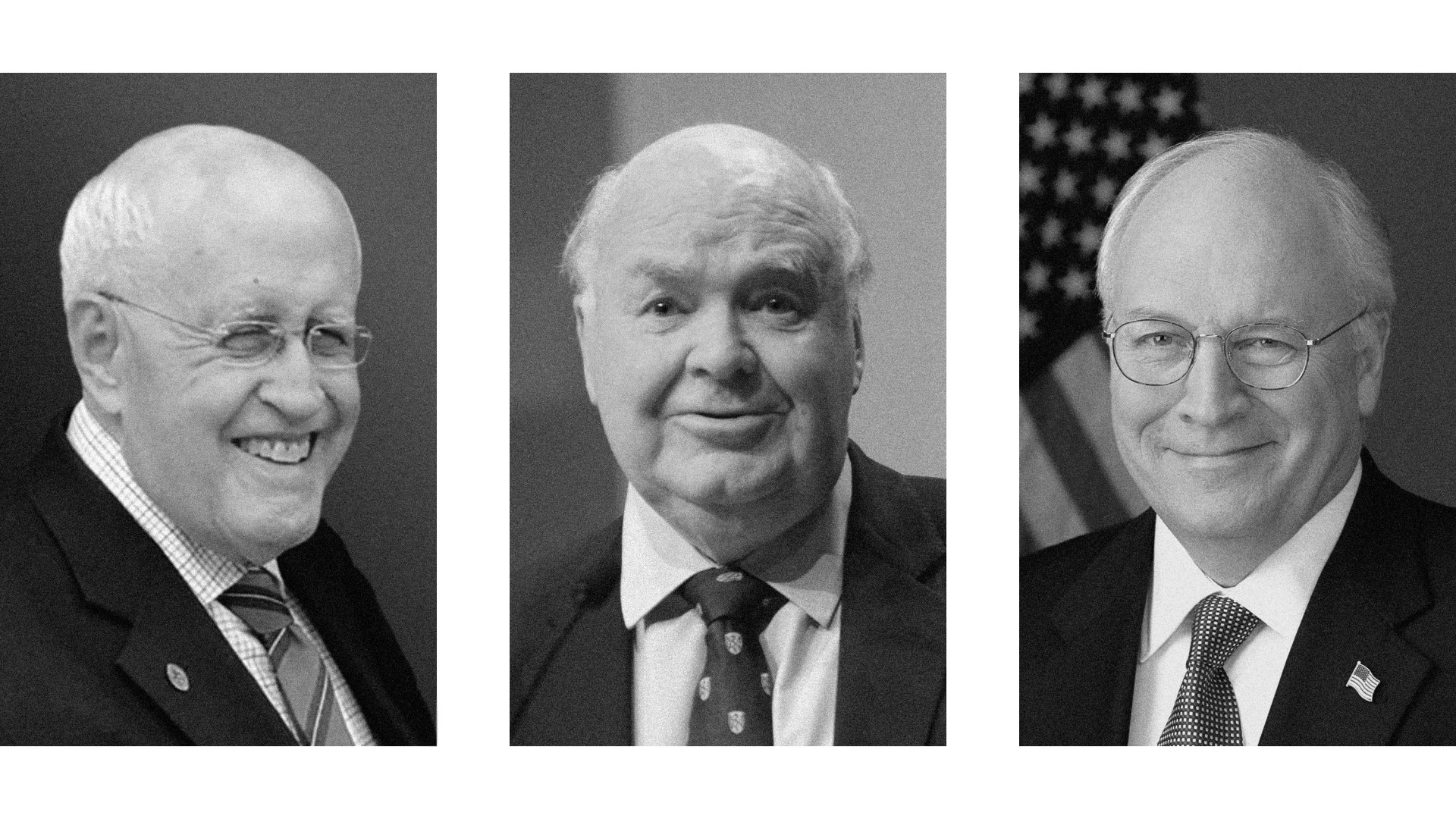
Left to right: Bill Murchison, John Lennox, and Dick Cheney.

Left to right: Bill Murchison, John Lennox, and Dick Cheney.

Illustration by Christianity Today / Source Images: WikiMedia Commons, Marvin Olasky

In “Man Knows Not His Time,” Puritan Increase Mather preached in wintry 1696 Boston about the surprise of unexpected dying. Many of us do not know our own times regarding the surprises of unexpected social and political changes. These three men, ages 83, 84, and 82, reacted vigorously to those changes: recently deceased syndicated columnist William (“Bill”) Murchison and Vice President Dick Cheney and still-living Oxford professor John Lennox.

Those who attended Murchison’s October 27 memorial service in Dallas learned he was born in 1942 and graduated from the University of Texas in 1963. He had 60 years as a faith-filled journalist and 50 years as a faithful husband. On CSPAN in 1999, Murchison said, “As a political commentator, it is my conviction that a marriage, a good marriage, is a happier event than an election.”

The service was held at Episcopal Church of the Incarnation, where Murchison was a chalice bearer for 47 years and a vestryman for multiple terms. But he was an Episcopalian with a difference. In his 2009 book Mortal Follies: Episcopalians and the Crisis of Mainline Christianity, Murchison wrote sardonically that “the God you increasingly hear spoken of in Episcopal circles is infinitely tolerant and given to sudden changes of mind” and is “a God that the culture would be proud of, as against a culture that God would be proud of.”

Murchison ardently opposed abortion and supported sexual distinctions: The summer 2025 issue of The Human Life Review, which he helped edit, lists on its cover a Murchison article headlined, “There Are Boys; There Are Girls.” Murchison and I corresponded over the years, and I interviewed him in front of Patrick Henry College students in November 2013. My first question was how journalism had changed during our half century within it. Here’s what he said:

Most journalists had the commitment that whatever they worked for—magazines, newspapers, TV stations—they were not your brains. They were your eyes and your ears. They existed to tell you how to use your own eyes and ears. That came to a sad end in the post-Watergate period when journalism began to reinvent itself as the kind of alternative source of wisdom, competing with colleges and universities and churches in terms of announcing what was important and what needed to be thought about and what we ought to think about it.

Murchison added that the older journalism came out of “people who had not been to Harvard, Yale, even Patrick Henry College.” He continued,

They joined newspapers because they loved to be on the frontlines of events. They loved to tell stories. … They loved to answer questions: What’s all this about? What’s really going on? Why should we care about it? They loved to answer those kinds of questions rather than to pose the question that journalists are fond of posing today: Why don’t you agree with liberal intellectuals?

Murchison, along with reporting for and editing the Dallas Morning News, wrote The Cost of Liberty: The Life of John Dickinson, a biography of the man known as the “Penman of the Revolution” for his highly influential Letters from a Farmer in Pennsylvania (1768). Dickinson, Murchison said, “wrote in favor of what he called ‘balanced moderation,’ the idea that a thorough and wholesome discussion is necessary before extraordinary actions are taken.”  

Murchison in 2013 said that if 21st-century progressives had not demanded such a rapid increase in what they saw as progress, “the level of anger would not have risen.” He added, “We need more people like Dickinson, instead of fewer. The lack of forethought and caution almost makes inevitable the rise of hotheads.”

But Murchison also wanted conservatives “to take prudent action” and said that “Dickinson did not consider burning down the barn to exterminate the vermin to be prudent action, but rather an action with more dire consequences than not.”

Dick Cheney, who died Monday, November 3, at age 84, grew into prudence. He went to Yale University to play football but flunked out twice and had a drunk-driving conviction in 1963 that he said was a turning point in his life. He graduated from the University of Wyoming, had six terms in the Congress, and was secretary of defense and then George W. Bush’s vice president from 2001 to 2009.  

I met Cheney only once and know little about his religious life or lack thereof, and obituaries haven’t provided many details. When asked about his beliefs in Clio, Michigan, in 2004, he said, “Well, I—my family was serious about their faith. My mother sang in the church choir. Dad was the church treasurer, as was his father before him. I grew up as a Methodist. And it has been an important part of my life, and our family’s life.”

Cheney then quickly pivoted:

But it’s also important to remember that one of our great strengths as a nation, one of the great gifts we have as Americans is freedom of religion that, in fact, we do believe in the separation of church and state. … I think it’s perfectly appropriate for us to recognize a divine being in the course of affairs of this nation, as did the Founding Fathers. … Our religious faith and religious convictions played a very important role in the founding of the country. I think it’s very important to a great many Americans.

Not a profession of faith that excites me or probably many CT readers. Nevertheless, while I disagreed with him about some things, in our current context I’m impressed that he had no personal scandals in decades of governmental service and no marital scandals during 61 years of devotion to his wife, Lynne, until death parted them. It takes all kinds of people to keep a ship going, and Cheney did speak of “the fixed stars by which the American ship of state navigates … our belief in limited government, in democracy, in pluralism and the rule of law.”

Steve Hayes, CEO of The Dispatch and a close observer of Cheney’s vice presidency, said on The Bulletin last week that Cheney was private about matters of faith:

That carried over to the way that he addressed issues that we would all deem as important to social conservatives. They moved from the kinds of issues that he was most comfortable with—national security issues, economic issues—into what I think he would describe as softer issues and issues that had more to do with feelings and faith than he was comfortable discussing in public.

Mike Cosper on The Bulletin added, “Late in his life when he stood with his daughter Liz when she bucked the entire party, those were remarkable moments. They were moments of courage.” Russell Moore recalled, “That moment in the 2004 vice presidential debate, when he said to the Democratic nominee John Edwards, I’m at the Senate every Tuesday, presiding over the Senate as vice president. The first time I’ve ever met you is now—behind it was this sense of responsibility. The contrast was just amazing.”

Cheney’s colleagues applauded, sometimes sardonically, his honesty. George W. Bush White House hand Dan Bartlett said in a Miller Center oral history series that he and others knew where they stood with Cheney: “In Washington and politics you get a lot of people who will stab you in the back. Dick Cheney was perfectly comfortable with stabbing you in the chest.”

On to Irish-born John Lennox, who turned 82 on November 7. As a student at the University of Cambridge, Lennox attended the last lectures of C. S. Lewis in 1962 and graduated from that institution with a science PhD in 1970. He then taught about science and religion at the University of Oxford and over the years had debates with Christopher Hitchens, Richard Dawkins, Peter Singer, and others. Lennox is the author of many books, including God’s Undertaker: Has Science Buried God? and Seven Days That Divide the World: The Beginning According to Genesis and Science.

Lennox sees the importance of speaking out, as Murchison and Cheney did. When I interviewed Lennox in front of Patrick Henry College students in 2012, he spoke to them about not hiding their light:

I’ve had bright graduate students saying, “We’re doing biology, and if we were to even suggest that we have a very dimensional Christian faith, we’d be looked at negatively, so we have to be very careful.” I would agree with that, but I think silence cannot be the answer, because in my experience people who say, “I’ll wait until I get tenure” or “I’ll wait until I become CEO,” et cetera—it never happens.

Lennox continued,

When I was 19 at Cambridge I met my first Nobel Prize winner. I sat by him at dinner and didn’t keep quiet about my Christian faith. I tried to talk to him about God and wasn’t very successful. At the end of the meal, he insisted I come to his room for a cup of coffee. He invited three other full professors and just me. He sat me down and said, “Do you want a career in science?” I said, “Yes, sir.” He said, “Give up this childish stuff.” The pressure was colossal. I managed to screw up enough courage to say, “What have you got to offer me? If it’s better than what I’ve got …” He came out with some evolutionism. I said, “If that’s all you have to offer me, I’m going to take the risk.” He was furious, but somehow it put steel into my heart.

Lennox’s bottom line is from the beginning of the Gospel of John. To the students he quoted, “‘In the beginning was the Word.’ That is of profound importance. This is a Word-based universe. In Genesis 1, God, who of course could have done everything at once, did it in sequence. He spoke. Then he spoke again. And he spoke again.”

Lennox said God created the world in six days, but Lennox did not stipulate that “they are 24-hour days within a single earth week.” He went on to tell stories about the departure from teaching of C. S. Lewis, who died on November 22, 1963, the same day as John F. Kennedy and Aldous Huxley:

In 1962 he did a final eight lectures on John Donne and his poetry. It was very cold. Lewis was wearing a hat and very long scarf and a very thick coat. He started to lecture immediately as he came through the door. The room was full of people sitting on the windowsills, sitting on the floor.

As he wound his way to the lectern, he was getting his coat off and his scarf and his hat. By the time he had done all that, you’d already had five minutes of a brilliantly delivered lecture. The fun was at the end of it: He reversed the process precisely. He kept lecturing while he got dressed for the outside chill. His last words were uttered as he fled through the double doors.

I asked Lennox for his most important advice to Christian students. He replied, 

To love the Lord with their mind and begin to take Scripture seriously, because in our university system the problem is the two speeds of education. Their professional education goes up very rapidly, but their education and knowledge of God through his Word remains almost at Sunday school level. I would want to encourage them very strongly to build up their confidence in God and his Word.

Final question: “Advice to non-Christians?” Lennox: “I would want to drive a very big hole in their notion that science has somehow made it impossible to believe in God.”

Culture
Review

In Netflix’s ‘Frankenstein,’ Monster Is More Compelling Than Maker

The Guillermo del Toro adaptation brings unique perspective—but fails to match the depth of its source material.

Jacob Elordi as The Creature in Frankenstein.

Jacob Elordi as The Creature in Frankenstein.

Christianity Today November 11, 2025
Ken Woroner / Netflix / © 2025 Netflix, Inc.

When it was announced that Guillermo del Toro had struck a deal with Netflix to write and direct Frankenstein, an adaptation of Mary Shelley’s 1818 novel, longtime followers of the award-winning Mexican filmmaker couldn’t believe their luck. Del Toro has been making Gothic monster movies for three decades, and now he would finally get to try his hand at the original that started them all.

Sometimes, however, it’s best to leave passion projects to the imagination. Del Toro is an inspired director and Shelley’s novel is a classic, but this adaptation is a mess. It has its moments and its virtues. But in the end it fails to match either the depth of the source material or the richness of del Toro’s other films.

For readers and viewers unfamiliar with either, I’ll begin with del Toro before turning to the novel and where things go wrong (and, at times, right) in the transition to the big screen.

Born in Guadalajara, Mexico, in 1964, Guillermo del Toro Gómez directed his first film before he turned 30 years old. Frankenstein is his 13th, quite the pace given the scale of his larger productions. His work alternates between character-driven atmospheric horror—The Devil’s Backbone (2001) Crimson Peak (2015), and Nightmare Alley (2021)—and big-budget Hollywood blockbusters like Blade II (2002), Hellboy (2004), Hellboy II: The Golden Army (2008), and Pacific Rim (2013).

In 2017 del Toro made The Shape of Water, a love story between a mute janitor and an amphibious anthropoid. Although it is neither fans’ nor critics’ favorite—that title goes to Pan’s Labyrinth (2006), though my heart belongs to Cronos (1992)—it went on to win the Academy Award for Best Picture. Del Toro also won the Award for Best Director, a coronation of sorts.

Del Toro’s style and themes are consistent. When you’re in his cinematic world, you know it. Across every one of his films, he reveals himself as an obsessive, and what he’s obsessed with is creatures.

It’s a word with many meanings, and the director takes advantage of them all. Sometimes creatures refers to the fantastic, and indeed del Toro’s stories feature fairies and vampires and kaiju. Sometimes the word conjures spiritual beings, devils or gods or ghosts. Still other times it is simply monsters, real or imagined—the enormous tentacled behemoth out of the fiction of H. P. Lovecraft or else the fascist regime of Francoist Spain.

Three themes emerge. First, creatures have creators, and accordingly, del Toro is fascinated by the nature of invention, whether artistic, scientific, or technological. As a maker himself, he’s keen to explore the nature of making.

For human beings, the highest mystery of creation is birth and death. And so the second theme of del Toro’s stories is childhood and fatherhood—above all paternity’s perennial failures and their generational effects, usually terminating in tragic violence. Both Eden and the Fall loom large in his imagination.

Finally, creatures are marginal figures, and del Toro’s films are about what it’s like to live on the edge. It’s obvious enough how this applies to ghosts and fairies, vampires and devils. They’re always just out of sight, right around the corner, glimpsed and sought and lost from view.

Yet marginal figures are not only agents of myth or malice. They also include ordinary—or not so ordinary—men and women. Just as del Toro has a special interest in the fantastical, so too he has a special affection for the deplorable. Nightmare Alley, for example, tells the story of a traveling carnival of weirdos, oddballs, and outcasts. At the film’s heart is the “geek,” a down-and-out man reduced to the status of a slave, mocked and gawked at by paying customers and treated worse than a beast.

Nightmare Alley reflects del Toro’s heart for the dispossessed and dejected. His is a preferential option for losers. He puts them on display not to invite us to point and laugh but to show us their humanity, and with it our own.

At the same time, del Toro is himself a maker of monsters and thus a kind of cinematic carnival barker. This is the fundamental ambiguity of his art, an ambiguity he openly interrogates.

All this makes Mary Shelley’s Frankenstein an ideal vehicle for del Toro’s obsessions. For more than two centuries, the novel has permeated our culture to such a degree that it’s difficult to disentangle its legacy from the text. As most readers know, Frankenstein is the name not of the monster but of the monster’s maker. But then, as readers may also know, that phrasing has it the wrong way round. Shelley invites readers to wonder: Who in fact is the monster? Is it the creature or his creator?

Here is what readers may not recall. The subtitle of Frankenstein is “The Modern Prometheus”; Shelley is transposing the myth of the god who gave humans fire into the early 19th century in the wake of the Enlightenment and at the height of the Industrial Revolution. The novel’s subtext is both the transformative nature of technological invention and the unintended consequences that result. (Recall that Prometheus was punished for his gift.)

Furthermore, the novel’s monster is not a stumbling, mumbling oaf but a literate, eloquent, emotionally voluble seeker, a romantic soul in a reanimated corpse. A crucial piece of his journey of self-understanding comes when he reads John Milton’s epic poem Paradise Lost, and in this way Shelley mischievously brings into view the theological questions that lie beneath the surface of her story. After all, Milton’s poem is a retelling of the opening chapters of Genesis. Is the monster a second Adam or a fallen angel? Is Frankenstein godlike, or is he monstrous precisely because, like Adam, he sought to “be like God” (Gen. 3:5)?

Del Toro’s adaptation is admirable in its attempt to be faithful to Shelley. Rather than hide the layers of source material—del Toro retelling Shelley retelling Milton retelling Moses, all shot through with echoes of Greek mythology—the film wears them like a badge of honor. Every image and exchange of dialogue is saturated with religious allusions. Occasionally the result is quite beautiful, such as in the quiet painterly compositions that recur. More often, though, scenes are bent over with the sheer weight of their overt evocations. Del Toro’s overstuffed script leaves little to viewers’ interpretation; he is far too eager to tell you what he means.

Like the novel, the film unfolds in the form of a flashback. Unlike the novel, the story is split in two: first the protagonist’s tale, as told by Victor Frankenstein (Oscar Isaac), then the monster’s tale, as told by the monster himself (Jacob Elordi).

The latter section is far superior to the former. Where the first half is hurried, humorless, and overwrought, the second half is patient, subtle, and affecting. Both leads are accomplished actors, but while Isaac hams it up, Elordi’s performance of the monster as an awkward adolescent, filled equally with fear and awe of the world, is the highlight of the movie. Del Toro wants us to see that the monster’s fury could be cooled, had he a creator sufficiently caring to teach him.

Del Toro contracts and combines some of Shelley’s characters while introducing others. Elizabeth (Mia Goth), the fiancée of Frankenstein’s brother, has left the convent but retains her faith in God. This faith enables her to see Frankenstein for who he is (“Only monsters play God,” she says to him) and to see his creation for what he (not “it”) is: a living soul in need of love. Because love requires another—“It is not good for the man to be alone” (Gen. 2:18)—the monster pleads with Frankenstein to create for him a female companion, to no avail. This Adam is fated to lack both a mother and an Eve.

Frankenstein is a movie about what happens when fathers fail and mothers die—when, in a word, male is severed from female. It is a pointed reflection on the unfortunate grammatical fact that the verb to mother captures the work of a lifetime whereas to father names but a single moment at the very start.

The ending of Shelley’s novel—and here I will spoil a 200-year old book and a 1-month old movie—is pure tragedy. Frankenstein dies, having lost everyone he ever loved. The monster, overwhelmed by self-loathing, walks into the cold north in order to burn himself alive, thereby ridding the world of his presence. “Polluted by crimes, and torn by the bitterest remorse,” he asks, “where can I find rest but in death?”

Though del Toro left the church as an adult, he was raised Roman Catholic, and he is open about Catholicism’s influence on all his films. So too here. The creature tells his creator the story of his life from his own perspective, and to our surprise, this induces not fury but pity. Frankenstein asks for forgiveness, the only time he ever sincerely admits fault. The creature grants it, kissing his maker’s forehead as he dies. The creature then turns north—undying, unkillable, immortal—and walks into the sunrise, his eyes filled with hope for the first time.

There it is again: del Toro’s eye for the unloved, his affection for monsters. He can’t let this one escape our compassion either. I regret the shortcomings that hold back this particular adaptation—the contrived first half, the horrid and unnecessary CGI, the monster’s outlandish fights and brutal rampages that feel torn out of some other movie—but they are worth regretting, because del Toro has a unique perspective on this material. Shelley’s original was biblical in body but pagan in spirit. For del Toro it is just the reverse. His creature looks like a monster on the outside but has a Christian soul.

Brad East is an associate professor of theology at Abilene Christian University. He is the author of four books, including The Church: A Guide to the People of God and Letters to a Future Saint.

addApple PodcastsDown ArrowDown ArrowDown Arrowarrow_left_altLeft ArrowLeft ArrowRight ArrowRight ArrowRight Arrowarrow_up_altUp ArrowUp ArrowAvailable at Amazoncaret-downCloseCloseellipseEmailEmailExpandExpandExternalExternalFacebookfacebook-squarefolderGiftGiftGooglegoogleGoogle KeephamburgerInstagraminstagram-squareLinkLinklinkedin-squareListenListenListenChristianity TodayCT Creative Studio Logologo_orgMegaphoneMenuMenupausePinterestPlayPlayPocketPodcastprintremoveRSSRSSSaveSavesaveSearchSearchsearchSpotifyStitcherTelegramTable of ContentsTable of Contentstwitter-squareWhatsAppXYouTubeYouTube