News

Europe’s Christian Pacifists Reconsider Peace by Arms

Some once committed to nonviolence see rearmament as a necessary deterrent.

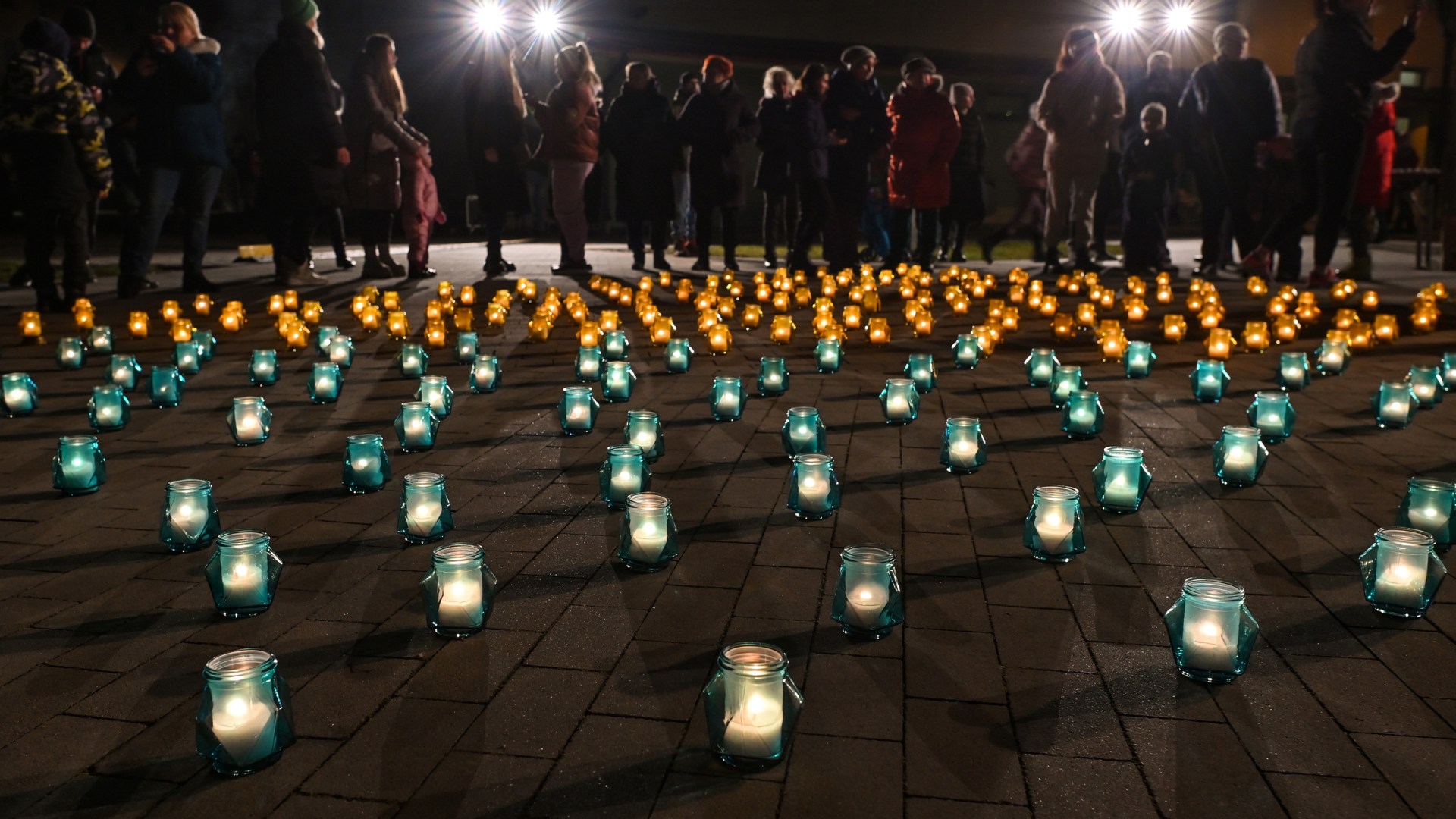
People at a 'Light for Ukraine' vigil in Poland in February 2023.

People at a 'Light for Ukraine' vigil in Poland in February 2023.

Christianity Today November 6, 2025
NurPhoto / Contributor / Getty

Over the last ten centuries, Nikolaikirche—a Protestant church in Eisenach, Germany—has witnessed its share of war and civil strife, dictators and destruction. But this year, in the encroaching darkness of early autumn, its Romanesque stone arches are bathed in candlelight, emanating from stations set up to invite visitors to pause and say a prayer—for peace, for an end to violence, for reconciliation.

The event, held annually in conjunction with the Community of the Cross of Nails and the Coventry Cathedral in England, reminds participants of Jesus’ emphasis on reconciliation and of Christian convictions around finding diplomatic solutions to serious conflicts, said Gabriele Phieler, a pastor and retired superior of a Protestant social welfare organization located next door to the Nikolaikirche.

Questions of war and peace are never easy, especially when European nations are increasing their military capabilities, acquiring more advanced weaponry, and boosting defense spending. In the last month, the continent has witnessed continued and intensified Russian attacks on Ukraine, which have killed civilians and damaged infrastructure. Europe is responding by bolstering its own defenses and considering new, controversial strategies like using frozen Russian assets to fund Ukraine’s military needs.

Given the fear of further Russian aggression, some German Christians want to do more to protect the country. But tonight, as the flicker of flames plays across centuries-old walls where Christians have gathered in times of turmoil and reconciliation alike, Phieler hopes attendees will simply come together to pray and trust in God for peace.

Over their history, European churches have blessed armies and supported wars in the name of God. At the same time, a countertradition of Christian pacifism has persisted. From Anabaptists, Mennonites, and Quakers in the 16th and 17th centuries to the Catholic peace group Pax Christi after World War II, various believers in Europe have argued that following Christ means rejecting violence.

Russia’s invasion of Ukraine in 2022 has brought that tradition under strain. Eastern European nations like Poland, Estonia, or Romania worry about future aggression. The region’s pacifist networks are now urging negotiation and reconciliation while others traditions insist on military support, reviving an old European argument over what Christian peacemaking really looks like.

Public debates reveal a polarized landscape. Initiatives opposing arms shipments to Ukraine, led by figures such as Left populist German politician Sahra Wagenknecht and journalist Alice Schwarzer, draw support from some Christian pacifists.

But others once committed to peace feel Russia’s invasion of Ukraine is prompting Christian pacifists to rethink what it means to pursue peace.

“We are simply faced with naked aggression. There must be some sort of deterrence. To keep the peace, we need security guarantees,” said Christian ethicist Alexander Maßmann.

Through his popular column Evangelisch Kontrovers, Maßmann has acknowledged the harsh realities that challenge idealistic pacifism. Maßmann, who once opposed military buildup, now sees deterrence as a moral necessity. “The international situation is not what we thought it would be,” he said. “We are simply faced with naked aggression.

“To keep the peace, we need security guarantees—and rearmament is helpful in that sense,” Maßmann said.

Looking back in recent decades, Germany’s Protestants, particularly under the leadership of Margot Käßmann, former chair of the Evangelical Church in Germany (EKD), had leaned toward a more pacifist stance.

Käßmann advocated for diplomacy and nonviolence, calling for an immediate cease-fire in Ukraine and an end to arms deliveries. She stressed that “God is not a party to war” and warned that growing militarization poses a threat to the future.

Yet in recent years, Russian aggression has prompted some within the church to reconsider. While Käßmann and like-minded voices continue to emphasize restraint, other Protestant leaders argue that refusing military assistance could leave civilians exposed to violence.

This tension illustrates a broader reassessment: Pacifism remains a guiding principle, but some see armed support as a practical necessity at times. The challenge, they say, is balancing historical commitments to peace with urgent demands for protection.

Maßmann points to the 2007 German church memorandum, which neither endorsed categorical pacifism nor unqualified just war theory—it contended instead that “military action can be justified under certain circumstances, yet it remains sinful.” Advocates like Maßmann suggest this approach allows Christians to navigate modern security dilemmas without abandoning a moral commitment to peace.

Across contemporary Europe, citizens find their ethical convictions challenged by geopolitical realities.

Maßmann said people fear that some form of a military-industrial complex might arise, making it harder to bring the long-term view of peace back into the frame and leaving Christians and citizens alike to weigh the costs of both action and inaction.

He worries that Christians could lose sight of their theological foundations. “It would be sobering if we had to surrender to realpolitik,” Maßmann warned. Instead of rejecting all force, he urged pacifists to consider “how we make those things serve peace and law in the longer run.” For now, that might mean choosing rearmament and war.

Even so, Maßmann cautioned against unchecked militarization. “There’s a real danger that a military-industrial complex might arise,” he said. The challenge for Christians, he added, is to keep any buildup under democratic control—and to “keep the vision of peace alive in our debates.”

The German Evangelical Alliance (EAD) has not yet commented on German arms deliveries to Ukraine. In a Q&A on the alliance’s website, its recently appointed political commissioner, Johann Matthies, said though he is personally committed to pacifism, he has never gone so far that he wanted to see the German military disarmed.

Rather, he said the crucial question Christians must ask in a time of rearmament and potential war is whether they themselves will “carry a sword”—either by serving the military or by voting for political platforms that promote rearmament. That question, Matthies said, is a matter of personal conscience. “Everyone must answer this question for themselves in conversation with God.”

While advocating for international diplomacy, Matthies said that failing to do everything possible for Ukraine’s air defense is not only “politically shortsighted,” but also, to Ukrainians under attack, quite “cynical.”

For Micael Grenholm, however, pacifism remains the only biblical—and practical—response to the specter of further European conflict.

A Swedish Pentecostal scholar and peace advocate, Grenholm works with Pentecostals and Charismatics for Peace and Justice, a movement that promotes nonviolence and conscientious objection.

Grenholm’s position stems from Gospel directives to love enemies and turn the other cheek. “I didn’t really argue with the text,” he said. “That’s how I became a pacifist.”

Grenholm said his conviction grew through the study of early Christianity, where figures such as Tertullian, Origen, and Justin Martyr emphasized nonviolence and refusal to join the Roman military. That tradition, he argues, sits alongside contemporary studies that argue violence is costly and nonviolent action is more effective.

Acknowledging the “naked aggression” Maßmann believes demands a response from pacifists, Grenholm also sees a place for noncooperation, sabotage, and other resistance that “doesn’t involve violence against human beings.” A Spanish study documented over 200 examples of nonviolent actions during Russia’s invasion of Ukraine that helped slow its progress and prevent an all-out capitulation by Kyiv.

Bolstered by his faith and such studies, Grenholm frames Christian pacifism as a “principled, effective, and Christ‑centered” form of resistance.

“Jesus isn’t telling his followers to give up in the face of oppression or military violence,” he said, “but pointing to another way that is a stronger, more successful force in opposing evil.”

Books

How to Forgive When You’re Deeply Offended

A new book from Bible teacher Yana Jenay Conner offers a blueprint for living out a difficult spiritual practice.

The book cover on a pink background.
Christianity Today November 6, 2025
Illustration by Christianity Today / Source Images: Getty, Harvest House Publishers

The pages of Scripture are soaked with forgiveness. In book after book, the Bible traces God’s redemptive plan to forgive those who repent of their sins and place their faith in him. As people who have been freely forgiven through the work of Christ, we are to reflect our heavenly Father by forgiving those who sin against us. 

But many times, forgiving is easier said than done. It’s more lovely to hear about God casting our sins into the sea of forgetfulness than to extend that type of grace to those we find at fault. Those who have been walking with God for a while may be able to forgive small offenses without much strain. But when bigger tests inflict deep wounds on the heart, forgiveness may only be offered over a tear-soaked Bible through gritted teeth. 

Living Beyond Offense: Doing the Hard Work of Forgiveness God's Way

Living Beyond Offense: Doing the Hard Work of Forgiveness God's Way

Harvest House Publishers

240 pages

Bible teacher Yana Jenay Conner wants to help guide Christians through what to do after offense has been served to us on a platter. In Living Beyond Offense: Doing the Hard Work of Forgiveness God’s Way, Conner takes readers through her own journeys of forgiveness and offers a helpful blueprint that disentangles the topic from its close cousins, reconciliation and trust. 

The author is quick to say that she sees herself not as an expert but a “fellow weary traveler” attempting to shine the light of Christ in the wilderness of suffering. Conner’s suffering included an 11-year journey of forgiving and ultimately reconciling with her once-absent father, who struggled with alcoholism. His absence led to suppressed feelings that went unaddressed for years, Conner writes, and culminated in a fear of abandonment that infected her other relationships. 

Conner knew God was calling her toward forgiveness, but she didn’t entirely understand why she should forgive or how. She sets out to address both questions in a way that’s accessible to readers encountering the topic for the first time and still insightful for those who need a refresher. 

As with any good exegete, Conner builds the foundational pillars of her book from the Scriptures. Sin warped God’s creation and marked our relationships with what Conner calls “self-conscious, self-centered self-preservation.” Christ came to reshape us into peacemakers who mirror him (Matt. 5:9) through “self-giving, others-centered sacrificial love.” 


Christ’s version of shalom (Hebrew for “peace” or “wholeness”) is revealed not just in fixing our enmity with God or the fractures in our societies, she writes, but also in living in relationship with each other. What we see today, however, are people who are shalom avoidant or shalom demanding.

Those in the first group, Conner writes, run away from uncomfortable situations and seek the absence of conflict, as with the person who ghosts a dating partner when it’s time to define the relationship. The second group is focused on settling debts and holding real or perceived offenders to account (the impetus behind cancel culture). 

Some readers might quibble with the labels, but I thought the categories were a helpful and accurate description of personality types and cultural attitudes. 

Conner correctly identifies both approaches as harmful and presents the biblical case: Forgive offenders of their debts, practice mercy, and choose not to retaliate, knowing that God, the ultimate judge, will avenge all wrongdoing and execute justice. 

Our culture often pits forgiveness against justice, casting the former as a weakness that evades accountability. Biblical forgiveness which is offered freely is not a license to abuse, nor is it the denial of justice. However, it does force us to trust in God and his plan—and his promise to accomplish it according to his righteous wisdom. 

Conner calls on readers to “humbly confront” offenders (Matt. 18:15–17) and seek to restore damaged relationships with the awareness that true reconciliation is shared work between different parties, not one person trying to glue broken pieces back together. Forgiveness is for everyone. But “reconciliation is for the repentant few,” she writes.   

The author stands on solid theological ground for most of the book, but I was not convinced by one of her interpretive moves. In her explanation of Jesus’ command to turn the other cheek, she says it’s more than a command to forgo retaliation.

“He is commanding them to humbly confront their offender by inviting them to reexamine the hierarchy they’ve created in their mind and to treat them as a fellow image-bearer,” Conner writes.

“While they would get slapped again, at least this time, with their right cheek protected, it would be an openhanded slap among equals” instead of a “backhanded slap” that would be deemed highly offensive in the Jewish honor and shame culture.

Conner’s interpretation of the text mirrors the one employed by some theologians including the scholar N.T. Wright. But since there is no distinction between a front hand and a backhand slap in the biblical text, I felt it required more argumentation than the book provided.

In another section of the book, Conner surprisingly pushes back on the idea of forgiving for the sake of internal freedom. Though the adage “Forgiveness is a gift you give yourself” is true in many ways, she accurately notes that the Bible’s primary encouragement to forgive comes from the fact that we as believers have been forgiven and in turn should forgive others (Eph. 4:32).  

The book is compassionate toward survivors of abuse, and Conner notes that she has counseled such individuals. For those on their own tender journeys of forgiveness, she recommends a counselor or trustworthy resources that can provide tools of support. 

But she also notes the extent to which therapy-speak (words like toxic, narcissistic, trauma) has infiltrated our culture, and she gives a much-needed call to discern between abuse and human-inflicted hurt that doesn’t cross that line. Furthermore, she exhorts readers to do the introspective work of figuring out when a perceived offender has run afoul of God’s commandments versus our own preferences and desires. 

Being a “shalom-maker,” as Conner calls it, is challenging. After we say, “I forgive,” feeling forgiveness can be tough, especially when memories of the offense pop up again and again. 

In my own life, forgiveness can feel incomplete until I pray for the offender—in some cases, repeatedly, until every taste of bitterness is washed away. I wish Conner spent a little more time on this area. But she does a respectable job of laying out the different ways God helps us in the journey: through his Word, his Spirit, and the counsel of Spirit-filled believers.

Overall, the book is an excellent guide that teaches readers how to navigate their own forgiveness journeys while looking to the author’s example. 


Ideas

Have We Kissed Purity Goodbye?

Contributor

We don’t need pledges or rose metaphors. We do need more reverence and restraint.

Wilted roses in a trash bag.
Illustration by Elizabeth Kaye / Source Images: Getty

If you grew up in purity culture, you probably remember the rose.

A preacher holds up a perfect red flower, full and fragrant, and passes it through the crowd. As the bloom makes its way around the room, he warns of the degrading power of sexual sin. He cautions against “giving pieces of yourself away.” By the time the rose returns to the front, it’s drooping, torn, missing petals. Like a prosecutor presenting evidence to a jury, the pastor holds up the flower and asks the question no one will answer. “Who wants this rose?” The ensuing silence is the point.

The rose illustration is emblematic of purity culture, the evangelical sexual-ethics movement that took hold in the 1990s amid soaring teen pregnancy rates. Offering father-daughter dances, spaghetti-strap prohibitions, and seminal titles like I Kissed Dating Goodbye, purity culture at its best proclaimed solid biblical teachings on sex, marriage, and modesty.

At its worst, it appealed to shame to protect the sacred. Too often, it preached self-control motivated by fear, equated virginity with virtue, and confused holiness with reputation. Its weight lay heaviest on women—how they dressed, who they tempted. Even when motivated by good intentions, purity culture left many believing they could lose God’s love with a single mistake.

Today, people who grew up signing pledges and internalizing object lessons—the rose, chewed-up bubblegum, tape that’s lost its stickiness—are naming what purity culture did to them. The guilt. The anxiety. And the church has started to listen. Writers, pastors, and therapists have worked to untangle desire from shame, to show that sex isn’t dirty and that grace isn’t fragile. Let me be clear: This reckoning is good and necessary. It’s helped many Christians rediscover a God who loves wounded people, not perfect performances.

But I fear that in the process of tearing down purity culture, we may have kissed purity itself goodbye. And that’s a problem.

You might think I sound like a boomer nostalgic for the days of modesty charts and curfews. I’m not. I’m a zoomer from the cesspool. My generation is porn addicted, drug dependent, dopamine sick, irony poisoned, attention fractured, and spiritually starved. We’ve traded repression for indulgence, and the result isn’t freedom—it’s decay.

Does Jesus still love my generation? Of course! But the youth pastors were halfway right. We really can become damaged roses.

If the 1990s and early 2000s gleamed with silver purity rings, today’s fingers slip over “for you” pages instead. Every scroll, swipe, and stream is saturated with sexual imagery—thirst traps disguised as authenticity, confessions that double as exhibition, and entire industries built on monetizing the human body. Pornography has become the air we breathe. Studies show that 73 percent of teens have consumed porn and 87 percent of young men watch porn weekly.

Porn aside, we’ve absorbed a worldview that treats the body as endlessly editable and desire as endlessly expressive. Sex before marriage is assumed. Cosmetic surgery is casual. Hookup culture is celebrated as empowerment. Even Christian spaces aren’t immune. Churchgoers hype the same music, the same aesthetics, the same algorithmic sexuality as everyone else.

The irony is that the “sexual freedom” meant to liberate us has only left us lonelier. Sociologists note that young adults are having less sex, entering fewer relationships, and marrying later than any generation before them. The more our culture obsesses over pleasure, the less capable we seem of connection. We’ve been trained to consume rather than commit, to perform rather than belong.

Recently, British influencer Lily Phillips went viral after admitting to sleeping with more than a hundred men in a single day—a story she later recounted with visible regret. “Sometimes you’d disassociate,” she said tearfully. “In my head right now, I can think of like five, six guys, ten guys I remember.” The sexual revolution promised empowerment, but it has delivered exhaustion—a generation of people who can’t tell the difference between intimacy and exposure.

Even secular thinkers are starting to admit this. In The Case Against the Sexual Revolution, journalist Louise Perry argued that newfound sexual “freedom” has made women less safe, less happy, and more disposable. She concludes her book with a piece of advice for her young readers: “Listen to Your Mother.” It turns out the Christian sexual ethic—once derided as prudish—is one of the last coherent frameworks for love, dignity, and belonging.

Purity, rightly understood, isn’t about fear. It’s about reverence. It’s not about suppressing desire but directing it. Paul writes, “It is God’s will that you should be sanctified: that you should avoid sexual immorality; that each of you should learn to control your own body in a way that is holy and honorable” (1 Thess. 4:3–4). The problem isn’t that we desire too much; it’s that we’ve forgotten what desire is for.

Our desperate need for purity runs deeper than sex. It’s apparent in our humor, our language, our appetite for outrage. In many conservative circles, it’s become fashionable to use once-banned words like retard and gay as weapons. Public figures toss them around like badges of bravery against “wokeness,” and their followers applaud the “courage” to say what others won’t. Even young Christians have joined in, mistaking cruelty for conviction.

But Scripture names this plainly: sin. “On the day of judgment,” Jesus said, “people will give account for every careless word they speak” (Matt. 12:36, ESV). Paul wrote, “Do not let any unwholesome talk come out of your mouths, but only what is helpful for building others up” (Eph. 4:29). James warned that the tongue is “a fire, a world of evil,” capable of blessing God and cursing his image bearers in the same breath (James 3:6–10).

We’ve confused bluntness with bravery, irreverence with realism, profanity with power. But how we speak about people—especially our enemies—reveals the kind of god we actually worship. The tongue, James says, cannot be tamed. Maybe that’s why purity still matters: not as repression but as restraint.

From shock-jock pastors to Taylor Swift’s raunchy lyrics, from poisoned memes to videos of a father gunned down in broad daylight—our culture is anything but pure. We live in an era where everything sacred has been reduced to a spectacle.

Nothing will make you long for purity quite like living without it. Spend enough time in the digital swamp, and you start to feel the brain rot, the moral vertigo. “The eye,” Jesus said, “is the lamp of the body. If your eyes are healthy, your whole body will be full of light” (Matt. 6:22). We’ve trained our eyes to crave darkness.

“The mouth speaks what the heart is full of” (Luke 6:45), and in the digital age, our feeds reveal our hearts. The internet has normalized voyeurism and cynicism. To refuse them is to remember that purity isn’t repression—it’s clarity. It’s the quiet discipline of guarding what you see and what you let shape you. “Above all else,” Proverbs 4:23 says, “guard your heart, for everything you do flows from it.”

Louise Perry’s questioning of the sexual revolution has led her somewhere she didn’t expect: faith. Recently, Perry announced that she has become a Christian—not just in a cultural sense but in a real, supernatural way. What began as a sociological interest in Christian sexual ethics has evolved into a belief in the Christ behind it.

The very purity our culture mocks is now drawing people back to God—because Christian purity, rightly understood, isn’t repression. It’s restoration. It doesn’t deny the body; it dignifies it. It doesn’t erase desire; it redeems it.

As someone who’s grown up entirely online, I’ve seen more than I ever needed to—and I know I’m not alone. So many of us feel exhausted and overexposed. We want a cleaner joy. We want guarded hearts, filtered eyes, sheltered souls. We’d rather be “prudes” than products.

We’re damaged roses who Jesus loves. We want to bloom again.

Luke Simon is the codirector of student ministries at The Crossing in Columbia, Missouri, and an MDiv student at Covenant Theological Seminary. He has written on Gen Z, technology, masculinity, and the church. You can follow him on X.

Theology

The Church Better Start Taking Nazification Seriously

Columnist

Tucker Carlson hosted neo-Nazi Nick Fuentes on his podcast. The stakes are high for American Christians.

Nick Fuentes
Christianity Today November 5, 2025
Illustration by Christianity Today / Source Images: Youtube

This piece was adapted from Russell Moore’s newsletter. Subscribe here.

Last week, after Tucker Carlson platformed neo-Nazi apologist Nick Fuentes on his podcast, the Heritage Foundation’s president Kevin Roberts issued a statement defending Carlson. Roberts denounced what he termed a “venomous coalition” of conservatives who called out the interview because they oppose any “no enemies to the right” posture that includes Nazism. In the days since, some Heritage Foundation staffers have told reporters that the controversy revealed for them how many of the youngest staffers and interns actually agree with Fuentes. This comes only weeks after text messages from multiple Young Republicans groups were leaked, showing racist, antisemitic, and pro-Hitler messages.

This matter is crucial for the future of the country, but the stakes are even higher for the church. It is well past time for the church of Jesus Christ to take this seriously. And the first step to seeing how to do so is to ask, “Why do so many evangelical pastors and leaders not take it seriously now?” Already some constantly online young men who profess to be evangelicals are winking and nodding with HH references and “noticing things” memes while commending the ideologies of Nazis such as Carl Schmitt. Some older leaders don’t take it seriously because they think the numbers of these young men are so few, and some because they think the numbers are so many.

Those who think the numbers are too few will wave away concerns with phrases like “Online is not real life,” usually pointing out that very few of these social media trolls are preachers or pastors. They will note that those who are preachers are typically in front of tiny congregations and spend most of their time podcasting and posting back-and-forth arguments online all day. That is true—and is utterly beside the point.

Those who say such things do not understand how almost every fad—good, bad, and neutral—that has swept through evangelicalism has taken hold. These trends start out in small groups of people that are not large enough to be taken seriously by “successful” leaders. These small communities then cultivate the fads until a couple people with bigger platforms adopt them. And then, seemingly suddenly, they are everywhere. Power evangelism, prayer walking, seeker-sensitive services, laughing revivals, New Calvinism—all of these (and again, some of these things are good, and some are not) happened that way.

Journalist Jonathan V. Last once described how systems fail: “When the bad guys win, it’s always because they are enabled by the weakness and wishful thinking of people in a position to stop them.”

The greater problem is with the evangelicals who say nothing because they think the numbers are too great. They will pivot the discussion and say that “this is what you get” when some objectionable thing happens elsewhere—as though we were talking about kindergartners. Whatever your theology proposes about the age of accountability, I think we can all agree that a 25-year-old is well past the bar. Others will argue that, though they wouldn’t have done it this way, there’s a vibe shift in this direction that we have to recognize.

During World War II, American journalist Dorothy Thompson described this type as “Mr. B” in her famous essay “Who Goes Nazi.” She wrote, “He fits easily into whatever pattern is successful. That is his sole measure of value—success. Nazism as a minority movement would not attract him. As a movement likely to attain power, it would.”

The mentality which suggests that laughing at sexual abuse or using denigrating slurs for those with disabilities or wink-wink-nod-nod sending around Nazi memes is evidence of a “vibe shift” is perhaps understandable for a pagan who believes the zeitgeist is lord. But for a Christian who has read any page of the Old or New Testament, that’s incomprehensible.

Jesus said, “For false christs and false prophets will arise and perform great signs and wonders, so as to lead astray, if possible, even the elect” (Matt. 24:24, ESV throughout). The description of the Beast of Revelation is of near-universal popularity and success: “Who is like the beast, and who can fight against it?” (Rev. 13:4).

When the popular will becomes the standard of truth, we move from silliness in the best of times to cruelty in worse times and to the death camps in the worst of times. This is a call, as Jesus put it, for “endurance and faith” (v. 10). You can call that a “vibe shift” if you want.

The vibe-shift view is precisely what led the Confessing Church of 1934 to stand up against the German Christians, the religious party associated with Adolf Hitler. The Confessing Church’s statement said, “We reject the false doctrine that the Church could and should recognize as a source of its proclamation, beyond and besides this one Word of God, yet other events, powers, historic figures and truths as God’s revelation.” Karl Barth, the primary author of the Barmen Declaration, would write later to churches in Nazi-occupied France, who seemed to be wobbling in their commitment to resist publicly or forcefully Nazi ideology:

I cannot think that your judgment of today about the fundamental situation between Hitler and the rest of us is different from a year ago just because in the meantime Hitler has had so many good days (vividly reminding us of Job [21] and Psalms [10] and [73]) and France, together with all those other countries, so many bad days.

Barth continued,

If that were your attitude, you would have surrendered, not merely to the German arms, but to that German philosophy which in 1933 broke out like a plague among the German people themselves. In that case, Hitler would have conquered not only your country but your souls.

During the years of Nazi domination of Germany, writer Thomas Mann, an expatriate, broadcast a series of radio addresses to his fellow Germans, pleading with them to resist what was happening to their country. Among the atrocities, he included what he said had to be “the strongest and most ghastly phenomena of National Socialism [Nazism].” He described it with a word we don’t use much anymore, vitiate, which means “to debase” or “to corrupt.” Mentioning such glorious words as peace and patriotism, Mann wrote that Nazism “has vitiated all ideas which were supported by the best men in the world and has made them something in which no decent person wants to partake anymore.”

Conservatives alarmed at the steps toward the normalization of Fuentes and a Nazified young right understand this. They know this awful ideology will evacuate all the principles they wish to conserve of the meaning of words like peace and patriotism. But why do I say the stakes are even higher for the church? After all, the church does not have nuclear codes and cannot build death camps. It can only empower with its support—or its silence—those who do.

The question is whether the gospel of Jesus Christ is true. If it is, as I firmly believe, then what happens if words like evangelical or church or salvation or (I shudder to write) Jesus are filled up with the meanings of an antichrist alt-gospel? In that case, what’s on the line for generations is a matter of eternity.

We have a choice. The Bible will not sit alongside Mein Kampf. The cross will not yield to the swastika. We must ask right now: Jesus or Hitler? We cannot have both.

Russell Moore is editor at-large and columnist at Christianity Today and leads its Public Theology Project.

Church Life

Are ‘Unreached People Groups’ Still a Thing?

Three experts discuss whether the popular concept has a future in missions discourse.

A small composition of three illustrations, each representing a different culture.

Illustration by Jisu Choi

In this series

Two years ago, I stood amid thousands at a missions conference in Bangkok as people prayed and sought God for discernment about how and where to be witnesses for Christ. The speakers challenged the crowd, who hailed from around Asia, to go to places where the gospel hadn’t yet been heard. 

While approximately 40 percent of the world has yet to hear the Good News, most missionaries go to predominantly Christian or post-Christian contexts rather than to unreached people groups, Lausanne’s State of the Great Commission report noted last year.

But what do we mean when we use the term unreached people groups? The International Mission Board defines it as an ethnolinguistic group where evangelicals comprise 2 percent or less of the population. It’s a term that missions mobilizers and missionaries often use to point to the urgent and unfulfilled task given in the Great Commission (Matt. 28:18–20).

Missiologists such as David Platt critiqued the term in 2019, arguing that the 2 percent threshold should not be the primary determining factor and that believers ought to focus on reaching unreached places as well. 

Some have come up with alternative terms like unengaged unreached people groups (less than 2 percent evangelicals with no existing missionary efforts) or frontier people groups (less than 0.1 percent evangelical with no indigenous Christian movement). Others, including Brooks Buser, president of missionary training organization Radius International, and Chad Vegas, pastor of Sovereign Grace Church, pushed back against the criticism in 2020, noting that the apostle Paul gave “strategic primacy” to preaching in places where the gospel had not been heard (Rom. 15:20).

As technological advancements make us increasingly interconnected and as global migration patterns surge, can we still say a person or people group is “unreached”? Is the term unreached people groups still relevant and useful for missions in modern times? Can anyone be considered unreached if the Holy Spirit is always reaching people (Acts 17:26–27)? And is the term a help or hindrance for mission work in a Majority World context?

CT invited three experts to assess these questions from different angles: Chris Howles, a cross-cultural missions mobilizer, to weigh the effects of globalization, urbanization, and migration; Samuel Law, a Majority World missions researcher, to discuss the role and status of missionaries today; and Matthew Hirt, an author and lecturer, to examine Scripture’s proclamations about geography and evangelism. 

We hope these essays probe your assumptions, enlarge your perspectives, and embolden you to do what King David sang in 1 Chronicles 16:24: “Declare his glory among the nations, his marvelous deeds among all peoples.”

Isabel Ong is Asia editor at Christianity Today.

Ideas

The Incarnation Sheds Light on Astrophysics

The heavens declare the glory of God in the person of Jesus Christ.

Jeff Hellerman, NRAO/AUI/NSF

The 27 huge dishes of the Very Large Array radio telescope were lined up on interconnected tracks, stretching for miles across the desert Plains of San Agustin in New Mexico. There was little other human activity in sight. My astrophysics colleagues were holed up in the nearby control room, monitoring the data as it came in from halfway across the universe. But I was outside, bundled up against the cold wind, looking up with bare eyes.

The sky was carpeted with stars. Words I had memorized long ago rang through my heart: “The heavens declare the glory of God; the skies proclaim the work of his hands” (Ps. 19:1).

We were using the telescope to hunt for gravitational lenses—places in the universe where space itself is curved. Earthly scales felt insufficient to describe a reality where our sun, for all its size, is but a single grain of sand on the long beach of the universe.

The scale could also be hard for my soul to grasp. As a young researcher, the arguments of atheists sometimes ran through my mind. “We live on an insignificant planet of a humdrum star … tucked away in some forgotten corner” of the universe, astronomer Carl Sagan once wrote. In Western culture, we often assume small means insignificant. So I struggled to grasp the place of humans—and God—in this vast cosmos.


Questions of human significance are arising today in many scientific fields besides astronomy, including cosmology, evolution, genetics, and artificial intelligence. Answers are often couched in atheistic narratives, which in turn have fueled a surge of people claiming no organized religion. Barna surveyed this group of people in 2022, asking what makes them doubt Christian belief. One of the top answers was “science.”

The ideas of scientism and reductionism promoted by some atheists have spread through our culture in recent decades. Science is the best source of knowledge, God is mere superstition, and humans have no higher purpose, they say. In tech circles, the ideologies of techno-salvation and transhumanism are growing as people put their trust in inventions to solve humanity’s problems and conquer death. Though the militant atheists are fading in influence, many in the sciences still reject Christianity as unnecessary or even harmful.

Meanwhile, the church is often seen as having rejected established science or at least not offering useful answers. Current scientific discoveries are only rarely discussed in church. The same Barna study showed most pastors do not realize that science is among the top reasons that people doubt.

We need better narratives than these. To reach people in today’s tech-dominated world, we must bring together the discoveries of modern
science with the ancient truths of Christianity. The coming of Jesus Christ over 2,000 years ago gives powerful answers to today’s questions. If the heavens are unfathomable in their greatness, then this truth is even more stunning: The Creator of the cosmos chose to become incarnate here.

image of a galaxy cluster.Nasa
Hundreds of galaxies in a galaxy cluster can be seen from NASA’s James Webb Space Telescope with a natural effect known as gravitational lensing.

When God became man, he came to a planet that is but a pinprick in the emptiness of space. In our solar system, the Sun carries the Earth and other planets along as it orbits the Milky Way galaxy, sailing among a vast number of stars of which it is but one.

Astronomers estimate the total number of stars in our galaxy at about 100 billion; the majority are distant and dim, with only a sprinkling of 5,000 or so bright enough to see with the human eye.

Beyond the Milky Way, many more galaxies are scattered along huge filaments throughout space. Some clump together in small groups, like the Milky Way and its neighbor galaxy Andromeda.

Many merge and collide throughout their lives, accumulating mass and birthing new stars. Hundreds or even thousands of galaxies can conglomerate in rich galaxy clusters, which are some of the largest objects known to humans.

The total number of galaxies in the universe is difficult to count, since many are too distant for us to detect. But researchers recently measured the collective faint light of the galaxies and estimated that the visible universe contains hundreds of billions of galaxies—each of which contains billions or trillions of stars.

Most of the stuff in the universe is not stars, however. Data from the WMAP and Planck satellites have shown that 27 percent of the universe is dark matter—a scientific mystery that doesn’t emit or block light and that we can detect only by its gravitational effect on other matter. The greatest part of the universe—68 percent—is dark energy, an even more mysterious substance that drives the way the universe expands.

For all our advances in physics and chemistry, what we know can describe only 5 percent of the universe, including all the stars and all the atoms on the Periodic Table. For the remaining 95 percent, we have no explanation.

Scripture doesn’t mention dark matter or galaxies. Yet the Bible speaks clearly of God’s cosmic scale. In chapter 1 of his gospel, John uses as comprehensive language as possible to talk about what God made. In Colossians 1, Paul proclaims Christ as the Creator of all things. If these first-century apostles had been told about distant galaxies, they no doubt would have declared that those were also created by God.

The Bible’s cosmic claims are timeless, yet they carry more heft when considered alongside the discoveries of modern science. The God who brings out the starry host one by one, calling each by name, can do this for billions upon trillions of stars, not just the few thousand we see at night (Isa. 40:26). The inconceivable vastness of the universe does not diminish God—it shows us more of his greatness.

The place of humans is certainly small; we find ourselves dwarfed by both the creation and the Creator. Yet there’s more to the story. Although he is Lord of the heavens, announcing his coming to earth with a starry sign to the Magi, God also set his heart on humankind. The Creator of the galaxies, eternal and unbegotten, emptied himself and was born as an infant. At the crossroads of time and space, he chose to become fully human, one of us.

That changes everything.

Image of the Serpens Nebula seen from the James Webb Space Telescope.Nasa.
The Serpens Nebula seen from the James Webb Space Telescope.

The mystery of the Incarnation becomes more profound when we consider the physical aspects. Science has shown that the atoms of our bodies have their origins in the heavens. Hydrogen dates back to the beginning of the universe, when protons formed from cooling primordial plasma. Other elements we need for life—like carbon, nitrogen, and oxygen—arose by nuclear fusion in the cores of stars.

Most of these atoms stay locked in the interiors of stars, but when a star dies in a supernova explosion, the atoms are flung out into space. The explosion is so powerful that additional elements, like cobalt and nickel, form in the expanding shock wave. Astronomers found recently that collisions of neutron stars produce much of the gold and platinum in the universe.

After leaving the stars, these atoms condense into clouds of gas and dust—tiny, clean grains of minerals, hydrocarbons, and ice drifting between the stars like smoke. When nearby stars light up one of these clouds, we see a stunning nebula of brilliant colors and deep shadows.

Some clouds are actually stellar nurseries, where clumps of gas and dust can be dense enough to collapse under their own gravity, eventually leading to nuclear fusion and the birth of a star. The remaining dust stays in orbit around the new star, gradually coalescing into pebbles, then boulders, then moons and planets.

The atoms in our bodies and our planet are indeed, as Carl Sagan put it famously, “star stuff,” or more poetically, stardust. But this means something even more astounding: Through the Incarnation, God himself took on stardust when he took on human flesh.

When Jesus was conceived in Mary, he took on atoms from her—as we all do from our mothers—and those atoms had histories stretching far beyond our solar system. Those atoms assembled into genes to give shape to his bones and blood and into organic chemicals shared with all life on earth.

Each cell of Jesus’ body embodies his love for his creation—not only humans but also the animals, plants, mountains, and rivers often mentioned in Scripture. His very atoms once glowed in beautiful nebulae and powerful supernovae in the far reaches of space. Indeed, when God took on human form, he took on all of creation.

The Incarnation answers deep questions raised by modern astrophysics about our purpose and significance in the universe.

One of the things I love most about astrophysics is the chance to study things that are impossible down on Earth. For example, in Albert Einstein’s theory of general relativity, gravity is defined not as the force described by Isaac Newton but rather as a distortion of the fabric of spacetime. In our everyday lives, Newton’s equations and Einstein’s equations give the same answers, so we don’t notice the difference. But we can see it in galaxy clusters.

Contrary to Newton, who said that light is not affected by gravity, Einstein found that it is. He discovered that space itself is curved and that light follows that curve, changing direction.

In galaxy clusters, the mass is so great that space curves substantially over large distances. An object that curves space this way is called a gravitational lens because—like a piece of warped glass—it distorts what we see through it. The distorted light appears to us as thin arcs circling the foregrounded galaxy cluster, visible in images taken by the James Webb Space Telescope.

Those who study relativity soon learn it is about more than curved space. Relativity describes deep and beautiful symmetries in the cosmos— between space and time, energy and momentum. Moreover, the same laws hold true in every location and circumstance we’ve been able to test. For those who can read the equations, the depth and universality of the mathematics is stunning. Many physicists have thus sensed the divine behind it. In 1948, Einstein himself told his friend William Hermanns, “I meet [God] every day in the harmonious laws which govern the universe. My religion is cosmic.”

Yet that very cosmic harmony can make God seem impersonal. Some years ago, I was out walking and thinking about physics when I suddenly felt overwhelmed by God’s intelligence. It seemed that this immense mind, governing space and time with such precision, couldn’t possibly care about individual people like me. I didn’t doubt God’s existence, but for a season I doubted his love. Einstein felt this too. He also told Hermanns, “My God is too universal to concern himself with the intentions of every human being.”

This is where science falls short. The natural world, though it reveals much of its Creator, cannot give us the full picture. In the Incarnation, we have God’s ultimate answer: Yes, God concerns himself with every human being. We know it because he came in person to dwell among us. The disciples saw him, touched him, knew his smile, and felt his love.

A few months after that walk, the Holy Spirit gradually moved in my heart. God’s love started to seem plausible to me again, but now on an entirely deeper level. I realized that the mind of God is superseded only by the heart of God.

Though the Scriptures don’t speak of galaxies, I found in the Bible a larger framework for understanding the cosmos and its loving Creator. The ancient Hebrew psalmist had little conception of the universe as we know it today. But when he penned Psalm 103, he was referring to the largest thing he could conceive:

He does not treat us
as our sins deserve
or repay us according
to our iniquities.
For as high as the heavens
are above the earth,
so great is his love
for those who fear him;
as far as the east
is from the west,
so far has he removed our transgressions from us. (vv. 10–12)

When the psalmist wrote of the east and the west, the heavens and the earth, he was picturing the furthest extent in each direction. He was pointing to the unfathomable ends of the universe. But he wasn’t doing so to point to God’s intelligence. He was underscoring the profound height and depth of God’s love and forgiveness.

Knowing the expanses of the universe, as we do today, only gives his point greater gravity. Whatever else God is doing in the cosmos, we believe that he took up the atoms of the universe to become one of us. In coming to us as an approachable, helpless baby, God’s message is unmistakable: Do not be afraid. I made you with intention. You are loved.

The carpet of stars above declares the shining glory of God. Yet God revealed his deeper glory, and his very heart, when the Word became flesh—with its cosmic implications—and dwelt among us (John 1:14). Through faith, the astrophysical elements of the Incarnation proclaim the stunning depth of the love of God in the person of Jesus Christ.

The discoveries of science cannot diminish God, for he created it all. Each time we look up at the night sky and consider the stars, we can remember that God delights in reminding us of his love—a love that is wider than the universe.

Deborah Haarsma is an astrophysicist, author, and the former president of BioLogos.

Church Life

Recalibrating What ‘People’ and ‘Place’ Mean

UK mission mobilizer wants to rethink “unreached people groups” amid changing migration patterns and a digitally-connected world.

An illustration weaving together scenes of rural life, urban settings, and domestic moments.
Illustration by Jisu Choi

In this series

For over 50 years, the term unreached people groups has shaped evangelical missiology. First gaining traction in the 1970s through the work of US missiologist Ralph Winter, the concept is “arguably the most significant thought innovation in twentieth century missiology,” according to mission mobilizer Leonard Bartlotti.

The term offers a compelling and convicting framework: Go where the gospel hasn’t gone, reach those who’ve never heard, and prioritize peoples without a local, witnessing church. Many, myself included, were awakened to a world in desperate need of more cross-cultural witnesses and to the centrality and primacy of the church’s global calling to missions.

But the world is being rapidly transformed by globalization, urbanization, migration, and digital connectedness. We can no longer agree on one singular definition of the term in question. In an environment where digital connectivity thrives, it feels outdated. We need to recalibrate our understanding of unreached people groups, recognizing its enduring strengths alongside its growing limitations and keeping before us the urgent biblical mandate to bring the gospel to those with little or no witness in their midst.

Part of the enduring appeal of unreached people groups lies in its simplicity. Amid so much that is complex, confusing, and contested within the academic and applied field of global missiology, this cuts through with clarity: Count the unreached, identify the most pressing needs, go to them, and finish the task. Each congregation has finite resources of time and money with which to effectively engage global religious realities. In this way, unreached people groups communicates opportunity, stirs prayer, and inspires action. It has helped countless evangelicals to pray, give, and go, especially toward nonbelievers residing in the “10/40 Window,” a region stretching from Morocco to Japan.

But problems arise when a useful tool becomes an unquestionable framework, especially if it dictates resource allocation and shapes strategy. We must be honest about the limits of its original definition and recognize that some of its built-in assumptions about people and place are starting to show wear and tear.

When Winter first directed evangelical attention toward unreached people groups, or “separate peoples,” at the first Lausanne congress in 1974, just over a third of the population worldwide lived in cities and around 84 million people lived outside their birth countries. But today, growing masses of people are migrating to sprawling urban hubs. Well over half the world’s population lives in cities, and more than 300 million people live as international migrants scattered across the globe.

In cities, cultures mingle, identities shift, and micro-communities form along lines of interest and worldview. As more people move to urban centers that increasingly look alike and as they consume similar food and pop culture trends, there are more points of commonality among peoples of different cultures and ethnicities than ever before. These migratory urban settings defy easy ethnolinguistic categorization, posing a challenge to the “people group” paradigm.

The term further breaks down when we consider contexts of multiple, mixed, or “hyphenated” identities; intercultural marriages; and hybridization where “language and cultures collide to give birth to new ones,” Vietnamese missions researcher Minh Ha Nguyen writes in an essay in the book People Vision: Reimagining Mission to Least Reached Peoples.

Technology-driven globalization has also changed how we understand people and place. A 17-year-old in California, a 17-year-old in Nairobi, and a 17-year-old in Mumbai may increasingly share digital habits, reference points, and forms of cultural expression. They may feel that they have a stronger common identity with one another through a global language like English than with a grandparent living a few miles away.

In situations where language barriers persist, the rapid development of AI translation tools means it is no longer unimaginable that worldview-level discourse across linguistic divides may someday be within easy reach of us all.

This doesn’t mean that people groups no longer matter or that we need to retire the term unreached people groups. But it means that people group thinking must adapt.

Mission strategies that cling too rigidly to fixed, inherited categories of people and place may miss emerging relational and cultural pathways through which people are coming to faith. Billions worldwide now have access to gospel materials in their own languages through smartphones. If calling groups “unreached” depends on their access to contextually and linguistically appropriate gospel communication, the activities of digital missionaries could rewrite the definition of unreached.

Can hearing the Good News through a social media ad or an AI-driven tool really count as reaching people who are “unreached” and helping them engage with the gospel? Surely, someone who casually scrolls past a Christian social media post or argues with a chatbot about matters of the faith should not be considered “reached” compared to someone who has a sustained, prayerful, face-to-face conversation with a vernacular-speaking believer.

Still, we must contend with ever-evolving migration patterns and rapid technological changes in our outreach. We need a messier missiology. If unreached-people-group thinking once gave us urgency and clarity, today’s world requires us to have flexibility and imagination. Gospel opportunities can appear unexpectedly, like talking about Jesus with a stranger through a game or inviting an overseas friend to a virtual Bible study with real-time translation.

Ecclesiastes exhorts us to “sow your seed in the morning, and at evening let your hands not be idle, for you do not know which will succeed” (11:6). We are called to share the Good News widely, trusting God to bring fruit and confident that the Lord of the harvest is still gathering people to himself. To recalibrate our understanding of unreached people groups is not to dilute our passion for mission but to deepen it.

Chris Howles served at Uganda Martyrs Seminary in Kampala between 2011 and 2023 and is now the director of cross-cultural training at Oak Hill College in London.

Church Life

A Place for the Placeless

President & CEO

A letter from Mission Advancement in our November/December issue.

A group of friends walking side by side, a bible study meeting, coffee cups
Illustration by Christianity Today / Source Images: Unsplash

There’s no place like home. There’s no place like home.” These now-iconic words defined Dorothy Gale’s ultimate quest in The Wizard of Oz.

In every song and with everyone she met, Dorothy articulated her heart’s desire to return to a place of familiarity, love, and belonging. 

We all long for a place to call home. We yearn for what the prophet Isaiah saw, a future where people live in “peaceful dwelling places, in secure homes, in undisturbed places of rest” (Isa. 32:18). This sense of home involves more than just a physical location. These peaceful dwelling places are also the relationships that stabilize, the communities that shape, and the structures that speak to who we long to be. While we yearn for places that satisfy our core need to belong, the global reality of displacement often keeps literal home and safety out of reach.

All of us can ask: How can we experience God in the tension of our earthly places and our heavenly home? What do we do if our current places actually detract from a more magnificent vision of our eternal home to come? You hold in your hands an issue that wrestles with these questions. 

At Christianity Today, we are navigating the balance between earthly displacement and the promise of our ultimate home with Christ. We are pilgrims on the way. We embrace this in-between space through stories and ideas that elevate the kingdom of God, whose fulfillment and shalom we so desperately desire now. 

With your continued support, we will not only learn to thrive as sojourners and pilgrims for our time here but also raise a new generation with the necessary resilience to find home wherever God’s presence may lead them.

Through The Next Gen Initiative, which is part of The One Kingdom Campaign, CT partners are helping us equip and inspire the next generation of the church with a compelling vision of what it looks like to follow Jesus. Together, we’re also creating a sense of home, a place to belong in a world that often divides and isolates.

There is an urgent cry for the church to redeem and reclaim the places and spaces around us. Like Dorothy, we can find ourselves following yellow brick roads, wondering if we’ll ever reach the answers we seek. But with Jesus as our focal point, we can walk together in our communal calling until we arrive at the place Christ has already prepared: our divine home in glory.


Nicole Massie Martin is chief operating officer at Christianity Today.

Theology

God Is Your Father, Not Your Dad

Our therapy culture has made us too comfortable with God.

An illustration of a father and daughter holding hands.
Illustration by Nicholas Stevenson

When theologian David H. Kelsey asked in 1993 what happened to the traditional doctrine of sin, his concern was not that it had disappeared. It was rather that it had migrated, moving from a frame of sickness and healing to one of estrangement and restoration. In the first version, we are sin-sick people, fated to die without intervention. In the second, we are far from God and need to be brought near. 

Both views are biblical. But with this shift—from a sin-sick Christian to an estranged one—we’ve adopted a new view of what the human problem is and how to fix it. In the first view, we need a doctor who will prescribe a cure. In the second, we need a therapist—one who will help us modify our behavior. If we need a doctor, the problem is systemic; if we need a therapist, the problem is the ego. It’s also a difference in agency. The sick need a doctor (Mark 2:17), but those far from God might simply move closer. It affects our diagnoses, too: Is our nature truly impaired, or are we simply suffering the consequences of false beliefs about ourselves?

Our age of wellness culture, for example, warns us of the dangers of our built environment—microplastics and carcinogens and dangerous food preservatives—and encourages us to reconnect with the natural world by adjusting our bodies to its “circadian rhythms” and avoiding the evils of blue light emanating from our phones. This guidance, while helpful, reflects the same kind of migration that Kelsey warned about. When we move about in the world, do we find ourselves suffering from a disease inherent in nature? Or are we merely victims of our environments, suffering from poor teaching or bad church structures? We might think a more holistic gospel, or a more healthy way of viewing God, is all the cure that we need. 

As a theologian, I applaud the pursuit of better ways to speak of God and his nature. But I see in our religious speak the same kind of contradiction I see in our pursuit of “Mother Nature.” Instead of seeing ourselves as in need of a holy God who can guide us through a hostile world, we imagine instead that nature intends to nurture, guide, and cure us. But is that the truth about nature, or about God? 


I’m a fan of the homeschool theorist Charlotte Mason, whose educational theory relies on regular, unstructured engagement with the natural world. “ ‘Nature never did betray the heart that loved her,’ ” Mason wrote, quoting William Wordsworth, “and, in return for our discriminating and loving observation, she gives us the joy of a beautiful and delightful intimacy.”

As a young mother, I found Mason’s theories inspiring and set about employing them with my own children as part of our preschool days. I wanted my kids to feel the space between the challenges they could tackle and the ones they needed help with. I wanted them to feel the effects of unpredictable weather and climb mountains that tested their endurance. In poet Rainer Maria Rilke’s words, I wanted them “defeated by ever greater things.”

There were bugs. And heat. And dreadful humidity. We encountered mosquitoes and leeches and a swimming snake. In the winter, there was snow and ice. For every awe-inspiring landscape and swooping bird, there was a sunburn and a sprained ankle to match. We trudged through the forest, sometimes enamored but sometimes praying to be delivered. 

Christians and the spiritually curious talk often about “finding God in nature.” We see him in birdsong or grand vistas or ocean bluffs. The nature we love is filled with well-marked trails and festivals of light, with snowflakes and sledding hills and cardinals at the bird feeder. But it’s hard to ignore platitudes that remain. 

“Nature’s sweetness” is a lovely sentiment but one that is difficult to prove with evidence. A true accounting of nature would need to examine how its exquisite beauty is met with what seems to be an underlying, unpredictable rage. The “red in tooth and claw” that Alfred, Lord Tennyson wrote of has been largely written out of our experience of the natural world, with our mulched hiking paths and bug spray.

But we need not look very hard to find in nature signs of virus and disease, of animals designed for violent predation, and of rivers that flood their banks. When hurricanes destroy our livelihoods, the temptation is to ask the perennial question “Did God do this?” instead of “Might God deliver us even from this?” 


By Kelsey’s account, sin was once seen as an actual state that set humans against God. This story started with creation, and the central drama of the human person was the story of being healed from our illness.

But sin’s story migrated from Creation to the account of the human person (what theologians call “theological anthropology”), which meant that it was no longer a universal story about creation but an account of our individual, felt estrangement before God. 

In the second version, the story of sin is less concerned with the story of how God made the world and more concerned with how human creatures experience themselves.  Kelsey writes about the effects of this change: “Fall and sin stories express our consciousness that the concrete ways in which we actually live, the ‘hows’ of our lives, are contradictory to ‘what’ we truly are.” He continues: “Accordingly, a doctrine of sin describes that contradiction and what is needed to avoid it.” The goal of the human person, then, is to better align with the identity of someone made and beloved by God—and to avoid the identity sin introduces of someone who is wicked and separated from God.

The question here becomes, Is the account of sin and humankind one of a true estrangement caused by a real impairment in our nature—or is it merely a perceived estrangement, resulting from us believing the wrong story about ourselves? This state of estrangement before God can also be named “sin.” But practically speaking, it makes sin primarily a psychological reality. Its reality and its cure become largely concerned with how we felt before the face of God and how we imagined God felt about us.

In these views, the theological mirror has been turned from a focus on God to a focus on ourselves. It can leave us searching for cures to our predicament—to wellness and therapy and self-esteem—when what we really need is God. It can leave us feeling that our soul-sickness—our alienation, our grief, our estrangement—is not a result of sin but needs a therapeutic fix. We label it our weakness or the fault of someone else. It can lead us to lash out at our families, parents, and religious institutions for not “fixing” the errors in their midst. We can cut off our families of origin and protect ourselves from the harms of institutional religion, but this leaves us lost, broken, and despairing. 

A soul-sick view—Kelsey’s first—would tell us instead that all of these perceived estrangements are the result of sin that we are in need of a Savior to fix. Wellness and therapy prove to be poor cures for what ails us.


Father,” the form of address Jesus uses in his prayer in Matthew 6, identifies God as the origin of all things. It ascribes to him a role as the generator of life and acknowledges his authority for the world and its creatures. But father brings with it a tremendous amount of cultural and personal baggage. Fathers, after all, can be punishing. They can be abusive and violent and capable of wielding great harm on their offspring. Father is a title that smacks of authority that might be misused. So why wouldn’t dad be better?

Instead of speaking about God as Father, we’ve come to prefer a picture of God as good ol’ Dad. Dads, after all, are expected to be emotionally present. They are able to teach their children important skills and hobbies, and their success in their role is related to the quality of relationship they share with their children. They should control their anger and never make their children afraid. They should gently guide and not shame with their instruction. Friendship with such men is a given. This seems to be closer to the view of God that we should want.

And if dad is good, couldn’t mother be better? Mothers, after all, are associated with emotional warmth and care. Using mother, proponents assert, is especially attractive to those who have suffered the most under patriarchy’s thumb, generating welcome and possibly cutting back some of the weeds of religious practices that have kept women at bay.

But there is nothing inherently good about mother, just as father presents its own challenges. There are suffocating and angry and controlling mothers. There are neglectful ones, too. By prioritizing female language over male language for God, we risk simply matching a first conceptual overreach with a second. 

But the more significant issue is that, by changing terms away from father, we are trying to do public relations for faith. By seeking to make God more accessible and emotionally warm, we have ended up with a picture of God that resembles a great man in the sky more than it does the God of the Bible. 

When God fails our expectations by not being what we perceive as kind, not granting us what we ask for, or failing our standards of equitable treatment, we tend to give up on God instead of on our pictures of him. We expect God to come as a vulnerable baby, to admire and put down in the cradle when we tire of him. But like real infants, God comes to us with a disruptive roar, failing our expectations so that he might, in the end, exceed them.

Especially around Christmas, we are tempted to yearn for “gentle Jesus, meek and mild.” I’ve wondered if the writer of that hymn had any children—or at least children like mine, some of whom came to me as if they were shot out of a cannon. Children, if they do anything, will unseat our expectations about children. God, by coming to us as one, seeks to do the same. 

By calling God “Father,” we might unseat our expectations of fathers, seeing one whose authority serves not to harm but to unseat the evil powers of this world.

This is where nature can teach us of God—but not in the way you might think.

When God comes to Israel, the natural world is often his vehicle. God seems especially well acquainted with water. First, in Noah’s day, we have the great flood, when God wipes out civilization due to its grave unfaithfulness. Water is the shovel with which God digs, uproots, and tosses away the debris of that lost world. Then there’s the Red Sea, where God makes a pillar of the waters so that Israel can pass through it. Then the Egyptians are drowned with their horses and chariots, the water acting again as an agent both of deliverance and of judgment. 

Elijah sustains a widow whose child is close to death due to a lack of rain. God’s prophet appears to address not the child’s illness but the absence of water. When the latter rains fall and fill the wells, it is a sign of God’s provision (1 Kings 18). Jeremiah and Joel both suffer under droughts and call their people to repentance so that God will send the desired rain. 

Appropriate amounts of water demonstrate God’s presence with his people; its absence reflects God’s own. When the disciples remark, “Even the winds and the waves obey him!” (Matt. 8:27), they are speaking of the one who delivered Israel through the waters by holding its destructive power at bay.

The images we see in the Hebrew Bible are of a God who works at a grand scale to both rescue and deliver. Israelite theology developed around these great acts; awe, mystery, and even overwhelming dread characterize Israel’s encounters with God. 

“Woe to me!” the prophet Isaiah says upon beholding God. “I am ruined! For I am a man of unclean lips” (6:5). He does not hug him or ask for a favor. He fears his imminent death. 

God is, of course, not only dread and acts of awe. He is also provision and sustaining care. But God cannot be one without the other. That God is present to provide care for the widow and the orphan depends on God’s ability to act and to intervene, at all times and in all places. This is not a merely human power. God cannot be the one who provides for the widow without being the one who made the ocean deep and all that swims in it. The power to separate the land from the waters and to hold back the water in towering force is the same power that brings gentle rain to nourish the land.

You do certain things before such a God. You might kneel in reverence. You might lay prostrate and cover your head in fear. You might raise your hands toward heaven. Sometimes, when angered, you might attempt a wrestling match. But you’d be left changed. You’d forever limp. 

We no longer see God in rushing water. Many of our religious expressions and practices are ordered toward the God of quiet waters, not the one who came in a powerful flood. It’s not just our worship music and preference for reassuring sermons. It is the kind of comfort we have with imagining what this God is like. Many of us want a humble king, the Lamb and never the Lion. We have become so comfortable with “gentle Jesus, meek and mild” that we forget that he is a warrior too. 

Of course, Jesus is the Christian’s answer to how God can be both the one who comes in judgment and the one who comes to heal. But this can easily slide into what feels like an inevitable progression from avenger to friend, and  can make it seem like the triumph is of the therapeutic gospel and not of the holy God who came in history. Christians must hold together conceptually the man who became our friend and the one who controls the mighty waters. It is not always easy to do so.

As our felt needs have increasingly turned inward—higher on Maslow’s scale of belonging, self-esteem, and self-actualization—we have adjusted our theological speech in this direction. We emphasize that church is a place of belonging more than a place of shared belief and that earnest commitment to the gospel is about our personal growth rather than our worship of the triune God. We talk about God as the ground of our personhood, someone who reveals our vocations, rather than as Creator and sustainer. 

This was all tried by the mainline churches of the late 20th century. As many of these churches have found, people don’t, in fact, need a God who exists to reinforce their self-esteem.

 All of this language falls flat when it runs up against a natural world that deals not in belonging but in threat and danger. In an age of rising waters and climate disruption, we should be reminded of the perilous mismatch between the God we speak of in our popular religious language and the God we so desperately need—one who judges, rescues, and delivers. 


When it comes to faith formation, Christians think a lot about the how, but I’ve been thinking more about what kind of God we form people to. Our priorities often lean toward reckoning with Christianity’s cultural overreach—its latent patriarchy or its unjust power structures—or with the negative theology that has harmed people’s self-esteem. We’re told that teaching about sin creates self-hatred and talking about divine judgment incites fear. But we think too little about the harm of presenting a God who is only a friend and never a Savior.

When David Kelsey ended his essay about sin’s “migration,” it was with a surprising warning, coming from a mainline theologian. Sin, he says, has not been forgotten by the mainline; it just exists under aliases or in different forms, such as injustice or inequality. Both are ways of speaking about sin, without the religious referent.

Or, he writes, perhaps the reason for its disappearance is different altogether. Perhaps it is “not so much a disuse of the concept of sin as it is an abandonment of the concept of divine wrath,” he writes, “for, if there is no need to talk about the wrath of God, then there is not much need to talk about the sin that incurs the wrath.”

H. Richard Niebhur predicted this when he wrote that “a God without wrath brought men without sin into a kingdom without judgment through the ministrations of a Christ without a cross.” People are not seeking a Christ without a cross. What they are seeking is a cross that would beckon us to a world without suffering, without failure, without struggle, and without weakness. The kind of saving we seek is not only one without wrath; it is one desiring a world that doesn’t exist—a world without raging waters.

By looking to God to be Dad and not Father, we come to expect of God the things we expect of parents—warmth, attachment, availability, and the prevention of harm. But this does not reflect the God who came in water. We do not need a swimming lesson. We need a God who can save us from the raging rivers—and if he doesn’t, a God who can gather us to himself as we await the Resurrection. Such a thing only God the Father Almighty can do. And we are in need of such a God. 

Kirsten Sanders is a theologian and the founder of Kinisi Theology Collective.

addApple PodcastsDown ArrowDown ArrowDown Arrowarrow_left_altLeft ArrowLeft ArrowRight ArrowRight ArrowRight Arrowarrow_up_altUp ArrowUp ArrowAvailable at Amazoncaret-downCloseCloseellipseEmailEmailExpandExpandExternalExternalFacebookfacebook-squarefolderGiftGiftGooglegoogleGoogle KeephamburgerInstagraminstagram-squareLinkLinklinkedin-squareListenListenListenChristianity TodayCT Creative Studio Logologo_orgMegaphoneMenuMenupausePinterestPlayPlayPocketPodcastprintremoveRSSRSSSaveSavesaveSearchSearchsearchSpotifyStitcherTelegramTable of ContentsTable of Contentstwitter-squareWhatsAppXYouTubeYouTube