Reagan Attends Church before Taking Oath of Office

A prayer service last month at Washington Cathedral combined Catholic, Protestant, Jewish, and evangelical traditions to observe President Reagan’s second inauguration. Reagan, along with his wife, Nancy, Vice President George Bush, and Bush’s wife, Barbara, worshiped in the front pew of the Episcopal cathedral, with 1,173 invited guests in attendance.

The Episcopal bishop of Washington, John T. Walker, asked God to “defend our liberties and fashion into one united people the multitudes brought hither out of many kindreds and tongues.” For Reagan and Bush, he asked “wisdom and strength to know and to do thy will.… Fill them with the love of truth and righteousness, and make them ever mindful of their calling to serve this people in thy fear.”

Rabbi Leonard S. Cahan, of Washington’s Congregation Har Shalom, read Deuteronomy 10:17–21, opening and closing with Hebrew chants. Washington’s Roman Catholic Archbishop James A. Hickey read 1 Corinthians 12:4–11, which, like the Old Testament reading, was selected by the Washington Cathedral staff.

At Reagan’s request, evangelist Billy Graham preached, offering a brief, intense sermon from an intricately carved stone pulpit. A wide grin spread across the President’s face as Graham recalled a time when Reagan, as governor of California, took his son Ron at age 11 to a Los Angeles Rams game. Afterward, they stopped at the locker room just in time to see the professional football players drop to their knees for prayer.

Graham said Reagan later told then-coach George Allen that nothing a father might say to a son could ever have the impact of seeing his heroes pause for prayer. The evangelist concluded, “Prayer should be the practice of everyone on this team we call America. We need to drop to our knees and acknowledge our dependence on [God].”

Graham began his sermon by mentioning America’s commitment to religious freedom and the separation of church and state. “Any and all religions have a right to exist and to propagate what they stand for,” he said. The evangelist added that people he meets the world over appear to be longing for spiritual leadership.

Citing Matthew 16:26 (“For what will it profit a man if he gains the whole world and forfeits his life?”), Graham said, “I believe that is true for nations as well as individuals. A nation that loses its spiritual moorings will grow old before its time.”

After the service, Reagan’s motorcade returned him to the White House for a private swearing-in ceremony. He said his oath of office with his hand on a Bible opened to 2 Chronicles 7:14, just as it was four years earlier at his first inauguration.
Child Abuse: The Church’s Best Kept Secret?

While the nation addresses the problem of sexual abuse, Christian victims of incest say the church is lagging behind.

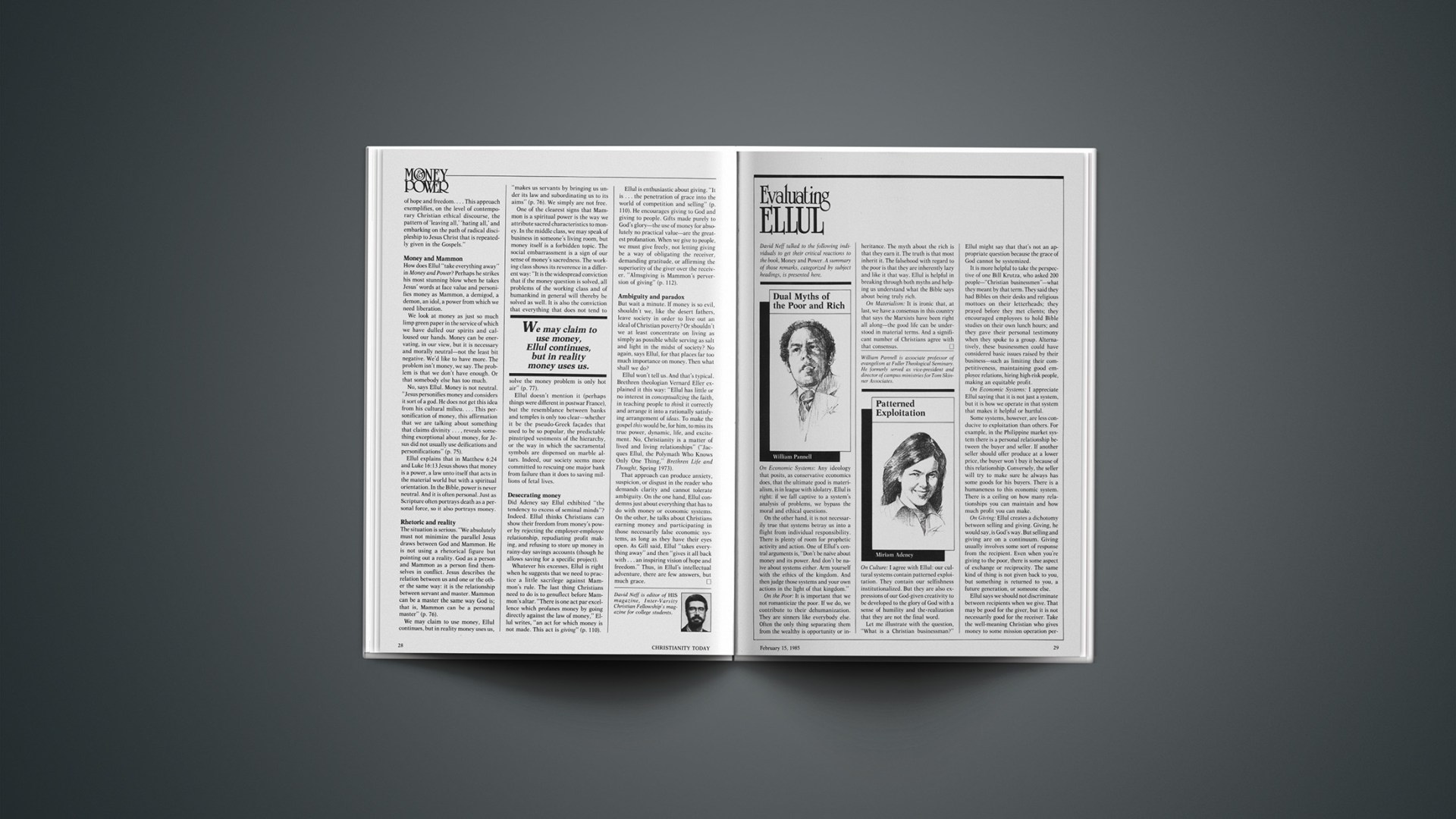
Alice Huskey remembers when she was just three years old, waking up in the morning and finding that her pajama bottoms had been removed. At first she was puzzled. Then she realized that her father had removed them during the night. An incestuous relationship that continued for 10 years had begun.

Huskey’s father wasn’t a convicted felon or even the town drunk. He was a Boy Scout leader and an active member of a fundamentalist church. On Sundays, he sang in the choir. But during the week he lived a private life about which only he and his daughter knew. For 10 years, on the average of twice a week, he coerced his daughter to have sexual relations, including intercourse and oral sex.

“I did not like what he was doing,” Huskey says today. “I felt it was wrong, but I feared him. I was taught to honor, trust, and obey my parents.… When I asked my father why he was doing this to me, his reply was that he was teaching me and this was the right way it was done by people. Trust him, it was okay.”

When Huskey was 13, her mother found out about the incestuous relationship, and the family crumbled. Huskey was placed in a foster home, and her parents were divorced. For the next 25 years she carried in silence the emotional scars of incest. But about two years ago, she became one of a rapidly increasing number of people who are talking about their experiences as abused children and expressing their concern for today’s victims.

Some observers regard child abuse, including incest, as this country’s greatest social problem. Experts cite studies indicating that as many as 25 percent of the country’s female population and 20 percent of the male population are sexually molested by the age of 16. Experts say most of this abuse occurs in the home.

Huskey has reason to believe these statistics apply to the evangelical community as well. She asked all 247 female students at a Christian liberal arts college to respond to a survey. Of the 96 who did, more than half said they had been abused as children. Almost all of these students had been reared in Christian homes.

At Focus on the Family, an organization founded by author James Dobson, all 25 people who work full-time answering letters say they have noticed an increase in the number of incest victims asking for help. “Our mail definitely reflects an increase in child abuse situations,” said correspondence director Claudette Reiser, adding that “the bulk of our mail is from Christians.” Reiser could not give details because of the organization’s commitment to confidentiality.

Sexually abused children typically develop emotional problems and have trouble adjusting socially as they move out into the world. They usually blame themselves for what happened. “The abused person feels fundamentally not okay,” says California therapist Henry Giaretto. “They have an intense, unconscious self-loathing, and some will do anything to sedate it.”

In 1972, Giaretto founded Parents United, today the nation’s largest treatment program for incest victims and their families. The first year he had 26 cases. Last year he had more than 1,000. Observers debate whether the increase is in the actual occurrence or in the reporting of incest. Most say it’s probably both.

Huskey says she remained silent about her experience with incest because “society does not look well on those who have been abused. And I thought I was the only person this had ever happened to.” But when she started telling others about her problem, she began hearing stories that sounded familiar.

One of the most tragic accounts she has heard is that of a young woman named Rebecca. For as long as Rebecca can remember, she was sexually and physically abused by her parents, both of whom continue to be active in their mainline Protestant church. She remembers being prostituted as a child for her parents’ financial gain. She was photographed in various sexual acts, including as a victim of sadism. She still shies away from cameras.

As a junior high school student, Rebecca told her school nurse what was happening, but the nurse simply reported her story to her father. After that, the abuse heightened, and she learned to endure in silence. Rebecca says that until recently, she felt guilty about what had happened to her. “I kept wondering if there was something I could have done that could have made a difference.”

Although the scars on her body remain, Rebecca’s emotional wounds have begun to heal. However, she does not attribute her progress to the church, an institution she says denies that the problem exists. At one point she sought pastoral counseling, but says, “All I got was an expression of disbelief.”

Huskey is writing a book intended in part to convince Christians that the problem does exist. It will be published by InterVarsity Press later this year. She has also formed an organization called Counter Abuse, Inc., which offers seminars and lectures at schools and churches in the Chicago area. Huskey says that at these events, young Christian women regularly come forward, unprompted, to reveal for the first time their history as incest victims.

Incest is but one aspect of child abuse, a problem that society only recently has begun to address. The hard reality of child abuse confronted America with the arrest last May of Virginia McMartin, a 76-year-old woman who seemed an unlikely candidate to be a leader of a child-sex ring. McMartin had operated a prestigious preschool in California. She and several members of her staff were charged with more than 100 counts of various forms of sexual abuse, including rape.

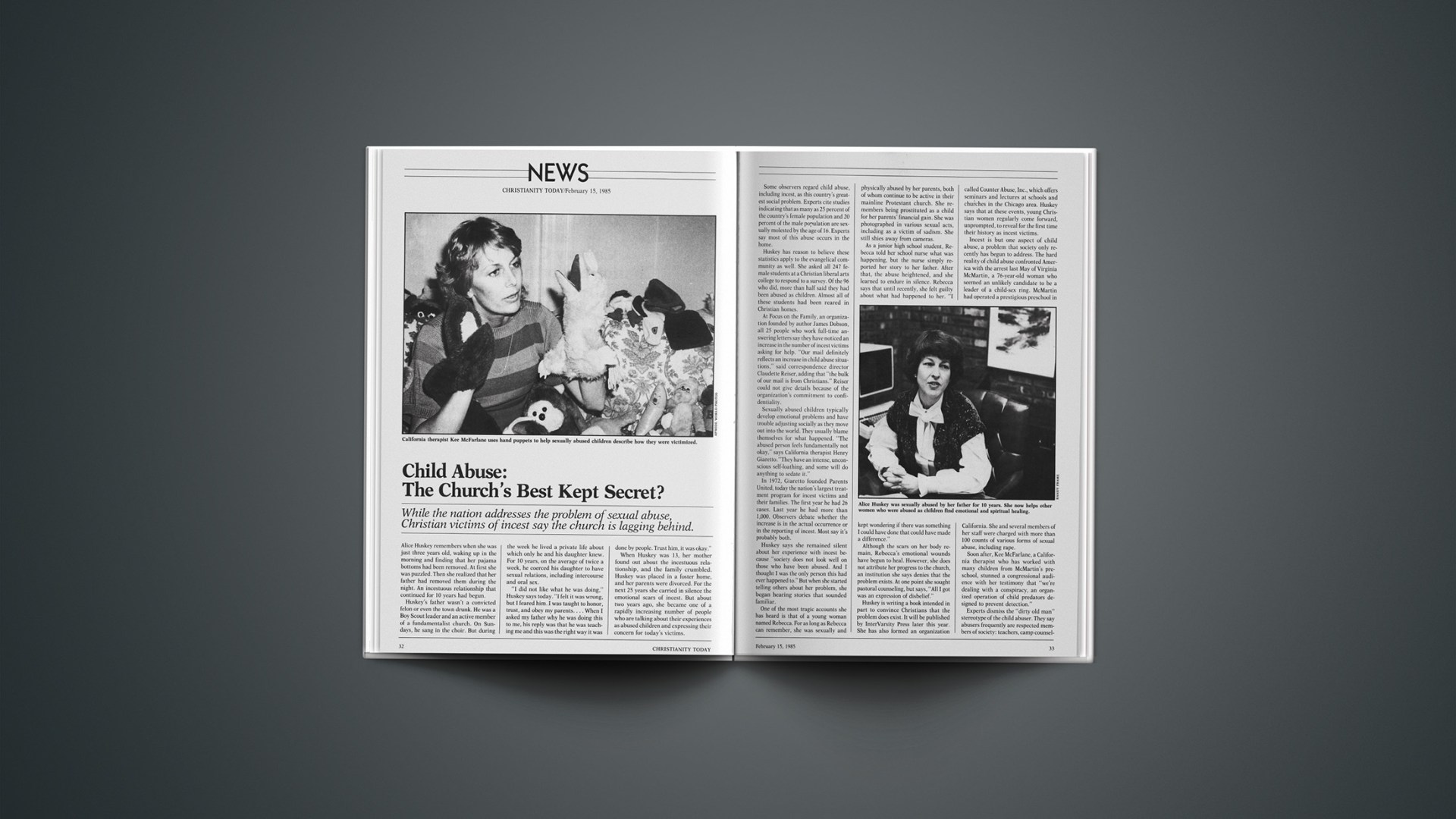
Soon after, Kee McFarlane, a California therapist who has worked with many children from McMartin’s preschool, stunned a congressional audience with her testimony that “we’re dealing with a conspiracy, an organized operation of child predators designed to prevent detection.”

Experts dismiss the “dirty old man” stereotype of the child abuser. They say abusers frequently are respected members of society: teachers, camp counselors, and scout leaders. The popular director of a Minneapolis children’s theater last year pleaded guilty to criminal sexual conduct with three 15-year-old boys. A United Methodist minister in New York whose church operated a day-care center was indicted on 42 counts of rape, sodomy, and sexual abuse of children.

Only a small percentage of sex abusers can be classified as pedophiles, according to Suzanne Danilson, who handles child abuse complaints for the state of Louisiana. “The pedophile has no normal adult sexual relationships,” she says. “They can only deal with children, and they have a certain type of child in mind.”

Danilson says pedophiles are rarely arrested “because they are so slick. They’re very good with children. They take a lot of time enticing them.” She adds that pedophiles “prey on children and teenagers who are having family problems.”

Franciscan priest Bruce Ritter says a high percentage of the children he works with daily have fled parents who abused them. Ritter’s New York City-based Covenant House provides food, clothing, and counseling to youth up to the age of 21. “These children grow up making no connection between sex and concepts like marriage, fidelity, and commitment,” he says.

Ritter cites a burgeoning pornography industry as a major reason for the increase in child abuse. The U.S. Justice Department is studying the relationship between pornography and aberrant sexual behavior. However, Ritter says he is not convinced such a study is necessary. “The most intellectually dishonest thing a person can say is that there is no connection between pornography and sexual abuse.”

Runaway children are prime targets for sex offenders, including those who peddle child pornography. According to Danilson, pedophiles use pornography as a way of breaking down the resistance of their victims. She says children are easily convinced that if something appears in a magazine, it must be okay.

Experts generally distinguish between the pedophile and the “situational” sex abuser. Unlike the pedophile, those in the latter category are not sexually obsessed with children. Rather, they use children as sexual outlets, typically as a surrogate partner in response to a troubled marriage or other personal problems. Many who contend that incest is on the rise cite the breakdown of the family as a major cause.

Most therapists believe the pedophile is untreatable, though the urges can be controlled by drugs. Abusers, they say, can be helped, but they suspect only a small percentage seek it. One reason is that therapists are required by law to report incidents of abuse to legal authorites.

Huskey says that offering “hope and help” to both the abused and the abusers presents Christians with a major opportunity for evangelism. She cites research indicating that sexual abuse is the root cause for violent crimes, including rape and murder. She says Christians should take steps to understand the feelings and motivations of victims before they victimize others.

However, Huskey says talking to abuse victims about God is no easy task. Because they were betrayed by those they trusted most, victims of abuse have trouble trusting anyone, including God. To some women, the word “father” invokes fear, not comfort. Huskey reports that after she invited one woman to allow Jesus to “come into her life,” the woman’s first reaction was fear that Christ would somehow abuse her sexually.

In another instance, such obstacles were overcome. Says Huskey’s friend Rebecca, “After meeting other victims of abuse, and realizing they had the same feelings and patterns of thought, I was comforted. Eventually I was able to see the Scriptures from a different perspective and to realize that to God, I was acceptable.”

A Watchdog Group Says The Irs Is Investigating The National Council Of Churches

A church monitoring group says the Internal Revenue Service (IRS) asked it for information to help determine if the National Council of Churches (NCC) has misused tax-exempt contributions for political purposes.

Penn Kemble, a spokesman for the Washington-based Institute on Religion and Democracy (IRD), said the IRS asked the institute to provide material from its files concerning the NCC’s use of tax-exempt contributions. Although the IRD has been a major critic of the NCC, Kemble said his organization refused to cooperate with the IRS investigation. NCC officials said they were unaware of any IRS investigation of the ecumenical body.

IRS spokesman Steven Mangellazzo said it was against the agency’s policy to “confirm or deny any alleged investigation.” However, he said the IRS would not contact a group such as IRD for information unless a formal investigation was under way. Evidence of partisan political use of tax-exempt contributions by a nonprofit organization could lead to the revocation of the organization’s tax-exempt status, he said.

George Johnson, of the IRS’s Chicago office, reportedly told the IRD that the inquiry was prompted by complaints from church members and clergy. Kemble said that Johnson asked the institute for any material it had concerning the council’s opposition to U.S. policies in Central America. Although the IRD is a leading critic of the council’s involvement in liberal social causes, the institute rejected the request for information.

“In this dispute [between the NCC and its critics], it is not for the government of the United States to judge,” Kemble wrote in a letter to Johnson. “The IRS should stay out.” He also expressed concern that government action against the NCC would hurt the cause of “real reform” in mainline denominations by making “legal and political” martyrs out of church officials.

Possible IRS action against the NCC would not be the first time the agency has investigated the ecumenical council. Between 1970 and 1981, the IRSconducted an audit that failed to prove that the council had misused tax-exempt contributions. Although the IRS refused to explain the grounds for that audit, some observers said they felt it was conducted in response to the NCC’s active opposition to the Vietnam War.

The cost of defending against such government inquiries sparked protests from many religious groups, and helped lead to the passage of the federal Church Audit Procedures Act. The law places some restrictions on the IRS’s ability to audit churches and religious groups.

In his letter to the IRS, Kemble wrote that if the IRS were to challenge the NCC’s tax exemption, “the IRD would almost certainly feel obliged to come to the council’s defense, even though we disagree profoundly with many of the council’s activities and the interpretation of Christian teaching from which such activities flow. Our disagreement with the NCC has a religious basis. We believe it must be resolved with the churches—not by the government.”

Government intervention into church disputes “can only make real church reform difficult,” Kemble wrote. “Some of those who are abusing Christian stewardship will eagerly seize upon any IRS action to claim a kind of legal and political martyrdom for themselves.… Others who are troubled by what their churches are doing may be lulled into passivity by the false expectations that the government could somehow solve the problems of their churches.”

RELIGIOUS NEWS SERVICE

NORTH AMERICAN SCENE

The Unification Church moved its fleet of 81 fishing boats out of Norfolk, Virginia, to avoid paying thousands of dollars in personal property taxes. Last year, the city collected $37,736 in taxes on the boats, trailers, and motors because they were not being used for religious purposes. “When they don’t use it, I tax it,” said revenue commissioner Sam Barfield.

A York, Pennsylvania, abortion clinic has dropped an effort to prevent picketing by antiabortion demonstrators. A spokeswoman for the Hillcrest Women’s Medical Center said they dropped their lawsuit against the protesters because the clinic did not want the suit to be used to get the picketers’ cause before the U.S. Supreme Court.

The U.S. government’s annual survey of drug abuse among high school seniors has shown a small decline in overall drug abuse, but a slight increase in the use of cocaine. The figure for cocaine abuse, 5.8 percent of all the nation’s high school students, has never been higher. Twenty-seven percent of the nation’s high school seniors had used at least one illicit drug within 30 days of the survey. That figure compares with 29 percent last year, and 38 percent in 1979, the peak year.

A recent Gallup Poll suggests that many Catholics would welcome the return of the Latin mass. Fifty-three percent of the respondents said they would attend such a mass if it were convenient to do so. Since the mid-1960s, Roman Catholics have celebrated mass in their own languages, having changed from the traditional Latin mass as a result of decisions made during the Second Vatican Council.

New Jersey education officials have suspended their attempt to end the observance of a moment of silence in three school districts until the U.S. Supreme Court decides on a similar case from Alabama. Schools in Woodbury, Pennsville, and Sayreville start each day with a moment of silence despite a federal judge’s ruling in 1983 that the practice is unconstitutional.

CBN University(CBNU),a graduate-level institution founded in 1978, has received full accreditation by the Southern Association of Colleges and Schools. Accreditation gives the school comparable academic standing and interchangeable course credits with other accredited colleges and universities. With an enrollment of 500, CBNU is part of a 685-acre complex that includes the headquarters of the Christian Broadcasting Network.

Personalia

Former President Jimmy Carter next month will receive the World Methodist Peace Award for 1985 in recognition of his continued commitment to world peace. The first American to receive the award, Carter helped establish the Carter Center of Emory University for the reduction of world conflict. Recently, he has worked with Habitat for Humanity, an organization that provides low-cost housing for the poor.

Books

Evaluating Ellul

Four respond-pro and con-to Ellul’s understanding of Mammon.

David Neff talked to the following individuals to get their critical reactions to the book, Money and Power. A summary of those remarks, categorized by subject headings, is presented here.

On Economic Systems: Any ideology that posits, as conservative economics does, that the ultimate good is materialism, is in league with idolatry. Ellul is right: if we fall captive to a system’s analysis of problems, we bypass the moral and ethical questions.

On the other hand, it is not necessarily true that systems betray us into a flight from individual responsibility. There is plenty of room for prophetic activity and action. One of Ellul’s central arguments is, “Don’t be naïve about money and its power. And don’t be naïve about systems either. Arm yourself with the ethics of the kingdom. And then judge those systems and your own actions in the light of that kingdom.”

On the Poor: It is important that we not romanticize the poor. If we do, we contribute to their dehumanization. They are sinners like everybody else. Often the only thing separating them from the wealthy is opportunity or inheritance. The myth about the rich is that they earn it. The truth is that most inherit it. The falsehood with regard to the poor is that they are inherently lazy and like it that way. Ellul is helpful in breaking through both myths and helping us understand what the Bible says about being truly rich.

On Materialism: It is ironic that, at last, we have a consensus in this country that says the Marxists have been right all along—the good life can be understood in material terms. And a significant number of Christians agree with that consensus.

On Culture: I agree with Ellul: our cultural systems contain patterned exploitation. They contain our selfishness institutionalized. But they are also expressions of our God-given creativity to be developed to the glory of God with a sense of humility and the realization that they are not the final word.

Let me illustrate with the question, “What is a Christian businessman?” Ellul might say that that’s not an appropriate question because the grace of God cannot be systemized.

It is more helpful to take the perspective of one Bill Krutza, who asked 200 people—“Christian businessmen”—what they meant by that term. They said they had Bibles on their desks and religious mottoes on their letterheads; they prayed before they met clients; they encouraged employees to hold Bible studies on their own lunch hours; and they gave their personal testimony when they spoke to a group. Alternatively, these businessmen could have considered basic issues raised by their business—such as limiting their competitiveness, maintaining good employee relations, hiring high-risk people, making an equitable profit.

On Economic Systems: I appreciate Ellul saying that it is not just a system, but it is how we operate in that system that makes it helpful or hurtful.

Some systems, however, are less conducive to exploitation than others. For example, in the Philippine market system there is a personal relationship between the buyer and seller. If another seller should offer produce at a lower price, the buyer won’t buy it because of this relationship. Conversely, the seller will try to make sure he always has some goods for his buyers. There is a humaneness to this economic system. There is a ceiling on how many relationships you can maintain and how much profit you can make.

On Giving: Ellul creates a dichotomy between selling and giving. Giving, he would say, is God’s way. But selling and giving are on a continuum. Giving usually involves some sort of response from the recipient. Even when you’re giving to the poor, there is some aspect of exchange or reciprocity. The same kind of thing is not given back to you, but something is returned to you, a future generation, or someone else.

Ellul says we should not discriminate between recipients when we give. That may be good for the giver, but it is not necessarily good for the receiver. Take the well-meaning Christian who gives money to some mission operation perpetuating structures keeping the poor poor. There are times when our right hand should not know what our left hand is doing. But there are also times when we have to use our common sense to be good stewards.

On Stewardship: I agree with Ellul’s major point: namely, that we live in a secular, materialistic world. The question is, “What should the Christian’s attitude be in this kind of a world?”

Ellul says that the Christian owes everything to God. Nothing belongs to himself. I agree with that. For example, Deuteronomy 8:17–18 clearly teaches that the ability to gain wealth is a gift of God. Ellul is correct. But is he saying anything new? The problem is not the basic approach to stewardship. The problem is how to get Christians to do what they are supposed to.

On Tithing: If we could get all Christians to tithe, most of the financial problems of our churches would be solved. The Jews under law did better than Christians under grace. The Jews were meticulous about tithing. And if the Jews were that careful under law—and they weren’t even redeemed in many instances—isn’t it strange that Christians under grace are so slothful?

On Money: Money is like sex. Whether it is good or bad depends on how you use it. Wealth in itself is neutral. John Wesley said, “Make as much as you can. Save as much as you can. Give as much as you can.”

There is no doubt that wealth may bring with it the possibility of using it wrongfully. But you cannot say that money or wealth in itself is sinful.

On Individual Responsibility: Ellul cannot lay down any prescriptions about what I ought to do, because I must function under Scripture by the power of the Holy Spirit. The Holy Spirit may intend for somebody to give up everything. But because someone else does it doesn’t mean I should do it. In our stewardship, there is one principle to remember: He who knows the will of God for everybody else doesn’t know the will of God for himself.

On Money: What should concern the believer is not money (something necessary for economic exchange) but wrong attitudes toward money. Similarly, it is not wealth per se but the improper use of wealth, along with wrong attitudes toward wealth, that deserve condemnation. Every Christian, rich or poor, needs to recognize that whatever he possesses is his—temporarily—as a steward under God. Wealth that is accumulated in a dishonest way or that becomes a controlling principle in one’s life is subject to condemnation. Wealth resulting from honest labor and wise investment, handled by people who recognize they are God’s stewards, is not.

On Capitalism: The capitalism that Ellul writes about is a caricature. But he is hardly alone in this regard. All critics of capitalism find it much easier to attack a straw man. Ellul’s claim that capitalism affirms the neutrality of human nature is false. Capitalism is a system of voluntary exchange in which basic human rights are protected by law. These laws protect us from force, fraud, and theft—hardly an arena of moral neutrality. In truth, capitalism (which should not be equated with the economic practices of the United States) neutralizes human greed. The market system forces even selfish businessmen to serve others by offering them products or services that the customer is willing to exchange for.

On Ellul’s Use of Scriptures: Three examples of Ellul’s injudicious handling of Scripture are his claims that: (1) the New Testament condemns wealth; (2) the Bible hates the rich; and (3) Christians sin if they save money for their future. Much of Ellul’s confusion results from his failure to draw a clear distinction between money (anything that may be used as a means of exchange) and Mammon (which is money personified and deified). Ellul is absolutely right in saying money often assumes a sinister power over human lives. But whenever this happens, money (something ethically neutral) has become Mammon.

Books

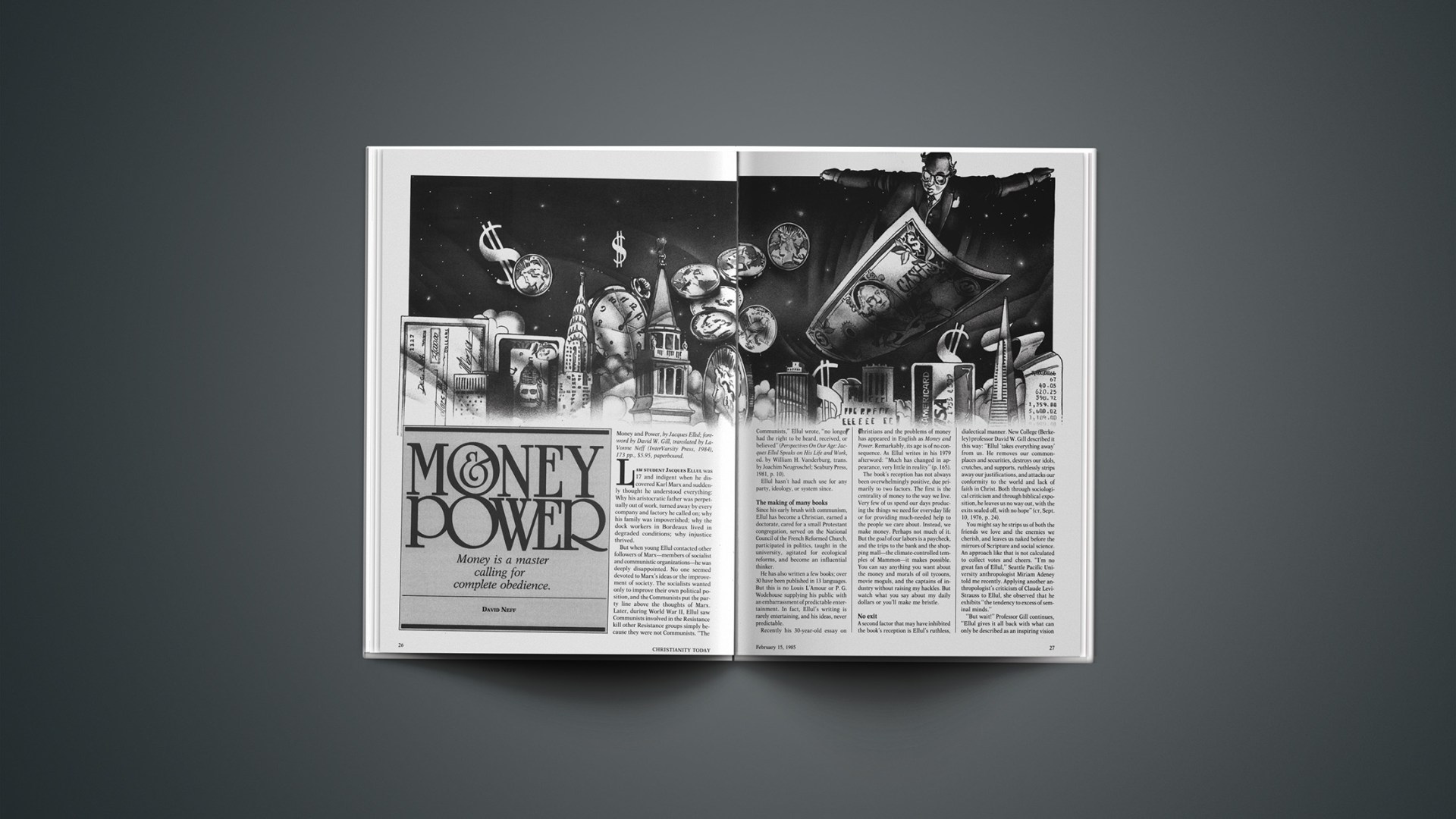
Money & Power

In his book, Money & Power, Jacques Ellul cuts through the success syndromes of church and state.

Money is a master calling for complete obedience.

Money and Power, by Jacques Ellul; foreword by David W. Gill, translated by LaVonne Neff (InterVarsity Press, 1984), 173 pp., $5.95, paperbound.

Law student Jacques Ellul was 17 and indigent when he discovered Karl Marx and suddenly thought he understood everything: Why his aristocratic father was perpetually out of work, turned away by every company and factory he called on; why his family was impoverished; why the dock workers in Bordeaux lived in degraded conditions; why injustice thrived.

But when young Ellul contacted other followers of Marx—members of socialist and communistic organizations—he was deeply disappointed. No one seemed devoted to Marx’s ideas or the improvement of society. The socialists wanted only to improve their own political position, and the Communists put the party line above the thoughts of Marx. Later, during World War II, Ellul saw Communists involved in the Resistance kill other Resistance groups simply because they were not Communists. “The Communists,” Ellul wrote, “no longer had the right to be heard, received, or believed” (Perspectives On Our Age: Jacques Ellul Speaks on His Life and Work, ed. by William H. Vanderburg, trans. by Joachim Neugroschel; Seabury Press, 1981, p. 10).

Ellul hasn’t had much use for any party, ideology, or system since.

The Making Of Many Books

Since his early brush with communism, Ellul has become a Christian, earned a doctorate, cared for a small Protestant congregation, served on the National Council of the French Reformed Church, participated in politics, taught in the university, agitated for ecological reforms, and become an influential thinker.

He has also written a few books; over 30 have been published in 13 languages. But this is no Louis L’Amour or P. G. Wodehouse supplying his public with an embarrassment of predictable entertainment. In fact, Ellul’s writing is rarely entertaining, and his ideas, never predictable.

Recently his 30-year-old essay on Christians and the problems of money has appeared in English as Money and Power. Remarkably, its age is of no consequence. As Ellul writes in his 1979 afterword: “Much has changed in appearance, very little in reality” (p. 165).

The book’s reception has not always been overwhelmingly positive, due primarily to two factors. The first is the centrality of money to the way we live. Very few of us spend our days producing the things we need for everyday life or for providing much-needed help to the people we care about. Instead, we make money. Perhaps not much of it. But the goal of our labors is a paycheck, and the trips to the bank and the shopping mall—the climate-controlled temples of Mammon—it makes possible. You can say anything you want about the money and morals of oil tycoons, movie moguls, and the captains of industry without raising my hackles. But watch what you say about my daily dollars or you’ll make me bristle.

No Exit

A second factor that may have inhibited the book’s reception is Ellul’s ruthless, dialectical manner. New College (Berkeley) professor David W. Gill described it this way: “Ellul ‘takes everything away’ from us. He removes our commonplaces and securities, destroys our idols, crutches, and supports, ruthlessly strips away our justifications, and attacks our conformity to the world and lack of faith in Christ. Both through sociological criticism and through biblical exposition, he leaves us no way out, with the exits sealed off, with no hope” (CT, Sept. 10, 1976, p. 24).

You might say he strips us of both the friends we love and the enemies we cherish, and leaves us naked before the mirrors of Scripture and social science. An approach like that is not calculated to collect votes and cheers. “I’m no great fan of Ellul,” Seattle Pacific University anthropologist Miriam Adeney told me recently. Applying another anthropologist’s criticism of Claude LeviStrauss to Ellul, she observed that he exhibits “the tendency to excess of seminal minds.”

“But wait!” Professor Gill continues, “Ellul gives it all back with what can only be described as an inspiring vision of hope and freedom.… This approach exemplifies, on the level of contemporary Christian ethical discourse, the pattern of ‘leaving all,’ ‘hating all,’ and embarking on the path of radical discipleship to Jesus Christ that is repeatedly given in the Gospels.”

Money And Mammon

How does Ellul “take everything away” in Money and Power? Perhaps he strikes his most stunning blow when he takes Jesus’ words at face value and personifies money as Mammon, a demigod, a demon, an idol, a power from which we need liberation.

We look at money as just so much limp green paper in the service of which we have dulled our spirits and calloused our hands. Money can be enervating, in our view, but it is necessary and morally neutral—not the least bit negative. We’d like to have more. The problem isn’t money, we say. The problem is that we don’t have enough. Or that somebody else has too much.

No, says Ellul. Money is not neutral. “Jesus personifies money and considers it sort of a god. He does not get this idea from his cultural milieu.… This personification of money, this affirmation that we are talking about something that claims divinity …, reveals something exceptional about money, for Jesus did not usually use deifications and personifications” (p. 75).

Ellul explains that in Matthew 6:24 and Luke 16:13 Jesus shows that money is a power, a law unto itself that acts in the material world but with a spiritual orientation. In the Bible, power is never neutral. And it is often personal. Just as Scripture often portrays death as a personal force, so it also portrays money.

Rhetoric And Reality

The situation is serious. “We absolutely must not minimize the parallel Jesus draws between God and Mammon. He is not using a rhetorical figure but pointing out a reality. God as a person and Mammon as a person find themselves in conflict. Jesus describes the relation between us and one or the other the same way: it is the relationship between servant and master. Mammon can be a master the same way God is; that is, Mammon can be a personal master” (p. 76).

We may claim to use money, Ellul continues, but in reality money uses us, “makes us servants by bringing us under its law and subordinating us to its aims” (p. 76). We simply are not free.

One of the clearest signs that Mammon is a spiritual power is the way we attribute sacred characteristics to money. In the middle class, we may speak of business in someone’s living room, but money itself is a forbidden topic. The social embarrassment is a sign of our sense of money’s sacredness. The working class shows its reverence in a different way: “It is the widespread conviction that if the money question is solved, all problems of the working class and of humankind in general will thereby be solved as well. It is also the conviction that everything that does not tend to solve the money problem is only hot air” (p. 77).

Ellul doesn’t mention it (perhaps things were different in postwar France), but the resemblance between banks and temples is only too clear—whether it be the pseudo-Greek façades that used to be so popular, the predictable pinstriped vestments of the hierarchy, or the way in which the sacramental symbols are dispensed on marble altars. Indeed, our society seems more committed to rescuing one major bank from failure than it does to saving millions of fetal lives.

Desecrating Money

Did Adeney say Ellul exhibited “the tendency to excess of seminal minds”? Indeed. Ellul thinks Christians can show their freedom from money’s power by rejecting the employer-employee relationship, repudiating profit making, and refusing to store up money in rainy-day savings accounts (though he allows saving for a specific project).

Whatever his excesses, Ellul is right when he suggests that we need to practice a little sacrilege against Mammon’s rule. The last thing Christians need to do is to genuflect before Mammon’s altar. “There is one act par excellence which profanes money by going directly against the law of money,” Ellul writes, “an act for which money is not made. This act is giving” (p. 110).

Ellul is enthusiastic about giving. “It is … the penetration of grace into the world of competition and selling” (p. 110). He encourages giving to God and giving to people. Gifts made purely to God’s glory—the use of money for absolutely no practical value—are the greatest profanation. When we give to people, we must give freely, not letting giving be a way of obligating the receiver, demanding gratitude, or affirming the superiority of the giver over the receiver. “Almsgiving is Mammon’s perversion of giving” (p. 112).

Ambiguity And Paradox

But wait a minute. If money is so evil, shouldn’t we, like the desert fathers, leave society in order to live out an ideal of Christian poverty? Or shouldn’t we at least concentrate on living as simply as possible while serving as salt and light in the midst of society? No again, says Ellul, for that places far too much importance on money. Then what shall we do?

Ellul won’t tell us. And that’s typical. Brethren theologian Vernard Eller explained it this way: “Ellul has little or no interest in conceptualizing the faith, in teaching people to think it correctly and arrange it into a rationally satisfying arrangement of ideas. To make the gospel this would be, for him, to miss its true power, dynamic, life, and excitement. No, Christianity is a matter of lived and living relationships” (“Jacques Ellul, the Polymath Who Knows Only One Thing,” Brethren Life and Thought, Spring 1973).

That approach can produce anxiety, suspicion, or disgust in the reader who demands clarity and cannot tolerate ambiguity. On the one hand, Ellul condemns just about everything that has to do with money or economic systems. On the other, he talks about Christians earning money and participating in those necessarily false economic systems, as long as they have their eyes open. As Gill said, Ellul “takes everything away” and then “gives it all back with … an inspiring vision of hope and freedom.” Thus, in Ellul’s intellectual adventure, there are few answers, but much grace.

Theology

The Mystery of Death

At the highest moments, we are overtaken by the dread of mortality.

At the highest moments, we are overtaken by the dread of mortality.

There is probably not one among us who has not now and then had the experience of being suddenly confronted by the dark enigma of life.

For long stretches, of course, we go on living our lives fairly innocuously, with no particular problems. Life simply pursues its course. We observe that evil does not pay, that success comes to the diligent, and that idlers finally come to grief.

But suddenly something happens that sounds like a broken axle in this smoothly rotating machine of life. We are confronted with a contradiction we simply cannot explain. We read in the newspapers that an airplane has crashed with 90 persons aboard, fathers, mothers, and children. Among them is a great musician, an irreplaceable scholar. Some ridiculous little bolt or screw that came loose—it may perhaps have cost only a dime—was capable of silencing beautiful music, annihilating the promise of increased knowledge, destroying human happiness, and shattering the ties of love.

Are we not surrounded on every side with these dark enigmas, which are so hard to shake off once they are discovered? Why is it that just when life reaches its supreme moments we should suddenly be overtaken by the dread of mortality and the fragility of life? Why do folk songs always link love and death?

Is nature an exception to this rule? A lovely, wooded valley with a stream running through it may strike us as idyllic, but we have only to look a little closer or fetch a microscope to see that here too there is devouring and being devoured, the dread of death, and the groaning of creation. Ecclesiastes and Job, and you and I too, each in our own way, have wrestled with this enigma. Everyone of us bears wounds and scars inflicted by the claws of this enigma.

The text from Genesis, which concludes the story of the Fall, paces the whole area of this enigma: Why should toil and the drudgery of labor exist at all? (On my trip to the Far East where I saw thousands of Egyptians on the Suez Canal and later Chinese coolies toiling in the scorching sun, I suddenly realized how immediate and real this question remains and how very superficially it is covered up by certain technological and social facilities.) Why should death exist? Why should the fate of men be like that of the beasts (cf. Eccles. 3:19)? Why cannot even the strongest love hold on to another when his hour has come? Why do thorns and thistles encumber the fields? Why should the horror of infantile paralysis exist alongside of the miracle of new life? Always, always the question: Why? Why?

This Genesis text deals with these hard harassing questions of life. It points to the background of it all, to the rift in the framework of the world and the contradictions we cannot reconcile. Many of us, perhaps, may say that it is useless to think about why life is as it is. They may advise us not to bore too long in the depths but rather get busy and stick to what is given to us to do each day. Goethe repeatedly counseled himself in this way and summoned himself to “action” whenever he was appalled by the fathomless depths of life.

But would not this be escape? After all, it is possible not only to be a coward physically—when a person fails, for example, to jump in to save a drowning man—but also a coward about certain thoughts and, as Goethe once expressed it, to “blink” them. But it will not be so simple to evade the Genesis text by blinking it, once it catches us and has us in its clutches.

To begin with, these primordial words of the Bible do something that is really tremendous. They take all these riddles of existence—from the mystery of death to the throes of a young mother and the misery of toil—and set them down within one mighty key signature, and then interpret them according to this one signature, which declares that all the contradictions and absurdities of life are manifestations of the creature’s disobedience to the Creator. They reveal that the world is no longer whole and sound and that it has lost its peace because it has lost its peace with God.

In other words, the Bible does not simply say: “Well, that’s the way life is!” Nor does it say: “Nature is cruel and that’s all there is to it.” Nor does it simply fall back upon the natural law of mortality, polarity, or the struggle for existence. Nor does it belabor the tragedy of contradiction. It says very simply, and with an almost shocking straightforwardness, that back of the suffering and back of the death in the world lies human guilt, and that therefore the only way I can come to terms with my lot is to come to terms with this guilt or else learn to know a court of judgment that will relieve me of it.

All this is, of course, a tremendous, breathtaking assertion. It is a good thing that the Bible does not express this assertion in philosophical propositions. This would only result in endless discussion. It simply sets before us a few monumental facts of life and says, “Just look at these for a moment. Don’t withdraw from the affair by saying that they are just myths. No, look at them for once!”

The greatest of these facts is death. And by speaking of it, this primordial story confronts us with nothing less than the thesis that “the wages of sin is death” (Rom. 6:23).

Let us recall certain details of the story of the Fall.

God said to Adam and Eve, “You shall die if you eat of the forbidden fruit.” And when they wickedly ate of it nevertheless, God said, “Behold, the man has become like one of us, knowing good and evil; and now, lest he put his hand and take also of the tree of life, and eat, and live forever,” God sent him out of the Garden of Eden.

So the curse of mortality settled down upon man.

The disobedience of man consists—we are given to understand—in the fact that he wants to be superman. He wants to “be like God.” He is the notoriously Unbound One, and by no means only in certain peak examples and high fliers, like Prometheus or Napoleon or Hitler. No, he is always the Unbound. He establishes the welfare state and abolishes—or at least thinks he abolishes—the misery of human existence. He undertakes to provide for every life situation and plays the role of the divine father of all.

But is it not utter folly that he should imagine that he can really burst the bounds of afflicted humanity? Does he not merely shift the misery from outward poverty to inward poverty? Does he not cause men to be debauched inwardly with excessive prosperity, comfort, and boredom by inculcating the illusion that the peace of his soul is to be found in cars, television sets, freezers, and other miracles of civilization?

Man also desires to be unbound in this technology. He breaks the bounds of this ancient earth and reaches for the stars. And as he launches cosmic expeditions and grasps at realms which earlier generations considered reserved to God, he takes with him into the universe his peacelessness, his anxiety, and his hunger for power; perhaps he may still upset the stars.

So, since that dark hour in the Garden of Eden, this has been the story of us all. We want to be untrammeled. We want more than God the Lord has allowed to us. We want more success, more power, more money. If we are workers, we want higher wages. If we are employers, we want higher profits, if we are publishers, we want larger printings. Expansion must never cease. The first limit we encounter—it may be the limit of our physical strength, the limit our heart trouble allows us, the limit of some sudden disillusionment with people we trusted—staggers us. For we no longer take any limits into account, simply because we are unlimited. “If gods exist,” said Nietzsche, “how could I bear not to be a god?”

Therefore I must also prolong my life; I believe all the humbug that any magazine blathers about some new hormone or cosmetic product that will make me live to a hundred and preserve the appearance of youth.

And then what happens—and this is the dramatic point in our story—is that this arrogant man who wanted no limitations put upon him, this man who wanted to snatch God’s eternity for himself, who wanted to be immortal and like God, has his limitations cast into his teeth. “The man has become like one of us,” the story says, “knowing good and evil.” After he has nibbled at the tree of knowledge, he will also reach out for the tree of life and plunder the fruit of immortality. He will want to be unlimited in time, he will want to be eternal.

And therefore he is driven out of paradise, and the burden of mortality is placed upon his back. In other words, the unlimited one is shown his limits, and the chains of time come clanking down upon this man who wanted to snatch eternity. He is hurled back to the realm of the finite, where there is such a thing as finis, where one day my last hour comes and it’s all up with me.

The fact that we must depart and that our life has a terminus is therefore a reminder that we are only men and not God. The fact that we must die and leave everything behind that we have made and loved and perhaps also idolized is a part of judgment. In this judgment there flames the reflection of a divine flash of lightning that says: “Thus far shall you come, and no farther, and here shall your proud waves be stayed.”

In Japan one can always see from tremendous distances the majestic, snow-capped pyramid of Fujiyama. And so it is with us: the death we are approaching stands like the landmark of Fujiyama above the landscape of our life and makes life a “being unto death.”

This “being unto death” is far more and also something different from our last hour, which we Christians talk about perhaps far too much. For death is present not only at the end of our life but is there long before, in every moment of our life.

Why do we keep hastening at our work? Why do we say: I must make the most of my youth? Why do we think: Now we are in our best years, now is the time to get it done? Why do we use calendars and clocks? Behind such very ordinary phrases and facts stands the appalling circumstances that hour by hour we realize that we must die, that we have only a limited time. Today will never return again. Even the physician who struggles to preserve life fights this battle in the shadow of death. He may fight a delaying action but he cannot conquer death, and in the end he himself will be snatched away.

So it is indeed; we see the Fujiyama of our death wherever we stand. This flaming barrier, at which the cherub stands with his flashing sword, cannot be overlooked. Arrogant, unlimited man, who would seize eternity, is hurled back behind the barrier of time.

Only now that we have spelled out the text to this extent dare we come forward with our doubts and objections. Let me repeat these doubts once more quite boldly and revert once more to the questions we asked before. Is what we have just said sheer mythology or perhaps even very sinister mythology? Is not death, instead of being a judgment, a purely biological process? Is it not caused by the dehydration of our cells and the natural wear and tear of the organism? Are not birth and death expressions of exactly the same rhythm of life which we observe in spring, summer, autumn, and winter? And is not death merely the final beat in this rhythm of life?

At first sight this looks very plausible. And yet it must strike us as significant that a physician hardly ever dares to tell a dying man that he is now facing a very natural process. If these things are really so terribly “natural,” why not call a spade a spade? Is there perhaps something more than—and something quite different from—this natural process behind the act of dying?

Not long ago I read again the following account in the diary of a young flier who fell in the war.

He was gathering a bouquet of lilacs. As he parted the branches he saw beneath the flowering bush the half-decayed body of a soldier. He drew back in horror—but not because he had never seen a dead body before. On the contrary, in his young life he had seen far too many. He recoiled because of the screaming contradiction between this dead man and the flowering bush. If he had only come upon a withered lilac bush he would not have been horrified. After all, a blooming lilac bush sooner or later will become a withered lilac bush—this is really an expression of the rhythm of life. But that a man was lying there in a decayed state, was something that would not harmonize with blooming nature. That’s why he recoiled. He sensed that this dead comrade was something contrary to the Creator’s plan of life. He felt that this dead man was a foreign body in God’s flowering world. There came over him the feeling that the death of man is an unnatural thing. And this young flier with his shock of horror was certainly nearer to the world of the New Testament and its message than the people who are always driveling about the “naturalness” of human death.

When Jesus Christ heals the sick and raises the dead the fundamental thesis behind these acts is that sickness and death should not exist. These things are physically unnatural—in a deeper sense than the purely biological sense; they are contrary to the intention, the conception of Creation; they are not order but disorder.

So for the Bible death is not simply a part of nature. Rather, the natural processes—which, of course, the Bible does not deny—are only the vehicle in which the “last enemy” drives about. Therefore all this unnaturalness, this disorder, this “wrongness” in the world must give way when Jesus Christ comes and lays our hand again in the hand of the Father.

Then, of course, the biological processes of death still go on. But the judgment is gone. Then death acquires, so to speak, a different quality; it ceases to be a hostile barrier let down between time and eternity, which violently hurls us back into our finitude. Now death becomes a bridge, a transition.

This is what is meant by the statement that death has lost its sting. Then death is no longer a judgment that compels us to leave all; then it becomes the joy of going back home, for now my Lord awaits me on the other side of the dark grave and he heads me from faith to sight, from this world where we see in a dim mirror to the table of the Father.

“Could the Head / Rise and leave his members dead?”

That’s the way it is with death now.

When I say “I have to depart,” then the values and the things of my life—my house, my garden, my stamp collection, my vocation—are the standard by which I measure the departure. But when I can say, “I am going home,” then there is a point in my life where even the greatest things become an insubstantial shadow and I see only the shore of home where I am awaited.

True, this presents many questions, and here I cannot even attempt to make the roads of thought any easier to follow. The power of this truth is so great that there is no way to approach it except by bowing in reverence before the mystery of it.

And yet I might ask: even when we look upon death as being primarily a natural event that we can reduce to biological formulas, do we not perceive that this leaves an insoluble remainder, a mysterious unknown factor? Must we not agree with what Alfred E. Hoche, the psychiatrist, says in his well-known autobiography—and he certainly is not saying this in defense of any biblical texts: “Man cannot understand his death. To him the thought is intolerable that this whole world of love and friendship, this world of work and devotion should be simply wiped out, intolerable simply to fall by the wayside, while others go on, chattering as if nothing had happened.… This mocks all logic.”

As a matter of fact, it cannot be reconciled with any biological categories either, for here we encounter the unknown factor of which the Bible speaks when it points to the judgment which constitutes the background of our finitude.

Always, when I stand at the grave of a person whose life was filled with meaning, who loved and was loved in return, a rebellious feeling descends upon me. Here is a person who was bound to human fellowship with every fiber of his being; he may also have been at peace with God, and here he must depart hence “like a beast.” Must death be? Must this limit, must this abyss, continue to exist if one is in the hands of a living God? This is the protest against death that rises up within us, if we have any conception of what man was really destined to be. We can understand Hölderlin’s complaint in Hyperion: “May God pardon me, but I cannot understand death existing in his world.”

None of us can understand the exultation that rings in the New Testament accounts of raising from the dead and of the Resurrection; none of us can comprehend the splendor that hovers over the fifteenth chapter of 1 Corinthians, if he has not seen this dark foil in the background.

To be sure, even here in this story of the beginnings we can already perceive the first flickering of the promise, which the message of the Resurrection will later make explicit, and we find it in a very discreet, almost hidden thought. God had forbidden man to eat of the tree in the midst of the garden, with the threat: “In the day that you eat of it you shall die.” And now man had eaten of it, and the lightning bolt of judgment struck beside him in the ground that would henceforth bear thorns and thistles, and it also struck the serpent. Thus the sentence of death did not overtake man on the spot. Instead of dying at once, the fate of mortality was imposed upon him. He is thus allowed to go on living, though in the shadow of death. He was granted a reprieve.

So in the midst of judgment the hidden mystery of grace is at work.

And again the promise arches over to the New Testament, where all this is enlarged and where it becomes more graphic and vivid. The barren fig tree is not immediately hewn down, but is given another year of probation. The clock of our life is turned back once more, in order that even today we may “know the things that make for peace.” “This night your soul is required of you,” says the Lord in the story of the Rich Fool. Who am I, where do I stand? The point is: In the coming night will my soul be required of me? Today I am still allowed to live. Today I can still answer the question whether I am content with my filled barns, my success, my comfort, my reputation and prestige—until suddenly it all forsakes me!—or whether I shall make my peace with God and set the whole course of my life toward homecoming. Today I can still watch for him to whom one day, when I shall have to depart and yet will be going home, I shall be permitted to say: “If one day I must depart, depart thou not from me. Thou art he who came into this passing world of mine and endured for me the powers of sin and suffering and death. Thou wilt be my comrade and brother now that my time is up and I must go through the gate, alone and without any baggage, where not even my most beloved can pass, except thee, who art the Lord of both time and eternity.”

So Adam must leave paradise. For every one of us, that is in the past. And only fools think that it can be reestablished on this earth. As a rule, those who have promised men a heaven on earth have made of life a hell. No, the cherub stands behind us, and there is no road back. We were never promised that the burden of mortality would be removed from us.

But Adam, and all of us, is permitted to go on living for a space. In the midst of the darkness of suffering and death, which we ourselves have conjured up, God will let his sign of grace shine, to proclaim to us: “Behold, I have not forgotten you; I have loved you with an everlasting love, and I will be the star for you to gaze at, the spring from which you may drink, and the peace that will cover you like a protecting mantle in all the strife of earth.” So he made the rainbow of reconciliation to shine above the storms. So he gives to us the laughter of a child, the encouraging word of a friend, the healing of an illness, the return from prisoner-of-war camp. Again and again the towers of the Father’s house suddenly light up as we tread the dust of the far country. The Savior walks beside us on the refugee’s road, for he himself was homeless and had nowhere to lay his head. He lies beside us in the hospital ward, for he too was stricken and smitten. And yet at the same time he is the Physician who heals us.

That’s the way God’s judgments always are when they bring hardship and darkness into our lives and we “have to depart.” Even in the deepest darkness the kindly, beckoning hand that is calling us home can be seen.

The other judgments of which our text speaks point to the same mystery, for the question of death slumbers in every experience of life. When a child is born this is accompanied by pain; these are sore moments and death is not too far away. What was once wrapped in the Creator’s blessing of fruitfulness and a symphony of joy, this too has become an ambiguous thing, shifted to the boundary of darkness. Whenever new life comes into being there is pain and dread, and the beating of the wings of death is heard. This Eve is told: “In pain you shall bring forth children.” And in the symbol of the subjection of the woman there is also a reference to the servitude and slavery that will prevail in our world.

But here too there slumbers a hidden blessing wrapped in darkness. The pangs and oppressions of our life keep reminding us that “this poor earth is not our home” and that we are waiting for a new heaven and a new earth in which there shall be neither mourning nor crying nor pain any more, and every tear shall be wiped from our eyes and the last enemy has been robbed of its power. How many of us would give up the darkest hours of suffering in our lives, now that we look back upon them; the hours of utter hopelessness as prisoners of war, the hours of failure in our work, the hours of painful farewell? Would we ever have learned how God can comfort, how faithfully he remembers us, and how punctually he fulfills his promise? (“When comes the hour, comes help with power.”) God’s stars are seen only from the deepest wells, and we learn that he hears us only when we cry to him from the depths.

So we are surrounded on every side by signals and beacons. They keep flashing the message that there is One who is determining the course of our life, that he is guiding us home, and that we shall never be left alone in the fog that veils the coming day in the storms we dread.

Often we do not know the meaning, but we believe in him who does know the meaning. This is the secret of our Christian life. And with it we walk straight through the enigmas of life.

Never can we say: “Because certain conditions are such and such, certain things happen to me.” We’ll never get by with that answer. It sticks in our throat, doesn’t it, when we think of the millions who die in war, the subterranean terror in the cellars and bomb shelters, the stricken women and children? The fact is that we do not know why this had to be; but now we can say: “I will abide with Thee.”

Just as our own death is not merely a biological process, so the great mass deaths are not mere historical processes that mechanically unfold according to pitiless, eternal laws. No, there is a heart that watches and cares, and everything must pass in review before that heart before it comes to me. There is a secret censor, and no stroke of fortune which would strike us can get past without being examined to see whether it will be for our good.

Therefore what we meet with in our life is not so terribly important; the only important thing is whether we accept it as coming from God’s hand and whether we dare to trust that it was made to measure—your measure and mine—and therefore is exactly right.

Is it not strange that Christians on the sinking Titanic sang, “Nearer, my God, to thee,” and so lost their fear of drowning in the icy Atlantic? The point is that they did not sing, “Farther away are now the golden jewelry in my cabin, the precious documents in the ship’s safe, farther away are my loved ones at home, farther than thousands of geographical miles—for now I must leave you forever.” No, this is not what they sang or thought. It was not sad leave taking and passing farther away; it was a coming nearer: “Nearer, my God, to thee.”

It is not necessary to go down with a ship or to be mortally sick or to find ourselves in a “boundary situation” or to be on our last legs in order to make this avowal, “Nearer, my God, to thee.” We still live in the light; perhaps life still lies before us. We rejoice in our home, the splendor of autumn leaves, a beautiful picture, the sound of music. It would simply be pride and pious snobbery to want to brush all this aside as “worldly pomp.” This would be not to honor the Giver of all good gifts but rather to offend him.

But we must not cling to these things and get caught in them. Instead, we must find our way through the things that can be so fascinating and delightful in life—but also through the burdens and trials we have to bear—to him who gives us all things, both good and hard, and in both is saying: “I know you. You no longer need to depart hence “like a beast”; you can come home “like a child.”

So he blesses the flush and flower of youth and comforts the loneliness of age. He lays his hand upon the little ones, and upon us too when the end draws near. He sends us the happy, starry hours of life, but he is also beside us in the dark valleys with his rod and staff and the marvel of his consolations. He always blesses. He is always near; and he changes everything—everything.

The “Gorilla”

To his opinion-making contemporaries, Abraham Lincoln was but a politician with no settled convictions.

To his opinion-making contemporaries, Abraham Lincoln was but a politician with no settled convictions.

Wartime Washington from 1861 to 1865 was a turbulence trying to hold on to the coattails of the vast armies and wheeling movements it had set in motion. At the center of the turbulence, always in the spotlight, nothing about him concealed from the great democracy that had made him its figurehead as well as chief executive, was that assailable and by no means yet hallowed figure known to the opposition papers as the Gorilla.

His vacillations, his lack of willpower and distinctive intelligence were cited by well-placed observers as one more proof of the dangers in democracy. To the opinion-making class the most obvious thing about Abraham Lincoln was that he was a mere politician with no settled convictions. He swayed from moment to moment; he was weak; he had a deplorable tendency to wait on public opinion. Although he had always found slavery repugnant, he would not alienate the vast pro-Union majority that was not yet ready to approve emancipation. His concern for the Union dominated every moral and constitutional issue. He would not keep ahead of the masses whom he so much resembled.

What it came to in the eyes of the critics, foreign and domestic, was that he was ordinary. In England, where the governing class was impatient to recognize the Confederacy, the London Herald pointed out that Lincoln’s predecessors had all been gentlemen. “Mr. Lincoln is a vulgar, brutal boor, wholly ignorant of political science, of military affairs, of everything else which a statesman should know.” The London Standard: “Never were issues so momentous placed in so feeble a hand; never was so great a place in history filled by a figure so mean.”

At home the contempt for Lincoln (he had been nominated as a compromise candidate and was elected only because he divided the vote with three opponents) was general among New England’s intellectuals. The aristocratic abolitionist Wendell Phillips dismissed Lincoln as “the white trash of the South spawned on Illinois,” “a first-rate second-rate man … waiting to be used.” The Brahmin historian Francis Parkman complained in 1862 that Lincoln was the very type of character which democracy had given to the world, the “feeble and ungainly mouthpiece of the North.” Thirty years later Parkman was deploring Lincoln’s displacement of Washington as a hero to schoolboys.

Hawthorne, observing Lincoln in 1862 for the Atlantic Monthly, jocularly noted that “there is no describing his lengthy awkwardness, nor the uncouthness of his movement; and yet it seemed as if I had been in the habit of seeing him daily, and had shaken hands with him a thousand times in some village street; so true was he to the aspect of the pattern American, though with a certain extravagance which, possibly, I exaggerated still further by the delighted eagerness with which I took it in.”

The Atlantic did not choose to publish Hawthorne’s condescension. Emerson, also observing Lincoln in 1862, allowed that the President was “correct enough, not vulgar, as described.” Lincoln’s delight in telling stories reminded Emerson of Harvard reunions.

In Lincoln’s lifetime Whitman was the only major writer to describe him with love. Whitman identified Lincoln with himself in the worshipful fashion that became standard after Lincoln’s death. That Lincoln was a class issue says a good deal about the prejudices of American society in the East. A leading New Yorker, George Templeton Strong, noted in his diary that while he never disavowed the “lank and hard featured man,” Lincoln was “despised and rejected by a third of the community, and only tolerated by the other two-thirds.” Whitman, the professional man of the people, had complicated reasons for loving Lincoln. The uneasiness about him among America’s elite was based on the fear that this unknown, untried man, elected without administrative experience (and without a majority), might not be up to his “fearful task.”

After his death, Lincoln’s supreme competence and firmness became such an article of American faith that he was enshrined as the purest type of American. Henry James, recalling the war period in his autobiography, condemned Lincoln’s unhappy successor, Andrew Johnson, because he was common and lackluster by contrast with the “mould-smashing mask” of Abraham Lincoln. It was the underlying political despair, the doubt that the federal government could maintain itself, that centered so much understandable anxiety on Lincoln. Slavery had for 40 years divided the country: it was not until slavery died in the war, until the country under his leadership proved that “a new birth of freedom” was real, that Lincoln could be seen to be the very reverse of “vacillating.”

Lincoln was not a revolutionary but a supreme nationalist. The Union had to be preserved at any cost. Since democracy in America was a revolutionary fact in the nineteenth-century world—Whitman always referred to Europe as “feudal”—there were too many powerful interests at home and abroad opposed to what Lincoln the campaigner joined as “free soil, free labor, free men,” for Lincoln the war President not to recognize that he was upholding more than a national cause. “Thanks to all: for the great republic—for the principle it lives by and keeps alive—for man’s vast future—thanks to all.” If it was difficult in the century of American superpower for an Edmund Wilson to share Lincoln’s fear for his threatened nation, it was still difficult to understand Lincoln’s reluctance to press emancipation when he honestly believed in the promise of equality in the Declaration of Independence. And how to reconcile the “suffering” and “Christ-like” Lincoln with the driving and even authoritarian President who suspended habeas corpus and violated individual rights granted by the Constitution? Although steel was not manufactured in great quantity until near the end of the war, Lincoln was capable of saying, “My mind is like a piece of steel—very hard to scratch anything on it, and almost impossible after you get it there to rub it out.”

It was Lincoln’s peculiar honesty—the total reliance on his innermost promptings that one associates with genius, least of all with politicians captive to public relations—that still makes him unfathomable and endlessly interesting. None of the contemporary literary folk who could have analyzed Lincoln’s writings as a subject worthy of themselves ever did so. Henry Adams’s feisty elder brother, Charles Francis Adams, Jr., was the first to lead black troops through captured Richmond, and may have had enough experience of war to know what went into the Second Inaugural Address. From the field he wrote to his father, the American minister in London, who was not an admirer of the President.

“What do you think of the inaugural? That rail-splitting lawyer is one of the wonders of the day. Once at Gettysburg and now again on a greater occasion he has shown a capacity for rising to the demands of the hour which we should not expect from orators or men of the schools. This inaugural strikes me in its grand simplicity and directness as being for all time the historical keynote of the war; in it a people seemed to speak in the sublimely simple utterance of ruder times. What will Europe think of this utterance of the rude ruler, of whom they have nourished so lofty a contempt? Not a prince or a minister in all Europe could have risen to such an equality with the occasion.”

It was Lincoln’s poised, patient, and unswervable spirit of command, triumphing finally over the bloodiest American factionalism, that made him important to Whitman. Lincoln was the greatest possible example to the “failed” poet whose life was a perpetual crisis.

Whitman’s “reports from the front,” as he liked to call them, show a strong sense of fact. Lincoln’s prominent “ugliness” and sallow complexion startled most observers. Whitman came up with “I think well of the President. He has a face like a Hoosier Michael Angelo, so awful ugly it becomes beautiful, with its strange mouth, its deep cut, crisscross lines, and its doughnut complexion.” In his notebooks of the war period, Specimen Days, Whitman gives us an endearing glimpse of the president on horseback, returning from the Soldiers Home where he slept on hot summer nights.

“Mr. Lincoln … is dressed in plain black, somewhat rusty and dusty, wears a black stiff hat, and looks about as ordinary in attire, etc. as the commonest man. A lieutenant, with yellow stripes, rides at his left, and following behind, two by two, come the cavalry men in their yellow-striped jackets.… The sabres and accoutrements clank, and the entirely unornamental cortege as it trots toward Lafayette Square arouses no sensation, only some curious stranger stops and gazes.”

And they heard the sound of the Lord God walking in the garden in the cool of the day, and the man and his wife hid themselves from the presence of the Lord God among the trees of the garden. But the Lord God called to the man, and said to him, “Where are you?” And he said, “I heard the sound of thee in the garden, and I was afraid, because I was naked; and I hid myself.” He said, “Who told you that you were naked? Have you eaten of the tree of which I commanded you not to eat?” The man said, “The woman whom thou gavest to be with me, she gave me fruit of the tree, and I ate.” Then the Lord God said to the woman, “What is this that you have done?” The woman said, “The serpent beguiled me, and I ate.” The Lord God said to the serpent,

“Because you have done this,

cursed are you above all cattle,

and above all wild animals;

upon your belly you shall go,

and dust you shall eat

all the days of your life.

I will put enmity between you and the woman,

and between your seed and her seed;

he shall bruise your head,

and you shall bruise his heel.”

To the woman he said,

“I will greatly multiply your pain in childbearing;

in pain you shall bring forth children,

yet your desire shall be for your husband,

and he shall rule over you.”

And to Adam he said,

“Because you have listened to the voice of your wife,

and have eaten of the tree

of which I commanded you,

‘You shall not eat of it,’

cursed is the ground because of you;

in toil you shall eat of it all the days of your life;

thorns and thistles it shall bring forth to you;

and you shall eat the plants of the field.

In the sweat of your face

you shall eat bread

till you return to the ground,

for out of it you were taken;

you are dust,

and to dust you shall return.”

Genesis 3:8–19

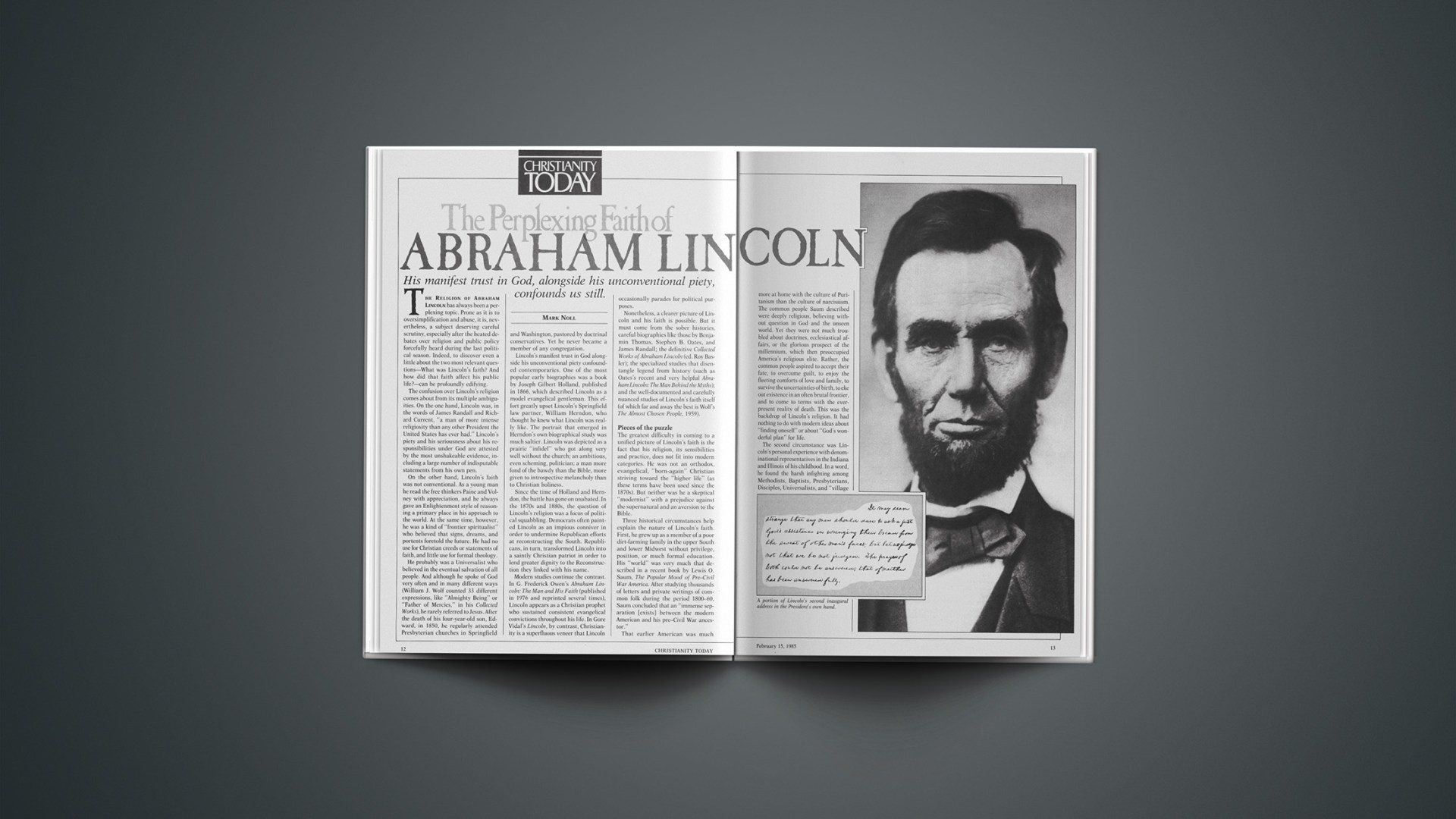
The Perplexing Faith of Abraham Lincoln

His manifest trust in God, alongside his unconventional piety, confounds us still.

His manifest trust in God, alongside his unconventional piety, confounds us still.

The Religion of Abraham Lincoln has always been a perplexing topic. Prone as it is to oversimplification and abuse, it is, nevertheless, a subject deserving careful scrutiny, especially after the heated debates over religion and public policy forcefully heard during the last political season. Indeed, to discover even a little about the two most relevant questions—What was Lincoln’s faith? And how did that faith affect his public life?—can be profoundly edifying.

The confusion over Lincoln’s religion comes about from its multiple ambiguities. On the one hand, Lincoln was, in the words of James Randall and Richard Current, “a man of more intense religiosity than any other President the United States has ever had.” Lincoln’s piety and his seriousness about his responsibilities under God are attested by the most unshakeable evidence, including a large number of indisputable statements from his own pen.

On the other hand, Lincoln’s faith was not conventional. As a young man he read the free thinkers Paine and Volney with appreciation, and he always gave an Enlightenment style of reasoning a primary place in his approach to the world. At the same time, however, he was a kind of “frontier spiritualist” who believed that signs, dreams, and portents foretold the future. He had no use for Christian creeds or statements of faith, and little use for formal theology.

He probably was a Universalist who believed in the eventual salvation of all people. And although he spoke of God very often and in many different ways (William J. Wolf counted 33 different expressions, like “Almighty Being” or “Father of Mercies,” in his Collected Works), he rarely referred to Jesus. After the death of his four-year-old son, Edward, in 1850, he regularly attended Presbyterian churches in Springfield and Washington, pastored by doctrinal conservatives. Yet he never became a member of any congregation.

Lincoln’s manifest trust in God alongside his unconventional piety confounded contemporaries. One of the most popular early biographies was a book by Joseph Gilbert Holland, published in 1866, which described Lincoln as a model evangelical gentleman. This effort greatly upset Lincoln’s Springfield law partner, William Herndon, who thought he knew what Lincoln was really like. The portrait that emerged in Herndon’s own biographical study was much saltier. Lincoln was depicted as a prairie “infidel” who got along very well without the church; an ambitious, even scheming, politician; a man more fond of the bawdy than the Bible, more given to introspective melancholy than to Christian holiness.

Since the time of Holland and Herndon, the battle has gone on unabated. In the 1870s and 1880s, the question of Lincoln’s religion was a focus of political squabbling. Democrats often painted Lincoln as an impious conniver in order to undermine Republican efforts at reconstructing the South. Republicans, in turn, transformed Lincoln into a saintly Christian patriot in order to lend greater dignity to the Reconstruction they linked with his name.

Modern studies continue the contrast. In G. Frederick Owen’s Abraham Lincoln: The Man and His Faith (published in 1976 and reprinted several times), Lincoln appears as a Christian prophet who sustained consistent evangelical convictions throughout his life. In Gore Vidal’s Lincoln, by contrast, Christianity is a superfluous veneer that Lincoln occasionally parades for political purposes.

Nonetheless, a clearer picture of Lincoln and his faith is possible. But it must come from the sober histories, careful biographies like those by Benjamin Thomas, Stephen B. Oates, and James Randall; the definitive Collected Works of Abraham Lincoln (ed. Roy Basler); the specialized studies that disentangle legend from history (such as Oates’s recent and very helpful Abraham Lincoln: The Man Behind the Myths); and the well-documented and carefully nuanced studies of Lincoln’s faith itself (of which far and away the best is Wolf’s The Almost Chosen People, 1959).

Pieces Of The Puzzle

The greatest difficulty in coming to a unified picture of Lincoln’s faith is the fact that his religion, its sensibilities and practice, does not fit into modern categories. He was not an orthodox, evangelical, “born-again” Christian striving toward the “higher life” (as these terms have been used since the 1870s). But neither was he a skeptical “modernist” with a prejudice against the supernatural and an aversion to the Bible.

Three historical circumstances help explain the nature of Lincoln’s faith. First, he grew up as a member of a poor dirt-farming family in the upper South and lower Midwest without privilege, position, or much formal education. His “world” was very much that described in a recent book by Lewis O. Saum, The Popular Mood of Pre-Civil War America. After studying thousands of letters and private writings of common folk during the period 1800–60, Saum concluded that an “immense separation [exists] between the modern American and his pre-Civil War ancestor.”

That earlier American was much more at home with the culture of Puritanism than the culture of narcissism. The common people Saum described were deeply religious, believing without question in God and the unseen world. Yet they were not much troubled about doctrines, ecclesiastical affairs, or the glorious prospect of the millennium, which then preoccupied America’s religious elite. Rather, the common people aspired to accept their fate, to overcome guilt, to enjoy the fleeting comforts of love and family, to survive the uncertainties of birth, to eke out existence in an often brutal frontier, and to come to terms with the ever-present reality of death. This was the backdrop of Lincoln’s religion. It had nothing to do with modern ideas about “finding oneself” or about “God’s wonderful plan” for life.

The second circumstance was Lincoln’s personal experience with denominational representatives in the Indiana and Illinois of his childhood. In a word, he found the harsh infighting among Methodists, Baptists, Presbyterians, Disciples, Universalists, and “village atheists” repulsive. As a consequence, Lincoln several times professed willingness to join a church that required nothing of its members but heartfelt love to God and to one’s neighbors. The competing creeds of the churches were not for him.

The third circumstance was instruction in reality by the coldest master, death. The passing of his mother when he was nine, the death of his sister shortly after her marriage, the death of two of his sons (in 1850 and at the White House in 1862), the death of several close friends in the early days of the Civil War (his Civil War), and increasingly, the heart-wrenching lists of casualties from the battlefields, left him no taste for easy believism, no escape from the mysteries of God and the universe.

The truly remarkable thing about Lincoln’s religion was how these circumstances drove him to deeper contemplations of God and the divine will. The external Lincoln, casual about religious observance, hid a man of profound morality and an almost unbearable God consciousness binding a vision for the nation with the providence of God. This religion, the real faith of Abraham Lincoln, was made up of a nonsectarian attachment to the Scriptures, a growing commitment to prayer, an unswerving moral consciousness, and a belief that American ideals closely reflected the principles of divine morality.

Although details are scanty about his early study, Lincoln somewhere and somehow acquired a wide and deep knowledge of the Scriptures. In his great debates with Stephen Douglas in 1858, he several times corrected his opponent’s inaccurate use of the Bible. After early doubts about the veracity of the Scriptures, he became convinced that they contained the voice of God. In a well-attested story from the last year of his life, Lincoln told an old friend who called himself a skeptic, “Take all this book upon reason that you can, and the balance on faith, and you will live and die a happier and better man” (Wolf, p. 86).

In that same year he accepted a magnificent ceremonial Bible from “the Loyal Colored People of Baltimore” and replied with oft-quoted words, “In regard to this Great Book, I have but to say, it is the best gift God has given to man. All the good the Saviour gave to the world was communicated through this book. But for it we could not know right from wrong. All things most desirable for man’s welfare, here and hereafter, are to be found portrayed in it” (Wolf, CM 7:542). Much earlier, in 1846, when a congressional candidate accused Lincoln of infidelity, he had replied that though he was a member of no church, he had “never denied the truth of the Scriptures” (Wolf, CW 1:382). The circumstances of life only deepened this early respect.

Unconfessional Christianity

Lincoln, like his political heroes Washington and Jefferson, was intensely private about his religious practice. But it does seem clear that he came to pray more regularly and devoutly as he moved through life. In the middle of the war, he wrote to two Iowans who had commended him for the recent Emancipation Proclamation and assured him of their prayers. In response, Lincoln said he was “sustained by the good wishes and prayers of God’s people” in such difficulties (Wolf, CW 6:39). And he often spoke of his own appeals to God for a speedy, just end to the conflict.

As was his habit, Lincoln joked about matters that were most important to him. On more than one occasion he told the story of two Quaker women discussing the war. “I think,” said the first, “Jefferson Davis will succeed.”

The second asked, “Why does thee think so?”

The reply came, “Because Jefferson is a praying man.”

“And so is Abraham a praying man,” was the immediate rejoinder.

“Yes,” said the first, “but the Lord will think Abraham is joking” (Oates, pp. 151–2).

Lincoln’s personal integrity was undeviating throughout his adult life. Legendary accounts of how as a youth he would expend vast energy to redress trivial discrepancies over pennies or borrowed books are not required to perceive a person of steady and unswerving morality. And nowhere does his public integrity appear more clearly than in his opposition to slavery.

Far too many learned books have discussed this issue to give more than the briefest summary here. But it seems clear that Lincoln was motivated in his struggle first by his feeling that slavery violated American principles of freedom. Second, he came to be more and more convinced of the rights of all people—even blacks—under God and under the law.

Lincoln was never a modern egalitarian, and he clung for a long time to the idea that liberated slaves could be resettled in Africa. Moreover, the timing of emancipation was politically expedient to be sure. Yet he also held with growing conviction that God had called him to national leadership precisely to extend freedom to all who lived in America, whether they had been traditionally granted the rights of citizenship or not. Contemporary advocates of abolition, like the ex-slave statesman Frederick Douglass, recognized the integrity of Lincoln’s actions. After emancipation was proclaimed on January 1, 1863, for slaves in occupied territory, Douglass, who had earlier criticized the president’s delays, wrote in his journal, “We shout for joy that we live to record this righteous decree” (Oates, p. 107). Lincoln did not posture when he invoked “the considerate judgment of mankind and the gracious favor of Almighty God” in the last words of the Proclamation.

Much of Lincoln’s refined moral sensibility grew out of his love for American ideals. As a youth he had read Parson Mason Weems’s laudatory biography of George Washington and many other inspiring accounts of the nation’s founding. To Lincoln the ideals of the country, rather than the political compromises that had been necessary to launch the government, became beacon lights for his own efforts. He could call his country “the almost chosen people” and speak of the United States as “the last, best hope of earth.” But this represented, in Martin Marty’s phrase, a “prophetic” style of civil religion. It did not equate the nation or its actions with God’s blessing, but rather felt that the founding ideals had given the country a uniquely moral vision. This was a vision, moreover, that condemned national immoralities much more readily than sanctioned national complacency.

This, then, is the personal story that lies behind Lincoln’s public life. The manifest morality of that career arose from what Wolf calls a “biblical religion,” rather than from any confessional variety of Christianity. It came to expression in his debates with Douglas in 1858 over the extension of slavery, in several of the speeches he gave in the late 1850s, in his first inaugural address of 1861, in his proclamation of a national fast in 1863, and above all, in the eloquent simplicity of the second inaugural of 1865.

It is no exaggeration to say that there is nothing like this address in the long, often tedious, and frequently hypocritical history of American political discourse. Lincoln briefly reviewed the circumstances that led to the conflict: “Both parties deprecated war; but one of them would make war rather than let the nation survive; and the other would accept war rather than let it perish.” He then singled out division over the extension of slavery as the spar that began a conflict that had lasted far longer than either side expected.

Everything common in American politics, at least in living memory, would lead us to expect that at this point in the speech Lincoln would begin to denounce the South (his foreign enemy) and his opponents in the North, and to justify his own actions and the actions of his party. But what came instead was utterly different. The last half of this short address, complete with quotations from Matthew 18:7 and Psalm 19:9, deserves to be quoted in full:

“Neither [side] anticipated that the cause of the conflict [i.e., slavery] might cease with, or even before, the conflict itself should cease. Each looked for an easier triumph, and a result less fundamental and astounding. Both read the same Bible, and pray to the same God; and each invokes His aid against the other. It may seem strange that any men should dare to ask a just God’s assistance in wringing their bread from the sweat of other men’s faces; but let us judge not that we be not judged. The prayers of both could not be answered; that of neither has been answered fully. The Almighty has His own purposes. ‘Woe unto the world because of offences! for it must needs be that offences come; but woe to that man by whom the offence cometh!’ If we shall suppose that American Slavery is one of those offences which, in the providence of God, must needs come, but which, having continued through His appointed time, He now wills to remove, and that He gives to both North and South, this terrible war, as the woe due to those by whom the offence came, shall we discern therein any departure from those divine attributes which the believers in a Living God always ascribe to Him? Fondly do we hope—fervently do we pray—that this mighty scourge of war may speedily pass away. Yet, if God wills that it continue, until all the wealth piled by the bond-man’s two hundred and fifty years of unrequited toil shall be sunk, and until every drop of blood drawn with the lash, shall be paid by another drawn with the sword, as was said three thousand years ago, so still it must be said ‘the judgments of the Lord, are true and righteous altogether.’

“With malice toward none; with charity for all; with firmness in the right, as God gives us to see the right, let us strive on to finish the work we are in; to bind up the nation’s wounds; to care for him who shall have borne the battle, and for his widow, and his orphan—to do all which may achieve and cherish a just, and a lasting peace, among ourselves, and with all nations” (Wolf, CW, 8:333).

Five weeks after he delivered this address on March 4, 1965, Lincoln was dead—and American politics returned to “normal.” What was missing immediately thereafter, and what has been largely missing since, is Lincoln’s unique blend of convictions:

• that the nation embodies lofty ideals about human dignity and worth;

• that these ideals are an expression of truths grounded in the Scriptures of the New, but especially of the Old Testament;

• that these ideals show us how far short we fall in most of our national life;

• that God’s judgment falls rightfully upon all of us, for personal and national sins alike;

• that national trauma is regularly deserved for the way in which we, as citizens, sanction or tolerate abuses against humanity;

• and that in spite of our weakness and guilt, God’s providence rules over the affairs of men and nations.

No one before or after Lincoln said such things so clearly. We have had many to champion the ideals of the nation, but usually without Lincoln’s clear sense that no party, no self-appointed guardians of public morality, no narrowly factional interest group, can embody the national ideals. We have had many call the nation to repentance, but few with the conviction that all stand guilty before God—even those who issue the call. We have had many who equate the United States with transcendent good, and more recently many who have identified it with root evil. But we have had precious few who, with Lincoln, have perceived how thoroughly the good and evil intermingle in our heritage; how completely our hope for the public future runs up against the legacies of private and corporate wrong.

In the end it is an irony that Lincoln, the man of deep, but unconventional faith, has so much to teach those of us whose evangelical faith is more orthodox and whose doctrinal bedrock is the lordship of Jesus Christ. A harsh upbringing, a melancholy disposition, a profound understanding of those Scriptures that portray the overarching providence of God, and an existential awareness of life’s transitory character gave Lincoln a grasp on reality that few of us ever achieve.

Abraham Lincoln knew he was no saint. “I have often wished that I was a more devout man than I am,” he told a delegation of Baltimore Presbyterians in 1863. Yet this ability to see himself realistically—to acknowledge that he had no right to condemn the unjust as if he had never sinned—allowed him to glimpse the realistic potential of human dignity. Even more, it allowed him to recognize that above and beyond all nations and national ideals, God prevailed. “Amid the greatest difficulties of my Administration,” he went on to the Baltimore Presbyterians, “when I could not see any other resort, I would place my whole reliance in God, knowing that all would go well, and that He would decide for the right.”

Lincoln had no illusions about what it meant for “all” to “go well.” The reason was that, whatever the deficiencies in his personal faith or religious practice, he knew, at its most profound level, where the world, the nation, and his own destiny fit into the scheme of things. Once more his humor illustrates this most clearly. On several occasions during the war he told visitors who prayed for God to be on “their” side that he was much more concerned that they be on God’s side. This is a message that, though its author is long dead, deserves to resound in our own day.

Ideas

What It Takes to Fight Pornography

We can explode its myths, and take wise local action.

When Moses sent spies into Canaan, all he required of them was an accurate assessment of the situation. All he got from them was the fruit of their fear—an immense distortion of the task at hand. The people did not conquer the land then primarily because they thought they could not conquer it.

Today the church is gripped by a virulent assault on its moral principles. Pornography, thriving in what appears to be a receptive society, is becoming ever more explicit in its content and bold in its reach. Playboy magazine, once hidden in the closet, is now on the coffee table. What is now in the closet is beyond belief. Nothing is more useful to the purveyors of pornography than the maintenance of a few myths about it, myths that defeat those who would battle it even before they begin.

Six Myths

Myth number one: Pornography is free speech, protected by the First Amendment to the Constitution. Actually, distribution of pornography is crime, punishable by fine or imprisonment. Never in the country’s history have obscene words or pictures been protected by the Constitution.

Myth number two: Ours is a secular society saturated by powerful national media; the average Christian cannot do much. But in its last major ruling on pornography, in 1973, the U.S. Supreme Court recognized that communities have differing moral standards. Whatever the average person in a particular community considers obscene, that, within bounds, is obscene. The Court said, “It is neither realistic nor constitutionally sound to read the First Amendment as requiring that the people of Maine or Mississippi accept public depiction of conduct found tolerable in Las Vegas, or New York City.” This ruling bestows a profound responsibility on church and civic leaders, for in their action—or in their silence—they are establishing what their community will allow.

Myth number three: If we begin to censor bad ideas, someday we may censor good ideas. This is a misuse of the term. Censorship is the restraint of material prior to its publication. All obscenity laws apply after publication, not before, and no obscenity law prohibits the dissemination of any idea, no matter how offensive. It addresses only the patently offensive means of depicting those ideas.

Myth number four: Pornography is often depicted by those who oppose it as “garbage,” “filth,” and “trash.” This too, is myth. In its most prevalent form, pornography is not at all repulsive, but very enticing, and often professionally and creatively presented. That makes it all the more deadly, because the essential problem with it is that it is counterfeit. It declares that love is inward, selfish feeling, primarily a gratification of the biological urge, as opposed to the biblical norm of love as outward, self-sacrificing commitment.

Myth number five: The Playboy philosophy tells men they no longer need to commit themselves to wives and families, that they can pluck the pleasures of marriage without its responsibilities. Actually, most men who follow this siren’s song find these promises ever elusive, but until that day when the playboy-in-waiting achieves what he seeks, there is always a full-color centerfold to help him imagine what lies ahead. Rousas Rushdooney writes that “The pornographic mind prefers the inner world of the imagination, where the ability to manipulate people without challenge or failure, and without consequence, reigns undisturbed by reality.” The playboy’s frustration only increases as he views his land of enchantment on an ever-receding horizon. Much of it never existed in the first place. Vanessa Williams, the Miss America who lost her crown, was actually insulted to learn that some men believed she really engaged in the activities she modeled in the pages of Penthouse magazine.

March Bell, formerly a Senate subcommittee counsel who helped draft a key child pornography law last year, notes that this world of sexual fantasy has both a trickle-up and a trickle-down effect. It seeps upward to infect the larger world of commercial television and movies, and downward into ever-more-demented forms of pornography. This last phenomenon is alarming and inevitable. The mind that has succumbed to pornography is soon jaded, and demands constantly stronger forms of titillation. There is growing, but still circumstantial evidence to suggest a link between pornography and sexual violence.

Myth number six: Spokesmen for the pornography traders, such as Burton Joseph, special counsel for Playboy, hasten to object when critics try to make these connections. They point out the absence of clear scientific data, much as the Tobacco Institute still claims that there is no clear scientific proof that smoking causes cancer. Meanwhile, the Metropolitan Life Insurance Company quietly reports that each year about 250 of its policyholders inadvertently strangle themselves to death, victims of “autoerotic asphyxiation.” They die trying to bring themselves to the point of asphyxiation, in the belief that it enhances sexual pleasure.

These spokesmen for the mass circulation pornography magazines, who try to discount the connection between what people see or read and what they do, are often the same executives who turn around and tell advertisers how effective their magazines and television programs are in convincing readers to alter their behavior and part with their money. This bifurcation of truth causes even free speech advocates to blanch. Nicholas von Hoffman, a Washington Post columnist, writes: “Why is it liberals who believe ‘role models’ in third grade readers are of decisive influence on behavior when it concerns racism or male chauvinist piggery, laugh at the assertion that pornography may also teach rape? Every textbook in every public school system in the nation has been overhauled in the last 20 years because it was thought that the blond, blue-eyed suburban children once depicted therein taught little people a socially dangerous ethnocentrism. If textbooks, those vapid and insipid instruments of such slight influence, can have such sweeping effect, what are we to surmise about the effects on the impressionably young of an R- or X-rated movie, in widescreen technicolor, with Dolby sound and every device of cinematic realism?”

Fighting The Myths And The Pornography

At various times in the life of the church, a particular order of events causes new pressures to build. Eventually, tiny fissures begin to crack the smooth surface of settled views. For the last four years, evangelicals have been hearing some of their values spoken in the Oval Office of the White House, and this has caused many of them to rekindle their interest in politics and public affairs. It has also caused some of them to believe that perhaps something can be done about things. At the same time, there have been frightening revelations about sexual abuses of children, and about the growth in child pornography that may be related to it. This ugly trend is beginning to rile people who have never before thought much about pornography. Within the church, many Christians who thought that “smut” was a fringe issue are beginning to reconsider. Running in concord with these developments is the simple fact that organized, committed citizens are proving that they have all the legal tools they need to rid their communities of pornography, if they are prepared for protracted battle. In some cases even that is unnecessary. Some convenience stores have been surprisingly quick to remove pornographic magazines from their shelves after citizens made them an issue. Entire cities now, such as Atlanta and Cincinnati, and Jacksonville, Florida, are free of adult bookstores. The climate is slowly changing. John Harrington, executive vice-president of the Periodical Distributors Association, has said that “Wholesalers face an increasing number of problems because of the explicitness of the so-called adult material. Because of the new ‘minor access laws,’ and pressure from conservative civic groups, we have strongly urged publishers to ‘clean up their acts.’ And it is not just the covers that are worrisome now. Entire contents of magazines are at issue.”

Within and without the church, the tectonic plates of public opinion are rumbling and shifting, and new contours of conviction are forming. Very soon, President Reagan will appoint a national commission to investigate the effects of pornography, and the issue will be joined full-scale in the public media. Pastors and lay Christian leaders must use this period of heightened interest to educate themselves and their people about the ugliness of pornography, to exploit the favorable climate of public opinion that is developing slowly. The time is right to accomplish much.

Peter, in his epistle, tells us that fleshly lusts war against the soul. The battle against pornography is a war whose most potent enemies are the ignorance and disinterest of those who could defeat it if they chose. The writer of Proverbs says that a city is exalted through the blessing of the upright (11:11). In this particular battle, clear understanding is the greatest blessing the upright can bestow.

Eutychus and His Kin: February 15, 1985

Lottery Stewardship

There are those who say playing the lottery is gambling. I prefer to view it as an investment. True, it’s a high-risk investment. But look at the potential yield: for a meager couple of bucks, the return could be 3, 4, 10, 40 million dollars! How can people who claim to be good stewards ignore these possibilities?

Sometimes I spend entire afternoons dreaming of what I could do with $40 million. The first thing I’d do, of course, is help the poor people of the world. That being done, I’d put in the new swimming pool—right next to the tennis court. And, of course, lottery winners have to have at least one new car. (And we’re not talkin’ Chevette here, either.)

Wouldn’t it be nice? Dinner out every night. Candlelight, soft music, menus—the kind without prices—printed in French. Weekdays on the golf course and weekends in the Bahamas. It wouldn’t be long before I’d forget the old life. It doesn’t take much to forget a ’72 Ford Maverick that’s falling apart (but we had some great times in that old car …).

Anyway, no more mowing the lawn or washing dishes. No more going to cheap theaters to see movies that were popular five months ago. Oh, there might be a few drawbacks. We’d probably have to take on a whole new bunch of friends; trade in our mutt, Fred, for a poodle named Fifi. But it would be nice.

No more boring Friday evenings singing around the piano. No more playing Trivial Pursuit till midnight, then discussing the logical merits of predestination till 3 A.M. No more sitting around a campfire trading puns till we cried with laughter. No more quiet evenings at home when all we needed was a bowl of popcorn, a liter of generic cola, and each other. No more winter mornings when the sight of a bright cardinal at the bird feeder was worth—well, $40 million.

EUTYCHUS

A Beautiful Cover

Thank you, Tim Botts, for the beautiful calligraphy adorning a wondrous text on the front page of the December 14 issue.

W. A. SAUNDERS

Ann Arbor, Mich.

To me it seems contradictory to publish a magazine with the title CHRISTIANITY TODAY and to quote on the cover a version that strips the Lord of his deity: “he appeared in a body.” The Authorized Bible reads: “God was manifest in the flesh.”

REV. KENNETH CODNER

Gove, Kans.

The Virgin Birth

Concerning “The Miracle of Christmas” [Editorial, Dec. 14], the Virgin Birth is truly a miracle to us. To God it was the only way! Satan got into the earth illegally, and the only way Jesus could come that would satisfy God’s rules was legally through birth of a woman.

MRS. HUGH GIBBONS

El Paso, Tex.

I found your reflections on the dogma of the Immaculate Conception to be a bit confusing. It seems to me that the teaching of the church on the Immaculate Conception addresses the question of the relationship between nature and grace, not the matter of human sexuality.

CAROL A. DWORKOWSKI

(no address given)

Hurray For Yancey!

Hurray! for Philip Yancey and his wonderful article “Living with Money” [Dec. 14]. My own journey with money paralleled Yancey’s: from unthinking acceptance of capitalism, American style, to a simple lifestyle.

DAN MCGERR

Chicago, Ill.

I started reading Yancey’s article with anticipation and ended up appalled, not only at its length, but at its complete poverty of ideas—not one new one that I could detect. His frequent use of the word “ungrace” (no Scripture reference given) was probably the low point of this soliloquy. If he wants to talk the matter over with his wife some week, that’s fine, but I object strenuously to using time set aside for reading in this fashion.

REV. JOSEPH H. GROTEPAN

Unicol, Tenn.

For the first time, I understand why giving stuff away is such giddy fun for me, why I wallow in guilt over the items I choose to keep, and why I feel persecuted when accused of not appreciating the value of a dollar. Especially helpful were Yancey’s admission that his struggle is permanent; his acknowledgement that economic specifics are confusing when based on Jesus’ experiences; and his assertion that giving money away disarms it of its hold on us.

SUZANNE WERKEMA

Whitehall, Mich.

It is unfortunate that Yancey’s experience with a simple lifestyle turned sour. He gave two reasons for abdicating such a position: (1) it led him into a kind of guilt-laden bondage, and (2) if everyone did it, the economics of Third World countries would be disrupted.

It appears to me Yancey found it pressing him into a form of bondage because he seemed to take upon himself the burden of remedying the whole world’s problems of poverty and injustice. But Scripture emphasizes that each of us render to God an acceptable account of personal stewardship.

As to the second point, I see no reason to believe that commitment to a simple lifestyle will ever affect so large a number of people that it will disrupt nations’ economies. Jesus taught that his kingdom people will always be a minority.

LEVI KEIDEL

Columbia Bible Institute

Clearbrook, B.C., Canada

As an investment/tax adviser, Certified Public Accountant, and marketer of securities, I’m continually reminded that the God of the American people is financial security, conspicuous consumption, and greed. This article was painful reading because Yancey rightfully hung a guilt trip on me for helping others to accumulate unneeded wealth. His writing reinforced a feeling I’ve had for some time—that I’m at the turning point where I either change occupations or physically perish from increasingly acute mental depression about the evil I’m practicing on others.

ANONYMOUS

God And Politics

Rodney Clapp’s thought-provoking article [“The God and Politics Debate,” Dec. 14] ended with the devasting point “that sheer convenience and our rampant hedonism motivate the vast majority of abortions.” However, questions arise from two other abortion-related concerns which did receive media coverage. Why are those who are ardently prolife on abortion so fervently antilife on the question of the deaths that would result from nuclear holocaust? And why are the crusaders for the life of the fetus not also crusading to protect children from poverty and malnutrition before and after birth? Some might say that these are questions of means and not ends, but I am saddened by sloganeering that can be paraphrased as, “We had to destroy the planet to save it,” and, “Let them eat trickle-down economics.” It is not surprising that the media finds little compassion displayed in the rhetoric of single-issue politics.

DARRELL J. HARTWICK

Brighton, Mass.

Day’S Christian Charity

Dorothy Day’s “Room for Christ” [Dec. 14] is a sensitive Christmas meditation. However, it perpetuates what I regard as a distortion of the teaching of Christ on Christian charity. She gets it right in the final sentence, but wrong in the body of the article. Jesus did say, “Whatever you did for one of the least of these brothers of mine, you did for me” (Matt. 25:40, NIV). But not all men are Christ’s brothers. To say they are is to repeat the liberal fallacy about the universal Fatherhood of God and brotherhood of man.

REV. RUSS OGDEN

Grace Brethren Church

Lanham, Md.

I am afraid Dorothy Day has done what so many modern theological writers have done. The implication is that we do not so much confront or meet God in church as we see him out in the streets and hospitals and prisons. But there is no place in the Bible where God is equated with people. He is God, and as God is never identical with people; he identifies with people. Biblically speaking, it is blasphemous to equate God or Christ with a people, a society, or any part thereof.

REV. MARTIN R. GREUNKE

Trinity Lutheran Church

San Bernadino, Calif.

Truth About Growth

Thank you for publishing the article “No-growth Guilt” [Dec. 14]. Evangelical churches need to be willing to admit that these circumstances are real in many of their churches. We personally know the reality of the truth revealed by Mr. Swank. If it is true that the truth sets us free, then it must also be true that truth does not always come in positive, sugar-coated packages.

REV. REGINALD ALFORD

Flora, Ind.

Swank again raises the fog so prevalent in our churches, and that is that no growth is acceptable. When God has called us to be faithful witnesses, he will bring the increase. I think the article does real disservice to the cause of Christ.

LARRY D. MCCRACKEN

Conservative Baptist Association of Oregon

Salem, Oreg.

A Reduction Of Faith?

In “Kierkegaard’s Leap or Schaeffer’s Step?” [Dec. 14], Harold O. J. Brown writes that although a step requires some courage, a step of faith must recognize foundational “good and sufficient reasons” prior to commitment. Is not this itself a leap, and does not it presume that human rationality is somehow exempt from the Curse? For Schaeffer the truth of faith rests on reasoned, well-structured propositions. For Kierkegaard truth is supra-propositional, and Christian faith a commitment to a reality that is more, not less, than that which we can articulate.

With respect for the late Dr. Schaeffer, I wonder if it is not his apologetic that may lead to despair, by its reduction of faith to the propositional content of analytic thought. As for me, I ask with Kierkegaard: “Why do we have our philosophers, if not to make supernatural things trivial and commonplace?”

JEFF WELLS

Toronto, Ont., Canada

Although we sympathetically appreciate Kierkegaard’s motivation to protest the shallow belief of his day, we cannot close our eyes to other serious difficulties in his views. There is, indeed, an irreconcilable gap between Kierkegaard’s “leap” and Schaeffer’s Christian “step” of courageous, confident faith. We simply cannot accept Kierkegaard’s view of faith as either epistemologically sound or scripturally based.

JOHN Y. MAY

Pittsburgh, Pa.

Letters are welcome; only a selection can be published. All are subject to condensation, and those of 100 to 150 words are preferred. Write to Eutychus and His Kin, CHRISTIANITY TODAY, 465 Gundersen Drive, Carol Stream, Illinois 60188.

Theology

Exulting in Monotony

What babies and lovers teach us about God.

A friend, a sophisticated, urbane young woman, stopped me the other day with some exciting news. Exciting to her, at least—she spent ten minutes recreating for me the first steps of her year-old nephew. He could walk!

The child tottered like a drunk, and grasped couches and chairs to steady himself, but he could walk! His legs bent at the knees, his feet shot out like they were supposed to, and his body lurched in an unmistakably forward direction.

At the time I was caught up in her blow-by-blow account. But later, as I reflected on our conversation in the sober surroundings of my office, I realized how bizarre we would have sounded to an eavesdropper. With the utmost enthusiasm we had been marveling at a skill that had been mastered by all but a very few of the eight billion humans who have inhabited this planet. So he could walk; everybody can walk. What was the big deal?

I was struck by an irony: infancy provides a rare luxury, a quality of specialness, that nearly vanishes for the rest of life. After childhood we must ceaselessly scramble for attention. Students stay up past midnight cramming for tests, abuse their bodies in torturous athletic regimens, wear designer clothes, spend hours in front of mirrors—all for recognition. Adulthood merely institutionalizes the process: witness the mad scramble for achievement in the business world. We want to stand out, to be noticed.

Meanwhile, an infant need only take a few herky-jerky steps across a living room carpet and his parents and aunts coo about the triumph to all their friends.

The limelight of special attention may reignite with the later experience of romance. To a lover every mole is cute, every weird hobby a sign of lively curiosity, every sniffle a cause for inordinate pampering. Once again we are blessed with specialness for awhile, until the tedium of life takes over. It is hard to maintain a limelight, for infants or for lovers.

Behavior in the two states of fawning parenthood and enrapt courtship differs strikingly from our usual treatment of people. We do not step onto a bus and exclaim to the driver, “I can’t believe it! You mean you drive this great big bus all day long, all by yourself! And you never have an accident? That’s wonderful!” We do not stop a fellow shopper in the supermarket aisle and exult, “I’m so proud of you for knowing what brands to pick. There’s a huge variety, and yet you go right to the ones you want and put them in your basket and push them around with such confidence! I’m impressed!”

Yet that spirit, absurd when applied to the monotony of life, is precisely what we show toward children and lovers. For them, we “hallow” what is ordinary and mundane.

I do not propose that we make fools of ourselves each time we come across a bus driver or a thrifty shopper. But thinking about our treatment of children and lovers did give me further appreciation for some biblical metaphors. More than any other word pictures, God chooses “children” and “lovers” to describe the way he views us.

The Old Testament is filled with the husband-bride imagery. God woos his people, and attends to them like a lover doting on his beloved. Read Hosea or Jeremiah for vivid examples. The New Testament proudly announces that we are not slaves, but sons, with all the rights and privileges of worthy heirs. Jesus (the “only begotten” Son of God) came, we’re told, to make possible our adoption. He became the firstborn of many sons and daughters in God’s family. Clearly, God looks upon us as we might look upon our own child, or our lover.

Infinity gives God a capacity we do not have: he can treat all of creation with unrelieved specialness. “Perhaps God is strong enough to exult in monotony,” G. K. Chesterton once said. “It is possible that God says every morning, ‘Do it again’ to the sun; and every evening, ‘Do it again’ to the moon.… It may be that He has the eternal appetite of infancy; for we have sinned and grown old, and our Father is younger than we.”

God applies his “eternal appetite” to individual people. I imagine that he views each halting step forward in my spiritual “walk” with the enthusiasm of a parent who watches a child take a first step. And perhaps, when the secrets of the universe are revealed to us, we will learn the ultimate purpose of parenthood and romantic love. It may be that God has granted us these times of specialness to awaken us to the possibility of infinite love—love of which our most intimate experiences here on earth are mere glimpses.

Apple PodcastsDown ArrowDown ArrowDown Arrowarrow_left_altLeft ArrowLeft ArrowRight ArrowRight ArrowRight Arrowarrow_up_altUp ArrowUp ArrowAvailable at Amazoncaret-downCloseCloseEmailEmailExpandExpandExternalExternalFacebookfacebook-squareGiftGiftGooglegoogleGoogle KeephamburgerInstagraminstagram-squareLinkLinklinkedin-squareListenListenListenChristianity TodayCT Creative Studio Logologo_orgMegaphoneMenuMenupausePinterestPlayPlayPocketPodcastRSSRSSSaveSaveSaveSearchSearchsearchSpotifyStitcherTelegramTable of ContentsTable of Contentstwitter-squareWhatsAppXYouTubeYouTube