News

Died: J. Delano Ellis II, Bishop Who Promoted High Church Pentecostalism

He believed church renewal would come from ardor and order of Spirit-empowered African Americans.

Christianity Today September 21, 2020
Courtesy of the Joint College of African-American College of Bishops

J. Delano Ellis II, an African American Pentecostal leader who sought to renew the church through new forms of unity and order adapted from Methodists and Catholics, died Saturday at the age of 75.

Ellis worked to reclaim the idea of bishops for black Pentecostals. He was a leading authority on proper clerical garb and rites of ordination and consecration. He co-founded the Joint College of African-American Pentecostal Bishops and wrote a handbook on “creating episcopacy” to train leaders for the office of overseer and promote the importance of an unbroken line of apostolic succession going back to Jesus’s first disciples.

“Traditionally … the Pentecostal church maintained its ardor but was never really known for its order,” Ellis said. “What we’re discovering is that order is not blasphemous. Order best represents God.”

According to Ellis’s autobiography, his first memory was of his mother calling on the name of Jesus while he was still in the womb. Lucy Ellis was only 13 or 14 at the time, married to a violent man who was 10 years older than her. Her husband was Jesse Delano Ellis Sr., who rejected Christianity for Moorish Science and then Moorish Science for the Nation of Islam. He was abusive and unfaithful, fathering 28 children in South Philadelphia after his namesake, Jesse Delano Ellis II, was born in December 1944.

Ellis’s mother suffered from epilepsy and was committed to a mental institution while Ellis was still young. He went across the street to live with his grandmother and great aunt. Both women were ordained Christian ministers, one in a Disciples of Christ church and the other in a small Holiness denomination.

As a teenager, Ellis tried to establish a relationship with this father by attending a Nation of Islam mosque, but he also regularly attended a black Pentecostal church to listen to the choir. At the mosque, he learned that God cannot have a son. His father told him that Jesus was the white man’s god and Christianity was a trick designed to enslave black people. At the Church of God in Christ, however, Ellis heard the gospel and it resonated in his heart.

One Sunday he heard a sermon on Romans 10:9. The preacher quoted the text from the King James Version, saying “If thou shalt confess with thy mouth the Lord Jesus, and shalt believe in thine heart that God hath raised him from the dead, thou shalt be saved.” Ellis jumped up out of his seat and said “I believe it!”

He went forward and confessed his faith and came back to the second service to receive the gift of the Holy Ghost and speak in tongues.

His father beat him that night until he was bloody. “Who is Jesus?” the elder Ellis shouted. “Isn’t he the white man’s god? Why do you choose to be a slave?”The next morning Ellis was bruised and limping. “But I had a peace and joy,” he later wrote, “that I couldn’t explain.”

Ellis joined the Air Force and then went to school at Trevecca Nazarene College in Nashville, Tennessee. He worked in the Nazarene Church until the racial segregation of the Holiness denomination began to bother him. He spent about a year in the Christian Methodist Episcopal Church (CME) and developed a deep appreciation for its high church liturgy and ecclesiology, but ultimately felt more at home in the Church of God in Christ (COGIC), the largest black Pentecostal denomination in the United States. He was consecrated a bishop in the church at age 26.

Liturgical Reforms in COGIC

One of Ellis’s first assignments as a leader in the denomination was to reform clerical dress, taking what he had learned from the CME and adapting it for use in COGIC. He was also tasked with revising the service for consecrating bishops. Some COGIC leaders resisted his changes, but Ellis later recalled the top leaders accepted the reforms rather quickly. They “grasped the beauty of the sacred,” he wrote, and wanted to turn “every ceremony into an experience that changed the lives of the worshippers.”

Ellis rose in the leadership, becoming the national public relations director and ultimately assistant general secretary. He found many of his tasks less interesting than liturgical reform, however. He grew frustrated at having to spend large chunks of his time negotiating hotel rates for the annual conference. He also didn’t seem to enjoy the perennial job of reiterating the denomination’s position against women in ministry.

In 1970 he made a brief statement that the Bible doesn’t permit women to be ministers. In 1985, he talked about the church’s complicated history on the subject: “Officially we don’t have women in the clergy, but we do have women pastors,” Ellis said. “They’re women who organized churches and stayed on as pastors and nobody said a thing.”

In 1989, he received a call from an independent Pentecostal church in Cleveland, asking him if he would leave COGIC and come be their pastor. Ellis was surprised because the church was Oneness Pentecostal, but he came to think the church’s beliefs weren’t that different from Trinitarian Pentecostal beliefs. God has a “triune nature,” the church teaches, but modern Christians place too much emphasis on the distinctions between Father, Son, and Holy Ghost. There is “no Scriptural support for the doctrine which defines the Godhead as three distinct persons,” according to the statement of faith.

When Ellis prayed about it, he heard God tell him to preach the name of Jesus, raise the ecclesial standards of the church, and “loose the women” into ministry. He accepted the call. A few years later, the church became a new denomination, the United Pentecostal Churches of Christ. When he retired it claimed 17 bishops, 300 churches, and about 500,000 members.

Emphasis on Apostolic Succession

As the head of a new Pentecostal denomination, Ellis began to emphasize the importance of the legitimacy of apostolic succession. He traced his own episcopal inheritance through COGIC to the Methodists, the Anglicans, the Roman Catholics, the church at Antioch, and ultimately the first-century believers in Jerusalem. He was additionally consecrated by a bishop in the Syro-Chaldean Church of North America, establishing an Eastern line of succession.

Ellis joined bishops from two other small denominations to form the Joint College of African-American Pentecostal Bishops in 1993. Christianity Today reported that the college was the vanguard of small but growing movement, where “the setting is high church, but the spirit is unmistakably Pentecostal.” Instagram video of a recent church services shows Ellis and his congregation dancing ecstatically, even as several men wear clerical collars, a woman wears a black cassock dress, and Ellis himself wears episcopal purple.

In addition to promoting high church ecclesiology among Pentecostals, the college served as an ecumenical meeting place for different spirit-filled African Americans to come together despite differences over the Trinity, women in ministry, or other doctrinal divisions.

Ellis stepped down from leadership in 2004 when he was diagnosed with leukemia. His wife Sabrina became pastor of the church in Cleveland and Larry Trotter, a mentee and the pastor of the Sweet Holy Spirit Church in Chicago took over the denomination.

The Next Billy Graham

Ellis said that when he looked at the recent history of the church, he thought the greatest renewal movement came through Billy Graham. The next movement, however, would come from African American Pentecostals who valued apostolic succession.

“There is a new way and a new movement,” he said. “I believe it will be the black bishop, the black preacher, the black clergy, that is going to set the Christian church back in order.”

The city of Cleveland honored the church leader by renaming two blocks of Chester Avenue J-Delano Ellis II Way on September 6. “I’ve just got one thing to say,” said Ellis, at what would be his last public appearance. “To God be the glory.” The bishop died a week later.

He is survived by his wife Sabrina, five children, one foster child, and many grandchildren.

Theology

The Best Way to Memorize Scripture Has Little to Do with Learning Words

How neuroscience can help us to be doers of the Word.

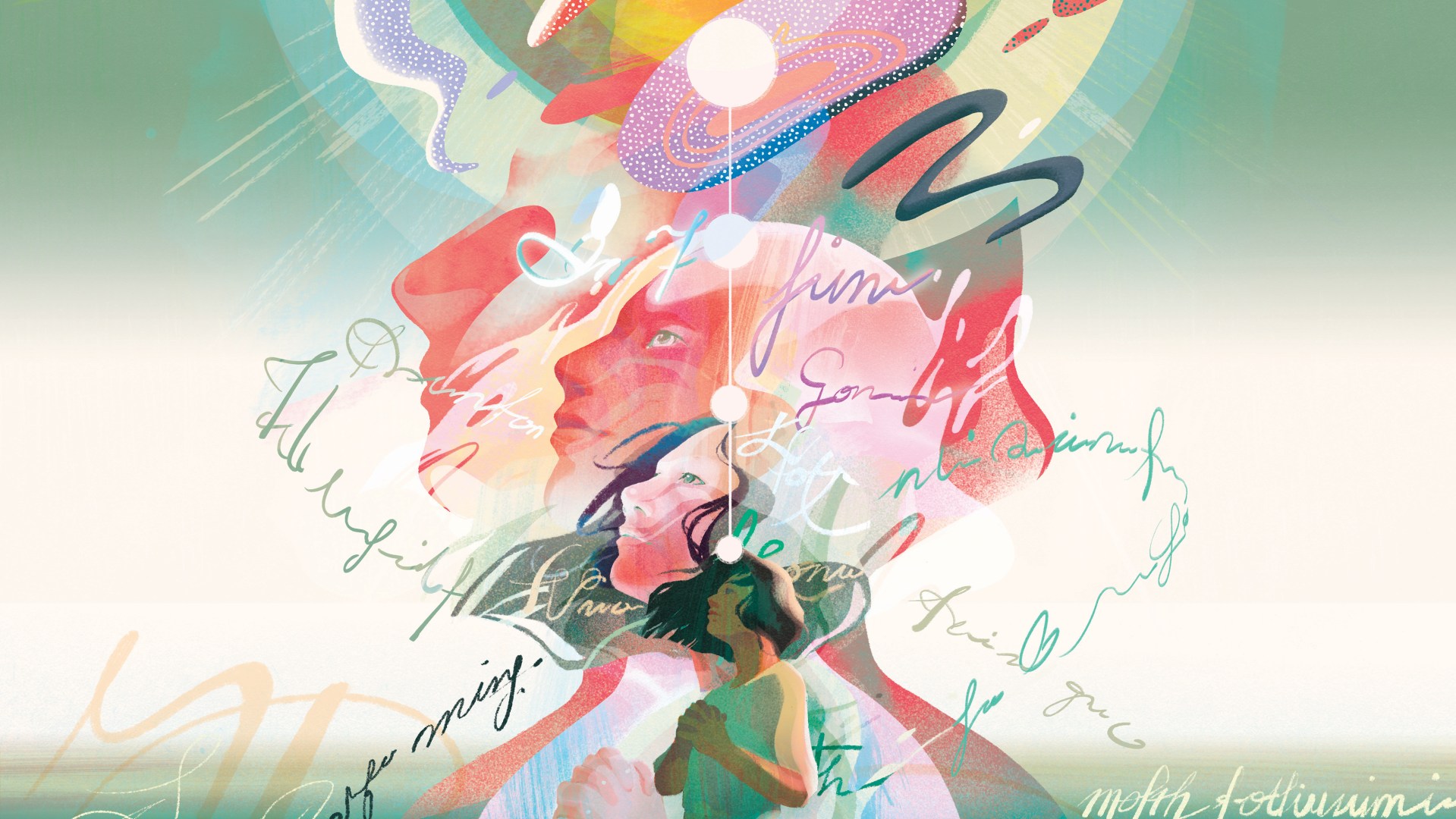
Illustration by Cornelia Li

I was desperate for encouragement but couldn’t even open my Bible. As my tears fell, the words I could not read welled up inside instead.

“For you created my inmost being; you knit me together in my mother’s womb. I praise you because I am fearfully and wonderfully made. …” (Ps. 139:13–14). Unbidden, my soul remembered its truest story, the story that my present suffering was threatening to smash and scatter into the wind.

A month after I turned 20, my body suddenly became a place of pain rather than possibility. In a matter of days, I could no longer walk because of severe joint pain and inflammation. I sat on my dorm bed, and for a few minutes I tried to uncoil my swollen hands to turn the pages of my Bible, to no avail.

In that suffering, the Word hidden in my heart started countering my fear. I was confused and craving comfort, but God’s story was alive inside of me, welcoming me into the wonder that I am loved at my weakest.

God’s Word became a living part of my memory long before I most needed it. Many summers during my childhood, my Presbyterian church memorized an entire chapter of Scripture together, including the psalm that bubbled up in me that afternoon in college. Our pastor printed verses on colored paper and posted them on every wall and bathroom stall. Each Sunday evening we would gather in the warmth of the setting sun, sitting in lawn chairs in quiet Michigan backyards, where word by word we repeated passages of Scripture together. It was before our eyes, on our lips, in our hearts, and in our midst.

Scripture memory was also a central part of my education at my conservative Baptist school. But instead of shared joy, there were stars on charts. At church, I learned God’s Word as a story while standing next to 70-year-olds with beaming smiles. But at school, I learned to satisfy teachers, afraid of their frowns. I barely remember the hundreds of verses “memorized” for our weekly quizzes. But the words we said under the summer sun are welded into who I am.

We can better understand the difference between what we remember and what we forget by learning the way God designed our brains and bodies to form lasting memories.

Most of us misunderstand the basic way memory works. In a large-scale 2011 study, researchers found that 63 percent of Americans believe human memory is like a video camera—as though our minds accurately record everything we see and hear so we can review and reflect on it later.

In reality, memory is a complex function of how the brain processes each moment, situation, and relationship and how it directs our response. Memory is shaping the story we live every moment of every day, but most of us are unaware of its steering. Our minds are etched by relationships, and our past relational experiences subconsciously guide how we experience God, ourselves, and others now. Our past shapes our present and our future.

Jessie Cruickshank is a researcher, minister, and Harvard-trained expert in neuroscience and education. She explained that our long-term memory banks are composed of two kinds of memories. “Heart knowledge is that embodied, autobiographical memory,” she told CT, “and head knowledge is semantic.” These two parts of our memory are not easily linked, such that it is incredibly difficult to learn something in our semantic memory and then wire it to our hearts.

According to Cruickshank, who is now a consultant at the leadership support ministry 5Q, the way most Christians in the US approach Scripture, especially memorizing it, involves using semantic memory. But research has shown that semantic memory has an extremely high forgetting rate. In other words, we often try to memorize Scripture in a manner in which it will be easily lost. Autobiographical memory, however, has much more staying power.

We want the Word of Christ to dwell richly among us (Col. 3:16) so that the stories of God’s love and redemption become so thoroughly etched in our memory that they guide us more than sin or any feelings of abandonment or fear. The Word has to be experienced and embraced as living, active, and relational to become a lasting part of our autobiographical memory. We must approach Scripture with our whole selves, whole stories, and whole bodies as a means by which we can encounter the author of all life, rather than as facts to retain or truth to know.

Cruickshank explained: “Only autobiographical memory can project into the future. Because it’s the memory of your past, it’s the memory of your future. It’s called prospecting. . . . Semantic memory cannot do that. So if you learn something as a data fact, you literally cannot—biologically cannot—apply it to your life. This has profound implications for discipleship. If you memorize—which is semantic memory—‘God is good,’ you literally cannot apply that to your life.”

Memorizing Scripture in ways that do not fully get stored in our autobiographical memory might mean we will know the truth but be incapable of living it. But when the Word, story, and presence of God become part of our autobiographical memory, we can’t help but apply them to our lives because they’ve been encoded into our story. Instead of needing to find a verse to discern right from wrong, we can so thoroughly encounter the person of God in his Word that walking in his way of wisdom becomes the habit of our hearts.

But we’re much more used to looking up information than dwelling with it and meditating on it. We live with nearly constant access to search engines, and research is showing that when we interact with the internet as an assistive memory partner, we do not remember as much information.

Researchers call this dynamic cognitive offloading. Perhaps without realizing it, we’re also offloading Scripture’s place in our hearts by searching for words or phrases on Bible Gateway instead of taking the time to search the Bible for ourselves. As psychologists Daniel M. Wegner and Adrian F. Ward wrote in Scientific American in 2013, our tendency toward cognitive offloading may “undermine the impulse to ensure that some important, just learned facts get inscribed into our biological memory banks.”

They also noted that the relational richness of our shared knowledge is diminishing, even as our access to knowledge has never been more expansive. Researchers in France and the UK have shown that “digital natives,” those who have grown up with internet- connected technologies, tend to gravitate toward shallow information processing. According to Ward, our tendency to reach for Google to tell us what’s true may be impairing how we encode new memories, keeping us from developing metamemory—our knowledge of learning processes and our capacity to be aware of and regulate how we form memories.

Our habits of disconnection and distraction with a wealth of devices at our fingertips keep us from being shaped to feel the wealth and wonder of the story of God as our own. Both our tendency toward cognitive offloading and our general bias toward treating Scripture like a collection of facts rather than encountering the person of God keep us stuck in a mode of shallow information processing, where the Word and presence of God cannot become rooted in our autobiographical memory.

Illustration by Cornelia Li

Rafael Rodriguez, a professor of New Testament at Johnson University in Knoxville, Tennessee, shared in an interview how the early church’s oral culture interacted with the Word of God. Though the earliest Christians had much lower rates of literacy, they were driven to turn to the words not simply to remember facts but to encounter Jesus. “The texts are important,” Rodriguez said, “because we believe God speaks through them to us and to our world and to our community.”

Rodriguez encourages his students to learn to listen to Scripture much the way a first-century Christian would. He tells them, “Read this out loud so that the muscles of your chest and throat and mouth have to form these words, so that your ears register them, so that your eyes see them on the page. You want to engage your whole body. Write out the Word, not just type out the Word. When you’re writing with a pen and paper, it interiorizes the Word in a way that’s much more real. Being a scribe of the Word is important for us as individual Christians and as the community of the church.”

Cruickshank agrees. She says that when we engage the Bible first and foremost as a relationship with the living God, it activates the parts of our brain needed to encode the story of Scripture into our autobiographical memory. Further, as we engage the Word with our whole bodies—writing, speaking, listening, drawing, and imagining—and connect it reflectively to our stories, we are able to absorb it in a way that connects multiple systems of our brains.

Some people in ministry witness these theories at work. Every Sunday, pastor Jon Brown stands before the congregation of Pillar Church in Holland, Michigan, and recites the sermon’s passage of Scripture from memory. In an interview with CT, Brown shared that he calls his approach “interiorization” instead of memorization. He described his process of sermon preparation as indwelling the story of Scripture so thoroughly that it becomes his story, so that when he shares it with his congregation, they can also experience the story as their own.

Brown preaches from texts set by the Narrative Lectionary, a four-year cycle of readings crafted by two professors at Luther Seminary aimed at helping Christians experience the Word as a larger, living story. During the week, Brown sets aside time to commit the text to memory. Like Rodriguez, he seeks to absorb a biblical passage with his whole body, employing hand motions, drawing, speaking the words aloud, writing out the passage, and using mnemonic devices. By the middle of the week, Brown says he has so internalized it that he cannot help but see its patterns and themes come alive in conversation. Rather than being something he can just recite, the Word animates his thoughts and actions. It becomes part of his autobiographical memory and sense of self. And he’s been doing this for 17 years.

Gary Cantwell, chief communications officer for the Navigators, shared similar experiences of being holistically formed by Scripture. Like Brown and Rodriguez, Cantwell has used embodied practices to absorb the Word over the past year while working through the Navigators’ Topical Memory System—drawing pictures and even recording himself reading verses to listen to later. He described noticing a shift from outside to in: “I have it [the Word] in my heart.” He said Bible memory was more of a duty or expectation in the early days of the Navigators, but leaders today are encouraged to pass on verses “from disciple to disciple” in a conversational way.

Yet there’s still potential for ministries that stress Bible memory to unwittingly shape Christians to turn to Scripture to accumulate facts rather than become part of God’s story. When our focus is on head knowledge, our encounters with the Word can become void of eagerness to be shaped by its author.

What helps us move from being mere observers of Scripture to participants in God’s story? Cruickshank says it’s suffering. When we suffer and experience the cognitive dissonance of realizing some things we thought were true are not, our brains release a hormone called brain-derived neurotrophic factor. Research done by the University of Arizona has shown that learning is optimized when we fail 15 percent of the time. When we come up against the limits of our knowledge of God and life, when we realize we are not in control and sometimes are wrong—a place that suffering brings us to again and again—God has wired us so that our bodies release the very hormone we need to form new neural connections. And as we learn to pause there, to reflect rather than anxiously seek answers or quick relief, our brains stay in the state needed for the presence and Word of God to become rooted in our autobiographical memory.

Living as an at-risk person during the COVID-19 era, I’m again finding that suffering can recall the Word within me. Right before the pandemic started, I looked forward to speaking opportunities all over the country. Now, my doctors anticipate I may not be medically safe to fly or even go to church until there is a vaccine. In a corner of my small apartment, I speak aloud the words of Psalm 18: “He brought me out into a broad place; he rescued me, because he delighted in me” (v. 19, ESV). Day by day, I mouth the words from behind my mask as I slowly make a loop around our neighborhood park. In my smallness, engaging all my senses, I start to see a spaciousness within me and feel a growing hope that I will again live farther than the confines of my apartment and park. It’s in the contrast between where I am, where I’d like to be, and what David expressed as true that I find my story in this season becoming bigger than what I can see.

In Jesus, we are offered the relationship that will change our stories by renewing our minds (Rom. 12:1–2), down to the very firing of our neural networks. Because Christ came, because he suffered, because he lives in us now by his Spirit, he is always meeting us in our smallness and sorrow. As we move from merely memorizing Scripture to encountering God with all our senses and emotions—especially when we are most anxious, confused, and in need of comfort—Christ’s story becomes our own. That is a broad place.

K. J. Ramsey is a licensed professional counselor and writer who lives in Colorado. Sections of this article are taken from her first book, This Too Shall Last: Finding Grace When Suffering Lingers.

Books
Excerpt

Churches: Don’t Worship—or Serve—Until You’re Blue in the Face

Maintaining a balance between gathering and scattering is the key to avoiding spiritual pneumonia.

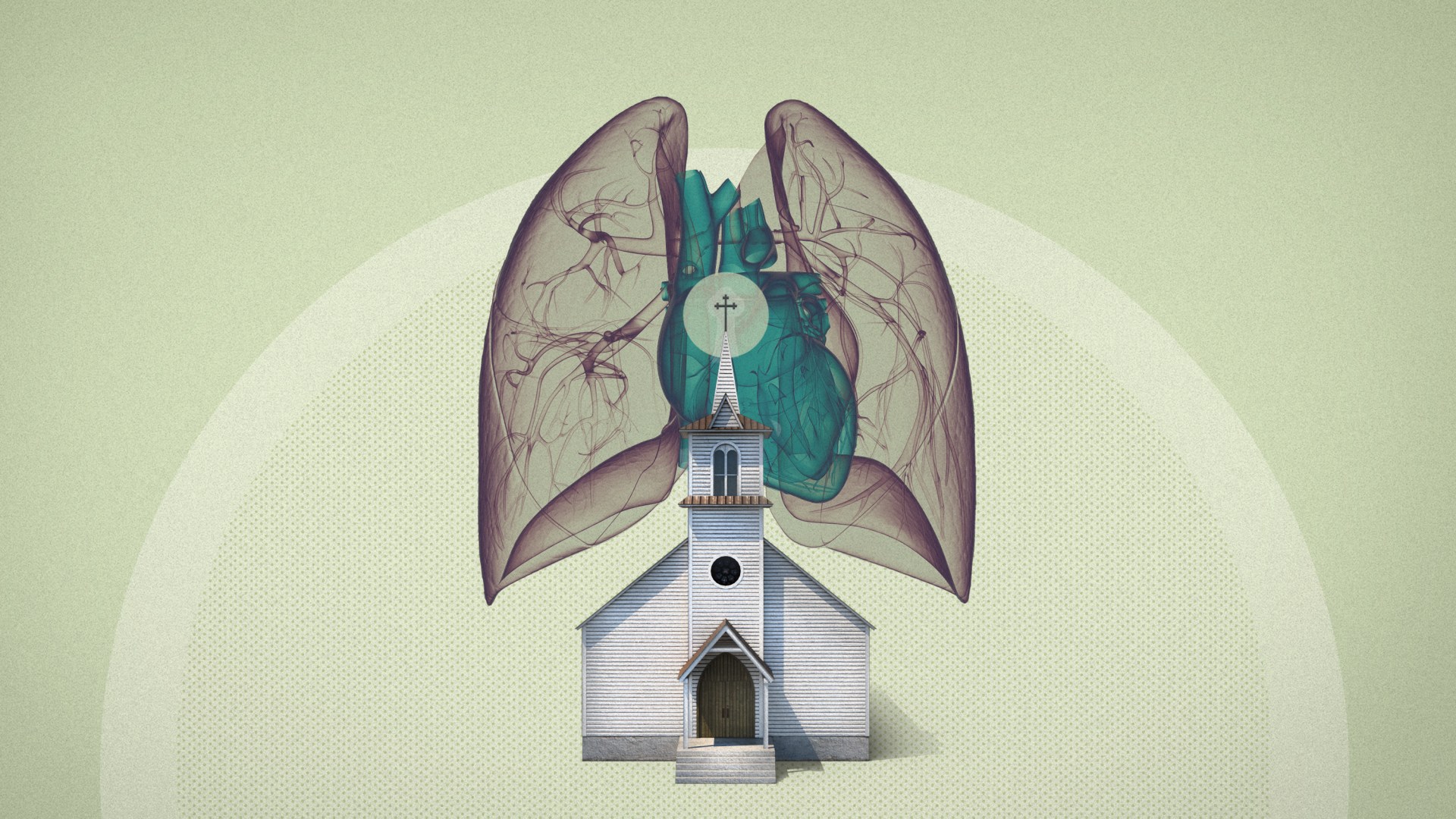
Illustration by Rick Szuecs / Source images: Sebastian Kaulitzki / Getty / Envato

My sons’ elementary school is just a block from our house; it appears to inhale students every morning, hold its breath for several hours, and then cough them back out in the afternoon. On spring mornings, when the windows in my office on the third floor of our house are open, I can hear the bustling as kids chat and squeal with their friends. When I look out the window, I can see the minivans lined up in the carpool lane, waiting to be waved forward by students on safety patrol.

The Sacred Overlap: Learning to Live Faithfully in the Space Between (Seedbed Resources)

The Sacred Overlap: Learning to Live Faithfully in the Space Between (Seedbed Resources)

HarperCollins Children's Books

288 pages

$8.88

When the weather is nice, I often take a walk around the block at midday, to clear my mind or pray. When I pass the school, all is quiet outside the building; there’s not a sound or person in sight. And then, at 3:40 every afternoon, kids begin trickling out a few at a time. This builds to a crescendo, as the building spews out one large, chaotic rush of students with noise, laughter, excitement, and relief. Some kids rush to hug their parents or jump in their parents’ cars, while others sprint to throw the football on the playground. Similar scenes of inhaling and exhaling probably play out at most schools around the world.

I often think of church as a pulsating heart, which expands and constricts to push blood through the veins and arteries of the body. Or, better yet, a living, breathing entity that inhales her people, holds her breath, and then exhales them out, scattering them as missionaries disguised in various vocations, roles, and responsibilities throughout the world. Of the 40 miracles found in the book of Acts, all but one of them occurred outside the walls of a religious building.

This idea of a breathing church is quite theological, actually. The Hebrew word for spirit is ruach. (To say it properly you have to say the end of the word—the ch—as if you are clearing your throat.) Ruach means “spirit, breath, or wind.” In Greek, the word is pneuma (said with a silent p), which means “spirit, mind, or breath.” It’s where we get our word pneumonia, the condition where you have trouble breathing. To be a faithful church, we take our cues from this holy wind-breath. We read in the Gospels that the first apostles were told by Jesus himself they could not begin his ministry until—and only until—they had received the gift of the Holy Spirit (Luke 24:49). Don’t do anything until the Spirit comes. Stay put. Maybe we should take note, too. In the Book of Acts we see that the Spirit is the chief player in the mission of Jesus’ church, the director of this entire venture which points the world toward Jesus.

As members of Jesus’ church, we are both blessed and also sent. We are called to gather in Jesus’ name and also scatter in it. If all we do is gather, singing our songs and saying our prayers and listening politely to sermons without any intent to live all of it outside the church, it would be like taking a deep breath and never exhaling. It’s exhausting, unhealthy, and eventually we’d turn blue and die. If all we do is scatter, busying ourselves with service projects, community events, and other meaningful endeavors, it would be like we’re exhaling and exhaling until there is nothing left in the tank. Eventually, we’d turn blue and die. Gathering for worship is vital because it’s where we center around the life, death, and resurrection of Jesus and respond to his great love for us. But 90 minutes spent in worship every Sunday only equates on average to a mere 1.3 percent of our waking hours in a given week. If we believe this space will be sufficient to mold us into fully formed, fully matured Christlikeness, who are we kidding? We need to gather together in worship, but we also need to learn to engage with God and others in various forms of worship, formation, and mission during the other 98.7 percent of our time.

This approach of only inhaling (or only exhaling) is never the vision or intention of the church. If we have either one without the other, we cannot faithfully express God’s purposes in and for the world. It’s spiritual pneumonia. But when churches find the sweet spot in the midst of this healthy tension, they develop strategies for both gathering and also scattering in order to bless the world. Doing both means we value the activities of the church without neglecting those outside the church. Inhaling and exhaling with regularity and intention, we allow the Spirit to work in our communities of faith in naturally supernatural ways. Being present and committed to the local church is an important priority, but sometimes this also means you have to just skip the Wednesday service to hang out with your neighbors.

This is what pastors and authors Hugh Halter and Matt Smay describe in their book AND: The Gathered and Scattered Church as the power of the and. The right things are centralized and also decentralized. Both people and resources find a blessed blending of maintenance and also mission, survival and also sending, tradition and also innovation. Fans are turned into followers, disciples are made into apprentices, and consumers become missionaries. It reminds me of Jesus’ words in Matthew 13, where the owner of a house brings out of his storeroom new treasures as well as old (v. 52). The kingdom is not always either/or; it’s often both/and.

Jesus’ intent is to create little pockets of heaven where people can be in God’s presence, but he does it out here in the world, in the middle of sin and death. I’m certainly not saying this is easy. Admittedly, many Christians find church to be the most difficult aspect of being a Christian. As a pastor, I have found this tension to be tough work, like walking a tightrope; sometimes it feels like I’m about to throw up.

The church stands as an alternative and prophetic space, a colony of heaven in a country of death. We don’t have to be seminary trained or overly religious to participate in this. As Eugene Peterson wrote, church is “a congregation of embarrassingly ordinary people in and through whom God chooses to be present to the world.” We long for things to be made right and to be put back together in the shalom of God, yet we live in the midst of a world at war with itself.

When we started our church over a decade ago, I asked our core team why we existed, why we would go to the trouble of setting up chairs and singing songs and listening to sermons. I wasn’t against these activities; I believed they were important. But if we didn’t clarify why we were doing these things, we could also fall into the trap that perpetuates the unhealthy mentality that we’re just in this for ourselves. Without focused and intentional conversation and communal discernment, we could run the risk of becoming a church that inhaled and held its breath for dear life.

During the weeks those conversations took place, trying to clarify exactly why we would gather each week as a community of Jesus followers, we eventually landed on the phrase formation for mission. We realized that we gathered to be formed in order to be sent. We realized that, in our own way, we were articulating the blessed-and-sent posture. The purpose of our singing and prayers and Communion and storytelling and sermons was to form us in order to allow the Spirit to exhale us into our various contexts, not as just somebodies but as God’s deeply loved children sent to represent Christ well in the world by living the with God life.

Inhaling and also exhaling, blessed and also sent, studying God’s Word and also following God’s Spirit. It’s messy and costly and time intensive. But it’s worth it.

Taken from The Sacred Overlap by J. R. Briggs. Copyright © 2020 by Zondervan. Used by permission of Zondervan. www.zondervan.com.

Books

New & Noteworthy Books

Compiled by Matt Reynolds.

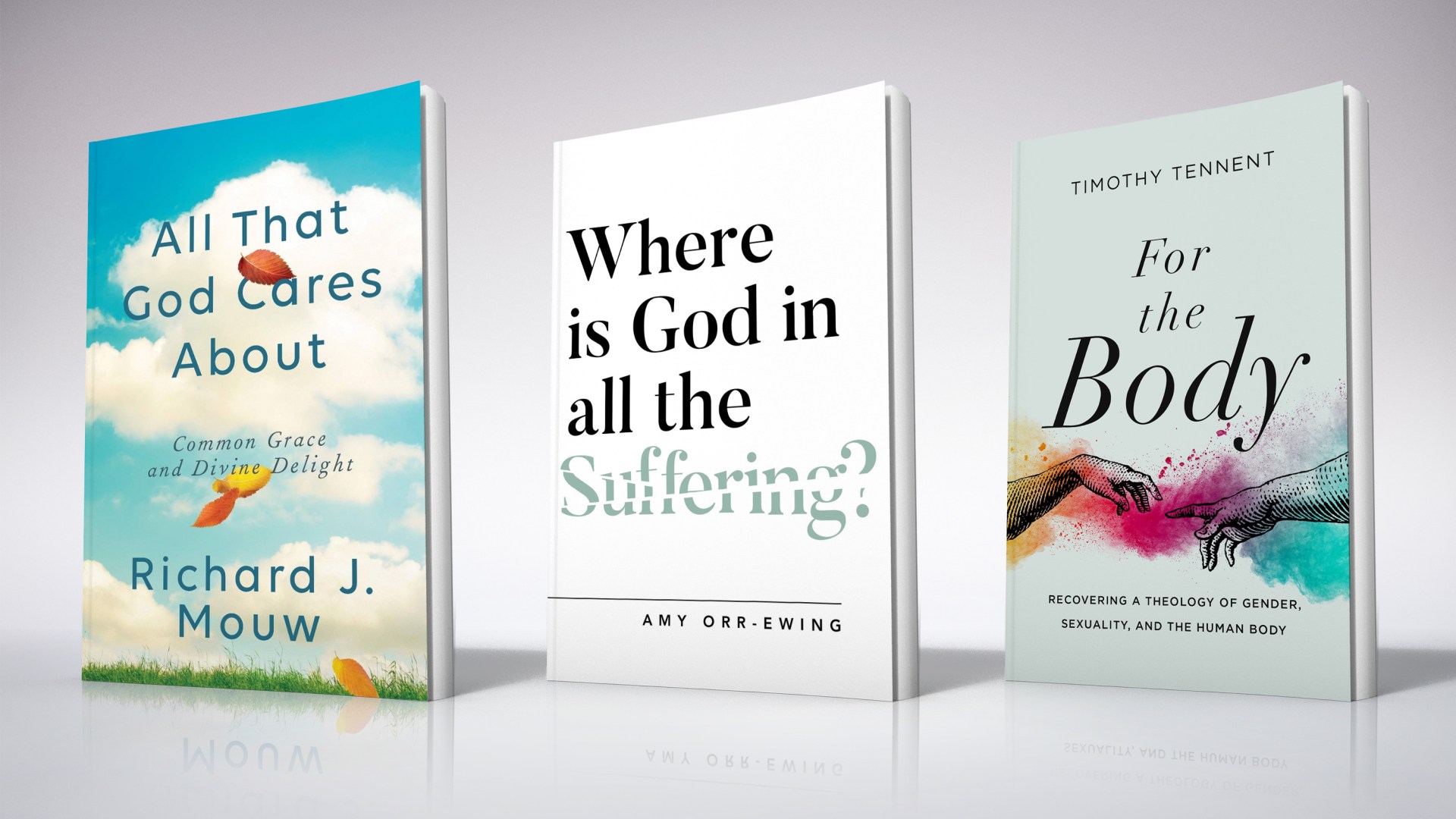
All That God Cares About: Common Grace and Divine Delight

Richard J. Mouw (Brazos Press)

Abraham Kuyper, the Dutch theologian and statesman, famously affirmed that Christ’s rule extends over every square inch of his creation. In All That God Cares About, Richard Mouw celebrates Kuyper’s understanding of common grace while cautioning against a “triumphalist tendency” that it sometimes encourages among believers who are fired up by his vision of cultural reclamation for kingdom purposes. As Mouw explains, “we need to discern the signs of God’s renewing work in the present.” However, “we do still need to be constantly reminded about Christ’s call to us to share in his suffering. The ravages of the fall are all too obvious in our world.”

Where Is God in all the Suffering?

Amy Orr-Ewing (The Good Book Company)

With each month COVID-19 lingers, it exacts an even heavier physical, psychological, and material toll. Writing in the thick of the pandemic, Oxford-trained apologist Amy Orr-Ewing takes a warm, personal approach to addressing the suffering that people experience and their doubts about God’s protective care. “For me,” she writes, “love is the starting place for untangling questions of pain and suffering, and especially the question, ‘Where is God in all the suffering?’ Love seems to be at the absolute core of why suffering feels like it does. Suffering feels so wrong to us because of our love for another person who is in distress.”

For the Body: Recovering a Theology of Gender, Sexuality, and the Human Body

Timothy C. Tennent (Zondervan)

The evangelical witness on matters of sex, gender, and public morality can suffer from a piecemeal focus. We mount distinct arguments against things like abortion, same-sex marriage, gender reassignment, pornography, or cohabitation, but we neglect knitting them together into a holistic theology of bodily life. Asbury Theological Seminary president Timothy C. Tennant sets out to correct this imbalance in For the Body. Too often, he writes, believers are rushing around “like firefighters desperately careening from one spot to another, trying to put out this fire or that fire,” and “our focus on extinguishing individual fires has prevented us from examining the underlying cause.”

Books
Review

Jesus Is Your Lord and Savior. Is He Also Your Philosopher King?

Why the church should learn to appreciate Christ as the world’s greatest thinker.

Michele Tantussi / Stringer / Getty / Envato

Let me begin with a brief lament. As a Christian philosopher who teaches future ministry leaders and speaks to lay leaders and pastors, I frequently defend the need for philosophy. Allowing for some slight exaggeration, a typical student comment goes like this: “Why do I need to learn logic? Will I ever perform a logical proof in a Bible study?” Whenever I speak, teach, or preach at a church, I find a similar suspicion. Philosophers are viewed as a kind of novelty act: “Look what we found! A philosopher! Let him babble a bit to see if any koans drop out of his mouth.” All too often, the church assumes that Christianity and philosophy mix as well as oil and water.

Jesus the Great Philosopher: Rediscovering the Wisdom Needed for the Good Life

Jesus the Great Philosopher: Rediscovering the Wisdom Needed for the Good Life

Brazos Press

240 pages

$11.29

In every generation, certain books profoundly influence individuals or entire cultures, serving as catalysts for new ideas, enlarged possibilities, and fresh perspectives on ancient truths. The Enlightenment philosopher Immanuel Kant, for example, claimed that reading David Hume awakened him from a dogmatic slumber. I hope that Jonathan T. Pennington’s Jesus the Great Philosopher plays a similar role in the contemporary church, reminding us to value the brilliance of Jesus the Philosopher King. Pennington, who teaches New Testament at The Southern Baptist Theological Seminary, makes three arguments: that the Bible addresses the big philosophical questions, that Christianity is a philosophy, and that Jesus is a philosopher. Each of these claims seeks to recover a key truth lost by the contemporary church.

Modern secular philosophy is anemic and disconnected from everyday life; it was not always so. The ancient Greeks and Romans had a rich conception of philosophy. For the ancients, philosophy was a way of life: the love and pursuit of the good, the true, and the beautiful for the flourishing of individuals and the broader public. Philosophers sculpted society. They mapped and explored what Pennington calls the “land of the Good.” This map of reality directs us to four main compass points for exploring life’s big questions: metaphysics (the study of the nature and structure of reality), epistemology (the study of knowledge, truth, and belief), ethics (the study of right and wrong, goodness and evil), and politics (the study of the nature and structure of human society).

Now for Pennington’s startling claim: We find the same four compass points in the Bible. God’s Word makes claims about the nature and structure of reality, including the fundamental distinction between Creator and creature (metaphysics). It offers a nuanced view of knowledge as both factual and experiential (epistemology). And it has much to say about how we ought to live both individually (ethics) and as a society (politics). Thus, if we pay attention to the questions the Bible seeks to answer, we’ll discover how the world works and how we ought to live in it. We’ll develop into good philosophers, learning to ask the big questions and finding answers that help us align our lives with the true story of the world.

The Bible answers the big philosophical questions, according to Pennington, because Christianity is a philosophy. It is not merely a philosophy, of course, but it is also not less than a philosophy. Christianity offers us a “whole-life philosophy” that unites head and heart—and humans to each other and God—for the sake of meaningful happiness. After establishing this, Pennington’s book then takes an unexpected turn for those familiar with contemporary philosophy, or even with contemporary Christian philosophy, as it tackles topics that are regularly ignored or glossed over. More specifically, Pennington spends two chapters apiece on emotions and relationships. Plato and Aristotle discussed both topics extensively—as did Jesus and the biblical writers. Pennington argues that matters of emotion and social situation figure prominently in Jesus’ conception of the good life, which means they should figure prominently in ours as well.

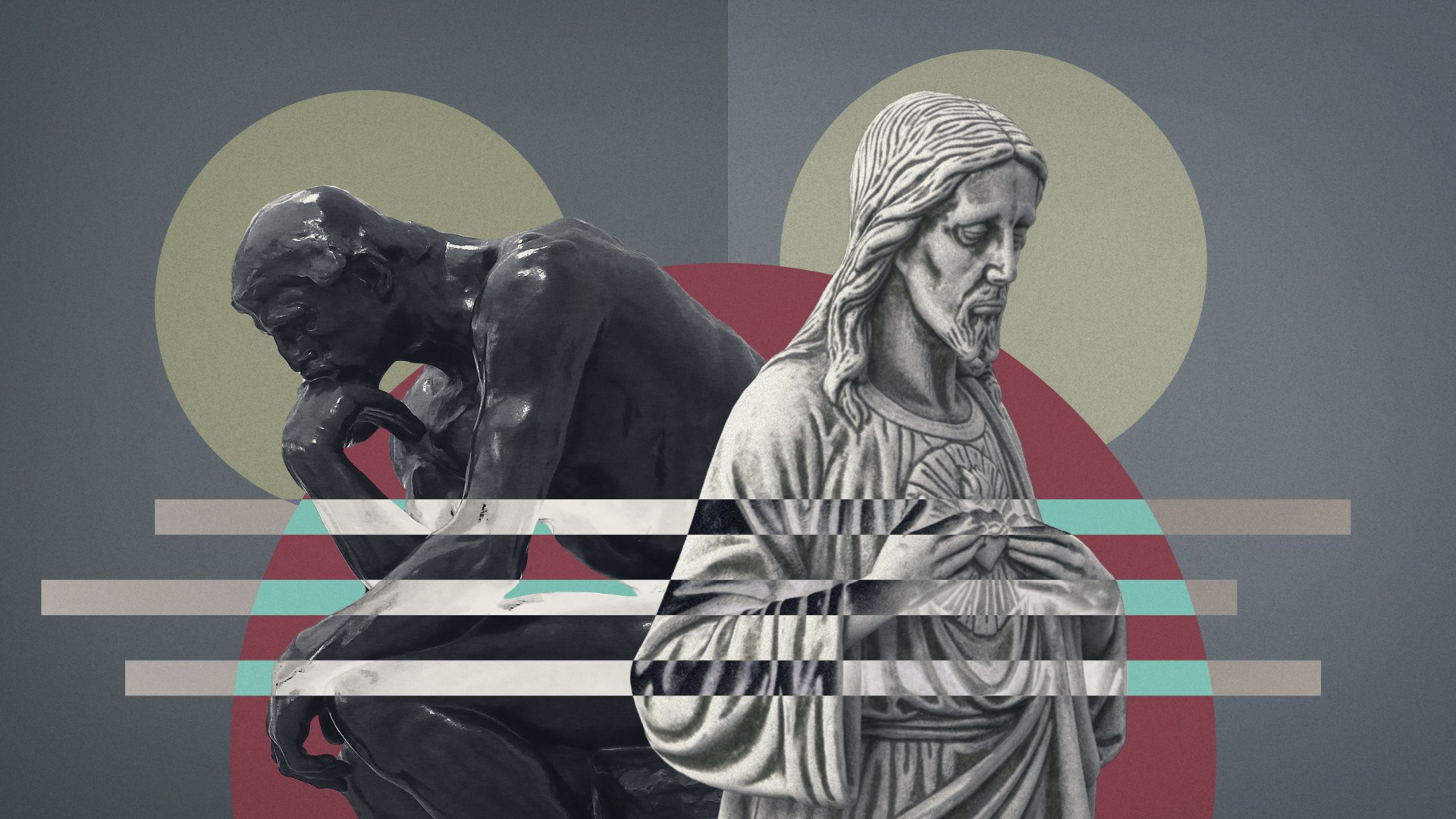
The book’s title makes an iconoclastic claim: Not only is Jesus a philosopher; he’s a great philosopher. Christians today are prepared to accept Jesus as Lord and Savior, but not necessarily as a philosopher. And yet, as Dallas Willard writes in The Divine Conspiracy, Jesus possesses intellectual virtue to speak on all matters of reality. This makes Jesus a philosopher. While this might sound odd to modern ears, early followers thought of him this way. For support, Pennington points to a third-century painting found in a house church in Dura-Europos (modern-day Syria) depicting Jesus with a philosopher’s haircut, robe, and posture. A guru worth following, Jesus speaks authoritatively about what is good, true, and beautiful.

Pennington links some of the problems endemic to modern Christianity—fragmentation, biblical illiteracy, anti-intellectualism, a limited witness, and more—to the church’s failure to appreciate the philosophical nature of Christianity and of Christ himself. His book sets forth a challenge for modern Christians: to return to a more ancient—and biblical—conception of Jesus as the true Philosopher King.

Paul M. Gould is an associate professor of philosophy of religion at Palm Beach Atlantic University. He is the author of Cultural Apologetics: Renewing the Christian Voice, Conscience, and Imagination in a Disenchanted World (Zondervan Academic).

Books
Review

Marilynne Robinson’s Latest Novel Probes the Mysteries of Predestination and Grace

Jack Boughton, the wayward pastor’s son, is a central character. So is Jesus.

Illustration by Dorothy Leung

John “Jack” Ames Boughton is a wayward preacher’s son who always seems to find himself close to Christians. He often feels the need to let them know he is actually an atheist. His Christian acquaintances, however, somehow don’t feel the need to take his confession at face value.

Jack (Oprah's Book Club): A Novel

Jack (Oprah's Book Club): A Novel

Farrar, Straus and Giroux

320 pages

$7.99

Perhaps Jack bears some blame for this ambiguity. He talks about his “atheist soul”—a soul he suspects has been predestined (he definitely believes in predestination) for perdition (he is definitely not a universalist). Yet he still seeks out Christian worship, pastoral counsel, and even a hoped-for blessing. He loves to play hymns on the piano. He is also a habitual thief, liar, drunkard, and—in his own unflinching self-assessment—a “confirmed, inveterate bum.” But perhaps that is just another way of saying that he starts from the same place we all do, as a son of the old Adam.

Jack is the fourth in a series of novels by Marilynne Robinson. It follows Gilead (2004); Home (2008), which adds Jack’s perspective to the events of Gilead; and Lila (2014), all of which were lauded by critics and readers alike.

Robinson is widely considered among the greatest American novelists writing today. She has also emerged as one of America’s leading public intellectuals. Many of her addresses and essays have been collected in resonant volumes such as The Death of Adam (1998), When I Was a Child I Read Books (2012), The Givenness of Things (2015), and What Are We Doing Here? (2018). Barack Obama is such an admirer that while he was president, he did an interview with Robinson that appeared in The New York Review of Books.

What makes all this especially intriguing is that Robinson is also very open about her Christian faith. She is even an unapologetic champion of John Calvin. Moreover, her works are infused with Christian thought and theological meditations. She trusts her readers to know and care about the contents of the Bible, the doctrines of the church, and the distinctive views of the major denominations.

Determined Harmlessness

This latest novel is centered on the romantic relationship between Jack, a white man from Iowa, and Della, an African American high school teacher from Tennessee, which blossomed when they were both living in St. Louis. The precise year is not identified, but my historical detective work suggests 1954. In other words, the novel is set in a time and place in which interracial marriage was illegal and segregation was the norm.

In the previous novels, readers learned a lot about Jack through the eyes of characters he had disappointed, notably his father and sister, and his namesake, the Reverend John Ames. Jack’s chief offense was impregnating an impoverished, underage girl and then callously abandoning her and their child. He skips town and leaves his distraught family—not least his Presbyterian minister father—to figure out how to make some amends.

That episode revealed a gross weakness of character. Arguably more rattling still was the fact of Jack’s chronic malicious streak. He would steal things of no use to him just because they held sentimental value for their owners. He would destroy things he happened upon just because he could.

Poignantly, we learn in this novel that Jack is just as bewildered by his behavior as everyone else. He can’t explain his actions even to himself—and he grasps how frightening they are. He felt these deeds as a “compulsion”—somehow, he knew he was going to do mischief. Robinson does not psychologize this, but there are moments when it seems like obsessive-compulsive disorder or something similar might be a factor. At one point in the story, Jack walks to a church building with the notion of touching it and thereby absorbing its solidity. When he arrives, someone he knows is standing there, unwittingly barring him from undertaking this private ritual. As he chats with the man, Jack can’t shake the inner turbulence of having the ritual interrupted.

Robinson’s real interest, however, is not psychological but theological. Jack knows himself to be a wretched man. The good he ought to do he does not do, and the evil he knows he shouldn’t do he ends up doing anyway. The reader is relieved that Jack is looking for a way out. When Della meets him, he is already pursuing a life of determined harmlessness. He has become a kind of utilitarian saint, following John Stuart Mill’s dictum of being free to do anything as long as it does not harm others.

Jack, however, is not a true saint. He is not doing anyone any good, and he is indulging in a lot of self-abuse. Moreover, as Scripture reminds us, it is not good for man to be alone (Gen. 2:18). A central tension of the novel is Jack’s moral dilemma: Should he embrace love and thus move beyond his self-contained, self-destructive life? Or is staying away from Della—thereby ensuring he does not cause her harm—truly the most good and Christian course?

One tragic aspect of the whole situation is the tragedy of America. In contrast to the callous relationship in Gilead that so marred his reputation, Jack’s behavior toward Della is utterly pure, even chivalrous. Yet because their relationship is interracial, everyone around them sees it as shameful and discreditable. The one time in his life when Jack is behaving honorably, he is judged dishonorable; he is at last being respectable, but a racist, sinful, toxic society condemns his actions as disrespectable.

Della and Jack fantasize about re-creating society from scratch, writing the rules as they see fit. Revealingly, even for Jack, this is an imagined chance to escape the injustices of segregation but not the demands of Christian discipleship. They decide against abolishing the category of “sin” in their brave new world, reasoning that the potential to do harm will still exist. Endearingly, they even commit to remembering the Sabbath. Not only is it “pretty hard to forget,” but as Jack reflects: “Closing the world down once a week to frustrate some percentage of bad impulses was Moses’ best gift to humankind.”

There can be no exit into nihilism. But, Jack muses, what if it were clearly, unequivocally revealed that life has no meaning? Della has her retort ready: “Meaninglessness would come as a terrible blow to most people. It would be full of significance for them. So it wouldn’t be meaningless. That’s where I always end up. Once you ask if there is meaning, the only answer is yes.”

Moreover, the guarantor of meaning is Jesus Christ. As Della observes, “I just think there has to be a Jesus, to say ‘beautiful’ about things no one else would ever see.” Jesus, therefore, is another prominent character in this narrative. Jack evokes his name incessantly, including in his internal monologues. Sometimes it can sound like an expletive, but on other occasions it is readily discernible as a prayer: “Dear Jesus, keep me harmless.”

When city officials devise a development scheme that involves demolishing the black neighborhood, Jack fantasizes about rescuing the large portrait of Christ’s ascension in the black Baptist church he has been attending. He would take it back to his tiny, dingy, one-room lodging. He imagines Christ filling his dwelling place.

On the piano in her house, Della has pictures of her family and, among them, a portrait of Jesus. We eventually learn that Della’s father—an African Methodist Episcopal bishop—has the same picture on his desk, as does Jack’s father. Are they not then already blood relations—part of the same family? In Della’s display, the picture of Jesus is the only one in color. Does he then offer a way to free us from our black-and-white binary?

Grace Upon Grace

Unchristian, unjust, and socially constructed though it is, that binary is nevertheless brutally real. Jack and Della cannot sit next to each other on a bus when they travel “together”; they cautiously face away from each other when they sit talking on a park bench.

Early on, Jack compliments Della: “You’re very sure of yourself. At ease in your own skin.” To which she can only reply, “You actually said that.” When she prods him to reform his life, Jack retorts, “You don’t know what you’re asking. Can the leopard change his spots?” Robinson counts on the reader to feel the haunting resonance of the unspoken first part of that biblical quotation: “Can an Ethiopian change his skin?” (Jer. 13:23).

Another way their relationship is “mixed” is that Della is a Methodist and—doubter and flagrant sinner though he is—Jack is very much a Presbyterian. When Della airs her doubts about predestination to reassure Jack that he isn’t doomed, he remains unmoved: “Destiny,” he replies, “has made you a Methodist.” Jack can even give a defense of the Reformed faith that would make his father proud: “It’s all pretty straightforward. Salvation by grace alone. It just begins earlier for us than for other people. In the deep womb of time, in fact. By His secret will and purpose.”

And so we reach the doctrines of grace, for this is a book about grace, and Marilynne Robinson is a theologian of grace. Della’s sister dismisses her interracial relationship as a “disgrace,” but the reader, thank God, doesn’t believe it. It’s not too great a spoiler to reveal that the novel’s last word is literally “grace.” At his birth, Jack was christened “John,” a name that means “the Lord is gracious” or “graced by the Lord.” And the reader, like Jack’s father, is allowed to hope that in Jack’s beginning is his end. Grace upon grace.

Timothy Larsen is McManis Professor of Christian Thought at Wheaton College. He is the co-editor of Balm in Gilead: A Theological Dialogue with Marilynne Robinson.

Books

Pursuing Racial Justice Requires More Than Lament, but Never Less

How the sharing of prayer and pain leads to trust—and then to change.

Illustration by Rick Szuecs / Source images: Envato Elements

In the wake of the high-profile killings of George Floyd, Ahmaud Arbery, Breonna Taylor, and others, many white evangelical churches have shown renewed interest in matters of racial reconciliation. Some have joined protest marches, hosted conversations with local black pastors, or participated in citywide prayer vigils. But others, unsure how to respond, have taken the path of least resistance. In Weep with Me: How Lament Opens a Door for Racial Reconciliation, Mark Vroegop, lead pastor of College Park Church in Indianapolis, argues that recovering the biblical practice of lament can help the church speak where it is tempted toward silence. Kathryn Freeman, a writer and master of divinity student at Baylor University, spoke with Vroegop about his book.

Weep with Me: How Lament Opens a Door for Racial Reconciliation

Weep with Me: How Lament Opens a Door for Racial Reconciliation

Crossway

224 pages

$8.05

How did it occur to you to bring together the topics of lament and racial justice?

Weep with Me was born out of my first book, Dark Clouds, Deep Mercy. The more I explored lament as a biblical category and as a way for people to navigate their grief, the more I saw parallels and possible applications in the area of racial reconciliation. In my own experience pastoring a church, trying to help hurting people, and with grief in general, I’ve found that the language of lament is really helpful, since it has the capacity to move people toward one another rather than pushing them away. And this has important implications for how we discuss racism and racial injustice within the church.

Why do you think lament is such an important part of the journey toward racial reconciliation?

When the subject of racial reconciliation comes up, people often lack a common language for discussing it. We don’t always understand what other people mean when they use certain words. Lament helps reset the conversation. We can say to each other, “Look, we are fellow Christians. You’re in pain, and I’m in pain. Let’s talk to God together about what’s wrong in the world.” And the conversation can proceed from there. In the book, I list five key steps: We love, listen, lament, learn, and then leverage all that into positive momentum toward justice and reconciliation.

In my own church, we’ve seen this process bear fruit on something we call a Civil Rights Vision Trip. Two years in a row, 50 leaders at a time, we’ve taken a pilgrimage to places like Montgomery, Birmingham, Selma, and Memphis to absorb the history that happened there. In the hotels, we spent time lamenting together, studying lament in the Bible, and talking to God about what we’ve experienced. This didn’t solve every problem or heal every division, but suddenly people were able to speak the same language.

This experience gave our black brothers and sisters permission to vocalize their grief. When they see words of lament echoed in the Bible, it validates their struggle. It gave our white brothers and sisters a language of empathy. And it allowed us to talk to God together, which starts us down a path toward unity in the context of a subject that seems to automatically create division.

In your own experience, do you think the language of lament is somewhat less familiar to Christians in the majority culture?

Yes, no doubt. In fact, one reason I wrote this book stems from an interview I did about my first book. I was asked, “Why do you think the church doesn’t understand lament?” And I realized I needed to reframe that question: “Why doesn’t the white church understand lament?” Because if you look at American church history, you’ll find this tradition very much alive within the black church, with African American spirituals being one of the classic examples. This doesn’t mean that every last white Christian neglects lament. But at least from my vantage point, when you look at the songs we’re singing and the topics we’re addressing in majority-white churches, then it’s clear that lament isn’t playing a major role.

Lament is something we don’t really understand until the bottom falls out. It’s interesting that, in the middle of the pandemic, even before racial justice issues started coming to the fore, there was growing interest in lament. All of the sudden, we had to wrestle with the idea of a hardship that everyone’s facing. I don’t think white evangelicals, as a group, are quite as familiar with this sense of communal, collective suffering as our black brothers and sisters, or Christians around the globe.

What would you say to someone who thinks of lament as an excuse for inaction on matters of racial justice?

Lament, by definition, is not meant to lead to inaction, even for those who are grieving. I define lament as prayer and pain that leads to trust. Lament is action oriented. It goes somewhere. It moves us from where we are to where we need to be.

Bringing this back to racial reconciliation: If all we do is lament, that’s not sufficient. And in fact, I would argue that without action, we haven’t engaged in genuine lament, because lament is designed to move us toward a renewal of trust. Imagine you have a friend who’s grieving. You’ll pray and lament, but afterward, you’re probably going to reach over and offer a hug, right? At the very least, you’ll do something that expresses solidarity or offer tangible ways to help. The same principle applies to racial reconciliation. As a pastor friend of mine, Isaac Adams, likes to say, We have to do more than pray, but we can’t do less than pray.

In my model, we’re committed to one another because we’re brothers and sisters in Christ. And so we need to practice James 1, being quick to listen, slow to speak, and slow to get angry [v. 19]. We need to enter into one another’s pain, weeping with those who weep. More than that, we need to understand that pain, to understand how we got here. And that’s part of the challenge for white evangelicals: Too often, our lamenting runs behind our learning. This is one of those subjects you need to grieve over before you can really study it.

What do you most hope the church will take away from your book?

Mainly, the importance of entering into the space of someone else’s pain, just the way I might, for instance, when my wife is hurting or struggling with something. Maybe I think I have a good solution. And that can be part of our conversation. But it should only come up after I’ve sat with her, wept with her, and understood her pain. My hope, then, is that this book could be a conversation changer for our white brothers and sisters. Our first step is to say: “I love you as a brother and sister in Christ. I want to listen and lament with you, so that I can learn, and together we can leverage that for meaningful change.”

For black brothers and sisters, I hope the book provides some level of validation and provides a biblical language for both their pain and their protest. Overall, I want to see the church reclaim its witness to the gospel by taking the lead in pursuing racial reconciliation rather than chasing after it from behind. In the book, I make it clear that gospel unity creates racial harmony, which means that racial harmony is part of God’s plan. When racial harmony isn’t present, that says something bad about the church. We should work to change that, because our witness is undermined when the church isn’t reconciled.

Theology

Good News: Tomorrow We Die

Why dwelling on our mortality may be good for us.

Madeleine Maguire / Unsplash

I used to assume that God owed me a long life—to pursue a vocation and family with full strength, to live long enough to become a grandparent. Then, at 39, I was diagnosed with incurable cancer. The expected storyline of my life was interrupted. Now, as a cancer patient, my expectations have changed. The cancer is likely to cut decades from my life; I experience daily pain and fatigue that drain my strength. While my former expectations of God may seem reasonable, I’ve come to see how I had unwittingly embraced a form of the prosperity gospel. I believed that God owed me a long life.

This assumption is widespread. Among those in the United States who believe in God, 56 percent think that “God will grant good health and relief from sickness to believers who have enough faith,” according to a recent Pew study. In other parts of the world, the percentage of Christians who hold this view is even higher.

In some ways, this belief fits with Old Testament teachings about reaping what we sow. “Trouble pursues the sinner, but the righteous are rewarded with good things,” Proverbs 13:21 says. The prosperity gospel takes nuggets of wisdom like this and combines them with the healing ministry of Jesus in a way that explains illness in a clear axiom: Since God loves us, he doesn’t want us to be sick. So if we don’t have good health, it must be a consequence of personal sin, or at least a lack of faith on our part. One way or another, the ill person is to blame. While many evangelicals would reject this “strong” form of the prosperity gospel, many of us accept a softer version, a corollary: If I’m seeking to obey God and live in faith, I should expect a long life of earthly flourishing and relative comfort.

Recently, a friend told me about her work as a counselor with middle school youth at a Christian summer camp. On a designated day, campers participated in an activity designed to help them develop empathy in some small ways for people living with physical disabilities. Some students were blindfolded, others had their ears covered, and others sat in a wheelchair for the day’s activities.

Partway through the day, one girl ripped off her blindfold and refused to put it back on. “If I became blind, God would heal me,” she said. She had faith in Jesus and was trying to obey God. Like a predictable transaction, she knew that if she did her part, she could count on God to give her a life she considered to be prosperous. If she became blind, God would fix that.

The problem with this approach is not the belief that God can heal and that God loves us. The issue is that the God of Scripture never promises the type of prosperity this camper so confidently expected. Certainly, when healing comes, including through the means of medical treatment, it is a good gift from God. When we feel like we are in a dark “pit,” like the psalmist (Ps. 30:1–3), we can and should lament and petition for deliverance, including in our pain and illness. We rightly ask God for healing, just as we ask the Father for our daily bread in the Lord’s Prayer. Yet healing, like our daily bread, is ephemeral, passing away. Whether we live only a few years or several decades, Ecclesiastes reminds us that, viewed through a wide-angle lens, “Everyone comes naked from their mother’s womb, and as everyone comes, so they depart” (5:15).

Every one of us will eventually be struck down by death, a wound that no medicine can heal. Though Proverbs is right to point us to the general wisdom of reaping what we sow, it’s not a divine law of how the universe always works. Job was “blameless and upright” yet suffered great calamity with the loss of his children, his servants, his wealth, and his health (Job 1:1, 13–19; 2:7–8). The apostle Paul served Christ and the church sacrificially in faith yet was not granted deliverance from his “thorn in the flesh” (2 Cor. 12:7–10). When it comes to mortality and the losses that come with it, none of us will be exempt. Although we tend to push away such basic human realities in our daily life, I’ve discovered something surprising: For us as Christians, embracing daily reminders of our mortal limits can refresh our parched souls.

Good News Worth Dying For

Our lifetime is “fleeting,” our days like a “handbreadth” in relation to the eternal God, Psalm 39 reminds us. Until the Lord of creation comes again to make all things new, we join the psalmist in praying:

Lord, let me know my end, and what is the measure of my days; let me know how fleeting my life is. You have made my days a few handbreadths, and my lifetime is as nothing in your sight. (vv. 4–5, NRSV)

This prayer contrasts with commonly shared cultural assumptions today. Our tendency to construct tales about ourselves on Facebook and Instagram, for example, is part of a larger cultural liturgy—a set of practices shaping our desires—that subtly leads many of us to assume that we are at the center of the universe and that our story, if not our actual number of years on earth, will never end. The COVID-19 crisis has exposed these assumptions as illusions. The fact that refrigerated trucks were required to gather the bodies of the dead in cities like New York and Detroit is jarring testimony that highly developed nations are not immune to unexpected death. Moreover, as protests about the killing of unarmed black people have disclosed, the assumption that “my storyline will never end” is a culturally privileged one. The black church and other marginalized communities are painfully aware of the fleeting nature of human life. “Steal away, steal away, steal away to Jesus,” the Negro spiritual intones. For “I ain’t got long to stay here.”

Our mortality was not so easy to avoid in earlier generations. Beyond the reality that life-threatening communicable disease was an ever-present threat, the culture of death in America was more communal. Funeral services served as consistent reminders of human mortality as whole congregations attended, including children. These services traditionally focused on how we are not our own but belong to Christ in life and in death. In contrast, it is more common now to have personal memorial services tailored to the particular life story of the deceased, with only family and friends attending. We may care about someone else’s death, but only when it’s meaningful for our own story. Our own story counts the most. Death is something that happens to other people.

Psalm 39 cuts through such illusions, yet it is charged with hope. Though we are temporal creatures, we can still find true flourishing by investing our deepest loves in the one who is everlasting, the Lord. Peter Craigie, a particularly insightful commentator on the Psalms, notes how life’s value must be understood in light of its finitude. “Life is extremely short,” Craigie once wrote. “If its meaning is to be found, it must be found in the purpose of God, the giver of all life.” Indeed, recognizing the “transitory nature” of our lives is “a starting point in achieving the sanity of a pilgrim in an otherwise mad world.” Craigie penned these words in 1983, in the first of three planned volumes on the Psalms in a prestigious scholarly commentary series. Two years later he died in a car accident, leaving his commentary series incomplete. He was 47.

Craigie’s life was taken before he and his loved ones expected, before he could accomplish his good and worthy earthly goals. Yet in his transient life, he bore witness to the breathtaking horizon of eternity. He bore witness to how embracing our mortal limits goes hand in hand with offering our mortal bodies to the Lord of life. We’re not heroes of the world, and we can’t do much. But we can love generously, and we can bear witness to the one who is the origin and end of life itself—the everlasting Lord, the Alpha and the Omega, the crucified and risen Savior who has accomplished and will bring about what we could never do ourselves.

The Antidote to Death Denial

Our faith should not be used as a buffer to shield us from the sobering reality of our own mortality. Indeed, this death-denying attitude, so common in the “soft” prosperity gospel today, is unnecessary because of our hope in God for the resurrection of the dead. In the end, a faith unable to cope with our mortal helplessness is not worth having. The apostle Paul admits this openly: “If Christ has not been raised, our preaching is useless and so is your faith,” he says in his famous chapter on Christ’s resurrection. “If only for this life we have hope in Christ, we are of all people most to be pitied” (1 Cor. 15:14, 19). Daily admitting our impotence before death can be a way of giving ourselves over to the risen Lord rather than depending upon our own attempts to manufacture a “prosperous” earthly life.

Strangely enough, admitting our powerlessness over death in this way can free us from slavery to the fear of death. Sociologists, in a school of thought inspired by Ernest Becker’s Pulitzer Prize–winning book, The Denial of Death, have documented how cultures tend to idolize political heroes or national fortunes as a way to deny their mortal limits. When we humans deny our mortality, we become defensive, trusting only our own political tribe or own racial or cultural groups. But living in resurrection hope displaces the need to idolize flawed leaders or whitewash sinful ideological causes. We can openly admit that we cannot defeat death. Instead, we live in trust that on the final day, “when the perishable has been clothed with the imperishable, and the mortal with immortality, then the saying that is written will come true: ‘Death has been swallowed up in victory’ ” (1 Cor. 15:54). That day has not yet come—we long for it in the coming age, when Christ’s kingdom comes in fullness. Our hope for it, and in God’s purposes rather than our own, makes a great deal of difference in how we live each day now.

In light of resurrection hope, Paul believed that though “outwardly we are wasting away,” our bodily decay will not have the final word (2 Cor. 4:16). Moreover, even our bodily afflictions are incorporated into the reality that holds us: our union with the crucified and risen Lord. “For we who are alive are always being given over to death for Jesus’ sake, so that his life may also be revealed in our mortal body” (v. 11). Whether or not we have sight or mobility, whether we live 5 or 40 or 90 years, our bodies belong to the Lord, and the process of outwardly wasting away can be a testimony to the humble love of our Savior. Amazingly, the Spirit enfolds bodily failings into his work in the world. As we are witnesses to Christ, the very crumbling of our bodies makes it “clear that this extraordinary power belongs to God and does not come from us” (v. 7, NRSV). In this way, the anchor of our hope is not deliverance from the process of decay but union with the crucified and risen Christ. This union with Christ will fully blossom in the coming resurrection, sharing in “an eternal glory that far outweighs” our present troubles (v. 17).

The Gift of Mortality Reminders

According to Martin Luther, even when our bodies feel vibrant and dying seems to belong to a far country, we should make death a frequent acquaintance. “We should familiarize ourselves with death during our lifetime,” he wrote in a 1518 sermon, “inviting death into our presence when it is still at a distance and not on the move.” Why does Luther advise this? His reason is not a morbid proclivity but rather the same reason the psalmist refers to life as merely “a few handbreadths” before God: Death punctures our hubris, our sense that the world is a drama in which we are the focal point. Reminders of our death can point to the God of life—the God who put flesh on dry bones—as our only hope, both now and in the age to come. As Luther reminds us, “since everyone must depart, we must turn our eyes to God, to whom the path of death leads and directs us.”

On hard days and easier days, amid joy and pain, I’ve come to embrace mortality reminders as strange but good gifts. They can ground me as a mortal before God. We live in hope that the frailty and decay of our bodies will not be the final measure of our lives. We live in hope that the central drama of the universe is not our own life story. Instead, living as small creatures, we can rejoice in the wonder and drama of God’s love in Christ.

Our present life will end when, like Job, we as creatures are stripped of family and fortune and worldly future. But even in light of this mortal end—indeed, especially in light of it—we can join the apostle Paul in being “convinced that neither death nor life, neither angels nor demons, neither the present nor the future, nor any powers, neither height nor depth, nor anything else in all creation, will be able to separate us from the love of God that is in Christ Jesus our Lord” (Rom. 8:38–39).

J. Todd Billings is the Gordon H. Girod Research Professor of Reformed Theology at Western Theological Seminary in Holland, Michigan. This article includes material adapted from his latest book, The End of the Christian Life: How Embracing Our Mortality Frees Us to Truly Live.

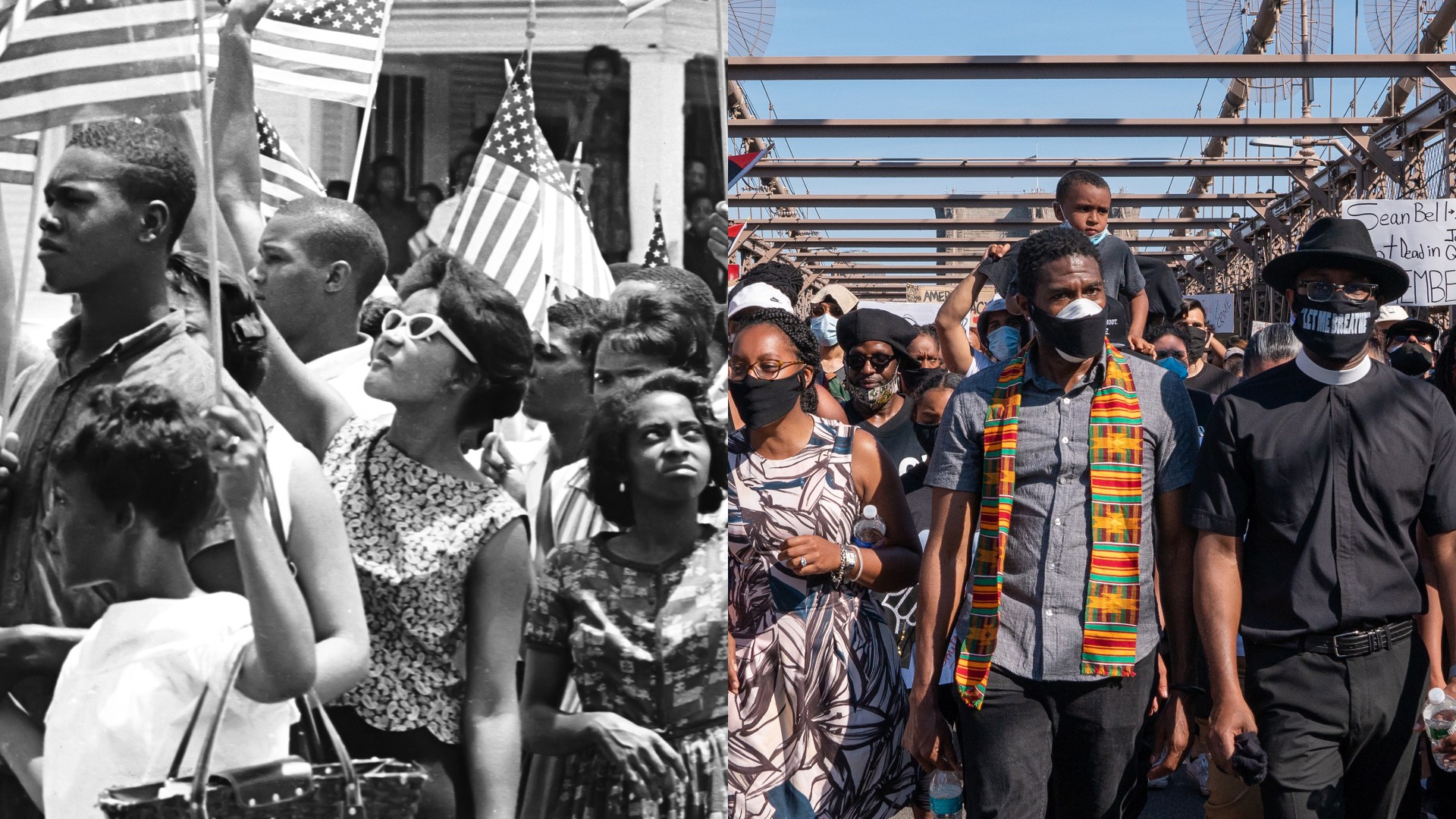
Our October Issue: Atlanta’s Black Church

Honoring hard-won progress while lamenting the costs of the struggle for justice.

Archive Photos / Stringer / David Dee Delgado / Stringer / Getty

They say you can’t love what you don’t know, and lately, many of us are realizing just how much we don’t know. This year, my church in Augusta, Georgia, began exploring the racial history of our city, the location of one of the first and largest civil rights riots in the South. The 1970 riot is chronicled in a recent Georgia Public Broadcasting podcast, made in partnership with the Jessye Norman School of the Arts in Augusta. The historical details resemble current events: a teen beaten to death in police custody, the black community responding with peaceful demands then rebellion, police using deadly force to suppress the uprising. But the parallels to the present aren’t striking if, like so many young people in our city, you had no idea it took place.

No wonder we feel so stuck in this racial justice fight. You can’t lament a past you don’t remember. You can’t change problems you don’t recognize. You can’t empathize with voices you ignore. Part of our call to love and serve our neighbors is to understand the lingering scars and burdens they bear.

Learning how my community downplayed the significance of its racial past made me all the more curious about the extensive civil rights legacy in the Georgia capital, the subject of this month’s cover package. Across the generations, Atlanta—with the black church as its heartbeat—has worked to honor its hard-won progress as well as to lament the cost of the ongoing fight for justice.

That practice has helped carry on a long legacy and inspire today’s leaders in Atlanta—the preachers and politicians, entrepreneurs and activists, who are working to see the principles of God’s kingdom shape every sphere of life. They live out a gospel promise that God would not just bring individual people to salvation but would restructure all of society to be just, peaceful, and flourishing in his name.

This is indeed the great hope of our faith. “At its core, Christianity is about systemic change. God so loved the whole world that he sent his son to save it. Existing outside the system he created, God intervenes with the greatest energy of all to redeem it,” writes CT editor in chief Daniel Harrell in his editorial.

As a Christian and a journalist, I believe the stories we tell—the brokenness and faithfulness of those who came before—influence our actions today. Charles Oatman, the 16-year-old whose death sparked a landmark riot in my town 50 years ago, was never a hashtag, and his name doesn’t appear in our history books.

The most unsettling part of learning about this chapter of our past was discovering how much had been buried and forgotten. Throughout Scripture, we see forgetfulness correspond with a lack of faith or disregard for God’s work in the world. It is a holy task, then, for us to remember rightly.

Kate Shellnutt is senior news editor of Christianity Today. Follow her on Twitter @KateShellnutt.

Ideas

Christianity Is About Systemic Change

Why we need the one in whom all things hold together.

Illustration by Dorothy Leung

Aristotle didn’t quite say, “The whole is greater than the sum of its parts.” But it is true—for good and for ill. First Corinthians 12:20–27 looks at churches and bodies as systems that possess properties their parts cannot possess on their own. You can’t be a community or a family by yourself. The same holds true with our political systems: A democratic government requires individual citizens working together as one nation for any common good to have a chance.

No matter how good or how strong, every system eventually succumbs to entropy. Increasing disorder is inherent in every system, including the very universe itself. As the physicist Stephen Hawking reminded us, everything we do increases disorder in the universe. This world is inevitably running down. Our bodies age and die, churches decrease, governments collapse, economies recess, families fall apart.

True, some things get better over time. But to overcome the entropy, systemic improvement must exceed the ever-increasing disorder. This is an enormous challenge, as the ever-penetrating repercussions of systemic racism in America demonstrate. Centuries of structural and institutional policies discriminated against black citizens, sanctioning inadequate education and substandard health care and creating economic disparity that restricted access to fair wages and decent housing.

Because entropy always increases, driving systems toward chaos, you might think the best strategy for opposing racism or any other systemic sin would be to let it be and watch it die. But that very chaos is the problem. To let it be is to let it wreak its havoc.

To achieve systemic change, an exceeding amount of energy from outside the system must be applied. An unhealthy body needs therapeutic injections; a bad family system needs outside intervention; a bad political system needs “outsider” candidates. Systemic racism requires changes in the laws and policies that perpetuate discrimination—a difficulty when the people who make the laws are mostly those who prosper from the prejudice.

Unfortunately, any human energy we tap only comes from within the systems we inhabit, meaning real change presents an enormous challenge. We go to counseling as families, but once the energy of intervention stops, family systems typically revert to old habits. We go to the polls every election season voting for change, but elected officials adapt to the political status quo. Black Americans unjustly suffer and protests erupt, but in time, societal behavior gravitates back toward the cultural mean.

At its core, Christianity is about systemic change. God so loved the whole world that he sent his Son to save it. Existing outside the system he created, God intervenes with the greatest energy of all to redeem it. As Martin Luther King Jr., drawing on his own faith, famously put it, “Darkness cannot drive out darkness; only light can do that. Hate cannot drive out hate; only love can do that.”

But an appeal to love can sound so clichéd. For many Christians, love tends to get relegated to personal relationships and forgiveness of individual sins. Win individual hearts and minds to Jesus, and trust that true change will follow. Inasmuch as structures and systems are composed of component parts, changing an individual person for good can have significant effects. But good people still make for bad systems. The whole remains greater than the sum of its parts. For systemic change to happen, the entire system must be addressed.

God so loved the world that he sent his Son to save it, but not always just one person at a time. Scripture speaks of whole tribes and nations and peoples and languages coming to Christ (Rev. 7:9). In Christ there is “one body and one Spirit…one hope [to which] you were called, one Lord, one faith, one baptism, one God and Father of all, who is over all and through all and in all” (Eph. 4:4–6). As one body of Christ, we possess power beyond what any one of us could ever exert on our own.

But to fully tap into that spiritual power requires sacrificial love. Jesus calls us to lay down our lives—our agendas, preferences, and priorities—to take up a cross and follow (Mark 8:34). As Jesus’ disciples, we make plain his passion to do right by the least and the lost, the disenfranchised and discriminated—along with their persecutors. As one global, massive manifestation of Jesus on earth, we are capable of changing the world. As the Southern preacher Vance Havner once put it: “Snowflakes are frail, but if enough of them get together, they can stop traffic.” So in the Spirit of Jesus, let it snow.

Daniel Harrell is editor in chief of Christianity Today.

Apple PodcastsDown ArrowDown ArrowDown Arrowarrow_left_altLeft ArrowLeft ArrowRight ArrowRight ArrowRight Arrowarrow_up_altUp ArrowUp ArrowAvailable at Amazoncaret-downCloseCloseEmailEmailExpandExpandExternalExternalFacebookfacebook-squareGiftGiftGooglegoogleGoogle KeephamburgerInstagraminstagram-squareLinkLinklinkedin-squareListenListenListenChristianity TodayCT Creative Studio Logologo_orgMegaphoneMenuMenupausePinterestPlayPlayPocketPodcastRSSRSSSaveSaveSaveSearchSearchsearchSpotifyStitcherTelegramTable of ContentsTable of Contentstwitter-squareWhatsAppXYouTubeYouTube