News

Christian Colleges Are Changing to Survive. Is it Working?

Faced with declining enrollments, evangelical schools add programs, cut programs, and hope.

Christianity Today September 9, 2020
Courtesy of Simpson University

Norman Hall knew what he needed to do. The new president of Simpson University was appointed in 2018 to save the Christian and Missionary Alliance-affiliated school in Redding, California. The hard part was how.

Enrollment was dropping at Simpson. In 2014, more than 1,000 full-time undergraduate students signed up to start classes in the fall. Four years later, there were only about 620. With that sharp decline in enrollment, revenues were disappearing fast. Faced with a budget shortfall, the administration eliminated 56 faculty and staff positions—but it wasn’t enough.

With the budget in crisis, the Northern California school was in danger of losing its accreditation. The Western Association of Schools and Colleges notified Simpson it was on a two-year probation. Things needed to turn around, quick, so the school hired a new president and presented Hall with this problem.

From his perspective, there were really only two options. Cut the budget. And attract more students. It wouldn’t be easy.

“It’s like you have a living organism,” said Hall, who studied biology and sociology before earning his doctorate in educational administration at Pepperdine University. “You’re going to reduce some of the tissue in one area and grow tissue in another area and you don’t want to kill the organism.”

Many of Simpson’s peers—small evangelical colleges and universities across the United States—are making similar calculations about where to cut and what to grow. Declining enrollments have thrown evangelical higher education into crisis. Administrators, experts, and many close observers believe that Christian colleges will have to change to survive. What no one knows, right now, is whether any of the changes they’re making will be enough.

The critical issue for small evangelical schools is the number of students paying tuition. Most small colleges’ donor base is limited, making it difficult to rely on fundraising or the endowments that buoy big state schools and Ivy League institutions. For the evangelical Christian schools that are full members of the Council for Christian Colleges and Universities (CCCU), tuition accounts for about 80 percent of revenue, said Tim Fuller, an enrollment consultant.

“For most of these campuses, they rise and fall on enrollment,” said Fuller, who works with the North American Coalition for Christian Admissions Professionals (NACCAP).

Evangelical schools have been concerned about enrollment for a long time. But then the financial crisis of 2008 created serious problems. Responding to their economic uncertainty, prospective students and their parents seemed to increasingly prioritize an education that would lead to a good job over one that would integrate faith and learning.

Add to that the declining birthrates, which lead to fewer people attending college, the shrinking percentage of young people who identify as evangelical Christians, and concerns about rising rates of college debt. Small, private Christian colleges were hit with a crisis.

New Programs: Engineering and Fishing

Sixty five percent of the CCCU-affiliated schools saw full-time undergraduate enrollment drop between 2014 and 2018, according to data from Integrated Postsecondary Education Data System (IPEDS). There was a loss of more than 3,000 students for the 112 US schools that are full members of the CCCU.

In response, evangelical institutions started adding new programs to attract new students. Adding a major can make a Christian college competitive with a nearby state school, so about 65 percent of CCCU institutions have added programs since 2010. According to CT’s survey, the most popular new majors at evangelical colleges include nursing, engineering, computer science, and other technology related fields. The schools have added more than 126 new undergraduate programs, according to news reports and press releases, as well as about 50 athletic programs, including esports, bass fishing, fly fishing, acrobatic tumbling, swimming, and football.

Simpson added three new programs: engineering, computer information systems, and digital media. The school also added several sports programs, including swimming and bass fishing.

There is a limit to how much this helps, though. For one thing, it isn’t cheap to launch a new program, according to Gillian Stewart-Wells, provost at Judson University in Elgin, Illinois. Judson has sought to enroll more graduate students so it’s less reliant on undergraduate enrollment. However, costs associated with masters or doctorate programs, including library books and adjunct salaries, are higher than undergraduate programs.

“We need to be very strategic about making sure that it doesn’t tip the scales,” Stewart-Wells said.

Adding programs doesn’t upset a campus in the same way that cutting programs invariably does, but it also doesn’t always solve the problem. According to Fuller, a new program may attract students initially, but there can be a challenge with keeping those students over the next few years.

Debating Essential Identities

If adding programs doesn’t work, the other option is subtraction. Since 2010, CCCU schools have cut at least 84 undergraduate majors, as well as 11 minors and 19 graduate programs, according to news reports and press releases. A few majors were merged into other departments or became minors. The most common eliminations at Christian colleges came from the language departments, humanities, education, and ministry. Many students at Christian colleges can no longer major in worship ministry, philosophy, or French.

There’s no centralized database keeping track of faculty cuts and the elimination of staff positions, but a CT survey shows that at least 944 jobs have been eliminated at CCCU schools in the last decade. About 30 percent of the evangelical schools have let people go.

Cuts can be deeply divisive to Christian college communities, pitting people against each other in heated debates about what is essential to the school’s mission and identity. Humanities faculty and college administrators, in particular, become locked in conflict. Faculty sometimes say they feel the administrators don’t appreciate the value of the liberal arts; the administrators say the faculty don’t understand the dire financial realities forcing tough decisions.

“No one’s happy about this. No one’s happy about cuts. No one’s happy about people losing their jobs and programs being cut,” said John Fea, a history professor at Messiah University.

If the financial problem creates a crisis, for many schools the solution creates one too. Some CCCU institutions have worked hard to show ongoing support for the humanities, even as they make cuts.

At Bethel University in Minnesota, historian Chris Gehrz said administrators showed him they supported liberal arts education, even as they merged the history department with political science and philosophy.

“If my position was affected, I would surely resent it and I would surely be complaining about what’s happening to history at Bethel,” Gehrz said. It was clear, though, that tough decisions had to be made. Bethel is cutting a total of 36 faculty positions, along with 28 staff, two masters programs and 11 majors. The history department lost a faculty member.

The best practice is for schools to be deliberate about stating priorities, and acknowledge that adding some programs and cutting others is a re-prioritization, said Greg Christy, president of Northwestern College in Iowa.

Full-time undergraduate enrollment dropped about 13 percent at Northwestern between 2014 and 2018, according to IPEDS. A sizable endowment gave the Reformed Church in America school some support, but the administrators were nonetheless alarmed by the declining number of new students.

“We couldn’t just continue to do business as usual. We needed to make some changes for the long-term flourishing of the institution,” Christy said.

The school launched a budget prioritization committee made up of faculty and administers. They developed a five-category rubric, and then used it to determine where they could trim the budget. The committee gave its report in May 2019. In December, the school eliminated the literature, philosophy, and writing departments, and cut 11 faculty positions.

Since then, Northwestern has added a master’s program training physicians’ assistants. Christy said it had its largest new class, counting 1,075 undergraduate and 461 graduate students, enrolled this fall.

“We are in a position where we can actually take some calculated risks,” Christy said.

According to Fuller, budget re-prioritization is probably overdue for most CCCU schools.

“I see this as, in many ways, institutions making healthy choices to do things that they maybe should have done have couple years ago,” he said. “But now they don’t have any choice, they have to do it.”

The delay may not be the worst thing, according to Fuller. It’s important for schools to take time when making these decisions and really evaluate the programs they’re considering cutting or adding. Sometimes they will add a new program and that will cost money, but not attract enough new students. Other times they’ll cut a program that didn’t seem to drive enrollments, only to find out too late that it was critical to retention.

Crisis in the Christian Humanities

The stakes are higher than that, though, according to Joe Creech, director of the Lilly Fellows Program at Valparaiso University, which includes a network of about 100 church-related colleges and universities. As schools make changes to survive, they may lose the very thing that made them special.

“An institution that cuts its humanities or liberal arts can certainly be a good Christian flight school or truck driving school and be deeply Christian,” Creech said, “but it’s not doing liberal arts education.”

The humanities are integral to the identity of many CCCU institutions. Christian liberal arts exist to give students a different set of intellectual tools—not just to prepare them for a job, but to open up deep questions of the soul.

“The tools of theology, the tools of Christian worship are the tools of the humanities,” Creech said.

To many students, though, and to many colleges, humanities programs may seem like a luxury they cannot afford. Simpson decided it would have to cut Spanish and its undergraduate program for theology and ministry. If students are especially interested in the subject, they can choose a five-year theology program that will give them graduate credits.

Many CCCU school administrators are feeling a moment of reprieve right now because COVID-19 hasn’t had the immediate negative impact on enrollment that many feared.

Early reports suggested that 2020 enrollment deposits at CCCU schools who are part of NACCAP are at about 97 percent of 2019 rates, Fuller said, based on an analysis of NACCAP data.

The Demographic Cliff

The long-term prognosis still looks pretty grim, though. In a few short years, schools are facing what some experts are calling “the demographic cliff.” America’s low birthrates declined with the economic crisis in 2008 and haven’t gone up again since. This means than in 2025 or 2026, there will be fewer college-bound students. The effects will likely vary by region and institution, but experts predict that most schools can expect to see a 10 to 15 percent drop in enrollments.

For small Christian institutions, that will be hard to survive. Schools like Simpson say they are doing what they can be ready and taking things one step at a time.

At least for now, the cuts and subtractions at Simpson seem to have worked. Enrollment is up. The school successfully renewed its accreditation. Hall is feeling encouraged. But everyone knows the university’s future isn’t certain, he said.

“One day, in the midst of our doing everything we can in a Christ-centered context, if there is no longer a need for Simpson,” he said. “We’ll figure that’s God’s gig.”

News

State of Theology: Evangelicals Hold Steady on Doctrine, More Outspoken on Politics

American evangelicals make mostly incremental changes around some common heresies.

Christianity Today September 8, 2020
Phillip Pastore / Getty

In this series

In the latest survey of Americans’ theological views, evangelicals stood out for their love of their Savior and Scripture, but like the rest of the country, they still have significant gaps in belief and interpretation.

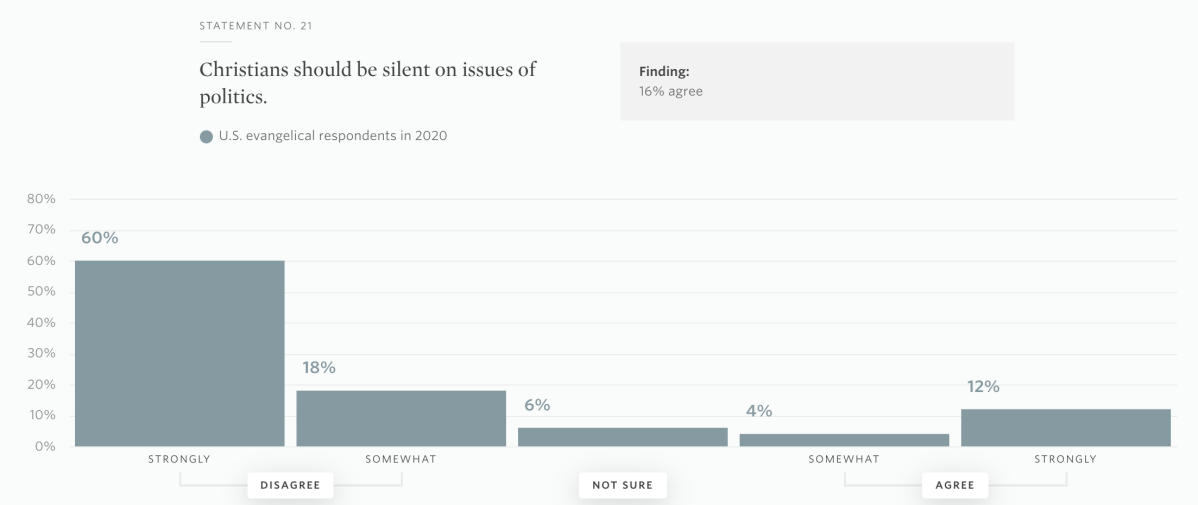
The biggest change in this year’s State of American Theology Study had to do with approaches to political engagement, with evangelicals half as likely to believe that Christians should be silent on political issues than back in 2016.

LifeWay Research, in association with Ligonier Ministries, released the results today. The two organizations have conducted the study every two years since 2014. While some questions have changed or been reworded, the report provides an opportunity to chart American theological beliefs and awareness.

The results were mixed this year, even among those the survey designates as “evangelicals by belief”—those who agreed that the Bible is the highest authority for Christian belief; that personal evangelism is very important; that Jesus’ death on the Cross was the only way to cancel the penalty of sin; and that trusting in Jesus is the only way to eternal salvation.

God, Jesus, and the Spirit

When it comes to the doctrine of God, evangelicals fare pretty well. Consistent with results from 2016 and 2018, evangelical respondents were nearly unanimous in affirming that God is a perfect being (97%); that God is a Trinity of Father, Son, and Holy Spirit (96%); and that God cares about our day-to-day decisions (87%).

There is still some confusion about whether God accepts worship from all religions, with evangelicals split—42 percent saying “yes" and 49 percent answering “no.” There were also disagreements that are unique to denominational traditions (for example, on predestination, with only 38% agreeing). By and large though, evangelicals remain pretty solid on God.

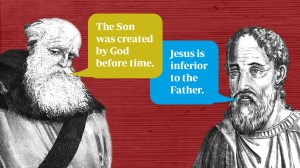
What about Jesus? When it comes to our Lord and Savior, God the Son, things get a bit more complicated. As noted by previous surveys, a disappointingly high number of evangelicals still believe the heresy of Arianism, which suggests that Jesus is not God but rather his greatest creation. Two-thirds of evangelicals (65%) affirmed the statement that “Jesus is the first and greatest being created by God.”

This figure is lower than in the last two surveys (in 2018, 78% agreed; in 2016, 71% agreed). In the 2016 survey, LifeWay added the phrase “and greatest,” resulting in a 40-point increase in positive responses. This seems to be a mitigating factor, given that evangelicals focus much of their faith on Jesus and so might be inclined to defend his greatness and overlook the phrase “created being.”
State of Theology report / Ligonier

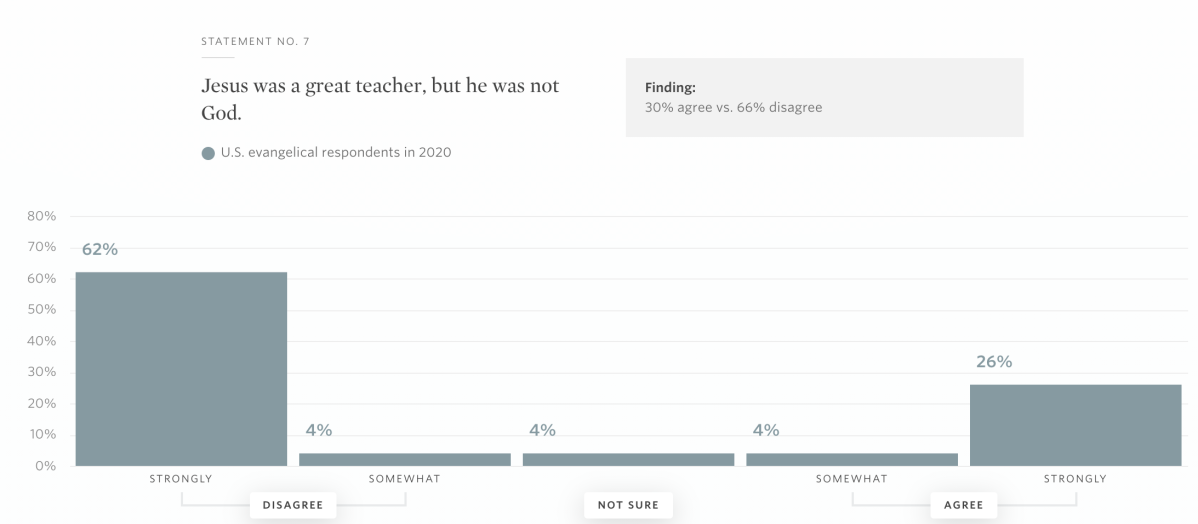
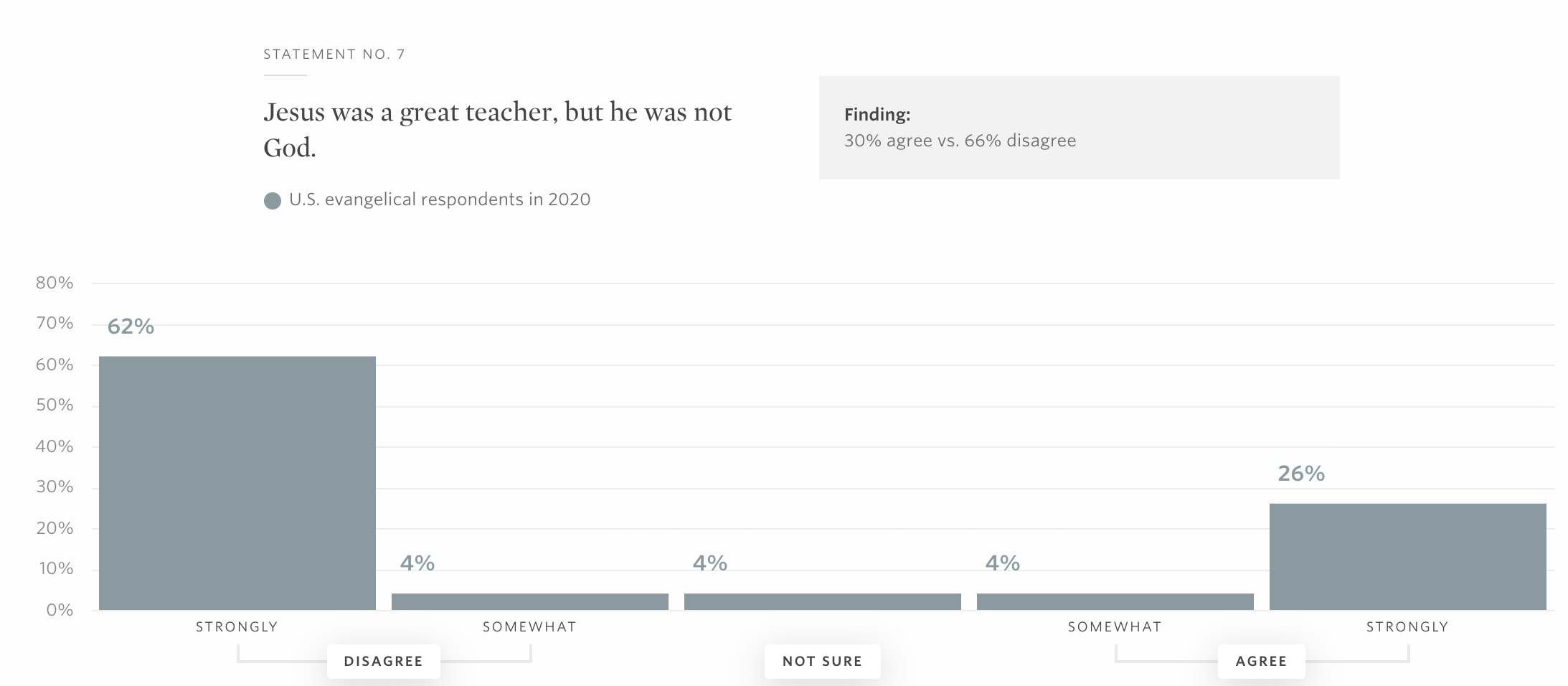
In a question that was new to the survey this year, a sizable minority (30%) of those with evangelical beliefs do not believe that Jesus is God but instead think he is simply a “great teacher.”

While 66 percent disagree with this claim, it is concerning that nearly a third of those with evangelical beliefs do not believe that Jesus is God.

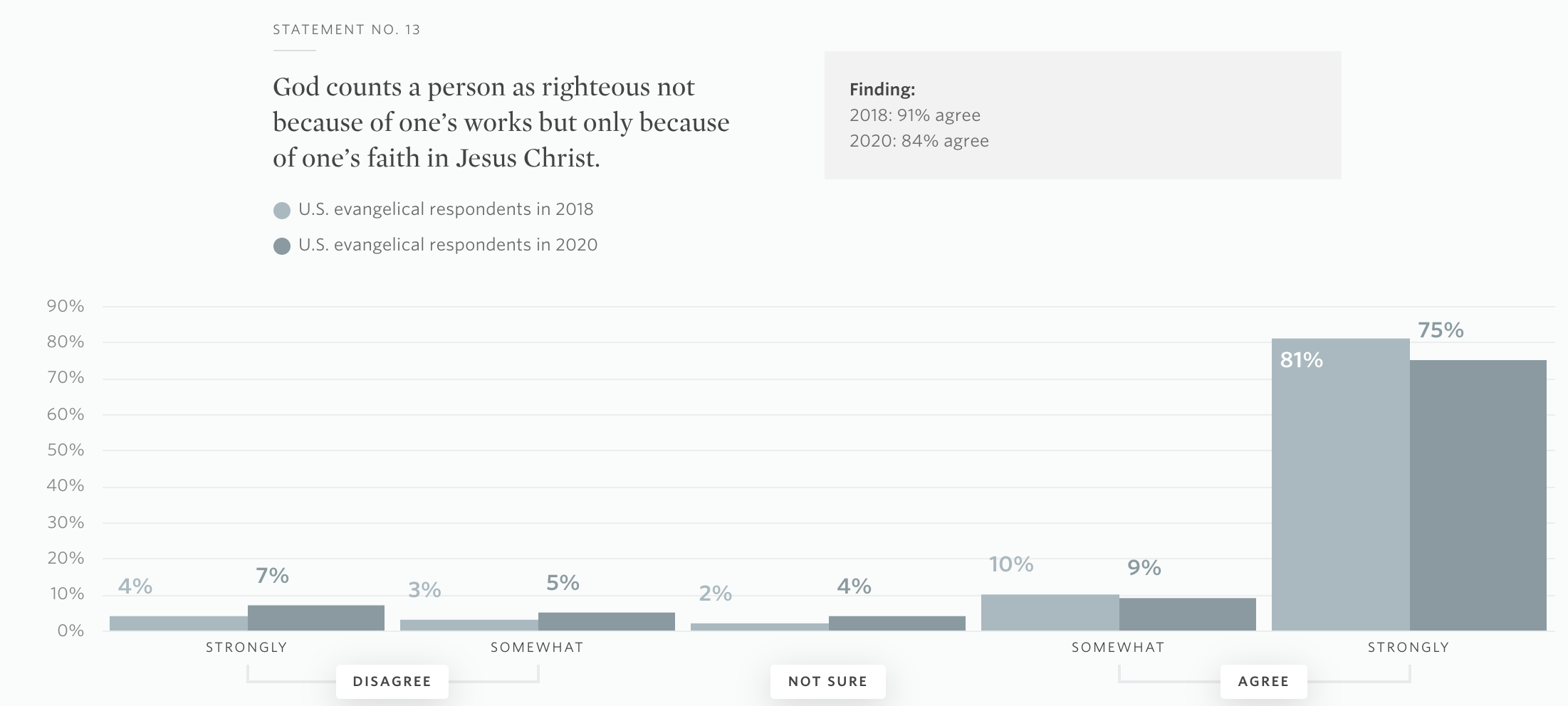
Similarly, more than 1 in 10 evangelicals (12%, up from just 8% in 2018) do not agree that “God counts a person as righteous not because of one’s works but only because of one’s faith in Jesus Christ.”
Oddly, this is a much lower percentage than the portion of evangelicals who believe Jesus is not God, but still, the number is worrisome.

State of Theology report / Ligonier

A key facet of the debate between the early church fathers and their Arian opponents was that a Jesus who was not God could not save, and faith in him would mean nothing. If two-thirds of those who don’t think Jesus is God still think salvation depends on him, then it’s fair to say that a surprising number of evangelicals lack awareness of the theology of salvation, or soteriology.

Similar confusion prevails when it comes to the third member of the Trinity, the Holy Spirit. Theologians we queried after previous surveys lamented the fact that today’s Christians don’t seem to understand the Spirit very well. Things do not appear to have improved with this year’s crop of results. Just under half of evangelical respondents (46%) believe that “the Holy Spirit is a force but is not a personal being.” This is down from previous years (56% in 2016; 59% in 2018). Furthermore, while 78 percent of evangelicals do not think the Spirit can instruct someone to do something that goes against Scripture, 18 percent do. That’s nearly 1 in 5, and that ratio remains consistent with the results of the 2018 study.

The Bible, Ethics, and Politics

When it comes to the Bible, evangelicals typically fared much better. Nearly all (98%) believe that the biblical accounts of Jesus’ resurrection are “completely accurate,” and 91 percent think the Bible overall is “accurate in all that it teaches.” Additionally, 95 percent agreed that the Bible has authority to instruct in us in what to do.

Strangely though, 18 percent of evangelical respondents believe the Bible “contains helpful accounts of ancient myths but is not literally true,” and 17 percent agree that “modern science disproves the Bible.” This appears to be at odds with their assent to the authority and accuracy of the Bible in other questions.

Greater consensus was found in matters of ethics, and especially sexual ethics. The survey found unanimous agreement (100%) with the statement that “God created male and female;” 90 percent agreed extramarital sex is a sin; 88 percent agreed abortion is a sin; and 73 percent disagreed that gender identity is a matter of choice. While these are not necessarily markers of theological orthodoxy, they do indicate a consensus arising among evangelicals based on their core evangelical beliefs.

Evangelicals are also fairly unanimous regarding hell and judgment, with 92 percent believing that hell is real and 97 percent believing that “there will be a time when Jesus Christ returns to judge all the people who have lived.”

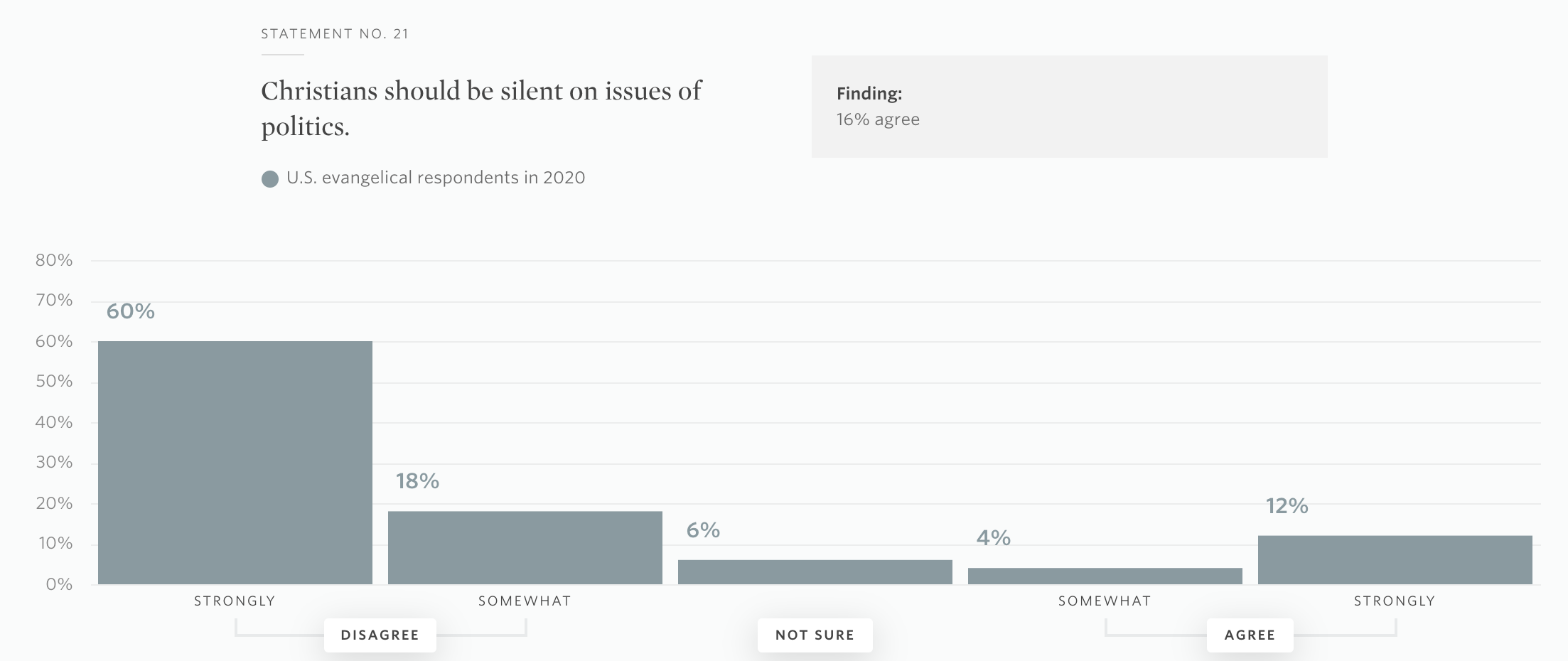
There was a major jump in belief in Christian political engagement. This year, only 16 percent of evangelicals agreed that “Christians should be silent on issues of politics.” This is down from 39 percent in 2016, ahead of Trump’s election.

Evangelicals by belief and Americans over 65 showed the highest levels of support for Christian voices in politics and were more likely than average to say Christians should not be silent on politics this election year.

State of Theology report / Ligonier

There was also a decrease in desire for entertaining worship services (27%, down from 46% in 2016), but evangelicals remain split on whether worshiping on your own or with your family is a valid replacement for church. While the realities of COVID-19 likely would influence responses to that question, the survey was conducted in mid-March before large-scale shutdowns had begun across the nation.

Rating Evangelicals in 2020

Overall, the report card for American evangelical theological awareness and orthodoxy seems to be consistent with previous years, with improvement in some areas and decline in others.

The major standout from this survey: Evangelicals are much more orthodox than the general population when it comes to beliefs about the Bible, and they have a high degree of agreement regarding matters of sexual ethics, even in slightly greater numbers than the 2016 and 2018 surveys.

Neither of these outcomes is surprising, particularly regarding the Bible, given that one of the markers of evangelicals is their strong agreement with the statement that “the Bible is the highest authority for what I believe.” Additionally, when compared against the general population (the total 3,002 respondents), evangelicals by belief (630 respondents) consistently displayed higher agreement with statements that described Jesus positively, regardless of their orthodoxy.

As noted in reporting on previous iterations of the “State of Theology in America Survey,” the wording of the questions is likely a contributing factor to some of the confusion. Additionally, a person can qualify as an evangelical according the LifeWay’s four-question criteria and still answer questions in ways that are inconsistent with Christian orthodoxy.

For instance, someone could strongly agree that the Bible is the highest authority for what they believe while also believing that it is mostly myth and not strictly true (as about 1 in 5 evangelicals do in this year’s survey). Similarly, a respondent could say that Jesus’ death on the Cross is the only way to remove the penalty for sin and that salvation only comes through belief in Jesus but not think that he was God. There are of course theological problems with that, but based on the questions asked in this survey, it would not necessarily be inconsistent.

In the final analysis, though, this year’s findings are neither cause for concern nor cause for hope. Things seems to be very much as they were the last time we checked in with the state of the theology in America back in 2018: Many still don’t quite understand who Jesus is, don’t get the Holy Spirit, see the Bible as an authority but want the freedom to read it their own way, and care a lot about sexual ethics.

Leaders from Ligonier have likewise reiterated concern about theological shift among evangelicals.

“Statistics like these from the State of Theology survey can give us quite a shock, but they also shed light on the concerns that many American Christians and churches have expressed for decades,” said Stephen Nichols, chief academic officer of Ligonier Ministries and president of Reformation Bible College.

“As the culture around us increasingly abandons its moral compass, professing evangelicals are sadly drifting away from God’s absolute standard in Scripture. It’s clear that the church does not have the luxury of idly standing by. This is a time for Christians to study Scripture diligently, engage confidently with people in our culture, and witness fearlessly to the identity and saving work of Jesus Christ in the gospel.”

Caleb Lindgren is associate theology editor for Christianity Today.

Correction: This story originally stated that in 2016, 46 percent of evangelicals believed Christians should be silent on political issues. The correct statistic is 39 percent.

Rise of the Machines: New Book Applies Christian Ethics to the Future of AI

John Lennox reflects on questions of consciousness in computers, enhancing humans, and other quandaries.

Christianity Today September 8, 2020
Illustration by Rick Szuecs / Source images: Andriy Onufriyenko / Getty / Ashton Bingham / Unsplash

Once viewed as the stuff of science fiction, artificial intelligence (AI) is steadily making inroads into our everyday lives—from our social media feeds to digital assistants like Siri and Alexa. As helpful as AI is for many aspects of our lives, it also raises a number of challenging moral and spiritual questions. Facial recognition can be used to locate fugitive criminals, but also to suppress political dissidents. Various apps and platforms can anticipate our preferences, but also harvest data that invades our privacy. Technology can speed healing, but many are hoping to use it to enhance natural human abilities or eliminate “undesirable” emotions.

In his recent book 2084: Artificial Intelligence and the Future of Humanity, Oxford professor emeritus John Lennox surveys the current and future landscape of AI and addresses these and related issues. Lennox is a mathematician who has spoken internationally on the philosophy of science, written books addressing the limits of science, and debated high profile atheists Richard Dawkins and Christopher Hitchens. In the new book, he acknowledges the many benefits AI can offer, but he also critiques the worldview that lies behind many secular visions of AI that seek to transform humans into gods and create utopias through technology.

Christopher Reese spoke with Lennox about his book and how Christians should think about a number of issues related to this rapidly accelerating technology, including “upgrading” humans, whether computers can become conscious, and how Christians should weigh the pros and cons of AI.

Many negative scenarios involving AI have played out in popular movies. In your opinion, are these the kinds of outcomes that we should be concerned about?

We’re nowhere near these negative scenarios yet in the opinion of the top thinkers in this area. But there’s enough going on in artificial intelligence that actually works at the moment to give us huge ethical concern.

There are two main strands in artificial intelligence. There’s narrow AI, which is very successful in certain areas though raising deep problems in others. This is simply a powerful computer working on huge databases, and it has a programed algorithm which looks for particular patterns. Let’s suppose we have a database of a million X-rays of lung diseases labeled by the best doctors in the world, and then you get an X-ray at your local hospital and an algorithm compares yours with the database in just a few seconds and comes up with a diagnosis. So, that’s a very positive thing.

But then you move on to the more questionable things—today the main one has to do with facial recognition. There again, you’ve got a huge database of millions of photographs of faces labeled with names and all kinds of information. You can immediately see that a police force would find that useful in checking for terrorists and criminals. But it can be used for suppressing people and manipulating and controlling them. In China today, there’s every evidence of extreme surveillance techniques being used to subdue the Uyghur minority. That has raised ethical questions all around the world.

This is not the 1984 Big Brother. We’re already there. But it’s not 2084. That’s where the second strand comes in: Artificial general intelligence is where we develop a super intelligence that’s controlling the world. That’s sci-fi stuff.

C. S. Lewis worried that technological advances might lead to the “abolition of man.” Can you elaborate on what he meant by that?

One reason I wrote the book was because of my familiarity with C. S. Lewis. In the 1940s, he wrote two books, The Abolition of Man and That Hideous Strength, which is a science fiction book. His concern was, if human beings ever managed to do this kind of thing, the result wouldn’t be human at all. It would be an artifact.

If you start to play about with humans as they are and introduce genetic engineering, what happens is you create an artifact—that is, something you have made that is not greater than human, but subhuman. In other words, you abolish human beings in that sense. You made something that you think is more than human, but it’s actually less than human because you, who are not God, have contributed to its specification. Lewis thus talks about how the final “triumph” of humanity will be the abolition of man. I think that ought to concern us.

The Bible affirms that human beings have souls and are made in the image of God. How do those ideas factors into your view of machines and their ability (or inability) to imitate humans?

We are made in the image of God. That gives us dignity and value. Some aspects of surveillance seem to infringe on that. They seem to be invasions of privacy, the space that God has given us to function. Certainly, when it comes to controlling people and getting them not to act out of their consciences but to do what the state requires, that can be a very dangerous path. We’re seeing that already, as I have mentioned.

But, of course, once we begin to talk about artificial general intelligence, there are two strands again. The first one is to bioengineer existing humans and turn them into gods. The Israeli historian Yuval Noah Harari has written a book called Homo Deus, which means “the man who is God.” He very straight forwardly says that there are two major agenda items for the 21st century. One is to solve the problem of death as a physical problem, meaning that medicine will go so far that you don’t need to die. You could die, but you don’t need to.

Second is to bioengineer human life to enhance it through technology, drugs, and other things so that we create a superhuman intelligence. That’s where all the dystopian scenarios come from, and that fuels films like The Matrix and so on. They’re scary because we are at the cusp of potentially altering what it means to be human permanently.

Human beings, “version 1.0” as created by God, are by nature special. The specialness of human beings is seen in the fact that God became one. The Word became human, became flesh, and dwelt among us. I take that extremely seriously, and therefore any attempt to make “humans 2.0” is going to be a step away from God’s design, not a step toward God.

Do you think it’s wrong in a Christian framework to try to enhance our abilities, or is there a place for that?

I have enhanced eyesight because I’m wearing a pair of glasses. At the moment, the technology is sitting on my nose and ears. It’s very crude, but I could be wearing contact lenses, which you might not even notice. That kind of enhancement is a very good thing because it’s simply helping with a deficiency in my own eyesight, as would a hearing aid, as would a prosthetic limb. So, there is a place for strengthening limbs, getting better eyesight, and of course dealing with chemical imbalances in our blood and in our brains and in our systems. We’re very grateful for medicine.

But to be very clear, there are pretty obvious limits where we begin to transgress and it’s effectively saying, “God, you did your best, but we can do better. We can improve human beings.” That’s a very risky business. One of the central dangers is playing God by modifying the genetic germ line, which could impact all generations to follow us.

What is your perspective on what’s been called the “hard problem of consciousness?” Can machines ever be conscious?

Here’s the problem: Nobody knows what consciousness is, let alone how to build it. If you’re going to make general artificial intelligence, then you will have to produce consciousness. So the arguments fly forwards and backwards. When people say to me, “What do you think of it all?” I say if you can first tell me what consciousness is, I will listen to you pretty seriously.

Of course, from a Christian perspective, the brain is physical, the mind is not. We have lived to see the information age where we realize that information, which is a non-material entity, has become fundamental to physics and our understanding of the universe. That accords exactly with Scripture, which tells us in the beginning was the Word. Not in the beginning was the universe. The universe is derivative. All things came to be through the Word. So, God the Word is primary. The universe is derivative, whereas atheism believes the exact opposite, that the universe is primary and mind is derivative.

You observe that science substitutes as a religion for some proponents of AI, who see technology as a means of salvation. How do you see science functioning for them religiously?

If you deny God as creator, you don’t get rid of the idea of creation because you’ve got to explain life, and in particular human life and consciousness. So, you often end up endowing material elementary particles with creative powers—which there’s no evidence that they have—so that the material universe has got to, in some sense, create life and create itself, which is philosophical nonsense.

I've spent my life trying to unpack these things so that people can understand just how crazy some of these things are, but they are what results by rejecting the creator. Paul put it well at the beginning of Romans. He says rejecting the creator means you become intellectually dark and you start talking nonsense. There's a great deal of it around, but because it is said by powerful scientists, people take it seriously. They don't remember what one of our most famous scientists, Richard Feynman, the Nobel Prize winner of physics, once brilliantly said: “Outside his or her field,” he said, “the scientist is just as dumb as the next guy.”

You write about possible connections between AI and events described in biblical prophecy. How do you see those things potentially fitting together?

Well, I’m very cautious here. There’s always a great skepticism when you mention biblical scenarios of the future. But for me, the bottom line is this: If we are prepared to take seriously, as many people are, highly dystopian situations in the future where you have a world dictator who controls economics by having some kind of implant in people’s skin or in their eyes or something like that—why don’t we go back to the scenario that is presented, at least in outline, in the Bible and compare it with these scenarios? Certain elements are very much in common. The idea is something that’s not simply the apocalyptic literature of the book of Revelation, but straightforward theological writing, as in Paul’s letter to the Thessalonians.

How should Christians weigh the potential benefits of AI with its possible—and actual—abuses?

Well, I would reply by saying, how do you weigh the benefits of a very sharp knife? A very sharp knife can be used to do surgery and save people’s lives. It can also be used for murder.

What I do with my Christian friends is, if they’re scientifically inclined, I say: IT, computer technology is a fascinating area to be in, and there’s so much good that can be done. One of the wonderful examples of that is at MIT where Rosalind Picard, who is a brilliant scientist, a Christian, has developed her own field called affective computing. She’s using facial recognition techniques to find signs of children having seizures before they happen and preventing them.

But every technological invention has potentiality for good and evil. The issue is not that one resists advance, but one learns to control that advance and set it into an ethical framework. The problem with that today is that the technology is outpacing the ethics at a colossal speed. People haven’t had time to think.

Some are concerned about what’s happening and they’re trying to set up international boards and ideas of basic ethical principles that need to be built into AI. All that is well and good, but we’re dealing at an international level. It depends on who’s got the most power. If people don’t have normative ethical principles that are transcendent, as Christianity gives us, then of course power will determine what’s believed.

Christians need to be able to sit credibly at the table with their non-Christian colleagues, discuss these things sensibly, and help other people think through the ethical issues.

Christopher Reese is the managing editor of The Worldview Bulletin, co-founder of the Christian Apologetics Alliance, and general editor of Three Views on Christianity and Science (forthcoming from Zondervan, 2021).

Pastors

Why Our Sunday School Disciples Christians in Politics

If churches don’t engage our members, pundits and memes will.

CT Pastors September 8, 2020
Illustration by Rick Szuecs / Source images: Arthobbit / Getty / Rahardi Creative / Envato

Are you sure that’s a good idea?”

That’s the most common response I get when I tell someone our church is hosting a Sunday school class on faith and politics this fall in the middle of the 2020 election season. We’re a growing, politically diverse congregation in the heart of downtown Indianapolis, so I understand the concern. Isn’t talking about politics a recipe for disaster? Won’t it just lead to division and disunity? Totally possible. But if we’re serious about discipleship and following Jesus in every area of life, we have to try. Politics can’t be off-limits when it comes to our formation as believers.

Name a topic and there are ready-made answers along partisan and ideological lines. From solutions to racial injustice to mitigating the spread of COVID-19, suspicion runs rampant. Hostility abounds. And in a climate like ours, many Americans are tempted—and taught—to believe the worst about their political opponents.

Almost 90 percent of Republicans say Democrats are “brainwashed” and “hateful,” and the numbers are even higher the other way around. Sadly, these dynamics are paralleled in the church. While we might hope to see more charitable conversations within the community of faith, a quick visit to Facebook reveals few discernible differences. In some ways, we shouldn’t be surprised. The average Christian spends an hour or two per week under the teaching of their local church but as many as 13 hours a day consuming other forms of media: listening to podcasts, scrolling through Twitter, watching cable news. How can we expect Christians to look any different when they’re functionally discipled by pundits and memes?

There has to be a better way.

Recent data suggest that US churchgoers generally don’t know the political leanings of their church leaders. Apart from certain high-profile examples to the contrary, the majority of pastors I know have little interest in endorsing candidates or telling their congregations exactly how they ought to vote—legally, we can’t, and most would be opposed as a matter of principle. Still, as Esau McCaulley highlights, the weightiest political claims are also ultimately theological, which means politics and faith can’t be neatly sealed off from each other. The New Testament itself is surprisingly rich with instruction on the relationship between faith and public life, often in contexts hostile to the church (Matt. 5; 1 Peter 2, Rom. 12–13; Rev. 13).

If discipleship is about following Jesus with all of our heart, soul, mind, and strength—a wholehearted commitment of all we think, do, love, and say—shouldn’t this include our politics as well? If believers are being formed by radio hosts and news programs, pastors must bear at least some burden to speak to these things too.

It’s commonplace for churches to devote great attention to helping believers consider how to follow Jesus in marriage, as a student, as a neighbor, or in the workplace. Pastors understand that unless people know God’s Word and can apply it in each of these areas, a litany of voices will end up filling in the void. Yet this kind of teaching is often strangely absent when it comes to political engagement. I’m not suggesting that churches start producing voter guides or using the pulpit for point-by-point policy analyses (probably best to leave that to the experts). I’m talking about giving people a framework for engaging politics biblically. For example:

  • How do we honor God in the ways we think and act politically?
  • In what ways might politics serve as a means of loving our neighbor?
  • What does God’s Word have to say about justice, human nature, or the role of civil authority, and how should we apply it to the questions of our day?
  • How do believers maintain unity and love in the midst of deep disagreement about real, significant issues?

None of these questions are simple, and faithful believers will come to various conclusions. Still, questions like these help us cut through the fog of partisan bickering and invite us to reckon with deeper matters of Christian fidelity. At its core, a Christian approach to politics is about asking, “What is God’s vision for a good and just society, and what must we cultivate in order to move in that direction (however imperfectly)?” That’s not to say our answers shouldn’t translate to genuine convictions about policy preferences—they should. But before we get to parties and platforms, political activity is about life in community.

As Vincent Bacote asks in The Political Disciple: “If Christ is being formed in God’s people by the Holy Spirit, has his work penetrated to those regions of the heart that reveal themselves in the domain of public responsibility?” While talking about politics is often fraught with difficulty, our political engagement is a matter of public holiness, Bacote says. Churches can and must lead their people in considering what this looks like. I’ve found three guidelines to be especially helpful.

Don’t shy away.

As tempting as it is to avoid the topic altogether, the need for wise, gracious, Christ-centered voices is difficult to overstate. If you’re not sure where to start, consider preaching a sermon or two about how the gospel might shape our political involvement. The Center for Public Justice has developed an entire small group curriculum that provides a theological basis and practical approach to active Christian citizenship. Similarly, our class will focus on key biblical texts and themes while also exploring major civic questions in the history of the church. Resources abound, and the possibilities are many. Whatever route you take, the dangers of disengagement far outweigh the benefits—especially in the long run.

Focus on principles before policies.

While there are certainly times for the church to take a clear moral stand, pastors and other leaders must exercise care and self-awareness to avoid drifting to a place of partisan manipulation. One way to do this is by focusing on the issues behind the issues. How do we honor the image of God in every person? What does it mean to “do justice” and “love mercy” in the communities God has placed us? How should the ninth commandment (you shall not bear false witness) impact our speech, media habits, and the way we interact with political sparring partners? The answers to these questions contain significant implications for how Christians can engage the political sphere without binding their consciences to a particular party or platform. Again, not all policies are created equal, but believers can differ when it comes to strategy and approach.

Finally, prioritize love.

G. K. Chesterton once quipped, “The Bible tells us to love our neighbors, and also to love our enemies; probably because generally they are the same people.” I’m convinced that learning to love our political enemies—no matter where you fall on the political spectrum—is among the most pressing issues facing Christians today. How do we engage from a place of love and not resentment? How do we relate to neighbors, family members, and others in our pew whose politics we find abhorrent (or at least troubling)? The answer, of course, looks a lot like crucifixion: taking up our cross, following Jesus, and pouring ourselves out for the good of those around us—even those who don’t think or vote like us. What better time to learn what this means for our politics than when we have to put it into practice?

Sam Haist is pastor of formation at Redeemer Presbyterian Church in Indianapolis.

News

Sudan Agrees with Rebels to Remove Islam as State Religion

Peace deals include bold pledges on religious freedom. But much work remains for transitional government after three decades under Bashir’s strict sharia.

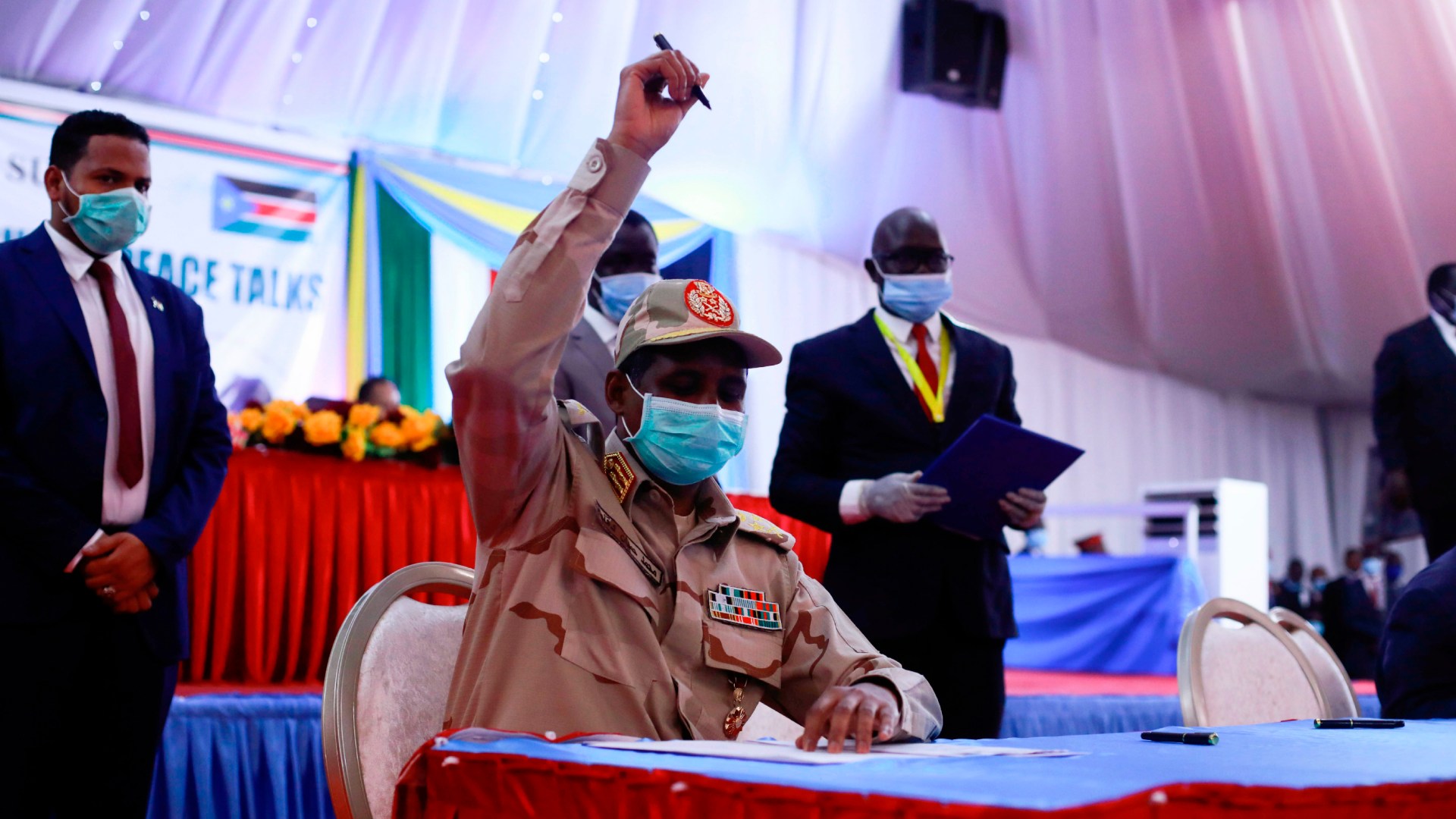
Lieutenant general Mohamed Hamdan Dagalo of Sudan holds up a pen before signing a peace deal with rebel groups on August 31.

Lieutenant general Mohamed Hamdan Dagalo of Sudan holds up a pen before signing a peace deal with rebel groups on August 31.

Christianity Today September 5, 2020
Akuot Chol / AFP / Getty Images

In signing successive peace deals with entrenched rebel movements last week, Sudan drew upon the legacy of Thomas Jefferson.

“The constitution should be based on the principle of ‘separation of religion and state,’” read the text of an agreement between the North African nation’s joint military-civilian transitional council and the Sudan People’s Liberation Movement–North (SPLM–N).

“The state shall not establish an official religion.”

The declaration of principles further cements Sudan’s efforts to undo the 30-year system of strict sharia law under President Omar al-Bashir, during which Islam was the religion of the state.

The agreement was signed in Addis Ababa, Ethiopia, four days after a more inclusive peace deal was signed with a coalition of rebel groups in the Sudan Revolutionary Front in Juba, South Sudan.

The Juba agreement established a national commission for religious freedom, which guarantees the rights of Christian communities in Sudan’s southern regions.

Sudan’s population of 45 million is roughly 91 percent Muslim and 6 percent Christian. Open Doors ranks Sudan at No. 7 among the 50 nations where it is hardest to be a Christian.

The US Commission on International Religious Freedom (USCIRF) interpreted the agreement even more widely: to protect the rights of all Sudanese people to practice their religion of choice.

With a stronghold in the southern Nuba Mountains within the South Kordofan region, an area with a significant Christian population, the SPLM–N held out of the initial peace deal specifically because it did not guarantee the separation of religion and state.

“There’s no equal citizenship rights, there’s no distribution of wealth, there’s no equal development in the country,” one rebel leader told South Sudan in Focus.

“There’s no equality between black and Arab, and Muslim and Christian.”

But now including most of the major rebel movements in the western Darfur region and the Sudanese south, democratic transition can continue with national unity.

Following months of popular protests, Sudan’s military overthrew Bashir in April 2019. An interim constitution—which notably omitted reference to sharia law as the primary source of legislation—was signed in August 2019, establishing a ceasefire and a six-month window to achieve peace.

Negotiations began in late 2019, and the February 2020 deadline was extended.

Autonomy is granted to the southern regions of Blue Nile and South Kordofan. Darfur, which had been split into five regions, will be reunified under its own governor with a special revenue-sharing agreement.

Rebel parties will receive 35 percent of government ministries, and 75 seats in the upcoming 300-member transitional parliament. Individual militants will be incorporated into the national army.

Sudan is currently led by an 11-member Sovereign Council, with one member a Coptic Christian. Currently headed by a military figure, a civilian will take the helm halfway through the three-year transition ending in 2022, with new elections.

Since conflict erupted in Darfur in 2003, about 300,000 were killed with 2.7 million displaced from their homes. Thousands more were killed in the south since fighting began in 2011.

The civilian prime minister has already implemented significant changes.

In September 2019, Sudan and the United Nations agreed to open human rights offices in marginalized areas with significant religious minorities.

In December 2019, the public order law—used to punish individuals, especially women, in non-conformity with sharia law—was repealed.

And in July 2020, the Miscellaneous Amendments Act repealed the apostasy law, ended flogging for blasphemy, banned female genital mutilation (FGM), and permitted non-Muslims to drink alcohol.

The government additionally disbanded church councils used to control Christian congregations, declared Christmas a national holiday, and stated it is working on a uniform law for all religious worship.

But there is still much to do.

USCIRF noted that promised compensation claims for churches destroyed or confiscated during Bashir’s reign have been held up by bureaucracy. It called for full repeal of the blasphemy law, which still stipulates a six-month imprisonment. And much work is necessary to reform remaining Islamist imprints in the judiciary and Ministry of Education.

Despite earlier hopes, Christianity will not be introduced for the first time in the national school curriculum. One pastor has complained that compulsory Islamic education sometimes results in the forced conversion of Christians to Islam.

And following the July repeal of sharia-based measures, thousands of Sudanese rallied against the “apostasy government.”

Sudan has witnessed several failed peace deals in the past, and significant hurdles toward full religious freedom remain.

But Christian leaders are hopeful.

“People here prefer to be cautious,” said Tombe Trille, Catholic bishop of El Obeid, capital of northern Kordofan, to the Vatican’s news agency. “But it is very important that a signature has finally been reached.

“We are all very happy.”

News

Digging Stopped in Ancient Biblical Cities

For US archaeologists, major discoveries will have to wait until next year, at least.

Christianity Today September 4, 2020
Courtesy of Zvi Lederman, Tel Beth-Shemesh Excavations

Dale Manor had a plan for 2020: Unearth an ancient Canaanite shrine in the lowlands of Judah, about 20 miles west of Jerusalem. Like so many plans for 2020, it was interrupted by a global pandemic.

So now the professor emeritus of archaeology and Bible at Harding University in Arkansas has a plan for 2021: Unearth that Canaanite shrine in Beth Shemesh, the city where the Philistines returned the captured Ark of the Covenant to Israel in 1 Samuel 6.

There are some drawbacks to putting an excavation on hold, Manor told Christianity Today. “There is an increased risk of site deterioration, both from the elements and plundering,” he said.

A highway also runs through the ancient Beth Shemesh site, and it is in the process of being widened. There have been some conflicts in Israel between the people who want the road and the people trying to preserve the biblical history buried underneath it.

The pause couldn’t be avoided, however. For biblical archaeologists, 2020 will be remembered as the summer without digs. Most projects were stopped as the coronavirus spread and international travel was suspended.

There were a few exceptions. An Israeli team did about a month of work at Tel Azekah, the site of the confrontation between David and Goliath (1 Sam. 17:1) and a Babylonian siege (Jer. 34:7).

Manor and other archaeologists said they used this summer to catch up on their analysis of artifacts and writing, while remaining hopeful that excavation work can resume again next year. Archaeology didn’t stop, they said, even if excavation did.

For now, biblical cities and sites wait across the Holy Land, their treasures yet to be revealed.

On the northern shore of the Sea of Galilee, excavation has stopped at a city that might be the true location of Bethsaida, home of the disciples Phillip, Peter, and Andrew. Archaeologists made some discoveries in 2019 that led them to think el-Araj could be the historic city, challenging the claim of nearby el-Tell.

Steven Notley, the academic director of the project and professor of New Testament at Nyack College in New York, believes some ornate mosaic floors found last year demonstrate that el-Araj was Bethsaida. Recent flooding has experts worried about damage to the site, however, and the damage cannot be fully assessed until next year at the earliest.

At Tel Shiloh, the excavation of a building from the time when Shiloh was the worship center of Israel (Josh. 18:1) will have to wait until 2021. “In three seasons of excavation, we have uncovered significant evidence of the ancient Israelite sacrificial system at Shiloh,” said excavation director Scott Stripling, who is provost of The Bible Seminary in Texas.

Excavations at a site in far northern Israel, Tel Abel Beth Maacah, were originally postponed from June to August but then postponed further to 2021, according to co-director Robert Mullins, chair of the Department of Biblical and Religious Studies at the Azusa Pacific University School of Theology in California. However, Mullins’s two Israeli co-directors were able to lead a team of eight Hebrew University students on a five-day excavation.

Abel Beth Maacah is most famously the city where King David’s general Joab convinced a wise woman to have her fellow residents throw the head of the rebel Sheba son of Bikri over the wall (2 Sam. 20:14–22), ending the conflict there.

A glazed ceramic head of a bearded man—believed to be a king from the time of Ahab—was found in the citadel area at the summit of the mound in 2017. This summer, the Hebrew University students found a cylinder seal in a nearby building.

Cynthia Shafer-Elliott, professor of Hebrew Bible and archaeology at William Jessup University in California, would normally have spent part of her year supervising one square of the excavation at Abel Beth Maacah. Instead, she had to watch via social media.

Shafer-Elliot said that being home instead of in the field allowed her to make some progress on other projects, but she still regretted not being there.

Mullins also said he was glad for an “unplanned” study season to make headway on an academic article. Still, he’s eager to get back to digging on the citadel.

Another dig—the Tel Dan excavation in northern Israel—has also been halted. Jonathan Greer, associate director of the excavation and professor of Old Testament at Cornerstone University in Michigan, said he hoped work on a temple complex on the northern edge of the dig would resume in 2021.

“I am most interested in learning more about the worship of Yahweh in the Northern Kingdom as it compares and contrasts with Judah and the way this relates to biblical priestly texts,” he said.

New Orleans Baptist Seminary professor Daniel Warner is looking forward to getting back into the field at Tel Hadid next year, where he is co-director. The location, near Ben-Gurion airport, has “significant potential to be a key site to fill in some needed information about the expansion of Israel into the Coastal Plain and lowlands,” Warner said. One early discovery: the largest screw-type wine press ever found in Israel.

A small team of students from Tel Aviv University worked at Tel Hadid for a couple of weeks this summer, digging test pits. The pits will help Warner and his co-directors decide where to continue their excavations next year.

But in the meantime, he has been writing up the report on the Tel Gezer water system. Canaanites are believed to have chiseled the system out of solid rock 4,000 years ago. It took archaeologists about nine years to muck out the water and sediment that flooded the ancient system.

“It’s the earliest of its kind anywhere in the ancient world,” Warner said. “The only thing similar are underground tunnels dug within the pyramids at Giza.”

Gezer is mentioned more than a dozen times in the Bible. It was presented to Solomon in 1 Kings 9:16 as the dowry of Egyptian pharaoh’s daughter. The water system is a feat of engineering and probably gave Canaanite residents access to drinking water. But during his research, Warner has also come to believe it was likely religious too.

“The tunnel is perfectly aligned east-west,” he said, which may imply “they’re trying to capture the morning sun for their rituals.”

Warner would like to spend a couple more weeks excavating an area between the water tunnel and a nearby Bronze Age city gate to help him better understand the significance of the water system. He also wants to get back to Tel Hadid.

But for now, he and other US archaeologists have to wait out the summer of no digs.

News

Lauren Daigle’s ‘You Say’ Sets Billboard Record with 100 Weeks at No. 1

The crossover Christian hit surpasses the standing power of Hillsong’s “Oceans.”

Christianity Today September 4, 2020
Terry Wyatt / Getty Images for K-LOVE Fan Awards

An inspirational anthem about finding your identity in God has become the only song to spend 100 weeks or more at the top of any of the Billboard hot songs charts.

Lauren Daigle’s “You Say,” released more than two years ago, broke the record this week, holding steady at No. 1 on the Hot Christian Songs chart more than two years after its debut.

“I am so honored,” the 28-year-old singer said on Twitter, thanking her collaborators and the fans who welcomed the song into their lives. “That is a gift I’ll never fully put into words.”

A year ago, “You Say” beat out the Christian songs record once held by Hillsong’s “Oceans (Where Feet May Fall),” which spent 61 weeks on the chart. While Hillsong’s lasting power got a major boost from its inclusion in worship sets, Daigle has been fueled by crossover popularity.

“You Say” became the first top Christian song to also hit No. 1 on the Adult Contemporary chart, and it reached No. 5 on Adult Pop Songs. The rankings are based on streaming, radio play, and sales.

Her voice has been compared to Adele’s and her broad appeal to fellow Christian crossover artist Amy Grant.

The chorus to “You Say” goes, “You say I am loved when I can’t feel a thing / You say I am strong when I think I am weak / And you say I am held when I am falling short / When I don't belong, oh, you say I am yours.”

The powerful song has been performed multiple times on the American Idol competition, including as a duet with Daigle, and Kelly Clarkson covered the song as a tribute to first responders back in May.

A Louisiana native, Daigle got her start singing for the Open Door Church choir in Lafayette. She began touring with a Christian band, eventually moving to Nashville in 2012 and signing with Centricity Music—the same label representing artists Andrew Peterson and Jason Gray.

Her breakout popularity—earning her talk show appearances and stadium tours, coincided with her second album, Look Up Child. It debuted at No. 3 on the Billboard 200 Albums chart and went platinum. Last year, both Look Up Child and the single “You Say” won Grammys in the contemporary Christian music categories.

The singer’s more recent single, “Rescue,” is trailing “You Say” at No. 2 on the Christian songs chart.

Daigle, who has now more than 2 million followers on Instagram, has navigated the perks and challenges around being labeled as Christian artist, including scrutiny in 2018 over her uncertain position around homosexuality.

She has partnered with the charity ChildFund and performed in an online benefit for the Churches Helping Churches initiative during the coronavirus pandemic.

The hit singer recently announced that she will resume touring this month with two drive-in shows.

While “You Say” rules the Billboard charts, a song with a similar title is near the top of the worship song rankings. Hillsong’s “Who You Say I Am,” currently at No. 2 for use in church services according to Christian Copyright Licensing International, evokes a similar message as Daigle’s in its hook: “I am chosen, not forsaken, I am who you say I am.”

Books
Review

Scripture Won’t Let You Endure Suffering on Your Own

Fellow believers might abandon you or cover you in happy talk. But the Bible offers companionship with saints who know sorrow.

Christianity Today September 4, 2020
Unblind / Lightstock

On many mornings I wake up early, my stiff body creaking as I pull on my yoga pants, grab my coffee, and hobble out the door to sit at the nearby lake and welcome the dawn. I come here to remember the God who set the sun in the sky and holds the world in its rotation, no matter how dark or shaky my disease or global suffering might make me feel.

Companions in Suffering: Comfort for Times of Loss and Loneliness

Companions in Suffering: Comfort for Times of Loss and Loneliness

IVP

192 pages

$11.25

I distinctly remember one morning, as the sun stretched its hot pink fingers over the horizon, when the words of Lamentations 3 reached out through my earbuds:

When life is heavy and hard to take,
go off by yourself. Enter the silence.
Bow in prayer. Don’t ask questions:
Wait for hope to appear.
Don’t run from trouble. Take it full-face.
The “worst” is never the worst.

Why? Because the Master won’t ever
walk out and fail to return (v. 28–31, The Message).

The violence of suffering is often its silence, the way it stops us from sharing and telling our stories as beloved children of the living God. There are places suffering takes us where others cannot or will not go, and underneath its long, lonely shadow, it can look and feel like God has left us too. But “the Master won ’t ever walk out and fail to return.” Besides being an author, I’m a therapist, and in these words I hear secure attachment, rooted in God’s promise to always come back and find his people.

Just a few pages into Companions in Suffering: Comfort for Times of Loss and Loneliness, author and theologian Wendy Alsup names the reality of “attachment disorder in the body of Christ.” Alsup aptly describes how sometimes we are like children who have experienced severe neglect or harm: When our needs are not acknowledged, we eventually stop crying altogether. For many long-term sufferers, she writes, “there comes a point in our journeys when the tears cease, not because circumstances got better or the weight on our shoulders lightened, but simply because we are dehydrated. Detaching from dark emotions seems the only way to survive. Yet how can we survive if we detach from God, his body, and his Word?”

From Withdrawal to Welcome

Though Alsup only briefly mentions the dynamic of an attachment disorder or wound, I believe it is at the heart of why long-term suffering hurts so terribly. The shadowed silence of suffering needs to be made sayable. Jesus promised his disciples, “In this world you will have trouble” (John 16:33), but in the American church we prefer to pretend faith can pole-vault over vulnerability. We’ve confused faith for fortune, and since most of us have long been discipled by the cult of shiny salvation, we don’t know how to sit with sorrow, as opposed to leaping over it like a track-and-field athlete hungry for a medal.

Sufferers often feel alone and rejected by God and our communities because, as Alsup writes, others “can endure with you for a little while, during the season when you still have hope that your suffering will be short term. But when easy solutions fail … few who haven’t suffered long themselves can endure with you. It threatens their own naive notions of what the good Christian life looks like.” When sufferers encounter little but platitudes, dismissive postures, and feelings of awkward discomfort from fellow Christians, we often end up withdrawing from relationships. It becomes less painful to not cry than to have your cries unacknowledged or belittled by smiling, shiny church folk. Companions in Suffering tends to this wound, inviting suffering believers to shift from withdrawal to welcome in the company of saints who know sorrow.

Perhaps the greatest strength of this book is its invitation to find our stories of suffering reflected in the story of God’s people throughout the ages. Through chapters reflecting on stories across Scripture, Alsup provides a corrective balance to our burdensome belief that faithfulness only looks like overcoming. When we suffer, Scripture itself can feel shadowed by both our sheer exhaustion and the throbbing pain of feeling forgotten or forsaken by God. By inviting us into friendship with David, Asaph, Mary and Martha, Job, and Jesus, Alsup asks suffering saints to reclaim Scripture as our story and suffering as an undeniable force of faithfulness within it. As she observes, “no one in Scripture seems to be fruitful except in the land of affliction. In fact, you can argue from Scripture that suffering, affliction, and death to self are essential to God’s plan of fruitfulness in his children.”

One perennial issue with Christian books and conversations about suffering is our penchant for platitudes. Our instinct for coping with injustice, pain, and unpleasant emotions is to counter them with little nuggets of “truth” meant to assuage any anger, doubt, or distress. And while Companions in Suffering is assuredly not rife with sugary statements on the order of “This too shall pass” or “God won’t give us more than we can handle,” Alsup’s language lacks a certain vitality. I think she could have better served her readers by candidly showing more scenes from her own suffering rather than mostly treating it with simple summaries.

Likewise, the book would have felt more alive had Alsup traded some spiritualized language for blunt honesty and evocative metaphors. Our spiritual language should aim at welcoming the whole of human experience as held in the heart of God. For many who have felt marginalized in Christian communities, I fear Alsup’s words will bear too much resemblance to a brand of Christianity that has long stigmatized vulnerability.

Even so, books like Companions in Suffering are needed, now more than ever. Though suffering, as Alsup reminds us, is the norm for Christians, churches too often act as though their mission is to make everyone as happy and fulfilled as possible. We need the song of the suffering, broken and strained though it may be.

A Climax of Reassurance

When I got home from praying at the lake that morning, I came across a video of Christians across New Zealand singing the popular worship song “The Blessing,” which a friend of mine had posted on social media. Normally, I scroll right past anything that looks the slightest bit like a megachurch version of American Idol, but my eyes stopped at his mention of how the video included indigenous and deaf Christians. Thirty seconds in, I was weeping.

Across the screen, scores of faces of all shades and sizes sang from their kitchens, yards, and churches, echoing the words God gave to Aaron to bless his people (Num. 6:24–26):

The Lord bless you

And keep you

Make His face shine upon you

And be gracious to you

The Lord turn His face toward you

And give you peace.

The song builds to a climax of reassurance: “He is for you. He is for you. He is for you”—words every sufferer longs to hear.

Through tears, I imagined these faces as the faces of all who have been silenced by the violence of suffering. I imagined Wendy Alsup, her face alight with the joy of Jesus. I imagined my counseling clients and my friends. I imagined what will come to pass, the truth that Companions in Suffering affirms: One day, our God will return for us, and every saint silenced by suffering will sing. Our cries will turn to song. Our tears will turn to joy.

Until then, may we turn silence to sound, sharing stories of suffering with every confidence that when Christ returns, our scars will change to crowns.

K.J. Ramsey is a licensed professional counselor and the author of This Too Shall Last: Finding Grace When Suffering Lingers. She and her husband live in Denver.

All For Love’s Sake

Bridging racial divides requires love as the motivation.

Christianity Today September 4, 2020
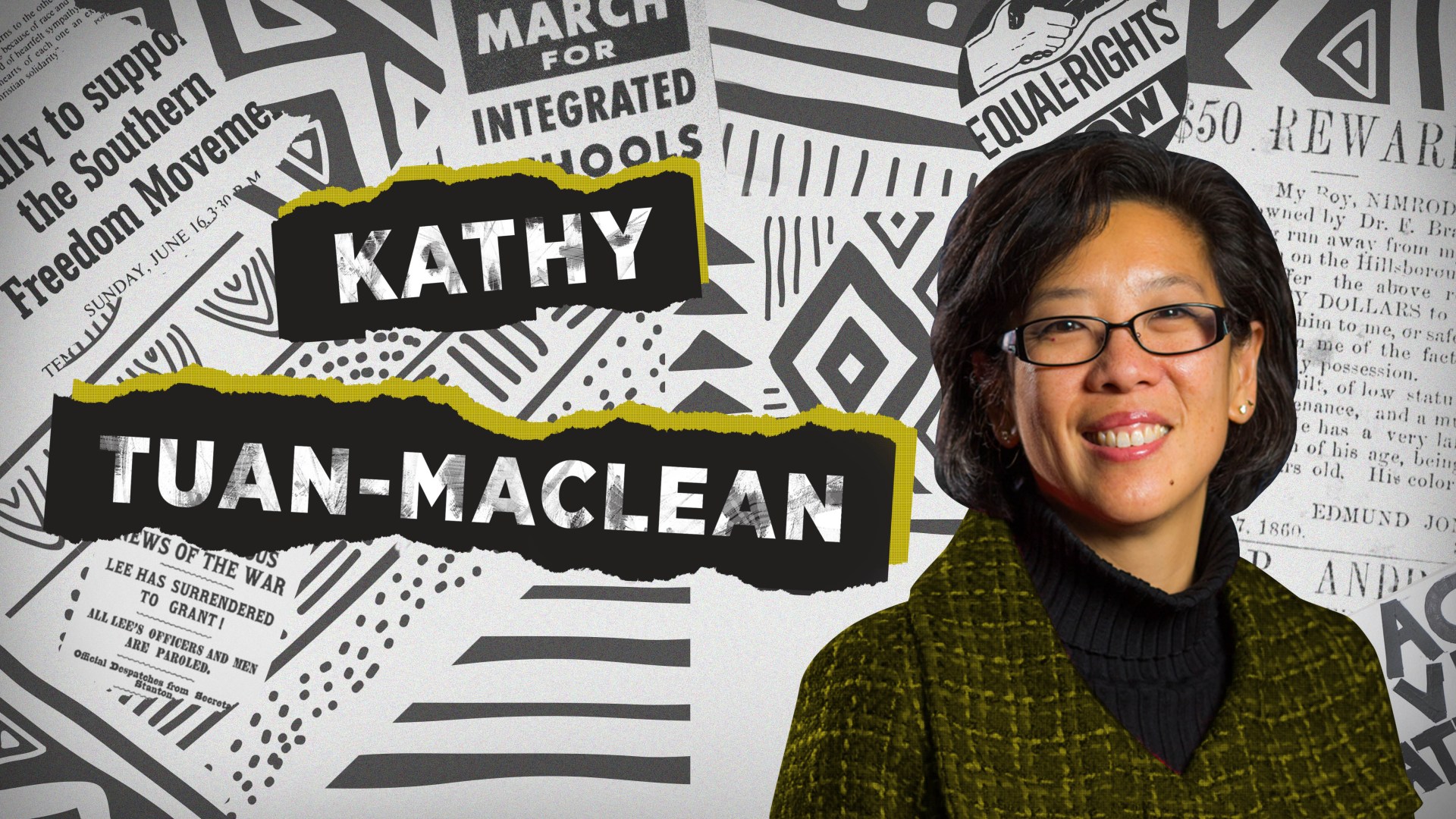
Illustration by Mallory Rentsch / Portrait: Courtesy of Kathy Tuan-MacLean / Background Images: WikiMedia / Unsplash / New York Public Library

Bonnie, a white woman in her late 20s, said, “I don’t understand why Jada has to make everything about race. Race is just not my issue.”

It was the summer of 1988. Jada, Bonnie, and I were working in the inner city with a multiracial team of students on InterVarsity’s Chicago Urban Project. Our team had just experienced an emotional explosion around race that left everyone walking on eggshells and some crying silently in back rooms.

I got why Bonnie, a white woman, would say that. Over the weeks, she’d confided experiencing sexual and emotional abuse. She had so much pain and needed so much healing that I could see why racial issues felt low on her priority list.

But in that moment the Holy Spirit prompted me. “Bonnie, you love Jada, right?”

“Of course I love her!” Bonnie exclaimed. Over the past seven weeks, our team had worked hard, played hard, learned hard. We’d lived together, struggled together, shared deep and difficult conversations together. There’s nothing more bonding than friends following Jesus together on mission.

“I know you love her,” I said, “and Jada’s biggest issue is race. As a black woman whose parents were civil rights activists, whose entire life has been shaped by race and racism, race is Jada’s issue. And if you love Jada, you will care about what hurts Jada. Not because it affects you, but because it affects Jada.”

That lesson has shaped my multiethnic journey ever since. We do it because of love.

In John’s gospel we read that Jesus “had to go through Samaria” (John 4:4). Actually, Jesus didn’t have to go through Samaria. In fact, rather than walking the straight line between Judea and Galilee, Jews walked around Samaria and through the wilderness to avoid defiling themselves. They shook the dust off their feet after walking on Samaritan soil, a sign of contempt and so they wouldn’t pollute their “holy” ground.

Jesus had to go to Samaria because he had a date at a well with a Samaritan woman, a woman who would not only be among the first to recognize him as Messiah but who would also become the first Samaritan evangelist, bringing the good news of Jesus to her whole town.

Jesus had to go to Samaria because of love.

As a second-generation Chinese American woman, I’m not white. I’m not black. My people usually get left out of the American narrative.

As a second-generation Chinese American woman, I fall in between. I’m not white. I’m not black. My people usually get left out of the American narrative. I can silently go about my business, “beating them at their own game,” as my immigrant parents encouraged me. I don’t have to go anywhere—I can use my privilege and duck most of what other people of color must endure.

Yet love compels me to cross ethnic boundaries—in my marriage, in my friendships, in my work—even in raising my bi-racial children, whose parents can’t understand their experience.

I follow Jesus across ethnic boundaries because he introduces me to those he loves and I experience friendship, inspiration, laughter, partnership, delicious food—in a word, more love—but not without more suffering too. Because when we love, we suffer with and for those we love.

How does Jesus invite us to cross boundaries and experience his love?

See what Jesus sees. The disciples saw a ritually unclean Samaritan woman in an unclean land. Jesus saw a broken, hurting daughter who needed a personal experience with him and had the potential to bring a whole village into his kingdom.

It hurts when others don’t see me, my people, or our pain. White friends have said, “I don’t see you as Chinese, I just see you as white” and thought that’s a compliment.

Folks suggest “It’s in your head” if I feel trepidation entering entirely white spaces during this time when our leaders call COVID-19 “kung flu” or the “Chinese virus” and over 2,500 Asians have been targeted. (Don’t believe me? Sociologist Russell Jeung is counting.)

Ask yourself questions the disciples failed to ask. Confused and surprised (maybe disgusted and judgmental?), the disciples don’t ask what’s in their hearts. The “disciples returned and were surprised to find him talking with a woman. But no one asked, ‘What do you want?’ or ‘Why are you talking with her?’” (John 4:27). In our fractured nation, with our terrible history, in this soul-sucking time where every injustice is exacerbated by pandemic, Jesus, what do you want? From me, my family, my church, my nation? How can I join the conversation you’re already having with my neighbor?

Stay a while in a foreign country. Jesus doesn’t answer the unasked questions. Instead, he and his disciples stay in the Samaritan village for two more days. What happened in those two days? How did Jesus transform that town? How did the disciples respond to living on “unclean” soil, eating “unclean” food, with “unclean” people? How is Jesus inviting you to stay in uncomfortable spaces?

Listen. Nothing makes me feel more loved than someone listening to my entire story with compassion, without judgment and without giving advice or trying to “solve me.” We love others by listening well to their stories, stories that include their history, their struggle, their particularities—in person or through books, movies, and podcasts.

Embrace discomfort and even pain: Years ago, I wrote a dissertation on interracial friendship among college students. At the time, friendship theory centered around similarities attracting. But I found that more than similarities attracting, differences repelled. Students talked about wanting to stay in their “comfort zone.” The more culturally different groups were, the less interracial friendship happened between them. Jesus never seems very concerned about our comfort zones. Love is messy. Relationships are hard. Issues of race and justice are extremely complex. Acknowledge the discomfort, accept the pain and, ask Jesus for perseverance to keep walking this journey.

Speak up on behalf of your neighbor: With today’s “cancel culture,” it’s scary to say anything about race or ethnicity. But it’s exhausting to be the person of color, or woman, or minority who always has to speak out to the majority. Take a risk as the Samaritan woman did, a pariah in her community, who used her tiny bit of relational capital to introduce her neighbors to Jesus.

Making mistakes is inevitable. But love covers a multitude of sins. Forgiveness is the balm, the healing ointment, that restores what’s been broken. Repenting, asking for forgiveness, receiving forgiveness, and forgiving myself and others have been essential spiritual disciplines in this long journey. Jesus said the world will know his gospel is true if we love one another, love our neighbors, and even love our enemies and persecutors. If followers of Jesus tangibly loved those from different ethnic, racial, class, and political backgrounds, imagine how the world would take notice. Imagine how our world might be healed.

Let’s do it. Together. For love.

Kathy Tuan-MacLean (PhD, Northwestern University) serves as InterVarsity’s national faculty ministry director.

Theology

Why Do We Cling to Scripture? Our Lives Depend on It.

More than other groups, black Americans dive deep into the Word.

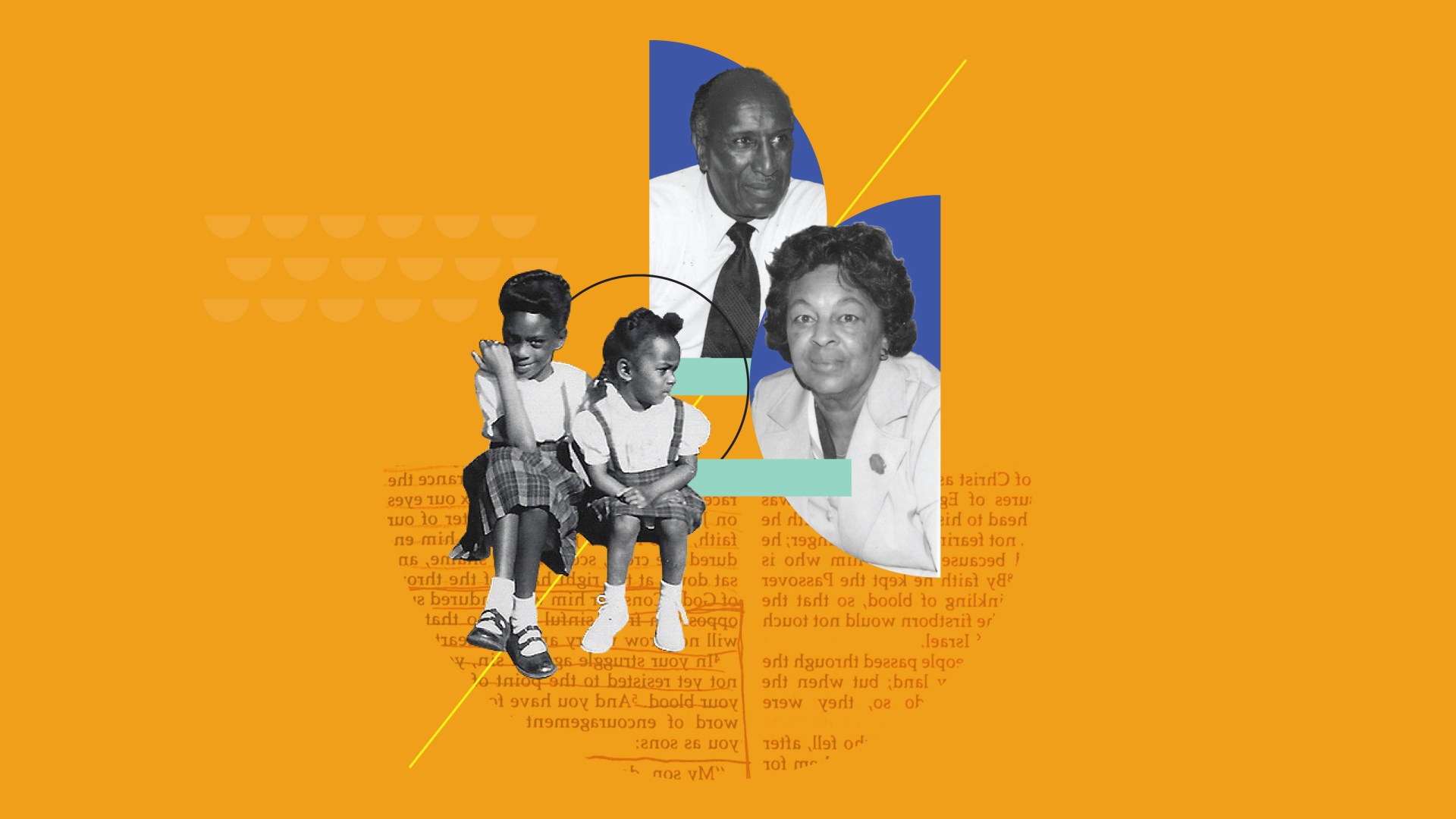
Patricia Raybon with her big sister and parents

Patricia Raybon with her big sister and parents

Illustration by Sarah Gordon / Source Photos: Courtesy of Patricia Raybon

It’s a Sunday evening and we’re just kids—black kids, in fact. We should be outdoors in fading daylight, slurping Mama’s homemade ice cream, catching fireflies, watching our parents laugh with neighbors, changing the record player—turning it low to soft-serenade our long-running, after-church meal.

Instead, dinner’s over and we kids are back at church. And get this: We kids are happy about it. “Sit next to me,” a friend whispers, pulling me over to her. We compare the outfits we’ve worn. Our summer sandals. Our straw summer handbags. As the boys come in, we try to act aloof, as if we don’t care. One boy pulls my friend’s curly ponytail. She starts to protest, but in walks our teacher.

“Let’s turn to Genesis.”

That’s our Bible leader, our Mr. Bell, starting a Sunday evening class for teens at the Cleaves Memorial CME Church in northeast Denver. It’s the Jim Crow ’60s, and this church is our heart place—our safe house sanctuary—in our red-lined cow town. We’re far from our parents’ Southern birthplaces and Dixie traumas. Yet we all have Bibles. White leatherette among the girls. Grown-up black among the boys. (Or a pew Bible if you forgot to bring yours.) For all of us, our Bible is something we don’t hold loosely—it’s something, indeed, to grasp, chew, swallow whole, and inhale, as if our lives depend on it.

Our lives do. We are black, and the wrong against us is a scourge and it’s sin. A toxic cocktail of lies and fears, the hurling mix of madness intends to kill us, again and again, every American day. When just leaving your home could mean risking your own death, your daily life can approximate a nightmare—never safe to fully wake up, never calm enough to exhale.

Thus, in almost every African American house, duplex, apartment, motel room, or trailer sits a Bible—often open, underlined, quoted, and being read. That was true for my generation, and it’s still true after all these years. The reasons aren’t confusing.

Survival

We need a raft, and the Bible doesn’t sink. We need an anchor, and the Bible holds fast. We need a lighthouse, and the Bible dares shine.

Even a silly teenager somehow knows that. There is a “ways and means” to the Book, with its Old Testament laws and New Testament grace. With its scandalous, audacious, paradoxically lovely Jesus and a rampart of parables and prophets, proverbs and psalms, kings and battles, family dramas, epistles, prayers, stories, and songs.

It was the book, as I had noticed, where black people are “dark … yet lovely” (Song 1:5) and Jesus himself, in John’s vision, is described as one with hair “like wool” and feet “like burnished bronze” (Rev. 1:14–15, ESV). In that Holy Book, indeed, this Savior Christ defies convention and narrow-minded fear. And in it, coincidentally, underdogs win.

“Let’s turn to Exodus.”

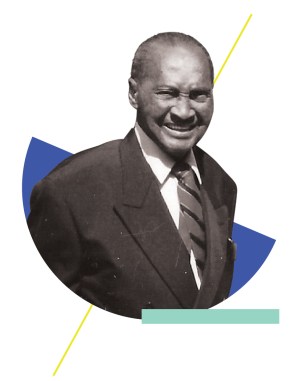
Mr. Bell in his later yearsCourtesy of Patricia Raybon
Mr. Bell in his later years

Mr. Bell had come up with his wife and children from Texas or Alabama or Mississippi or one of the places from which harassed and weary black people fled. A veteran of World War II, he’d served a country that refused him at every turn. But by persistence—and with the kindest heart we’d ever known—he became the first black person in our city hired by the downtown Woolworth’s store to be a floor clerk.

They assigned him to the basement floor. But it was a job, and he wore a shirt, tie, and Sunday slacks every workday. We respected and even loved him. He taught us of Christ, how the Lord redeems evil. So we’ll overcome this, Mr. Bell promised. Modeling that, he then began to teach.

“Let’s turn to Deuteronomy.”

Why does a grown man teach Bible stories? Why do his fidgety students listen? Those stories taught us how to survive our racial tsunami, creating for us a “black sacred cosmos,” as scholars C. Eric Lincoln and Lawrence H. Mamiya described the insulation that God’s Word builds for black souls against supremacist assaults.

The Bible was our love letter from God, drawing us to him, lifting us together. Indeed, if you were black and in church—which was pretty much every black man, woman, boy, and girl I knew—at some point, you were called on to study and teach a Bible lesson. Moreover, your effort was encouraged by the church: “Teach, baby!”

The Bible endorsed our personhood, and through it, we endorsed one another in turn. The world outside rarely did. It was dangerous, therefore, this book—especially for a disempowered people. Consider the “Slave Bible,” displayed in the Museum of the Bible in Washington, DC. It was published by missionaries “for the use of the Negro slaves.” For fear of inciting rebellion, this “Bible” omits Scripture’s stories of heroics and freedom. Moses, for example, is barely mentioned. “You’ll see a jump from Genesis 45, and they’ve cut out all the material to Exodus 19,” said Anthony Schmidt, associate curator of Bible and religion in America at the museum. In fact, “about 90 percent of the Old Testament is missing [and] 50 percent of the New Testament,” Schmidt told NPR. “Put in another way, there are 1,189 chapters in a standard protestant Bible. This Bible contains only 232.”

But the whole Bible? Given and studied in full, it’s revelation power.

“Let’s turn to the Book of Jonah.”

Hope

Raybon in her early teens Courtesy of Patricia Raybon
Raybon in her early teens

Scholars make much of African Americans’ love of Scripture and our common belief in the Bible’s stories as literally true. But at my Bible study, we never debated whether the story of Jonah and his whale was true or not. Instead, our focus was on celebrating Jonah’s story because, as with the entire Bible narrative, it gives drowning people life and a second chance.

Mr. Bell invited us into the big-whale story (among others), helping us unravel Jonah’s ordeal—we were humbled to learn God expects obedience and good ministry from his followers. Yet, if we fail, even in a storm, God grants another try—giving living hope. In the belly of the Bible, indeed, hope happens—especially in storms.

As storm-tossed people, we still cling to this uplift. But we cling also to God’s radical truth: that love and justice are both divine. Mr. Bell wanted us suited up, our life jackets sound. Thus, he taught us the whole affirming Book: how to read it, who the people were, why the wars were waged, how the Psalms were composed, what the parables meant, how disciples acted—indeed, who Jesus is and who we are in him.

We are loved, Mr. Bell insisted. Made in God’s image. Our salvation secured by a Savior who endured black-like shame on a rugged, government cross.

This was spiritual formation while our world was on fire. The truth of God’s Word held us aloft, in defiance of flames and smoke. Today, I still ride this updraft.

But beyond empowerment, God’s Word is also grounding, humbling. For me daily, it also teaches love. Consider him, indeed, taught Mr. Bell, “who endured such opposition from sinners, so that you will not grow weary and lose heart” (Heb. 12:3). I clung to this word during our Jim Crow crucible, and I still do—still stunned by its assurance.

“So, turn to Second Timothy.”

Mr. Bell adored that epistle. The imprisoned, aging Paul encouraging a young pastor. I still treasure the letter today. As it says, all Scripture is inspired by God, equipping us thoroughly “for every good work” (2 Tim. 3:16–17). Especially when life is hard. So it is true: More than other groups, black Americans still dive deep into the Word. It’s our lifeline. But during these times, decades later, I can almost hear Mr. Bell urging this: Dive with us.

Patricia Raybon is a regular contributor for Our Daily Bread and (in)courage. Her books include My First White Friend: Confessions on Race, Love, and Forgiveness and Undivided: A Muslim Daughter, Her Christian Mother, Their Path to Peace.

This article is part of “Why Women Love the Bible,” CT’s special issue spotlighting women’s voices on the topic of Scripture engagement. You can download a free pdf of the issue or order print copies for yourself at MoreCT.com/special-issue.

Apple PodcastsDown ArrowDown ArrowDown Arrowarrow_left_altLeft ArrowLeft ArrowRight ArrowRight ArrowRight Arrowarrow_up_altUp ArrowUp ArrowAvailable at Amazoncaret-downCloseCloseEmailEmailExpandExpandExternalExternalFacebookfacebook-squareGiftGiftGooglegoogleGoogle KeephamburgerInstagraminstagram-squareLinkLinklinkedin-squareListenListenListenChristianity TodayCT Creative Studio Logologo_orgMegaphoneMenuMenupausePinterestPlayPlayPocketPodcastRSSRSSSaveSaveSaveSearchSearchsearchSpotifyStitcherTelegramTable of ContentsTable of Contentstwitter-squareWhatsAppXYouTubeYouTube