Theology

J.I. Packer Was the Robin Hood of Evangelicalism

The prominent theologian ‘stole’ riches from church history and gave them to the spiritually impoverished.

Christianity Today July 22, 2020
Illustration by Mallory Rentsch / Source Images: WikiMedia Commons / Getty Images / Portrait by Ken McAllister / Courtesy of Regent College

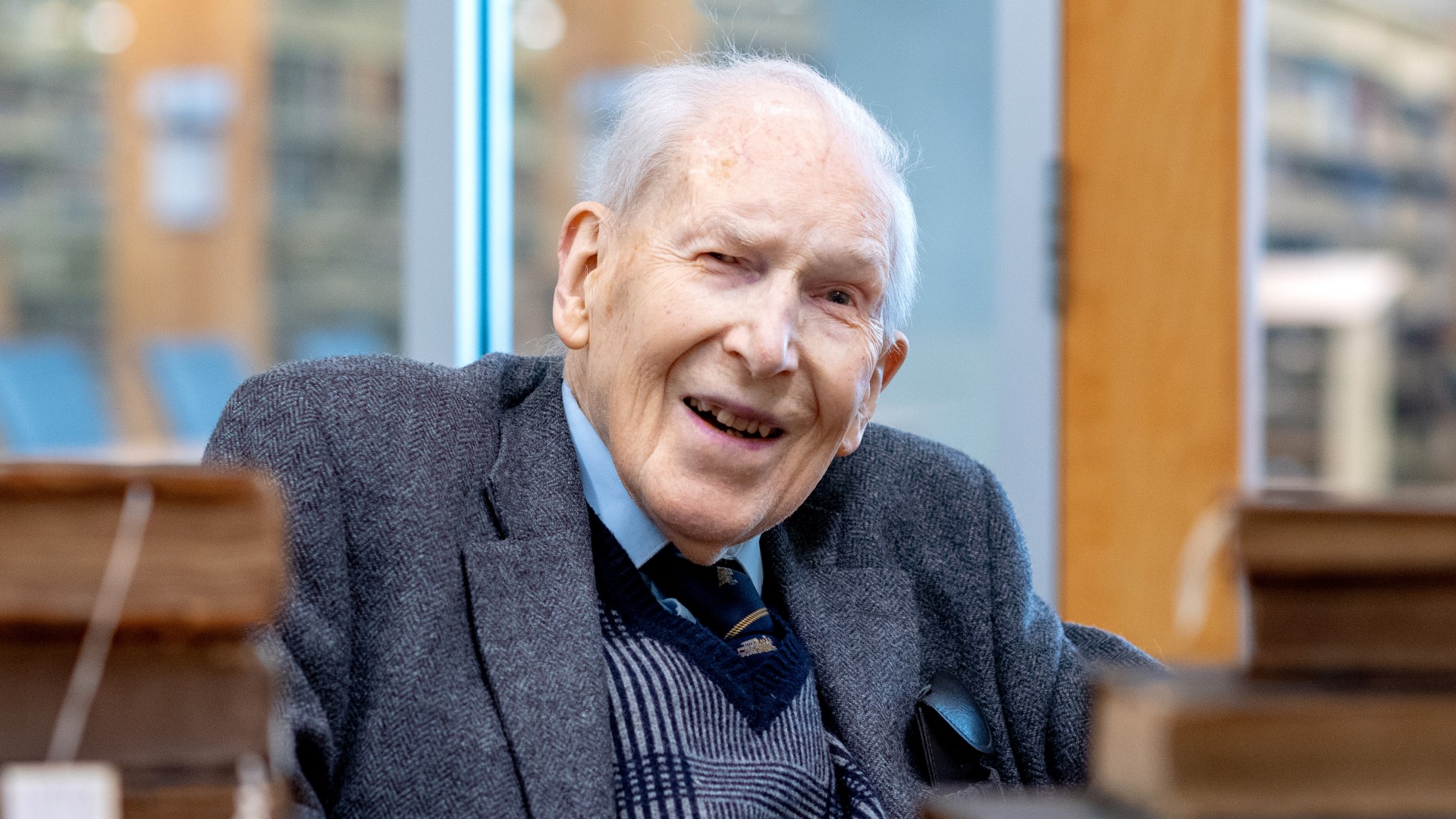
J. I. Packer was my teacher at Regent College when I was a young graduate student. Some years later, he became my colleague and next-door neighbor in the hallways at the college and a fellow church member at St. John’s Anglican Church in Vancouver. I will forever be grateful to have known him. He shaped my life and thought in many ways, and I am not alone in this experience.

In light of his recent passing, I have been thinking more about his wider legacy and especially his significant contribution to evangelicalism as a whole. In the present political culture, however, the word “evangelical” or “evangelicalism” is freighted with a good deal of baggage that’s worth shedding immediately.

We can do so by going back in time. The Old English word “gospel” never got a proper Old English adjective and had to steal a Greek one: “evangelical.” But the noun and the adjective belong together. And as the great Bible translator William Tyndale put it, “evangelical” is a word that “signifieth good, merry, glad and joyful tidings, that maketh a man’s heart glad, and maketh him sing, dance, and leap for joy.”

This vibrant relationship between word and life, message and experience, doctrine and devotion was absolutely central to the evangelical movements in Germany and English-speaking lands that emerged at the beginning of the modern period.

Evangelicals today claim some sort of genealogical or theological continuity with these movements. But wherever we see the preaching of Jesus Christ generate new life and set people in joyful motion, that is where we properly use the adjective “evangelical” in its most important and basic sense. It is why we cannot, I think, abandon the term. Again, the words “gospel” and “evangelical” ought always to be kept together. Indeed, Jim Packer played a significant role in evangelicalism over the past six decades precisely because he helped those who identify as social evangelicals to be theological and spiritual evangelicals as well.

With this context in mind, I can think of six roles that sum up Packer’s contribution to the modern evangelical movement.

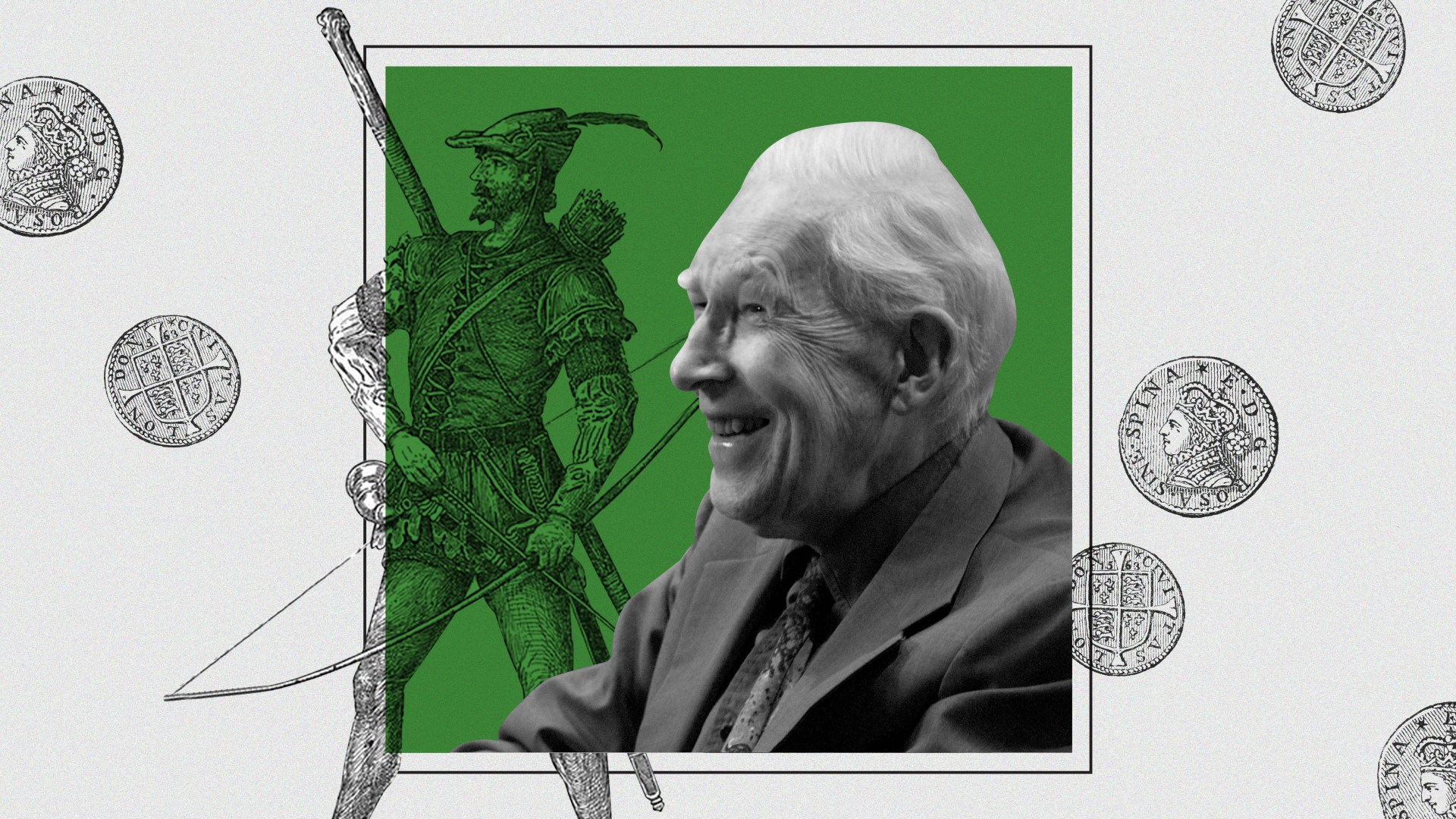
First, he was the Robin Hood of evangelicalism, stealing from the rich and giving to the poor.

By training and by dint of his own disciplined study, Packer acquired early in his career a deep knowledge of church history and the classic works of Christian theology. Popular evangelicalism, on the other hand, has often been profoundly ahistorical and anti-intellectual in its outlook. Just as the absence of good King Richard left England in turmoil during the time of Robin Hood, so modernity has caused troubles for the church.
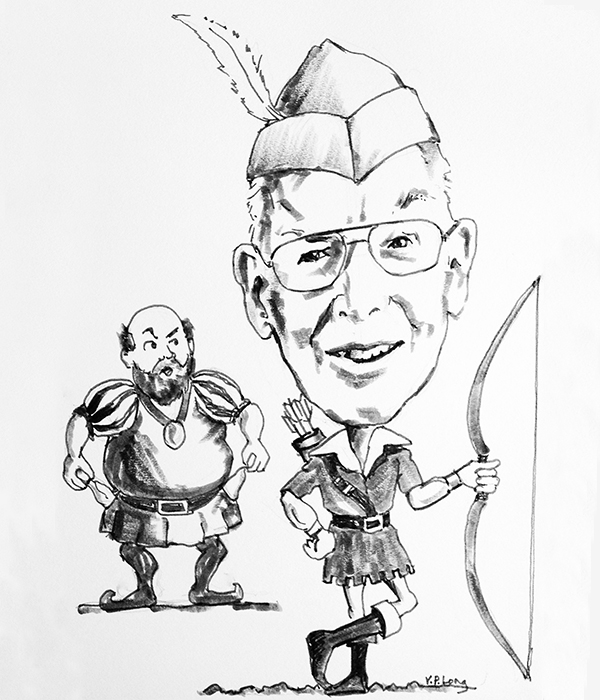
Illustration courtesy of Phil Long

Not to put too fine a point on it, but Packer described North American Protestantism as “man-centred, manipulative, success oriented, self-indulgent, and sentimental.” He therefore contrived, like Robin Hood, to “take from the rich and give to the poor.” He was able to retrieve riches from the past and employ them for the purpose of renewing the life of Christians in the present.

In his essay, “On from Orr,” Packer wrote, “As an Anglican, a Protestant, an evangelical, and … a ‘small-c’ catholic, I theologize out of what I see as the authentic biblical and creedal mainstream of Christian identity, the confessional and liturgical ‘great tradition.’” From these riches, he addressed the poverty of popular evangelicalism, which he once described as “3,000 miles wide and half an inch deep.” We are all richer on account of his theological generosity.

Although he “stole” from the whole wealth of church history and the great tradition, he came early to the conviction that the Puritan tradition, in particular, contributed much to the church today. Indeed, he was one of the key catalysts in the post-war revival of Puritan or neo-Calvinist theology among evangelicals on both sides of the Atlantic.

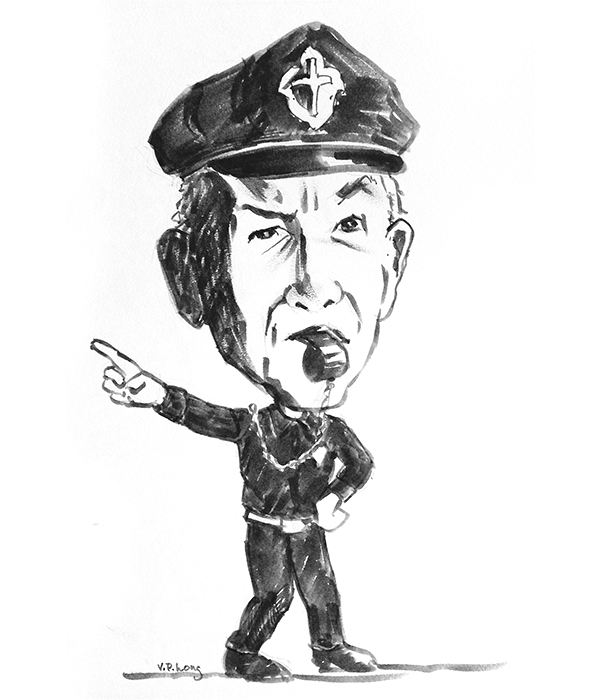
Second, Packer was what Time once called the “theological traffic cop of evangelicalism.”

Throughout its history, evangelicalism has been a movement, with all the fluidity that that word implies. Without a magisterium or a visible church order or hierarchy, it has not always been clear how theology functions to regulate evangelical belief and practice or to unite evangelicals around core doctrines. In this context, amid all the diversity and denominational pluralism of 20th-century evangelicalism, Packer was, according to Time, a “doctrinal Solomon.”

“Mediating debates on everything from a particular Bible translation to the acceptability of free-flowing Pentecostal spirituality,” wrote the magazine, “Packer helps unify a community that could easily fall victim to its internal tensions.”
Illustrations courtesy of Phil Long

Through the influence of Knowing God, Packer emerged as a theological arbiter among evangelicals. In the West, as well as in Singapore, Hong Kong, Korea, and other countries where his works have been translated and loved, many evangelicals have looked to Packer’s writings as the embodiment of evangelical theology. Packer was an international traffic cop, too.

In his regulatory role, Packer was willing to engage in controversy and contend for the faith. Any number of issues within evangelical ranks drew his fire, but he was especially concerned with the threat of theological liberalism to the faith of ordinary Christians. As he often said, liberal Christianity has no grandchildren. Wherever Packer saw revisionist liberal traffic approaching, he held up a hand, blew his whistle, and refused to let it merge onto the evangelical roadway.

In addition to being a Robin Hood and a theological traffic cop, Packer was also a plumber.

In the winter of 1989, on the occasion of his installation as the first Sangwoo Youtong Chee Professor of Theology at Regent College, Packer gave an inaugural address titled “An Introduction to Systematic Spirituality.”

He called for a marriage of sorts: “I want our systematic theology to be practiced as an element in our spirituality,” he said, “and I want our spirituality to be viewed as an implicate and expression of our systematic theology.” Evangelical theology and evangelical life were to be inseparable.

Illustrations courtesy of Phil Long

At the close of his address, though, Packer donned his plumber’s bib and brace, as it were, and described his role alongside Jim Houston, who had been teaching spiritual theology at Regent for more than a decade. “Strengthening every way I can the links between spirituality and systematic theology will certainly be high on my agenda,” Packer said. “I do not think l shall cramp Dr. Houston’s style. What I do will be more in the nature of digging out foundations and putting in drains, leaving the air clear for him to fly in, as at present.”

The role of “Packer the plumber” at Regent College might be extended more broadly to his work within evangelicalism at large. In the context of a growing interest in spirituality by the wider postmodern culture, Packer played a role as Plumber in Chief, keeping the drains clear and digging out the foundations with the aim that all may soar aloft in healthy, unpolluted air.

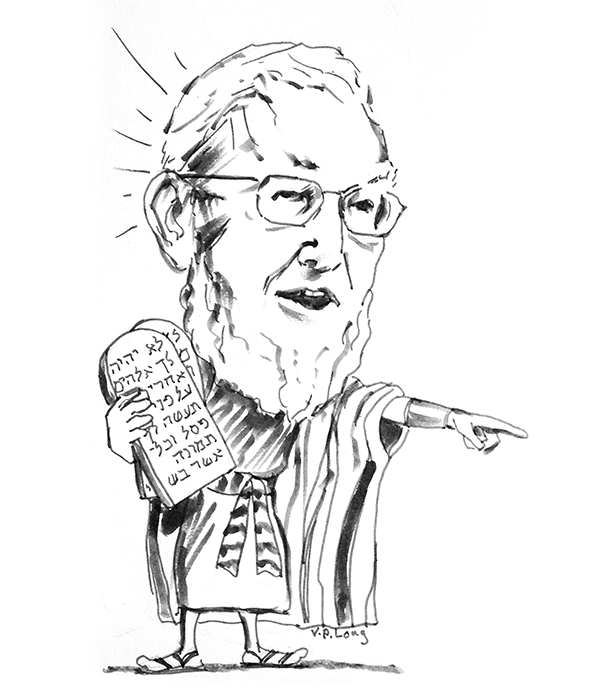
Packer was also fundamentally a catechist.
Illustrations courtesy of Phil Long

From his post at Regent, and with the popularity of Knowing God, Packer effectively became a catechist-at-large for evangelicals. This was his “sweet spot” as a communicator. He was a scholar through and through, as bookish and tweedy as they come, yet he spoke and wrote not for specialists in peer-reviewed publications but for general audiences. To be sure, he was never short on content—“Packer by name, Packer by nature,” he said—but he wrote to be understood.

While some academics might have wished that Jim had written more for specialists, this was not his sense of personal mission. He was a catechist first. Given the social structure and character of evangelicalism as a popular movement, it will always need those who can communicate in exactly this register. And Jim did this better than anyone.

From my perch in Vancouver, I was privileged to witness some of the ways that Packer lived out his catechist vocation in our local church. For decades, he was the inspiration behind a thriving adult Sunday school class that still goes by the humble name “Learner’s Exchange.” Although Jim regularly contributed, the course was lay led and lay taught most weeks. He sat there utterly in his element and positively beaming while adult Christians, serious about their faith, learned together Sunday after Sunday.

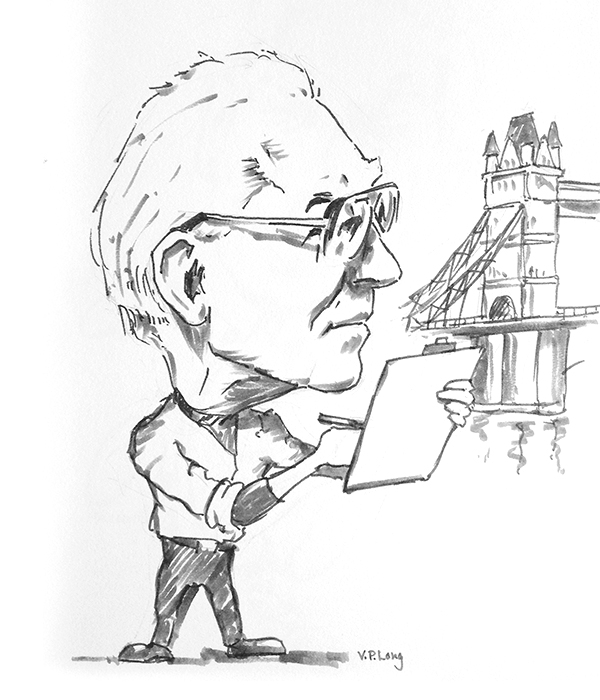
Fifth, Packer was a bridge-builder among evangelicals.

My wife and I live on the south arm of the mighty Fraser River on the delta where it empties into the Pacific Ocean. Some years ago, our provincial government employed an army of engineers to plan a new bridge to span the river and connect us better to the rest of Vancouver.

We might picture Packer as one of those highly skilled bridge-building engineers who knew exactly how and where to connect distinct communities. He was Reformed, he was Anglican, and he was evangelical. Yet in his writing, teaching, debating, and worshipping, he looked for common ground with charismatics, Roman Catholics, and Orthodox believers.
Illustrations courtesy of Phil Long

Packer’s approach was not to pursue some sort of abstract via media agenda but rather to unite Christians around biblical teaching and a thoughtful consideration of church history. He described evangelicalism as an “ethos of convertedness within a larger ethos of catholicity.”

Convertedness is a divine dynamic, generated by an understanding of the gospel and issuing forth in a renewal of life. It’s like a mainstream current within the great Mississippi River, a mainstream that flows onward, despite eddies and bayous, mudflats, and reed beds. Creeds and councils mark the banks of the river. Faith, repentance, fellowship, communion, holiness, and service are all the while being renewed by the coursing life of the Spirit. Given this spiritual ethos, Packer was eager to make common cause with faithful believers in other Christian communions.

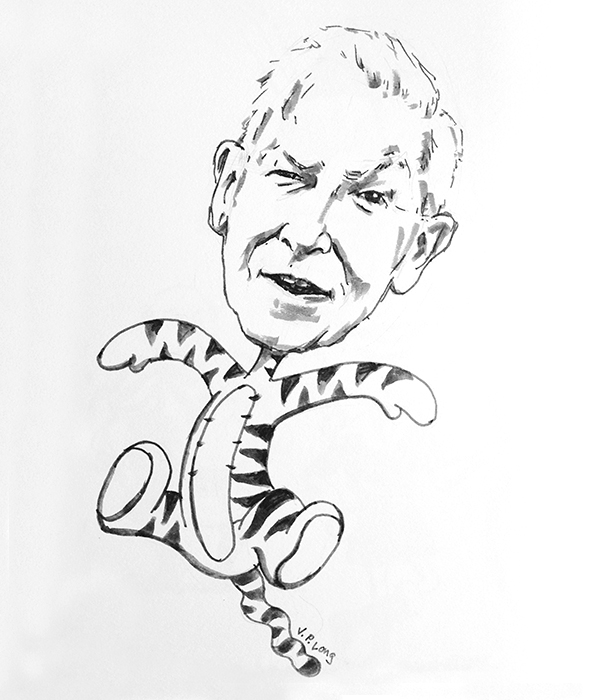
The last role I would assign to Jim Packer is, well, that of Tigger from A. A. Milne’s Winnie-the-Pooh stories.

In The House at Pooh Corner, where the character is first introduced, Tigger says of himself, “Bouncing is what Tiggers do best.” Piglet agreed: “He just is bouncy … and he can’t help it.” For many years, this is the picture I have had of Jim Packer coming into the building at Regent College with a spring in his step—boing, boing, boing—as if he were walking on springs. Being more temperamentally an Eeyore by nature, I have looked on in wonder and admired his effervescent Christian joy.
Illustrations courtesy of Phil Long

Jim had a zest for life, a real whimsical streak, and a genuine cheerfulness. He also had a remarkable, dry wit, a love of clarinet and classic jazz music, a love of steam trains, a love of literature, and a love of food. His Asian friends like to see him keep up with them, spoonful for spoonful, with the hottest curries and spicy meals.

By the grace of God, he sustained this joyful spirit even in the midst of suffering and real disability. His personal witness to the joy of being a Christian and a theologian was itself a significant contribution to evangelicalism.

This brings us full circle to Tyndale’s idea that the word evangelical “signifieth good, merry, glad and joyful tidings, that maketh a man’s heart glad, and maketh him sing, dance, and leap for joy.” Like Tigger.

Indeed, in his old age, Packer knew that there was still a joy set before him. As his beloved Richard Baxter wrote in Saints’ Everlasting Rest, “We are on our way home, and home will be glorious.” Packer knew well that the wise man will “live, as it were, packed up and ready to go.”

Friends, Packer was packed. Here, at the end, in his joyful expectation of heaven, he was doing what he had always done: keeping evangelicals connected with the gospel.

Bruce Hindmarsh is the James M. Houston Professor of Spiritual Theology and professor of the history of Christianity at Regent College, as well as the author of The Spirit of Early Evangelicalism: True Religion in a Modern World.

This essay was adapted from a talk titled “The Significance of J. I. Packer for Evangelicalism,” given at the 2016 annual meeting of the Evangelical Theological Society on the occasion of Packer’s 90th birthday.
The Stories Our Politicians Tell

Our allegiance to economic prosperity can shape us more than we realize.

Christianity Today July 22, 2020
Illustration by Rick Szuecs / Source images: OlegAlbinsky / Getty /Ethan Jones / Jeffrey Czum / Pexels / Kellietalbert / Twenty20 / Envato

As the height of the 2020 presidential election season approaches, many Christians are asking important questions about our political responsibility: What policies should I support? Do I vote on party lines or on the issues most important to me? In the midst of a global pandemic and racial tension splintering our society, the stakes feel different this year. But important questions about parties and candidates can easily obscure another question at the heart of our political and spiritual lives: What story am I buying into?

The Liturgy of Politics: Spiritual Formation for the Sake of Our Neighbor

The Liturgy of Politics: Spiritual Formation for the Sake of Our Neighbor

IVP

216 pages

$10.44

Politics is all about storytelling. Picture Ronald Reagan’s iconic 1984 “Morning in America” campaign ad. Light slowly rises over shots of farmers working in the fields and a paperboy throwing the morning paper onto green lawns. A family moves into their new home, a beaming couple celebrates their wedding, and the sun rises over Capitol Hill. The economic statistics listed throughout the ad are secondary to the emotional and visual story of hope, new beginnings, and the American Dream.

In their campaigns, candidates do not merely outline policy proposals, they articulate a vision of a good life: free from certain threats, in community with the right kind of people. These marketable narratives are not content to remain at the penultimate level, shaping our political decisions while leaving our theological commitments and spiritual formation unaffected. Like all persuasive, affective stories, they will fight for ultimate status in our lives.

Most Christians separate their political and spiritual lives into two different realms. One is about the care of our souls, the inner life of the Christian, the way that spiritual disciplines shape us into the people of God. The other is about how we as individuals approach the political world as an external reality we can manipulate. While American evangelicals have a history of overidentifying their faith with a political party, separating our moral or theological obligations from our political ones has been necessary to maintain this singular identity. Any dissonance between the two identities is overcome by dividing the rules for the spiritual and political parts of our lives. The real tragedy of this way of thinking is that we believe we can run headfirst into the political world, armed with our theology, and engage as unaffected outsiders. We fail to see how political stories shape our loves and loyalties more often than they convince us intellectually.

The power of political storytelling has been empirically verified: a study published last year in the American Journal of Political Science found that most people’s political ideology was able to accurately predict their answers to moral questions, not the other way around. “We will switch our moral compass depending on how it fits with what we believe politically,” said Peter Hatemi, one of the researchers and a political science professor at Pennsylvania State University. Similarly, Stanford political scientist Francis Fukuyama says that most people begin with an “emotional commitment” to an ideology and then process new information with this prior commitment controlling their reasoning.

As creatures deeply formed by our communities, rituals, and affective bodily experiences, we are easily drawn into such stories. Philosopher James K. A. Smith makes the theological case in Awaiting the King that our “political and social allegiances trump religious allegiances all the time, whether in presidential primaries, under the grotesque shadow of the lynching tree, or in horrifying cases like the Rwandan genocide.” As Smith illustrates, political allegiances are powerful precisely because they are mediated to us through rituals and stories that teach us what to fear and love, how to understand our own identity, and what ultimate good to seek. The scariest thing about these stories is that they form in us desires, fears, and loyalties that we would theologically deny.

Shaped by prosperity

One such narrative is the promise of prosperity. Across the political spectrum, the promise of a politician is the same: ease, affluence, success. In the 2016 Republican primary, the candidates battled to make the most ambitious promises of prosperity, from Rubio’s commitment to “usher in a new American century,” Cruz’s promotion of the American Dream, or Kasich’s plan to “help America reclaim our power, money and influence.”

Our country’s response to the COVID-19 pandemic reveals how deeply committed we are to economic prosperity at any cost. Texas Lieutenant Governor Dan Patrick argued that grandparents were willing to sacrifice themselves for the sake of the economy; opportunists forced Amazon to crack down on hand sanitizer price gouging in the early weeks of the pandemic, and every reopening step has been made with economic recovery primarily in mind. COVID-19 brought grievous economic devastation to communities and individuals, but our response has also revealed the primacy given to economic prosperity in our political decision making. It has also highlighted the flaw in prosperity logic: even a powerful country with a booming economy can be brought to its knees by forces outside its control.

The 2020 presidential debate will largely focus on the public health and economic consequences of COVID-19. This is certainly warranted. It makes sense for candidates at both the local and national levels to win voters over with promises of prosperity in the face of economic decline. But we are naïve if we think that we can ingest a regular diet of prosperity storytelling without it affecting us in larger ways.

Our political involvement—the policies and politicians we support, the news we consume, the rallies or protests we attend—can also shape our theological and moral commitments.

Politicians and commentators use morally coded language to subtly reinforce the idea that wealth is a product of righteous hard work and poverty is the result of moral weakness. We can use terms like “thugs” in the “inner city” and “upstanding citizens” from “good families” to describe the perpetrators of the same crimes while communicating that one involves the moral good of wealth and the other the moral evil of poverty. The formative story about prosperity may not claim that God rewards the righteous with material success, but that’s not because it denies that the righteous will receive material success. The narrative of material wealth claims that the all-powerful market is sovereign over human lives; it promises salvation to the hardworking.

Conversely, Christians have robust theological reasons to deny that poverty is a moral failure. Scripture teaches, for example, that the wealthy often abuse their power (James 5:1-6); the poor are especially vulnerable and need advocates (Isa. 61:1); and wealth usually makes faithfulness more difficult (Mark 10:23-25). Yet a 2017 Washington Post/Kaiser Family Foundation study found that white evangelicals were twice as likely to attribute poverty to individual failings. This is not merely evidence of incorrect theology, but evidence of the ways in which our immersion in this political story has shaped us in spiritual and moral ways.

This grand story of prosperity is not content to merely influence our political decisions. It will change the way we spend our money, the way we interpret Bible passages about wealth and poverty, the way our churches engage our communities. At the heart of the economic prosperity gospel is an aversion to weakness, to insufficiency, to the very logic of Christ’s gospel. When the prosperity gospel shapes the church, it has far more serious consequences than we imagine.

When I was a student at Liberty University during the 2016 election, many politicians and journalists spoke at our thrice-weekly convocation, including Sen. Bernie Sanders. His message centered on the common ground he thought he shared with politically conservative Christians, even if they disagreed on the solution: a concern for the poor and vulnerable. Following his talk, many students complained that “this is a job for the church, not the government.” Soon after Sanders’ visit, Christian writer Ann Voskamp spoke on Esther and the need to advocate for marginalized groups and those “outside the gate.” While Voskamp’s message advocated for the church (rather than the government) to use their privilege to serve society, it was met with similar antagonism: “What does she expect poor college students to do?” “She was dressed way too nicely to be saying stuff like that.” “The concept of ‘privilege’ is a tool of the left.”

The response from students clearly illustrated how their steady diet of political storytelling had not merely produced a commitment to a particular economic system but had shaped their theological understanding of wealth and poverty. It showed how our political involvement—the policies and politicians we support, the news we consume, the rallies or protests we attend—can also shape our theological and moral commitments.

Formed by a better story

Political participation is one way we creatively pursue the common good of God’s creation, and Christians should work to faithfully evaluate different policy proposals using both their theology and their knowledge of policymaking. However, we must also learn to identify and challenge the prevailing stories that animate each policy. In their book People of the Truth: The Power of the Worshipping Community in the Modern World, Robert Webber and Rodney Clapp call this the “diacritical” function of the church: we both criticize the errant stories we are immersed in and offer a compelling alternative.

The power of political storytelling presents both a challenge and opportunity to church leaders struggling to respond to the evangelical political crisis. Our churches are filled with people who have been strongly shaped by political stories that affect their voting and shape their theology, relationships, and spiritual formation. Yet the church has the resources—corporate worship, Scripture, historic liturgy, music, community—to instill an even greater story.

Our conversations about evangelical political engagement need to be greater than which policies we should support or who should earn our vote. Those decisions cannot be abstracted away from the larger stories that animate them: stories that form our identity and desires, instill fears and loyalties in us, and orient our work in the world toward ultimate good.

As a people formed weekly by a grand story, we should learn to recognize the competing narratives that threaten to unseat the story of the kingdom of God from its place as the controlling narrative in our lives. The church has exactly the resources it needs: the ultimate story, communicated through teaching and historic Christian practices, rehearsed in the context of the community of God.

Kaitlyn Schiess is a writer and seminary student at Dallas Theological Seminary. She is the author of The Liturgy of Politics: Spiritual Formation for the Sake of Our Neighbor, which releases in Sept. 2020.

Theology

Growing Young and Growing Old: The Legacies of John Lewis and J.I. Packer

The maturity of youth and the vibrancy of age both serve the true needs of our day.

Christianity Today July 21, 2020
Illustration by Mallory Rentsch / Source Images: Hulton Archive / Stringer / Getty Images / Genesis Photos

“The glory of young men is their strength, gray hair the splendor of the old.” Prov. 20:29

Within a span of 24 hours, we learned of the deaths of two titanic figures—civil rights leader and United States Congressman John Lewis, and evangelical theologian J.I. Packer. Both were old—Lewis was 80 and Packer 93—but upon reflection, I couldn’t help but see each, in my own imagination, at radically different periods in life. With Lewis, I saw the smiling, young civil rights worker in the mug shot after his arrest in Mississippi. With Packer, I saw the frail, wizened theologian ambling through a library, a stack of books precariously cradled in his arms.

Lewis and Packer were both young once. Any who paid attention likely recall images of each from their youth—Lewis at the 1963 March on Washington, or Packer as a young scholar at Oxford. What intrigued me, however, was how the first image in my mind was of Lewis as the strident and exuberant demonstrator and of Packer as the elderly sage. I could envision the old John Lewis to be sure, but I had to work my way there from the past. For Packer, it was the reverse. Some of this is due, no doubt, to the primary callings of each. Lewis was a thinker and a politician, but his primary mark was as an activist. Most of us came to know Packer by reading his books on the authority of the Bible, or knowing God, or on the Puritans, or by reading his columns in Christianity Today.

But there’s more to it.

Our knowledge of these two stalwarts comes to us in the guise of what popular culture would call an “origin story.” In the narrative version of Lewis’s life—at least as we know it—a signature moment was the awful beating he suffered on the Edmund Pettus Bridge in 1965. When we reflect on that horrific incident—whether in history books or film or the graphic novel about his life, The March—we can see its consistency with the rest of his life—the lawmaker fighting against repeal of voting rights laws or the elderly congressman walking across the House floor to embrace an ailing white U.S. senator of the opposing party grappling with disease. Many of us could still see in his aged face the expressions of the young man with a head injury, or the smiling mug shot after his Mississippi arrest.

With Packer, it’s the reverse. Whatever pictures of the young scholar we may see, we project backwards the light of the revered elder evangelical statesman who carefully reasoned us through the importance of biblical inerrancy, or who modeled a calm and non-vindictive demeanor when assailed by separatists of a narrower Calvinism who rejected his work with Roman Catholics and higher-church Anglicans, or when lambasted by progressives in his Anglican Communion for his refusal to “evolve” on matters of sexual morality.

A life well lived does not view youth as something to be hoarded nor age as something to be evaded.

The reason for this difference, to me, has to do with the integrity of each. Lewis’s youth comes first to our minds not because his early life was more accomplished than his later life (he was a skillful legislator and orator to the day of his death). Rather, what we see in the young John Lewis is the courage it took to sacrifice not just his life but also his youth. If Lewis had died on the Pettus Bridge or elsewhere in South during the violence of the 60s—a very real possibility—he would have been remembered as the young protégé of Martin Luther King, Jr., and as a valiant hero. But we would have missed witnessing what it looks like for the courage of youth to encompass an entire life. Even in the throes of pancreas cancer, to see Lewis standing with protesters against racial injustice after the death of George Floyd is to see the courageous young Lewis of the Edmund Pettus Bridge standing there too.

Packer, on the other hand, modeled what it looks like for an evangelical “celebrity” to age without scandal or bitterness or resentment toward those who harmed him or resentment of the generations coming after him—a sight sadly in short supply. He wrote in his final years of what it means to be near to death, and did not seek to hide from view what many deem the “indignities” of age. Instead, he taught how “weakness is the way.” When we read Packer’s early and middle writings, we see a building wisdom toward the humble sage we knew at his life’s end.

The narrative consistency between youth and age in the course of a life—between who one is in their prime and in the valley of the shadow of death—is essential to integrity. Youth is about more than self-indulgence or self-protection. And old age is about more than reflecting back on the “good old days” of the heights of one’s powers. A life well lived does not view youth as something to be hoarded nor age as something to be evaded. A life well lived sacrifices one’s future by standing in the face of danger for the sake of those one may never see, and similarly, such a life sacrifices one’s legacy by teaching those younger how to wither into weakness embraced by the knowing God of one’s youth.

This is counter-intuitive in a day when the young are expected to project an image of cynicism and world-weariness and the old are expected to airbrush their profiles to maintain “relevance” and strength. What we admire in these giants we lost is their refusal to do either. Lewis seemed young even when he was old. Packer, by his own admission, seemed old even when he was young. The maturity of youth and the vibrancy of age, both are needed in times that seem too juvenile for gravity and too decrepit for joy.

Russell Moore is president of the Ethics and Religious Liberty Commission and is the author of the forthcoming book The Courage to Stand: Facing Your Fear Without Losing Your Soul (B&H).

Theology

From N.T. Wright to J.D. Greear: How J.I. Packer Shaped My Faith and Work

20 evangelical thought leaders on the theologian who inspired their seminary studies, sparked their love of Scripture, and took them out for spicy food.

Christianity Today July 21, 2020
Photo by Ken McAllister / Courtesy of Regent College

On July 17, J. I. Packer passed away at the age of 93. He was “one of the most famous and influential evangelical leaders of our time,” according to Leland Ryken, professor emeritus of English at Wheaton College and author of J. I. Packer: An Evangelical Life.

To mark the moment, we asked 20 Christian thought leaders to answer this question: How did J. I. Packer shape your faith and work? Some of the respondents were his close friends and colleagues, others studied under him, and still others knew him only through his writing. Here’s what they had to say.

N. T. Wright, senior research fellow, Wycliffe Hall, Oxford University:

In the 1960s, three men set an example of robustly intelligent evangelicalism: John Stott, Michael Green, and Jim Packer. Widely discounted by the liberal establishment, they carved out space for my generation to develop in new ways. Jim, the intellectual giant of the three, encouraged me from our first meeting in 1969 to my final one 50 years later. I thank God for his friendship, his courage, his intellectual rigor, his prayerfulness, his gentle humor, and above all, his love of the Lord and of Scripture.

Joel Scandrett, assistant professor of historical theology, Trinity School for Ministry:

“Chicken vindaloo, as hot as you can make it!” That was one of the more unanticipated sentences I heard from J. I. Packer’s lips during the years we worked together on the catechism of the Anglican Church in North America. He loved Indian food, and we would go to his favorite restaurant whenever we were in Vancouver. He always ordered chicken vindaloo with white wine.

I'm saddened by his passing but indescribably grateful for the chance to have worked with him and known him as a person, if only a little bit. What a mind! And what a heart for Christ and his church. Packer’s capacity to capture complex propositions with utter clarity and succinctness was astonishing, and his joy in the task of theology was undimmed and infectious. I love the man. So here’s to Jim Packer, lover of God, teacher of the church, now gathered to the saints with Jesus in paradise. May we all be as faithful as he in our vocations, whatever they may be. And may we eat chicken vindaloo and drink white wine at the wedding supper of the Lamb. RIP, James Innell Packer.

J. D. Greear, PhD, president of the Southern Baptist Convention:

God used J. I. Packer, along with a few of his contemporaries, to establish the theological core for our generation. Knowing God remains one of the most important books I’ve ever read, one I have returned to many times and one that I have taken many others through. Packer showed me that loving God with all my heart necessitated loving him correctly with my mind. His warning—about how offensive it was to God to worship him wrongly or according to the dictates of our imaginations—was a thunderbolt to my soul. May God raise up another J. I. Packer for the rising generation.

Suzanne McDonald, professor of systematic and historical theology, Western Theological Seminary:

J. I. Packer’s Knowing God was one of the very first books I read soon after I came to faith in my late teens. It has crossed continents with me several times since then. So has his book A Quest for Godliness, which fed the fire of a love for the Puritans that became formative for my faith and my work. I never had the privilege of meeting or hearing him, and he would not have approved of the direction of my calling as an ordained woman. But like countless thousands of others around the world, I give thanks to God for his faith, life, work, and witness, and for the ways that, by grace, he has helped to shape mine.

Walter Kim, president of the National Association of Evangelicals:

J. I. Packer was a theological luminary, not simply for his intellectual brilliance but more for the way that he illuminated a path to knowing and loving God. In my college days, his writings introduced me to the majesty of God in a way that was also intimate and inviting. Then, when my wife and I studied at Regent College, we discovered that the man up close was even better than the man from afar. He exuded a love for God and a humble and confident curiosity about the things of God. His lectures were unfailingly well-prepared, but his devotion to the triune God is what I remember most.

Derek Rishmawy, campus minister for Reformed University Fellowship at UC Irvine:

Like thousands of other pastors, I can say that Packer’s work and witness are of inestimable value to me. He was a master of making the divide between doctrine and piety disappear, and for that reason, Knowing God is still one of the first books I tell my college students to read. Evangelism and the Sovereignty of God helped me grab hold of two biblical truths in seeming tension and, like Jacob, not let them go until I received the blessing.

His classic essay, “The Logic of Penal Substitution,” taught me that, in speaking of the mystery of the cross—of Christ and him crucified—we cannot be content in “treating half-truth as the whole truth.” We must proclaim the fullness of Christ’s work in all of its multi-dimensional splendor.

Alister E. McGrath, Andreas Idreos Professor of Science and Religion, University of Oxford:

I shall miss Jim Packer. One of the many things I learned from him was the importance of learning from others who have made the journey of faith before us and passed on their wisdom. Jim’s love of the Puritans was not some form of whimsical nostalgia for the past but a firm belief in the ability of their theology to enrich and nourish Christians today. It is by being rooted in the past that we are best equipped to engage the present. Yet Jim did more than point to these theological riches; he manifested them in his own teaching and life. Theology was never an optional extra or an intellectual luxury or a hobby for Jim. It safeguarded the heartbeat of our faith.

Elisabeth Rain Kincaid, assistant professor of ethics and moral theology, Nashotah House Theological Seminary:

I first read J. I. Packer’s Knowing God and Concise Theology in high school. Along with Dallas Willard, Packer illuminated for me the connection between theological doctrine and the daily life of the disciple. In contrast to a focus on affective experience alone—which was the main emphasis of the evangelical camps and youth groups that I attended—Packer showed me the importance of theological knowledge and theologically informed prayer.

Today, it’s a joy to teach theological ethics at a seminary within Packer’s Anglican tradition. My students are exposed to the same idea that I encountered in Packer’s writings so many years ago: There is a deep connection between theology and an intimate, personal, knowledge of God.

W. David O. Taylor, associate professor of theology and culture, Fuller Theological Seminary:

I had the privilege of serving as J. I. Packer’s teaching assistant for three years at Regent College. Among other things, I learned what it means to do theology in service of the church, how all good theology arises from doxology (which is why he began every class with a rousing version of the Doxology itself), and how important humility, wit, and clarity are to the work of a theologian.

While he was never fully respected in the academy for choosing chiefly to serve what he called “the thoughtful Christian,” Packer was precisely the kind of evangelical theologian that the church has needed in these times: capable of crossing denominational and theological lines in service of creedal orthodoxy for the sake of a gracious, generous-spirited witness of Christ.

Emily McGowin, assistant professor of theology, Wheaton College:

Like many others, I cut my theological teeth on J. I. Packer’s Knowing God. I was 16 years old and taking a theology course at a local Bible college. Of course, Knowing God was biblically rich and intellectually rigorous. But more than anything else, it was awe-inspiring. It moved me to worship. God was so much more holy and beautiful than I had imagined! I knew then that I wanted to study theology for the rest of my life. And I wanted to write theology that would stir others to know and love God, too.

Anthony Carter, lead pastor, East Point Church:

I can say without reservation that J. I. Packer had an enormous impact on my early theological development and understanding. Like so many others, I became a student and admirer through his writing and lectures. Three books, in particular, Knowing God, A Quest for Godliness, and Evangelism and the Sovereignty of God shaped my thoughts and practice for many years.

This is the gift that I believe Packer gave to me and, by God’s grace, continues to give to the church: namely, a reminder of the mission of the Christian life, which is to know God and make him known. So thank you, J. I. Packer. You challenged me to know God. I am still on that mission, and due to your influence and legacy, so are multitudes of Christians around the world. Soli Deo gloria.

Mika Edmondson, PhD, lead congregational pastor, Christ Presbyterian Church:

J. I. Packer had a warmth, humility, and generosity born out of the joy of knowing and being known by God. As brilliant as Packer was, his humility was what left an indelible impression on me. Rather than casting himself as an expert on grace, he cast himself as a debtor to grace. The best theologians are debtors to grace.

Ben Witherington III, Amos Professor of New Testament for Doctoral Studies, Asbury Theological Seminary:

Jim Packer provided us with an example of a fully committed but irenic Christian who was always open to the new things God was doing by means of the Holy Spirit. For me, his impact was twofold: the way he lived out his faith, believing that God’s Word and work were new every morning, and also his strong emphasis on how knowing and loving God was the very highest calling of all human beings.

Krish Kandiah, founding director of Home for Good, author of The Greatest Secret:

I first met J. I. Packer through his writings. As a student, I devoured Knowing God, Keep in Step with the Spirit, and Passion for Holiness. Just this week, I preached on healthy spirituality and found myself citing him from memory. I will never forget the first time I met Packer in person. He was incredibly energetic and encouraging as we talked about our mutual passions: our adopted children, and what he called the “mind-boggling” theology of adoption.

Packer claimed that “adoption is … the highest privilege that the gospel offers.” These words encouraged me often in my work of inspiring Christians to consider adopting children from foster care. They were also the prompt for my own book. This intellectual giant with an infectious, persistent wonder at God’s grace was a gift to our generation. Long may he be remembered.

Cynthia Bunch, associate publisher, director of editorial, InterVarsity Press:

In July 1988, while finishing up at Northern seminary, I started working at InterVarsity Press. That summer, I registered as a guest student at Trinity Evangelical Divinity School in order to take J. I. Packer’s three-week course on Puritanism. Little did I know that some years later I would acquire two books from him: Never Beyond Hope and Praying. I was also able to collaborate with him on a number of Knowing God-related books and Bible studies. When we launched Never Beyond Hope, a group of us from IVP went to hear jazz with him at Preservation Hall in New Orleans . He was passionate about the music and immersed in the experience.

A little-known fact is that we did have one more book contract awaiting completion. That was Knowing Christ. He never finished that work. Now his experience of knowing God in the three persons of the Trinity is fully realized.

Julie Canlis, author of A Theology of the Ordinary and Calvin’s Ladder:

J. I.’s practice of starting every theology class with singing the Doxology (“arise, friends!” he would say) felt at the time quaint. It wasn’t until much later that I realized what he was doing: he was taking preemptive measures to strengthen our hearts. Many of us students were hard-pressed, as our faith was undergoing the unique detox of seminary.

We sometimes found ourselves critical, disoriented, and judgmental of the church. But Packer’s desire for us was not a critical spirit but the Holy Spirit. He didn’t want our theology classes to train us in being right but in being loved. And so … the simple doxology. Inch by inch, refrain by refrain, we were moved unknowingly to the place all seminary students long to return to: a place of childlike faith and gratitude.

Rennis Ponniah, Bishop of Singapore, The Anglican Church:

“Not deity reduced but divine capacities restrained.” This description of Jesus’ humanity by J. I. Packer has remained with me since my undergraduate days when I read Knowing God as a 20-year-old. Many decades on, when I met Packer for lunch during my clergy sabbatical in 2016, he had one over-riding concern: namely, that pastors pursue the “teaching of all age-groups in our churches,” so that we do not lose ground in evangelism and discipleship in the postmodern world.

Packer was a pastor at heart. His warmth, care, and humility—combined with his clarity of thought, confidence in God’s word, and tenacity for truth—made him a model for me and many other pastors. Anglicans have very few outstanding pastor-theologians on the contemporary world stage. Packer was one of them. He will be sorely missed on this side of eternity!

Mark Galli, former editor in chief of Christianity Today:

Precision in language—that is what impressed me most about J. I. Packer. As an executive editor for CT, he would visit the offices between two and four times a year. We'd hand him a pile of manuscripts to review, many of which were in the final stage of editing. He would make not just theological comments but very often also note how an author used a word in one sense in an early paragraph and in another sense by the end of the piece. It was frankly embarrassing when I had been the point editor of the piece! I’m grateful that this man was an exemplary theologian who also modeled excellence for us journalists.

Sharon Galgay Ketcham, professor of theology and Christian ministries, Gordon College:

At a time when my friends and I naïvely enjoyed framing our theological debates into “either-or” positions, my college professor assigned J. I. Packer’s Evangelism and the Sovereignty of God. I was stopped in my tracks by Packer’s caution: Our tendency to overvalue logical consistency through “rationalistic speculations” resists making room for God. With that idea, Packer invited me to set aside my focus on apparent contradictions and instead embrace paradox as a pathway for faithfully speaking about God’s movement among us.

Timothy George, Distinguished Professor of Divinity, Beeson Divinity School:

For some 35 years, I was privileged to work closely with Jim Packer at Christianity Today, with the organization Evangelicals and Catholics Together, and at Billy Graham’s Amsterdam 2000 conference, among other contexts. What T.H.L. Parker once wrote about Karl Barth I can say of Jim: “He taught me the meaning of what I believed.” I was grounded in the fundamentals of the faith as a young Christian, but Jim showed me how doctrine connected to life and how theology and spirituality were co-inherent.

Jim walked in step with the Spirit (the title of one of his many books) and lived in the presence of Christ in a way befitting a saint. I loved to hear him pray. He knew that we all live our lives—including the pulls and tears—coram deo, or “in light of eternity.” He taught us that theology is for doxology and devotion and at its best “when it is consciously done under the eye of God of whom it speaks, and when it is singing to his glory.”

News
Wire Story

Texas Pastor Killed While Helping Stranded Driver

Southern Baptist leaders mourn the sudden death of the 38-year-old church planter.

Christianity Today July 20, 2020
Courtesy of the Powell Family / RNS

John Powell, a Houston-area church planter and former Southern Baptist Theological Seminary staff member, was killed in a highway accident over the weekend. He was helping a driver who had stopped in traffic.

The Houston Chronicle reported that in Powell’s final sermon to his congregation, Emmanuel Baptist Church in New Caney, Texas, he “preached on Psalm 72 and prayed that ‘in the poor man’s distress, Christians might be there.’”

Less than two weeks later, on Saturday, July 18, Powell and another man pulled over to assist a car that had caught fire after hitting a truck. Powell, 38, was struck by a semi and killed, according to a report from the Sherman, Texas, police department. The driver of the car that was on fire survived.

News of Powell’s death was shared on social media by Russell Moore, president of the Southern Baptist Convention’s Ethics and Religious Liberty Commission. Moore was a friend and former professor of Powell’s.

“I am shocked and shaken and grieving this morning, beyond what I can say,” Moore wrote on Twitter. “My former student John Powell was killed last night, hit by an eighteen wheeler while helping stranded motorists off of a highway.”

Nathan Lino, one of Powell's closest friends in the ministry and the pastor of Northeast Houston Baptist Church, which sponsors Powell's church plant, told Baptist Press that “planting a church is extraordinarily difficult, and so I got to see John under enormous stress and at all times he wanted to know and do the will of Christ. He loved the local church. As much as John loved to preach, and he did, he had an equal passion for the personal wellbeing of his people.”

Powell left behind his wife and four young children. He and his family had moved to New Caney, north of Houston, from Hamlin, Texas, in 2016. He had previously been director of admissions at Southern Seminary and discipleship pastor at Carlisle Avenue Baptist Church in Louisville, Kentucky, according to his ERLC bio.

On Sunday, news of his death was met with grieving and tributes on social media.

“It is impossible to imagine the heartbreak of this young family in the death of their husband & father & of this church in losing their pastor,” wrote Al Mohler, president of Southern Baptist Theological Seminary. “But John Powell loved Christ, preached Christ, trusted Christ. Our hearts break for them. This is why we sing that all we have is Christ.”

Jason Allen, president of Midwestern Baptist Theological Seminary, called Powell “one of the best men I’ve ever known.”

Author and pastor Dean Inserra described Powell as a humble pastor who did not seek the spotlight.

“He never cared about being known,” wrote Inserra. “Faithfully plowed daily as a family man and local church pastor. He did not sweat what many sweat.”

A GoFundMe site to raise funds for Powell’s family was set up by Andrew Walker, a professor at Southern.

“We are asking for friends and family to help care for the Powell family as they deal with unspeakable tragedy and grief,” the appeal reads. “As they have shown all of their family and friends love in times past, let us now, as the body of Christ, show them love and care.”

On Monday, Emmanuel released a statement, saying the work of the church goes on.

“This past weekend, our church experienced one of the greatest tragedies we can imagine,” the church said. “Pastor John Powell, in an act in the image of His sacrificial Savior, was killed in a traffic accident. While we deeply grieve this loss, we remember what he would want us to remember: that Christ is the head of this church, and the vision and passion that John instilled in us is still alive.”

The Houston Chronicle quoted from his final sermon: “How could we pray that God would have compassion on those that need it while not having compassion on them ourselves?” he had asked, 13 days before the highway accident. “It would be like praying for someone who got robbed and beaten and thrown into a ditch alive while we pass on our way to wherever we’re going.”

Ideas

6 Reasons Christians Worldwide Thank God for J.I. Packer

As an evangelical leader in the Global South, I see how Packer brought credibility and renewal to churches in Sri Lanka and other nations.

J. I. Packer

J. I. Packer

Christianity Today July 20, 2020
Courtesy of Crossway

Often when the church in the West commemorates the giants it produced, it forgets the contribution these leaders made to the church in the Global South, and the part they played in the renewal our churches are experiencing today.

We have just seen the passing away of another of those giants: J. I. Packer. This is a personal reflection on his impact on my life, and I believe on the lives of many Christians in the majority world:

1) Demonstrating the Intellectual Credibility of Evangelical Theology

My first encounter with Packer was when he visited Sri Lanka around 1970. I was a university student and he stayed in my parents’ home. The church in Sri Lanka at that time was in a situation of retreat. Numbers were going down. There were only a very few small, openly evangelical denominations. Christians were suffering from “post-colonial blues” with the accompanying embarrassment of being the religion of those who had ruled us. Liberal theology was the dominant position of most of the church’s hierarchy. We were made to feel that we had committed intellectual suicide because of our belief in the trustworthiness of scripture including miracles, eternal hell, and the absolute uniqueness of Christ.

During this critical time in our history, three Western evangelical scholars visited Sri Lanka: John Stott, Carl F. H. Henry, and Packer. Listening to them, we realized that there were brilliant scholars who still believed fully in the scriptures. We were encouraged in our resolve to remain committed to orthodox theology. Fifty years later, I still remember Packer’s talk on the inspiration of Scripture using a passage from Jeremiah.

2) Defending the Inerrancy of Scripture

I went for theological studies to the US in February 1972. The “Battle for the Bible” was just beginning to gain momentum. Many Christians were asking whether we could still believe in the inerrancy of Scripture. There was some simplistic scholarship defending biblical authority, which I found quite embarrassing. In December 1972, I spent the Christmas holidays in the home of my brother in New Jersey. During this time, I read Packer’s Fundamentalism and the Word of God. I became convinced that there was an intellectually credible case for believing in the complete trustworthiness of the Bible. The battle has moved on and new challenges have arisen. But that grounding received almost 50 years ago has helped me weather those storms.

3) Looking Theologically at Life and Ministry

In my final year at Asbury Seminary, we had a brilliant Anglican Englishman (like Packer), Bishop Stephen Neill, come for a few days to our school. I availed myself of every opportunity I could get to be near this great man who had spent a major part of his life in South India. During this visit, he gave us a piece of advice that I have followed all these years: Get into the habit of taking a good theological book and reading it slowly over a long period of time.

I believe the first book with which I followed that advice was Packer’s 1973 classic, Knowing God. I read it slowly, reading short sections at a time, over a period of about three to four months. What an impact it had on me! Some chapters, like one entitled “Sons of God,” became key aspects of my approach to life and ministry.

This book also helped affirm a conviction that was growing in me: that all of life and ministry is theological and should come from biblical, theological convictions. Several other of Packer’s books that I read buttressed this idea, such as Hot Tub Religion, Finishing Our Course with Joy, and Weakness is the Way. The latter two books, published in 2013, are among Packer’s most recent. They ministered to me deeply, speaking to my personal needs. Sometimes when a book impacts me markedly, I remember where I read it. I still remember where I read these books. The first was seated on a rock at the beach in Colombo; the second was on successive flights and airports during a trip to the US; and the third was while I spent two three-hour stretches in a queue on the road outside Thailand’s embassy in Colombo in order to apply for a visa.

4) Encouraging Aspiring Authors

My Th.M. thesis at Fuller Seminary sought to respond to the exegetical arguments for the doctrine of universalism. Universalism was growing in popularity in the church in Sri Lanka at that time, so I wrote this thesis hoping to get it published. I soon realized that no one was interested in publishing a densely argued exegetical work by a Youth for Christ worker in Sri Lanka (though an Indian publisher did a small print run many years later). Fifteen years after completing my thesis, the British publisher Kingsway published a simplified book that I wrote on the doctrine of hell based on this thesis. Yet it took a big risk in doing so, considering that I was an unknown youth worker who would seem unqualified to write a book on a theological topic. Enter James Packer. He wrote a foreword to this book that helped its acceptance among many. The book was subsequently published by Crossway in the US and in several other languages. I know that Packer has written so many other forewords and endorsements to books written by young, unknown writers. Having had to do this a bit myself, I know what a time-consuming task this is. But encouragers are willing to pay the price of spending the time needed to help other aspiring authors.

5) Packing Language Succinctly

Packer always remained true to his name by his ability to be a “packer” of complex truths succinctly and understandably. I had the thrilling experience of serving with people like Packer and Timothy George on the drafting committee of the Amsterdam Conference for Evangelists in 2000. I remember how we would discuss an issue for about 15 to 20 minutes while Packer remained silent scribbling on his notebook. Then he would break in, saying something like, “How does this sound?” And he would give in one sentence the gist of what we had been discussing for such a long time. The church needs such people who help it come to grips with complex and controversial ideas through concise and understandable expositions of truth.

6) Encouragement to Remain in Mainline Denominations

I am an active member of the Methodist Church, and staying on all my life in such a mainline church has not been easy—especially during the times when liberal theology has reigned supreme. But encouraged by the example of people like Stott and Packer, many of us in Sri Lanka stayed on in our churches. Over the years, we saw a change taking place as those who remained helped the evangelical viewpoint to grow in influence until it became a major force within our churches. One result of this has been a new commitment to evangelism resulting in the growth of our denomination, the Sri Lanka Methodist Church, through evangelistic efforts among unreached peoples. Fifty years ago, we would have never envisaged the possibility of the present climate within our denomination.

Sadly, the renewal Packer dreamed of did not occur in the North American branch of the Anglican Communion to which Packer belonged, and he was forced out of the church. I cannot imagine how much pain this must have caused him. But Packer’s decision to stay within the Anglican fold helped many of us to stay on in our churches. And we did see the renewal in our churches that he longed for. Membership has grown, new churches have been planted in unreached areas, and evangelical thinking is no longer considered a strange deviation from accepted beliefs.

The church in Asia is experiencing something of a springtime of renewal right now. I believe analysts have not taken sufficient note of the fact that a generation before this renewal there were Western scholars who helped lay a foundation which nurtured the indigenous agents of the present renewal.

This may well be one of the most important contributions that scholars like Stott, Henry, and Packer have made to the church universal. Our styles of ministry, worship, and communication differ markedly from theirs. But our lives and ministries have been built on the theological foundation we imbibed from them.

I join a host of others in the majority world who thank God for the impact that J. I. Packer had on our lives.

Ajith Fernando is teaching director of Youth for Christ in Sri Lanka.

Speaking Out is Christianity Today’s guest opinion column and (unlike an editorial) does not necessarily represent the opinion of the publication.

News

Died: John Lewis, Preaching Politician and Civil Rights Leader

From Freedom Rides to March on Washington, Selma protest, and House of Congress, he showed that “Sometimes you have to find a way to get in trouble, good trouble.”

Christianity Today July 18, 2020
Rick Diamond/Getty Images

Rep. John Lewis, the longtime civil rights activist and ordained Baptist minister who preached about getting in “good trouble,” died Friday at the age of 80.

From childhood, when Lewis preached to chickens on his family farm, to his twilight years, when he urged National Prayer Breakfast attendees to “be a blessing to our fellow human beings,” faith was the fuel of Lewis’s life.

“As a people of faith, as a people of hope, we need the blessing of God Almighty,” he prayed as he uttered a benediction for the February breakfast via videotape, with a photo of the US Capitol as a backdrop. “It does not matter what language you speak or the color of your skin, it does not matter whether you worship one God, many gods, or no gods. We are one people, one family.”

The Congressional Black Caucus announced the death of its longtime member in a statement Friday.

“The world has lost a legend; the civil rights movement has lost an icon, the City of Atlanta has lost one of its most fearless leaders, and the Congressional Black Caucus has lost our longest serving member,” it said.

The Georgia congressman had announced in December 2019 that he been diagnosed with pancreatic cancer. That announcement prompted tweeted prayers from luminaries ranging from William Barber II to Fox Business News anchor Lou Dobbs to former President Barack Obama.

Hearing of Lewis’s death, Obama said: “He believed that in all of us, there exists the capacity for great courage, a longing to do what’s right, a willingness to love all people, and to extend to them their God-given rights to dignity and respect. And it’s because he saw the best in all of us that he will continue, even in his passing, to serve as a beacon in that long journey towards a more perfect union.”

Lewis recounted his young days of ministry in “March,” the award-winning graphic novel series about his life in rural Alabama, his role in interfaith and interracial civil rights marches and his leadership as a Democratic congressman.

He preached his first public sermon five days before he turned 16, on the theme “A Praying Mother,” based on the Old Testament book of 1 Samuel. A nearby newspaper wrote about it, featuring his photo: “That was the first time I ever saw my name in print,” he wrote in the first book of the trilogy of graphic novels.

He attended segregated schools, often hiding under the front porch and running to catch the bus so he could get his education and escape the grueling tasks of planting and harvesting crops. As he grew up, sometimes carrying his Bible to school, the future congressman was influenced by the faith and activism of lay people such as Rosa Parks and clergy like Martin Luther King Jr., who he first met in 1958.

In the book “Across That Bridge: A Vision for Change and the Future of America,” Lewis included a chapter on faith. In it, he talked about living out principles of compassion and unity, concepts he said were shared by a range of faith groups, including Christians, Jews, Muslims, Hindus, and others.

“It was no accident that the movement was led primarily by ministers—not politicians, presidents or even community activists—but ministers first, who believed they were called to the work of civil rights as an expression of their faith,” he wrote in the book co-authored with Brenda Jones. “Religious faith is a powerful connecting force for any group of people who are working toward social change.”

Howard-John Wesley, senior pastor of Alfred Street Baptist Church in Alexandria, Virginia, noted that Lewis is among the key men and women who accompanied King and made sacrifices for benefits Wesley and others in the next generation now reap.

“John Lewis is clearly one of those—an inspiration to me to be reminded that the true legacy of any person is not what they achieve or acquire, but what they do for others,” said Wesley, who was a Martin Luther King Jr. scholar at Boston University’s theology school. “That’s why we loved him so much. That’s why we mourn him.”

In 1961, Lewis applied to be a Freedom Rider, a member of a corps of civil rights workers who sought to desegregate buses in the South.

In the 2020 documentary “John Lewis: Good Trouble,” the native of rural Alabama recalled how he ate Chinese food for the first time at a Washington restaurant just before embarking on his first Freedom Ride.

“Someone that evening said, ‘You should eat well because this might be like the Last Supper,’” he recalled.

Lewis was arrested dozens of times—40 instances in the 1960s alone—and faced angry and violent opponents.

He was the youngest speaker at the 1963 March on Washington for Jobs and Freedom, stepping to the microphone shortly before Martin Luther King’s “I Have a Dream” speech.

“By the forces of our demands, our determination, and our numbers, we shall splinter the segregated South into a thousand pieces and put them together in the image of God and democracy,” said Lewis, then the chairman of the Student Nonviolent Coordinating Committee.

“We must say: ‘Wake up America! Wake up!’ For we cannot stop, and we will not and cannot be patient.”

In addition to his civil rights work, Lewis graduated from American Baptist Theological Seminary in Nashville (now American Baptist College) and earned a bachelor’s degree in religion and philosophy from Fisk University in the 1960s. He was appointed by President Jimmy Carter in the 1970s to lead a national volunteer program. In 1981, he was elected to the Atlanta City Council and served as a member of Congress since his 1986 election.

As the country marked the 50th anniversary of the March on Washington in 2013, Lewis told Religion News Service that his enduring recollection of that day was the religious unity demonstrated by the people in attendance.

“My most lasting memory of my participation in the march was to march with Martin Luther King Jr., Rabbi Joachim Prinz, Eugene Carson Blake of the National Council of Churches and the World Council of Churches,” he said, “and to see hundreds of thousands of people carrying signs representing different religious communities from all over America.”

On March 1, just months after his cancer diagnosis, he made an unexpected appearance at the “Bloody Sunday” commemoration in Selma, Alabama. It was 55 years after he marched over the Edmund Pettus Bridge and was beaten for his activism.

“We were beaten, we were tear-gassed. I thought I was going to die on this bridge,” he said in a tweet that day. “But somehow and some way, God almighty helped me here. We cannot give up now. We cannot give in. We must keep the faith, keep our eyes on the prize.”

In recent years, Lewis has continued to preach his message about the need to enhance voting rights.

“We need to fix it before next year’s election. We’ve got to do it, brothers and sisters,” Lewis, told leaders of the Progressive National Baptist Convention in 2015. “We have a moral obligation, a mission and a mandate to do it.”

Gavel in hand, Lewis announced in December the House’s passage of a bill to restore the struck provision of the Voting Rights Act. The measure has not moved forward since it was referred to the Senate Judiciary Committee.

He also encouraged others to keep working on the goals put forth by King, who spoke of the “three evils” of racism, poverty, and militarism.

Barber, co-chair of the Poor People’s Campaign: A National Call for Moral Revival, which echoes King’s efforts, said that Lewis supported the newer version of the campaign.

“It was on that Edmund Pettus Bridge that John Lewis gave his blessing and encouraged us,” Barber said in a June (2020) conference call with faith leaders. “And when I talk to him from time to time, he always says ‘Stay with it.’”

Lewis was honored by Obama with a Presidential Medal of Freedom in 2011 and at the 125th anniversary of his home church, Ebenezer Baptist Church, a month later. King was co-pastor of that congregation in the 1960s.

Five years after receiving the honors from the White House and his church, Lewis spoke at a 2016 community forum at Ebenezer on gun violence. It occurred a week after he led a sit-in on the floor of the U.S. House of Representatives to draw attention to the issue.

“Sometimes you have to find a way to get in the way,” he said, reciting his mantra to hundreds of people the church, according to a recording from Georgia Public Broadcasting. “Sometimes you have to find a way to make a way out of no way. Sometimes you have to find a way to get in trouble, good trouble, necessary trouble and that’s what we did.”

Asked in 2016 if he ever regretted not sticking with ministry in its traditional sense, Lewis told RNS he did not at all.

“I think my pulpit today is a much larger pulpit,” he said. “If I had stayed in a traditional church, I would have been limited to four walls and probably in some place in Alabama or in Nashville, Tennessee. I preach every day. Every day, I’m preaching a sermon, telling people to get off their butts and do something.”

News

J. I. Packer, ‘Knowing God’ Author, Dies at 93

The influential evangelical theologian leaves a final lesson for the church: Glorify Christ every way.

J. I. Packer

J. I. Packer

Christianity Today July 17, 2020
Courtesy of Crossway

[Editor’s note: You can now read this tribute in Arabic, in addition to the six languages linked above.]

James Innell Packer, better known to many as J. I. Packer, was one of the most famous and influential evangelical leaders of our time. He died Friday, July 17, at age 93.

J. I. Packer was born in a village outside of Gloucester, England, on July 22, 1926. He came from humble stock, being born into a family that he called lower middle class. The religious climate at home and church was that of nominal Anglicanism rather than evangelical belief in Christ as Savior (something that Packer was not taught in his home church).

Packer’s life-changing childhood experience came at the age of seven when he was chased out of the schoolyard by a bully onto the busy London Road in Gloucester, where he was struck by a bread van and sustained a serious head injury. He carried a visible dent in the side of his head for the rest of his life. Nevertheless, Packer was uncomplaining and accepting of what providence brought into his life from childhood on.

Much more important than Packer’s accident was his conversion to Christ, which happened within two weeks of his matriculation as an undergraduate at Oxford University. Packer committed his life to Christ on October 22, 1944, while attending an evangelistic service sponsored by the campus InterVarsity chapter.

Although Packer was a serious student pursuing a classics degree, the heartbeat of his life at Oxford was spiritual. It was at Oxford that Packer first heard lectures from C. S. Lewis, and though they were never personally acquainted, Lewis would exert a powerful influence on Packer’s life and work. When Packer left Oxford with his doctorate on Richard Baxter in 1952, he did not immediately begin his academic career but spent a three-year term as a parish minister in suburban Birmingham.

Packer had a varied professional life. He spent the first half of his career in England before moving to Canada for the second half. In England, Packer held various teaching posts at theological colleges in Bristol, during which he had a decade-long interlude as warden (director) of Latimer House in Oxford, a clearinghouse for evangelical interests in the Church of England. In that role, Packer was one of the three most influential evangelical leaders in England (along with John Stott and Martyn Lloyd-Jones). Packer’s move to Regent College in Vancouver in 1979 shocked the evangelical world but enlarged Packer’s influence for the rest of his life.

Although Packer was a humble man who repudiated the success ethic, his life nonetheless reads like a success story. His first book, Fundamentalism and the Word of God (published in 1958) sold 20,000 copies in its first year and has consistently been in print since. In 2005, Time magazine named Packer one of the 25 most influential evangelicals.

When Christianity Today conducted a survey to determine the top 50 books that have shaped evangelicals, Packer’s book Knowing God came in fifth. His fame and influence were not something that he set out to accomplish. He steadfastly refused to cultivate a following. Instead, he made his mark with his typewriter (which he used to compose his articles and books throughout his life).

J. I. Packer filled so many roles that we can accurately think of him as having had multiple careers. He earned his livelihood by teaching and was known to those who were his students as a professor. But the world at large knows Packer as an author and speaker.

Packer’s fame as a speaker rivaled his stature as an author. In both spheres, his generosity was unsurpassed. No audience or venue was too small to elicit Packer’s best effort. His publishing career was a case study in accepting virtually every request that was made of him. His signature book, Knowing God (which has sold a million and a half copies), began as a series of bimonthly articles requested by the editor of a small evangelical magazine. His first book, Fundamentalism and the Word of God, began as a talk to a group of students (the publisher requested a pamphlet but Packer wrote a book). Perhaps no one in history has written more endorsements and prefaces to the books of others than Packer did.

In both his publishing and speaking, Packer was famous as a Puritan scholar, but he was also a dedicated churchman who said that his teaching was primarily aimed at the education of future ministers, and he spent countless hours serving on church committees. For a quarter of a century, Packer’s involvement with Christianity Today gave him a platform as an essayist who frequently turned to topics of cultural critique. Packer had a career as a controversialist (by necessity rather than choice, he confided to me). Despite this range, Packer consistently self-identified as a theologian, which we can therefore regard as his primary vocation.

When we speak of the legacy left by a deceased person, we think misleadingly in terms of a speculative posthumous legacy that is impossible to predict. J. I. Packer’s primary legacy is the influence he held over events in Christendom and over people’s lives during his lifetime. That is his indisputable legacy, and I will highlight what I believe to be the most important ways in which Packer affected the direction of Christianity during his life.

Packer’s first book was a defense of the authority of the Bible, and this became both a lifelong passion and one of Packer’s most significant contributions to the evangelical church. Packer had an extraordinarily strong commitment to the view that the words of the Bible are the very words of God. He championed the out-of-vogue doctrine of the inerrancy of Scripture. He published books on the reliability of the Bible. He served as general editor of the English Standard Version of the Bible, calling that project the greatest achievement of his life.

J. I. Packer gave evangelicals a place to stand in regard to the authority of the Bible. Personally, no Packer legacy has been more important to me than this one, starting from the moment I pulled a paperback copy of Fundamentalism and the Word of God off a bookshelf in a Christian bookstore in my hometown as a college student.

The way in which Packer became a spokesman for conservative evangelicals in the face of liberalizing trends and assaults is another important contribution that he made during his lifetime. When Packer looked back with satisfaction on his decade of leadership with the International Council on Biblical Inerrancy, he spoke of “holding the line” for inerrancy. That metaphor applies to multiple causes to which Packer devoted his best efforts. Packer helped to hold the conservative evangelical line on numerous theological issues, such as the nature of Scripture and its interpretation, women’s roles in the church, and the church’s position regarding homosexuality. He was a traditionalist who looked to the past for truth. In Knowing God, he quoted Jeremiah 6:16, with its image of the “ancient paths … where the good way is,” claiming that his book was a call to follow those old paths.

Another unifying theme in Packer’s life was his elevation of the common person, and this, too, is part of his legacy. Packer never lost the common touch that he absorbed in his upbringing, and the same spirit was fostered by his identity as a latter-day Puritan. Although Packer could write specialized scholarship with the best, his calling was to write mid-level scholarship for the layperson. He was utterly devoid of careerism. The title of a Festschrift published in his honor got it exactly right: Doing Theology for the People of God.

When Alister McGrath labeled Packer a theologizer rather than a theologian, Packer experienced it as “quite a discovery” that led him to conclude that he was “an adult catechist,” dedicated to the systematic teaching of doctrine for the ordinary Christian. Packer was not as pained as some scholars have been by never having completed or published his systematic theology because he regarded his informal theological writings for the layperson to be his calling.

Another part of Packer’s legacy during his lifetime was his exemplary Christian character that served as a model and inspiration to those who knew him. His godliness was apparent at every moment, and his presence was a benediction on people who spent time with him. His words were words of wisdom. He was hardworking, but at the same time generous with his time. Like the Puritans he loved, Packer believed that the Christian faith is based on clear thinking while at the same time engaging the heart. Packer spoke with precision in the best British manner but he also exuded spiritual warmth. For those fortunate enough to have met him, we immediately experienced Packer as a kindred spirit in the faith and a fellow traveler of the Way. The authentic spiritual note was apparent.

Packer’s writings show what mattered most to him, and what he also thought the church must value most. Part of Packer’s legacy was thus helping Christians set the right agenda and concern themselves with the right things. Packer’s list of priorities included the Bible, the church, correct theology, holiness in life, and vocation. The reason Packer wrote on such a broad array of subjects is not only that he had an active and capacious mind but also that he was concerned that Christians think correctly on all subjects that relate to life. Packer had a passion for truth in every sphere.

J. I. Packer was also a man of paradoxes. He was a lifelong, devoted Anglican, but he moved with equal ease among the nonconformist wing of evangelicalism and was perhaps most influential in Reformed circles. He was quintessentially British but lived half of his adult life in Canada, and in an additional twist, the sphere of his greatest influence was the United States. Packer became one of the most famous evangelicals of his day, but he never held a prestigious post at a major university and never filled a high-visibility pulpit on a permanent basis. He was a mild man with a peaceable disposition, but he consistently found himself at the center of controversy and was often maligned.

If we ask how a quiet person who minded his own business became so famous and influential, the answer is that Packer’s publishing was the vehicle by which his ideas were disseminated. His life therefore stands as a tribute to the power of the written and published word. On the strength of his writings, Packer became a widely known speaker as well. In both writing and speaking, his content was always thoughtful, logically packaged, clear, and substantial, and he routinely overestimated the amount of time he had available to present the extensive amount of material he had prepared.

Packer himself ascribed the fame and success that he achieved to divine providence, and it is obvious that this is the case. He did not set out to be famous. He simply did the task that was placed before him and left the outcome to God. Speaking to teenagers in a living room was as likely an assignment for him as addressing a packed auditorium. J. I. Packer was above all serviceable to the kingdom and its King.

His ministry concluded in 2016, when he became unable to read, travel, or speak publicly due to going blind from macular degeneration.

When asked late in life what his final words to the church might be, Packer replied, “I think I can boil it down to four words: Glorify Christ every way.” That can serve as an epitaph for what Packer did in his lifetime and what he is doing now.

Leland Ryken is Emeritus Professor of English at Wheaton College, where he taught for half a century. He has written a biography of J. I. Packer, titled J. I. Packer: An Evangelical Life.

You can now read or share this obituary in Spanish, Portuguese, French, Chinese (Simplified or Traditional), Korean, Indonesian, and Arabic.

J. I. Packer wrote often for Christianity Today, most recently on living joyfully.

In his memory, we’ve compiled a list of articles, including:

News

Malawi’s New President, a Christian Theologian, Confronts Corruption and Coronavirus

Lazarus Chakwera, an Assemblies of God minister and alumnus of TEDS and Haggai International, hopes his servant leadership will restore faith in government of struggling country.

Christianity Today July 17, 2020
Thoko Chikondi / AP

In his second week in office, the new president of Malawi—theologian and former Assemblies of God leader Lazarus Chakwera—has called on the African nation to join in three days of prayer and fasting against the spread of the coronavirus.

Despite the challenges of the current circumstances, with the pandemic taking a significant economic toll on one of the world’s poorest countries, Christians across the region are hopeful about Chakwera’s leadership.

He pledged in his inauguration speech: “With your help we will restore faith in having a government that serves; not a government that rules, a government that inspires, not a government that infuriates, a government that listens, not a government that shouts but a government that fights for you and not against you.”

The pastor spent more than 20 years as the head of one of the country’s largest denominations, the Assemblies of God, before he entered politics as the Malawi Congress Party leader in 2013. In the presidential election held last month, following more than a year of political protests, Chakwera won with 58 percent of the vote. It was the first time in Africa that a court-overturned vote resulted in the defeat of an incumbent president.

Describing his political ambitions as a divine calling, Chakwera said, “God spoke to my heart…. He said, ‘I am not pulling you out of ministry. Instead I am extending your ministry. I want you to get into politics.’”

The new president has repeatedly targeted the corruption, nepotism, and injustice that has plagued his country and said he wants to work for economic progress that allows everyone to prosper.

“Christians dream for a better country and an improved leadership,” said Matilda Matabwa, secretary general of the Malawian Assemblies of God. “We expect to see and experience the birth of a new nation, and are excited to have a highly respected man of God as the head of state.”

The 65-year-old leader had trained with the ministry Haggai International, attended Trinity Evangelical Divinity School, and worked in partnership with the Billy Graham Evangelistic Association, whose president Franklin Graham congratulated him on Twitter.

Chakwera taught at the Pan African Theological Seminary and the Assemblies of God School of Theology, where he also served as chair. Over 80 percent of the population in Malawi is Christian.

Christian leaders in Kenya have also voiced their support, according to a report by Nairobi-based reporter Tom Osanjo for Religion Unplugged.

Edward Munene, head of the International Christian Center in Mombasa, called Chakwera a “focused, wise, eloquent and godly man,” and said, “I believe he will lead this nation as a leader of integrity, leading with wisdom and the humility to take Malawi forward.”

Leo Kinuthia, a pastor with the International Christian Centre Nairobi, a Kenyan Assemblies of God church, said “the Malawians have spoken clearly and loudly” by electing Chakwera, and “may Africa learn from you what it means to lead with a servant’s heart.”

This week, Agenzia Fides reported that Chakwera asked for prayers “for the healing of those affected by the virus; for the protection and support of frontline health workers in the struggle; for the protection and zeal of those who have not contracted the virus.”

The three days of prayer and fasting conclude Sunday with a national Day of Thanksgiving.

Books
Review

Stuck in a Spiritual Rut? Neuroscience Might Have the Answer.

How better understanding our brains can help us grow in conformity to Christ.

Christianity Today July 17, 2020
Illustration by Mallory Rentsch / Source Images: Aaron Burdon / Angélica Echeverry / Unsplash / WikiMedia Commons

Read your Bible. Pray. Go to church—twice on Sundays. And don’t sin. Be sure not to sin.

Renovated: God, Dallas Willard, and the Church That Transforms

Renovated: God, Dallas Willard, and the Church That Transforms

NavPress

240 pages

$16.67

This was the extent of my spiritual formation.

Of course, no one talked about spiritual formation when I was growing up. Reading the Bible, fasting, and prayer were part of my devotions, not part of a package of historic “spiritual disciplines.” These were just the things we did to grow our faith—to become holy, as God is holy.

And the simplicity of these activities served me well. Until—while in college—they didn’t.

That’s when I encountered Richard Foster’s Devotional Classics, soon followed by Dallas Willard’s The Spirit of the Disciplines: Understanding How God Changes Lives, and his Renovation of the Heart: Putting On the Character of Christ. These books opened my heart and mind to broader streams of God’s life-giving water. They led me down God’s ancient paths of transformation.

As for so many, discovering this wider tradition of spiritual disciplines—which included practices like meditation, fasting, and Sabbath rest—was a revelation and a relief. I no longer had to cut my own path with God, each day, alone. Now an ancient way stretched before me that I could walk with others.

Jim Wilder’s new book, Renovated: God, Dallas Willard and the Church That Transforms, integrates these ancient pathways with findings from brain science about our neural pathways. Wilder shows how contemporary neuroscience transforms our understanding of spiritual formation.

(Before Willard’s health began to decline, Wilder’s goal had been to co-write this book with him. As a witness to their original collaboration, Wilder alternates his own chapters with chapters by Willard, based on transcripts of the lectures he gave at the 2012 Heart and Soul Conference. These chapters, which summarize his thoughts on human life and the process of spiritual maturity, are the perfect introduction for those unfamiliar with his work.)

Stalled Growth

After a couple of years spent zealously practicing spiritual disciplines, two realizations emerged. First, it seemed many of my friends either resisted them or could not engage with them. They were not experiencing transformation like I had.

Second, these practices didn’t fix everything in my own life. I still struggled with sin. I would often go through the motions. And I fell into a new legalism just as my spiritual maturity plateaued. I wondered why my growth had stalled out.

I soon found that other church leaders were wondering the same things. Why do some people benefit from spiritual disciplines while others seem to flounder? Why do some people embrace them wholeheartedly while others just shrug them off? And why, after these disciplines help us grow for a time, does the fruit sometimes begin to fade?

Renovated speaks to these very questions. Wilder’s book is for those feeling stuck in a spiritual-formation rut, for those longing to see others grow spiritually, and for those interested in how brain science transforms our understanding of spiritual growth.

Fast-Track Training

Wilder’s book recommends three main shifts in how we understand the process of spiritual formation. The first is a shift from thinking about God to thinking with God.

A. W. Tozer famously said that “what comes into our minds when we think about God is the most important thing about us.” Yet Wilder, leaning on what we know about the brain, argues that thinking about God is too slow of a mental process to actively transform our lives. He calls it a “slow-track” mental process that can only focus on one thing at a time. Thoughts that develop on this slower track appear in our minds too late to inform actions in real time.

This slow-track process is great when there is time to pause and reflect on complex problems. It’s less helpful, however, amid the stress, fear, and disappointment of everyday life. As Wilder observes, our slow-track thinking focuses “our attention just in time to see our sinful reactions,” but not in time to follow Jesus at the speed of life.

A better alternative, Wilder argues, is thinking with God, which utilizes “fast-track” mental processes that can focus on (and react to) multiple things at once.

Have you ever reacted to a dangerous situation without thinking? Have you ever responded to someone in a way you regret? This is your fast-track brain at work. Wilder explains that our fast-track brain “produces a reaction to our circumstances before we have a chance to consider how we would rather react.”

These instantaneous reactions will probably go awry if our fast-track brain has been trained the wrong way. But they can be useful if it has been trained in a good way. A fast-track mind trained according to God’s will is able to think with God in the midst of real-time interactions.

Thinking with God is like how a sports team wordlessly works together to achieve its goal. Or how a jazz band spontaneously flows together. When a team or a band practices together—stopping and starting over again until everything is flowing smoothly—this is like thinking about God (slow-track). The game or the performance is like thinking with God (fast-track).

Relational Capacities

But the difference between thinking about God and thinking with God is more than just the difference between practice time and game time. We might be tempted to assume that a shift toward thinking with God would focus on our actions more than our thoughts. And in a certain sense, programs of spiritual formation do tend to emphasize our practices more than our underlying beliefs.

But even spiritual practice only gets us part of the way toward spiritual maturity, because true spiritual transformation requires a change in our fast-track brain. And changing our fast-track brain is connected to growing our relational skills and capacities.

As Wilder explains, our spiritual maturity is directly related to our relational maturity. And unfortunately, most spiritual disciplines do not focus directly on growing relational capacity. They aren’t meant to do that. However, since God is a Trinity, and therefore relational, it makes sense that our relational capacity would be connected to our spiritual maturity.

Relational skills (like shared gratitude, calming the body when stressed, understanding nonverbal cues, and practicing emotional attunement) grow through relational exercises. And when our relational skills and capacities grow, so does our ability to connect to our relational God.

When we reach a spiritual wall or plateau, we often either double down on our spiritual practices or cast them aside. But brain science tell us that the better answer is working to grow our relational skills as a means of growing our relational and spiritual capacity.

From Me to We

The third shift Wilder describes is from a form of discipleship rooted in me to one rooted in we.

From our first cries to our final breaths, the necessity of being attached to someone—first to our parents and then to a larger group—means that my sense of “me” is always built upon an established sense of “we.” Our semi-automatic reactions to life are marked indelibly by the people we spend the most time with, the group we identify with. At the most basic level of our brains, we become like the ones we love.

Growing up, we all receive a fast-track pattern (or a “program file,” as Wilder calls it) that tells us how “my people” act in a given situation. And because this program file is buried in our fast-track brain, it is incredibly hard to override when we are tired, stressed, afraid, or angry.

Because of this, Wilder argues that true transformation comes through changing our understanding of who “my people” are and how they act. As he writes, transforming our character “depends on becoming attached by love, joy, and peace to a new people.” And this is why discipleship is fundamentally a we, rather than me, activity.

By ourselves, it is nearly impossible to change the assumptions of our fast-track brain and the actions that flow out of them. Instead, our character changes in and through community as a process of trial and error, which involves learning how the people of God act in various situations. We first see how more mature disciples behave in the crucibles of everyday life. Then we imitate their reactions as best we can. And eventually we spontaneously act in a way that witnesses to our identification with a new people—the people of God.

Spiritual practices done alone will not change our character. They may help a little. But relational skills grown through community will lead to lasting transformation.

The goal of all spiritual formation is being conformed to the image of Christ (Rom. 8:29), who was fully human as well as fully divine. So it only makes sense that a deep understanding of our humanity—including our brains—should inform that process. Renovated is a gift to the church, to all who long to understand the impact of neuroscience on spiritual maturity, and to all who were blessed by the work of Dallas Willard.

Geoff Holsclaw is a pastor at Vineyard North church in Grand Rapids, Michigan and an affiliate professor of theology at Northern Seminary. He and his wife Cyd are co-authors of Does God Really Like Me?: Discovering the God Who Wants to Be With Us (InterVarsity Press).

Apple PodcastsDown ArrowDown ArrowDown Arrowarrow_left_altLeft ArrowLeft ArrowRight ArrowRight ArrowRight Arrowarrow_up_altUp ArrowUp ArrowAvailable at Amazoncaret-downCloseCloseEmailEmailExpandExpandExternalExternalFacebookfacebook-squareGiftGiftGooglegoogleGoogle KeephamburgerInstagraminstagram-squareLinkLinklinkedin-squareListenListenListenChristianity TodayCT Creative Studio Logologo_orgMegaphoneMenuMenupausePinterestPlayPlayPocketPodcastRSSRSSSaveSaveSaveSearchSearchsearchSpotifyStitcherTelegramTable of ContentsTable of Contentstwitter-squareWhatsAppXYouTubeYouTube