Books
Review

‘Mother to Son’ Amplifies the Voices of Black Mothers

Jasmine Holmes spotlights the realities black families face.

Christianity Today July 9, 2020
Illustration by Mallory Rentsch / Source Images: Nicholas Githiri / Pexels

As he breathed his last obstructed breaths, George Floyd called to the mother who died before him, “Momma! Momma!” Black mothers, in our communal tradition, hear Floyd calling to us, too. George Floyd, Rayshard Brooks, Trayvon Martin, Tamir Rice, Michael Brown not only could have been our sons, but they were our sons. When we hear the news of their deaths, our chests tighten and our tears flow. We are praying with everything in us that our son or husband or nephew isn’t the next name printed on police brutality protest signs.

Mother to Son: Letters to a Black Boy on Identity and Hope

Mother to Son: Letters to a Black Boy on Identity and Hope

IVP

160 pages

$12.36

Black Christian mothers in this moment need comfort, support, and direction. We struggle against our hearts hardening. We know that it is difficult for our white Christian family to completely understand our fear and pain, but we need our brothers and sisters to hear us.

Through her recent book Mother to Son: Letters to a Black Boy on Identity and Hope, writer and speaker Jasmine Holmes amplifies the voice of black Christian mothers by highlighting her own concerns and advice for her toddler-aged son Wynn. She offers the church a window to see what black boys face as they grow into men in America. By giving voice to the underrepresented perspectives of their mothers, Holmes offers the church a way forward toward racial unity and understanding.

Black mothers have often felt minimized or excluded from opportunities in white Christian spaces to share our unique struggles and cultivate understanding in the body of Christ. This reality is true even when motherhood is the focus. National groups like MOPS and Moms in Prayer have scant black leadership. There are no black women on the MOPS executive team and only one black woman on their board of directors. Except for international leadership teams in black majority locations, Moms in Prayer is also lacking black representation: one out of 50 state and regional coordinators and no black headquarters staff.

Beginning 15 years ago, I participated in Moms in Prayer groups for several years and even spoke at a regional event, but I still felt an emotional void as the only black mom, knowing that many of the issues I faced were unfamiliar to white mothers. To me, black voices mattered, and I wondered why the other moms did not seem to notice the absence of those voices.

When a black mother is not seen or heard, it shouldn’t be surprising when her children experience similar invisibility. But worse than invisibility is being viewed through a lens of fear and stereotypes. A 2014 Center for Policing Equity study showed that young white women perceived black boys from 10-17 years old to be on average 4.5 years older than they actually were, and were more likely to see black boys than Latino or white teens as dangerous and a threat.

Similarly, black students are disciplined in school more harshly for the same behavior by white students. Data for the 2015-2016 school year from the U.S. Department of Education Office of Civil Rights shows that while black boys represented only 8 percent of total student enrollment, they accounted for nearly a quarter of students who received at least one out of school suspension.

Holmes warns Wynn about this type of toxic perception when she writes,

…because of your brown skin, you won’t just be seen as tall for your age. To some, you’ll look like an adult long before you’re grown. Your exuberance will sometimes be mistaken for recklessness, your passion for anger. Your affection will make some people nervous, especially if your flirtation veers in the direction of the wrong white man’s daughter. Your joyous dancing will indicate to some that you’re wild, even threatening. Some people won’t even take the time to get to know your tenderness.

Black mothers like Holmes know and understand these realities. We often struggle for words to comfort and strengthen our children for what they might face. We wonder what it will take for white Christians to accept the truth of how the world, including the American church, sees our sons and daughters.

One of the most difficult challenges faced by black, Christian mothers is helping our children strike the right balance between their blackness and their Christianity.

As preparation to meet this challenge, Holmes advises Wynn to always remember that he will never be primarily defined by how others see him, by conclusions drawn from distorted sight, or “by the cruelty that some in this world wish to offer you.” He will always be defined by God who with undeniable intention and unassailable purpose “gave you that beautiful black skin for his glory.” This reminder of Wynn’s true source of identity is also a clarion call to the white evangelical church to pray and work for their sight to be reconciled with how God sees our beautiful black boys and girls, women and men.

Mother to Son also provides an opportunity for all Christians to examine our willingness to live sacrificially for the sake of unity—an absolute necessity if we are ever to demonstrate the type of witness through love Jesus described in John 13:34.

One of the most difficult challenges faced by black Christian mothers is helping our children strike the right balance between their blackness and their Christianity. There is tremendous emotional and spiritual tension knowing that as preeminent as race and ethnicity are in our culture, society, and within the church, we as black mothers still have an overriding obligation to represent the kingdom of God, and to teach our children to love and walk with God. I found myself nodding vigorously when Holmes writes that she prays Wynn’s “heavenly identity will not only supersede [his] earthly shell, but also give it deeper and fuller meaning as purposeful evidence of God’s grace towards you and everyone around you.”

As an example of how this tension might work in Wynn’s life, she explains to him that Paul never denied his cultural Jewish heritage but always subjected that heritage to his Christian faith:

His conversion did not erase his bond with his Jewish brethren … But his link to the Jewish people became secondary to his link to the most high God through the family of faith …Your cultural brotherhood is valid. As long as it is in service of your spiritual brotherhood.

It has sometimes been hard to drive this point home with my sons. We must reject media that might be culturally affirmed but violates faith commitments. Bitterness, resentment, and hostility—though culturally justified—cannot be embraced by young disciples of Christ.

Reading Holmes’s explanation to Wynn and reflecting on my own struggles, I could not ignore the questions that arose in my heart: do white Christians feel this same conflict? Do white mothers instruct their children to subject their cultural whiteness to Christianity? Do they interrogate their cultural norms against the obligations of Scripture and disciple their children to know that the narrative of white supremacy, even in its most nuanced forms, must be subjected to biblical truth about our equal standing before God?

Mother to Son provokes questions that Christian parents should ask ourselves as we strive to more truly reflect the kingdom of God. Holmes’s observations and advice to Wynn point to the need for wider acceptance of the parenting challenges black mothers face. But equally important, Holmes hopes that increased understanding and empathy will be a catalyst for the evangelical church to deeply commit to the complex work required to more authentically engage each other on issues of race and reconciliation. She challenges us to work together to cultivate an environment that is “a more welcome place for discussion, learning, and growth.” The church should be leading discussions on racial equity and driving movements toward racial healing. Listening to black mothers, as often unheard members of the body of Christ, is the best place to start.

Chandra White-Cummings is a freelance writer. She is the founder of CWC Media Group and creator of the Race@Home project.

Ideas

What the Ministerial Exception Will Mean for Religious Employers

For Christians who despaired over recent Supreme Court rulings, the Our Lady of Guadalupe decision has a lot to offer.

Christianity Today July 9, 2020
Bloomberg / Getty Images

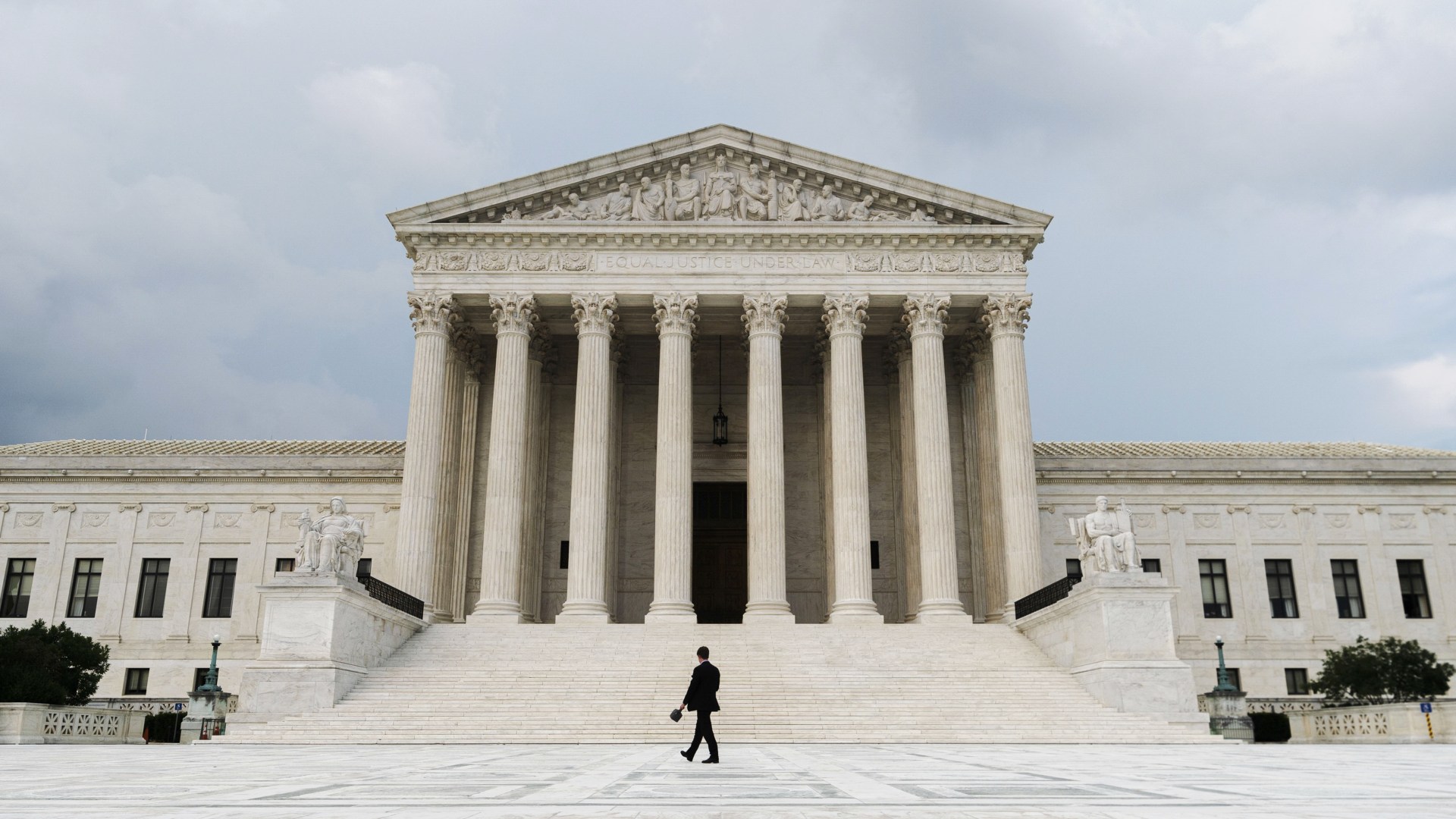
The Supreme Court defended religious liberty on Wednesday, bolstering and broadening the so-called “ministerial exception.” In a 7-2 decision, the court ruled that the Constitution protects the freedom of religious organizations to hire and fire employees who play a vital role in fulfilling their religious mission. The decision, Our Lady of Guadalupe School v. Morrissey-Berru, reaffirms important religious liberty principles and offers valuable guidance to religious organizations concerned about the strength of the protections of the First Amendment.

In an opinion authored by Justice Samuel Alito, the court held that the ministerial exception barred two fifth-grade teachers at Catholic schools in Southern California from bringing employment discrimination claims against their schools. The court reversed the decision of the Ninth Circuit, which held that the teachers fell outside the ministerial exception because they lacked religious training and credentials, and did not hold themselves out as faith leaders.

Rejecting the lower court’s formalistic approach, the Supreme Court stated that religious titles and training were neither necessary nor sufficient for determining whether a particular employee falls within the ministerial exception. “What matters,” Alito wrote, “is what an employee does.”

Wednesday’s ruling built upon the unanimous 2012 decision in which the Supreme Court first recognized the ministerial exception. In that case, which CT called the biggest religion case in 20 years, the court held that the First Amendment barred an ordained teacher from suing her employer, Hosanna-Tabor Evangelical Lutheran School, for alleged disability discrimination.

The 2012 decision relied on evidence that the teacher, Cheryl Perich, had been “called” by the church, completed a six-year theology program at a Lutheran college, held herself out as a minister, and performed a variety of religious functions at the school. Because those facts were enough to resolve the case, the court declined to provide a “rigid formula” for determining whether an employee counts as a minister, and is therefore not protected by employment law that regulates hiring and firing in America.

The teachers in Wednesday’s case, Agnes Morrissey-Berru and Kristen Biel, argued for a narrow application of the “ministerial exception” from the Hosanna-Tabor decision. Instead, the Supreme Court embraced a broad, flexible view of the ministerial exception, holding that courts should “take all relevant circumstances into account” in determining whether a worker carries out the mission of a religious employer. The court explained that the ministerial exception may even apply to employees who do not share their employer’s religious beliefs.

Focusing on the religious education context, the court emphasized the responsibility of teachers at religious schools to impart the faith to their students—something Morrissey-Berru and Biel were clearly charged with doing. That function, the court recognized, is at the “core” of a religious school’s mission. Citing Rod Dreher’s The Benedict Option, Alito specifically acknowledged the proliferation of non-denominational Christian schools aimed at “inculcating Biblical values in the students.”

At a moment when some Christians have despaired over recent Supreme Court decisions, Our Lady of Guadalupe has a lot to offer.

First, the decision explicitly reaffirms longstanding First Amendment protections for religious organizations, tracing the need for these protections back to England’s Acts of Uniformity in the 16th century. The court explained that while religious organizations are not immune from secular laws, the First Amendment protects their autonomy when it comes to “internal management decisions that are essential to the institution’s central mission.”

Second, the decision serves as something of a counterweight to last month’s Bostock case, which held that Title VII prohibits employment discrimination on the basis of sexual orientation and gender identity.

In Bostock, the court acknowledged concerns about the interplay between religious liberty and Title VII’s newfound prohibition on LGBT discrimination. Writing for the majority, Justice Neal Gorsuch said he was “deeply concerned with preserving the promise of the free exercise of religion enshrined in our Constitution,” but he made no effort to explain how this promise might protect religious organizations holding traditional views about sexual orientation and gender identity.

Wednesday’s decision is a step in that direction. It appears to confirm that the First Amendment immunizes religious organizations from lawsuits brought by workers alleging LGBT discrimination, so long as those workers fall within the ministerial exception and play a vital part in carrying out the religious mission of the organization. Moreover, because the ministerial exception arises from the Constitution, rather than a statute, it applies with equal force to state and local laws prohibiting LGBT discrimination.

Third, Our Lady of Guadalupe provides practical guidance about what steps religious organizations should take to maximize the protection afforded by the ministerial exception.

Dozens of Christian organizations, not to mention other religious groups, filed friend-of-the-court briefs urging the Supreme Court to defer to an organization’s good-faith claims that certain employees’ positions are “ministerial.” While two members of the Court— Gorsuch and Clarence Thomas—defended that view in a concurring opinion, the majority stopped short of holding that an organization’s good-faith classification is all that’s necessary for a ministerial exception. Even so, the majority placed considerable weight on the organization’s perspective, noting that “a religious institution’s explanation of the role of [its] employees in the life of the religion in question is important.”

In the case of Our Lady of Guadalupe, the court relied on the schools’ mission statements, faculty handbooks, and codes of conduct. These documents, the court held, provided abundant evidence that religious instruction and spiritual formation “lay at the core of the mission of the schools.” The court also cited the employment contracts signed by the teachers, which explained “in no uncertain terms that they were expected to help the schools carry out this mission and that their work would be evaluated to ensure that they were fulfilling that responsibility.”

The takeaway is clear: religious organizations of all types must define and articulate their core mission, then carefully and thoughtfully link employee responsibilities and duties—the things an employee does—to the mission. Employees' performance evaluations should be clearly connected to the mission and the organization should be able to show how the employees play a vital role in carrying out its religious goals.

The dissenting opinion in Our Lady of Guadalupe offers lessons for religious organizations, too. The dissenting justices warned that religious organizations will “discriminate widely and with impunity for reasons wholly divorced from religious beliefs.” To avoid acting out the worst fears of the dissenting justices and the broader secular society, religious organizations should resist the temptation to weaponize the ministerial exception for their culture war battles. The ministerial exception is not a license to mistreat employees. Religious organizations must act in good faith when identifying employees’ duties and roles and their relationship to the organization’s mission.

Christian organizations committed to love, grace, and integrity should treat the ministerial exception as a tool to be used with care and compassion, and in a manner consistent with their other commitments to employees. The exception should be deployed only where necessary to protect an organization’s ability to carry out its mission. Among other things, that means religious organizations should develop—and follow—comprehensive policies and procedures for resolving disputes outside the courts, either internally or with the help of religious authorities or mechanisms for dispute resolution.

These procedures should be crafted to align with biblical values of humility, mercy, and reconciliation. That way, the ministerial exception will function not as a spotlight exposing culture war hostilities, but as a beacon highlighting the gospel’s ability to transform human relationships and bring peace where no secular court ever could.

John Melcon is a judicial law clerk at the United States Court of Appeals for the Fifth Circuit. Later this year he will join the religious organization's practice group at Sherman & Howard, LLC in Colorado Springs.

News

Military Ministries Prepare for Potential US Troop Withdrawal From Germany

Trump plan creates uncertainty for evangelical churches serving soldiers—and new opportunities.

Christianity Today July 9, 2020
Christian Charisius/picture-alliance/dpa/AP Images

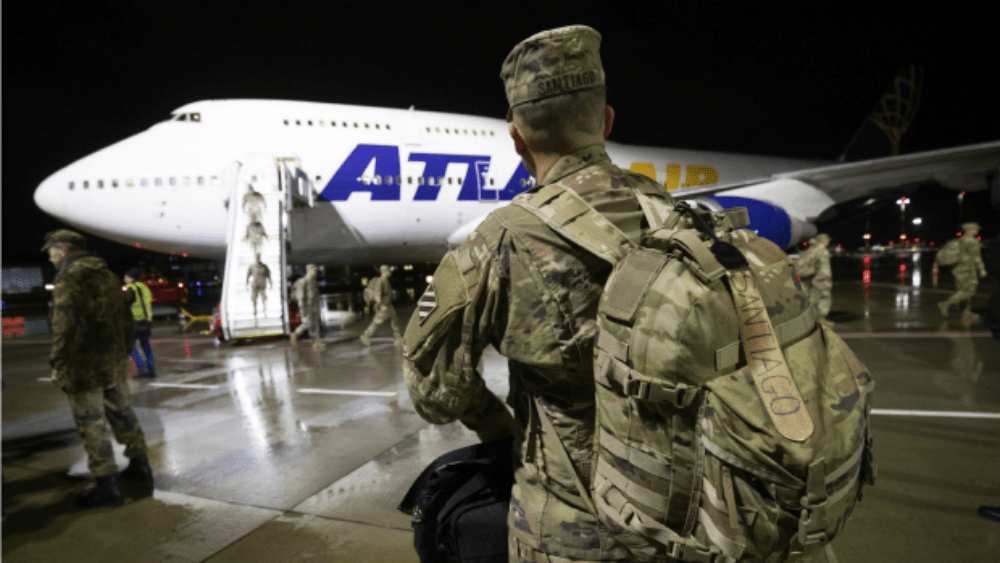
An Assemblies of God church in Heidelberg, Germany lost two-thirds of its worshipping members overnight when a US military base closed. One day in 2015, it was a congregation of 300. The next, 100.

That’s how it goes for ministries serving United States soldiers stationed abroad. “You always have to adapt,” said Kirk Priest, pastor of LIFE Church Heidelberg, a Pentecostal church plant that absorbed the Assemblies of God congregation.

Evangelical churches across Germany are bracing themselves to adapt again as American legislators debate President Donald Trump’s plans to pull about 10,000 troops out of the country. Trump has said Germany, an ally since the Cold War, is not spending enough on national defense and depends too much on American largess and the stability of NATO, the North Atlantic Treaty Organization established for the common defense of Europe in 1949.

The proposed drawdown would reduce the number of US military personnel by about a third. The troops would leave the country, along with military families, civil staff, and some government contractors. That would likely would trigger base closures, as well.

There are, as of yet, no firm details on where the troops might be redeployed, which bases might shuttered, or exactly when this would happen, although the Wall Street Journal reported that Trump has set a September deadline. For now, what is known is that the removal of US soldiers would have an immense impact on Germany—economic, political, and ecclesial.

Faced with this uncertainty, evangelical pastors across the country say they remain “Kingdom minded.” They will work to faithfully minister to their congregations through the transition and keep an eye open for new ministry opportunities as things change.

“We know people are going to come and go,” said Kevin Weaver, CEO and co-founder of The Warrior’s Journey, which supports a network of ministries for military members, veterans, and their families. “Being overseas, you have lots of change. And because of that, people are typically a lot more open to spiritual conversations.”

While some Germans might be happy to see a reduction in American military presence in their country, many of the country’s evangelicals will be sad to see their friends and fellow congregation members go.

There are many evangelical ministries that have grown up around the US military presence in Germany. Since the end of World War II, multiple generations of American military members and their families have made homes in the country and created strong ties with German communities in Bamberg, Baumholder, Darmstadt, Heidelberg, Kaiserlautern, Landstuhl, Wiesbaden, and a dozen other cities.

“The Lord has historically used military ministry to not only touch American lives, but thousands of Germans through church plants and youth ministries,” Priest said. “Wherever there’s a base, a local evangelical ministry has helped provide for a spiritually needy German society.”

Past closures, such as the shutdown of the Heidelberg base and a base in Bamberg in 2014, took a toll on local churches. Lennart Haas, an evangelical in Bamberg, said the church he goes to lost 50 members when the Warner Barracks shut down in the Upper Franconian city.

Stars and Stripes, the military’s independent newspaper, reported that two posts west of Frankfurt am Main might be targets for closure, if Trump’s proposed troop withdrawal becomes a reality. Both are home to multiple churches—Baptist, New Apostolic, and non-denominational—with American members. But some pastors are hesitant to speculate about which bases might close this time, and when and where troops will move.

“I cannot confirm or deny any troop movements in Germany,” said Matt Leighty, who served in the Air Force and is one of the lead pastors at Stuttgart Missional Community Church. His church reaches out to the more than 20,000 US military personnel, civilians, and family members in the area, so a withdrawal could have a serious impact on his community.

Others are less concerned. At Rhema Café, an Assemblies of God mission in Landstuhl near Kaiserslautern, pastor Timothy Carentz Sr. feels the troop movements won’t really change anything.

“Even if we lost 50,000 troops, I’m not sure we’d even notice,” he said. “Our area will not really be affected. We’re building up here—there’s a strong NATO community in Kaiserslautern.”

If and when change does come, it’s not necessarily a bad thing for evangelical ministries. Weaver said that when The Warrior’s Journey starts to field phone calls from its network of German ministries in the coming months, it will work to help pastors and churches “embrace the change.” He knows those challenges from his own time as pastor of a church in Panama when the US military pulled out of that country completely in 1999. His experience taught him that movements, drawdowns, or closures in military ministry are “good problems” that create new opportunities for ministry.

Priest, who is the Central Europe area director for the Assemblies of God World Mission, is taking a similar approach. He has one eye on the possible expansion of military presence in Poland, based on some things that Trump has said. Currently, US soldiers in Poland are on “unaccompanied orders,” which means their families are not with them.

“Soldiers can be quite lonely and isolated. It’s a great opportunity for ministry,” Priest said. “I am actively praying for a missionary to go there.”

Whether troop movements open new fields for ministry or new hearts to hear the Gospel, the evangelical ministers think their mission stays the same.

“If the troop movements happen, we’re going to keep a ‘Kingdom mindset’ and find the next place to minister,” Priest said. “That might be Poland, that might be somewhere else. Wherever, we’ll find a way to deploy.”

News

665K Ministry Jobs Covered by Paycheck Protection Program Funds

At least 11,500 Christian employers accepted $150,000 or more in government stimulus loans.

Christianity Today July 8, 2020
Eduardo Munoz Alvarez / Getty Images

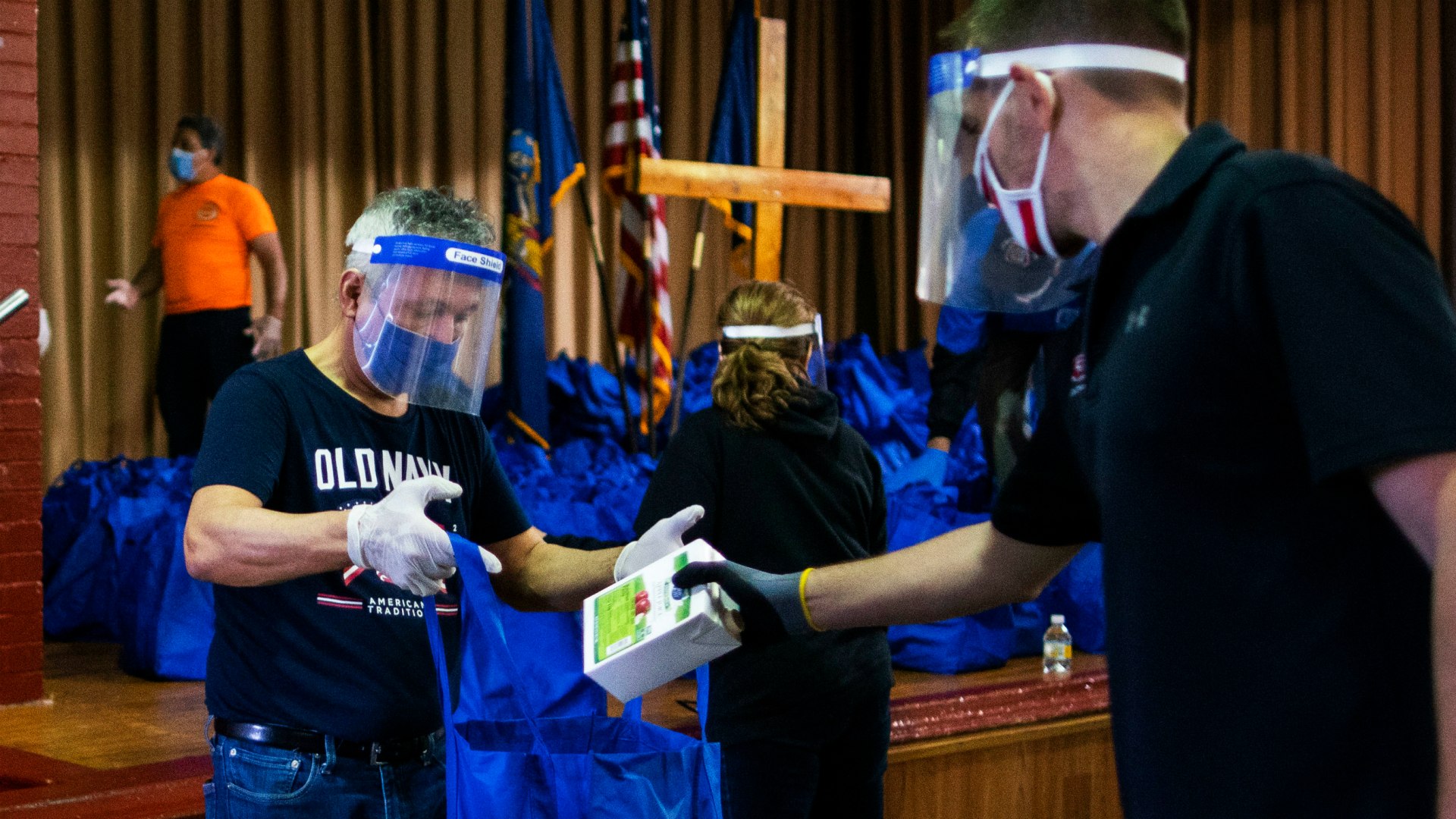
Well over a half million pastors, church staff members, and ministry employees kept their jobs and continued serving their communities during the pandemic thanks to Paycheck Protection Program (PPP) loans, according to a list released last week.

As part of the Coronavirus Aid, Relief, and Economic Security (CARES) Act passed in March, the government offered grants to cover payroll costs for employers, including religious organizations, as a way to keep the economy going and reduce layoffs.

It was the first time the US government had offered to cover the salaries of clergy and ministry workers as part of a stimulus. Some critics—including within the church—discouraged Christian organizations from accepting government funds due to concerns over church-state separation, while others saw it as a way churches and charities to continue to meet community needs during the pandemic.

A list released Wednesday by the Small Business Administration (SBA) showed that at least 11,500 Christian organizations took advantage of the opportunity and received loans of $150,000 or more.

The list was culled based on a keyword search of terminology including church, Christian, Catholic, and diocese, so the totals do not include ministries without Christian wording in their names or those that received smaller loans. More than 80 percent of the 5 million US employers that were granted PPP loans took in less than $150,000, according to the Associated Press, and weren’t included in the recent data.

Through the program, companies and organizations with fewer than 500 employees could request up to two and a half months of payroll costs (excluding salaries above $100,000) to offset the economic hit of the coronavirus shutdowns. Most churches and ministries on the list fell in the $150,000 to $300,000 range. Using the federal funds, the average church retained about 60 jobs.

A few megachurches and denominations ranked among the largest stimulus loan amounts, taking loans of over $5 million. They include Willow Creek Church in Chicago, which preserved 353 jobs, and Life.Church in Edmond, Oklahoma, which kept 451 jobs.

The stimulus loans do not need to be repaid if used for eligible payroll and operations expenses.

On the SBA list of recipients of $150,000 or more, 7,009 had the word “church” in their name.

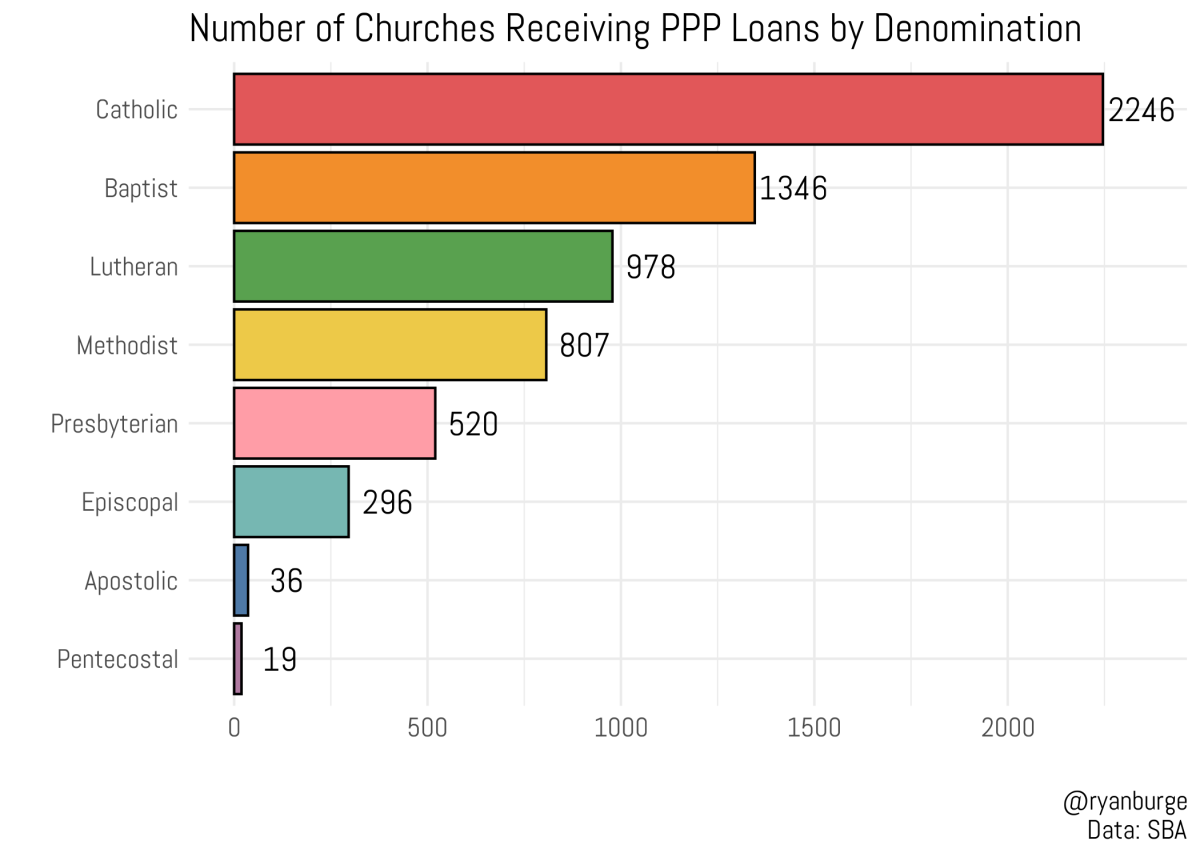
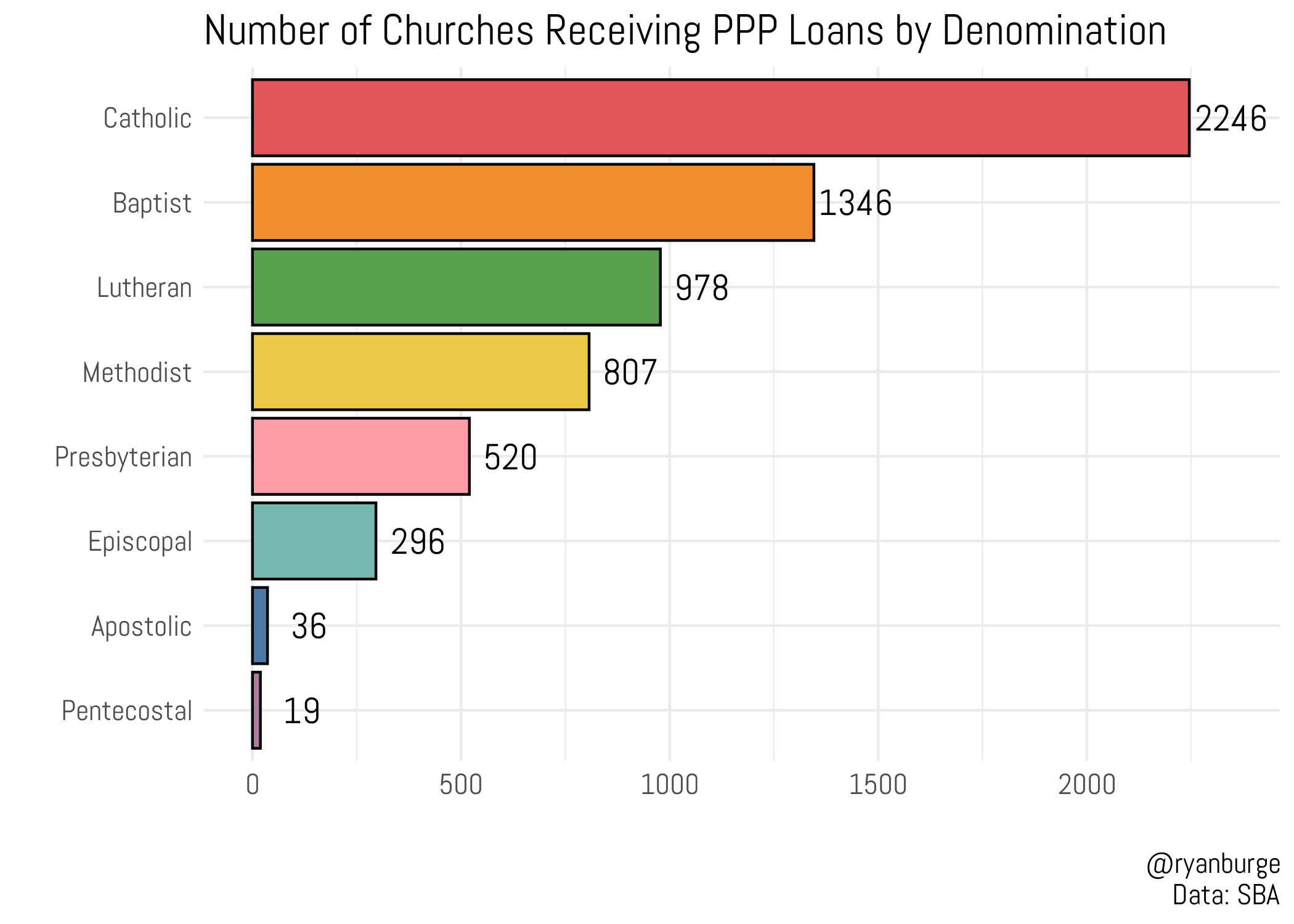
Of the churches whose names included denominational markers, Catholic and Baptist congregations were the most common beneficiaries. More than 2,000 Catholic churches received PPP loans, as did more than 1,000 Baptist churches. The rankings reflect Christian affiliation in the US—around 20 percent of the country is Catholic, while around 15 percent belongs to Baptist denominations (across evangelical, mainline, and historically black Protestant traditions), according to the Pew Research Center.

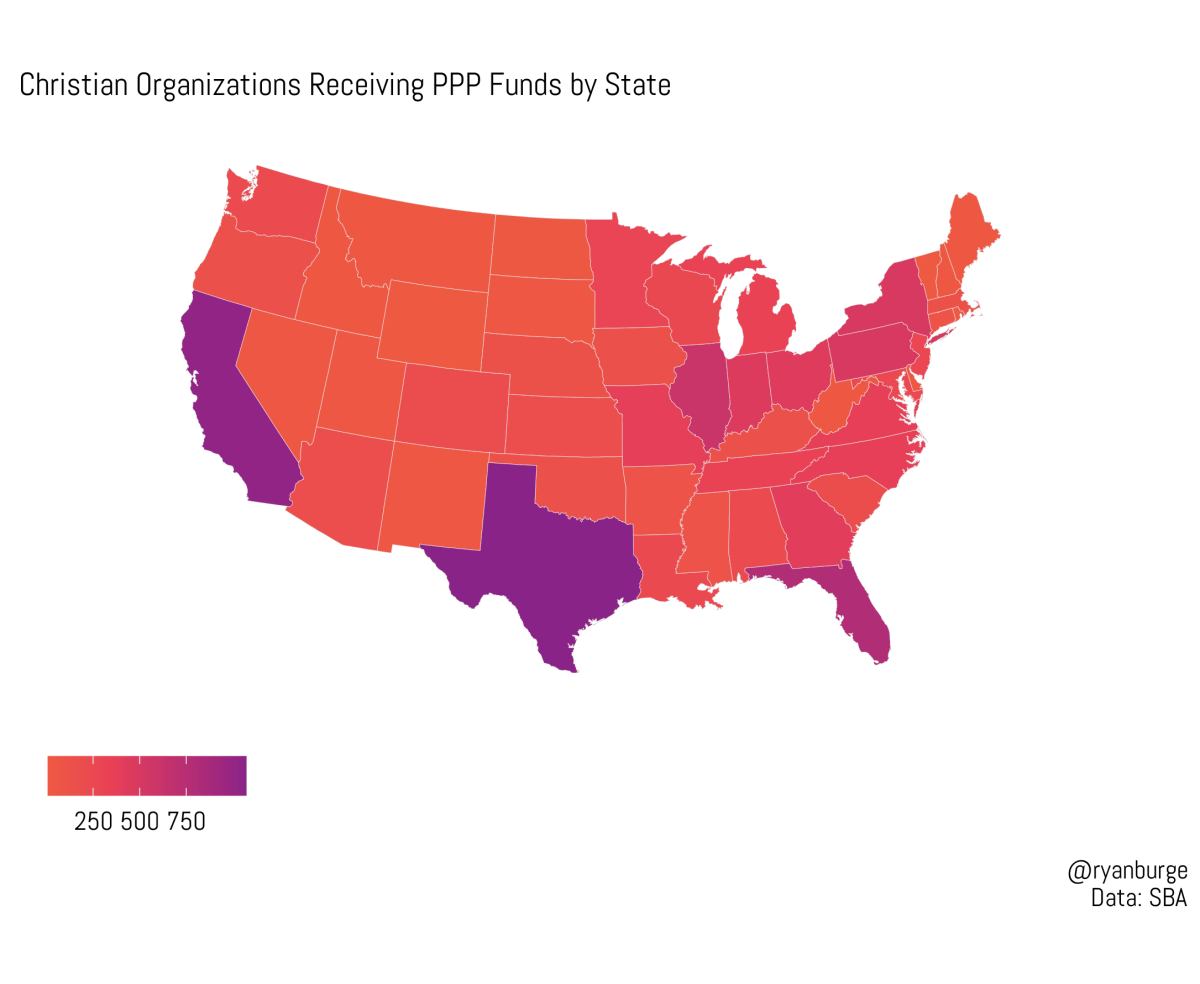
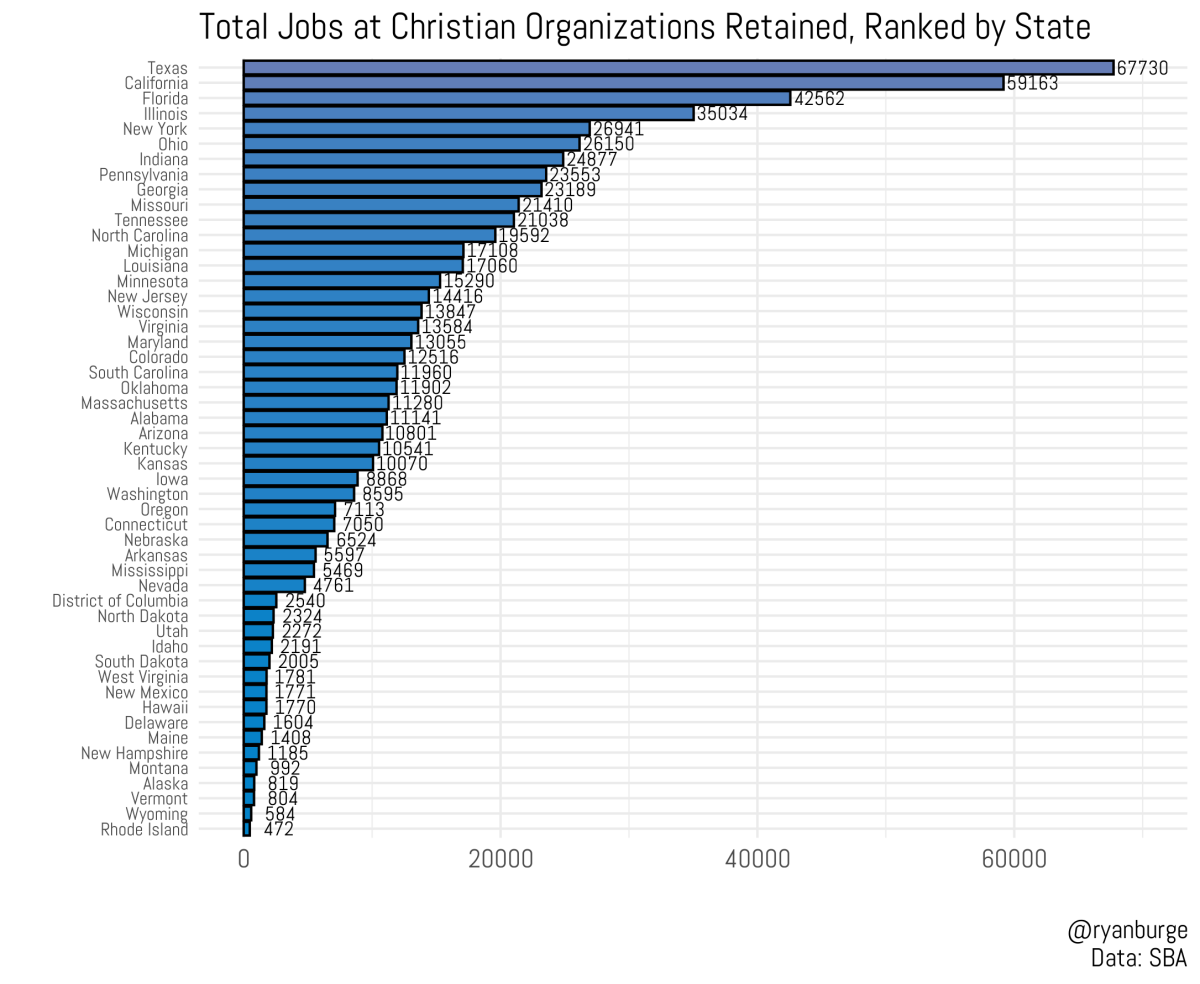
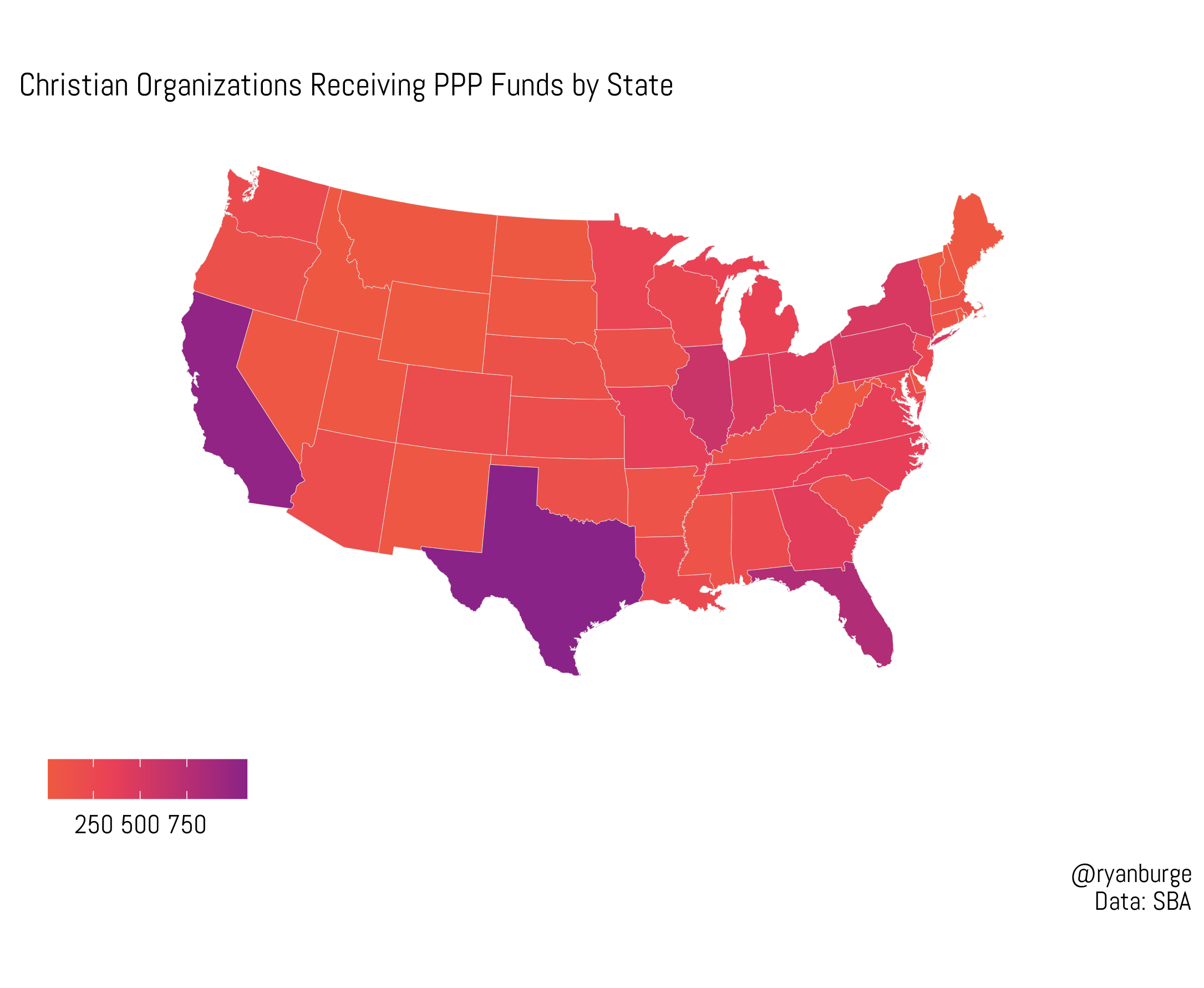
The most populous states saw the most religious organizations taking funds and the most jobs saved.

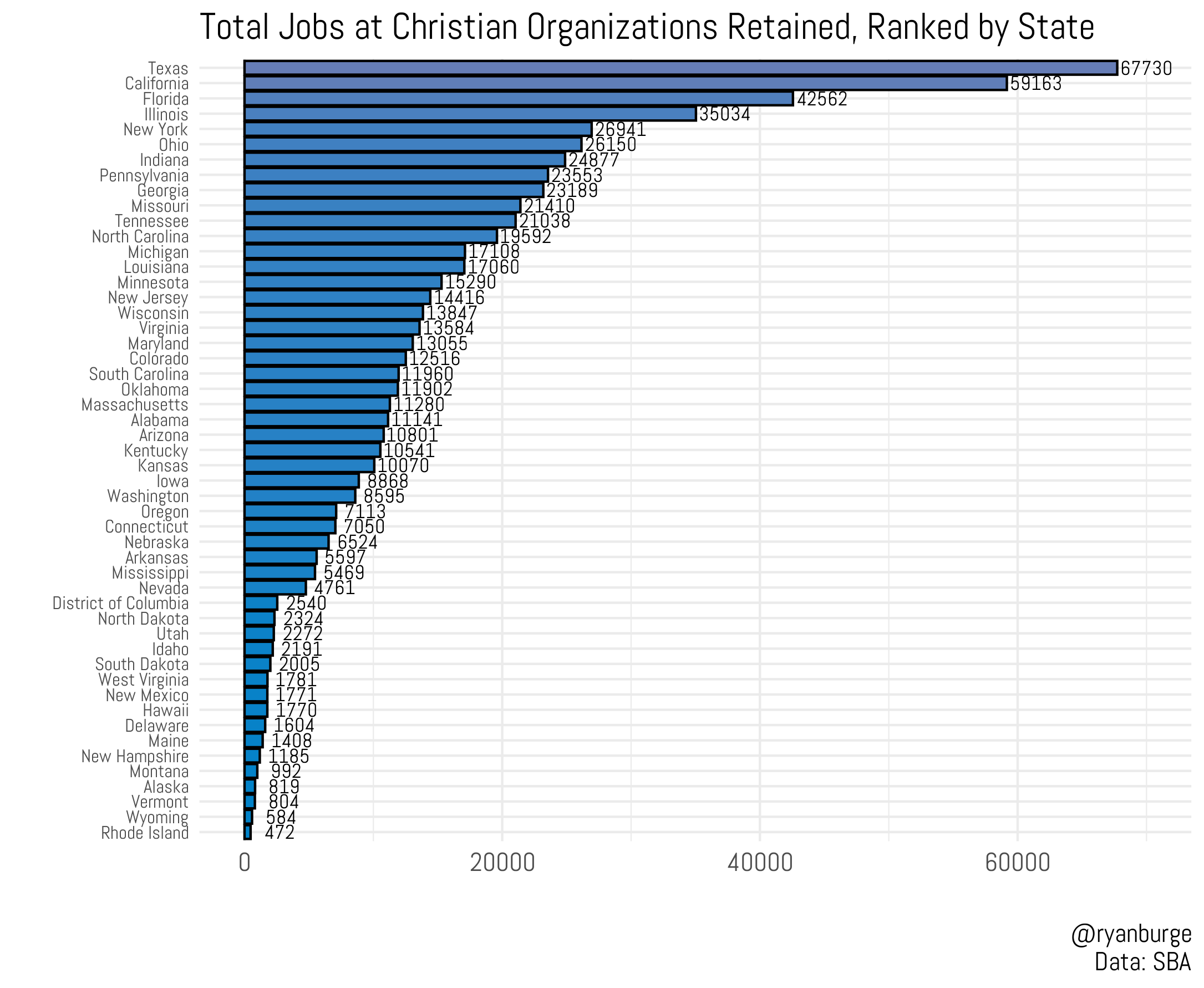
Texas had 1,072 Christian organizations that received PPP funds, and California was close behind at 1,025. Those recipients indicated the funds were used to retain nearly 70,000 jobs in Texas and nearly 60,000 in California.

Among the biggest Christian employers taking advantage of the stimulus opportunities in those states were Catholic Charities of San Francisco, which retained 500 jobs through the program, and First Baptist Church of Dallas, which recorded 293 jobs being saved through a loan of between $2 million and $5 million from the PPP.

Other large states followed, with Florida at 869 Christian organizations and Illinois at 643.

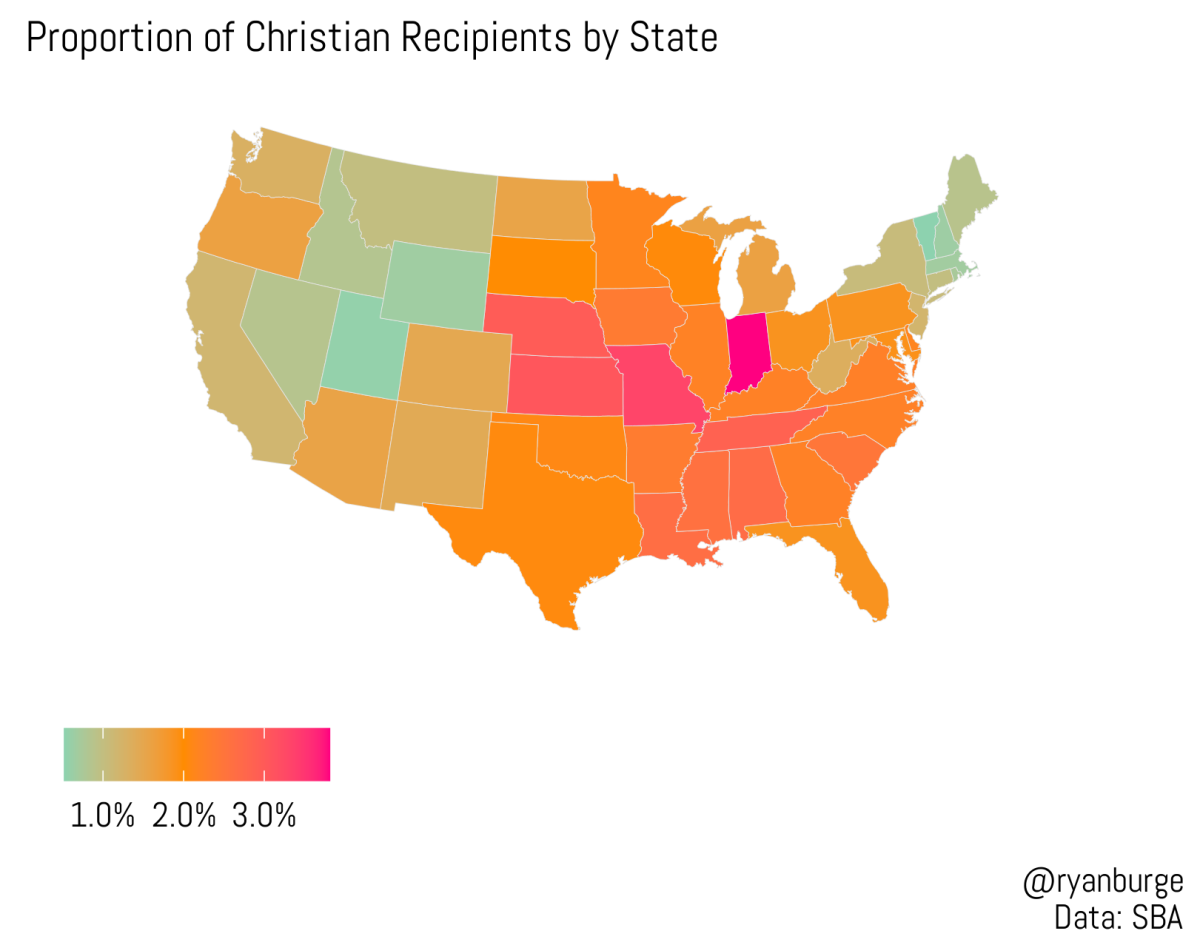
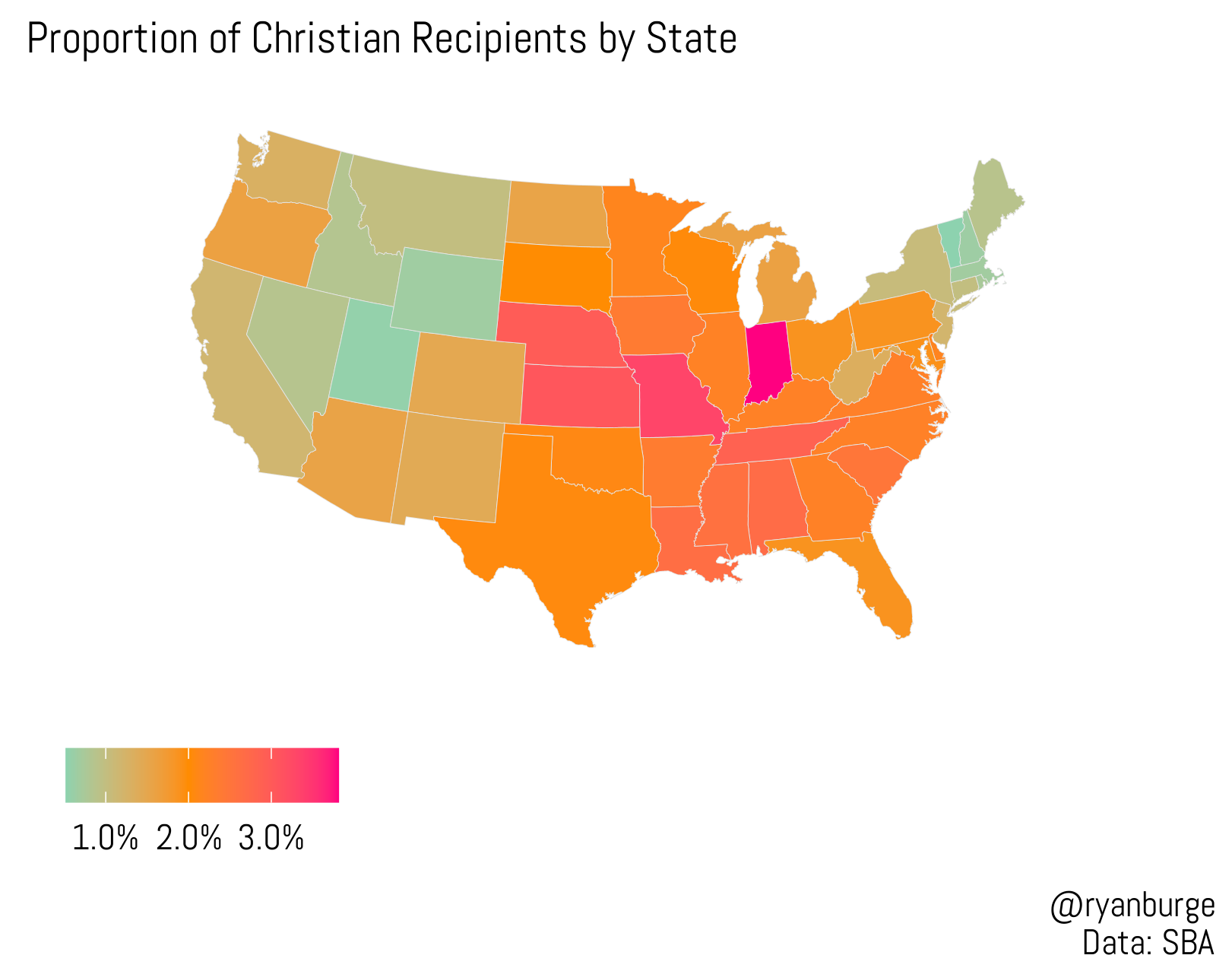
While the larger states had more ministries and churches receiving PPP dollars, the concentration of religious recipients was greatest in the Midwest.

Christian organizations in Missouri, Kansas, and Nebraska made up at least 3 percent of all PPP beneficiaries in the state, higher than the national average. Indiana had the highest concentration of religious recipients, with 4 percent. The state’s biggest PPP loan to a religious organization went to First Baptist Church of Hammond, Indiana, which was able to retain 322 employees with a loan of between $350,000 and $1 million.

In a majority of states, PPP funds preserved over 10,000 church and ministry jobs. Of the 665,000 Christian positions covered by the loans, nearly 20 percent were in Texas and California alone.

Although both states had between 1,000 and 1,100 Christian employers receive PPP funds over $150,000, Texas recipients represented an additional 8,500 jobs—perhaps a sign of the greater concentration of megachurches with large staffs located in the state.

Across industries, the PPP retained 31.4 million workers in organizations that received more than $150,000 in funds; those in Christian organizations represented 2.1 percent of all workers in this group. (Editor’s note: Christianity Today is a recipient of PPP funds.)

For many churches not meeting in person this April, May, and June (and not passing the offering plate), the PPP provided the monies necessary to pay staff and clergy, potentially heading off tens of thousands of people applying for unemployment benefits.

Yet there are some signs that churches and ministries’ initial financial concerns may have been overblown. A survey by the Evangelical Council for Financial Accountability found that by April, more than half of churches and Christian nonprofits reported that giving was back to pre-pandemic levels.

Christian camps and conferences as well as Christian schools remain most pessimistic about their financial future. Some Christian colleges have cited COVID-19 as a factor in recent faculty cuts.

Ryan P. Burge is an assistant professor of political science at Eastern Illinois University. His research appears on the site Religion in Public , and he tweets at @ryanburge .

Ideas

Families Keep Going, In Pandemic and Health

Our households are bearing the brunt of COVID-19 shutdowns. It’s time for new levels of creativity, flexibility, and support.

Christianity Today July 8, 2020
Illustration by Rick Szuecs / Source images: Kate_sept2004 / Getty / Envato

The spring semester ended with my elementary school children waving to a computer, offering their goodbyes and “I miss yous” to faces on a screen. The present-tense-ness of the farewell struck me particularly hard: It wasn’t “I will miss you.” Children have been missing their teachers and classmates for months.

Over the past couple weeks, state and local education departments began releasing plans for fall schooling. These disclosures are as much information as indicators of what is unknown. Some states intend schools to reopen full time while asking students to wear masks and practice social distancing. Others combine rotating periods of in-person learning with days of distance education while offering optional full-time distance learning.

Even for schools and childcare centers that fully reopen, the spread of the virus in the meantime may change those plans. The American Enterprise Institute expects COVID-19 to disrupt school life throughout 2020, with the possibility of rolling closures triggered by new waves of infections or local outbreaks. The same stop-and-start reality will also be true for childcare providers and those who provide care for disabled or elderly people in communal settings. With so many unknowns, families find themselves in a holding pattern, missing teachers, classmates, and friends for an indefinite period of time.

It’s easy to resent the ways COVID-19 precautions have affected the places we love and rely on and dismiss them as the product of insensitive bureaucrats or biased media. But demanding that schools and childcare reopen as usual, virus be damned, displaces risk onto other people and families, including the many teachers who worry about the health implications of in-classroom learning.

We also may be tempted to resign to a state of frazzled helplessness. The flood of content about the burden of being a parent in the COVID-era conveys a narrative of being constantly overwhelmed. We hear about parents who have given up on distance-schooling, lost track of screen time limits, or reverted to mainly eating carbs for dinner. To be sure, caregiver burnout is real, and these narratives can rightly give families permission to experience exhaustion and grieve the loss of normalcy. But, placed on repeat, they can function like a pandemic version of the “wine mom” meme, training our focus on immediate discomforts while, ultimately, enervating the family and enshrining habits that are unhealthy and unsustainable.

In reality, God designed and entrusted families with the care of their members, in sickness and in health. Families honor the sacredness of life in all of its vulnerability and precarity (Ps. 68:6). Yes, there is brokenness in family life. But God also equips many families with resilience, adaptability, and love for just such a time as this.

The COVID-19 pandemic places heavy responsibilities on all of us. Families have a unique and crucial role. The place where we begin and are first formed, families are also a residual home base when other institutions close and a guardian of the sanctity of life. Families watch out for elders and those with special needs; ask difficult questions of nursing homes or care facilities; and gather and remember when it is time grieve.

Rather than deny or resent the responsibilities God has for families during COVID-19, we have the chance to identify practical ways to support families in rising to these tasks. If families are frazzled, it is often because they are too isolated and without enough support.

The first support for families is straightforward encouragement, particularly from the church. All the exhaustion, anxiety, and uncertainty that pastors feel right now—families experience those, too. A weekly note from a pastor to parents and caregivers in the congregation may go a long way in making God’s love and presence known through the layers of isolation imposed by COVID-19. Offering online storytime for children provides caregivers with an assist and reminds children that they are part of a loving church community.

The second way to support families is by paying attention to the balance of responsibility within the family. A recent survey suggested that men are taking on additional homeschooling responsibilities while children are at home, though women’s perspectives and emerging research suggest otherwise. Whether or not the crisis has yet brought about a realignment of household work, taking intentional steps to share or rotate caregiving shifts will help make pandemic life sustainable for families. There may be unexpected gains in new household habits as well. Fathers, for example, may have a chance at closeness with children that pre-pandemic patterns of work and home implicitly discouraged.

A third step is to make use of, and expand, the systems that sustain families through this crisis. In March, with COVID-19 closures first upon us, Congress amended our mutual aid system to adapt to the crisis. The Families First Coronavirus Response Act created an emergency paid family leave benefit that covers two-thirds of a worker’s pay while caring for a child whose school or daycare has closed. This emergency leave can cover up to 12 weeks total until the end of 2020. It is available to those who are self-employed and is mandated for many employers. Refundable tax credits absorb the cost to employers.

Polling suggests that many Americans are unfamiliar with the benefit, which came online amid a surge of new coronavirus-related legislation this spring. Many employers are unaware of the program as well. But it could further serve as a vital resource for families this fall, together with any paid leave an employer provides independently. As a first step, workers can check their eligibility for the federal benefit through a Department of Labor online tool and contact their human resource departments, bringing with them information about employer requirements under the newly created emergency paid leave program.

The majority of children in the United States live in households without a stay-at-home parent. For parents whose work cannot be done on a laptop—often those in blue-collar jobs or retail or human services—paid leave enables time at home to tend to little ones, to monitor the online classroom, or to offer at-home lessons. Notably, fathers and mothers eligible for the new emergency leave program can take that leave in increments so as to align their leave days with hybrid learning schedules anticipated in some school districts. Legislative and administrative changes should be made to replenish paid leave for those who already exhausted it when schools closed in the spring and to adapt it to a wider range of family situations and workers.

Finally, this is a time for workplaces to exercise flexibility and creativity. For example, Stroopies, a small, Pennsylvania-based cookie business, had to shut down due to statewide orders. Its Christian owner paid the employees for the first week—all of them are mothers who came to the US as refugees—and helped them navigate the process to obtain unemployment and emergency leave benefits. Now that Stroopies has reopened, the owner is welcoming staff back to work and holding jobs for those who need to be home with children over the summer.

Organizations have an opportunity to choose flexibility and resourcefulness for the sake of families. Likewise, congregations have opportunities to come alongside families in new ways—offering, for example, support or space for small-scale childcare or tutoring programs when schools are closed.

When my children said their goodbyes and turned off their computers that mid-June day, I felt bleak and exhausted, like a marathon runner who had just been challenged to a 10K. After summer camp at home concludes in August, the starting gun of another marathon will sound as a hybrid at-home/at-school semester begins. But once I let go of the frustration and desire to throw up my hands, a sense of peace crept in. As public theologian Ekemini Uwan explained, there is deep value in a radical acceptance of reality as it is.

Indeed, we can never honestly survey reality without God at our side or in our vision. Honest, prayerful reckoning with reality is an antidote to the temptations to give in to denial and burnout. Disease and financial hardship can be terrible to endure, but God has gifted and entrusted us with the capacity for resilience in and through the family, church, and even government.

It is not an injustice to ask families to be families right now, to offer a reservoir of care and a home base that no other institution can. It would be an injustice to fail to provide what families need to exercise their responsibilities.

Rachel Anderson is a resident fellow with the Families Valued initiative at the Center for Public Justice.

Speaking Out is Christianity Today’s guest opinion column and (unlike an editorial) does not necessarily represent the opinion of the publication.

Books
Review

Where Two or More Are Gathered, the First Amendment Should Protect Them

Why voluntary organizations deserve the same rights to speech, religion, and assembly as individuals.

Christianity Today July 8, 2020
Illustration by Mallory Rentsch / Source Images: SolStock / Getty Images

The Christian tradition has a lot to say about community. People weren’t made to be solitary individualists. Aristotle may have been the first to describe man as a “social animal,” but he was not the first to recognize our inherent sociability.

Why Associations Matter: The Case for First Amendment Pluralism

Why Associations Matter: The Case for First Amendment Pluralism

University Press of Kansas

248 pages

$49.99

The Scriptures describe God creating human beings to have fellowship with him. As God himself has eternal fellowship within the triune Godhead, human beings are also designed to have fellowship with each other. As God proclaimed in the Garden of Eden, “It is not good for the man to be alone” (Gen. 2:18). Over the course of biblical history, God ordains a series of social institutions: marriage, family, state, church. Of course there is an important place for the individual in Christian anthropology. But the point is that the individual exists—is created to exist—within a rich set of social interactions, institutions, and associations.

Mainstream contemporary political and legal theory, by contrast, tends to operate within a more constrained social landscape. The focus is on the relationship between the individual and the state. By comparison, non-state social groups get short shrift.

Several scholars have been working to change that, including Luke C. Sheahan, a political theorist at Duquesne University. Sheahan’s new book, Why Associations Matter: The Case for First Amendment Pluralism, makes the case for the importance of voluntary associations in our political landscape. Rather than the dichotomy of individual and state, Sheahan offers an account of society with three components: individual, state, and association. He argues that the American judiciary in particular has failed to recognize the importance of associations. Finally, he suggests ways to do better in the future. That’s where the First Amendment comes in, with its promises of protection for freedom of speech, religion, and assembly.

Associational Rights

The book’s first task is to develop what Sheahan calls a “political sociology” of associations. Sheahan, echoing the sociologist Robert Nisbet, argues that human beings are social creatures who crave community and connection with others. This is a point that will intuitively appeal to many readers, but Sheahan doesn’t elaborate on the foundations for the insight. One might wonder (as John Dewey did years before) whether this is grounded in psychology, biological instinct, or something else. To these, one could add Christian anthropology. In any case, Sheahan never invokes religious reasons, and it is enough for him that one accepts that humans are social.

Sheahan believes that associating with others has intrinsic value. “It is in various social groups,” he writes, “that one’s very personality is shaped and within which one finds identity and purpose.” What is an association? It’s not just a casual meeting of people. But neither does it have to be a formal organization with a constitution and bylaws.

Sheahan defines associations functionally (again drawing on sociological work by Nisbet), listing seven characteristics. Each association has (1) a function, (2) a sense of purpose (which will often coincide with the function), (3) an authority structure, (4) some amount of hierarchy, (5) solidarity among members, (6) a sense of the association’s importance, and (7) a belief that the association has a special status relative to the rest of the world. This is a rich description of an association, whether or not one agrees with every point. This kind of association is one with a strong conception of its own identity and purpose.

So how does all of this apply to our legal system and political culture? Sheahan’s critique of existing law focuses on the Supreme Court’s treatment of associations under the First Amendment. The First Amendment freedom of association protects freedom of speech and assembly (as well as religious freedom and press freedom). But the Supreme Court has done very little to recognize assembly as a right on its own. Instead, it has largely replaced references to freedom of assembly with references to freedom of association.

This might sound like a distinction without a difference—until one considers what association means to the contemporary Supreme Court. Association is not valued for its own sake but only as a means to further free speech. Building on the pioneering work of evangelical legal scholar John Inazu’s critiquing the reduction of association to speech, Sheahan explains that the Supreme Court has made speech as an individual right the predicate for the recognition of any associational rights. Sheahan calls this the First Amendment dichotomy: For the Supreme Court, First Amendment rights are either individual rights, or else there are no limits on how the government can restrict them.

Problems with this line of reasoning were evident in the Supreme Court’s 2010 decision in Christian Legal Society v. Martinez. In that case, the University of California Hastings College of the Law required student organizations to be open to any student. It refused to recognize a student chapter of the Christian Legal Society because the group required its officers to hold Christian doctrinal and ethical commitments, including the belief that sex should be reserved for marriage between a man and a woman. The Supreme Court ruled in favor of the university. It could require a student group to admit anyone to membership regardless of the group’s own convictions (or else give up its status as a recognized student organization on campus).

Sheahan thinks the court was seriously mistaken in its approach. His point is not just that the court’s majority was wrong. Sheahan’s argument goes deeper, criticizing even the dissenting justices who would have ruled in favor of the student group. The problem, Sheahan says, is that neither the majority nor the dissent gave an account of why associations are valuable apart from their instrumental utility in advancing speech by individuals within the association.

In place of the existing precedents, Sheahan argues that the courts should recognize associations, not just individuals, as bearers of First Amendment rights. He calls this “First Amendment pluralism.” These rights shouldn’t depend on the association being “expressive” (that is, primarily concerned with speech). This associational right could be rooted in the Constitution (perhaps in the First Amendment’s guarantee of the right to assemble) or in a specific statute. Sheahan suggests legislation (modeled on the Religious Freedom Restoration Act) that would compel judges to apply “strict scrutiny” to any government action that infringes on the freedom of association, broadly defined.

How Much Is Too Much?

An obvious objection to this kind of protection for associations is that it could undercut civil-rights protections. Sheahan has two main responses, both familiar to those following the conversation on associational rights.

First, Sheahan says that his argument only concerns protection for voluntary associations, not for commercial or educational organizations (a racially discriminatory private school could still lose its tax exemption, for example). Second, he suggests that race discrimination might be a unique (and uniquely unjust) form of discrimination, such that a state university (for instance) could rightfully refuse recognition to a voluntary student organization that practices it. Sheahan recognizes that this raises as many questions as it answers. What characteristics make race discrimination different? (Is it the troubled history of race relations in America? The centrality of race to a person’s identity?) Are there other kinds of discrimination (sex or, more controversially, sexual orientation) that are covered by the same principles? Does it undercut a principled commitment to associational pluralism to recognize areas where the state has a compelling interest in prohibiting discrimination? These are tough issues. To his credit, Sheahan doesn’t shy away from this. But given that he’s not the first to confront the issue, hopefully we will see more work on the subject in the future.

Another question that Sheahan doesn’t analyze at all is how a defense of associational rights relates to corporate rights. Corporations are voluntary associations of a sort. The Supreme Court has controversially said that corporations can exercise constitutional rights. How does this fit with Sheahan’s vision of associational rights? And what makes commercial organizations different from noncommercial voluntary associations?

Sheahan doesn’t have all the answers. But his book advances an important conversation about how to appreciate the social dimension of life—including associations—in the face of an individualistic intellectual culture. Sheahan’s synthesis of work by Nisbet and others on the structure of associations is likely to become a point of reference for anyone serious about understanding the structure of human sociability. And his analysis of the Supreme Court’s approach to association deepens existing critiques.

Even though this book isn’t specifically about religious organizations, this conversation is one that Christian readers in particular have reason to care about. Churches have an interest in seeing continued legal protection as institutions; religious organizations like the Christian Legal Society are directly affected when courts recognize (or fail to recognize) associational rights. Christian teaching is already clear that human nature craves fellowship and sociability. Figuring out how to wisely live that out is a task for everyone.

Lael Weinberger is the Berger-Howe Legal History Fellow at Harvard Law School.

News

John Ortberg’s Church Says ‘No Evidence of Misconduct’ As More Details Emerge

Megachurch pastor’s son named as the volunteer who confessed sexual attraction to children.

Christianity Today July 7, 2020
Courtesy of Menlo Church

In this series

A California megachurch is defending the investigation and restoration of senior pastor John Ortberg as more information emerges about his concealment of a church volunteer’s confession of unwanted sexual attraction to children.

The pastor’s son Daniel Lavery, frustrated by what he has characterized as a lack of concern for the seriousness of sexual abuse, publicly named the volunteer on Twitter in late June: his brother and Ortberg’s youngest child, 30-year-old John Ortberg III.

Menlo Church elders first learned of the concealment when Lavery wrote them in November 2019. In the letter, Lavery said he believed there was “a credible basis for a serious and thorough investigation of every aspect of my brother’s work with children.” He said his father was choosing to take the younger Ortberg at his word that he had never acted on his sexual attractions, despite a clear pattern of seeking out opportunities to be alone with children.

“In the most charitable reading possible, my parents have acted with unconscionable disregard for their responsibilities as leaders, ministers, and parents,” Lavery wrote.

The church placed John Ortberg on leave in November after receiving the letter but did not inform the congregation of that for more than a month, according to Religion News Service (RNS). An investigation found that Ortberg failed to inform elders of the volunteer’s disclosure or do anything to prevent the volunteer from being alone with minors. The church elders concluded the pastor exhibited “poor judgement” and “did not handle this matter consistent with his responsibilities to Menlo Church.”

Ortberg then went through a restoration process in February 2020. It lasted “several weeks,” according to a sermon Ortberg preached when he returned to the Menlo Church pulpit on March 7.

The church defended the investigation and the restoration in a letter sent to congregation members last week, after the name of the volunteer was made public. “We realize … that this new development could raise questions and concerns,” wrote executive pastor Eugene Lee. He also assured them that “independent, third-party investigation found no evidence of misconduct” and that there is “no reason to believe there was any wrongdoing” by the volunteer.

The church reiterated the statement in another letter after RNS reported on the new information and ongoing family dispute.

“A name for the volunteer has been alleged publicly, but no new information has been presented,” the second Menlo Church letter said. “As we reported earlier, but wish to reiterate here, the investigation did not find any indication of misconduct by the volunteer in question in the Menlo Church community or otherwise, and similarly did not learn of any allegations that the volunteer had engaged in any misconduct of any sort.”

Lavery and other critics say the investigation was inadequate. The church hired an employment lawyer named Fred W. Alvarez to conduct the inquiry. There is no record that Alvarez, a partner at Coblentz Patch Duffy & Bass LLP, has any experience investigating sexual abuse, though a church spokesman described him to RNS as a respected investigator. His company bio says he has a practice defending employers from litigation and “currently focuses substantial attention on providing strategic and compliance advice.”

Alvarez’s investigation lasted about six weeks, according to the church. He reviewed volunteer records and interviewed children’s ministry staff, but did not ask specifically about the younger Ortberg or tell them there were concerns about his behavior. Alvarez did not interview people who volunteered alongside Ortberg, the parents of children he was alone with, or anyone in the groups Ortberg volunteered with outside the church. The investigator also didn’t speak with Ortberg himself. A church spokesman told RNS that was “deemed unnecessary.”

According to the church’s most recent letter, “The Board gave the investigator and his team full discretion to investigate the matter thoroughly.”

Alvarez and the church kept John Ortberg III’s name private during the process. The church cites the “confidentiality requirements of an ongoing investigation.” It is common practice in criminal investigations of alleged sexual abuse to name the suspect and encourage anyone with information to come forward.

“I don’t know how you can investigate 16 years of volunteer work in about five weeks over the Christmas holidays,” Lavery told RNS. Lavery says his concerns have not been taken seriously by the church and others because he is transgender.

Pastor Ortberg said in a public statement that he thought the situation was “extensively investigated.” He has some previous experience with the investigation of church scandals. Ortberg called for additional inquiry into Willow Creek Community Church founder Bill Hybels after an initial investigation cleared him of allegations of sexual misconduct. Ortberg had been a close friend of Hybels and served as a teaching pastor at Willow Creek before leaving for Menlo Church in 2004. Ortberg said the church leaders’ reticence to hold their pastor accountable and the seriousness of the charges merited a more serious, more independent investigation.

The investigation at Menlo Church concluded with a letter to the congregation in January 2020. Church leadership reported that “John failed to take the required steps to prevent the person from volunteering with minors at the Menlo Park campus and did not consult anyone else at Menlo Church about the situation.” The church-wide email also announced a “restoration plan,” without elaborating specific details.

When he returned to the pulpit in March, Ortberg said the process involved more than 80 meetings with elders, staff, and church members, asking them how his actions had impacted them. He described the meetings as “very chastening and very humbling.”

“I made several mistakes that I so regret,” Ortberg told the church, “and I have been walking through pain around that which has involved job pain and relationship pain and spiritual pain and family pain and media pain that has just been more intense and raw than stuff I have known.”

At about the same time, Ortberg repeated that he never believed any children were at risk. Lavery strongly objects to that assessment. He says he was prompted to go to the church elders when he asked Ortberg if his brother still went on unsupervised, overnight trips with young children and the pastor said, “I don’t know” and “I’m not sure.” Without a more thorough investigation, Lavery told RNS, no one can be sure.

Neither church leaders nor the Ortbergs responded to CT requests for comment beyond their public statements.

Menlo Church, however, is reiterating that “the safety and well-being” of children in the church has “always been of utmost importance.” Regular volunteers are required to undergo extended background checks and staff receive mandated training.

Adopted Children Have Already Been ‘Re-Homed’

A therapist and adoptee asks: Are we seeking to serve or be served by our children?

Christianity Today July 7, 2020
Illustration by Mallory Rentsch / Source Images: ChatchaiWA / Jessica Peterson / Getty Images / WikiMedia Commons

A common term for adoption placements is “forever family,” indicating the child has now been legally and symbolically grafted into a new home. After being relinquished (voluntarily or not) from their birth family, some children stay with the first placement that follows. To their biological connections and culture, they might say, “goodbye forever, family.”

On the more extreme end: Some children in the Kansas foster care system navigated over 100 placements, according to a recent lawsuit. It’s not uncommon for some children to say, “Goodbye, forever family” to multiple caregivers throughout their lifespan. Such was the case in a recent controversy regarding a transracially adopted child from China. Social media influencer Myka Stauffer posted an apology about “rehoming” Huxley to another family after recognizing he needed more care than her family could provide:

“I apologize for being so naive when I started the adoption process, I was not selective or fully equipped or prepared. I received one day of watching at home online video training and gained my Hague adoption certification, which was required by my accredited adoption agency,” Stauffer wrote on Instagram.

How do you measure the intent of someone’s message along with its impact? Sometimes, they’re different. Other times, the purpose was accomplished. I think adoption, as an institution and as an experience, can be like that.

I remember standing on the playground as a fourth grader. A boy walked up to me and taunted, “Chinese, Japanese, dirty knees, look at these!” Simultaneously slanting his eyes up and down with his fingers, he finished by lifting up his shirt so we could all see his chest.

I can’t claim to know what that boy was intending on the playground. However, in that moment, as a transracial adoptee, I felt incredibly uncomfortable, foreign, inferior, embarrassed, ashamed, confused, and severely out of place. I didn’t tell my parents about it because I couldn’t imagine they’d understand; they were white, along with all the teachers. So, throughout my childhood I generally kept those incidents to myself. It wasn’t healthy and I paid for it later on.

Perhaps adoption, as an institution in need of reform and redemption, doesn’t intend to hurt us in that way. And yet it shapes lives profoundly, for better and worse.

But let’s be careful not to let the Stauffers’ story distract us from the larger narrative. Internationally and domestically, same-race and transracial adoption is the original “dissolution.” There will be an impact. Therefore, we ought to expect needs related to mental health and actively prepare the way for something (and someone) better.

In her Ted Talk, adult adoptee Sara Jones recalls how, when she was adopted from Korea at age three, the experience overwhelmed her and she stopped speaking for six months. When she started speaking again, one of her first phrases in English was, “Sara sad.”

Not only does research show how mental health needs are intrinsically woven into the adoption experience, but youth and adult adoptees have pleaded with those in power to change the way they see and serve us (I’ve posted a list at my blog for families interested in listening).

As Christians, we navigate the “already and not yet” reality of Jesus Christ who has freed us from the penalty of sin, rescues us from its power over our lives here and now, and sends us toward the complete absence of brokenness—there and beyond the grave. His work, not ours. And yet, we’re sent as his workers, his ambassadors.

What does that mean for us, individually, as we walk throughout a fallen world, institutionally? How are we called to participate in a way that represents the hands and feet of a suffering Savior? And what do we do when we see an institution (and individuals within it) hurting people, either intentionally or because of its collateral impact?

For me, as a licensed clinician and adult adoptee, part of my professional calling is to take those kinds of questions into the foster and adoption community and serve in a way that moves the folks within it toward health and restoration.

The mental health of adoptees

To begin with, adoption-related needs are often comorbid with other mental health–related needs. This is not a personal heart-check for adoptive parents as much as it’s a community assessment of the system that uses their money, and, ultimately, a call to understand and serve the children who are impacted by the experience of birth, relinquishment, nonpermanency, and adoption.

Comorbid. Co means joint, mutual, or common. Morbid indicates disease. Comorbidity as a mental health term refers to the presence of two or more “conditions” in one person. The Diagnostic and Statistical Manual of Mental Disorders (DSM-5) is used to classify symptoms into diagnoses (such as PTSD, Depression, Anxiety, Reactive Attachment Disorder). I put conditions in quotes because I recognize not all clinicians find value in ascribing DSM-5 labels to actual people, as if they were somehow problems to be fixed, reduced to a pathology of sorts. Can it help with insurance and gaining access to services? Sometimes. Can it also help put a name to a unique experience, a set of symptoms and struggles? Certainly.

However, as well-known psychiatrist Bessel van der Kolk puts it, “Before they reach their twenties, many patients have been given four, five, six, or more of these impressive but meaningless labels. If they receive treatment at all, they get whatever is being promulgated as the method of management du jour: medications, behavioral modification, or exposure therapy. These rarely work and often cause more damage.”

I can see it from both sides. Here are some of the common DSM-5 “labels” foster children and adoptees might receive at some point in their narrative:

Anxiety Disorder

Adjustment Disorder

Attention-Deficit Hyperactivity Disorder

Childhood Obsessive Compulsive Disorders

Conduct Disorders

Oppositional Defiant Disorder

Reactive Attachment Disorder

Post Traumatic Stress Disorder

As an adoptee and clinician, my heart sinks when I imagine how many of us might be struggling to navigate any one of those sets of symptoms right now, let alone multiple layers of them.

Take just one of those diagnoses: Some research suggests ADHD is higher among adoptees than non-adopted peers. This could be due to the increased stress related to poor neonatal conditions, separation from caregivers, or neglect during the process of foster care/adoption. There’s also the added stressor of having to make sense of life events. If an infant or toddler is wrapped up in meaning-making, it’s possible there’d be a delay in other milestones related to emotional, cognitive, and physical development. Because ADHD includes a genetic component, adoptive parents must also consider the generational impact of addiction, depression, abuse, and other factors.

In all diagnoses, an important takeaway here is that foster and adoptive placements can contribute to that stress or serve as a factor of protection. Sometimes, they’re both.

On top of the clinical diagnoses, some adoptees struggle to make sense of the death, or perceived death, of their biological/natural parents (see author and adoption activist Valerie Andrews, the executive director of Origins Canada, for a dialogue on language).

Biological parents, the original attachment figure, remain psychologically present yet physically absent, an idea that social worker, professor, and adoptee JaeRan Kim unpacks in her article on ambiguous loss. And when an adoptee is not given social or cultural approval to mourn that loss, it becomes more challenging to heal from it. This invalidation is called disenfranchised grief. I would never ask the couple struggling with infertility, “Why can’t you just be thankful?” We need to be just as sensitive with children navigating adoption and foster care; otherwise, we risk blocking them from such restoration.

On top of that, we must consider transracial adoption and the complexities bound within a white supremacist country, laws and policies (written or unwritten) that build or maintain inequity between racial groups, individual (internalized, interpersonal) and systemic (institutional, structural) racism, racial abuse (microaggressions), and other various forms of racialized oppression. How inconsistent is it for a country to facilitate its citizens to adopt babies into their homes but sustain walls and rules and attitudes against their peers and parents? Children notice this.

Comorbidity touches adoptees in many ways. It’s important to affirm that not all adoptees experience mental health needs at a clinically significant level. We do not want to pathologize children navigating adoption and permanency. We do want to normalize our experiences and we do want to raise awareness about our stories. If the only adoptee voices you listen to are the ones who report, “My parents were awesome and I’m so grateful,” then you miss out on rich and essential learning for your family.

Adoption disrupts many of us from the daily life experiences most take for granted, and that needs to be brought into the light. We can call it adoption, foster care, rehoming, dissolution, dissolved, disrupted … but whatever we call it, our actual lived experiences will hurt.

Where do we go from here?

I’m not the judge of anyone who has adopted or has spoken out against adoption (or “rehoming”), or even over any particular agency. A friend recently shared, “It’s not our business. We weren’t there. It’s between them and God.”

I think there’s a lot of truth to that.

My observations are not punitive; they’re meant to re-posture us as a community to consider how our current laws, policies, and beliefs around adoption don’t serve the ones being adopted. If we’re concerned about the current and next generation of adoptees, we must have the courage to ask those in power, trusted leaders, policymakers, and arbitrators to do better.

They challenge us as Christians in two ways: our vertical relationship with God and our horizontal relationship with others.

In our relationship with God, where have we replaced God with something (or someone) else? In his book Parenting, author and theologian Paul Tripp explicitly names the tendency parents have to use their children as a means for self-serving purposes, robbing God of glory because they want it for themselves. Adoption is an occasion for those distorted desires to hijack our families and institutions for the worst of our humanity to flourish under the guise of our best humanitarian efforts.

We can’t forget the transactional nature of adoption, according to social scientists. Anthropologist Eleana Kim writes that adoptees are vulnerable to commodification, quoting sociologist Sara Dorow: “Transnationally adopted children are not bought and sold, but neither are they given and received freely and altruistically; the people and institutions around them enter into social relationships of exchange, meaning, and value that are both caring and consumptive.”

Kim adds, “This close imbrication of commodification and care can make it difficult to distinguish between the ‘caring-parent’ and the ‘consumer-parent’ or between humanitarian and egocentric motivations.”

In our relationship with others, how have we either sought to be a god or made children into gods, rather than seeking to serve as God’s ambassador? And when have adoptees seemed more like barriers between us and our desires rather than the very people we’ve been called to love?

Adoption agencies, in general, play a symbiotic role within a larger system of cultural and institutional forces, such as stigma of children born outside of marriage, lack of mental health awareness and training, barriers to education, shame-based family values, poverty, pride, nationalism, ableism, racism, religion, coercion, and sexual violence. Despite genuine progress in some post-adoption services, I believe many agencies themselves fall short of the kind of support and diligence that children and families need, and thus their practices should be reformed.

If in adoption we were seeking to be the hands and feet of Christ, we’re also called to embrace the idea that Christ’s hands and feet were nailed to a cross by those he came to rescue. He suffered. He faced tribulation. Adopters (not just adoptees) will suffer.

This is not because humans are actual saviors, but because, like any good work, “caring for orphans and widows” (James 1:27, NLT) will demand from us strength we don’t have, pushing us to depend on the actual Savior, and will perhaps reorient our distorted motives along the way. This does not mean we can’t outsource our needs to professionals skilled in a particular domain or discipline. There are times and situations when that step makes sense. What it means is we need to count the costs of adoption and hold institutions accountable when they hide the cost from us.

Parenting in general is a place where we’re meant to serve rather than be served. And, the more we embrace that message, the more we’ll be a source of health and hope for the ones who truly need it.

Those who labor to be like Christ in this world will certainly feel the pain of his cross. Yes, for the joy set before us. Yes, toward a resurrection like his. And yes, for the keeping of many lives. And by his grace God keeps us. Even when we can’t.

Cameron Lee Small has been working to raise consciousness about faith, child welfare, and mental health since 2012, after meeting his biological mother in Korea. He provides therapy services online from Minneapolis, Minnesota, where he lives with his wife and family.

A ‘Sober Curious’ Quarantine Broke My Perfectionism

While researching young adult ministry, I discovered the younger generation had something to teach me about my approach to alcohol.

Christianity Today July 6, 2020
Illustration by Mallory Rentsch / Source image: thethomsn / Getty Images

She couldn’t have been younger than 65. Fit, trim, close-cropped silver hair, loading her third case of wine into her Costco cart. The man next to her laughed and said, “You’re going to ride this out in style, eh?”

She smiled. It was just days before Colorado Governor Jared Polis issued stay-at-home orders.

It seems that she was not alone. Health officials issued warnings about drinking during quarantine, citing the 55 percent increase in alcohol sales in the week ending on March 21. Other reports indicate that online alcohol sales jumped more than 243 percent during the pandemic. Coronavirus-induced drinking memes swept across the internet, showcasing a nation’s coping mechanism for times of crisis.

But the pandemic has also coincided with a growing number of Americans rethinking their relationship with alcohol. Though far less meme-worthy, the “sober curious” movement has taken off recently, prompting people to make intentional choices about what, why, and how often they drink.

Named after the book Sober Curious by Ruby Warrington, it’s gaining popularity among young millennials and older Gen Zers who are looking for a healthier lifestyle. There are now “nonalcoholic spirits” that are soaring in sales, thousands joining groups to promote “sobriety as a lifestyle,” and even bars that offer a wide range of mocktails or cater specifically to people who are sober curious or in recovery.

No longer is sobriety seen as just the last resort for people whose lives are falling apart. Many in the sober curious set would not label themselves as traditional alcoholics, but they do wonder if their drinking is a problem and recognize the benefits of ditching the booze.

Over the years, I’d asked myself the same kinds of questions. When my children were toddlers, and the gray Michigan winter days blurred into one long Groundhog Day, I caught myself anxiously watching the clock for 5 p.m. when I could open up a bottle of Pinot Grigio.

I started wondering if that extra glass was really necessary, and if things would be easier if I didn’t have to fight the morning mental fog leftover from the wine the night before. Would life be better without alcohol? And more to the point: Did I like the release brought on by my glass of wine just a little too much?

I didn’t identify with the term alcoholic because, to be honest, my drinking didn’t look different from my friends—Christians who, like I did, devoted their life in some way to promoting the gospel message. After all, I reasoned with my inner doubts, I wasn’t living in the gutter! I had two advanced degrees, a nice home, steady work, two strong, confident daughters, and a healthy marriage. What was the problem?

It wasn’t until I discovered the sober curious movement that I found the language for it.

Younger generations have been willing to rethink categories and overcome the stigma to embrace a life sans alcohol.

During the pandemic, I attended 30 online recovery groups for alcoholics in 30 days. The first thing I learned was that the people in these groups weren’t the people I imagined them to be: struggling for work, struggling in relationships. Instead, the women were especially high achieving. They were doctors, lawyers, marathon runners, CEOs, and entrepreneurs. In their life before, they drank to manage their extraordinary responsibilities. To my utter shock, their stories did not sound any different from mine. But there was another lesson I learned. It was one of those lessons that upends everything, that gets in the roots and the cracks of your character, that digs out the deep-rooted weed sown into your soul long ago. I realized that the very skills that helped me survive a dysfunctional home—perfectionism, overachievement—were killing me as an adult. And I had to let go. I had to change. Some Christians fall into a cycle of perfectionism and achievement and ultimately dejection when they fail to live up to impossible standards because they believe God will not accept them any other way. I cycled because I believed tectonic plates would shift if I wasn’t perfect.

If you had asked me, I would have told you, “Of course, I know the world won’t fall apart if I’m not perfect.” I knew it, but I didn’t know it the way I know I love my daughters. God did not require, expect, or even ask me for perfection. He never had. But those meetings helped me see how much I stood upon my own perfectionism. Being at those recovery meetings cracked the ground beneath me and forced me to stand back on the solid ground of my faith.

As a researcher at Denver Seminary who studies ministry to young adults, I had read studies on addiction and virtue and heard of young adults asking: Why isn’t the church more like recovery groups?

Indeed, people who populated these meetings demonstrated more vulnerability than I have seen in any church group. Perhaps because you’re known the second you step in the door. And because you’re known, you know you don’t have to hide your pain and failures behind a façade or a smiling face. The people in recovery groups have already met their worst selves. The world can be a brutal place, and they are not afraid to say it.

As a sober curious person who has turned down more than a few drinks at Christian events, it’s occurred to me that alcohol is the only drug you have to explain not using. Embarrassed, I’ve whispered to bartenders more than once at open bars, “Just a ginger ale please.” Not imbibing at Christian events sometimes raises eyebrows and other times stokes jokes about whether or not you are a “fundie”—a fundamentalist who judgmentally looks down on drinking. (When did non-imbibing become something you have to explain around Christians?)

Paul references our call to “not treat with contempt” those whose faith leads them to not indulge (Rom. 14). Perhaps in America today, that means not assuming all of us who are “free” to drink will choose to, and not second-guessing those who pass on alcohol for a range of reasons.

Because of my work in young adult ministry, I also see the sober curious movement as an example of how the younger generations can lead the older. They’ve been willing to rethink categories and overcome the stigma to embrace a life sans alcohol, or with a lot less of it. And the research is backing up their instincts that sobriety really is the healthiest option.

On June 9, the American Cancer Society, in a major move, issued new guidelines on the consumption of alcohol and cancer risk. It recommends not one, not two drinks per day for optimal health, but none. Not drinking alcohol is the third most important thing you can do to decrease your risk of cancer, just behind not smoking and maintaining a healthy weight. Furthermore, studies show that mental health is affected even among moderate drinkers.

Going without still is not always the easy choice. Sometimes, nothing sounds better than sitting in my backyard as the sun sets over the Rockies with a charcuterie board and chilled glass of Pinot Grigio. But I know that in forgoing that, I will go to bed and wake up with peace and mental clarity to face my day. I will enjoy a deep connectedness with God and my family. Most of all, I will experience life unblunted. I will walk through valleys, even the valley of the shadow of death, without the aid of alcohol to numb the pain. And I will summit mountaintops, joys unnumbered, living in high definition.

Books
Review

D. L. Mayfield: The American Dream Makes Four False Promises

The writer and activist measures them against the promises of Scripture and finds them wanting.

Christianity Today July 2, 2020
Illustration by Mallory Rentsch / Source Images: Sasan Hezarkhani / NeonBrand / Jacques Bopp / Unsplash

As D. L. Mayfield understands it, the American Dream offers a simple formula: “Anyone can make something of themselves if only they try hard enough.”

The Myth of the American Dream: Reflections on Affluence, Autonomy, Safety, and Power

In one sense, I can’t argue with this formula because it’s been the story of my life. I’ve worked hard, and to a large degree I’ve built the life I want. Yet in another sense, I know it’s fanciful to believe I’m a purely self-made woman. My skin color, my family, my place of birth, my education, and my personal connections are just a few of the advantages I’ve enjoyed.

In her latest book, The Myth of the American Dream: Reflections on Affluence, Autonomy, Safety, and Power, Mayfield calls upon Christians to reject the “work hard and achieve your dreams” formula as both false and dangerous. For some, she argues, trusting in the American Dream is a recipe for disappointment. (After all, plenty of hard-working people see their ambitions thwarted by misfortune, injustice, or structural barriers.) For others, the ones who do seem to succeed, the greater danger is self-satisfied complacency. Overlooking their privileges, they fail to ask why others can’t follow the same path.

To expose the insufficiency of the American Dream, Mayfield measures it against the prophecy found in Isaiah 61, the passage Jesus used to inaugurate his public ministry in Luke 4:

The Spirit of the Lord is on me, because he has anointed me to proclaim good news to the poor. He has sent me to proclaim freedom for the prisoners and recovery of sight for the blind, to set the oppressed free, to proclaim the year of the Lord ’s favor. (Luke 4:18–19)

Instead of orienting our lives around the false ideals of affluence, autonomy, safety, and power, Mayfield argues that God’s people in America are called to something different and better—to the Bible’s vision of the good life, as reflected in the person and work of Jesus.

Paying Attention

The call of Mayfield’s book is clear: to pay attention—to one’s own life, the history and current landscape of the United States, and the story of white evangelicalism within it.

Mayfield—a writer and activist living in Portland, Oregon—has certainly paid attention, and it serves her readers well. Although her writing is strong and intense, she doesn’t create a spectacle. It’s clear she’s done the emotional work of processing her experiences growing up within white evangelicalism. This allows her to see certain flaws and blind spots that others might neglect.

Mayfield’s doubts about the American Dream are not, first and foremost, a function of her political beliefs. They arise, instead, from thoughtful observation of the lives of her neighbors. Much of her adult life has been spent working with and living alongside refugee groups, often in the capacity of teaching English classes. Seeing the struggles those refugees endure while trying to gain an economic and cultural foothold in the United States has moved her to fresh consideration of why the American Dream seems so cruelly unattainable to those on the lower rungs of society.

As Mayfield sees it, the ideals of the American Dream—the appeal of affluence, autonomy, safety, and power—are more a pagan than a Christian inheritance. Pushing back on the idea of American as a Christian nation, she instead argues that the United States bears a close resemblance to those nations in the Bible that oppressed God’s people. “It is important,” she writes, “for those of us who are embedded in the dominant culture of the United States to take the time to meditate on the ways of Pharaoh, who ruled off of predatory economic practices and was never satisfied. The Bible shows us example after example of empire and how it works in the world: places like Egypt, Assyria, Babylon, and Rome.”

These observations reminded me of my experience studying the book of Exodus a few years ago. Reflecting on Pharaoh’s use of Israelite slave labor to build his kingdom, I was spurred to consider the unseen, oppressive forces (both current and historic) that allow me to live with ease and comfort, enjoying access to good food, stylish clothing, and a mortgage for a home in a place of my choosing. Mayfield pushes readers to make these kinds of connections, identifying parts of ourselves that are more like Pharaoh than Moses.

Within American evangelical culture, one of the most influential exponents of the American Dream is Dave Ramsey, the popular personal-finance guru and radio host. Without identifying him by name (though it is plain enough who she is talking about), Mayfield writes perceptively about Ramsey and his money-management philosophy, which forthrightly holds out the pursuit of millionaire status as a good and honorable goal. She praises his rants against debt, his encouragement of frugality, and his warnings against chasing after a consumeristic culture in our spending habits. But she also beautifully captures the tension involved in marketing all this as distinctively “Christian” wisdom, especially when structural barriers in place prevent many Americans from putting it into practice.

Ramsey’s program, Mayfield writes, is “part advice column, part celebrating those people who have done it, who have achieved the American Dream of being debt free, of paying off their mortgage, of being a millionaire. The only problem is, being financially safe and secure isn’t a major theme of Scripture—but unjust economic practices are.”

And we shouldn’t be surprised to see those unjust practices persist, Mayfield warns, so long as our imaginations are captured by the prospect of making millions rather than a vision of prosperity that promotes our neighbors’ flourishing in systemic ways. It isn’t enough for Christians to follow the American dream, get rich, and then donate their excess wealth to the needy. For Mayfield, that pattern only entrenches the conditions that create neediness in the first place. Instead, she argues, we need to recover the Bible’s full witness on economic life, which includes Old Testament Jubilee texts that often sit uneasily with the philosophy of free-market capitalism.

Mayfield is perhaps most scathing in her excavation of a childhood spent in the homeschooling and white-conservative subcultures of the United States. The aim of this education, she writes, was “to train conservative Christians to take up influential positions in the world, uncorrupted by the evils of modernity and liberalism, and to return America once more to the biblical morality that is supreme above all others.”

Describing her homeschooling history curriculum, she recounts learning of a “pristine wilderness” discovered by Europeans, a sacred Constitution written by a heroic, God-fearing group of Founding Fathers, and a Civil War that was mostly unfortunate because “it splintered our nation.”

But of course, these lessons glossed over the displacement and murder of indigenous peoples, the tensions and compromises involved in crafting the Constitution, the heterodoxies of the Founders (to say nothing of their all-too-human moral flaws), and the centuries of terrible racial injustice whose wounds are still with us today.

Living the Questions

As I finished the book, several questions surfaced. First, what role does the church, both local and universal, play in this discussion?

In theory, the church should stand as an outpost of God’s kingdom in our place of exile, modeling sacrificial love of God and neighbor in a world devoted to affluence, autonomy, safety, and power. Mayfield is correct to fault certain strains of white evangelicalism cozying up to power and blurring the boundaries of Christianity and the American dream. But it helps to consider the black church as a counterpoint—a community living out the values of God’s kingdom while too often being denied basic forms of freedom and respect, much less affluence, autonomy, power, and safety. While Mayfield is quick to quote nonwhite Christian activists, scholars, and clergy members, The Myth of the American Dream would have been benefitted from a more sustained look at the faithful witness of the black church.

My next question gets a little more personal: If one wants to reject the idolatry of the American Dream, to what extent does that entail, in Mayfield’s judgment, making the same choices she does? Because her own story is so tightly intertwined with the argument of her book, Mayfield’s personal accounts can easily give off a fairly prescriptive impression.

I felt this most acutely while reading about her decision to send her daughter to public school. For Mayfield, this was an act of solidarity with her neighbors and a means of exposing her daughter to diverse people and perspectives. As someone (like Mayfield) who grew up in a conservative Christian homeschooling subculture, I’m thankful for robust discussions on schooling that look beyond an individual family’s desires to consider the racial and socioeconomic consequences of our choices.

Yet I did not sense Mayfield conceding much room for opting out of public schooling without bowing to the American Dream. While I cheer on my friends who send their kids to public school and participate in the life of our own public schools as best I can (without school-age children), I also firmly believe that parents or caregivers can make different choices without being unduly influenced by a desire for racial, economic, or cultural self-segregation.

Should more parents scrutinize their reasons for avoiding public schools? Absolutely. Will that result in more decisions for public schooling? Not necessarily.

My life situation diverges from Mayfield’s in many ways. And while her epilogue points to anecdotes of friends and family members who live out biblical ideals under different circumstances, I still felt a nagging sense of guilt as I read her book. How can someone like me resist the American Dream and live a life defined by the lordship of Jesus? Should I leverage my affluence, autonomy, power, and safety for kingdom purposes, after the example of biblical figures like Lydia, Phoebe, Esther, Joseph, and the Roman centurion of Luke 7? Or is the only solution to throw it all away?

As I ponder these questions, I’m reminded of the words of poet Rainer Maria Rilke: “Live the questions now. Perhaps then, someday far in the future, you will gradually, without even noticing it, live your way into the answer.”

In the meantime, I’ll keep paying attention.

Abigail Murrish lives in Norwood, Ohio, where she works for her church and curates the newsletter “Given Appetites.” You can subscribe to her newsletter and find her online at abigailmurrish.com.

Apple PodcastsDown ArrowDown ArrowDown Arrowarrow_left_altLeft ArrowLeft ArrowRight ArrowRight ArrowRight Arrowarrow_up_altUp ArrowUp ArrowAvailable at Amazoncaret-downCloseCloseEmailEmailExpandExpandExternalExternalFacebookfacebook-squareGiftGiftGooglegoogleGoogle KeephamburgerInstagraminstagram-squareLinkLinklinkedin-squareListenListenListenChristianity TodayCT Creative Studio Logologo_orgMegaphoneMenuMenupausePinterestPlayPlayPocketPodcastRSSRSSSaveSaveSaveSearchSearchsearchSpotifyStitcherTelegramTable of ContentsTable of Contentstwitter-squareWhatsAppXYouTubeYouTube