Deathbed Apology: Norma McCorvey’s Pro-Life Friends Tell Another Story

What the ‘AKA Jane Roe’ documentary gets wrong.

Christianity Today May 22, 2020
Manuel Balce Ceneta / AP Images

In February 1970 I was Norma McCorvey, a pregnant street person, a twenty-one-year-old woman in big trouble,” writes McCorvey in her 1994 memoir I Am Roe. “I became Jane Roe at a corner table at Columbo’s, an Italian restaurant at Mockingbird Lane and Greenville Avenue in Dallas.”

That short meeting with Sarah Weddington and Linda Coffee, two lawyers looking for the right case to strike a blow on behalf of abortion rights, transformed McCorvey’s life. The following month, Weddington and Coffee filed a lawsuit against Dallas district attorney Henry Wade for enforcing Texas’s abortion law and used McCorvey as their lead plaintiff. The case ended up at the United States Supreme Court, and on January 22, 1973, the justices overturned the law seven-to-two and legalized abortion in all fifty states.

On that day, Norma McCorvey became Jane Roe of Roe v. Wade—part symbol, part person, trapped in the maelstrom of history and the sound and fury of America’s abortion wars. When she left the abortion industry for the pro-life movement in 1994, she made headlines across the nation.

Now again, McCorvey is making headlines as the bombshell subject of a new FX documentary, AKA Jane Roe, which claims that she changed her mind a second time and reverted back to a pro-abortion position. Producer Nick Sweeney tells a story in which McCorvey’s relationship with the pro-life movement was strictly a financial one.

In a series of interviews that she dubbed her “deathbed confession,” McCorvey calls it all an “act.”

“I was the big fish,” McCorvey says in the documentary. “I think it was a mutual thing … I took their money and they’d put me out in front of the cameras and tell me what to say.”

Numerous headlines have suggested that McCorvey was “paid to change her mind” on abortion, despite the fact that those are not actually her words. In trying to unearth the real narrative, I spoke with many of her close friends, three of whom went on the record. Those three, in addition to others, reject the idea that she was bribed into switching sides. Their story of McCorvey and their relationship with her is much more complex, intimate, and humane.

“For this new documentary to quote Norma saying she was not genuinely pro-life is very suspicious,” said Father Frank Pavone, director of Priests for Life. “I knew Norma. Her pro-life convictions were not an act.”

Pavone was part of McCorvey’s faith story. As she described in her second memoir, Won By Love, her relationship with various pro-lifers led her to Christianity and also to the pro-life movement. On August 8, 1995, she was baptized in a backyard swimming pool in Dallas, Texas. In 1998, she became a Roman Catholic and adopted Pavone as her spiritual director. (His organization recently released a statement on the Sweeney documentary.)

Starting the year of her baptism, McCorvey spoke at numerous pro-life events and publicly expressed remorse for her role in the legalization of abortion. In 2004, she even sought to have the Supreme Court overturn Roe v. Wade based on new evidence that abortion hurts women. (The case was dismissed the following year.)

Was McCorvey bribed for her ongoing contributions to the movement? Sweeney’s evidence for this claim—that over the decades, McCorvey had been paid at least $456,911 in gifts—supports an opposite conclusion, in my opinion. The figure is not a high one, considering that some pro-life speakers often earn upwards of $10,000 for a single speaking engagement. And being paid to advocate for a position is not the same thing as being paid to change your mind.

More importantly, my sources suggest that these monetary contributions were primarily given not for coercive purposes but for supportive ones. McCorvey’s pro-life friends cared deeply for her and often helped her financially when she was in need.

“She’d begun speaking at banquets and giving her testimony with the help of Ronda Mackey and the Operation Rescue team [a pro-life organization founded in 1986], but the travel soon became too strenuous for her, as it caused her anxiety,” said Karen Garnett, one of McCorvey’s close friends.

“Father Edward Robinson suggested to the board of directors of the Catholic Pro-Life Committee of North Texas, of which I was executive director, that we consider adopting Roe No More Ministry [McCorvey’s project] as one of the pro-life agencies we donated to, to help Norma pay the bills to keep her office going,” Garrett said. “It was agreed, and a monthly donation to her ministry began and continued through the years, purely out of love and support for our dear sister and friend.”

According to my sources, McCorvey also lived frequently with her friends in the pro-life community when she needed a place to stay. In the early 2000s, she lived for several months with Troy Newman, one of the participants in Operation Rescue. Newman remembers her as a funny, down-to-earth friend who “loved children and adored my own five children.” They had many heart-to-heart conversations, one of which transpired on New Year’s Eve, after he and Norma—along with his family and friends—had gone to a pub and grill.

On the drive home, McCorvey grew very quiet. “What’s wrong, Norma?” Newman asked her. “It’s January,” she replied softly.

“Both of us knew immediately what that meant,” Newman told me. It meant the anniversary of Roe v. Wade was near, and with it came a renewal of the guilt McCorvey carried with her.

Bryan Kemper, the youth outreach director of Priests for Life, remembers similar conversations with McCorvey. He recalls one in particular that happened while they were both sitting in a church parking lot smoking cigarettes. She told him about the crushing guilt that would sweep over her when she would sit across from an empty playground. She would weep and wonder if it was empty because the children that could be playing there had been killed by abortion. In response, he reminded her that grace and forgiveness could be found in God.

“She was always such a blessing to talk to and hang out with,” Kemper told me. “She was a friend, and someone who I know loved God and wanted to see an end to abortion.”

What about one of the most damning accusations leveled by the media in response to AKA Jane Roe—that the pro-life movement “used” McCorvey? If that is true, several sources told me, it was “not done cynically or intentionally.” Unfortunately, but perhaps inevitably, many people looked at McCorvey and saw Jane Roe the symbol rather than Norma McCorvey, a complex woman with a pain-filled past. The simple story of Jane Roe going to war with the industry she once served was both powerful and irresistible, and in their zeal to overturn Roe v. Wade and save lives from abortion, some pro-life advocates easily overlooked the fact that the real Norma McCorvey couldn’t easily fill a symbolic role. But that certainly wasn’t the case for everyone.

“I know she felt that there were people who used her because they saw her more as Jane Roe than as Miss Norma,” Newman told me. “But to me, she was always Miss Norma. She was my friend, and I loved her. She was the Rosa Parks of the pro-life movement, and it was our responsibility to take care of her. It was our privilege to do so.”

Garnett, who shared a 22-year friendship with McCorvey that the two dubbed a “sisterhood,” has a similar but slightly different view of this part of the story. She hadn’t heard that her friend felt “used” by the pro-life movement until McCorvey’s biographer Joshua Prager told her so.

“In our conversation, he shared that through his hundreds of hours of time spent with Norma over the previous four years, he believed Norma felt that she had been ‘used and exploited’ by both sides of the abortion debate,” said Garnett. “That was a surprise to me, because in the 22 years that I had known Norma, she had never expressed to me that she’d felt used and exploited by people in the pro-life movement.”

Nonetheless, Garnett wanted to respond before it was too late.

At the time of Prager’s revelation to Garnett, McCorvey had been in and out of the hospital and was nearing death. On the morning of February 13, 2017, her daughter called Garnett to let her know that McCorvey had been admitted to ICU and intubated. They weren’t sure if she would make it, so they asked Garnett to come. McCorvey was sedated through the night. The following evening, however, “she was able to talk to me for the first time after coming off the breathing machine, and she said ‘Hi Baby’ three times,” Garnett said. “It was very heart-warming.”

“She was awake and alert, and as I was standing on one side of her bed, with her daughter and granddaughter standing across on the other side of her bed, I told her, and them, that I wanted to apologize to her and ask for her forgiveness for anyone in the pro-life movement who had ever hurt her or caused her to feel hurt or pain,” Garnett said. “I shared that publicly, as well, during the eulogy at her funeral on February 25, 2017 after she’d passed on the morning of February 18th.”

What lesson should the pro-life community learn from all this?

In her apology, Garnett did something deeply Christian: She recognized McCorvey’s vulnerability and asked forgiveness for any sins committed against her. This moment of apology is not depicted in the documentary, even by vague description. But from where I sit, it might be the most important moment to ponder. As a pro-life advocate, I’m left asking: How can we as a movement continue to soul-search ourselves and our collective actions?

As Matthew Lee Anderson writes, our movement is “animated by the gospel of Jesus Christ.” In this context, “the truth of compassion provides comfort in the face of the cross—a comfort that defeats death not by inflicting it, but by overcoming it with love.”

In the midst of our movement’s failures and successes, we, like Garnett, are invited to be Christ’s voice of love to the vulnerable. We share a high calling—to admit our failures, eschew vice and deception, embrace virtue, and embody Christian ethics as we seek to protect the unborn and those who carry them. The people we serve include the McCorveys of the world, and protecting their humanity is part of that high calling. In so doing, we model the sanctity of life from “womb to tomb,” as the saying goes.

McCorvey’s closest friends, many of them Christians, did that for her in her dying hours.

At the end, McCorvey’s deathbed conversations were not with Nick Sweeney. They were spent with Father Pavone, who spoke with her the day she died, Garnett (by phone), and several others.

In the final hours, Garnett told me, McCorvey’s family asked her to share some music. She sent the prayer songs that she had been listening to during the time that she'd spent with McCorvey in the hospital and in hospice. One of those songs was “The Lord Is My Shepherd.” The family played that songs for McCorvey, resting the phone on her chest.

At the last, regardless of how conflicted McCorvey may have felt about abortion or the actions of herself and others, she died loved and surrounded by those who saw her not as Jane Roe, but as their precious friend: Norma McCorvey.

Jonathon Van Maren is a public speaker, writer, and pro-life activist. His commentary has appeared in National Review, The European Conservative, and The National Post, among others. He is the author of The Culture War and Seeing Is Believing: Why Our Culture Must Face the Victims of Abortion.

Speaking Out is Christianity Today’s guest opinion column and (unlike an editorial) does not necessarily represent the opinion of the publication.


Church Life

Do Unto the Least of These? There’s a Wait List for That.

How one New York City food ministry is thriving, even behind masks.

Christianity Today May 22, 2020
Courtesy of The Father's Heart Ministries

The line that forms Saturday mornings outside The Father’s Heart Ministries stretches farther than it used to—in part because of a rising number of first-time guests at the soup kitchen in Manhattan’s East Village, and in part because masked patrons stand safely distant from one another.

With the highest unemployment numbers since the Great Depression, food pantries across America are experiencing an average of more than 50 percent growth in attendance, with two in every five people seeking assistance for the first time.

But also growing at ministries like The Father’s Heart is the number of volunteers who want to serve. In an era when many food pantries and soup kitchens are suspending services due to coronavirus-related precautions, the volunteers have kept the 22-year-old food program operating out of the historic brick-and-stone church building that houses it. In fact, there’s a waitlist to serve there.

Churches have long played a critical role in America’s food pantry network, particularly in areas with glaring hunger needs. And amid the COVID-19 pandemic, they’re continuing to do what they’ve always done—now with the help of a new wave of volunteers, particularly younger ones who find themselves home from school and work, according to Jeremy Everett, executive director of the Baylor Collaborative on Hunger and Poverty at Baylor University.

“A part of our faith tradition is to love our neighbors as ourselves,” Everett said. “If you have a church community, and maybe some of the traditional volunteers that don’t feel like it’s safe to volunteer, that elicits other people to step up.”

Marian Hutchins is the executive director of The Father’s Heart and one of six pastors at the ministry’s host church, which bears the same name. As volunteers arrive, she smiles behind a mask and welcomes them with a “Good morning!” and a “How was your week?”

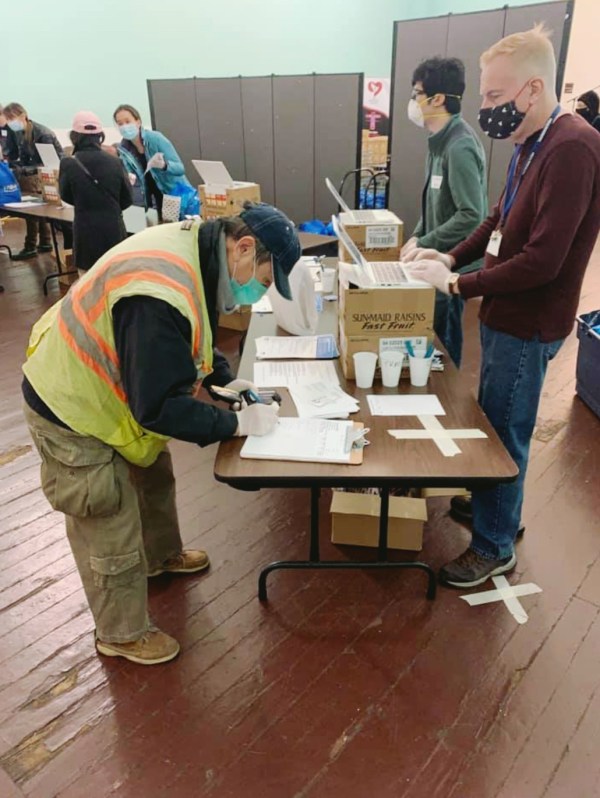
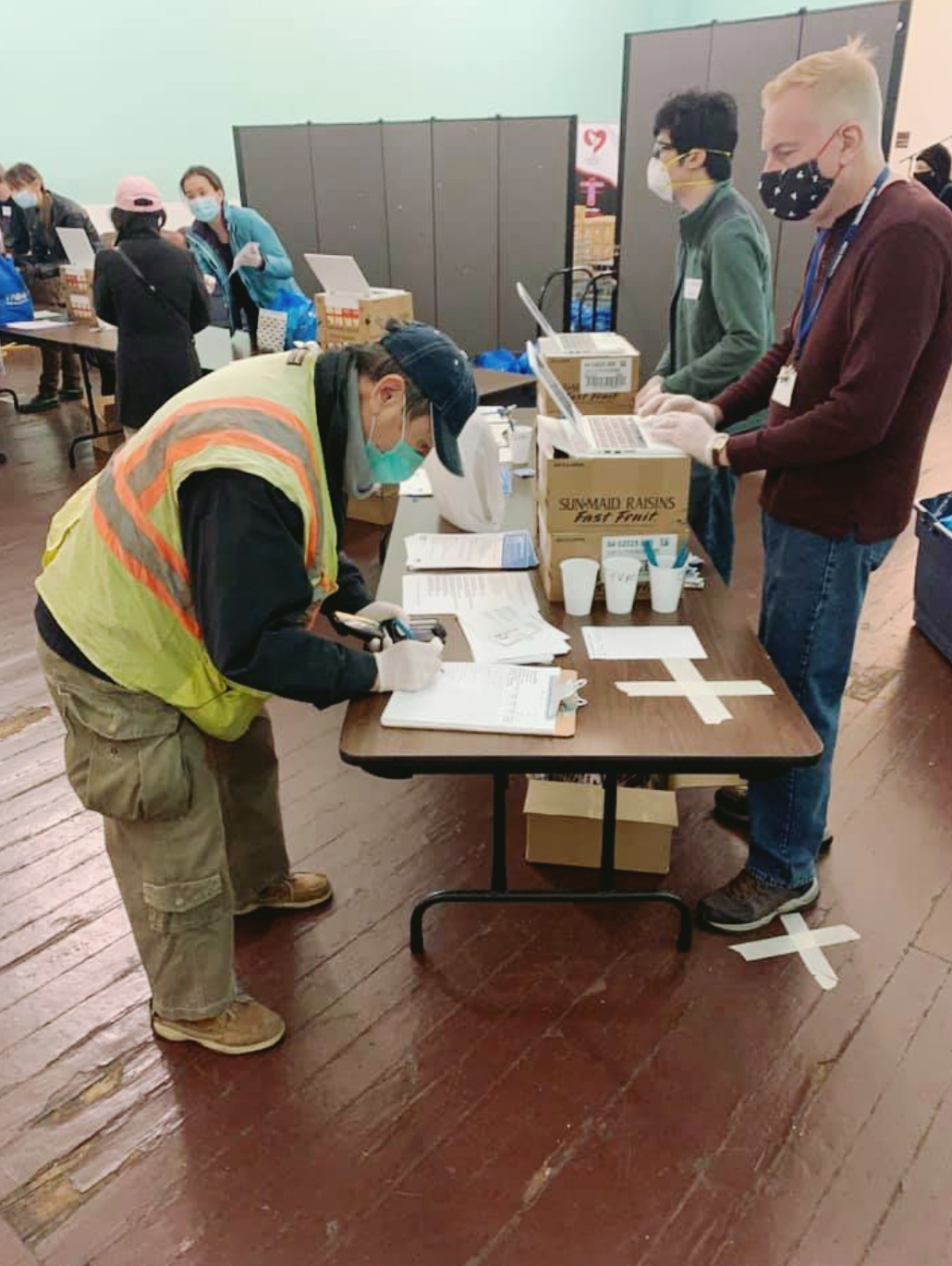
In normal times, Hutchins would add a hug to her greeting, but now volunteers immediately wash their hands once they arrive and don masks and gloves. They can’t serve otherwise. And in usual times, as many as 150 volunteers would descend on the church on Saturday morning to hand out food and run a full-service kitchen. But now, with social distancing requirements, only 30 volunteers are allowed at one time.

The volunteers flock in from across New York City. Some have been coming for close to a decade, like Katie Sullivan, who stumbled on The Father’s Heart in 2013 when a friend told her the soup kitchen was short on volunteers.

Katie Sullivan walks four miles from her home and back to volunteer at The Father's Heart each week.Courtesy of The Father's Heart Ministries
Katie Sullivan walks four miles from her home and back to volunteer at The Father’s Heart each week.

“I just fell in love with it immediately,” said Sullivan, an anti-corruption attorney for The World Bank who now avoids the subway and walks four miles each way between her Brooklyn apartment and the church. “Their focus on maintaining people’s dignity and really caring for people, and the way that they do table service, really lit up my heart.”

Not only do volunteers continue to show up every Saturday, they’re also reaching into their pockets.

The Father’s Heart typically has a yearly budget of around $1 million. But Hutchins says they’ve had an increase in private donations and grants from volunteers, long-time supporters, church partners, and organizations like United Way and Hope for New York. The availability of the CARES Act small business loans has also buoyed funding hopes at The Father’s Heart and pantries across the country.

While non-perishable foods like rice and canned tuna are staples of the pantry bags guests receive, Hutchins said the additional funding will help them “take it up a few notches” and order the kinds of fresh foods she buys for her own family, essentials like eggs, milk, grains, and meats.

On a recent Saturday, Hutchins felt something different from the moment she woke up in her Flushing, Queens home. With all the strict protocols she’d put in place, she realized, the atmosphere during the Saturday food program had become flat. City-mandated protocols had drained so much of the human contact from the operation.

To create more separation between volunteers who prepare groceries, Hutchins had moved the food pantry staging area from a tighter space in the basement to the 3,600-square-foot sanctuary, which was vacant since Sunday church services had moved online. A weekly sit-down, buffet-style breakfast was replaced by “breakfast to go,” where volunteers pass ready-to-eat packed food through an outside window and give guests a second bag of groceries inside the building.

A service that once beamed with hugs, handshakes, and praying hand-in-hand has been subdued to a monotonous assembly line.

“It’s hard with the six-foot distancing,” Hutchins said. “It’s changed the dynamics in the sense that the guests can’t stay long, they can’t get close.”

She felt God telling her the volunteers needed an extra boost of inspiration. So on this morning, instead of handing out cook and server assignments for their restaurant-style soup kitchen, Hutchins gathered her 30 volunteers in the high-ceiling sanctuary and opened with a Scripture reading and a prayer.

She read from Psalms 46: “Be still and know I am God.”

Although Hutchins, who is 64, is ordained and has served in this church for 36 years, she would not usually have this kind of spiritual component for volunteers. But in truth, she was looking for inspiration, too.

Standing at the center of the elevated alcove altar, an old wooden cross draped with red velvet cloth hanging atop, she looked out to her volunteers and prayed:

“Lord, let us see and let us feel. Let us be your hands and be sensitive, be present and not just get through the safety of today but let’s be present.”

She finished the prayer with:

“Let us be present with your knowledge and be alert to people’s needs.”

Hutchins’ prayer was met with echoing “Amen!” and “Hallelujah!” from volunteers spread every six feet throughout the teal-walled sanctuary on white-taped floor markers.

After the prayer, some volunteers went back to prepping food pantry bags. Others assembled to-go breakfast packages full of cheerios, milk, juice boxes, granola bars, yogurt, and chicken salad. They added lollipops and Cheez-Its for kids. And, of course, individually wrapped wipes.

Not long after Hutchins finished her prayer, the doors opened and guests started to roll in 30 to 50 at a time, staggering their entries and exits. Since New York City became an epicenter of the coronavirus pandemic, the operation has been opening an hour and a half earlier than normal to accommodate the extra safety logistics.

“Everything has got to be strict,” Hutchins said. “But we find ourselves grabbing an arm or an elbow or pat someone’s back. It’s so hard to stay sterile when you see people you love and you want to reach out to them.”

The pantry serves just over 400 guests on a given Saturday, though Hutchins knows that many of the older regulars are staying home out of caution, even as the pantry registers a growing number of new guests each week.

First-time guest registrations have surged at The Father's Heart and at food pantries around the country.Courtesy of The Father's Heart Ministries
First-time guest registrations have surged at The Father’s Heart and at food pantries around the country.

Though guests remain thankful, some have met the changes with sneer.

Shortly after opening, a lofty, striking homeless man questioned the volunteers’ faith when he saw them wearing face masks and gloves and keeping their distance.

“Why?” he asked loudly, pointing to their protective gear. “Don’t you believe in God? Don’t you have faith?”

“It’s not about my faith,” Hutchins, her petite frame drowning in an overcoat, tried to lull the man’s taunts. “It’s about other people getting my germs.”

“Jesus touched the lepers, and he didn’t get leprosy,” the man retorted.

Another homeless man was on his way out when Hutchins offered him a mask. He quietly refused, saying, “I have faith in God.”

Still, Hutchins emphasizes, such encounters are one-offs. Most of their guests are embracing the challenges with gratitude. One homeless woman smiled and told her, “You doing this brings hope to everyone on the streets.”

Guests are normally offered a Bible as they leave the church. In the past, many would refuse. But lately, Hutchins says, guests have been taking Bibles like “crazy.”

“People are saying, ‘Everything that I counted on, everything that I lived for, everything that I relied on is gone,’” she said. “I think that causes people to look away from the natural things and look to God.”

What is hard is that Hutchins and volunteers can’t console hurting people in the same ways they used to. The comfort that hugging and physical contact bring are what some of the guests and volunteers had come to look forward to, said Neil Weiss, a former homeless guest who now serves as a volunteer supervisor.

“We can’t interact like we used to,” Weiss said. “But, we still hear them say ‘God bless you. We really appreciate it.’ We heard that before, but it seems like they’re expressing it deeper.”

Volunteers are finding ways to adjust. For example, since sitting down with guests to eat and mingling with them in line are no longer options, they’ve turned to a new initiative in the form of prayer slips. Guests write prayer requests on pieces of papers that volunteers then carry with them throughout the week and pray over. The prayer pens are sanitized after every use.

Food insecurity is usually linked to the homeless. But since the pandemic hit and unemployment has soared, Hutchins says The Father’s Heart is seeing more than 100 new guests almost every week. Many of these first-timers have never before had to find free food.

“Who knows that there’s a Food Bank for New York City unless you need food?” Hutchins said.

New guests she’s encountering are going online and calling hunger hotlines to find resources they’ve never needed before. Many come agitated, scared, or confused.

And they’re very hungry. Hutchins says she’s proud that The Father’s Heart is equipped to remain open with staff and supplies for the long haul.

The Father's Heart turned its church sanctuary into a food staging area after worship services went online.Courtesy of The Father's Heart Ministries
The Father’s Heart turned its church sanctuary into a food staging area after worship services went online.

Over 100 service locations affiliated with the Food Bank for New York City—which supplies more than 1,000 food pantries and soup kitchens—have suspended their operations. According to New York City Mission Society, an organization aimed at ending multigenerational poverty, a third of the nation’s food pantries are also closed, impacting over 17 million people.

Some pantries don’t have enough space to comply with social distancing requirements. Some experienced debilitating drops in volunteers.

“We didn’t have volunteers to cook anymore,” said a representative from Community Help in Park Slope Inc., a similar service center in Brooklyn that recently suspended services. “Everyone is afraid to come in.”

Hutchins says she’s grateful to her volunteers for their dedication to serving the community. She worries about protecting their safety, too, every time she thinks about them leaving their homes and risking their lives to serve.

“You want to do what’s best for the community,” she said. “But you also have staff that you need to protect and take care of, too.”

To that end, Hutchins has had a lot of help. Partners in New York, such as the Food Bank and United Way, have provided boxes of gloves with every donation delivery. Masks have come in from church partners and locals around the city and across the country.

Ione Parshall is a retired military officer in Manhattan, Kansas, who wanted to help America’s “worst-hit city” that happens to share a name with hers. So far, she has rallied her congregation, University Christian Church, to make and donate more than 350 masks to The Father’s Heart.

“I just felt like I needed to do something,” Parshall said. “As a Christian, we’re supposed to reach out to those in need.”

Hutchins is now looking ahead to recovery. Her community has gone through similar crises, like Hurricane Sandy, and she wonders how people will overcome this one.

“There’s going to be a lot more people needing food,” she said. “We may have to be open more and hire more people.”

As they said goodbye to their last guest of the day, Hutchins offered individually wrapped Communion for her volunteers and closed with a prayer, which included:

“We are an extension of God’s love on earth.”

Then, in the middle of the sanctuary, pantry boxes stacked high around, and everyone standing six feet apart, they sang “Amazing Grace.”

Rita Omokha is a freelance journalist based in New York City. She is an alumna of Columbia University Graduate School of Journalism.

Pastors

Letting Grief Come to Church

Five ways to welcome what may feel unwelcome once doors reopen.

CT Pastors May 21, 2020
Source image: Prixel Creative / Lightstock

It’s been ten weeks now since I last sat in my church’s sanctuary. For more than two months, we’ve streamed Sunday worship online, emailed encouraging weekday devotionals, and texted prayer requests. Our church has worked hard to keep our community connected, but we all feel a similar longing: We can’t wait to be together in person.

While I am genuinely excited for the return to gathered worship and face-to-face interactions at church, I am anxious, too. I know all too well how complicated a return to church can be. Like the thousands of churchgoers who will trickle back as sanctuary doors reopen, our family has endured the complicated task of returning to church with a new, unwelcome visitor named grief.

After my husband’s unexpected death, my children and I found, to our deep disappointment, that the familiar rhythms of our former life now felt strange. School and relationships—even with family and close friends—became awkward and unwieldy. And worst of all, church attendance and ministry, a core family commitment and mainstay of our week, grew sporadic and painful.

Though I had spent almost 20 years in lay ministry, our local congregation felt like the one place to which it was impossible to return. Death had deeply changed that dimension of our life. Our family was in danger of a regression, in the words of Miriam Neff, “from the front row of the church to the back, and then out the door … from serving and singing in choir to solitude and silent sobbing.”

Many grieving people find church one of the hardest places to return to after loss. Some find uplifting worship services jarring in the face of their grief. Some feel uncomfortable circulating in large groups. Others discover their congregation ill-equipped to support their deep, ongoing needs of care. Changed forever by death, all struggle to navigate where they fit in a community that once knew them as someone else.

In the coming weeks and months, our churches will be met with a flood of grief, a unique and painful byproduct of the COVID-19 pandemic. Grief ministry will become more important than ever before. While many churches have individual care ministries, the reopening of sanctuary doors will require a more comprehensive approach to grief care in congregations to meet the real, felt needs of those who are now bereaved or anxious about death and dying. Consider these five practical ways your church can prepare to care for those who will bring grief to church:

1. Integrate Lament in Worship

During quarantine, many churches have integrated lament beautifully into worship. This does not need to end when church doors open. We must continue to lament in worship, through song, Scripture, and testimony. Faith persists amid sorrow.

Lament offers space for those grieving to bring their sorrows before the God who hears our cries and binds up our wounds. Lament in corporate worship also reminds the larger body that there are those among us we must carry gently, who need our comfort and care. We remind the bereaved they are not forgotten; their tears matter to God and to us.

2. Develop Remembrance Rituals

Remembering a lost loved one is one of the simplest but most profound acts of care a congregation can offer. Make remembrance rituals part of the church culture and calendar.

Few churches keep graveyards on their property anymore, but this need not stop congregations from remembering the names of those who are now members of the church triumphant. Years ago, our family’s church in the Chicago suburbs hung a plaque at the back of the sanctuary where names of deceased members were engraved. Once a year, the names were read aloud in a service of remembrance. Special remembrance services for each season, listing names in the bulletin for six months after a death, or placing roses on the altar on anniversaries of death are all ways to corporately remember the body’s losses.

3. Train Ministry Leaders to Be Grief-Aware

When I served as director of children’s ministries for a church plant outside of Seattle, I always marveled at the thoughts and feelings children relayed during worship. Unlike adults who tend to filter intimate or personal conversation, children and youth often readily talk about the things that weigh on their hearts. As your church resumes ministry, prepare your leaders to be grief-sensitive and grief-aware. There are going to be adults and children who need to talk. Lay leaders need a basic understanding of grief and the anxiety that accompanies death and dying. Equip them to answer questions, provide comfort, and listen compassionately.

Grief is long-lasting, nonlinear, and not something to be fixed. It is the natural outflow of losing someone we love. Consider resources like Philip Kenyon’s excellent tips on caring for the bereaved, Neff’s guide for caring for widows or psychologist Sarah Rainer’s advice on navigating trauma and grief. Point children’s ministry leaders to nationally recognized children’s bereavement resources like those from The Dougy Center. Encourage ministry leaders to be quick to listen and slow to speak.

Bereavement is not a problem to fix, but an experience in which leaders can be companions. Once ministry leaders understand that a companion in grief need only be present in love, it can alleviate feelings of inadequacy.

4. Prepare to Offer Practical Care

For the bereaved, the isolation of grief will linger even after quarantine is over. Offering tangible care will provide comfort when those who grieve feel most alone, when it feels as though everyone else has moved on.

Add volunteers to the meals ministry, prayer shawl ministry, handyman’s ministry. Research a GriefShare or Stephen Ministries program in anticipation of providing long-term emotional support. Plan how you will assist families who have had to delay funerals and memorial services because of COVID-19. When doors reopen, your practical care for the bereaved is just beginning.

5. Consider Death

With the news of the pandemic filling our ears, we’ve heard enough talk of death to last a lifetime. After churches reopen, the last thing we’ll want to hear about is more. But for those who grieve, death will continue to play a central role. Coronavirus has called forth an acknowledgment of our own mortality. The church has a gospel for this.

As your church resumes regular programming, consider hosting a Sunday school class about grief or end-of-life issues. We’ve watched Christians wrestle with ethical questions amid coronavirus concerns; let these discussions prompt your church to ask these important questions in small groups and Bible studies. Offer a special workshop in partnership with your local hospice organization to help church members understand the grief process. Lead your congregation in thinking about what it means to die well.

Bringing Grief to Church

Making space for mourning will make our churches radically alternative cultures—places where bereaved will find deep understanding, empathy, and belonging, even beyond COVID-19. When grief ministry becomes core to our church’s mission, nursery workers will also know what to say to the mother who has miscarried and is grieving that her infant won’t be on the fall roster. The meals ministry will know how to care for the bereaved husband who’s lost his appetite. The church softball team will understand the difficulty of arranging childcare for a dad who now has to raise two young children alone. And in worship, the widow won’t be the only one who weeps.

A few months after my husband’s death, I slipped into the back row of a Sunday school class on Christian views of the body and soul. I’d only sporadically attended since his death; sitting in Sunday school with an empty seat beside me was just too hard. Unbeknownst to me, the topic that day was death and dying. For the next hour, I sat in my seat with a lump in my throat, my hands clasped in my lap to keep them from shaking.

After class, the teacher—a friend and professor at our local seminary—approached me. “I’m sorry. I should have warned you,” she apologized. Tears filled my eyes. I told her, no, the class had been exactly what I had needed. In church, where I often felt like I no longer fit in, I had found renewed life among those unafraid to talk about dying.

Clarissa Moll (MA, Trinity Evangelical Divinity School) is the young widow of author Rob Moll and the mother of their four children. After a career in fundraising and marketing for small nonprofits, she now supports those in grief through her writing. Find her on Instagram and Twitter.

Theology

What’s Up with the Ascension?

Seated at the right hand of God, what’s Jesus doing up there?

Christianity Today May 21, 2020
Source Image: Traveler1116 / Getty

Fellow church members occasionally ask: “If all our sin was dealt with when Jesus died on the cross, why must we still confess it?”

The answer is partly found in an oft overlooked aspect of Christian belief—Jesus’ ascension. According to the New Testament, God raised Jesus from the dead, and then, 40 days later, took him up into heaven (Acts 1:9–11). Romans, Hebrews, and 1 John all describe the ascended Jesus actively working for his people in God’s heavenly presence. Romans 8:34 and Hebrews 7:25 identify Jesus’ present activity as intercession. In 1 John 2:1–2, Jesus serves as an advocate before the Father.

But why do God’s people need an advocate? Is the Crucifixion not enough for our salvation? I would answer no. The single event of the Cross is not sufficient—only the person of Jesus is sufficient. If all we had were the Cross, then we’d have no salvation. As important as Jesus’ death is, Christ’s saving work involves more. We need Jesus’ ongoing ministry of intercession for our salvation. Hebrews identifies Jesus’ ongoing intercession as key for Jesus “to save completely those who come to God through him” (Heb. 7:25). To reduce Jesus’ saving work merely to his dying ignores this important aspect of Jesus’ present ministry for his people.

Salvation isn’t accomplished just because Jesus died but because he was also raised and ascended into heaven. There, continuously interceding for us, Jesus maintains the New Covenant better (permanently better) than the Old Testament sacrifices and priests maintained the old. Hebrews and 1 John describe Christ’s heavenly ministry using concepts drawn from Old Testament sacrifices and priestly ministry. Hebrews looks to the annual Day of Atonement (Lev. 16) to explain how the ascended Jesus ensures his people’s salvation. The earthly high priests entered God’s presence in the Holy of Holies once every year to offer the sacrifice of atonement by sprinkling blood.

But Jesus did something better. He ascended to God’s presence in the heavenly Holy of Holies once for all time. There, as an ever-living sacrifice, he offered himself before the Father the way the earthly high priests offered the sacrificial blood (Heb. 9:6–7, 24–26). Hebrews says that Jesus took his seat at God’s right hand after he made purification for sins (Heb. 1:3). Jesus presently rules on the heavenly throne as God’s exalted Son. Hebrews also affirms that Jesus now serves as the Great High Priest who continues to work for the salvation of his siblings. He is seated, but he is not silent. Even now, the ascended Christ ministers as the Great High Priest in the heavenly Holy of Holies (Heb. 8:1–2), perpetually interceding for his people (Heb. 7:25). This is part of how he saves us completely.

Similarly, 1 John reflects on Jesus’ work in the light of Jewish sacrifices: Jesus himself is the “atoning sacrifice” now located in the Father’s presence (1 John 2:1-2). As in Hebrews, Jesus is not silent in God’s presence. He actively advocates for his people when they sin. This advocacy supplies the rationale for John’s admonition to believers to continually confess their sins (1 John 1:9). The reality of ongoing sin requires ongoing confession and forgiveness of sin. Jesus’ ascension makes this possible because Jesus, who is the atoning sacrifice, presently pleads with his Father for his people. Unlike Hebrews, 1 John does not identify Jesus as high priest, but Jesus’ ongoing advocacy clearly implies his priestly ministry.

In Romans 8:34, Paul also highlights the importance of Jesus’ ongoing intercession at God’s right hand as a central means for preserving relationship between God and God’s people. No one can condemn those who are in Christ. This truth depends not only on Jesus’ death, but, as Paul says, even more on his resurrection and present intercession at God’s right hand. Paul can therefore confidently declare that nothing “will be able to separate us from the love of God that is in Christ Jesus our Lord” (Rom. 8:39). Jesus’ love extends beyond the Cross—his death, resurrection, and ongoing intercession at God’s right hand are essential for his people’s salvation. Take out any one of those elements and, like the Jenga tower that falls to pieces when a key block is removed, Paul’s confident claims in Romans 8:35–39 collapse.

The preceding reflections do not do full justice to the significance of Jesus’ ascension. They only highlight some of the important implications of this event. They remind us that our ascended Lord is not sitting silently in his Father’s presence. He actively intercedes and advocates for us, ministering before the Father as our merciful and faithful high priest (Heb. 2:17). We need this ministry as we continue to wait for the Lord to return and make all things right (Heb. 9:28). Our salvation is completely contingent on Jesus—the one who died but even more rose, ascended, and presently intercedes for us.

Why do we continue to confess our sins and seek forgiveness even after professing faith in Christ’s salvific death?

All of this brings us back to our opening question. Why do we continue to confess our sins and seek forgiveness even after professing faith in his salvific death? We do this, boldly even, because Jesus ascended as our great advocate, our high priest (Heb. 4:14–16). He has returned to his Father and ours to intercede on our behalf. This present work is an essential part of the ongoing relationship that he, the Father, the Holy Spirit, and we as God’s people share. Jesus’ ascension, we might say, is part of how he maintains the New Covenant relationship he inaugurated at his death. Atonement in the Old Testament wasn’t accomplished simply by slaughtering animals; their bodies and blood had to be brought to the altars by priests with prayers offered. Similarly, Jesus’ ascension brought him, the crucified and resurrected one, into God’s heavenly presence to minister as his people’s high priest. He is the atoning sacrifice who died, rose, and now intercedes for his siblings. He ensures his people will receive the salvation God has promised them. We still sin and fall short, but we have an advocate in heaven. We can, therefore, confidently proclaim his death, until he comes (1 Cor. 11:26).

David M. Moffitt is Reader in New Testament Studies, University of St Andrews, Scotland

News

Meet the ‘Gang Pastor’ Behind Cape Town’s Viral Coronavirus Cooperation

Australian banker turned South Africa missionary explains what making the international news and Trevor Noah means for ministry.

Andie Steele-Smith (left) and some of his gang members turned coronavirus supply network.

Andie Steele-Smith (left) and some of his gang members turned coronavirus supply network.

Christianity Today May 21, 2020
Andie Steele-Smith

Somehow, an Australian-born investment banker in England went to South Africa and got mixed up with the “Americans.” The gang, that is, in one of Cape Town’s most dangerous townships (known outside of South Africa as “shantytowns”).

And with them, the Hard Livings and Clever Kidz.

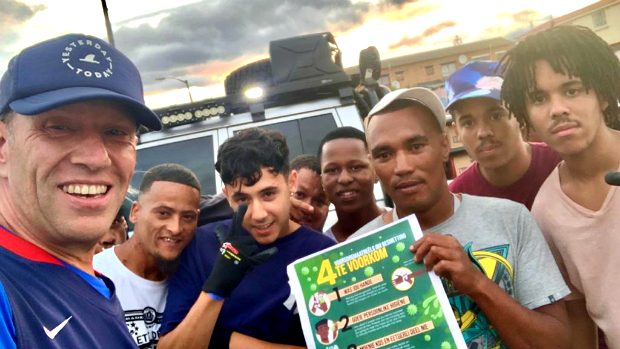
Called by God into a life far from his Christian but comfortable existence, Andie Steele-Smith has recently won international acclaim as the “gang pastor” crossing rival lines. Serving the last five years in 2018’s second-highest homicide city, he has led murderers and drug lords to cooperate amid the coronavirus pandemic as a new distribution network for soap and emergency food delivery.

In addition to endemic crime, Cape Town counts 10 percent of the confirmed COVID-19 cases in all of Africa, and 60 percent of South Africa’s cases.

With both mass media and the masses desperate for good news amid the pandemic, his story has been told by the Associated Press, the BBC, CBS News, and even earned a quip (at the 12:30 mark) on Comedy Central’s The Daily Show with Trevor Noah, himself a South African from Johannesburg.

CT spoke with Steele-Smith, who attends Hillsong’s Cape Town campus, about his calling, the spiritual impact of his ministry, and whether “15 minutes of fame” makes the situation better or worse:

Andie Steele-Smith

You started out as a successful investment banker. How did you end up in South Africa?

I grew up in a strong Christian home and church, but until I was about 40 years old, my life was all about building my own empire.

Around 12 years ago, I visited San Diego to buy a coffee company. Invited to what I thought was a megachurch, little did I know it was a Christian rehab center. The Holy Spirit convicted me, and I spent the rest of the day crying like a baby. First, that these people are the same as me, but then, that they are actually better than me. I was the rich arrogant fool, and my life turned upside down.

I began volunteering with the homeless and drug addicts in the US and the UK. But in 2012, I visited South Africa for business, and felt God speaking to me and saying this is where you’re meant to be.

God gave me a very clear, but blurry, picture: a circle with four corners. The circle had the Great Commission at the center. The corners were justice, entrepreneurship, education, and safe church communities.

You are still a businessman?

I run a couple different businesses, and this supports what we do. But as the needs multiplied after COVID-19, buying soap and food for thousands of people, it was bigger than we could do alone. We’re members of Hillsong Church, and their Hillsong Africa Foundation came alongside to help as has a Christian NGO called Chanan54.

But at first, I assumed God would have me sit on the boards of a few Christian charities. I purposefully didn’t join any ministries for a year, so we could look, listen, and learn. The last thing South Africa needed was another “white savior,” saying he knows what the answer is.

A year later, we joined a small church plant in a township near our house in Cape Town. These were created during apartheid, when the white people told everyone they didn’t want living near them, “Here’s your hellhole. Stay there.”

I was asked if I would run a Bible study, and I asked to meet the person who ran it before. They said, “No one ever has. Everyone has been too scared.”

But I had hung out with some of the gangs in Los Angeles, and thought, “This isn’t safe, but it’s not scary.” So I set up a barbecue and started cooking. I invited six young men, and eight turned up. By Week 6, we had 150 around the fire, and started building community.

What have you seen God do in these communities?

The No. 1 lesson is just turn up. You don’t need a project or a program, but if you turn up every day you are no longer just a white person. All of a sudden, you are one of us. It is a massive difference.

But you have to be prepared to be there at any time, especially when the ambulances often won’t enter these neighborhoods after dark. So the second lesson is to run into the flames, rather than do the natural thing and run … away from it.

Andie Steele-Smith

Underpinning all of this is that we can lift them up and give them the privilege of leading their own communities. Three years ago, there was a massive storm with thousands of dwellings destroyed. We helped them rebuild for the next six weeks, but almost all the work was done by these young men.

Now they are walking in their community with their heads held high—called hero, or leader, or even pastor. When a 12-year-old boy is called a pastor, that is a pretty radical thing.

Were these gang members?

No, they were ordinary people. But as we served in that township for a couple of years, we started seeing needs in other communities. After a fire in a different location, hundreds of people lost everything they owned. The young men actually called me, and said let’s go and help them. We stayed there for a month, rebuilding 700 homes. But by far the most valuable thing we brought was solidarity.

Andie Steele-Smith

We had been praying with the young men to get involved in gang ministry. These impoverished boys rarely leave their own community, let alone go somewhere more dangerous to minister.

What does ministry look like in this context?

Beside my four children, I have two local boys, Franklin and Junior, whom I call my adopted twins (age 19 and 14 when we started), even though they have a wonderful mother and father. They do all the hard work, I’m just a glorified taxi driver with crazy ideas. I drop them off in a community, and after half an hour they come out with 50 others trailing behind them like the Pied Piper.

The young men are wonderful instinctive leaders. As they give practical instruction in how to use a hammer and nail, they are also discipling them, spreading the gospel.

In one township, we met a local gang boss already serving an elderly man in a wheelchair, who was trying to rebuild his house. He was just released from jail after being sentenced for armed robbery and murder. If he has an innate desire to do good, there is hope, and we can work with that.

Two weeks later, when he wasn’t working alongside us, six young men from another gang came to attack us with knives drawn. I pulled my boys behind me, and on autopilot I grabbed the leader, hugged him, and kissed him on the forehead. He burst into tears, put his knife in his pocket, and said, “Uncle, can we help build with you?” More than anything, these boys just need a dad figure. They have been gang members for five or six generations. They are not the bad guys. They have done terrible things, but they are also victims.

Andie Steele-Smith

Have you seen people saved?

We regularly stop while we are working to invite people to follow Jesus. I’ve lost track, but maybe 5,000 to 10,000 have told us they’ve repented and are turning to follow Jesus. But I don’t call this success, it is just a small piece in the overall cause of what we Christians are called to do.

We’ve seen hundreds of gangsters give their lives to Jesus, and Hillsong runs a bus to bring them to church. The pastors sit in the first rows, and the gangsters right behind them. It’s pretty cool. But we get the credit where hundreds of other pastors have already invested in these communities. We just get to see the harvest.

Do these young men wind up leaving their gangs? Is there less violence in their communities?

We’ve seen transformation, but we are at an early stage of where I think this could go. We’re trying to address the causes of gangsterism, and Hillsong helps with the discipleship component. But before COVID-19, I would have thought the next step would be to provide an avenue to get people out of the gangs, off the street, and into a safe environment.

But now, by virtue of them turning up to work in cooperation, this has given them a cause to pursue in their own communities, rather than go elsewhere to get their minds transformed.

When people are set free from alcoholism, they still need to drink something. Gangsterism identifies the best entrepreneurs in a community. But they need legitimate enterprise so they can use their same skills and hustle for God’s kingdom and their community.

How has this season of publicity impacted the community?

The community has been happy and supportive, because they see a real change in terms of these gangs. For the young men, it has been incredible. I’ve tried to be cautious with the media, because I imagined they might come in and use the boys by sensationalizing things.

But the Holy Spirit told me this is a good thing, and a God thing, and I should not stop it from happening.

These boys have grown up believing what they see on TV, about anything. Now they are seeing themselves on the world news, portrayed as heroes. They are heroes, but now they are starting to believe it. If I tell them, it makes an impact. But when the reporter says so through the TV lens—sometimes with tears in their eyes—they stand a foot taller.

Andie Steele-Smith

How are you personally interpreting these 15 minutes of fame?

To be honest, it is a distraction for me. I already have 20 hours a day of things to do, six days a week. It doesn’t personally add anything to me. Instead it detracts because it makes me more tired, giving me less sleep and time with the family.

It is amusing, and fun for a second, but it is an additional thing I have to do. It exposes me personally to the world, and I’d rather not do that. But now that these boys are seeing themselves as heroes, and starting to act every day as heroes, there has been a good consequence.

Jesus says we have to not do good deeds in front of others, but also to let our light shine before men. How have you lived in this tension?

I try not to talk about what I do, but about what the boys do. I feel more comfortable when I am letting the light shine through them. I’ve stuck to this from the first time media approached me.

Nothing that we do, or that the boys do, is done to get praise. We are doing it to see transformation. Feeding people, or building houses, or fighting fires, these are the unintended consequences of turning up and showing solidarity—showing that God loves them.

The things that people see in the media and say are amazing? No, these are the unintended consequences; they’re irrelevant in a sense. That’s not actually what we are there to do. It is to love someone who might not have felt loved.

Editor’s note: This article has been updated to note that the proper name in South Africa of a “shantytown” is a township.

Books
Review

Amid the Stresses and Strains of Higher Education, Christian Study Centers Are Thriving

How a postwar evangelical movement to unite mind and heart spread to campuses across the country.

Christianity Today May 20, 2020
Illustration by Rick Szuecs / Source images: Tadeu Bara / IBAB / Maskot / Getty / Gary Todd / Flickr

In the May 1972 issue of Christianity Today, Frank Nelsen, a history professor from the University of Wisconsin–Milwaukee, proposed creating “evangelical living and learning centers for undergraduate students [to] be built on private property near large state universities.” These centers would provide students with space to pursue “an intellectually honest investigation of the Christian faith and its relation to secular disciplines.”

To Think Christianly: A History of L'Abri, Regent College, and the Christian Study Center Movement

To Think Christianly: A History of L'Abri, Regent College, and the Christian Study Center Movement

IVP Academic

320 pages

$40.40

Nelsen suggested the idea—targeting a niche between campus ministries, local churches, and Christian liberal arts colleges—as a solution to what CT had identified a year earlier as the “Crisis in Christian Education.” The postwar boom in higher education was waning, and evangelicals were unprepared to respond. Rather than stick to an aging model, Nelsen asked: “Is there an educational alternative to the private college for evangelicals to consider in the light of current economic stresses and strains?”

The question is, unfortunately, as timely in May of 2020 as it was in May of 1972. Once again, universities—both public and private—are facing a tidal wave of new “economic stresses and strains.” And what of Nelsen’s proposal? In the almost-half-century since, “evangelical learning centers” have popped up on dozens of college campuses, from flagship public institutions such as the University of Virginia and the University of Wisconsin–Madison to elite private schools including Yale and Duke. The 30 or so individual centers have formed a national Consortium of Christian Study Centers, founded in 2008. While the details of Nelsen’s proposal never came to fruition (he suggested separate Christian dormitories and accredited coursework), the idea took on a life of its own.

The path from CT article to national consortium was anything but straightforward. Charles Cotherman’s new book, To Think Christianly, is the first comprehensive history of the Christian study center movement and its many roots in postwar evangelicalism. Focused on an influential, if small, class of educated evangelicals pursuing deeper cultural engagement with contemporary thought, To Think Christianly carefully reconstructs a vast web of intellectual networks and institutional struggles that most recent histories of postwar evangelicalism ignore, resisting the dominant narrative of evangelical cultural engagement since World War II.

Two New Frameworks

To Think Christianly may be the first time many readers encounter the institution of the Christian study center. Cotherman, it should be clear, is exclusively concerned with the genealogy of “evangelical learning centers.” In the 19th century, organizations like the YMCA and the Chautauqua movement fulfilled a similar role for lay Christians. Catholics have built a vast Newman Center network, and mainline Protestants founded centers like the Ecumenical Institute at Bossey, Switzerland, in the late 1940s. Even Christian Science Reading Rooms resemble Christian study centers. Cotherman ignores this wider Christian history in favor of explaining contemporary evangelical study centers in particular. This may rankle some readers, but the choice also sharpens his focus on a distinct evangelical engagement with culture that remains understudied.

Evangelical Christian study centers trace their roots to two progenitors: Francis Schaeffer’s L’Abri community in Switzerland and Regent College in Vancouver, British Columbia. While both were founded outside of the United States, they were deeply attuned to midcentury American evangelical concerns. Founded in 1955 in the Swiss Alps, L’Abri became a destination for travelers and wanderers to learn at the feet (or more often at the cassette tape) of ex-fundamentalist Francis Schaeffer. A one-time missionary, Schaeffer and his wife, Edith, recognized the growing appeal of hosting young travelers in their home. As Cotherman observes, L’Abri’s “home-based hospitality” of open-ended stays, communal work, and eating together made it “a working, living, studying, praying community before communal living became a countercultural standard.”

L’Abri’s “radical hospitality” helped to popularize Schaeffer’s novel conservative Protestant engagement with art, philosophy, and culture. By the late 1960s, Schaeffer was a best-selling author with speaking tours across the United States. Yet there were limitations. Especially as he became a leader in pro-life politics in the 1970s, he developed a guru-like aura among his followers. Rather than engage directly with other thought leaders, he maintained an insular circle of intellectual partners. While most historical accounts of Schaeffer linger on this later phase of political activism, Cotherman emphasizes how a generation of intellectually inclined evangelicals were inspired by Schaeffer’s earlier period at L’Abri.

If L’Abri’s hospitality modeled a new type of evangelical community, Regent College suggested a novel framework for evangelicals to pursue academic knowledge. Initiated by a circle of educated Plymouth Brethren in Vancouver, Regent started as a graduate school for lay Christians, eventually affiliating with the University of British Columbia. Regent’s founding in 1970 was shaped by its first principal, James M. Houston, a Scottish geographer who left Oxford for the job. Houston quickly assembled an impressive faculty, including J. I. Packer and W. Ward Gasque, which led to growing enrollment.

One of Houston’s early struggles was to maintain Regent’s focus on relational lay theological training and to resist developing Regent into a large seminary. As Cotherman puts it, Houston wanted education “to do away with the trappings of technocracy in favor of personal relations.” There were many benefits to this approach. With its mission to lay Christians, Regent was more welcoming to women (predominantly as students) in an era when it was almost impossible for women to enroll in evangelical seminaries. Regent encouraged women and men alike to become theological thinkers.

Why so much attention directed to this pair of institutions? In Cotherman’s telling, the twin legacies of L’Abri and Regent “helped sow an emphasis on hospitality and relationship” for the study centers that would follow. Moreover, the majority of later study center founders had some connection to L’Abri or Regent. These common evangelical roots were revealed through overlapping interpersonal networks and a shared intellectual agenda. The relationship of knowledge to faith—of “mind and heart”—was the umbrella under which each new generation could contemplate certain core questions: What role does Christian faith play in the pursuit of academic knowledge? What does it mean to have a faithful Christian presence in a modern university community? How should Christian thought form an engineer, a doctor, an architect?

Cotherman’s other examples—R. C. Sproul’s Ligonier Valley Study Center in Stahlstown, Pennsylvania, and New College Berkeley near the University of California (now affiliated with the Graduate Theological Union)—diverged from the early models. Ligonier eventually became a national cassette and video tape ministry that relocated to outside of Orlando, Florida. New College Berkeley nearly folded in its attempt to gain accreditation in the 1980s, deciding instead to embed itself in an existing network of seminaries and theological centers in the San Francisco Bay area. More closely linked to the contemporary Christian study center movement is the Center for Christian Study on the campus of the University of Virginia, which under the leadership of Andrew Trotter in the 1990s and 2000s developed the cooperative model between university and study center that now dominates the movement. (Trotter would become the first director of the Consortium of Christian Study Centers in 2009.)

Carrying the Torch

Cotherman’s story largely sidesteps the familiar culture-war and Christian-right themes that currently receive so much attention from journalists and historians. Study centers themselves are scattered across the political spectrum. Schaeffer played a crucial role in the Christian right until his death in 1984, while New College Berkeley’s roots are in the evangelical left of the 1970s.

This diversity does not mean, however, that Cotherman overlooks the areas where Christian study centers overlapped with conservative evangelical politics. Many study centers pitched (and still pitch) themselves as a “shelter” and specialize in apologetics, creating Christian “bubbles” of students floating in secular campuses. The US Supreme Court’s 2010 ruling on Christian Legal Society v. Martinez, which allowed universities to implement far more muscular anti-bias regulations, only hardened this posture. According to Cotherman, the decision aided a “reactionary and isolationist strain” that can work against stated missions of cooperative academic engagement. And while the study centers that followed in Regent’s path were substantially more accessible to women than evangelical seminaries, most often they have been founded and led by white men.

Cotherman’s narrative choice is refreshing, suggesting an alternate story of postwar evangelical cultural engagement that is challenging, insightful, and, at times, inspirational. Like all histories, this one is shaped by the questions asked of the past. The Consortium of Christian Study Centers has recently experienced remarkable growth, as more than half of its 30 member centers were founded after 2010. To Think Christianlyreflects this narrative of growth, tracking the movement’s shift from an “innovation” mindset to a “multiplication” mindset. It remains unclear if the movement will continue to grow, or what its broader influence on evangelical thought will be. Observers beyond Cotherman, including historians Mark Noll and Molly Worthen, have highlighted study centers as potential bright spots in an intellectual landscape darkened by the multiple crises afflicting evangelical intellectual life and higher education.

These cycles of educational crisis, voiced by Nelsen in 1972, are, admittedly, here to stay. “Crises are nothing new for the Christian colleges,” he observed, “their histories are replete with them.” Cotherman’s excellent book illustrates how there has been and will continue to be an evangelical impulse to care for the mind, body, and spirit of these university communities. Whatever crises lay on the horizon, we can expect a host of Christian study centers to build creatively on the foundations laid by previous generations, carrying the torch of evangelical cultural engagement with the same verve and resilience.

Daniel G. Hummel is an honorary research fellow in the history department at the University of Wisconsin–Madison and a staff member at Upper House, a Christian study center based there. He is the author of Covenant Brothers: Evangelicals, Jews, and U.S.-Israeli Relations (University of Pennsylvania).

News

NIH Director Francis Collins Wins $1.3M Templeton Prize

The pioneering geneticist offers an ‘intellectual synthesis’ of faith and evolution.

Christianity Today May 20, 2020
Andrew Harnik - Pool / Getty Images

In the middle of the busiest season of his career, working 100 hours a week to rally the country’s medical response to coronavirus, National Institutes of Health director Francis Collins has been awarded the world’s top honor in faith and science.

This year’s $1.3 million Templeton Prize goes to the American geneticist and physician who led the Human Genome Project and established the BioLogos Foundation, an organization that promotes harmony between the Christian faith and evolution.

“It’s a bit overwhelming,” Collins, 70, said in an interview with Christianity Today. “The timing is pretty stunning because I’m totally immersed right now to try to develop treatments, vaccines, and testing for COVID-19.”

The government’s leading expert in biomedicine was selected for the prestigious award based on his research and service as a scientist, official, and public intellectual.

In a statement, Heather Templeton Dill, president of the John Templeton Foundation and the granddaughter of its namesake benefactor, said Collins has “encouraged greater curiosity, open-mindedness, and humility among scientists and religious believers with the aim of illuminating a pathway toward, as he has written, ‘a sober and intellectually honest integration’ of the scientific and spiritual perspectives.”

Appointed by President Barack Obama in 2008 and asked to remain by President Donald Trump, Collins is the longest-serving NIH director.

“If my calling was to try to use the tools of science to reduce the human suffering, this is an amazing job,” said Collins, who was enlisted last week to join the White House coronavirus task force. “The job is probably the best job in the world to make those dreams come true.”

During the pandemic, he has been working from his home office in Maryland, where he has a copy of Psalm 46 printed out on by his desk: “God is our refuge and strength, an ever-present help in trouble.”

Prior to his NIH role, Collins was known for his groundbreaking genetics research, as well as his intellectual arguments reconciling God and science and his willingness to foster discussion around the two.

He became a Christian during his medical residency, but like many scientists, he stayed quiet about his faith early on. As his career grew, he became more outspoken about his beliefs.

“You always are a little worried that someone will conclude from that you’re not as rigorous with your science,” he said. “By the time I got the opportunity to say more, I felt I was less likely to suffer the consequences.”

Collins pioneered a technique in genetics called “positional cloning” to identify genes responsible for diseases including cystic fibrosis, neurofibromatosis, Huntington’s disease, and Hutchinson-Guilford progeria syndrome, a rare form of premature aging. He also led the Human Genome Project from 1990 to 2003, which mapped the 3 billion DNA letters that make up the human genome and remains the largest biological collaboration project in history.

As the director of the National Human Genome Research Institute, Collins balanced meetings at the White House and with congressional leaders, top-level scientists, patients, and trainees in any given day, according to Praveen Sethupathy, who was mentored by Collins for his post-doctorate.

“I was amazed at how he gave each and every one of these activities his complete effort and full attention,” said Sethupathy, now associate professor of biomedical sciences and the director of the Center for Vertebrate Genomics at Cornell University. “He treats every person, young or old, educated or not, with the dignity and respect they deserve as human beings … his humble posture toward others speaks the loudest and gives the most life to people around him.”

Georgia Dunston, a geneticist who worked with Collins at the Human Genome Project, applauded his efforts to champion the work of black and minority researchers.

“Francis really appreciated not only doing the science but the perspectives [diversity offers], the kinds of questions you ask and how you approach it are just as important as doing the work,” said Dunston, who helped establish the National Genome Center at Howard University, the only program of its kind on a historically black campus, with Collins’s support.

Because of his interest in researching type 2 diabetes, Collins helped secure funding to obtain DNA samples from Africans in Nigeria and Ghana, which furthered Dunston’s goal of understanding the disease among African Americans.

Dunston said she enjoyed being able to be open about her own faith with him while working on the Human Genome Project. She told CT she was impressed by his boldness while he worked at the genome institute and likened him to Paul being “not ashamed of the gospel” (Rom. 1:16).

Collins’s public engagement around faith and science began to pick up after a 2003 lecture series at Harvard Memorial Church. Each night, 600–700 students packed in to hear him speak, and they still had questions when it was over. “Most were not believers,” said Collins. “I thought, ‘Wow. There’s a real hunger for this.’”

At the time, the science-religion conversation was dominated by extreme voices: new atheists that belittled the intellectual rigor of faith, and fundamentalists who saw mainstream science, particularly evolution, in contradiction to Scripture. Collins believed he could help people see that an “intellectual synthesis” is possible.

“I think of God as the greatest scientist. We human scientists have an opportunity to understand the elegance and wisdom of God’s creation in a way that is truly exhilarating. When a scientist discovers something that no human knew before, but God did—that is both an occasion for scientific excitement and, for a believer, also an occasion for worship,” he said in a 2001 CT interview.

“It makes me sad that we have slipped into a polarized stance between science and religion that implies that a thinking human being could not believe in the value of both. … I find it completely comfortable to be both a rigorous scientist, who demands to see the data before accepting anybody’s conclusions about the natural world, and also a believer whose life is profoundly influenced by the relationship I have with God.”

In 2006, Collins wrote The Language of God: A Scientist Presents Evidence for Belief, which “argues that belief in God can be an entirely rational choice and that the principles of faith are, in fact, complementary with the principles of science.” It became a bestseller and was published in 24 languages.

After such positive reception, Collins and his wife, Diane Baker, a founding faculty member and director of the genetic counseling program at the University of Michigan, founded BioLogos in 2007. Not long after, he stepped down to take the job at the NIH.

“Francis’s vision in starting BioLogos was to influence not only the content of the national conversation so that there is more scientific, philosophical, and theological depth, but also the tone and tenor of the dialogue so that there is greater civility and mutual respect even in disagreement,” said Sethupathy, now a board member at BioLogos.

Collins’s position leading the government agency requires additional sensitivity in how he speaks publicly about his faith. He said he turns down most invitations and clears the rest of his talks with the government ethics office.

He recently addressed questions about faith in the pandemic in online chats hosted by BioLogos, including one this week with evangelical leader Tim Keller.

Collins says he still feels “heartache” for young people in a crisis of faith and continues to receive emails from high school and college students who contact him while searching for footing amid the skepticism toward science they have been taught in their faith communities.

“They are very concerned about the collapse of something that is deeply important to them,” he said. They worry their biblical perspective will fall apart when confronted with scientific evidence that the Earth is billions of years old. Despite all he is juggling, Collins responds. “I just feel like this is something too important when someone else is pouring their heart out to me.”

In addition to his own book, he recommends other resources released by BioLogos. “If there’s a way that we can actually give them some hope and reassurance that this is not a requirement that you do not have to pick one or the other, then I have done something useful,” he said.

In the past 10 to 15 years, pastors tell Collins, the debate over the origins of the earth hasn’t seemed as divisive. “It is less the case that a church gets blown apart for disagreeing with the young-Earth perspective,” he said.

The last time Pew Research surveyed people about evolution in 2019, in fact, most Christians thought that humans evolved and that God had a hand in it. And in a recent poll from the National Association of Evangelical (NAE), leaders agreed that it is acceptable to have different views. “This is a not a salvation issue. Christians can disagree with how to interpret,” said Collins. “That’s encouraging. At the same time, there’s still a long way to go.”

“Francis Collins and I don’t see eye to eye on some of the details about how science and Christianity fit together. But, he has always been willing to take the time to enter into gracious dialogue with me, publicly, and one on one.” said Fuz Rana, vice president of research and apologetics at Reasons To Believe, which promotes scientific evidence for an old Earth but not human evolution.

Rana recalled meeting with Collins during a last-minute trip to Washington, DC. “His willingness to spend time with me when he didn’t have to demonstrated to me his genuine commitment to build bridges with people with differing perspectives than his,” Rana said.

Collins said if he ever leaves government service, he’ll return to writing for a faith audience, starting with an update to The Language of God.

For now, though, “I love the job because I am so excited right now about the pace of scientific progress, particularly in biomedicine,” he said. “We have the opportunity to solve mysteries I didn’t think we’d solve in my lifetime.”

In addition to the current efforts to battle COVID-19, Collins has a front-row seat as researchers work to address widespread cancers with immunotherapy, use gene editing to cure sickle-cell disease, and develop a vaccine that really works for HIV.

Collins will formally receive the Templeton Prize in a virtual ceremony later this year.

The Templeton Prize recognizes individuals whose achievements ask the big questions about the universe and humanity’s place in it. Other Christians who have won the annual award include physicists John Polkinghorne (2002), Freeman Dyson (2000), and Paul Davies (1995), as well as philosopher Alvin Plantinga (2017).

The prize has also honored global religious leaders Billy Graham (1982), Mother Teresa (the inaugural award in 1973), and Archbishop Desmond Tutu (2013). Last year’s Templeton Prize went to physicist Marcelo Gleiser, an agnostic who encourages the religious to embrace the mysteries of science and faith.

Christianity Today is also a recipient of Templeton Foundation funding.

Ideas

Martin Luther: Whether One May Flee From A Deadly Plague

Read in full the famous reformer’s advice on Christian faithfulness amid pandemics like the coronavirus.

Christianity Today May 19, 2020
Illustration by Mallory Rentsch / Source Images: Youssef Naddam / CDC / Unsplash / Wikimedia Commons

[Republished with permission of Fortress Press]

To the Reverend Doctor Johann Hess, pastor at Breslau, and to his fellow-servants of the gospel of Jesus Christ (1527 A.D.):

Grace and peace from God our Father and our Lord Jesus Christ. Your letter, sent to me at Wittenberg, was received some time ago. You wish to know whether it is proper for a Christian to run away from a deadly plague. I should have answered long ago, but God has for some time disciplined and scourged me so severely that I have been unable to do much reading or writing. Furthermore, it occurred to me that God, the merciful Father, has endowed you so richly with wisdom and truth in Christ that you yourself should be well qualified to decide this matter or even weightier problems in his Spirit and grace without our assistance.

But now that you keep on writing to me and have, so to speak, humbled yourself in requesting our view on this matter so that, as St. Paul repeatedly teaches, we may always agree with one another and be of one mind (1 Cor. 1:10; 2 Cor. 13:11; Phil. 2:2). Therefore we here give you our opinion as far as God grants us to understand and perceive. This we would humbly submit to your judgment and to that of all devout Christians for them, as is proper, to come to their own decision and conclusion. Since the rumor of death is to be heard in these and many other parts also, we have permitted these instructions of ours to be printed because others might also want to make use of them.

To begin with, some people are of the firm opinion that one need not and should not run away from a deadly plague. Rather, since death is God’s punishment, which he sends upon us for our sins, we must submit to God and with a true and firm faith patiently await our punishment. They look upon running away as an outright wrong and as lack of belief in God. Others take the position that one may properly flee, particularly if one holds no public office.

I cannot censure the former for their excellent decision. They uphold a good cause, namely, a strong faith in God, and deserve commendation because they desire every Christian to hold to a strong, firm faith. It takes more than a milk faith to await a death before which most of the saints themselves have been and still are in dread. Who would not acclaim these earnest people to whom death is a little thing? They willingly accept God’s chastisement, doing so without tempting God, as we shall hear later on.

Since it is generally true of Christians that few are strong and many are weak, one simply cannot place the same burden upon everyone. A person who has a strong faith can drink poison and suffer no harm, Mark 16:18, while one who has a weak faith would thereby drink to his death. Peter could walk upon the water because he was strong in faith. When he began to doubt and his faith weakened, he sank and almost drowned. When a strong man travels with a weak man, he must restrain himself so as not to walk at a speed proportionate to his strength lest he set a killing pace for his weak companion. Christ does not want his weak ones to be abandoned, as St. Paul teaches in Romans 15:1 and 1 Corinthians 12:22. To put it briefly and concisely, running away from death may happen in one of two ways. First, it may happen in disobedience to God’s word and command. For instance, in the case of a man who is imprisoned for the sake of God’s word and who, to escape death, denies and repudiates God’s word. In such a situation everyone has Christ’s plain mandate and command not to flee but rather to suffer death, as he says, “Whoever denies me before men, I will also deny before my Father who is in heaven” and “Do not fear those who kill the body but cannot kill the soul,” Matthew 10:28, 33.

Those who are engaged in a spiritual ministry such as preachers and pastors must likewise remain steadfast before the peril of death. We have a plain command from Christ, “A good shepherd lays down his life for the sheep but the hireling sees the wolf coming and flees” (John 10:11). For when people are dying, they most need a spiritual ministry which strengthens and comforts their consciences by word and sacrament and in faith overcomes death. However, where enough preachers are available in one locality and they agree to encourage the other clergy to leave in order not to expose themselves needlessly to danger, I do not consider such conduct sinful because spiritual services are provided for and because they would have been ready and willing to stay if it had been necessary. We read that St. Athanasius fled from his church that his life might be spared because many others were there to administer his office. Similarly, the brethren in Damascus lowered Paul in a basket over the wall to make it possible for him to escape, Acts 9:25. And also in Acts 19:30. Paul allowed himself to be kept from risking danger in the marketplace because it was not essential for him to do so.

Accordingly, all those in public office such as mayors, judges, and the like are under obligation to remain. This, too, is God’s word, which institutes secular authority and commands that town and country be ruled, protected, and preserved, as St. Paul teaches in Romans 13:4, “The governing authorities are God’s ministers for your own good.” To abandon an entire community which one has been called to govern and to leave it without official or government, exposed to all kinds of danger such as fires, murder, riots, and every imaginable disaster is a great sin. It is the kind of disaster the devil would like to instigate wherever there is no law and order. St. Paul says, “Anyone who does not provide for his own family denies the faith and is worse than an unbeliever” (1 Tim. 5:8). On the other hand, if in great weakness they flee but provide capable substitutes to make sure that the community is well governed and protected, as we previously indicated, and if they continually and carefully supervise them [i.e., the substitutes], all that would be proper.

What applies to these two offices [church and state] should also apply to persons who stand in a relationship of service or duty toward one another. A servant should not leave his master nor a maid her mistress except with the knowledge and permission of master or mistress. Again, a master should not desert his servant or a lady her maid unless suitable provision for their care has been made somewhere. In all these matters it is a divine command that servants and maids should render obedience and by the same token masters and ladies should take care of their servants. Likewise, fathers and mothers are bound by God’s law to serve and help their children, and children their fathers and mothers. Likewise, paid public servants such as city physicians, city clerks and constables, or whatever their titles, should not flee unless they furnish capable substitutes who are acceptable to their employer.

In the case of children who are orphaned, guardians or close friends are under obligation either to stay with them or to arrange diligently for other nursing care for their sick friends. Yes, no one should dare leave his neighbor unless there are others who will take care of the sick in their stead and nurse them. In such cases we must respect the word of Christ, “I was sick and you did not visit me …” (Matt. 25:41–46). According to this passage we are bound to each other in such a way that no one may forsake the other in his distress but is obliged to assist and help him as he himself would like to be helped.

Where no such emergency exists and where enough people are available for nursing and taking care of the sick, and where, voluntarily or by orders, those who are weak in faith make provision so that there is no need for additional helpers, or where the sick do not want them and have refused their services, I judge that they have an equal choice either to flee or to remain. If someone is sufficiently bold and strong in his faith, let him stay in God’s name; that is certainly no sin. If someone is weak and fearful, let him flee in God’s name as long as he does not neglect his duty toward his neighbor but has made adequate provision for others to provide nursing care. To flee from death and to save one’s life is a natural tendency, implanted by God and not forbidden unless it be against God and neighbor, as St. Paul says in Ephesians 5:29, “No man ever hates his own flesh, but nourishes and cherishes it.” It is even commanded that every man should as much as possible preserve body and life and not neglect them, as St. Paul says in 1 Corinthians 12:21–26 that God has so ordered the members of the body that each one cares and works for the other.

It is not forbidden but rather commanded that by the sweat of our brow we should seek our daily food, clothing, and all we need and avoid destruction and disaster whenever we can, as long as we do so without detracting from our love and duty toward our neighbor. How much more appropriate it is therefore to seek to preserve life and avoid death if this can be done without harm to our neighbor, inasmuch as life is more than food and clothing, as Christ himself says in Matthew 6:25. If someone is so strong in faith, however, that he can willingly suffer nakedness, hunger, and want without tempting God and not trying to escape, although he could do so, let him continue that way, but let him not condemn those who will not or cannot do the same.

Examples in Holy Scripture abundantly prove that to flee from death is not wrong in itself. Abraham was a great saint but he feared death and escaped it by pretending that his wife, Sarah, was his sister. Because he did so without neglecting or adversely affecting his neighbor, it was not counted as a sin against him. His son, Isaac, did likewise. Jacob also fled from his brother Esau to avoid death at his hands. Likewise, David fled from Saul, and from Absalom. The prophet Uriah escaped from King Jehoiakim and fled into Egypt. The valiant prophet, Elijah, 1 Kings 19:3, had destroyed all the prophets of Baal by his great faith, but afterward, when Queen Jezebel threatened him, he became afraid and fled into the desert. Before that, Moses fled into the land of Midian when the king searched for him in Egypt. Many others have done likewise. All of them fled from death when it was possible and saved their lives, yet without depriving their neighbors of anything but first meeting their obligations toward them.

Yes, you may reply, but these examples do not refer to dying by pestilence but to death under persecution. Answer: Death is death, no matter how it occurs. According to Holy Scripture God sent his four scourges: pestilence, famine, sword, and wild beasts. If it is permissible to flee from one or the other in clear conscience, why not from all four? Our examples demonstrate how the holy fathers escaped from the sword; it is quite evident that Abraham, Isaac, and Jacob fled from the other scourge, namely, hunger and death, when they went to Egypt to escape famine, as we are told in Genesis 40–47. Likewise, why should one not run away from wild beasts? I hear people say, “If war or the Turks come, one should not flee from his village or town but stay and await God’s punishment by the sword.” That is quite true; let him who has a strong faith wait for his death, but he should not condemn those who take flight.

By such reasoning, when a house is on fire, no one should run outside or rush to help because such a fire is also a punishment from God. Anyone who falls into deep water dare not save himself by swimming but must surrender to the water as to a divine punishment. Very well, do so if you can but do not tempt God, and allow others to do as much as they are capable of doing. Likewise, if someone breaks a leg, is wounded or bitten, he should not seek medical aid but say, “It is God’s punishment. I shall bear it until it heals by itself.” Freezing weather and winter are also God’s punishment and can cause death. Why run to get inside or near a fire? Be strong and stay outside until it becomes warm again. We should then need no apothecaries or drugs or physicians because all illnesses are punishment from God. Hunger and thirst are also great punishments and torture. Why do you eat and drink instead of letting yourself be punished until hunger and thirst stop of themselves? Ultimately such talk will lead to the point where we abbreviate the Lord’s Prayer and no longer pray, “deliver us from evil, Amen,” since we would have to stop praying to be saved from hell and stop seeking to escape it. It, too, is God’s punishment as is every kind of evil. Where would all this end?

From what has been said we derive this guidance: We must pray against every form of evil and guard against it to the best of our ability in order not to act contrary to God, as was previously explained. If it be God’s will that evil come upon us and destroy us, none of our precautions will help us. Everybody must take this to heart: first of all, if he feels bound to remain where death rages in order to serve his neighbor, let him commend himself to God and say, “Lord, I am in thy hands; thou hast kept me here; thy will be done. I am thy lowly creature. Thou canst kill me or preserve me in this pestilence in the same way as if I were in fire, water, drought, or any other danger.” If a man is free, however, and can escape, let him commend himself and say, “Lord God, I am weak and fearful. Therefore I am running away from evil and am doing what I can to protect myself against it. I am nevertheless in thy hands in this danger as in any other which might overtake me. Thy will be done. My flight alone will not succeed of itself because calamity and harm are everywhere. Moreover, the devil never sleeps. He is a murderer from the beginning (John 8:44) and tries everywhere to instigate murder and misfortune.”

In the same way we must and we owe it to our neighbor to accord him the same treatment in other troubles and perils, also. If his house is on fire, love compels me to run to help him extinguish the flames. If there are enough other people around to put the fire out, I may either go home or remain to help. If he falls into the water or into a pit I dare not turn away but must hurry to help him as best I can. If there are others to do it, I am released. If I see that he is hungry or thirsty, I cannot ignore him but must offer food and drink, not considering whether I would risk impoverishing myself by doing so. A man who will not help or support others unless he can do so without affecting his safety or his property will never help his neighbor. He will always reckon with the possibility that doing so will bring some disadvantage and damage, danger and loss. No neighbor can live alongside another without risk to his safety, property, wife, or child. He must run the risk that fire or some other accident will start in the neighbor’s house and destroy him bodily or deprive him of his goods, wife, children, and all he has.

Anyone who does not do that for his neighbor, but forsakes him and leaves him to his misfortune, becomes a murderer in the sight of God, as St. John states in his epistles, “Whoever does not love his brother is a murderer,” and again, “If anyone has the world’s goods, and sees his brother in need [yet closes his heart against him], how does God’s love abide in him?” (1 John 3:15, 17). That is also one of the sins which God attributed to the city of Sodom when he speaks through the prophet Ezekiel 16:49, “Behold, this was the guilt of your sister Sodom: she and her daughters had pride, surfeit of food, and prosperous ease, but did not aid the poor and needy.” Christ, therefore, will condemn them as murderers on the Last Day when he will say, “I was sick and you did not visit me” (Matt. 25:43). If that shall be the judgment upon those who have failed to visit the sick and needy or to offer them relief, what will become of those who abandoned them and let them lie there like dogs and pigs? Yes, how will they fare who rob the poor of the little they have and plague them in all kinds of ways? That is what the tyrants do to the poor who accept the gospel. But let that be; they have their condemnation.

It would be well, where there is such an efficient government in cities and states, to maintain municipal homes and hospitals staffed with people to take care of the sick so that patients from private homes can be sent there — as was the intent and purpose of our forefathers with so many pious bequests, hospices, hospitals, and infirmaries so that it should not be necessary for every citizen to maintain a hospital in his own home. That would indeed be a fine, commendable, and Christian arrangement to which everyone should offer generous help and contributions, particularly the government. Where there are no such institutions — and they exist in only a few places — we must give hospital care and be nurses for one another in any extremity or risk the loss of salvation and the grace of God. Thus it is written in God’s word and command, “Love your neighbor as yourself,” and in Matthew 7:12, “So whatever you wish that men would do to you, do so to them.”

Now if a deadly epidemic strikes, we should stay where we are, make our preparations, and take courage in the fact that we are mutually bound together (as previously indicated) so that we cannot desert one another or flee from one another. First, we can be sure that God’s punishment has come upon us, not only to chastise us for our sins but also to test our faith and love — our faith in that we may see and experience how we should act toward God; our love in that we may recognize how we should act toward our neighbor. I am of the opinion that all the epidemics, like any plague, are spread among the people by evil spirits who poison the air or exhale a pestilential breath which puts a deadly poison into the flesh. Nevertheless, this is God’s decree and punishment to which we must patiently submit and serve our neighbor, risking our lives in this manner as St. John teaches, “If Christ laid down his life for us, we ought to lay down our lives for the brethren” (1 John 3:16).

When anyone is overcome by horror and repugnance in the presence of a sick person he should take courage and strength in the firm assurance that it is the devil who stirs up such abhorrence, fear, and loathing in his heart. He is such a bitter, knavish devil that he not only unceasingly tries to slay and kill, but also takes delight in making us deathly afraid, worried, and apprehensive so that we should regard dying as horrible and have no rest or peace all through our life. And so the devil would excrete us out of this life as he tries to make us despair of God, become unwilling and unprepared to die, and, under the stormy and dark sky of fear and anxiety, make us forget and lose Christ, our light and life, and desert our neighbor in his troubles. We would sin thereby against God and man; that would be the devil’s glory and delight. Because we know that it is the devil’s game to induce such fear and dread, we should in turn minimize it, take such courage as to spite and annoy him, and send those terrors right back to him. And we should arm ourselves with this answer to the devil:

“Get away, you devil, with your terrors! Just because you hate it, I’ll spite you by going the more quickly to help my sick neighbor. I’ll pay no attention to you: I’ve got two heavy blows to use against you: the first one is that I know that helping my neighbor is a deed well-pleasing to God and all the angels; by this deed I do God’s will and render true service and obedience to him. All the more so because if you hate it so and are so strongly opposed to it, it must be particularly acceptable to God. I’d do this readily and gladly if I could please only one angel who might look with delight on it. But now that it pleases my Lord Jesus Christ and the whole heavenly host because it is the will and command of God, my Father, then how could any fear of you cause me to spoil such joy in heaven or such delight for my Lord? Or how could I, by flattering you, give you and your devils in hell reason to mock and laugh at me? No, you’ll not have the last word! If Christ shed his blood for me and died for me, why should I not expose myself to some small dangers for his sake and disregard this feeble plague? If you can terrorize, Christ can strengthen me. If you can kill, Christ can give life. If you have poison in your fangs, Christ has far greater medicine. Should not my dear Christ, with his precepts, his kindness, and all his encouragement, be more important in my spirit than you, roguish devil, with your false terrors in my weak flesh? God forbid! Get away, devil. Here is Christ and here am I, his servant in this work. Let Christ prevail! Amen.”

The second blow against the devil is God’s mighty promise by which he encourages those who minister to the needy. He says in Psalm 41:1–3, “Blessed is he who considers the poor. The Lord will deliver him in the day of trouble. The Lord will protect him and keep him alive; the Lord will bless him on earth and not give him up to the will of his enemies. The Lord will sustain him on his sickbed. In his illness he will heal all his infirmities.” Are not these glorious and mighty promises of God heaped up upon those who minister to the needy? What should terrorize us or frighten us away from such great and divine comfort? The service we can render to the needy is indeed such a small thing in comparison with God’s promises and rewards that St. Paul says to Timothy, “Godliness is of value in every way, and it holds promise both for the present life and for the life to come” (1 Tim. 4:8). Godliness is nothing else but service to God. Service to God is indeed service to our neighbor. It is proved by experience that those who nurse the sick with love, devotion, and sincerity are generally protected. Though they are poisoned, they are not harmed. As the psalm says, “in his illness you heal all his infirmities” (Ps. 41:3), that is, you change his bed of sickness into a bed of health. A person who attends a patient because of greed, or with the expectation of an inheritance or some personal advantage in such services, should not be surprised if eventually he is infected, disfigured, or even dies before he comes into possession of that estate or inheritance.

But whoever serves the sick for the sake of God’s gracious promise, though he may accept a suitable reward to which he is entitled, inasmuch as every laborer is worthy of his hire — whoever does so has the great assurance that he shall in turn be cared for. God himself shall be his attendant and his physician, too. What an attendant he is! What a physician! Friend, what are all the physicians, apothecaries, and attendants in comparison to God? Should that not encourage one to go and serve a sick person, even though he might have as many contagious boils on him as hairs on his body, and though he might be bent double carrying a hundred plague-ridden bodies! What do all kinds of pestilence or devils mean over against God, who binds and obliges himself to be our attendant and physician? Shame and more shame on you, you out-and-out unbeliever, for despising such great comfort and letting yourself become more frightened by some small boil or some uncertain danger than emboldened by such sure and faithful promises of God! What would it avail you if all physicians and the entire world were at your service, but God were not present? Again, what harm could overtake you if the whole world were to desert you and no physician would remain with you, but God would abide with you with his assurance? Do you not know that you are surrounded as by thousands of angels who watch over you in such a way that you can indeed trample upon the plague, as it is written in Psalm 91:11–13, “He has given his angels charge of you to guard you in all your ways. On their hands they will bear you up lest you dash your foot against a stone. You will tread upon the lion and the adder, and trample the young lion and the serpent under foot.”

Therefore, dear friends, let us not become so desperate as to desert our own whom we are duty-bound to help and flee in such a cowardly way from the terror of the devil, or allow him the joy of mocking us and vexing and distressing God and all his angels. For it is certainly true that he who despises such great promises and commands of God and leaves his own people destitute, violates all of God’s laws and is guilty of the murder of his neighbor whom he abandons. I fear that in such a case God’s promise will be reversed and changed into horrible threats and the psalm will then read this way against them: “Accursed is he who does not provide for the needy but escapes and forsakes them. The Lord in turn will not spare him in evil days but will flee from him and desert him, The Lord will not preserve him and keep him alive and will not prosper him on earth but will deliver him into the hands of his enemies. The Lord will not refresh him on his sickbed nor take him from the couch of his illness.” For “the measure you give will be the measure you get” (Matt. 7:2). Nothing else can come of it. It is terrible to hear this, more terrible to be waiting for this to happen, most terrible to experience it. What else can happen if God withdraws his hand and forsakes us except sheer devilment and every kind of evil? It cannot be otherwise if, against God’s command, one abandons his neighbor. This fate will surely overtake anyone of this sort, unless he sincerely repents.

This I well know, that if it were Christ or his mother who were laid low by illness, everybody would be so solicitous and would gladly become a servant or helper. Everyone would want to be bold and fearless; nobody would flee but everyone would come running. And yet they don’t hear what Christ himself says, “As you did to one of the least, you did it to me” (Matt. 25:40). When he speaks of the greatest commandment he says, “The other commandment is like unto it, you shall love your neighbor as yourself ” (Matt. 22:39). There you hear that the command to love your neighbor is equal to the greatest commandment to love God, and that what you do or fail to do for your neighbor means doing the same to God. If you wish to serve Christ and to wait on him, very well, you have your sick neighbor close at hand. Go to him and serve him, and you will surely find Christ in him, not outwardly but in his word. If you do not wish or care to serve your neighbor you can be sure that if Christ lay there instead you would not do so either and would let him lie there. Those are nothing but illusions on your part which puff you up with vain pride, namely, that you would really serve Christ if he were there in person. Those are nothing but lies; whoever wants to serve Christ in person would surely serve his neighbor as well. This is said as an admonition and encouragement against fear and a disgraceful flight to which the devil would tempt us so that we would disregard God’s command in our dealings with our neighbor and so we would fall into sin on the left hand.

Others sin on the right hand. They are much too rash and reckless, tempting God and disregarding everything which might counteract death and the plague. They disdain the use of medicines; they do not avoid places and persons infected by the plague, but lightheartedly make sport of it and wish to prove how independent they are. They say that it is God’s punishment; if he wants to protect them he can do so without medicines or our carefulness. This is not trusting God but tempting him. God has created medicines and provided us with intelligence to guard and take good care of the body so that we can live in good health.

If one makes no use of intelligence or medicine when he could do so without detriment to his neighbor, such a person injures his body and must beware lest he become a suicide in God’s eyes. By the same reasoning a person might forego eating and drinking, clothing and shelter, and boldly proclaim his faith that if God wanted to preserve him from starvation and cold, he could do so without food and clothing. Actually that would be suicide. It is even more shameful for a person to pay no heed to his own body and to fail to protect it against the plague the best he is able, and then to infect and poison others who might have remained alive if he had taken care of his body as he should have. He is thus responsible before God for his neighbor’s death and is a murderer many times over. Indeed, such people behave as though a house were burning in the city and nobody were trying to put the fire out. Instead they give leeway to the flames so that the whole city is consumed, saying that if God so willed, he could save the city without water to quench the fire.

No, my dear friends, that is no good. Use medicine; take potions which can help you; fumigate house, yard, and street; shun persons and places wherever your neighbor does not need your presence or has recovered, and act like a man who wants to help put out the burning city. What else is the epidemic but a fire which instead of consuming wood and straw devours life and body? You ought to think this way: “Very well, by God’s decree the enemy has sent us poison and deadly offal. Therefore I shall ask God mercifully to protect us. Then I shall fumigate, help purify the air, administer medicine, and take it. I shall avoid places and persons where my presence is not needed in order not to become contaminated and thus perchance infect and pollute others, and so cause their death as a result of my negligence. If God should wish to take me, he will surely find me and I have done what he has expected of me and so I am not responsible for either my own death or the death of others. If my neighbor needs me, however, I shall not avoid place or person but will go freely, as stated above. See, this is such a God-fearing faith because it is neither brash nor foolhardy and does not tempt God.

Moreover, he who has contracted the disease and recovered should keep away from others and not admit them into his presence unless it be necessary. Though one should aid him in his time of need, as previously pointed out, he in turn should, after his recovery, so act toward others that no one becomes unnecessarily endangered on his account and so cause another’s death. “Whoever loves danger,” says the wise man, “will perish by it” (Ecclus. 3:26). If the people in a city were to show themselves bold in their faith when a neighbor’s need so demands, and cautious when no emergency exists, and if everyone would help ward off contagion as best he can, then the death toll would indeed be moderate. But if some are too panicky and desert their neighbors in their plight, and if some are so foolish as not to take precautions but aggravate the contagion, then the devil has a heyday and many will die. On both counts this is a grievous offense to God and to man — here it is tempting God; there it is bringing man into despair. Then the one who flees, the devil will pursue; the one who stays behind, the devil will hold captive so that no one escapes him.

Some are even worse than that. They keep it secret that they have the disease and go among others in the belief that by contaminating and poisoning others they can rid themselves of the plague and so recover. With this idea they enter streets and homes, trying to saddle children or servants with the disease and thus save themselves. I certainly believe that this is the devil’s doing, who helps turn the wheel of fate to make this happen. I have been told that some are so incredibly vicious that they circulate among people and enter homes because they are sorry that the plague has not reached that far and wish to carry it in, as though it were a prank like putting lice into fur garments or flies into someone’s living room. I do not know whether I should believe this; if it is true, I do not know whether we Germans are not really devils instead of human beings. It must be admitted that there are some extremely coarse and wicked people. The devil is never idle. My advice is that if any such persons are discovered, the judge should take them by the ear and turn them over to Master Jack, the hangman, as outright and deliberate murderers. What else are such people but assassins in our town? Here and there an assassin will jab a knife through someone and no one can find the culprit. So these folk infect a child here, a woman there, and can never be caught. They go on laughing as though they had accomplished something. Where this is the case, it would be better to live among wild beasts than with such murderers. I do not know how to preach to such killers. They pay no heed. I appeal to the authorities to take charge and turn them over to the help and advice not of physicians, but of Master Jack, the hangman.

If in the Old Testament God himself ordered lepers to be banished from the community and compelled to live outside the city to prevent contamination (Leviticus 13–14), we must do the same with this dangerous pestilence so that anyone who becomes infected will stay away from other persons, or allow himself to be taken away and given speedy help with medicine. Under such circumstances it is our duty to assist such a person and not forsake him in his plight, as I have repeatedly pointed out before. Then the poison is stopped in time, which benefits not only the individual but also the whole community, which might be contaminated if one person is permitted to infect others. Our plague here in Wittenberg has been caused by nothing but filth. The air, thank God, is still clean and pure, but some few have been contaminated because of the laziness or recklessness of some. So the devil enjoys himself at the terror and flight which he causes among us. May God thwart him! Amen.

This is what we think and conclude on this subject of fleeing from death by the plague. If you are of a different opinion, may God enlighten you. Amen.

Because this letter will go out in print for people to read, I regard it useful to add some brief instructions on how one should care and provide for the soul in time of death. We have done this orally from the pulpit, and still do so every day in fulfillment of the ministry to which we have been called as pastors.

First, one must admonish the people to attend church and listen to the sermon so that they learn through God’s word how to live and how to die. It must be noted that those who are so uncouth and wicked as to despise God’s word while they are in good health should be left unattended when they are sick unless they demonstrate their remorse and repentance with great earnestness, tears, and lamentation. A person who wants to live like a heathen or a dog and does not publicly repent should not expect us to administer the sacrament to him or have us count him a Christian. Let him die as he has lived because we shall not throw pearls before swine nor give to dogs what is holy (Matt. 7:6). Sad to say, there are many churlish, hardened ruffians who do not care for their souls when they live or when they die. They simply lie down and die like unthinking hulks.

Second, everyone should prepare in time and get ready for death by going to confession and taking the sacrament once every week or fortnight. He should become reconciled with his neighbor and make his will so that if the Lord knocks and he departs before a pastor or chaplain can arrive, he has provided for his soul, has left nothing undone, and has committed himself to God. When there are many fatalities and only two or three pastors on duty, it is impossible to visit everyone, to give instruction, and to teach each one what a Christian ought to know in the anguish of death. Those who have been careless and negligent in these matters must account for themselves. That is their own fault. After all, we cannot set up a private pulpit and altar daily at their bedside simply because they have despised the public pulpit and altar to which God has summoned and called them.

Third, if someone wants the chaplain or pastor to come, let the sick person send word in time to call him and let him do so early enough while he is still in his right mind before the illness overwhelms the patient. The reason I say this is that some are so negligent that they make no request and send no message until the soul is perched for flight on the tip of their tongues and they are no longer rational or able to speak. Then we are told, “Dear Sir, say the very best you can to him,” etc. But earlier, when the illness first began, they wanted no visit from the pastor, but would say, “Oh, there’s no need. I hope he’ll get better.” What should a diligent pastor do with such people who neglect both body and soul? They live and die like beasts in the field. They want us to teach them the gospel at the last minute and administer the sacrament to them as they were accustomed to it under the papacy when nobody asked whether they believed or understood the gospel but just stuffed the sacrament down their throats as if into a bread bag.

This won’t do. If someone cannot talk or indicate by a sign that he believes, understands, and desires the sacrament—particularly if he has willfully neglected it—we will not give it to him just anytime he asks for it. We have been commanded not to offer the holy sacrament to unbelievers but rather to believers who can state and confess their faith. Let the others alone in their unbelief; we are guiltless because we have not been slothful in preaching, teaching, exhortation, consolation, visitation, or in anything else that pertains to our ministry and office. This, in brief, is our instruction and what we practice here. We do not write this for you in Breslau, because Christ is with you and without our aid he will amply instruct you and supply your needs with his own ointment. To him be praise and honor together with God the Father and the Holy Spirit, world without end. Amen.

Because we have come upon the subject of death, I cannot refrain from saying something about burials. First of all, I leave it to the doctors of medicine and others with greater experience than mine in such matters to decide whether it is dangerous to maintain cemeteries within the city limits. I do not know and do not claim to understand whether vapors and mists arise out of graves to pollute the air. If this were so my previously stated warnings constitute ample reason to locate cemeteries outside the city. As we have learned, all of us have the responsibility of warding off this poison to the best of our ability because God has commanded us to care for the body, to protect and nurse it so that we are not exposed needlessly. In an emergency, however, we must be bold enough to risk our health if that is necessary. Thus we should be ready for both — to live and to die according to God’s will. For “none of us lives to himself and none of us dies to himself,” as St. Paul says, Romans 14:7.

It is very well known that the custom in antiquity, both among Jews and pagans, among saints and sinners, was to bury the dead outside the city. Those people were just as prudent as we claim to be ourselves. This is also evident in St. Luke’s Gospel, when Christ raised from the dead the widow’s son at the gates of Nain (for the text of Luke 7:12 states, “He was being carried out of the city to the grave and a large crowd from the city was with her”). In that country it was the practice to bury the dead outside the town.

Christs tomb, also, was prepared outside the city. Abraham, too, bought a burial plot in the field of Ephron near the double cave where all the patriarchs wished to be buried. The Latin therefore employs the term efferi, that is, “to carry out,” by which we mean “carry to the grave.” They not only carried the dead out but also burned them to powder to keep the air as pure as possible.

My advice, therefore, is to follow these examples and to bury the dead outside the town. Not only necessity but piety and decency should induce us to provide a public burial ground outside the town, that is, our town of Wittenberg.

A cemetery rightfully ought to be a fine quiet place, removed from all other localities, to which one can go and reverently meditate upon death, the Last Judgment, the resurrection, and say one’s prayers. Such a place should properly be a decent, hallowed place, to be entered with trepidation and reverence because doubtlessly some saints rest there. It might even be arranged to have religious pictures and portraits painted on the walls.

But our cemetery, what is it like? Four or five alleys, two or three marketplaces, with the result that no place in the whole town is busier or noisier than the cemetery. People and cattle roam over it at any time, night and day. Everyone has a door or pathway to it from his house and all sorts of things take place there, probably even some that are not fit to be mentioned. This totally destroys respect and reverence for the graves, and people think no more about walking across it than if it were a burial ground for executed criminals. Not even the Turk would dishonor the place the way we do. And yet a cemetery should inspire us to devout thoughts, to the contemplation of death and the resurrection, and to respect for the saints who rest there. How can that be done at such a common place through which everyone must walk and into which every man’s door opens? If a cemetery is to have some dignity, I would rather be put to rest in the Elbe or in the forest. If a graveyard were located at a quiet, remote spot where no one could make a path through it, it would be a spiritual, proper, and holy sight and could be so arranged that it would inspire devotion in those who go there. That would be my advice. Follow it, who so wishes. If anyone knows better, let him go ahead. I am no man’s master.

In closing, we admonish and plead with you in Christ’s name to help us with your prayers to God so that we may do battle with word and precept against the real and spiritual pestilence of Satan in his wickedness with which he now poisons and defiles the world. That is, particularly against those who blaspheme the sacrament, though there are other sectarians also. Satan is infuriated and perhaps he feels that the day of Christ is at hand. That is why he raves so fiercely and tries through the enthusiasts to rob us of the Savior, Jesus Christ. Under the papacy Satan was simply “flesh” so that even a monk’s cap had to be regarded as sacred. Now he is nothing more than sheer “spirit” and Christ’s flesh and word are no longer supposed to mean anything. They made an answer to my treatise long ago, but I am surprised that it has not yet reached me at Wittenberg. [When it does] I shall, God willing, answer them once again and let the matter drop. I can see that they will only become worse. They are like a bedbug which itself has a foul smell, but the harder you rub to crush it, the more it stinks. I hope that I’ve written enough in this pamphlet for those who can be saved so that — God be praised — many may thereby be snatched from their jaws and many more may be strengthened and confirmed in the truth. May Christ our Lord and Savior preserve us all in pure faith and fervent love, unspotted and pure until his day. Amen. Pray for me, a poor sinner.

Martin Luther, Luther’s Works, Vol. 43: Devotional Writings II, ed. Jaroslav Jan Pelikan, Hilton C. Oswald, and Helmut T. Lehmann, vol. 43 (Philadelphia: Fortress Press, 1999), 119–38.

Ideas

Martin Luther Helps Us See Divine Love in Pandemic Suffering

The German reformer would call COVID-19 an “alien work of God.”

Christianity Today May 19, 2020
Illustration by Mallory Rentsch / Source Images: Youssef Naddam / CDC / Unsplash / Wikimedia Commons

If we could ask Martin Luther how to make sense of the current pandemic, he would likely encourage us to view it as the “alien work of God.” The phrase appears in his earliest lectures on the Psalms and again in his lectures on Romans and Hebrews, where he develops the defining contours of his evangelical theology. It directly informs the advice he gives in his much-quoted “Whether One May Flee from a Deadly Plague” and is central to the way he interprets suffering and misfortune.

Luther believed that God is utterly sovereign over all things, including suffering of various kinds. God is even sovereign over the Devil, whose diabolical plots in the world the Wittenberg reformer took quite seriously. Luther was very honest about the reality of suffering in the world, along with the pain and despair that it causes—there is nothing Pollyannaish about his theology.

But Luther firmly believed that God is good. God’s very nature is ardent, self-giving love—this is foundational for Luther. Human beings, on the other hand, are deeply sinful and strongly prone to self-deification in all things. Even Christians have to engage in a daily, life-or-death battle with the “old Adam” (or “old Eve”), which they can only win by divine grace. Many are also prone—as he himself was prone—to see God as an angry judge who is easily provoked to wrath. Luther knew firsthand that when such souls experience suffering, they nearly always view it as divine punishment for sin.

The phrase “alien work of God” was Luther’s pastoral response, putting all of these beliefs and concerns together and offering some comfort in the midst of overwhelming suffering. The term expresses Luther’s desire to assure Christians that God is for them, never against them, despite appearances to the contrary.

According to Luther, suffering is God’s work. That is, God is its ultimate cause, although not necessarily its immediate cause—God can sovereignly use the Devil or other agents as tools to accomplish his larger redemptive purposes in the world. But suffering is not God’s proper work, which is always to love and save. Suffering is alien to God in the sense that it is foreign to his nature and intentions, even though he is still sovereign over it.

This means that in the midst of suffering, faithful Christians shouldn’t read their lives for signs of God’s attitude toward them. Rather, they should trust what Scripture says about God—that he is good—not what fallen reason concludes—that he is not. Luther thought that if people relied on their own unaided efforts to find and understand God in the midst of the reality of suffering, they would wind up concluding that God is absent or that God doesn’t love humans. But by faith, Luther believed, we can see through suffering to the true nature of God.

Luther’s emphasis on suffering as the alien work of God was connected to his larger conviction that God is mostly hidden from our view in this life. God can be discovered, however, in the last place fallen human reason would expect to find him—the Cross. In fact, Luther once asserted, drawing directly on 1 Corinthians 1:18–2:5, that “God can be found only in suffering and the cross.”

According to Luther, God hides from view to confront us with our sin, which necessitates this veil, and to drive us to know him by faith, which is itself a divine gift. Luther refers to such faith as kunst—an “art” or “craft”—stressing that while faith is essential to the Christian life, it is also difficult, requiring daily practice in surrender to God.

In his Treatise on Good Works, Luther explains how such faith rescues the Christian from despair during suffering:

It is an art to have a sure confidence in God when, at least as far as we can see or understand, he shows himself in wrath, and to expect better from him than we now know. Here God is hidden, as the bride says in the Song of Songs [2:9], “Behold there he stands behind our wall, gazing in through the windows.” That means he stands hidden among the sufferings which would separate us from him like a wall, indeed, like a wall of a fortress. And yet he looks upon me and does not forsake me. He stands there and is ready to help in grace, and through the window of dim faith he permits Himself to be seen. And Jeremiah says in Lamentations 3 [vv. 32–33], “He casts men aside, but that is not the intention of his heart.”

Luther, the father of evangelical Protestantism, would want the faithful Christian to know that COVID-19 is not the proper work of God. Rather, it is the alien work of God that summons us to know the true intentions of his heart by the art of faith, even as it is working to conform us to the image of Christ and his self-sacrificial love. Luther would want to console us with these words, especially those of us who are inclined to doubt and despair.

The current pandemic is dark and menacing for many of us, and it is easy to wonder whether there is a good and sovereign God in heaven or not. Luther would welcome and even encourage such honest questions. But he would finally want to teach us how to glimpse our loving yet hidden God as he beholds us in grace through the window he has placed in this wall of suffering. This window is faith, “dim faith,” which clings passionately yet always imperfectly to the Word and its promises that God loves us in all things, including suffering.

Dim faith may be all we can muster in these difficult days. It’s frequently all I can muster. But it can suffice to assure us of what we most need to know: Our God is with us and for us in this crisis; he does not forsake us but eagerly seeks to help us, for this is his true heart. All of this may seem strange to us, but such is the alien work of God.

Ron Rittgers holds the Erich Markel Chair in German Reformation Studies at Valparaiso University. He is the author of The Reformation of Suffering: Pastoral Theology and Lay Piety in Late Medieval and Early Modern Germany, along with other book chapters and articles on Christian responses to suffering in the past.

News

Ravi Zacharias Dies of Cancer

The famous apologist was 74.

Christianity Today May 19, 2020
Courtesy of RZIM

Apologist Ravi Zacharias died Tuesday, two months after he announced he had been diagnosed with cancer. He was 74.

The popular author and Christian teacher was known for his work through Ravi Zacharias International Ministries (RZIM), which focused on apologetic arguments for the existence of God and the reasonableness of Christianity.

He preached in more than 70 countries and authored more than 30 books in his 48-year career, teaching Christians to engage with skeptics and arguing that the Christian worldview has robust answers to humanity’s existential questions.

Zacharias was born in India and raised in an Anglican family. He recounted that his conversion to Christianity came while reading the Bible in the hospital after a failed suicide attempt as a teen. He immigrated to Canada at the age of 20.

Zacharias started his ministry with the Christian and Missionary Alliance (CMA). A graduate of Ontario Bible College (now Tyndale University) and Trinity International University, he was commissioned as a national evangelist for the United States in 1977 and ordained in the CMA in 1980. He founded RZIM in 1984, and the organization has grown to about 200 employees in 16 offices around the world, with more than 70 traveling speakers.

His best-selling book, Can Man Live Without God?, sold about 500,000 copies in 1995. His most recent book, The Logic of God: 52 Christian Essentials for the Heart and Mind, won the Evangelical Christian Publishers Association’s 2020 Christian book award in the Bible study category.

Late in his ministry career, Zacharias faced claims that he overstated his academic background and implied he had earned a doctorate degree. Over the years, RZIM and Zacharias’s publishers revised his biographies to clarify that he has received honorary doctorates and removed references to “Dr. Zacharias.”

Zacharias was also involved in a legal dispute over “sexually explicit” communication with a woman he met through his speaking ministry. Her lawyer said Zacharias had groomed and exploited her. Zacharias sued, and the lawsuit was settled out of court with a non-disclosure agreement.

Earlier this year, doctors discovered a malignant tumor on Zacharias’s sacrum as he underwent back surgery. He began receiving treatment for sarcoma at MD Anderson Cancer Center in Houston.

The ministry posted an update on May 8 saying Zacharias’s cancer was deemed untreatable, and he was sent home to Atlanta to be with his family. On social media, a wide range of Christians including Lee Strobel, Tim Tebow, and Christine Caine posted tributes with the hashtag #ThankYouRavi.

He is survived by his wife, Margaret, and their three children.

Apple PodcastsDown ArrowDown ArrowDown Arrowarrow_left_altLeft ArrowLeft ArrowRight ArrowRight ArrowRight Arrowarrow_up_altUp ArrowUp ArrowAvailable at Amazoncaret-downCloseCloseEmailEmailExpandExpandExternalExternalFacebookfacebook-squareGiftGiftGooglegoogleGoogle KeephamburgerInstagraminstagram-squareLinkLinklinkedin-squareListenListenListenChristianity TodayCT Creative Studio Logologo_orgMegaphoneMenuMenupausePinterestPlayPlayPocketPodcastRSSRSSSaveSaveSaveSearchSearchsearchSpotifyStitcherTelegramTable of ContentsTable of Contentstwitter-squareWhatsAppXYouTubeYouTube