Theology

Fighting Anxiety With the Old Testament

The ancient Scriptures are a surprising source of support in our struggles with stress.

Illustration by Matt Chinworth

This is the third in a six-part series of essays from a cross section of leading scholars revisiting the place of the “First Testament” in contemporary Christian faith. —The editors

I am a millennial statistic. Dubbed “the anxious generation,” most of us are stressed, and we experience work-disrupting anxiety at twice the average rate. We are leaders of the mental health crisis in a world where many think anxiety is generally on the rise.

Until recently, I didn’t think I was an anxious person. Then, in a single year, I finished writing my PhD thesis in England, worked multiple part-time jobs to pay the bills, tore my MCL (with a wife 36 weeks pregnant), became a first-time father, found an academic job, got a work visa, moved across the Atlantic, found housing, completed my first term of teaching, and defended my doctoral thesis. By no means was all of this bad or world-ending—some of it was very good. But at the end of it all, I was burned out and anxious.

My story isn’t unique. Workplaces are increasingly mobile, creating the risk of isolation and overwork. Young people are told to go anywhere and do anything, but their mental health is paying the price. And that’s to say nothing of weightier problems like addiction, abuse, chronic illness, joblessness, homelessness, and a host of others that afflict so many today. A thriving wellness industry has risen in response, complete with Instagram therapists, wellness dogs, and stress-relief toys. As a Christian, you can feel tension—even guilt—when a doctor or a self-help book improves your mental health more than a Bible reading.

As someone who has sought professional help for anxiety, I can say that my own recovery has always been rooted in the Bible, especially one Old Testament passage: “Do not fear, for I am with you; do not be dismayed, for I am your God. I will strengthen you and help you; I will uphold you with my righteous right hand” (Isa. 41:10). If you accept the wisdom of the media, or even of some Christian leaders, my deliverance shouldn’t have happened this way—not with the help of that dry, dusty Old Testament. But as others buy a casket and recite a eulogy for these texts, I find them bounding with life.

Thankfully, I’m not the only one. Many of our most therapeutic worship songs brim with Old Testament references, including “Raise a Hallelujah” and “Blessed Be Your Name.” Fleming Rutledge’s award-winning book The Crucifixion notes how communities that endure generations of marginalization find solace in Old Testament stories of exile and deliverance. This is seen in Martin Luther King Jr.’s “I Have a Dream” speech, in which King employs Old Testament themes, including an allusion to Psalm 30, to comfort his anxious audience.

The texts of the Bible—especially the Old Testament—are ancient, and they were written long before our mental health crisis. But they’re neither irrelevant to our concerns nor merely a backstory to the more useful New Testament. In fact, by telling the stories of various individuals and their toughest experiences, the Old Testament is not so ancient—it delivers a special form of group therapy.

Learning from Experience

The relevance of the Old Testament for addressing anxiety begins with its composition. It is the product of dozens of authors over a whole millennium. So it catalogs an overwhelming number of traumatic events, from the murder of Abel and Israel’s oppression in Egypt to the rape of Tamar and the exile to Babylon, to name just a few. This is different from the New Testament, which is so focused and was finished so quickly that similar first-century events—the destruction of the temple or the eruption that leveled Pompeii and may have killed dozens of early Christians—are not recorded.

Imagine you’re standing near the site of the World Trade Center on September 11, 2001. What thoughts and feelings would you experience? Almost all Americans who were alive during the attacks remember where they were on that fateful day and what it felt like to watch the news repeatedly show the buildings’ collapse. The experiences undergirding the Old Testament texts aren’t much different. At least one disturbing event for society at large—from natural disaster or military invasion to national exile or political scandal—lies behind almost every Old Testament writing.

It’s no surprise, then, that the Old Testament is more saturated with the Bible’s famous “fear not” statements than the New Testament. These documents distill the wisdom of centuries, ushering us into the counsel of the eldest elders and the wisest sages to learn what it means to trust in God.

Showing Solidarity

One of the ways the Old Testament brings comfort to the anxious is by its dependence on two personable literary genres. The first is historical narrative, which is found in books like Genesis or Joshua. Unlike some social media profiles that are carefully crafted to present only the best, most exciting, and successful sides of a person, these narratives reveal a more complete picture. Characters are presented with both achievements and frailties. There is Moses, the scared speaker (Ex. 4:10); Ahaz, the desperate monarch (2 Kings 16:7); and Naomi, the bitter mother-in-law (Ruth 1:20–21). These characters remove the stigma of anxiety and remind us that God works through broken people.

The Psalms complement the narratives by offering snapshots of individuals responding to anxiety. Rather than a tidy summary packaged for retrospective sharing, David’s penetrating question, “How long, Lord?” (Ps. 13:1), invites us into his active suffering and gives us permission to plead with God to end our suffering, too. Asaph expresses the inexpressible when he says that God has given him only “the bread of tears” (Ps. 80:5). Most importantly, this group of human voices provides theological solutions: “The Lord is with me; I will not be afraid. What can mere mortals do to me?” (Ps. 118:6). The comfort of the Psalms is especially felt by recalling that they are songs meant to be sung and they are the inspired Word of God. This means, as John Calvin noted, that when we sing the Psalms during trials, it is as though God’s Spirit is singing through us.

Of course, the texts of the Old Testament don’t always seem like a good resource for fighting anxiety. There are moments that feel like a literary gut punch, including Micah’s promise of judgment on the people of Israel (Mic. 2:3–5), and stories of severe testing, such as Abraham’s near sacrifice of Isaac (Gen. 22:1–18). Far from comforting us, these texts only increase our anxiety. But if we read them closely, we find that each story is redemptive because the anxiety is momentary and meant to draw us closer to God in faith and hope. It’s never the intent of a biblical author to constantly tease a believer’s fears or to pry away their faith in a good God.

Posing the Existential Question

After sharing stories and offering reassurance, Old Testament texts often issue a challenge: Will you enact the faith that you profess? It may seem trite, but it’s exactly what we need to hear if anxiety is at least partly the product of our will—a habit of mind that can be counteracted. When I was visiting a professional for strength-based counseling, this was the issue he kept discussing with me. “Isn’t your God one of infinite love and care? How does that relate to your anxiety?” It’s unsettling to have a non-Christian pressing you on the disconnect between your orthodoxy and your orthopraxy, but he was right. You can only say the Serenity Prayer for so long before the line “courage to change the things I can” becomes less of a statement and more of an imperative.

The Old Testament fits nicely into this movement from comfort to command. Joshua tells the Israelites to enter Canaan with courage (Josh. 1:18). Proverbs contrasts the wicked and the godly based on how they relate to fear and anxiety: “The wicked run away when no one is chasing them, but the godly are as bold as lions” (28:1, NLT). In Isaiah, the prophet challenges Ahaz as he worries about the threat of military invasion: “If you do not stand firm in your faith, then you will not stand at all” (7:9).

Crucially, these commands are not issued from a finger-pointing God who stands back as we are thrown into the terrors of life. This God is ever present, and­—even as he commands us—he is already walking with us, leading us down paths that we cannot travel on our own. This is the message of Psalm 23:4, which some translations render: “Even when I walk through a valley of deep darkness, I will not be afraid because you are with me” (ISV, emphasis added). This translation helps us to see that God walks with us, not only as we approach death but in all of the dark moments of our lives. He is always there.

When this ever-present God asks us to be bold and courageous, we find a surprising paradigm for dealing with anxiety. The life of faith is difficult and requires trusting in God beyond what the eye can see. But a life of unbelief is even more difficult because it capitulates to fear and loses sight of God in the ensuing panic. Either way, this isn’t the proverbial case of doubt crowding out faith. Doubt is a tool for questioning one’s fears. It is anxiety itself that undermines faith. Our vocation as anxious believers is to see and appreciate the contradiction between our anxiety and the God who loves us. With the help of other techniques, and possibly medication, we battle anxiety simply by believing God.

This challenge has been impactful for me personally. I am very good at controlling my life. I can anticipate demands, manage projects, and persevere. I plan my days to the hour (sometimes even more detailed than that), and I work with others, whether my wife or a coworker, to make sure I’m covering my responsibilities at home and at work. But in my darkest moments, especially when I’m tired, I get anxious about things I can never control. I fret about plane crashes, cancer—even about interactions with strangers.

If left unchecked, these thoughts become the background noise of my life. So there is grace in being told that my anxiety is creating illusions, or in the words of Martin Luther—a theologian who struggled with anxiety unlike any other—anxiety is all that Satan can do to us now, for the Lord is “a fortified tower; the righteous run to it and are safe” (Prov. 18:10).

Triune Therapy

As the Old Testament gathers a multitude of characters, from prophets to kings, to reflect on their struggle with faith and anxiety, there is still a sense of incompletion. Their human counsel only goes so far. So, by a chorus of voices, we are vaulted into the counsel of God himself. God backs up Moses with plagues; Isaiah delivers the word of the Lord to Ahaz; Naomi receives an answer to her prayers. These human voices point to a divine solution. Even still, Job cries, “If only there were someone to mediate between us, someone to bring us together” (Job 9:33).

This is where the New Testament enters the fray. It’s focused on the greatest cataclysm in history—the death of God’s Son—and how the cataclysms of the Old Testament find their resolution in him. But the New Testament never abandons the Old Testament pattern of redemption, especially the comfort of a God who walks with us in “a valley of deep darkness.” The incarnation of Jesus on that fateful night in Bethlehem allows God to enter our suffering more fully, even our mental illness.

By the time Jesus reaches Gethsemane, he says he is pained or “very sorrowful” to the point of death (Matt. 26:38, ESV). This expression is derived from the Greek term lýp (pronounced loo-pay), arguably the most feared emotion in antiquity. Some scholars suggest it is the equivalent of our notion of depression. It was so troublesome that the Stoics, Greek philosophers famous for trying to avoid negative emotions, believed there was no cure for it. It was an irredeemable mental state.

As this despairing God-man hangs on the cross, he turns—you guessed it—to the Old Testament. “My God, my God, why have you forsaken me?” (Matt. 27:46; Ps. 22:1). Here we enter the mystery of the triune God. As Jesus expresses his dying angst, we can’t definitively know what the Spirit said to him. But it probably had to do with the content of the psalm he was reciting: “They will proclaim his righteousness, declaring to a people yet unborn: He has done it!” (v. 31).

The final note of hope and expectation in Psalm 22 foreshadows Jesus’ resurrection, and it is an event that has far more implications than we can imagine. If Jesus can go to the darkest mental places of the human mind in Gethsemane and emerge resurrected and vindicated, we also—by faith in him—will be raised to new life and a new psychology. This realization provides great encouragement for the anxious.

For me, anxiety has always been a sense of impending doom. It’s hard to shake, and disaster seems inevitable. There is no counseling session, no piece of sage advice that fully deflects it. But in the therapy of the Father, Son, and Holy Spirit, there is a promise that our anxiety will eventually end, and this perspective helps us to endure our often-anxious lives. Better yet, the promise envisions total freedom from anxiety, and all mental illness, when we receive new bodies and we rise to celebrate Christ’s victory with minds that know only the “perfect love” of God, which “drives out all fear” (1 John 4:18, GNB).

B.G. White is an assistant professor of biblical studies at The King’s College in New York City and a fellow at the Center for Pastor Theologians.


Editor’s note: Want to read or share in Spanish or Portuguese? Now you can!

For translations of other select CT articles, click here and look for the yellow links.

Ideas

April Fools

Easter’s joke is on us.

Illustration by Eric Chow

Stumbling to Jesus’ grave that first Easter morning only to find an empty tomb must have seemed like a joke. Grieving women, courageous enough to show up at the gravesite, were met by dazzling angels who delivered a riddle: “Why do you look for the living among the dead?” And then the punch line: “He is not here; he has risen!” (Luke 24:5–6). But the mourners didn’t get it. Luke’s gospel reports first bewilderment, then terror. When the grieving women dashed off to tell the disciples what they’d seen, the disciples laughed them right out of the room. We read, “They did not believe the women, because their words seemed to them like nonsense” (v. 11).

We’re told the first stage of grief is denial. “Everything happens for a reason,” people say, trying to make sense of our loss. “God needed another angel,” they’ll say, in an effort to comfort. As someone who’s suffered great loss, I know such phrases ring hollow. “Angels” and “reasons” come off as insensitive. Then again, when you turn to Luke’s Easter story, you end up with both.

Luke presents two angels and a good reason: “Remember how [Jesus] told you, while he was still with you in Galilee: ‘The Son of Man must be delivered over to the hands of sinners, be crucified and on the third day be raised again’” (vv. 6–7). The women remembered, but not the disciples. Maybe they didn’t want to remember. Rising from the dead was no laughing matter. Getting killed on a cross was the cruelest of jokes. That Jesus was forced to carry his own cross and hang on it was public shame and condemnation of the worst kind in his culture. And yet when designing our worship spaces, we Christians almost always affix big crosses to the walls. What’s wrong with us?

I once served Communion to residents of a retirement home on a Maundy Thursday afternoon. Greeting residents afterward, I asked one, her oxygen tank in tow, “How’s it going?” as if I couldn’t tell. She replied with a wink, “I’d normally say, ‘Hanging in there,’ but with this being Holy Week…” She died before the next Easter, secure in the hope that was hers in Christ.

To suffer and die—whether at the end of a long life or too terribly soon—is the one way we will all be like Jesus without even trying. Paul goes so far as to say we’ve been crucified already, that as far as God goes we’re as good as dead now (Gal. 2:19–20). Paul goes on to insist we’re raised now too—buried in baptism and raised by faith (Col. 2:12). For Christians, our future is so certain it’s like we’ve died and gone to heaven already.

Try as we might to disengage from suffering, the Cross does not let us off the hook. We may be already raised, but we still have to die.

For some, this means skipping over Good Friday to declare Easter victory. We can have our best lives right now, some preachers preach. But try as we might to disengage from hardship and suffering, the Cross does not let us off the hook. We may be already raised, but we still have to die.

We often speak of “God with us” at Christmas. “God with us” as a precious child in a manger is preferable to “God with us” as a despised man hung to die. But the manger is not the central symbol of our faith. The empty tomb isn’t either. Christians decided early on that the sign of their faith would be a cross.

Ask people to share what shaped their souls most intensely and meaningfully, and they’ll tell you stories of suffering. We understand that we’re all terminal and needy and selfish and hurtful and hurting and can’t really fix or be fixed in any permanent way in this life. But none of us really want to be fixed as much as we want to cherish and be cherished and fed and embraced and forgiven and heard and included and seen as beautiful and assured that we matter.

Page past the empty tomb, and a Christ risen again in the flesh shows himself to his disciples. Somehow they still weren’t so sure. Jesus showed them his hands and insisted they poke a finger in the wounds (John 20:27). Risen again in victory, Jesus still bore his telltale scars. He refused to hide the evidence of his hurt. We hang on to our crosses, even at Easter, because it is in the hard places of life where Christ’s presence with us proves most holy.

Scripture assures we all shall be raised, hallelujah. Just not yet, hallelujah. Life’s short enough and I’m not quite ready to go. But when my time comes, I pray for grace enough to step into that glory. “For the trumpet will sound, the dead will be raised imperishable, and we will be changed” (1 Cor. 15:52).

I’ve spent a lot of hours and Easters attempting to make the Cross and Resurrection make sense. But nothing ruins a joke like trying to explain it. So let’s leave it with this: In Christ, God is dying to love us forever. Get it?

Daniel Harrell is Christianity Today’s editor in chief.

Reply All

Responses to our January/February issue.

Nora Carol Photography / Getty Images

The Hidden Cost of Tax Exemption

For years I have wondered if it is a good witness to nonbelievers the way churches claim entitlement to the 501(c)(3) status. When your church features a full-service health club, gym, and white-tablecloth restaurant on its campus, along with six-figure salaries for its leadership staff, the notion of “nonprofit” defies all logic. If Jesus paid taxes, who are we to presume that we should be above the law when it comes to paying taxes?

Kurt Kelley Indianapolis, IN

What about the many ministries that can’t be so easily divorced from the local church, like the youth group that keeps kids off the street or the disability support group that provides a place of respite for exhausted parents? Without churches providing these and countless other services, many of the needs of local communities would become the responsibility of government, which would cost far more than the potential tax receipts to be gained from most churches.

Stephen Wilburn Telford, PA

The New Face of Medical Missions

I want to highlight that African nationals are also being educated as nurses and lay health care workers, standing in the gap to provide health care for many. For example, as a WHO [World Health Organization] collaborative center, the University of Illinois at Chicago College of Nursing is partnering with Kamuzu College of Nursing at the University of Malawi, educating nurse researchers, developing a peer group intervention to utilize rural health workers for HIV prevention, and culturally adapting prenatal care strategies to address Malawi’s critical shortage of health care professionals. Though these are not faith-based initiatives, those being educated may have a personal mission to provide compassionate, quality health care in their homeland.

Marlene Sefton, RN, PhD, APRN, Clinical Assistant Professor, University of Illinois at Chicago College of Nursing Chicago, IL

God Will Not Speak to You Through Skywriting

Let’s hear it for Jen Wilkin’s word about God’s will and the many ways people seek to hear or see what it is. Wilkin is right that we already know what God wishes for us. (Check “God’s will” in a concordance and you will have quite enough to do.) Maybe we should hear Peter: “His divine power has given us everything we need for a godly life through our knowledge of him who called us” (2 Pet. 1:3).

Knute Larson, Pastoral Coach Sawyer, MI

I totally agree with the heart of this article, that God’s will for our lives is clearly spelled out in Scripture. However, I was disappointed that our highest calling of all was omitted: “Above all, love each other deeply” (1 Pet. 4:8). In any shortlist of God’s will for our lives, this must be at the top!

Stephen Dorsey Oakland, NJ

What If I’m Not the Submissive Type?

I have often wondered why there are not more messages on a man’s role in marriage to be like Christ with the church. This can make a wife’s submission to her husband a joy rather than a duty.

John Reese Camp Hill, PA

Baby Bust

Were we really doing so well if we were depending on having babies for church growth? Maybe this is a wake-up call for us to go into the world and preach the gospel.

Bethany DuVal (Facebook)

I was married young but had the average two children and said, like the culture, I’m done! It wasn’t until I was in my mid 20s and started asking some questions like, were we done having children? Why? After seeing all over the Bible that children were seen as a gift, blessing, and inheritance, we stepped out in faith and asked God to give us the faith and provision we needed to have as many as he would provide. After surrendering the hardest part of my life to God, my life and my womb, I saw with each baby how the church viewed fruitfulness, and I wish I could say it was pretty. I cannot tell you how many times I was scolded, derided, and even mocked for being pregnant again. I wish I could say that through the joy, pain, and sacrifices of bearing nine children, which I’ve laid down my life to disciple, the church as a whole has supported me, but I can’t. In so many ways the church has followed the culture instead of leading it, particularly in regard to family, roles, and children.

Valerie Hubbard Clyde, NC

When Your Prayer Request Goes Viral

I am a bereaved parent who deeply grieves for their precious child. Articles like this make the grief and faith journey worse for many. This article is similar to the emotional, well-produced church videos that show miraculous recoveries. Unfortunately, from segments of the Christian community, I get the sense that medical advancements are secondary to prayer. Pray for medical researchers, pioneering surgeons, people that fundraise, and the lives lost during clinical trials so the public doesn’t get the sense that God picks survivors based on prayer emojis or the number of likes.

Jennifer Swenson North Oaks, MN

Books
Excerpt

Whatever Your Secret Sins, the Psalms Will Give You the Courage to Come Clean

Hiding from God (and neighbor) is dehumanizing, but honest prayer and confession bring healing and freedom.

Christianity Today March 16, 2020
Illustration by Mallory Rentsch / Source Images: Klaus Vedfelt / Getty Images

In February 1995, I confessed my sins publicly in front of 500 fellow students at the University of Texas at Austin. This took place at a concert of prayer sponsored by a parachurch campus ministry. Standing on the auditorium stage of a large classroom, I confessed the sins of lust, pride, impatience, anger, and others I have now forgotten. While I had previously confessed my sins to a pastor or a group of friends, I had never confessed my sins publicly. (It is rather terrifying.)

Open and Unafraid: The Psalms as a Guide to Life

Open and Unafraid: The Psalms as a Guide to Life

Thomas Nelson

224 pages

$16.21

Everyone, of course, has a secret. For some it is an addictive behavior. For others it is an abusive or traumatic experience that may only intensify feelings of shame. For still others it is the fear of being rejected, the lust for power, an uncontrollable temper, emotional infidelity, a vicious prejudice, an insatiable jealousy of others, repeated acts of self-indulgence, and so on.

Whatever they may be, with our secrets we hide. We hide from others, and we hide from ourselves. Ultimately, we hide from God, and in our hiding, we choose darkness over light, we embrace death instead of life, and we elect to be lonely rather than to be relationally at home with others.

The psalms understand the human condition. In them we see a mirror of humanity at its best and at its worst. We see our very selves reflected back, “be he a faithful soul or be he a sinner,” as Athanasius once described the experience of looking at the psalms. If we wish to flourish in our God-given calling, then, our secrets must be brought into the light so we are no longer governed by their corrosive and destructive power.

And if we desire to be truly alive, we must abandon all our efforts not just to hide our secrets but also to justify them. This is what the psalms help us to do: to tell our secrets faithfully.

Coming Out from Hiding

To share our secrets with another person naturally requires a great deal of courage. It requires an ability to trust others in ways that few of us feel safe to do. It requires an extraordinary ability to believe that others will not take advantage of our vulnerable disclosure—by judging us unfairly, by rejecting us, or by gossiping about us—and that we will not be undone by our confession. As the psalms see it, telling our secrets to God requires perfect honesty.

In theological terms, to be open and unafraid with God is to counter the devastating effects of our primordial sin. When Adam and Eve sinned, their first impulse was to hide. In making clothes for themselves, they hid their bodies. When they heard the sound of their Maker’s voice, they hid from God. In their telltale lies, they hid from the truth. And in their mutual accusations, they hid from each other. All the ways in which Adam and Eve hid resulted in one thing: their dehumanization.

Like Adam and Eve, when we hide from God, we become alienated from God and thus spend our strength trying to transcend life’s limits. When we hide from others, we cut ourselves off from the gift of community. When we hide from creation, we deny our God-ordained creaturely nature and often seek to exploit rather than to care for his handiwork. And when we hide from ourselves, we become strangers to ourselves through selfish, self-indulgent behavior that ultimately does violence to our nature as humans made in God’s image.

What the psalms offer is help to un-hide: to stand honestly before God without fear, to face one another vulnerably without shame, and to encounter life in the world without any of the secrets that would demean and distort our humanity. The psalms, then, are for those who know that they spend much of their life hiding secrets; they are also for those who know that they cannot hide these secrets from God.

The psalms invite us, thus, to stand in the light, to see ourselves truly, and to receive the reformative work of God through the formative words of the psalmist, so that we might be rehumanized in Christ.

The Lord’s Searching Gaze

Psalm 139 is the paradigmatic psalm of the honest person. There is nothing the psalmist hides from God. “You have looked deep into my heart, Lord, and you know all about me” (v. 1, CEV). It is a cleansing and healing self-disclosure. To be known by God through and through—nothing hidden (v. 15), nothing excused (v. 23)—is beyond the psalmist’s capacity to fully grasp.

It is only in standing open before God in this way, naked like a baby and unashamed as the beloved of God (vv. 13–16), that the psalmist discovers his truest identity. “I praise you because I am fearfully and wonderfully made” (v. 14). In the psalmist’s waking hours and asleep at night, the Lord is there (vv. 2–3). No height, no depth, not the darkest night, not a secret thought, neither heaven nor hell—none of these things can hide the psalmist from the Lord’s searching gaze (vv. 8–12). He cannot escape the Lord’s presence (v. 7).

Nor does he wish to. The psalmist feels as precious as all the Lord’s thoughts toward him (v. 17); he is secure in the Lord’s sovereign care (v. 16). All the days of his life are seen by God. It is for that reason that the psalmist welcomes his (often terrifying) scrutiny. “Investigate my life, O God, find out everything about me; cross-examine and test me, get a clear picture of what I’m about” (v. 23, The Message).

This is the way that leads to wholeness. And we walk it by praying in the manner that the psalms model for us: praying our honest joys and our honest sorrows; praying our honest praise of God and our honest anger at God; praying for honest speech in our words to God. With the psalmist we pray that God will protect our tongues from deceit (Ps. 34:13). We pray that we resist the urge to gossip and flatter (12:3), and that we choose to live with integrity (41:12), rejecting words that both inflate and deflate us before God (Ps. 32).

To pray in this way is to keep ourselves open to others and to God. In refusing the temptation to hide, we refuse the temptation to use words as a cover-up. We speak plainly, trustingly. When we do this, we find ourselves praying freely to God, in a way that frees us. The Psalter understands, of course, that we do not often succeed at this kind of speech and prayer, and so it repeatedly welcomes the penitent to confess to God, in the hearing of God’s people:

Blessed is the one whose transgressions are forgiven,

whose sins are covered.

Blessed is the one whose sin the Lord does not count against them

and in whose spirit is no deceit. (32:1–2)

The psalmist describes the experience of “keeping silent” about sin as a kind of disintegration. His bones turn to powder (32:3); his energy dissipates, “as in the heat of summer” (v. 4); he risks returning to the dust (22:15). But when he honestly confesses his sin, the Lord forgives him. And instead of “covering up” his sin, God now covers it (32:1, 5), and instead of hiding from God, God now becomes his “hiding place” (v. 7).

Praying Who We Actually Are

If honesty is the capacity to speak truthfully to God, sincerely to others, and without any lie about the world in its real condition, then the psalms invite us to honest prayer about all things, not just the things we suffer or regret. We pray honestly about our bouts of depression (Ps. 88). We pray honestly about our hate (Ps. 137). We pray honestly about our experiences of trust, thanksgiving, and joy (Pss. 23; 46; 27; 91).

We pray honestly about God’s trustworthy character, the wonder of creation (Ps. 104), the beauty of torah (Ps. 119), and the virtue of wisdom (Pss. 37; 49; 112). We pray it all, as Eugene Peterson encourages us:

It is easy to be honest before God with our hallelujahs; it is somewhat more difficult to be honest in our hurts; it is nearly impossible to be honest before God in the dark emotions of our hate. So we commonly suppress our negative emotions (unless, neurotically, we advertise them). Or, when we do express them, we do it far from the presence, or what we think is the presence, of God, ashamed or embarrassed to be seen in these curse-stained bib overalls. But when we pray the psalms, these classic prayers of God’s people, we find that will not do. We must pray who we actually are, not who we think we should be.

When we pray the psalms by the empowering presence of the Holy Spirit, we pray not just who we actually are but also who we can and shall be by grace. As Athanasius sees it, the psalms not only enable us to be wholly ourselves before God, but also to be wholly our true selves. This is only possible, he argues, because Christ himself makes it possible. Before coming among us, Athanasius writes, Christ sketched the likeness of true humanity for us in the psalms. In praying them, then, we experience the healing and reformation of our humanity.

The good news for the follower of Jesus is that the decision to be honest to God does not result in self-absorption or self-hatred. Grace has the last word, not sin, as the German theologian Karl Barth rightly reminds us.

“We are forbidden,” Barth writes, “to take sin more seriously than grace, or even as seriously as grace.” Why? Because God in Christ does not take sin more seriously than grace, even if it remains true that God takes sin with deadly seriousness. We can be honest about the best and worst parts of our human condition, because we know that the grace of God precedes our honest confessions, undergirds our honest thanksgivings, and follows our honest laments.

What happens when we pray the psalms under the light of God’s grace? We become free to pray with abandonment because we have abandoned ourselves to this gracious God. And because Jesus comes to us “full of grace and truth” (John 1:14), we can be confident that we shall be found and filled with grace. We, too, can pray daring prayers because we trust that Jesus himself prays them with us and in us by the power of his Spirit.

Open, Unafraid, and Free

To this day, I regret neglecting to keep the piece of paper on which I had written the 11 sins I had confessed to both friends and strangers at the University of Texas. I also regret the failure of courage I experience repeatedly in my resistance to honest confession. That’s why I return again and again to the psalms. They show me how to be honest to God, they retrain me to be honest with God’s people, and they remind me how deeply good it feels to be this open, unafraid, and free.

“The Psalms make it possible,” writes Bible scholar John Goldingay, “to say things that are otherwise unsayable. In church, they have the capacity to free us to talk about things that we cannot talk about anywhere else.” Hebrew scholar Ellen Davis says something similar when she writes that the psalms “enable us to bring into our conversation with God feelings and thoughts most of us think we need to get rid of before God will be interested in hearing from us.”

If the common saying within recovery ministries is true, that we are only as sick as the secrets we keep, then the secrets we keep rob us of vitality. But when they are brought into the gracious light of God, they no longer hold a destructive power over us, and a space is made for God, who “knows the secrets of the heart,” to rehumanize us (Ps. 44:21).

One of the great benefits of the psalms, Athanasius believed, is that in reading them “you learn about yourself.” You see all your failures and recoveries, all your ups and downs. You see yourself as both saint and sinner.

But the psalms are not only interested in helping us to be open and unafraid before God; they also help us to be open and unafraid with the people of God: vulnerable, porous, freed, fully alive. And in seeing ourselves in this way, honestly, with others, we find ourselves being reformed by the love of God.

Adapted from Open and Unafraid: The Psalms as a Guide to Life, by W. David O. Taylor. Copyright © 2020 by W. David O. Taylor. Used by permission of Thomas Nelson. www.thomasnelson.com

Cover Story

World Vision’s Forgotten Founder

A Korean pastor helped birth one of the world’s largest charities. Why did he disappear from history?

Photo Courtesy of Kyunhchik Han Foundation

Several years ago, I sat on the top floor of World Vision’s nine-story office building on Yeouido Island in Seoul, South Korea. It was located blocks from the National Assembly and was dwarfed by soaring skyscrapers in the nation’s main political and financial district. The real estate was elite. The building, befitting a humanitarian nonprofit organization, was not. I interviewed a series of Korean executives over bottles of orange juice, surrounded by sturdy vintage furniture from the 1970s.

I had traveled to Korea to research the origins of World Vision, one of the largest humanitarian organizations in the world. I was expecting to confirm the accepted narrative of a dynamic evangelist named Bob Pierce, who in 1950 was undone by the sights of Marxist cruelties in Seoul. Working alongside the US Army, Pierce started schools, orphanages, and churches that helped lift Korea to capitalist heights out of wartime devastation. The myth of World Vision’s founding—an altruistic American evangelical organization born in the anxious ferment of the Cold War—has stood for well over a half century.

As I talked with Jong-Sam Park, the just-retired president of World Vision Korea, he jolted me out of this conventional narrative. The distinguished, silver-haired executive fielded my persistent questions about Bob Pierce, but he wanted to talk much more about a Korean pastor I had never heard of. Kyung-Chik Han had helped Park during the Korean War when he was a homeless refugee child covered only by a straw mat as he slept on the streets of Seoul.

I listened impatiently, hoping to return to my questions about American missionaries. But when I tried to guide him back, he grew exasperated. Han, he explained, was also a founder of World Vision. “World Vision Korea?” I tried to clarify. “No, the whole thing,” he replied.

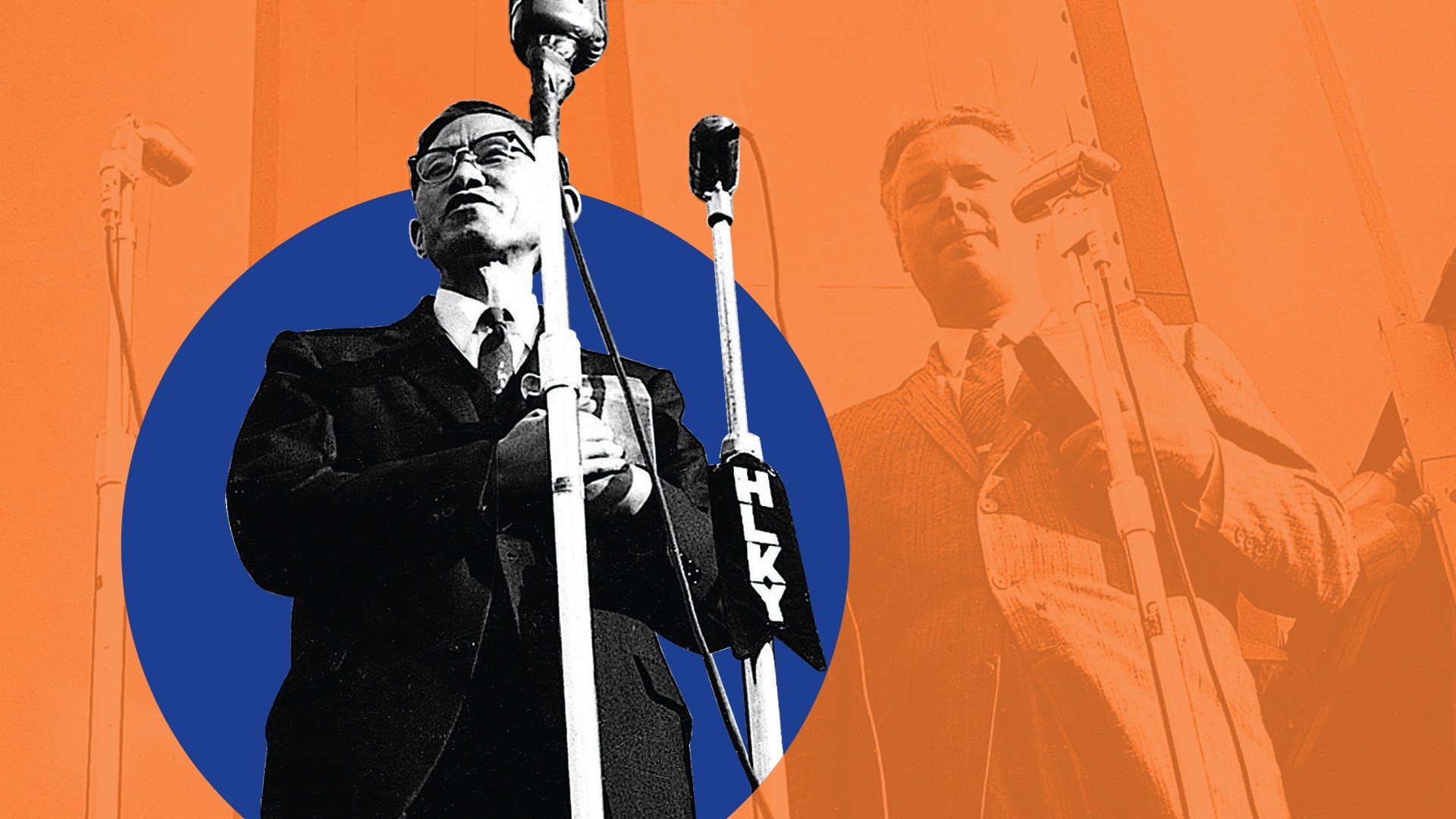
Upon reflection, Park’s assertion fit evidence that I had previously overlooked. I had seen several photographs in which Pierce and Han appeared on stage together, usually with a caption describing Han as Pierce’s “interpreter.” Indeed, many archival sources from the early 1950s described the two men appearing together, most often in Seoul. Han may have interpreted Pierce’s sermons into Korean for his parishioners, but Han also spoke in his own voice as the pastor of the largest Presbyterian church in the world—and as the architect of hundreds of humanitarian initiatives that were becoming the foundation of World Vision.

As Pierce became a legend, friend to presidents around the world and the recognized founder of World Vision, Han was ushered off the stage, disappearing from American consciousness.

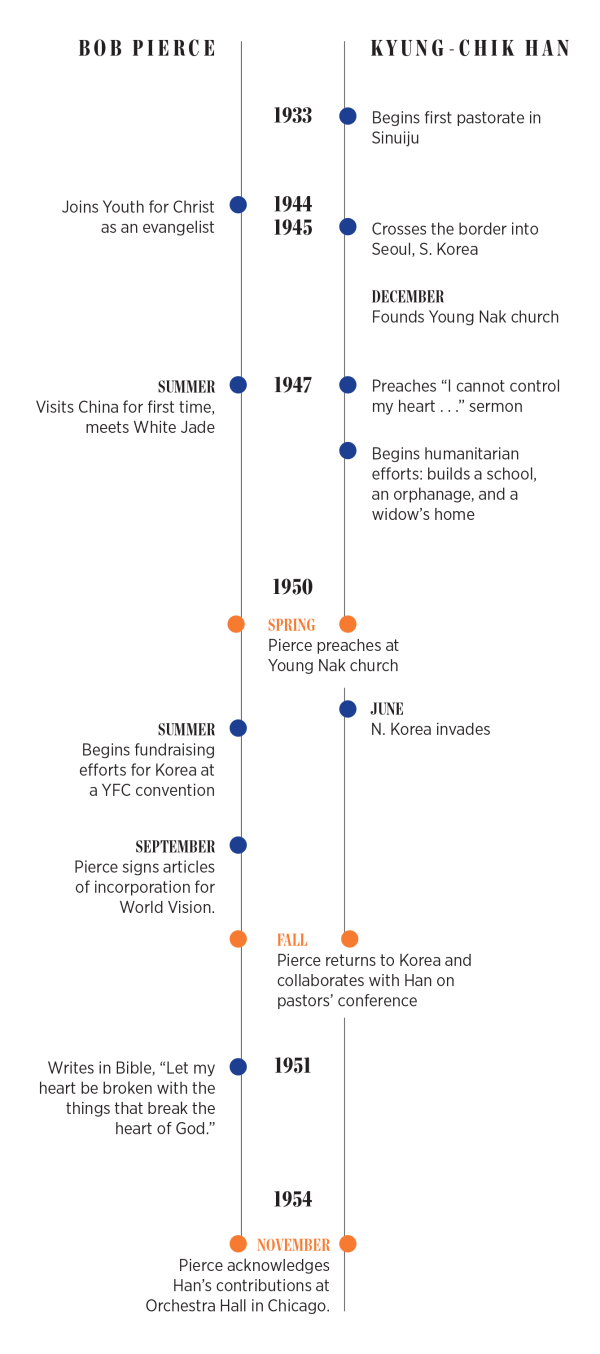
There were also clues in America about Han’s contributions. On one cold November evening in 1954 in Chicago’s Orchestra Hall, where Han earlier had appeared on stage, the irrepressible Pierce acknowledged his colleague’s evangelistic and humanitarian bona fides. Han, he said, was expertly distributing rice and the gospel to “war weary” Koreans. In this moment, a terrifying time in the Cold War when it appeared as if the United States and the Soviet Union might destroy each other with nuclear weapons, Pierce proclaimed hope for Asia, partly because of Han’s work on the Korean peninsula. Pierce called him “a man of God, full of the Holy Ghost, the real soul-winner.” But Pierce didn’t put all his hope in Han—or in God. He praised American bombers over Seoul, and he pledged to do his part. “I don’t expect to die in hospital sheets, I expect to die at the hand of a Communist.”

Pierce ended his sermon with a combination sales pitch–altar call:

How I pray tonight that there will be someone who will answer the call and give God your heart, to fill you with the Holy Ghost, and break your heart. . . . I have 600 children waiting [for] adoption this month. Their pictures are already taken, their names [could be] filed within ten days, if you will write on that envelope “I will adopt a child” and covenant with God that you will send ten dollars a month for a year.

With businesslike efficiency, ushers collected the pledges, moved the crowd out, and brought in a new one. Then Pierce gave the presentation all over again.

The money collected in Chicago went to a brand-new organization called World Vision. Like Billy Graham and growing evangelical institutions such as Youth for Christ and Christianity Today in the 1950s, World Vision nurtured a strong dedication to spiritual revival and a strong opposition to communism. What made it different was its emphasis on humanitarian relief. But this too was attractive to many American Christians, who propelled World Vision to prominence. The ministry grew from 240 sponsorships of children in 1954 to 1 million in 1990 and 3.5 million by 2015.

Today the recipient of multimillion-dollar grants from the US government and millions of small donations from individuals, World Vision is the 19th-largest charity in the United States by private donations. The American arm records annual revenues of more than $1 billion; combined revenues for World Vision International, the global umbrella organization, are $2.75 billion.

But 65 years ago in Orchestra Hall, the notion that World Vision was the brainchild of two men was already starting to fade. As Pierce became a legend, friend to presidents around the world and the recognized founder of World Vision, Han was ushered off the stage, disappearing from American consciousness.

An American Narrative

Pierce moved to Southern California in the 1930s, along with many other Americans devastated by the Great Depression. Dramatically converted to faith, he overcame an unstable childhood and a rocky marriage and began to preach salvation with the passion of a man who had radically experienced it himself. His charisma took him on a fast track through the surging Sun Belt evangelical world of Southern California Baptists, Nazarenes, and the Christian and Missionary Alliance. After serving at several churches as a youth leader and associate pastor, Pierce became an evangelist with Youth for Christ.

Pierce’s first international trips to China in the late 1940s fueled his anticommunist convictions. After notching 17,852 “decisions for Christ” during a stunningly successful evangelistic tour, he witnessed the destruction of hospitals, schools, and missionary compounds by the Red Army. Chinese pastors—new friends of the American evangelist—were murdered. Pierce, sometimes only miles from the front, barely escaped before Mao Zedong took all of mainland China. The specter of communism had turned into a ghastly spectacle.

With China lost, Pierce set his sights on Korea. But an early 1950 visit reinforced his sense of alarm. Russian forces lay across the 38th parallel, and just weeks after Pierce returned to the US, North Korea invaded. The attack, which sparked the Korean War, immediately engulfed Seoul and pushed the South Koreans to the southern coast. By September 1950, communists held more than 90 percent of the Korean peninsula.

A daring intervention at Incheon in November by General Douglas MacArthur, however, led to the recapture of Seoul. In fact, US and United Nations forces advanced northward all the way to the Yalu River on the border of Korea and China. Then the tide turned again. The sudden insertion of Chinese Communist forces reversed the progress, leaving Seoul once again, in Pierce’s description, a “bleeding, battered city.” And the war continued, going back and forth until 1953, when an armistice established a demilitarized zone at the same line at which the hostilities had begun three years earlier.

In Korea, as in China, Pierce’s work emerged as an existential response to communism. Pierce maintained a frenetic pace in those years of military action. At first watching helplessly from his home base in the United States, he began raising money for one of the first hot fronts of the Cold War. At a 1950 conference in Winona Lake, Indiana, Pierce told dramatic stories of Christian martyrdom as he pleaded for generous gifts. Billy Graham, who spoke after Pierce, told the crowd, “I had planned to buy a Bel Air Chevy, but instead I’m giving the money to Bob Pierce for the Koreans.”

On the spiritual front, Pierce continued an evangelistic offensive. In the midst of war, he persuaded 25,000 Korean civilians, Korean soldiers, and American soldiers to “turn from the darkness of heathenism and unbelief unto the glorious light of the Gospel.” South Korea’s President Syngman Rhee, a Christian, effusively praised Pierce’s successes. Pierce relayed in a newsletter that Rhee believed “Youth for Christ’s type of evangelism will help hold back the flood of atheism which is flowing through the Far East.”

If Pierce’s combination of wanderlust and revivalism was not unusual, his response to the suffering was. Though evangelicals had long built hospitals and schools around the world, the fundamentalist-modernist controversies of the 1920s had moved evangelicals, at least rhetorically, away from work that smacked of the social gospel. Pierce’s encounter with physical suffering and poverty in China and Korea, however, provoked him to reengage with humanitarian efforts both theologically and rhetorically.

Pierce’s humanitarianism was awakened through a personal encounter that became the myth of World Vision’s founding. He met a young Chinese girl named White Jade who had been beaten and disowned by her father after she converted to the Christian faith. Effectively an orphan, White Jade had no place to go. A local missionary did not have the capacity to care for yet another orphan. Pierce gave the missionary and White Jade all his remaining cash—five dollars—and pledged the same amount each month thereafter.

This encounter, among others, so moved Pierce that he wrote a sentence on the inside cover of his Bible: “Let my heart be broken with the things that break the heart of God.” This became World Vision’s mantra, and it birthed its child sponsorship program. American evangelicals could sponsor a Korean orphan for ten dollars a month to help with food, clothing, education, and religious teaching. Funds for “my orphanages,” as Pierce called them, jumped from $57,000 to over $450,000 between 1954 and 1956. By the late 1960s, World Vision had become a humanitarian behemoth familiar even to nonreligious Americans. As historian David King has shown, it patched together “the dichotomy between evangelism and social action that had ripped apart the Protestant missionary enterprise.” Pierce, it seemed, was the force of nature that set it in motion.

That’s the official World Vision history. But from Korea itself, there is another narrative, one that pushes back against a triumphalist American storyline and features Korean Christians influencing Americans.

A Korean Story

Han’s rise to prominence was even less likely than Pierce’s. Born to a Confucian family in 1902, Han grew up in a small, poverty-stricken village 25 miles north of Pyongyang. Revival swept through the area in the years around Han’s birth, and his family, along with many others, converted to Christianity. It is difficult to imagine now, but before Pyongyang became the capital city of an atheistic North Korea, it was the spiritual capital for all of Christian Asia.

Han himself was a very impressive young man. Church leaders, noting his amiable personality, exceptional intelligence, diligent work ethic, and vital faith, quickly identified his potential. Benefactors sent him to study at Princeton Theological Seminary with noted theologian J. Gresham Machen. Compelled by Machen’s intellect and theology but unimpressed by his pugnacious fundamentalism, Han occupied a middle theological space characterized by a gentle and ecumenical conservatism.

These qualities served Han well during his first Korean pastorate in Sinuiju, a large city at the border of China. If Pierce’s social concern was built on the intensely emotional response of a privileged American’s shock at foreign poverty, Han’s was rooted in the prolonged shepherding of a suffering flock. His 13 years in the far north of Korea were a productive if worrisome time, as his congregation dealt with profound social problems. Increasing Japanese imperialism was restricting Christian activities. His church suffered from a struggling economy, and there were few political freedoms. At one point, Japanese authorities, having tortured Han, forced him to bow to a Shinto shrine, an act he regretted for the rest of his life. Amid these difficulties, he nonetheless oversaw the construction of a church building, an orphanage, and a nursing home. Han was emerging as an important voice in religious and civic affairs.

Han’s rising prominence became most evident when Japan surrendered to Allied forces at the end of World War II. Han was tapped by the Japanese governor-general to oversee security during the transition. He established the Sinuiju Self-Government Association, which organized young men in policing efforts. But Han’s exhilaration at the overthrow of Japan gave way to despair. American rule in the north of Korea did not materialize as he had expected. Instead, a North-South boundary was established at the 38th parallel along with Soviet oversight of Sinuiju. The communists immediately cracked down and subjected millions to land seizure, torture, and summary executions. When an order was issued for his arrest, Han disguised himself as a common refugee. He managed to cross the border into South Korea, which was still leaky in late 1945.

Han’s leadership blossomed in Seoul. Exacerbated by a crush of refugees from the north, conditions were as bad in Seoul as in Sinuiju. Han was driven to despair as he walked among beggars, the homeless, and prostitutes. “I cannot control my heart,” he mourned in a sermon titled “A Gospel of the Propertyless.” “I cannot lift up my head, so that bending my head and walking became my habit.” Immediately he began securing tents, organizing refugees into cooperatives, assigning work duties, and establishing schools. In December 1945, he presided over the first meetings of 27 refugees at Young Nak Presbyterian, called the “refugee church” because of its predominate membership of displaced North Koreans. Within half a year, the church claimed 1,000 members. Within two years, it tallied 4,300.

For four years, these refugees held services in tents. Then, through Han’s connections in the United States, Young Nak raised $20,000 the refugees used for materials to build a giant stone Gothic structure by hand. All the while, Han continued his humanitarian work. In 1947, he began half a dozen new projects, including several orphanages, a widow’s home, more schools, and a funeral home. In 1948, he worked to get North Korean refugees voting rights. “To help the poor and the weak people must be the first,” declared Han.

On June 25, 1950, tragedy struck yet again. Just weeks after Young Nak completed its church building, North Korea invaded. The numbers of the poor and weak multiplied as both sides committed atrocities. One church leader was executed at Young Nak’s gate for denying entry to the invading forces who wanted to use the church as an armory. Reports circulated of 3,000 Christian pastors who were drowned in the Han River by communist forces. Within months, nearly the entire peninsula was razed.

Han’s humanitarian work accelerated in the chaos. One day after the war began, he launched the Korean Christian National Relief Society. He also led the Christian Union Emergency Committee for War. He negotiated with General MacArthur for tents from the US Army and distributed them in refugee camps. That Han served as a South Korean delegate to the United Nations in March 1951 underscores his status as a consummate insider who brokered high-level humanitarian deals. Han was a bureaucratic force of nature as he led dozens of Korean organizations.

Observers, trying to explain his organizational genius, noted that he was an unassuming leader whose quiet charisma gave his colleagues “inspiration and encouragement” to follow his lead. Others called Han a master mediator who could bring about consensus through gentle persuasion. He was also brutally efficient, working doggedly to produce the best results. One onlooker quipped that Han operated like a rational businessman “even though he claimed to just be an old servant of God.”

Facing West

Bob Pierce’s “rescue” of Korean Christians—and the West’s portrayal of his relationship with Han, the “exotic interpreter”—looks very different facing west rather than east. Before Pierce ever set foot in Korea, the foundation had already been laid for the construction of World Vision. Han, a distinguished churchman fluent in English, was already coordinating relief work and networking with contacts all over the world.

American evangelicals never narrated it this way, but it might be accurate to say that Han discovered Pierce as much as Pierce discovered Han. It was Han who in early 1950 invited Pierce, at an American missionary’s advice, to speak at Young Nak Church. Quickly discerning that Pierce could contribute to the humanitarian projects he had founded, Han hosted the evangelist the very night he arrived in Seoul. Pierce recorded that he preached to 1,500 congregants “huddled together in one great mosaic of human flesh,” and Han followed up on this new relationship almost immediately by inviting Pierce to preach at a large open-air revival in Seoul.

Sometimes, the interpreter is much more than an interpreter.

When war broke out just weeks later, Han kept Pierce apprised of conditions. In late 1950, they met again in Busan, South Korea, and worked together to hold a series of pastors’ conferences. At the culminating event, Pierce was the main speaker, and he paid for the entire conference. Han certainly interpreted for Pierce, as the Americans incessantly noted, but this did not mean he was the subordinate in the relationship. Han organized everything.

This collaborative arrangement became the pattern for the two humanitarians. Pierce spearheaded fundraising and publicity, and Han oversaw the infant ministries of World Vision. Most of these had been operational even before Pierce came on the scene. Under Han’s influence, their partnership increasingly took the form of social relief, work that became the heart of World Vision activity around the world.

Pierce was plugging into an already-existing humanitarian network constructed by Han. Before World Vision, there was Young Nak Church; before Young Nak Church there was Sinijui; before Sinijui there was a Christian family just outside Pyongyang. The genealogy of World Vision is profoundly Korean.

As the years passed, however, Han’s role in World Vision’s myth of origin diminished. A 1960 account by author Richard Gehman mentioned Han only briefly, as part of a Korean delegation that greeted Pierce at the Seoul airport. It credited Western groups for orphanage work. A 1972 tribute described Han as a devout saint and “a gentle, dedicated pastor” who built several orphanages and schools for refugees, but it included no acknowledgment that World Vision came directly out of Han’s activities before and during the Korean War. In 1983, Franklin Graham repeated the long-standing line that a “fine interpreter, Dr. Hahn [sic]” translated Pierce’s message “into understandable Korean.”

Man of Vision, a biography written by Marilee Pierce Dunker, Pierce’s daughter, acknowledged that Pierce “became involved with the Tabitha Widows’ Home, sponsored by the Yung [sic] Nak Presbyterian Church,” but nonetheless stated, “And behind every bit of it was the compassion, the energy, and the vision of one man; in fact, to most people World Vision was Bob Pierce.”

Despite Han’s continued involvement in both World Vision International and World Vision Korea, references to his legacy were overwhelmed by a triumphalist narrative of Western evangelical social action.

Pierce himself did not mean to obscure Han’s contributions. World Vision’s earliest literature offered descriptions of—and even glowing tributes to—Han. In his first memoir, The Untold Korea Story, Pierce effusively praised Han’s courage, piety, and prowess in serving his people. “Out of the chaos of the past,” wrote Pierce, “this man of God built a future for his people.” In an interview with CT, Dunker said her father “would be the first one to say, ‘I had the vision, but I didn’t do it. I was a fundraiser. I was the communicator. The people on the ground did it.’ ”

Nor did Han seem to resent Pierce as the rising star. Indeed, Han flew from Seoul to Los Angeles to preach at his colleague’s 1978 funeral, where he said, “The people of Korea can never forget him, for he was the best-known preacher of the gospel and welfare worker from abroad during the Korean War. . . . God be praised for him.” But Han’s qualifying phrase, “from abroad,” also testifies that Pierce was never the sole founder. Koreans have consistently portrayed World Vision as a collaborative enterprise of which Pierce and Han were cofounders. Pierce, says Park, the former World Vision Korea president, “was a master performer with a script. Koreans did 90 percent of it.” World Vision may have been incorporated in the United States, but a battered North Korean pastor actually built it in the slums of Seoul.

In a TED talk titled “The Danger of a Single Story,” Nigerian novelist Chimamanda Adichie describes how a dominant narrative can stereotype and ultimately disempower other actors. Many American Christians, understandably eager to enshrine the piety and progress of one of their own heroes, have done exactly this. The result has been a single, definitive story that emphasizes a strong, benevolent America and a needy, desperate Korea. To be sure, American money and technical expertise helped South Korea emerge out of utter devastation. Pierce was an important part of that. But the other story is that there was already a thriving Christianity, one that was arguably more vibrant than the American version, one that taught Americans about the value of fervent prayer, social relief, and development work. Sometimes, the interpreter is much more than an interpreter.

Transnational collaborations, like the one between Han and Pierce, are multiplying as faith moves in disorienting directions in this new century. More than two-thirds of the world’s Christians now live outside North America and Europe. And demographers forecast that the United States will become a majority-minority nation sometime in the 2040s.

Many American organizations, from Compassion International to InterVarsity to the National Association of Evangelicals, are anticipating the new realities and tapping Christians who look more like the majority world for positions of leadership. But it is also important to recognize that the shaping of faith-based institutions by people of color is not just a present and future reality. It is something that has been happening all along. It is time for mission agencies and humanitarian organizations to plumb their pasts in search of their own Kyung-Chik Hans. Who are the men and women lost to historical memory, or hidden all along, who have built Christian institutions across the globe?

For World Vision—which named Edgar Sandoval as its first nonwhite American CEO in 2018, internationalized its governance in the 1970s, and has featured a diverse constituency for half a century—this should be a natural move. Including Han in its founding narrative would much better fit what World Vision already is: a profoundly international and multiethnic organization.

There is evidence the narrative may, in fact, already be shifting. Forty years after writing her father’s biography, Dunker says she is writing her next book. It will feature Han’s story alongside those of other churches and individuals who laid the groundwork for World Vision to become the global powerhouse it is today.

David R. Swartz is an associate professor of history at Asbury University. He is the author of Facing West: American Evangelicals in an Age of World Christianity (Oxford University Press, April 2020).

Books

New & Noteworthy Fiction

Chosen by Valerie Fraser Luesse, a magazine editor, award-winning travel writer, and author of “Missing Isaac” and “Almost Home” (Revell).

The Words Between Us

Erin Bartels (Revell)

In a story that time-hops between the “then” and “now” of protagonist Robin Windsor and her high school love, Peter Flynt, Bartels traces the fragile but compelling relationship between two teenagers drawn together by loss and then pulled apart by secrets. If the adult Peter and Robin are to find each other again, both will have to muster the courage for a leap of faith. At its core, The Words Between Us is about trust and forgiveness: How much of either can any of us give, and how can we ever know in the moment if our gifts will be treasured or shattered?

The Bright Unknown

Elizabeth Byler Younts (Thomas Nelson)

From the first page, Brighton Friedrich lets the reader know that she somehow made it through the harrowing childhood she is about to recount. But as you journey back through her memories, you will doubt continually whether anyone could survive this with soul intact. Born and raised in an insane asylum during the dark ages of mental health care, Brighton can’t imagine any future for herself, even as she hopes for one. Though it will break your heart to keep watching as Brighton and her only childhood friend, Angel, struggle for survival, Younts’s powerful writing will draw you back in, time and again.

The Dutch House

Ann Patchett (Harper)

Even those of us who prefer paper books will happily turn to Audible when Tom Hanks is the performer. It’s hard to say which is more irresistible—Patchett’s story of the lifelong bond between a brother and sister, or Hanks’s reading of it. Born into the grandest house in their Philadelphia suburb, Maeve and Danny Conroy are abandoned by both parents, lose their money and their home, and spend years feeling misunderstood (except by each other). As the years pass, they return to the Dutch House and park outside, struggling together to make sense of their thwarted longings for home and family. (Note: This is not an inspirational novel, and it contains profanity—though, to be fair, it’s not used gratuitously or excessively and is true to character and situation.)

Books

Five Books That Capture the Blessings of Getting Older

Chosen by Michelle Van Loon, author of “Becoming Sage: Cultivating Meaning, Purpose, and Spirituality in Midlife” (Moody Publishers).

Thanasis Zovoilis / Getty Images

On the Brink of Everything: Grace, Gravity, and Getting Old

Parker J. Palmer

Palmer’s trademark mix of the contemplative and the prophetic fills the pages of this reflection on the gifts and challenges of aging. “Every hour,” writes Parker, “I’m closer to death than I was the hour before. All of us draw closer all the time, but rarely with the acute awareness that comes when old age or calamity reminds us of where we stand.” Embracing this awareness can move us toward true shalom as we age.

Adventure of Ascent: Field Notes from a Lifelong Journey

Luci Shaw

Shaw teases transcendence from the everyday things that mark a life lived well and long: colonoscopies, memory hiccups, yet another first day of spring, and many meaningful conversations. “I think I am learning to inhabit my own mortality,” she writes. This book invites readers to do the same, helping us marvel at God’s work in the final movements of life.

Falling Upward: A Spirituality for the Two Halves of Life

Richard Rohr

This book has been both prod and balm to many who have found themselves disoriented by the seismic shifts of midlife. Although Rohr’s theology veers from orthodoxy in places, discerning readers can glean much from his insightful descriptions of spiritual development in life’s second half. Falling Upward helped me understand that some of the desires and ambitions that served me well in the first half of my life often hampered my journey toward Christlikeness thereafter.

The Critical Journey: Stages in the Life of Faith

Janet O. Hagbert and Robert A. Guelich

This book shows how the physical and emotional changes we experience during each season of life can provide insight into the ways we mature in our faith. Hagberg and Guelich cast a vision of spiritual maturity marked by willing obedience to God, depth of wisdom, and full embrace of the sorrows, joys, and paradoxes of the life of Christ.

The Velveteen Rabbit

Margery Williams

This is a profound parable about aging and the hope of transformation disguised as a children’s book. A stuffed rabbit’s deepest longing is to become “Real,” and he does so only by being used up in the service of love—losing his life in order to find it. With each rereading, the image of the little stuffed bunny discovering that he can leap and dance with the other rabbits in the forest renews my vision of eternal life with God.

Books
Review

Youth Ministry Needs Less Fun and More Joy

The collapse of an older, activities-driven model has created room for a gospel-centered alternative.

Illustration by Eric Chow

This is Wednesday night youth group. We don’t do Bibles here. We’re here to have fun.”

The End of Youth Ministry?: Why Parents Don't Really Care about Youth Groups and What Youth Workers Should Do about It (Theology for the Life of the World)

That’s what a high school senior told me during my first week as a youth minister nearly two decades ago. At that church, I was only threatened with termination once, after several parents came to the senior pastor with the same criticism: Their children weren’t having as much fun as they did during the previous youth minister’s tenure. Clearly, in their minds, youth ministry was for fun.

The memory of that uncomfortable conversation resurfaced in my mind as I read Andrew Root’s new book The End of Youth Ministry?: Why Parents Don’t Really Care about Youth Groups and What Youth Workers Should Do about It. In the opening pages, one youth minister laments that every complaint and every expectation about her ministry “kept coming back to fun. . . . As if fun were freedom instead of a chain around my whole body.”

As someone who spent years fettered by the soul-draining weight of that chain, I was encouraged by the alternative that Root recommends: “Youth ministry is for joy.”

Changing Values

Root, professor of youth and family ministry at Luther Seminary, sets the stage for this claim by analyzing the history of American adolescence. His focus is “not on how to do youth ministry but rather on why to do it at all.” It’s here that Root is at his best. Working from the moral philosophy of Charles Taylor, best known for books like Sources of the Self and A Secular Age, Root illustrates complex social changes in easily understandable ways. In the process, he mounts a cogent argument for the obsolescence of the type of youth ministry that dominated the 1980s and ’90s.

Parents no longer prioritize youth ministry, according to Root’s retelling, because youth groups no longer provide the goods that they desire. In the heyday of youth ministry, peer groups were perceived as the proper context for children’s identity formation, and permissive parenting was viewed positively. Teenagers in particular developed their identities by spending unstructured time with groups of peers and experimenting together with the world of adulthood. From Fast Times at Ridgemont High to Stand by Me, E.T., and The Goonies, films of the 1980s idealized coming-of-age quests in which identities were forged by taking risks within a self-selected circle of friends.

There were dangers, however, particularly when the risks turned romantic. This is one reason why youth groups became so popular. Church-based peer groups decelerated the rush toward adulthood by providing teenagers with a safer circle of friends within which personal identities could take shape. Weekly youth group gatherings were packed with fun activities that provided all the benefits of risky coming-of-age quests without any authentic peril. Emotionally charged worship at camps and retreats fed feelings of love and longing while (at least in theory) turning these desires toward Jesus.

But times have changed, and peer groups that provide safe risks are not what parents value most. Among youth, the quest for recognition through social media has eclipsed the peer-group experimentation that characterized earlier generations. Among parents, permissive parenting has given way to what Root calls “constant, hovering parental presence.” As a result, coming-of-age quests have morphed into parent-managed pilgrimages aimed at discovering which activity or hobby will become each child’s “thing.” Parents provide their children with a smorgasbord of different activities because, as Root observes, they hope “one or two will stick. . . . The garage full of discarded tennis rackets, musical instruments, one-time-worn gymnastics outfits, and unused golf clubs witnesses to this reality.” The assumption is that a pain-free discovery of each child’s “thing” will secure her or his present happiness and future success.

These parents don’t deliberately devalue youth ministry or church. For the most part, their feelings are grounded in worldviews of which they’re likely unaware. By and large, youth groups simply don’t strike them as very important. At most, they might help students find their identities and provide a safe refuge during difficult moments. And that’s why youth ministries that focus on high-energy activities and emotionally charged events have become obsolete.

But what if—as Root suggests early on—the goal of youth ministry is joy? This would take the focus off of producing activities that compete with parent-managed quests to find a child’s “thing.” Joy-oriented youth ministry “seeks to give young people visions and practices in which the point of life is to encounter and to participate in the Good.”

Activities and events build our identities only if they are embedded in stories, and the only stories that satisfy our deepest longings are shaped by the story of the cross and the empty tomb. Helping youth to reconceive the pain and promise of their stories in light of the gospel doesn’t decelerate movement toward adulthood. Instead, it makes space for recognition and identity formation without competition and resentment. Youth ministry then becomes a place where students and adults “share stories and are open to something bigger that ushers us into joy.”

Blind Spots

Root’s writing is elegant and precise. Extended quotations are quarantined in footnotes, which frees Root to craft a readable narrative while still providing scholars with necessary points of reference. His depiction of the rise and decline of youth ministry is well researched and compelling.

However, Root’s prescriptions for the future seem somewhat less compelling. Throughout the book, he weaves a touching but apparently fictional story of a ministry that was transformed after a teenage girl’s brush with death. The narrator’s month-by-month journey of interviewing parents and youth workers mixes “factual occurrences and made-up characters to articulate larger points.” Yet, because Root writes in the first person singular and intertwines this fictional narrative with his own reminiscences, it’s difficult to tell where fiction ends and fact begins.

As a literary device, this fuzziness is of little consequence. But these narratives form the foundations for Root’s advice to workers and volunteers in youth ministry, which left me wondering whether his prescriptions might be based on little more than his ruminations and a handful of unstructured conversations.

The End of Youth Ministry? also operates with some significant blind spots regarding lower-income families. To be fair, Root does declare in the opening pages that, “because congregation-based youth ministry remains mainly a middle-class phenomenon, I’ll locate my story there.” I’ve invested most of my ministry years into low-income and inner-city contexts, and I would suggest that his middle-class lens is deeply mistaken.

Youth groups began in middle-class contexts in the mid-20th century, but they didn’t stay there. By the 1980s, many rural churches were doing everything in their power to hire part-time youth ministers, and congregations in economically challenged areas had weekly youth group gatherings overseen by volunteers. Even if Root is correct in claiming that youth ministry remains a middle-class phenomenon, the upshot is a package of prescriptions aimed at a demographic that’s largely white, privileged, and rapidly shrinking. Perhaps, within this demographic, it makes sense to equate parenthood with shuttling children to ballet, piano, hockey, debate, SAT tutoring, and a stream of other activities. Root’s fixation on this demographic seems blind to life outside the middle class.

My own church’s youth ministry includes several teenagers who remember vividly the summer four years ago when six people were shot to death within sight of the church’s bell tower. The freedom to discover their “thing” by participating in traveling baseball teams and SAT tutoring requires an infrastructure largely beyond their reach. This isn’t simply an issue of cost. It calls for a family structure secure enough to allow risk and possible failure. It requires households where parents have jobs that are salaried and flexible. Neither the diagnoses nor the recommendations in The End of Youth Ministry? takes these students’ experiences into account.

A few weeks ago, conversing with a single mother who works an hourly wage job, I asked, “What does your son need?” Her response was more a lament than an answer: “All he needs is somewhere to be other than here in the house. I save up and buy him a new video game every month; I know it’s not good for him to be just playing those games all the time, but it’s either a game inside or a gang outside.”

A book that sets a vision for the future of youth ministry ought to include something for families like hers. I’m not suggesting this woman’s son needs the activity-driven youth groups of the 1980s and ’90s. Maybe what he needs most is a youth ministry built for joy. And yet, The End of Youth Ministry? seems to operate with little awareness of the challenges standing between transcendent joy and the experiences of families like this one.

Promising Avenues

Twenty years ago, when I was informed that youth group was more a matter of fun than of Bibles, I replied—once I regained my voice—that “things are different now.”

In that moment, I was speaking more truth than I knew. The demise of the youth-ministry models of the 1980s and ’90s was well underway. In The End of Youth Ministry?, Root provides a helpful diagnosis and a hopeful response. The book is not without its oversights, but I’m encouraged by its emphasis on cultivating joy. Root has opened promising avenues for further research into a model of youth ministry aimed toward transcendent goodness and structured around the narrative of the cross.

Timothy Paul Jones is the C. Edwin Gheens Professor of Christian Family Ministry and chair of the Department of Apologetics, Ethics, and Philosophy at The Southern Baptist Theological Seminary. He is the editor of Perspectives on Family Ministry: Three Views (B&H Academic) and serves as a teaching pastor at Sojourn Church Midtown in Louisville, Kentucky.

Books
Review

God Likes You. He Really Likes You!

Scripture has a resounding reply to our doubts about his longing to be with us.

Gerard Puigmal / Getty Images

I’ve given up trying to keep on top of the Star Wars and Avengers franchises. I still watch the movies with my son, but I’m incapable of remembering the minor characters and plot details from six movies ago. Even when I enjoy the action on the screen, I feel certain I’m missing something.

Does God Really Like Me?: Discovering the God Who Wants to Be With Us

Does God Really Like Me?: Discovering the God Who Wants to Be With Us

IVP

224 pages

$9.99

When my dental hygienist started attending church recently, I wondered if that’s how she feels. Even for preachers and theologians, it’s a challenge to tie the individual passages and stories of Scripture to the overall plot. What hope is there for her?

Does God Really Like Me?: Discovering the God Who Wants to Be With Us is a helpful book both for people who are trying to learn the basics of Christianity and for those who already know the basics but feel disconnected from God. It addresses common questions—like “Does God love me?” or “Is this all there is to life?”—with the story of Scripture, inviting us to reimagine our lives in light of the answers.

“We’re convinced that everything changes when we believe God is glad to be with us,” write the authors, Geoff and Cyd Holsclaw, both of whom are pastors at Vineyard North Church in Grand Rapids, Michigan.

As A.W. Tozer once said, “What comes into our minds when we think about God is the most important thing about us.” Most of us seem to believe that God tolerates us, but we have a hard time believing he is truly glad to be with us.

The authors relate. They share stories of their struggles with matters like significance, worthiness, and identity. Cyd describes feeling insignificant as a new mother. Geoff admits that he’s naturally competitive, always measuring himself against others. We read about cats, car accidents, relocations, sibling fights, parental deaths, and more.

The Holsclaws aren’t interested in answering abstract questions. Instead, they want to deal with the shame and disconnection we feel in our relationship with God. The practices, reflections, and exercises that close each chapter help us experience the truths they write instead of just thinking about them.

Does God Really Like Me? looks like a self-help book, but it’s actually a biblical theology book in disguise. The Holsclaws take us on a journey from Genesis to Revelation, exploring the themes of “God with us” and “God through us” in four parts: God’s idols in creation (or what it means to be made in God’s image), God’s house in Israel, God’s body in Jesus Christ, and God’s movement in and through the church. “We’ll show you,” they write, “how God continually demonstrates a desire to be with his people—no matter what we do. And we’ll highlight the ways God always invites people to join him in his unfolding plan to spread new and unending life throughout the entire world.”

The Holsclaws teach key theological principles about humanity, sin, God’s holiness, the gospel, the church, and the future while tracing the story of Scripture around a unified theme. Their book equips us to understand and participate in God’s story as it unfolds around us.

Does God Really Like Me? would help my dental hygienist understand the main theme of Scripture: that God, more than just liking us, longs to dwell with us. It would also introduce her to some solid theology while answering questions I’m sure she’s asked.

But the book is equally valuable for believers who already understand Scripture yet can’t shake the nagging suspicion that God regards them with disappointment. It would especially help someone who is quick to understand God’s judgment but struggles to believe in God’s love.

“Making disciples involves more (but not less) than informing minds or forming habits,” writes theologian Kevin Vanhoozer. “It also involves transforming imaginations, that is, the primary ways they see, think about, and experience life.” In that sense, Does God Really Like Me? could play an important role in reshaping our imaginations as we try to connect our deepest questions, insecurities, and doubts to the story of God’s relentless pursuit of his people.

Don’t read this book just to understand the Bible. Don’t even read it just to answer your questions and doubts. Read it to transform your imagination of what life is about: God’s desire for us to live in his presence, his actions to make this possible, and his plan to bless the world through our kingdom labors. Read it to remind yourself of the relationship you have with your Father and the love, joy, and purpose it secures.

Darryl Dash is pastor of Liberty Grace Church in Toronto and the author of How to Grow: Applying the Gospel to All of Your Life (Moody Publishers).

Books

The ‘Over There’ Era of Missions Is Over

Nowadays, the Western church needs to send ambassadors to its own culture.

Illustration by Mallory Rentsch / Source Images: Joseph Pearson / Zhu Hongzhi / Unsplash / Cavan Images / Getty Images

Over There,” George M. Cohan’s rousing World War I anthem, captures much of the Western church’s perception of missions over the last century. The field was abroad. And we, the Christianized West, sent the word—through missionary personnel, resources, programs, and institutions—over there. Nowadays, our “here” increasingly resembles foreign territory, as the Western church finds itself on the social and cultural margins. In Exiles on Mission: How Christians Can Thrive in a Post-Christian World, Paul S. Williams, CEO of the British and Foreign Bible Society, calls us to embrace the opportunities this new position affords. Evangelism as Exiles author Elliot Clark, who works with Training Leaders International, spoke with Williams about serving as God’s ambassadors to our own culture.

Exiles on Mission: How Christians Can Thrive in a Post-Christian World

You have a unique combination of ministerial and marketplace experience both in the UK and North America. How does that background inform your writing on the challenges facing the Western church today?

In my twenties I was wrestling with how to relate my faith to my work. I had grown up in a Christian family, walked away from the faith, gone to university, and grown very ambitious in a worldly way. Then I had a fairly dramatic encounter with God that brought me back to faith. This was the 1980s, and I was caught up in London’s “Big Bang,” a time of massive growth in finance and investment banking. Huge sums of money were being thrown at young graduates like me. Money and power were the worlds in which I’d been formed to succeed through my education.

I knew, as I returned to faith, that if Christianity meant anything at all, it meant the lordship of Christ over all of life, economic and political power included. And I began to comprehend the sacred-secular divide in the modern West, not merely as a conceptual idea but also what it meant in practice.

How do you see the church still operating as though Western culture were basically Christian?

I don’t think we come close to grasping the level of ignorance about Christianity—what the gospel is, what the Bible teaches—in Western societies.

My organization did a survey that found that people weren’t sure if the nativity story was in the Bible. A ridiculously high percentage of adults thought Superman might be in the Bible. You’re talking about a staggering level of ignorance, which completely changes the way you think about communicating with unbelievers. In many ways, Westerners aren’t even aware of the God they’ve rejected. So there is a new openness, a curiosity, that creates new opportunities to educate.

If we are a church on mission, how do our discipleship practices need to change?

Growing up, the expectation in my church community was a rigorous discipleship program, especially for young people. You made serious commitments to Bible reading and memorization, serving others, public evangelism, and righteous living. You developed accountability relationships with mature believers. It was challenging, but that’s precisely why you wanted to be involved.

What I see now—through the lens of students I talk to, as well as my own children—is that even the best churches take discipleship to mean getting a certain age group together and having a large program with activities and games. Maybe there’s a Bible talk or a time of prayer, but nothing with an edge to it. There’s no challenge, no requirement.

The young people I speak to are fed up with that. They want to get serious. Jesus wanted disciples who understood there was a cost. But we’ve lost confidence that there is such a cost and that it’s worth paying. There’s a timidity in our approach to discipleship that goes alongside a lack of confidence in the Bible itself.

You spend a good portion of the book talking about different societal and cultural narratives. Why is it important to understand these narratives?

A basic principle of good communication is understanding your audience. When Christians are involved in cross-cultural missions or Bible translation, we understand this dynamic well—to make sense to people from different linguistic and cultural backgrounds, we have to make the effort to learn their languages and ways of thinking.

When we are communicating with non-Christians in our own society, we can easily make the mistake of neglecting this step. But communicating the gospel is always a cross-cultural event, because our culture isn’t the culture of biblical times. So to truly love those around us, we must make the effort to understand how they think and why, so that our communication expresses the truth and grace of the gospel.

A final reason concerns us. We are steeped in the narratives of our own culture, and since those are not fully biblical, we are ever in danger of ideological capture. If we neglect Paul’s instruction to be transformed by the renewing of our minds (Rom. 12:2), we’ll end up being conformed to the surrounding culture.

Regarding life in exile, what can believers in the West learn from sisters and brothers around the world?

I don’t want to put the persecuted church on a pedestal as having everything right. They also face the temptation to ally politically with whichever strongman appears most likely to defend them. Nonetheless, I think of the experience of the church in places like Egypt, where I’ve had the privilege of getting to know Coptic believers. They’re very courageous. They’re not political in the sense of getting involved in public policy or trying to control the state. But they’re prophetic publicly. They have a sense of what it means to serve Muslim neighbors. They’re remarkable witnesses.

I’ve had a similar experience in China, another environment where the church faces enormous political pressure. Hearing how some of the house church leaders speak the blessing and favor of God on the Communist Party without compromising their message is quite remarkable. It’s a challenge to the way we handle the vitriolic social media politics of our day.

The church in the West is also under pressure, albeit pressure of a very different sort. There’s a mutual need to provoke and learn from one another. But Christians in the West cannot possibly learn from or speak to Christians in other cultures unless we’re willing to recognize our essential spiritual equality. For me, one of the hopeful aspects of globalization is the possibility of a growing consciousness of the global church.

In the book, you highlight our role as ambassadors. How is it helpful for exiles to see themselves as ambassadors, rather than aliens or visitors?

In each case—as an ambassador, an alien, or a visitor—I am a foreigner in a strange land. But the alien has the feeling that somehow this is happening against my will. And I think that describes much of the church’s mentality at the moment. Culture is moving away from Christ, from the Bible, from the church, and we feel threatened.

A visitor can cope with unpleasant feelings by saying, “I’m just passing through. I have to be faithful in this life, but it’s all going to burn anyway.” This was, in a way, the message of the false prophets during Jeremiah’s time.

But Jeremiah tells the exiles in Babylon to seek the welfare of the city (29:7). Paul and Peter tell us to live as citizens of heaven, conducting ourselves honorably here on earth so that people will give glory to our Father in heaven. That is the spirit of the ambassador who says, “Yes, I’m in a strange land, but I’m here on purpose. I’ve been sent, and I’ve got something to do.”

Apple PodcastsDown ArrowDown ArrowDown Arrowarrow_left_altLeft ArrowLeft ArrowRight ArrowRight ArrowRight Arrowarrow_up_altUp ArrowUp ArrowAvailable at Amazoncaret-downCloseCloseEmailEmailExpandExpandExternalExternalFacebookfacebook-squareGiftGiftGooglegoogleGoogle KeephamburgerInstagraminstagram-squareLinkLinklinkedin-squareListenListenListenChristianity TodayCT Creative Studio Logologo_orgMegaphoneMenuMenupausePinterestPlayPlayPocketPodcastRSSRSSSaveSaveSaveSearchSearchsearchSpotifyStitcherTelegramTable of ContentsTable of Contentstwitter-squareWhatsAppXYouTubeYouTube