Lighting the Way Back Home

Our ongoing call to offer clarity in confusing times.

Tim Foster / Unsplash

A friend recently asked for my opinion on the greatest challenge confronting American evangelicalism. He listened patiently as I offered a few thoughts. “There’s a deeper problem beneath those things,” he said. “It’s a crisis of leadership.”

The more I’ve considered the matter, the more I consider his words both true and ironic. An older generation of American evangelical leaders has passed away or passed the baton. When it comes to the younger generation, scarcely a week passes when we do not have another noteworthy Christian leader suffering a deeply destructive fall from grace. The ironic part is this: Evangelicals produce and consume countless books, seminars, and events on leadership. We have a thriving Christian leadership industry, yet we’re starving for Christlike leaders. Why is there so much leadership content and so little leadership character?

In our December issue I introduced the first of four strategic initiatives that will shape the future of Christianity Today. As I explained, CT Global will create a kind of central nervous system for the body of Christ, raising up storytellers and thought leaders around the world. The second initiative is simply called CT National. Billy Graham explained that he founded Christianity Today to be a clear voice, speaking with conviction and love. We are rededicating ourselves to that vision, to doing it better than ever.

As we move forward, we wish for Christianity Today to better represent the beautiful (and increasing) diversity of the American church. Men and women of evangelical conviction with a passionate love for Jesus Christ are found in churches of every ethnicity. They should see more of themselves and hear more of their voices in the pages of CT. We are also recommitting ourselves to deep reporting and storytelling here and overseas, so that American evangelical pastors and laypeople can be inspired to think more deeply and more broadly. Finally, we are recommitting ourselves to thought leadership. Sometimes Christianity Today has served as a pulpit, where the most insightful evangelical voices share their thoughts with the world. Sometimes it has served as a table, a place to discuss the vexing challenges we face as a community. We wish to serve both roles with excellence.

We believe Christianity Today is called both to be a leader and to serve leaders. Countless churches are foundering on the shoals of social, political, technological, and generational change. Despair and unbelief ride the tides. In the years to come, Christianity Today will reinvest in its aim to be a lighthouse, illuminating a path through the troubled waters for our brothers and sisters in the faith, and calling more of our friends and family home to the love of Jesus Christ.

Timothy Dalrymple is president and CEO of Christianity Today. Follow him on Twitter @TimDalrymple_.

News

Black Protestants, Evangelicals Top Rankings for Longest Sermons

Pew Research Center finds more mentions of praise in black churches’ messages and more mentions of sin in evangelicals’.

Christianity Today December 16, 2019
York Creative / Lightstock

How long should a sermon be?

The major branches of Christianity in the US have sharply different traditions, with sermons at historically black Protestant churches lasting—on average—nearly four times as long as Roman Catholic sermons.

That’s among the findings of an analysis by the Pew Research Center—billed as the first of its kind—of 49,719 sermons delivered in April and May that were shared online by 6,431 churches. Pew described its research as “the most exhaustive attempt to date to catalogue and analyze American religious sermons.”

According to Pew, the median length of the sermons was 37 minutes. Catholic sermons were the shortest, at a median of just 14 minutes, compared with 25 minutes for sermons in mainline Protestant congregations and 39 minutes in evangelical Protestant congregations. Historically black Protestant churches had by far the longest sermons, at a median of 54 minutes.

Pew Research Center

Pew said sermons at the black churches lasted longer than mainline Protestant sermons even though, on average, they had roughly the same number of words. A possible explanation, Pew said, is that the preachers at black churches allow more time during their sermons for musical interludes, responses from worshippers in the pews and dramatic pauses in their oratory.

Numerous prominent pastors have pondered the question of a sermon’s length.

“I’ve asked and been asked that question a hundred times,” Hershael York, a professor of Christian preaching at the Southern Baptist Theological Seminary, wrote in 2016. “Today, after 35 years in ministry, I have a definitive answer: You can preach as long as you hold their attention.”

The question came up in a 2018 episode of “Ask Pastor John,” a Q-and-A forum hosted by the John Piper, chancellor of Bethlehem College & Seminary in Minneapolis. He said he generally needs at least 40 minutes, sometimes more than 50, to deeply explore his themes.

“If I look around the nation, there are many hundreds, maybe thousands, of growing churches where pastors preach rich, Christ-exalting, God-centered, Bible-saturated, textually rooted, intellectually challenging, emotionally moving, life-altering sermons for 50 or more minutes, and very few people get frustrated that they are too long,” Piper said.

Missouri-based researcher/writer Chris Colvin, who helps pastors with sermon preparation, notes that Jesus’ Sermon on the Mount—containing some of the most powerful passages in the Scriptures—can be read aloud in less than 15 minutes.

Pew Research Center

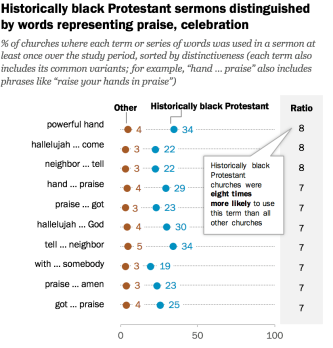
In addition to sermon length, the new Pew analysis delved into an examination of words and phrases most commonly used by preachers from the different Christian traditions.

It found that the word “hallelujah” appeared in sermons from about 22 percent of the historically black Protestant churches, and those congregations were eight times more likely than others to hear that word.

Sermons from evangelical churches were three times more likely than those from other traditions to include the phrase “eternal hell.”

Editor’s note: Pew also reported on Bible references in sermons:

The sermons that American churches share online are heavily laced with Scripture: 95 percent reference at least one book, Gospel, or epistle of the Bible by name, and more than half (56%) cite particular books from both the Old Testament (also known as the Hebrew scriptures) and the New Testament (which includes the Christian Gospels) in the same sermon.

These numbers vary across Christian groups, with evangelical churches being the most likely to reference a book, Gospel or epistle of the Bible by name—doing so in 97 percent of all sermons. Pastors across the country are more likely to reference the New Testament by name (90% do so) than to mention the Old Testament (61%).

Pew said the sermons it examined came from 2,156 evangelical congregations, 1,367 mainline Protestant congregations, 422 Catholic parishes and 278 historically black Protestant congregations, while other congregations could not be reliably classified. The research did not analyze sermons delivered in synagogues, mosques or other non-Christian congregations.

Associated Press religion coverage receives support from the Lilly Endowment through the Religion News Foundation. The AP is solely responsible for this content.

Ideas

Knocking on My Jewish Neighbor’s Door

How to move forward in the complicated relationship of African Americans and Jews.

Christianity Today December 16, 2019
Source images: Getty / Unsplash

The recent prolonged firefight in Jersey City left six people dead and raised again the ugly specter of anti-Semitism in America. One of the two assailants who attacked a kosher supermarket was said to have written anti-Semitic posts and has been part of an organization known as the Black Hebrew Israelites that spreads anti-Semitic teachings.

I appreciate the common ground my black community shares with the Jewish community. Both have endured a history of oppression.

This is the second time this year when the group has come to public attention. The first occurred when a video went viral showing Covington Catholic High School student Nick Sandmann in conversation with Nathan Phillips, a Native American activist, at the Lincoln Memorial. The Washington Post eventually discovered that both Sandmann and Phillips had been goaded and preached at by “a small band of Hebrew Israelites.”

This group, despite and perhaps because of their hate-filled rhetoric, reveals some of the complexity of black-Jewish relationships in America today. My own Christian faith and black identity have made me grasp these tensions even more deeply. And it’s not just me. A recent study conducted by Lifeway Research shows the same.

A Common Heritage—and Divergence

I appreciate the common ground my black community shares with the Jewish community. Both have endured a history of oppression and a history of resisting the evils of prejudice and discrimination. In many ways, the horrors of the transatlantic slave trade and the Holocaust, as well as the racist and anti-Semitic narratives that drove them, frame our imaginations. In addition, black Christians resonate with the God of the Hebrew Bible (what Christians call the Old Testament) and hope in the same stories of faith and liberation.

Years ago, as a student at the University of Pennsylvania, I participated in a group, Alliance Understanding, which brought together black and Jewish students for dialogue and cultural exchange. Our immersive learning experience culminated in a trip to the main Hasidic synagogue in Crown Heights in Brooklyn and the historic, black Abyssinian Baptist Church in Harlem, which fostered conversations that I’ll never forget.

At the same time, relationships between blacks and Jews have not been without tensions. I have found at times that the points of divergence are more apparent than those of convergence. Sometimes the rush to claim or assume “sameness” of my black experience prevented my Jewish friends from appreciating our historical differences.

The Israel-Palestine conflict is not the primary measure of the state of black-Jewish affairs, but it is significant marker. The Lifeway study, sponsored by the Philos Project, an organization committed to “promoting positive Christian engagement in the Middle East,” found that 7 out of 10 black people “sympathize equally with the hardships Israelis and Palestinians face.” dship. And 42 percent of those surveyed responded “Not sure” to statements like “Israel denies Palestinians basic human rights.” At the same time, 42 percent of African Americans surveyed viewed Israel in a “positive way” while 32 percent were unsure.

Historically, blacks and Jews have had a close and productive relationship as minorities in the United States. But the relationship has also been fraught with tensions.

Such findings reveal not only the diversity of views within the black community, but also uncertainty about issues facing Israel and Jews. Historically, blacks and Jews have had a close and productive relationship as minorities in the United States. But the relationship has also been fraught with tensions. It’s a complexity I have experienced personally as an African American who lives in Crown Heights, where the two major demographics are ultra-orthodox Lubbavitch Jews and Afro-Caribbeans, and where tensions between the two flared up over 25 years ago.

Historically, if you were critical of Israel, especially if you believed that Jews had disproportionate influence in the US, you were considered anti-Semitic. However, in a racialized society that privileges whiteness, “disproportionate influence” can often be more an expression of race. And yet, it’s without question that antagonism toward Jews and resistance to a Jewish state has a long history. In Nehemiah 2:10 we read:

When Sanballat the Horonite and Tobiah the Ammonite official heard about this, they were very much disturbed that someone had come to promote the welfare of the Israelites.

It’s a pattern we unfortunately witness throughout the centuries and tragically has re-emerged recently in terrorist attacks. At the white supremacist march in Charlottesville in 2017, organizers chanted, “Jews will not replace us!” This legacy of anti-Semitism spreads with a sinister twist today in the teachings of many of the sect known as the Black Hebrew Israelites.

Black Israelites

Kendrick Lamar’s highly acclaimed 2016 album, DAMN, became a watershed moment in awareness of this group. Its teachings were featured in the album’s interludes and lyrics, bringing national awareness to the previously obscure group that had been known mostly in New York City. While Lamar himself has not identified himself with this sect, the album caused urban ministers like myself to respond.

The Black Hebrew Israelite claim is … that modern-day Jews descending from Europe (and white people more broadly) are despised Edomites, the hated rivals of the Jewish people.

In their just pursuit for dignity, members have pressed the black identification with the Jewish people too far. They make the controversial, provocative claim that more or less goes like this: “Not only can Black people draw inspiration from the Jewish people in the Exodus, we are the people of this story, the real Jews.” The Black Hebrew Israelite claim is not simply that some Jews were of African descent (which is true), but also that modern-day Jews descending from Europe (and white people more broadly) are despised Edomites, the hated rivals of the Jewish people in the Old Testament. Black Hebrew Israelites accuse most Jews (especially those who are white) of being impostors, who stripped the true Jews (the African Diaspora who suffered from the transatlantic slave trade) of their identity.

This group is growing, though its social media and internet presence is disproportionately larger than its actual population. Lifeway recorded that 4 percent of the black people it surveyed identified as Black Hebrew Israelites. That would make their population 1.6 million. It’s hard to extrapolate like this based on one survey, but urban apologists like former Hebrew Israelite Muhammad Tanzymore and author Vocab Malone (who wrote a primer on the topic) have shown that this group is one of the fastest-growing sects in the black community. It represents a vocal minority of black people whose appropriation of Jewish identity poses a unique challenge to black-Jewish relationships.

The Palestine Issue

Another unique factor in all this is black identification with Palestine.

In January 2019, civil rights icon Angela Davis was recognized by the Birmingham Civil Rights Institute for her lifetime of civil rights activism. The institute later revoked the award after facing backlash from Jewish communities in light of Davis’s support of the Boycott, Divest, Sanctions (BDS) movement, which staunchly criticizes Israel for its treatment of Palestinians. After a backlash to the backlash, the institute restored the award to Davis.

Footage of unrest in Israel and Palestine resonates with black viewers because it reflects antagonisms between law enforcement and impoverished communities that they have experienced. Davis, like many other progressive blacks, claims that direct parallels can be drawn between racial injustice in the United States and what we witness between Israel and Palestinians.

While there are some similarities, I’ve discovered divergences as well. Until I visited Israel and Palestine, my own views were shaped primarily by what I saw on television; I didn’t have a more nuanced appreciation of the existential threat to their existence that both Jews and Palestinians feel. On my last trip to Israel, I was subjected to increased screening by Israeli security in Tel Aviv. The questioning intensified once I handed over my American passport and they saw my very Arabic name: my Muslim origins caused the flight to be delayed. It is impossible for me to ignore my own experience. And yet, I also learned how the legacy of anti-Semitism and a history of terrorism has required a vigilance of a nation surrounded by political enemies. I left with more questions than answers.

Dr. Martin Luther King Jr.’s words and images are too often employed disingenuously to support a myriad of causes and perspectives, usually without nuance or precision. Pro-Israel advocates can quote from a letter he wrote to the Rabbinical Assembly in 1968 shortly before his assassination:

Peace for Israel means security, and we must stand with all our might to protect its right to exist, its territorial integrity. I see Israel as one of the great outposts of democracy in the world, and a marvelous example of what can be done, how desert land can be transformed into an oasis of brotherhood and democracy. Peace for Israel means security and that security must be a reality.

And at the same time, Michelle Alexander, author of the best-selling The New Jim Crow, referenced King in her strong critiques of Israel in an article in The New York Times earlier this year. She quoted King’s consternation in 1967 when he shared with his advisors his ambivalence about going to Israel:

I just think that if I go, the Arab world, and of course Africa and Asia for that matter, would interpret this as endorsing everything that Israel has done, and I do have questions of doubt.

He ended up canceling his trip. His hesitancy to “endorse everything that Israel has done” is juxtaposed to King’s insistence that “Peace for Israel means security and that security must be a reality.” King’s consternation is one that I often share.

That tension reflects the essential complexity of the black-Jewish relationship in America.

Moving Forward

In 2017, I joined a group of pastors invited to experience Israel with the Philos Project. We traveled to Palestine and Israel, heard lectures from Jewish and Palestinian ambassadors about the conflict, and were able to engage in discussion with each other.

One highlight was meeting a community of Ethiopian Jews who made aliyah (immigrated to Israel). They traced their Jewish heritage back to King Solomon, and shared both enthusiasm and frustration about the opportunity to live in a place they had dreamed about. They said, for instance, that they often experienced discrimination—something I could relate to.

While in Jerusalem, I learned about Purim, the Jewish festival celebrating the saving of the Jews as recorded in Esther. When I returned to Crown Heights, I decided to give my Hasidic Jewish neighbors a gift to celebrate when Purim rolled around. As I knocked on their door, I faced the fears that a black man knows when knocking on a white stranger’s door, as well as the awkwardness of a Gentile intruding on an ultra-orthodox home.

As the door opened, I said “Happy Purim” and offered my gift. A gregarious, rotund man with a white beard, white shirt, and black slacks greeted me. The reaction was priceless: shock and confusion. Then he extended his hand and pulled me into his house. He gave me a big bear hug but said he was touched and perplexed by my visit.

I told him that I learned about Purim when I went to Israel. And then he gave me a bigger gift than the one I gave him. He welcomed me as a neighbor.

The Lifeway study revealed that 50 percent of black people don’t have Jewish friends or much engagement with Jewish people. Perhaps the beginning of a more dynamic relationship starts not with tackling the complicated issues of geopolitics, but simply knocking on a neighbor’s door.

Rasool Berry is the teaching pastor at Bridge Church in Brooklyn, serves with Cru, and lives in Crown Heights, Brooklyn.

Theology

Let the Psalms Be Your Guide This Advent

In Old Testament poetry, we find echoes of our deepest longings.

Christianity Today December 16, 2019
Source images: Envato / Harvey Made / Lightstock

Whenever Christmas rolls around, I get a little sad. I look back and am encouraged in the ways God worked in the past year, but also acutely aware of the things still hoped for—the things yet unseen (2 Cor. 4:18; Heb. 11). I look back and have hope. I look forward and ache.

One of my favorite Christmas hymns is “O Come, O Come Emmanuel.” I tend to be a melancholy person, so a song in a minor key speaks my language of angst. But I think another reason it resonates with me is because it contains echoes of our collective longing. I find a kinship in this haunting song because, like the ancient Israelites, I am also mourning in exile, waiting for the Son of God to appear. I count myself among the “weary souls” we sing about in “O Holy Night.” I am waiting for Christ to return, and every unanswered prayer in my life today is a reminder that his return is still an awaited longing in my own soul.

This is also why I am drawn to the Psalms. At Advent, we often gravitate toward the same passages—Matthew’s genealogy, Luke 1–2, and the prophecies in Isaiah. But the Psalms have been a comfort to God’s people since this first songbook was put to parchment. They were the songs of ancient Israel as they were forced into exile and longed for their return. They were the songs of Israel’s greatest king as he faced persecution, struggles to ascend to the throne, and even his own sinfulness. They lived thousands of years before us, but they too were waiting for the Christ to come. And in their waiting, they sang of their experience. They sang of their questions. They sang of their sorrows. And they sang of their hope.

The Psalms continue to be the songs we sing or read in our moments of deep anguish and times of great joy. But they also have something to teach us during Advent.

First, the Psalms instruct us to remember. Scripture helps us to remember the story of how God has worked in his people from Creation to Christ (Ps. 89, 90, 114, 124). Israel was called repeatedly to remember how God had delivered them over and over again (Ps. 103:2–5). Christians are called to the very same remembrance. We remember our salvation Sunday after Sunday when we preach the Good News of Jesus Christ. We remember our Savior’s birth at Christmas. We even remember the personal ways he has worked in our lives.

In 1 Samuel 7, the prophet Samuel set up a stone of remembrance—an Ebenezer stone—to call the Israelites to remember God’s deliverance of them from the Philistines. They had the Ebenezer stone as a continual reminder that God saves. The Psalms contain similar “stones” of remembrance. There are entire Psalms that recount Israel’s history. There are Psalms that remember what God has done personally in the life of the psalmist. There are Psalms that look back only to have the faith to be sustained in the future (Ps. 66, 116).

Advent, too, calls us to remember. In our pain we need to remember that we have a God who saves (Ps. 68:20). In our grief, we need to remember that we have a God who raises the dead (Ps. 27:13). In our joy, we need to remember that we have a God who gives good things to his people (Ps. 107:9). And in our waiting for Christ’s return, we need to remember a God who is near, not far off (Ps. 46:1).

The Psalms also teach us to wait. Advent means to wait or be expectant. In the weeks leading up to Christmas Day we are looking forward to Christ’s birth and expectant with hope. But we are also waiting for another entry of Christ into this world—when he returns to make all things right (Rev. 21:1–8). The Psalms speak to this story of waiting, both for Israel in the Old Testament and for us.

Many believe that Psalm 1 and Psalm 2 set up the entire book of Psalms. Charles Spurgeon even called Psalm 1 the “preface Psalm.” Psalm 1 begins with “Blessed is the man” and Psalm 2 ends with “Blessed are all who take refuge in him.” Sandwiched between the “blessed” are the expectations of this blessed life. The blessed life is the one spent meditating on God’s Word (Ps. 1:2). The blessed person flourishes like a tree planted by streams of water (v. 3). The blessed life is found in believing that the true King rules and reigns (Ps. 2:12).

We can get behind that, can’t we? Especially as we end a calendar year and look forward to the next one, we tend to be more hopeful. In Psalm 1 and 2, we are getting the end before we even begin. We get the outcome before we get into the reality of life. But we also have Psalm 3 in quick succession, where David is under oppression rather quickly after this introduction filled with hope of the blessed life. We may have hope before us in Advent, but we also are living real life. And the Psalms give us real life and tell us we are not the first or the last to ask God, “How long?”

As we look forward at Christmas, the Psalms prepare us for real life, and in looking forward they give us hope for the future. Psalm 1 reminds us that as we meditate on the Word—the Word made flesh—we will live and have hope. Psalm 2 reminds us that there is a final and sure outcome to all the raging around us, where God wins in the end.

In light of victory, the Psalms call us to worship. We may have the messy middle of lament in Psalms 3–144, but we also have what many call “an explosion of praise” in the final five Psalms of the book. The Psalms are telling our story in poetic form, and as we sing the songs of anxiety in our seasons of waiting, we have a hopeful reminder that as we were always intended to, we will one day sing the songs of the delivered.

This is exactly why the Old Testament poems can and should be read during a time when we are looking back at what Christ has done and looking forward to what he will do again. They speak to our stories even as they speak to the larger story we are part of. And in doing that, they speak to our deepest longings.

We can sing along with the psalmist in the deliverance:

I will give thanks to you, Lord, with all my heart;
I will tell of all your wonderful deeds.
I will be glad and rejoice in you;
I will sing the praises of your name, O Most High. (Ps. 9:1–2)

And in the questions:

How long, O Lord? Will you hide yourself forever?
How long will your wrath burn like fire? (Ps. 89:46)

With the psalmist, I am in exile. I am waiting. I am mourning. I am lamenting. I am broken. I am betrayed. I am sometimes just plain sad. The psalmists of old were waiting for Christ’s first coming, and in waiting for Christ’s first coming they experienced all of the ravages of life in this world in need of healing by the Son of God. We are waiting for his second coming, also ravaged by brokenness, sin, and a fallen world. In all the ways they ached for the restoration of all things in this promised Messiah, we wait with the same expectancy—but with even more understanding of what is to come.

As we wait for the return of our promised King, we hold on in faith like the psalmists before us, knowing he is coming soon. And when he does, we will join the collective song of the redeemed and our waiting will be over.

Courtney Reissig is a writer and Bible teacher living in Little Rock, Arkansas. She is the author of the upcoming book Teach Me to Feel: Worshiping Through the Psalms in Every Season of Life.

Church Life

When Prayer Requests Become Viral Hashtags

Online outlets like CaringBridge, GoFundMe, and social media accounts have the power to turn individual medical crises into trending topics.

The first thing her daughter’s diagnosis stole from Holly McRae was her words. Her memory of that day in 2009 is foggy, but the hospital staff later told her all she could muster at first was, “Jesus, Jesus.”

It was early summer, and a neurologist at Phoenix Children’s Hospital had just told Holly there was a large mass in a “dangerous spot” on five-year-old Kate’s brain. Holly had brought Kate in after noticing a small hand tremor. She was sitting in the waiting room, filling out Kate’s kindergarten application, before she lost her words. She and Kate didn’t leave the hospital for another two months.

Back then, Kate was precocious and talkative, with wispy blond curls and cheeks that filled up like balloons when she smiled. She jumped on the bed before surgery. Her parents could barely process the shock of the diagnosis.

“I felt like my language was suddenly gone,” Holly said. “We didn’t have deep-rooted community yet, so it was like … who do we even call?” Though their church had been welcoming and kind, they were still new to the area.

Even so, Holly said friends showed up. Their worship pastor had an idea: Film a little video to update the congregation. Get people praying.

So Holly and her husband, Aaron, a pastor, sat down in the ICU lobby at Phoenix Children’s and shot a low-budget, numb-eyed video to explain Kate’s diagnosis and plead for prayer. Worship pastor Brian Wurzell uploaded it, called it “Pray for Kate,” and off it went.

In the first 24 hours, the video got thousands of views. Then thousands more. Celebrities shared it. The late Arizona Senator John McCain stopped by the hospital to visit the family. Dr. Phil promoted it (and would later invite the family onto his show). Kate made her way onto prayer lists worldwide.

At the time of Kate’s diagnosis a decade ago, CaringBridge—a kind of social network for sharing updates from people receiving medical treatment—had been around for years but was still relatively niche. The McRaes had seen another family in their church use CaringBridge for a similar health crisis, so they gave it a try. The site streamlines communication so that caregivers don’t have to keep sending updates to a bunch of different people.

In the weeks and months that followed Kate’s first surgery, thanks to the publicity from the “Pray for Kate” video, Holly’s CaringBridge site—which was open to the public—garnered a huge following. It turns out the situation was uncharted territory for both the McRaes and for CaringBridge.

“I do remember Kate’s page—I actually still follow Kate’s page and her story,” said Sona Mehring, the founder of CaringBridge, who was acting CEO in 2009. “It became one of the most active pages very quickly. … It actually helped us prove that we could handle that kind of traffic.”

The team could tell when Holly posted an update, Mehring said, because traffic would skyrocket. The numbers are staggering: From CaringBridge’s inception in 1997 to the beginning of 2009, about 185,000 pages were created. From 2009 to 2019, that number more than tripled to over 608,000.

Prayers from Internet Strangers

Holly wasn’t thinking about publicity back when she started posting updates; she was thinking about survival. Still, Kate’s story went viral all the same. Prayers and good wishes started pouring in. Kate received mountains of mail in the hospital, which provided welcome encouragement and distraction.

Holly was grateful for the prayers but surprised by the response. “It’s funny how attention is less enamoring when there’s so much on the line. There were moments you wished no one knew her name and yet you were thankful that so many said her name in prayer,” she said.

It’s an odd conundrum to become “famous” right in the middle of a crisis, for that crisis. The McRaes couldn’t really have predicted the widespread attention they’d get; they were pioneers. Even Facebook users back then were still adjusting to the “Newsfeed,” then a relatively new feature but today the cornerstone of the site. At first, users complained that it was too “invasive” to scroll through personal updates.

Yet now, amid a barrage of personal details on social media, personal health news and fundraising have carved out their own corner of the internet, through crowdsourced sites like GoFundMe, which hosts more than 250,000 medical campaigns totaling $650 million a year.

Dozens of other well-known Christians have brought their health crises online, as social media offers the opportunity—and pressure—to turn prayer into a viral campaign. Los Angeles pastor Chad Veach shared his daughter’s diagnosis with a rare brain disorder with his large online following, and some—including celebrities like Justin Bieber—have even gotten “G” tattoos in her honor. Christian writer Kara Tippetts blogged about her battle with breast cancer, with fellow believers reading and praying along until her death in 2015 at age 38.

More recently, Christian artist and calligrapher Lindsay Sherbondy, founder of the brand Lindsay Letters, was inundated with prayer from a growing online community after her daughter, Eva, suffered a traumatic brain injury in an accident last summer when she was 7. Tens of thousands of followers liked and share each Instagram update, tagged #EvaLove.

Lately, the social media landscape for prayer campaigns or health-care fundraising has grown more crowded. These days, the comments section on Kate’s CaringBridge page is peppered with notes from other families, who may offer prayer and support but then request their own support and include a link to their own sites. These requests also come up in Instagram comments for families like the Veaches and Sherbondys.

A 2016 study from the University of Washington found that roughly 90 percent of GoFundMe accounts don’t meet their goal. People with wide-ranging personal networks (like celebrities) are likely to raise more. So are people with curable conditions. So are the photogenic, the upbeat, and those promising an exciting life once they’re past the crises. Some marketing agencies have even started offering services to help families and entrepreneurs curate their Kickstarter or GoFundMe pages to be more successful.

For the McRaes, the wide response to Kate’s crisis was likely due to a combination of factors: The social media trend was relatively new, Kate was young, and Holly was a compelling blogger. But instead of dissecting it, Holly simply welcomed the deluge of encouragement.

Not only was the flood of prayers from strangers a kindness, the sheer volume of them was a whole other gift. “It was also a reminder that, man, if God is doing this, what else will he potentially do in and through this?” she said.

Viral campaigns often have a way of drawing even those unfamiliar with Jesus to sympathize with young patients and their families—sometimes turning to God on their behalf.

Holly said: “We had people tell us, ‘I have never in my life fasted before. But I felt impressed that if I really wanted to pray and intercede for your daughter, I was challenged to fast, and I did for the first time.’”

Kate’s circumstances and urgent needs for prayer gave the uninitiated just the sort of impetus they didn’t know they needed to get started. “For some … it was a new way of relating to God,” Holly said. “It gave them this new language that they were cutting their teeth on with Kate.”

I Felt God Say, ‘You Need to Post This’

Three days before Christmas in 2017, Jaxon Taylor was strapped to a gurney and flown by helicopter to the University of California Davis Children’s Hospital in Sacramento. He was two years old, and his parents, Bethel Music CEO Joel Taylor and wife Janie, had absolutely no idea what was happening. The usually healthy and happy Jaxon had been getting sicker over the past few days. He had already been admitted and released once from their local hospital in Redding. And then suddenly, the doctors were using phrases like “worst-case scenario” and “some children don’t make it.”

Jaxon had contracted E. coli—the Taylors still don’t know the source—and then developed hemolytic uremic syndrome (HUS), a dangerous condition that can cause kidney failure.

Taylor texted an urgent prayer request to several close friends, from inside and outside the Bethel Music world. Then he went online.

“I didn’t want to bring everyone into my world … I wasn’t a huge social media person,” Taylor said. “But clear as day, I felt God say, ‘Right now, you need to post this.’” So, with swollen eyes and unwashed hair, he posted a video from his hotel room, begging for prayer.

Within hours, he was gaining Instagram followers by the thousands. Nearly 240,000 people watched that first video. He went from about 4,000 followers to more than 100,000 over the course of Jaxon’s illness.

“I was just like … this is incredible … this is the church,” Taylor said. He was especially moved by messages from parents saying their kids were praying. He got comments that churches in Russia and Asia were praying corporately. He’s still approached regularly—at conferences, at coffee shops—by people who say that they prayed for Jaxon.

To Taylor, Jaxon’s is a story of a praying world and a full recovery. Like Holly, he mostly defends the earnest, faithful people who rallied at the altar for Jaxon. Still, things occasionally got weird. During Jaxon’s hospital say, Taylor said his family was inundated with mail and gifts, which they treasured. But people also started driving to the hospital, even from several hours away.

Some of these uninvited visitors claimed they were called to pray over Jaxon, right at that very moment, right at his bedside. Taylor was humbled and grateful but said he and wife Janie also learned fairly quickly that to protect their family time and the peace in Jaxon’s hospital room, they had to turn people away. It didn’t always go well. “One person drove out and then was really upset, angry at my wife,” Taylor said.

Alongside friends in our feeds, these stories can cultivate a sense of false intimacy or even a type of digital “rubbernecking” as followers wait for updates.

It happened with Taylor during Jaxon’s illness, and it’s happened with the Sherbondys in the midst of daughter Eva’s brain injury rehab.

“Oh, dear friends. I hear you …” Lindsay wrote in one post. “You want an Eva Love update, and gosh I wish I could give you more. I wish this were like a TV show, or a book I was writing, and not our actual life. But it is. And it’s so tender … I have to know and trust that God will continue to use you beautiful people and your prayers … even if I can’t post regularly!”

Holly experienced some weirdness too, but doesn’t dwell on it. “There’s definitely people that meet her that feel a deep affection for her,” Holly said, “and sometimes I wonder about it … Is it fascination, or intimacy created through prayer?” But Holly has experienced the same intimacy, she said, when praying for others. She understands it.

She’s more concerned, she said, with the possibility that praying for Kate or others online might keep some people from actively engaging in their own flesh-and-blood communities.

“Investing in someone’s suffering online is an easier alternative to engaging suffering in our physical communities,” Holly said. “There is far less responsibility and far more convenience online.”

Megan Hill, an editor at The Gospel Coalition and author of Praying Together, shares Holly’s caution. She said praying for strangers and friends alike can be a beautiful way to follow Paul’s exhortation to ceaseless prayer (1 Thess. 5:17). But she said Christians should focus their prayers especially on those in their natural circles. “It’s our unique privilege to pray for the salvation of our unbelieving children and next-door neighbors,” she said. “If we don’t remember those ordinary and often-overlooked people in prayer, who will?”

That red flag went up early for Holly. She remembered right at the beginning of Kate’s sickness, in the ICU, meeting a little boy down the hall with an IV in his arm and zero visitors. It turns out he was in foster care. “I wrestled with that,” Holly said. “I knew God did not allow all these people to come support Kate in prayer because he loved her more. He loved that little boy two doors down equally as much.”

A few months later, as Kate was hospitalized for chemotherapy over Christmas in 2009, the McRaes started “Kate’s Crazy Cool Christmas,” asking their online community to donate gifts and financial help to other families facing pediatric brain cancer. They aim to find families with little outside support, Holly said. Last year was their eleventh year doing it.

The McRae family’s impulse to bless others points to a truth about prayer. Surely we’re moved to pray in a crisis because God made us that way. But our motivation to ask for prayer is partly a request to be seen, said John Starke, lead pastor at Apostles Church Uptown in New York City and author of The Possibility of Prayer.

“In some ways when we’re asking people to pray, we’re longing for people who are shoulder to shoulder with us,” he said. We want someone else to feel the depth of what’s happening to us. Maybe Holly felt despair when she saw the solitary little boy because it felt for a moment that no one else saw him.

Taylor said he felt that too. He struggled to make sense of the response to Jaxon’s situation. He thinks the timing—it was Christmas, people were off work, maybe sitting at home, scrolling—may have contributed. Surely his network of prominent Christian musicians was a significant factor drawing attention to his family’s plight. With a vague sense of penance, he said he still takes very seriously the requests he gets to pray for other children.

But it’s not a zero-sum game, promises pastor John Piper. In a post on his Desiring God website, Piper said there’s no Scripture to suggest that a prayer request said by millions as opposed to dozens is accomplished because the prayers “twist God’s arm.” If God does grant a widely shared request, Piper said, it may instead be motivated by his own glory and the spread of his gospel. He references Paul’s invitation in 2 Corinthians 1:11, saying, “Join me in praying, so that when God answers, God will be glorified in answering many prayers.”

Piper said there are other factors to prayer, such as our faith, our need, and our desperation. Starke agreed, calling to mind Genesis 21. In that chapter, Abraham casts Hagar and the pair’s son, Ishmael, into the wilderness. Mother and son quickly run out of food and water, and Hagar “lifted up her voice and wept” as she waited, in horror, for Ishmael to die. She was one woman, alone. And still God heard her. “‘Do not be afraid; God has heard the boy crying as he lies there,’” an angel tells her (v.17). The boy lives and grows into a nation.

The World’s ‘Special Kate’

Kate is 16 now. She’s a freshman in high school and still has the same beautiful curls and movie-star eyes she did at five. She’s still on an oral chemo regimen and is in “uncharted waters,” according to her oncologists. Holly said they only know of one other child who has lived this long with the type of cancer she has. An MRI in late 2019 was negative for cancer growth.

Holly has kept more things private as Kate has gotten older. They’re still approached by strangers sometimes, and Holly has learned something else: While Kate’s diagnosis is a big part of the McRae family story, it’s also become a part of others’ stories. It birthed prayer groups, drove nominal Christians to pray regularly, and gave petitioners who couldn’t find their words a structured way to go to the Father.

“I feel like when we get to heaven, it will be the sweetest thing to think however God chooses to use Kate, and how he already has, that these people who have invested in prayer for her are a part of that. That’s a part of their story too,” Holly said.

She still shares occasional updates and prayer requests on CaringBridge, where visitors still check in. One commenter, Cathy, posted out of the blue last summer. “Thinking about you,” she wrote. “The world’s Special Kate.”

Maria Baer is a contributing writer for CT based in Columbus, Ohio.

Ideas

God Will Not Speak to You Through Skywriting

Columnist

Our desperate pleas for a clear sign from the heavens may be answered already.

negatina / Getty Images

We’ve all said it, either out loud or in our heads: “If God would just tell me what to do, I would do it!”

We want to follow God’s will, and when we’re facing a big decision, it does seem that an audible command from God—or even an emphatic hint of some sort—would be extremely helpful, not to mention efficient.

When the way forward seems opaque, we begin to ask why the heavens can’t just part and impart a little direction. After all, God did that for people in the Bible. Couldn’t he do it for us? But I wonder if we aren’t missing a bit of obvious direction that is right beneath our noses.

It’s true that the Bible contains multiple accounts of people who hear the audible voice of God telling them what to do. They receive exactly what we say we want: clear direction from the mouth of God. But rather than rush to obey, alarmingly, they often hesitate or ignore the direction outright.

Moses hesitates when God speaks to him from the burning bush, telling him explicitly to rescue Israel from slavery. Israel ignores the thundering commands of God at Sinai, despite their initial affirmation to “do all that the Lord has said.” Gideon hesitates when God speaks to him on a threshing floor, asking for a series of signs as confirmation. And perhaps most famously of all, Adam and Eve receive an audible command regarding a certain fruit, which they patently ignore.

In light of the evidence, it seems doubtful that the audible voice of God would inspire belief or ensure obedience with us any more than it did with our predecessors.

Yet we persist in looking for some way to be certain of what God wants us to do. We “lay out a fleece” of some sort, thinking, “If X happens by this date, I will know God wants me to do Y.” We fast from food or TV or social media hoping for clarity on a decision. We seek solitude hoping to hear a still, small voice. We look for confirmation from a friend or spouse. We squint at the sky hoping for handwriting in the clouds. Please, Lord—just tell me what to do.

In our desire for certainty, we may become fixated on doing and become forgetful of being.

If we are not careful, while looking for God’s will for our circumstance we may overlook his will for our character. In our desire for certainty, we may become fixated on doing and become forgetful of being.

Yet God is clear that sacrifices and offerings (our doings) have never been what he desires, rather hearts (our being) that seek after him, hearts that desire holiness (Ps. 40:6-8).

God does have a will for our lives that is clearly stated: that we be sanctified, made holy, conformed to the image of Christ (1 Thess. 4:3, Eph. 5:1). When this becomes our first concern, we can demote our searching for hints in the clouds or handwriting on the wall. Happily, such signs are not needed for determining who God would have us to be.

You will never have to lay out a fleece to know for certain that it is God’s will that you live self-controlled, upright, and godly lives in this present age (Titus 2:12).

You will never have to fast to be 100 percent certain that it is God’s will that you be free of selfish ambition and vain conceit (Phil. 2:3).

You will never have to look for handwriting on the wall to know beyond a doubt that it is God’s will that you set aside impurity and greed (Eph. 5:3).

You will never have to wait for confirmation from a friend or spouse that it is God’s will that you be slow to anger (James 1:19).

You will never have to listen for a still, small voice to know without reservation that it is God’s will that you practice thankfulness (Eph. 5:4).

You will never have to search the sky for a message in the clouds to know without doubt that it is God’s will that you be holy and blameless (Eph. 1:4).

God has indeed spoken to us with clarity through his Word.

For life and godliness, we need no sign other than the life-giving sign of Jonah: Christ is raised, and the grace we receive as a result is transforming us into his image.

We are called to be transformed. We seek first his kingdom and his righteousness, trusting our circumstances to his sovereign care and submitting our character to his gracious will.

Jen Wilkin is a wife, mom, and Bible teacher with a passion to see women become committed followers of Christ. She is the author of Women of the Word, In His Image, and None Like Him.

Ideas

Christians in the Age of Callout Culture

Contributor

How Christians lost the benefit of the doubt—and why we need to find the good in each other again.

Ileana Soon

I used to get excited to see my Twitter mentions spike. Now I dread it. All that attention inevitably means I’m getting called out for something wrong—maybe a typo or broken link, maybe a bad joke or hasty observation.

Posting on social media has always risked irking angry employers, incessant trolls, or vengeful doxxers, but lately we face backlash from our own friends and feeds. The bar for what merits a public reckoning has fallen as the internet incentivizes us to speak up, call out, and shout down.

Last December, The Atlantic deemed it the “dark psychology of social networks,” noting studies that found tweets using heated language like “wrong” and “shameful” were 20 percent more likely to go viral. Facebook posts professing “indignant disagreement” got about twice as many likes and shares.

Being on the receiving end of a barrage of negative feedback can ruin your day, your year, or your career. Any defense, explanation, or apology could rile up further condemnation. This critical attitude dampens our dialogue and betrays a cynical attitude toward our digital brothers and sisters.

In a community of believers, “love bears all things, believes all things, hopes all things, endures all things” (1 Cor. 13:7, ESV). In short, we hope for the best and forgive one another quickly when others inevitably fall short.

Yet even among Christians, today’s online chatter is far less “believes all things” and far more “show us the receipts.”

It can seem harsh and ungracious for commenters to go after a single misworded tweet or poorly formed idea. Why so suspicious from the get-go? Why not give someone the benefit of the doubt? But we must also remember the broader context for this chatter. Christians are sadly learning their lesson for what happens when bad actors get the benefit of the doubt.

There are hundreds of stories of abuse, racism, fraud, manipulation, corruption, sexism, and other unbiblical offenses that have come to light in just the past few years—often thanks in part to online whistleblowers.

Looking back, we wonder, why weren’t they challenged over their behavior or remarks? Even when it’s just a single line in a sermon or quick tweet, some would rather call them into question right away than let it go and risk overlooking what could be a bigger underlying theological, ethical, or moral issue.

Part of me gets this instinct. Journalists pay attention to the smoke before the fire and investigate where trouble could be looming, even among those we’d normally trust as good people; as the adage goes, “If your mother says she loves you, check it out.” Scripture provides inspiration here too. We’re called to be discerning, to protect the flock, to be “wise as serpents and innocent as doves” (Matt. 10:16, ESV).

The recent offense-seeking and finger-pointing grows out of our lack of trust in the institutions and leaders who have proven corruptible. “Without trust, we become fearful and desperate to exert control,” Kat Rosenfield wrote for the Jewish magazine Tablet. “We are less charitable, more judgmental, and more likely to go to extremes.”

Sharon Hodde Miller, in her book Nice, describes “a world that swings between sweetness and outrage.” I think of my desire to go silent when confronted by the Twitter mob. Miller directs us to a biblical grounding that is still unafraid of causing offense: “Jesus understood the difference between graciousness and personal compromise, between speaking truth and needlessly alienating people.”

Critics deem call-out culture too sensitive and overreactive. But if we long to return to a time when our corner of the internet assumed the best in each other, we might also try to assume the best of the users who boldly push back against us. Among them are people who want to see those who claim the name of Christ better reflect his values.

It is not an entirely bad thing that our mercurial social networks have forced us to think twice before we post, spurring us to be slow to tweet and quick to listen. We can learn from the faithful voices reminding us to avoid careless language, sloppy analogies, poor theology, and narrow-mindedness.

The body of Christ is directed to live out the call to “believe all things” and be “wise as serpents,” to be a model of loving, truth-seeking community—even online. But we will not restore trust by shouting at or shaming the voices who push back or rush to judgment. We will only do it by offering a steady, faithful witness over time—living our lives and filling our feeds in a way that proves that we can be trusted.

Kate Shellnutt is senior news editor at Christianity Today.

History

The Synod of Dort Was Protestantism’s Biggest Debate

Why Arminians and Reformers squared off 400 years ago.

Christian History December 16, 2019
Dordrechts Museum Collection

The year was 1618, just over a century after Martin Luther nailed his famous theses on the door of the Wittenberg church, and the established Dutch churches feared his teachings in their country were about to be overturned. The Netherlands (which initially included what is today Belgium, Luxemburg, and portions of northern France) had been one of the first areas to receive the message of the Reformation, and the first to produce Protestant martyrs. Over time, the number of Dutch martyrs exceeded those of any other European nation.

The worst persecution took place under Phillip II of Spain, who ruled over the Netherlands from 1555 to his death. Popular protests included raids upon Roman Catholic churches and destruction of images. Philip’s armed intervention started a full-scale war, with William the Silent, Prince of Orange, leading the northern provinces into independence from Spain. These provinces, known as the Dutch Republic, adopted Protestant worship, while the southern ones remained under Spanish (Roman Catholic) rule.

The Father of Arminianism

Jacob Arminius (1559–1609) was one of the many orphans of this Eighty Years’ War, as his father died fighting against Spain. Raised by cousins of his mother, Arminius received a large grant from the Protestant merchants’ guild in Amsterdam, which allowed him to study theology in various European cities. He returned to Amsterdam in 1587 with a recommendation by Theodore Beza, John Calvin’s successor, and was ordained and installed as pastor.

Arminius’s sermons didn’t raise many questions until 1591, when Petrus Plancius, a well-known pastor, professor, and cartographer, noticed some unconventional interpretations of the book of Romans, particularly chapters 7 and 9. In dealing with subjects such as Paul’s sinful tendencies after regeneration and God’s election of his people, Arminius had departed from the traditional Augustinian teachings the Reformed Church had adopted. When confronted, however, Arminius denied any divergence from either Augustine or the Belgic Confession—the 1561 summary of Reformation teachings that he, as a pastor, had solemnly promised to uphold.

Arminius continued a relatively quiet ministry until 1603, when he was considered for a professorship at the Dutch University of Leiden. Those who had been suspicious of his views wondered if he was the best candidate. He was cleared when Francis Gomarus, the eldest professor at Leiden, interviewed him thoroughly and, based on Arminius’s answers, concluded his teachings were orthodox.

But this clearance was not sufficient to put to rest the prevailing doubts of many pastors, including Gomarus, who sensed that Arminius’s private teachings didn’t match his public statements but found the matter difficult to investigate. Arminius refused invitations to conferences where his views could be examined and limited his correspondence to a denial of wrongdoing and explanations of his reticence to speak.

In 1608 Arminius wrote a more complete statement of beliefs, the Declaration of Sentiments, in response to a document that attributed to him portions of 31 controversial articles. This Declaration revealed some of his differences with the established church, but Arminus died the following year, before his statements could be fully examined.

The Rise of the Remonstrants

Instead of putting an end to the controversy, Arminius’s death brought his true teachings into the open, mostly through the publication of writings he had until then kept private. Some of his students became also vocal, taking his thoughts further than he had done.

In 1610, 42 of these men produced a document questioning some of the teachings of the Belgic Confession on matters of salvation, and presented it to the Dutch government, asking for their views to be considered and protected. (At this time, monarchs determined the religion of their countries and had the power to convene or authorize synods.)

These statements of objection were normally called remonstrances. This particular document became so crucial that it is now remembered simply as the Remonstrance, and its supporters as the Remonstrants.

The Remonstrance included five points, which can be summarized as follows:

  1. God predestines to eternal life those who “shall believe on this his Son Jesus, and shall persevere in this faith and obedience of faith.” The Remonstrants agreed that the New Testament speaks of predestination, but they interpreted it as pre-science, or as predestination of a condition (faith and obedience) rather than individuals.
  2. Jesus died “for all men and for every man, so that he has obtained for them all, by his death on the cross, redemption and the forgiveness of sins; yet that no one actually enjoys this forgiveness of sins except the believer.”
  3. Human beings are born in sin and incapable of doing anything good until they are born again of God’s Spirit.
  4. A person can choose to resist and reject God’s grace.
  5. Further examination is necessary to determine if a person can lose his or her salvation.

The Remonstrants believed the Scriptures allowed for their interpretation of salvation, which emphasized free will and gave human beings a greater participation in their salvation.

A Long-Overdue Synod

The majority of Dutch pastors (sometimes described as Contra-Remonstrants) didn’t find these points biblical. To them, much of the Remonstrance sounded similar to the teachings of Pelagius, a fourth-century monk who had been condemned as heretic for teaching that, in spite of Adam’s sin, human beings have in themselves, by nature and apart from God’s grace, the power to believe in God and obey him.

The Remonstrants hadn’t gone as far as Pelagius but, to the Reformed pastors, saying that salvation rests on a person’s decision to believe and that grace can be resisted and possibly abandoned sounded like a step in that dangerous direction. This controversy clearly called for a synod, but convening one was not easy. The approval had to come from the government, but its highest levels of leadership were in turmoil over political disagreements.

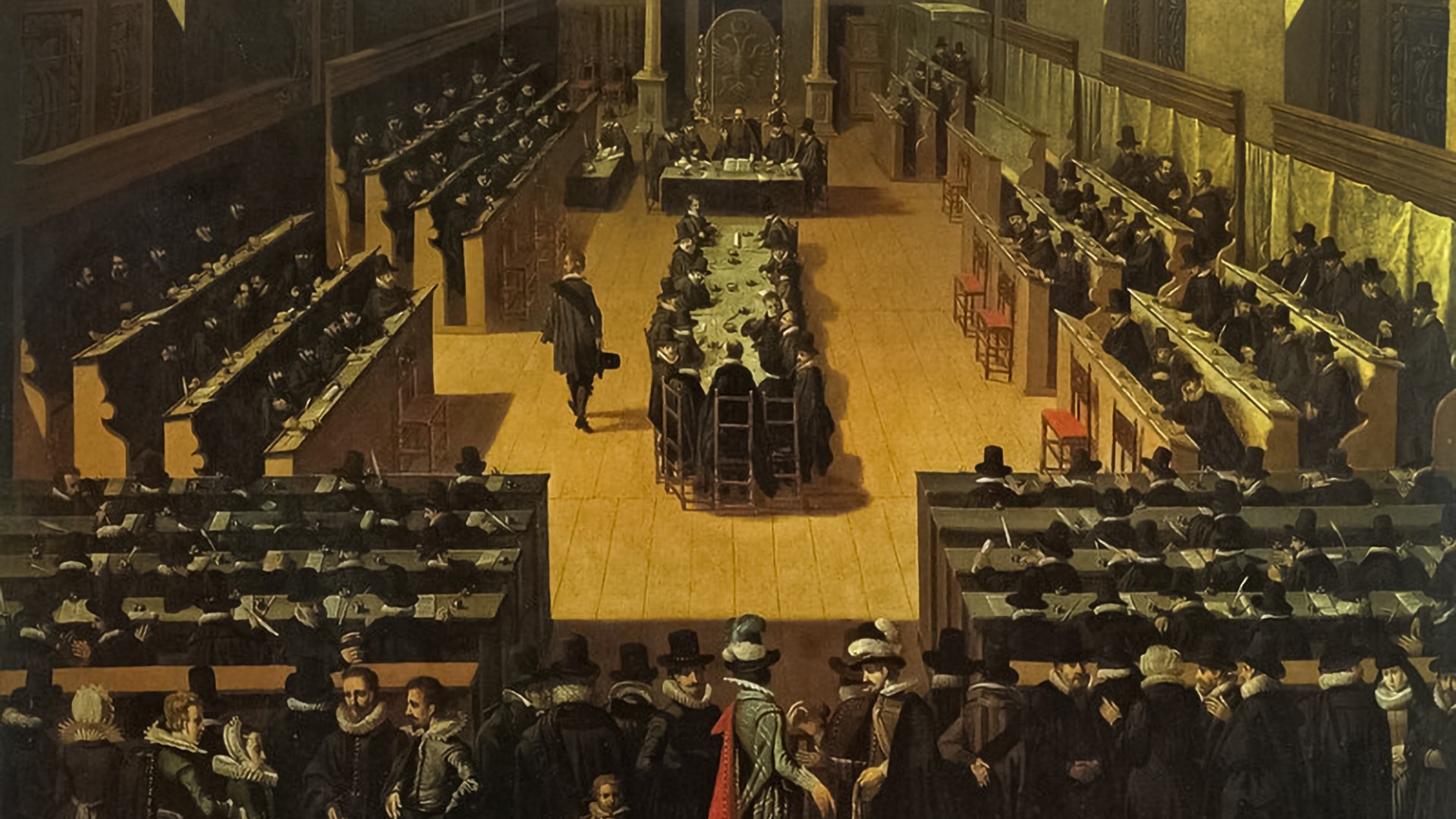
It was only in 1618, after his key political rival was put to death for treason, that Prince Maurice of Orange was able to call the long-overdue synod in the Dutch city of Dordtrech (shortened as Dort). The issue on the table: a determination of whether the Remonstrants’ teachings were in line with the confessional documents of the church. Since the Remonstrance was already affecting churches in other countries, invitations were sent to delegates in Britain, Germany, Switzerland, and France.

The synod lasted over six months, from November 1618 to May 1619. It opened with a long prayer for God’s guidance in finding biblical answers. The synod decided to invite a group of Remonstrants in order to hear from them firsthand. While they waited for their arrival, the delegates discussed other matters (such as the teaching of the catechism and a translation of the Bible in Dutch).

Resenting the fact that they had been merely summoned to defend their position and had not been invited as delegates, the attending Remonstrants refused to consider the synod a proper judge of the validity of their teachings. Their spokesman, Simon Episcopius, gave a prolonged speech, leaving the delegates with the feeling that he was trying to avoid direct answers and to divert the discussion to secondary issues. Eventually, the chairman, Johannes Bogerman, expelled the Remonstrants with a brusqueness that surprised some of his fellow delegates.

The ensuing discussion was then based on the Remonstrants’ written documents and their five points. In the end, the Reformed presented their answers that can be summarized as follows:

  1. God’s choice of those who will be saved is not conditioned by what people may or may not do, since it is God who will, in time, “grant faith in Christ and perseverance.”
  2. On the cross, Jesus took upon himself the sins of those God has chosen to save, making full and permanent satisfaction for them.
  3. The Reformed found the Remonstrants in agreement about the human inability, apart from God’s grace, to choose to believe in Christ and obey him. Since the Remonstrants’ fourth point didn’t seem consistent with this statement, however, the synod answered points three and four together.
  4. If God decides to save someone by his grace, that person will not be able to say no.
  5. When God chooses to save a person, that person will persevere in faith until the end. Unlike the Remonstrants, the Reformed believed there is enough in Scriptures to support this interpretation. In fact, the synod provided plenty of Scriptural references to this as well as the rest of its statements.

The Canons and the Tulip

The conclusions of the synod were reported in a document known as “Canons of Dort,” which was then added to the existing confessional documents of the Dutch church. Together, the Canons, the Heidelberg Catechism, and the Belgic Confession make up the so-called Three Forms of Unity, which are still held by Reformed churches all over the world.

The Canons were written in simple Latin, void of academic jargon, as a pastoral text for laypeople. (If our English versions seem a little challenging, that’s because they are literal translations.) The synod believed they were composed “to the glory of God” and “for the integrity of the truth of salvation, the tranquility of consciences, and the peace and well-being of the Dutch church,” according to W. Robert Godfrey's translation of a preface to the canons. In reality, they ended up bringing comfort and peace to all Reformed churches, both in 17th-century Europe and throughout the world in later times.

Today, the five points listed in the Canons are often described as “Five Points of Calvinism.” The definition is incorrect in many ways. First, these were specific answers to the five points of the Remonstrants. Second, they only represent a small portion of what the French Reformer John Calvin taught. Third, they were not invented by Calvin or his followers. Most of them were already defended by the fourth-century theologian Augustine of Hippo and have continued throughout the Middle Ages, only to be emphasized during the Protestant Reformation.

In the English-speaking world, the Remonstrants are commonly known as Arminians and the five points of the Contra-Remonstrants are remembered with the acronym TULIP, which stands for Total Depravity (point 3), Unconditional Election (point 1), Limited Atonement (point 2), Irresistible Grace (point 4), and Perseverance of the Saints (point 5). (The unknown author of this acronym changed the order, likely because ULTIP was not as catchy.) The acronym was a late invention, and some of these titles have been contested, particularly Limited Atonement, because the sacrifice of Christ was not in itself limited. Some prefer speaking of Definite Redemption, which is arguably more in line with the age-old description of Christ’s sacrifice as sufficient for all but efficient for some.

The Legacy of Dort

The Synod of Dort clarified and consolidated the positions of both Reformed and Arminians on these important matters. In fact, being the first formal, international Reformed synod, it brought theological unity among the European Reformed churches. For example, when the Westminster Assembly met from 1643 to 1653, it was able to build on the foundation Dort had already laid.

The controversy continued, most famously flaring up in the 18th century between John Wesley as promoter of Arminian teachings and George Whitefield as defender of the Reformed position.

The Synod of Dort is just as relevant today, on its 400th anniversary, because the same questions are still lingering (often aggravated by misconceptions and caricatures), and the different answers produce different worldviews and reactions. For example, Arminians and Reformed may have different responses to common situations such as the death of infants, a person’s crisis of faith, and unseemly rejections of God by Christians who become affected by serious mental illness or Alzheimer’s.

No matter what one’s convictions, reading the Canons of Dort can help Christians to take these matters seriously, especially in an age when we all tend to make the quickest decisions with the least possible effort. They offer a deeper understanding of our eternal salvation, our evangelistic duties, and especially the nature and purpose of our Triune God and how to live our lives for his glory.

Simonetta Carr is the author of the award-winning series Christian Biographies for Young Readers, published by Reformation Heritage Books. She also writes a regular column, “ Cloud of Witnesses, ” for the Alliance of Confessing Evangelicals.

News

Senate’s Genocide Vote Not the Only Good News for Armenian Christians

In addition to historic recognition by US lawmakers, this week a new patriarch was finally elected in Istanbul, Turkey.

Christianity Today December 13, 2019
Maja Hitij / Staff / Getty

Following years of frustration, Armenian Christians worldwide received a double blessing this week.

For the first time in its history, the US Senate recognized the Armenian Genocide. And after 11 years of practical vacancy, the Armenian community in Istanbul, Turkey, elected a new patriarch.

“It is very emotional for the Armenian world, and anyone who wants to see the truth incarnated,” Paul Haidostian, president of evangelical Haigazian University in Beirut, Lebanon—the only Armenian university in the diaspora—told CT concerning the resolution.

“But it is very obvious this was the opportune moment to be bipartisan.”

Led by Sen. Ted Cruz, a Republican from Texas, the unanimous passage yesterday drove his co-sponsor Sen. Robert Menendez to tears.

“I’m thankful that this resolution has passed at a time in which there are still survivors of the genocide,” said the Democrat from New Jersey, pausing for 20 seconds before being able to continue. “[They] will be able to see that the Senate acknowledges what they went through.”

About 1.5 million Armenians were killed between 1915 and 1923, as the defeated Ottoman Empire transitioned into the modern Republic of Turkey. Less than half a million survived.

The resolution also mentions the Greek, Assyrian, Chaldean, Syriac, Aramean, Maronite, and other Christian victims who lived in Asia Minor and other Ottoman provinces at the time.

Turkey concedes that many Armenians died in the fighting and aftermath of World War II, though it believes the numbers are inflated. It calls for a joint academic commission of Turkish and Armenian scholars. But it rejects the term “genocide.”

The Senate’s Resolution 150 is a duplicate of the US House of Representatives’s Resolution 296, approved overwhelmingly six weeks earlier by a 405–11 vote, as CT reported. But they are not “joint resolutions,” and therefore neither require President Donald Trump’s signature nor have the force of law.

Turkey nonetheless responded harshly, calling the resolutions “irresponsible and irrational,” and “a political show.”

Following the House approval, Trump asked Republican Senate leaders to block the bill, according to al-Monitor. Engaged in negotiations over Syria and Russian weapons purchased by Ankara, Trump followed longstanding political practice and yielded to the objection of the fellow NATO ally. (During the administration of President George W. Bush, nearly 70 percent of air supplies to the US military in Iraq went through Turkey’s Incerlik airbase.)

Three times, Republicans obliged Trump’s request. But Sen. Jim Risch of Idaho, who earlier helped delay the vote, grew frustrated with Turkish obstinacy.

“[Turkey has] thumbed their noses at us,” he said, according to The New York Times. “If we just look the other way on this, we will be viewed as weak.”

Instead, the Senate rebuke satisfied Armenian-Americans.

“I’ve invested, like, decades of my life," said Aram Hamparian, executive director of the Armenian National Committee of America. “So it was a sense of relief and a bit of a vindication that [the US] put up a firewall against foreign countries coming into our democracy and dictating to us.”

The entertainment industry also contributed to the effort. Both Dean Cain, of Superman fame, and Kim Kardashian traveled to Armenia and campaigned in the US.

Prime Minister Nikol Pashinyan was grateful.

“On behalf of the Armenian people, I would like to address words of appreciation to all members of the US Senate, also members of the House of Representatives,” said the Armenian head of state, according to Armen Press, “and to congratulate the Armenian people on the occasion of this historic victory of truth.”

Armenia was the first nation to officially adopt Christianity, in 301 A.D., and the faith first arrived as early as 40 A.D., traditionally attributed to the preaching of Jesus’ disciples Bartholomew and Thaddeus.

The US Commission on International Religious Freedom tweeted its “applause.” In Defense of Christians, an advocacy group, stated the Senate “did the right thing.”

Armenian Christian leaders also lent their support.

“This is our legitimate claim: that the international community make a visible, tangible manifestation of their concern in respect to human rights, and recognize the Armenian Genocide,” Aram I, Catholicos of the Holy See of Cilicia, told CT following the House vote in November. Based in Beirut, his position is linked historically to the Armenian presence in western Turkey; he is responsible for the entire diaspora.

“It is our firm expectation that the Senate will reaffirm their decision.”

Now that it has, Garegin II, Supreme Patriarch and Catholicos of All Armenians, based in Armenia, offered his appreciation—and plea.

“Our prayer is that God keeps the life of all humanity in peace, free of tragedies and disasters like the Armenian Genocide,” he stated, “for the sake of calm future of all nations.”

But the effort to politically recognize the genocide has not been universally welcomed by Armenians—especially in Turkey. A divided community of 70,000 has witnessed its leaders’ side with their nation of citizenship.

In a 2007 interview, Patriarch Mesrob II stated he did not want to saddle modern Turkey with the “collective punishment” of the Ottoman Empire, and endorsed Ankara’s offer for a joint academic committee. International efforts to recognize a genocide only harm Armenian relations with Turks, he said.

Mesrob, consecrated in 1998, succumbed to dementia 10 years later. Yet despite the official petition of the Armenian Orthodox patriarchate, Turkey refused to permit a new election.

Instead, in 2008 Aram Atesyan was elected to serve as acting patriarch. In a 2016 letter to the Turkish president, he condemned the Armenian Genocide resolution of the Bundestag, Germany’s parliament.

“This historical pain of the Armenian nation is considered as a tool for accusing and punishing the Turkish state and nation,” he wrote. “The ones who are willing to see the truth can realize how [we] have been abused by imperialist powers.”

Mesrob died in March of this year, and Atesyan was one of three candidates—after new controversial Turkish regulations—eligible to succeed him. In September, the Ministry of Interior limited the pool to clerics currently serving in the Istanbul patriarchate.

Prior regulations allowed anyone born in Turkey to qualify. The new regulation eliminated 10 candidates, and one of the three who were eligible withdrew in protest, as did eight members of the electoral board.

“I will not consider the chosen one as my patriarch,” stated Garo Paylan, a legislator in Turkey’s parliament.

Sahin Gezer, a former member of the patriarchate’s property commission, called the process “dreadful,” and remarked the entire debate around process and candidates was marked by insults and accusations.

In the end, Sahak Masalyan received 102 out of 119 delegate votes to become the 85th head of the Armenian Patriarchate of Constantinople and All of Turkey.

“The community was facing many challenges, and for practical reasons they were waiting for a leader,” Haidostian, the university president, told CT.

“It is difficult for us to know about the circumstances, but we are happy for them.”

But from Armenia, Garegin II spoke of his “boundless joy.”

“We pray to Almighty God to grant you strength and power to assume the spiritual mission … with wisdom and high responsibility,” he stated to Masalyan. “May the Lord help and support you, granting you welfare and success in your spiritual service.”

Masalyan recalled the servanthood of Jesus washing the feet of his disciples, pledging to bring “something new.”

“Today, you did not elect a patriarch, you elected the first servant of God and nation,” he stated. “Now I have to ask you to pray for me.”

News

British Evangelicals Brace for Brexit

Politics remain divisive, but churches seek unity in prayer.

Peter Summers/Getty Images

Peter Summers/Getty Images

Christianity Today December 13, 2019

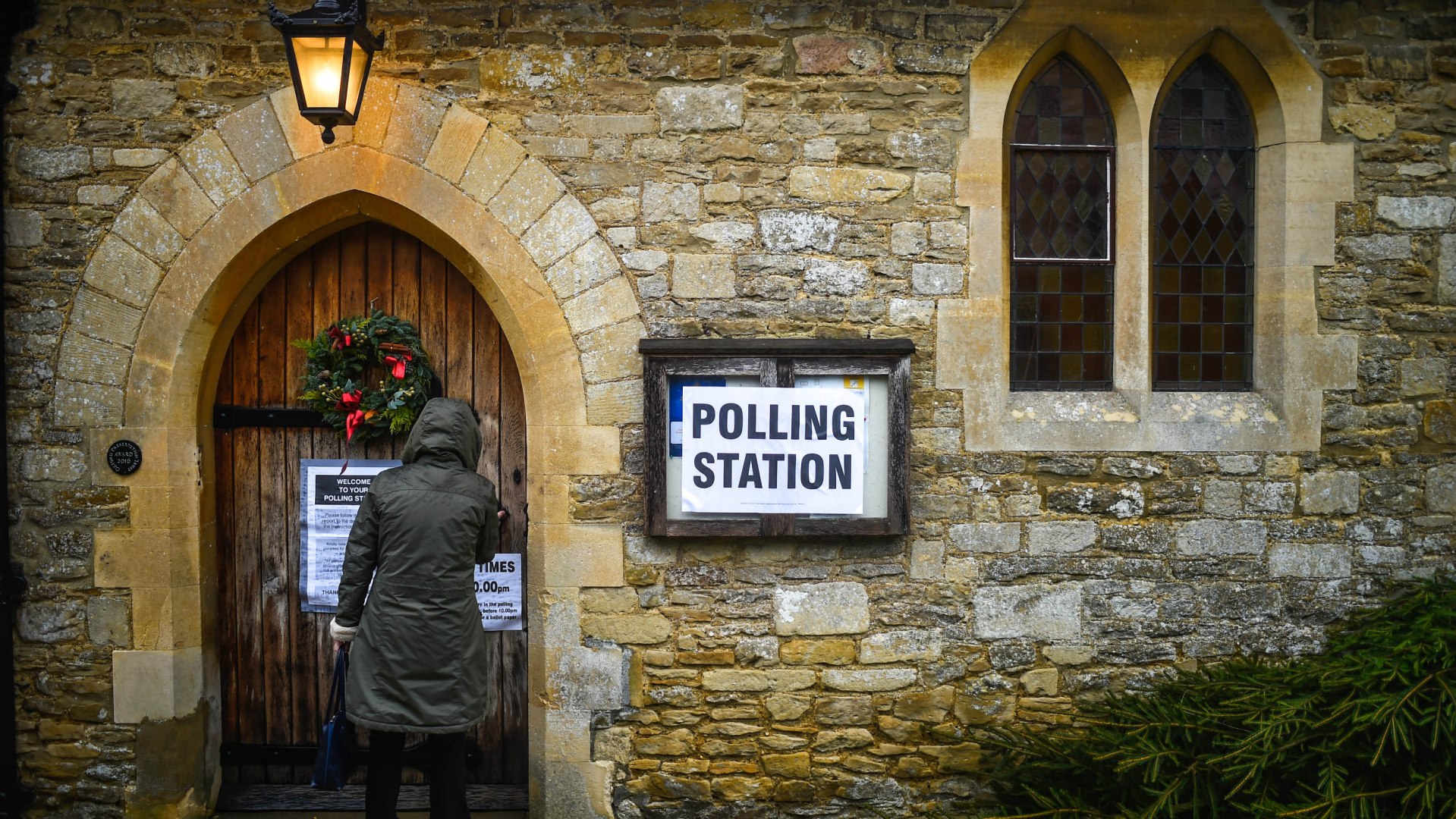
British evangelicals are divided over Brexit. The January 31 deadline for the nation’s departure from the European Union is fast approaching, and Thursday’s elections gave the Conservative Party a historic victory and “a powerful new mandate to get Brexit done,” according to Prime Minister Boris Johnson. As evangelicals absorb the news, they are grappling with the political tumult, the ongoing uncertainty, and the question of what a Christian should do in these difficult times.

The Evangelical Alliance of the United Kingdom (EAUK) has been urging everyone to pray, posting a prayer to social media every Thursday “to ask God for His peace, grace and guidance.” It’s an effort at unity amid division. The EAUK has remained “studiously impartial” on Brexit, “to reflect the diversity of political opinions” among evangelicals, according to spokesman Danny Webster.

If there’s a chance to come together, Webster believes, it’s in prayer. “We can pray for wisdom for our leaders,” Webster told CT, “whether we agree with them or not.”

Britain itself has been deeply divided over the plans to leave the European Union. In 2016, 52 percent of the population voted for leave. Debates about how to do that, exactly, have roiled UK politics ever since, as two successive prime ministers struggled to negotiate a divorce with the EU that can also get approved by Parliament.

A slight majority of evangelicals voted remain. According to a 2016 study immediately before the vote, 51 percent supported staying in the EU, 27 percent wanted Brexit, and 22 percent were undecided. In the last three years, British evangelicals across the spectrum have expressed the need “for peace and reconciliation.”

The generally pro-remain stance of British evangelicals might be surprising to some. However, political scientist Andrea Hatcher of the University of the South in Sewanee, Tennessee, found British evangelicals are “less boundaried” and generally “more internationalist in outlook” than either their Anglican and Pentecostal peers or US evangelicals. They are also more willing to work across political divides.

Krish Kandiah, evangelical author and founder of Home for Good, a UK-based fostering and adoption charity, agrees. “It is vital for Christians in the UK as members of the global body of Christ to demonstrate a spirit of global allegiance and brotherhood,” he said. “Now more than ever we are needed to stand up for hospitality and offer welcome to our vulnerable brothers and sisters around the world.”

Being Christian means being welcoming

Katie Gaddini, a sociologist at the University of Cambridge, says immigration is a key issue for a lot of British evangelicals, as part of a larger commitment to hospitality. For them, “being a Christian means being welcoming and hospitable to outsiders,” she said.

British evangelicals worry that Brexit might cut them off from the rest of the world, Gaddini said, as well as the global evangelical community. The feeling can be devastating.

Gaddini spoke with an evangelical in London who was so upset after the Brexit vote that the woman stayed in bed for a week and cried. She canceled social events so she wouldn’t have to face the reality that so many of her neighbors, friends, and fellow evangelicals voted leave.

At the same time, British evangelicals don’t want to be separated from their local evangelical community either. As Brexit deadlines loom yet again, Gaddini said, “there will be more discussion, church events, groups and wider conversation around how evangelicals can practice their faith in the midst of this political upheaval.”

There are also evangelicals who are staunchly pro-leave and feel God is at work in Brexit. Paul Garner of the Biblical Creation Trust advocated for the leave position in an op-ed in the Evangelical Times, a nondenominational newspaper.

“The EU has been bad for Britain,” he wrote. “Sound political arguments apply to Christians and non-Christians alike and, in my mind, there are many compelling reasons to leave the EU.”

Three years later, his views are steadfast. “Events since the referendum haven’t changed my mind,” he said. “The basic arguments remain sound.”

Others support Brexit because of prayer and prophecy. Peter Horobrin, founder and international director of Ellel Ministries, said the Brexit vote was a “massive answer to prayer” because God “acted to set the UK free from the external spiritual control of the European Union.”

Tony Pierce, an end times teacher, has warned evangelicals that the EU will be associated with the Antichrist. He points to the sculpture that stands outside the Winston Churchill EU building in Strasbourg, France, “The Removal of Europa,” depicting the ancient Greek myth of the abduction of Europa by Zeus, who is represented as a large silver bull. For Pierce, this an image “straight out of the Book of Revelation,” a woman riding a beast.

Uncertain impact on missions

More British evangelicals, however, are worried about the impact Brexit might have on missions. “The impact of Brexit remains unclear,” said John Stevens, national director of the Fellowship of Independent Evangelical Churches (FIEC). “But the removal of the mutual rights of free movement are likely to make it harder for UK citizens to serve as missionaries in some European countries.”

Highlighting Eastern European, Middle Eastern, Central Asian, and sub-Saharan African churches in the FIEC, Stevens said, “they will clearly be affected by the need for people to obtain ‘settled status’ and where it will be harder for others to come, live, and work in the UK in the future.”

Amos Enabulele, national president of the Africa Christian Fellowship (ACF) in the UK and Ireland, said that his members are apprehensive “about the possible negative consequences of Brexit.”

The ACF is also turning to prayer with a planned 2020 event, “Prayer for Nations.” Enabulele said, “we believe that the implications of Brexit will reverberate around the world and trigger un-envisaged and unintended consequential patterns in Britain and in nations far and near.”

Ruth Chepkwony, an African evangelical and immigrant living near Southwark, shares these fears. A recent All Party Parliamentary Group report found that African applicants are already more likely to be denied a UK visa. She said she is concerned that Brexit will further complicate immigration.

“There is so much paperwork, the requirements are unclear,” she said, “plus many of us get rejected anyways. After Brexit, it will be much harder.”

How to Brexit like a Christian

Faced with so many unknowns, British evangelicals are trying to remain focused on things that don’t change.

“It is essentially important our attitude to each other remains fueled by love,” Webster said. “As Brexit stumbles towards actually happening, evangelicals should not lose sight of loving our neighbor.”

In the end, the question of “how to Brexit like a Christian” has as many possible answers as the question of “how to Brexit” at all. Friendships have been tested, harsh words said, zealous positions taken.

That is because, John Stevens said, “there is no specific ‘biblical’ position on Brexit.” Stevens believes evangelicals have "to speak wisely and model unity-in-disagreement.”

“This will no doubt become easier once decisions are made and the uncertainty is ended,” he said. “In the meantime we need to keep praying for wisdom and grace, and keep trusting the good sovereign purposes of God. Who will win? At this point God knows. And that is the only true comfort.”

Apple PodcastsDown ArrowDown ArrowDown Arrowarrow_left_altLeft ArrowLeft ArrowRight ArrowRight ArrowRight Arrowarrow_up_altUp ArrowUp ArrowAvailable at Amazoncaret-downCloseCloseEmailEmailExpandExpandExternalExternalFacebookfacebook-squareGiftGiftGooglegoogleGoogle KeephamburgerInstagraminstagram-squareLinkLinklinkedin-squareListenListenListenChristianity TodayCT Creative Studio Logologo_orgMegaphoneMenuMenupausePinterestPlayPlayPocketPodcastRSSRSSSaveSaveSaveSearchSearchsearchSpotifyStitcherTelegramTable of ContentsTable of Contentstwitter-squareWhatsAppXYouTubeYouTube