News

US Pastor Still Detained in India, Awaiting December Trial

Bryan Nerren “always knew the danger” of missions in South Asia but longed to see revival in Nepal.

Bryan Nerren

Bryan Nerren

Christianity Today November 11, 2019
ACLJ

Each year, when Tennessee pastor Bryan Nerren delivered the closing message at a conference for Nepali Christian leaders in South Asia, he called them to persist in ministry despite the associated risk in a Hindu-dominated region sometimes hostile to their faith.

Now, Nerren, 58, is living out his sermon more than at any time in his 17 years of mission trips to South Asia, trapped in India for more than a month and prohibited from returning home following a six-day imprisonment. While Indian officials charge him with failing to fill out proper paperwork to declare the cash he was carrying, Nerren’s attorneys call the charges unjust and the detention an example of religious persecution.

Nerren, pastor of the nondenominational International House of Prayer in Shelbyville, Tennessee, did nothing wrong and “is essentially being held hostage in India for his Christian faith,” according to the American Center for Law and Justice (ACLJ), the evangelical legal organization representing him. “He deserves to come home.”

Released on bail October 11 in the Indian state of West Bengal, Nerren had his passport seized by a judge while he awaits a December 12 court date. Despite backchannel work by the Trump administration and three US senators, Nerren’s family doesn’t know when he will return home.

Arrest and imprisonment

Nerren’s legal trouble began October 5. He and two other American ministers cleared Indian customs upon arriving in New Delhi and proceeded through security to board their domestic flight to the northeast Indian city of Bagdogra to lead a conference there, the ACLJ reported. After Nerren answered questions for an hour in New Delhi about the cash he was carrying—including questions about whether the funds would be used for Christian causes—customs officials authorized him to board his flight.

But upon arrival in Bagdogra, he was arrested for allegedly not filling out a form to declare his cash. The ensuing six-day imprisonment included a trip to the hospital because of a health condition, where a physician treating Nerren spit on the ground, apparently in disgust, after learning he was a Christian.

Nerren’s wife Rhonda traveled to Washington in late October to meet with State Department officials and Senators Lamar Alexander (R-Tennessee), Marsha Blackburn (R-Tennessee), and James Lankford (R-Oklahoma), the ACLJ told Christianity Today. All officials with whom Rhonda Nerren met are “engaged” and “concerned” about her husband’s case, but no information has been released about the specific steps they are taking to secure his release.

Nerren’s son Kevin, an associate pastor at International House of Prayer, told CT his father has “always known the danger” of ministering in India and Nepal, but he persisted because of love for the Nepali people. (His work in India was limited to the northeastern region, with a focus on its large Nepali population, and he has only ministered there “a couple of times.”)

Each fall, Bryan Nerren has travelled to Nepal to train Sunday school teachers, and each spring he has returned to lead a staff retreat for a Nepali nonprofit organization that partners with the US nonprofit Nerren established to support his mission endeavors, the Asian Children’s Education Fellowship (ACEF). According to the group’s website, ACEF has trained more than 20,000 leaders in Nepal.

“You will never have a conversation with him without his bringing up Nepal,” Kevin Nerren said of his father. In the hallways at International House of Prayer, “there are pictures and a flag and mementoes from Nepal everywhere.”

‘Revival like none other’

The danger of Nerren’s mission work stems from the fact proselytizing has been illegal in Nepal since 2017. Open Doors USA places Nepal at number 32 on its list of the 50 countries where it is most dangerous to be a Christian.

India ranks number 10 on Open Doors USA’s persecution list, with an increase in attacks on Christians by Hindu radicals reported since the current Hindu nationalist government came to power in 2014.

Despite the risk, Nerren has persisted in his work with the Nepali people because of a desire to see 1 million Christians in Nepal, Kevin Nerren said.

Official estimates put the number of believers in Nepal at about 400,000 out of a total population of 29.7 million—explosive growth since a 1951 census listed no Christians in the country. Yet Kevin Nerren believes the total number of believers is actually “well over” 1 million today, an assessment corroborated by an NPR report claiming the number Christians in Nepal could be “much higher” than officially reported and calling it “one of the world’s fastest-growing Christian populations.”

Nepal has experienced “a revival like none other,” Kevin Nerren said, recounting trips where his father has discovered thriving Christian communities in remote mountain villages. Such communities arise, he said, because Nepalese villagers go to major cities to find work, encounter the gospel there, and take it back to their villages.

Nerren’s ministry has focused on training Nepali believers in Nepal and India to share their faith and fuel that indigenous Christian movement.

If Nerren manages to get out of the region he loves, his next challenge might be getting back in as publicity surrounding his case mounts.

“His name’s probably going to be on a black list,” Kevin Nerren said, “especially for India, and he may not get to go to Nepal to do ministry again … He’s struggling with that a bit. But he’ll never stop loving Nepal.”

David Roach is a writer in Nashville, Tennessee .
Books
Review

A Report from the Religious Liberty Front Lines

An experienced litigator explains why believers and nonbelievers alike have a stake in defending America’s “first freedom.”

Christianity Today November 11, 2019
Sean Pavone / Envato

As a leading attorney for the Becket Fund for Religious Liberty, Luke Goodrich has helped litigate some of the most important religious liberty cases heard by the United States Supreme Court over the past decade. Decisions in these cases have protected the ability of churches to select the ministers they desire, kept a family-owned company from having to provide insurance that covers abortifacients, and ensured that a prisoner could grow a short beard as required by his faith.

Free to Believe: The Battle Over Religious Liberty in America

Free to Believe: The Battle Over Religious Liberty in America

Multnomah

288 pages

$14.22

Goodrich has also written a book, Free to Believe: The Battle Over Religious Liberty in America. Typically, attorneys are not known for their crisp, clear prose, but I’m pleased to report that Free to Believe is a pleasure to read. Goodrich is an excellent writer, and throughout the book he scatters stories and personal anecdotes that help bring to life what could otherwise be a dry subject.

A Robust Defense

Goodrich begins by offering a robust, Christian defense of religious liberty. He argues that God created men and women in his image, that he intends for us to be in relationship with him, and that this relationship must be freely chosen. Religious liberty is first and foremost a God-given right grounded in a biblical conception of justice, not a gift from the state. It is a right that God provides to all of his image-bearers, not just those who already follow him.

From the Roman emperor Constantine to the present day, Christians who have access to political power have been tempted to use governments to promote their understanding of Christian orthodoxy. This is unfortunate, Goodrich argues, because true faith cannot be coerced, rulers are poor judges of religious truth, and, most fundamentally, when “the government punishes someone for rejecting God, it is usurping God’s authority.”

Of course, religious liberty is not a trump card in every dispute. The ability of citizens to act upon their religious convictions may be restricted if their actions infringe on the rights of others. To give an obvious example, the government may properly prohibit an individual from sacrificing a baby to the sun god.

Non-believers are unlikely to be convinced by biblical or theological arguments for religious liberty, so Goodrich offers other arguments as well. For instance, there is excellent evidence that religious freedom causes religion to flourish. This, in turn, encourages morality and good works, such as the creation and maintenance of hospitals, soup kitchens, shelters, and other institutions that benefit society. Religious liberty also protects diversity and reduces social conflict.

Religious liberty is a fundamental human right, and in the United States it is also a right protected by federal and state constitutions and laws. The second section of Free to Believe contains seven chapters cataloging the many ways religious liberty is under assault today. Almost no one supports laws banning religious practices per se. Instead, the chief threats to religious liberty come from neutral, generally applicable laws that inadvertently burden the ability of citizens to act upon their religious convictions.

For instance, about half of the states ban discrimination on the basis of sexual orientation. These laws have been used against photographers, bakers, florists, and other creative professionals who have sincere religious objections to participating in same-sex wedding ceremonies. They also threaten the ability of religious institutions to insist that employees abide by traditional Christian sexual ethics. Before ending his presidential candidacy, Beto O’Rourke went so far as to say that churches that hold disfavored views on same-sex marriage should lose their tax-exempt status.

Some Christians contend that laws protecting LGBT rights should be repealed, at least in part to protect religious liberty. Or, at the very least, new ones should not be passed. Goodrich doesn’t address these possibilities, perhaps because neither is politically feasible. Instead, he argues that the best way to protect religious liberty in these situations is to carefully craft narrow exemptions to protect religious citizens.

Americans have a great deal of experience with such accommodations. From the early colonies to the present day, religious pacifists have been exempted from military service. The Constitution itself contains an accommodation that permits Quakers and others who object to swearing oaths to affirm them instead. By one count, there are more than 2,000 religious accommodations in federal and state laws. There is little evidence that these accommodations have kept governments from meeting important policy objectives.

Even so, when the possibility of religious exemptions is raised with respect to LGBT rights, activist groups such as the Human Rights Campaign inevitably object. They often raise the analogy to racial discrimination—that is, they contend that we would not permit bakers to decline to participate in an interracial wedding ceremony, so we cannot permit them to do so for a same-sex ceremony.

Goodrich demonstrates that this analogy is faulty for a number of reasons. Most significantly, there are fundamental difference between how racial minorities and LGBT citizens have been treated throughout this country’s history. Members of both groups have suffered:

But African Americans were enslaved. Their families were torn apart. They were denied the right to vote. They were subjected to repeated mob violence that was ignored and sometimes supported by the state. . . . In short, they faced centuries of systematic, pervasive barriers to full participation in the economic, social, and political life of the nation.

This difference is recognized even in the 21 states that have laws banning discrimination on the basis of sexual orientation. As Goodrich notes, all of these states include exemptions that permit “religious groups to hire based on their religious beliefs about sexuality.”

Goodrich also discusses the recent assault on protections—historically supported by both Democrats and Republicans—that permit health-care professionals to decline to participate in medical procedures (like abortion or sterilization) to which they have moral or religious objections. If successful, these attacks could force doctors, nurses, pharmacists, and other medical workers to choose between their professions and their religious convictions.

Christians are generally supportive of religious liberty when it comes to fellow Christians. But when it comes to religious freedom for Muslims, the level of commitment sometimes wavers. Goodrich devotes an entire chapter to this problem, arguing that religious freedom is a matter of justice, which means we must seek it for all citizens. As well, Christians will have more credibility when it comes to cases involving our own convictions if we seek to ensure that all Americans may freely exercise their faiths.

In the introduction to his book, Goodrich writes that he is an attorney “at the Becket Fund for Religious Liberty, the nation’s only law firm dedicated to protecting religious freedom for people of all faiths.” It may be fair to call Becket a leader in protecting non-Christian citizens, but it is important to recognize that other Christian legal advocacy groups such as the Alliance Defending Freedom, Christian Legal Society, and First Liberty advocate for people of different faiths as well.

Prudent Protections

The last three chapters of Free to Believe should reassure readers who might be a bit nervous after Goodrich’s lengthy discussion of threats to religious liberty. He reminds us that religious liberty remains extraordinarily well protected in the United States. Indeed, there are few times or places where this freedom has been better protected.

But even if this were not the case, or if things take a significant turn for the worse, our faith should not be in laws or lawyers. As Christians, we should expect to suffer for our faith, as many of our brothers and sisters have throughout history and up to the present day. Scripture teaches us to rejoice when suffering comes, using it to bring glory to God. In the end, our hope rests in the Creator and Ruler of the universe, a Savior who has overcome the world.

Of course, our trust in God does not mean religious organizations should neglect taking prudential steps to protect themselves. Goodrich briefly discusses a few of these, such as defining one’s mission clearly, aligning employment criteria with that mission, and consistently enforcing rules. He also suggests creative and loving ways to resolve conflicts.

Religious liberty is a God-given right grounded in a biblical conception of justice, but it is also a core American value. Indeed, many American founders referred to it as “the sacred right of conscience.” Free to Believe helps believers and non-believers alike understand why this right is so important, how it is being attacked today, and what we can do to counter these threats. It should be read by religious and political leaders, and by any citizen concerned about America’s first freedom.

Mark David Hall is Herbert Hoover Distinguished Professor of Politics at George Fox University. He is the author of Did America Have a Christian Founding?: Separating Modern Myth from Historical Truth (Thomas Nelson).

Culture

What Kanye West’s Sunday Service Taught Me About Grace

When I visited Kanye’s Sunday Service, I was met by contradiction, a mix of characters, and a spiritual lesson.

Christianity Today November 8, 2019
Curtis Yee

It’s Sunday morning and I’m on my way to worship service—a normal part of my weekend routine except for the fact that it’s 4 a.m., I’m embarking on a five-and-a-half-hour drive from Sacramento to Southern California, and the service will be led by Kanye West.

Coinciding with the release of his much-anticipated ninth studio album, Jesus is King, West released $10 tickets for his “Sunday Service” at The Forum, a 17,500-seat stadium in Inglewood that formerly hosted the Los Angeles Lakers. I bought tickets on a whim and convinced my friend Vince, who is also a bit impulsive, to attend the show with me. Groggy and a little delusional, we laugh about what a bad idea this is (we also plan to make the drive home immediately after the show).

We listen to the new album on repeat as we drive, dissecting each bar and rating his tracks as I quietly hope that the performance will paint a clearer picture of West’s new status as an unlikely evangelical darling. But when we arrive at the venue, the tangle of contradictions only seems to grow.

By the time we arrive, the typical pre-concert rituals are already underway, but against the backdrop of the album’s strong religious message and iconography the scene is disorienting. Masses wait in line to snag limited edition Yeezy merchandise—one crewneck with pictures of a medieval dark-skinned Jesus runs for 0—a woman poses provocatively in front of a banner that read “Jesus is King,” and the unmistakable scent of California kush punctuates the air.

“He’s tapping into an urban market,” says Susie Seiko, an LA musician and longtime West fan. Seiko, who frequents multiple churches in the area including Hillsong Church LA, is excited about Kanye’s new direction. “He’s showing the world that you can believe in God and still be excited and lit about music.”

Called “Sunday Service,” these pop-up worship events were originally described by Kanye’s wife Kim Kardashian West as a “healing experience” to “start off your week.” The initial events were usually private and hosted Hollywood A-listers like Brad Pitt and Katy Perry. Back then, I couldn’t help but assume that the services were more about self-promotion than sincerity, and that like many artists before him, Kanye was commodifying the church experience for clout and profit.

But following a widely attended Sunday Service at Coachella earlier this year, where the visibly distressed rapper wept during the performance, something changed. West said that afterwards he became “born again.”

In the following months, the title of his impending album Yandhi was changed to Jesus is King and he announced that he would no longer be making secular music. The internet swirled with reports about how he had confronted his wife about modesty, that he was asking album collaborators to fast and abstain from premarital sex, and that his latest spiritual mentor Rev. Adam Tyson, a graduate of John MacArthur’s The Master’s Seminary, was teaching him about the Five Solas of the Reformation.

With most shows now open to the public, the crowd, filled with the inevitable mismatch of hypebeasts and hipsters drawn to LA headliners, seems to validate Seiko’s claim. His most diehard fans seem to be taking this newfound faith to heart. Juan Rosales, an LA native who calls West “one of the greatest rap artists ever,” has not attended church in years, but says that the lyrics of “Closed on Sunday” are making him rethink the idea of the Sabbath. “The Bible says you shouldn’t work on Sunday, so I want to use that day to reconnect with family members and go to church more often.”

While many are embracing West’s new God-centered music (some have even skipped their weekly church service to attend the event), others from non-religious backgrounds say that West is their first real exposure to Christianity. Pasha Esmaili has never stepped inside a church before but loves to watch the services online. “[Kanye’s] the only person who can make me like this kind of music. I’m not religious, but even him playing this makes me feel some type of way. It’s weird,” he says.

Considering West’s seemingly endless stream of controversies, the impassioned support of his fans is notable. Perhaps numbed by the artist’s many scandals, fans are quick to forgive his past transgressions.

“As Christians, we can’t judge anyone—only God can judge,” says Seiko, who added she’s been personally praying for West since his mother passed in 2007. “You shouldn’t judge someone based on their past. You cannot say that someone is always going to be this way.”

But not all Christians have received his new identity with celebration. While many have welcomed him as a new bona fide evangelical (some hip megachurches are already playing his new album in their lobby), others have argued that West is appropriating the sounds of gospel music with white evangelical theology while neglecting the genre’s theology of resistance. His predilection for sporting Trump’s “Make America Great Again” hat and his claim that Democrat-voting blacks are trapped in “mental slavery” have only added to that disarray.

Reflecting on the rapper’s numerous blunders over the years, I have held substantial misgivings about his overnight popularity among evangelicals, questioning whether West’s rise to contemporary Christian music stardom was in spite of these perceived missteps, or because of them.

The list of West’s unsubstantiated, ahistorical (though often well-intentioned) “hot takes”—from calling Chicago the murder capital of the world to claiming that slavery “sounds like a choice”—are too arduous to mention and to purport such ideas while wielding his level of influence is dangerous.

Though the Bible encourages believers to extend a charitable view towards those who profess belief, I found myself, like the Apostle Thomas, skeptical and looking for proof. I was willing to drive almost 400 miles to find it.

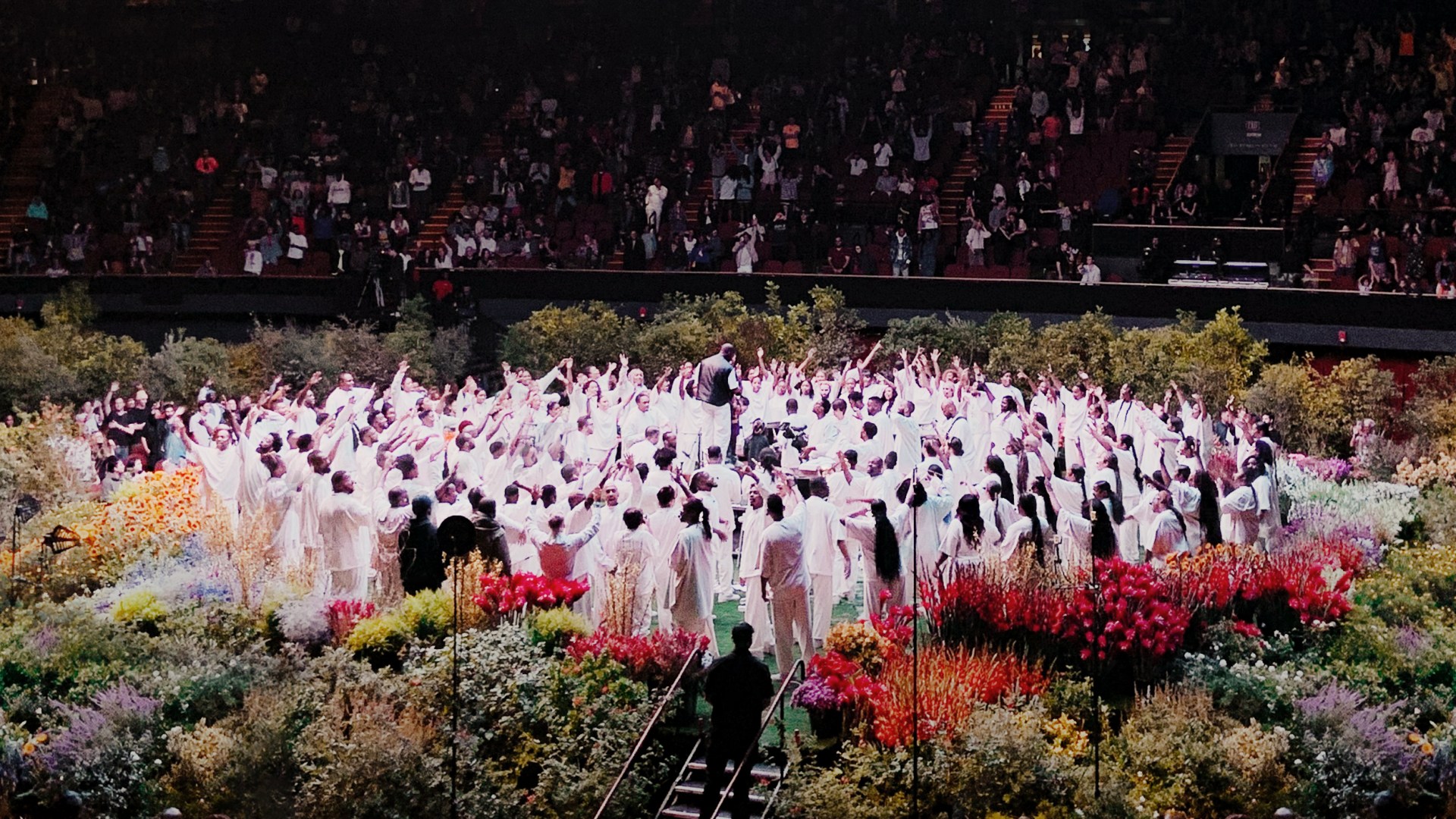
Centered inside the arena floor is a round, green-matted stage wrapped with vibrant potted flowers—bright yellow sunflowers, deep red roses and lavender irises. Beyond that, tendrils of green foliage weave out from the center stage, stretching towards the stands. It’s a striking set; it’s Eden.

In silence, a stream of over 100 singers dressed in all white spiral in a circle and stand silently on the darkened stage as the crowd cheers with anticipation. Choir director Jason White, who has been directing the service since it debuted in January, stands at attention and, with one swift wave of the hand, summons the chorus to life.

“Je-sus is Lord! The Lord of Lords! Our God he reigns for-ever!”

Their singular and unflinching voice silences the crowd and the words ring in the air. The refrain repeats several times before their voices are replaced with the soft picking of a guitar and West’s voice filled the room.

“Closed on Sunday, you’re my Chick-fil-A.”

I chuckle at the transition. Scanning the stage, I look for the source of West’s voice, but struggle to spot him amongst the crowd of singers and instrumentalists. Suddenly, the blare of trombones reverberate through the arena and the previously standstill choir bursts to life. Their rhythmic bodies sway, and from afar they are a singular hypnotizing organism.

“I bow down to the king up the throne / My life is his, I’m no longer my own.”

Finally, West appears. Standing atop a small platform in the middle of the chorus, a fitted black vest is the only thing that distinguishes him from the crowd.

The song finishes and as the thundering chorus softens, West steps down and disappears back into the chorus. I expect him to greet the crowd. But instead, it’s White’s voice, not West’s that speaks to energize the crowd. In fact, as the show progresses, and the band works their way through its repertoire of new and old songs—“Every Hour,” “Saint Pablo,” a cover of Steve Green’s “Hallelujah, Salvation and Glory”—West, apart from when he sings his lines, is uncharacteristically quiet. Instead, he wanders the stage, smiling and singing with the chorus off mic. As he lifts his daughter North onto his shoulders, sometimes handing her the mic and encouraging her to sing along, it finally dawns on me that this is not a concert—it’s a family worship service.

After a rendition of “Follow God,” the Rev. Adam Tyson takes the stage. Drawing from the former song’s refrain, he proclaims, “We stretch our hands out to God, but I’ve got good news for you today—he stretches his hands out to us.”

In a service that has remained broad in its appeal, with songs speaking generally on God’s goodness and love, Tyson hones in on a specific call to action: repentance. “It doesn't matter how many steps you’ve taken from our great God. It just takes one step of repentance, one step of faith,” he declares. “God’s calling you back.”

In his nine-minute sermon he speaks with striking clarity and conviction. He warns the crowd that God “sends unrepentant, unbelieving sinners to hell,” a line that receives stiff silence, but quickly pivots towards Jesus’ sacrificial death on the cross. Tyson knows that some of these faces might never step into a worship setting again, and he takes care to emphasize each beat of the gospel.

“There’s room at the cross for you this day,” he says, his last words before he steps down to a smattering of applause. “Come to him and be born again by faith in the Lord Jesus Christ. Come to him this day and declare that Jesus is king.”

The show quickly moves on as a series of West’s high-profile collaborators take the stage to perform—Francis and the Lights, Clipse (the brothers No Malice and Pusha T), and saxophonist Kenny G. The service’s penultimate number is a sultry rendition of his 2004 hit “Jesus Walks,” the lyrics of which have been notably changed to replace “I ain’t here to … convert atheists into believers” to “we’re here to convert atheists into believers.” A verse about police brutality has also been omitted.

I scan the room and as White leads the crowd in “Jesus is Lord,” a simple song with the refrain, “Every knee shall bow / Every tongue confess / Jesus is Lord / Jesus is Lord,” I see arms outstretched, eyes closed and people lost in worship. Even Tyson, whose seminary is notorious for stoic and unmoving worship posture, can’t help but raise his hands.

Before closing, White addresses the crowd one last time, exhorting them to put their trust in Christ and leads the room with a version of the sinner’s prayer. I look for West again in the crowd, but I can’t find him. He’s already disappeared, and it occurs to me, that for the last half of the show, I had barely thought about him at all.

“I need prayer, not judgment,” West says at the opening of the following week’s service, once again held at The Forum. “We need a chance to learn God at our own speed. We’re human beings trying our best, repenting from our sins and learning and growing every day. And we need your hands on us, your prayers on us. Pray for me.”

If anything has resonated with me, it is the sincerity of West’s testimony. As I stood in the stands, the earnestness of his songs and prayers often gave me chills. And to his credit, West has never struggled to bear his soul.

But sincerity alone is not the fruit of salvation. For a peek into West’s unsteady steps into evangelicalism, the past few weeks alone should suffice: he reportedly struck up a controversial friendship with Liberty University president Jerry Farwell Jr., he claimed that God granted him a $68 million tax return in response to his conversion, he argued that Democrats have “brainwashed” black Americans in an interview with radio host Big Boy, and at a Baton Rouge, Louisiana, show on November 1, West held an altar call where 1,000 people reportedly raised their hands to accept Christ.

Driving home from the show, I found myself listening to “Street Lights,” a remnant of the old Kanye from his 2008 album 808s and Heartbreak. His soft repetitive refrain is tethered by the album’s minimal synth-pop style. Speaking just above a whisper, he sings, “Let me know / Do I still got time to grow? / Things ain't always set in stone.”

And as the endless California farmland stretched out before me, I was reminded of the ease with which West’s fans extended their absolutions. “We’re not all perfect,” Seiko had told me. “I just think there’s a little Kanye West in all of us.”

I was reminded that perhaps the best response is not less grace, but more.

Curtis Yee is a writer in Sacramento, California.

News

Split the Cedars of Lebanon: Evangelicals Balance Prayer, Protest, and Politics in Ongoing Uprising

With a prayer tent going up in Beirut square, participants see a “spiritual dimension” to anti-corruption demonstrations.

Christianity Today November 8, 2019
Mahmoud Zayyat / Contributor / Getty

At first, it was two high school girls.

The education minister in Lebanon had just canceled classes nationwide due to an explosion of popular anger at proposed taxes. Public squares in Beirut and other cities swelled with demonstrations. The two students asked Steve White, principal of the Lebanese Evangelical School (LES), if he would join them and protest too.

White, a Lebanese citizen since 2013, became principal in 2000, succeeding his English father who’d held the post since 1968. Founded by a British missionary in 1860, LES preaches the gospel clearly and is one of the top schools in Lebanon. But it bucks the sectarian trend of community enclaves as 85 percent of its students are Muslim—most coming from the Shiite community. Discussion about religion and politics is forbidden.

The protests began October 17. At the height of student interest, White arranged four school buses for a unique civic education. Though he knows his students well, he couldn’t tell their breakdown by sect: Sunni, Shia, or Christian.

Which fit perfectly with the protests.

“I got excited because it was not religious,” said White. “It was nonsectarian: all of Lebanon together, no flags, no parties, they were cursing everybody.”

White did not approve of the cursing. But he did of the “everybody.” The slogan adopted by protesters: “All of them means all of them.” It targeted the leaders of Lebanon’s multiple religion-based political parties, accusing them all of corruption.

Transparency International ranked Lebanon No. 138 out of 180 in its 2018 corruption perception index, listed from clean to corrupt.

Traditionally viewed as the guardians of each sect’s interests, Lebanese political parties would regularly voice vague charges of corruption against unnamed colleagues. But unlike previous protest movements, which carried the banners of each party, this one hoisted only the Lebanese national flag with its distinguishing cedar tree.

Accordingly, White forbade students from bringing the flag of LES.

Whether inspired, sympathetic, or threatened, political leaders had little choice but to express solidarity.

According to the World Bank, one-quarter of Lebanon’s population lives in poverty. Citizens pay exorbitant fees for privately generated electricity, as the tiny Arab nation of 6 million on the shores of the Mediterranean Sea has the fourth-worst public provision in the world. Smaller than Connecticut, public debt is 150 percent of GDP. Prior to the protests, strikes threatened to cripple bread and gasoline services, as the US dollars needed to import materials dried up from the market.

People started to fear economic collapse.

In order to unlock millions of dollars of promised international investments, the government announced new taxes—including upon WhatsApp, a popular free messaging service— to lower the deficit. An austerity budget loomed, with some effort at reforms it was long unwilling to tackle. Sectarian political squabbling had prevented an agreed-upon national budget for the prior 12 years.

The subsequent protests caught the government off guard. Promising a solution in three days, officials hastily agreed to cancel tax increases, fix the electricity sector, slash their own salaries, pass laws to fight corruption, and impose a one-time tax on lucrative banks in order to balance the budget.

It wasn’t enough.

“We’ve had the same names and parties for 30 years. Why should we give them another chance?” said Nadim Costa, head of the Near East Organization, an evangelical ministry serving the poor, marginalized, and displaced across the Arab world.

“There is a spiritual dimension to what is going on. It is demonic, because corruption is evil. We are praying for God to raise God-fearing leaders.”

Costa’s prayer echoed the rejection chants of the protesters who wanted the entire political class to resign. His “30 years” complaint traces back to the Ta’if Agreement of 1989, which ended the 15-year Lebanese civil war. Warlords transformed their militias into political parties, and businessmen filled the void of the struggling state by establishing patronage networks. Their children inherited both.

The Ta’if Agreement tweaked but enshrined the unique sectarian arrangement that requires a Maronite Christian to be Lebanon’s president, a Sunni Muslim to be the prime minister, and a Shiite Muslim to be the speaker of parliament. Representatives are chosen according to a 50-50 division between Christians and Muslims, apportioned further by sect and size.

It is the best of a bad situation, Costa said.

Costa, a political independent, lost the 2018 election for the one Protestant seat. Previously, he served on the Beirut city council and witnessed corruption first-hand. An enthusiastic participant in the protests, he has worked to organize the leaderless movement and to offer possible names for a transitional, technocratic government.

But beyond politics, he beseeches God. He is working with fellow evangelicals to erect a tent for three days of continual prayer.

“The purpose is to create a continuous prayer initiative for our country,” he posted on Facebook, “and ask the spirit of God to break the grip of evil.”

The announcement, sent out over WhatsApp, asks God to “bless, protect, heal, and bring justice to Lebanon,” from November 8–11.

As for the protest’s most controversial tactic—roadblocks—he doesn’t fully agree, but considers it an inevitable evil. For two weeks, main arteries were blocked as the country came to a standstill. Schools and banks remained closed. The governor of the central bank urged that Lebanon had mere days to reach an agreement before catastrophe.

“We must push the government to talk to the people. There is no dialogue,” said Joseph Kassab, president of the Supreme Council of Evangelicals in Syria and Lebanon. “I believe this is the role of the church: to bring the two parties together.”

On October 23, Kassab joined about 50 other Christian religious leaders for a “spiritual summit” called by the Maronite Patriarch. A Catholic sect affiliated to Rome but preserving its ancient Eastern rites, Maronites make up about half of Lebanon’s Christians.

The summit issued an appeal for the government to listen to the people and to shuffle its cabinet for a renewal of both ministers and department administrators. But it also urged demonstrators to unblock roads for the sake of freedom of movement, and to form a leadership group to engage in talks with the government.

One day following the summit, Lebanon’s Maronite president, Michel Aoun, issued the same call for dialogue. But it fell on deaf ears. Whereas the statement warned against turning the protest into a coup d’etat, demonstrators were now also calling for Aoun’s resignation—and some even for the dismantling of the entire sectarian system.

“The radical demands of the street—though valid—might tumble the temple,” Kassab said. “It is a risky situation, because it brings people back to the memory of the civil war.”

From 1975 to 1990, Christians and Muslims exchanged bloody confrontations. But each group also turned upon its own. Eventually, Sunni Muslims coalesced into one major political party and Shiite Muslims into two. Christians have at least five parties represented in parliament.

Though no census has been taken since 1932, the prior Christian majority has declined over the years. Current estimates vary, but the CIA World Factbook puts Christians now at 36 percent of the population, and Shiites and Sunnis at 28 percent each. A Beirut-based research firm counts all three sects at roughly 31 percent. International Religious Demography finds Christians at 34 percent; Pew Research Center numbers them at 38 percent. [The Druze, an offshoot of Shia Islam that believes in reincarnation, make up the difference along with other religious minorities.]

Now a minority, Christians might feel threatened if the Ta’if agreement were to fall.

“The Lebanese system preserves the rights of minorities. And all Lebanese communities are minorities,” said Kassab. “It is a challenge. But we can give an example to the whole Middle East that [Christians and Muslims] can live together in a civil state.”

The challenge is significant. Aoun assumed the presidency in 2016, ending a 29-month vacancy as the parliament was unable to secure a majority for any candidate. The Lebanese army general had been in exile following the civil war; in 2005, he returned to widespread Christian applause.

The presidential deadlock was broken when Aoun’s party, the officially secular Free Patriotic Movement (FPM), brokered a deal with both Prime Minister Saad Hariri’s Sunni-led Future Movement and the Shiite Hezbollah, designated a terrorist entity by the United States.

While Hariri appeared to be seeking to reshuffle the cabinet in response to the current protests, media reports said both the FPM and Hezbollah insisted on keeping certain figures. The FPM led large counterdemonstrations in support of President Aoun. And alleged Hezbollah-affiliated groups attacked the roadblocks and protest sites, while its leadership alternated between support for protest demands and accusations of foreign interference.

“Once the leaders spoke, it became sectarian,” said White, as student participation dwindled to two. “Parents are now showing fear, and not letting their children participate.”

But some Christians also believe the protest movement was manipulated to begin with, or at least seized upon by international and domestic parties opposed to the current political alignment.

“The street is shouting for what the party and president have been trying to do,” said Ralph Zarazir, the FPM representative to the National Dental Board. “People were fed up for 30 years, but the protest came during our time, just when we were starting to do things.

“It’s not fair.”

Lebanon’s current government was formed only 10 months ago, after eight months of coalition negotiations following the 2018 parliamentary elections. But the FPM pushed through a pricing reform for private electricity generators. President Aoun blamed his ruling partners for their failure to enact many party proposals for reform and fighting corruption. And following the protests, the FPM opened the bank accounts of its officials and their families to public scrutiny.

“There is no perfect political party,” said Zarazir, also a board member of the Lebanese Evangelical Society. “But as much as possible, the FPM lives their slogan: ‘Reform and change.’”

Like Costa, Zarazir believes Christians should be involved in Lebanon’s public life and politics. Costa wished to root out the corruption common across the system. Zarazir values the FPM in restoring the rights of the Christian community, while respecting the other religious groups.

But both run against the general swath of evangelical Lebanese, who are now unusually consumed by political discussion.

“Born-again Christians should not participate in the protests going on in Lebanon,” said Raymond Abou Mekhael, pastor of Christ Bible Baptist Church in Keserwan, 12 miles north of Beirut in the Lebanese mountains.

“The believer is an ambassador of Christ, and our mission is to present the gospel.”

There can be no unity with protesters cursing and hurling hatred at the political class, he said, urging Christian separation from such behavior. If citizens are unsatisfied, they should vote their officials out. And as for the economic troubles, he believes a great God will take care of their needs.

Other pastors have endorsed demonstrations as a vehicle for change. Some have called for prayer and fasting. Either way, many of the previously apolitical have become engaged.

“Regular churchgoers are throwing verses at each other,” wrote Nabil Habibi, a professor at the Beirut-based Arab Baptist Theological Seminary, on the school’s blog.

“Social media is awash with people vehemently arguing that ‘Jesus did not revolt against the Romans,’ or, ‘We are called to fight injustice.’”

Like many Lebanese, Wissam al-Saliby is following along online, digesting sermons about Romans 13 and the proper meaning of submitting to the government.

The system is corrupt, he said. But he fears evangelicals may be endorsing the revolution uncritically.

“I know a lot of the demonstration folk from my work on human rights,” said Saliby, advocacy officer for the World Evangelical Alliance at the UN. He thought that collectively they lacked vision and plans and would alienate those who voted for the politicians.

“There is no guarantee they will be any better than those in power.”

Instead, evangelicals should create a separate space to keep the demands of the uprising tethered to biblical values. It might also help keep the protests from morphing into violence, as Saliby witnessed in Hong Kong.

“Justice is more than just taking down the political elite,” he said.

“Is the uprising’s justice also about the healing and reconciliation that can build a nation? I’m not sure.”

Many hope the country will soon return to normal; others continue to press the uprising’s demands.

Meanwhile, the army has been opening roadblocks, sometimes with protester agreement. But the favored tactic now is to stage sit-ins at state-owned companies and public institutions. Still nonviolent, they hope disruptive pressure on identified locations of corruption will push the government to reform.

Whether a licit fight or a lamentable revolt, the protesters achieved their most significant gain on October 29, when Prime Minister Hariri resigned. Parliament must now agree upon a new government that will satisfy both the street and the political parties.

Still, the economic clock keeps ticking, as does the school calendar.

Banks reopened a week ago to relative calm; schools, for just a few days, though many youth continue to protest.

And like many of Lebanon’s evangelicals, LES students will be palpably engaged, White anticipates.

“Some will say, ‘I was with the protests,’ and some will say, ‘I was against them,’” said the LES principal, who will address the situation in an upcoming chapel. “We have to stand against this division with our Christian glue—with Jesus.”

News

Despite HHS Change, Christian Foster Agencies Still Fight LGBT Requirements

The new federal policy doesn’t stop legal battles on the state and local levels.

Christianity Today November 8, 2019
Shaw Photography Co. / Getty Images

Evangelicals celebrated the recent news that the Department of Health and Human Services (HHS) will no longer enforce an Obama-era mandate that required foster and adoption agencies receiving federal funds to place children with same-sex couples.

But while the new policy will soon allow faith-based agencies to obtain government grants without setting aside their religious beliefs on sexuality, the same agencies face growing pressure from city and state governments. Regulations on prominent foster care ministries have resulted in several legal clashes over the past few years, with one case headed to the Supreme Court next week.

“Faith-based agencies … still need help from SCOTUS,” Becket Law attorney Lori Windham said on Twitter. “The federal rule will not stop Philadelphia or Michigan from discriminating against faith-based foster and adoption agencies.”

On November 1—the start of National Adoption Month—HHS announced that it will reissue guidelines that require adoption agencies applying for government grants to comply only with nondiscrimination provisions approved by Congress. The proposed rule will require agencies to abide by the 1964 Civil Rights Act, the Fair Housing Act, and the Equal Credit Opportunity Act—all of which protect citizens against religious discrimination but do not mention sexual orientation.

“This is not a narrowing rule that excludes gay people and others from serving children,” Russell Moore, president of the Ethics and Religious Liberty Commission of the Southern Baptist Convention, wrote in a Wall Street Journal op-ed about the proposed regulation change. “Instead, the regulation merely ensures that no one is kept from serving, while ending an attempt to stop religious organizations from doing so consistent with their convictions. It’s a welcome statement that the child-welfare system is about the welfare of children—not proxy culture wars.”

But religious liberty advocates note that the new rules will not protect faith-based agencies from regulations outside the federal level. It’s state and city governments who are responsible for overseeing the foster system, often relying on faith-based nonprofits to place children. There are currently 442,000 children in the United States needing temporary foster care, and 123,000 foster children waiting for an adoptive families.

According to the Movement Advancement Project, a think tank promoting LGBT rights, nine states and the District of Columbia have passed laws requiring agencies to place children in foster care with same-sex couples.

States with such regulations—as well as LGBT advocates—often say that recipients of state funding should not be permitted to discriminate against same-sex couples on religious grounds, and that same-sex couples should be welcomed as foster parents, especially when the system is in need of caring homes for children. Evangelical and Catholic agencies argue that they should be able to keep their standards aligned with their beliefs since same-sex couples can go through other organizations to receive placements.

In 2017 the American Civil Liberties Union (ACLU) sued Michigan-based Bethany Christian Services over the agency’s refusal to place children with same-sex couples. When the Michigan attorney general declared that adoption agencies contracting with the state can no longer decline to work with LGBT families, Bethany changed its policy rather than lose the opportunity to serve the thousands of children in Michigan’s foster care system.

In 2018 Bethany worked with more than 1,000 children in Michigan—about 8 percent of the foster or foster-to-adopt cases statewide. The year before, the agency provided foster care placements for more than 3,800 children across the US, in addition to 6,000 adoptions.

St. Vincent Catholic Charities fought the Michigan mandate, citing the Catholic group’s religious beliefs. On September 26, a Michigan court issued a preliminary injunction allowing St. Vincent to continue foster care while the case winds through the courts.

In March 2018 the City of Philadelphia put out an urgent call for 300 new foster families to assist the 6,000 children in Philadelphia’s foster care system. The same month the city issued a restriction requiring faith-based agencies to place children with same-sex couples. When Catholic Social Services refused to comply, it lost its contract with the city.

Becket Law sued the City of Philadelphia on behalf of Catholic Social Services and its foster parents. Becket attorneys asked the district court and the Third Circuit Court of Appeals for preliminary injunctions to stop the city’s new policies. When both courts refused to grant the injunction, attorneys for Catholic Social Services asked the US Supreme Court to take up the case. The Supreme Court will review the case on November 15.

Bethany, which has been in operation for 75 years, emphasized that its mission and Christian beliefs have not changed. In a statement about its change in policy, Bethany wrote, “We determined not to give up on the kids God created and calls us to care for. Instead, Bethany chose to continue serving children in Michigan and Philadelphia because Christians need to reflect God’s light into the lives of kids who have been traumatized, abused and neglected. (Matt. 5:14)”

The statement also notes that Christian social services agencies have lost legal battles in Illinois and Massachusetts, and long legal battles in Michigan and Philadelphia could have cost Bethany its foster care services.

“The fact of the matter is that the government runs the foster care system,” Bethany president and CEO Chris Palusky wrote earlier this year. “We cannot serve foster children without contracting with the state. So we faced a choice: Continue caring for hurting children in foster care or let our disappointment with government requirements supersede our compassion for kids who have suffered and need a loving family.”

A Bethany spokesperson told CT that the agency does not keep records on how many same-sex couples it has licensed, but, anecdotally, the numbers are very small. It remains committed to recruiting Christian families from local churches.

Similarly, Catholic Social Services of Philadelphia—which is taking its case to the Supreme Court—said the city has not received a single complaint from a same-sex couple about its policy.

Advocates like Becket fear that state regulations hurt the system; Massachusetts and Illinois saw the number of foster homes drop by 1,500–2,000 after they stopped working with faith-based agencies.

Practicing Christians have been found to be twice as likely as the overall population to adopt and 50 percent more likely to foster, according to 2013 Barna Research. A LifeWay Research study found that about 4 in 10 Protestant churchgoers say their congregation has been involved with adoption or foster care in the past year.

Books
Excerpt

My Advice to Struggling Artists: Seek First God’s Kingdom

The key to creativity is worship and prayer.

Christianity Today November 7, 2019
Illustration by Rick Szuecs / Source images: Envato / Unsplash

A few years ago, I walked into Cason Cooley’s studio in East Nashville—a warm room strung with lights and jammed full of guitars and pianos and books—and sat down with my friends to start a new project. I looked around, thinking about all the other times I had done this very thing, marveling at how little I still knew about it. What do we do first? Do we sit around and play the songs for a day? Do we record scratch guitars? Do we pore over lyrics first?

Adorning the Dark: Thoughts on Community, Calling, and the Mystery of Making

Adorning the Dark: Thoughts on Community, Calling, and the Mystery of Making

B&H Books

224 pages

$13.06

In some ways, making art is like looking at a hoarder’s house and wondering where to begin the cleanup. It’s also like looking out at a fallow field, steeling your resolve to tame it, furrow it, and plant—but you know it’s littered with stones and it’s going to be harder than you think. I was a grownup. This wasn’t my first rodeo. I shouldn’t have felt that old fear, anxiety, or self-doubt, right? Then again, maybe I should have. As soon as you think you know what you’re doing, you’re in big trouble. So before we opened a single guitar case, we talked.

I told my collaborators that I felt awfully unprepared. I doubted the songs. I was nervous about the musical direction the record seemed to want to take. I wondered if I was up to the task. I told them about the themes that had arisen in many of the songs I was writing: loss of innocence, the grief of growing up, the ache for the coming kingdom, the sehnsucht I experience when I see my children on the cusp of the thousand joys and ten thousand heartaches of young-adulthood.

Then we prayed. We asked for help. If you’re familiar with Bach, you may know that at the bottom of his manuscripts, he wrote the initials, “S. D. G.” Soli Deo Gloria, which means “glory to God alone.” What you may not know is that at the top of his manuscripts he wrote, “Jesu Juva,” which is Latin for “Jesus, help!”

In one way or another, this process has repeated itself over the years, and in this process, I’ve discovered that seeking God’s kingdom is essential not only to the practice of faith but also to the practice of art. Here’s what I’ve found:

First, pray for help.

There’s no better prayer for the beginning of an adventure than “Jesus, help!” But you can also pray: Jesus, you’re the source of beauty. Help us make something beautiful. Jesus, you’re the Word that was with God in the beginning, the Word that made all creation. Give us words and be with us in the beginning of this creation. Jesus, you’re the light of the world. Light our way into this mystery. Jesus, you love perfectly and with perfect humility. Let this imperfect music bear your perfect love to every ear that hears it.

Write about your smallness, too.

Write about your sin, your heart, your inability to say anything worth saying. Watch what happens. And so, with a deep breath, you strum the chords again, quieting the inner taunts, the self-mockery. And you sing something that feels somehow like an echo of the music and the murky waters you’re wallowing in and the words you mumbled several days ago. Then, after hours and days of the same miserable slog, something happens that you cannot explain: You realize you have a song. Behold, there is something new under the sun.

Press into God’s kingdom.

So how do you start a career? Do you wait tables? Sure. Do you make the demo CD? Maybe, but don’t bother carrying it around. Do you work hard at your craft? Definitely. Do you move? Quit your day job? Marry the girl? Borrow the start-up funds? Sign the deal?

Here’s what I know in a nutshell: Seek first God’s kingdom and righteousness and all these things will be added unto you (Matt. 6:33).Early on, I didn’t always seek God’s kingdom first, and Lord knows his righteousness was only on my mind for a minute or two a day max (I think I’m up to three, maybe four minutes now). That simple verse in Matthew draws into sharp focus the only thing that will satisfy us in our desperate seeking for what we think we want. We may want something harmless, but if it’s out of place, if it comes before the right thing, then what’s benign becomes malignant.

So set fire to your expectations, your rights, and even your dreams. When all that is gone, it will be clear that the only thing you ever really had was this wild and Holy Spirit that whirls about inside you, urging you to follow where his wind blows. It may not take you to an easy chair in a Nashville mansion with a Grammy on the mantel; it probably won’t lead you to some head-turning fame, and it probably won’t even lead you to a feeling that you’re a righteous, kingdom-seeking saint.

Instead, it will remind you that righteousness means more than pious obedience; it means letting a strong, humble mercy mark your path, even when—especially when—you don’t know where it’s taking you.

Worship as you work.

Since we were made to glorify God, worship happens when someone is doing exactly what he or she was made to do. I ask myself when I feel God’s pleasure, in the Eric Liddell sense, and it happens—seldom, to be sure, but it happens—when I’ve just broken through to a song after hours of effort, days of thinking, months of circling the song like an airplane low on fuel, searching desperately for the runway. Then I feel my own pleasure, too, a runner’s high, a rush of adrenaline. I literally tremble. There is no proper response but gratitude.

The spark of the idea is hope; the work that leads to the song is faith; the completion of the song leads to worship, because in that startling moment of clarity, when the song exists in time and history and takes up narrative space in the story of the world—a space that had been empty, unwritten, unknown by all who are subject to time—then it is obvious (and humbling) that a great mystery is at play.

This realization is good and proper, and leads into the courts of praise, if not the throne room itself.

Finally, submit your insecurities to God.

I’ll probably always be self conscious, so the battle to make something out of nothing at all will rage on, and I’ll have to fight it in the familiar territory of selfishness until the Spirit winnows my work into something loving and lovable. I’m no longer surprised by my capacity for self-doubt, but I’ve learned that the only way to victory is to lose myself, to surrender to sacredness—which is safer than insecurity. I have to accept the fact that I’m beloved by God. That’s it. Compared to that, the songs don’t matter all that much—a realization that has the surprising consequence of making them easier to write.

Stop a moment and look around. This is our Father’s world. We are sacred, you and I.

And that’s the answer to the question artists often ask in a fit of insecurity or arrogance: Who do I think I am, anyway? We need not look anywhere but to the eyes of our Savior for our true identity, an identity which is profoundly complex, unfathomable, deep as the sea, and yet can be boiled down to one little word: beloved.

Andrew Peterson is an award-winning singer-songwriter and author. His most recent book is Adorning the Dark: Thoughts on Community, Calling, and the Mystery of Making.

Adapted with permission from Adorning the Dark by Andrew Peterson. Copyright 2019, B&H Publishing.

Church Life

The Road from Damascus: How a Syrian Christian Spoke at Harvard’s Commencement

From Homs to Harvard Divinity to Fuller Seminary, Tony Amoury Alkhoury trusts God to “bring life out of deadly events.”

Christianity Today November 7, 2019
Beshoy Thomas

Following Turkey’s recent incursion into Syria and establishment of a “safe zone” in coordination with Russia, the beleaguered nation faces another refugee crisis. According to the United Nations, 6.7 million Syrians have registered with their High Commission for Refugees. Turkey hosts the largest share, with 3.4 million, followed by Lebanon with 1 million.

The United States: 21,645, according to official State Department figures, from the start of the Syrian civil war in 2011. Of those, 536 were admitted in the last 12 months.

Of the total, 21,245 are Muslim, compared to only 211 Christians, including five Protestants. Tony Amoury Alkhoury is not one of them. But his is a story of potential for those allowed in.

Born in Homs and an evangelical Christian, he is 1 of 450 Syrians in the US on an active student visa.

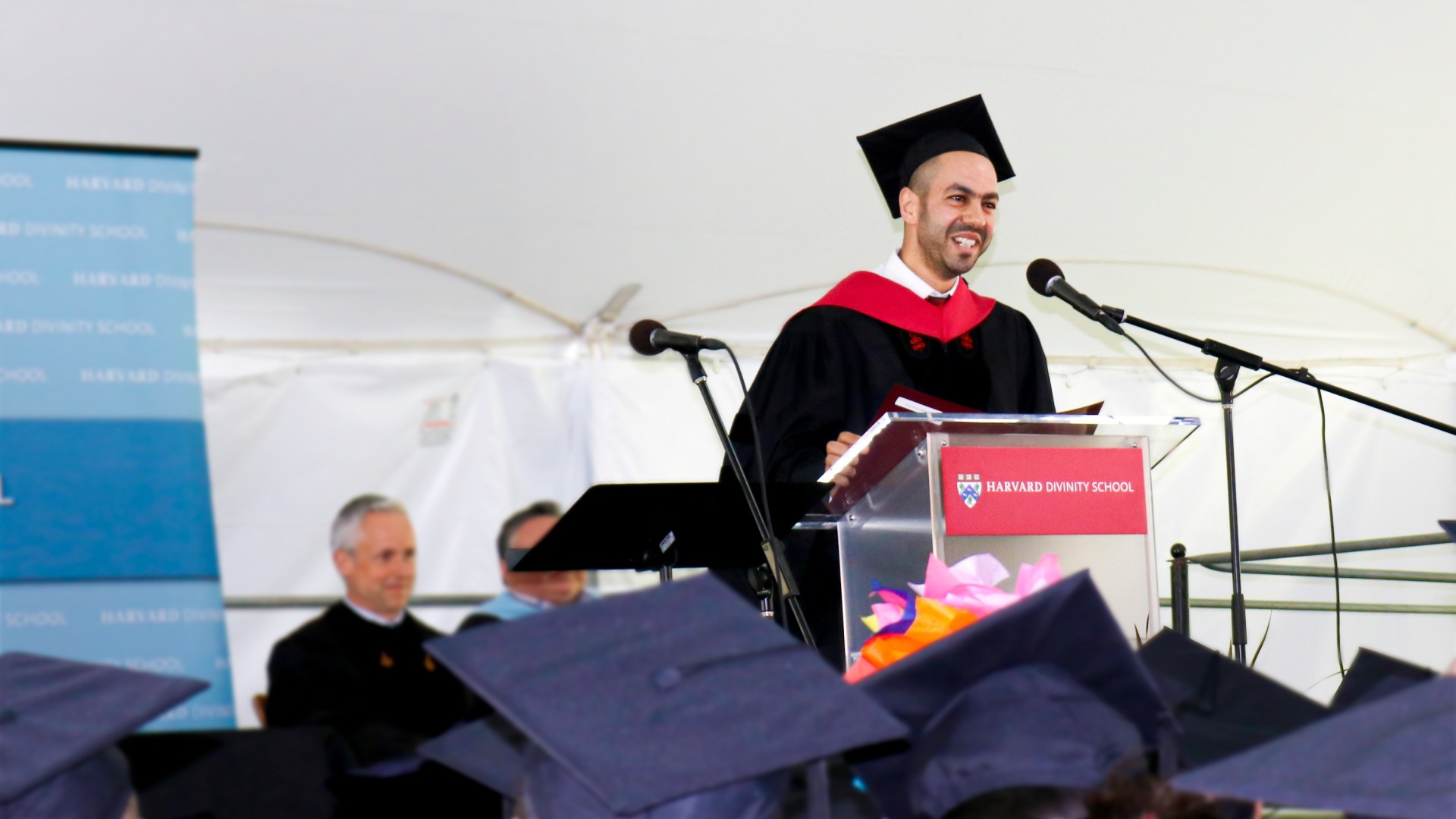
In Arabic, Alkhoury’s family name means “the priest.” Currently pursuing a PhD in practical theology at Fuller Seminary, in 2016 he began a unique cross-cultural ministry adventure—at Harvard University.

Through it drove the divinity student to the depths of depression, it ended with rapturous applause.

“I want to live, I want to love, and I want to be loved,” he told the student body, which selected him to deliver the commencement address this past May. “I want to fight to keep hope and make meaning of all the things that I do not have control over.”

In the prime of his life, Alkhoury witnessed the destruction of Syria. America might have been a refuge for many, until President Donald Trump’s travel ban.

Syrian visas reached a high point of 15,479 in 2016, the year of Alkhoury’s arrival. In January 2017, Trump issued his executive order banning citizens of initially seven Muslim-majority nations—challenged consistently in the courts and modified to include non-Muslim countries—and the number dipped to 3,024. In 2018, it fell to 41.

The meaning of it all, for which Alkhoury has long been seeking, has been years in the making.

Born in 1984 to Orthodox parents, he attended the local Alliance church in Homs. In 2005, he felt a call to full-time ministry.

Alkhoury became a youth pastor, volunteering also in peacemaking initiatives. Initially excited by the Arab Spring in 2011, he soured when it was hijacked by Islamic extremists. But his local university studies in pharmacology kept him off the front lines, as conflict plagued his war-torn city.

Following graduation in 2014, he prepared to pursue his theological studies in Egypt. But he desired to study in the US, and his senior pastor connected him to an evangelical-backed rescue operation.

Celebrities and religious freedom advocates—including Mark Burnett and Roma Downey, Glenn Beck, and Johnnie Moore— cooperated in various initiatives to raise millions of dollars to help displaced Christian refugees, relocating more than 10,000 to a dozen different nations.

Among the programs created was the Nazarene Fund, which agreed to support Alkhoury in America following his acceptance and full ride scholarship to Harvard Divinity School (HDS).

“I met him because evangelical pastors in Syria chose to stay, but also chose to send Tony here,” said Johnnie Moore, a founder of the Nazarene Fund.

Alkhoury applied to Harvard because he wanted to be challenged outside his conservative Christian bubble. Like many American evangelicals going off to college, he was.

His first roommate was a gay, Jewish atheist. Touched by Alkhoury’s story, he offered free rent and sincere friendship.

And though at Harvard he was accepted warmly as a Syrian, some of Alkhoury’s colleagues were vocal in questioning how the university could accept an incoming contingent of American evangelical students.

But he also discovered like-minded evangelicals equally critical of the progressives.

“It breaks my heart to hear liberal friends talk about conservatives, and vice versa, implying they are bad people,” Alkhoury said. “Many people have a false tolerance.”

It was a difficult experience. At Harvard, he discovered the rhetoric of acceptance and inclusion. Yet when given the chance to actually engage different opinions, many progressives drew back.

“Dialogue is hard,” he said. “It isn’t fun.”

But he also had a message for the US church: Judge ideas, not people. No matter their politics, everyone can contribute positively to America.

Alkhoury stuck at it through the trials of language, culture, and homesickness. Trauma from Syria and anxiety in America plagued his studies. But both liberal and conservative friends helped him along, and his “American mother,” an evangelical Catholic, housed him with her husband for three months. She sees the hand of God in her “third son.”

“Tony had a fear of being persecuted at Harvard, but was received with love and care,” said Suzanne Grishman, CEO of Mercury One, which administers the Nazarene Fund.

“God uniquely positioned him to bring people together in civil discourse.”

Moore told CT that during commencement he couldn’t go three feet on campus without discovering someone—and all different types of someone—who spoke warmly of Tony.

And in the end, they voted for him to close their university experience.

“May the name of Jesus protect you,” Alkhoury began his speech, using a traditional Syrian Christian greeting. He proceeded to openly speak of his belief in the absolute universal truth of Jesus.

But he also praised the richness and genuineness of other faith expressions he discovered. And rather than challenging the student body, and through them America, he chose instead to confess his fear.

“When I left Syria, the country was engulfed in civil war, torn between those who are proponents of the regime and those who are opposing it,” Alkhoury told the student body.

“Both were completely and are still completely convinced that they are serving the country, but they are not.

“I feel terrified when I witness a similar polarization in the US today.”

Alkhoury graduated with a masters degree in divinity, but cannot yet divine his future. He can remain in America as long as he continues his education. But if he visits Syria, he fears the travel ban would bar his return.

Mercury One is ready to hire him as a spiritual case worker to counsel those who share his wartime experience—and worse. Grishman noted his “amazing ability” with various trauma victims, including ISIS captives.

But his application for an employment-based green card through Mercury One was rejected, and is now under court appeal.

His long-term goal is to be a connection between the American and Syrian churches, in order to support Middle East ministries from the United States.

Meanwhile back in Syria, his father underwent open heart surgery, and his mother is suffering from breast cancer. In Homs, life is now relatively peaceful, suffering only a few hours of blackouts each day.

“I pray the American government can look into my case quickly, so I can travel and see my ill parents,” Alkhoury said. “Everything depends on that, and I put it in God’s hands.”

As he does Syria.

“This disaster is certainly not from God,” he said, “but God is willing to partner with us to bring life out of these deadly events.

“The church has a responsibility to respond. And when people want to do something positive, they can do it.”

Jayson Casper is Christianity Today’s Middle East correspondent.

Culture

‘His Dark Materials’ Imagines a Church Without God

The new HBO take on Phillip Pullman’s trilogy explores the brutality of a church’s power without the gospel.

Christianity Today November 7, 2019
Courtesy of HBO

Imagine a world where the church exists without Jesus. Where a hierarchical church authority controls society, but lacks the genuine faith to guide it. His Dark Materials, a new HBO show based on the trilogy of the same name by Phillip Pullman, takes viewers into this oppressive world where the “Magisterium,” a fictional church, rules with fear and brutality.

His Dark Materials, which premiered Nov. 4 and airs on Mondays, intentionally offers viewers a picture of a powerful institutional church without Jesus or the gospel. The show’s narrative follows so-called heretics as they fight the ruthless Magisterium, which demands allegiance to its traditions and its mysterious “Authority,” without offering the hope of a Savior in exchange.

Anything that challenges the Magisterium’s authority is labeled heresy—and the merciless church will do anything to protect its power. His Dark Materials is less a story about belief and more about power, and how religious organization can distort and manipulate faith in God.

The overarching conflict of the show is between the freedom to choose and the church’s control. His Dark Materials isn’t shy about parallels to the Garden of Eden story. A key portion of Genesis is read aloud in one classroom scene: “eyes will be opened…and you shall be as gods, knowing good and evil.”

The Magisterium offers “scholastic sanctuary,” or academic freedom—but it’s a loophole with limits. Scholars are warned against “blasphemy” and spies are present even in private conversations, with the authorities ready to mete out punishment. This world lives under fear of the church.

Pullman describes himself as an atheist. And the show has a dark view of religious authority. Still, the creative forces behind the TV series would prefer viewers not see it as a critique of Christianity.

“Philip Pullman in these books is not attacking belief, is not attacking faith,” executive producer Jane Tranter said at the San Diego Comic Con panel for the show earlier this year. “He's not attacking religion or the church, per se. He's attacking a particular form of control, where there is a very deliberate attempt to withhold information, keep people in the dark, and not allow ideas and thinking to be free…It doesn't equate to any particular church or form of religion in our world.”

The books—the first of which was published in 1995 as Northern Lights (marketed as The Golden Compass in the US)—earned critical raves when they were published. But Pullman believes his young adult trilogy only avoided controversy thanks to the Harry Potter series.

“I've been flying under the radar, saying things that are far more subversive than anything poor old Harry has said,” he told The Sydney Morning Herald in 2003. The first book in J. K. Rowling's series was published in 1997. Pullman’s third—and most controversial—novel in the His Dark Materials series was published three years later.

A number of US schools and libraries did attempt to ban the books, citing their anti-religious content and their violence, according to the American Library Association. And ahead of the 2007 release of a film adaptation of The Golden Compass, the Catholic League declared that "the goal of the books is to sour kids on the Church while promoting atheism.”

Unlike the 2007 movie, which was a critical and commercial flop, the new series—a joint production between HBO and the BBC—is not afraid to explore religion or politics. It is adapted by Jack Thorne from the full breadth of Pullman’s works including his more recent trilogy, The Book of Dust. Thorne reportedly consults often with the author.

In the show, 12-year-old Lyra (Dafne Keen) and her uncle Asriel (James McAvoy) are thirsty for knowledge that the Magisterium wants kept under wraps, putting them at odds with the church.

"There's a war raging right now between those trying to keep us in ignorance…and those willing to fight for the light, fight for true academic freedom," Asriel declares early in the first episode. The structure and governance of the Magisterium remains shadowy, but key players in religious garb are regularly depicted issuing sinister orders from a megachurch-like complex in London.

Meanwhile, Lyra craves adventure. She insists “sometimes you’ve got to have dreams”—and she dreams of traveling north to explore. The plot in the first book, and this season of the show, is largely propelled by the disappearance of children, including Lyra’s school friend Roger (Lewin Lloyd). Lyra wants to find Roger and allies with various people—who have various motives—in order to follow his trail north.

Lyra’s determination to find Roger puts her on a course to unveil secrets of the Magisterium and a sinister plot with dark parallels to child abuse incidents within the Catholic and Protestant churches.

At heart an adventure story, the layers of metaphor in His Dark Materials are part of what make both the source material and the show compelling. There is Dust, a mysterious substance Asriel is studying even though the Magisterium considers his discoveries heresy. There are daemons, souls that exist in the form of animals outside the body of their owner and act and speak as an extension of them.

The first four episodes of the show are relatively clean—far more than Game of Thrones, the same audience His Dark Materials seems to target—with no sex and toned-down violence. As the series moves slowly toward an inevitable clash between its heretics and its church, the show will likely raise red flags later on. But perhaps they will reveal valuable lessons.

Religious education should include “serious examination” of doubt and conflict in faith, former Church of England head Rowan Williams said about the books in 2004. “But it is in showing how religious beliefs sustain themselves in such circumstances that we best educate students in a critical understanding of their own faith and a critical understanding of faith in general.”

The show offers a more nuanced portrayal than the standard church-as-oppressive force version we've seen in other fantasy epics, including Game of Thrones. Even Mrs. Coulter (Ruth Wilson), the central human villain who aligns herself with the Magisterium, has found ways to manipulate the system and is not a true believer. It is clear that the human quest for power is the root of evil in the Magisterium.

The church without a Savior is an empty shell, a vacuum that inevitably seeks power. And in His Dark Materials, the absence of Jesus is strikingly conspicuous even though he is never named. Pullman told Williams in 2004 that Jesus does not exist in the realm of his Magisterium, an acknowledgement that his church offers no redemption and is only an organization of human power. And in a world where the church controls the government, it is hardly a fantasy that the human authorities use religious manipulation to cement their control.

The New Testament has a fair amount to say about structuring the church so that it supports the goal of pointing its people to Christ and it describes a church body with dispersed power. Without Christ at the head, the church is a slave to sin instead of proclaiming its purpose: “It is for freedom that Christ has set us free” (Gal. 5:1).

His Dark Materials lets us see what it would be like if we could never be free from the fear of original sin, but were condemned to the terror that frightens the Magisterium. Yet Pullman rejects the idea that we should be afraid of sin.

“I try to present the idea that the Fall, like any myth, is not something that has happened once in a historical sense but happens again and again in all our lives,” he said in 2004. “The Fall is something that happens to all of us when we move from childhood through adolescence to adulthood and I wanted to find a way of presenting it as something natural and good, and to be welcomed, and, you know—celebrated, rather than deplored.”

The series’ portrayal of a church without Jesus—one that forces free-thinkers to seek out other worlds in order to escape its control—offers a powerful contrast to what the church in our world offers: the freedom promised by Christ. His Dark Materials may not point anyone directly toward Jesus—but by portraying a world without him, it may highlight just how much he is needed in ours.

Alicia Cohn is an editor and writer based in Denver. She interned at Christianity Today in 2009. Follow her on Twitter @aliciacohn.

News

Comedian John Crist Cancels Tour Over Sexual Harassment Allegations

The viral entertainer confesses “sexual sin and addiction” following Charisma investigation.

Christianity Today November 6, 2019
Jason Davis/Getty Images for KLOVE

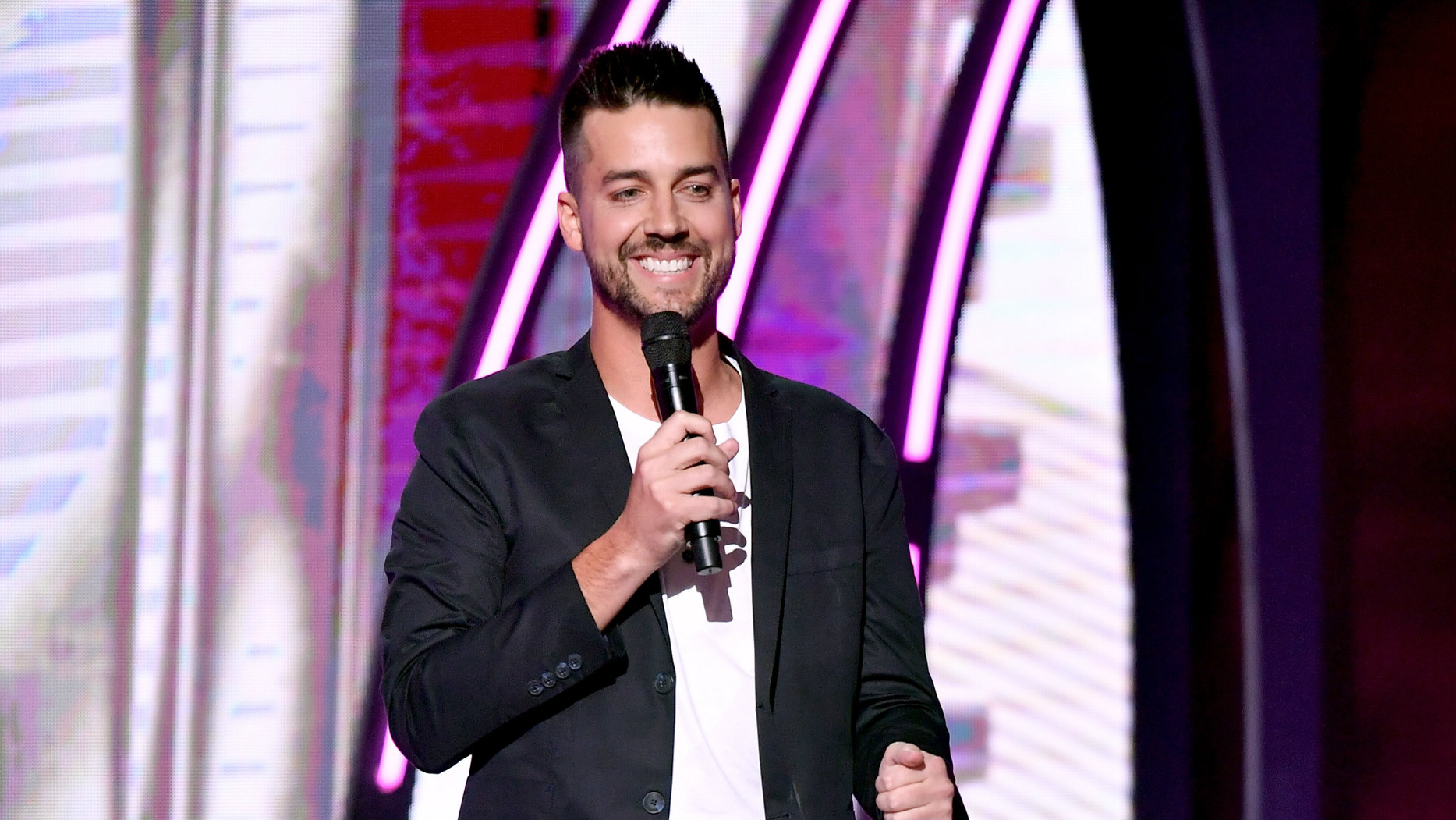
Comedian John Crist, known for his viral videos and jokes satirizing Christian culture, has canceled upcoming tour dates after reports he has harassed and manipulated multiple women to pressure them into sexual relationships.

According to a Charisma magazine investigation, Crist used his celebrity to exploit at least five women over the last seven years.

“The allegations include, but are not limited to, individually sexting multiple women during the same time period,” reporter Taylor Berglund wrote, “initiating sexual relationships with married women and women in committed relationships, offering show tickets in exchange for sexual favors and repeatedly calling these women late at night while drunk.”

Five women shared their stories with Charisma, and the magazine independently verified substantial portions of their accounts. The women believed that sharing their stories could protect others from Crist’s manipulative behavior.

Crist turned the Christian-ese phrase “check your heart” into a punchline, but now faces serious allegations. He said in an official statement to Charisma that he is not guilty of everything he’s been accused of, but did admit to “sexual sin and addiction struggles.”

“I have violated my own Christian beliefs, convictions and values, and have hurt many people in the process,” Crist wrote in his statement. “I am sorry for the hurt and pain I have caused these women and will continue to seek their forgiveness. I have also hurt the name of Jesus and have sought His forgiveness.”

Crist is currently on a comedy tour titled “Immature Thoughts.” On Wednesday night, tickets were still for sale on his website, but several venues had announced shows were being canceled due to “health concerns.”

The 35-year-old comedian, now with over 1.2 million Instagram followers, became popular with YouTube videos satirizing Christian culture. His first viral video made fun of Contemporary Christian Music, joking about the secret formula for popular Christian music: three chords, simple rhymes, and vague struggles. “Boom,” Crist says in the video. “Hit song.” The clip has been viewed more than 2 million times on YouTube.

Crist followed the success with more viral videos, including one making fun of picky church shoppers and another of “Christian girls on Instagram.” In a popular Facebook post, he read one-star reviews of churches on Google, getting more and more exasperated with people’s complaints about church.

“There’s nothing funny to me about Jesus on the cross or the Virgin Mary, things that are very at the center of our belief system,” he told The Tennessean in 2019. “But if your pastor is dressed like he’s on ‘MTV Cribs,’ I’m gonna make fun of that. I worked in a church last week that had ‘Pastors Only’ parking spots, which in my estimation, is, I think, 100 percent everything that Jesus as a person was against.”

Crist has millions of followers online and has performed for larger and larger audiences and he frequently sold-out shows. He opened for popular mainstream comedians, including Jeff Foxworthy, Dana Carvey, and Dave Chappelle, making a niche for himself as a clean Christian comedian who was “actually funny.”

At the same, according to Charisma’s reporting, he was using his celebrity to manipulate young women to give him sexual favors.

Earlier this year, Crist released a music video called “Check Your Heart,” which immediately hit the top of iTunes’ Christian chart. In the song, Crist raps about watching porn, sending sexually explicit texts, and scrolling through Instagram to look at women who are “thirst traps.”

“Why you trollin’? Check your heart,” says the chorus, rapped by hip hop artists nobigdyl and 1K Phew. “Stop that scrollin', check your heart.”

Crist, an Atlanta native and graduate of Samford University, seemed poised to make the jump to mainstream entertainment this fall with a Netflix special called “I Ain’t Prayin' for That” set to release on Thanksgiving day. His first book, Untag Me: The Subtle Art of Appearing Better than You Really Are, is slated for publication by WaterBrook in March. Both are now on hold following the news of Crist’s alleged misconduct.

Theology

My ‘Mom Rage’ Is Understandable. But It’s Not Excusable.

In my fury, I’m invited to repent and be restored at the foot of the cross.

Christianity Today November 6, 2019
Illustration by Rick Szuecs / Source images: Envato

I am the mom who tries to have it all. I work a full-time job from home with two kids ages two and under. As a result, my life is very tightly wound. One sleepless night, one cancellation from the nanny, or one last minute trip to the doctor can collapse my carefully crafted plans and provoke me to anger.

Recently, I’ve found myself in a protracted battle with my youngest daughter over breastfeeding. When she arches her back and refuses to comply with my feeding plans, rage courses through my veins.

Yesterday, I looked into her eyes and said the words, “Shut up.” I was tired of her whining and constant grunting in dissatisfaction, so in a moment of desperation, I uttered words that I could never have imagined saying to a baby. I didn’t even know I was going to say them until they came out of my mouth. Then in sheer terror I remembered: “Out of the heart speaks the mouth” (Matt. 12:34), and “whoever hates his brother in his heart commits murder” (1 John 3:15).

These days, a lot of mothers (and fathers) struggle with anger. Various Facebook groups for moms—including those I’m part of—often discuss strategies for dealing with “mom rage.” Major magazine publications, too, are giving voice to women’s experiences of rage. They’re providing space for vulnerable and brave conversations and stories of women who struggle in their relationships with their kids.

Though it’s largely assumed that mothers have natural, self-giving love for their children (and we do), being a mom does not preclude real, powerful darkness from growing in our hearts. As Minna Dubin shared recently in The New York Times, “Mother rage can change you, providing access to parts of yourself you didn’t even know you had.”

As a Christian, I see my anger through the framework of brokenness that sin brings to my life. In other words: The Bible speaks directly to my parental anger.

The first time I realized I had committed biblically defined murder against my child was only a few days after we arrived home from the hospital with my oldest. After yet another sleepless night, I looked down into my daughter’s crib and wept with the knowledge that not only was my love for her limited, but evil lurked in my heart.Even now, I am most guilty of hating her when she is most in need of me, a sad and heartbreaking reminder that the strong do not naturally look out for the best interests of the weak. When my child has sleepless nights, needs extra time in my arms, seems incapable of adapting to my schedule, or feels sick, those are the times I am most likely to rage against her. Those are the times I am most likely to believe that my needs—the needs of someone stronger, older, wiser, and healthier—are more important than hers.

What’s the solution, then? Dubin claims that “couples therapy, individualized therapy, life coaching, [and] anger management for mothers” have helped her, along with exercise, art-making and healthy food. “In toolbox lingo: These things fill up my patience cup.” She also studies emotional intelligence as a helpful tool for understanding her rage and others’. “Repeated aggravations,” she writes, “can dramatically increase anger, so that by the third or fourth rage trigger, the person is reacting on a level 10 in response to a misplaced key or a dropped spoon.”

Dubin is right: We have to understand parental anger as a psychological and interpersonal phenomenon. But that isn’t enough. As believers, we find freedom in repentance.

First, repentance enables us to see ourselves as we truly are—sinners in need of a savior. It’s directional; it moves us away from sin and toward Christ. Paul writes, “For godly grief produces a repentance that leads to salvation without regret, whereas worldly grief produces death” (2 Corinth. 7:10). And Peter urges, “Repent therefore, and turn back, that your sins may be blotted out, that times of refreshing may come from the presence of the Lord” (Acts 3:19).

Second, repentance moves us toward reconciliation with the one we’ve offended. In Ephesians 4:32, Paul encourages us to “be kind to one another, tenderhearted, forgiving one another, as God in Christ forgave you.”

But how do you apologize to a baby? I’ve come to realize that by the time my daughter is old enough for me to look into her eyes and say “I’m sorry” in any meaningful way, the pile of sins will already be too high and too deep for me to atone for. There is already a backlog of incommunicable reconciliation that needs to happen between us.

As a mother, the guilt I feel over this backlog is crushing. As a Christian, however, it drives me to rest in this gospel reality: The countless acts of rage and “murder” that I’ve already carried out against my child are fully covered by Christ’s blood. Motherhood has brought this wisdom to life in painful ways. On this day and every day to come, Jesus’ blood will cover each and every aspect of my parenting until final reconciliation takes place in the new heavens and the new earth.

Finally, repentance moves me to my knees. “When our Lord and Master Jesus Christ said ‘repent,’” wrote Martin Luther, “he willed the entire life of believers to be one of repentance.”

Constant repentance requires constant prayer, so as my daughter gets older and finds new ways to challenge me, I often find myself praying these words: “God, save my child from myself! Do not let her suffer the consequences of my sin, of my hard heartedness. Love her more than I can dare to hope to love her. Speak softly to her soul. Love her first so that she might love you. Shield her from who I am, from my brokenness. Be tender to her in ways I fail to be.”

Ultimately, in seeking to reconcile with my nonverbal daughter, I must first reconcile with the Lord. My sins against my daughter are offenses against God. He created her, imbued her with dignity and beauty, and understands the pleas of her heart when I cannot or will not. In the midst of my anger and guilt, my only hope is in Christ, who covers my shame with his blood.

Hannah Nation is a writer and editor based in Cambridge, Massachusetts and temporarily living in the Netherlands. She received her MA in church history from Gordon-Conwell Theological Seminary and serves as the communications and content director for China Partnership.

Apple PodcastsDown ArrowDown ArrowDown Arrowarrow_left_altLeft ArrowLeft ArrowRight ArrowRight ArrowRight Arrowarrow_up_altUp ArrowUp ArrowAvailable at Amazoncaret-downCloseCloseEmailEmailExpandExpandExternalExternalFacebookfacebook-squareGiftGiftGooglegoogleGoogle KeephamburgerInstagraminstagram-squareLinkLinklinkedin-squareListenListenListenChristianity TodayCT Creative Studio Logologo_orgMegaphoneMenuMenupausePinterestPlayPlayPocketPodcastRSSRSSSaveSaveSaveSearchSearchsearchSpotifyStitcherTelegramTable of ContentsTable of Contentstwitter-squareWhatsAppXYouTubeYouTube