Books
Review

How to Be Faithful When You’re Too Busy to Think

Tara Sun’s new book is a practical and realistic call to Christ-centered faithfulness for women who are overbooked and overwhelmed.

A girl surrounded by work, school, and social media
Christianity Today August 5, 2025
Illustration by Mallory Rentsch Tlapek / Source Images: Getty, Unsplash

It was well past 1 a.m., and I was still frantically working on an article with a deadline just hours away. I was exhausted but couldn’t sleep yet. Between classes and work, I knew the article wouldn’t be in on time if I didn’t finish it immediately—but I was near tears as I remembered the editing I still had to do. To top it off, I wasn’t going to have time to read my Bible, and I felt enormously guilty about it. I couldn’t even look forward to going to bed, knowing I’d have to get up far too early and spend the next day working feverishly. 

This late-night rush to finish homework happened far more times than I could count last semester. And it wasn’t that I was procrastinating. Between full-time classes, my internship at a local newspaper, attempts to have a social life, and work as a conservative speaker, writer, and podcast host, I barely had time to think, let alone get everything done. 

Probably every woman has gone through a period of feeling that it’s impossible to keep up. Tara Sun knows this well. Sun is a mother, the host of the podcast Truth Talks with Tara, an influencer, a speaker, and the author of several books, most recently the aptly titled Overbooked and Overwhelmed: How to Keep Up with God When You’re Just Trying to Keep Up with Life. Using her own struggles with busyness and distraction, Sun shares what she’s learned about prioritizing faith and slowing down. 

Sun’s central theme is that “Jesus is better.” In fact, she writes, “before we named this book Overbooked and Overwhelmed, I toyed with the idea of including ‘Jesus is better’ in the title. … This is the bedrock upon which this whole book stands.” 

We are overwhelmed not only because we have a lot to do, Sun argues, but also because we’re distracted and focusing on the wrong things. We’ve filled every space in our lives with something—be it scrolling social media for a quick five minutes, watching TV while doing mundane tasks, or listening to podcasts while we travel—using up time we should be giving to Christ. 

“The little choices we make each day, saying yes to either devotion or distraction, add up,” Sun says. “Our choices, like ignoring our Bible yet again and scrolling social media, may feel inconsequential in the moment, but those choices put down roots too, whether we realize it or not.”

To break this pattern, she explains, we need to examine ourselves and discern what we’re desiring above the Lord, because the things we value influence how we live. We naturally long for peace, comfort, security, and acceptance, but too often we’re seeking them from sources other than God. In the midst of our over-busy, fast-paced lives, the fundamental answer to our feelings of overwhelm is to prioritize Jesus over our calendars. 

But practically, how do we do that when our lives feel like a never-ending whirlwind? Sun stresses the importance of building habits and taking the time to reflect on what God has done in our lives. 

Each chapter ends with reflection questions women can use to examine our minds and hearts and reorient our lives to focus on Christ. I know from experience that taking time to journal through questions like this can be a more effective teaching tool than reading alone, and Sun does a good job highlighting and then dismantling lies readers may have come to believe about busyness and distraction. Her practical tips for reorienting life around Jesus are tips we can actually follow. 

In a few places, however, Overbooked and Overwhelmed struck me as a bit wordy and redundant, as if Sun didn’t have quite enough substance for a project of this size. For instance, when Sun is explaining the importance of devotion to Christ, she says the same thing multiple times in different ways. Her conversational tone would feel natural in an Instagram caption but didn’t always translate well to print. 

A more serious flaw was some of Sun’s scriptural exegesis. Though the bulk of Overbooked and Overwhelmed is biblically sound, Sun sometimes plays fast and loose when turning to Scripture to support minor points—points that could have stood on their own as simple Christian prudence or that could have been better supported with other parts of the Bible. In these spots, Sun would pull a lesson the story wasn’t meant to teach or use a verse to make a point that had nothing to do with what the passage was saying. 

For example, Sun gives a quick recap of the story of David and Goliath from 1 Samuel 17, focusing on the part where Saul gives David his armor to try on. David “tried in vain to go,” verse 39 says, and could not, “for he had not tested them” (ESV throughout). Sun concludes this retelling by commenting that “David playing dress-up in Saul’s armor teaches us something profound: What fits for some may not fit for others.”

That’s not false, and it may even be reminiscent of Paul talking in 1 Corinthians 9 about becoming all things to all people so he can deliver the unchanging gospel. But it’s not the point of David and Goliath. The story is about David’s faith and his total reliance on God, rather than external things like Saul’s armor, to defeat the giant. 

It’s also not scripturally inaccurate to recognize, as Sun does, that human limitations can be a good thing: “Limitations, if seen through the lens of Christ, are liberating. They push us towards God’s strength when we come to the end of ours. And they are license to give two of life’s most precious commodities—time and energy—to the things of God.”   

But when Mark 10:14 says, “Let the children come to me,” Jesus is not talking about the beauty of limitations. He’s highlighting God’s love for children and saying we should come to Christ with a trusting, childlike faith. 

It’s not necessarily wrong to draw this kind of subpoint from Scripture—but it’s certainly not strong argumentation. And it risks looking as if the Bible is being used in service to a predetermined point rather than serving as inspiration and authority. 

Fortunately, most of Overbooked and Overwhelmed doesn’t follow that pattern. The book is helpful for women who feel that they can’t keep up with life, much less their faith. As someone who is constantly overbooked and overwhelmed (you thought that frantic writing session was just last semester? You should see my summer schedule!), I found Overbooked and Overwhelmed to be encouraging. 

Sun was at her best in calling out situations we don’t normally think of as problematic in our day-to-day lives, such as constantly being distracted and surrounded by the noise of social media, overbooked calendars, and overwhelmed hearts:

If we’re being honest, a lot of us don’t see distraction as a detriment to our souls. We don’t see the problem. Don’t we deserve to enjoy what makes us feel happy and rested? Don’t we deserve a little relief and entertainment when we work hard or when life is hard? Is distraction really that soul deep? What if it’s just the norm in this thing we call the twenty-first century?

It might be the norm, but Sun makes a compelling case that it shouldn’t be. Even when we don’t think our distractions are a big deal—it’s just five minutes on Instagram—they add up and often, subtly but surely, reshape our lives for the worse. 

That’s especially true when we allow ourselves to be distracted from spending time with Jesus. There’s nothing wrong with enjoying the things God has given us, Sun acknowledges, but we must not let them distract us from God as the source and center of our lives. 

When my schedule is busy, I tend to reach for my phone or turn on a TV show during breaks because I just want to turn my brain off. Even when I get up in the morning, my first instinct is to scroll rather than read my Bible, because thinking itself can feel overwhelming. Overbooked and Overwhelmed reminded me anew that the fleeting comfort from numbing my brain will leave me empty and less mature in Christ.

“Netflix and Instagram may provide a hit of dopamine or a retreat from reality, and they definitely have their perks, but those perks are fleeting for our souls,” Sun writes. “A well that will always run out, a cistern too broken to hold anything of value. But how our souls really, truly, and deeply find satisfaction is through devoting ourselves to God.”

It’s easy to remember God works in us to sanctify us—and too easy to forget we have a responsibility as believers to make the right choices. Though God is working in our hearts, we still have a responsibility, Sun says, to “roll up our sleeves and participate in the work God starts and sustains in us.”

Practically, Sun advises, that may look like being more specific about the habit you want to form and layering it on top of something you’re already doing. Say you want to get some Bible reading in every morning, but you can’t seem to make time. Could you listen to Scripture while you’re making breakfast, commuting, or working out? 

For women who desperately want to be closer to God but are so busy we can barely think, these practical ideas are a blessing. Sun provides realistic ways of keeping Christ the focus of our lives, including suggestions for reflection and creating goals. She explores the tendency to say yes too frequently and God’s ability to work through us—including our weaknesses and the times we have to say no. And she makes sense of our limitations, pointing out that Christ, though fully God, is fully human, and therefore had physical limitations too. Jesus, the Son of God, needed to spend time with his heavenly Father just as we do. He prioritized it where we too often do not. 

It is vital to refocus our minds and hearts on the one who matters most, because our stress and responsibilities can only be handled through him. Even when our responsibilities are good, if we’re not focusing on Jesus, they can become burdens too heavy for us to bear. 

 “A wasted life happens,” Sun says, “when we let our forgetfulness of who God is and what we were made for allow us to live small and live forgetful of His goodness, His truth, and His commission.” I needed that reminder, and I know many women—and men—do as well.

Kenna Hartian is the Habecker fellow at Christianity Today.

Culture

The Documentary That Devastated Me

I’m a Native American and a Christian, and “Sugarcane” also moved me to prayer.

A decayed statue of Mother Mary and baby Jesus

A statue of Mary and Baby Jesus looks over St. Joseph’s Mission, a former Indian residential school in British Columbia, in the documentary, Sugarcane.

Christianity Today August 4, 2025
Christopher LaMarca / Sugarcane Film LLC

A Native American–directed documentary, Sugarcane, made history earlier this year when it earned a nomination for an Academy Award.

Codirected by Julian Brave NoiseCat (Secwepemc Nation) and Emily Kassie, the film investigates the abuses against and disappearances of Indigenous children at Saint Joseph’s Mission Indian Residential School in British Columbia—and also delves into the traumatic legacy of the larger Native American Indian residential school system across Canada and the US. Highlighting stories from survivors and descendants, Sugarcane exposes for the first time a pattern of infanticide, the killing of babies who were fathered by priests and born to Indigenous girls.

Although it didn’t take home the Oscar, Sugarcane garnered critical acclaim, winning Best Documentary at the National Board of Review, US Documentary Directing Award at the Sundance Film Festival, and Best True Crime Documentary at the Critics’ Choice Awards. Since its 2024 debut, the movie has screened globally, sparking a grassroots movement to uncover the truth about hundreds of other schools.

From the mid to late 1800s until the 1970s, hundreds of thousands of Native children were forced to attend state-funded Christian schools in an attempt to “anglicize” and assimilate them into Canadian and American society. They were not allowed to speak their native languages or practice cultural traditions. Many were beaten and verbally abused, and thousands are believed to have died. Many young children perished because they attempted to escape, freezing in the harsh Canadian winter.

In Canada alone, a report by the Truth and Reconciliation Commission identified 3,200 children who died while attending residential schools. Canada’s institutions were very similar to facilities in the United States; between the two countries there were approximately 500 residential schools, often operated by Catholic and Protestant denominations.

As a documentary filmmaker myself, I appreciate the years of research that went into the making of Sugarcane. As a Christian—and Native American by heritage—I’m devastated by the shameful stories of violent sexual crimes and infanticide. It would be hideous if these crimes had been committed by hardened criminals. It’s all the more appalling that they were perpetrated by church leaders, entrusted to be child caretakers and preachers of the gospel.

The night after watching Sugarcane, I couldn’t sleep. I’d cringed, screamed, and wept through the movie, and now I couldn’t stop thinking about it. My father, who was Cherokee and born on Indian territory in Oklahoma, was forced to attend a boarding school as a very young child. Although I do not believe he was sexually abused, our family has certainly felt the effects and emotional scars of his traumatic experiences.

As I felt God calling me to react to Sugarcane, I prayed that the Native American community might understand that these actions were not of Jesus, and might believe that the Lord will judge the violent school officials. Indeed, one emphasis of Jesus’ ministry was his admonishment of church leaders for hypocritical behavior. He called them “whitewashed tombs,” beautiful on the outside but full of bones on the inside (Matt. 23:27–28). He chastised those who honored him with their lips while their hearts were far away (Mark 7:6–8). And he warned that if someone caused a child to stumble, it would be “better for them to have a large millstone hung around their neck and to be drowned in the depths of the sea” (Matt. 18:6).

I continue to pray that the Native American community may understand the true nature of Jesus Christ: his love, his mercy, his support of children and others who are persecuted. Native Americans are in general a faithful people. According to recent surveys, around 6 in 10 identify as Christian believers. And yet one must wonder how much harm the horrors of these boarding schools did to the message of the gospel and trust in the church.

According to codirector Emily Kassie, Sugarcane is being screened post–award season for government officials, in classrooms, and in tribal community locations, including in New Zealand. I hope that through these screenings, Native communities can understand that beyond sin and hypocrisy there is healing and redemption at the hands of our Lord. Scripture promises ultimate judgement and victory from God (Rom. 12:19; 1 Cor. 5:10), and this gives me peace that I hope I can convey in my own life.   

I also pray that as Christians we will remember that God created many peoples and cultures and that even though we are all one in Christ, we cannot ignore the differences between us. I encourage people of all backgrounds to celebrate Native American heritage and culture while also understanding tribes’ heartbreaking histories. Many tribal nations have museums and celebrations to which all are invited.

I recently led a Bible study based on the book Beyond Colorblind: Redeeming Our Ethnic Journey. Author Sarah Shin writes that “when we experience internal transformation in our ethnic journeys, God propels us outward in a reconciling witness to the world. Ethnic healing can demonstrate God’s power and goodness and bring good news to others.” My own ethnic-healing journey has been a story of two communities (Native American and Christian) intersecting and fusing to result in the inner contentment of my identity; of my mission; and of the deep, abiding love of Christ.

My prayer is that all of us can love the way Jesus loves us, with that love bringing healing and reconciliation to Native American communities and beyond.

Valerie Red-Horse Mohl (Cherokee) is a board member of Christianity Today, a finance professional, and an award-winning documentary filmmaker. She teaches part-time within Native American Studies at Stanford University.

Theology

Put Down the Shofar

Contributor

The early church earnestly considered the question of Gentile observance of Jewish law and customs. Their answer was a firm no.

Moses with the Tablets of the Ten Commandments by Rembrandt

Moses with the Tablets of the Ten Commandments by Rembrandt.

Christianity Today August 4, 2025
WikiMedia Commons / Edits by CT

One day a student approached me after class with an urgent question. The course was on the doctrine of the church, and we’d spent a few weeks on Abraham, Israel, and the law of Moses. Some years back, my student’s family left a mainstream congregation to found a house church which sought to be more like the Christian communities in the Book of Acts. Though Gentiles, they began observing Jewish customs and celebrating the festivals commanded by Moses, including Passover.

My student asked me earnestly, “Were we wrong?” This small church was trying to heed the admonition of James to “be doers of the word,” following “the perfect law, the law of liberty” (1:22–25, RSV throughout). And their logic was impeccable: The Torah (the Hebrew word for the law of Moses) is God’s Word for God’s people. Baptized Gentiles are members of God’s people; therefore, they ought to obey these commands.

The question is not a trivial one, nor is it obscure in American Christian life. You’re likely familiar with shofars blown in public, Seder meals for Passover, and circumcision for baby boys. But as common and well-intended as these may be, I want to explain why I told my student that, yes, his house church was wrong—or at least, misguided. The New Testament is not silent on the question of Gentile observance of the law of Moses. And its answer is a firm no.

The apostles are clear that Gentiles—that is, non-Jews, people who do not descend biologically from Abraham, Isaac, and Jacob—need not become Jewish to follow Christ. Indeed, Paul goes further, particularly in his letter to the Galatians, where a young church had been convinced that God required circumcision and law following for Gentile salvation. He writes there that if Gentiles are circumcised, “Christ will be of no advantage to you” (5:2–4). Any who say otherwise, he charges, are preaching “another gospel,” one that is “accursed” (1:7–9).

Yet for all that clarity, I understand why the question is perennial. It certainly mattered to the early church—arguably it prompted the first theological crisis the apostles faced, and every document of the New Testament bears the impression of this debate. The question could be phrased from two different perspectives. Jewish believers asked, On what basis may Gentiles join us? Once included, Gentile believers asked, On what basis is the Torah authoritative for us?

The question didn’t stand alone but drew together a host of others: the oneness and justice of God, the sacrifice of Christ, the authority of Scripture, the election of Abraham, the vocation of the Jews, the scope of salvation, the gift of the Spirit, the purpose of faith, and the efficacy of baptism. Given its implications, everything hung on getting the answer to this question right.

The New Testament is written more or less entirely from the first perspective. This presents a conundrum for a church that has long been majority Gentile: How should we interpret texts written by Jews to Gentiles joining a religiously and mostly ethnically Jewish movement? The questions they were answering are subtly different from the questions we face today.

Nevertheless, we should start with their debates. Very early the apostles realized that Gentiles were eager to join the faith. It took the intervention of the Spirit to help them see that this was God’s will (Acts 10:1–11:18; Gal. 2:11–21). But eventually they couldn’t deny that Gentiles were receiving faith, baptism, and the gift of the Holy Spirit. Christ himself was welcoming Gentiles into his family, the family of Abraham.

What does it mean to become a child of Abraham? For Jewish believers, the answer in Genesis 17 came from God in no uncertain terms: “This is my covenant, which you shall keep, between me and you and your descendants after you: Every male among you shall be circumcised,” and any male not circumcised “has broken my covenant” (vv. 10–14). You couldn’t ask for a clearer command.

This is the biblical case pious Jewish believers brought forward for the apostles to consider. These believers were neither xenophobic nor racist, as they are sometimes labeled. They simply wanted Gentiles to join the family on the terms God had set. As they understood the Scriptures, that meant circumcision. And circumcision in turn stood for following the whole law, because it is the sign of the covenant and the doorway into all its obligations. On this, Paul agreed: “Every man who receives circumcision … is bound to keep the whole law” (Gal. 5:3).

It was hardly unreasonable for faithful Jewish Christians to suppose this long-standing command would remain the same for Gentile converts. After all, God’s command to Abraham even included circumcising foreigners joined to his house (Gen. 17:12–13)! So Jewish believers applied Scripture to the newfound situation of baptized Gentiles: “Unless you are circumcised according to the custom of Moses, you cannot be saved. … It is necessary to circumcise them, and to charge them to keep the law of Moses” (Acts 15:1, 5).

It seems to me that many believers today are like early Gentile Christians ready to go “all the way” as new members of Abraham’s household. This was the exact attitude that animated my student’s house church. They read the opening chapters of Acts and wanted to imitate the early church. A worthy impulse! But what they failed to do—and what I believe too many Gentile believers fail to do—is follow this thread of debate through the rest of the book.

The apostles approached the question of Gentiles and the law with the utmost seriousness. In Acts 15, we see them meet in Jerusalem with the church’s elders to consider the matter (v. 6). Peter bore witness to the work of the Spirit in Gentiles like the God-fearer Cornelius, whose story is recounted five chapters prior (vv. 7–11). Barnabas and Paul bore witness to the “signs and wonders God had done through them among the Gentiles” (v. 12). And finally, James arose to deliver the verdict (vv. 13–21).

The council’s answer was unambiguous: No, Gentiles need not be circumcised to follow Jesus; no, Gentiles need not be law observant to join the church; no, salvation is not impossible apart from the Torah. The grace of God is sufficient for all, and faith in Christ is available to all. 

As Paul would later write, “For as many of you as were baptized into Christ have put on Christ. There is neither Jew nor Greek, there is neither slave nor free, there is neither male nor female; for you are all one in Christ Jesus. And if you are Christ’s, then you are Abraham’s offspring, heirs according to promise” (Gal. 3:27–29).

If James announced the ruling, Paul provided the reasons. Jesus is the Messiah of Israel. As the seed or descendant of Abraham, he is the one in whom all the promises of God are fulfilled (Gal. 3:14–18; 2 Cor. 1:20). The love of God comes to a head in him; grace and truth are flesh and blood in Mary’s son (John 1:17). To have Jesus, then, is to have everything: God as heavenly Father, Abraham as human father, and every promise God made to Abraham—blessing, family, election, covenant, inheritance, and posterity. In a word, life.

Take note that Peter, James, and Paul retain the background assumptions of the pro-Torah party in the Judean church. Redemption is not found apart from Abraham, or the covenant God established with him, or the people of God as a whole. As Jesus affirmed, “Salvation is from the Jews” (John 4:22). 

Yet through Jesus, Gentiles are adopted as children of Abraham just as Jews and Gentiles alike are adopted as children of God (Rom 3:9–8:25; Gal. 3:6–5:1; Eph. 2:11–22). It was always God’s intention to bless the families of the earth (the Gentiles) through the one family of Abraham (the Jews). Christ “is our peace, who has made us both one,” reconciling Jews and Gentiles “to God in one body through the cross” so that “through him we both have access in one Spirit to the Father” (Eph. 2:14, 16, 18).

In this sense, the pro-Torah party was right: Jesus is not a way to avoid either Abraham or his family. Jesus is a way—the way—to join them. He doesn’t “abolish the law and the prophets” but fulfills them (Matt 5:17–18). As Paul outlines in exacting detail in the Book of Romans, God is faithful simultaneously to Abraham, to his biological descendants, and to his adopted children. 

Still, the apostles’ verdict at the Jerusalem council opens further questions for present-day interpretation. Neither circumcision nor Torah observance is a condition for receiving salvation in Christ—granted. But what then of Moses’ law? What is its status for faith, discipleship, and the church? How should Christians read it as the Word of the Lord to and for his people?

The place to start is where the New Testament is clearest: Gentiles are not meant to keep the law of Moses. They are not supposed to keep kosher, celebrate Jewish festivals, or circumcise their boys as a ritual sign of Torah observance. To do so is spiritually risky, suggesting—just as Paul warned the Galatians—that Christ alone is insufficient for salvation or implying that God is unable or unwilling to bring Gentiles into the fold as Gentiles.

This is the insecurity of the younger brother or, better said, the adopted sibling. Yet Paul reiterates time and again to Gentile Christians that Christ is enough. Torah observance is not the “next level” for spiritual maturity or devotion. 

Confessing faith in Christ, we receive him in baptism, where his Spirit writes his law on our hearts, and we rise from the waters as children of God and Abraham both. Circumcision adds nothing to this, nor can anything else: “For neither circumcision counts for anything, nor uncircumcision, but a new creation” (Gal. 6:15). “Therefore let no one pass judgment on you in questions of food and drink or with regard to a festival or a new moon or a sabbath. These are only a shadow of what is to come; but the substance belongs to Christ” (Col. 2:16–17).

To be sure, Gentile Christians who use shofars or host Seders do not claim God requires these things for salvation. Yet many believe that Torah observance, if not mandatory for Gentile Christians, is nonetheless spiritually wise and edifying. This strikes me as difficult to square with the plain teaching of Galatians about Gentiles and the law.

Others simply want to get in touch with the Jewish roots of Christian faith. At the risk of raining on a well-meaning parade, allow me to place a question mark next to this practice. Seder meals, for instance, are not an ancient ritual long extinct; living Jewish families hold them every year. Gentile Christians trying on a Jewish rite that their own faith doesn’t instruct them to observe may not be “another gospel.” But it is in danger of slipping into a kind of ethnoreligious cosplay.

It should go without saying that I do not mean that churches should not teach or learn about Passover, whether in Scripture or in contemporary Jewish practice, perhaps in friendship with Jewish neighbors. But Gentile Christians curious about Passover need to remember that they have a Passover meal of their own: the Lord’s Supper. This is the church’s memorial meal of the new covenant wrought by the blood of Christ. As Paul wrote to the Gentiles in Corinth, “Christ our Passover is sacrificed for us: Therefore let us keep the feast” (1 Cor 5:7–8, KJV).

As to the authority of the Torah for Christians today, it remains God’s Word for his people. For Gentiles, it is a narrative that reveals God’s creation of the world, his calling of a people, and his deliverance of them from bondage in Egypt. It further unveils his will for this people as a nation distinct from other nations, including guidance for royal governance, ritual sacrifices, and moral behavior.

Christian tradition has tended to say that the first two kinds of instruction were specific to the Davidic kingdom of ancient Israel and its Levitical priesthood centered on the Jerusalem temple. Now that they are fulfilled in the priest-king Jesus, they have much to teach us but are not binding the way that, for example, the Ten Commandments still are. This too stems from the verdict in Acts 15.

The tricky business is what the church should think about the status of some of these commands for Jewish Christians. Peter and James in the Book of Acts seem to presuppose the law’s continuing authority for Messianic Jews, and even Paul in Romans and Galatians appears to assume that the church will include the circumcised and the uncircumcised in perpetuity, just as it will always include both men and women. The apostles did not easily foresee a day when the super-majority of Christ’s body would be Gentiles and the Resurrection would be centuries behind us.

I am in the minority of Christian theologians who believe that parts of the ceremonial Torah remain binding on all Jews, including baptized believers. It’s not salvific for Messianic Jews any more than the moral law is salvific for Gentiles—yet I think it’s binding just the same.

I can’t argue the full case here, but let me show you why it matters. Paul’s driving vision was for Jews and Gentiles to be united and reconciled in Christ without Jews becoming Gentiles or Gentiles becoming Jews. He came to realize that this was God’s plan all along. By the Spirit’s power, this unity is itself a testimony to the Father’s matchless glory (Eph. 1:3–23) and a preview of the countless multitudes in Revelation, who hail from both the 12 tribes of Israel (7:1–8) and “all tribes and peoples and tongues” (v. 9). What they share is love for the Lamb of God.

Paul anticipated this final unity when, some 25 years after the Resurrection, he wrote to Jewish and Gentile believers in Rome struggling to share a common life. After much dense argument, he summarizes the Good News for them: “Christ became a servant to the circumcised to show God’s truthfulness, in order to confirm the promises given to the patriarchs, and in order that the Gentiles might glorify God for his mercy” (15:8–9). 

This single sentence says it all, and in so doing it captures Paul’s purpose in writing to them: “that together you may with one voice glorify the God and Father of our Lord Jesus Christ” (v. 6). The Lord, in short, wants to hear both Jews and Gentiles singing aloud with one voice. This polyphony of praise is the point of all God’s ways and works in the world. No believer need envy another’s part. When the result is harmony in difference, then we know we are on the right path. When someone’s part goes silent, then we know that something has gone wrong.

Brad East is an associate professor of theology at Abilene Christian University. He is the author of four books, including The Church: A Guide to the People of God and Letters to a Future Saint.

News

How to Lead a Youth Group Through a Missile Attack

Ukrainian teens and tweens learn to pray and read Psalms through a Russian bombardment.

Ark Church youth group Dnipro, Ukraine

Sergey Vivchar, left, and the Baptist youth group that he leads in Dnipro, Ukraine.

Christianity Today August 4, 2025
Sergey Vivchar

At 1:30 a.m. on July 26, Sergey Vivchar heard his city’s air-raid siren and jumped out of bed. He knew he had less than three minutes to find a safer location before Russian missiles hit.

He went to the corner of his bathroom, away from the windows, and sat down. He got on his phone and sent a group message to the Baptist youth group he leads. Many of the 30 teenagers were scared. 

“These kids carry pain and trauma far beyond their age,” Vivchar told Christianity Today. “Some cry during air raids. Others tremble and hide. Some simply scream in fear.”

This night was particularly long. Vivchar, a pastor at Ark Church, counted 30 explosions that shook the eastern city of Dnipro, Ukraine. The drone and missile attacks continued until 5 a.m. 

A 12-year-old girl named Tanya told the group, “I’m afraid! I’m afraid all the time.” Vivchar led them in prayer. He guided the group through breathing exercises. He asked them to repeat the Bible verses they studied during summer camp, from Psalms 58 and 62, where David talks about putting his trust in God even when his life is in danger. 

The group continued to send voice memos and texts. Tanya said she felt better, but another explosion made her panic. Vivchar asked the group to pray again. 

“Yes, it’s a little bit easier for me now,” said Tanya.

The barrage killed three people and wounded six. Russia has intensified its aerial campaign in recent months, with hundreds of drones firing upon civilian centers nearly every night. The attacks have overwhelmed Ukrainian defense systems. 

Last Monday, US president Donald Trump changed his 50-day cease-fire deadline. The new deadline is 10 days. He threatened to enforce “very severe tariffs” on Russia and secondary tariffs on countries buying Russian oil and gas if President Vladimir Putin doesn’t agree to end his war in Ukraine. 

“I’m not so interested in talking [to Putin] anymore,” Trump said. “He talks, we have such nice conversations, … and then people die the following night” in a missile strike. 

Many Ukrainians question whether Putin will accept a cease-fire, even with US pressure. 

Trump announced the new deadline on July 28. That night, Russian missiles and drones rained down in three cities, hitting a hospital and killing at least 22 people, including a 23-year-old pregnant woman.

One of the cities was 20 miles west of Dnipro. “The sounds of the explosions there were so powerful that I heard them in our city,” Vivchar said. “Maybe Putin didn’t hear about Trump’s ultimatum?” 

Each day that passes brings more deaths, he added. Vivchar frequently sees social media posts from friends across the country who have lost loved ones, and three deacons from his church have died fighting on the frontlines, including one last month. The soldier, Volodymyr Holer, was a close friend of Vivchar’s and left behind a wife and a five-year-old. 

Vivchar is encouraged by one of the last texts he got from Holer, telling him he needed to keep ministering to teenagers. 

“If Ukrainians don’t have believers who trust Christ and who follow Christ, we don’t have a Ukraine,” the text said. “I cannot see Ukraine without Christ and without Christians.”

Vivchar, who has worked with teens for 16 years, said God is at work in Ukraine, even as the country faces suffering and grief. When the full-scale war began, 70 percent of Ark Church’s 150 congregants fled. But then the church gained 700 new people, who came to Dnipro from regions Russia occupied. The church’s youth programs have drawn many into the pews on Sundays, and Vivchar has seen a lot of teenagers come to faith in Christ and engage in daily Bible reading and prayer. 

But the entire country is feeling the strain of more than three years of war. 

Vladyslav Sobolevskyi, adviser to the commander of Ukraine’s 3rd Army Corps, told CT that many soldiers have been fighting since 2022. Approximately 2,000 soldiers have been on the frontlines since 2019. Some have served since the first Russian invasion in 2014, Sobolevskyi noted.

Vivchar said the church is also encountering fatigue.

Many Christians, including pastors, have left the country. Others, like Vivchar, have stayed to help meet the spiritual needs all around them, but sent their families away to keep them safe. Vivchar’s wife and eight-year-old daughter are temporarily living in England alongside a group of Ukrainian orphans and foster families. His wife serves as a translator for the group. Sometimes he misses them desperately.

Vivchar said 90 to 95 percent of Ukrainians have experienced some form of psychological distress from war and displacement. Teenagers have missed out on much of their childhood due to both COVID-19 lockdowns and years of war. 

“They sit all the time in a basement because almost every day Russia tries to kill us,” Vivchar said. 

A 2024 JAMA Pediatrics study concluded that Russia’s invasion of Ukraine has greatly impacted the mental health of Ukrainian adolescents, with those exposed to war “more likely to screen positive for PTSD, depression, anxiety, substance use disorder, and eating disorders.” 

Vivchar has taught his youth group the trauma-response techniques he learned during a spring retreat sponsored by The Renewal Initiative. He said one of the most helpful tools involves bringing yourself “back to the present moment through breathing, sensory awareness, and prayer.” 

He taught the teenagers how to count their inhales and exhales during a Russian attack and name things they can see, hear, touch, taste, and smell. The tools help, but he says the most important thing the teens have learned is that “Jesus is near, even in the darkest moments. That’s our comfort.”

One of the church youths, 16-year-old Anya Volkova, said Russia has attacked Dnipro approximately ten times this past year, usually on a large scale. She has things she does now on nights when suicide drones are crashing into buildings. She grabs her two cats and runs with her family to the nearest shelter. 

Then, as she learned in youth group, she prays. 

“I ask God to protect all of the people who are in danger now,” she said. “And as soon as I finish, the anxiety immediately leaves me, and I feel like everything is fine now because I entrusted it to God’s hands.”

News

With Student Visas in Limbo, Chinese Ministries Soldier On

Even if incoming classes shrink, a Pittsburgh church sees a plentiful harvest.

A Chinese student sitting and studying in a classroom
Christianity Today August 1, 2025
Macancy / Unsplash

Eugene Ooi was driving toward Pittsburgh’s university district at dusk in June 2009 when a dazzling sunset brought about an epiphany.

“I started imagining how many [Chinese] students and scholars here must be longing for … a warm and welcoming home away from home.”

A native of Malaysia, Ooi was familiar with the feeling, as he moved to the States at 17 for college. So through his church, Pittsburgh Chinese Church Oakland (PCCO), he started a new small group called Xinjia, or “Home Away from Home,” focused on reaching out to Chinese students at the nearby colleges of Carnegie Mellon University, the University of Pittsburgh, and Duquesne University.

That first year, Home Away from Home saw a remarkable season of growth, “one we haven’t quite experienced again in the same way since,” Ooi noted. Around seven or eight out of every ten newcomers came to faith and many now serve in churches around the world. The Chinese students were hungry for community and interested in learning about Christianity.

“You could say this was God’s reward or confirmation for our decision to fully commit to campus ministry,” he said.

Today, Ooi is still ministering to Chinese international students as the church’s campus minister, yet global trends and geopolitics have changed the church’s ministry. An increase in Chinese students’ economic level has made the church’s practical outreach efforts, such as offering rides or free food, less effective. More students are suspicious or fearful of interacting with Christians in the US as the Chinese government tightens the reins on religion. Students are also more likely to return to work and live in China rather than staying in the US due to challenges securing work visas.

Recently, the Trump administration announced that it planned to “aggressively” revoke visas for Chinese students it believes have “connections to the Chinese Communist Party or studying in critical fields.” In May, the US suspended the process for foreigners to apply for student visas before restarting it a month later, adding the requirement that all applicants set their social media accounts to “public” for government review.

In the midst of the uncertainties, Chinese student ministries like PCCO’s are seeking to adapt.

“If we do make any changes to our approach, it’s not because of politics—it’s because we want to grow, to be renewed in our minds, and to continually seek better ways to connect with students,” Ooi said.

PCCO’s campus fellowship now has six groups spread across the three universities. Many of the Chinese students attending the groups have decided to stay in Pittsburgh this summer instead of returning to China, as they fear they won’t be able to reenter the country, said Situ Junqing, a minister at the fellowship. The government recently deported several Carnegie Mellon students and recent grads after revoking their visas.

“There’s a general feeling of instability, this fear of the unknown,” Situ said.

He noted that many students who come to study in the US face family pressure, as their parents invested a significant amount of money into their education. Students also don’t want to take part in China’s intense work culture, so the thought of returning home is emotionally taxing. “The pressure is intense,” he noted.

Situ sees this as an opportunity to help ground the students’ identities in biblical truth, rather than their careers or their ability to stay in the US. “I do believe these moments offer opportunities to walk with people, help them apply truth to their lives, and pray together,” he said.

Tsun-En Lu of the diaspora Chinese ministry Ambassadors for Christ (AFC) said that although the Trump administration has threatened to revoke Chinese student visas, that doesn’t necessarily mean there will be a large-scale policy shift. US universities, as well as industries like medicine and engineering, need talented Chinese students. “Once some political or interest-based conflicts are resolved, things will return to fundamentals, [as] cooperation is more of a need than competition for both societies,” he said.

Lu, director of AFC’s Discipleship Resource Center, noted that the number of Chinese international students has been dropping in the past decade, a decline the COVID-19 pandemic exacerbated. Yet ambitious Chinese families are still set on sending their children to top-tier schools in the States, and those who do come are often more intentional in their studies and plan to stay long-term, Lu said.

“They carefully choose schools, study diligently, plan their finances, and have a more favorable view of Christianity” and they are curious about American society, he said. “So from a campus ministry perspective, that’s actually good news. … It’s actually easier now to build real relationships.”

Back in Pittsburgh, PCCO conducted an online survey for members of the student ministry to gauge their needs. He found that young professionals, including those with H-1B work visas or green cards, were the most anxious, as they are more inclined to stay in the US, while many undergraduates or graduate students plan to return to China.

Ooi organized talks over the summer to explain to students their constitutional rights if immigration officers were to knock on their doors or ask to speak with them. But the turnout was lower than expected, which he believes signals that the students weren’t very concerned.

Home Away from Home hosting a barbecue and picnic in June 2013.Courtesy of Eugene Ooi
Home Away from Home hosting a barbecue and picnic in June 2013.

“I think the pressure might be greater for those who haven’t yet come to the US and don’t know what to expect, whereas those already here have somewhat adjusted to how things are and feel it’s okay,” Ooi said.

While the leaders of the fellowship don’t know how the policy changes will impact the incoming class this fall, they know there will continue to be opportunities to tell new students from China about Jesus, as their mother church has done for nearly a century.

PCCO is a church plant of Pittsburgh Chinese Church, whose origins date back to 1937, when missionary Lizzie Shaw gathered 13 children in Pittsburgh’s Chinatown for Bible study. Pittsburgh’s steel mills attracted many early Chinese immigrants, then later Chinese students came to attend the city’s universities. Pittsburgh Chinese Church was established in 1967.

Steve Sheng, one of the pastors of PCCO, noted that campus ministry has always been an integral part of their church because of its location. The church leadership want to strengthen the connection between campus fellowships and the local church.

For many Chinese immigrants, college is a pivotal time in their faith journeys. Ooi grew up attending church in Sabah in East Malaysia, and he felt called to go into ministry during a youth conference as a teen. While attending the University of Georgia, he got involved in student ministry and met his wife, Meiru, and together their hearts became burdened for mainland Chinese people.

They thought that meant they would go to missions in China one day, but the couple instead moved to Pittsburgh in 2005 for Ooi’s ophthalmology residency. They began attending PCCO and doing ministry with Chinese international students. Soon they “realized how vast the Chinese harvest field was even in this city,” Ooi said.

Situ and his wife, Yin Shengjun, who are from Shanghai, came to faith through the PCCO fellowship while they were attending grad school. Originally from a Buddhist background, Situ struggled to accept the exclusivity of Christianity after Yin, his then-girlfriend, connected with Meiru and became a believer. Then in 2012, he attended a PCCO retreat where during a prayer session, he felt the Holy Spirit move in him. Crying uncontrollably, he began to understand the gospel.

The Oois mentored the couple, walking with them through a difficult breakup, then witnessing Situ’s genuine growth in faith. “They basically watched us grow, break up, argue, slam doors—I don’t know how many times their doors were slammed,” he said, laughing.

Eugene and Meiru with Situ and Shengjun, 2015 after serving together at "Heavenly Father's love" retreat Courtesy of Eugene Ooi
Left to right: Eugene, Situ, Meiru, and Shengjun after serving together at a retreat in 2015.

Seeing the impact college ministry had on their own lives, the couple started mentoring college students while working and raising their four children in Pittsburgh. They believe Chinese student ministry is a vital part of global missions; they are making disciples who go back to China or other parts of the world. “The discipleship is not necessarily for the Pittsburgh church but for God’s global church,” Situ said.

In July, the campus ministry team gathered to discuss new ways to reach students. Situ noted that the changes—both geopolitical and generational—forced them to think and pray about their strategy.

“Of course, God is in control,” Situ said. “We just need to be faithful and think through things both spiritually and rationally. I look at myself and realize that if God had just let us do whatever we wanted, we wouldn’t be here serving today.”

Ooi noted that the new generation of Chinese college students needs more than just biblical teaching—it needs “a new kind of connection.”

Traditionally, Chinese student ministries have reached students by putting on events like Chinese New Year dinners or hosting churchwide evangelistic rallies. But in the past decade, the fellowship leaders have found that students are less likely to attend large events but respond when Christians make an effort to befriend them.

“We must build deep relationships, enter into their lives, understand their academic stress, emotional struggles, and relational conflicts,” he said.

The fellowship follows a “life cycle” based on the school year: welcoming new students in August, focusing on outreach evangelism from September to December, and shifting to discipleship from January to May. The leaders host gatherings in the homes of families who live nearby and weekly meetings in classrooms to increase their physical presence on campus. This year, they plan to participate in more school-sponsored events and organize their own events, such as career talks or mental health workshops, to connect with more students.

As Christianity has grown in China in past few decades years, more students come to the college with background knowledge of Christianity or as Christians themselves. Still, most Chinese students hear the gospel for the first time while studying in the US.

Ooi leverages this change by pairing Chinese Christian students with mentors and encouraging them to take “an active role in leading [the fellowship’s] on-campus activities so they can genuinely feel a sense of belonging.”

Chinese students made up 18 percent of Carnegie Mellon’s student body in 2023, according to the school’s official enrollment data. Ooi noted that even if the Trump administration’s policies mean a couple hundred fewer Chinese students come this year, there are still thousands of Chinese students for Ooi and his team to reach.

Currently many Chinese students are struggling with belonging, Ooi said. “The US doesn’t feel like home, they face unfriendly attitudes, and it’s hard to find work, yet going back to China doesn’t seem like a better opportunity,” he noted.

This is an opening for students to reconsider where their true home lies, Ooi said.

“This may be an opportunity for students to realize there is a third way: It’s not America or China but Jesus Christ,” he said. “So we continue to work, no matter the environment.”

Books
Review

The Book of Psalms Is the Bible’s ‘Little Bible’

We should read it not as an assortment of poems and songs but as a single rhapsody on God’s covenant promises.

Woman holding a mini book of Psalms
Christianity Today August 1, 2025
Illustration by Christianity Today / Source Images: Getty, Unsplash

Late in the fourth century, a man named Palladius of Galatia left his home (somewhere in present-day Turkey) and journeyed into the Egyptian desert, intent on meeting the ancient monks we now remember as the Desert Fathers. One afternoon, he realized he had wandered into the middle of a monastic community. Although he didn’t immediately see any of the monks, he could hear them chanting psalms from the mouth of every surrounding cave. Describing the experience decades later in a book, The Lausiac History, he recalled feeling as though “one is high above the world in Paradise.”

This story came to mind as I read Reading the Psalms as Scripture, a short work by James M. Hamilton Jr. (a seminary professor) and Matthew Damico (a pastor). This book is not a commentary, a study guide, a devotional, an overview, or even an introduction to the Psalms, though to varying extents it embodies all these genres. Instead, it boldly ventures to say what the Book of Psalms is and to propose we read it accordingly.

As the book’s title suggests, Hamilton and Damico regard the Psalms as a book of Scripture. This point might appear so basic that it’s barely worth mentioning. But Hamilton and Damico mean at least two things by it. 

First, the book of Psalms is a book. It is not merely an assortment of songs, like hymns in a hymnal, but a coherent, unified work of literature that we can read in sequence.

This fact easily escapes us. At a glance, the Psalms have no plain order. They are not arranged chronologically: The oldest (perhaps Psalm 90, attributed to Moses) doesn’t appear first. Psalms were not added to the book as they were written. Nor are they organized by author, theme, subject matter, or genre.

There are certain signs, however, that the arrangement isn’t entirely random. Certain clusters of psalms, such as Psalms 1–2 or Psalms 15–24, have long been recognized as discrete literary units. 

Hamilton and Damico perceive a unity not only within these smaller units but also throughout the Psalter. This unity had not been agreed upon before the psalms were composed. The authors hypothesize that “David started this process of organizing the Psalter into an intentionally arranged collection, and … it seems that people who came after David completed it.” In this sense it is possible to “attribute” the Psalter to David, even if he did not author every psalm. In fact, it is possible to think of the Psalter as a single, grand psalm: a rhapsody on God’s covenant promises, full of repeating themes and refrains.

Just as we can miss the forest for the trees, so we might miss the Psalter for the Psalms. The Psalter, however, includes material besides psalms—namely, the superscriptions, small headings included for many purposes. Some name the author (as with those that specify, “Of David”). Some convey liturgical instructions (as with Psalm 22, which begins, “For the director of music: To the tune of ‘The Doe of the Morning’”). Others identify the genre of the psalm (as with Psalm 145, “A psalm of praise”) or indicate the historical context behind its composition (as with Psalm 3, “A psalm of David. When he fled from his son Absalom”). Some superscriptions run to multiple lines, while others employ a single word.

Superscriptions are key textual tools for tracing literary units, large and small, within the Psalter. So are the poetic devices the book highlights, like parallelism or acrostic and chiastic structures. Incorporating them into our reading is the first step toward comprehending the Psalms as a unified Psalter.

The crucial next step is ensuring that King David remains at the center. We need not credit him with composing all 150 psalms, but his personality, vision, and biography are their unifying force. In sum, not every psalm is “of David,” but all are Davidic.

We see this in the basic story line proposed by Hamilton and Damico, which unfolds in five stages, corresponding to what biblical scholars recognize as the five “books” of the Psalter. Book 1 (Pss. 1–41) takes its inspiration from David’s suffering under Saul and other historic foes. Book 2 (42–72), from his reign as king. Book 3 (73–89), from the end of his royal line on earth. Book 4 (90–106), from God’s vow of faithfulness to his covenant with David. And book 5 (107–150), from the promised triumph of the Messiah who would bring about its ultimate fulfillment.

When we comprehend this structure, the authors argue, the Psalter emerges as a prophetic document through and through, “written from a messianic perspective, to sustain and provoke a messianic hope.” Seen this way, the book’s prophetic significance extends beyond a select few “messianic” psalms. Indeed, the entire Psalter is a sustained prophecy concerning the king to whom God pledges himself, despite the nation’s schemes. Here, in poem after poem, song after song, we find the unified theology of the Psalms.

In highlighting the Psalter’s prophetic thrust, Reading the Psalms as Scripture has implications for understanding how the New Testament writers used Old Testament passages. Far and away, they cited the Psalms more than any other Old Testament source. By some estimates, the New Testament quotes or alludes to over 100 of the 150 psalms, with Psalm 110 alone inspiring 22 such mentions. All this suggests that Hamilton and Damico are correct to portray the Psalter as playing a pivotal role in stoking and conceptually framing the messianic expectations that prevailed thereafter.

There is a possible pushback to the way Hamilton and Damico emphasize the Psalter’s overall structure. One Old Testament scholar, David Willgren, has argued that the choice of which Psalms to include should take precedence over their order. After all, not all the psalms of ancient Israel appear in the Psalter, and although ancient editions may differ in how they number the psalms, they agree on which ones belong. Seen this way, the psalms themselves, not their sequencing, are the most stable feature of the Psalter.

But the insights of Hamilton and Damico can complement rather than contradict this perspective. What distinguishes their own perspective is the conviction that we should sing the psalms, not merely interpret them. Their ultimate agenda is elevating the Psalter to a central place in Christian formation and the prophetic identity of the church—the same place it held for the New Testament writers.

The second core claim Hamilton and Damico make builds on their first. If the book of Psalms is a book, it is also a book of Scripture. By this, they do not merely affirm the Psalms’ divine inspiration and authority. They also suggest that the Psalms engage other books of Scripture, just as those books engage each other.

The Psalter stands apart from the rest of Scripture as an anthology of songs and poems. Accordingly, most scholars bring it into conversation with songs and poems from other ancient Near Eastern cultures. While this comparative work is fruitful, Hamilton and Damico emphasize that the key literary backdrop to the Psalter is other earlier Scriptures. Like all the Bible’s books, the Psalter, to invoke a term from biblical scholarship, is intertextual: It exists in conversation with Scriptures written before it. It quotes from them, alludes to them, and interprets them, just as later Old Testament books quote, allude to, and interpret the Psalms.

When we combine the two main ideas Hamilton and Damico advance—reading the Psalms as both a book and a book of Scripture—we arrive at their overarching objective: presenting the Psalter as Christianity’s premier “sourcebook for a faithful conception of who we are and how we ought to live in God’s world.” The authors want the church to embrace the Psalms as one of its primary distinguishing marks, just as ancient monks did by chanting them into the howling wilderness.

By emphasizing the Psalter, the authors hardly mean to exclude the rest of Scripture. As Martin Luther taught, the Psalter “might well be entitled a Little Bible, wherein everything contained in the entire Bible is beautifully and briefly comprehended.” Moreover, as Hamilton and Damico take pains to point out, the Psalter is connected to the rest of Scripture and meant to be read alongside it. Even so, it is a unique microcosm of the entire Bible, elevated in song. Unlike, say, a historical book we can reading and understand, a psalm remains unfinished until it is sung. That is what makes it a psalm.

We cannot read the Psalter in the same way we would read any other book of the Bible. On this, Hamilton and Damico are clear. Memorizing is a good devotional practice for, say, a letter of Paul, a section of a Gospel, or a story from Old Testament history. With the Psalms, however, memorizing and singing is how we actually “read” them. To be sure, Hamilton and Damico don’t wish to exclude all other hymns or spiritual songs from the church’s worship. Yet they acknowledge that the Psalms do something these other songs don’t. Once we understand the Psalter as a messianic text whose ultimate subject is Christ, we can see how it defines the church’s prophetic existence within the world.

Through the Psalms, we can reassert our Christian identity in a secular age. “If we know the ‘little Bible’ inside and out, we are on our way to knowing the whole thing,” write Hamilton and Damico. “And if we know the whole thing, we’ll know what it looks like to love the Lord and walk in wisdom, and we will not be lured by the prevailing narratives and vacuous promises of the world around us.”

In this way, the “little Bible” of the Psalter offers a potentially radical approach to Christian formation. Through it, the church can demonstrate to a watching world that its borders are held by not an army but a choir.

Blake Adams is a writer and editor living in Glen Ellyn, Illinois.

News

As Nigerian Health Care Crumbles, Patients Seek Alternatives

How Christian hospitals are caring for neglected cataracts and common ailments.

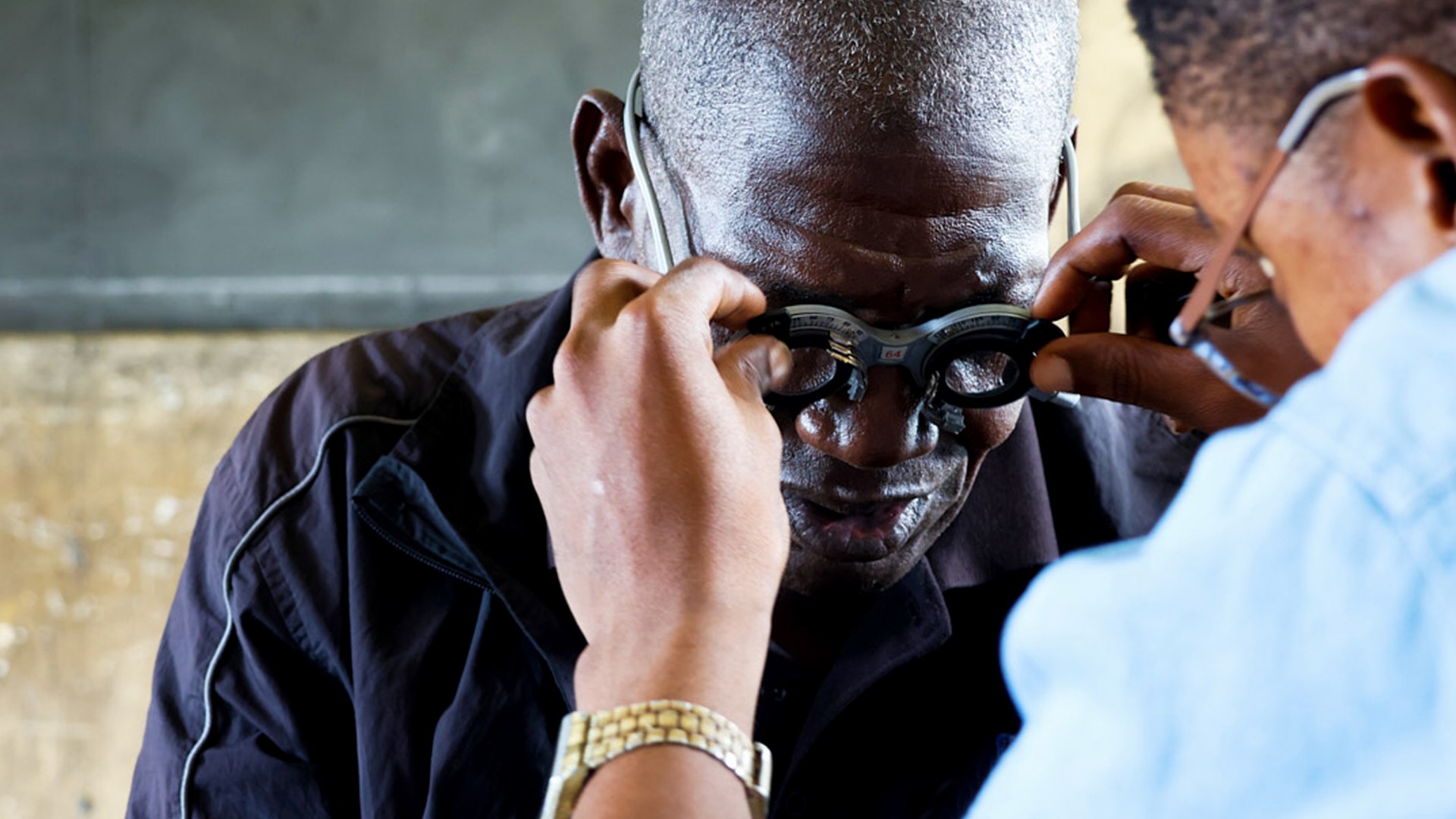
An ophthalmologist examines a man's eye at a free medical outreach program in Nigeria.

An ophthalmologist examines a man's eye as part of a free medical outreach program in Nigeria.

Christianity Today August 1, 2025
NurPhoto / Getty

When a friend pointed out a white spot in Onjefu Agbo’s eye, he knew he’d have to pay for treatment himself. Barely able to see out of his left eye, Agbo sought care at several facilities that couldn’t identify the problem before doctors at Meserat Defar Eye Clinic in Ikeja, Lagos state, Nigeria, diagnosed him with an advanced cataract.

They recommended a surgery costing 75,000 naira (about $49 USD). Agbo earned only 15,000 naira (about $10 USD) monthly at the time: “I was at a loss on where to get that kind of money, having spent a lot to get the diagnosis.”

While visiting his parents in Jos, Plateau state, Agbo heard a radio ad about an annual outreach at Vom Christian Hospital offering the procedure for free. He traveled 30 minutes by public transportation to the hospital, where doctors conducted new tests, then removed Agbo’s cataract and implanted an artificial lens.

“Life would have been better if government facilities are as responsive as these faith-based organizations are,” he said.

Agbo was not unusual in finding it hard to get adequate medical attention in Nigeria. Public hospitals in Nigeria bustle like markets, with consulting areas so full waiting people have to stand. A 2022 study showed Nigeria’s emergency hospital bed capacity stood at 0.9 beds per 1,000 people, less than half the global average.

Within the broken infrastructure, less than 5 percent of Nigerians have public health insurance, and 70 percent pay for their health care out-of-pocket. According to the World Health Organization, Nigeria should have 237,000 doctors but only has 35,000 for a population of over 200 million. And like Kenya, Nigeria is hemorrhaging medical staff to emigration.

Christian hospitals and ministries are trying to fill health care gaps. An Evangelical Church of West Africa (ECWA) Evangel hospital in Jos—known locally as Jankwano, meaning “red roof”—offers free surgeries for patients with vesicovaginal fistula—a condition that’s rare among women in developed countries but is a public health concern in developing nations such as Nigeria.

Emmanuel Adewara—the senior pastor of First Baptist Church in Kubwa, Abuja—said his church organizes a medical outreach every July and has a sick bay for treating common ailments such as malaria and typhoid. When Nigerians can’t afford care, Adewara warned, some turn to dangerous practices.

Some turn to cheaper traditional herbal remedies, but without proper dosages they may complicate rather than heal what started as minor ailments. Others turn to pastoral prayer rather than going to the hospital.

“We believe in supernatural healing.” Adewara said. “We believe in divine health. We do all those as a church. But we still have great commitment to orthodox medicine, which we encourage people to do.”

Some Nigerians have also fallen back on faith healers, putting themselves at risk of exploitation. The country has seen several cases of fraudulent pastors bribing people to fake healings during services. Some HIV patients may have died after pastors told them to stop taking antiretroviral drugs.

Meanwhile, the death of former Nigerian president Muhammadu Buhari made headlines beyond usual obituary coverage because of the location of his passing: an elite hospital in the United Kingdom on July 13. The London Clinic—where Buhari died after falling ill during a routine visit—boasts private luxury rooms with dressing gowns and spa products.

All that did not help Buhari. It did help Abdulsalami Abubakar—the former military head of state who helped transition Nigeria from military to democratic rule in 1999—who admitted he once received treatment there. Both clergy and journalists, such as Onjefu Agbo, lamented that public officials and wealthy private citizens seek treatment abroad instead of improving Nigeria’s health care system.

An article in one scholarly journal, Health Policy and Planning, indicated that reforms achieved limited success because “senior politicians did not spend political capital to ensure fundamental institutional reforms.”

Reforms could have helped Adesuwa Osunde last year when a public hospital in Abuja couldn’t finish her three children’s eye and dental exams because there were too many patients.She took them back the next day, but by the time a doctor finished their exams and prescribed the right follow-up tests, the lab had closed for the day.

“These people don’t care about us. If they did, at least they would make hospitals work,” Osunde said. If reforms continue to lag, she worries next time could be worse: “What if there is an emergency?”

News

ERLC President Steps Down Amid Southern Baptist Discord

After four years under Brent Leatherwood, SBC pastors look for a leader to rebuild trust in its public-policy arm.

Brent Leatherwood

Brent Leatherwood at the SBC annual meeting in 2025.

Christianity Today July 31, 2025
Roy Burroughs / Baptist Press

Pamphlets with a photo of Brent Leatherwood alongside House Speaker Mike Johnson dotted thousands of gray chairs in the Dallas meeting hall where the Southern Baptist Convention (SBC) gathered in June.

Leatherwood, the president of the embattled Ethics and Religious Liberty Commission (ERLC), spoke from the US Capitol lawn in a promotional video touting Southern Baptists’ lobbying efforts in Washington. He pleaded with the convention to allow its public-policy arm to continue its work.

Ultimately, it was enough for the ERLC to withstand calls for its elimination and for Leatherwood to keep his job.

For seven more weeks.

Leatherwood stepped down Thursday, the culmination of a tumultuous few years when growing numbers of Southern Baptists saw him and the ERLC as out of line with their own political stances and everyday church life.

ERLC board members accepted his resignation and thanked him for his leadership during a divisive time, appointing chief of staff Miles Mullin as acting president in the interim. Leatherwood—a 44-year-old church deacon who previously worked for the Republican Party in Tennessee and on Capitol Hill in DC—did not cite a reason for his departure, only that it was “time to close this chapter of my life.”

“His resignation from the ERLC is a sign of how difficult it is to represent Southern Baptists in the political sphere … and to do it in a time of polarization in the convention,” said Griffin Gulledge, pastor of Fayetteville First Baptist Church in Georgia and a leader with The Baptist Review.

At the SBC’s annual meeting this year, 43 percent voted to abolish the ERLC. The proposal didn’t pass, but the split showed dwindling confidence in the entity. Even Albert Mohler, president of The Southern Baptist Theological Seminary, had spoken up in an interview to voice his “grave doubts about the utility of the ERLC.”

The ERLC’s most vocal detractors consider the entity’s activity as evidence of broader liberal drift in the conservative denomination, calling out positions on immigration and guns. Other pastors saw Leatherwood’s ERLC as detached from the 47,000 local congregations that make up the SBC.

In the weeks since the annual meeting, Leatherwood stayed hard at work as the ERLC saw major news unfold: a string of Supreme Court rulings at the end of June and the congressional budget reconciliation bill in July. Both included moves toward a longtime ERLC aim of defunding Planned Parenthood.

Amid all the public responses to political happenings, Leatherwood prepared another statement for the ERLC board: his resignation.

The trustees had discussed Leatherwood’s future at ERLC before. Last year in July, he faced online backlash for calling Joe Biden’s decision to drop out “a selfless act.” The next day, the ERLC’s former board chair erroneously declared that Leatherwood had been fired—only for the ERLC to retract the announcement since the decision came without a formal vote.

In the SBC, the convention votes in trustees for each entity, and the trustees oversee entity leadership.

Even among ERLC supporters, many left the meeting in Dallas last month assuming that if the ERLC gets to stay, it’ll have to make changes—likely starting at the top.

“The messengers to the SBC annual meeting have signaled with their ballots over the last couple of years that trust has been breached and must be rebuilt,” said Andrew Hébert, a pastor from Longview, Texas.

Former ERLC presidents drew from their theological and pastoral backgrounds to speak into current issues; Leatherwood brought public policy know-how that positioned him well in DC but, to some, made him feel less connected with the people in the pews.

“I am praying that the trustees will choose someone who understands the churches of the Southern Baptist Convention and can wisely represent their concerns in the public square,” said Hébert. “Policy experts can be hired, but the leader of the entity must know how to engage with pastors and churches.”

Much of the criticism directed at the ERLC predates Leatherwood, back to Russell Moore’s “never Trump” stance during his tenure leading the entity nearly a decade ago. (Moore now serves as editor in chief of CT.) And Moore’s predecessor, Richard Land, said disagreements over the ERLC’s work are “inevitable” but its work remains crucial.

Senator James Lankford, an Oklahoma Republican and a fellow Southern Baptist, recently thanked Leatherwood for his engagement in Washington.

“He has a very challenging task to be able to speak for us without speaking for us,” Lankford said at an ERLC event during the SBC annual meeting, underscoring the independence of Southern Baptist churches. “He’s everywhere. He’s speaking out about abortion, about adoption, about international religious liberty. … He’s out there working on it.”

Leatherwood, in his earlier appeals, defended the significance of having a Baptist voice in Washington and downplayed his own stances. “This is not about me,” he said in a video. “This is not my entity but yours,” he told the convention crowd.

Leatherwood’s children survived the 2023 Covenant School shooting in Nashville, and some Southern Baptists objected to his advocacy for a state law to restrict guns from people deemed a threat to themselves or others. The ERLC also faced ongoing criticism and defended itself against accusations of being pro-amnesty for its advocacy around refugees and involvement in the Evangelical Immigration Table.

The SBC operates as a convention bringing together independent churches rather than a hierarchy, so individual Southern Baptists often disagree on approaches to political and cultural issues and how the convention should engage.

In recent years, leaders beyond the ERLC have grown their platforms and resources to engage Southern Baptists around political and cultural commentary. Mohler at Southern Seminary discusses current events on his popular Briefing podcast each weekday. The Center for Baptist Leadership, a group within the SBC that wants to see conservative revitalization, offers articles and podcasts, saying it aims to “serve as a better Baptist voice in the public square.”

After Leatherwood’s resignation, Mohler said, “Southern Baptists will be grateful to Brent Leatherwood for the investment of his life and work through the Ethics and Religious Liberty Commission,” and extended prayer for him, his family, and “the future and faithfulness of the commission itself.”

Scott Foshie, the chair of the ERLC board of trustees, called Leatherwood “a consistent and faithful missionary to the public square.” A fellow trustee, Mitch Kimbrell, cited the pro-life advances made under Leatherwood, including defunding Planned Parenthood and donating 40 ultrasound machines to pregnancy centers.

Leatherwood’s statement said, “It has been an honor to guide this Baptist organization in a way that has honored the Lord, served the churches of our Convention, and made this fallen world a little better.”

Mullin, the ERLC’s current vice president and chief of staff, will take over for Leatherwood in the meantime. Before the ERLC, Mullin worked in Christian higher education and taught church history; he holds a master’s degree from Southeastern Baptist Theological Seminary and a PhD from Vanderbilt University.

The board has not yet announced a search committee to find Leatherwood’s replacement—a tough ask given the $3.3 million entity’s contentious place in the SBC today. “Even as your smallest institution, we attract outsized attention and scrutiny,” Leatherwood told the convention in June.
“A lot of people are wondering if there’s anyone who can navigate the pressures of this job or withstanding the daily brunt of well-funded antagonists,” said Gulledge. “Whoever the trustees choose to lead the organization in the future must be committed to doing the hard work to rebuild the relationship between the ERLC and the churches and pastors it represents.”

This is a breaking news story and has been updated.

News

India Army Dismissed Christian Officer for Refusing Religious Rituals

A Delhi court ruled the lieutenant disobeyed his superior’s orders by not taking part in Sikh and Hindu worship.

Indian army soldiers from a Sikh regiment.

Indian army soldiers from a Sikh regiment.

Christianity Today July 31, 2025
NurPhoto / Contributor / Getty

When Samuel Kamalesan, a Christian officer in the Indian Army, asked to not take part in certain Hindu and Sikh rituals in his regiment’s weekly religious parades, the army dismissed him without a trial in 2021. Left without a job and cut off from military benefits, Kamalesan challenged his termination in the Delhi High Court, claiming it violated the right to freedom of religion guaranteed to every citizen by the Indian Constitution.

This June, the court ruled that the dismissal was justified, claiming that choosing his religion above the lawful command of his superior was an “act of indiscipline.”

The court further emphasized that officers like Kamalesan have an additional responsibility to foster bonds and unity in the troops. Yet some legal scholars questioned how that requirement for religious bonding fits in a secular country like India.

“When someone is removed from the forces for not participating in religious rituals (because it would lead to destroying the unity), is it not an acknowledgement that there cannot be any other bonding agent apart from religion?” Sri Harsha Kandukuri, a legal researcher, wrote in The News Minute.

Some Christians decried the ruling. A. Santhanam, a Jesuit lawyer, told Crux that the dismissal “constitutes religious coercion and undermines India’s secular character” and said that “no authority or order can compel someone to act against their beliefs—such coercion amounts to a form of violence.”

A current member and a former member of the Indian Army told CT they had not faced the coercion Kamalesan had experienced. As a minority in the military, Christians decide based on their personal consciences how to engage with the dominant Hindu or Sikh religious rituals that are a part of military life.

During colonial rule, the British recruited soldiers into either class regiments (each one made up of a single ethnic group) or class company regiments (each one made up of a mix of religions and ethnicities). The British believed that recruiting from a single ethnic class would foster a sense of communal pride, which in turn would make it harder for the troops to unite and fight against the British.

Recruiting extensively from the Sikh, Rajput, and Gorkha communities, the British officers considered these groups “martial classes” that were biologically more suited for the military and warfare.

After India gained independence from Britain, the government tried to remove class-based recruitment, but single-class regiments in the Indian Army remain prevalent. Religion serves an important motivational function in the army. For instance, the war cries of some regiments are slogans invoking Hindu deities or verses from Sikh holy texts. Each regiment has designated religious teachers to lead the troops every week in worship known as “religious parades.”

Despite the deep-rooted presence of religion and ethnic divides, the Delhi High Court in its judgement maintained that the Indian Army is a “secular institution” and that officers should place troop morale over their religious convictions, reiterating the popular principle in the Indian Army that “my religion is my soldier’s religion.”

Kamalesan, who joined the army as a lieutenant in 2017, was part of the 3rd Cavalry Regiment, an armored regiment that uses tanks and predominantly recruits Hindu and Sikh soldiers. The regiment has a mandir (Hindu temple) and a gurdwara (Sikh temple) on its premises but has no church or Sarv Dharm Sthal, a shrine where people of all faiths can worship. For instance, a Sarv Dharm Sthal in a regiment with Hindu and Christian soldiers might have both the Bible and Hindu sacred texts, along with sermons from different religions taking place one after the other.

Leading a troop of about 20 Sikhs, Kamalesan was required to join weekly religious parades, as well as religious festivals. Kamalesan claimed in his petition to the Delhi High Court that he was willing to “remain present with his fellow troops in the temple courtyard,” take off his shoes and belt, put on a turban with clean hands when necessary, and “view the rituals in the inner shrine.”

All he sought exemption from was entering the innermost part of the gurdwara or mandir when Sikhs and Hindus performed rituals like puja (prayers), arti (waving a lamp in front of a deity), or havans (burning sacrifices in front of a deity).

Yet the commanding officer of the regiment refused and forced Kamalesan to participate. Soon after, Kamalesan’s superior initiated disciplinary action against him. According to Kamalesan’s petition, his superiors harassed him—verbally abusing him, mocking his faith, and threatening to end his career. They also subjected him to military punishments, including placing him on nighttime guard duty without sufficient rest, causing sleep deprivation.

Kamalesan’s superiors also prevented him from getting promoted, the petition said. They barred the Christian lieutenant from taking any upskilling courses needed for advancement. His annual evaluations contained negative remarks about his religious beliefs. And despite passing the requisite exams, Kamalesan watched as his juniors got promotions and he remained at the same rank.

Officers told Kamalesan that if he agreed to join in the religious rituals, even if it meant prostrating halfway before the idols, they would lift all the restrictions and sanctions against him. The petition also said they sent him to counseling sessions with the pastor of the local church, other Christian officers, and religious teachers, who tried to explain to him the necessity and rationale behind these religious rituals.

When Kamalesan’s superiors saw no change in his stand, they issued a show-cause notice in 2019 ordering him to explain his “acts of misconduct.” While he filed complaints, authorities rejected them.
In March 2021, Kamalesan received a final notice that the Indian Army was dismissing him permanently without pension or benefits. Military court denied him the chance for a trial because his superiors claimed his case was sensitive since it involved religion.

Although the Delhi High Court supported the military’s decision, the Indian Constitution allows Kamalesan the right to appeal to the Supreme Court.

A 31-year-old Christian soldier from a Northeastern regiment was surprised to hear about Kamalesan’s experience. Although he had served in the military for the past decade, he said he had never seen any commanding officer force soldiers to perform religious rituals. CT granted him anonymity, as speaking out on these issues could cost him his job.

“In our regiment, we are never forced to bow down before idols, apply tika [a paste of vermilion or sandalwood applied on the forehead], or eat food offered to idols,” he said. “We are only expected to attend both Christian and Hindu sermons.”

He serves in a regiment with personnel belonging to a mix of religions, and the religious parades take place in a Sarv Dharm Sthal.

Despite the freedom in his regiment, the soldier does not always shy away from eating food offered to Hindu idols, known as prasad. “While taking prasad, we always tell ourselves and others, ‘Why avoid it? Even if it’s food offered to their gods, we still have our true, living God,’” he said. “But even then, sometimes we take it and sometimes we leave it.”

Brigadier Neil John, a former Christian army officer, said that he participated in all religious parades and rituals—including bowing before idols, doing arti, and eating prasad—during his 33-year tenure, as he believed it was part of his duty. He said that Paul’s message in 1 Corinthians 8 about eating food sacrificed to idols guides his conscience, as “an idol is nothing at all in the world” and “there is no God but one” (v. 4).

He believes that no matter what religion military leaders come from, once they are part of a regiment, they must stand with their troops and worship the divine—regardless of what forms their gods take—to maintain morale.

Yet he feels that the punishment against Kamalesan was exceedingly severe.

“Religion is very personal. A mandir parade is a parade where the unit commanding officer is attending; therefore, all below him attend,” he told CT. “But to compulsorily expect individuals of other faiths to follow rituals and practices intrinsic to a particular religion is rather harsh.”

News

When Praise Is Power, Secular Songs Are the Enemy

Christian artists and influencers draw from a theology of worship as battle to warn about music’s dark side. 

Two toy soldiers holding earbuds.
Christianity Today July 31, 2025
Illustration by Elizabeth Kaye / Source Images: Getty

When Doechii’s song “Anxiety” went viral at the beginning of the summer, thousands of social media users participated in the dance trend, posting videos of themselves shimmying back and forth to the lyrics “Somebody’s watching me, it’s my anxiety.” 

Then, Christian content creators jumped on the “Anxiety” bandwagon—to rebuke the song. Some warned that “anxiety is a demonic spirit”; others posted musical rebuttals. One creator posted a video in which he claimed that the song is “demonic” and gave him sleep paralysis. 

Their claims resemble warnings about 1980s and ’90s rock music from fundamentalists like Bill Gothard and Jim Logan. But the new wave of Satanic Panic over popular music doesn’t stem from fiery preachers in suits—this time, it’s Christian influencers and musicians stoking alarm. 

Meanwhile, popular worship music from charismatic outlets like Bethel Church has recentered power and spiritual warfare. The theology, in turn, escalates fears about what music can do, or rather, what music can be used to do: Christians who view their worship as a weapon become more likely to see music as a weapon that can be used against them

Music affects human hearts and minds. But is it a weapon that evil forces use against listeners? 

Bethel holds to a “theology of encounter and presence” and sees musical worship as “a means to carry out revival in our world,” according to Emily Snider Andrews, executive director of the Center for Worship and the Arts at Samford University. Andrews said that, in Bethel’s framework, musical worship is an “infiltrating” force for Christians to “invade society” and build “kingdom culture.” 

The lyrics of the song “Revival’s in the Air,” for example, speak of coming culture change (“Revival’s in the air; / Catch it if you can” and “The dawn is breaking”). And the song “We Make Space” invites God to “invade, take over this space” and “surround, engulf.” 

These ideas and beliefs extend beyond Bethel. Popular worship leader and songwriter Rita Springer hosts a podcast called “Worship is My Weapon.” The song “Sevens” on Brandon Lake’s new hit album calls listeners repeatedly to “ready the weapon of praise.”

Todd Korpi, dean of digital ministry at Ascent College, said that beliefs about the power of musical worship vary in “Spirit-filled” traditions. But in general, he said, Christians in charismatic or Pentecostal communities share the belief that “when we sing together, we come into alignment with one another” and that there is real power in that “all-encompassing unity.” 

Former Bethel worship leader Sean Feucht is a prominent example of an artist who explicitly frames worship as culture war. Most Bethel collaborators aren’t as combative but still believe in the power of musical worship. And beliefs about its wonder-working power—like the ability to manifest literal “glory clouds” of gold dust above a singing congregation—are common. 

In addition to encountering a theology of worship that treats praise as power, a generation of young Christians and spiritual seekers are finding a chorus of online voices theorizing about the spiritual power of music and warning about its dangers.

Recently, Christian rapper Hulvey told podcaster George Janko that his “spirit will feel disturbed” when listening to some secular hip-hop music. Author and hip-hop artist Jackie Hill Perry has speculated that some secular music succeeds because the producers have help from demons. 

Theatrical preachers are performing mass exorcisms and reanimating conversations about spiritual warfare and demonic possession. Some Christian influencers declare that “secular concerts are demonic rituals,” and others post that, the closer they get to God, the more unbearable secular music becomes to listen to. 

The popular podcast Girls Gone Bible recently featured a guest who suggested that Satan is musical in nature and that demons can “sing through” musicians when they are drunk or high. 

“If you know anything about the spiritual realm you know large artists like [Taylor Swift] are operating in darkness,” one influencer posted on Instagram, talking about why she doesn’t let her daughters listen to Swift’s music. Instead, she says, she “blasts [Forrest] Frank.”

Now, as Christian music’s popularity is growing, some artists and influencers are seizing the moment to reassert the niche as a spiritually safe and nourishing space in an otherwise dark entertainment industry. 

Christian musicians claim that they are making music using God’s tuning, suggesting that sonic frequencies can positively or negatively affect bodies and minds. Other artists post that audiences can replace “toxic” secular music with their faith-based songs. 

Charismatic Christians have historically read biblical narratives about music—such as the story of David playing the harp to soothe King Saul in 1 Samuel 16:23—as evidence that there is something particularly powerful about the medium. 

“We have passages describing Paul and Silas singing in prison or Miriam and the women singing in Exodus,” said Tim Larsen, professor of theology at Wheaton College. “Charismatics will read these as saying that there is a spiritual efficaciousness to praise. And there seems to be a strong connection between music and the prophetic.”

Larsen suggests that music is one of many channels for the spiritual that Christians can point to in Scripture, but that superstition arises when believers start to see the vehicle itself as having special power. 

But not all charismatic Christians see music the same way. In the Vineyard movement, a neo-charismatic association that grew out of Calvary Chapel in Costa Mesa, California, worship leaders tend to emphasize music as a channel for individual intimacy with God rather than a vehicle for collective empowerment or breakthrough.

“In practice, music has a sacramental quality in that it can be filled by the real presence of God,” said Caleb Maskell, associate national director of theology and education for Vineyard USA. He added that the sacramental understanding of music doesn’t stem from belief in the mystical power of music. “In reality, it’s the people who are filled with the presence of God.” 

Adam Russell, director of Vineyard Worship USA, said that over the past 20 years, he has seen a movement in contemporary worship music away from intimacy and toward “intensity.” 

“My Pentecostal brothers and sisters have a really strong sense that when we worship, we’re doing something apostolic or bringing the kingdom,” said Russell. “But in Vineyard, we’re not about bringing the kingdom; we’re discovering the kingdom. It’s already been sown. We’re not here to enforce it upon culture.” 

Maskell and Russell contrast Vineyard’s view of the power of musical worship with the theology articulated in lyrics about praise as a weapon or the act of worship as warfare. According to Russell, Vineyard has been criticized in the past for producing sentimental “love songs to Jesus,” but that emotional earnestness without a battle mentality is what sets it apart and keeps music in its proper place theologically.

“Some people might say that Vineyard songs are a little sappy,” said Russell, “and maybe so. But that’s been our superpower: to sing directly to Jesus, from the heart.” 

Examples of less “sappy” and more militant songs are easy to find these days, including at least three ranking among the top 100 sung in churches. Bethel Music’s “Raise a Hallelujah” includes the lyrics “My weapon is a melody” and “Heaven comes to fight for me.” It’s an anthem about singing “hallelujah” in the presence of the Enemy to drive out darkness.

Elevation Worship’s hit song “Praise” features the lines “Praise is the water / My enemies drown in” and “My praise is my weapon. / It’s more than a sound. / My praise is the shout / That brings Jericho down.” Similarly, the chorus of Phil Wickham’s “Battle Belongs” frames prayer and worship as a fight (“When I fight, I’ll fight on my knees / With my hands lifted high”). 

In Vineyard churches and at Bethel, encounter with the divine is a goal of congregational singing. Vineyard emphasizes intimacy and introspection; Bethel emphasizes inbreaking and victory. The latter tends to grant more agency to the act of singing, but worshipers in both circles believe that musical worship does something

Maskell said musical worship that tries to summon God to act is misguided. “Worship as intercession is about drawing close to the presence of God in my own life and relationships, not ‘God, do things to other people,’” he said. 

But scholars see a fine line between keeping music in its proper place theologically and dismissing its potential to be an agent of spiritual formation. 

Korpi said that charismatic Christians generally take seriously the “formative power” of media, including film, music, and literature. There is a difference between avoiding, for one’s peace of mind, lyrics or images that depict immorality and attributing invasive, corrupting influence to them. 

Panic about the potential dangers of certain kinds of music is rooted in the belief that if Christians can mobilize music as a weapon of spiritual warfare, music can also be used against them. Preachers and politicians who railed against hidden messages in rock or heavy metal during the ’80s stoked fear that music could invade listeners against their will, opening a door for evil into the mind or soul. 

Christians who see musical worship as ammunition in a spiritual war are primed to see music as a tool of their enemies. And when it’s easier than ever to access an endless stream of music to accompany daily life, Christians understandably want to understand its potential impacts on their emotional and spiritual well-being.

But the view that music can serve as a hidden inroad for spiritual oppression or the demonic is one that sows fear, said Larsen, cautioning that this kind of “magical thinking” verges on gnosticism. “Gnosticism promises hidden knowledge. Discipleship is about obvious, simple knowledge,” said Larsen. “Paul says, ‘Eat what you want and give thanks to God, and trust that he will protect you.’”

addApple PodcastsDown ArrowDown ArrowDown Arrowarrow_left_altLeft ArrowLeft ArrowRight ArrowRight ArrowRight Arrowarrow_up_altUp ArrowUp ArrowAvailable at Amazoncaret-downCloseCloseellipseEmailEmailExpandExpandExternalExternalFacebookfacebook-squarefolderGiftGiftGooglegoogleGoogle KeephamburgerInstagraminstagram-squareLinkLinklinkedin-squareListenListenListenChristianity TodayCT Creative Studio Logologo_orgMegaphoneMenuMenupausePinterestPlayPlayPocketPodcastprintremoveRSSRSSSaveSavesaveSearchSearchsearchSpotifyStitcherTelegramTable of ContentsTable of Contentstwitter-squareWhatsAppXYouTubeYouTube