





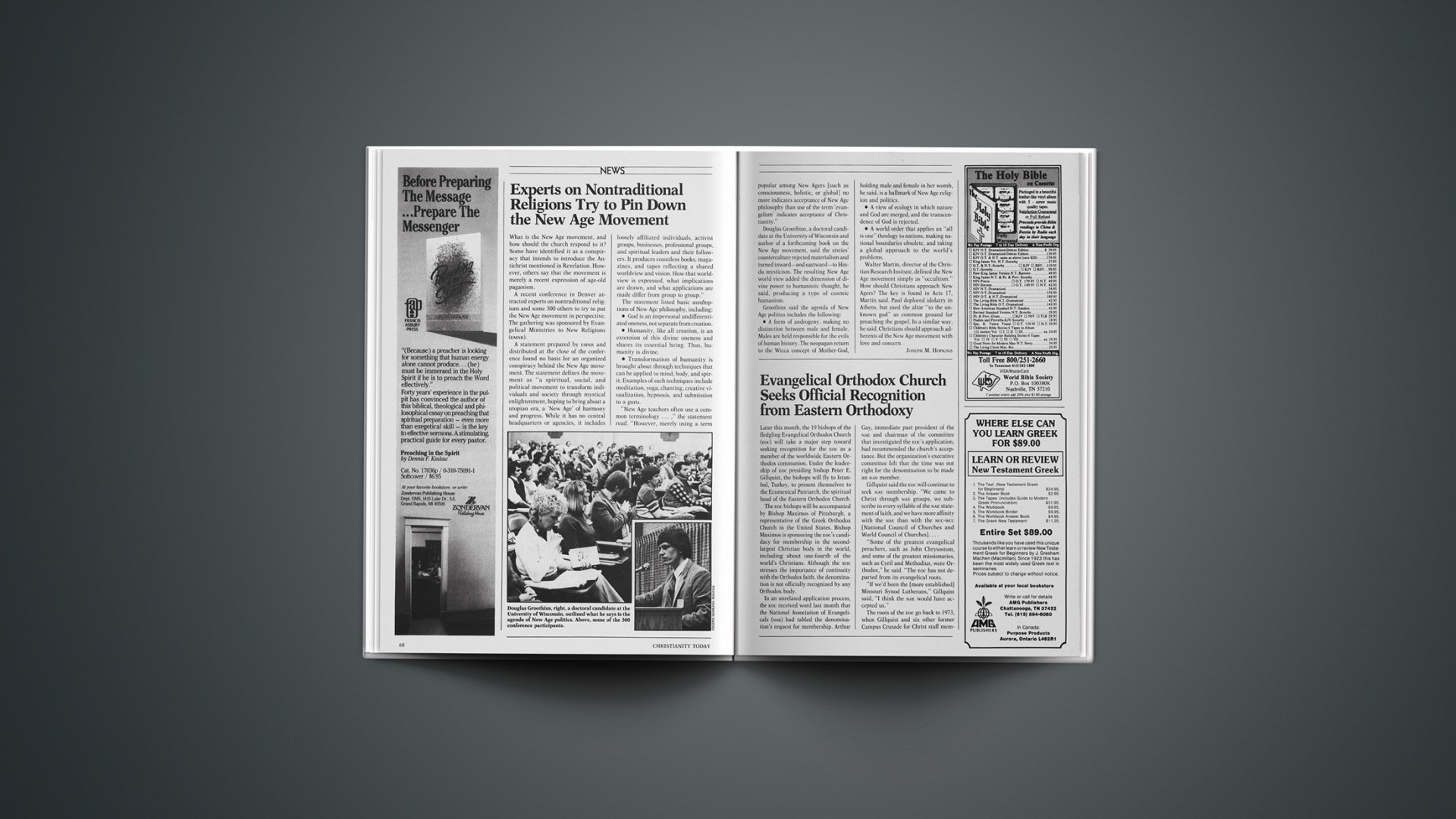

What is the New Age movement, and how should the church respond to it? Some have identified it as a conspiracy that intends to introduce the Antichrist mentioned in Revelation. However, others say that the movement is merely a recent expression of age-old paganism.
A recent conference in Denver attracted experts on nontraditional religions and some 300 others to try to put the New Age movement in perspective. The gathering was sponsored by Evangelical Ministries to New Religions (EMNR).
A statement prepared by EMNR and distributed at the close of the conference found no basis for an organized conspiracy behind the New Age movement. The statement defines the movement as “a spiritual, social, and political movement to transform individuals and society through mystical enlightenment, hoping to bring about a utopian era, a ‘New Age’ of harmony and progress. While it has no central headquarters or agencies, it includes loosely affiliated individuals, activist groups, businesses, professional groups, and spiritual leaders and their followers. It produces countless books, magazines, and tapes reflecting a shared worldview and vision. How that worldview is expressed, what implications are drawn, and what applications are made differ from group to group.”
The statement listed basic assumptions of New Age philosophy, including:
• God is an impersonal undifferentiated oneness, not separate from creation.
• Humanity, like all creation, is an extension of this divine oneness and shares its essential being. Thus, humanity is divine.
• Transformation of humanity is brought about through techniques that can be applied to mind, body, and spirit. Examples of such techniques include meditation, yoga, chanting, creative visualization, hypnosis, and submission to a guru.
“New Age teachers often use a common terminology …,” the statement read. “However, merely using a term popular among New Agers [such as consciousness, holistic, or global] no more indicates acceptance of New Age philosophy than use of the term ‘evangelism’ indicates acceptance of Christianity.”
Douglas Groothius, a doctoral candidate at the University of Wisconsin and author of a forthcoming book on the New Age movement, said the sixties’ counterculture rejected materialism and turned inward—and eastward—to Hindu mysticism. The resulting New Age world view added the dimension of divine power to humanistic thought, he said, producing a type of cosmic humanism.
Groothius said the agenda of New Age politics includes the following:
• A form of androgeny, making no distinction between male and female. Males are held responsible for the evils of human history. The neopagan return to the Wicca concept of Mother-God, holding male and female in her womb, he said, is a hallmark of New Age religion and politics.
• A view of ecology in which nature and God are merged, and the transcendence of God is rejected.
• A world order that applies an “all is one” theology to nations, making national boundaries obsolete, and taking a global approach to the world’s problems.
Walter Marlin, director of the Christian Research Insitute, defined the New Age movement simply as “occultism.” How should Christians approach New Agers? The key is found in Acts 17, Martin said. Paul deplored idolatry in Athens, but used the altar “to the unknown god” as common ground for preaching the gospel. In a similar way, he said, Christians should approach adherents of the New Age movement with love and concern.







