
Hurricane Andrew, the worst natural disaster in U.S. history, caused an estimated $30 billion in damage, destroyed or severely damaged more than 63,000 south Florida homes, left nearly 300,000 people homeless, and bankrupted at least five insurance companies.
Nearly ten months later, as communities struggle to rebuild, hurt, anger, and sometimes desperation are evident in many streets and homes. But as soon as Andrew approached Miami last August, an army of volunteers descended on south Dade County, the area hardest hit. The army is still there, providing help and hope. Their story is one of the most inspiring of the recovery effort.
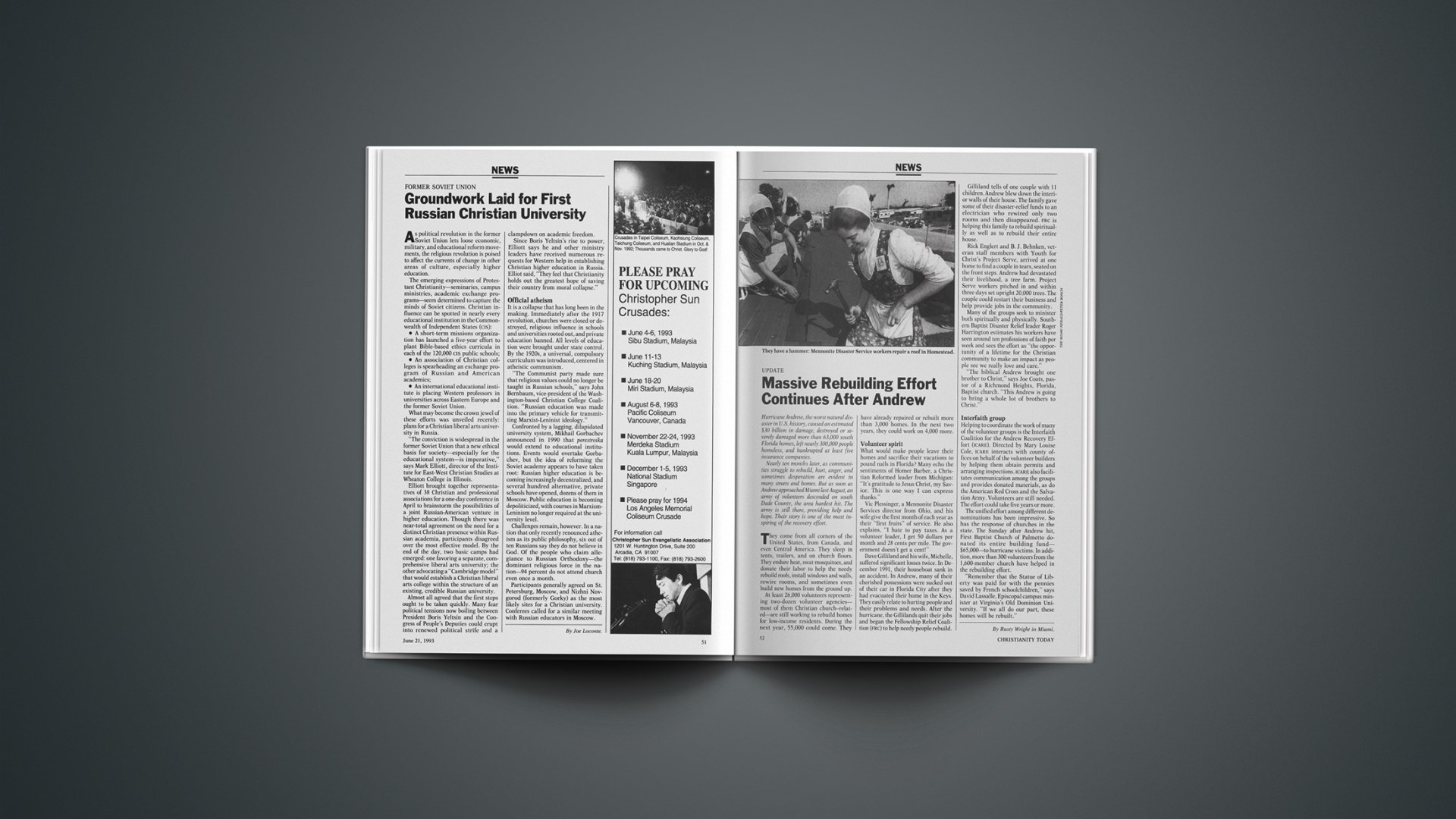
They come from all corners of the United States, from Canada, and even Central America. They sleep in tents, trailers, and on church floors. They endure heat, swat mosquitoes, and donate their labor to help the needy rebuild roofs, install windows and walls, rewire rooms, and sometimes even build new homes from the ground up.
At least 26,000 volunteers representing two-dozen volunteer agencies—most of them Christian church-related—are still working to rebuild homes for low-income residents. During the next year, 55,000 could come. They have already repaired or rebuilt more than 3,000 homes. In the next two years, they could work on 4,000 more.
Volunteer spirit
What would make people leave their homes and sacrifice their vacations to pound nails in Florida? Many echo the sentiments of Homer Barber, a Christian Reformed leader from Michigan: “It’s gratitude to Jesus Christ, my Savior. This is one way I can express thanks.”
Vic Plessinger, a Mennonite Disaster Services director from Ohio, and his wife give the first month of each year as their “first fruits” of service. He also explains, “I hate to pay taxes. As a volunteer leader, I get 50 dollars per month and 28 cents per mile. The government doesn’t get a cent!”
Dave Gilliland and his wife, Michelle, suffered significant losses twice. In December 1991, their houseboat sank in an accident. In Andrew, many of their cherished possessions were sucked out of their car in Florida City after they had evacuated their home in the Keys. They easily relate to hurting people and their problems and needs. After the hurricane, the Gillilands quit their jobs and began the Fellowship Relief Coalition (FRC) to help needy people rebuild.
Gilliland tells of one couple with 11 children. Andrew blew down the interior walls of their house. The family gave some of their disaster-relief funds to an electrician who rewired only two rooms and then disappeared. FRC is helping this family to rebuild spiritually as well as to rebuild their entire house.
Rick Englert and B. J. Behnken, veteran staff members with Youth for Christ’s Project Serve, arrived at one home to find a couple in tears, seated on the front steps. Andrew had devastated their livelihood, a tree farm. Project Serve workers pitched in and within three days set upright 20,000 trees. The couple could restart their business and help provide jobs in the community.
Many of the groups seek to minister both spiritually and physically. Southern Baptist Disaster Relief leader Roger Harrington estimates his workers have seen around ten professions of faith per week and sees the effort as “the opportunity of a lifetime for the Christian community to make an impact as people see we really love and care.”
“The biblical Andrew brought one brother to Christ,” says Joe Coats, pastor of a Richmond Heights, Florida, Baptist church. “This Andrew is going to bring a whole lot of brothers to Christ.”
Interfaith group
Helping to coordinate the work of many of the volunteer groups is the Interfaith Coalition for the Andrew Recovery Effort (ICARE). Directed by Mary Louise Cole, ICARE interacts with county offices on behalf of the volunteer builders by helping them obtain permits and arranging inspections, ICARE also facilitates communication among the groups and provides donated materials, as do the American Red Cross and the Salvation Army. Volunteers are still needed. The effort could take five years or more.
The unified effort among different denominations has been impressive. So has the response of churches in the state. The Sunday after Andrew hit, First Baptist Church of Palmetto donated its entire building fund—$65,000—to hurricane victims. In addition, more than 300 volunteers from the 1,600-member church have helped in the rebuilding effort.
“Remember that the Statue of Liberty was paid for with the pennies saved by French schoolchildren,” says David Lassalle, Episcopal campus minister at Virginia’s Old Dominion University. “If we all do our part, these homes will be rebuilt.”
By Rusty Wright in Miami.