You worry about your heating bill this winter. You worry about your cholesterol. And the West Nile virus. And avian flu. Now and then, you may worry about a repeat of 9/11 in some diabolical new form. But you probably don’t spend much time thinking about the threat of neos (near earth objects, such as asteroids, which could strike the planet with catastrophic impact) or the accidental release of deadly nerve gas at the facility near Toole, Utah, where the U.S. Army is disposing of chemical weapons by burning them.
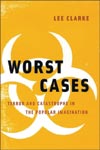 Worst Cases:Terror and Catastrophein thePopular Imagination by Lee Clarke University of Chicago, 200 pp.; $22.50 |
Lee Clarke wants to change that. He wants ordinary citizens, planners, and policymakers to pay more attention to potential events that are admittedly improbable but possible nonetheless—events with consequences so severe that we ignore them at our peril.
Not that he supposes we’d be better off in a constant state of anxiety. On the contrary. Thinking ahead in this way may have a practical payoff (consider the preemptive response to Hurricane Rita versus the lack of adequate preparation for Katrina), but there is more at stake. By acknowledging that such terrible things could happen, we admit there is much that remains beyond our control.
Clarke makes his case in a flawed, occasionally maddening, but timely book, Worst Cases: Terror and Catastrophe in the Popular Imagination. “Worst cases,” in Clarke’s fuzzy usage, can mean anything from the 1937 explosion of the zeppelin Hindenburg or the 1940 failure of the Tacoma Narrows Bridge to the extinction of the human race. A notion so elastic has little purchase. And the subtitle seems to belong to a different book, perhaps one concerned with disaster in movies, novels, and so on.
Worst Cases differs from Richard Posner’s book of 2004, Catastrophe, which is more systematic and policy-oriented. Clarke’s book will make you ponder how we think about (or fail to think about) “the unthinkable.” Catastrophe is a kind of reality therapy. He writes: “In this book, I look the worst full in the face. What I see is frightening but enlightening. I believe that knowing a thing permits more comfort with that thing.” In other words, Memento mori (“Remember your death”), as our ancestors did.
Clarke’s psychology is a bit shaky here. After all, he is a professional disasterologist (a sociologist by training), and one of his favorite words is “interesting.” An airliner inexplicably explodes in midair? That’s interesting. The prospect that more than 50 million people could die from a rogue strain of avian flu? That’s really interesting! Clarke is not unfeeling—not at all—but he does like to point out that almost every disaster has a silver lining. (Katrina will no doubt boost the sales of his own book.)
You could make the case, as Michael Crichton does in State of Fear, that—thanks in part to the insistent presence of the media—contemporary Americans are already excessively, absurdly conscious of myriad threats, risks, and lurking dangers, even as they enjoy a degree of safety and comfort unparalleled in human history. And yet, as Clarke and others argue, the very advances that have enabled such safety and comfort have also rendered modern societies extremely vulnerable. (What happens when there is a massive failure of the power grid?)
Clarke’s we sometimes overlaps with the readership of Christianity Today—such as when he’s addressing our common responsibilities as citizens—but it often does not. The primary audience he has in mind, it seems, consists of enlightened secularists. Where he differs from many of his own tribe is in his recognition of human limitations. “Worst cases,” he writes, “should humble us more than they do.”
It’s not Clarke’s purpose to consider how Christians—and evangelicals in particular—might distinctively wrestle with catastrophe. Theologically, such matters are tied up with rival understandings of God’s sovereignty, though how they play out in the everyday lives of believers is another question.
What about the charge—raised, for example, by Bill Moyers (“Welcome to Doomsday”) in a screed in The New York Review of Books last year—that evangelicals tend to be indifferent to global warming and other threats to the environment because (with some exceptions) they’re pretty much convinced the Rapture is coming soon anyway? Presumably the same reasoning would apply to other potential catastrophes, unless they are looming straight ahead.
Moyers needs to get out more. He would find evangelicals planting trees, engaging in estate planning, and generally behaving as if this present world will continue, even while knowing that it will someday come to an end. But there is a grain of truth in his indictment. Modern evangelicalism suffers from an enfeebled doctrine of Creation. There are, however, hopeful signs of generational change.
As for those catastrophes just waiting to happen (“Things that have never happened before happen all the time,” Scott Sagan nicely puts it, quoted by Clarke), perhaps it would be wisest to divide the labor of our worrying. Unprompted, I wake up in the middle of the night with just the sort of thoughts Clarke’s book encourages: for instance, the worldwide failure of the coffee crop due to some pestilential mutation. So you needn’t worry about that particular catastrophe. I’ve got it covered.
John Wilson is the editor of Books & Culture and of Best Christian Writing 2006 (Jossey-Bass).
Copyright © 2006 Christianity Today. Click for reprint information.
Related Elsewhere:
Worst Cases is available from Amazon.com and other book retailers.
More about the book, including an interview with the author, is available from the University of Chicago Press.
For specific instructions on how to survive such disasters as a failed parachute, a shark or alligator attack, or an alien abduction, see the worst cases scenario website.
If you’re wondering about if you should worry about bird flu, read how the U.S. is overdue and underprepared for it.