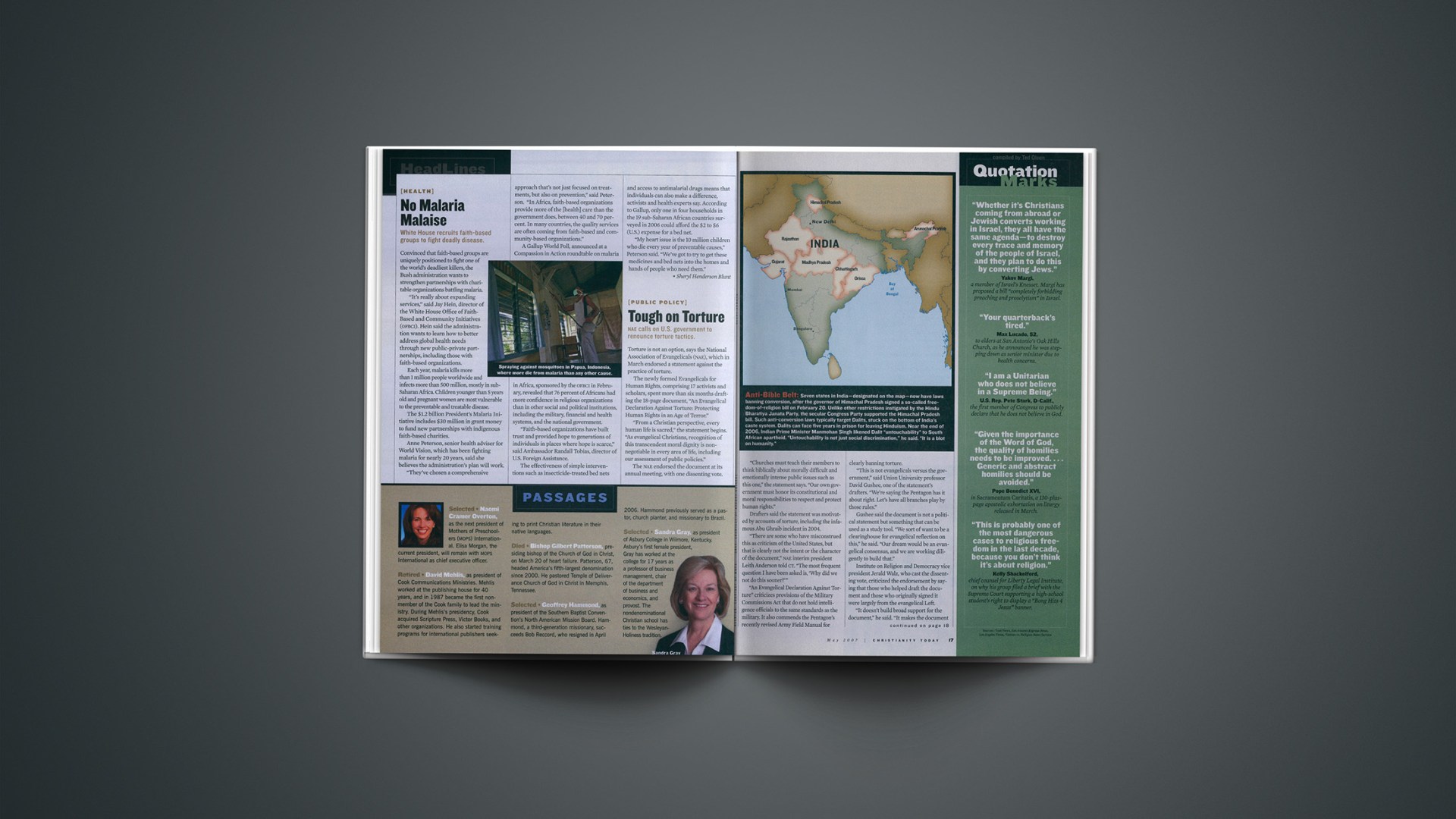

Convinced that faith-based groups are uniquely positioned to fight one of the world’s deadliest killers, the Bush administration wants to strengthen partnerships with charitable organizations battling malaria.
“It’s really about expanding services,” said Jay Hein, director of the White House Office of Faith-Based and Community Initiatives (OFBCI). Hein said the administration wants to learn how to better address global health needs through new public-private partnerships, including those with faith-based organizations.
Each year, malaria kills more than 1 million people worldwide and infects more than 500 million, mostly in sub-Saharan Africa. Children younger than 5 years old and pregnant women are most vulnerable to the preventable and treatable disease.
The $1.2 billion President’s Malaria Initiative includes $30 million in grant money to fund new partnerships with indigenous faith-based charities.
Anne Peterson, senior health adviser for World Vision, which has been fighting malaria for nearly 20 years, said she believes the administration’s plan will work.
“They’ve chosen a comprehensive approach that’s not just focused on treatments, but also on prevention,” said Peterson. “In Africa, faith-based organizations provide more of the [health] care than the government does, between 40 and 70 percent. In many countries, the quality services are often coming from faith-based and community-based organizations.”
A Gallup World Poll, announced at a Compassion in Action roundtable on malaria in Africa, sponsored by the OFBCI in February, revealed that 76 percent of Africans had more confidence in religious organizations than in other social and political institutions, including the military, financial and health systems, and the national government.
“Faith-based organizations have built trust and provided hope to generations of individuals in places where hope is scarce,” said Ambassador Randall Tobias, director of U.S. Foreign Assistance.
The effectiveness of simple interventions such as insecticide-treated bed nets and access to antimalarial drugs means that individuals can also make a difference, activists and health experts say. According to Gallup, only one in four households in the 19 sub-Saharan African countries surveyed in 2006 could afford the $2 to $6 (U.S.) expense for a bed net.
“My heart issue is the 10 million children who die every year of preventable causes,” Peterson said. “We’ve got to try to get these medicines and bed nets into the homes and hands of people who need them.”
Copyright © 2007 Christianity Today. Click for reprint information.
Related Elsewhere:
This week, President Bush declared April 25 Malaria Awareness Day. Annual World Malaria Day was April 24.
The President’s Malaria Initiative‘s (PMI) official site links to its partners and facts about its results so far.
The Centers for Disease Control and Prevention website has a section on malaria, with information on PMI, facts about malaria and its impact, and other resources.
Laura Bush’s remarks to a Compassion in Action roundtable on malaria are available from The White House Office of Faith-Based and Community Initiatives.
Other Christianity Today articles on science and health are available on our site.