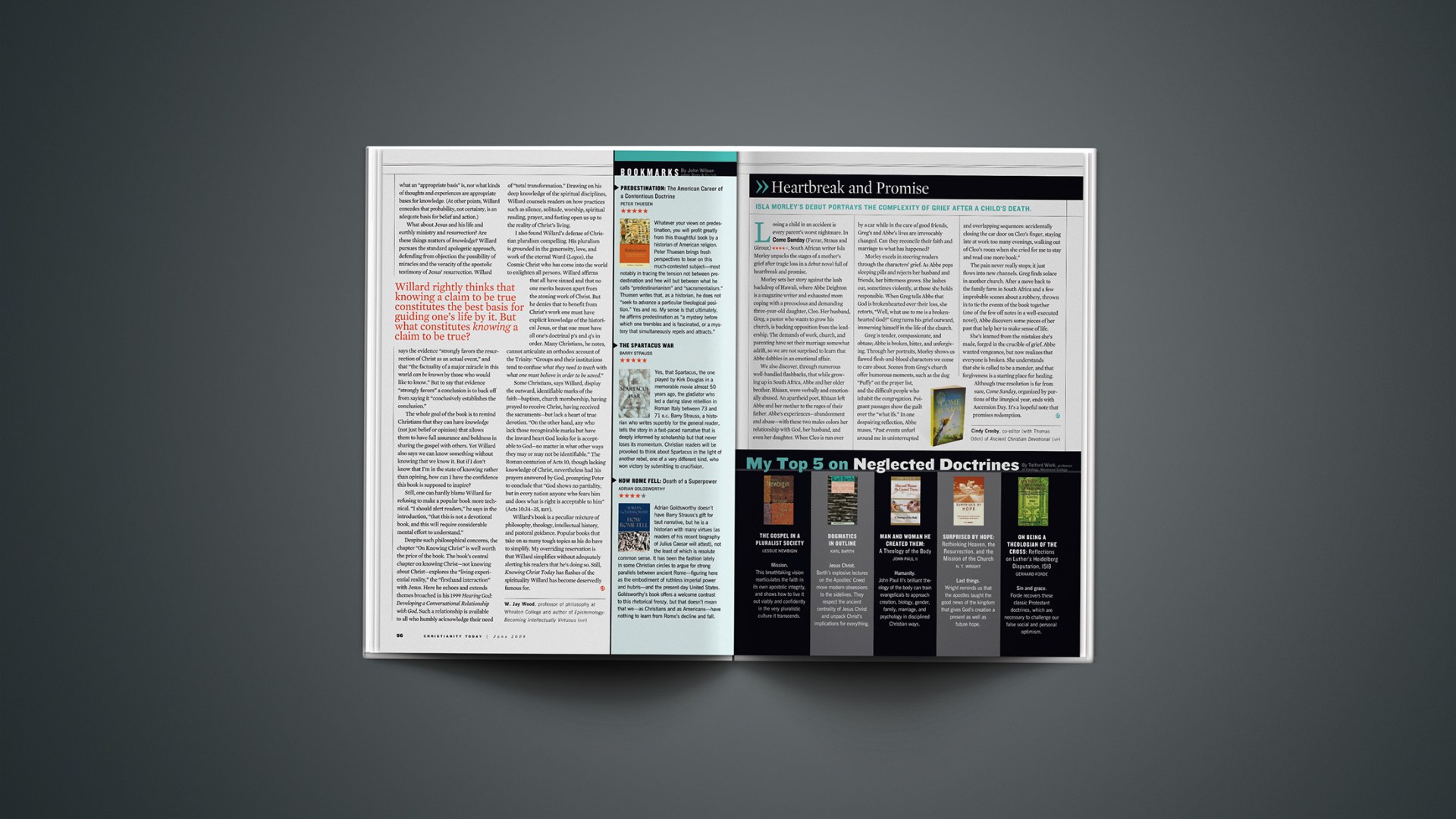

Losing a child in an accident is every parent’s worst nightmare. In Come Sunday (Farrar, Straus and Giroux), South African writer Isla Morley unpacks the stages of a mother’s grief after tragic loss in a debut novel full of heartbreak and promise.

Morley sets her story against the lush backdrop of Hawaii, where Abbe Deighton is a magazine writer and exhausted mom coping with a precocious and demanding three-year-old daughter, Cleo. Her husband, Greg, a pastor who wants to grow his church, is bucking opposition from the leadership. The demands of work, church, and parenting have set their marriage somewhat adrift, so we are not surprised to learn that Abbe dabbles in an emotional affair.
We also discover, through numerous well-handled flashbacks, that while growing up in South Africa, Abbe and her older brother, Rhiaan, were verbally and emotionally abused. An apartheid poet, Rhiaan left Abbe and her mother to the rages of their father. Abbe’s experiences—abandonment and abuse—with these two males colors her relationship with God, her husband, and even her daughter. When Cleo is run over by a car while in the care of good friends, Greg’s and Abbe’s lives are irrevocably changed. Can they reconcile their faith and marriage to what has happened?
Morley excels in steering readers through the characters’ grief. As Abbe pops sleeping pills and rejects her husband and friends, her bitterness grows. She lashes out, sometimes violently, at those she holds responsible. When Greg tells Abbe that God is brokenhearted over their loss, she retorts, “Well, what use to me is a brokenhearted God?” Greg turns his grief outward, immersing himself in the life of the church.
Greg is tender, compassionate, and obtuse; Abbe is broken, bitter, and unforgiving. Through her portraits, Morley shows us flawed flesh-and-blood characters we come to care about. Scenes from Greg’s church offer humorous moments, such as the dog “Puffy” on the prayer list, and the difficult people who inhabit the congregation. Poignant passages show the guilt over the “what ifs.” In one despairing reflection, Abbe muses, “Past events unfurl around me in uninterrupted and overlapping sequences: accidentally closing the car door on Cleo’s finger, staying late at work too many evenings, walking out of Cleo’s room when she cried for me to stay and read one more book.”
The pain never really stops; it just flows into new channels. Greg finds solace in another church. After a move back to the family farm in South Africa and a few improbable scenes about a robbery, thrown in to tie the events of the book together (one of the few off notes in a well-executed novel), Abbe discovers some pieces of her past that help her to make sense of life.
She’s learned from the mistakes she’s made, forged in the crucible of grief. Abbe wanted vengeance, but now realizes that everyone is broken. She understands that she is called to be a mender, and that forgiveness is a starting place for healing. Although true resolution is far from sure, Come Sunday, organized by portions of the liturgical year, ends with Ascension Day. It’s a hopeful note that promises redemption.
Cindy Crosby, co-editor (with Thomas Oden) of Ancient Christian Devotional (IVP)
Copyright © 2009 Christianity Today. Click for reprint information.
Related Elsewhere:
Come Sunday is available at Amazon.com and other book retailers.
Christianity Today also has more book reviews.