The Pill turned 50 this year, and Time magazine commemorated the anniversary last week with Nancy Gibbs’s cover story, “Love, Sex, Freedom and the Paradox of the Pill.” Gibbs thoroughly and thoughtfully provides a scientific and sociological history of birth control, while addressing some of the ethical questions raised by the little tablet, swallowed by more than 100 million women worldwide every day. Gibbs sets up a strong contrast in how people respond to the Pill: “Its supporters hoped it would strengthen marriage by easing the strain of unwanted children; its critics still charge that the Pill gave rise to promiscuity, adultery, and the breakdown of the family.”
As a Christian who has taken the Pill intermittently for over a decade, I find myself on both sides of the divide, caught between an ethic of hospitality and of stewardship, between individual responsibility and collective consciousness, between traditional family values and feminist theory. Reading Gibbs’s article didn’t answer all my questions, but it forced me to admit that the questions needed asking.
A year or so into our marriage, my husband, Peter, and I went away for a weekend. In the middle of an expensive dinner—both of us content with the “just us”-ness of our lives—I said to him, “Do you ever think about never having kids?”
“All the time,” he replied.
We were young. We hadn’t had sex before marriage. I wouldn’t have called it entitlement then, but in retrospect I admit that I felt entitled to “my” life with “my” husband. Kids were an afterthought, something that might come, someday, if we felt like it, and if a convenient time arose.
We both eventually changed our minds. We realized that kids are never convenient. More, I wanted to see Peter become a father. I wanted to give something of myself to a child. We wanted to have a family. But although we changed our minds, we didn’t change our perspective on having children. When I went off the Pill, we still thought we were in control.
The birth of our daughter, Penny, when I was 28 years old was our first indication that the words control and children should rarely be used in the same sentence. Penny was diagnosed with Down syndrome two hours after she was born. I’ve written elsewhere about that experience, but what strikes me now is how much my thoughts about using birth control were informed by the idea that my body is in my control. God comes into the picture on my terms. Now, as I worry about the dehumanizing consequences of in vitro fertilization and prenatal diagnosis and the abortion of unwanted babies, I wonder whether birth control is just one step in a staircase of choices that leaves us with the illusion that humans are products to be consumed or discarded rather than gifts given, created, by God.
Christian opinion varies widely on the issue of birth control in general and the Pill in particular. The Catholic Church continues to teach that any form of birth control other than Natural Family Planning is contrary to God’s will. Protestants, according to Gibbs, endorsed birth control starting in the middle of the 20th century. Yet while a majority of Catholics in the U.S. use birth control in spite of church teaching, a growing number of evangelicals are questioning the godliness of asserting human control over family size.
Different theological lenses lead to divergent conclusions about whether or not Christian women should take the Pill. First, there is the argument from a stewardship principle. God entrusted us with filling the earth and subduing it (Gen. 1:28). Just as we are are stewarding our health in going to doctors’ appointments and getting vaccinations, so too we have responsibility—before God, and with the guidance of the Spirit—to make choices about the health of our bodies. As women, our bodies can be used to make babies, but they can also be used for any number of other goods. Increased use of birth control has led to greater economic stability, improved health, and greater access to education and careers for many women. And now that we are well on our way to “filling the earth,” choosing to limit family size can be a way to demonstrate care and stewardship of God’s creation more generally.
But another way to come at the question is from the perspective of hospitality. As former editor Agnieszka Tennant wrote for Christianity Today in 2005, taking the Pill may be a way not only to prevent conception but also to potentially eradicate life from the womb. It certainly makes the womb an inhospitable environment for human life. Yet God calls us to an ethic of hospitality—to welcome the stranger, the foreigner, the unwanted one, whomever that might be. To what degree does birth control do the opposite?
And then there’s the biblical witness: that children are a blessing, even a sign of God’s favor. That God is the one in control of wombs opening and closing, that God is the one who knits us together before we are born.
In retrospect, I don’t think it was wrong to take the Pill. But I do think it was wrong to take it for the reasons I did—because of selfishness, and because I wanted control.
We have two children now, and I sometimes shake my head at the younger me who thought life was richer without them. Sure, I long for uninterrupted nights of sleep and days to call my own. Yet I know God’s presence through Penny and William, through the daily obedience of caring for them, through the daily grace of our love for one another. I have learned more about love, I have known more of love, because of our children. Because of these uncontrollable, inconvenient children of ours, I have known more of our God.
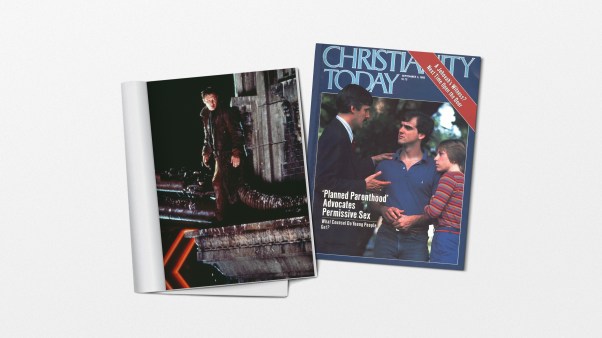
Christianity Today magazine has more articles on birth control and the Pill:A Hard Pill to Swallow | How the tiny tablet upset my soul. By Agnieszka Tennant (November 2005)Has Natural Birth Control Been Proved Impossible? | Don’t believe the media reports, cautions the author of Birth Control for Christians. By Jenell Williams Paris (July 2003)Make Love and Babies | The contraceptive mentality says children are something to be avoided. We’re not buying it. By Sam and Bethany Torode (Nov. 9, 2001)‘Be Fruitful and Multiply’ | Is this a command, or a blessing? By Raymond C. Van Leeuwen (Nov. 9, 2001)