
Future historians will find more than enough material from Billy Graham's life and work to keep them occupied. But one of the main questions they will want to answer is: What was the secret of his success?
One vital component will probably elude most of them: Graham's deep commitment to a consistent, thoughtful devotional life. Without it, Graham never would have become the person he was, nor would he have had the worldwide impact he did. It kept him humble, reinforced his integrity, expanded his vision, and enabled him to keep his focus. Most of all, as he often said, it kept him close to the One he sought to serve.
The Willing Learner
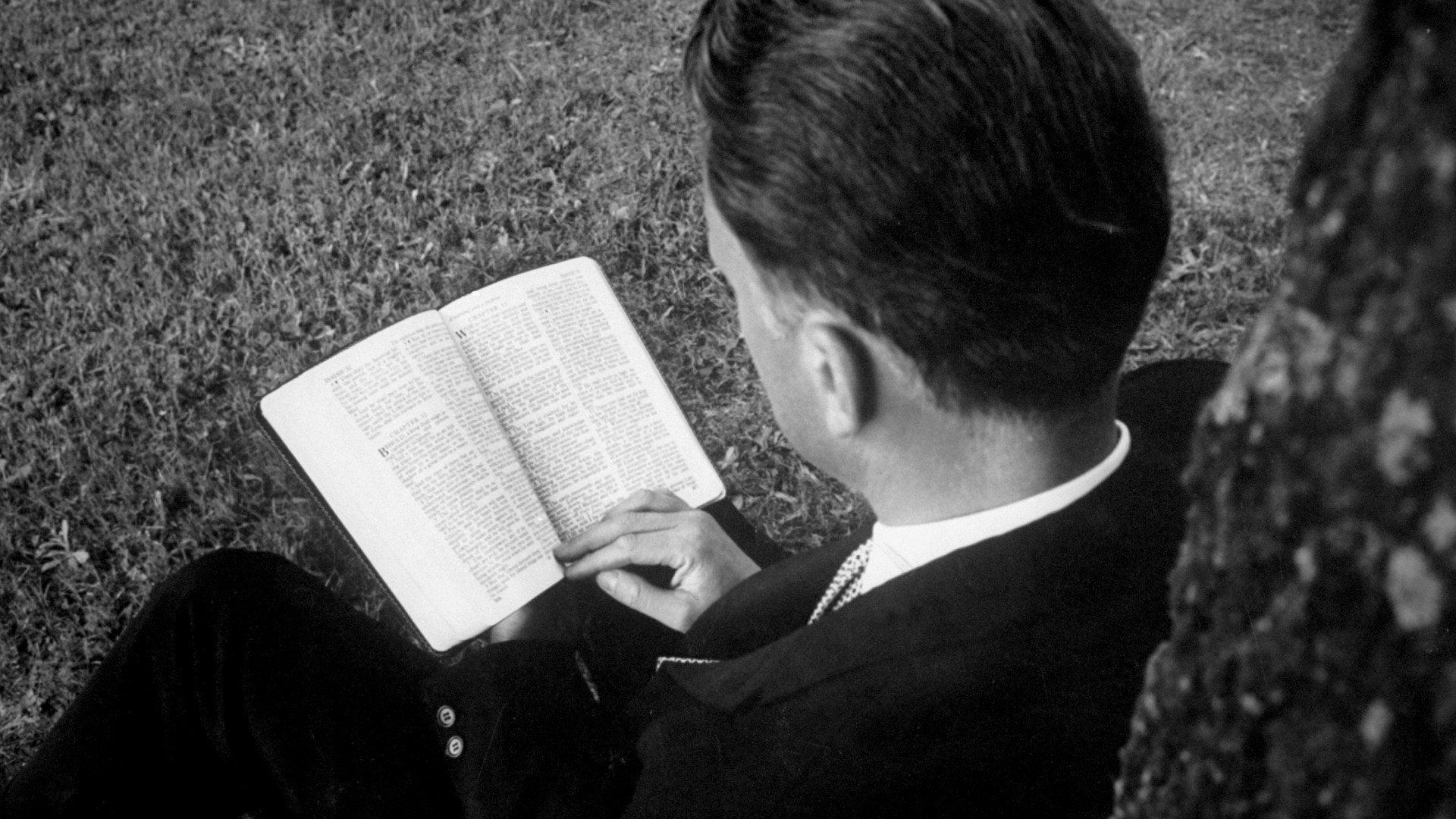
The elements of Graham's devotional life were simple: the Bible, prayer, and reflection. In his view, each was essential and bound to the others. Graham learned early on the value of setting aside a definite time each day (preferably in the early morning) to be alone with God, a practice he sought to maintain even in the midst of overwhelming pressures, disruptions, and frequent travel.
Graham believed that his time at Florida Bible Institute was the most important period of his life in terms of his spiritual growth. The significance of daily quiet time was reinforced there as he learned what it meant to study the Bible systematically and thoughtfully, and the experience shaped his life in profound ways.
His relationships with his teachers and fellow students from Florida Bible and Wheaton colleges also helped shape his mind and soul throughout his life. One of his most significant personal qualities was his willingness (even eagerness) to interact with men and women whose education or experience might help him expand his horizons—from his wife, Ruth, and her father, L. Nelson Bell, to theologians and churchmen as diverse as Harold Ockenga, Carl F. H. Henry, and Karl Barth. He enjoyed few things more than the opportunity to slip unnoticed into a church service and hear someone else preach. His willingness to learn from others, including his critics, was often overlooked.
To the end of his life, Graham maintained the practice of setting aside a daily time for Bible study and prayer, which was not restricted to once a day. Prayer was a constant part of his life (even while preaching or talking with someone), and he frequently opened his Bible or spent time reflecting on what he felt God was teaching him. He often asked visitors if they could end their time together with prayer, even as his health declined. As his sight deteriorated, he found it increasingly hard to read more than the very large, computer-generated print of a brief passage.
Depending on God
Why was a disciplined devotional life so much a part of his life? It wasn't mere habit, nor was it because that was what any sincere Christian was supposed to do. Nor was it simply a desire for intimacy with God—although that was important to him. Two other reasons prompted his devotional habits.
First, Graham took seriously the apostle Paul's question: "And who is equal to such a task?" (2 Cor. 2:16). Faced with the enormity of the responsibilities and opportunities God had set before him, Graham knew that in himself he was not equal to the task, and he needed God's help. Yes, God had called him and gifted him as an evangelist—but that was not enough. The words of Jesus echoed through his soul and sent him to his knees: "I am the vine; you are the branches. If you remain in me and I in you, you will bear much fruit; apart from me you can do nothing" (John 15:5).
The second reason was equally compelling: Graham had a deep concern—even a fear—that he might do something that would bring disgrace to Christ's name. He had seen this happen to evangelists and other Christian leaders who allowed sin to creep into their lives: pride, sexual misconduct, strife, lovelessness, hypocrisy, cynicism, lying, etc. He was determined not to let it happen to him. In private he frequently quoted God's warning to Isaiah: "I will not yield my glory to another" (Isa. 42:8).
Before their ministry was widely known, Graham and his early associates drew up a brief list of commitments: purity in personal conduct, integrity in finances, honesty in statistical reporting, and cooperation with local churches. But most importantly, he knew they had to stay immersed in the Scriptures and only move forward prayerfully and in humble reliance on God.
Billy Graham's legacy will be studied for decades, perhaps centuries. But one of his most enduring legacies should be the one that was largely hidden from public view: a life of humble devotion to his Savior and Lord, Jesus Christ.
John Akers, longtime special assistant to Billy Graham, also served as editorial coordinator for many of Graham's books, including the autobiography Just As I Am.