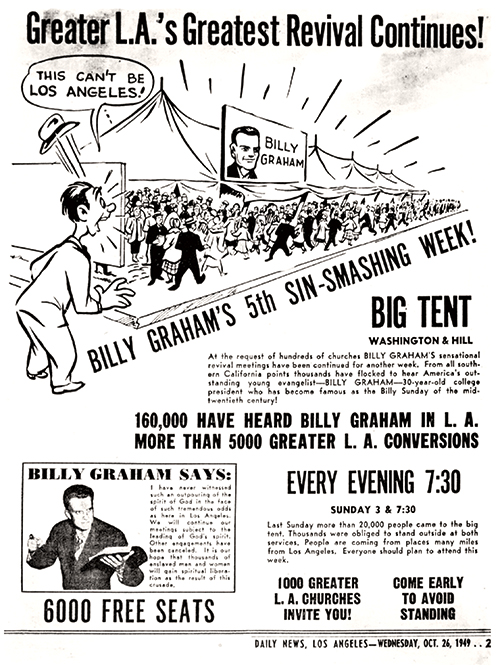

Billy Graham debuted on a national stage during his Los Angeles Crusade in fall 1949. Just 30 years old, Graham met his audience with a fiery call for repentance from sin, boldly announcing on the opening night that "this city of wickedness and sin" had a choice between revival and renewal—or judgment. At first, Los Angeles responded rather coolly to Graham's ire. But after a publicity boost from news magnate William Randolph Hearst, Graham's crusade entered its "5th Sin-Smashing Week!" A week later, the "Canvas Cathedral" overflowed as Graham presided over the "6th Great Sin-Smashing Week!"
Graham was no false advertiser. According to The Los Angeles Times, when the sawdust settled, some 6,000 souls had either "re-consecrated their lives" or converted to a life in Christ, "weeping forgiveness for their sins." Their tears were understandable since, according to Graham, they had narrowly missed hellfire and damnation. “Those who reject Christ,” Graham bellowed in an early sermon, "will be cast into the lake of fire and brimstone to spend eternity." He emphasized the point even more vividly in a sermon about Judgment Day. Upon Jesus' return, Graham warned, he would condemn the unrepentant with “fire coming from his eyes,” and a “sword coming from his mouth.” The young evangelist rounded off the theme of condemnation near the end of his crusade with a recitation of Jonathan Edwards's “Sinners in the Hands of an Angry God.” Such firebrand sermons produced restless nights among some audience members, forcing Graham to employ a “‘swing shift’” evangelist to handle decisions for Christ motivated by nightmares of a terrifying Jesus and a wrathful God.
 BGEA
BGEAAlong with the thousands who turned to Christ, Graham's life and evangelism were never the same after Los Angeles. Virtually overnight he went from a well-known minister within the evangelical subculture to a nationally recognized preacher. Amidst a deluge of media coverage, an editor at Life captured the transformation simply but presciently: "A New Evangelist Arises." Graham's meteoric rise to prominence awakened him to the burden and responsibility of his national role. That his sermons were scrutinized by the press and analyzed by “hundreds of clergy, laymen, and theologians throughout the world,” Graham recalled later, "baffled, perplexed,” and “frightened” him. Consequently, the Los Angeles crusade was the beginning of the end of the “turn or burn” style of preaching that had characterized many of his sermons there.
If the 1949 campaign marked the beginning of a shift in his preaching tone, the end came a decade later. Graham announced in a 1960 Christian Century article, "What Ten Years Have Taught Me," that he centered his message on the Cross and its dual revelation of the "sins of men" but also the "unwearying love of God." Four years later, in 1964, he confirmed the tonal change of his evangelism, remarking, "I stress a great deal the love of God from the Cross saying to the whole world, 'I love you, I love you, I will forgive you.' "
Graham's greater assurances about the love of God transformed his evangelism in his attitude toward sin, social crises, and ecumenism.
What about the intervening years caused this shift in emphasis? In the space of a decade, Graham had become the most renowned evangelist in the world, magnifying a hundredfold the burden he felt after Los Angeles. With an audience numbering in the millions, Graham understood that his words had the potential to alienate as much as invite untold numbers around the globe. Accordingly, while the theme of repentance was as strong as ever, he curbed excessive references to the flames of hell. More importantly, Graham, as the title of his Century article suggested, adopted the posture of a student. Lacking a formal theological education, he hungrily studied the Bible and theology and realized more fully that the gospel really was good news to those "lost and confused and frustrated about purpose and meaning in life." Practical experience also pushed Graham toward his revised message. His wide travels schooled him in the vast diversity of "the family of God" and further convinced him of the need for Christians of all stripes to "love one another." Finally, Graham studied his audience and recognized that he ministered to a population—especially in America—beset by doubt, loneliness, and unhappiness during an era known as the "Age of Anxiety." In light of such malaise, Graham adjusted his message to fit the concerns of his constituents, promising an "age of grace" for those who would turn to Christ.
Graham's greater assurances about the love of God transformed his evangelism in his attitude toward sin, social crises, and ecumenism. With the love of God at the center of his message, Graham spoke more often of sin as the condition of all humanity, as opposed to sin as particular transgressions of one kind or another. This distinction crystallized for him as he recognized that God's loving sacrifice of Jesus at the Cross was meant to "deal with sin and not just individual sins." Graham's decreasing emphasis on a gospel of good behavior strengthened his commitment to a social gospel. Make no mistake, Graham never wavered in his primary mission to bring individuals to Christ. But he worried less about—as he preached in 1949—"the sins of the Sunset Strip," and more about social problems, including racism, AIDS, and poverty. Finally, Graham's ecumenical spirit deepened and broadened. He refused to speculate about the fate of non-Christians, and offered that "the love of God is absolute … and I think he loves everybody regardless of what label they have."
The legacies of Graham's ministry are many, but perhaps none is greater than its demonstration that it is not the flames of hell but the triumphant love of God that defines and emboldens a Christian life.
Andrew Finstuen is dean of the Honors College and associate professor of history at Boise State University. He is also the author of Original Sin and Everyday Protestants: The Theology of Reinhold Niebuhr, Billy Graham, and Paul Tillich in an Age of Anxiety.