Bonnie, a white woman in her late 20s, said, “I don’t understand why Jada has to make everything about race. Race is just not my issue.”
It was the summer of 1988. Jada, Bonnie, and I were working in the inner city with a multiracial team of students on InterVarsity’s Chicago Urban Project. Our team had just experienced an emotional explosion around race that left everyone walking on eggshells and some crying silently in back rooms.
I got why Bonnie, a white woman, would say that. Over the weeks, she’d confided experiencing sexual and emotional abuse. She had so much pain and needed so much healing that I could see why racial issues felt low on her priority list.
But in that moment the Holy Spirit prompted me. “Bonnie, you love Jada, right?”
“Of course I love her!” Bonnie exclaimed. Over the past seven weeks, our team had worked hard, played hard, learned hard. We’d lived together, struggled together, shared deep and difficult conversations together. There’s nothing more bonding than friends following Jesus together on mission.
“I know you love her,” I said, “and Jada’s biggest issue is race. As a black woman whose parents were civil rights activists, whose entire life has been shaped by race and racism, race is Jada’s issue. And if you love Jada, you will care about what hurts Jada. Not because it affects you, but because it affects Jada.”
That lesson has shaped my multiethnic journey ever since. We do it because of love.
In John’s gospel we read that Jesus “had to go through Samaria” (John 4:4). Actually, Jesus didn’t have to go through Samaria. In fact, rather than walking the straight line between Judea and Galilee, Jews walked around Samaria and through the wilderness to avoid defiling themselves. They shook the dust off their feet after walking on Samaritan soil, a sign of contempt and so they wouldn’t pollute their “holy” ground.
Jesus had to go to Samaria because he had a date at a well with a Samaritan woman, a woman who would not only be among the first to recognize him as Messiah but who would also become the first Samaritan evangelist, bringing the good news of Jesus to her whole town.
Jesus had to go to Samaria because of love.
As a second-generation Chinese American woman, I’m not white. I’m not black. My people usually get left out of the American narrative.
As a second-generation Chinese American woman, I fall in between. I’m not white. I’m not black. My people usually get left out of the American narrative. I can silently go about my business, “beating them at their own game,” as my immigrant parents encouraged me. I don’t have to go anywhere—I can use my privilege and duck most of what other people of color must endure.
Yet love compels me to cross ethnic boundaries—in my marriage, in my friendships, in my work—even in raising my bi-racial children, whose parents can’t understand their experience.
I follow Jesus across ethnic boundaries because he introduces me to those he loves and I experience friendship, inspiration, laughter, partnership, delicious food—in a word, more love—but not without more suffering too. Because when we love, we suffer with and for those we love.
How does Jesus invite us to cross boundaries and experience his love?
See what Jesus sees. The disciples saw a ritually unclean Samaritan woman in an unclean land. Jesus saw a broken, hurting daughter who needed a personal experience with him and had the potential to bring a whole village into his kingdom.
It hurts when others don’t see me, my people, or our pain. White friends have said, “I don’t see you as Chinese, I just see you as white” and thought that’s a compliment.
Folks suggest “It’s in your head” if I feel trepidation entering entirely white spaces during this time when our leaders call COVID-19 “kung flu” or the “Chinese virus” and over 2,500 Asians have been targeted. (Don’t believe me? Sociologist Russell Jeung is counting.)
Ask yourself questions the disciples failed to ask. Confused and surprised (maybe disgusted and judgmental?), the disciples don’t ask what’s in their hearts. The “disciples returned and were surprised to find him talking with a woman. But no one asked, ‘What do you want?’ or ‘Why are you talking with her?’” (John 4:27). In our fractured nation, with our terrible history, in this soul-sucking time where every injustice is exacerbated by pandemic, Jesus, what do you want? From me, my family, my church, my nation? How can I join the conversation you’re already having with my neighbor?
Stay a while in a foreign country. Jesus doesn’t answer the unasked questions. Instead, he and his disciples stay in the Samaritan village for two more days. What happened in those two days? How did Jesus transform that town? How did the disciples respond to living on “unclean” soil, eating “unclean” food, with “unclean” people? How is Jesus inviting you to stay in uncomfortable spaces?
Listen. Nothing makes me feel more loved than someone listening to my entire story with compassion, without judgment and without giving advice or trying to “solve me.” We love others by listening well to their stories, stories that include their history, their struggle, their particularities—in person or through books, movies, and podcasts.

Embrace discomfort and even pain: Years ago, I wrote a dissertation on interracial friendship among college students. At the time, friendship theory centered around similarities attracting. But I found that more than similarities attracting, differences repelled. Students talked about wanting to stay in their “comfort zone.” The more culturally different groups were, the less interracial friendship happened between them. Jesus never seems very concerned about our comfort zones. Love is messy. Relationships are hard. Issues of race and justice are extremely complex. Acknowledge the discomfort, accept the pain and, ask Jesus for perseverance to keep walking this journey.
Speak up on behalf of your neighbor: With today’s “cancel culture,” it’s scary to say anything about race or ethnicity. But it’s exhausting to be the person of color, or woman, or minority who always has to speak out to the majority. Take a risk as the Samaritan woman did, a pariah in her community, who used her tiny bit of relational capital to introduce her neighbors to Jesus.
Making mistakes is inevitable. But love covers a multitude of sins. Forgiveness is the balm, the healing ointment, that restores what’s been broken. Repenting, asking for forgiveness, receiving forgiveness, and forgiving myself and others have been essential spiritual disciplines in this long journey. Jesus said the world will know his gospel is true if we love one another, love our neighbors, and even love our enemies and persecutors. If followers of Jesus tangibly loved those from different ethnic, racial, class, and political backgrounds, imagine how the world would take notice. Imagine how our world might be healed.
Let’s do it. Together. For love.
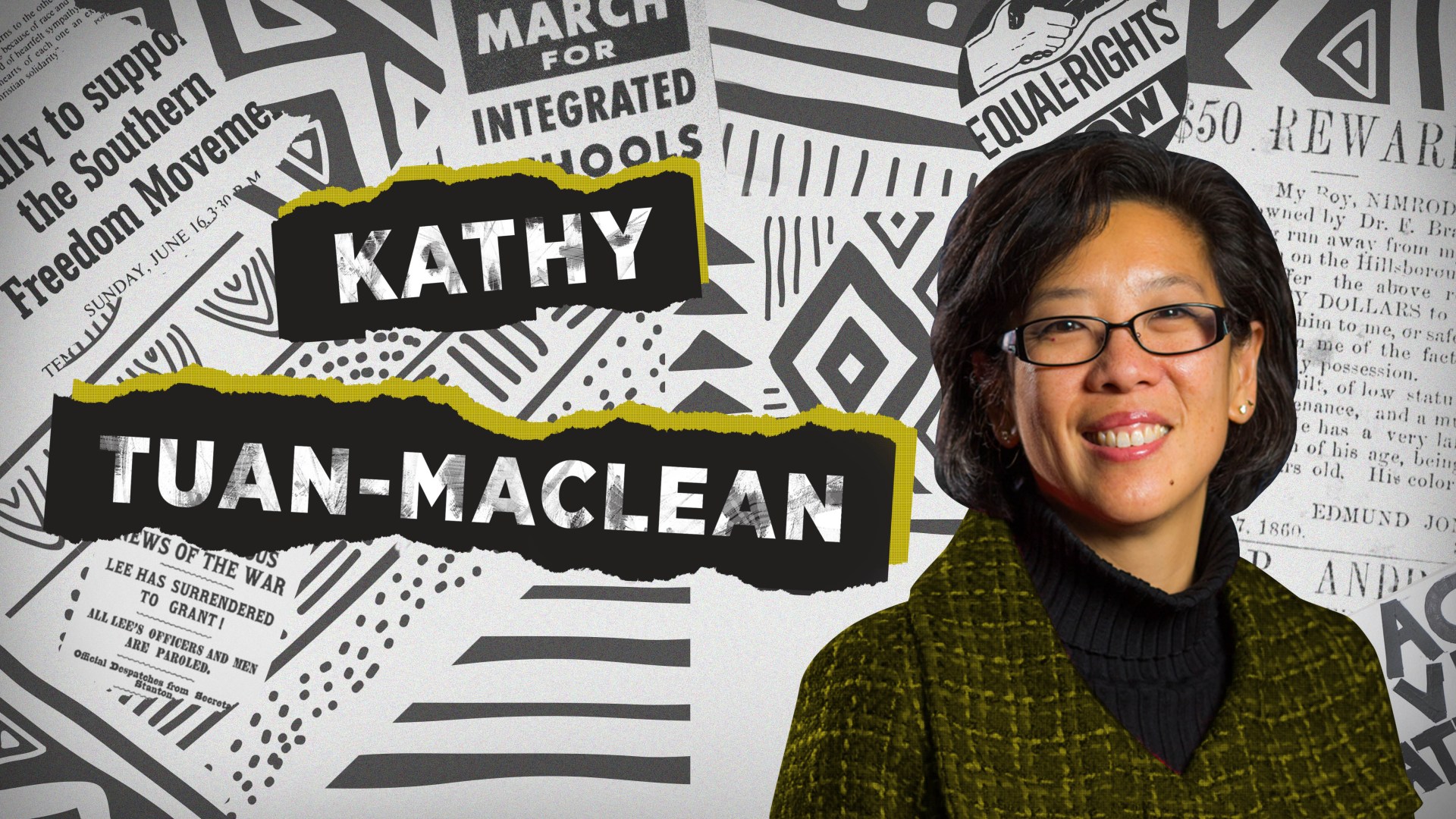
Kathy Tuan-MacLean (PhD, Northwestern University) serves as InterVarsity’s national faculty ministry director.