How do we rightly understand the people who stormed the Capitol last month? MSNBC analyst Mehdi Hasan, soon after the riot, wrote that we must ask, Where were they radicalized?
Hasan’s answer was right-wing news and social media, a frantic feed of Fox and Facebook. But in a column for Religion Dispatches, Chrissy Stroop pointed to Christian education as well. Citing a Huffington Post report that connects rhetoric from former President Donald Trump with lessons in widely used Christian textbooks produced by Abeka Publishing and Bob Jones University Press, Stroop argued “conservative Christian” schools are “sources of radicalization” with a “toxic influence” that contributed to the seditious violence in Washington on January 6.
On the one hand, if Stroop’s broad verdict is right, I should have joined the Capitol mob. I am a product of Christian primary education—even used Abeka books. Still, I can’t argue with Stroop’s basic contention that the mushrooming visibility of Christian nationalism in American evangelical circles requires new scrutiny of Christian schooling. The question I keep returning to is this: Are our schools training Christians or Americans?
If education is the chief project of childhood, then it should be a project infused with Jesus Christ.
Our reflexive answer would be “Christians, of course.” After all, this is why parents like my mom seek Christian education, sometimes despite great financial strain. If education is the chief project of childhood, then it should be a project infused with Jesus Christ. Three hours a week at church can’t compete with 35 hours a week in the classroom. Education shapes what sociologists call the “imaginary”—an expansive, all-encompassing, and intuitively held perspective on life. Christian schools offer parents the tantalizing prospect of children educated into a thoroughly Christian imaginary, a way to “bring them up in the training and instruction of the Lord” (Eph. 6:4). And research shows Christian education has measurable, lifelong effects.
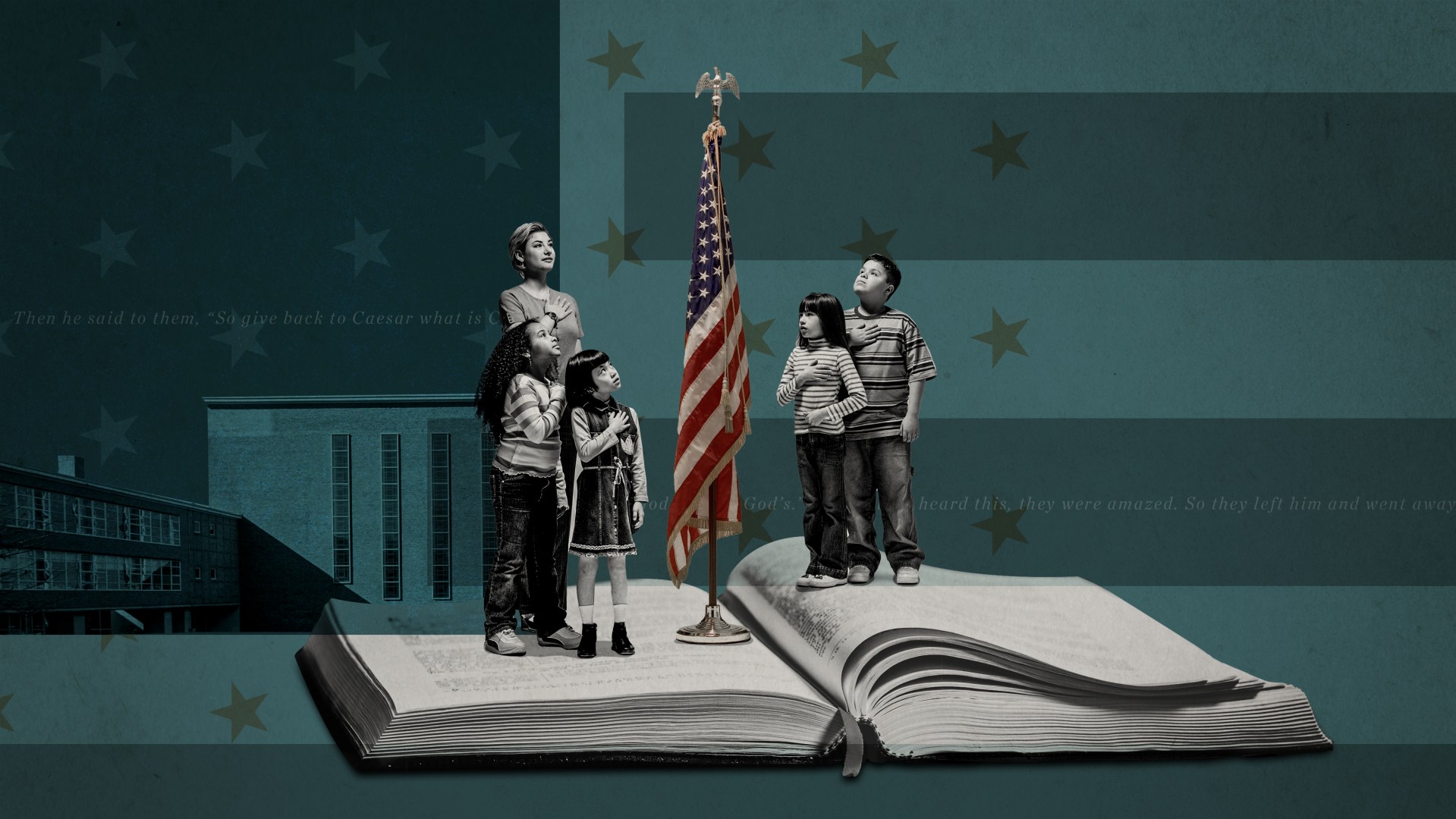
But thinking back on my own Christian education, mere Christianity was not all I learned. I moved around a lot growing up, attending four Christian schools and spending one year in American public school, one year in Chinese public school, and one year homeschooled. The four Christian schools I attended varied theologically and culturally: One was affiliated with a fundamentalist Baptist church; another hired a Democrat to teach civics the year former President George W. Bush was reelected with overwhelming evangelical support. At all of them we said our pledges, sometimes daily or as a standard feature of a weekly chapel. The order of pledging allegiance, to my recollection, started with the American flag, then the Christian flag, and, lastly, the Bible.

That routine—placing national loyalty first—implies a devotion to nation before Jesus, the very essence of Christian nationalism, not faith in Christ. To pledge ourselves to any state is not appropriate for Christians. Martyrs of the early church died for this conviction. Their declaration that “Jesus is Lord” carried an implicit repudiation of the Caesars’ claim to be their lord.
“When the early Christians chose to say, ‘Jesus is Lord,’” explains CT contributing editor Ed Stetzer, “they were literally choosing to align everything with Jesus, even their own lives. Their words were not trite statements. They were downright treasonous. They echoed a subversive rebellion against the establishment that clearly resonated their allegiances and alliances.” Yet 19 or so centuries later, my Christian schools had me pledging—whether I understood it or not—first to the flag of Caesar and only secondarily to Jesus by way of a flag with colors deliberately suggesting a link between Christianity and American patriotism. (This flag, by the way, was carried by a rioter on the Senate floor last month.) That portion of my schooling wasn’t Christian discipleship. It was good American training—or, more bluntly, it was Christian nationalism.
My twins are still a few years out from kindergarten, but as my husband and I consider our school options, this weighs heavily on my mind. My inclination after my unusually broad educational experience is to send my kids to Christian school, ideally a large one with elements of classical education and de-emphasized technology use.
But the possibility that the flow of their education will have an undercurrent of Christian nationalism troubles me. I don’t want my children to be expected to pledge themselves to the United States of America, because I believe saying the Pledge of Allegiance is a direct violation of Jesus’ instruction to give ourselves only to God (Matt. 22:15–22). Nor do I want them, especially while they’re too young to be able to explain their parents’ theological reasoning, to be the “weird” ones opting out of a school-wide ritual. I want them to be trained in our faith, not in idolatrous American civil religion.
But public schools also lean toward nationalism, only without the “Christian.”
“Ah,” I can imagine some readers saying, “so send them to public schools instead.” But public schools also lean toward nationalism, only without the “Christian.” Not that public school teachers and administrators can’t be Christians or conscientious public servants; plenty are. Yet at an institutional level, American public education as we know it was built on models developed in 18th- and 19th-century Europe (chiefly Prussia), models designed to turn out loyal citizens with a strong sense of “national spirit.”
This design was well intended. One immediate impetus was to overcome deep (and sometimes violent) religious and ethnic divisions by teaching children to think of themselves as Prussians or Americans first and Catholics or Protestants second. The idea, in the words of philosopher Johann Gottlieb Fichte, was to “establish deeply and indelibly in the hearts of all, by means of education, the true and all-powerful love of fatherland, the conception of our people as an eternal people and as the security for our own eternity.”
However good the intent, that’s a clear usurpation of roles that, for Christians, belong to Christ and his church. While this theory of education is certainly not the only influence in the American public school system, it’s indefensible enough for my family to decide we’ll steer clear. Opting for public school wouldn’t free my kids of an expectation to say the Pledge of Allegiance, for example—in fact, they might be asked say it even more often in a public setting, depending on the district.
So that brings me back to Christian schools. They played a powerful and positive formative role in my life and now stand accused, not entirely without basis, of inculcating the Christian nationalism on display at the Capitol insurrection. The best I can do is plead with Christian educators: If it is lurking in your school, root out the nationalist weed. Burn it away like the dross it is (Isa. 1:25–26). Train Christians, not Americans. Graduate students who have never pledged to a flag but know they belong to Christ. I hope my children will be among them.
Bonnie Kristian is a columnist at Christianity Today.