The rollout of the US State Department’s most recent report on international religious freedom (IRF) this week was a study in the contrasts between the Trump and Biden administrations.
But there were also continuities.
Here are two of each that stand out to me as a religious freedom scholar and former staffer in the IRF office:
1. Humility
At last year’s rollout, then Secretary of State Mike Pompeo boasted, “There is no other nation that cares so deeply about religious freedom” and “We remain the greatest nation in the history of civilization.” Hardly a winsome self-characterization. His only caveat was “America is not a perfect nation,” which is the kind of thing you say when you think you’re pretty close to perfect or don’t want to get into specifics about how you’re not.
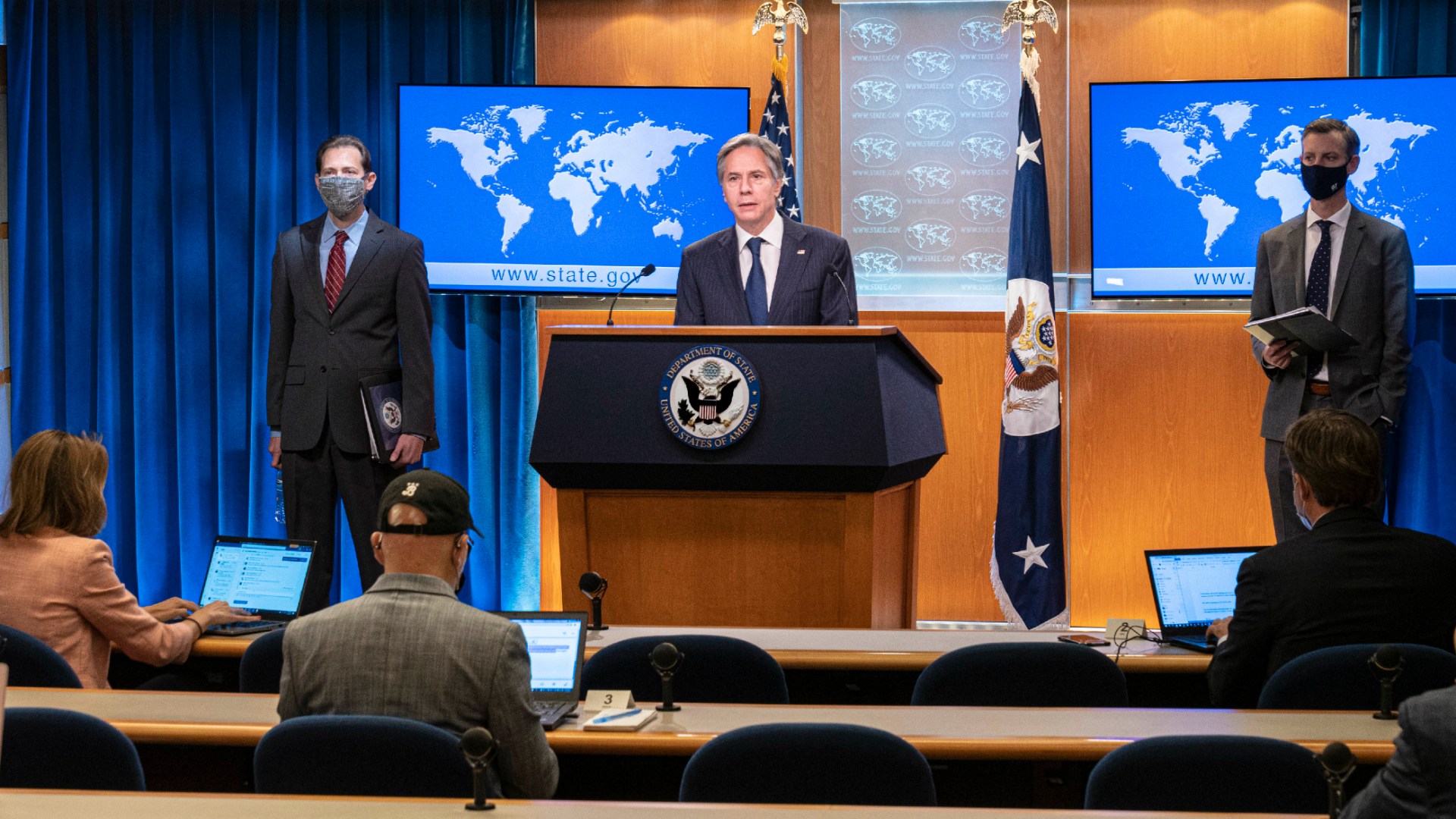
By contrast, this week current Secretary of State Antony Blinken was self-effacing and specific. Blinken, who is Jewish, lamented that “we’re seeing antisemitism on the rise worldwide, including here in the United States as well as across Europe.” The same goes for anti-Muslim sentiment, which he labeled a “serious problem for the United States as well as in Europe.” Blinken’s modesty and self-awareness add credibility to America’s promotion of tolerance. What should differentiate the US government from authoritarian regimes is not only a higher level of respect for religious freedom but also more honesty about shortcomings and actively addressing them.
2. Co-equal Human Rights
In an article for Christianity Today last November, I argued that American religious freedom advocates can be divided into two basic camps: “First Freedom” and “Article 18.” The First Freedom camp asserts that religious liberty is not only sequentially the first freedom enumerated in the Bill of Rights but also the foundational right because it touches on matters of ultimate significance. The Article 18 crowd points to the fact that religious freedom is the 18th article in the Universal Declaration of Human Rights, which suggests it is part of a broader web an interconnected, equally important rights.
Pompeo and other Trump officials were vocal proponents of the First Freedom view. Blinken implicitly but clearly repudiated that view and articulated the basic outline of the Article 18 perspective:
Religious freedom is co-equal with other human rights because human rights are indivisible. Religious freedom is not more or less important than the freedom to speak and assemble, to participate in the political life of one’s country, to live free from torture or slavery, or any other human right. Indeed, they’re all interdependent. Religious freedom can’t be fully realized unless other human rights are respected, and when governments violate their people’s right to believe and worship freely, it jeopardizes all the others.
During the Q&A with reporters, IRF office director Dan Nadel was asked whether this comment from Blinken represented a departure from the Trump approach. Nadel responded, “Secretary Pompeo did express his view that there was perhaps a hierarchy of rights concept and that’s a view that this administration does depart from.”
Importantly, Nadel followed this observation by stating that the approach of the Biden administration “in no way is to indicate that religious freedom is any less important.” The Trump administration invested considerable financial and political capital in the promotion of religious freedom, but its efforts were widely criticized as disproportionate. The danger now is that a more proportionate approach can look, especially to the First Freedom camp, as a diminution of religious freedom advocacy. The challenge for the Biden administration will be to articulate and demonstrate that its approach is more conceptually sound and practically beneficial.
3. Numbers vs. Narrative
One element of continuity between Blinken and his predecessor is the use of data from the Pew Research Center as a measure of global religious freedom conditions. In his 2019 speech on “Being a Christian Leader,” for instance, Pompeo used Pew’s data to claim “more than 80 percent of mankind lives in areas where religious freedom is suppressed or denied in its entirety.” In his remarks this week, Blinken cited the same Pew study when stating that 56 countries “have high or severe restrictions on religious freedom.”
Policymakers and activists routinely use Pew data in this way—as a measure of religious freedom conditions. But that’s not exactly what Pew is measuring.
Pew’s Government Restrictions Index seeks to measure government “restrictions” on religion. As I have argued elsewhere, a number of those “restrictions” are perfectly legitimate in principle and very common in pluralistic liberal democracies that promote religious freedom globally. A restriction on religion as defined by Pew is not necessarily a violation of religious freedom according to international law. Pew data provides a valuable resource, but one has to be aware of what it is actually measuring.
4. A Quality Report
A more significant continuity between the Trump and Biden administrations is the quality of the IRF report itself. It is by far the most comprehensive and authoritative review of religious freedom conditions worldwide. It serves as the foundational study for an array of scholars, advocates, and officials—not just in the United States but around the globe.
In his remarks, Nadel expressed why it’s so valuable to have qualitative reports on the issue. The IRF report’s 2,397 pages offer “a rich fabric of individual stories,” he said. “Stories that help us understand the experiences of individuals, of communities, sometimes of entire societies.” All this fine-grained detail serves, said Nadel, as the baseline for US policy and engagement on religious freedom throughout the year. Numbers are powerful tools, but insufficient on their own. We need narratives—the stories and descriptions behind the numbers—for a well-rounded understanding of the complexities and trends in the field of religious freedom.
Thankfully, changes of administration don’t impact the quality of the IRF report. But they do affect how religious freedom is conceptualized and promoted. That was evident at this week’s rollout of the first IRF report of the Biden era.
Let’s hope that First Freedomists and Article 18ers alike will use the new IRF report to advance the common cause of religious liberty. As Blinken argued, and the report makes clear, “We have work to do to ensure that people of all faiths and backgrounds are treated with equal dignity and respect.”
Judd Birdsall is a senior research fellow at the Berkley Center for Religion, Peace, and World Affairs at Georgetown University. He previously served at the US State Department in the Office of International Religious Freedom and on the Policy Planning Staff.
Speaking Out is Christianity Today’s guest opinion column and (unlike an editorial) does not necessarily represent the opinion of the magazine.