(Supplementing our issue on “The Ten Most Influential Christians of the Twentieth Century,” historian Bruce Shelley highlights another of the century’s most controversial figures. —EC)
It was evident in the 1920s that controversy can come from the left as well as the right. From his position at Union Seminary and his pulpits in and around New York City, Harry Emerson Fosdick stood on the left.
Fosdick was in and out of controversy most of his life. But his great passion was his disdain for fundamentalism. Early in life, he rejected Calvinism’s “God who is a devil” and came to rely on the authority of his own experiences. He joined Union Seminary’s faculty in 1911, but he met his first major controversy in the early twenties while serving as a Baptist minister in New York’s First Presbyterian congregation.
J. Gresham Machen, the fundamentalist defender of Presbyterianism, challenged his church’s sanction of Fosdick’s ministry and set forth his case against Fosdick’s modernity and liberalism. “Modern liberalism,” he wrote, “may be criticized (1) on the ground that it is un-Christian and (2) on the ground that it is unscientific. … If a condition could be conceived in which all the preaching of the church should be controlled by the liberali which in many quarters has already become preponderant, then … Christianity would at last have perished from the earth.”
“The question,” Machen wrote, “is not whether Dr. Fosdick is winning men, but whether the thing to which he is winning them is Christianity.”
Fosdick answered his conservative critics in May 1922 with an epoch-making sermon, “Shall the Fundamentalists Win?” (published under the title “The New Knowledge and the Christian Faith”). From his Presbyterian pulpit he declared belief in the virgin birth of Christ nonessential, the inerrancy of the Scriptures incredible, and the literal Second Coming of Christ outmoded.
“The present world situation smells to heaven!” he proclaimed. “And now, in the presence of colossal problems, which must be solved in Christ’s name and for Christ’s sake, the Fundamentalists propose to drive out from the Christian churches all the consecrated souls who do not agree with their theory of inspiration. What immeasurable folly!”
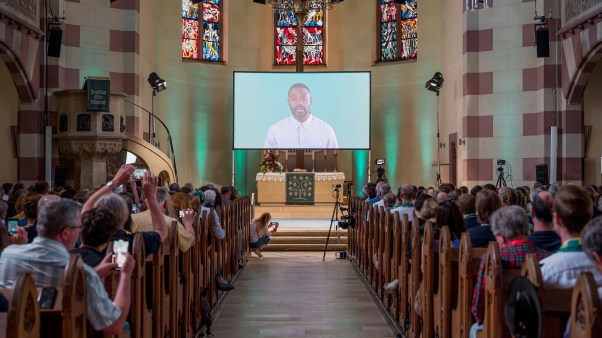
In the end Fosdick stepped down from his pulpit but fell into the arms of his influential supporter John D. Rockefeller, Jr. New York’s Park Avenue Baptist Church had plans to enter the glorious structure Rockefeller was building near Union Seminary, a modern Gothic cathedral called Riverside Church. The church sponsored a number of social service programs throughout the Depression, through which some 7,000 people found employment.
Seating over 2,300 worshipers, Riverside gave Fosdick an even larger platform for his controversial opinions. Though his views of modernism shifted in the thirties, writers, like advice columnist Ann Landers, often quoted Fosdick’s simple affirmations of life even as conservative Christians continued to label him “Modernism’s Moses.”
* Christian History issue 55: The Monkey Trial & the Rise of Fundamentalism, features a face-off between Fosdick and Machen.
Elesha Coffman can be reached at cheditor@ChristianityToday.com.
Copyright © 2000 by the author or Christianity Today/Christian History magazine.Click here for reprint information on Christian History.