"Let it not make thee despair, neither yet discourage thee, O reader, that it is forbidden thee in pain of life and goods, or that it is made breaking of the king's peace, or treason unto his highness, to read the Word of thy soul's health—for if God be on our side, what matter maketh it who be against us, be they bishops, cardinals, popes."

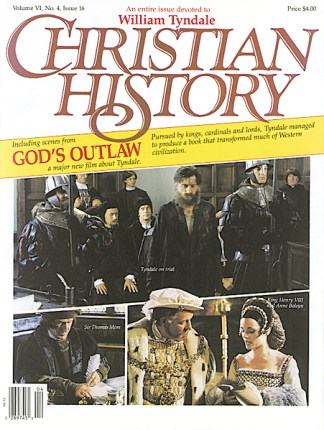
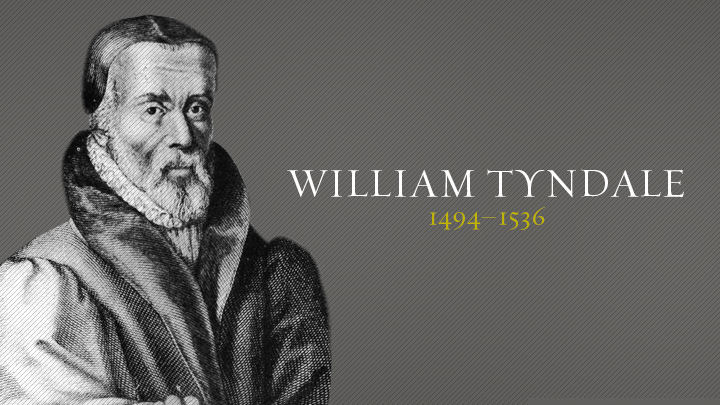
William Tyndale could speak seven languages and was proficient in ancient Hebrew and Greek. He was a priest whose intellectual gifts and disciplined life could have taken him a long way in the church—had he not had one compulsion: to teach English men and women the good news of justification by faith.
Tyndale had discovered this doctrine when he read Erasmus's Greek edition of the New Testament. What better way to share this message with his countrymen than to put an English version of the New Testament into their hands? This, in fact, became Tyndale's life passion, aptly summed up in the words of his mentor, Erasmus: "Christ desires his mysteries to be published abroad as widely as possible. I would that [the Gospels and the epistles of Paul] were translated into all languages, of all Christian people, and that they might be read and known."
Timeline |
|
|
1456 |
Gutenberg produces first printed bible |
|
1479 |
Establishment of Spanish Inquisition |
|
1488 |
First complete Hebrew Old Testament |
|
1494 |
William Tyndale born |
|
1536 |
William Tyndale dies |
|
1555 |
Latimer and Ridley burned at stake |
It would be a passion, though, for which Tyndale would pay dearly.
Genius translator
He was a native of Gloucester and began his studies at Oxford in 1510, later moving on to Cambridge. By 1523 his passion had been ignited; in that year he sought permission and funds from the bishop of London to translate the New Testament. The bishop denied his request, and further queries convinced Tyndale the project would not be welcomed anywhere in England.
To find a hospitable environment, he traveled to the free cities of Europe—Hamburg, Wittenberg, Cologne, and finally to the Lutheran city of Worms. There, in 1525, his New Testament emerged: the first translation from Greek into the English language. It was quickly smuggled into England, where it received a less-than-enthusiastic response from the authorities. King Henry VIII, Cardinal Wolsey, and Sir Thomas More, among others, were furious. It was, said More, "not worthy to be called Christ's testament, but either Tyndale's own testament or the testament of his master Antichrist."
Authorities bought up copies of the translation (which, ironically, only financed Tyndale's further work) and hatched plans to silence Tyndale.
Meanwhile Tyndale had moved to Antwerp, a city in which he was relatively free from both English agents and those of the Holy Roman (and Catholic) Empire. For nine years he managed with the help of friends to evade authorities, revise his New Testament, and begin translating the Old.
His translations, it would turn out, became decisive in the history of the English Bible, and of the English language. Nearly a century later, when translators of the Authorized, or King James Version, debated how to translate the original languages, eight of ten times, they agreed that Tyndale had it best to begin with.
Betrayal
During these years, Tyndale also gave himself methodically to good works because, as he said, "My part be not in Christ if mine heart be not to follow and live according as I teach." On Mondays he visited other religious refugees from England. On Saturdays he walked Antwerp's streets, seeking to minister to the poor. On Sundays he dined in merchants' homes, reading Scripture before and after dinner. The rest of the week he devoted to writing tracts and books and translating the Bible.
We do not know who planned and financed the plot that ended his life (whether English or continental authorities), but we do know it was carried out by Henry Phillips, a man who had been accused of robbing his father and of gambling himself into poverty. Phillips became Tyndale's guest at meals and soon was one of the few privileged to look at Tyndale's books and papers.
In May 1535, Phillips lured Tyndale away from the safety of his quarters and into the arms of soldiers. Tyndale was immediately taken to the Castle of Vilvorde, the great state prison of the Low Countries, and accused of heresy.
Trials for heresy in the Netherlands were in the hands of special commissioners of the Holy Roman Empire. It took months for the law to take its course. During this time, Tyndale had many hours to reflect on his own teachings, such as this passage from one of his tracts:
"Let it not make thee despair, neither yet discourage thee, O reader, that it is forbidden thee in pain of life and goods, or that it is made breaking of the king's peace, or treason unto his highness, to read the Word of thy soul's health—for if God be on our side, what matter maketh it who be against us, be they bishops, cardinals, popes."
Finally, in early August 1536, Tyndale was condemned as a heretic, degraded from the priesthood, and delivered to the secular authorities for punishment.
On Friday, October 6, after local officials took their seats, Tyndale was brought to the cross in the middle of the town square and given a chance to recant. That refused, he was given a moment to pray. English historian John Foxe said he cried out, "Lord, open the King of England's eyes!"
Then he was bound to the beam, and both an iron chain and a rope were put around his neck. Gunpowder was added to the brush and logs. At the signal of a local official, the executioner, standing behind Tyndale, quickly tightened the noose, strangling him. Then an official took up a lighted torch and handed it to the executioner, who set the wood ablaze.
One other brief report of that distant scene has come down to us. It is found in a letter from an English agent to Lord Cromwell two months later.
"They speak much," he wrote, "of the patient sufferance of Master Tyndale at the time of his execution."
Corresponding Issue