 Tracy Scollon / Lightstock
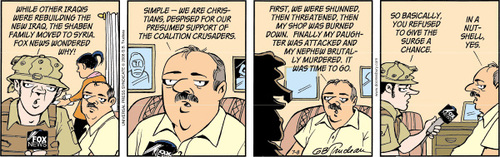
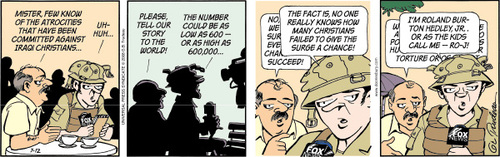
Gary B. Trudeau’s Doonesbury, which newspapers publish either with the comics or the editorial cartoons, just wrapped up a series about Iraqi Christian refugees. Roland (in this series a Fox News correspondent) is trying to cover the story of an Assyrian family in a way that is flattering for the Surge. Doonesbury treats the imaginary Iraqis with a great deal of dignity. Fox News doesn’t fare so well.
 Since October, Bulgarian evangelicals have protested proposed legislation that would hinder preaching, evangelizing, funding, and training by non-Orthodox minority faiths with weekly demonstrations and nationwide calls to prayer.
Last Friday, its last working day of 2018, the country’s parliament finally passed the new law, without the restrictions Protestants had feared the most.
“We celebrate the decision by the government of Bulgaria earlier today to allow hundreds of churches, including 130 Baptist churches, to remain open so that people of faith may continue to worship in the free convictions of their conscience,” stated the Baptist World Alliance, which opposed the initial proposal along with the Baptist Union of Bulgaria and several other national church councils.
The amendments to the Religious Denominations Act go into effect January 1 and present some additional regulations in the southeastern European country. The two major faith groups, Orthodox (85%) and Muslim (10%), also receive bigger government subsidies under the new law.
An earlier version of the amendments, as CT reported last month, put the future of Protestant education and foreign funding for churches in jeopardy.
The original proposal also barred all church activity outside official buildings and kept foreign preachers from leading services; the approved amendments regulate only the use of loudspeakers to amplify outdoor worship and allow non-Bulgarians to preach if they inform the religious affairs office, according to Evangelical Focus, a Christian news site in Europe.
Gong forward under the new rules, churches and other religious buildings can join an optional national registry to receive tax deductions.
“The willingness of the Government to listen to the concerns and perspective of citizens with a minority faith is commendable,” according to the Baptist World Alliance.
“The work of many Baptist leaders and other people of goodwill who led rallies for seven weeks inside Bulgaria and faithfully pressed for full religious freedom, as well as the support of many who prayed and engaged across the world, is a powerful example. The actions of today are a true Christmas blessing.”
Last Friday, the protests in the capital city of Sofia continued. Church leaders distributed Bibles and personal pleas to each member of Parliament, and 200 evangelicals gathered outside the government building to pray against the restrictions, Evangelical Focus wrote.
“Almost all of the provisions that were protested against were dropped. Whether due to the piled up international pressure, or because of the eight evangelical street protests, or maybe due to the thousands of prayers spoken against the amendments—the lawmakers dropped every single restrictive provision of the original version,” the site reported.
Though they are relieved and praising God that Bulgaria passed an acceptable version of the regulations, Protestants are still concerned that their government had put forth such severe proposals in the first place, Evangelical Focus said.
“Lack of consideration or instinct of totalitarian control? What was driving six out of the seven political parties to coin out so many restrictions depriving basic human and religious rights?”
The Christian legal group Advocates International also commended the former Communist nation’s decision to “drop various provisions in its amendment of its Religious Denominations Act that restricted freedom of religion.”
“Please join us in thanking God for these news and continue praying for Bulgaria and our advocates there who continue to face challenges to their freedom and working faithfully and courageously to safeguard it,” Daniela Ancalle said in a statement.
Protestants and other minority faiths each make up less than 1 percent of the population, so the public funding granted to them under the new law pales in comparison to the millions allotted for Orthodox and Muslim adherents.
The United Methodist Church, Bulgarian Baptist Union, Bulgarian Evangelical Alliance, Catholic Church in Bulgaria, and National Alliance United Churches of God all released statements objecting to the initial proposals, and Orthodox and Muslim leaders also voiced concerns.
The Bulgarian Evangelical Alliance posted detailed reports from last week’s meeting on its Facebook page, thanking fellow believers both inside and outside the country for their support and prayers.
Fox News actually did run an Associated Press story about “Christians Fleeing Violence in Iraq” in early May, which brings up the matter of ransoms most Christians pay for “protection.”
The background–not in the comic strips, although alluded to–is that Iraq’s Christians, the largest non-Muslim religious group in Iraq , are represented disproportionately in the refugee population (although it should be mentioned that the Assyrian diaspora dates back to World War I). It’s such a huge drain that some churches in Iraq have no members left. Christians can be identified by their names and ID cards, and they are often targeted for violence. The Assyrian International News Agency (AINA) is calling it genocide. So, many Assyrians leave as soon as they can. Others, like the family in Doonesbury, wait until something unbearable happens.
 Since October, Bulgarian evangelicals have protested proposed legislation that would hinder preaching, evangelizing, funding, and training by non-Orthodox minority faiths with weekly demonstrations and nationwide calls to prayer.
Last Friday, its last working day of 2018, the country’s parliament finally passed the new law, without the restrictions Protestants had feared the most.
“We celebrate the decision by the government of Bulgaria earlier today to allow hundreds of churches, including 130 Baptist churches, to remain open so that people of faith may continue to worship in the free convictions of their conscience,” stated the Baptist World Alliance, which opposed the initial proposal along with the Baptist Union of Bulgaria and several other national church councils.
The amendments to the Religious Denominations Act go into effect January 1 and present some additional regulations in the southeastern European country. The two major faith groups, Orthodox (85%) and Muslim (10%), also receive bigger government subsidies under the new law.
An earlier version of the amendments, as CT reported last month, put the future of Protestant education and foreign funding for churches in jeopardy.
The original proposal also barred all church activity outside official buildings and kept foreign preachers from leading services; the approved amendments regulate only the use of loudspeakers to amplify outdoor worship and allow non-Bulgarians to preach if they inform the religious affairs office, according to Evangelical Focus, a Christian news site in Europe.
Gong forward under the new rules, churches and other religious buildings can join an optional national registry to receive tax deductions.
“The willingness of the Government to listen to the concerns and perspective of citizens with a minority faith is commendable,” according to the Baptist World Alliance.
“The work of many Baptist leaders and other people of goodwill who led rallies for seven weeks inside Bulgaria and faithfully pressed for full religious freedom, as well as the support of many who prayed and engaged across the world, is a powerful example. The actions of today are a true Christmas blessing.”
Last Friday, the protests in the capital city of Sofia continued. Church leaders distributed Bibles and personal pleas to each member of Parliament, and 200 evangelicals gathered outside the government building to pray against the restrictions, Evangelical Focus wrote.
“Almost all of the provisions that were protested against were dropped. Whether due to the piled up international pressure, or because of the eight evangelical street protests, or maybe due to the thousands of prayers spoken against the amendments—the lawmakers dropped every single restrictive provision of the original version,” the site reported.
Though they are relieved and praising God that Bulgaria passed an acceptable version of the regulations, Protestants are still concerned that their government had put forth such severe proposals in the first place, Evangelical Focus said.
“Lack of consideration or instinct of totalitarian control? What was driving six out of the seven political parties to coin out so many restrictions depriving basic human and religious rights?”
The Christian legal group Advocates International also commended the former Communist nation’s decision to “drop various provisions in its amendment of its Religious Denominations Act that restricted freedom of religion.”
“Please join us in thanking God for these news and continue praying for Bulgaria and our advocates there who continue to face challenges to their freedom and working faithfully and courageously to safeguard it,” Daniela Ancalle said in a statement.
Protestants and other minority faiths each make up less than 1 percent of the population, so the public funding granted to them under the new law pales in comparison to the millions allotted for Orthodox and Muslim adherents.
The United Methodist Church, Bulgarian Baptist Union, Bulgarian Evangelical Alliance, Catholic Church in Bulgaria, and National Alliance United Churches of God all released statements objecting to the initial proposals, and Orthodox and Muslim leaders also voiced concerns.
The Bulgarian Evangelical Alliance posted detailed reports from last week’s meeting on its Facebook page, thanking fellow believers both inside and outside the country for their support and prayers.
CT suggested in an editorial that U.S. and Iraqi governments should:
Stop discrimination in aid grants by naming a special aid coordinator in Iraq to insure that Christians and other minorities receive a fair share of international assistance.
Implement the creation of a homeland for Christians in Iraq’s Nineveh Plains to be governed jointly by Christians and other minority groups. (This is provided for under article 125 of Iraq’s new constitution.)
Provide more comprehensive care for the estimated 3 million Iraqi refugees and internally displaced people. The United States should follow through with its commitment to resettle more refugees from Iraq. In 2006, only 202 were resettled, while a total of 20,000 had been authorized.
Remove religious affiliation from identification cards. There could hardly be an easier way to protect the lives of Christian civilians, such as Ayad Tariq, than issuing new ID cards minus religious labels.
AINA divides Assyrians up into five groups: Chaldeans (of the Chaldean Catholic Church) at 45 percent, Syriac Orthodox at 26 percent, Church of the East at 19 percent, Syriac Catholic at 4 percent, and other groups at 6 percent. In 2005, 2 percent of Iraq’s population was Christian, according to the World Christian Database.
CT published an article on Iraqi Christian refugees in 2006.