Christianity on the Early American Frontier: A Gallery of Trendsetters in the Religious Wilderness


Barton Warren Stone
(1772–1844)
The Bible-only man
“The Bible only” was the rallying cry of Barton Warren Stone, a cry that led him to question orthodox doctrine and create a new church whose members would be called merely “Christians.”
After his father died, young Barton invested his portion of the estate in education. He studied law in Greensboro, North Carolina, and while there sat under the preaching of Presbyterian evangelist James McGready. After three years, Stone set aside his legal ambitions and took up preaching.
He headed west and became the pastor of two Presbyterian parishes, in Concord and Cane Ridge, Kentucky. He was troubled by the spiritual acedia in his parishes, so when he heard about a revival in southwestern Kentucky, he went there to see what it was about.
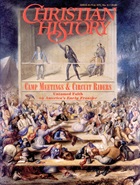
He returned home enthused, and within months, a revival had erupted in Stone’s parishes; in August of 1801, it reached its climax at Cane Ridge. An estimated 20,000 listened to revival preaching and responded by shouting, dancing, singing, and collapsing: “With a piercing scream,” Stone said, people would “fall like a log on the floor, earth, or mud, and appear as dead.”
Since many of his Presbyterian colleagues frowned on such emotionalism, Stone and four others formed the independent Springfield Presbytery. But in less than a year, they dissolved it because they believed each congregation should be independent, guided by nothing but the Bible.
When his wife died in 1809, Stone was left with four daughters, the oldest of whom was 8. He put them into the care of friends until he remarried so he could devote his “whole life gratuitously to the churches, scattered far and near.”
In 1830 Stone met Alexander Campbell, another Presbyterian-turned-independent who believed in “Bible only” Christianity. “I will not say there are no faults in brother Campbell,” wrote Stone, “but that there are fewer, perhaps, in him, than any man I know on earth.”
Their friendship and common passion led to a merger in 1832. “We plainly saw that we were on the same foundation,” wrote Stone, “in the same spirit, and preached the same gospel.” The writings of Stone, published in The Christian Messenger, a monthly launched by him in 1826, gave direction to the movement and cemented the merger.
Stone was sharply criticized for his unorthodox views, which included a denial of the Trinity. “The word Trinity,” he said, “is not found in the Bible.” So he refused to accept “that the Son of God was very and eternal God and yet eternally begotten.”
Stone’s legacy endures in the large number of churches called “Disciples of Christ” or “Church of Christ,” who have been committed to a “Bible only” Christianity.
Alexander Campbell
(1788–1866)
“Primitive” Christian
Separated by the Atlantic Ocean, Presbyterian preacher Thomas Campbell and his son Alexander simultaneously came to the same conclusion: the future was not with Presbyterianism.
The plan was for Thomas to sail to America with his Irish family to follow later. But the ship carrying Campbell’s family was shipwrecked, and they had to spend a year in Glasgow. There, 19-year-old Alexander answered the call to preach and began studying at the University of Glasgow. He quickly became disgusted with what he perceived to be theological pettiness in Presbyterianism. One Sunday he refused Communion, symbolically breaking with the faith of his father.
When Alexander arrived in Pennsylvania, though, he discovered his father had seceded from the local presbytery! One reason: a perceived lack of scriptural support for infant baptism. Thomas had founded The Christian Association of Washington (County, Pennsylvania). “Where the Scriptures speak, we speak,” declared Thomas, “where the Scriptures are silent, we are silent.”
In 1811, Alexander began pastoring Brush Run Church, a group of Presbyterian refugees. The birth of his first child led him to reconsider his views on infant baptism. He decided that his own infant baptism was invalid, so he sought out a Baptist minister to immerse him. His church then joined the local Baptist association.
Alexander traveled on horseback through the Midwest and South, preaching a simple gospel stripped of “dogma” and “creeds.” In 1823 he launched The Christian Baptist, a monthly that, said editor Campbell, “shall espouse the cause of no religious sect, excepting that ancient sect ‘called Christians first at Antioch.’”
That purist spirit eventually drove a wedge between Campbell and the Baptists, but it created an affinity with Barton Stone and his followers. The two groups merged in 1832 to form a loosely organized group of independent-minded churches committed to primitive Christianity.
A life-long debater, Campbell once sparred with popular atheist Robert Owen, delivering an address on the evidences of Christianity that lasted 12 hours! Later Campbell visited Owen and pleaded with him to accept the Christian faith; Owen wouldn’t budge, though Campbell’s appeal allegedly moved him to tears.
Perhaps Campbell’s most important work was launching and editing The Millennial Harbinger. The journal defined and fueled the movement’s spectacular growth, from about 22,000 in 1830, when the journal was launched, to over 200,000 in the year of Campbell’s death.
Lucy Wright
(1760–1821)
Unmatched Shaker leader
Lucy Wright, the brown-eyed “handsome” daughter of an upscale Massachusetts family, married at 18. Then she and her husband converted to the Shaker sect. Since Shaker codes required celibacy, they dissolved their marriage and Wright took back her maiden name—and eventually became one of the Shakers’ greatest leaders.
By the late 1780s, Joseph Meacham, the second successor to founder Mother Ann, had divided the Shakers into male and female orders, in accord with their belief in God as Father-Mother. In 1787, he named Wright “the first leading character in the female line.”
Nine years later, Meacham by-passed his male assistant and appointed Wright as “Elder,” so that after Meacham’s death, she was able to take the Shaker helm.
But “Mother Lucy,” as she was called, inherited trouble: the Shaker communities (eleven of them by the end of the 1700s) were in debt, and many of the younger Shakers were leaving, angry at the hard work and strict moral codes. Other Shakers “apostasized” because they bristled at having a woman leader. Mother Lucy, however, persevered and led Shaker societies into a quarter century of unprecedented growth.
She broke a 12-year hiatus of Shaker evangelism: she sent missionaries to the western frontier in 1804 and spawned seven Shaker communities. Mother Lucy also enlivened Shaker worship, which under Meacham’s leadership had become flat. She reintroduced singing and added dancing, hand motions, and worship marches.
According to Wright’s first biographer, Calvin Green, Wright emphasized “correct and proper language in speaking.” She expected Shakers to “speak properly, and not use clipped, or low, vulgar words, or expressions.”
Some male Shakers never accepted a female head. An elder of the Maine Shaker communities once accused Wright’s community of drunkenness and doctrinal error: “We have become weary of petticoat government.” But in her life, and for decades to come, no Shaker male matched her leadership.
Lorenzo Dow
(1777–1834)
Scraggly, sickly, and eccentric
As many people came to see Lorenzo Dow preach as came to hear him preach. Tall and gaunt, with a scraggly beard and long, stringy hair, he often may have looked more like a sideshow at a circus than a preacher at a revival.
Born into a large New England family, Dow was a sickly and melancholic child. When he was 12, he promised God he would go into the ministry if he won a local lottery (worth nine shillings). He won, but then reneged. He said he was “uneasy for some weeks.”
In his teenage years, he was tormented by nightmares and became suicidal. One day he pressed a gun against his ribs, but then he thought, If you end your life, you are undone forever; but if you omit it [put it off] a few days longer, it may be that something will turn up in your favor.
That “something” turned out to be his conversion at a Methodist meeting. Within a year, he felt called to preach, but he didn’t have an education or experience. Because of his quirks of personality and his asthma, he failed to convince the Methodist bishop to license him to preach, so he struck out on his own.
A few years into his ministry, though, Francis Asbury asked him to minister as a Methodist in the Canadian wilderness. Instead, Dow headed to Ireland. There the bedraggled, unshaven, hungry, and often sick Dow circulated among the villages preaching—sometimes getting arrested for doing so.
When he returned to America, the Methodists appointed him to a circuit, but after six months, Dow headed to Georgia. He criss-crossed the frontier, covering up to 150 miles and preaching as many as 20 sermons a week. His public scoldings, strange pronouncements, and scruffy appearance earned him the name “Crazy Dow.”
The day after his marriage, he left his wife, Peggy, to make a swing through Mississippi. Later she accompanied him on one of his missionary trips through England, where his revivals helped start England’s Primitive Methodist Church.
In his later years, Dow seemed to grow only more eccentric. He bought a farm in Connecticut, preaching less but offending more in his writings. He panned even the Methodists, saying they were tainted with Roman Catholic popery.
With a friend, he invented and patented an elixir: “This medicine has been found of general utility and efficacy,” wrote Dow, “in all disorders called bilious and affections of the liver exceeding common credibility.” Still, his preaching saved more people than did his tonic, and he died as the most colorful circuit rider of his time.
Francis Asbury
(1745–1816)
Mr. Circuit Rider
Some today might call him a workaholic. Or maybe just utterly dedicated. English-born Francis Asbury certainly had the numbers: during his 45-year ministry in America, he traveled on horseback or in carriage an estimated 300,000 miles, delivering some 16,500 sermons.
Asbury was born into a working-class Anglican family; he dropped out of school before he was 12 to work as a blacksmith’s apprentice. By the time he was 14, he had been “awakened” in the Christian faith.
He and his mother attended Methodist meetings, where soon he began to preach; he was appointed a full-time Methodist preacher by the time he was 21. In 1771, at a gathering of Methodist ministers John Wesley asked, “Our brethren in America call aloud for help. Who are willing to go over and help them?” Asbury answered.
In October 1771, Asbury landed in Philadelphia and within days hit the road preaching. He so pushed himself that first winter, he became ill. This was the beginning of a pattern: over the next 45 years, he suffered from colds, coughs, fevers, severe headaches, ulcers, and eventually chronic rheumatism, which forced him off his horse and into a carriage. Yet he continued to preach.
During the Revolutionary War, Asbury remained politically neutral. To avoid signing an oath disclaiming his allegiance to England and to dodge the American draft, he went into hiding for several months. “I am considered by some as an enemy,” he wrote, “liable to be seized by violence and abused.” By war’s end, he had retained his credibility with the victorious Americans and was able to continue his ministry among them.
After the war, John Wesley ordained Englishman Thomas Coke as Wesley’s American superintendent. Coke, in turn, ordained Asbury—and within six months returned to England. Thereafter, Asbury held the reins of American Methodism.
Organization was Asbury’s gift. He created “districts” of churches, each of which would be served by circuit riders—preachers who traveled from church to church to preach and minister. Asbury pushed for missionary expansion into the Tennessee and Kentucky frontier, though his and other preachers’ lives were constantly threatened by illness and Indian attacks.
Though a school dropout, Asbury launched five schools. He also promoted “Sunday schools,” in which children were taught reading, writing, and arithmetic.
Asbury hated slavery and once petitioned George Washington to enact antislavery legislation. “My spirit was grieved at the conduct of some Methodists,” wrote Asbury, “that hire slaves at public places to the highest bidder, to cut skin, and starve them.”
Asbury’s preaching, according to biographer Ezra Tipple, was more zeal than art. Tipple wrote that there were occasions when “under the rush of his utterance, people sprang to their feet as if summoned to the judgment bar of God.”
Asbury pushed himself to the end. After preaching what was to be his last sermon, he was so weak he had to be carried to his carriage. By then, though, Methodism had grown under his leadership to 200,000 strong.
David Goetz is associate editor of Leadership, a journal for church leaders.
Copyright © 1995 by the author or Christianity Today/Christian History magazine.
Click here for reprint information on Christian History.

Support Our Work
Subscribe to CT for less than $4.25/month