


Genius with a Message


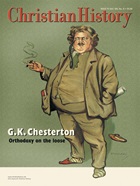
Critics over the past century have sought to identify the fundamental Chesterton. He offers an answer in Orthodoxy: "The central Christian theology … is the best root of energy and sound ethics." Indeed, theology informs and connects everything he wrote: about 50 Father Brown stories; more than 85 major works in genres including novel, short story, poem, play, biography, lecture, and literary criticism; some 1,600 articles in The Illustrated London News; and countless other pieces.
Essays
Though Chesterton did not proclaim Christian faith until adulthood, inklings of faith appear even in his earliest work. More than 200 notebooks filled with his youthful writings were discovered just a decade ago beneath old clothing in a storage trunk in England, affording a glimpse of his developing spiritual thought and literary style. His early short story "The Wine of Cana," for example, includes the weighty line, "On that last night, in that dark garret, knowing that the gibbet hung above him, he gave those he loved a last symbol and memory."
Chesterton's first published work, a short piece in The Speaker, appeared in 1892. Soon his art college magazine, The Quarto, printed more of his work. Even as he studied visual art, he prepared for a career in publishing.
Chesterton's ability to write succinct, lively prose—and to write it quickly—suited him perfectly for newspaper publishing. London's Daily News picked him up in 1899, and The Illustrated London News gave him a regular column in 1905. His output proved so valuable that many of the essays were republished in book form.
Though produced for the boisterous world of Fleet Street, Chesterton's essays feature beautiful metaphors and deep theological insights. For example, "In Defence of Baby Worship" (from The Defendant, 1901) asserts:
The most unfathomable schools and sages have never attained to the gravity which dwells in the eyes of a baby of three months old. It is the gravity of astonishment at the universe, and astonishment at the universe is not mysticism, but a transcendent common sense. … With each one of them all things are remade, and the universe is put again upon its trial.
Other essay collections, such as All Things Considered (1908), continue the theological theme:
Man is an exception, whatever else he is. If he is not the image of God, then he is a disease of the dust. If it is not true that a divine being fell, then we can only say that one of the animals went entirely off its head. ("Wine When it is Red")
Many books ensued, including Varied Types (1908), Tremendous Trifles (1909), What's Wrong with the World (1910), Appetite of Tyranny and The Crimes of England (wartime books dealing with German thought, 1915), and Eugenics and Other Evils (1922). Fancies Versus Fads (1923) typifies his criticism of modernity, and The Thing: Why I Am a Catholic (1929) exemplifies some of the specifically theological titles following his 1922 entry into the Roman Church.
Poems, plays, pictures
If Chesterton's first teenage essays gave way to such a string of collections, his first two books, published in 1900 (The Wild Knight and Other Poems and Greybeards at Play), introduced his poetry. On the divine presence within creation, Chesterton writes in "The Holy of Holies":
"Speller of the stones and weeds,
Skilled in Nature's crafts and creeds,
Tell me what is in the heart
Of the smallest seeds."
"God Almighty, and with Him
Cherubim and Seraphim,
Filling all eternity—
Adonai Elohim."
"The Ballad of the Battle of Gibeon" (referring to Joshua as a figure of the incarnate Christ) and "By the Babe Unborn" are two well-known poems. "The Donkey," a unique perspective of the crucifixion, also is often quoted:
"Fools! For I also had my hour;
One far fierce hour and sweet:
There was a shout about my ears,
And palms before my feet."
The later, earthy poetry in Wine, Water and Song (1915) became popular in the wartime pubs of his day. "Who Goes Home?" for example, is a rousing, military cheer for the God-given freedom of individual will:
For there's blood on the field and blood on the foam,
And blood on the body when man goes home.
And a voice valedictory—Who is for Victory?
Who is for Liberty? Who goes home?
Other poems include historical and religious epics such as The Ballad of the White Horse (1911), The Ballad of St. Barbara (1922), and The Queen of Seven Swords (1926).
Magic (1913) was the first (and most successful) of three plays Chesterton wrote. His illustrations appear in some of his own works, 10 Hilaire Belloc novels, and Edmund Bentley's 1905 Biography for Beginners.
Critical thoughts
In 1903, Chesterton was commissioned to write his first major literary critique, Robert Browning. He followed this with books on Charles Dickens (responsible for a scholarly revival in the popularity of that author), Robert Louis Stevenson (one of Chesterton's favorite writers), Chaucer, William Blake, and others. The Victorian Age in Literature (1913) remains an important text of literary and cultural criticism.
Chesterton also applied his critical thinking skills to debate. In 1903-4, The Clarion printed his controversy with the paper's atheist editor, Robert Blatchford. This argument became the first public arena for Chesterton's Christian beliefs.
Chesterton sparred with many other partners in print as well. In Heretics (1905), he took on several contemporary thought-leaders as a means of critiquing prevailing philosophies of the age. The book is unabashedly polemical, for, as Chesterton writes, "[N]o man ought to write at all, or even to speak at all, unless he thinks that he is in truth and the other man in error."
Fiction
In 1904, Chesterton published his first of a half-dozen novels, The Napoleon of Notting Hill. He identified its theme in the introductory poem dedicated to his lifelong friend, Hilaire Belloc:
For every tiny town or place
God made the stars especially;
Babies look up with owlish face
and see them tangled in a tree …
Yea; Heaven is everywhere at home.
Inspired in part by the 1899 outbreak of the Boer War, the socio-political motif of this novel is rooted in Chesterton's love of home as "an Earthly Paradise": "Nature puts on a disguise when she speaks to every man; to this man she put on the disguise of Notting Hill."
His subsequent novels explored questions of good versus evil. The Man Who Was Thursday (1908) depicts Chesterton's own pursuit of God through the chaos of a fallen universe, which yet retains traces of the Creator:
"Listen to me," cried Syme, with extraordinary emphasis. "Shall I tell you the secret of the whole world? We see everything from behind, and it looks brutal. That is not a tree, but the back of a tree. That is not a cloud, but the back of a cloud. Cannot you see that everything is stooping and hiding a face? If we could only get around in front."
Other novel titles include The Ball and the Cross (1909, a fictional "quarrel" serialized in 1905-6, shortly after the Blatchford controversy), Manalive (1912, with its theme of the global wanderer searching for "home"), The Flying Inn (1914), and The Return of Don Quixote (1927). Basil Howe: A Story of Young Love, written when Chesterton was just 20, was recently discovered and published.
Chesterton's first short story collection, The Club of Queer Trades, came out in 1905. Other collections include The Man Who Knew Too Much (1922), Tales of the Long Bow (1925), The Poet and the Lunatics (1929), Four Faultless Felons (1930), and The Paradoxes of Mr. Pond (1937).
His most popular works, the Father Brown series, also fit into the short-story category. Ostensibly conventional "whodunits," these remarkable pieces nonetheless reinforce the messages Chesterton preached elsewhere.
Nonfiction
A maturing Chesterton found much to say about places he visited on frequent trips abroad. A journey to Ireland yielded Irish Impressions (1919), in which he supports Irish Home Rule. The New Jerusalem (1920) details some observations from a trek that influenced his faith. What I Saw in America (1922) and Sidelights on London and Newer York (1932) feature more social commentary, but religious questions always surface as well.
Chesterton's faith informed his books on history and culture, too. A Short History of England (1917) and a commemoration of a war hero, Lord Kitchener (1917), preceded a book central to understanding Chesterton's view of the Incarnation. The Everlasting Man (1925) divided the religious history of the world into two parts, which balance on the fulcrum of Jesus Christ:
The cross has become something more than a historical memory; it does convey, almost as by a mathematical diagram, the truth about the real point at issue; the idea of a conflict stretching outwards into eternity. It is true, and even tautological, to say that the cross is the crux of the whole matter.
Two important religious biographies, St. Francis of Assisi (1923) and St. Thomas Aquinas (1933), flesh out the relationship between Christianity and history. "When Religion would have maddened men," Chesterton writes in Aquinas, "Theology kept them sane."
Whether in journalism or debate, script, poem, or novel, Chesterton's comprehensive application of the creeds of Christianity remained focused on spiritual issues. His voice and his purpose still ring in the earliest words of his famous sleuth, Father Brown, who on Hampstead Heath frustrated the attempts of the jewel thief to snatch a sapphire-encrusted relic. Along with his fictional character, Chesterton, too, can perhaps boast: "I saved the cross, as the cross will always be saved."
Deb Elkink, a freelance writer, lives in Medicine Hat, Alberta.
Copyright © 2002 by the author or Christianity Today/Christian History magazine.
Click here for reprint information on Christian History.

Support Our Work
Subscribe to CT for less than $4.25/month