





Worshiping Under the Communist Eye



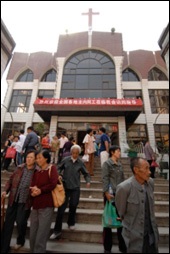
The former Anglican cathedral in a provincial capital is jammed to the rafters. Dressed in a simple black robe and white surplice, the old deacon leads the congregation through the hymns, liturgy, and announcements that take up the first hour of the service. A thousand voices echo from the unadorned brick walls as they recite the Apostles' Creed, and the elderly blind pianist, raised in a Christian orphanage until the Communist victory in 1949, leads her small choir through a lovely rendition of "Alas, and did my Savior bleed?" The young pastor Lin [a pseudonym] is preaching today, and the congregation knows his worth—he would have been ordained two years earlier but for objecting to government interference in a church election. The young family struggled financially as a result, but the damage to his standing with the Religious Affairs officials also raised his credibility with the believers.
Lin's sermon is short today, by Chinese standards: an exposition of Deuteronomy 33:27, "The eternal God is your refuge, and underneath are the everlasting arms," truncated to a mere 30 minutes to leave time for baptisms. The candidates for baptism are called forward—nearly 40 of them, from college students and cell-phone-toting entrepreneurs to middle-aged laborers, white-collar workers, and elderly matrons. One by one, they repeat their baptismal vows before the font and are signed with the sign of the cross. Then the pastor presents them to the joyous applause and welcome of the assembly. As always, the sung Doxology—so much more emphatic in Chinese than in English—concludes the liturgy, followed by "Lord, dismiss us with thy blessing" as the pastors and choir recess from the sanctuary.
Pastor Lin and his congregation are but one face of the open churches in the People's Republic of China, often called the "official" or "TSPM" churches due to their affiliation with the state-sanctioned organizations for Protestant Christians, the Three-Self Patriotic Movement and the China Christian Council.
For the most part, these churches began as the hard-won fruits of missionary efforts in the century before 1949. Conceived and nurtured through the political breakdown of the ancient Chinese empire, the failure of the first Chinese republic, and the pressures of imperialism, war, and revolution, these churches inherited a rich but ambiguous legacy. On the one hand, they benefited from the commitment and sacrifice of many of the missionaries, and from the institutional riches that mission generosity had made possible: schools and universities, hospitals, publishing houses, and ministries that brought tangible as well as spiritual benefits to Chinese society. But they were also plagued by the question that faces so many of the newer churches around the world: how to honor the work of the missions without remaining beholden to them, to establish their independence from missionary control, and in so doing to reclaim their credibility in the eyes of their countrymen.
An opportunity to reform?
Efforts to forge unity across denominational lines and cultivate Chinese leaders for the churches became especially urgent in the 1930s, as the Great Depression and the outbreak of war wreaked havoc on missionary funding and personnel. The great colleges and hospitals began to seem more like expensive millstones around the slender neck of the young Chinese church than visible symbols of Christian altruism. Similarly, divisions based on European and American denominationalism looked increasingly wasteful in the new climate of scarcity and weakness, as the new independent Chinese churches, such as Watchman Nee's "Little Flock," were apt to point out.
Independence, patriotism, unity, and sustainability were thus already major issues for the Protestant churches well before the Communist revolution of 1949. Following the revolution, many Chinese Christian leaders saw the new political reality as an opportunity to address them.
In April 1950, six months into the new regime, a delegation of prominent Protestant educators, editors, and denominational leaders traveled to Beijing to meet with the country's new masters. It was already clear by this time that schools, hospitals, and other church-run social enterprises would be taken over by the socialist state, but the future of the churches as religious entities was more hopeful. With the subtlety and diplomacy for which he would become famous, the Premier, Zhou Enlai, reassured them of the new government's good intentions toward Christians—and also spelled out the government's expectations that the churches would free themselves from imperialist influences and embrace the new political order.
The Protestant leader who embraced this call for internal reform most enthusiastically was Y.T. Wu (Wu Yao-tsung or Wu Yaozong, 1893-1979), who became the dominant figure in the Three-Self Patriotic Movement until the Cultural Revolution broke out in 1966. Wu was a YMCA secretary, author, and Christian magazine editor who had converted to Christianity in his youth. He was a man of strong convictions, influenced by the social gospel and the ethical teachings of Jesus, and impatient with the caution and the more conservative, supernaturally-oriented theology of the churches. For Wu, the new era offered the prospect of purging the Chinese church of its links with American and European imperialism and making it truly independent, under the slogan of the "three selves": self-governing, self-supporting and self-propagating.
In consultation with Premier Zhou, Wu and his colleagues published the "Christian Manifesto," which argued that Christianity in China had been used as a tool of imperialism and called on Protestants to renounce foreign missionary ties and to support the new government. The nationwide signature campaign that followed gathered 400,000 signatures for the Manifesto, and in effect marked the beginning of the Three-Self Patriotic Movement.
Taking shape in the tense political atmosphere after the outbreak of the Korean War in June 1950, the Movement was an association of individual Protestants dedicated to the internal reform of the church, but it quickly came to be regarded by the government as the body responsible for keeping the Protestant churches patriotic and independent of foreign control. Over the 1950s and early 1960s, it oversaw the denunciation of missionaries, the weakening of denominational structures in favor of the TSPM, and the closure of first rural and then "surplus" urban churches in the name of consolidation.
These developments closely mirrored broader political pressures in the nation, as China's Communist leaders struggled to define the correct Marxist direction for the country. Profound fissures opened up within the leadership over many issues, including the place of religion in a socialist society. Tensions came to a head in 1966 when Chairman Mao Zedong launched the unprecedented social upheaval known as the "Great Proletarian Cultural Revolution." The Cultural Revolution was simultaneously Mao's way of toppling his opponents within the Party leadership and a mass outpouring of revolutionary enthusiasm, particularly among the young. Mao believed that 17 years of socialism had not succeeded in purifying China of the evils of class society, and he incited the revolutionary masses to attack his political enemies and eliminate all cultural vestiges of the old society from the Communist utopia.
Open religious life of all sorts was suppressed entirely during those 10 years, all churches were closed, and church leaders were attacked, criticized, and sent to the countryside to reform themselves through productive labor. The long history of Christianity in China had ended in the final extinction of the church, it seemed.
A new national church
After Chairman Mao's death in 1976, the Communist Party retreated from Mao's radical vision of complete socialist purity and embarked on a course of economic reforms and limited political liberalization. Toleration for religious worship was reinstated from 1978, in order to accommodate the small remnant of elderly religious believers that Communist Party leaders thought remained. That expectation was soon confounded as religious activities of all sorts gathered influence and adherents, including among the young. Thirty years later, the Chinese government continues to struggle with how to manage this new reality.
Among Protestant Christians, the change in policy was both a source of rejoicing and an opportunity to move forward more positively than had been the case before 1966. Party policy still insisted that Protestants must be loyal to the Communist state and independent of foreign control and funding. It also insisted that all church affairs should be supervised by a nationwide "patriotic religious organization" answerable to the Party. For many Protestants, however, the TSPM savored of political extremism due to the role it had played in the 1950s and 1960s. In addition, it had always been an association of individuals rather than churches. Many of the more radical leaders of that period had passed from the scene (Y. T. Wu died in late 1979). Accordingly, in 1980 the new Protestant leadership founded the China Christian Council to serve as the national ecclesiastical expression of the Protestant churches in China. In practice, the two organizations have overlapped considerably in personnel and responsibilities, and they are often referred to together as the TSPM/CCC. Local differences in worship style persisted, but denominational structures were not restored, and the Chinese church became officially "post-denominational."
The new church leaders faced immense challenges. They had to locate the deeds of church properties that had been expropriated during the Cultural Revolution and persuade the local authorities to return these premises to the Protestants for worship. They had to restore regular worship across China's vast territory, both in areas where the officials were relatively cooperative and in the many regions where Party leaders still thought of religious believers as retrograde blemishes on socialist society. They had to persuade the people of a poor country to begin financially supporting church work again. They had to renew contacts between the Chinese churches and Christians abroad, yet without compromising the independence of the Chinese church. Most pressing of all, they had to train a new generation of Christian workers after 30 years of limited and then zero theological education.
It was fitting, then, that the man who emerged as the key leader of the TSPM/CCC in post-Mao China was a theological educator, Bishop K. H. Ting (Ding Guangxun, born 1915), president of the Jinling Union Seminary in Nanjing. An Anglican bishop with graduate degrees from Columbia University and Union Theological Seminary in New York, Ting was a different sort of leader than Y. T. Wu. His intelligence and tact made him able to gain the respect of Communists, Christians of different stripes, and leaders of other religions. Ting's Christian faith was also more spiritual in orientation than Wu's, and he was able to work with evangelicals as well as more liberal elements within the church. Over the 1980s, Ting became increasingly vocal in advocating for the interests of the church and against some of the more clumsy efforts by government and Party authorities to control church affairs—including early efforts to create a registration system for churches. He also came to acknowledge frankly the existence of Protestants in China outside of the TSPM/CCC aegis. Ting retired in 1997 at age 82. Christians both inside and outside of China will debate his legacy for a long time to come, but the importance of his leadership cannot be denied.
Imperfect, vital ministry
Comprising at least 32,000 churches, 16,000 meeting points, and 18 million worshippers (according to 2004 figures), the TSPM/CCC is larger and more diverse than any single denomination in the U.S.A. With only 2,600 ordained ministers (one per twenty congregations), the shortage of trained pastoral leadership remains dire. Yet the growth of the church has been remarkable by any standards, and does not appear to be abating. The Amity Foundation, the social service arm of the TSPM/CCC churches, has published over 50 million Bibles in Chinese since the mid-1980s.
Independence, patriotism, unity, and sustainability persist as perennial issues for the Chinese church. The relationship between the church and China's authoritarian state is likewise a major challenge for church leaders, whether in the open churches or the unregistered ones. So also is discerning the line between unregistered Protestants and the quasi-
Christian new religious movements that have been proliferating in China over the last 20 years. For all these challenges, the churches affiliated with the TSPM/CCC occupy an essential place as the main publicly-visible expression of Protestant Christianity in Chinese society. Like all churches, the TSPM/CCC church reflects the Christian gospel imperfectly, but it is vital for China's Christians and for Christian witness within Chinese society.
Ryan Dunch is associate professor of history at the University of Alberta, Canada.
Religious freedom and Chinese law
The current Chinese Constitution (adopted in 1982) grants "freedom of religious belief," but only specifies that right as belonging to the individual citizen. It refers to, but does not define, "normal religious activities." These two items have been pressure points in religious policy and law ever since. Article 36 reads as follows:
"Citizens of the People's Republic of China enjoy freedom of religious belief. No state organ, public organization or individual may compel citizens to believe in, or not to believe in, any religion; nor may they discriminate against citizens who believe in, or do not believe in, any religion. The state protects normal religious activities. No one may make use of religion to engage in activities that disrupt public order, impair the health of citizens or interfere with the educational system of the state. Religious bodies and religious affairs are not subject to any foreign domination."
An Evangelical Patriot and Critic
Marcus Cheng (Chen Chonggui, 1884-1963)
The ideals of the Three-Self Patriotic Movement appealed to evangelicals as well as to mainline Protestants in the early years of the People's Republic of China. The life of Marcus Cheng exemplifies this. Cheng, the son of a poor artisan, grew up as a Christian in the small independent Swedish Covenant Church mission. He earned his B.A. at Wheaton College in Illinois, then returned to China and went on to become a leading evangelical educator and evangelist. In 1943, Cheng founded a seminary in the wartime capital, Chongqing (Chungking), and as its president was one of the most respected national figures among conservative Protestants when the Communists came to power.
Cheng was also a patriot. He agreed that China's churches needed to purge themselves of their imperialist and bourgeois ties, and he denounced the "imperialist distortion of Christianity" which had kept Christians aloof from the revolution. He became one of the founding members of the TSPM. "Formerly I was 'above politics,' [but] I now have a real concern for politics and the economic reconstruction of our country," he wrote in 1952.
As a high-profile evangelical, Cheng also became a member of the Chinese People's Political Consultative Conference (CPPCC), a non-Communist advisory organ of the government. In 1957, the Communist Party called for people to offer their criticisms and suggestions on the work of the government, under the slogan "Let a hundred flowers bloom, and a hundred schools of thought contend." In March of that year, Cheng made a strong speech on the floor of the CPPCC in which he complained of the haughty and blasphemous attitude taken towards Christians by some government workers. Contention between theism and atheism was to be expected, he argued, but should be carried out "without abuse or name-calling." The speech received national media coverage.
But the Pandora's box of criticism opened up by the "Hundred Flowers" movement quickly exceeded the comfort level of Party leaders, and a purge of "rightist" elements followed. Many prominent intellectuals and social leaders fell from grace. Cheng came under attack as a leading rightist in Protestant circles. He lost his leadership positions in the church and the CPPCC from that time until his death in Beijing in 1963.
Ryan Dunch
Religious freedom and Chinese law
The current Chinese Constitution (adopted in 1982) grants "freedom of religious belief," but only specifies that right as belonging to the individual citizen. It refers to, but does not define, "normal religious activities." These two items have been pressure points in religious policy and law ever since. Article 36 reads as follows:
"Citizens of the People's Republic of China enjoy freedom of religious belief. No state organ, public organization or individual may compel citizens to believe in, or not to believe in, any religion; nor may they discriminate against citizens who believe in, or do not believe in, any religion. The state protects normal religious activities. No one may make use of religion to engage in activities that disrupt public order, impair the health of citizens or interfere with the educational system of the state. Religious bodies and religious affairs are not subject to any foreign domination."
Copyright © 2008 by the author or Christianity Today/Christian History & Biography magazine.
Click here for reprint information on Christian History & Biography.

Support Our Work
Subscribe to CT for less than $4.25/month