This article originally appeared in the December 15, 1978, issue of Christianity Today, three years before Koop, who died yesterday, was nominated to serve as U.S. Surgeon General.
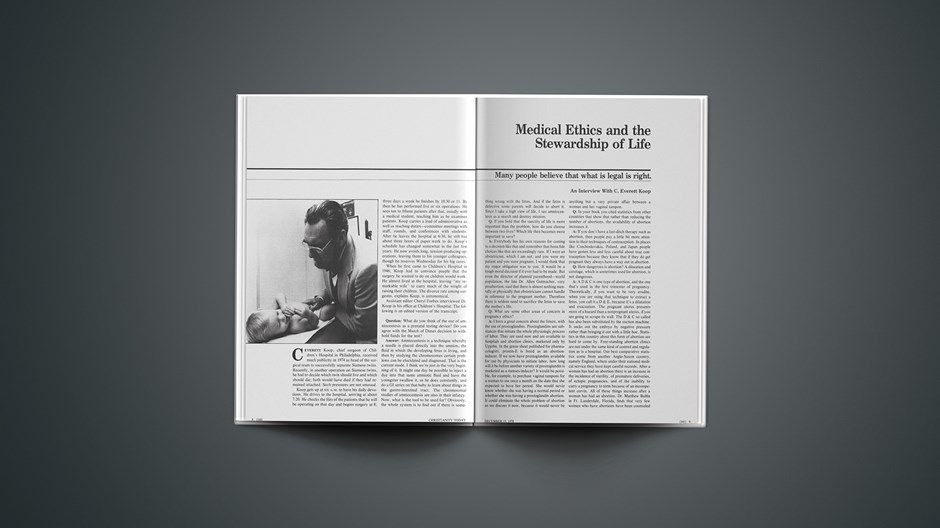
C Everett Koop, chief surgeon of Children's Hospital in Philadelphia, received much publicity in 1974 as head of the surgical team to successfully separate Siamese twins. Recently, in another operation on Siamese twins, he had to decide which twin should live and which should die; both would have died if they had remained attached. Such pressures are not unusual.
Koop gets up at six A.M. to have his daily devotions. He drives to the hospital, arriving at about 7:20. He checks the files of the patients that he will be operating on that day and begins surgery at 8; three days a Week he finishes by 10:30 or 11. By then he has performed or six operations. He sees ten to fifteen patients after that, usually with a medical student, teaching him as he examines patients. Koop carries a load of administrative as well as teaching duties—committee meetings with staff, rounds, and conferences with students. After he leaves the hospital at 6:30, he still has about three hours of paper work to do. Koop's schedule has changed somewhat in the last few years. He now avoids long, tension-producing operations, leaving them to his younger colleagues, though he reserves Wednesday for his big cases.
When he first came to Chi1dren's Hospital in 1946, Koop had to convince people that the surgery he wanted to do on children would work. He almost lived at the hospital, leaving "my remarkable wife" to carry much of the weight of raising their children. The divorce rate among surgeons, explains Koop, is astronomical.
Assistant editor Cheryl Forbes interviewed Dr. Koop in his office at Children's Hospital. The following is an edited version of the transcript.
What do you think of the use of amniocentesis as a prenatal testing device? Do you agree with the March of Dimes decision to withhold funds for the test?
Amniocentesis is a technique whereby a needle is placed directly into the amnion, the fluid in which the developing fetus is living, and then by studying the chromosomes certain problems can be elucidated and diagnosed. That is the current mode. I think we're just in the very beginning of it. It might one day be possible to inject a dye into that same amniotic fluid and have the youngster swallow it, as he does constantly, and do a GI series on that baby to learn about things in the gastro-intestinal tract. The chromosomal studies of amniocentesis are also in their infancy. Now, what is the tool to be used for? Obviously, the whole system is to find out if there is something wrong with the fetus. And if the fetus is defective some parents will decide to abort it. Since I take a high view of life, I see amniocentesis as a search and destroy mission.
If you hold that the sanctity of life is more important than the problem, how do you choose between two lives? Which life then becomes more important to save?
Everybody has his own reasons for coming to a decision like that and remember that bona fide choices like that are exceedingly rare. If I were an obstetrician, which I am not, and you were my patient and you were pregnant, I would think that my major obligation was to you. It would be a tough moral decision if it ever had to be made. But even the director of Planned Parenthood—world population, the late Dr. Allen Gutttmacher, very proabortion, said that there is almost nothing mentally or physically that obstetricians cannot handle in reference to the pregnant mother. Therefore there is seldom need to sacrifice the fetus to save the mother's life.
What are some other areas of concern in pregnancy ethics?
I have a great concern about the future, with the use of prostaglandins. Prostaglandins are substances that initiate the whole physiologic process of labor. They are used now and are available to hospitals and abortion clinics, marketed only by Upjohn. In the green sheet published for pharmacologists, prostin-E is listed ask an abortion-inducer. If we now have prostaglandins available for use by physicians to initiate labor, how long will it be before another variety of prostaglandin is marketed as a menses-inducer? It would be possible, for example, to purchase vaginal tampons for a woman to use once a month on the date that she expected to have her period. She would never know whether she was having a normal period or whether she was having a prostaglandin abortion. It could eliminate the whole problem of abortion as we discuss it now, because it would never be anything but a very private affair between a woman and her vaginal tampon.
In your book you cited statistics from other countries that show that rather than reducing the number of abortions, the availability of abortion increases it.
If you don't have a last-ditch therapy such as abortion, then people pay a little bit more attention to their techniques of contraception. In places like Czechoslovakia, Poland, and Japan people have gotten less and less careful about true contraception because they know that if they do get pregnant they always have a way out in abortion.
Article continues below
How dangerous is abortion? A dilatation and curettage, which is sometimes used for abortion, is not dangerous.
A D&C is one type of abortion, and the one that's used in the first trimester of pregnancy. Theoretically, if you want to be very erudite, when you are using that technique to extract a fetus, you call it a D&E, because it's a dilatation and evacuation. The pregnant uterus presents more of a hazard than a nonpregnant uterus, if you are going to scrape its wall. The D&C so called has also been substituted by the suction machine. It sucks out the embryo by negative pressure rather than bringing it out with a little hoe. Statistics in this country about this form of abortion are hard to come by. Free-standing abortion clinics are not under the same kind of control and regulation as is a hospital. Our best comparative statistics come from another Anglo-Saxon country, namely England, where under their national medical service they have kept careful records. After a woman has had an abortion there is an increase in the incidence of sterility, of premature deliveries, of ectopic pregnancies, and of the inability to carry a pregnancy to term because of an incompetent cervix. All of these things increase after a woman has had an abortion. Dr. Matthew Bulfin in Ft. Lauderdale, Florida, finds that very few women who have abortions have been counseled on what some of the subsequent dangers are.
What should you tell a woman who is contemplating abortion?
She should be shown photographs of exactly what she is aborting. She also needs some spiritual guidance. Many women early on in pregnancy go through a time of depression when they do not want the child. If they have only one kind of counseling available—to abort—women may live to regret it.
What about an unmarried, pregnant Christian?
That's where we Christians are reprehensible. I've been involved for a long time and was instrumental in founding the Evangelical Child and Family service in Philadelphia largely because of my concern for Christian unwed mothers. One would expect that evangelical Christians, having understood the grace of God, would be most gracious under these circumstances. They are not. They are judgmental and it's to our detriment that this can be said of us. My son and his wife took to live with them a Christian girl who was pregnant and carried her child to term. She knew she couldn't raise the child, so I made arrangements for it to be adopted by a Christian couple who were on cloud nine at the prospect. I knew of another unwed pregnant woman who joined a very conservative, fundamentalist, independent church in the suburbs because she wanted to be in a Christian community when her child was born. I was afraid that the poor girl would get the cold shoulder. To my absolute amazement and delight, that congregation rallied around her. They provided her with babysitting and child care until she could finish her education to become a teacher. She is now raising that child herself. It could not have been possible without that church. Unfortunately, such experiences are exceptions.
Article continues below
Would you always recommend adoption?
In general, yes. There just aren't many babies around to adopt these days. People are willing to adopt racially different babies, ethnically different babies, even handicapped children. I don't think having a single parent is nearly as good for a child as the usual arrangement.
That might be a blessing sprung from the curse.
Oh, it's a blessing, but many childless couples will not be able to have it. I wrote the introduction for a book published by Good News Press called Chosen Children. It's the trials and tribulations of parents who adopted handicapped children and made it work. The outstanding emotional experiences in my pediatric surgical career have been to get to know parents who went out of their way to adopt handicapped children.
Explain the difference between birth control and contraception.
Birth control is a big umbrella that covers any kind of plan or procedure that prevents birth. Contraception is a form of birth control; abortion is a form of birth control. Many people use the terms contraception and birth control as if they were synonyms; they're not. The morning-after pill is not a contraceptive, but it is a birth control medication. An IUD is not a contraceptive; it is something that's effective in birth control.
And you would not approve of those two methods.
I would not. They affect the already fertilized egg.
Is there a problem with the use of the word fetus?
Fetus is a perfectly good Latin word for an unborn baby. It was used primarily in medical circles. I am convinced that we are using certain words to depersonalize the unborn baby. It doesn't pose such a problem when you decide to kill it. It's easier to kill a fetus than an unborn baby.
Article continues below
What other language problems are there?
You never see the term unborn baby used in proabortion circles. The most flagrant semantic fraud that has been carried out is one by obstetricians who changed the definition of pregnancy. The definition of pregnancy when I went to medical school and when you were born was that period of time between fertilization of the egg, or conception, and delivery of the baby. Now, pregnancy is called that period of time between implantation of the fertilized egg in the uterine wall and the delivery of the baby. If pregnancy doesn't begin until implantation, and you prevent implantation as with an IUD, the patient doesn't have to face the fact that she is destroying a fertilized egg that could have become a baby. The IUD used to be called IUCD, interuterine contraceptive device, but the word contraceptive was removed long ago, because IUDs aren't contraceptive. An IUD acts after the egg is fertilized by a sperm. The IUD sits in the uterus and prevents the egg from nestling onto the wall and getting its blood supply.
Are medical students different today?
In talking on rounds to medical students who have never known medicine when abortion was illegal, I find that they have an entirely different concept of the worth of human life—it' cheap.
What do you tell these medical students?
I tell them that when I was in their place the very word abortionist was a loathsome thing; now the abortionist is likely to be the professor of obstetrics in the medical school. There was a time when everybody believed that it was wrong to destroy an unborn baby. Now a great many people feel that it is right to do that. Many people believe that what is legal is right. There are thousands of women who would never have an abortion, I am sure, if the law said it's wrong.
What would you consider extreme measures to save an infant's life?
Let's say that a newborn has a situation where so much of his intestine is destroyed that there is not enough left to support life. It would be possible to put that child on total intravenous nutrition and keep him alive for many months but with the ultimate understanding that eventually one would run out of veins and the child would eventually die because you could no longer provide nutrition. To use that type of nutrition would be to me in that circumstance extraordinary care that I would elect not to use. Knowing that the situation was hopeless anyway, I would provide just the usual (not extraordinary) care and the youngster would therefore not live as long. However, no active step would be taken to shorten the child's life and he would be treated with all the love and care and compassion that we had.
Article continues below
Do you differentiate between certain extraordinary means and others, then?
I'm best known for a series of operations on newborn babies, children born without a rectum, with intestinal obstruction, with no connection between throat and stomach, with their abdominal organs in the umbilical cord. It would not be possible for me to have achieved the survival statistics I have if I didn't use extraordinary care. But even in that category there are patients that I know are not going to make it and in them I would taper the extraordinary care. There are three things that I must know to make a decision. I must know the patient, his disease, and how the patient responds to the disease. I've never killed anyone, but I have frequently been relieved when a child under my care has died. I have told the family that this is a blessing in disguise. But that doesn't entitle me to distribute showers of blessings to other people by destroying their children, even though they have big hardships ahead of them.
What should the relationship between doctor and patient be?
There are two different kinds of conversations that take place. There are pediatricians who go to parents at a most difficult time. Picture the emotional situation. You've been waiting for nine months. All that's in your mind is the Gerber baby with the pink cheeks, but what you've got is what they call wrongful life. In this emotional disappointment the physician comes in and explains that the baby will not have a life worthy to be lived and that he thinks it should not be fed. That is a terrible decision to have a mother and father make about their own child. If they're dealing with a pediatrician who would like to see all children born normal, but if they're not born normal he'd rather see them die, as I would not, then you get one kind of information. Some intensive care physicians in newborn nurseries claim that 14 per cent of their patients die because treatment was deliberately withheld. If this were twenty-five years ago, I would say that a lot of doctors would have done this reluctantly. But that's not the case now. When I first came into this branch of surgery, I was the sixth person in the country who practiced pediatric surgery exclusively. When I came to this hospital there were babies who died without a surgical consultation—babies that I could have fixed. A lot of people think that the deformity they see is a lethal one. It's not. These children live on and on. Even if you don't feed a child it sometimes takes a month for it to starve to death. The film Who Shall Survive, put out by Johns Hopkins, showed the decision-making process on the part of the staff and the family to let a mongoloid child with intestinal obstruction die. The intestinal obstruction could have been fixed by a twenty minute operation, which has about a 98 percent effectiveness. Mongolism is not curable. Mongoloid children are mentally deficient; some are educable, some are not. They are loving, cute little kids, but a great burden to their parents. So they decided that they would let this child die.
Article continues below
They put the baby in a corner of the ward and hung up a sign that said "nothing by mouth." It took twenty-eight days, as I recall, for the child to die. When this film was showed at the Kennedy Center I am told that a jury of twelve men not only condemned the decision but also the inhumane way in which it was done.
How do you deal as a Christian and doctor with the distrust many people feel toward doctors?
I deplore the attitude that the doctor knows it all and doesn't consider the patient capable of understanding his explanation. I am on the side of the layman when he has a physician like this. I can't think of anything more reprehensible than the attitude of that kind of physician. I approach a family as intelligent human beings who are entitled to know everything they can understand about their child and his problem. I draw pictures on the wall of my examining room to explain things. They and I are allies against the disease that affects their child. I seldom have a distrusting parent. The rapport that I have with parents is great and when something goes wrong they don't say, "This is the fault of that magician Koop, who hasn't told us anything." They say they knew this was one of the possibilities. We have a law that says that a patient is entitled to informed consent. But it has always been my position as a Christian physician that it was a Christian's obligation to give the information to his patient that permitted his consent to be informed.
Article continues below
You encourage your patients to ask questions?
I do. I not only encourage them to ask questions, but I give all the answers about that particular problem that I have learned over the years parents ask. I frequently say facetiously to my patients that they now know as much as their pediatrician does about this problem. I thoroughly enjoy my relationship with the parents and their children. If you told me that I could never operate again, that would not bother me. But if you told me I couldn't have a relationship with patients' families I would be upset. That's where I really get my kicks. That's what I enjoy. I enjoy more than anything in the world taking parents who have a sore point of anxiety about their chíld's health and relieving it. You can't always straighten out the problem, but you can straighten out the anxiety.
How do you feel about the state getting involved with parents who want to remove their children from doctor-recommended treatment?
I think that in general a patient has the right to choose what will be done with his body. I think that's moral and ethical, and I think that if a patient decides that he will not take his physician's advice, that's his business. Now you can extend that to the minor child who is not able to make his own decisions. In general you can say it is the right and the privilege of the parents to make the decision about what will be done with their child. The law supports that. If I were to do something to your child without your permission, legally that is assault and battery. Now, there are lines that have to be drawn and I'm willing to draw them. If parents come to me and say that they don't want to go through with this treatment for their child, then I have got to decide what the consequences will be. If the problem is something that can wait I would not press the issue. But if it's cancer chemotherapy, I would sit down with them and find out why they didn't want it and what they thought it could and couldn't do. In most circumstances I would probably convince the family that it was the right thing to do, or I would agree with the parents that it was the wrong thing to do. I might even suggest to them that they stop chemotherapy. But then you have a situation like a Jehovah's Witness, who will not permit you to give a life-saving blood transfusion to his dying child with a ruptured ulcer. In that case I would go to court to get an order to care for the child.
Article continues below
What about a case where the parents take the child off prescribed cancer therapy and the state takes the child away from the parents?
It's a horrendous problem that I would try to avoid. But there are some parents with real hangups and no matter how hard you try you can't win them all. When you're talking about cancer chemotherapy you're up against an emotional circumstance. You're dealing with a child who may die with or without chemotherapy. The side effects of it are terrible—he gets bald, needs transfusions, looks like death warmed over. Some parents aren't emotionally able to put their child through that. I try to put my ethical and moral decisions in the same stewardship category that I put my money and my time. If I have a patient with a life or death problem, I consider that he is given to me as a steward.
The state is encroaching on medicine. If we could just keep such matters in the realm of trust between doctor and patient we'd be way ahead. There is a certain trust in medicine that you acknowledge when you go to see a doctor. There are a lot of things that I know you don't know and you've got to trust me to use the things that I know for you and your welfare. A difficulty that has now come on the scene is the living will. That takes the problem out of the realm of trust and puts it into the form of a contract. It works to the detriment of the patient and the physician. The language of the living will can be confusing. For one thing, you or I could be in our terminal illness right now and not know it. Well, you don't want decisions made next month based on a terminal illness that won't kill you for another twenty years. Just the word terminal is difficult. Or, if you have a living will and I am in an accident ward when you are brought to me, I might be concerned that if I do certain things it may violate that living will. What if you weren't restored to health after treatment? Or suppose you and I are both in a car accident. You have a living will and I don't. Well, the doctors treat me first, because I don't have one. I could get the care you probably ought to get. You might die and I might get the very vegetative existence you were trying to avoid.
How do you know when you go to a doctor that he is trustworthy?
When I retire I plan to write a book called How to Find Good Medical Care. You'll need to wait till then for an answer.
Do you think that there is such a thing as passive euthanasia?
No. Passive euthanasia is a cop-out. I was asked to separate Siamese twins. They had a single heart and were both dying. If we hadn't operated they both would have died. It was possible to separate them but in so doing one being would have to die. It took me about ten minutes after I knew the facts to make up my mind about what should be done. One child would have ended up with a four-chambered heart and been viable and one would have ended up with a two-chambered heart and been dead already. My reasoning was that one child was parasitic on the other and if I didn't get rid of the parasite the other would die. Although I didn't enjoy what I did, there was a moment in that operation when I put a hemeostat on the carotid artery of the baby girl and she died. I was talking to a lawyer about this several weeks ago in a public debate. He thought that what I did was totally out of keeping with my prolife stance. It may be out of keeping, but it's not out of keeping with my ethics or with what I understand my role to be as a steward. He asked why I didn't just cut the blood vessel and let her bleed to death. Then I wouldn't have had to say that I caused her death by putting the ligature on her blood vessel. That to me is nothing but a cop-out. You'd be trying to say that she bled to death passively versus being killed actively. In either event it was my willful decision that made it happen.
Article continues below
If you could save a patient by plugging him into a machine but don't, isn't that passive euthanasia?
No. But it's called passive euthanasia by those who would like active euthanasia to follow it immediately.
Well, what would you call it?
I call it the withholding of therapy that might be considered heroic or extraordinary. That's what physicians do all the time, but they don't consider that they are practicing euthanasia of any kind. Take my mother—an 86-year-old Christian lady, widowed for eighteen years, arthritic, riddled with cancer, who wanted nothing better than to go to heaven. At a fine hospital, where the blood tests that they carried out on her last illness cost $6,000, she died of kidney failure. It would have been possible to keep my mother alive for probably a month in coma with dialysis. So there's a therapy available, but I think that the decision to withhold it was just about as easy as to decide to take a glass of water when you're thirsty. It had nothing to do with euthanasia. There's no time when feeding a patient could be called heroic. There's no time when giving an intravenous to a dried up old lady could be considered heroic. But there are times that you make decisions in different circumstances because of age and other things. I decided not to give an aged uncle of mine extraordinary care. I told the doctor to give him the best nursing care that he could. It meant giving him water but it did not mean giving him an IV. So there an IV was an extraordinary thing. I had a young patient who was dehydrated. He would have died without an IV, and he had about sixty years of life left. Not to have started an IV immediately would have been wrong. Try to write that in a book of instructions for residents. You can't. What was extraordinary yesterday is ordinary now. Who would have thought when they put the first pacemaker in somebody's chest to keep his heart going that there would be literally 100,000 people walking around this country today with pacemakers? There was a day when oxygen was extraordinary. The terms have to be tailored to the individual circumstances and they also have to be tailored to the skills of the physician. For a general practitioner dealing with a patient in a community hospital in a town of 10,000 what he would consider extraordinary and what I would, working in the middle of a very sophisticated medical center, are two entirely different things.
Article continues below
What do you think of denying women on welfare abortion?
It's victory for the wrong reason. I know that the prolife people were very jubilant over the passage of the Hyde Amendment. And if I'm against abortion I guess I have to be pleased over that too, because it means that about 475,000 abortions that were funded by the government will not be done if the law is adhered to. But I hate to have it come about on the basis of an economic decision. I would much rather have it come about on the basis of a moral and ethical decision.
Don't you think that such jubilation is hurting the prolife cause?
Yes. It puts the prolife person who is jubilant over the Hyde Amendment into the position where he can be criticized about the poor.
You do a lot of counseling on death and dying. What do you tell parents?
There's nothing more difficult in life than to lose a child. I've been through this and I would say that it is the most devastating of experiences. You expect to bury your mother and father. Every married couple knows that one of them will die before the other under most circumstances. But you don't expect that you're going to have to bury your children. And therefore when a child is dying it is not only a tremendous emotional episode for the family, but it is an affront to the community.
Article continues below
I consider this counseling unpleasant but rewarding. You can guide parents through the last year of their chi1d's life and end up so that they are comfortable with their position and don't bear any animosity toward the hospital. You can also help their friends recognize that the medical profession in general and that hospital in particular did the best they could. That's just the way I try to teach our residents to be an ally with the parents against the disease that affects the child. I ask the resident to work with the parents of a dying child in such a way that they will come back and work in the hospital as a volunteer.
It's one of the best opportunities for Christian witness that one could have. I have to bring parents to understand what I had to understand when I lost my own child. There is no place for "what if" and "if only" kinds of questions. I understand from what I can reconstruct about my twenty-year-old son's death that if he could have taken the clip off his belt and hooked it into a piton, a two-second maneuver, he wouldn't have been killed. I could plague myself for the rest of my life with "if only" he had done it or "what if" he had the time to do it.
Families that are going to lose a child from something such as a tumor lose their child twice. They lose him when you finally make clear to them what the prognosis is and they lose him when his death finally takes place. The second death is a lot easier than the first death many times. One of the difficult things about a child who dies is that it isn't over as it is when your grandmother dies. Parents have problems with anniversaries. I have parents who call me on the anniversary of their child's death or they call me every year on the day after Thanksgiving, because it's become a custom. I receive more Christmas cards from parents of dead children than I do from parents of living children. There is what I call a ritual of closing the circle in families who lose a child in a hospital like this. They have to come back and talk to the doctor or they have to come back to the place where it all happened. That wraps the thing up neatly and they can put it to rest in a different part of their lives, where it's not going to produce acute anxiety and pain all the time.
Article continues below
Another thing that I'm very concerned about is the child who is expected to die and doesn't. That family is really an abandoned family. Let's say that Janey was expected to die of a tumor and sure enough the radiation therapy took hold and two years later she's called cured. Whereas the whole system is geared to the support of the parent whose child might die and whose child does die, few recognize the tremendous hole in the life of the family who has been living in the expectancy of a death and they suddenly realize that it's not going to happen. All the supports that were bolstering them up are withdrawn because the child is cured and they're almost frantic. These people have to be let down very, very carefully. l find that this is the time when families fall apart. The tragedy of the impending death of a child will keep an unstable marriage together but as soon as they're told their child is cured, then parents separate and the thing falls apart. The cured child as a patient is just beginning to get some of the attention he deserves.
You're working on a film with Francis Schaeffer. What's it about?
Francis Schaeffer and I have been working for about a year and a half now on a project called "Whatever Happened to the Human Race?" There is a book manuscript written and we have already filmed forty-five-minute documentary movies. The first three of these cover the subject of abortion, infanticide, and euthanasia. The last two are Schaeffer's alone and in them he presents his own Christian base and presents some authoritative answers based upon the Word of God to the problems we raise. We plan to take these films in the form of a two-day seminar in twenty cities in America, beginning in Philadelphia in the fall of 1979.
Have something to add about this? See something we missed? Share your feedback here.
Our digital archives are a work in progress. Let us know if corrections need to be made.















 While we pray for peace, we need moral clarity about this war.
 A Christian reconciliation group in Israel and Palestine warned that war would come. Now the war threatens their relevance.españolالعربيةFrançaisрусскийУкраїнська
 How groups like Hillsong learned to let go of the literal in favor of creative collaboration.españolPortuguês






