How do you know whom to believe? Before our modern era, we used to judge people's credibility by who they were—Parents? Mutual friends? Church, school, or club connections? But today, most of our information comes from people we have never met, so we rely on a discourse of numbers, precisely measured, to tell us whom to trust. Whether it's the fat grams in the granola we buy or projections of violent crime rates in New York, we trust people we know nothing about because they give us numbers.
Curiously, we have become such numbers junkies that we enjoy viewing ourselves as statistics. Magazines poll their readers about their sex lives and then amuse them by reporting the numbers. And priest-sociologist Andrew Greeley is a constant source of amusement: 3 out of 10 Catholics have purchased erotic underwear, he reported in 1994, compared to just 2 out of 10 non-Catholics.
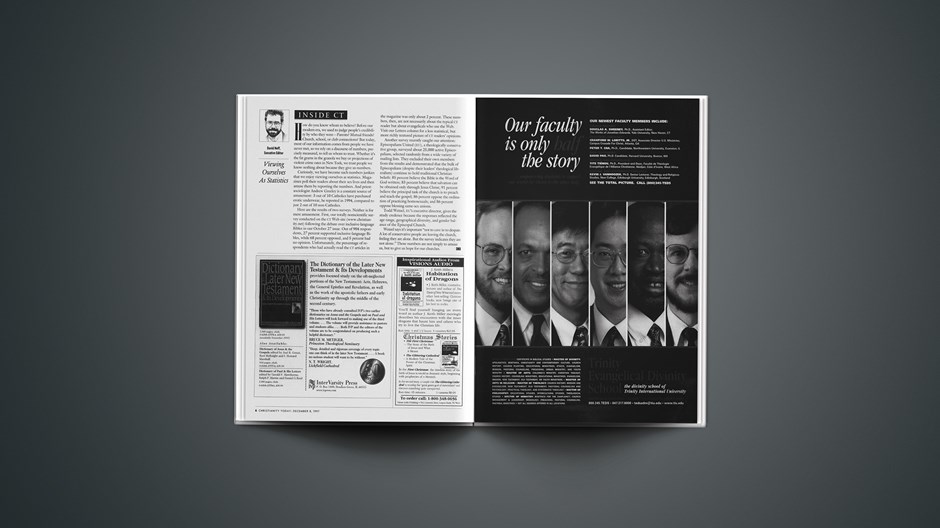
Here are the results of two surveys. Neither is for mere amusement. First, our totally nonscientific survey conducted on the CT Web site (www.ChristianityToday.com) following the debate over inclusive-language Bibles in our October 27 issue. Out of 904 respondents, 27 percent supported inclusive-language Bibles, while 68 percent opposed, and 5 percent had no opinion. Unfortunately, the percentage of respondents who had actually read the CT articles in the magazine was only about 2 percent. These numbers, then, are not necessarily about the typical CT reader but about evangelicals who use the Web. Visit our Letters column for a less statistical, but more richly textured picture of CT readers' opinions.
Another survey recently caught our attention: Episcopalians United (EU), a theologically conservative group, surveyed about 25,000 active Episcopalians, selected randomly from a wide variety of mailing lists. They excluded their own members from the results and demonstrated that the bulk of Episcopalians (despite their leaders' theological liberalism) continue to hold traditional Christian beliefs: 85 percent believe the Bible is the Word of God written; 83 percent believe that salvation can be obtained only through Jesus Christ; 91 percent believe the principal task of the church is to preach and teach the gospel; 86 percent oppose the ordination of practicing homosexuals; and 86 percent oppose blessing same-sex unions.
Todd Wetzel, EU's executive director, gives the study credence because the responses reflected the age range, geographical diversity, and gender balance of the Episcopal Church.
Wetzel says it's important "not to cave in to despair. A lot of conservative people are leaving the church, feeling they are alone. But the survey indicates they are not alone." Those numbers are not simply to amuse us, but to give us hope for our churches.

















 While we pray for peace, we need moral clarity about this war.
 A Christian reconciliation group in Israel and Palestine warned that war would come. Now the war threatens their relevance.españolالعربيةFrançaisрусскийУкраїнська
 The plan would organize UMC churches in four global regions, with each given more leeway around same-sex marriage and other theological issues.






