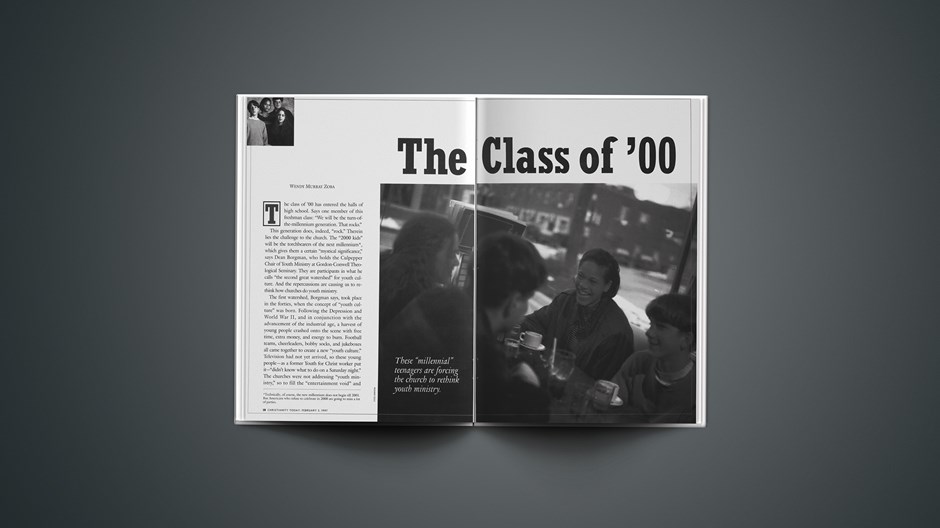
The class of '00 has entered the halls of high school. Says one member of this freshman class: "We will be the turn-of-the-millennium generation. That rocks."
This generation does, indeed, "rock." Therein lies the challenge to the church. The "2000 kids" will be the torchbearers of the next millennium*, which gives them a certain "mystical significance," says Dean Borgman, who holds the Culpepper Chair of Youth Ministry at Gordon-Conwell Theological Seminary. They are participants in what he calls "the second great watershed" for youth culture. And the repercussions are causing us to rethink how churches do youth ministry.
The first watershed, Borgman says, took place in the forties, when the concept of "youth culture" was born. Following the Depression and World War II, and in conjunction with the advancement of the industrial age, a harvest of young people crashed onto the scene with free time, extra money, and energy to burn. Football teams, cheerleaders, bobby socks, and jukeboxes all came together to create a new "youth culture." Television had not yet arrived, so these young people—as a former Youth for Christ worker put it—"didn't know what to do on a Saturday night." The churches were not addressing "youth ministry," so to fill the "entertain ment void" and reach young people with the gospel, "God raised up organizations like Young Life and Youth for Christ and people like Jack Wyrtzen," says Borgman.
And so the youth rally was born. Serving up Saturday evening entertainment (in a neutral setting), the trumpet trios or big bands were followed by an evangelistic message. This model introduced what has become a long-standing model for youth ministry—still much in force today.
But a second watershed occurred in the early 1980s. In or about 1980 the effects of the decline of the family dovetailed with the rise of the electronic revolution. "Their Walkmans, VCRs, cable TV," says Borgman, "have given these kids an artificial and superficial home in the absence of parents." Author Sydney Lewis calls them "the most plugged-in generation ever." And their electronic world has become their community, their tribe, their family. Mark Lamport, codirector of the Link Institute for Faithful and Effective Youth Ministry, says, "It is entirely possible that adolescents in our world have more in common with each other than with the adults of their own cultures" due to the "powerful and pervasive influence of media."
This makes them a different breed from their postwar forebears who invented youth culture; and from the boomers, who rewrote the book on accepted social behavior; and even from Generation X (once called the "most aborted generation in American history"), who came of age as society writhed in the throes of the boomers' dismantling of conventional mores. These are the "Millennials" (coined by author and generation cycles—watcher William Strauss). Born around 1980, they are stepping into a world where the boomers' revolution has been fought and won (and lost). They are only now "coming of age," so their demographics remain largely uncharted. But this is a summary of what some "experts," both in youth work and sociology, have observed about this next generation:
—This generation's pulse runs fast. Bombarded by frequent images, they are in need of continual "hits."
—The remote control symbolizes their reality: change is constant; focus is fragmented.
—They've eaten from the tree of knowledge.
—They live for now.
—They are jaded, having a "Been there/Done that" attitude, nothing shocks them.
—They take consumerism for granted.
—They are a cyber-suckled community.
—They process information in narrative images (like Nike commercials).
—Their "B.S.—detectors" are always on.
—They've had everything handed to them.
—They don't trust adults.
Some of these features—not trusting adults, for example—echo the attitude of the sixties' "revolutionaries." Yet, "the establishment" in those days meant survivors of the Depression, World War II veterans, and couples in four-decade marriages. The lack of trust today is derived more from the fact that many of today's "establishment" were the architects of societal breakdown, as evidenced in the high divorce rate among boomers. The Millennials, in one sense, have good reason not to "trust" adults.
Culled from a questionnaire I sent out, and from other sources, this is what Millennials say about themselves:
—My generation seems oblivious.
—Everybody is too feeble because everything's handed to us.
—We don't do anything; we don't have any great achievements.
—We feel like everything is changing and we have nothing to do with it, so we sit back and let it happen.
—No one's thinking for [him/herself] anymore.
—No one has any sense of honor anymore.
—We have nothing stable to grasp; no one to look up to; no one to believe in.
—We're just coasting.
—We're not standing for anything.
—We desperately need to be standing for something.
Article continues below
The entertainment/rally model of youth ministry spawned a generation of great Christian leaders, but teens today aren't looking for Saturday-night amusement any more. "We have a completely different landscape in which to minister," says Wayne Rice, founder of Youth Specialties and director of Understanding Your Teenager. "The family was intact in those days. Today youth ministry is more like the emergency room in a hospital." Adds Mark Senter, chairman of the Christian Education Department at Trinity Evangelical Divinity School: "We aren't going to be able to do the same things. We have to change!"
1. Where Youth Ministry Went Wrong
Do any other youth pastors out there feel like the 'old' methods and standbys just aren't working anymore?" So queried a youth pastor recently on an e-mail bulletin board for youth ministry workers. Several youth ministry pioneers have found themselves asking the same question. As a result, they are coming to terms with some shortcomings of the more traditional model of youth ministry. Consensus comes down to three principles that worked well at one time, but no longer. The first of these is the emphasis on entertainment.
"I found myself in a room with 200 or 300 screaming kids, and I thought to myself, 'Why am I doing this?' " said John Ruhlman, high-school pastor at Shadow Mountain Community Church, El Cajon, California. "We thought, 'Get 'em to church and have a party.' If they're at church, at least they're not out partying someplace else. So we've done our job." But the problem was, Ruhlman says, they were coming to church to be entertained, and they were going home—entertained. "They endured the message."
"We who did youth ministry," says Jim Burns, president of the National Institute of Youth Ministry, "took the Youth for Christ and Young Life models—they were the best models—and brought them into the church." And for decades the entertainment/message model succeeded in winning swarms of young people to Christ. Campus Life would hold afternoon "Burger Bashes" on the grounds of public high schools (before this became fodder for litigation), attracting hundreds of unchurched teens who would show up for the free food.
Article continues below
But, says Wayne Rice, "We live in a culture that didn't exist 20 years ago." Whatever a youth minister could drum up in the way of "entertainment" today simply cannot compete with Ren and Stimpy and Letterman's Top Ten list. "There are too many options and distractions we are competing with, even for inner-city kids," says Rudy Carrasco, associate director of a neighborhood-based youth outreach ministry in northwest Pasadena. "Jumping through more colorful hoops isn't doing it."
"When youth ministry focuses on playing into the entertainment culture," adds Greg Jones, a professor who serves part-time as minister of discipleship at Arbutus United Methodist church in Baltimore, "it encourages passivity and reduces it to just another consumer item."
Kids these days ask, "How do dumb games express your Christian faith?"
The second flaw is what Senter calls the "trickle-down" strategy. For the past several decades, this strategy was to reach the leaders of a high school (usually the athlete/cheerleader types) and then the people they influenced would be attracted. "Huge youth ministries have been built around this idea," he says.
Today's high schools have changed. There is no longer one "group" that asserts an influence over all the others. Senter sent some of his seminary students to area high schools and told them to ask the students, Who are the groups in your school? The initial response was, There are no groups. But when the seminary students probed further, asking the kids, What about jocks? a virtual floodgate of "groups" spilled forth. There were the bands, blacks, blonds, brains, computer people, cools, crews, dorks, druggies, floaters, fobs (fresh off the boat), friendlies, gangbangers, geeks, "the GROUP," headbangers, hippies, groovies, jocks, losers, nerds, nobodies, normals, overly violent ("regular violence was okay; you just couldn't be overly violent"), partiers, peace freaks, pom-poms, rappers, richies, scumbags, sluts, smokers, snobs, yuppies, stoners, tides, trendies, wanna-bes, wavers, and weirdoes. "Is a 'burger bash' going to reach the kid in the garage band who thinks he's part of the next Smashing Pumpkins? Probably not," says Senter. "It just don't trickle down no more."
Article continues below
The third weakness is the problem of assimilation. "The question used to be 'How many kids are coming?' " says Jim Burns. "After a few years the question became, 'Where are those kids now?' "
"The fatal flaw in what we've been doing in the past 50 years," says Senter, "is that in its worst manifestation, it is a baby-sitting service to cocoon kids from devilish influences." Others have referred to it as the "youth group ghetto." "We were in the basement and happy to be there," says Burns, "but we didn't assimilate into the life of the church."
This is because the youth group is based upon what Senter calls a "hand-off philosophy." The junior-high youth group "hands them off" to senior high. The problem is, after senior high, who do you hand them off to?
George Barna, in his book Generation Next, notes that there is a marked drop-off rate in church attendance once young people graduate from high school. "Millions of kids will graduate from high school and never be pursued again by a church until later in their adult years." Between the ages of 18 and 25 is the "most spiritually vulnerable time" of their lives, he says. Huge numbers will not darken the door of a church again until after they are married and have had kids (if then). The junior high youths graduate to the senior high; and the senior highs graduate to nothing in the way of church involvement and belonging.
As it is, many youth who faithfully attend a youth group never set foot in the church service. "My youth group has, like, 50 teens some nights," says a high-school junior, "and about 25 to 35 don't go to church." The youth have been "ghetto-ized"; their loyalties are fixed to the youth group with little or no organic attachment to the larger worshiping body.
"The goal is discipleship," says Rudy Carrasco. "And they have to be in church to learn how to relate to other members of the body—not to mention those outside the church." But if the church is "bunk," as he puts it, then today's savvy young people "won't want to be anywhere near it."
But before a "new approach" can be forged, churches need to have some sense of who they are trying to reach. So the next question to be asked is: Who are the Millennials?
Article continues below
2. Who They Are
Author, film critic, and self-confessed "white liberal" David Den-by recounts in his essay "Buried Alive" (New Yorker, July 15, 1996) a moment when he is sitting on the "tufted and matted shag" carpet in his teenage son's room looking over what he calls the "landscape of the American child." He calls it a "kiddies' bouillabaisse"—a "thickening brew of plastic and metallic stuff."
It bothers Denby a little that his teenage son, Max, hits the computer first thing in the morning before breakfast. It bothers him a lot that Max saw Pulp Fiction at a friend's house without his father's permission. But it is not these moment-by-moment confrontations with popular culture that unravel Denby. It is the sense that these encounters have evolved into an all-out assault. Today's youth are being "shaped [into] consumers before they've had a chance to develop their souls," he laments. ("Consuming media, they think, is part of what children do.") He opines that "pop has triumphed."
Kids grow up in front of tubes, screens, or boxes that define their perceptions of reality. The television splatters images of anorexic-looking models to define beauty. Model Zoe Fleischauer recounts in Newsweek (Aug. 26, 1996) that she developed a heroin habit as a teen because the modeling industry glamorized it: "They wanted models that looked like junkies. The more skinny and [wasted] you look, the more everybody thinks you're fabulous."
A student at a high school in my area wrote this in his school paper:
We all know drugs are bad, evil, should be destroyed, and all that happy crap, but I've got something for you to chew on. … The police define drugs as any substance that alters the mind or body. … Well, I'm here to tell you about a drug so powerful it cultivates millions of users around the world each year; practically everyone is addicted. I know I am. Chances are you are too. So what's this exceptional drug? Television. From the time we are born we are sat down in front of this miracle box for the purpose of what?
Computers are another arm of the electronic media that brings a set of concerns. Mainstream fare in the computer game market is the popular game called Doom. (The first few levels of it are available for free on the Internet.) The primary objective of the game is to get out of a hellish inferno. The secondary objective, according to one Doom ace, is "to kill as many people as you can" in the process. This is not Super Mario Brothers doinking mushrooms. The game is predicated upon intense kill-or-be-killed instincts where victims are mowed down while the blood and gore flow freely. This expert (who is a Christian) says, "It causes a very strong reaction the first time you play." I asked if his revulsion compelled him to stop. He shook his head, no: "It's fun."
Article continues below
Stephen Keillor in his new book, This Rebellious House (IVP), writes: "It is possible to refine technology to make vices such as pornography, gambling, on-screen murder or virtual sex seemingly victimless. … Keep them virtual. There would still be negative consequences for participants—jaded, depraved minds numbed by lesser evils and hungry for greater, more vivid ones—but society may cease to define those as negative."
Recorded music is yet another endemic influence of the electronic media. One of the industry's popular markets today is "alternative rock," which, by all counts, is "mellower" than hard rock. But it is "edgy" and nihilistic. Lyrics glorify sadness, celebrate loneliness, and drone on about the emptiness of God and pointlessness of life.
Compare some of the bands listed among the Rolling Stone readers' top albums a few months ago to the top bands listed 30 years ago: Metallica, Alice in Chains, and Garbage compared to the Monkees, Johnny Rivers, and the Four Tops.
I hear my son, as he sets the table before dinner, parroting one of his favorite artist's hit songs: "I'm a loser, baby—why don't you kill me?"
One might protest, Don't let your son listen to that kind of music.
The point is, I didn't "let" him listen to it. He listened to it on a tape given to him by a friend without my permission. Listening to questionable music without parental consent is not new. What is new, however, is the level of depravity that these electronic messages have reached. That is what Denby means when he says that "the media have become three-dimensional, inescapable, omnivorous, and self-referring." He asks, "How can you control what they breathe?"
"What is indecent at school?" another teen writes in a student newspaper. "Not much. Not even mooning. … Indecency is no longer deemed vulgar. It is now looked upon as typical day-to-day living."
Article continues below
"Before you know it, your kids have bought into the acceptance of a degraded environment that devalues everything," says Denby. It is not the words, nor even the images, that matter so much as the "ravaging lack of dignity" of this culture that causes Denby's anguish. A 16-year-old laments, "Peer pressure pushes you into being all-out hateful," while a 14-year-old adds, "Society has made so many things that shouldn't be [normative] normal, it's hard to know what is really right."
















 While we pray for peace, we need moral clarity about this war.
 A Christian reconciliation group in Israel and Palestine warned that war would come. Now the war threatens their relevance.españolالعربيةFrançaisрусскийУкраїнська
 How groups like Hillsong learned to let go of the literal in favor of creative collaboration.españolPortuguês






