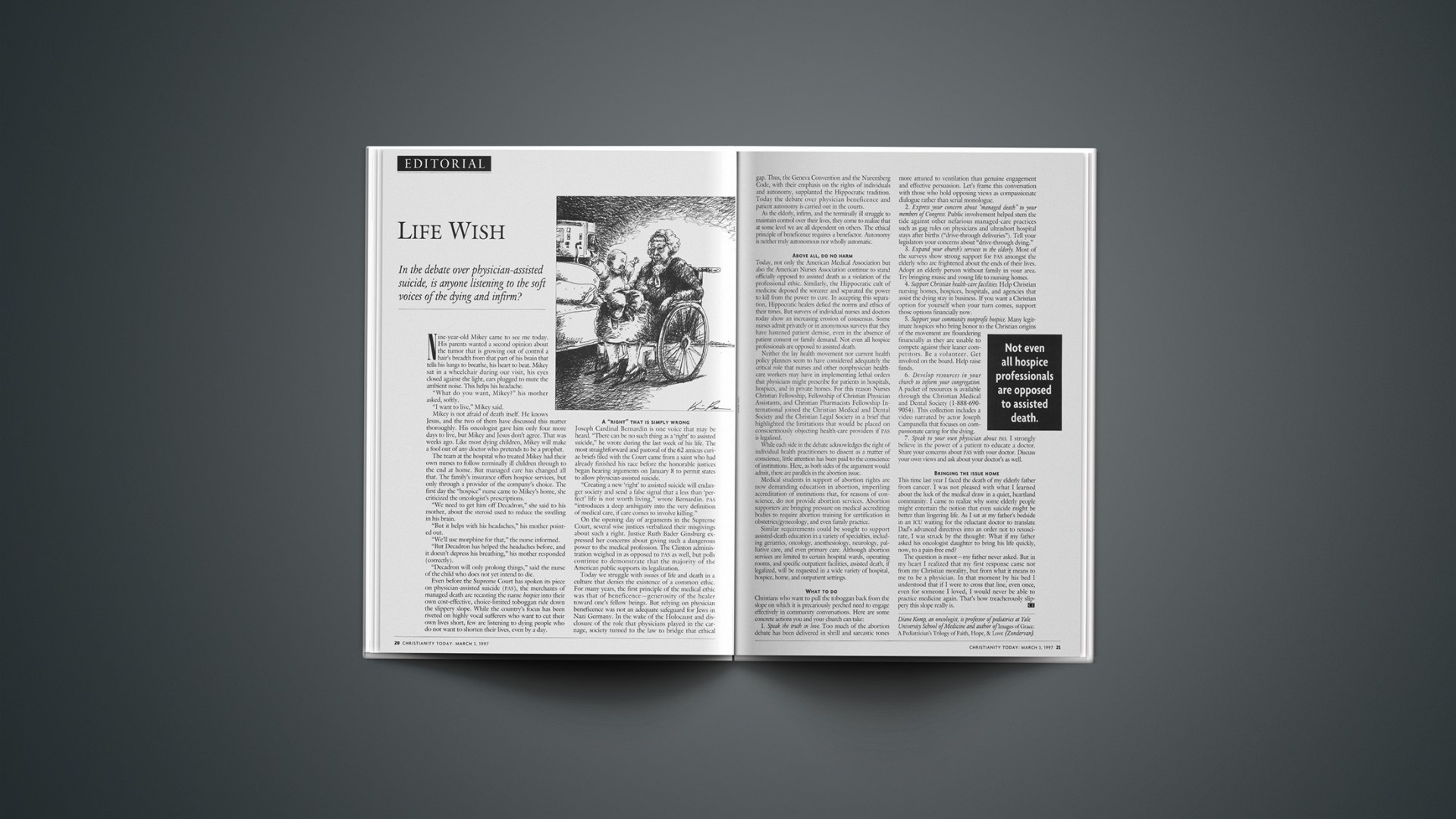

Nine-year-old Mikey came to see me today. His parents wanted a second opinion about the tumor that is growing out of control a hair’s breadth from that part of his brain that tells his lungs to breathe, his heart to beat. Mikey sat in a wheelchair during our visit, his eyes closed against the light, ears plugged to mute the ambient noise. This helps his headache.
“What do you want, Mikey?” his mother asked, softly.
“I want to live,” Mikey said.
Mikey is not afraid of death itself. He knows Jesus, and the two of them have discussed this matter thoroughly. His oncologist gave him only four more days to live, but Mikey and Jesus don’t agree. That was weeks ago. Like most dying children, Mikey will make a fool out of any doctor who pretends to be a prophet.
The team at the hospital who treated Mikey had their own nurses to follow terminally ill children through to the end at home. But managed care has changed all that. The family’s insurance offers hospice services, but only through a provider of the company’s choice. The first day the “hospice” nurse came to Mikey’s home, she criticized the oncologist’s prescriptions.
“We need to get him off Decadron,” she said to his mother, about the steroid used to reduce the swelling in his brain.
“But it helps with his headaches,” his mother pointed out.
“We’ll use morphine for that,” the nurse informed.
“But Decadron has helped the headaches before, and it doesn’t depress his breathing,” his mother responded (correctly).
“Decadron will only prolong things,” said the nurse of the child who does not yet intend to die.
Even before the Supreme Court has spoken its piece on physician-assisted suicide (PAS), the merchants of managed death are recasting the name hospice into their own cost-effective, choice-limited toboggan ride down the slippery slope. While the country’s focus has been riveted on highly vocal sufferers who want to cut their own lives short, few are listening to dying people who do not want to shorten their lives, even by a day.
A “right” that is simply wrong Joseph Cardinal Bernardin is one voice that may be heard. “There can be no such thing as a ‘right’ to assisted suicide,” he wrote during the last week of his life. The most straightforward and pastoral of the 62 amicus curiae briefs filed with the Court came from a saint who had already finished his race before the honorable justices began hearing arguments on January 8 to permit states to allow physician-assisted suicide.
“Creating a new ‘right’ to assisted suicide will endanger society and send a false signal that a less than ‘perfect’ life is not worth living,” wrote Bernardin. pas “introduces a deep ambiguity into the very definition of medical care, if care comes to involve killing.”
On the opening day of arguments in the Supreme Court, several wise justices verbalized their misgivings about such a right. Justice Ruth Bader Ginsburg expressed her concerns about giving such a dangerous power to the medical profession. The Clinton administration weighed in as opposed to PAS as well, but polls continue to demonstrate that the majority of the American public supports its legalization.
Today we struggle with issues of life and death in a culture that denies the existence of a common ethic. For many years, the first principle of the medical ethic was that of beneficence—generosity of the healer toward one’s fellow beings. But relying on physician beneficence was not an adequate safeguard for Jews in Nazi Germany. In the wake of the Holocaust and disclosure of the role that physicians played in the carnage, society turned to the law to bridge that ethical gap. Thus, the Geneva Convention and the Nuremberg Code, with their emphasis on the rights of individuals and autonomy, supplanted the Hippocratic tradition. Today the debate over physician beneficence and patient autonomy is carried out in the courts.
As the elderly, infirm, and the terminally ill struggle to maintain control over their lives, they come to realize that at some level we are all dependent on others. The ethical principle of beneficence requires a benefactor. Autonomy is neither truly autonomous nor wholly automatic.
Above all, do no harm Today, not only the American Medical Association but also the American Nurses Association continue to stand officially opposed to assisted death as a violation of the professional ethic. Similarly, the Hippocratic cult of medicine deposed the sorcerer and separated the power to kill from the power to cure. In accepting this separation, Hippocratic healers defied the norms and ethics of their times. But surveys of individual nurses and doctors today show an increasing erosion of consensus. Some nurses admit privately or in anonymous surveys that they have hastened patient demise, even in the absence of patient consent or family demand. Not even all hospice professionals are opposed to assisted death.
Neither the lay health movement nor current health policy planners seem to have considered adequately the critical role that nurses and other nonphysician health-care workers may have in implementing lethal orders that physicians might prescribe for patients in hospitals, hospices, and in private homes. For this reason Nurses Christian Fellowship, Fellowship of Christian Physician Assistants, and Christian Pharmacists Fellowship International joined the Christian Medical and Dental Society and the Christian Legal Society in a brief that highlighted the limitations that would be placed on conscientiously objecting health-care providers if PAS is legalized.
While each side in the debate acknowledges the right of individual health practitioners to dissent as a matter of conscience, little attention has been paid to the conscience of institutions. Here, as both sides of the argument would admit, there are parallels in the abortion issue.
Medical students in support of abortion rights are now demanding education in abortion, imperiling accreditation of institutions that, for reasons of conscience, do not provide abortion services. Abortion supporters are bringing pressure on medical accrediting bodies to require abortion training for certification in obstetrics/gynecology, and even family practice.
Similar requirements could be sought to support assisted-death education in a variety of specialties, including geriatrics, oncology, anesthesiology, neurology, palliative care, and even primary care. Although abortion services are limited to certain hospital wards, operating rooms, and specific outpatient facilities, assisted death, if legalized, will be requested in a wide variety of hospital, hospice, home, and outpatient settings.
What to do Christians who want to pull the toboggan back from the slope on which it is precariously perched need to engage effectively in community conversations. Here are some concrete actions you and your church can take:
1. Speak the truth in love. Too much of the abortion debate has been delivered in shrill and sarcastic tones more attuned to ventilation than genuine engagement and effective persuasion. Let’s frame this conversation with those who hold opposing views as compassionate dialogue rather than serial monologue.
2. Express your concern about “managed death” to your members of Congress. Public involvement helped stem the tide against other nefarious managed-care practices such as gag rules on physicians and ultrashort hospital stays after births (“drive-through deliveries”). Tell your legislators your concerns about “drive-through dying.”
3. Expand your church’s services to the elderly. Most of the surveys show strong support for PAS amongst the elderly who are frightened about the ends of their lives. Adopt an elderly person without family in your area. Try bringing music and young life to nursing homes.
4. Support Christian health-care facilities. Help Christian nursing homes, hospices, hospitals, and agencies that assist the dying stay in business. If you want a Christian option for yourself when your turn comes, support those options financially now.
5. Support your community nonprofit hospice. Many legitimate hospices who bring honor to the Christian origins of the movement are floundering financially as they are unable to compete against their leaner competitors. Be a volunteer. Get involved on the board. Help raise funds.
6. Develop resources in your church to inform your congregation. A packet of resources is available through the Christian Medical & Dental Society (1-888-690-9054). This collection includes a video narrated by actor Joseph Campanella that focuses on compassionate caring for the dying.
7. Speak to your own physician about PAS. I strongly believe in the power of a patient to educate a doctor. Share your concerns about PAS with your doctor. Discuss your own views and ask about your doctor’s as well.
Bringing the issue home This time last year I faced the death of my elderly father from cancer. I was not pleased with what I learned about the luck of the medical draw in a quiet, heartland community. I came to realize why some elderly people might entertain the notion that even suicide might be better than lingering life. As I sat at my father’s bedside in an ICU waiting for the reluctant doctor to translate Dad’s advanced directives into an order not to resuscitate, I was struck by the thought: What if my father asked his oncologist daughter to bring his life quickly, now, to a pain-free end?
The question is moot—my father never asked. But in my heart I realized that my first response came not from my Christian morality, but from what it means to me to be a physician. In that moment by his bed I understood that if I were to cross that line, even once, even for someone I loved, I would never be able to practice medicine again. That’s how treacherously slippery this slope really is.
-Diane Komp, an oncologist, is professor of pediatrics at Yale University School of Medicine and author ofImages of Grace: A Pediatrician’s Trilogy of Faith, Hope, & Love (Zondervan).
Copyright © 1997 Christianity Today. Click for reprint information.