This department has been created to showcase stimulating opinions, interviews, and other writings from some of our sister publications at CHRISTIANITY TODAY, Inc. In coming issues you can expect readings on trends affecting the church from LEADERSHIP journal, instructive tales of the past from CHRISTIAN HISTORY, and incisive commentary from BOOKS & CULTURE.
We inaugurate the series with an excerpt from the November/December issue of B&C. In his review essay, historian Mark Noll summarizes the thought experiment that opens missiologist Andrew Walls's new book The Missionary Movement in Christian History (Orbis). For Noll, this passage wonderfully captures the significance of Walls's larger thesis that "the whole history of Christianity is a series of successive adaptations of the faith to local situations."
Imagine an alien savant who wants to study Christianity and who is able to visit planet Earth at widely spaced intervals. His first visit occurs in A.D. 37 at a gathering of believers in Jerusalem where the ways in which this church differs from a Jewish sect are hard to discern. The Christians honor the seventh day, meet in the temple, read from the Hebrew Scriptures, and circumcise their sons. Only by unusual interpretations of parts of those Hebrew Scriptures, specifically by relating Jewish accounts of the Messiah, the Suffering Servant, and the Son of Man to Jesus of Nazareth, do these Jews show that they are, in fact, Christians.
Next, the extraterrestrial returns in the year 325 to the little town of Nicea in what is now modern Turkey where a great gathering of Christian leaders is taking place. Jews and the marks of Judaism are nowhere to be seen. Rather, the believers come from throughout the Mediterranean world and beyond. And they are preoccupied with minute, but also obviously momentous, discussions about how to understand Jesus in the thought forms of Hellenistic culture.
The visitor is back in about three centuries, this time to the coast of Ireland. Here he encounters a crowd of monks undergoing several kinds of privations, some self-inflicted, some arising from efforts to spread the message of Jesus to unappreciative listeners. Some have forsaken all fellowship with other humans and sit quietly in caves by the sea. The religious issue that consumes them is how to determine the exact date on which to celebrate Easter.
Now leap forward more than a millennium to 1840 and a great meeting of prosperous Londoners in Exeter Hall. They are convened to discuss how best to advance Christianity, along with commerce and civilization, in the continent of Africa. Their prosperity could not be in starker contrast to the poverty of the Irish monks, their lack of concern for anything Jewish as clear as at Nicea, their centrality in their society's power structure (which is at the pinnacle of all such powers in the world) as evident as was the marginality of the Christians of A.D. 37 in relationship to the might of Rome.
Finally, come with our alien to Lagos, Nigeria, in 1980. Walls describes what the visitor sees:
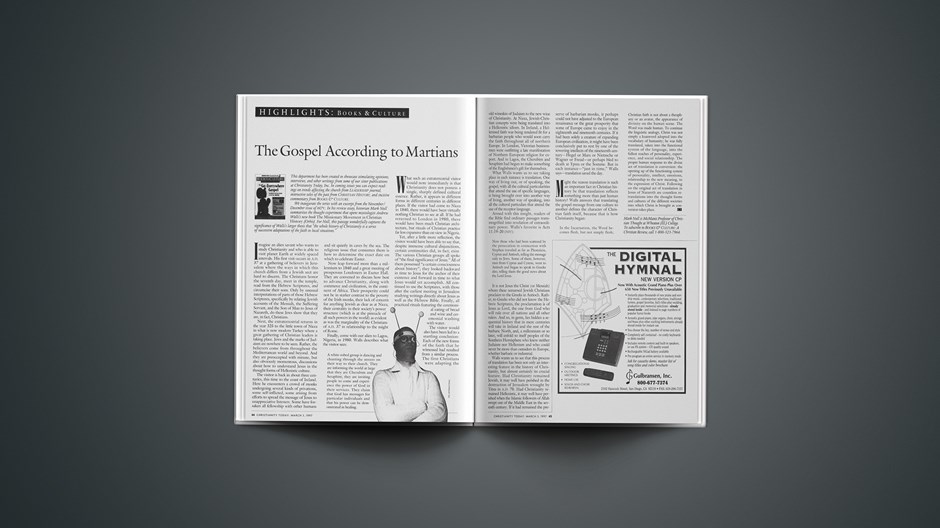
A white-robed group is dancing and chanting through the streets on their way to their church. They are informing the world at large that they are Cherubim and Seraphim; they are inviting people to come and experience the power of God in their services. They claim that God has messages for particular individuals and that his power can be demonstrated in healing.
What such an extraterrestrial visitor would note immediately is that Christianity does not possess a single, sharply defined cultural essence. Rather, it appears in different forms in different centuries in different places. If the visitor had come to Nicea in 1840, there would have been virtually nothing Christian to see at all. If he had returned to London in 1980, there would have been much Christian architecture, but rituals of Christian practice far less expansive than on view in Nigeria.
Yet, after a little more reflection, the visitor would have been able to say that, despite immense cultural disjunctions, certain continuities did, in fact, exist. The various Christian groups all spoke of "the final significance of Jesus." All of them possessed "a certain consciousness about history"; they looked backward in time to Jesus for the anchor of their existence and forward in time to what Jesus would yet accomplish. All continued to use the Scriptures, with those after the earliest meeting in Jerusalem studying writings directly about Jesus as well as the Hebrew Bible. Finally, all practiced rituals featuring the ceremonial eating of bread and wine and ceremonial washing with water.
The visitor would also have been led to a startling conclusion: Each of the new forms of the faith that he witnessed had resulted from a similar process. The first Christians were adapting the old wineskin of Judaism to the new wine of Christianity. At Nicea, Jewish-Christian concepts were being translated into a Hellenistic idiom. In Ireland, a Helenized faith was being rendered fit for a barbarian people who would soon carry the faith throughout all of northern Europe. In London, Victorian businessmen were outfitting a late manifestation of Northern European religion for export. And in Lagos, the Cherubim and Seraphim had begun to make something of the Englishmen's gift for themselves.
Article continues below
What Walls wants us to see taking place in each instance is translation. One way of living out, or of speaking, the gospel, with all the cultural particularities that attend the use of specific languages, is being brought over into another way of living, another way of speaking, into all the cultural particulars that attend the use of the receptor language.
Armed with this insight, readers of the Bible find ordinary passages transmogrified into revelation of extraordinary power. Walls's favorite is Acts 11:19-20 (NIV):
Now those who had been scattered by the persecution in connection with Stephen traveled as far as Phoenicia, Cyprus and Antioch, telling the message only to Jews. Some of them, however, men from Cyprus and Cyrene, went to Antioch and began to speak to Greeks also, telling them the good news about the Lord Jesus.
It is not Jesus the Christ (or Messiah) whom these unnamed Jewish Christians proclaim to the Greeks in Antioch. Rather, to Greeks who did not know the Hebrew Scriptures, the proclamation is of Jesus as Lord, the one from God who will rule over all nations and all other rulers. And so, in germ, lies hidden a sequential history that in mere centuries will take in Ireland and the rest of the barbaric North, and, a millennium or so later, will enfold to itself peoples of the Southern Hemisphere who knew neither Judaism nor Hellenism and who could never be more than outsiders to Europe, whether barbaric or industrial.
Walls wants us to see that this process of translation has been not only an interesting feature in the history of Christianity, but almost certainly its crucial feature. Had Christianity remained Jewish, it may well have perished in the destruction of Jerusalem wrought by Titus in A.D. 70. Had Christianity remained Hellenistic, it may well have perished when the Islamic followers of Allah swept out of the Middle East in the seventh century. If it had remained the preserve of barbarian monks, it perhaps could not have adjusted to the European renaissance or the great prosperity that some of Europe came to enjoy in the eighteenth and nineteenth centuries. If it had been solely a creature of expanding European civilization, it might have been conclusively put to rest by one of the towering intellects of the nineteenth century—Hegel or Marx or Nietzsche or Wagner or Freud—or perhaps bled to death at Ypres or the Somme. But in each instance—"just in time," Walls says—translation saved the day.
Article continues below
Might the reason translation is such an important fact in Christian history be that translation reflects something more than just human history? Walls answers that translating the gospel message from one culture to another defines the character of Christian faith itself, because that is how Christianity began:
In the Incarnation, the Word becomes flesh, but not simply flesh; Christian faith is not about a theophany or an avatar, the appearance of divinity on the human scene. The Word was made human. To continue the linguistic analogy, Christ was not simply a loanword adopted into the vocabulary of humanity; he was fully vocabulary of humanity; he was fully translated, taken into the functional system of the language, into the fullest reaches of personality, experience, and social relationship. The proper human response to the divine act of translation is conversion: the opening up of the functioning system of personality, intellect, emotions, relationship to the new meaning, to the expression of Christ. Following on the original act of translation in Jesus of Nazareth are countless re-translations into the thought forms and cultures of the different societies into which Christ is brought as conversion takes place.
-Mark Noll is McManis Professor of Christian Thought at Wheaton (Ill.) College. To subscribe to BOOKS & CULTURE: A Christian Review, call 1-800-523-7964.















 While we pray for peace, we need moral clarity about this war.
 A Christian reconciliation group in Israel and Palestine warned that war would come. Now the war threatens their relevance.españolالعربيةFrançaisрусскийУкраїнська
 How groups like Hillsong learned to let go of the literal in favor of creative collaboration.españolPortuguês






